Testing a Linear ARMA Model against
Threshold-ARMA Models: a Bayesian Approach
R
ubing
L
iang
aQ
iang
X
ia
a∗J
iazhu
P
an
bJ
inshan
L
iu
aaCollege of Science, South China Agricultural University, Guangzhou 510642, P.R. China bDepartment of Mathematics and Statistics, University of Strathclyde, Glasgow G1 1XH, UK
Abstract. We introduce a Bayesian approach to test linear autoregressive
moving-average (ARMA) models against threshold autoregressive moving-moving-average (TARMA)
models. Firstly, the marginal posterior densities of all parameters, including the
thresh-old and delay, of a TARMA model are obtained by using Gibbs sampler with
Metropolis-Hastings algorithm. Secondly, reversible-jump Markov chain Monte Carlo (RJMCMC)
method is adopted to calculate the posterior probabilities for ARMA and TARMA
mod-els: Posterior evidence in favor of TARMA models indicates threshold nonlinearity.
Fi-nally, based on RJMCMC scheme and Akaike information criterion (AIC) or Bayesian
information criterion (BIC), the procedure for modeling TARMA models is exploited.
Simulation experiments and a real data example show that our method works well for
distinguishing a ARMA from a TARMA model and for building TARMA models.
Mathematics Subject Classification (2010) : 62F10, 62F15
Key words: Bayesian inference; ARMA models; Gibbs sampler; Metropolis-Hastings
algorithm; RJMCMC methods; AIC; BIC; TARMA models.
∗Corresponding author, E-mail: [email protected]
1
Introduction
Threshold autoregressive (TAR) models have become a standard and popular class of nonlinear
time series models to describe the asymmetric phenomena in many branches of science and social
science. Since Tong (1978) and Tong and Lim (1980), a huge amount of literature on theoretical
properties and statistical inference of TAR models has appeared, see Tong (1990) and Tsay (2005)
among others. But complicated analytical works and numerical multiple integration is involved
in statistical inference of TAR models by the likelihood approaches. To overcome the computing
problem and to avoid analytical difficulty, some authors have applied Bayesian method to carry out
parameter estimation for TAR models. Mcculloch and Tsay (1993a, 1993b) proposed a Bayesian
procedure for detecting threshold values in a TAR model via posterior probability plots. Chen and
Lee (1995) applied the Gibbs sampler of Geman and Geman (1984), and the Metropolis-Hastings
(M-H) algorithm of Metropolis et al. (1953) and Hastings (1970), for inference of TAR models. So
and Chen (2003) developed an efficient way to select the best subset from threshold autoregressive
models.
Some authors have realized that threshold moving average (TMA) models have their own
ad-vantages and are as important as TAR models in practice, see Ismail and Charif (2003) and Ling
and Tong (2005) among others. Ismail and Charif (2003) introduced a Bayesian analysis for TMA
models, and Ling and Tong (2005) proposed a likelihood ratio test for linear MA model against
TMA models. Recently, Xia et al. (2010) gave Bayesian test for nonlinear of a TMA model.
However, in order to get a parsimonious model for asymmetrical high order dependence, some
authors found that threshold autoregressive moving average (TARMA) should be used. For
like-lihood approach to statistical inference of TARMA models, analytical works and computation are
even more complicated than those for TAR and TMA models. So Bayesian method has been used
to do statistical analysis of TARMA models, see for instance S´afadi and Morettin (2000), Chen,
Liu and Gerlach (2011), and Xia et al. (2012). Chen et al. (2011) developed an efficient way
to select a subset from a general family of TARMA models, but they did not give any discussion
about the threshold nonlinear test. Meanwhile, fundamental theory about TARMA models, such
as identifying the threshold and delay values, estimating the parameters, and testing the threshold
nonlinearity, needs to be developed further.
The aim of this paper is to propose a Bayesian test for the threshold nonlinearity of TARMA
models. Firstly, Bayesian estimation of the threshold value and other parameters of TARMA
mod-els is investigated. Chen and Lee (1995) and S´afadi and Morettin (2000) adopted the MCMC
technique and used the arranged autoregression approach to estimate the threshold and delay
val-ues as well as the coefficients simultaneously. Basing on their work, we combine Gibbs sampler
and Metropolis-Hastings algorithm to give a Bayesian analysis of two-regime TARMA models.
We do not need to employ the arranged autoregression. Secondly, to avoid analytical difficulty and
complicated computation, Xia et al. (2010) applied the RJMCMC method (Green, 1995) for
test-ing TMA models, but they only constructed kernels by not includtest-ing the variance parameter. We
know that the variance parameter, especially different variance in each regime, is a very important
characteristic for the TARMA models to be identified. Thus, we add the variance parameter into
the kernels by using the reversible-jump MCMC method for testing TARMA models. It is
demon-strated that the reversible-jump method is easy to implement and fits well within our framework of
Bayesian procedure. Finally, since the order of each regime is also important to TARMA models,
we will try to combine the reversible-jump MCMC method and AIC or BIC to determine whether
the threshold nonlinearity is significant.
The context of this paper is arranged as follows. The TARMA models and the methodology
of Bayesian inference are presented in Section 2. Section 3 gives details of a Bayesian model
selection procedure by RJMCMC method. Section 4 exploits the procedure for modeling TARMA
models briefly. Simulation results and a real data example are presented in Section 5. Section 6 is
our conclusion.
Throughout the paper, we denote the transpose of a matrix A by A0.
2
Threshold ARMA and Its Bayesian Inference
2.1
TARMA Model
A time series{Yt,t=1,2, ...}is said to follow a TARMA(2; p1,q1,p2,q2,d) model with two regimes
if it satisfies the following equation
Yt =
φ(1)0 +
p1
P
j=1
φ(1)j Yt−j+
q1
P
k=1
θ(1)k ξt(1)−k +ξ(1)t , Yt−d > r
φ(2)0 +
p2
P
j=1
φ(2)j Yt−j+
q2
P
k=1
θ(2)k ξt(2)−k +ξ(2)t , Yt−d ≤ r
(2.1.1)
where{ξt(i)}is assumed to be a sequence of independent and identically distributed (i.i.d.) random
variables with common distribution N(0, σ2
i), p1,q1,p2,q2,d are positive integers. Here d is called
the delay (or threshold lag) parameter of the model, and r∈R is called the threshold parameter.
2.2
Bayesian Inference
Suppose we have a sample Y= {Y1,Y2, ...,Yn}. Let p= max{p1,p2}and q =max{q1,q2}. Then we
assume the threshold variable Yt−dtakes values in{Yh−d, ...,Yn−d}, where h=max{d+1,p+1,q+1}.
Given the first h−1 observations and ξ1(i) = ... = ξh(i)−1 = 0, the conditional likelihood function of
TARMA(2; p1,q1,p2,q2,d) model can be easily obtained as follows
L(Φ1,Φ2, σ21, σ 2
2,r,d |Y)
∝σs1
1σ s2 2 exp ( − 1 2σ2 1 n P
t=h
Yt −φ(1)0 −φ(1)1 Yt−1−...−φ(1)p1Yt−p1
−θ(1)1 ξ(1)t−1−...−θ(1)q1ξ
(1)
t−q1
2
I(Yt−d >r)
− 1
2σ2 2
n
P
t=h
Yt−φ(2)0 −φ(2)1 Yt−1−...−φ(2)p2Yt−p2
−θ(2)
1 ξ
(2)
t−1−...−θ (2)
q2ξ
(2)
t−q2
2
I(Yt−d ≤r)
)
(2.2.1)
where I is the indicator function, and s1 = P
t=h
I(Yt−d >r),s2 = P
t=h
I(Yt−d ≤r). Denote
Y = Yh,Yh+1, ...,Yn0, Ξ1 = ξ(1)h , ξh(1)+1, ..., ξn(1)
0, Ξ
2 = ξh(2), ξ(2)h+1, ..., ξn(2)
0,
Φ1 = φ(1)0 , φ(1)1 , ..., φ(1)p1, θ
(1)
1 , ..., θ
(1)
q1
0, Φ
2 = φ(2)0 , φ(2)1 , ..., φ(2)p2, θ
(2)
1 , ..., θ
(2)
q2
0,
I1 = diag
I(Yh−d >r), I(Yh+1−d > r), ..., I(Yn−d > r)
,
I2 = diag
I(Yh−d ≤r), I(Yh+1−d ≤ r), ... ,I(Yn−d ≤ r)
,
X1 =
1 Yh−1 ... Yh−p1 ξ
(1)
h−1 ... ξ (1)
h−q1
1 Yh ... Yh+1−p1 ξ
(1)
h ... ξ
(1)
h+1−q1
.. .. .. .. .. .. ..
1 Yn−1 ... Yn−p1 ξ
(1)
n−1 ... ξ (1)
n−q1
, and
X2 =
1 Yh−1 ... Yh−p2 ξ
(2)
h−1 ... ξ (2)
h−q2
1 Yh ... Yh+1−p2 ξ
(2)
h ... ξ
(2)
h+1−q2
.. .. .. .. .. .. ..
1 Yn−1 ... Yn−p2 ξ
(2)
n−1 ... ξ (2)
n−q2
. Then
Ξ1 = I1 Y −X1Φ1), Ξ2 = I2(Y −X2Φ2,
and we can rewrite (2.2.1) as
L(Φ1,Φ2, σ21, σ22,r,d |Y)∝ |Σ1|−
1 2|Σ
2|−
1
2 ∙exp− 1
2(Ξ01Σ− 1
1 Ξ1+ Ξ02Σ− 1 2 Ξ2)
(2.2.2)
where Σ1 = diag σ21, ..., σ21 and Σ2 = diag σ22, ..., σ22 are all (n−h+1)× (n− h+ 1) diagonal
matrix, respectively. Taking{ξt(i) =0,t<h}, we can compute{ξ(i)t ,t≥ h}recursively as follows
ξ(1)t =Yt −X1t0 Φ1 if Yt−d >r; ξt(2)= Yt−X02tΦ2 otherwise, (2.2.3)
where X1t = 1,Yt−1, ...,Yt−p1, ξt−1, ..., ξt−q1 , X2t = 1,Yt−1, ...,Yt−p2, ξt−1, ..., ξt−q2 .
To carry out the Bayesian inference about the parametersΦ1,Φ2, σ21, σ22,r,d in the TARMA(2; p1,
q1,p2,q2,d) model, we need to obtain the marginal distribution by the joint posterior distribution
P(Φ1,Φ2, σ21, σ22,r,d|Y), which is difficult to be finished and can be replaced by using conditional
posterior distributions in a MCMC process. Therefore, we need to choose priors to derive the
conditional posterior distribution for the unknown parameters.
Referring to Chen and Lee (1995), Xia et al. (2010), and Chen et al. (2011) we assume that
Φi follows N(Φ0i,Vi−1), where Videnotes the precision, i = 1,2, andΦ1 is independent ofΦ2. Let
σ2
i follow the inverse gamma distribution IG(αi, βi), where the hyper-parameters are known. For r,
similar to Geweke and Terui (1993), we adopt that it follows a uniform distribution on an interval
(a,b). Assume that d follows a discrete uniform distribution on a set of integers{1,2, ...,d0}, where
d0is a prescribed positive integer.
Using Bayesian techniques, we derive the conditional posterior distributions ofΦ1,Φ2, σ21, σ22,r,d
based on the above priors as follows.
(1) The conditional posterior probability function ofΦiis
p(Φi |Y, σ21, σ22,r,d) ∝exp
(
− 1
2
Ξ0iΣ−1
i Ξi+
Φi−Φ0i 0
Vi
Φi−Φ0i )
(2.2.4)
for i= 1,2.
(2) The conditional posterior distribution ofσ2
i is
p(σ2
i |Y,Φ1,Φ2,r,d)∼ IG αi +
si 2, βi+
S2i
2
, (2.2.5)
where S2i = Ξ0iΞi for i=1,2.
(3) The conditional posterior probability function of r is
p(r |Y,Φ1,Φ2, σ2i, σ
2
2,d)∝ exp
h
− 12S
2 1 σ2 1 + S 2 2 σ2 2 i
∙I(a< r< b). (2.2.6)
Note that Si is a function of r.
(4) The conditional posterior probability function of d is a multinomial distribution with
proba-bility
p(d |Y,Φ1,Φ2, σ21, σ 2 2,r)=
L(Φ1,Φ2, σ21, σ22,r,d|Y)
d0
P
d=1
L(Φ1,Φ2, σ21, σ22,r,d |Y)
(2.2.7)
where d =1,2, ...,d0.
2.3
Sampling Scheme
From the previous section, we see that the conditional densities for σ2
i and d can be identified.
Then, the Gibbs sampler can be used. But there are not closed form for the conditional distributions
of r andΦi (i = 1,2). The random walk Metropolis-Hastings (M-H) algorithm will be applied to
draw Φi, i = 1,2, and r. Details of the Gibbs sampler and Metropolis-Hastings algorithm can
be found in Casella and George (1992) and Chib and Greenberg (1995), respectively. Denote the
target density in (2.2.3) by f1(∙). The algorithm for drawingΦi is described below.
Step 1: At iteration j, generate a pointΦi from the random walk kernel
Φi = Φ[ ji −1]+ξΦi, ξΦi ∼ N(0,Σ
∗
Φi)
whereΦ[ ji −1]is the ( j−1)th iterate forΦi.
Step 2: AcceptΦi asΦ[ j]i with probability p = min{1, f1(Φi)/f1(Φi[ j−1])} > u,u ∼
U(0,1). Otherwise, setΦ[ j]i = Φ[ ji −1].
We usually selectΣ∗Φ
i to be a diagonal matrix, whose elements are tuned by monitoring the
accep-tance rate between 0.25 and 0.75.
Remark 1. Chen et al. (2011) employed the modified GM (George and McCulloch, 1993)
method for M-H steps ofΦi, we use the similar idea to drawΦi.
Denote the target density in (2.2.5) by f2(∙). The algorithm for drawing r is described as follows.
• At iteration j, generate a point r from the random walk kernel
r =r[ j−1]+ξr, ξr ∼ N(0, σ∗r
2
)
where r[ j−1]is the ( j−1)th iterate of r.
• Accept r as r[ j] with probability p= min{1, f2(r)/f2(r[ j−1])}> u,u ∼ U(0,1).
Otherwise, set r[ j] =r[ j−1].
In summary, we use the following iterative sampling scheme to construct the desired posterior
sample:
(1) DrawΦi using the random walk Metropolis-Hastings algorithm from the conditional
poste-rior distribution in (2.2.3), i= 1,2;
(2) Drawσ2
i from the inverse Gamma distribution in (2.2.4), i=1,2;
(3) Draw r using the random walk Metropolis-Hastings algorithm the conditional posterior
dis-tribution in (2.2.5);
(4) Draw d from a multinomial distribution with probabilities proportional to the likelihood
func-tion in (2.2.6).
This completes one iteration. Of course, we can change the order in sampling the variables. So
and Chen (2003) have illustrated that fast convergence is attained irrespective of the order. In
addition, these desired posterior samples will be used in RJMCMC scheme to test the significance
of threshold nonlinearity by comparing a ARMA model and its counterpart of a TARMA model,
and the details are introduced in the following section.
Remark 2. Chen et al. (2011) pointed out that it remains difficult to find necessary and
suf-ficient conditions of stationarity and invertibility for the general TARMA model. Therefore, we
simply ignore the stationary assumptions and proceed to use the normal-gamma family as a
con-jugate prior distribution, such as in Chen (1999), So and Chen (2003) and So et al. (2006) for AR,
TAR and ARX-GARCH models, respectively.
3
Selecting Model by RJMCMC
The main goal of our study is to test for the threshold nonlinearity of TARMA models. The testing
problem will be transferred to a Bayesian model-selection problem. To do this, we need to calculate
the posterior probabilities P(Mk|Y),k = 1,2, where M1 and M2 represent ARMA and TARMA
models respectively. The RJMCMC method in Green (1995), which is a very useful mechanism
to allow jumps between spaces with different dimensions while maintaining the detailed balance
condition ensuring convergence of the Markov chain, can be adopted here. This method was used
to choose between pairs of GARCH models by Vrontos et al. (2000), So et al. (2005), Chen et al.
(2008).
We consider the jump from M1 with parameter Φ(1) to M2 with parameter Φ(2). Here Φ(1)
consists of a set of ARMA parameters, and Φ(2) consists of Φ1, Φ2, σ21, σ22 and r in TARMA
model. Generally speaking,Φ(1) andΦ(2)have different dimensions. To jump from M1to M2, we
construct two variables U(1)and U(2)to form a bijection between (Φ(1),U(1)) and (Φ(2),U(2)), that is,
an one-to-one bijective transformation which links (Φ(2),U(2)) with (Φ(1),U(1)). This transformation
ensures the necessary condition that the dimensions of (Φ(1),U(1)) and (Φ(2),U(2)) are the same, i.e.,
dim(Φ(1))+dim(U(1))=dim(Φ(2))+dim(U(2)).
To jump from M1to M2, we simulate U(1)from a kernel Q1(U(1)|Φ(1)) and determineΦ(2)from
Q2(U(2)|Φ(2)). Then, we accept the jump with probability min{1,p}, where
p= L(Y|M2,Φ
(2))Π(Φ(2)|M
2)P(M2)J(M1,M2)Q2(U(2)|Φ(2)) L(Y|M1,Φ(1))Π(Φ(1)|M1)P(M1)J(M2,M1)Q1(U(1)|Φ(1))∙
∂(Φ
(2),U(2))
∂(Φ(1),U(1))
. (3.1)
The term L(Y|Mi,Φ(i)) is the likelihood function of model Mi, Π(Φ(i)|Mi) is the prior distribution,
and P(Mi) is the prior probability, i = 1,2. Denote the probability of the jump from Mi to Mj by
J(Mi,Mj). The last part in (3.1) is the Jacobian of the transformation. We can implement the jump
from M2to M1in the reversed way by simulating U(2)from a kernel Q2(U(2)|Φ(2)) and determining
Φ(1)from Q1(U(1)|Φ(1)) to calculate the acceptance probability min{1,p−1}.
To introduce the bijection for RJMCMC, we follow Vrontos et al. (2000), So et al. (2005),
and define U(1) = Φ(2), U(2) = Φ(1), which implies a Jacobian∂(Φ∂(Φ(2)(1),,UU(2)(1))) = 1. In addition, we set
J(Mi,Mj)=1 to allow a jump in each MCMC iteration, and P(M1) =P(M2)=0.5 to reflect prior
model ignorance. In this case, we can simplify the acceptance probability of reversible jump in
(3.1) to
p= L(Y|M2,Φ
(2))Π(Φ(2)|M
2)Q2(U(2)) L(Y|M1,Φ(1))Π(Φ(1)|M1)Q1(U(1))
(3.2)
with the kernels Q1 and Q2 being independent ofΦ(1)andΦ(2), respectively.
It is important to choose appropriate kernels Q1 and Q2 to apply the RJMCMC successfully.
To do this, firstly, the Gibbs sampler combining with random walk M-H algorithm in the
subsec-tion 2.3 is implemented for M iterates, and sample means μΦi, μr, μσ2i, μd, the sample covariance
matrix ΣΦi and sample variances σ
2
r, σ2σ2
i
, σ2
d can be obtained. And then, we will substitute μd
for d in the TARMA model, and use μΦi,ΣΦi, μr, σ
2
r and μσ2
i,Σσ
2
i to form the Gaussian kernels
N(μΦi,ΣΦi),N(μr, σ
2
r) and N(μσ2
i,Σσ
2
i)I(σ
2
i > 0). Therefore, we select the kernel Q1(U
(1)) for
draw-ingΦ(2) = (Φ0
1,Φ02,r, σ 2 1, σ
2
2)0 to be the product of the above four Gaussian kernels, i.e., Q1(U
(1))∼
N(μΦ1,ΣΦ1)∙N(μΦ2,ΣΦ2)∙N(μr, σ
2
r)∙N(μσ2,Σσ2 1)I(σ
2
1 > 0)∙N(μσ22,Σσ22)I(σ
2
2 >0). For the
simula-tion of u(2), which is the parametersΦ(1) = ( ˜Φ0, ˜σ2)0in ARMA model, we use the same method as
described in the previous section to construct N(μΦ˜,ΣΦ˜) and N(μσ˜2,Σσ˜2)I( ˜σ2 >0) from the first M
iterates of ˜Φand ˜σ2. We then choose Q
2(u(2))∼ N(μΦ˜,ΣΦ˜) N(μσ˜2,Σσ˜2)I( ˜σ2 > 0) as the kernel for
drawingΦ(1)=( ˜Φ0,σ˜2)0. In summary, the jumping scheme is as follows.
• From ARMA(M1) to TARMA (M2):
(1) DrawΦi ∼N(μΦi,ΣΦi),i=1,2, r∼ N(μr, σ
2
r) andσ2i ∼ N(μσ2
i,Σσ
2
i)I(σ
2
i >
0) and accept the jump with probability min{1,p}.
(2) If accepted, updateΦ(2). Otherwise, updateΦ(1).
• From TARMA(M2) to ARMA (M1):
(1) Draw ˜Φ ∼ N(μΦ˜,ΣΦ˜), ˜σ2 ∼ N(μσ˜2,Σσ˜2)I( ˜σ2 > 0), and accept the jump
with probability min{1,p−1}.
(2) If accepted, updateΦ(1). Otherwise, updateΦ(2).
4
Modeling TARMA Models
Based on the results of RJMCMC method, we propose a procedure for building a TARMA model,
as long as its threshold nonlinearity is significant. We hope that the potential of TARMA models
can be exploited by this procedure in simulation and application, which consists of several steps
and is described as follows.
Step 1. Select the appropriate AR order p and MA order q for ARMA models by AIC or BIC.
Step 2. For given p and q, use the sampling scheme as described in Subsection 2.3 to construct
the Gaussian kernels (N(μΦ˜,ΣΦ˜),N(μσ˜2,Σσ˜2)I( ˜σ2> 0)) for ARMA model.
Step 3. For given p and q, use the sampling scheme as described in Subsection 2.3 to construct
the Gaussian kernels (N(μΦ1,ΣΦ1), N(μΦ2,ΣΦ2), N(μr, σ
2
r), N(μσ2 1,Σσ
2 1)I(σ
2
1 >0), N(μσ22,Σσ 2 2)I(σ
2 2 >
0)) for TARMA model.
Step 4. Using the jumping scheme, choose the appropriate TARMA model. If necessary, refine
the AR order, MA order and parameters of TARMA model with AIC or BIC and MCMC sampling
scheme again.
Remark 3. For the specified ARMA or TARMA model, the AIC and BIC are taken as the
following form
AIC(k)= −ln(L)+2k, BIC(k)= −ln(L)+ln(n)k
where L is the likelihood value for the model in (2.1.1), n is the ”effective number of observations”
and k is the number of independent parameters of the models.
5
Simulation Experiments and a Real Data Example
In this section, we first present simulation results to show the effectiveness of our MCMC sampling
scheme, model selection method and the procedure for modeling TARMA models, and then apply
our method to a real data set.
5.1
Simulation Experiments
We set M = 8000 in all experiments, and apply the sampler scheme to draw all parameters
and to form the means and the normal kernels by discarding the first 5000 iterations. We then
perform 8000 iterations for posterior inference and model selection. The hyper-parameters are
Θ0i = (0, ...,0)0p+q,Vi = diag(0.1, ...,0.1)p+q, i = 1,2, and furthermore we choose α = 2.5, β =
1.6, d0 = 3, a = p10, b = p90, where p and q is the most AR and MA order of TARMA
model respectively, pk denotes the kth percentile of the data.
The RJMCMC scheme in testing the significance of threshold nonlinearity will be studied
firstly. The null is the ARMA(1,1) model with constant term φ0 = 0, and the alternative is the
TARMA(2; 1,1,1,1,1) model with constant terms φ( j)0 = 0, j = 1,2,r = 0, φ1(2) = θ(2)1 = 0.5
andφ(1)1 = θ(1)1 = −1, −0.5, 0, 0.2, 0.4, 0.5, denoted by model 1 ∼ 6 respectively. We
generate 400 points of y with y0 = 0, but only use the last 300 observations as data set for each
realization. Table 1 lists the posterior probabilities (prob.) of identifying the true models, the
posterior means, the posterior standard deviations (s.d.) for the true model efficiently.
From Table 1, it is clear that the posterior means are closed to the true values under the good
performance of the RJMCMC scheme testing, although there are slightly bias for φ(1)1 of model 3
and r of model 4 and 5.
To make some discussion about the power of the proposed Bayesian test and the effectiveness
of our MCMC sampling scheme, we continue to study the above models with the same prior setting
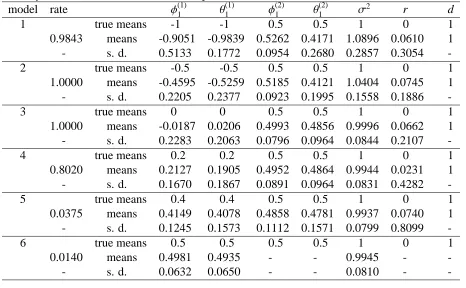
as the generated examples before based on 500 samples each with size 300. The rate of correct
selections of TARMA models (rate) and Bayesian estimates of the above six models are shown
in Table 2. From Table 2, our results in this simulation study are fine. Based on 500 samples
each with size 300, the estimates of the coefficients are approximately unbiased, and the power of
correct selections of TARMA models increases when the alternative departs from the linear ARMA
model.
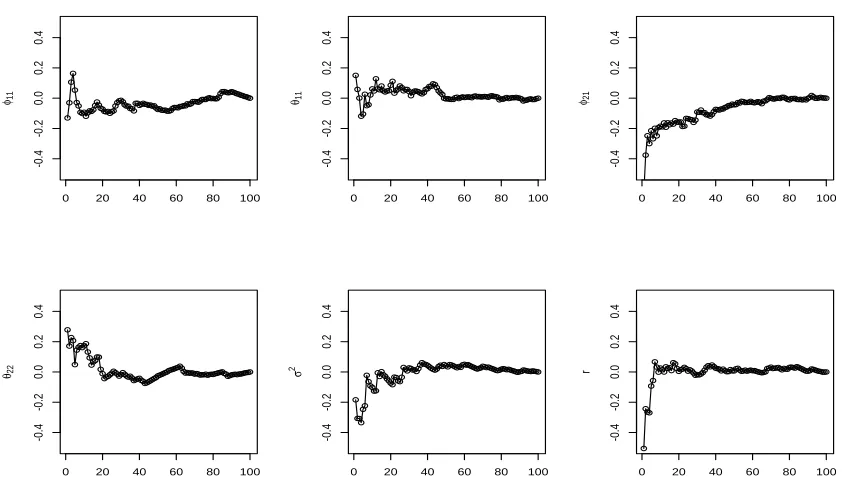
For the check of convergence of our algorithm, we will use the visual inspection of CUMSUM
statistics (Yu and Mykland, 1994) defined by
CSt = 1
t
t
X
j=1
θ( j)−μ
θ/σθ
whereμθ andσθ are the empirical mean and standard deviation of the 500 draws. Figure 1 shows
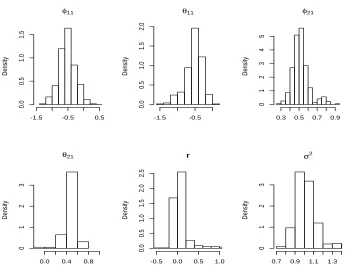
that our algorithm is almost convergent for the model 2 in some sense. Meanwhile, the histogram
of all parameters are nearly symmetric form the Figure 2.
To illustrate the usefulness of our procedure for building a TARMA model a bit further, we
conduct an preliminary investigation about the following two TARMA models. Here, we also
generate 400 points of y with y0 = 0 and discard the first 100 observations as data set for each
realization, and then carry out MCMC iterations for them.
• Model 7: T ARMA(2; 1,1,1,1,1)
Yt =
ξt +0.6ξt−1+0.4Yt−1, Yt−1 >0.5
ξt −0.5ξt−1−0.3Yt−1, Yt−1 ≤0.5
ξt ∼ N(0,1).
(5.1)
• Model 8: T ARMA(2; 2,1,3,1,2)
Yt =
ξt −0.4ξt−1+0.8Yt−1−0.6Yt−2, Yt−2> −0.1
ξt +0.4ξt−1+0.2Yt−1+0.5Yt−3, Yt−2≤ −0.1
ξt ∼ N(0,1).
(5.2)
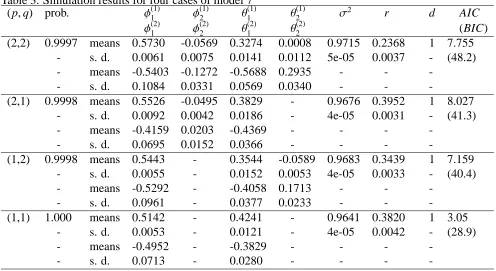
For the data simulated from model 7, we choose (p,q) = (2,2) for ARMA model by AIC or
BIC, and then we investigate the four cases of RJMCMC scheme testing by decreasing the order
(p,q) and obtain the corresponding results recorded in Table 3. Although the true order (p,q) of
model 7 is (1,1), the RJMCMC scheme testing is still efficient and the posterior means are almost
closed to the true values in other cases of appropriate AR and MA order. In particular, the posterior
means of some parameters are quite closed to 0, which is the true values of model 7. Furthermore,
AIC and BIC values indicate that (p,q) = (1,1) is the best choice, which just suggests that our
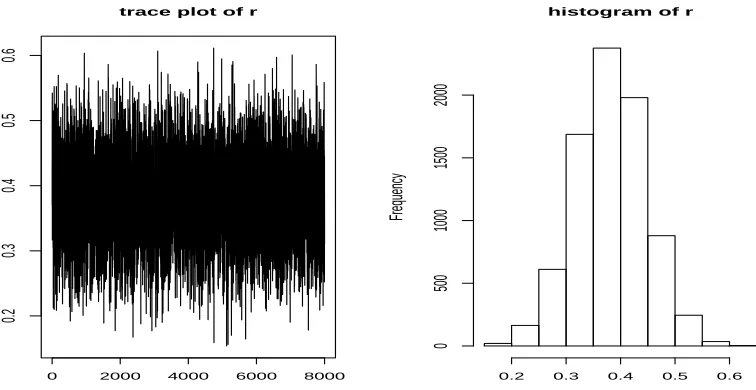
procedure for building a TARMA model may be useful. In addition, the posterior means of all
parameters, the trace plot and the histogram of r (Figure 1) show that the final modeling results
would pass in crow.
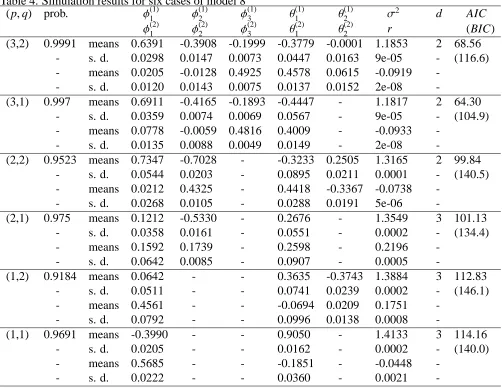
For model 8, this is an special example, we hope our MCMC algorithm to be useful to it by
identifying as TARMA(2; 2,1,3,1,2) model with φ(2)2 = 0. Firstly, we select the order (p,q) =
(3,2) for ARMA model by AIC or BIC. To examine the efficiency of the RJMCMC scheme, we
also attempt to change the order as low as possible. Table 4 lists the results for six cases, which
illustrate that the RJMCMC scheme can obtain good performance on the nonlinear case. If the
order (p,q) of the fitted model is lower than the true model, the values of AIC and BIC will be
larger. Under these circumstances, we should refine the order (p,q) to gain the final results by AIC
and BIC again. If the order (p,q) of the fitted model is larger than or equal to the true model, the
posterior means of parameters are quite closed to the true values as well. The final model may
be TARMA(2; 2,1,3,1,2), which can keep close consistent to model 8, althoughφ(2)1 andφ(1)3 has
slightly bias, the other estimates are close to the true parameters, especially theφ(2)2 is close to 0.
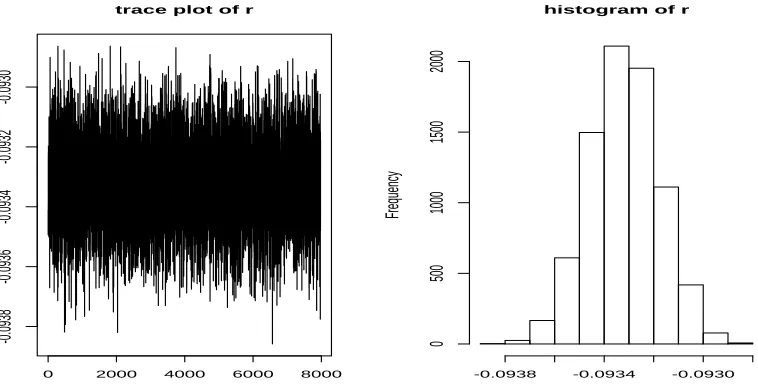
Meanwhile, the trace plot and the histogram of r (Figure 2) also give fine results.
The visual inspection of CUMSUM statistics are also used to check the convergence of our
algorithm to r of model 7 and 8, depicted in Figure 5, which indicates that our MCMC algorithm
has been almost convergent in some sense.
The above simulation analysis shows that our MCMC sampling methods can perform well in
providing posterior samplers for statistical inference for TARMA models. Therefore, it should be
useful in practice.
Remark 4. The maximum of AR and MA order is prescribed to 3 in all above simulations. In
addition, the order p and q can be also chosen starting from the low order.
5.2
Some Real Data Examples
To make a supplement for our MCMC sampling method, we consider a data set in an application:
the exchange rate of Japanese Yen v.s. USA dollar. Similar to Chen and Lee (1995) and Xia et al.
(2010), the hyper-parameters used areΦ0i = (0,0)0 for i = 1,2, V = diag(0.1,0.1), α = 2.5, β =
1.6, and a= p5and b= p95, which are defined as in subsection 5.1. Set M =10000 to run MCMC
iterations. Burning the first 5000 times, the posterior means and variances can be got to form the
normal kernels which are applied to RJMCMC iterations for 10000 times.
The monthly data from Jan. 1971 to Dec. 2000 are used and there are 360 observations. This
data set were analyzed recently by Ling and Tong (2005) and Xia et al. (2010). Pt denotes the
exchange rate at tth month. Let xt = 100[log(Pt)−log(Pt−1)] and yt = xt −
360P
i=2
xi/359 for t ≥ 2.
We take the order (p,q) = (1,1) for ARMA model by AIC and BIC, i.e., employ ARMA(1,1)
and TARMA(2; 1,1,1,1,d) models to fit the data {y2,y3, ...,y360}. The estimate of the posterior
probability identifying the TARMA model is 0.7813, which suggests that the threshold nonlinearity
is significant. According to our procedure for modeling TARMA model, we should refine the order
(p,q) by AIC or BIC and MCMC sampler. Table 5 lists the values of AIC and BIC, which illustrate
that (p,q)=(1,1) is best choice for TARMA model. For illustrative purposes, we obtain estimated
model (4.1) with the standard errors in the square brackets. From model (4.1), we can see that
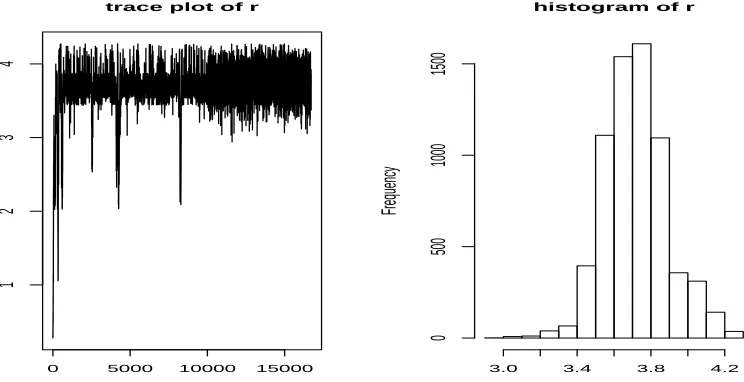
the estimates of threshold and delay parameters are r = 3.7197 and d = 3 respectively. Figure 4
displays the trace plot for all MCMC iterations of r and the histogram of r for TARMA model.
We see that the trace plot of r is stationary gradually, and after 5000 MCMC iterations it is almost
stationary. The histogram of r also shows that its distribution is symmetric in some sense.
Yt =
−0.9663Yt−1+0.6666ξt−1+ξt,Yt−3 >3.7197
(0.1981) (0.1481) (0.0293)
0.0494Yt−1+0.3863ξt−1+ξt,Yt−3≤ 3.7197
(0.0144) (0.0120)
ξt =
√
6.7239et, et ∼ N(0,1).
(0.0293)
(4.1)
6
Conclusion
In this paper, we develop a Bayesian testing scheme for threshold nonlinearity of two-regime
TARMA models. Firstly, combining Gibbs sampler and Metropolis-Hastings algorithm, we
pro-pose a Bayesian method to analysis the TARMA models. And then, with these Bayesian estiamtes,
we use a RJMCMC algorithm to select model between a ARMA model and a TARMA model by
constructing the Normal kernels. The main idea is to compute the posterior probabilities of
com-petitive models, hence, our procedure can avoid some analytical difficulty and complicated
compu-tation, therefore, it is simple to implement and requires no subjective specification of threshold and
delay values. This is the main advantage of our Bayesian approach. Finally, based on RJMCMC
scheme and AIC or BIC, we give the procedure for modeling TARMA models. Simulation results
and a real data example show that our approach can perform good. However, this work is only
limited to two-regime case without considering the heteroscedastic model. In the further research,
the heteroscedasticity can be added as an extension of our work.
ACKNOWLEDGMENTS
The authors thank the editor, and the referees for their constructive suggestions and comments
that led to an improvement of the manuscript. The research of Qiang Xia was supported in part
by National Social Science Foundation of China (No:12CTJ019), Ministry of Education in China
Project of Humanities and Social Sciences (Project No.11YJCZH195), and the National Natural
Science Foundation of China (grant 61375006). The research of Jinshan Liu was supported by
National Natural Science Foundation of China (grant 11171117).
References
[1] Akaike, H. (1974). A new look at statistical model identification. IEEE Transactions on
Au-tomatic Control, 19, 716-722.
[2] Casella, G. and George, E. I. (1992). Explaining the Gibbs sampler. The American
Statisti-cian, 46,167-174.
[3] Chen, C. W. S. (1999). Subset selection of autoregressive time series models. Journal of
Forecasting, 18, 505-516.
[4] Chen, C. W. S. and Lee, J. C. (1995). Bayesian inference of threshold autoregressive models.
Journal of Time Series Analysis, 16, 483-492.
[5] Chen, C. W. S., Gerlach, R., and So, M. K. P. (2008). Bayesian model selection for
heter-roskedastic models. Advances in Econometrics, 25, 567-594.
[6] Chen, C. W. S., Liu, F. C., and Gerlach, R. (2011). Bayesian subset selection for threshold
autoregressive moving-average models. Computational Statistics, 26, 1-30.
[7] Chib, S. and Greenberg, E. (1995). Understanding the Metropolis-Hastings algorithm. The
American Statistician, 49, 327-335.
[8] Geman, S. and Geman, D. (1984). Stochastic relaxation, Gibbs distribution and the Bayesian
restoration of images. IEEE Transactions on Pattern Analysis and Machine Intelligence, 6,
721-741.
[9] George E. I. and McCulloch R. E. (1993). Variable selection via Gibbs sampling.Journal of
the American Statistical Association, 88, 881-889.
[10] Geweke, J. and Terui, N. (1993). Bayesian threshold autoregressive models for nonlinear time
series. Journal of Time Series Analysis, 14, 441-454.
[11] Green, P.J. (1995). Reversible jump MCMC computation and Bayesian model determination.
Biometrika, 82, 711-732.
[12] Hastings, W. K. (1970). Monte-Carlo sampling methods using Markov chains and their
ap-plications. Biometrika, 57, 97-109.
[13] Ling, S. and Tong, H. (2005). Testing a linear moving-average model against threshold
moving-average models. Ann. Statist., 33, 2529-2552.
[14] Ismail, M. A. and Charif, H. A. (2003). Bayesian Inference for threshold moving average
models. METRON, 1, 119-132.
[15] Mcculloch, R. E. and Tsay, R. S. (1993a). Bayesian analysis of threshold autoregressive
pro-cesses with a random number of regimes. Computing Science and Statistics. Proceedings
of the 25th Symposium on the Interface, Fairfax Station, VA: Interface Foundation of North
America, 253-262.
[16] Mcculloch, R. E. and Tsay, R. S. (1993b). Bayesian inference and prediction for mean and
variance shifts in autoregressive time series. Journal of the American Statistical Association,
88, 968-978.
[17] Metropolis, N., Rosenbluth, A. W, Rosenbluth, M. N., and Teller, E. (1953). Equations of
state calculations by fast computing machines. Journal of Chemical Physics, 21, 1087-1091.
[18] So, M. K. P. and Chen, C. W. S. (2003). Subset threshold autoregression. Journal of
Fore-casting, 22, 49-66.
[19] So, M. K. P., Chen, C. W. S., and Chen, M. T. (2005). A Bayesian threshold nonlinearity test
in financial time series, Journal of Forecasting, 24, 61-75.
[20] So, M. K. P., Chen, C. W. S., and Liu, F. C. (2006) Best subset selection of autoregressive
models with exogenous variables and generalized autoregressive conditional
heteroscedastic-ity errors. J Roy Stat Soc Ser C, 55, 201-224.
[21] S´afadi, T. and Morettin, P. A. (2000). Bayesian Analysis of threshold autoregressive moving
average models. Sanky˜a, 62, 353-371.
[22] Tong, H. (1978). On a Threshold Model, in C.H. Chen (eds). Pattern Recognition and Signal
Processing, Amsterdam: Sijthoffand Noordhoff, 101-141.
[23] Tong, H. and Lim, K. S. (1980). Threshold autoregressions, limit cycles, and data. Journal of
the Royal Statistical Society B, 42, 245-292.
[24] Tong, H. (1990). Non-Linear Time Series: A Dynamical System Approach. Oxford
Univer-sity Press, Oxford.
[25] Tsay, R. S. (2005). Analysis of Financial Time Series. 2nd Edition, John Wiley & Sons.
[26] Vrontos, I. D., Dellaportas, P., and Politis, D. N. (2000). Full Bayesian inference for GARCH
and EGARCH models. Journal of Business & Economic Statistics, 18, 187-198.
[27] Xia Q., Liu J.S., Pan J.Z., and Liang R.B. (2012). Bayesian Analysis of two-regime Threshold
Autoregressive-Moving Average Models with Exogenous Inputs. Communications in
Statis-tics - Theory and Methods, 41, 1089-1104.
[28] Xia Q., Pan J. Z., Zhang Z. Q., and Liu J. S. (2010). A Bayesian nonlinearity test for threshold
moving average models. Journal of Time Series Analysis, 31, 329-336.
[29] Yu, B. and P. Mykland (1994). Looking at Markov samplers through CUMSUM path plots:
a simple diagnostic idea. Technical Report 413. Department of Statistics, University of
Cali-fornia at Berkeley.
Table 1. Simulation results for six cases of TARMA(2;1,1,1,1,1)
true model prob. φ(1)1 θ(1)1 φ(2)1 θ(2)1 σ2 r d
1 true means -1 -1 0.5 0.5 1 0 1
1.0000 means -1.0048 -0.9096 0.4147 0.4916 1.0213 0.0144 1
- s. d. 0.0413 0.0186 0.0031 0.0055 5e-05 5e-07
-2 true means -0.5 -0.5 0.5 0.5 1 0 1
1.0000 means -0.2906 -0.7830 0.4654 0.5269 0.8642 0.0064 1
- s. d. 0.0385 0.0141 0.0040 0.0065 3e-05 2e-08
-3 true means 0 0 0.5 0.5 1 0 1
1.0000 means 0.0512 -0.1548 0.4236 0.5974 1.1196 -0.1009 1
- s. d. 0.0482 0.0380 0.0061 0.0064 7e-05 0.0010
-4 true means 0.2 0.2 0.5 0.5 1 0 1
0.9690 means 0.2278 0.2784 0.4394 0.6021 0.8718 0.2396 1
- s. d. 0.0168 0.0145 0.0088 0.0105 3e-05 0.0113
-5 true means 0.4 0.4 0.5 0.5 1 0 1
0.0273 means 0.2622 0.5342 0.5094 0.4109 0.9783 0.5057 1
- s. d. 0.0162 0.0214 0.0077 0.0183 4e-05 0.5886
-6 true means 0.5 0.5 0.5 0.5 1 0 1
0.0017 means 0.4422 0.5517 - - 0.8993 -
-- s. d. 0.0042 0.0036 - - 0.0056 -
-Table 2. The rate of correct selections of TARMA models and Bayesian estimates based on 500 samples
model rate φ(1)1 θ(1)1 φ(2)1 θ(2)1 σ2 r d
1 true means -1 -1 0.5 0.5 1 0 1
0.9843 means -0.9051 -0.9839 0.5262 0.4171 1.0896 0.0610 1
- s. d. 0.5133 0.1772 0.0954 0.2680 0.2857 0.3054
-2 true means -0.5 -0.5 0.5 0.5 1 0 1
1.0000 means -0.4595 -0.5259 0.5185 0.4121 1.0404 0.0745 1
- s. d. 0.2205 0.2377 0.0923 0.1995 0.1558 0.1886
-3 true means 0 0 0.5 0.5 1 0 1
1.0000 means -0.0187 0.0206 0.4993 0.4856 0.9996 0.0662 1
- s. d. 0.2283 0.2063 0.0796 0.0964 0.0844 0.2107
-4 true means 0.2 0.2 0.5 0.5 1 0 1
0.8020 means 0.2127 0.1905 0.4952 0.4864 0.9944 0.0231 1
- s. d. 0.1670 0.1867 0.0891 0.0964 0.0831 0.4282
-5 true means 0.4 0.4 0.5 0.5 1 0 1
0.0375 means 0.4149 0.4078 0.4858 0.4781 0.9937 0.0740 1
- s. d. 0.1245 0.1573 0.1112 0.1571 0.0799 0.8099
-6 true means 0.5 0.5 0.5 0.5 1 0 1
0.0140 means 0.4981 0.4935 - - 0.9945 -
-- s. d. 0.0632 0.0650 - - 0.0810 -
[image:20.612.70.536.419.707.2]Table 3. Simulation results for four cases of model 7
(p,q) prob. φ(1)1 φ(1)2 θ(1)1 θ(1)2 σ2 r d AIC
φ(2)1 φ(2)2 θ(2)1 θ(2)2 (BIC)
(2,2) 0.9997 means 0.5730 -0.0569 0.3274 0.0008 0.9715 0.2368 1 7.755
- s. d. 0.0061 0.0075 0.0141 0.0112 5e-05 0.0037 - (48.2)
- means -0.5403 -0.1272 -0.5688 0.2935 - -
-- s. d. 0.1084 0.0331 0.0569 0.0340 - -
-(2,1) 0.9998 means 0.5526 -0.0495 0.3829 - 0.9676 0.3952 1 8.027
- s. d. 0.0092 0.0042 0.0186 - 4e-05 0.0031 - (41.3)
- means -0.4159 0.0203 -0.4369 - - -
-- s. d. 0.0695 0.0152 0.0366 - - -
-(1,2) 0.9998 means 0.5443 - 0.3544 -0.0589 0.9683 0.3439 1 7.159
- s. d. 0.0055 - 0.0152 0.0053 4e-05 0.0033 - (40.4)
- means -0.5292 - -0.4058 0.1713 - -
-- s. d. 0.0961 - 0.0377 0.0233 - -
-(1,1) 1.000 means 0.5142 - 0.4241 - 0.9641 0.3820 1 3.05
- s. d. 0.0053 - 0.0121 - 4e-05 0.0042 - (28.9)
- means -0.4952 - -0.3829 - - -
-- s. d. 0.0713 - 0.0280 - - -
Table 4. Simulation results for six cases of model 8
(p,q) prob. φ(1)
1 φ
(1)
2 φ
(1)
3 θ
(1)
1 θ
(1)
2 σ
2 d AIC
φ(2)
1 φ
(2)
2 φ
(2)
3 θ
(2)
1 θ
(2)
2 r (BIC)
(3,2) 0.9991 means 0.6391 -0.3908 -0.1999 -0.3779 -0.0001 1.1853 2 68.56
- s. d. 0.0298 0.0147 0.0073 0.0447 0.0163 9e-05 - (116.6)
- means 0.0205 -0.0128 0.4925 0.4578 0.0615 -0.0919
-- s. d. 0.0120 0.0143 0.0075 0.0137 0.0152 2e-08
-(3,1) 0.997 means 0.6911 -0.4165 -0.1893 -0.4447 - 1.1817 2 64.30
- s. d. 0.0359 0.0074 0.0069 0.0567 - 9e-05 - (104.9)
- means 0.0778 -0.0059 0.4816 0.4009 - -0.0933
-- s. d. 0.0135 0.0088 0.0049 0.0149 - 2e-08
-(2,2) 0.9523 means 0.7347 -0.7028 - -0.3233 0.2505 1.3165 2 99.84
- s. d. 0.0544 0.0203 - 0.0895 0.0211 0.0001 - (140.5)
- means 0.0212 0.4325 - 0.4418 -0.3367 -0.0738
-- s. d. 0.0268 0.0105 - 0.0288 0.0191 5e-06
-(2,1) 0.975 means 0.1212 -0.5330 - 0.2676 - 1.3549 3 101.13
- s. d. 0.0358 0.0161 - 0.0551 - 0.0002 - (134.4)
- means 0.1592 0.1739 - 0.2598 - 0.2196
-- s. d. 0.0642 0.0085 - 0.0907 - 0.0005
-(1,2) 0.9184 means 0.0642 - - 0.3635 -0.3743 1.3884 3 112.83
- s. d. 0.0511 - - 0.0741 0.0239 0.0002 - (146.1)
- means 0.4561 - - -0.0694 0.0209 0.1751
-- s. d. 0.0792 - - 0.0996 0.0138 0.0008
-(1,1) 0.9691 means -0.3990 - - 0.9050 - 1.4133 3 114.16
- s. d. 0.0205 - - 0.0162 - 0.0002 - (140.0)
- means 0.5685 - - -0.1851 - -0.0448
-- s. d. 0.0222 - - 0.0360 - 0.0021
-Table 5. Values of AIC (BIC) for different order (p,q) of TARMA model
pq 1 2 3
1 683.91(714.04) 692.98(730.86) 692.0(737.62)
2 685.10(723.0) 694.92(740.57) 693.08(746.46)
3 688.46(734.09) 685.86(739.23) 690.45(751.58)
0 20 40 60 80 100
-0.4
-0.2
0.0
0.2
0.4
φ11
0 20 40 60 80 100
-0.4
-0.2
0.0
0.2
0.4
θ11
0 20 40 60 80 100
-0.4
-0.2
0.0
0.2
0.4
φ21
0 20 40 60 80 100
-0.4
-0.2
0.0
0.2
0.4
θ22
0 20 40 60 80 100
-0.4
-0.2
0.0
0.2
0.4
σ
2
0 20 40 60 80 100
-0.4
-0.2
0.0
0.2
0.4
[image:23.612.90.511.267.510.2]r
Figure 1. The CUMSUM plots of posterior mean estimates for the model 2
φ11
Density
-1.5 -0.5 0.5
0.0
0.5
1.0
1.5
θ11
Density
-1.5 -0.5
0.0
0.5
1.0
1.5
2.0
φ21
Density
0.3 0.5 0.7 0.9
0
1
2
3
4
5
θ21
Density
0.0 0.4 0.8
0
1
2
3
r
Density
-0.5 0.0 0.5 1.0
0.0
0.5
1.0
1.5
2.0
2.5
σ2
Density
0.7 0.9 1.1 1.3
0
1
2
[image:24.612.126.471.246.516.2]3
Figure 2. The histogram of all parameters for model 2
0 2000 4000 6000 8000
0.2
0.3
0.4
0.5
0.6
trace plot of r histogram of r
Frequency
0.2 0.3 0.4 0.5 0.6
0
500
1000
1500
[image:25.612.115.493.286.481.2]2000
Figure 3. The trace plot and the histogram of r for model 7
0 2000 4000 6000 8000
-0.0938
-0.0936
-0.0934
-0.0932
-0.0930
trace plot of r histogram of r
Frequency
-0.0938 -0.0934 -0.0930
0
500
1000
1500
[image:26.612.117.496.287.480.2]2000
Figure 4. The trace plot and the histogram of r for model 8
0 20 40 60 80
-0.05
0.00
0.05
0.10
0.15
0.20
model 7
r
0 20 40 60 80
-0.15
-0.10
-0.05
0.00
0.05
model 8
[image:27.612.97.502.313.486.2]r
Figure 5. The CUMSUM plots of posterior mean estimates of r for model 7 and 8
0 50 100 150 200 250 300 350
100
200
300
Monthly exchange rate of JPY v.s. USD, Jan. 1971 - Dec. 2000
Index
0 50 100 150 200 250 300 350
-10
-5
0
5
The log-return of monthly exchange rate of JPY v.s. USD, Jan. 1971 - Dec. 2000
[image:28.612.99.518.285.381.2]Index
Figure 6. Time series plots for the exchange rate of Japanese Yen v.s. USA dollar
0 5000 10000 15000
1
2
3
4
trace plot of r histogram of r
Frequency
3.0 3.4 3.8 4.2
0
500
1000
[image:29.612.119.491.289.480.2]1500
Figure 7. The trace plot and the histogram of r for the real data example