International Journal of Innovative Technology and Exploring Engineering (IJITEE) ISSN: 2278-3075,Volume-8 Issue-3C, January 2019
Abstract: Background: The purpose of this study was to examine the effectiveness of forgiveness education program for university students. It aimed to grasp how forgiveness programs affected life satisfaction, the degrees of forgiveness, anger, depression, self-esteem, spirituality and happiness of university students. Methods: Subjects were 43 students as an experimental group and 43 students as a control group. One was an experimental group which participated in a forgiveness education program in K University, and the other was a control group which was not participated in any programs in other universities. Findings: Following the intervention, the experimental group experienced a significant improvement in degrees of forgiveness (t=-2.41, p<.05), self-esteem (t=-2.12, p<.05), happiness (t=-3.01, p<.01)), spirituality (t=-2.56, p<.05) and forgiveness (t=-2.41, p<.05). But experimental group experienced a significant decreased anger expression (t=3.03, p<.01). There was a slight difference on the anger expression, spirituality, happiness and the degrees of forgiveness between the experimental and the control group. Improvements: This study implies that a forgiveness education program was effective in improving university students’ degrees of forgiveness, happiness, spirituality, self-esteem, and reducing anger. Systematic and specific a forgiveness education program will be needed for future study.
Keywords: Forgiveness, Education, Program, University students, Effects
I.INTRODUCTION
We have hurt or we have been hurt others between relationships while living. Especially due to some hurt by someone in childhood, he or she has problems in building relationships between others, lowers self-esteem or suffers when starting a new job. The students in Korea have felt wounded by someone closer such as their parents, siblings, peers, teachers etc., and experienced agony, anger, depression and anxiety by accumulating some wound. Since they also have a variety of chances to form new relationships at university, actively experiencing relationships, they are satisfied with the expanded connections or depressed and unhappy owing to conflicts resulting from the process [1]. Such internal problems may cause harmful influence on human relations or negative effect on the current life. At this point, people will cope with in various ways to reduce negative emotions due to the wound.
Forgiveness can be a positive and healthy solution to the
Revised Manuscript Received on January 03, 2019.
Hye-Won Jeon, Dept. of Nursing, Kkottongnae University, Chungbuk, 28211, Korea.
Seung-Joo Kim, corresponding author, Dept. of Social Welfare, Kkottongnae University, Chungbuk,28211, Korea.
Myung-Sook Chung, Dept. of Social Welfare, Kkottongnae University, Chungbuk, 28211, Korea.
Seok-Im Kang, Dept. of Social Welfare, Kkottongnae University, Chungbuk, 28211, Korea.
wound felt unfairly due to personal relations [2, 3]. Forgiveness is needed for university students because it resolves conflicts and enhances happiness [1]. Through forgiveness being relieved anger and fear, university students can get assistance to play their own role as a newly perfect human [4]. That is, forgiveness can free the person who was wounded unfairly from negative emotions and make him or her stop doing negative behaviors such as hostility, intention for revenge and verbal aggression.[5]. It is reported that A man hurt by others who forgives easily can enhance self-esteem by improving the positive sides and reduce anger, depression and anxiety.[6, 7].There is some researches in which forgiveness help recover injured relationships and elevate subjective well-being and life quality. [8].
Starting in 1990 in Korea, various researches on effectiveness of forgiveness including the concept definition, the procedure of its understanding, development of its scale and program development have been progressed [9]. Forgiveness research related to factors has mostly been dealt; particularly a lot of effects researches after forgiveness education programs have been conducted for elementary school students [9], few for university levels.
It is necessary for social welfare and nursing students whose major is human services providing services from cradle to grave to improve one’s life quality and conduct the effectiveness of forgiveness through its educational program. They are suffering from a lot of stresses caused by heavy curriculums, onsite practice such as health and welfare institutes, responsibilities on providing services, a lot of stresses caused by professional ethics and criterion for life [10]. Moreover due to insecurity of employment and future, it is believed that life satisfaction and happiness has been lowered. Therefore, this study is to examine effects on anger, the degrees of forgiveness, spirituality, depression, self-esteem, happiness, life satisfaction for human service students after applying for forgiveness education programs and to utilize a basic material for developing further systematic forgiveness education programs. It is additionally to resolve conflicts from personal relations, help cure the wound and ultimately heighten their self-esteem, spiritual well-being and happiness by conducting forgiveness education programs.
II.MATERIALS AND METHODS 2.1. Research design and subjects
This study was a qusai-experimental research by analyzing the effects of forgiveness
education programs
The Effects of Forgiveness Education Program
for University Students
1
both participants and not-participants under the program and using non-equivalent control group pre-posttest design. It was intended to know the differences on life satisfaction, subjective well-being and the status of health, anger, depression, self-esteem, spirituality, the degrees of forgiveness after applying for forgiveness education programs for university students in C city. One was an experimental group which participated in forgiveness education program, and the other was a control group which was not participated in the program. The subjects for the experimental group were the students who selected ‘Forgiveness’ lecture as a liberal arts course in K University while freshmen who were majoring similar studies near the K University were selected as a control group. 43 students for each group were allocated. The research was progressed only for the students understood research goals and signed on the paper to participate in the research among students who confirmed class goals and subjects on the syllabus, enrolled in the course voluntarily.
2.2. Research instruments
2.2.1. Korean version of the satisfaction with the life scale; K-SWLS
The satisfaction with the life scale is a tool which evaluates the level of life satisfaction consisting of five questions. It is a seven-point scale meaning the higher, the more satisfied with one’s life. In this study, the scale used by [11] was measured.
2.2.2. Korean center for epidemiologic studies depression scale: CES-D
Depression scale [12] used in this study was CES-D, an integrated Korean scale which used to use three Korean CES-D domestically. Consisting of total 20 questions and a four-point scale, the total range is from 0 to 60. The higher score one gets, the more highly depressed one gets.
2.2.3. Enright’s forgiveness inventory
The degrees of forgiveness were measured by using Enright's Forgiveness Inventory, EFI developed by Enright[13] and EFI-K translated by [14]. This test was made up of total 30 questions including each 10 sub-areas question
under recognition, emotion and behavior. The response against each question was from ‘quite yes’ (5 points) to ‘Not at all’ (1 point), meaning the higher point one gets, the higher degrees of forgiveness one gets.
2.2.4. State-Trait Anger Expression Inventory
The contracted form which dealt with three aspects of anger among STAXI-K was used in this study. STAXI(State-Trait Anger Expression Inventory)was developed by Spielberger[15] and STAXI-K was translated by [16]. This scale consisted of total 24 questions including each 8 sub-areas’ question under anger control, anger expression and suppression. The response against each question was measured by 5 points scale. The lower points on anger control and the higher points on anger expression and suppression mean higher anger.
2.2.5. Spirituality scale
Developed by [17], it is suitable for Koreans to measure spirituality quantitatively and consists of total 30 questions, 6 constructive factors.
2.2.6. Subjective Happiness Scale: SHS
To measure happiness, 4 questions used by [18] were used. Each question was measured a seven-point scale from ‘Not at all.’ (1 point) to ‘quite yes’ (5 points),
2.3. Forgiveness Education program
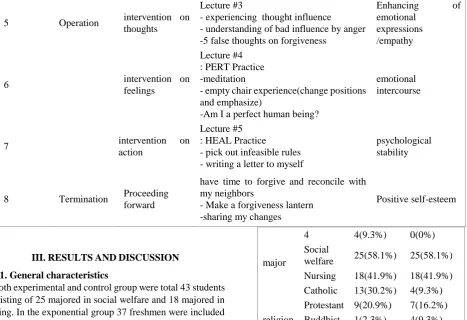
In this study, an forgiveness education program is based on a forgiveness education program by[6], made up for the class by major professors of psychology, social welfare and nursing, developed and opened a subject as a personal course since 2016 in K university. It is composed of 8 periods, the program operation has progressed lecturing, writing by the participants, presenting and sharing with each other. The course contents of each period are as follows: 1st period as an introductive stage for building reliability, 2nd and 3rd as expositional stages for expressing the wound and understanding self, 4th period as experiencing forgiveness, 5th to 7th as operational stages for treating thought, emotions and behaviors, and final 8th stage for sharing changes and opinions and encouraging each other as seen in table 1. Table 1: Forgiveness Education Program
session stage topic contents effects
1 introduction opening mind
Orientation &Introduction - Pre-test / make a name tag
- choosing a friend to forgive / introducing program
facilitate participation /building trust
2 Express
acknowledge and express wounds
forgive Re-creation - skin ship game
-the person who wants to remember and is most comfortable
-a memoryless and uncomfortable person
Self-openness
3 find my true self
Lecture #1: Review previous study - basic understanding of anger and resentment
- why should we learn forgiveness?
Self-understanding
4 decision Experience
forgiveness
Lecture #2
- three stages of anger
- free from ascribing others and complaining resentment
International Journal of Innovative Technology and Exploring Engineering (IJITEE) ISSN: 2278-3075,Volume-8 Issue-3C, January 2019
5 Operation intervention on
thoughts
Lecture #3
- experiencing thought influence
- understanding of bad influence by anger -5 false thoughts on forgiveness
Enhancing of
emotional expressions /empathy
6 intervention on
feelings
Lecture #4 : PERT Practice -meditation
- empty chair experience(change positions and emphasize)
-Am I a perfect human being?
emotional intercourse
7 intervention on
action
Lecture #5 : HEAL Practice
- pick out infeasible rules - writing a letter to myself
psychological stability
8 Termination Proceeding
forward
have time to forgive and reconcile with my neighbors
- Make a forgiveness lantern -sharing my changes
Positive self-esteem
III.RESULTS AND DISCUSSION 3.1. General characteristics
[image:3.595.65.533.53.373.2] [image:3.595.61.509.399.691.2] [image:3.595.74.503.460.686.2]Both experimental and control group were total 43 students consisting of 25 majored in social welfare and 18 majored in nursing. In the exponential group 37 freshmen were included and in the control group all freshmen were included as seen in Table 2.
Table 2: General Characteristics characteristics Exp.(n=43) Cont.(n=43)
gender female 29(67.4%) 10(23.3%) male 14(32.6%) 33(76.7%)
grade
1 37(86.0%) 43(100.0%)
2 0(0%) 0(0%)
3 2(4.7%) 0(0%)
4 4(9.3%) 0(0%)
major
Social
welfare 25(58.1%) 25(58.1%)
Nursing 18(41.9%) 18(41.9%)
religion
Catholic 13(30.2%) 4(9.3%)
Protestant 9(20.9%) 7(16.2%)
Buddhist 1(2.3%) 4(9.3%)
None 20(46.5%) 27(62.8%)
Others 0(0%) 1(2.3%)
3.2. Homogeneity test
After comparing to pretest scores for the experimental and control group’s homogeneity test, it was certified that two groups were appropriate homogeneous groups showing no significant difference between them as seen in Table 3.
Table 3: Homogeneity Test of Dependent Variables between Two Groups
Exp. (N=43) Cont. (N=43) t p
life satisfaction 3.77(.649) 3.77(.895) .000 1.000
health status 3.63(.846) 3.88(.793) -1.447 .152
anger control 3.27(.553) 3.31(.568) -.360 .719
expression 2.89(.664) 2.86(.576) .195 .846
suppression 3.09(.749) 2.94(.539) .741 .305
spiritual
experience 3.39(.569) 3.36(.466) .200 .842
happiness 3.39(.657) 3.50(.646) -.827 .411
depression 1.77(.447) 1.72(.322) .561 .576
self esteem 3.43(.666) 3.62(.530) -1.486 .141
forgiveness 2.66(.573) 2.47(.482) 1.655 .102
3.3 The Effects Verification of the Program
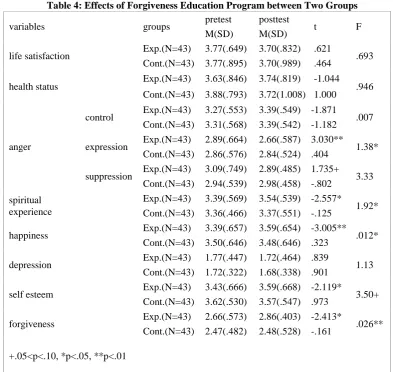
This study was validated using the ANCOVA. The experimental group experienced a significant improvement in degrees of forgiveness (t=-2.41, p<.05), self-esteem (t=-2.12, p<.05), happiness (t=-3.01, p<.01), spirituality (t=-2.56, p<.05) and forgiveness (t=-2.41, p<.05)as seen in table 4. But
forgiveness grade showed higher grades in the posttest than in the pretest in the experimental group. While the control
[image:4.595.100.494.76.448.2]group showed no significant differences statistically in average grades both pretest and posttest.
Table 4: Effects of Forgiveness Education Program between Two Groups
variables groups pretest posttest t F
M(SD) M(SD)
life satisfaction Exp.(N=43) 3.77(.649) 3.70(.832) .621 .693 Cont.(N=43) 3.77(.895) 3.70(.989) .464
health status Exp.(N=43) 3.63(.846) 3.74(.819) -1.044 .946
Cont.(N=43) 3.88(.793) 3.72(1.008) 1.000
anger
control Exp.(N=43) 3.27(.553) 3.39(.549) -1.871 .007 Cont.(N=43) 3.31(.568) 3.39(.542) -1.182
expression Exp.(N=43) 2.89(.664) 2.66(.587) 3.030** 1.38* Cont.(N=43) 2.86(.576) 2.84(.524) .404
suppression Exp.(N=43) 3.09(.749) 2.89(.485) 1.735+ 3.33 Cont.(N=43) 2.94(.539) 2.98(.458) -.802
spiritual experience
Exp.(N=43) 3.39(.569) 3.54(.539) -2.557*
1.92* Cont.(N=43) 3.36(.466) 3.37(.551) -.125
happiness Exp.(N=43) 3.39(.657) 3.59(.654) -3.005** .012*
Cont.(N=43) 3.50(.646) 3.48(.646) .323
depression Exp.(N=43) 1.77(.447) 1.72(.464) .839 1.13
Cont.(N=43) 1.72(.322) 1.68(.338) .901
self esteem Exp.(N=43) 3.43(.666) 3.59(.668) -2.119* 3.50+
Cont.(N=43) 3.62(.530) 3.57(.547) .973
forgiveness Exp.(N=43) 2.66(.573) 2.86(.403) -2.413* .026**
Cont.(N=43) 2.47(.482) 2.48(.528) -.161
+.05<p<.10, *p<.05, **p<.01
Through this study, students who took forgiveness education program during one semester had effect on anger expression, spiritual experience, happiness, self-esteem and forgiveness. These findings were similar to the study [19] for the subjects of university students who were hurt by personal relations. The results were that anger and anxiety were reduced however depression did not show significant difference. That’s because depression may need long term treatment.
In this study, a forgiveness education program had an effect on the degrees of forgiveness enhancement for university students and showed a significant difference statistically compared to the control group. These findings were the same as the existing researches on alcohol addicts [7], women victims of domestic violence [20] and breast cancer patients for middle-aged women [21].
It is considered that forgiveness grades got higher because the subjects acknowledged and expressed the wound through forgiveness education programs and understand others by treating emotions and experiencing forgiveness. The score on anger expression fell in the experimental group and this result was the same as the research on the subject of the old in facilities.[5] It is necessary for university students to minimize conflicts, control, suppress anger effectively and express it properly if they feel happy. Anger control ability will be enhanced if they find the origin of anger, face and
expose it properly through a forgiveness education program. In this study, spirituality was improved significantly in the experimental group and showed a significant difference statistically compared to the control group. This is the same result [5, 21], and it is thought that a forgiveness education program make them find life meaning and purposes, understand others and heightened self-esteem. That’s why spirituality may have been enhanced. Students can accept their life positively, have close relations with others and be considerate to others. Therefore forgiveness education programs can be utilized as nursing invention by enhancing positive emotions and keeping healthy life spiritually. In this study, however, depression, self-esteem and life satisfaction showed no remarkable differences statistically between pre and posttest and showed no difference compared to the control group. Hence it is required to do further repetitive research and validate them along with qualitative research.
IV.CONCLUSION
International Journal of Innovative Technology and Exploring Engineering (IJITEE) ISSN: 2278-3075,Volume-8 Issue-3C, January 2019
spiritual experience and forgiveness were improved significantly. Anger expression, spiritual experience, happiness, self-esteem, forgiveness grades had a meaningful difference in the experimental group compared to the control group. Consequently, forgiveness education program was so effective for undergraduates that systematic and specific forgiveness education program will be needed for future subjects.
ACKNOWLEDGMENT
This study was supported by the research program funded by the Kkottongnae University in 2018.
REFERENCES
1. Chung SJ, Suh KH. Trait forgiveness, state forgiveness, and forgiveness
determinants of Korean college students. Korean Journal of Youth Studies, 2011;18(6):147-169.
2. Oh YH. A survey of hurt and forgiveness on Korean people. Korean
Journal of Educational Psychology, 2006;20(2):467-486.
3. Enright R, Fitzgibbons RP. Helping clients forgive. Washington D.C.:
American Psychological Association; 2000.
4. Oh YH. Patient-child conflict, forgiveness, and mental health of college
students. Korean Journal of Educational Psychology, 2004;18(3):59-77.
5. Chung MS, Kim SJ, Saji V. Effectiveness of forgiveness enhancement
program on spiritual well-being and ego integrity of elderly people residing in facilities. Korean Journal of Social Welfare Education, 2017;
40: 135-156.Available from:
http://www.newnonmun.com/article=10777812
6. Kim KS. The development and the effects of program for forgiveness.
The Korea Journal of Youth counseling, 2002; 10(1): 165-191.
Available from:
http://www.riss.kr/search/download/FullTextDownload.do?control_no =7b29c78dbf38b9cab36097776a77e665&p_mat_type=1a0202e37d52 c72d&p_submat_type=&fulltext_kind=&t_gubun=undefined&DDOD Flag=&redirectURL=%2Fsearch%2Fdownload%2FFullTextDownload. do&loginFlag=1&url_type=&query=%EC%9A%A9%EC%84%9C%E D%94%84%EB%A1%9C%EA%B7%B8%EB%9E%A8&content_pag e=
7. Kang SJ, Kim SJ. Effects of forgiveness therapy program on self-esteem,
anger, and forgiveness in people who abuse alcohol. J Korean Acad
Psychiatr Ment Health nurs, 2015 Dec;24(4):300-309.
DOI:10.12934/jkpmhn.2015.24.4.300
8. Tae YS, Youn SJ. Effects of a forgiveness nursing intervention program
on hope and quality of life in women cancer patients. Asian Oncology
Nursing, 2006; 6(2): 111-120. Available from:
http://www.dbpia.co.kr/Journal/ArticleDetail/NODE00758002
9. Lee YS, Kim KS. Trends of research on forgiveness in Korea: Analysis
of Korean journals from 1990 to 2012. The Korean Journal of Youth Counseling, 2013; 21(2): 289-316.
10. Whang SJ. The relationship between clinical stress, self-efficacy, and self-esteem of nursing college students. J Korean Acad Soc Nurs Edu,
2006 Dec; 12(2): 205-213. Available from:
http://www.dbpia.co.kr/Journal/ArticleDetail/NODE02344918 11. Lim YJ. Psychometric properties of the satisfaction with life scale
among Korean police officers, university students, and adolescents. Korean Journal of Psychology: General, 2012 Sep; 31(3):877-896.
Available from:
http://www.dbpia.co.kr/Journal/ArticleDetail/NODE06368283
12. Chon KK, Choi SC, Yang BC. Integrated adaptation of CES-D in Korea.
The Korean Health Psychology 2001; 6(1): 59-76.Available from: http://www.dbpia.co.kr/Journal/ArticleDetail/NODE06368475
13. Enright, RD, Human Developmental Study Group. The moral
development forgiveness. In Kurtines W, Gerwirtz J. Handbook of moral behavior and development, Hillsdale, NJ:Erlbaum.
14. Park JH. A validation study of the Enright forgiveness inventory
–Korean. Korean Journal of Educational Psychology 2002; 20(1): 265-282.
15. Spielberger CD, Krasner S, Solomon EP. The experience, expression,
and control of anger. Individual Differences, Stress, and Health Psychology, 1988:89-108. DOI:10. 1007/978-1-4612-3824-9-5.
16. Hahn DW, Lee CH, Chon KK. Korean adaptation of the state-trait anger
expression inventory (STAXI-K). The Korean Journal Health
Psychology 1998; 3(1): 18-32. Available from:
http://www.dbpia.co.kr/Journal/ArticleDetail/NODE06368430
17. Lee GY, Kim JH, Kim DW. Development of the spirituality scale. The
Korean journal of Counseling and Psychotherapy, 2003; 15(4):
711-728.Available from:
http://www.dbpia.co.kr/Journal/ArticleDetail/NODE06369431
18. Jang HS. The relationship of developmental tasks and happiness in early
adulthood. The Korean Journal of Development Psychology, 2009 Mar;
22(1): 19-36. Available from:
http://www.dbpia.co.kr/Journal/ArticleDetail/NODE06375144
19. Kim HY, Kim CH, Lee YS. The effects of the forgiveness program on
forgiveness degree, anger, anxiety, and depression of university students: comparison between the weekly group and the intensive group. The Korean Journal of Counseling and Psychotherapy, 2004; 16(3): 347-366.
20. Kang JH, Park JH. Development of a forgiveness program and
evaluation of its effectiveness for female victims of domestic violence. Korean Journal of Counseling, 2014; 15(6): 2245-2267. Available from: http://www.papersearch.net/thesis/article.asp?key=3292401&code=CP 00000006
21.Bae JH, Tae YS. Effects of Forgiveness educational program on
forgiveness, self-esteem, depression, and spiritual well-being in middle aged women with breast cancer. Journal of General nursing Science,
2015 Oct; 7:67-80. Available from: