Abstract: The human reorganization process plays a major part in giving a safer way of information sharing. The security plays a vital role in accessing applications with lot of confidentiality. The image processing can be a solvent of solving various security issues in iris detection technique. The IRIS images are collected from various persons for testing process and compared with various classification algorithms. Images are cleaned with implementing the preprocessing technique for noise removal. The clarity of the image are also improved with implementing image enhancement and resizing process. Basic image processing algorithmic rules are applied for identifying the necessary features for enhanced features. Some of filtering techniques such as Gabor filter, discrete wavelet transformation filter, Gaussian filter, etc, are used for main feature enhancement and filtering technique. These filtering technique used in this research work are helpful in calculating the distance between pupil and iris of an eye. The implementation process is tested with three different dissimilar iris dataset and compared with different classification algorithms. The research work helps in giving a simple solution in giving security to systems as well as giving a solution to identify the eye disease effectively.
Keywords : Image Resizing, Morphological operation, Binary Image, Masek Method.
I. INTRODUCTION
T
his is an International reputed journal that published research articles globally. All accepted papers should be formatted as per Journal Template. Be sure that Each author profile (min 100 word) along with photo should be included in the final paper/camera ready submission. It is be sure that contents of the paper are fine and satisfactory. Author (s) can make rectification in the final paper but after the final submission to the journal, rectification is not possible. In the formatted paper, volume no/ issue no will be in the right top corner of the paper. In the case of failure, the papers will be declined from the database of journal and publishing house. It is noted that: 1. Each author profile along with photo (min 100 word) has been included in the final paper. 2. Final paper is prepared as per journal the template. 3. Contents of the paper are fine and satisfactory. Author (s) can make rectification in the final paper but after the final submission to the journal, rectification is not possible.Human iris has enormous mathematical advantage that its
Revised Manuscript Received on October 05, 2019.
* Correspondence Author
S. Perumal*, Department of Computer Science, VISTAS, Chennai, India. Email: [email protected]
Lalitha Raju2, Department of Computer Science, VISTAS, Chennai, India. Email: [email protected].
R. Balamurugan, Department of Computer Science, VISTAS, Chennai, India. Email: [email protected]
pattern inconsistency among different persons is tremendous, since iris patterns acquire a high degree of randomness. Nowadays most of the systems in used and they required unambiguous user collaboration, demanding that the user is placed properly to attain a quality image.
Alternatively, as above study IRIS recognition is most reliable techniques in biometrics for human identification. Thus, the Daugman algorithm is able to acquire a false match rate below 1 in 200 billions. Iris recognition methods have been employed extensively by governments, for example the Aadhaar card project in India. Conversely, biometric feature in law of social control diligences the iris is under evaluation yet. One cause that obstructs the forensic exploitation of iris is that iris recognition outcomes are not simply understandable to examiners. Thus ―Iris Examiner Workstation‖ may be built equivalently to the ―Tenprint Examiner Workstation‖, which has been employed in forensics. In fingerprint recognition, a human auditor basis a choice on the number of matched details on two fingerprints. On compare, frequent iris recognition methods, e.g. Daugman‘s framework, execute matching on an iris code, which is the outcome of employing a band-pass filter and quantize to grayscale images. In these circumstances, the entire process becomes visible as a black-box to an examiner without knowing about image processing.
Conduct tests have demonstrated that human examiners can act upon better in identity verification with iris images. The result was prepared based on human perception of the on the whole texture. Equivalent to fingerprints, one method to additional endorse the improvement of iris recognition in law enforcement applications is to build the resemblance between irises understandable with the intention that the entire procedure can be supervised and verified by human experts. Explicitly, the decision supposed to be ready based on quantitative matching of visible features in iris images
II. RELATED WORKS
Pradeep Manikrao Patil [1], discussed that biometric established on the physical and behavioral features were commonly followed and were employed to recognize person uniquely in a usual and instinctive way. This iris recognition system depicted good recognition rate except Performance of the system degrades in noisy environment. They presented the analysis of iris recognition in fewer inhibited background. The author discussed challenges also.
According to Deepa, V.Priyanka and J.Pradeepa [2], Iris was a biometric feature used for human recognition in a variety of applications.
Implementation of IRIS Image Segmentation
using Distance Matrix
The developed method of this model was to allow for additional correctness in detecting rate and to appliance in student authentications coming out for high level regulation oriented Examinations.
Mrigana walia, Dr. Shaily Jain [3] explained that based on particular aspects of an entity, the biometric method recognized an individual inevitably. The feature extraction step transformed the atypical iris image texture into typical bit vector code. An iris recognition system was suggested here holding four paces. The first is, image segmentation, and second is to localize the individuals and iris regions. The third step sectioned iris was normalized and features were extracted using standard symlet wavelet. Finally the last step, the comparison of iris code was performed. After the comparison with existing system, a high recognition rate was found while the FAR and FRR values found continued low for this proposed system.
According to Proença H et. al. [4] the iris was considered as one of the most valuable qualities for biometric recognition and the dispersion of countrywide iris-based recognition systems was about to happen. Nevertheless, presently distributed systems trusted on intense imaging restraints to capture near infrared images with adequate excellence. Mustafa M. et. al. [5], Iris recognition was the main exact pattern of biometric identification. In most iris recognition systems, ideal image acquisition terms were presumed. These terms comprised a near infrared (NIR) light source to divulge the patent iris texture with look and gaze restraints and close distance from the capturing device. Though, modern progresses on iris recognition have developed dissimilar methods to work iris images captured in unrestrained surroundings. These surroundings contain a visible wavelength (VW) light source, on the move and over distance from the capturing device. This research stated the most used iris databases and depicted their imaging framework along with all characteristics of iris images in each database.
Shaik Touseef Ahmad and Sandesh Kumar [6] discussed that ordinal evaluations had been presented as an efficient feature illustration model for iris and palmprint recognition. Nevertheless, ordinal measures were a common concept of image analysis and many variants with distinct parameter settings, e.g. location, scale, orientation, etc. could be derived to construct an enormous feature space. According to Vineetha John Tharakan and Shaikh Fairooz [7], reliable authorization and authentication had turn out to be a part of life for numerous routine applications. Most of the authentication systems obtained was not much flexibleThe texture features e.g. scale, orientation and salient texture primitives of iris patterns diverge from region to region.
Manisha Sam Sunder and Arun Ross [8] discussed that most of the iris recognition systems used the global and local texture information of the iris sequentially to recognize individuals. In this work, they inquired the use of macro-features that were seeable on the anterior surface of RGB images of the iris for matching and retrieval. These macro-features matched to structures e.g. moles, freckles, nevi, melanoma, etc. and might not be illustrated in all iris images.
According to Dr.S. Prasath and A.Selvakumar [9], Iris
area focused on how to extract and recognize iris images. Iris recognition was a broadly used biometric application for security and identification security iris was being used for recognition of humans. The experimental outcome demonstrated that developed method offered better recognition rate when compared with the existing methods e.g. Local Binary Pattern, Local Ternary Pattern etc.
Geetanjali Sharma and Neerav Mehan [10][21] explained that biometric features based system provided an automated recognition for a person based on unique features of an individual. Iris recognition was considered as the most reliable and accurate automated recognition system like it was a safe body part and did not vary with time. This work illustrated a new technique for iris based recognition system based on median filter and compared it with other existing technique based on Gaussian filters. The outcomes demonstrated that the developed method is better than the previous ones. Correctness of the developed method was 99.07%.
According to Himanshi Budhiraja et. al. [11][20] this work demonstrated analysis on fusion strategies for personal identification utilizing fingerprints and iris biometrics. The aim of this work was to inquire whether the integration of fingerprint and iris biometrics could attain performance that might not be possible employing a single biometric approach. The fusion of multiple biometrics assisted to diminish the system error rates. Fusion methods involved processing biometric modalities in order to anticipation of an acceptable match was accomplished. The outcomes of this work affirmed that a multimodal biometric can overcome some of the restrictions of a single biometric consequential in a significant performance enhancement.
Govindharaj et. al. [12] discussed that biometric methods based on iris images were conceived to accomplish very high accuracy, and there had been an explosion of nterest in biometrics. In this work, they employed the Scale Invariant Feature Transformation (SIFT) for recognition of iris. On comparison with traditional iris recognition systems, the SIFT methods did not trust on the transformation of the iris pattern to polar coordinates, appropriating less inhibited image acquisition considerations. The feature points used the SIFT method to extract feature points in scale space and perform matching based on the texture information.
Joaquim de Mira Jr. and Joceli Mayer [13] showed a new technique based on morphological operators for application of biometric empathy of somebody‘s by segmentation and analysis of the iris. To demonstrate the efficiency of the morphological technique some outcomes were delivered. The developed method was derived to illustrate low storage requirements and low complexity implementation.
III. METHODOLOGY
The noise from collected iris images from three different dissimilar database are processed for removing irrelevancy such as noise and bure. The cleaned iris images are taken into various image processing technique for feature selection and image enhancement process.
extracted iris images. The proposed classification technique are applied and tested for best solutions.
A. Iris Image preprocessing
Image preprocessing is the most important part of image processing techniques for cleaning irrelevancy in images. The unwanted parts for authentication process and irrelevant parts of images are removed with the help of preprocessing stage. Usually blur parts of the images are also removed or sent to the enhancement process. Some of preprocessing techniques followed in this image processing techniques are discussed below.
B. Input iris image acquisition:
The input iris image are undergone various image processing technique for enhancing the quality of image as well as to identify the objects of eye parts. MATLAB helps in separating the objects of an eye into various sections.
C. Object identification:
The iris of an eye can be differentiated into various objects such as crypts, pupil, etc. The inner boundary of an eye are known to be pupil and outer boundary of an eye known to be crypts, which are very essential parts for authentication process. Furthermost Inner circle of crypts are also identified for detecting the size of a pupil and difference in pupil. The color difference of a pupil may be a main factor for differentiating the persons.
D. Image Resizing
The Image resizing plays a major role in enhancing the size of the pupil and giving the clarity to the extracted image, which is the most vital factor for identification process. The output of this process provides a clear and enhanced pupil image, which is most important factor in pattern matching and texture mining of an iris image. The iris image are clearly resized and enhanced for clear image.
E. Binary Image
A digital image is a binary image that holds just two probable values for each pixel. Though any two colors can be used for binary Image, usually two colors black and white are used for a binary image. For the object(s) in the image the color used is the foreground color whereas the rest of the image is the background color. This is frequently referred to as "bi-tonal" in the document-scanning industry. Binary images are termed as bi-level or two-level
IV. RESULTS AND DISCUSSIONS
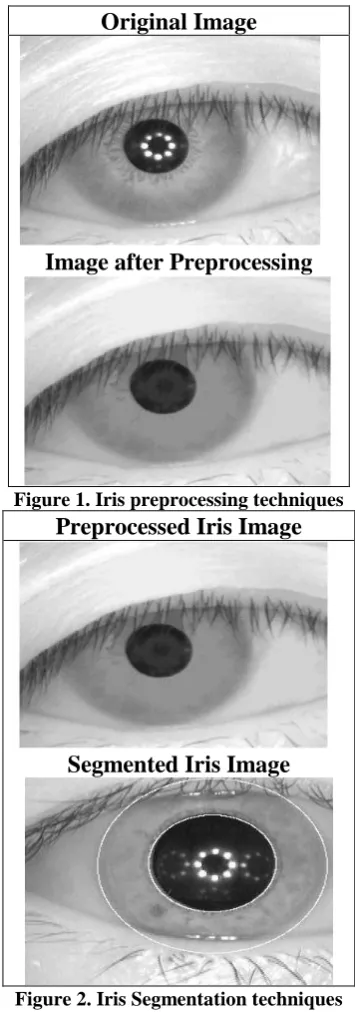
The iris images are taken for preprocessing stage, where noise present in the iris images are removed carefully without effecting the originality of the eye image. The cleaned iris images are processed for extracting the necessary features. The filtering techniques such as image enhancement, edge detection technique, resizing, Gaussian filtering techniques are applied before classification process.
Original Image
[image:3.595.337.515.60.567.2]Image after Preprocessing
Figure 1. Iris preprocessing techniques
Preprocessed Iris Image
Segmented Iris Image
Figure 2. Iris Segmentation techniques
Segmented Iris image
Figure 3. Segmented iris image
A. Preprocessing Iris image
The operations carried out in preprocessing are finding threshold, applying histogram equation, implementing morphology operators and median filtering techniques. Figure 2 shows the result before and after applying the preprocessing technique in iris image.
B. Iris segmentation
Image segmentation is a technique carried out after the preprocessing technique of the image processing. Some of common segmentation techniques such as Masek method,
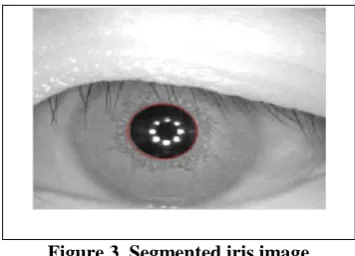
Geodesic Active Contour and Integrodifferential are used for segmenting the preprocessed iris image. Figure 3 shows the various segmentations of iris images after applying the segmentation techniques.
C. Median Filtering for pupil identification
The segmented iris images are taken for pupil identification technique, which is very essential for authentication process. The identification of boundary of pupil, the median filtering technique are applied after applying the smoothing the iris image. The binary image median filtering technique is used for detecting all the remaining boundary outside pupil boundary. Figure 4. Shows the pupil identification after the iris segmented image
D. Evaluation of segmentation performance
The segmentation process are tested for accuracy with different segmentation methods, and shown in the table 1. The measurement matrices used for evaluating the performance of three different segmentation technique are also shown. The segmentation methods deployed in this research work processing time can also be clearly indicated with the graph representation figure 5
.
Table 1. Segmentation Performance
Segmentation Methods Accuracy (%)
Processing time of Iris segmentation (Sec)
Min Max Mean
Masek Method 92.66 0.972 1.298 0.873
Geodesic Active Contours 95.02 4.62 5.78 5.22
[image:4.595.79.257.48.176.2]Integrodifferntial 78.56 0.199 0.863 0.689
[image:4.595.54.295.347.768.2]Figure 5. Processing time of Iris segmentation
Figure 6. Accuracy rate for three different methods
The segmentation methods deployed in this research work accuracy is shown in figure 6, which clearly shows that the method Geodesic Active Contours is better than other two methods.
E. Canny iris Edge detection algorithms
The edge detection algorithm is used for detecting each and boundary of identified pupil after the segmentation technique. Figure 7. Shows the result for canny edge detection technique, which clearly shows representation of edges outside the range of pupil.
Segmented Iris image
[image:4.595.331.526.581.788.2]Figure 7. Canny Edge Detection F. Performance Evaluation of Edge detection
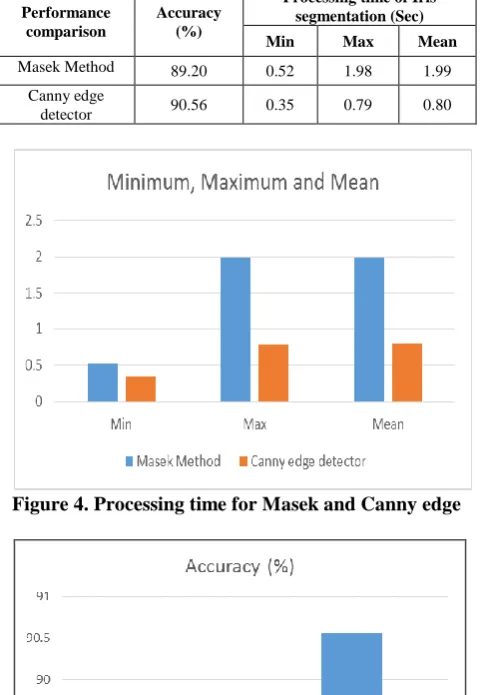
The performance evaluation process of edge detection technique are compared with the Masek Method. The result of the process are shown in the table 2.
Performance evaluation measures taken for Masek method and Canny edge detection method are also shown for minimum, maximum and mean time for segmentation in graphical representation, figure 8.
Performance evaluation measures taken for Masek method and Canny edge detection method accuracy are shown in figure 9.
Performance comparison
Accuracy (%)
Processing time of Iris segmentation (Sec)
Min Max Mean
Masek Method 89.20 0.52 1.98 1.99
Canny edge
[image:5.595.50.294.323.671.2]detector 90.56 0.35 0.79 0.80
Figure 4. Processing time for Masek and Canny edge
Figure 9. Accuracy rate for Masek and Canny methods
V. CONCLUSION
A novel method for identifying and matching iris vaults for the human-in-the-loop iris biometric system is introduced. The presented method develops predicting outcomes on the three tested datasets, in-house dataset, ICE2005, and CASIA-Iris-Interval. On Comparison with the existing method, this proposed method enhances the iris recognition performance by minimum 22% on the position one hit rate in the circumstance of human identification and by minimum 51% on the equal error rate in provisions of subject verification. It is noticed that the three datasets under estimation were gathered using dissimilar facilities among diverse population groups. The constraints applied in this method were skilled on a different small set of homemade data.
The simplification and usefulness of this method on varied image data can be presented. Additionally, to the extent that, this work is so reserved the just estimation of a human-interpretable iris features matching method by using the public datasets, that provides a lead contrast with existing methods for example Daugman‘s framework. Experimental analysis has shown the effectiveness of the proposed system
REFERENCES
1. Pradeep Manikrao Patil ―Iris Recognition in Less Constrained
Environment‖ International Journal of Emerging Technology and Advanced Engineering, Volume 3, Issue 7, July 2013.
2. Deepa, V.Priyanka and J.Pradeepa ―Iris Recognition Based on Iris
Crypts‖ International Journal of Engineering Sciences & Research Technology, February, 2017, DOI: 10.5281/zenodo.291855.
3. Mrigana walia and Shaily Jain ―Iris Recognition System Using
Circular Hough Transform‖ International Journal of Advance Research in Computer Science and Management Studies, Volume 3, July 2015.
4. Proença H, Filipe S, Santos R, Oliveira J and Alexandre LA ―The
UBIRIS.v2: a database of visible wavelength iris images captured on-the-move and at-a-distance‖ IEEE Transaction Aug 2010. doi: 10.1109/TPAMI.2009.66
5. Mustafa M. Alrifaee, Mohammad M. Abdallah and Basem G. Al
Okush ―A Short Survey of Iris Images Databases‖ The International Journal of Multimedia & Its Applications (IJMA) Vol.9, No.2, April 2017
6. Shaik Touseef Ahmad and Sandesh Kumar B. V ―Ordinal Feature
Selection for IRIS and Palm print Recognition‖ International Journal of Ethics in Engineering & Management Education, Volume 2, Issue 6, June 2015.
7. Vineetha John Tharakan and Shaikh Fairooz ―Ordinal Features Based
Palmprint and Iris Recognition for Military Security‖ International Journal of Advanced Research in Electrical, Electronics and Instrumentation Engineering, Vol. 6, Issue 4, April 2017
8. Manisha Sam Sunder and Arun Ross ―Iris Image Retrieval Based on
Macro-features‖ International Conference on Pattern Recognition (ICPR), (Istanbul, Turkey), August 2010
9. Dr.S. Prasath and A.Selvakumar ―A Novel Iris Image Retrieval with
Boundary Based Feature Using Manhattan Distance Classifier‖ International Journal of Innovative Technology and Creative Engineering, vol.5 no.7 july 2015
10. Geetanjali Sharma and Neerav Mehan ―Iris based Human
Identification using Median and Gaussian Filter‖ International Journal of Latest Trends in Engineering and Technology Vol.(7), DOI: http://dx.doi.org/10.21172/1.73.560.
11. Himanshi Budhiraja, Himani Tomar, Harshi Goel, Amar Singh
[image:5.595.55.285.593.742.2]12. Govindharaj, R. Vinitha, N. V. Dhanapriya, P. Diviyabarady R. Abiramy ―Retina Based Personal Identification System using SIFT algorithm: A survey‖ Asian Journal of Applied Research (AJAR) Volume 03- Issue 02- pp-18-23, 2017
13. Joaquim de Mira Jr. and Joceli Mayer ―Image Feature Extraction for
application of Biometric Identification of Iris - A Morphological Approach‖ IEEE Symposium on Computer Graphics and Image Processing, 2003
14. J. Daugman, ―How iris recognition works,‖ IEEE Trans. Circuits Syst.
Video Technol., vol. 14, no. 1, pp. 21–30, Jan. 2004.
15. J. Daugman, ―Probing the uniqueness and randomness of IrisCodes:
Results from 200 billion iris pair comparisons,‖ Proc. IEEE, vol. 94, no. 11, pp. 1927–1935, Nov. 2006.
16. Unique Identification Authority of India. [Online]. Available:
http://uidai.gov.in, accessed Nov. 1, 2015.
17. K. R. Nobel, ―The state of the art in algorithms, fast identification solutions and forensic applications,‖ MorphoTrust USA, Billerica, MA, USA, Tech. Rep., Jan. 2013. [Online]. Available: http://www.planetbiometrics.com/article-details/i/1446/.
18. P. E. Peterson et al., ―Latent prints: A perspective on the state of the
science,‖ Forensic Sci. Commun., vol. 11, no. 4, pp. 1–9, 2009.
19. C. Champod, ―Edmond Locard—Numerical standards and ‗probable‘
identifications,‖ J. Forensic Identificat., vol. 45, no. 2, pp. 136–163, 1995.
20. Arunachalam, A.S., Hidhaya, A.P., ―Locating nearest neighbor using
privacy query based on improvised paillier cryptosystem‖, Journal of Advanced Research in Dynamical and Control Systems, (Special Issue 5), pp.176-179, 2017.
21. Dharmarajan, K., and M. A. Dorairangaswamy. "Discovering Student
E-Learning Preferred Navigation Paths Using Selection Page and Time
Preference Algorithm." International Journal of Emerging