International Journal of Innovative Technology and Exploring Engineering (IJITEE) ISSN: 2278-3075, Volume-8 Issue-10, August 2019
Abstract: CNC machine tool is the end mechanism in the
process of converting input materials into desired outputs shape reflecting the customer specifications and requirements. All executions and operation processes are fully organized and control by the CNC controller unit. As the brain for the whole system, the architecture and internal structure of the controller plays an important role in realizing intelligent functions of the CNC machine tool systems. Unfortunately, the methodology for CNC machines programming remains relatively unchanged over
these years. Traditionally, CNC machine tools have rigid
programming structure. Most of the CNC programs are restricted to any modification during machining operation execution. Establishing of STEP-NC as next generation data model lead to huge paradigm shift of future CNC system especially the ways of CNC being programmed. However, as a passive data model, STEP-NC does not have any intelligent functionality. Thus, to
overcome these limitations, a new data processing unit for
adaptive CNC controller is proposed based on IEC61499 function blocks. The main function of this unit is to establish operational decision-making function at controller level. It generates native information for a particular machine tool. Whereby, the availability of manufacturing resources and machine condition are taken into account. By establishing layered and distributed architecture, the proposed systems are expected to cover up the deficiency of current CNC controller structure. Hence, the portability, interoperability, flexibility and openness of the CNC controller structure can be further improved.
Index Terms: CNC, Adaptive Controller, Function Block,
STEP-NC
I. INTRODUCTION
The past fourth years, Computer Numerical Control (CNC) technology has played incredible roles in manufacturing industries especially in machining processes. This technology has been proven to be effective and economical crosswise several production methods; including job-based or project production, production by batch, mass production and, flow or continuous production. Reacting toward customer demands and high-quality requirements, nowadays a multiple of CNC machine brands with various capabilities are extensively developed and being used in machining industry. However, in order to face out a new era of manufacturing and to be stay competitive, manufacturing companies demanding the modern CNC machining systems to have more advance character including, to name a few, high intelligent and automation for autonomy, adaptability and
Revised Manuscript Received on August 05, 2019.
Muhammad Azri Othman, Faculty of Manufacturing Engineering, Universiti Teknikal Malaysia Melaka, Melaka, Malaysia.
Zamberi Jamaludin, Faculty of Manufacturing Engineering, Universiti Teknikal Malaysia Melaka, Melaka, Malaysia.
Mohamad Minhat, Faculty of Manufacturing Engineering, Universiti Teknikal Malaysia Melaka, Melaka, Malaysia.
flexibility for dynamic changing environment, and interoperability for seamless information exchange system [1].
Since last decade, there has been an increasing interest in developing and promoting ISO 14649 (STEP-NC) as a future CNC interface for supporting the development of next generation CNC system. Thus far, a number of prototypes and methodologies was proposed dan being develop along the ways. Having STEP-NC in machine level will synergize the role of CNC controller with more intelligent functionality such as on-machine decision making along with adaptive control abilities. Moreover, being informed based on online resource status and the machine tool operating status, make the decision done by the CNC controller are more reliable than existing system which is depending on the prediction of an upstream systems like CAPP and CAM.
Due to the architecture of existing CNC controllers are found to be closed in nature due to dependency on vendor specification, accessible to the system architecture and user modification are almost impossible. By considering these conditions, the development of new controller architecture that able to work with STEP-NC is one of key aspect for boosting CNC machine tool capabilities. Although the development of STEP-NC compliant controllers have started but is not yet completed to meet the requirement of next generation CNC system [2]. The new structure of controller must powerful enough to handle STEP-NC data and execute mechanism with intelligence. So, the internal structure of controller itself should have capability to intelligently process (reads, interprets and manipulate) the comprehensive data provides by STEP-NC program into understandable machine commands.
This paper highlights the need of new data processing unit architecture for supporting the development of adaptive controller in an intelligent CNC system. This new architecture is intended to create last-minute specific machine native information based on available resources and machine conditions. This manuscript is prepared as follows: Section 2 briefly introduce CNC system and its controller follows by the IEC 61499 as an enabler technology for enhancing intelligent functionally to CNC controller, section 4 highlights the proposed system architecture while section 5 conclude the findings made.
II. CNCSYSTEMSANDITSCONTROLLER
A. CNC System
Design of Intelligent CNC system using
IEC61499 Function Block
The overall activities required for producing part from product design up to finished product using a CNC machine can be categories into three levels of tasks as illustrated in the fig.1. The first level is offline activities included part modelling by Computer Aided Design (CAD) system, process planning determination by Computer Aided Process Planning (CAPP) system, and part program generation by Computer Aided Manufacturing (CAM) system. At this stage, all the necessary information required for actual machining execution and product inspection are well prepared before proceeding to next level activities.
Second level is online activities, which real machining processes for fabricating the part being executed by the CNC machine tool system. Basically, a CNC system contains of three primary components as following: (1) input program, (2) machine control unit (MCU), and (3) physical processing equipment. A part program that generated at offline stage are being reads and interprets to generate sequences of machine understandable instructions for controlling the movement of axes and auxiliary functions on the actual machine tool. All these activities occurred inside machine control unit (MCU).
CAD
Program Code
CAM CAPP
DRIVER MOTER
CNC BOARD
E
N
C
O
DE
R
What-to-make? (Desired Feature) 1. PC 2. 2D Draft
Tool Path Generation. Geometrical
Data
Final Product
Tool
Machine Table
Semi-Closed loop
E
N
C
O
DE
R
OFF-LINE
ON-LINE
Ball screw workpiece Full-Closed loop
Linear Scale How-to-make?
(Selection) 1. Machine Tool 2. Cutting Tool
CNC Board
POST-MACHINING
Inspection
Fig.1 Existing CNC system[3]
The third level is post operation task included inspection for the finished product. At this level, the quality of the product was evaluated against specification and requirement of the product design. Based on inspection result, extra process will be performed for compensation purpose if any. The performance data gathered in this event will be use as input for the next batch machining process.
B. Control Systems
In modern NC technology, the MCU play crucial role as a brain for CNC machine tool system. Its functional to read and interpret an input program into specific machine instructions for execution actual machining tasks. Traditionally, the MCU can be divided into two core elements. The first element is a data-processing unit (DPU). The function of DPU is read, interpret and retrieve the input data (coded program) and then passes the data such as axes positioning, direction of mechanism movement, feed rate and auxiliary function control signals to the control-loops unit (CLU). A CLU is a second element inside the MCU. The main function of CLU is controlling the machine tool mechanism precisely and effectively follow the information provides by DPU. Besides that, CLU also responsible to manage actual positioning and velocity feedback for each machine axes.
C. CNC Languages
Since the CNC system was invented, there are three common standards being use over the world: ISO6983 (ISO), DIN66025 (Europe) and RS274D (USA) for NC program [4].
However, over the time, all these standards found to be bottlenecked to react toward advancement of intelligent CNC system. Beside the use of low-level language, several another limitations found against the development CNC system such as unsupported bilateral data flow, limited information deliver to CNC and vendor dependency [5]. Due to limitation of these existing standards coverage, CNC vendors have extended the NC program standards in order to support their new functions and controller-specific features. Consequently, make the program exchange between a different CNC system become more difficult and some cases are almost impossible. Result, diversity of NC programs always entraps the machine tool users. Looking forward to all the evident listed previously, employment of a new type of data model on CNC machine tool system is really needed since the existing standard are no longer capable to reply the demands of interoperable and intelligent CNC systems.
An ISO 14649, familiar to STEP-NC was promoted to be the new CNC language for future development of CNC system [6]. Instead of generating the cutting tool motions and auxiliary instruction, STEP-NC brings a comprehensive and standard machining related information into the CNC machine tool level. Therefore, machine tools can intelligently plan and restructure its operations spontaneously and capable to process rich set of machining related data in both online or offline mode conditions [7].
III. IEC61499ASENABLERTECHNOLOGY
A. Briefly Description of Function Blocks
IEC61499 standard for distributed industrial process measurement and control system (IPMCS) was developed by the International Electrotechnical Commission (IEC) in 2005. It was reflected to the increasing system design complexity in the automation industry [8]. This standard offering the next generation system architecture by promoting distributed control through decentralized logic in automation application. Established of this standard is come with the mission to increase the interoperability, flexibility, reconfigurability, and portability of the system architecture which have not adequately supported in the IEC61131-3 standard.
IEC61499 is an open architectural standard defines component-oriented approach using Function Block (FB). Function block promoting abstraction of software function unit by encapsulating algorithms, state transition and local data inside a well-defined event-data interface. With the ability to encapsulate the algorithms, function block reacts like an autonomous unit of software that provides reuse function and distributed design of application. By having a set of function blocks connecting in a network, the entire systems are designated to be independent to whatever implementation platform. Each of them communicates to each other based on event-driven model. The execution only happened once the input events was triggered.
Three different kinds of FBs are defined in IEC 61499:
Basic function block (BFB): is a single unit for execution. Functional autonomously, this type of FB contains internal algorithm and has an
International Journal of Innovative Technology and Exploring Engineering (IJITEE) ISSN: 2278-3075, Volume-8 Issue-10, August 2019
Composite function blocks (CFB): is a combination of multi blocks network (either basic or composite or both) that encapsulate into one CFB. The functionality of CFB is determined by network of FBs inside.
Service interface function blocks (SIFB); is a communication function block. It used to establish complete communication interface between FBs network with their surroundings.
Execution Control Chart (ECC)
Encapsulated Functionality (Algorithm)
Internal Variables Event
Inputs
Event Outputs
Data Inputs
Data Outputs Event flow
Data flow
Event flow
[image:3.595.67.272.160.299.2]Data flow Event/Data Associations
Fig. 2 Basic function blocks structure
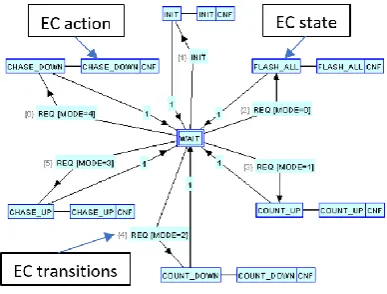
Function blocks are divided into event flow and data flow as illustrated in fig 2. Although the same inputs are injected into a function block, the numerous outputs can be produced based on the internal state hidden inside the function block. This behavior is determined by its execution control chart (ECC). As shown in fig.3, an ECC consists of EC (execution control) states, EC transitions, and EC actions that functional to process data inputs and generates possible output event with or without data output. The working principle of ECC is as following: once the EC transition was triggered, EC state was changed and lead to an associated EC action be executed. Instead of ECC model, the CFB includes references to component function block instances along with models of event and data connections.
As a modeling language, function block can offer direct executable function ready for simulation purpose. If needed, the simulation model can be replaced by the actual equipment like actuators and sensors seamlessly. Employment of function block in the system are not only deliver a better system modularity and facilitate the software components reusability, but also providing an appropriate and robust characters for broader embedded systems domain implementation.
Fig. 3 Example of ECC structure [9]
B. Function Block Application in Manufacturing Adoption of IEC 61499 function block in manufacturing industry activities related to machining processes is not totally a new approach. Several studies have been done in various fields related to machining process such as process planning activities, machining data manipulation and machining processes execution, process control and monitoring, optimization, and machining sustainability. The short review has been made in this subsection to reveal the advantages of function block.
Most computer aided process planning systems available today have centralized architecture and processing data in offline mode. Without knowing the actual runtime condition, make adaptive decisions and keeping that decision in the optimal condition are very difficult. Since the establishing of the IEC 61499 standard, FBs have been uses to create adaptive and distributed process planning. Wang and their colleagues are firstly reported develop a new methodologies for distributed process planning (DPP) based on event-driven IEC 61499 FBs [10].
In Auckland University, a group of researchers from Intelligent and Interoperable Manufacturing System Research Group (IIMS) started the initiative to use combination of STEP-NC technology and IEC 61499 FB in developing interoperable manufacturing. The first prototype system was presented in 2007 [11]. This prototype use function block platform to mapping and translate the STEP-NC data into desired G&M code program for a particular CNC machine. Two years later, Minhat and his teammates was demonstrated the development of STEP-NC/FB CNC controller by using layered architecture[12]. This architecture was proven able to simplify the CNC controller design. The system was develop based on open softPC-based CNC system and its was G&M code free system that capable to generate machine understandable code by direct interpretation from STEP-NC program.
Beside the use of function blocks in process planning and machining application, several works have been reported with regard to the use of function block in machining parameter optimization and machining sustainability. Nikoloas et al in [13] develop system that can select and optimize machining parameter in real time condition using IEC 61499 FBs technology.
Improving the efficiency of machining equipment and machining systems is one of organizational goal for manufacturing industry to keep and increase their competitiveness and profitability against the modern manufacturing environment. Peng and their co-researchers in [14] has taken first action to develop a function block-based energy demand modelling approach for next-generation CNC machining system. Compared with existing approach, proposed model will perform the energy analysis and optimization based on-going process, not at the beginning operation. With access to runtime, proposed model has advantage over when dealing with fluctuating and dynamics changes in production.
Based on the evidence provides by the above studies, function block capable to enhance and improve the performance of the developed systems by offering more intelligent function with
[image:3.595.69.263.601.748.2]distributed control methodology. For that reason, this research works with looking forward the beneficial of IEC 61499 in developing intelligent CNC controller system
IV. OVERVIEWOFTHESYSTEM
A. Design Concept
This research primary goal is to design and develop a new structure of an adaptive controller for intelligent CNC machining systems. The system will be designed to take advantages from the blended technologies of STEP/STEP-NC and IEC 61499. Availability of comprehensive and high-level data model like STEP and STEP-NC into machine level will synergize CNC system especially controller to have more intelligent functionalities as illustrated in fig.4.
Novel Architecture
of an Adaptive
CNC controller Bring
comprehensive and high levels
standard information into machine
level
Provides intelligent functionality and simplify the design of
controller
IEC61499 FBs
Empower controller internal structure by having intelligent decision making and control
[image:4.595.313.539.195.339.2]abilities
STEP/STEP-NC
Fig. 4 Technological concept
Next generation of CNC controller system requires a flexible and customizable internal structure. In order to inject adaptive and flexible characteristics into the proposed system, the concept of distributed process planning (DPP) was used. In this research, STEP-NC data is divided into two sections: generic STEP-NC data (machining sequence, machining method, machining strategy, machining setup) and native STEP-NC data (cutting tool, cutting condition, tool paths). The generic STEP-NC is uses as input file to the system. Firstly, All the useful information provides by generic STEP-NC file is interpret and be organized in the function block software editor, FBDK by Holobloc Inc. The main reason separated the program into 2 parts is the characteristic of generic STEP-NC data itself, which is independent from any specific machine tool. So then, portability of the program to be executed by a different machine tool will be increased.
The native information only processes by the DPU module based on availability of manufacturing resources and machine that was selected at supervisory planning. The desired data needed to execute the machining process will directly send to the CLU for controlling the mechanism movement. No G&M code program will be generated in this system.
B. Overview of the proposed system
To ensure the proposed system to have the desired adaptability, portability, interoperability and openness characteristics, data required are divided into generic and native data. All the data structure involved in this research refers to STEP and STEP-NC standard. The overall processes were involving 4 phases: (i) read and interpret a generic STEP-NC data; (ii) transferring all the data into desired function blocks; (iii) native data generation; (iv) send commands for machining task execution by 3-axis XYZ milling table. The overall configuration is presented in fig.5.
XYZ milling table MATLAB and ControlDesk software
Analog signal DS1104 (Digital Signal
Processor)
Drives Amplifier Digital encoder
signal Signal to drive motor
Analog encoder signal
Digital signal
Tracking condition Digital
signal
Feedback data Eclipse IDE and FBDK
software
Part Design Feature Based Data
* Data Processing Unit (DPU) * Control Logic unit (CLU) AdapSTEPFB controller
Fig. 5 Proposed system configuration
[image:4.595.68.270.262.489.2]Fig. 6 show the native data generator graphical user interface (GUI) inside the controller. In this GUI, user can verify the information received from the input file. The modification also allowed at this stage before the native data be generated. The flow of native data generation starts with selecting the reasonable cutting tool referring to the availability of cutting tool on the predetermined machine tool. The developed algorithm will consider workpiece material and machining features. Next, cutting parameter such as depth of cut, cutting speed and feed rate will be generated. Finally, the toolpaths are generated.
Fig. 6 GUI for Native data Generator module
V. CONCLUSION
Instead by providing the rigid code write up by using G&M code standard, establishing of algorithms together with an availability of rich data set at very end stage, will give much more flexibility for CNC to react intelligently at runtime upon any changes or unexpected events. In future, if the manufacturing resource was changed with the same input, the related embedded algorithms of function blocks inside the proposed system will still has the capability to provides or regenerates all the necessary data required to execute the machining process such as a set of cutting tool, machining parameter and toolpath reflected to existing resource availability. By enabling the
use of online resource and
[image:4.595.310.543.488.566.2]International Journal of Innovative Technology and Exploring Engineering (IJITEE) ISSN: 2278-3075, Volume-8 Issue-10, August 2019
information, applying function block on the proposed system will give more intelligence and autonomy to the system to better handle and adapt to changes. Currently, the proposed system is still under development and testing.
REFERENCES
1. 1. S. T. Newman et al., “Strategic advantages of interoperability for global manufacturing using CNC technology,” Robotics and Computer Integrated Manufacturing, vol. 24, no. 6, pp. 699–708, 2008.
2. 2. M. A. Othman, M. Minhat, and Z. Jamaludin, “An overview on STEP-NC compliant controller development,” in IOP Conference Series: Materials Science and Engineering, vol. 257, pp. 41–51, 2017. 3. 3. M. Minhat, “Development of a STEP-NC Controller,” University
of Auckland, 2009.
4. 4. Y. Liu, X. Guo, W. Li, K. Yamazaki, K. Kashihara, and M. Fujishima, “An intelligent NC program processor for CNC system of machine tool,” Robotics and Computer Integrated Manufacturing, vol. 23, no. 2, pp. 160–169, 2007.
5. 5. Y. Yusof and L. Kamran, “New Technique for the Interpretation of ISO 14649 and 6983 based on Open CNC Technology,” International Journal Computer Integrated Manufacturing, vol. 29, pp. 136–148, 2016.
6. 6. W. Xiao, L. Zheng, J. Huan, and P. Lei, “A complete CAD / CAM / CNC solution for STEP-compliant manufacturing,” Robotics and Computer Integrated Manufacturing, vol. 31, pp. 1–10, 2015. 7. 7. X. W. Xu, L. Wang, and Y. Rong, “STEP-NC and function blocks
for interoperable manufacturing,” IEEE Trans. Autom. Sci. Eng., vol. 3, no. 3, pp. 297–308, 2006.
8. 8. I E C, Function blocks. International Standard IEC 61499, 2005. 9. 9. “Holobloc.” [Online]. Available: http://ftp.holobloc.com/.
[Accessed: 19-Jul-2019].
10. 10. L. Wang, H.-Y. Feng, and N. Cai, “Architecture design for distributed process planning,” Journal Manufacturing Systems, vol. 22, no. 2, pp. 99–115, 2003.
11. 11. H. Wang, X. Xu, and J. Des Tedford, “An adaptable CNC system based on STEP-NC and function blocks,” International Journal Production Research, vol. 45, no. 17, pp. 3809–3829, 2007. 12. 12. M. Minhat, V. Vyatkin, X. Xu, S. Wong, and Z. Al-Bayaa, “A
novel open CNC architecture based on STEP-NC data model and IEC 61499 function blocks,” Robotics and Computer Integrated Manufacturing, vol. 25, no. 3, pp. 560–569, 2009.
13. 13. T. Nikolaos, M. Jörn, D. Michael, and M. Dimitris, “Optimal Machining Parameter Selection Based on Real-Time Machine Monitoring Using IEC61499 Function Blocks For Use In A Cloud Manufacturing Environment : a Case Study for Face Milling,” in Proceedings of the ASME 2014 International Manufacturing Science and Engineering Conference, pp. 1–9, 2014.
14. 14. T. Peng, X. Xu, and L. Wang, “A novel energy demand modelling approach for CNC machining based on function blocks,” Journal of Manufacturing Systems, vol. 33, no. 1, pp. 196–208, 2014.
AUTHORS PROFILE
Muhammad Azri Othman, received the B.Eng (Honors) in Manufacturing Engineering (Robotics and Automation) from University Teknikal Malaysia Melaka, Malaysia and M.Eng Manufacturing System Engineering from Universiti Putra Malaysia, Malaysia. After completed his undergraduate studies, he working as R&D engineer at multinational company located at Pontian, Johor. In 2011, he joined Universiti Tun Hussein Onn Malaysia as a Tutor. Currently, he is pursuing his PhD in Manufacturing Engineering.
Zamberi Jamaludin, works as an Associate Professor at the Faculty of Manufacturing Engineering, Universiti Teknikal Malaysia Melaka, Melaka, Malaysia. He completed his B.Eng in Chemical Engineering from Lakehead University, Canada, M.Eng in Manufacturing System from Universiti Kebangsaan Malaysia, and hold a PhD in Mechanical Engineering from Katholieke Universiteit Leuven, Belgium. His current research interests include Automation and Robotics, Advanced Control System, System Dynamics, Industrial Automation and Mechatronics.
Presently, he is the Dean of Faculty of Manufacturing Engineering, Universiti Teknikal Malaysia Melaka.