International Journal of Innovative Technology and Exploring Engineering (IJITEE) ISSN: 2278-3075, Volume-8 Issue-10, August 2019
Abstract: In the conditions of transition to international financial reporting standards (hereinafter – IFRS), the issues of developing a methodology for analyzing of the Russian consolidated financial statements, prepared in accordance with the requirements of the international format, are of particular relevance. In order to develop a methodology for analyzing of consolidated financial statements, the authors developed key indicators RIC of integrated business, based on the application of institutional analysis, as well as the coefficient method of relative indicators. The key RIC indicators, presented in the article, are intended to perform express analysis of consolidated financial statements, since they will provide a basic picture of the financial situation of a group through a series of simple calculations. The research results can be used in the transformation of statements, as well as in the construction of consolidated financial statements, generated in Russia in accordance with the IFRS requirements.
Index Terms: institutional analysis methodology, the relevance, the overall profitability of non-current assets revaluation, the profit investment rate, total financial result.
I. INTRODUCTION
A law on consolidated financial statements was adopted under the conditions of publication and acceptance of international financial reporting standards (hereinafter - IFRS) on the Russian Federation territory. Amendmets of the law were made until January 2019. In keeping with the law, the Russian consolidated financial reporting should be prepared in accordance with the rules and regulations of IFRS [1]. A document, which was published on the Ministry of Finance of the Russian Federation website on December 8, 2017 and contains a summary of the practice of applying IFRS in Russia, outlines the features of forming consolidated financial statements (hereinafter – the CFS) in accordance with the new IFRS requirements. Due to the adopted changes, issues related to the methodology of integrated business analysis become especially actual.
Revised Manuscript Received on August 05, 2019.
Natalia Alekseevna Prodanova, Plekhanov Russian University of Economics, Moscow, Russian Federation.
Liudmila Borisovna Trofimova, Plekhanov Russian University of Economics, Moscow, Russian Federation.
Lyudmila Nikolayevna Korshunova, Moscow Witte University, Moscow, Russian Federation.
Sergey Georgievich Kamolov, Moscow State Institute of International Relations (MGIMO), Moscow, Russian Federation.
Konstantin Zaurovich Trapaidze, Moscow State Institute of International Relations (MGIMO), Moscow, Russian Federation.
Albert Valentinovich Pavlyuk, Moscow State Institute of International Relations (MGIMO), Moscow, Russian Federation.
II. LITERATUREREVIEW
Consolidation of financial statements is a complex process of preparing a report on the overall financial results of a company grouping. The description of the consolidation process is reflected in the works of many Russian and foreign scientists [2-3]. The features of definitions of processes related to the consolidation of reporting were studied by Italian scientists Sotti, F. Rinaldi, L. Gavana, G. [4]. Kazan economists Usanova D. S. and R. Z. Mukhametdinov [5] discussed the issues of consolidation of business in their scientific works.
Scientists from southern Africa, van Zijl, W. Maroun, W. [6] paid special attention to the formation of the CFS. Recognition of property rights in the construction of the CFS was investigated by German, Czech and Slovak scientists Casajus, A. Labrenz, H. [7] and Gluzová, T. [8].
A lot of Russian scientists studied the technique of consolidation financial statements [9-12], however, economists did not pay proper attention to a reasonable selection of coefficient analysis for CFS.
III. PROPOSEDMETHODOLOGY
A. Algorithm
When the consolidated financial statements analysis is planned, it is important to determine the stages of work in order to obtain reliable results and form valid conclusions and correct recommendations based on performance. Therefore, it should be started with a target selection. Users of financial statements should clearly define the range of issues they are interested in, whether they are managerial goals, or the generation of a company’s development strategy for the upcoming period [13]. Before work, analysts should make sure, that the information is accurate and reliable [14-15]. Then the algorithm of financial statements analysis is created (Fig. 1).
The Methods and evaluation of RIC Integrated
Business Indicators
Natalia Alekseevna Prodanova, Liudmila Borisovna Trofimova, Lyudmila Nikolayevna
Korshunova, Sergey Georgievich Kamolov, Konstantin Zaurovich Trapaidze, Albert
Fig. 1: Stages of the financial statements analysis Source: developed by the authors
Regarding the analysis of financial statements in Russia on June 25, 2003, the Government of the Russian Federation had adopted Resolution No. 367 on the rules for financial analysis, but it contained a methodology for analysis that is mainly applicable to single statements. Traditional approaches to IFRS analysis using a standard set of ratios and do not take into account the specific features of consolidated financial statements. However, its analysis is necessary to increase the probability of making the right decisions. While analyzing of the consolidated financial statements is performed, its strategic component is especially important. The choice of the right direction of development of the analysis is the basis for effective management of the company grouping [16]. The institutional method for the analysis of consolidated business should be based on the study of financial statements analytical indicators in compliance with the principles of relevance.
Practical familiarity with the financial statements revealed the key points of their analysis. The purpose of the analysis depends on the needs of the persons, who get benefits due to analysis. If the main task of the analysis is to develop a company's development strategy for management purposes, then analysts prepare recommendations for management based on the obtained calculations. The study can also be carried out in order to predict the probability of bankruptcy, factor analysis is performed to simulate various economic strategies of the company, etc. [17].
Before analysis, analysts check the initial data for reliability and quality, therefore financial statements should be prepared in accordance with the requirements of the regulatory legislation in the field of accounting and reporting. In this respect, firstly analysts get acquainted with the final part of the audit report, explanatory note and accounting policies of the organization.
The stage of analyzing the reliability and quality of information begins with the algorithm selection. The following sequence of analytical calculations should be used for effective consideration of an integrated business:
• Express analysis of consolidated financial statements; • Factor analysis of the impact of indicators specific to the consolidated financial statements;
• Analysis of special indicators widely used in integrated business.
B. Consolidated financial statements express analysis Let us consider the features of the express analysis of the consolidated financial statements. Its distinctive feature is the use in the calculations of indicators, which are contained in the financial statements. There are three offered key
indicators of consolidated financial statements, obtained from a preliminary acquaintance with financial statements and not required additional complex transformations. The key indicators will be assigned the common name RIC by the first letters of the names of the indicators. Below is a method of calculating them based on relevance of the CFS indicators [18].
1. Introduction to the statement of financial situation and determination of the revaluation share of non-current assets in the total financial result – R.
From the point of view the analysis of financial statements the specific interest is generated by the change in the additional capital received as a result of the revaluation of non-current assets (EA). The ratio of additional capital received as a result of the revaluation for the reporting period to the cumulative financial result of the period (СFR) indicates its share in the revenue (R) and can be calculated by the formula:
CFR EA
R (1)
Thus, the indicator of the share of non-current assets revaluation R in the cumulative financial result is interesting, because the additional capital obtained as a result of the revaluation of non-current assets when calculating of the cumulative financial result is the main share of net profit adjustments. Other adjustments, and non-reporting (analytical) articles, can be neglected, since they occupy a small volume.
The indicator R can be computed by the express calculation method, what is useful when organization prefers to get quick results. If R is more than 5%, it can be considered that share of the non-current assets revaluation is large. It leads to significance difference between total financial result and net profit, what is correspond to the principles of relevance, i.e. relevance of balance sheet. In this case, the application of the cumulative financial result in the calculation of the Return on total capital, assets and other indicators instead net profit reflects the business efficiency more accurately.
2. Investment income indicator – I.
The priority of the company's economic life is own capital formation sources. In a large company, the share capital size must be commensurate with balance sheet currency. If a company is a limited liability company which owns many subsidiaries, the authorized capital, as a rule, is a significant share of the balance sheet total.
A significant value of additional capital caused by the revaluation of non-current assets may indicate the presence of reliable assets on the balance sheet, namely, real estate.
We consider it is necessary to add lines that ensure the comparability of statements of financial situation and financial results in the balance sheet to increase the "analyticity" of the retained earnings indicator.
International Journal of Innovative Technology and Exploring Engineering (IJITEE) ISSN: 2278-3075, Volume-8 Issue-10, August 2019
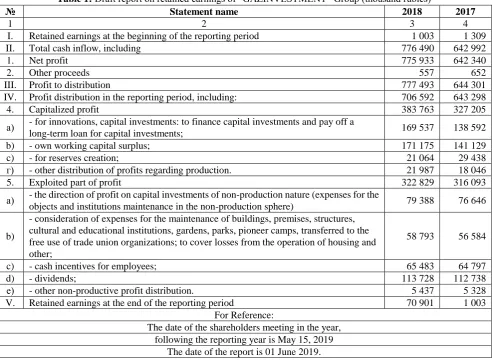
Table 1: Draft report on retained earnings of “GAZINVESTMENT” Group (thousand rubles)
№ Statement name 2018 2017
1 2 3 4
I. Retained earnings at the beginning of the reporting period 1 003 1 309
II. Total cash inflow, including 776 490 642 992
1. Net profit 775 933 642 340
2. Other proceeds 557 652
III. Profit to distribution 777 493 644 301
IV. Profit distribution in the reporting period, including: 706 592 643 298
4. Capitalized profit 383 763 327 205
а) - for innovations, capital investments: to finance capital investments and pay off a
long-term loan for capital investments; 169 537 138 592
b) - own working capital surplus; 171 175 141 129
c) - for reserves creation; 21 064 29 438
г) - other distribution of profits regarding production. 21 987 18 046
5. Exploited part of profit 322 829 316 093
а) - the direction of profit on capital investments of non-production nature (expenses for the
objects and institutions maintenance in the non-production sphere) 79 388 76 646
b)
- consideration of expenses for the maintenance of buildings, premises, structures, cultural and educational institutions, gardens, parks, pioneer camps, transferred to the free use of trade union organizations; to cover losses from the operation of housing and other;
58 793 56 584
c) - cash incentives for employees; 65 483 64 797
d) - dividends; 113 728 112 738
е) - other non-productive profit distribution. 5 437 5 328
V. Retained earnings at the end of the reporting period 70 901 1 003
For Reference:
The date of the shareholders meeting in the year, following the reporting year is May 15, 2019
The date of the report is 01 June 2019. Source: developed by the authors
One of the purposes of the report on retained earnings is to ensure comparability with the balance sheet, as well as to determine indicators related to the reflection of the target profit distribution.
The proposed draft report has the following differences from the report used in IFRS:
• the report is more detailed;
• contains the line “Unspent amounts of profit distribution for the previous year (amounts transferred from funds)”; • in accordance with the principle of relevance, the line “Other income” was added, i.e. at distribution of profit the indicator of the cumulative financial income is taken;
• profit distribution is shown with division into capitalized part of profit and exploited part of profit;
• contains the line “For Reference”, which indicates the date of the shareholders' meeting in the reporting and following the reporting period;
• contains the line “Accumulated retained earnings at the end of the reporting period from the start of operations”, which ensures comparability of the statement of financial conditions and financial results.
The proposed structure of the draft report leads to conclusion that the main purpose of the report on retained earnings is to ensure comparability with the balance sheet, as well as to determine indicators related to the reflection of the target profit distribution.
The profit distribution nature is one of the investment attractiveness indicators of an organization; therefore,
development of indicators reflected the structure of investing profits allows to analyze the efficiency of the profit distribution.
in this regard it is interesting to trace the ratio of capitalized and exploited parts of profit in the total volume of distributed profits:
Pdis = Pcap + Pexp (2),
where:
Pdis – distributable profit; Pcap – capitalized profit; Pexp – exploited profit.
Based on this ratio, it is possible to calculate the consumption investment coefficients:
dis cap inv
P P
K (3),
where:
Kinv – investment coefficient.
dis exp exp
P P
K (4),
Based on the definition of coefficients, their sum is equal to 1:
Kinv + Kexp = 1 (5).
The coefficient of investment growth is determined by getting the ratio of investment rates for the reporting and previous years:
inv0 inv1 K K
I (6),
where:
I – investment growth coefficient;
Kinv1 – investment coefficient for the reporting year; Kinv0 – investment coefficient for the previous year. A positive trend of increasing investment is observed if I is greater than 1.
From the report on the retained earnings of “GAZINVESTMENT” Group, we calculate the indicators (Fig. 2):
For the reporting 2018 year
54 , 0 706592 383763
Kinv
46 , 0 706592 322829
[image:4.595.56.237.283.486.2]Kexp
Fig. 1: The structure of the distributed profit of “GAZINVESTMENT” Group in 2018
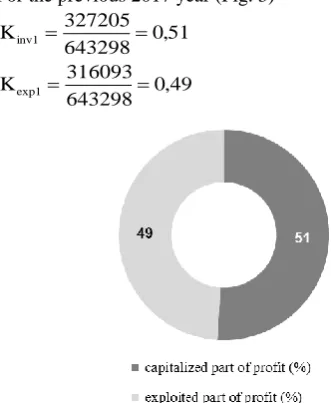
Source: developed by the authors For the previous 2017 year (Fig. 3)
51 , 0 643298 327205
Kinv1
49 , 0 643298 316093
Kexp1
Fig. 3: The structure of the distributed profit of “GAZINVESTMENT” Group in 2017
Source: developed by the authors
06 , 1 0,51 0,54 K
K 1
inv0
inv1
Dynamics of investments of “GAZINVESTMENT” Group in 2017 has a positive trend.
3. Return on sales for the comprehensive financial result - C.
The organization can be judged by the selected format of the comprehensive income statement also. The International Standard IAS 1 proposes to use two formats for the presentation of expenses in the of comprehensive income statement: by cost function and by nature of costs [19]. According to the current legislation, the cost function method is used in the preparation of the Profit and Loss statement in Russia. At the same time, in Russia the practical application of this method is possible through the extended application of Appendix 3 to Order No. 66n of the Ministry of Finance of the Russian Federation dated July 02, 2010, section 6 of which contains a tabular form of production costs, which are described by cost elements. We consider this form should be used by production organizations that have costs associated with environmental protection. This chapter proposes an analysis of the environmental report, so the presence of this form of production costs, which is a transcript to the report on the financial results, will simplify the preparation of an environmental report and its analysis.
According to the FASB, the other comprehensive income (OCI) is regarded as an element of the report of changes in equity. According to ASC 220, income, expenses, profits and losses, in accordance with generally accepted accounting principles, are included in total income but excluded from net income. The report of changes in equity includes all changes in equity during the period, except for those that occurred as a result of owners' investments and payments to holders. Other comprehensive income also includes:
• unfulfilled gains (losses) on securities; • minimum commitments for pensions payment;
• the financial result from the hedging of planned transactions in foreign currency;
• income tax on other comprehensive income (if components are not shown after taxes deduction).
The same time, provisions of IAS 1 “Presentation of financial statements” specifies that “comprehensive income” is an item of the “Comprehensive income report”. According to IFRS, other comprehensive income includes:
• financial result from the fair value changes of financial assets recorded on the balance sheet for sale purposes; • the share of other comprehensive income of associated and jointly controlled companies;
• differences in exchange rate; • revaluation of interest.
[image:4.595.59.225.550.752.2]International Journal of Innovative Technology and Exploring Engineering (IJITEE) ISSN: 2278-3075, Volume-8 Issue-10, August 2019
(there are different words which are synonyms of total in Russian language) and revenue from sales (N). It is defined as the product price (P) multiplied by the number of products sold (Q):
Q P
N (7).
In this context, the concept of "comprehensive income" means revenue, but not the financial result. In the Russian financial statements, “comprehensive income” is called the “cumulative financial result” and is regarded as the final result for the reporting period.
In line 2500 of the financial performance report, the cumulative financial result (СFR) is equal to the sum of the indicators of the statement of financial result: line 2400 – net profit (loss) (NI); line 2510 – the result of the revaluation of non-current assets, which is not included in the net profit (loss) of the period (Ea); line 2520 – the result of other operations, which is not included in the net profit (loss) of the reporting period (Ro). The sales profitability for the cumulative financial result is defined as the ratio of the cumulative financial result of the period to line 2110 - sales revenue for the reporting period (S), the formula is stated below:
S Ro) Ea (NI
C , or
S
CCFR (8).
The main difference between the profitability of sales by the cumulative financial result and the profitability of sales, calculated by net profit, is that the indicator (C) reflects the profitability in the aggregate, taking into account the results from the revaluation of non-current assets and other results. Due to it this indicator is the most informative for management purposes of the company. The profitability of sales by the cumulative financial result reflects the degree of cost effectiveness of the company's reporting data, i.e. thanks to this indicator, the management can complexly estimate the result, which actually was achieved in the company at the reporting date. The growth of this indicator in the dynamics is a favorable factor.
IV.RESULTANALYSIS
[image:5.595.48.546.330.516.2]As a result of study about the features of the consolidated statement of financial situation formation, key RIC indicators were proposed for express analysis of financial statements, that makes it possible to conduct a complex estimation of the consolidated business. The application of table 2, which contains the regulatory parameters of key RIC indicators, is aimed at an effective estimation of the integrated business financial statements.
Table 2: Regulatory values of key RIC indicators
№ Key RIC indicators Regulatory values
1 2 3
1. The share of revaluation of non-current assets in the cumulative financial result – R.
If the indicator is more than 5%, it can be considered that share of the non-current assets revaluation is large, and there is a significant difference between the aggregate financial result and the net profit. This indicator value will serve as an indicator of the feasibility of calculating the return on equity, assets, and so on, from the cumulative financial result.
2. Investment income indicator – I. If the indicator is greater than 1 there is a positive trend of increasing investment.
3. Return on sales for the comprehensive financial result – C.
The growth of this indicator in the dynamics is a favorable factor.
Source: developed by the authors
V. DISCUSSION
Many foreign scientists in other countries studied the problem of consolidated financial accountancy analysis, constructed in accordance with IFRS standards. For example, Austrian and Australian economists from d'Arcy, A. Tarca, A. [20], Spanish scientists Amorós Martínez, A. Cavero Rubio, J.A. [21], as well as from Italy, Switzerland and England Mazzi, F. André, P. Dionysiou, D. Tsalavoutas, I. [22] devoted their research papers to business consolidation analysis. These scientists began their research with the issues of determining the non-controlling share arising from business combination, calculating positive and negative goodwill, as well as owning the technique of eliminating mutual settlements between companies in the group. We believe that CFA analysis based on the in-depth knowledge of the consolidation technique is extremely important, but it is necessary to expand the methodology by identifying a number of indicators based on a study of the cumulative financial result to conduct a comprehensive financial analysis.
VI. IMPLEMENTATIONS
VII. CONCLUSION
As follows from the above, the key indicators RIC are based on a detailed analysis of the financial statements feature in accordance with IFRS, which is especially important in solving management problems of integrated business. Application of the proposed coefficients is useful, when choosing the right decisions based on the obtained analytical indicators. The proposed method of analysis is designed to significantly increase the relevance of consolidated financial statements when searching for the right ways of an integrated business investment policy.
REFERENCES
1. L.B. Trofimova, “Relevant financial statements in the context of the development of integration processes”, Moscow: Infra-M, 2015. DOI: 10.12737/14656 (In Russ.)
2. E.A. Osadchy, E.F. Amirova, T.N. Bochkareva, Y.Y. Gazizyanova, A.V. Yumashev, “Financial statements of a company as an information base for decision-making in a transforming economy”, European Research Studies Journal, 21(2), 2018, pp. 339-350.
3. A.A. Bisultanova, N.S. Zemlyakova, O.A. Razzhivin, E.E. Udovik, A.A. Adamenko, “Modern trends in corporate finance management”, Espacios, 2018, 39(31).
4. F. Sotti, L. Rinaldi, G. Gavana, “Measurement options for non-controlling interests and their effects on consolidated financial statements consistency. which should the disclosure be?”, Corporate Ownership and Control, 12(2Continued3), 2015, pp. 293-302. 5. D.S. Usanova, R.Z. Mukhametzyanov, “Initial consolidation of
financial statements of Russian companies: Actual issues”, Social Sciences and Interdisciplinary Behavior - Proceedings of the 4th International Congress on Interdisciplinary Behavior and Social Science, ICIBSOS 2015, Indonesia: Jakarta, 2016, pp. 249-252. 6. W. van Zijl, W. Maroun, “Discipline and punish: Exploring the
application of IFRS 10 and IFRS 12”, Critical Perspectives on Accounting, 44, 2017, pp. 42-58. doi:10.1016/j.cpa.2015.11.001 7. A. Casajus, H. Labrenz, “Recognition of non-controlling interest in
consolidated financial statements based on property rights”, Review of Law and Economics, 2017, 13(3) doi:10.1515/rle-2015-0050 8. T. Gluzová, “Disclosure of subsidiaries with non-controlling interest in
accordance with IFRS 12: Case of materiality”, Acta Universitatis Agriculturae Et Silviculturae Mendelianae Brunensis, 64(1), 2016, pp. 275-281. doi:10.11118/actaun201664010275
9. N.V. Generalova, D.N. Olenkov, “The consolidated financial statements according to IFRS: voluntary or mandatory?”, Accounting. 1C, 5, 2014, pp. 31-35. (In Russ.)
10. L.V. Sotnikova, “The consolidated financial statements are: the need to build”, Accounting in construction organizations, 8, 2014, pp. 44-49. (In Russ.)
11. S.I. Puchkova, “Business combinations and consolidated financial statements in the period of transition to IFRS”, Accounting, 5, 2015, pp. 26-29. (In Russ.)
12. Y.U. Tikhonova, “The consolidated accounts as the basis for determining the financial condition of the corporation”, Master's Herald, 12-2(51), 2015, pp. 65-67. (In Russ.)
13. E.M. Akhmetshin, “The System of Internal Control as a Factor in the Integration of the Strategic and Innovation Dimensions of a Company’s Development”, Journal of Advanced Research in Law and
Economics, 8(6), 2017, pp. 1684-1692.
doi:10.14505/jarle.v8.6(28).03
14. K.S. Mullakhmetov, R.D. Sadriev, R.A. Bikulov, I.G. Khairullin, “Information assurance of the procedure of development of management decision-making”, Paper presented at the Proceedings of the 32nd International Business Information Management Association Conference, IBIMA 2018 - Vision 2020: Sustainable Economic Development and Application of Innovation Management from Regional Expansion to Global Growth, 2018, pp. 6433-6442. 15. V.L. Vasilev, “The role of information and information technology in
the management control function”, Biosciences Biotechnology Research Asia, 11(3), 2014, pp. 1469-1474. doi:10.13005/bbra/1540 16. S.G., Kamolov, P.V., Artemova, V.E. Berezko, “Shaping the systems
of digital public governance of the digital economy in Russia and abroad”, Studies in Computational Intelligence, 826, 2019, pp. 435-442. doi:10.1007/978-3-030-13397-9_51
17. A.A. Urasova, P.A. Kuznetsov, A.V. Plotnikov, “Modeling horizontal integration of companies in volatile markets”, Espacios, 2017, 38(62) 18. L.B. Trofimova, “Application coefficient diagnosis in factor analysis of the consolidated financial statements”, Financial analytics: problems and solutions, 38, 2014, pp. 39-50.
19. E.A. Osadchy, E.M. Akhmetshin, “Accounting and control of indirect costs of organization as a condition of optimizing its financial and economic activities”, International Business Management, 9(7), 2015, pp. 1705-1709. DOI:10.3923/ibm.2015.1705.1709
20. A. d'Arcy, A. Tarca, “Reviewing IFRS goodwill accounting research: Implementation effects and cross-country differences”, International Journal of Accounting, 53(3), 2018, pp. 203-226. doi:10.1016/j.intacc.2018.07.004
21. A. Amorós Martínez, J.A. Cavero Rubio, “The economic effects of IFRS goodwill reporting”, Australian Accounting Review, 28(3), 2018, pp. 309-322. DOI:10.1111/auar.12200