International Journal of Innovative Technology and Exploring Engineering (IJITEE) ISSN: 2278-3075, Volume-8 Issue-10, August 2019
Modifying the MANET Routing algorithm by GBR
CNR-Efficient Neighbor Selection Algorithm
Ankur Goyal, Vivek Kumar Sharma
Abstract- In today’s worlds, Mobile Ad-Hoc Network (MANET) plays most important role in the field networks technology in the world. The MANET has been rapidly rising and becoming signif-icant from the last decade. A MANET is a kind of wireless net-work which has been set-up without requirement of fixed infra-structure where mobile nodes are connected over wireless link. Due to moving nature of the devices, the network topology is unstable and will change dynamically. That’s why stable routing in MANET cannot work properly. In this research paper, a new routing algorithm is proposed to get better routing performance in the MANET. The proposed algorithm designed based on the number of neighbors in the network. Planned algorithm is the improvement of GBR-CNR-LN (GBR-CNR with less neighbors) by calculating the stay time between the selected neighbor nodes and the transmission nodes. If the stay time of sender node is more than the packet transmission time then the selected node is the efficient neighbor selection. The algorithm is implemented and results are analyzed. The results of this paper show the use-fulness of the proposed algorithm. The Evaluation of AODV protocol was carried out using Python and outcome of this evalu-ation showed that proposed Algorithm gave better results than GBR-CNR with less neighbor in terms of End-to-End delay, Number of control message transferred(Routing Overhead) and Network Load. The proposed Algorithm (GC-ENS) decrease Average End-to-End delay 52.54 %, reduce Average Routing Overhead 60.54% and decline the Average load on Network 61.17%.
Index Terms: MANET,AODV, GBR, CNR, GBR-CNR-LN, GC-ENS algorithm.
I. INTRODUCTION
The most important advantage of using wireless technology is the huge mobility it offers (portability and freedom of movement) [1].With the development of Wireless LAN (WLAN) technology, the users can achieve connectivity while moving in a network, with a useable amount of band-width. Now the user can access the network without using any of the wall socket present in the old wired network [2]. New generations of the movable devices allow the users to access the stored data via fast speed network. A wireless network can be divided into two groups: Infrastructure based WSN and Infrastructure less WSN. [3, 4]. In infrastructure based wireless sensor networks, the base station is fixed and the devices can move in the region of the base station during the communication. There is more than one base station in the infrastructure based network and each base station has its own range. If a node crosses the range of a base station then it will come under the range of another base station, in such a way that connection will not break down.
Revised Manuscript Received on August 01, 2019
Ankur Goyal, Ph.D. Scholar, Jagannath University, Jaipur, Rajasthan, INDIA
Vivek Kumar Sharma, Professor, Jagannath University, Jaipur, Raja-sthan, INDIA
Due to independent, non-centralized wireless techniques of MANET, all nodes, devices, mobiles, and terminals are in-terconnected by wireless links [11]. All these basic features of MANET make it easy, efficient, scalable, less expansive and very practical to implement and deploy it effectively
AODV is a reactive routing algorithm that creates a route to a destination on demand. Routing method of AODV consists of 2 steps and these steps are path discovery and path maintenance. In the path discovery steps, when the sender wants to send some information to a device and there is no valid active route, then it will start the procedure by broadcasting RREQ message to all devices by flooding method. When a node will receive a RREQ message then it will examine the entry of destination in its routing table. [12, 10]. If the address of the destination is available in the routing table then it will send back the route reply (RREP) message to source and that RREP message is unicast which will send back the path from where RREQ came. If address of the destination is not available in routing table it means route is not found and then the neighbors also broadcast the same RREQ packets to their neighbors. This process will go on until destination or any node which has route towards destination receives the RREQ.The reverse route which was created to send the RREP message to source, will uti-lized as a route for transmission of the information by sender. [10] In the route maintenance steps, RERR message will be used by the node. When an active node is not re-ceiving HELLO message in regular interval of times then this is defined as a broken link. Initially when a neighbor of node will detect a link break, it will try to repair the route but if it is not possible to repair the route then it will send the RERR message to the source. After receiving a RERR message, source node will broadcast the RREQ message to find out the route by using route discovery process. [9, 10].
The primary challenge for developing a MANET atmos-phere is to properly sustain the information that is required to route the traffic effectively. MANETs can connect every node themselves to the network. Nodes are having more than one transceivers. This results in a extremely dynamic and self-directed topology [13, 14]. MANET has an atmosphere that processes the interchange of data from one device to another device. There are many protocols invented for find-ing out the packet drop rate, the routfind-ing overhead initiate by the routing protocol, end-to-end delay, load on Network, network throughput, efficiency transmission time etc.
The routing plays an important role in the MANET. A routing technique affects the quality of the network as well as the power consumption of the device [15]. A properly designed routing improves the quality of the network. The present work is a concern with the development of a new routing algorithm to enhance the network quality. We are dividing this article into five segments. The first segment gives the introduction of the MANETs. The second segment gives the related work in which the work performed by dif-ferent authors is given. The third segment illustrates the proposed work. The basic description of the proposed algo-rithm is given. In the fourth segment, the outcomes of the proposed algorithm are discussed. Last and fifth segment describe the conclusion.
II. RELATED WORK
A lot of routing protocols have been planned by different researchers to increase the quality of routing algorithm in MANETs. These Routing protocols can be classified into three categories: topology-based routing, position-based routing & Clustering Algorithms. The work performed by different authors is as following –
A.Interference aware topology-based routing
Interference reduces the efficiency in MANET by morti-fying a few packets that are switch over among the different nodes of the network.So.it is important to understand the interference in Manet’s atmosphere.
Pyun et al. [16] designed a distributed topology organize system for MANETs. In this work, the transmission power of every moving device was attuned depend on the amount of its neighbor devices and the quantity of interference which was created by the devices for its neighbors. The mo-bile node can modify its transmission power accordingly to its neighbors to sustain the quantity of objected neighbors. This saves the power at the mobile node.
De Rango et al. [17] designed a procedure that was estab-lished the idea of interference to look up the wireless net-work efficiency. Two different metrics were projected: the first was based upon the Universal interference apparent by devices which were occupied in the communication and the second was based on the interference apparent only on the links fit in to the path from the origin to the end. The Origi-nality of the Suggestion was to accept mentioned two met-rics for the process to choose the best possible path from the origin to the end and for the route maintenance process. This designed work was not dependent on the minimum hop count but based on the Universal interference apparent by nodes and on the interference affecting the link which was concerned in the transmission.
C. Gu et al. [18] proposed the Interference Aware Cross-Layer Routing protocol (IA-CLR). This protocol was an interference aware routing protocol which was depended upon sending and receiving ability of a node. IA-CLR con-structs the path by using the new routing metric that can widely imitate the network situation.
B.Position-based routing for MANET:
M. Khabbazian et al. [19] proposed an iterative approxi-mation algorithm in which they have given a set of locations for wireless devices. The interference minimization problem is to allot a communication radius of every device such that the resultant communications graph would be connected and reducing the maximum count of overlaps broadcast range of a node.
International Journal of Innovative Technology and Exploring Engineering (IJITEE) ISSN: 2278-3075, Volume-8 Issue-10, August 2019
Y. Zhou et al. [21] proposed a solution of localized link scheduling created by difficult physical interference limita-tion. By incorporate the dividing and shifting approach into the pick-and-compare scheme, they offered a class of local-ized scheduling algorithm with verifiable throughput guaran-tee subject to physical interference limitation.
W. Yang et al. [22] offered a Greedy-based Backup Rout-ing Protocol (GBR).This proposed algorithm was developed to arrive at high route permanence by considering the route length and linkage life time. It was used to build the main pathway such that every device believes the neighboring node to the destination inside its broadcast range as its next hop. To maintain local link stability in the network, GBR locally build backup pathway. As the greedy behavior of GPSR, it may possible that before sending the next HELLO signal, a node can go outside of the broadcast range of the node. Due to this there is no more signal or message trans-mitted. A. Zadin et al. [23] proposed a Greedy-based Backup Routing Protocol with Conservative Neighborhood Range (GBR-CNR) algorithm by modifying the GBR algorithm. Authors introduced a Conservative Neighborhood Range (CNR) and suggested that sending node will choose the next hop node that will not go outside the range of sender node before receiving the hello message and it is the closest node to the destination Node.[23,24] The CNR is identified by the conservative neighborhood transmission range Rc which depends on the node’s velocity, the time interval between the HELLO message transmitted, and the actual transmission range value. Rc is calculated as –
Rc = R − (Vmax)*t where R is the real transmission range, Vmax the maximum velocity of the device, and t is the time gap between two consecutive HELLO message transmitted. There is not as such a requirement to take the back up of the primary path A. Zadin et al. [25] proposed two new routing algorithms based on neighbors and the use of nodes. The basic idea behind the proposed algorithm is that when a node wants to send the data to another node, then node will prefer to select the next hop or receiving node that has less neighbors of surrounding. If we select the node with fewer neighbors then it will decrease the probability of corrupt data due to low traffic, low consumption of network resources and it will increase the throughput of the network. The algorithm is GBR-CNR with less number of neighbors (GBR-CNR-LN). Second variation was based on the ap-proach that sender will select the next hop or receiving node who is involving less communication than other neighbor nodes even though node is far away to the destination. Less used node forwards the packet fast. This algorithm is GBR-CNR with the less used (GBR-GBR-CNR-LU).These two men-tioned algorithms provide the minimization of interference
C.Cluster based routing for MANET:
In Pathak. S. [26] has proposed a comparative study of vari-ous clustering algorithm to find out stable cluster by mini-mizing cluster head changes. From the study it has been clearly indicated that minimizing cluster head changes will increase more robust cluster for MANETs.
Pathak. S. [27] has proposed priority based weighted cluster-ing algorithm for MAANETs to minimize cluster head changes, clustering overhead and cluster member changes by using the concept of calculating priority of each mobile node.
Pathak. S. [28] has proposed an optimize clustering algo-rithm to prevent cluster head changes by using the concept
of backup node. In OSCA the node with highest priority will elected as cluster head and node with second largest priority will be elected as backup node.
Pathak. S. [29] has proposed a newel weight based clustering algorithm for MANETs where priority is calculated based on node degree and remaining battery power for each node.
III. PROPOSED WORK
In [25], the authors proposed the GBR-CNR with less neighbors (GBR-CNR-LN). This routing algorithm has dif-ferent drawbacks, which are as follows –
1. The node with the less neighbor is selected from the neighbors.
2. If the contact time of the transmitting node and re-ceiving node is less than the packet transmission time then the packet cannot be transmitted properly. It causes the loss of the packet.
3. There is no discussion about the stay time of the re-ceiving node in the transmission range of the transmitting device.
These drawbacks pull the present algorithm in doubt. These drawbacks not only create the packet delay but also degrade the network efficiency.
To overcome the drawbacks of the GBR-CNR-LN algo-rithm, a new algorithm is proposed that is called the GBR-CNR with the Efficient Neighbor Selection Algorithm (GC-ENS Algorithm).
In the GC-ENS Algorithm, Each mobile node in the MANET is moving in the network with V-speed. Due to the variation in the velocities, the maximum velocity is taken Vmax. Each node has its location coordinate (x,y) in the simulation area. Each moving node has transceiver with a range. It is taken TRange in which the node can receive and transmit the messages.
When the transmitting node wants to transmit the packet, then it first checks the entire neighbors which are connected with it. Now from all of the neighbors, neighbors are select-ed that are in the transmission range TRange of the transmit-ting node. The packets have the packet transfer time TPktTr. Now the neighbor is selected from the several neighbors that are in transmission range called the minimum neighbor's node (MinNbsNode) which has the minimum neighbors. Now the stay time (TStay) is calculated between the selected neighbor node (MinNbsNode) and the transmitting node.
If the TStay is more than the TPktTr time then the select-ed node is an efficient node and the packet can be transmit-ted, otherwise, the next minimum neighbor's node is selected from the neighbors in the transmission range. The Efficient Neighbor Node is selected.
The GC-ENS algorithm provides a better way to select the efficient neighbor so that the packets can be properly transmitted. The proposed algorithm not only reduces the packet loss but also improve the MANET. The packets are not blindly forwarded to any minimum neighbor node. The node is checked on the time parameters.
Proposed Algorithm:
Step 1: Start
Step 2:
[Input Section]
Input values for: Node Speed,
Step 3:
[Assignment Section]
Assigned Values For: Simulation area and Vmax.
Step 4: Packets transmission time TPktTr.
Step 5:
Select minimum neighbor node (MinNbsNode) from the neighboring nodes with the transmission range.
Step 6:
Calculate stay time (TStay) between the selected
neighbor node (MinNbsNode) and the transmitting node.
Step 7:
If [TStay>TPktTr]
Efficient Neighbor Node selected.
Else
Again select the minimum neighbor node (MinNbsNode).
End if
Step 8: Transfer the packets. Step 9: End
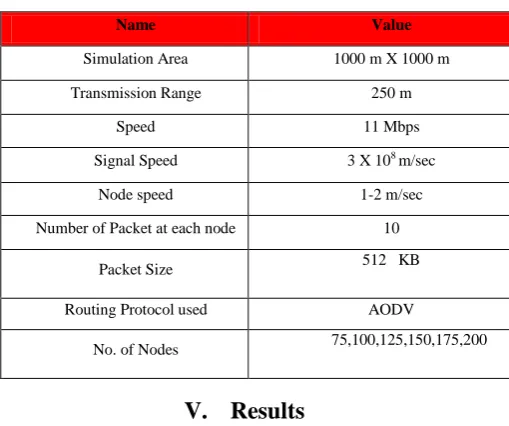
IV. SIMULATION PARAMETERS
We are using a bounded region of 1000m*1000 m, in which we are placing nodes with a uniform distribution. The results are obtained for the various nodes such as
[image:4.595.48.290.50.261.2]75,100,125,150,175,200. We are using signal speed as vac-uum speed and node speed is 1-2 meter/sec. We evaluate our results through Python. The following table summarizes the simulation parameter used.
Table 1: Performance Parameters
Name Value
Simulation Area 1000 m X 1000 m
Transmission Range 250 m
Speed 11 Mbps
Signal Speed 3 X 10⁸ m/sec
Node speed 1-2 m/sec
Number of Packet at each node 10
Packet Size 512 KB
Routing Protocol used AODV
No. of Nodes 75,100,125,150,175,200
V.
Results
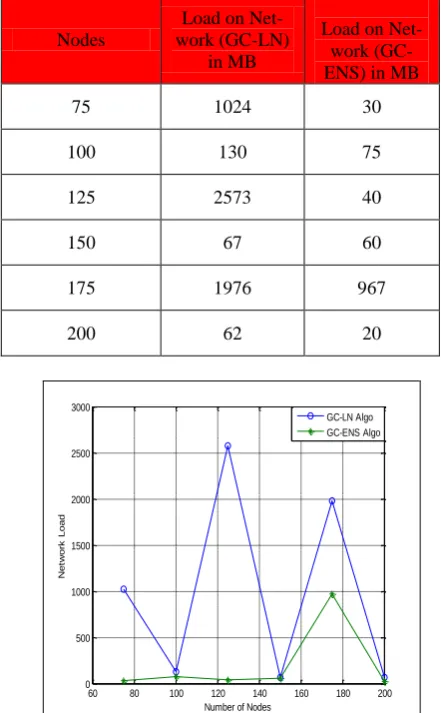
The GBR-CNR with the Efficient Neighbor Selection Al-gorithm (GC-ENS AlAl-gorithm) is implemented. We have obtained three major results like End-to-End delay, Routing Overhead (the number of control messages transferred) and load on Network in MB.
[image:4.595.310.556.59.349.2]The results are given in Table 2.End-to-End Delay refers the maximum time (in seconds or milliseconds) taken from the source device to the destination device for the successful transmission of a packet. As End-to-End Delay in GBR-CNR with an efficient neighbor selection algorithm (GC-ENS Algorithm) is less than End-to-End Delay in GBR-CNR with fewer nodes. So the proposed Algorithm is more efficient because it will take less time to send packets from source to destination. Table 2 explains that the Average End-to-End delay has reduced by 52.54%.
Table 2:End-to-End Delay in GC-LN and GC-ENS Algorithm
Nodes Delay (GC-LN) in ms Delay (GC-ENS) in ms
75 217.392 23.678
100 39.782 38.04
125 92.976 28.559
150 21.9175 11.219
175 176.02 112.183
[image:4.595.41.296.378.591.2]200 32.1985 10.487
Fig 1: Comparative End-to-End Delay graph
The second parameter for compare proposed Algorithm with GBR-CNR less nodes algorithm is the Routing Over-head (total number of control messages transferred) to find a route and send data from source to destination. Thus, the higher the number of overhead messages transmitted, the higher the amount of energy consumed. It shows that due to fewer control messages transferred in the proposed algo-rithm, congestion and packet loss will reduce and the pro-posed algorithm will work more efficiently. So, the propro-posed algorithm (GBR-CNR Efficient Neighbor selection algo-rithm) consumes less power and energy than the GBR-CNR less nodes algorithm. Average Routing Overhead of the proposed algorithm has reduced 60.545% as a comparison to GBR-CNR with a less node algorithm. Table 3 and fig 2 shows that GC-ENS algorithm is much more Energy Effi-cient algorithm.
Table 3 Number of Control Messages Transferred (Routing Overhead) in GC-LN and GC-ENS Algorithm
Nodes
No. of Control Messages trans-ferred(GC-LN)
No. of Control Messages transferred
(GC-ENS)
75 204 6
100 26 15
125 514 8
150 13 12
175 395 193
200 12 4
60 80 100 120 140 160 180 200
0 50 100 150 200 250
Number of Nodes
D
el
ay
[image:4.595.312.546.577.833.2]International Journal of Innovative Technology and Exploring Engineering (IJITEE) ISSN: 2278-3075, Volume-8 Issue-10, August 2019
Fig.2 Comparative Number of Control Messages Transferred (Routing Overhead) Graph.
[image:5.595.64.274.49.240.2]The third parameter to compare both algorithms is load on the network. It is the total size of packets (in MB) trans-ferred uselessly in the network from source to destination. Table 4 shows that the GC-ENS algorithm will send and receive less packets so traffic on the network will reduce and simultaneously load on the network will reduce. It also de-creases the congestion in the Network. The average load on Network had decreased 61.17% of the proposed algorithm (GC-ENS).
Table 4 Load on Network in GC-LN and GC-ENS Algo-rithm
Nodes
Load on Net-work (GC-LN)
in MB
Load on Net-work (GC-ENS) in MB
75 1024 30
100 130 75
125 2573 40
150 67 60
175 1976 967
200 62 20
Fig.3 Comparative Load on Network Graph
VI.
CONCLUSIONA routing protocol plays an important role in networks. The properly designed algorithm not only improves the quality of services but also becomes more popular among the network providers. This work considers the problem of the selection of neighbors in the AODV routing protocol. The new technique for the selection of neighbors is proposed. The new proposed algorithm is GBR-CNR with the Efficient Neighbor Selection Algorithm (GC-ENS Algorithm). The proposed algorithm for neighbor selection is executed and the outcomes are achieved. In MANET, sender will send the data to its neighbor nodes. By this proposed algorithm, we will not send the data to all its neighbor nodes but we will send the data to only those neighbor nodes which are in the transmission range of the sender, which has minimum number of neighbor nodes and stay time of sender node should be more than the packet transfer time. The results compared with the previous algorithm. We have examined the GBR-CNR efficient nodes selection algorithm using Python with three parameters i.e. End-to-End delay, Routing overhead and Load on Network. A comparative analysis is performed which investigates that the proposed algorithm is
giving better results in all three parameters. The main
contribution of this paper is to select better neighbors than the previous algorithms during the finalize the route from source to destination. The proposed Algorithm (GC-ENS) decrease Average End-to-End delay 52.54%,reduce Average Routing Overhead 60.54% and decline the Average load on Network 61.17%. In the future, the new method based on the node information can be developed that will further enhance the MANET performance.
REFERENCES
1. Dhirendra Kumar Sharma, Amar NathPatra, Chiranjeev Kumar: An
improvement in the performance of mobile ad hoc networks using modified route maintenance, Computers and Electrical Engineering 56 (2016) 300–312
2. Gabriel Mujica, Jorge Portilla, Teresa Riesgo: Performance evaluation of an AODV-based routing protocol implementation by using a novel in-field WSN diagnosis tool, Microprocessors and Microsystems 39(2015) 920-938.
3. J. Kaur, G.Singh: MANET Routing Protocols: A Review, International
Journal of Computer Sciences and Engineering, Volume-5, Issue-3, (2017).
4. Wilder E.Castel lanos, Juan C. Guerri, Pau Arce: QoS-aware routing protocol with adaptive feedback scheme for video streaming for mobile networks, Computer Communications 77, 10–25 (2016).
5. ShobhaTyagi, Subhranil Som, Q. P. Rana: A Reliability-Based Variant
of AODV In MANETs: Proposal, Analysis, And Comparison, 7th In-ternational Conference on Communication, Computing and Virtualiza-tion 2016, Procedia Computer Science 79, 903 – 91 (2016).
6. Jegan Govindasamy, Samundiswary Punniakody , A comparative study
of reactive, proactive and hybrid routing protocol in wireless sensor network Under wormhole attack, , Journal of Electrical Systems and In-formation Technology 163 (2017).
7. Chavan, Prof. D. S. Kurule, Prof. P. U. Dere, Performance Analysis of
AODV and DSDV Routing Protocol in MANET and Modifications in AODV against Black Hole Attack, Procedia Computer Science 79 (2016),835-844.
8. Joydeep Tripathi, Jaudelice C. de Oliveira, J.P. Vasseur, Proactive
versus reactive routing in low power and lossy networks: Performance analysis and Scalability improvements, Ad Hoc Networks 23(2014) 121-144.
60 80 100 120 140 160 180 200
0 100 200 300 400 500 600
Number of Nodes
N
u
m
b
e
r
o
f
C
o
n
tr
o
l
M
e
s
s
a
g
e
s
Tr
a
n
s
fe
rr
e
d
GC-LN Algo GC-ENS Algo
60 80 100 120 140 160 180 200
0 500 1000 1500 2000 2500 3000
Number of Nodes
N
e
tw
o
rk
L
o
a
d
[image:5.595.59.280.405.762.2]9. G. Ravi & K.R. Kashwan, Performance analysis of an energy-aware zone routing protocol using Span, International Journal Of computer and Applications, ISSN: 1206-212X (Print) 1925-(Online), November 2017.
10. Esubalew Yitayal, Jean-Marc Pierson, Dejene Ejigu: A Balanced
Bat-tery Usage Routing Protocol to Maximize Network Lifetime of MANET Based on AODV, Springer. 7th Conference on Internet of Things and Smart Spaces (ruSMART 2014) co-located with 15th Inter-national Conference on Next Generation Wired/Wireless Advanced Networks and System NEW2AN, Aug 2014, St. Petersbourg, Russia. Lecture Notes in Computer Science, pp.266-279 (2014).
11. Bal Krishna Saraswat, Manish Bhardwaj, Analp Pathak, Optimum
Experimental Results of AODV, DSDV & DSR Routing Protocol in Grid Environment, Procedia Computer Science 57 (2015),1359-1366.
12. Jegan Govindasamy, Samundiswary Punniakody: A comparative study
of reactive,proactive and hybrid routing in wireless sensor network un-der wormhole attack,Journal of Electrical systems and information technology(2017).
13. K. Sumathia, A. Priyadharshini: Energy Optimization in MANETs
using On-Demand Routing Protocol, Procedia Computer Science 47, 460 – 470 (2015).
14. Farkhana Muchtar, Abdul Hanan Abdullah, Suhaidi Hassan,
FarhanMasud: Energy conservation strategies in Host Centric Network-ing based MANET: A review, Journal of Network and Computer Ap-plications 111 (2018) 77-98.
15. Pathak S., Jain S. (2013), “A Survey: On Unicast Routing Protocols for
Mobile Ad Hoc Network”, International Journal of Emerging Technol-ogy and Advanced Engineering, V-3, No-1, pp 2459. ISSN: 2250-2459.
16. S.-Y. Pyun, D.-H. Cho: Interference-aware topology control in wireless
mobile ad-hoc networks, in Consumer Communications and Network-ing Conference (CCNC), IEEE, 2012, pp. 376–377 (2012).
17. F. De Rango, F. Veltri, P. Fazio: Interference aware-based ad-hoc on-demand distance vector (IA-AODV) ultra-wideband system routing protocol, Comput. Commun., 34 (12), 1475–1483 (2011).
18. C. Gu, Q. Zhu: Interference aware routing for mobile ad hoc networks
based on node’s sending and receiving capabilities, J. China Univ. Posts Telecommunication., 20(4), 73–79 (2013).
19. M. Khabbazian, S. Durocher, A. Haghnegahdar: Bounding interference
in wireless ad hoc networks with nodes in random position, in G. Even, M.M. Halldórsson (Eds.), Structural Information and Communication Complexity, in Lecture Notes in Computer Science, vol. 7355, Spring-er, Berlin, Heidelberg, pp. 85–98 (2012).
20. R. Hekmat, P. Van Mieghem: Interference in wireless multi-hop ad-hoc
networks and its effect on network capacity, Wireless Network, 10 (4), 389–399 (2004).
21. Y. Zhou, X.-Y. Li, M. Liu, X. Mao, S. Tang, Z. Li: Throughput opti-mizing localized link scheduling for multihop wireless networks under the physical interference model, IEEE Trans. Parallel Distrib. A system, 25 (10), 2708–2720 (2014).
22. W. Yang, X. Yang, S. Yang, D. Yang: A greedy-based stable multi-path
routing protocol in mobile ad hoc networks, Ad Hoc Networks 9, 662– 674 (2011).
23. A. Zadin, T. Fevens: Stable connections using multi-paths and
con-servative neighborhood ranges in mobile ad hoc networks, in 26th An-nual IEEE Canadian Conference on Electrical and Computer Engineer-ing, CCECE, 2013, pp. 1–4 (2013).
24. Ankur Goyal,Dr. Vivek Sharma: Study of position based Greedy
rout-ing algorithm with interference in the MANET, in 2nd international
con-ference on emerging trends in Engineering and Applied Science (ICETEAS,19),ISSN:2454-4248,pp 04-06(2019).
25. A. Zadin, T. Fevens: Neighborhood based interference minimization for
stable position based routing in mobile ad hoc network, future genera-tion computer systems 64(2016) 88-97.
26. Pathak, S. & Jain, S., ‘Comparative Study of Clustering Algorithms for
MANETs ‘, Journal of Statistics and Management Systems (JSMS),
Taylor Francis (2019) Vol.22 No 4, pp. 653–664.
DOI: 10.1080/09720510.2019.1609723.
27. Pathak, S. and Jain, S.(2019) ‘A priority-based weighted clustering algorithm for mobile ad hoc network’, International Journal of Commu-nication Networks and Distributed Systems, 2019 Vol.22 No.3, pp.313 – 328. DOI: 10.1504/IJCNDS.2019.098872.
28. Pathak, S. & Jain, S., ‘An optimized stable clustering algorithm for mobile ad hoc networks‘, EURASIP Journal on Wireless Communica-tions and Networking, Springer Link, 2017: 51. DOI: 10.1186/s13638-017-0832-4.
29. Pathak S, Jain S, “A novel weight based clustering algorithm for
rout-ing in MANET”, Wireless Networks-The Journal of Mobile Communi-cation, Computation and Information, Springer Link, November 2016, Volume 22, Issue-8, pp 2695–2704. DOI: 10.1007/s11276-015-1124-8.
Author profile
Ankur Goyal is pursuing Ph D from jagannath University, Jaipur, India from 2016 in Department of Computer Science & Engineering,. He received his M Tech degree in Computer Engineering from Rajasthan Technical University, Kota, India in 2011-12. His area of interest includes routing proto-col, security, and mobile ad-hoc network, computer networks, Data structure and Algorithm and pro-gramming languages. He has published many re-search papers in National, International Conferences and Journals. He has more than 15 years of teaching experiences of gradu-ate and post gradugradu-ate Students of Engineering.