InTrans Project Reports Institute for Transportation
5-2012
Development of LRFD Procedures for Bridge Piles
in Iowa—Volume IV: Design Guide and Track
Examples
Donald Green Michael Baker Jr., Inc. Kam W. Ng Iowa State University Kenneth F. Dunker Sri SritharanIowa State University, [email protected]
Michael Nop
Follow this and additional works at:http://lib.dr.iastate.edu/intrans_reports
Part of theCivil Engineering Commons, and theStructural Engineering Commons
This Report is brought to you for free and open access by the Institute for Transportation at Iowa State University Digital Repository. It has been accepted for inclusion in InTrans Project Reports by an authorized administrator of Iowa State University Digital Repository. For more information, please [email protected].
Recommended Citation
Green, Donald; Ng, Kam W.; Dunker, Kenneth F.; Sritharan, Sri; and Nop, Michael, "Development of LRFD Procedures for Bridge Piles in Iowa—Volume IV: Design Guide and Track Examples" (2012).InTrans Project Reports. 34.
Development of LRFD Procedures for Bridge Piles in Iowa—Volume IV:
Design Guide and Track Examples
Abstract
With the goal of producing engineered foundation designs with consistent levels of reliability as well as fulfilling the Federal Highway Administration (FHWA) mandate that all new bridges initiated after October 1, 2007 be designed according to the Load and Resistance Factor Design (LRFD) approach, the Iowa Highway Research Board (IHRB) sponsored three research projects on driven piles (TR-573, -583 and -584). The research outcomes are presented in three reports entitled Development of LRFD Design Procedures for Bridge Piles in Iowa, Volumes I, II, and III, and other research information is available on the project web site at http://srg.cce.iastate.edu/lrfd/.
Upon incorporating the regional LRFD recommendations from the completed research into the Iowa DOT Bridge Design Manual (2010) as it is being rewritten under the new title of LRFD Bridge Design Manual (December 2011), and adopting the American Association of State Highway and Transportation Officials (AASHTO) LRFD Bridge Design Specifications (2010), this Volume IV for driven piles in Iowa was developed.
Following the layout of a design guide, the application of the LRFD approach is demonstrated using various pile design examples in three different tracks, which depend on the construction control method used for establishing the pile driving criteria. Piles are designed using the Iowa Blue Book method. The pile driving criteria are established using the Wave Equation Analysis Program (WEAP) in Track 1, the modified Iowa Engineering News Record (ENR) formula in Track 2, and the combination of WEAP and the Pile Driving Analyzer (PDA) with a subsequent pile signal matching analysis using the CAse Pile Wave Analysis Program (CAPWAP) in Track 3.
The track examples cover various pile types, three different soil profiles (cohesive, non-cohesive, and mixed) and special design considerations (piles on rock, scouring, downdrag, and uplift).
Keywords
Civil Construction and Environmental Engineering, BEC, CAPWAP, driven bridge piles, load and resistance factor design, modified Iowa ENR formula, PDA, WEAP
Disciplines
Development of LRFD Procedures for
Bridge Pile Foundations in Iowa
Final Report
May 2012
Sponsored by
Iowa Highway Research Board
About the Bridge Engineering Center
The mission of the Bridge Engineering Center (BEC) is to conduct research on bridge
technologies to help bridge designers/owners design, build, and maintain long-lasting bridges.
About the Institute for Transportation
The mission of the Institute for Transportation (InTrans) at Iowa State University is to develop and implement innovative methods, materials, and technologies for improving transportation efficiency, safety, reliability, and sustainability while improving the learning environment of students, faculty, and staff in transportation-related fields.
Disclaimer Notice
The contents of this report reflect the views of the authors, who are responsible for the facts and the accuracy of the information presented herein. The opinions, findings and conclusions expressed in this publication are those of the authors and not necessarily those of the sponsors.
The sponsors assume no liability for the contents or use of the information contained in this document. This report does not constitute a standard, specification, or regulation.
The sponsors do not endorse products or manufacturers. Trademarks or manufacturers’ names appear in this report only because they are considered essential to the objective of the document.
Non-Discrimination Statement
Iowa State University does not discriminate on the basis of race, color, age, religion, national origin, sexual orientation, gender identity, genetic information, sex, marital status, disability, or status as a U.S. veteran. Inquiries can be directed to the Director of Equal Opportunity and Compliance, 3280 Beardshear Hall, (515) 294-7612.
Iowa Department of Transportation Statements
Federal and state laws prohibit employment and/or public accommodation discrimination on the basis of age, color, creed, disability, gender identity, national origin, pregnancy, race, religion, sex, sexual orientation or veteran’s status. If you believe you have been discriminated against, please contact the Iowa Civil Rights Commission at 800-457-4416 or Iowa Department of Transportation’s affirmative action officer. If you need accommodations because of a disability to access the Iowa Department of Transportation’s services, contact the agency’s affirmative action officer at 800-262-0003.
The preparation of this document was financed in part through funds provided by the Iowa Department of Transportation through its “Agreement for the Management of Research Conducted by Iowa State University for the Iowa Department of Transportation,” and its amendments.
Technical Report Documentation Page
1. Report No. 2. Government Accession No. 3. Recipient’s Catalog No.
IHRB Projects TR-573, TR-583, and TR-584
4. Title and Subtitle 5. Report Date
Development of LRFD Procedures for Bridge Piles in Iowa – Volume IV: Design Guide and Track Examples
May 2012
6. Performing Organization Code
7. Author(s) 8. Performing Organization Report No.
Donald Green, Kam W. Ng, Kenneth F. Dunker, Sri Sritharan, andMichael Nop InTrans Projects 07-294, 08-312, and 08-313
9. Performing Organization Name and Address 10. Work Unit No. (TRAIS)
Bridge Engineering Center Iowa State University
2711 South Loop Drive, Suite 4700 Ames, IA 50010-8664
11. Contract or Grant No.
12. Sponsoring Organization Name and Address 13. Type of Report and Period Covered
Iowa Highway Research Board Iowa Department of Transportation 800 Lincoln Way
Ames, IA 50010
Final Report
14. Sponsoring Agency Code
15. Supplementary Notes
Visit www.intrans.iastate.edu for color pdfs of this and other research reports.
16. Abstract
With the goal of producing engineered foundation designs with consistent levels of reliability as well as fulfilling the Federal Highway Administration (FHWA) mandatethat all new bridges initiated after October 1, 2007 be designed according to the Load and Resistance Factor Design (LRFD) approach, the Iowa Highway Research Board (IHRB) sponsored three research projects on driven piles (TR-573, -583 and -584). The research outcomes are presented in three reports entitled Development of LRFD Design Procedures for Bridge Piles in Iowa, Volumes I, II, and III, and other research information is available on the project web site at http://srg.cce.iastate.edu/lrfd/.
Upon incorporating the regional LRFD recommendations from the completed research into the Iowa DOT Bridge Design Manual (2010) as it is being rewritten under the new title of LRFD Bridge Design Manual (December 2011), and adopting the American Association of State Highway and Transportation Officials (AASHTO) LRFD Bridge Design Specifications (2010), this Volume IV for driven piles in Iowa was developed.
Following the layout of a design guide, the application of the LRFD approach is demonstrated using various pile design examples in three different tracks, which depend on the construction control method used for establishing the pile driving criteria. Piles are designed using the Iowa Blue Book method. The pile driving criteria are established using the Wave Equation Analysis Program (WEAP) in Track 1, the modified Iowa Engineering News Record (ENR) formula in Track 2, and the combination of WEAP and the Pile Driving Analyzer (PDA) with a subsequent pile signal matching analysis using the CAse Pile Wave Analysis Program (CAPWAP) in Track 3.
The track examples cover various pile types, three different soil profiles (cohesive, non-cohesive, and mixed) and special design considerations (piles on rock, scouring, downdrag, and uplift).
17. Key Words 18. Distribution Statement
CAPWAP—driven bridge piles—load and resistance factor design—modified Iowa ENR formula—PDA—WEAP
No restrictions.
19. Security Classification (of this report)
20. Security Classification (of this page)
21. No. of Pages 22. Price
Unclassified. Unclassified. 162 NA
Development of LRFD Procedures for Bridge
Piles in Iowa – Volume IV: Design Guide and
Track Examples
Final Report May 2012
Principal Investigator
Sri Sritharan
Wilson Engineering Professor
Department of Civil, Construction, and Environmental Engineering, Iowa State University
Post-doctoral Research Associate
Kam Weng Ng
Consultants
Donald Green and Scott D. Zang Michael Baker Jr., Inc.
Authors
Donald Green, Kam W. Ng, Kenneth F. Dunker, Sri Sritharan, and Michael Nop
Sponsored by
The Iowa Highway Research Board (IHRB Projects TR-573, TR-583, and TR-584)
Preparation of this report was financed in part
through funds provided by the Iowa Department of Transportation through its research management agreement with the
Institute for Transportation
(In Trans Projects 07-294, 08-312, and 08-313)
A report from
Institute for Transportation Iowa State University
2711 South Loop Drive, Suite 4700 Ames, IA 50010-8664
TABLE OF CONTENTS
ACKNOWLEDGMENTS ... ix
EXECUTIVE SUMMARY ... xi
CHAPTER 1. INTRODUCTION ...1
CHAPTER 2. DESIGN GUIDANCE AND OVERVIEW OF TRACK EXAMPLES ...5
2.1. General ...5
2.2. Track Concept ...5
2.3. Pile Design and Construction Steps ...7
2.4. Standardized CADD Note Templates ...9
2.5. Overview of Design Examples ...12
CHAPTER 3. TRACK 1 EXAMPLES FOR LRFD USING THE WEAP CONSTRUCTION CONTROL METHOD...16
3.1. Track 1 Example 1: Driven H-Pile in Cohesive Soil with Construction Control Based on Wave Equation and No Planned Retap ...16
3.2. Track 1 Example 2: Driven H-Pile in Mixed Soil with Scour, Construction Control Based on Wave Equation, and No Planned Retap ...32
3.3. Track 1 Example 3: Driven H-Pile in Cohesive Soil with Downdrag, Construction Control Based on Wave Equation, and No Planned Retap ...41
3.4. Track 1 Example 4: Driven H-Pile in Sand with Uplift Load, Construction Control Based on Wave Equation, and No Planned Retap ...51
3.5. Track 1 Example 5: Driven H-Pile in Cohesive Soil to Bedrock, Construction Control Based on Wave Equation, and No Planned Retap ...60
3.6. Track 1 Example 6: Driven Pipe Pile in Non-Cohesive Soil with Scour, Construction Control Based on Wave Equation, and No Planned Retap (prepared by Iowa DOT) ...68
3.7. Track 1 Example 7: Driven Prestressed Concrete Pile in Non-Cohesive Soil with Scour, Construction Control Based on Wave Equation, and No Planned Retap (prepared by Iowa DOT) ...75
CHAPTER 4. TRACK 2 EXAMPLES FOR LRFD USING THE MODIFIED IOWA ENR FORMULA ...83
4.1. Track 2 Example 1: Driven H-Pile in Cohesive Soil with Construction Control Based on Modified Iowa ENR Formula and No Planned Retap ...83
4.2. Track 2 Example 2: Driven Timber Pile in Non-Cohesive Soil with Construction Control Based on Modified Iowa ENR Formula and No Planned Retap (prepared by Iowa DOT) ...97
CHAPTER 5. TRACK 3 EXAMPLES FOR SPECIAL PROJECTS ...105
5.1. Track 3 Example 1: Driven H-Pile in Cohesive Soil with Construction Control Based on PDA/CAPWAP and Wave Equation with No Planned Retap ...105
CHAPTER 6. SUMMARY ...128
REFERENCES ...131
NOTATIONS ...133
APPENDIX A. UNIT GEOTECHNICAL RESISTANCE ...135
APPENDIX B. GENERALIZED SOIL CATEGORY ...138
APPENDIX C. RESISTANCE FACTORS ...140
APPENDIX D. SETUP FACTOR CHART ...143
APPENDIX E. DERIVATION OF EQUATIONS FOR PILE DRIVING RESISTANCE AT EOD (REOD) THAT ACCOUNTS FOR PILE SETUP WITH NO PLANNED RETAP ...144
APPENDIX F. RECOMMENDATIONS FOR DRIVING STEEL H-PILES INTO ROCK ...146
APPENDIX G. ADDITIONAL RECOMMENDATIONS FROM THE BLUE BOOK ...147
LIST OF FIGURES
Figure 2.1. Construction control flow chart for end bearing piles in all soil types and friction
piles embedded in non-cohesive and mixed soil types ...8
Figure 2.2. Construction control flow chart for friction piles embedded in cohesive soil and retap performed after EOD ...8
Figure 3.1. Track 1 Example 1: Soil profile ...18
Figure 3.2. Track 1 Example 1: Pile arrangement at an abutment ...19
Figure 3.3. Track 1 Example 1: Plot of nominal geotechnical resistance versus depth ...23
Figure 3.4. Track 1 Example 1: Pile setup factor chart ...25
Figure 3.5. Track 1 Example 1: General WEAP bearing graph ...28
Figure 3.6. Track 1 Example 1: WEAP bearing graph for west abutment piles...30
Figure 3.7. Track 1 Example 1: Pile driving log...31
Figure 3.8. Track 1 Example 2: Soil profile ...34
Figure 3.9. Track 1 Example 2: Pile arrangement at a pier ...35
Figure 3.10. Track 1 Example 3: Soil profile ...43
Figure 3.11. Track 1 Example 3: Pile arrangement at an abutment ...44
Figure 3.12. Track 1 Example 3: Pile setup factor chart ...48
Figure 3.13. Track 1 Example 4: Soil profile ...53
Figure 3.14. Track 1 Example 4: Pile arrangement at pile piers...54
Figure 3.15. Track 1 Example 5: Pile arrangement at an abutment ...62
Figure 3.16. Track 1 Example 5: Pile setup factor chart ...65
Figure 4.1. Track 2 Example 1: Soil profile ...85
Figure 4.2. Track 2 Example 1: Pile arrangement at an abutment ...86
Figure 4.3. Track 2 Example 1: Pile setup factor chart ...92
Figure 4.4. Track 2 Example 1: Pile driving log...95
Figure 5.1. Track 3 Example 1: Soil profile ...107
Figure 5.2. Track 3 Example 1: Pile arrangement at an abutment ...108
Figure 5.3. Track 3 Example 1: A plot of nominal geotechnical resistance versus depth ...113
Figure 5.4. Track 3 Example 1: Pile setup factor chart ...115
Figure 5.5. Track 3 Example 2: Pile arrangement at an abutment ...120
Figure 5.6. Track 3 Example 2: Pile setup factor chart ...123
Figure 5.7. Track 3 Example 2: WEAP bearing graph for the west abutment ...125
Figure 5.8. Track 3 Example 2: Pile driving log...127
LIST OF TABLES
Table 2.1. Overview of LRFD examples organized by track in Chapters 3 through 5 ...6
Table 2.2. Summary of pile design and construction steps...7
Table 2.3. Summary of track examples ...12
Table 3.1. Track 1 Example 1: Design and construction steps ...16
Table 3.2. Track 1 Example 1: BDM geotechnical resistance chart ...20
Table 3.3. Track 1 Example 1: Estimated nominal geotechnical resistance ...21
Table 3.4. Track 1 Example 1: Soil classification table ...22
Table 3.5. Track 2 Example 2: Design and construction steps ...32
Table 3.6. Track 1 Example 2: Estimated nominal geotechnical resistance ...36
Table 3.7. Track 1 Example 3: Design and construction steps ...41
Table 3.8. Track 1 Example 3: Estimated nominal geotechnical resistance ...45
Table 3.9. Track 1 Example 4: Design and construction steps ...51
Table 3.10. Track 1 Example 4: Estimated nominal geotechnical resistance ...55
Table 3.11. Track 1 Example 5: Design and construction steps ...60
Table 3.12. Track 1 Example 5: Estimated nominal geotechnical resistance ...63
Table 3.13. Track 1 Example 6: Design and construction steps ...68
Table 3.14. Track 1 Example 6: Estimated nominal geotechnical resistance ...70
Table 3.15. Track 1 Example 7: Design and construction steps ...75
Table 3.16. Track 1 Example 7: Estimated nominal geotechnical resistance ...77
Table 4.1. Track 2 Example 1: Design and construction steps ...83
Table 4.2. Track 2 Example 1: Estimated nominal geotechnical resistance ...87
Table 4.3. Track 2 Example 2: BDM geotechnical resistance chart ...88
Table 4.4. Track 2 Example 1: Soil classification table ...89
Table 4.5. Track 2 Example 2: Design and construction steps ...97
Table 4.6. Track 2 Example 2: Estimated nominal geotechnical resistance ...99
Table 5.1. Track 3 Example 1: Design and construction steps ...105
Table 5.2. Track 3 Example 1: Estimated nominal geotechnical resistance ...109
Table 5.3. Track 3 Example 1: BDM geotechnical resistance chart ...110
Table 5.4. Track 3 Example 1: Soil classification table ...111
Table 5.5. Track 3 Example 2: Design and construction steps ...118
Table 5.6. Track 3 Example 2: Estimated nominal geotechnical resistance ...121
Table A.1. BDM nominal geotechnical end bearing chart ...136
Table A.2. BDM nominal geotechnical side resistance chart ...137
Table B.1. Table of soil classification method ...139
Table C.1. Resistance factors for design of single pile in axial compression for redundant pile groups (contract length) ...141
Table C.2. Resistance factors for design of single pile in axial tension for redundant pile groups (contract length) ...141
Table C.3. Resistance factors for construction control for redundant pile groups ...142
ACKNOWLEDGMENTS
This report is the culmination of three Iowa Highway Research Board (IHRB) Load and
Resistance Factor Design (LRFD) projects (TR-573, -583, and -584). The researchers would like to thank the IHRB and the Iowa Department of Transportation (DOT) for funding these projects and the technical advisory committee (TAC) for their guidance.
The following individuals served on the TAC: Ahmad Abu-Hawash, Dean Bierwagen, Lyle Brehm, Ken Dunker, Kyle Frame, Steve Megivern, Curtis Monk, Michael Nop, Gary Novey, John Rasmussen, and Bob Stanley.
EXECUTIVE SUMMARY
With the goal of producing engineered designs with consistent levels of reliability, the Federal Highway Administration (FHWA) issued a policy memorandum on June 28, 2000 requiring all new bridges initiated after October 1, 2007, to be designed according to the Load and Resistance Factor Design (LRFD) approach. To improve the economy of bridge foundations, the American Association of State Highway and Transportation Officials (AASHTO) allows the development of regional LRFD recommendations that reflect local soil conditions and practices in accordance with the AASHTO LRFD framework.
In response to the FHWA mandate and AASHTO recommendations, the Iowa Highway Research Board (IHRB) sponsored three research projects on driven piles (TR-573, -583, and -584). This research was undertaken by researchers with the Bridge Engineering Center and the Department of Civil, Construction, and Environmental Engineering at Iowa State University.
Complete research outcomes are presented on the project web site at
http://srg.cce.iastate.edu/lrfd/ and in the following three volumes entitled Development of LRFD Procedures for Bridge Pile Foundations in Iowa:
Volume I: An Electronic Database for PIle Load Tests (PILOT)
Volume II: Field Testing of Steel Piles in Clay, Sand, and Mixed Soils and Data
Analysis
Volume III: Recommended Resistance Factors with Consideration of Construction
Control and Setup
Incorporating the LRFD resistance factors developed in Volume III, and adopting the AASHTO LRFD Bridge Design Specifications (2010), design for driven piles in Iowa is presented in this volume. The application of the LRFD approach is demonstrated using several pile design examples in three different tracks, depending on the construction control method chosen for verifying the pile resistance in the field.
In all cases, piles are designed using the Iowa “Blue Book” method as recommended in Volume III. The pile driving criteria are established using the Wave Equation Analysis Program (WEAP) in Track 1, the modified Iowa Engineering News Record (ENR) formula in Track 2, and the combination of WEAP and Pile Driving Analyzer (PDA) with a subsequent pile signal matching analysis using the CAse Pile Wave Analysis Program (CAPWAP) in Track 3.
CHAPTER 1. INTRODUCTION
The Allowable Stress Design (ASD) philosophy has been used for the design of pile foundations for decades in Iowa and the nation. However, this approach does not ensure sufficiently
consistent reliability for pile design and installation. Since the mid-1980s, the Load and Resistance Factor Design (LRFD) approach has been progressively developed to ensure an improved and more uniform reliability of bridge design in the US.
Due to the high variation in soil properties, complexity in soil-pile interaction, and difficulty in accurately predicting pile resistance and driving stresses, the integration of the LRFD approach in pile foundation design and its construction control poses more challenges than those
associated with the superstructure elements.
With the goal of producing engineered designs with consistent levels of reliability for both superstructure and substructure, the Federal Highway Administration (FHWA) issued a policy memorandum on June 28, 2000 requiring all new bridges initiated after October 1, 2007 to be designed according to the LRFD approach. Meanwhile, the American Association of State Highway and Transportation Officials (AASHTO) recommended an LRFD framework and permitted the use of regionally calibrated resistance factors so that the economy of bridge foundations can be improved.
As the first step toward implementing the FHWA mandate, and to ensure a smooth transition from the ASD to the LRFD approach, the Iowa Department of Transportation (DOT)
implemented an interim procedure as a short-term solution to the LRFD mandate.
Next, the regional LRFD procedure was developed for steel H- and timber piles driven into cohesive, non-cohesive, and mixed soils in Iowa. Adequacy of these procedures were verified through three research projects (TR-573, -583, and -584) supported by the Iowa Highway Research Board (IHRB).
In addition to giving consideration to the regional soil conditions, the LRFD approach developed for Iowa also paid attention to the local design and construction practices, so that the familiar approaches could be retained even if they are not the most efficient methods. Consideration was also given to timber piles because of interest in using this pile type in several counties in Iowa for low-volume bridges.
Details can be found at http://srg.cce.iastate.edu/lrfd/ and in the following reports:
Volume I: An Electronic Database for PIle LOad Tests (PILOT) (Roling et al. 2010)
Volume II: Field Testing of Steel Piles in Clay, Sand, and Mixed Soils and Data
Analysis (Ng et al. 2011)
Volume III: Recommended Resistance Factors with Consideration of Construction
Volume I describes the development of PILOT, the user-friendly, quality-assured, electronic database of historical pile load tests conducted in the Iowa from 1966 through 1989. A strict acceptance criterion for each of the three hierarchical pile load test dependability classifications (reliable, usable-static, and usable-dynamic) was imposed to ensure that the resulting data available in PILOT for LRFD regional calibration is of superior quality.
Of the 164 historical steel H-pile records contained within PILOT, 80 were usable for investigations dealing with static analysis methods, while 34 were usable for evaluating the dynamic analysis methods as well as dynamic pile driving formulas. For each pile in the database, the pile capacity was defined using the Davisson’s criterion (1972).
In Volume II, the 10 full-scale field tests on the most commonly used steel H-piles (e.g., HP 10 × 42) conducted throughout Iowa to cover all five geological regions are summarized. These field tests involved detailed site characterization using both in situ subsurface investigations and laboratory soil tests.
Test piles were instrumented with strain gauges and monitored, using the Pile Driving Analyzer (PDA), during pile installations and restrikes that were performed to investigate the influence of pile setup. After completing all re-strikes on the test piles, vertical static load tests were
performed on test piles following the “Quick Test” procedure of ASTM D1143 (2007), and the pile capacity in each case was defined using the Davisson’s criterion (1972).
Pile resistances were analyzed using static analysis methods, dynamic driving formulas, the Wave Equation Analysis Program (WEAP), and the CAse Pile Wave Analysis Program
(CAPWAP). Detailed data analyses and the development of pile setup quantification methods are described in Volume II and all data from the field tests were also incorporated in PILOT.
Volume III describes the development of regional LRFD resistance factors following the AASHTO LRFD framework and the incorporation of the construction control aspects and soil setup into the pile design and construction processes. Using the PILOT database and the field test results, resistance factors were calibrated for various static analysis methods.
Among the various methods, the in-house Iowa “Blue Book” method, based on the Geotechnical Resistance Charts (Appendix A), was recommended for design of steel H-piles. Similarly, resistance factors were calibrated for various dynamic formulas, WEAP, and CAPWAP. Following the examination of efficiencies of different methods, the modified Iowa Engineering News Record (ENR) formula, WEAP, and CAPWAP are recommended for the construction control of steel H-piles, while the modified Iowa ENR formula is recommended for the construction control of timber piles.
1. Resistance factors for other pile types, such as prestressed concrete piles and pipe piles
2. Resistance factors for end bearing piles or driven piles on rock
3. LRFD consideration to scour
4. LRFD consideration to downdrag load
5. LRFD recommendation for piles subjected to uplift
However, adopting the AASHTO LRFD Bridge Design Specifications (2010) and the Iowa DOT Bridge Design Manual (2010) as it is being rewritten under the new title of LRFD Bridge Design Manual (December 2011), these special topics are incorporated in this volume to the extent possible, and their design steps are demonstrated in selected examples. It should be expected that these resistance factors are not as efficient as those developed for steel H-piles, summarized in Appendix C, through the completed comprehensive research program.
In addition to these three volumes of reports, additional information with more emphasis on theoretical aspects can be found in a master’s thesis by Roling (2010) and doctoral dissertations by AbdelSalam (2010) and Ng (2011). The research outcomes have also been published in journal papers, including the following:
AbdelSalam et al. (2010b). Current Design and Construction Practices of Bridge Pile
Foundations with Emphasis on Implementation of LRFD.
Roling et al. (2011a). Introduction to PILOT Database and Establishment of LRFD
Resistance Factors for the Construction Control of Driven Steel H-Piles.
Roling et al. (2011b). Load and Resistance Factor Design Calibration for Bridge Pile
Foundations-Investigation of Design and Construction Practices in Iowa County, Iowa, Jurisdictions.
AbdelSalam et al. (2011). LRFD Resistance Factors for Design of Driven H-Piles in
Layered Soils.
AbdelSalam et al. (2012b). Modeling Axially Loaded Friction Steel H-Piles using the
Load-Transfer Approach Based on a Modified Borehole Shear Test.
Ng et al. (2012a). Pile Setup in Cohesive Soil with Emphasis on LRFD: An
Experimental Investigation.
Ng et al. (2012b). Pile Setup in Cohesive Soil with Emphasis on LRFD: Analytical
Quantifications and Design Recommendations.
Ng et al. (2012c). Verification of Recommended Load and Resistance Factor Design
Approach to Pile Design and Construction in Cohesive Soils.
Ng et al. (2012d). A Procedure for Incorporating Pile Setup in Load and Resistance
Factor Design of Steel H-Piles in Cohesive Soils.
Piles are designed using the Iowa “Blue Book” method, and the pile driving criteria are
established using the WEAP, modified Iowa ENR formula, and combination of WEAP and PDA, with a subsequent pile signal matching analysis using CAPWAP. Chapter 2 outlines the concept of the three tracks, includes pile design flow charts, provides the standardized templates and instructions for the Computer-Aided Design and Drafting (CADD) design and driving notes for abutment piles and pier piles, and briefly describes each design example included in the
following three chapters and tracks.
Track 1, which makes up Chapter 3, consists of seven design examples that use WEAP as the construction control method to define the pile driving criteria. The applications of LRFD in three different soil categories (cohesive, non-cohesive, and mixed soils, as defined in Appendix B) are illustrated in Track 1.
Track 2, which is detailed in Chapter 4, consists of two examples that use the modified Iowa ENR formula as the construction control method to define pile driving criteria. The LRFD application to timber piles is also demonstrated in this track.
Track 3, which makes up Chapter 5, demonstrates two design examples for projects that require special construction control procedures using PDA/CAPWAP, WEAP, and/or planned retaps.
CHAPTER 2. DESIGN GUIDANCE AND OVERVIEW OF TRACK EXAMPLES
2.1. General
The background and basis for the resistance factors used in this volume are presented in the Development of LRFD Procedures for Bridge Pile Foundations in Iowa – Volume III: Recommended Resistance Factors with Consideration of Construction Control and Setup (AbdelSalam et al. 2012a).
Volume III includes a discussion of the rationale considered to calibrate resistance factors statistically and to adjust the calibrated resistance factors to maintain uniformity with Iowa DOT pile design practice. Volume III also includes a discussion about how pile setup and construction control are accommodated in the overall design process.
2.2. Track Concept
The design examples in this volume focus on issues related to geotechnical design (and not structural issues) of the pile foundations. The examples present the general procedures for pile foundation design.
Pile setup in cohesive soils (as outlined in Appendix B) and other special considerations, such as scour, downdrag, uplift, and end bearing in bedrock, are addressed in the design examples.
Given driven steel H-piles are mostly used in Iowa, steel H-piles were primarily considered in this volume, while other pile types, such as timber, prestressed concrete, and steel pipe piles, are included in the track examples. For other pile types, the general design procedures remain the same.
Table 2.1. Overview of LRFD examples organized by track in Chapters 3 through 5
Chapter Track LRFD Using Description
3 1 WEAP construction control
(present design method for typical bridges)
The designer determines pile length based on plan-specified WEAP construction control. Only the pile length on the plans (contract length) will be provided and used. Any setup will be included in the original design. The Iowa DOT inspector will be provided a driving graph
determined by a WEAP analysis. Retaps will be used within 24 hours only if bearing is not achieved with contract pile length at end of driving (EOD).
4 2 Modified Iowa ENR formula
construction control (similar to WEAP for typical bridges)
The designer determines pile length based on plan-specified Iowa DOT ENR formula construction control. Only the pile length on the plans (contract length) will be provided and used. Any setup will be included in the original design. The inspector and/or contractor will use the formula to determine driving blow count. Retaps will be used within 24 hours only if bearing is not achieved with contract pile length at EOD.
5 3 Site load test,
PDA/CAPWAP, WEAP, planned retaps, or special procedures (for large bridges and other bridges for which special procedures are appropriate)
2.3. Pile Design and Construction Steps
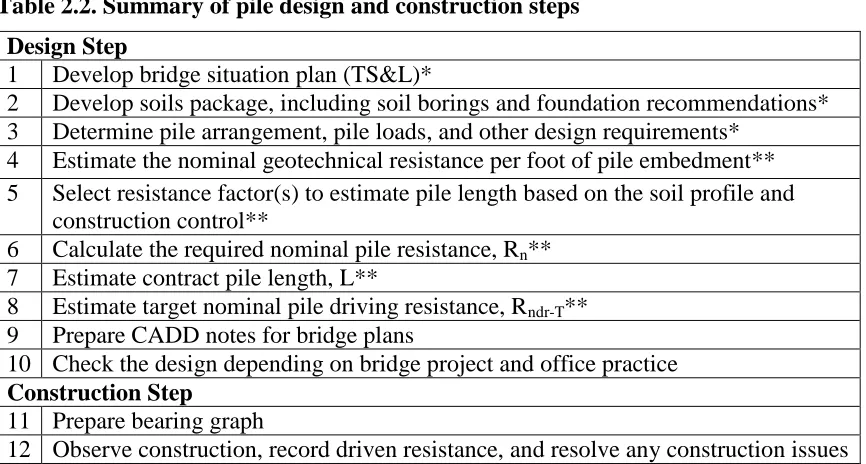
[image:23.612.74.507.166.398.2]All of the design examples in this volume generally follow the same steps, which reflect the real-world design and construction procedures for an Iowa DOT driven pile foundation, as presented in Table 2.2.
Table 2.2. Summary of pile design and construction steps
Design Step
1 Develop bridge situation plan (TS&L)*
2 Develop soils package, including soil borings and foundation recommendations*
3 Determine pile arrangement, pile loads, and other design requirements*
4 Estimate the nominal geotechnical resistance per foot of pile embedment**
5 Select resistance factor(s) to estimate pile length based on the soil profile and
construction control**
6 Calculate the required nominal pile resistance, Rn**
7 Estimate contract pile length, L**
8 Estimate target nominal pile driving resistance, Rndr-T**
9 Prepare CADD notes for bridge plans
10 Check the design depending on bridge project and office practice
Construction Step
11 Prepare bearing graph
12 Observe construction, record driven resistance, and resolve any construction issues
* These steps determine the basic information for geotechnical pile design and vary depending on bridge project and office practice
** These steps are modified in Track 1 Example 5 for piles that are end bearing in bedrock
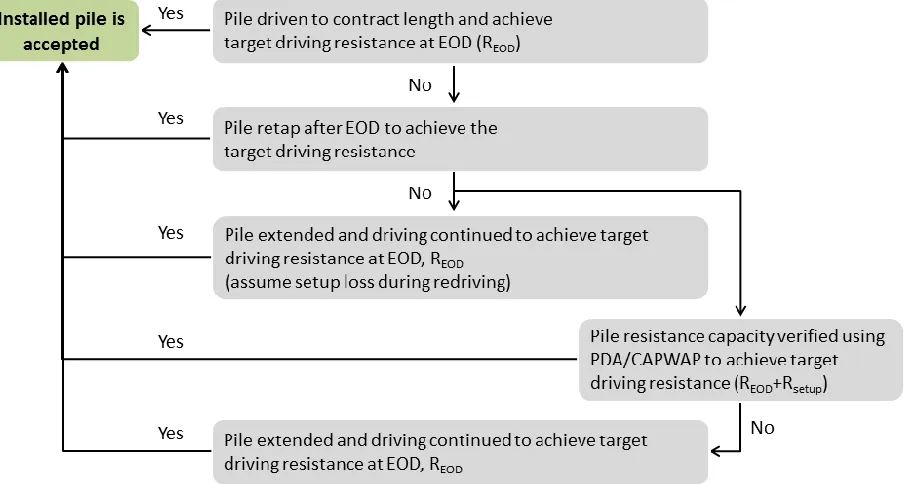
Figure 2.1 shows the construction control flow chart describing the process to be followed during construction to achieve the required nominal bearing resistance for construction control
involving the following:
End bearing pile embedded in all soil types as well as bedrock
Figure 2.1. Construction control flow chart for end bearing piles in all soil types and friction piles embedded in non-cohesive and mixed soil types
Figure 2.2 shows the construction control flow chart describing the process to be followed during construction to achieve the required nominal bearing resistance for construction control
involving friction pile embedded in cohesive soil with setup.
2.4. Standardized CADD Note Templates
The Iowa DOT prepared standardized CADD note templates for use in summarizing and
presenting pile design requirements and driving criteria on drawings and plans. The final design engineer selects the appropriate CADD notes and adds the specific pile load values to the notes.
The Iowa DOT presents pile design and driving notes in all capital letters (as shown below), and the authors of this volume replicate these notes using the same typeface as the Iowa DOT
throughout the remainder of this volume.
The instructions to complete the CADD notes are also provided below (numbered, rather than bulleted).
A list of pertinent notations is included after the References for this volume and before the appendices.
2.4.1 Abutment Piles: Design Note and Instructions
THE CONTRACT LENGTH OF ___ FEET FOR THE ___ ABUTMENT PILES IS BASED ON A ___ SOIL CLASSIFICATION, A TOTAL FACTORED AXIAL LOAD PER PILE (PU) OF ___
KIPS, AND A GEOTECHNICAL RESISTANCE FACTOR (PHI) OF ___ FOR SOIL AND ___ FOR ROCK END BEARING. TO ACCOUNT FOR SOIL CONSOLIDATION UNDER THE NEW FILL, THE FACTORED AXIAL LOAD INCLUDES A FACTORED DOWNDRAG LOAD OF ___ KIPS. ABUTMENT PILES ALSO WERE DESIGNED FOR A FACTORED TENSION FORCE OF ___ KIPS.
THE NOMINAL AXIAL BEARING RESISTANCE FOR CONSTRUCTION CONTROL WAS DETERMINED FROM A ___ SOIL CLASSIFICATION AND A GEOTECHNICAL
RESISTANCE FACTOR (PHI) OF ___ FOR SOIL AND ___ FOR ROCK END BEARING. DESIGN SCOUR (100-YEAR) WAS ASSUMED TO AFFECT THE UPPER ___ FEET OF EMBEDDED PILE LENGTH AND CAUSE ___ KIPS OF DRIVING RESISTANCE.
1. Fill in the contract length (ft).
2. Fill in abutment location (north, east, south, or west) or delete the blank if the note
covers both abutments.
3. Fill in soil classification for design (cohesive, mixed, or non-cohesive).
4. Fill in the total factored axial load per pile (Pu, kips).
5. Fill in the resistance factor (phi) for design in soil. If piles are to be driven to rock,
add the resistance factor (phi) for rock; otherwise, delete the end of the sentence beginning with “for”.
6. If piles are subject to downdrag, fill in the factored downdrag load (kips).
7. Fill in soil classification for construction control (cohesive, mixed, or non-cohesive).
8. Fill in the resistance factor for construction control (phi).
9. If piles were designed for scour, fill in the affected embedded length (ft); otherwise,
2.4.2 Abutment Piles: Driving Note and Instructions
THE REQUIRED NOMINAL AXIAL BEARING RESISTANCE FOR ___ ABUTMENT PILES IS ___ TONS AT END OF DRIVE (EOD). IF RETAPS ARE NECESSARY TO ACHIEVE
BEARING, THE REQUIRED NOMINAL AXIAL BEARING RESISTANCE IS ___ TONS AT ONE-DAY RETAP, ___ TONS AT THREE-DAY RETAP, OR ___ TONS AT SEVEN-DAY RETAP. THE PILE CONTRACT LENGTH SHALL BE DRIVEN AS PER PLAN UNLESS PILES REACH REFUSAL. IN NO CASE SHALL A PILE BE EMBEDDED LESS THAN ___ FEET. CONSTRUCTION CONTROL REQUIRES A WEAP ANALYSIS WITH BEARING GRAPH.
1. Fill in abutment location (north, east, south, or west) or delete the blank if the note
covers both abutments.
2. Fill in end of drive bearing (tons).
3. For clay or mixed sites, fill in retap blanks; for sand sites or piles driven to rock,
delete the retap sentence. If retap is required for construction control, substitute the following sentence:
Piles must be retapped at ___ days with a required nominal axial bearing
resistance of ___ tons.
4. For timber piles, replace the contract length sentence with the following:
The pile contract length shall be driven as per plan unless piles reach a driving
limit of 110 tons.
5. If piles are subject to tension, scour, or other condition requiring a minimum
embedment length, fill in the length (ft); otherwise, delete the sentence.
6. Replace the construction control sentence if a method other than WEAP without
planned retap is to be used. Alternate sentences are as follows:
Construction control requires a modified Iowa DOT formula.
Construction control requires PDA/CAPWAP and a WEAP analysis with
bearing graph.
Construction control requires a WEAP analysis with bearing graph and a retap
at ___ days after EOD.
2.4.3 Pier Piles: Design Note and Instructions
THE CONTRACT LENGTH OF ___ FEET FOR THE ___ PIER PILES IS BASED ON A ___ SOIL CLASSIFICATION, A TOTAL FACTORED AXIAL LOAD PER PILE (PU) OF ___ KIPS,
AND A GEOTECHNICAL RESISTANCE FACTOR (PHI) OF ___ FOR SOIL AND ___ FOR ROCK END BEARING. TO ACCOUNT FOR SOIL CONSOLIDATION, THE FACTORED AXIAL LOAD INCLUDES A FACTORED DOWNDRAG LOAD OF ___ KIPS. PIER PILES ALSO WERE DESIGNED FOR A FACTORED TENSION FORCE OF ___ KIPS.
THE NOMINAL AXIAL BEARING RESISTANCE FOR CONSTRUCTION CONTROL WAS DETERMINED FROM A ___ SOIL CLASSIFICATION AND A GEOTECHNICAL
1. Fill in the contract length (ft).
2. Fill in abutment location (north, east, south, or west) or delete the blank if the note
covers both abutments.
3. Fill in soil classification for design (cohesive, mixed, or non-cohesive).
4. Fill in the total factored axial load per pile (Pu, kips).
5. Fill in the resistance factor (phi) for design in soil. If piles are to be driven to rock,
add the resistance factor (phi) for rock; otherwise, delete the end of the sentence beginning with “for”.
6. If piles are subject to downdrag, fill in the factored downdrag load (kips).
7. Fill in soil classification for construction control (cohesive, mixed, or non-cohesive).
8. Fill in the resistance factor for construction control (phi).
9. If piles were designed for scour, fill in the affected embedded length (ft); otherwise,
delete the sentence.
2.4.4 Pier Piles: Driving Note and Instructions
THE REQUIRED NOMINAL AXIAL BEARING RESISTANCE FOR PIER ___ PILES IS ___ TONS AT END OF DRIVE. IF RETAPS ARE NECESSARY THE REQUIRED NOMINAL AXIAL BEARING RESISTANCE IS ___ TONS AT ONE-DAY RETAP, ___ TONS AT THREE DAY RETAP, OR ___ TONS AT SEVEN DAY RETAP. THE PILE CONTRACT LENGTH SHALL BE DRIVEN AS PER PLAN UNLESS PILES REACH REFUSAL. IN NO CASE SHALL A PILE BE EMBEDDED LESS THAN ___ FEET. CONSTRUCTION CONTROL REQUIRES A WEAP ANALYSIS AND BEARING GRAPH.
1. Fill in pier number (1, 2…) or delete the blank if the note covers all piers.
2. Fill in end of drive bearing (tons).
3. For clay or mixed sites, fill in retap blanks; for sand sites delete retap sentence.
4. For clay or mixed sites, fill in retap blanks; for sand sites or piles driven to rock,
delete the retap sentence. If retap is required for construction control, substitute the following sentence.
Piles must be retapped at ___ days with a required nominal axial bearing
resistance of ___ tons.
5. For timber piles replace the contract length sentence with the following:
The pile contract length shall be driven as per plan unless piles reach a driving
limit of 110 tons.
6. If piles are subject to tension, scour, or other conditions requiring a minimum
embedment length, fill in the length; otherwise delete the sentence.
7. Replace the construction control sentence if a method other than WEAP without
planned retap is to be used. Alternate sentences are as follows:
Construction control requires a modified Iowa DOT formula.
Construction control requires PDA/CAPWAP and a WEAP analysis with
bearing graph.
Construction control requires a WEAP analysis with bearing graph and a retap
2.5. Overview of Design Examples
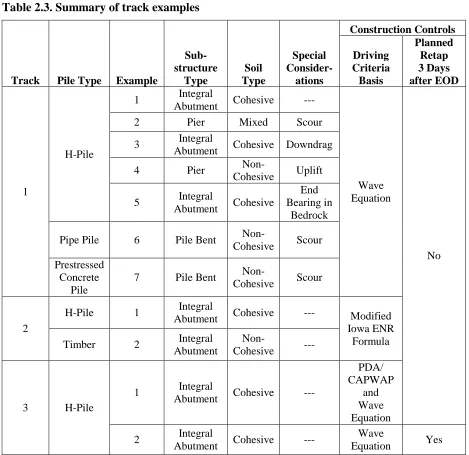
[image:28.612.70.539.238.693.2]This volume currently consists of 11 design examples, which are arranged into three tracks as listed in Table 2.3.
Table 2.3. Summary of track examples
Track Pile Type Example
Sub-structure Type Soil Type Special Consider- ations Construction Controls Driving Criteria Basis Planned Retap 3 Days after EOD 1 H-Pile
1 Integral
Abutment Cohesive ---
Wave Equation
No 2 Pier Mixed Scour
3 Integral
Abutment Cohesive Downdrag
4 Pier
Non-Cohesive Uplift
5 Integral
Abutment Cohesive
End Bearing in
Bedrock
Pipe Pile 6 Pile Bent
Non-Cohesive Scour
Prestressed Concrete
Pile
7 Pile Bent
Non-Cohesive Scour
2
H-Pile 1 Integral
Abutment Cohesive --- Modified Iowa ENR
Formula Timber 2 Integral
Abutment
Non-Cohesive ---
3 H-Pile
1 Integral
Abutment Cohesive ---
PDA/ CAPWAP
and Wave Equation
2 Integral
Abutment Cohesive ---
Wave
The Office of Bridges and Structures policies regarding LRFD for piles are still evolving. In some cases, the design examples in this volume may not illustrate current policies. The designer is responsible for determining up-to-date policies. Each design example is a standalone
document.
The soil classification in this volume (as listed in Table 2.3), as well as throughout the LRFD study, including PILOT, was defined using a 70 percent rule. Accordingly, a site is classified as sand or clay if the corresponding soil type is present more than 70 percent of the pile embedded length, where the soil type for each layer is identified as per the Unified Soil Classification System (USCS). If the percentage of the predominant soil along the pile length is less than 70 percent sand or clay, that site is taken as a mixed soil site.
A brief description of each design example follows.
Track 1 Example 1
As the first example in this volume, this example provides detailed calculations that might not be included in the other examples, such as the following:
Selection of unit nominal resistance based on soil type and SPT N-value
Determination of setup factor for cohesive soil based on average SPT N-value
Determination of nominal driving resistance from blow count during construction
Determination of generalized soil category based on the ratio of pile penetration in
cohesive and non-cohesive layers
Incorporation of setup into driving resistance estimation for cohesive soils
Discussion on pile retap 24 hours after EOD for piles with driving resistance at EOD
less than the required nominal driving resistance
Track 1 Example 2
This example illustrates that for friction pile subject to scour, the contribution to side resistance from the soil above the scour interval should be neglected to estimate the nominal bearing resistance (Design Step 7), while this contribution should be included to estimate driving
resistance (Design Step 8). The increase in the length of the friction pile to account for scour will result in additional driving resistance that must be accounted for when the piles are driven.
Track 1 Example 3
Track 1 Example 4
This design example includes an uplift resistance calculation, in addition to the routine pile axial compression resistance calculation. Resistance factors for uplift are taken as 75 percent of the resistance factors for axial compression resistance.
Track 1 Example 5
This design example is for end bearing piles that are driven through cohesive soil and tipped out in rock. A resistance factor of 0.7 was used for end bearing in rock based on successful past practice with WEAP analysis and the general direction of Iowa LRFD pile testing and research. This design example presents the procedures to calculate pile resistance from a combination of side friction in soil and end bearing in rock. It also demonstrates how to consider the partial setup effect from the side resistance in cohesive soil.
Track 1 Example 6 (Supplemental Design Example prepared by Iowa DOT)
This design example illustrates design of displacement pipe pile that develops frictional resistance in non-cohesive soil at a pile bent that is exposed to possible scour.
Track 1 Example 7 (Supplemental Design Example prepared by Iowa DOT)
This design example is for prestressed concrete friction pile that is driven in non-cohesive soil at a pile bent that is exposed to possible scour.
Track 2 Example 1
This design example demonstrates how to use the modified Iowa ENR formula to estimate nominal pile driving resistance from observed blow counts during pile driving. The only
difference between this design example and Track 1 Example 1 is the construction control. Note that the resistance factors used in this design example are lower than those in Track 1 Example 1, given more uncertainty is involved when using construction control based on the modified Iowa ENR formula rather than a wave equation analysis.
Track 2 Example 2 (Supplemental Design Example prepared by Iowa DOT)
This design example is for timber pile that is driven in non-cohesive soil using the modified Iowa ENR formula for construction control.
Track 3 Example 1
design example is to demonstrate that when more strict construction control is applied, fewer uncertainties are involved given the pile resistance can be field-verified by PDA/CAPWAP tests. Therefore, higher resistance factors can be used, and this results in shorter pile length.
Track 3 Example 2
CHAPTER 3. TRACK 1 EXAMPLES FOR LRFD USING THE WEAP CONSTRUCTION CONTROL METHOD
Track 1 demonstrates the application of the LRFD procedure using WEAP as the construction control method. As briefly described in Chapter 2, seven examples, each having their own special considerations, are presented in this chapter.
Steel H-piles are used in the first five examples, and pipe piles and prestressed concrete piles are used in Examples 6 and 7, respectively. Three different substructure types, integral abutment, pier, and pile bent are considered. Examples 1, 3, and 5 consider the pile LRFD procedures in cohesive soils. Example 2 illustrates the LRFD procedure in mixed soils, while Examples 4, 6, and 7 demonstrate the LRFD applications in non-cohesive soils. The different soil types are described in the Appendix B.
Examples 1 through 5 were prepared based on the outcomes of the three LRFD research projects (Roling et al. 2000, Ng et al. 2011, and AbdelSalam et al. 2012a). Examples 6 and 7 were
provided by Iowa DOT as supplemental design examples.
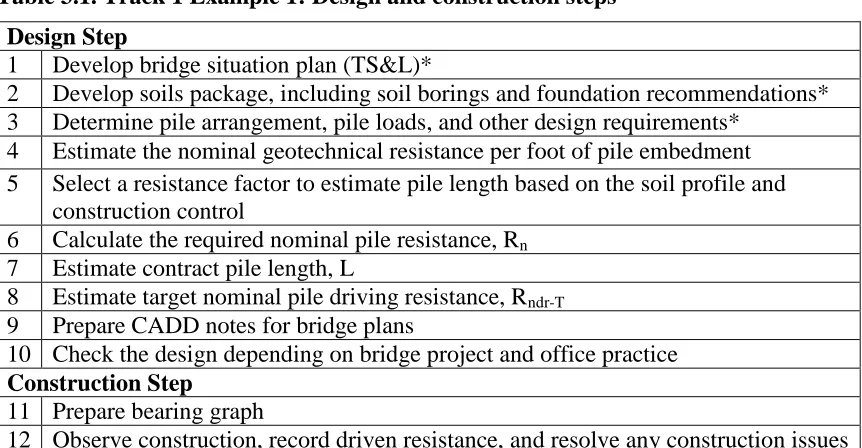
[image:32.612.74.505.392.616.2]3.1. Track 1 Example 1: Driven H-Pile in Cohesive Soil with Construction Control Based on Wave Equation and No Planned Retap
Table 3.1. Track 1 Example 1: Design and construction steps
Design Step
1 Develop bridge situation plan (TS&L)*
2 Develop soils package, including soil borings and foundation recommendations*
3 Determine pile arrangement, pile loads, and other design requirements*
4 Estimate the nominal geotechnical resistance per foot of pile embedment
5 Select a resistance factor to estimate pile length based on the soil profile and
construction control
6 Calculate the required nominal pile resistance, Rn
7 Estimate contract pile length, L
8 Estimate target nominal pile driving resistance, Rndr-T
9 Prepare CADD notes for bridge plans
10 Check the design depending on bridge project and office practice
Construction Step
11 Prepare bearing graph
12 Observe construction, record driven resistance, and resolve any construction issues
* These steps determine the basic information for geotechnical pile design and vary depending on bridge project and office practice
through 3. The steps involve communication among the preliminary design engineer, soils design engineer, and final design engineer.
In other organizations, the basic information may be determined differently, but that process generally should not affect the overall geotechnical design of the pile.
Step 1 – Develop bridge situation plan (or TS&L)
For a typical bridge, the preliminary design engineer plots topographical information, locates the bridge, determines general type of superstructure, location of substructure units, elevations of foundations, hydraulic information (if needed), and other basic information to characterize the bridge. The preliminary design engineer then prepares the TS&L sheet that shows a plan and longitudinal section of the bridge.
For this example, the TS&L gives the following information needed for design of abutment piles:
120 ft, single-span, prestressed concrete beam superstructure
Zero skew
Integral abutments
Pile foundations, no prebored holes (because the bridge length is less than 130 ft)
(BDM 6.5.1.1.1)
Bottom of abutment footing elevation 433 ft
Step 2 – Develop soils package, including soil borings and foundation recommendations
Based on location of the abutments, the soils design engineer orders soil borings (typically at least one per substructure unit). Upon receipt of the boring logs, the engineer arranges for them to be plotted on a longitudinal section, checks any special geotechnical conditions on the site, and writes a recommendation for foundation type with any applicable special design
considerations.
For this example, the recommendations are as follows:
Friction piles that tip out in the firm glacial clay layer
Steel H-piles for the integral abutments
Structural Resistance Level – 1 (which does not require a driving analysis by the
Office of Construction during design (BDM 6.2.6.1))
Normal driving resistance (This will lead to φc = 0.6 for the structural check, which
needs to be performed but is not included in this geotechnical example.)
No special site considerations for stability, settlement, or lateral movement
(Therefore, the Service I load will not be required for design.)
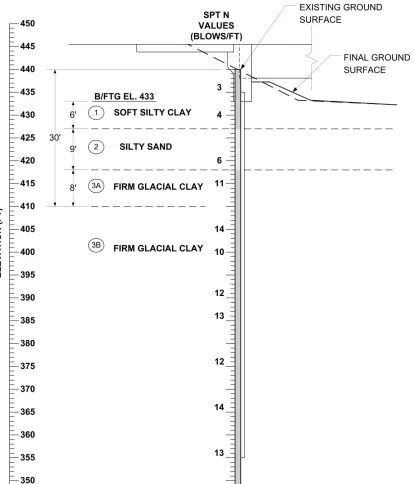
The soil profile shown in Figure 3.1 includes the soil boring at the west abutment. Generally, below the bottom of footing elevation, there are three layers: 6 ft of soft silty clay, 9 ft of silty sand, and firm glacial clay to the bottom of the boring at 95 ft.
Step 3 – Determine pile arrangement, pile loads, and other design requirements
The final design engineer begins design of the abutment piles with the TS&L and the soils design package. Because the bridge has a prestressed concrete beam superstructure and integral
abutments, the engineer selects HP 10×57 piles, following Bridge Design Manual policy (BDM 6.5.1.1.1).
Based on total Strength I abutment load and the Bridge Design Manual policy for pile spacing and number of piles (BDM 6.5.4.1.1), the engineer determines the following:
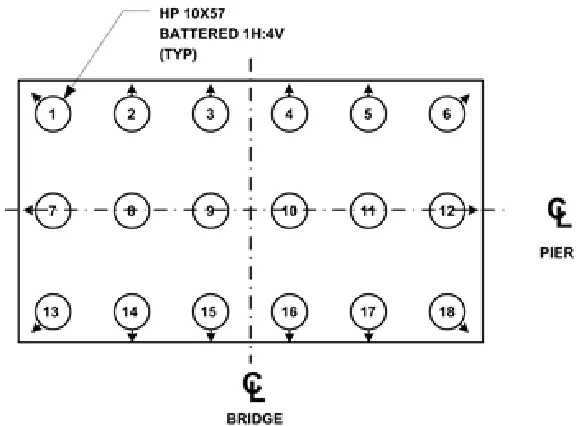
Seven HP 10×57 piles plus two wing extension piles, numbers 1 and 9 in Figure 3.2,
that support the wings only as shown in the figure
Strength I load per pile = 128 kips
No uplift, downdrag, or scour
Standard Iowa DOT construction control based on WEAP analysis and no planned
retap
Figure 3.2. Track 1 Example 1: Pile arrangement at an abutment
Because the bridge characteristics fall within integral abutment policy, the site has no unusual characteristics, the soils design engineer did not require further analysis, and construction will not be accelerated or delayed, there will be no need for lateral load or special analysis of the abutment piles. The piles may be simply designed for vertical load.
Step 4 – Estimate the nominal geotechnical resistance per foot of pile embedment
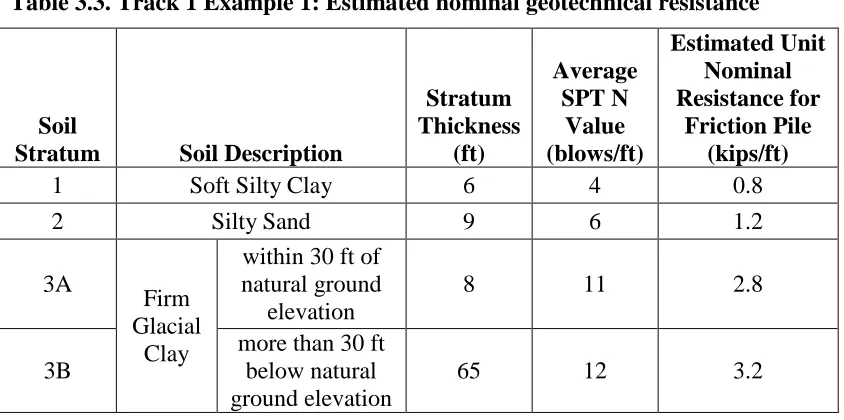
Table 3.3. Track 1 Example 1: Estimated nominal geotechnical resistance
Soil
Stratum Soil Description
Stratum Thickness
(ft)
Average SPT N
Value (blows/ft)
Estimated Unit Nominal Resistance for
Friction Pile (kips/ft)
1 Soft Silty Clay 6 4 0.8
2 Silty Sand 9 6 1.2
3A
Firm Glacial
Clay
within 30 ft of natural ground
elevation
8 11 2.8
3B
more than 30 ft below natural ground elevation
65 12 3.2
The firm glacial clay stratum has been divided into two parts to delineate the embedded pile length that is within 30 ft of the natural ground surface as noted in the BDM geotechnical resistance chart. Application of the chart to estimate the nominal resistance values is illustrated on Table 3.2. Note that the SPT N values are too small for use of end bearing in Layer 3B.
Step 5 – Select a resistance factor to estimate pile length based on the soil profile and construction control
Table 3.4. Track 1 Example 1: Soil classification table
Generalized Soil Category
Soil Classification Method
AASHTO
USDA Textural
BDM 6.2.7 Geotechnical Resistance Chart
C
ohes
ive A-4, A-5,
A-6, and A-7
Clay Silty clay Silty clay loam
Silt Clay loam Silt loam Loam Sandy clay Loess
Very soft silty clay
Soft silty clay
Stiff silty clay Firm silty clay
Stiff silt Stiff sandy clay
G
lac
ial
C
lay
Firm silty glacial clay Firm clay (gumbotil)
Firm glacial clay
Firm sandy glacial clay Firm-very firm glacial clay
Very firm glacial clay Very firm sandy glacial clay
Cohesive or glacial material
N on -C ohes ive A-1, A-2, and A-3 Sandy clay loam Sandy loam Loamy sand Sand A ll uv iu m O r Loe
ss Stiff sandy silt
Silty sand
Clayey sand Fine sand Coarse sand Gravely sand Granular material (N>40)
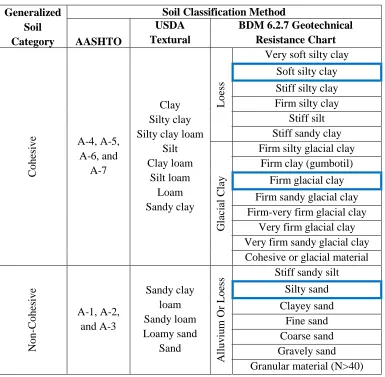
Only the 9 ft Layer two of silty sand is classified as non-cohesive. The remainder of the profile is classified as cohesive, and most likely will represent more than 70 percent of the pile embedment length. Thus, the soil is expected to fit the cohesive classification, and the resistance factor selection from the three available choices below is 0.65.
φ = 0.65 for cohesive soil, averaged over the full depth of estimated pile penetration φ = 0.65 for mixed soil, averaged over the full depth of estimated pile penetration
φ = 0.55 for non-cohesive soil, averaged over the full depth of estimated pile penetration
Step 6 – Calculate the required nominal pile resistance, Rn
The required nominal pile resistance is as follows:
∑
where
∑ηγQ = γQ = 128 kips (Step 3)
γDDDD =0 (no downdrag)
φ = 0.65 (Step 5)
Step 7 – Estimate contract pile length, L
Based on the nominal resistance values in Step 4, the cumulative nominal geotechnical
resistance, Rn-BB, per pile is calculated as follows, where D = depth in feet below the bottom of
footing:
D0 = 0 ft, Rn-BB0 = 0
D1 = 6 ft, Rn-BB1 = Rn-BB0 + (0.8 kips/ft) (6 ft) = 4.8 kips
D2 = 6 + 9 = 15 ft, Rn-BB2 = Rn-BB1 + (1.2 kips/ft) (9 ft) = 4.8 + 10.8 = 15.6 kips
D3 = 15 + 8 = 23 ft, Rn-BB3 = Rn-BB2 + (2.8 kips/ft) (8 ft) = 15.6 + 22.4 = 38.0 kips
D4 = 23 + 65 = 88 ft, Rn-BB4 = Rn-BB3 + (3.2 kips/ft) (65 ft) = 38.0 + 208.0 = 246.0 kips
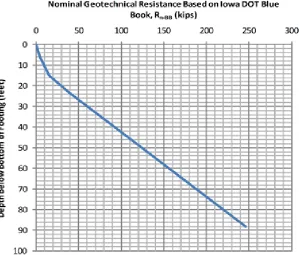
[image:39.612.160.459.427.682.2]A graphic presentation of the estimated nominal geotechnical resistance per pile versus depth is presented in Figure 3.3.
From the graph, the depth below the footing necessary to achieve 197 kips is about 73 ft and may be computed as follows:
DL = 23 + (197-38.0)/3.2 = 73 ft
The contract pile length includes a 2 ft embedment in the footing and a 1 ft allowance for cutoff due to driving damage:
L = 73 + 2 + 1 = 76 ft
The length for steel H-piles is specified in 5 ft increments (BDM 6.2.4.1). Therefore, the contract pile length is 75 ft, with 72 ft embedded.
At this point, the embedded pile length is known and it is necessary to check the resistance factor:
% cohesive soil = [(72-9)/72] (100) = 88% > 70%
Therefore, the resistance factor for cohesive soil is the correct choice.
If the resistance factor were incorrect, the engineer would need to repeat Steps 6 and 7 (although, in this example, the mixed soil classification would not result in numeric changes).
Step 8 – Estimate target nominal pile driving resistance, Rndr-T
For a driven H-pile with no planned retap and use of a WEAP analysis for construction control, the following resistance factors, φ, are recommended to estimate the target nominal pile driving resistance:
φEOD = 0.65 for cohesive soil, averaged over the full depth of estimated pile penetration φSETUP = 0.2 for cohesive soil, averaged over the full depth of estimated pile
penetration
φ = 0.65 for mixed soil, averaged over the full depth of estimated pile penetration
φ = 0.55 for non-cohesive soil, averaged over the full depth of estimated pile penetration
For a normal construction schedule, pile setup at 1 day is the most appropriate choice. Therefore,
the nominal pile resistance during construction, Rn, will be determined at EOD by scaling back
setup gain, and, then, adjusting retaps to account for setup. Refer to Appendix E for more
information on calculating the required nominal resistance at EOD (REOD).
Let Rn = RT = nominal pile resistance at time T (days) after EOD.
∑ ( )
where
∑ = γQ = 128 kips, (Step 2)
γDDDD = 0 (no downdrag)
FSETUP = Setup Ratio = RT/REOD
To determine the setup ratio, the soil profile was used to calculate the average SPT N-value for the cohesive soil layers penetrated by the driven pile over the contract pile length, as follows:
Calculated average SPT N-value = [(6′)(4) + (8′)(11) + (72′-23′)(12)]/(72′-9′) = 11
The average SPT N-value of 11 yields a Setup Ratio, FSETUP, of 1.47 for 1 day retap, 1.55 for 3
day retap and 1.61 for 7 day retap, as shown in Figure 3.4. Refer to Appendix D for more information on the pile setup design chart.
Figure 3.4. Track 1 Example 1: Pile setup factor chart
1.3 1.4 1.5 1.6 1.7 1.8 1.9 2 2.1
0 10 20 30 40 50
F
SETU
P
Average SPT N-value, N
a1-Day
3-Day
7-Day
1.47
11 1.55
Let φTAR = Resistance factor for target nominal resistance ≤ 1.00
= ( ),
and Rndr-T = REOD
The target pile driving resistance at EOD is as follows:
∑
∑ ( )
( ) ( )( )
= 166 kips/pile
The target nominal geotechnical resistance at 1 day retap, then, is as follows:
R1-day = (166.0)(1.47) = 244 kips = 122 tons
The target nominal geotechnical resistance at 3 day retap, then, is as follows:
R3-day = (166.0)(1.55) = 257.3 kips = 129 tons
The target nominal geotechnical resistance at 7 day retap, then, is as follows:
R7-day = (166.0) (1.61) = 267.3 kips = 134 tons
Step 9 – Prepare CADD notes for bridge plans
At this point, the final design engineer selects the appropriate CADD notes and adds the specific pile load values to the notes.
Abutment piles design note
THE NOMINAL AXIAL BEARING RESISTANCE FOR CONSTRUCTION CONTROL WAS DETERMINED FROM A COHESIVE SOIL CLASSIFICATION AND A GEOTECHNICAL RESISTANCE FACTOR (PHI) OF 0.77.
Abutment piles driving note
THE REQUIRED NOMINAL AXIAL BEARING RESISTANCE FOR WEST ABUTMENT PILES IS 83 TONS AT END OF DRIVE (EOD). IF RETAPS ARE NECESSARY TO ACHIEVE BEARING, THE REQUIRED NOMINAL AXIAL BEARING RESISTANCE IS 122 TONS AT ONE-DAY RETAP, 129 TONS AT THREE-DAY RETAP, OR 134 TONS AT SEVEN-DAY RETAP. THE PILE CONTRACT LENGTH SHALL BE DRIVEN AS PER PLAN UNLESS PILES REACH REFUSAL. CONSTRUCTION CONTROL REQUIRES A WEAP ANALYSIS AND BEARING GRAPH.
Step 10 – Check the design
Within the Iowa DOT Office of Bridges and Structures, a final design engineer other than the bridge designer is assigned to give the bridge design an independent check when final plans are complete. During the checking process, the final design engineer reviews the soils package to ensure all recommendations were followed and also checks structural, geotechnical, and drivability aspects of the design.
For this example, only the structural and geotechnical aspects would be checked because pile driving stresses will be relatively low. (For simplicity, the structural design was not shown in this example.)
Other design organizations may perform checks at various stages of design rather than upon plan completion.
---END DESIGN AND BEGIN CONSTRUCTION
PHASE---Step 11 – Prepare bearing graph
After the bridge contract is let and prior to start of pile driving, the contractor completes Hammer Data sheets for use of the planned pile driving hammer. The Hammer Data sheets include all pertinent information including the cap (helmet) number and hammer identification information with details, hammer cushion, and pile cushion (where required), as well as pile size, pile length, and estimated pile driving resistance.
Step 12 – Observe construction, record driven resistance, and resolve any construction issues
During pile driving, the construction inspector records the hammer stroke and number of blows to advance the pile an equivalent penetration of 1 ft, and, then, converts the recorded information with the Driving Graph to record the driven resistance per pile at EOD. This information is shown for this example in the driving log in Figure 3.7.
If the recorded pile driving resistance at EOD is less than the target pile nominal driving resistance, the pile is retapped about 24 hours after EOD. (The retap is a remedial measure that makes use of setup for an individual pile. If the 24 hour retap does not indicate sufficient driven resistance, an extension will be added. An extension is expensive, and the designer should not overestimate the benefit of setup.)
For example, at EOD for the planned pile embedment length at Pile 1, the construction inspector recorded a hammer stroke of 7.5 ft and a blow count of 30 blows per ft for the last foot of pile penetration, as shown on the log. Based on the Driving Graph, the construction inspector recorded a driving resistance of 88 tons, which is greater than the target driving resistance of 83 tons, as shown in Figure 3.6.
Pile 4 illustrates the use of pile retaps. At EOD at Pile 4, the construction inspector recorded a driving resistance of 69 tons, which is less than the target nominal pile driving resistance of 83 tons. Twenty-four hours after EOD, Pile 4 was retapped.
The target nominal driving resistance was increased to account for pile setup by 120 percent (per Appendix C), yielding a retap target nominal driving resistance of 122 tons. The pile driving hammer was warmed up with 20 blows on another pile; after two blows on Pile 4 to set the cap, Pile 4 was retapped 10 blows with a measured driven penetration distance of 2-2/5 in. (10 × 12/2.4 = 50 blows per ft) at a stroke of 8.5 ft.
The Pile 4 retap resulted in a retap driving resistance of 127 tons, which is greater than the retap target driving resistance of 122 tons. The driving log shows that all piles reached the target resistance at contract length with relatively little variation.
If the production pile cannot reach the target nominal pile driving resistance of 122 tons at the retap event, the production pile can be spliced with an extension pile, and redriving can be continued to avoid any delay in construction. At this point, the pile setup resistance initially developed is not taken into account. The pile can be extended until the new field measured pile driving resistance reaches the target nominal driving resistance at EOD of 83 tons estimated in Step 8 and described in the CADD note.
Figure 3.6. Track 1 Example 1: WEAP bearing graph for west abutment piles
3.2. Track 1 Example 2: Driven H-Pile in Mixed Soil with Scour, Construction Control Based on Wave Equation, and No Planned Retap
Table 3.5. Track 2 Example 2: Design and construction steps
Design Step
1 Develop bridge situation plan (TS&L)*
2 Develop soils package, including soil borings and foundation recommendations*
3 Determine pile arrangement, pile loads, and other design requirements*
4 Estimate the nominal geotechnical resistance per foot of pile embedment
5 Select a resistance factor to estimate pile length based on the soil profile and
construction control
6 Calculate the required nominal pile resistance, Rn
7 Estimate contract pile length, L
8 Estimate target nominal pile driving resistance, Rndr-T
9 Prepare CADD notes for bridge plans
10 Check the design depending on bridge project and office practice
Construction Step
11 Prepare bearing graph
12 Observe construction, record driven resistance, and resolve any construction issues
* These steps determine the basic information for geotechnical pile design and vary depending on bridge project and office practice
Within the Iowa DOT Office of Bridges and Structures, the design steps that determine the basic information necessary for geotechnical design of a steel H-pile generally follow Steps 1 through 3. The steps involve communication among the preliminary design engineer, soils design
engineer, and final design engineer.
In other organizations, the basic information may be determined differently, but that process generally should not affect the overall geotechnical design of the pile.
Step 1 – Develop bridge situation plan (or TS&L)
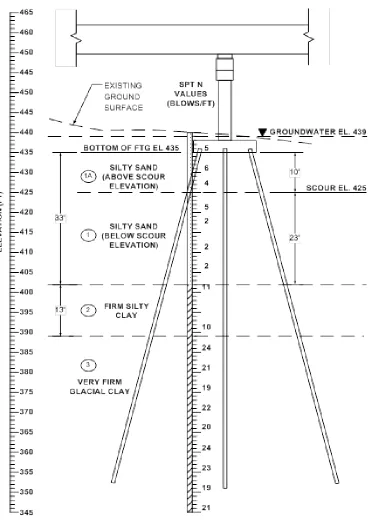
For a typical bridge, the preliminary design engineer plots topographical information, locates the bridge, determines general type of superstructure, location of substructure units, elevations of foundations, hydraulic information (if needed), and other basic information to characterize the bridge. The preliminary design engineer then prepares the TS&L sheet that shows a plan and longitudinal section of the bridge.
For this example, the TS&L gives the following information needed for design of T-pier piles:
208 ft, three-span, prestressed concrete beam superstructure
Zero skew