Collaboration and Community Grids
Geoffrey Fox
Community Grids Laboratory, Computer Science Department and School of Informatics
Indiana University Bloomington
[email protected]
ABSTRACT
We study Grid architectures and relate them to the ideas of collaboration and community networks. We discuss services and architectural principles that support both synchronous and asynchronous collaboration and the integration with community networks and peer-to-peer systems. We identify 18 core features and services that characterize Grid systems. We conclude with a proposed Semantic Scholars’ Grid integrating these concepts to support information discovery and sharing in communities of users.
KEYWORDS: Grids, Collaboration, Community, Services, P2P, Web Services
1. INTRODUCTION
The concept of Collaboration is intuitively obvious but nevertheless not used in consistent fashion by different communities. For example some applications specialize collaboration to either its synchronous or asynchronous form without noting this. Further collaborative systems are often built but not described in these terms. Here we note many community networks and peer-to-peer systems which clearly have significant collaborative properties. In this paper, we try to use a broad net to catch many of the different approaches to collaboration and discuss and illustrate Grid approaches to all of them. The major activities we will highlight in this paper are
1. The traditional Grid problem [1,2] of the sharing of large data and compute resources and the support of international scientific and engineering research teams (e-Science)
2. The Net Centric Environment (NCE) or Net Centric Operations and Warfare (NCOW) target architecture developed for the next generation Department of Defense systems [3-5]
3. The community and social networks exemplified by systems like http://del.icio.us. Wikis, Blogs and the search-enriched Internet
4. Peer-to-peer systems including the related chat systems and forums.
5. e-learning allowing distributed education and more generally collaboratories and portals supporting groups in other areas including software development (the notorious outsourcing) and other global business activities.
[image:1.612.327.533.435.577.2]In section 2, we review and synthesize Grids with a service oriented architecture that captures the experience and practice of the major international Grid projects. This is summarized in the final Table 4 and exemplified in Figs. 4 and 5. This is followed by a discussion in Section 3 of different styles of collaboration and their characteristics. Then section 4 explains how one forms Collaboration and Community Grids based on these general ideas or more precisely on general services.
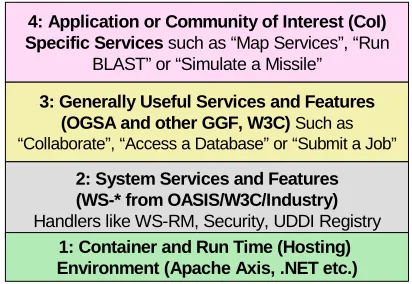
Figure 1. The Grid and Web service Institutional Hierarchy
2. GRID AND WEB SERVICES
Web Service-based SOA systems [6] are built on XML-based service description languages (WSDL) and message formats (SOAP). A review of Web Service concepts is given in [7]. In Fig. 1, we illustrate the current institutional hierarchy of Grid services. We call it “institutional” as the four blocks of service define groups
2: System Services and Features (WS-* from OASIS/W3C/Industry)
Handlers like WS-RM, Security, UDDI Registry
3: Generally Useful Services and Features (OGSA and other GGF, W3C) Such as “Collaborate”, “Access a Database” or “Submit a Job”
4: Application or Community of Interest (CoI) Specific Services such as “Map Services”, “Run
BLAST” or “Simulate a Missile”
of services or service support of increasing specialization as we move up the figure. In an SOA, we are building services, their interactions (namely messages) and the support for the two fundamental concepts of messages and services. At the bottom level we have what is usually called the hosting environment, which forms the virtual machine on which we are building the “distributed service operating system” contained in the next layer. For services constructed from Java, Apache Axis is the usual container and it provides the message processing needed by the multiple services in the container.
H1 H2 H3 H4 Body F1 F2 F3 F4 Service
Container Handlers
Container System Processing
Figure 2. Message Processing in a Container
As shown in Fig. 2, a SOAP message contains multiple headers and a body. The headers are processed by handlers controlled by the container and these capabilities are included in the second level of Fig. 1. They include operations such as security, service addressing, routing, reliability and possibly conveying aspects of state and meta-data. One can consider handlers as the core system services for Web services. The handlers will in general modify the SOAP envelop contents, which are then formatted by the container so that it can be processed by the appropriate service instance. This instance could be implemented as a Java method corresponding to the WSDL-specified XML in the body. Microsoft’s .NET provides similar capabilities for Windows environments. Note that the SOAP messages can be transported by any mechanism for which a binding can be defined. This includes the normal HTTP transport but also may be message-oriented middleware to give environments like those in modern enterprise software environments such as those using IBM’s MQSeries Messaging or Java Messaging Service.
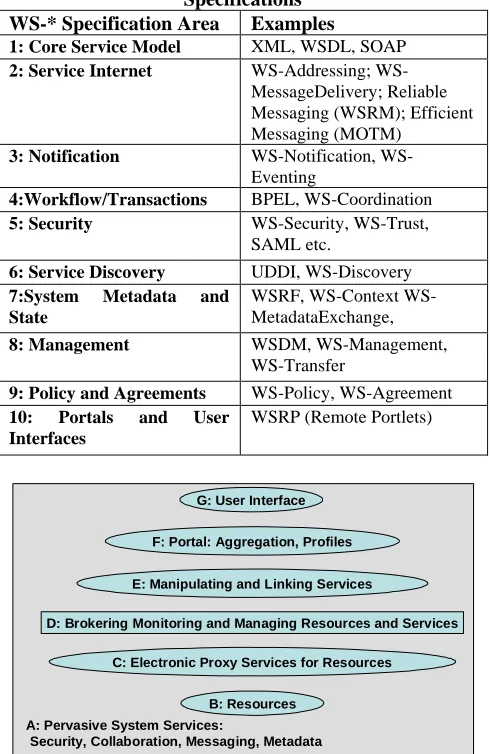
The capabilities described above are needed in all aspects of Web and Grid service implementations and several major international activities aim at setting the standards for the service and handler interfaces. The core level 1 and 2 specifications of Fig. 1 are often called the WS-*. In Table 2, we list the broad areas covered by this process which involves multiple standards agencies (OASIS, W3C, the Global Grid Forum, Distributed Management Task Force) and companies such as IBM and Microsoft working inside and outside the community bodies and in different combinations. There are over 60 WS-* proposal specifications – mostly initiated in the last 4 years – with a coverage indicated in Table 1. Column 1 lists our classification of the area and a very incomplete sample of the proposed specifications for each area are given in column 2. See appendices in [1] for more information.
[image:2.612.313.558.231.608.2]Note that all handler specifications are given in one or more areas of Table 1. However this table also includes system services which are broad in scope and so fit in level 2 but are not processed in handlers. Areas 4 and 10 of Table 1 correspond to workflow and user interfaces – core capabilities but not associated with handlers. This is clarified in Fig. 3 which has a functional Web service hierarchy with pervasive system services like security (termed A in Fig. 3) separated from workflow (in Fig. 3(E) labeled manipulating and linking services) and portals in boxes F and G in Fig. 3.
Table 1: The Ten Areas Covered By the Core WS-* Specifications
WS-* Specification Area Examples
1: Core Service Model XML, WSDL, SOAP
2: Service Internet Addressing; WS-MessageDelivery; Reliable Messaging (WSRM); Efficient Messaging (MOTM)
3: Notification Notification, WS-Eventing
4:Workflow/Transactions BPEL, WS-Coordination
5: Security WS-Security, WS-Trust, SAML etc.
6: Service Discovery UDDI, WS-Discovery
7:System Metadata and State
WSRF, Context WS-MetadataExchange,
8: Management WSDM, WS-Management, WS-Transfer
9: Policy and Agreements WS-Policy, WS-Agreement
10: Portals and User Interfaces
WSRP (Remote Portlets)
B: Resources
C: Electronic Proxy Services for Resources G: User Interface
F: Portal: Aggregation, Profiles
E: Manipulating and Linking Services
A: Pervasive System Services:
Security, Collaboration, Messaging, Metadata
D: Brokering Monitoring and Managing Resources and Services
Figure 3. The Grid and Web service functional hierarchy
throughout any system, and in Table 1 (area 7) and Fig. 3(A), we use the term “system metadata,” which is envisaged as the equivalent of Windows registries or UNIX environments. An important class of system metadata specifies aspects of a service and WSRF, the Web Service Resource Framework is important here [8]. Application metadata [9] is equally critical and normally implemented as a queryable database resource. This would be in the language of Fig. 1, set up as a level 4 domain specific service using a level 3 generic Grid database mechanism like OGSA-DAI [10]. As a further illustration of the uncertainties in rigid classifications, Table 1 has separate entries for service discovery and metadata. In fact service discovery is essentially a query to system metadata and included in grey pervasive system services in Fig. 3.
One should note that of the over 60 WS-* specifications, only a fraction have been refined into agreed standards and of these standards only a few have been broadly adopted. The WS-I, or Web Services Interoperability consortium, is the industry group developing consensus on both the accepted standards and how to use them in a set of profiles. Currently < 10% of the WS-* (namely XML, WSDL, SOAP, UDDI and parts of WS-Security) are endorsed by WS-I. There are often competing specifications for a given capability such as the example of two similar specifications WS-ReliableMessaging and WS-Reliability for reliable messaging. We can expect that as experience grows, specifications will be updated, merged and often dropped as a stable endorsed set emerges. Although this process illustrates the immaturity of the field, this is an open, broad, multi-participant activity. We can expect the resultant set of standards to be highly effective and broadly adopted; characteristics of importance to industry and government agencies but that this result can only occur if a broad but necessarily slow process is adopted. Further, the essentials of the resultant architecture are clear – we are typically debating implementation details.
Quality of service and autonomic self-healing are critical Grid characteristics and there is a serious attempt to deal with this in the Grid as the Service Internet (Table 1-area 2) addresses this for messages. Similarly, service management (Table 1-area 8) can be used to build autonomic services. One important aspect of the Web service architecture is that services and messages (not network drivers and packets) are the primitives. Quality of service is thus defined at a higher level than conventional network approaches and we need to understand how to make these approaches blend properly.
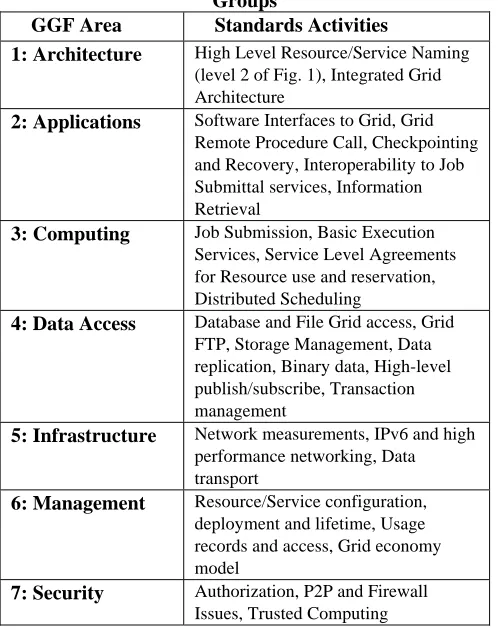
[image:3.612.312.561.262.577.2]Grids assume that the WS-* specifications will mature and be well implemented. Then we need to design and build the services at levels 3 and 4. Correspondingly there are major efforts to design the “important general services” at level 3 and the OGSA (Open Grid Service Architecture) of the Global Grid Forum (GGF) [2] is devoted to this. Note that the community assumes that the first step is to define the open interfaces needed for interoperability for all such common services. The rationale is straightforward as these services cross many application domains (communities of interest) and will involve cooperation between many different developers in business, government and academia.
Table 2: Activities in Global Grid Forum Working Groups
GGF Area Standards Activities
1: Architecture High Level Resource/Service Naming (level 2 of Fig. 1), Integrated Grid Architecture
2: Applications Software Interfaces to Grid, Grid Remote Procedure Call, Checkpointing and Recovery, Interoperability to Job Submittal services, Information Retrieval
3: Computing Job Submission, Basic Execution Services, Service Level Agreements for Resource use and reservation, Distributed Scheduling
4: Data Access Database and File Grid access, Grid FTP, Storage Management, Data replication, Binary data, High-level publish/subscribe, Transaction management
5: Infrastructure Network measurements, IPv6 and high performance networking, Data transport
6: Management Resource/Service configuration, deployment and lifetime, Usage records and access, Grid economy model
7: Security Authorization, P2P and Firewall Issues, Trusted Computing
terms of the GGF work areas given in first column of Table 2 with some examples of their work in column 2.The above table is illustrative of the international activity setting level 3 standards. There is much additional work within individual projects and organizations and within other standards organizations. A good example of the latter is the work of the Open Geospatial Consortium on Geographical Information System (GIS) services [11, 12]. This also illustrates that different communities might classify services into different levels. Sensor-based applications could view GIS as a universal level 3 service and job submittal (a major focus of GGF) as rather specialized and so level 4. Clearly the Global Grid Forum views job processing as central and so far has not looked at GIS in detail.
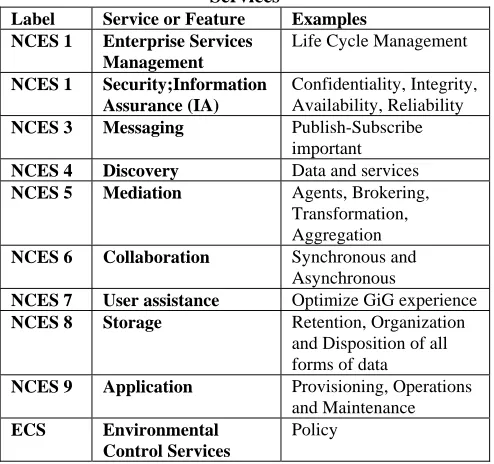
Table 3: Core Global information Grid Net Centric Services
Label Service or Feature Examples NCES 1 Enterprise Services
Management
Life Cycle Management
NCES 1 Security;Information Assurance (IA)
Confidentiality, Integrity, Availability, Reliability
NCES 3 Messaging Publish-Subscribe important
NCES 4 Discovery Data and services
NCES 5 Mediation Agents, Brokering, Transformation, Aggregation
NCES 6 Collaboration Synchronous and Asynchronous
NCES 7 User assistance Optimize GiG experience
NCES 8 Storage Retention, Organization and Disposition of all forms of data
NCES 9 Application Provisioning, Operations and Maintenance
ECS Environmental Control Services
Policy
The US Department of Defense has developed the Net Centric Environment (NCE) as a future architecture for defense information systems with their Global Information Grid (GiG) as the infrastructure on which the NCE is to be deployed. There are nine core services defined for the NCE given in table 3 together with an additional policy layer. Note NCE recognizes the importance (and inevitability) of service oriented architectures but do not define a clear relationship of their architectures to Grid or Web services. Also we note that DoD explicitly identifies collaboration as a core service but this does not directly appear in the earlier tables.
If we synthesize the work of the Grid and NCE communities, we can define in Table 4, a set of 18
features and services that form levels 1, 2 and 3 of Fig. 1 and on which domain specific services (level 4) can be built.
Table 4: 18 Categories of Core Features and Services
Service or Feature
WS-* GS-* NCES Comments
A: Broad Principles FS1: Use SOA: Service Oriented Architecture
WS1 Core Service Model, Build Grids on Web Services. Industry best practice
FS2: Grid of Grids
Strategy for legacy subsystems and modular architecture
B: Core Services FS3: Service Internet, Messaging
WS2 NC3 Streams/Sensors
FS4: Notification WS3 NC3 JMS, MQSeries
FS5 Workflow WS4 NC5 Grid Programming
FS6 : Security WS5 GS7 NC2 Grid-Shib, Permis Liberty Alliance ...
FS7: Discovery WS6 NC4
FS8: System Metadata & State
WS7 Globus MDS
Semantic Grid
FS9: Management WS8 GS6 NC1 CIM
FS10: Policy WS9 ECS
FS11: Portals and User assistance
WS10 NC7 Portlets JSR168,
NCES Capability Interfaces
FS12: Computing GS3
FS13: Data and Storage GS4 NC8 NCOW Data Strategy
FS14: Information GS4 JBI for DoD
FS15: Applications and User Services
GS2 NC9 Standalone Services Proxies for jobs
FS16: Resources and Infrastructure
GS5 Ad-hoc networks
FS17: Collaboration and Virtual Organizations
GS7 NC6 XGSP, Shared
Web Service ports
FS18: Scheduling and matching of Services and Resources
GS3
[image:4.612.55.302.289.521.2]mapping of the messages in the SOAP infrastructure) federates them together as a Grid of Grids. In fact both Grids and services can be considered as entities that consume and produce (SOAP) messages. This idea is illustrated in Fig. 4, which shows sensors Grids and Services around the top, bottom and left of Fig. 4 being treated uniformly with their input and output ports linked together and to other services such as filters (FS15) in a workflow (FS5). Elsewhere [13] we have discussed how this suggests an information architecture (FS14) built around service interfaces in high level domain specific languages such as CellML (Biology), GML (Geographic information systems) or XBML (Military). All sensors, services and Grids have interfaces where domain-specific data, queries and service invocations are expressed in the domain language.
Database SS
SS SS SS SS SS SS SS SS SS FS FS FS FS FS FS FS FS FS FS FS FS FS FS FS FS FS FS FS
FS Porta
l FS OS OS OS OS OS OS OS OS OS OS OS OS M D M D M D M D M D M D M D M D M D
MetaData Filter Service Sensor Service Other Service Another Grid
Raw Data Æ Data Æ Information Æ Knowledge ÆWisdom
Decisions SS SS Another Service Another Service SS Another Grid SS Another Grid SS SS SS SS SS SS SS SS FS SO A
P M essa
[image:5.612.316.553.182.382.2]ges
Figure 4. Grids Sensors and Services lead to Wisdom
Returning to Table 4, we have listed the final nine WS-* categories in FS3 to FS11. These with the exception of systems metadata and state (FS8) correspond to an identified Net Centric core service while the Global Grid Forum has advanced work on security (FS6) and Management (FS9). The level 3 (of Fig. 1) services FS12 to FS18 have GGF activities, and we indicate where they are also Net Centric core services. Note that all the entries in Tables 1 to 3 occur at least once in the WS-*, GS-* or NCES columns of Table 4. Note that even when entries are missing such as in FS8, FS12, FS16 and FS18 for the Net Centric case, there is no doubt that the DoD architectures needs the capabilities of these categories; they were not however highlighted as core services. Further there is a lot of unsaid detail behind the entries in Table 4. For example in the scheduling area FS18, GGF has a major effort for jobs managed typically by service proxies. However, NCE and in fact streaming e-Science applications need the scheduling of networks and services that are often dynamically instantiated.
In Fig. 5, we show how these ideas can be used to build a cluster of related Grids – in this case Chemical Informatics and Bioinformatics re-using multiple common Grids and services. In the top tabs, we show how the common application service framework is specialized to different simulations and filters. The Information Grid (FS14) would also be customized to use CML for Chemistry and SBML/CellML for Biology.
Physical Network (monitored by FS16)
7: Discovery 8:Metadata
BioInformatics Grid Chemical Informatics Grid
…
Domain Specific Grids/Services…
4: Notification
6: Security 3: Messaging 5: Workflow 9: Management
14: Information Instrument/Sensor
12: Computing
Core Low Level Grid Services
9: Management 18: Scheduling 10: Policy
15: Application Services
Screening Tools Quantum
Calculations
15: Application Services
Sequencing Tools Biocomplexity Simulations 11: Portals 17: Collaboration S er v ice s
13: Data Access/Storage
Figure 5. Using the Grid of Grids and core services of Table 4 to build multiple application grids re-using
common components
We somewhat controversially view a service as a special case of a (small) Grid and so we can refer to the components in Fig. 5 as Grids even if they just consist of services. Clearly there could be major subcomponents with the computing (FS12) component including TeraGrid and perhaps other such subGrids spread internationally. Here recent GGF interoperability initiatives are very important. Collaboration, discussed in the following section, is viewed as a Grid of specialized services including everything from white boards and chats to session management. There is also a collaboration framework as part of FS15 that supports collaborative versions of particular applications and services. The GGF community often uses the term Virtual Organizations, or VO, which are for us electronic communities. The GGF VO technology supplies important security capabilities for asynchronous collaboration.
[image:5.612.62.295.273.429.2]running through parameter spaces. We also see in Fig. 5 sensor and instrument services that as in Fig. 4 are constructed so that their output streams are similar to those of filters and simulations and would be viewed as level 4 services or if you prefer a part of FS13. Similarly visualization is very important for many Grids and this would be a level 4 service building on FS11 portals. In many applications we have found a GIS Grid very important [12] as a set of level 4 services. The collaboration and community services discussed in the following sections can either be called part of FS17 or define a subset of themselves as the core FS17 on which to build a suite of level 4 services. At this stage the distinction between the different levels in Fig. 1 is not so important. More interesting is the types of services needed and how they interact together; we join tightly coupled services together into (sub)Grids and compose these for the full Grid with comparatively looser coupling.
3. COLLABORATION SYSTEMS
Collaboration is all about “togetherness” and this involves some form of sharing but there are many variants of this as we will discuss below. Of course communities just describe those that are “together” or who are collaborating. The traditional Grid application involves sharing of computers (such as large supercomputers on the TeraGrid), networks and data repositories. Here there is some togetherness as maybe we need to manage multiple sharing files or computer allocations. However a lot of the problem is separateness as we need to take resources and divide them up to minimize interference between different users. We note that this class of Grid applications extends shared data and file repositories seen in both pervasive technologies like WebDAV and customized systems such as KnowledgeKinetics [14]. The classic Internet exemplifies another form of collaboration where information is posted by one individual or organization and accessed by everybody else or perhaps those selected through some authorization scheme. Simple Internet pages are very important in creating communities with for example the Olympic web pages supporting both the host country and particular groups of sports fans. The page listing my research group’s publications supports the Community Grids Laboratory community; more importantly the exciting field of Bioinformatics is some ways enabled by the many
internet resources like the Protein Data Bank and PubMed. Note in this type of togetherness there are not direct interactions between the members of a community but rather individual to resource and resource (web page and database) to member interactions. An important variant of the shared Internet resource is seen in the many file sharing systems where the original Napster, Gnutella and BitTorrent are representative technologies. It is worth noting that this class of application is a far larger contribution to Internet traffic than all the Grid applications.
Figure 6. Shared Input Port (Replicated WS) Collaboration. UFIO and SFIO are User Facing and
Service Facing Input/Output Ports
There are many interesting community tools starting with email, which is still for instance the dominant form of electronic collaboration in most of my activities. Many community tools are variants of the shared Internet resource but allow ways for multiple people to contribute to that resource. These include venerable bulletin boards, list-serves or forums and more recently Wikis where multiple people can edit a set of web pages. In these and other cases one can either allow a free for all or establish an authorization system to control those who can change or view the site. Blogs are an important variant of a Wiki where typically the basic material is produced by an individual but comments can be made by others. Sites such as http://www.hotornot.com support shared photographs and their annotation. Annotation has proved to be extremely popular in the sites supporting generalized bookmarks with excellent reviews in Refs. [20] and [21]. http://del.icio.us/ supports annotation and sharing of bookmarks while http://www.connotea.org,
http://www.bibsonomy.org/ and
http://www.CiteULike.org add features relevant for
document collections with the latter two supporting the familiar Bibtex constructs. A striking feature of all these sites is their simplicity – the simple keyword annotation chosen by these sites (and their customers) is a far cry from the sophistication of RDF and certainly OWL in the Semantic Web. Such community tools are customized for different domains and applications as for example LinkedIn http://www.linkedin.com, which uses metadata to form people networks (i.e. communities). Tools such as Citeseer and Google Scholar identify citations in articles and so can form communities (and hence collaborations) by identifying people with common interests. More generally domain-specific web crawlers can link documents by common application meta-data and so link both the authors and subjects of the web resources. We are exploring this in Chemical Informatics
http://www.chembioGrid.org where the labels (names) of
chemical compounds allow this linkage. Applications like
e-learning or e-business need a mix of above basic collaboration models. For example e-learning might use a mix of synchronous delivery (using in simple cases shared PowerPoint and audio-video conferencing) and an asynchronous learning management system.
[image:7.612.324.539.169.284.2]4. COLLABORATION GRIDS
Figure 7. Shared Output Port (Single WS) Collaboration that is possible at any point on visualization pipeline
In this section, we discuss Grid architectures supporting collaboration and communities. First we recall the simple idea [16] [22] allowing the sharing of Web services. This is shown in Figs. 6 and 7 for the two basic cases of replicated or single services. We exploit the definition of a Web Service which implies that it is defined by its input messages and exhibits the impact of the input messages on its output ports. In Fig. 6 – termed MMMV (Multiple Model Multiple View) by Qiu [16] – we instantiate mutiple identical services. We can ensure that they track each other as needed say by multiple copies of a PowerPoint presentation in e-learning, by ensuring they get the same messages. These messages are always explicit in a (Web) service architecture, and we just need to replicate the input messages. This multicast is enabled by NaradaBrokering [23] in our applications. Jabber technology [24] is also a common choice for this type of capability. In Fig. 7, we show the shared output port or Single Model Multiple View SMMV [16] collaboration model. Note that shared display case falls into this category with the messages corresponding to the final stage of the visualization pipeline when they define pixel changes in the framebuffer. This approach to collaboration applications can straightforwardly make any service collaborative and corresponds to a framework that is supported by the message delivery system [23] in FS3 and a “session manager” which is a service in FS17 in the terminology of Table 4. One can view a session manager as “just” a domain (here collaboration) specific metadata handler which records the users and services (applications) involved in a particular collaborative session. In accordance with the information FS14 model [13], such a metadata system needs a custom language and should probably store the metadata in a database
WS Display WS
Viewer
WS Display WS
Viewer
Event (Message)
Service
Master
WS Display WS
Viewer Application or
Content source WSDL
Web Service F I U
O F
I S
O
Other Participants
WS Display WS
Viewer
WS Display WS
Viewer
Event (Message)
Service
Master
WS Display WS
Viewer
Web Service
F I U
O F I S O
Other Participants
Web Service
F I U
O F I S O
Web Service
F I U
“disguised” (wrapped) by the XML-based language defining the data and queries. We have proposed [15, 25] XGSP for this based on the well established H323 and SIP protocols as well as those like XMPP designed for instant messengers.
Traditional synchronous collaboration systems are given a Grid architecture by implementing services for each of their functions. These services include capabilities like text chats, white boards and the polling and quizzes used in e-learning. Implementing [15] audio-video conferencing as a Grid requires breaking up a traditional MCU into multiple Grid services including [26] the session control discussed above, calendar and scheduling, thumbnail image grabber, audio mixer, video mixer and codec converters. There are also many gateways needed that present service interfaces to the Grid but accept information from “foreign” systems such as H323, SIP, Access Grid, Helix (RealPlayer), Shared desktop and the many inconsistent PDA protocols. One can add functionality with annotation, record and replay services. Looking at the implementation in [15], one finds that such a Collaboration Grid needs (referring back to Table 4) messaging (FS3), workflow (FS5), possibly security (FS6), discovery (FS7) and meta-data (FS8). Further one of most serious problems with collaboration systems is robustness and it seems plausible that a powerful management layer (FS9) could be very important.
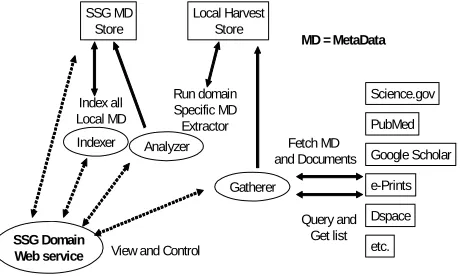
SSG MD Store
Local Harvest Store
Gatherer Analyzer
Indexer
Query and Get list Fetch MD and Documents Run domain
Specific MD Extractor Index all
Local MD
Science.gov
PubMed
Google Scholar
etc. Dspace e-Prints
MD = MetaData
SSG Domain
[image:8.612.324.547.230.382.2]Web service View and Control
Figure 8. Semantic Scholars’ Grid (SSG) Domain Metadata Web service
Now we discuss an approach to integration of community tools into a Grid environment shown in Figs. 8 and 9 for what we term the Semantic Scholars’ Grid (SSG). We follow the same strategy used in GlobalMMCS of building gateways [15] shown in Fig. 9, to existing community services that project a Web Service to the SSG. This allows one to fully preserve existing user interfaces and capabilities while extracting and enhancing selected features that can either be exchanged between the “mass services” and/or manipulated with a separate interface. We also see in Fig. 8, addition of domain
specific Google style services that analyze the Internet (or rather existing repositories of Internet material) for domain specific metadata. This can be structured as a Grid Information Retrieval system [27] and is initially attractive in science fields like biology and chemistry that have already shown the value of mining scientific literature as captured partly in NIH’s PubChem and PubMed. Another application builds on systems like Citeseer [28] and Google Scholar to build communities implied by the co-authors of papers and the authors of those citing or cited by papers. Initially we are applying this to del.icio.us, Connotea and CiteULike [29, 30, 31].
SSG Domain-1 W eb service
SSG Domain-N W eb service
Tool-1 Del.icio.us
Tool-2 Connotea
Tool-3 CiteULike
Tool–N e.g. CiteSeer Native
UI-1
Native UI-4
Native UI-3
Native UI-N
Integrated User Interface UI
Gateway WS-1
Gateway WS-2
Gateway WS-3
Gateway WS-N
[image:8.612.64.294.414.552.2]SSG MD Store
Figure 9. SSG Integration Framework
We stress that most existing community systems consist of some mechanism to collect information (user input or analysis of data such as that from Internet robots), which is stored in some “central” location that is offered to users as a “service” although not usually with complete WSDL (Web Service Definition Language) interfaces. In Fig. 9 we propose building wrappers to provide these missing WSDL interfaces. An exciting feature of the resultant service model of community tools is the immediate ability to integrate and enhance them. We suggest that future collaboratories and e-learning and e-business portals will have at their core a collection of such community (Web) services customized for the particular application.
“on the edge”. However we don’t see any difficulty in implementing any peer-to-peer community system with service architectures and think it is important to support peer-to-peer messaging, transport (BitTorrent), security and discovery models for Grids. The gateways we discussed above for GlobalMMCS and community tools in the SSG, exemplify how one can build service interfaces to non Grid systems. Further the use of NaradaBrokering in both Grid and JXTA [39] illustrates that one can capture differences between Grid and peer-to-peer systems in different implementation of the core (messaging) services. Further Skype and GlobalMMCS offer similar capabilities and the huge success of the former, suggests that peer-to-peer implementations can be very competitive with the more traditional server-based solutions for large scale robust applications.
5.
CONCLUSIONS
In this paper we have shown how one can collect all the desirable community and collaboration tools together and wrap them as services to form a Collaboration Grid. This can be customized to support different communities and deliver a next generation of portals and collaboratories. One can choose between peer-to-peer and server based implementations of the system.
REFERENCES
[1] Typical Grid references are The Grid 2: Blueprint for a new Computing Infrastructure, edited by Ian Foster and Carl Kesselman, Morgan Kaufmann 2004 and Grid Computing: Making the Global Infrastructure a Reality edited by F. Berman, G. Fox and A. Hey, Wiley, March 2003.
[2] Global Grid Forum http://www.Gridforum.org
[3] Geoffrey Fox, Alex Ho, Shrideep Pallickara, Marlon Pierce, Wenjun Wu Grids for the GiG and Real Time Simulations
http://Grids.ucs.indiana.edu/ptliupages/publications/gig/DSR TOct05.pdf Proceedings of Ninth IEEE International Symposium DS-RT2005 on Distributed Simulation and Real Time Applications, pages 129-138 IEEE Computer Society http://doi.ieeecomputersociety.org/10.1109/DISTRA.2005.2 3, Montreal October 10-12 2005
[4] Geoffrey Fox, Alex Ho, Marlon Pierce Collection of Grid Resources for DoD Applications, Internal Reports June 2005, http://Grids.ucs.indiana.edu/ptliupages/publications/gig/.
[5] Ken Birman, Robert Hillman, Stefan Pleisch, Building network-centric military applications over service oriented
architectures SPIE Conference DEFENSE
TRANSFORMATION AND NETWORK-CENTRIC SYSTEMS Orlando Florida 31 March 2005. http://www.cs.cornell.edu/projects/quicksilver/public_pdfs/G IGonWS_final.pdf
[6] Booth, D. et al.. Web Service Architecture W3C Working Group Note, 11 February 2004. http://www.w3c.org/TR/ws-arch
[7] Sanjiva Weerawarana, Francisco Curbera, Frank Leymann, Tony Storey, Donald F. Ferguson, Web Services Platform Architecture: SOAP, WSDL, WS-Policy, WS-Addressing, WS-BPEL, WS-Reliable Messaging, and More, Prentice Hall March 22, 2005, ISBN: 0-13-148874-0.
[8] Globus Project http://www.globus.org.
[9] Semantic Grid http://www.semanticGrid.org
[10] OGSA-DAI Grid and Web database interface
http://www.ogsa-dai.org/.
[11] Open Geospatial Consortium
http://www.opengeospatial.org/
[12] GIS Grid Services http://www.crisisGrid.org \
[13] Geoffrey Fox Services and the Semantic Grid Panel discussion at SKG 2005 International Conference on Semantics, Knowledge and Grid Beijing Friendship Hotel
November 28 2005. http://Grids.ucs.indiana.edu/ptliupages/presentations/skg05p
anelnov28-05.ppt
[14] KnowledgeKinetics, Ball Aerospace enterprise
collaboration environment http://www.ball.com/aerospace/k2_home.html
[15] GlobalMMCS Service oriented Collaboration Environment from Community Grids Laboratory http://www.globalmmcs.org.
[16] Xiaohong Qiu Message-based MVC Architecture for Distributed and Desktop Applications Syracuse University
PhD March 2 2005 http://Grids.ucs.indiana.edu/ptliupages/publications/qiuPhDt
hesis.pdf
[17] Minjun Wang, Geoffrey Fox and Shrideep Pallickara
Demonstrations of Collaborative Web Services and
Peer-to-Peer Grids Journal Of Digital Information Management.
Volume 2, Issue 2. June 2004.Special Issue of selected papers from the IEEE ITCC 2004 Track on Modern Grid and
Web Systems. http://Grids.ucs.indiana.edu/ptliupages/publications/P2PGrid
s_JDIM_PDF.pdf
[18] Minjun Wang and Geoffrey Fox Design of a
Collaborative System for Open Office, Proceedings of
IASTED KSCE Conference Virgin Islands November 2004 http://Grids.ucs.indiana.edu/ptliupages/publications/OpenOff iceCollaborativeSystemFINAL.pdf
Applications Proceedings of International Conference on Information Technology: Coding and Computing (ITCC'05) - Volume I pp. 335-341, April 4-6, 2005, Las Vegas http://Grids.ucs.indiana.edu/ptliupages/publications/GridColl abIDL_ITCC2005.pdf
[20] Tony Hammond, Timo Hannay, Ben Lund, and
Joanna Scott Social Bookmarking Tools (I) A General
Review, D-Lib Magazine April 2005 Volume 11 Number 4
http://www.dlib.org/dlib/april05/hammond/04hammond.html
[21] Ben Lund, Tony Hammond, Martin Flack and Timo Hannay Social Bookmarking Tools (II) A Case Study -
Connotea, D-Lib Magazine April 2005 Volume 11 Number
4 http://www.dlib.org/dlib/april05/lund/04lund.html
[22] Geoffrey Fox, Dennis Gannon, Sung-Hoon Ko, Sangmi Lee, Shrideep Pallickara, Marlon Pierce, Xiaohong Qiu, Xi Rao Ahmet Uyar, Minjun Wang, Wenjun Wu Peer-to-Peer Grids, Chapter 18 of Grid Computing: Making the Global Infrastructure a Reality edited by F. Berman, G. Fox and A. Hey, Wiley, March 2003.
[23] NaradaBrokering Grid Messaging
http://www.naradabrokering.org
[24] Jabber Software Foundation http://www.jabber.org/
[25] Wenjun Wu, Geoffrey Fox, Hasan Bulut, Ahmet Uyar, Tao Huang Service Oriented Architecture for VoIP conferencing to be published 2006 in Special Issue on Voice over IP - Theory and Practice of the International Journal of
Communication Systems
http://Grids.ucs.indiana.edu/ptliupages/publications/soa-voip-05.doc
[26] Ahmet Uyar Scalable Service Oriented Architecture
for Audio/Video Conferencing Syracuse University PhD
March 23 2005 http://Grids.ucs.indiana.edu/ptliupages/publications/UyarThe
sisFinal.PDF
[27] GGF14 Information Retrieval Grid Session
http://www.ggf.org/GGF14/GGF14IR.html
[28] Citeseer citation analysis system
http://citeseer.ist.psu.edu/
[29] Del.icio.us annotation system http://del.icio.us/
[30] Connotea annotation system http://www.connotea.org/
[31] CiteUlike annotation system http://www.citeulike.org/
[32] GGF9 workshop on Peer-to-Peer and Grids:
Synergies and Opportunities http://csag.ucsd.edu/P2P-Grid/
[33] Ian Taylor, The Triana Project http://www.trianacode.org/index.html
[34] Kai Hwang USC Peer-to-Peer Grids,
http://Gridsec.usc.edu/Hwang.html
[35] Shanshan Song, Kai Hwang, Runfang Zhou, Yu-Kwong Kwok, Trusted P2P Transactions with Fuzzy
Reputation Aggregation.
http://csdl.computer.org/dl/mags/ic/2005/06/w6024.pdf
[36] Ian Foster , Adriana Iamnitchi, On Death, Taxes, and
the Convergence of Peer-to-Peer and Grid Computing,
http://people.cs.uchicago.edu/~anda/papers/foster_Grid_vs_p 2p.pdf
[37] Adriana Iamnitchi, Matei Ripeanu and Ian Foster,
Small-World File-Sharing Communities, INFOCOM 2004,
March 2004, Hong Kong. http://arxiv.org/abs/cs.DC/0307036
[38] M. Cai, A. Chervenak, M. Frank, A Peer-to-Peer Replica Location Service Based on A Distributed Hash Table.
Proceedings of the SC2004 Conference (SC2004),
November 2004 http://www.globus.org/alliance/publications/papers/sc2004v
15.pdf
[39] Geoffrey Fox, Shrideep Pallickara, Xi Rao Towards enabling peer-to-peer Grids Concurrency and Computation: Practice & Experience archive Volume 17 , Issue 7-8 (June 2005) Pages: 1109 - 1131. 2002 ACM Java Grande–ISCOPE
Conference Part II
http://Grids.ucs.indiana.edu/ptliupages/publications/CCPE-P2PGrids.pdf
[40] Domenico Talia, Paolo Trunfio, Toward a Synergy
Between P2P and Grids,
http://csdl.computer.org/dl/mags/ic/2003/04/w4096.pdf
[41] Robson Santos, Francisco Brasileiro, Alisson Andrade, Nazareno Andrade, Walfredo Cirne, Accurate Autonomous
Accounting in Peer-to-Peer Grids,