. .Types and Programming Languages
by Benjamin C. Pierce ISBN:0262162091
The MIT Press © 2002 (623 pages)
This thorough type-systems reference examines theory, pragmatics, implementation, and more
Table of Contents
Types and Programming Languages
Preface
Chapter 1 - Introduction
Chapter 2 - Mathematical Preliminaries
Part I - Untyped Systems
Chapter 3 - Untyped Arithmetic Expressions
Chapter 4 - An ML Implementation of Arithmetic Expressions Chapter 5 - The Untyped Lambda-Calculus
Chapter 6 - Nameless Representation of Terms
Chapter 7 - An ML Implementation of the Lambda-Calculus
Part II - Simple Types
Chapter 8 - Typed Arithmetic Expressions Chapter 9 - Simply Typed Lambda-Calculus Chapter 10 - An ML Implementation of Simple Types Chapter 11 - Simple Extensions
Chapter 12 - Normalization Chapter 13 - References Chapter 14 - Exceptions
Part III - Subtyping
Chapter 15 - Subtyping
Chapter 16 - Metatheory of Subtyping
Chapter 17 - An ML Implementation of Subtyping Chapter 18 - Case Study: Imperative Objects Chapter 19 - Case Study: Featherweight Java
Part IV - Recursive Types
Chapter 20 - Recursive Types
Chapter 21 - Metatheory of Recursive Types
Part V - Polymorphism
Chapter 25 - An ML Implementation of System F Chapter 26 - Bounded Quantification
Chapter 27 - Case Study: Imperative Objects, Redux Chapter 28 - Metatheory of Bounded Quantification
Part VI - Higher-Order Systems
Chapter 29 - Type Operators and Kinding Chapter 30 - Higher-Order Polymorphism Chapter 31 - Higher-Order Subtyping
Chapter 32 - Case Study: Purely Functional Objects
Part VII - Appendices
Appendix A - Solutions to Selected Exercises Appendix B - Notational Conventions References
Index
List of Figures
Back Cover
A type system is a syntactic method for automatically checking the absence of certain erroneous behaviors by classifying program phrases according to the kinds of values they compute. The study of type systems--and of programming languages from a type-theoretic perspective--has important applications in software engineering, language design, high-performance compilers, and security.
This text provides a comprehensive introduction both to type systems in computer science and to the basic theory of programming languages. The approach is pragmatic and operational; each new concept is motivated by programming examples and the more theoretical sections are driven by the needs of implementations. Each chapter is accompanied by numerous exercises and solutions, as well as a running implementation, available via the Web. Dependencies between chapters are explicity identified, allowing readers to choose a variety of paths through the material.
About the Author
Benjamin C. Pierce is Associate Professor of Computer and Information Science at the University of Pennsylvania.
< Free Open Study >
Types and Programming Languages
Benjamin C. Pierce
The MIT Press
Cambridge, Massachusetts London, England
Copyright © 2002 Benjamin C. Pierce
All rights reserved. No part of this book may be reproduced in any form by any electronic of mechanical means (including photocopying, recording, or information storage and retrieval) without permission in writing from the publisher.
This book was set in Lucida Bright by the author using the document preparation system. Printed and bound in the United States of America.
Library of Congress Cataloging-in-Publication Data
Pierce, Benjamin C.
Types and programming languages / Benjamin C. Pierce p. cm.
Includes bibliographical references and index. ISBN 0-262-16209-1 (hc.:alk. paper)
1. Programming languages (Electronic computers). I. Title. QA76.7 .P54 2002
005.13—dc21 2001044428
Preface
The study of type systems—and of programming languages from a type-theoretic perspective—has become an energetic field with major applications in software engineering, language design, high-performance compiler
implementation, and security. This text offers a comprehensive introduction to the fundamental definitions, results, and techniques in the area.
Audience
The book addresses two main audiences: graduate students and researchers specializing in programming languages and type theory, and graduate students and mature undergraduates from all areas of computer science who want an introduction to key concepts in the theory of programming languages. For the former group, the book supplies a thorough tour of the field, with sufficient depth to proceed directly to the research literature. For the latter, it provides extensive introductory material and a wealth of examples, exercises, and case studies. It can serve as the main text for both introductory graduate-level courses and advanced seminars in programming languages.
< Free Open Study >
Goals
A primary aim is coverage of core topics, including basic operational semantics and associated proof techniques, the untyped lambda-calculus, simple type systems, universal and existential polymorphism, type reconstruction, subtyping, bounded quantification, recursive types, and type operators, with shorter discussions of numerous other topics. A second main goal is pragmatism. The book concentrates on the use of type systems in programming languages, at the expense of some topics (such as denotational semantics) that probably would be included in a more mathematical text on typed lambda-calculi. The underlying computational substrate is a call-by-value lambda-calculus, which matches most present-day programming languages and extends easily to imperative constructs such as references and exceptions. For each language feature, the main concerns are the practical motivations for considering this feature, the techniques needed to prove safety of languages that include it, and the implementation issues that it raises—in particular, the design and analysis of typechecking algorithms.
A further goal is respect for the diversity of the field; the book covers numerous individual topics and several well-understood combinations but does not attempt to bring everything together into a single unified system. Unified presentations have been given for some subsets of the topics—for example, many varieties of "arrow types" can be elegantly and compactly treated in the uniform notation of pure type systems—but the field as a whole is still growing too rapidly to be fully systematized.
The book is designed for ease of use, both in courses and for self-study. Full solutions are provided for most of the exercises. Core definitions are organized into self-contained figures for easy reference. Dependencies between concepts and systems are made as explicit as possible. The text is supplemented with an extensive bibliography and index.
A final organizing principle is honesty. All the systems discussed in the book (except a few that are only mentioned in passing) are implemented. Each chapter is accompanied by a typechecker and interpreter that are used to check the examples mechanically. These implementations are available from the book's web site and can be used for
programming exercises, experimenting with extensions, and larger class projects.
To achieve these goals, some other desirable properties have necessarily been sacrificed. The most important of these is completeness of coverage. Surveying the whole area of programming languages and type systems is probably impossible in one book—certainly in a textbook. The focus here is on careful development of core concepts; numerous pointers to the research literature are supplied as starting points for further study. A second non-goal is the practical
efficiency of the typechecking algorithms: this is not a book on industrial-strength compiler or typechecker implementation.
Structure
Part I of the book discusses untyped systems. Basic concepts of abstract syntax, inductive definitions and proofs, inference rules, and operational semantics are introduced first in the setting of a very simple language of numbers and booleans, then repeated for the untyped lambda-calculus. Part II covers the simply typed lambda-calculus and a variety of basic language features such as products, sums, records, variants, references, and exceptions. A pre liminary chapter on typed arithmetic expressions provides a gentle introduction to the key idea of type safety. An optional chapter develops a proof of normalization for the simply typed lambda-calculus using Tait's method. Part III addresses the fundamental mechanism of subtyping; it includes a detailed discussion of metatheory and two extended case studies. Part IV covers recursive types, in both the simple iso-recursive and the trickier equi-recursive
formulations. The second of the two chapters in this part develops the metatheory of a system with equi-recursive types and subtyping in the mathematical framework of coinduction. Part V takes up polymorphism, with chapters on ML-style type reconstruction, the more powerful impredicative polymorphism of System F, existential quantification and its connections with abstract data types, and the combination of polymorphism and subtyping in systems with bounded quantification. Part VI deals with type operators. One chapter covers basic concepts; the next develops System Fω and its metatheory; the next combines type operators and bounded quantification to yield System ; the final chapter is a closing case study.
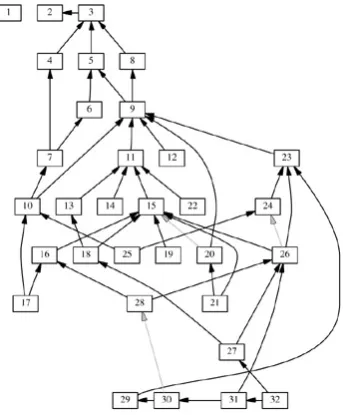
Figure P-1: Chapter Dependencies
The treatment of each language feature discussed in the book follows a common pattern. Motivating examples are first; then formal definitions; then proofs of basic properties such as type safety; then (usually in a separate chapter) a deeper investigation of metatheory, leading to typechecking algorithms and their proofs of soundness, completeness, and termination; and finally (again in a separate chapter) the concrete realization of these algorithms as an OCaml (Objective Caml) program.
An important source of examples throughout the book is the analysis and design of features for object-oriented programming. Four case-study chapters develop different approaches in detail—a simple model of conventional imperative objects and classes (Chapter 18), a core calculus based on Java (Chapter 19), a more refined account of imperative objects using bounded quantification (Chapter 27), and a treatment of objects and classes in the purely functional setting of System , using existential types (Chapter 32).
[image:8.595.105.449.46.462.2]< Free Open Study >
Required Background
The text assumes no preparation in the theory of programming languages, but readers should start with a degree of mathematical maturity—in particular, rigorous undergraduate coursework in discrete mathematics, algorithms, and elementary logic.
Readers should be familiar with at least one higher-order functional programming language (Scheme, ML, Haskell, etc.), and with basic concepts of programming languages and compilers (abstract syntax, BNF grammars, evaluation, abstract machines, etc.). This material is available in many excellent undergraduate texts; I particularly like Essentials
of Programming Languages by Friedman, Wand, and Haynes (2001) and Programming Language Pragmatics by Scott (1999). Experience with an object-oriented language such as Java (Arnold and Gosling, 1996) is useful in several chapters.
The chapters on concrete implementations of typecheckers present significant code fragments in OCaml (or Objective Caml), a popular dialect of ML. Prior knowledge of OCaml is helpful in these chapters, but not absolutely necessary; only a small part of the language is used, and features are explained at their first occurrence. These chapters constitute a distinct thread from the rest of the book and can be skipped completely if desired.
The best textbook on OCaml at the moment is Cousineau and Mauny's (1998). The tutorial materials packaged with the OCaml distribution (available at http://caml.inria.fr and http://www.ocaml.org) are also very readable.
Readers familiar with the other major dialect of ML, Standard ML, should have no trouble following the OCaml code fragments. Popular textbooks on Standard ML include those by Paulson (1996) and Ullman (1997).
Course Outlines
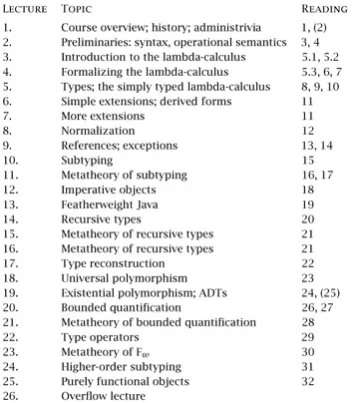
An intermediate or advanced graduate course should be able to cover most of the book in a semester. Figure P-2 gives a sample syllabus from an upper- level course for doctoral students at the University of Pennsylvania (two 90-minute lectures a week, assuming minimal prior preparation in programming language theory but moving quickly).
Figure P-2: Sample Syllabus for an Advanced Graduate Course
For an undergraduate or an introductory graduate course, there are a number of possible paths through the material. A course on type systems in programming would concentrate on the chapters that introduce various typing features and illustrate their uses and omit most of the metatheory and implementation chapters. Alternatively, a course on basic
theory and implementation of type systems would progress through all the early chapters, probably skipping Chapter 12 (and perhaps 18 and 21) and sacrificing the more advanced material toward the end of the book. Shorter courses can also be constructed by selecting particular chapters of interest using the dependency diagram in Figure P-1. The book is also suitable as the main text for a more general graduate course in theory of programming languages. Such a course might spend half to two-thirds of a semester working through the better part of the book and devote the rest to, say, a unit on the theory of concurrency based on Milner's pi-calculus book (1999), an introduction to Hoare Logic and axiomatic semantics (e.g. Winskel, 1993), or a survey of advanced language features such as continuations or module systems.
[image:11.595.97.452.189.593.2](e.g., normalization, and perhaps some of the chapters on metatheory) so that a broad range of examples can be covered before students choose project topics.
Exercises
Most chapters include extensive exercises—some designed for pencil and paper, some involving programming examples in the calculi under discussion, and some concerning extensions to the ML implementations of these calculi. The estimated difficulty of each exercise is indicated using the following scale:
? Quick check 30 seconds to 5 minutes
?? Easy ≤ 1 hour
??? Moderate ≤ 3 hours
???? Challenging > 3 hours
Exercises marked ? are intended as real-time checks of important concepts. Readers are strongly encouraged to pause for each one of these before moving on to the material that follows. In each chapter, a roughly
homework-assignment-sized set of exercises is labeled RECOMMENDED.
Complete solutions to most of the exercises are provided in Appendix A. To save readers the frustration of searching for solutions to the few exercises for which solutions are not available, those exercises are marked ?.
< Free Open Study >
Typographic Conventions
Most chapters introduce the features of some type system in a discursive style, then define the system formally as a collection of inference rules in one or more figures. For easy reference, these definitions are usually presented in full, including not only the new rules for the features under discussion at the moment, but also the rest of the rules needed to constitute a complete calculus. The new parts are set on a gray background to make the "delta" from previous systems visually obvious.
An unusual feature of the book's production is that all the examples are mechanically typechecked during typesetting: a script goes through each chapter, extracts the examples, generates and compiles a custom typechecker containing the features under discussion, applies it to the examples, and inserts the checker's responses in the text. The system that does the hard parts of this, called TinkerType, was developed by Michael Levin and myself (2001). Funding for this research was provided by the National Science Foundation, through grants CCR-9701826, Principled Foundations
for Programming with Objects, and CCR-9912352, Modular Type Systems.
Electronic Resources
A web site associated with this book can be found at the following URL: http://www.cis.upenn.edu/~bcpierce/tapl
Resources available on this site include errata for the text, suggestions for course projects, pointers to supplemental material contributed by readers, and a collection of implementations (typecheckers and simple interpreters) of the calculi covered in each chapter of the text.
These implementations offer an environment for experimenting with the examples in the book and testing solutions to exercises. They have also been polished for readability and modifiability and have been used successfully by students in my courses as the basis of both small implementation exercises and larger course projects. The implementations are written in OCaml. The OCaml compiler is available at no cost through http://caml.inria.fr and installs very easily on most platforms.
Readers should also be aware of the Types Forum, an email list covering all aspects of type systems and their applications. The list is moderated to ensure reasonably low volume and a high signal-to-noise ratio in announcements and discussions. Archives and subscription instructions can be found at http://www.cis.upenn.edu/~bcpierce/types.
< Free Open Study >
Acknowledgments
Readers who find value in this book owe their biggest debt of gratitude to four mentors—Luca Cardelli, Bob Harper, Robin Milner, and John Reynolds—who taught me most of what I know about programming languages and types. The rest I have learned mostly through collaborations; besides Luca, Bob, Robin, and John, my partners in these investigations have included Martín Abadi, Gordon Plotkin, Randy Pollack, David N. Turner, Didier Rémy, Davide Sangiorgi, Adriana Compagnoni, Martin Hofmann, Giuseppe Castagna, Martin Steffen, Kim Bruce, Naoki Kobayashi, Haruo Hosoya, Atsushi Igarashi, Philip Wadler, Peter Buneman, Vladimir Gapeyev, Michael Levin, Peter Sewell, Jérôme Vouillon, and Eijiro Sumii. These collaborations are the foundation not only of my understanding, but also of my pleasure in the topic.
The structure and organization of this text have been improved by discussions on pedagogy with Thorsten Altenkirch, Bob Harper, and John Reynolds, and the text itself by corrections and comments from Jim Alexander, Penny Anderson, Josh Berdine, Tony Bonner, John Tang Boyland, Dave Clarke, Diego Dainese, Olivier Danvy, Matthew Davis, Vladimir Gapeyev, Bob Harper, Eric Hilsdale, Haruo Hosoya, Atsushi Igarashi, Robert Irwin, Takayasu Ito, Assaf Kfoury, Michael Levin, Vassily Litvinov, Pablo López Olivas, Dave MacQueen, Narciso Marti-Oliet, Philippe Meunier, Robin Milner, Matti Nykänen, Gordon Plotkin, John Prevost, Fermin Reig, Didier Rémy, John Reynolds, James Riely, Ohad Rodeh, Jürgen Schlegelmilch, Alan Schmitt, Andrew Schoonmaker, Olin Shivers, Perdita Stevens, Chris Stone, Eijiro Sumii, Val Tannen, Jérôme Vouillon, and Philip Wadler. (I apologize if I've inadvertently omitted anybody from this list.) Luca Cardelli, Roger Hindley, Dave MacQueen, John Reynolds, and Jonathan Seldin offered insiders' perspectives on some tangled historical points.
The participants in my graduate seminars at Indiana University in 1997 and 1998 and at the University of Pennsylvania in 1999 and 2000 soldiered through early versions of the manuscript; their reactions and comments gave me crucial guidance in shaping the book as you see it. Bob Prior and his team from The MIT Press expertly guided the manuscript through the many phases of the publication process. The book's design is based on macros developed by Christopher Manning for The MIT Press.
Proofs of programs are too boring for the social process of mathematics to work. —Richard DeMillo, Richard Lipton, and Alan Perlis, 1979
… So don't rely on social processes for verification. —David Dill, 1999
Formal methods will never have a significant impact until they can be used by people that don't understand them. —attributed to Tom Melham
Chapter 1:
Introduction
1.1 Types in Computer Science
Modern software engineering recognizes a broad range of formal methods for helping ensure that a system behaves correctly with respect to some specification, implicit or explicit, of its desired behavior. On one end of the spectrum are powerful frameworks such as Hoare logic, algebraic specification languages, modal logics, and denotational
semantics. These can be used to express very general correctness properties but are often cumbersome to use and demand a good deal of sophistication on the part of programmers. At the other end are techniques of much more modest power—modest enough that automatic checkers can be built into compilers, linkers, or program analyzers and thus be applied even by programmers unfamiliar with the underlying theories. One well-known instance of this sort of
lightweight formal methods is model checkers, tools that search for errors in finite-state systems such as chip designs
or communication protocols. Another that is growing in popularity is run-time monitoring, a collection of techniques that allow a system to detect, dynamically, when one of its components is not behaving according to specification. But by far the most popular and best established lightweight formal methods are type systems, the central focus of this book. As with many terms shared by large communities, it is difficult to define "type system" in a way that covers its informal usage by programming language designers and implementors but is still specific enough to have any bite. One plausible definition is this:
A type system is a tractable syntactic method for proving the absence of certain program behaviors by classifying phrases according to the kinds of values they compute.
A number of points deserve comment. First, this definition identifies type systems as tools for reasoning about
programs. This wording reflects the orientation of this book toward the type systems found in programming
languages. More generally, the term type systems (or type theory) refers to a much broader field of study in logic, mathematics, and philosophy. Type systems in this sense were first formalized in the early 1900s as ways of avoiding the logical paradoxes, such as Russell's (Russell, 1902), that threatened the foundations of mathematics. During the twentieth century, types have become standard tools in logic, especially in proof theory (see Gandy, 1976 and Hindley, 1997), and have permeated the language of philosophy and science. Major landmarks in this area include Russell's original ramified theory of types (Whitehead and Russell, 1910), Ramsey's simple theory of types (1925)—the basis of Church's simply typed lambda-calculus (1940)—Martin-Löf's constructive type theory (1973, 1984), and Berardi, Terlouw, and Barendregt's pure type systems (Berardi, 1988; Terlouw, 1989; Barendregt, 1992).
Even within computer science, there are two major branches to the study of type systems. The more practical, which concerns applications to programming languages, is the main focus of this book. The more abstract focuses on connections between various "pure typed lambda-calculi" and varieties of logic, via the Curry-Howard correspondence (§9.4). Similar concepts, notations, and techniques are used by both communities, but with some important differences in orientation. For example, research on typed lambda-calculi is usually concerned with systems in which every well-typed computation is guaranteed to terminate, whereas most programming languages sacrifice this property for the sake of features like recursive function definitions.
Another important element in the above definition is its emphasis on classification of terms—syntactic
phrases—according to the properties of the values that they will compute when executed. A type system can be regarded as calculating a kind of static approximation to the run-time behaviors of the terms in a program. (Moreover, the types assigned to terms are generally calculated compositionally, with the type of an expression depending only on the types of its subexpressions.)
found in languages such as Scheme (Sussman and Steele, 1975; Kelsey, Clinger, and Rees, 1998; Dybvig, 1996), where run-time type tags are used to distinguish different kinds of structures in the heap. Terms like "dynamically typed" are arguably misnomers and should probably be replaced by "dynamically checked," but the usage is standard. Being static, type systems are necessarily also conservative: they can categorically prove the absence of some bad program behaviors, but they cannot prove their presence, and hence they must also sometimes reject programs that actually behave well at run time. For example, a program like
if <complex test> then 5 else <type error>
will be rejected as ill-typed, even if it happens that the <complex test> will always evaluate to true, because a static analysis cannot determine that this is the case. The tension between conservativity and expressiveness is a fundamental fact of life in the design of type systems. The desire to allow more programs to be typed—by assigning more accurate types to their parts—is the main force driving research in the field.
A related point is that the relatively straightforward analyses embodied in most type systems are not capable of proscribing arbitrary undesired program behaviors; they can only guarantee that well-typed programs are free from
certain kinds of misbehavior. For example, most type systems can check statically that the arguments to primitive
arithmetic operations are always numbers, that the receiver object in a method invocation always provides the requested method, etc., but not that the second argument to the division operation is non-zero, or that array accesses are always within bounds.
The bad behaviors that can be eliminated by the type system in a given language are often called run-time type errors. It is important to keep in mind that this set of behaviors is a per-language choice: although there is substantial overlap between the behaviors considered to be run-time type errors in different languages, in principle each type system comes with a definition of the behaviors it aims to prevent. The safety (or soundness) of each type system must be judged with respect to its own set of run-time errors.
The sorts of bad behaviors detected by type analysis are not restricted to low-level faults like invoking non-existent methods: type systems are also used to enforce higher-level modularity properties and to protect the integrity of user-defined abstractions. Violations of information hiding, such as directly accessing the fields of a data value whose representation is supposed to be abstract, are run-time type errors in exactly the same way as, for example, treating an integer as a pointer and using it to crash the machine.
Typecheckers are typically built into compilers or linkers. This implies that they must be able to do their job
automatically, with no manual intervention or interaction with the programmer—i.e., they must embody computationally
tractable analyses. However, there is still plenty of room for requiring guidance from the programmer, in the form of
explicit type annotations in programs. Usually, these annotations are kept fairly light, to make programs easier to write and read. But, in principle, a full proof that the program meets some arbitrary specification could be encoded in type annotations; in this case, the typechecker would effectively become a proof checker. Technologies like Extended Static Checking (Detlefs, Leino, Nelson, and Saxe, 1998) are working to settle this territory between type systems and full-scale program verification methods, implementing fully automatic checks for some broad classes of correctness properties that rely only on "reasonably light" program annotations to guide their work.
By the same token, we are most interested in methods that are not just automatable in principle, but that actually come with efficient algorithms for checking types. However, exactly what counts as efficient is a matter of debate. Even widely used type systems like that of ML (Damas and Milner, 1982) may exhibit huge typechecking times in
pathological cases (Henglein and Mairson, 1991). There are even languages with typechecking or type reconstruction problems that are undecidable, but for which algorithms are available that halt quickly "in most cases of practical interest" (e.g. Pierce and Turner, 2000; Nadathur and Miller, 1988; Pfenning, 1994).
1.2 What Type Systems are Good For
Detecting Errors
The most obvious benefit of static typechecking is that it allows early detection of some programming errors. Errors that are detected early can be fixed immediately, rather than lurking in the code to be discovered much later, when the programmer is in the middle of something else—or even after the program has been deployed. Moreover, errors can often be pinpointed more accurately during typechecking than at run time, when their effects may not become visible until some time after things begin to go wrong.
In practice, static typechecking exposes a surprisingly broad range of errors. Programmers working in richly typed languages often remark that their programs tend to "just work" once they pass the typechecker, much more often than they feel they have a right to expect. One possible explanation for this is that not only trivial mental slips (e.g., forgetting to convert a string to a number before taking its square root), but also deeper conceptual errors (e.g., neglecting a boundary condition in a complex case analysis, or confusing units in a scientific calculation), will often manifest as inconsistencies at the level of types. The strength of this effect depends on the expressiveness of the type system and on the programming task in question: programs that manipulate a variety of data structures (e.g., symbol processing applications such as compilers) offer more purchase for the typechecker than programs involving just a few simple types, such as numerical calculations in scientific applications (though, even here, refined type systems supporting dimension analysis [Kennedy, 1994] can be quite useful).
Obtaining maximum benefit from the type system generally involves some attention on the part of the programmer, as well as a willingness to make good use of the facilities provided by the language; for example, a complex program that encodes all its data structures as lists will not get as much help from the compiler as one that defines a different datatype or abstract type for each. Expressive type systems offer numerous "tricks" for encoding information about structure in terms of types.
For some sorts of programs, a typechecker can also be an invaluable maintenance tool. For example, a programmer who needs to change the definition of a complex data structure need not search by hand to find all the places in a large program where code involving this structure needs to be fixed. Once the declaration of the datatype has been changed, all of these sites become type-inconsistent, and they can be enumerated simply by running the compiler and examining the points where typechecking fails.
Abstraction
Another important way in which type systems support the programming process is by enforcing disciplined
programming. In particular, in the context of large-scale software composition, type systems form the backbone of the
module languages used to package and tie together the components of large systems. Types show up in the
interfaces of modules (and related structures such as classes); indeed, an interface itself can be viewed as "the type of a module," providing a summary of the facilities provided by the module—a kind of partial contract between
implementors and users.
Structuring large systems in terms of modules with clear interfaces leads to a more abstract style of design, where interfaces are designed and discussed independently from their eventual implementations. More abstract thinking about interfaces generally leads to better design.
Documentation
Language Safety
The term "safe language" is, unfortunately, even more contentious than "type system." Although people generally feel they know one when they see it, their notions of exactly what constitutes language safety are strongly influenced by the language community to which they belong. Informally, though, safe languages can be defined as ones that make it impossible to shoot yourself in the foot while programming.
Refining this intuition a little, we could say that a safe language is one that protects its own abstractions. Every high-level language provides abstractions of machine services. Safety refers to the language's ability to guarantee the integrity of these abstractions and of higher-level abstractions introduced by the programmer using the definitional facilities of the language. For example, a language may provide arrays, with access and update operations, as an abstraction of the underlying memory. A programmer using this language then expects that an array can be changed only by using the update operation on it explicitly—and not, for example, by writing past the end of some other data structure. Similarly, one expects that lexically scoped variables can be accessed only from within their scopes, that the call stack truly behaves like a stack, etc. In a safe language, such abstractions can be used abstractly; in an unsafe language, they cannot: in order to completely understand how a program may (mis)behave, it is necessary to keep in mind all sorts of low-level details such as the layout of data structures in memory and the order in which they will be allocated by the compiler. In the limit, programs in unsafe languages may disrupt not only their own data structures but even those of the run-time system; the results in this case can be completely arbitrary.
Language safety is not the same thing as static type safety. Language safety can be achieved by static checking, but also by run-time checks that trap nonsensical operations just at the moment when they are attempted and stop the program or raise an exception. For example, Scheme is a safe language, even though it has no static type system. Conversely, unsafe languages often provide "best effort" static type checkers that help programmers eliminate at least the most obvious sorts of slips, but such languages do not qualify as type-safe either, according to our definition, since they are generally not capable of offering any sort of guarantees that well-typed programs are well
behaved—typecheckers for these languages can suggest the presence of run-time type errors (which is certainly better than nothing) but not prove their absence.
Statically checked Dynamically checked
Safe ML, Haskell, Java, etc. Lisp, Scheme, Perl, Postscript, etc. Unsafe C, C++, etc.
The emptiness of the bottom-right entry in the preceding table is explained by the fact that, once facilities are in place for enforcing the safety of most operations at run time, there is little additional cost to checking all operations. (Actually, there are a few dynamically checked languages, e.g., some dialects of Basic for microcomputers with minimal
operating systems, that do offer low-level primitives for reading and writing arbitrary memory locations, which can be misused to destroy the integrity of the run-time system.)
Run-time safety is not normally achievable by static typing alone. For example, all of the languages listed as safe in the table above actually perform array-bounds checking dynamically.[1] Similarly, statically checked languages sometimes choose to provide operations (e.g., the down-cast operator in Java—see §15.5) whose typechecking rules are actually unsound—language safety is obtained by checking each use of such a construct dynamically.
Language safety is seldom absolute. Safe languages often offer programmers "escape hatches," such as foreign function calls to code written in other, possibly unsafe, languages. Indeed, such escape hatches are sometimes provided in a controlled form within the language itself—Obj.magic in OCaml (Leroy, 2000), Unsafe.cast in the New Jersey implementation of Standard ML, etc. Modula-3 (Cardelli et al., 1989; Nelson, 1991) and C# (Wille, 2000) go yet further, offering an "unsafe sublanguage" intended for implementing low-level run-time facilities such as garbage collectors. The special features of this sublanguage may be used only in modules explicitly marked unsafe. Cardelli (1996) articulates a somewhat different perspective on language safety, distinguishing between so-called
defined by its programmer's manual." Let the definition of a language be the set of things the programmer needs to understand in order to predict the behavior of every program in the language. Then the manual for a language like C does not constitute a definition, since the behavior of some programs (e.g., ones involving unchecked array accesses or pointer arithmetic) cannot be predicted without knowing the details of how a particular C compiler lays out structures in memory, etc., and the same program may have quite different behaviors when executed by different compilers. By contrast, the manuals for Java, Scheme, and ML specify (with varying degrees of rigor) the exact behavior of all programs in the language. A well-typed program will yield the same results under any correct implementation of these languages.
Efficiency
The first type systems in computer science, beginning in the 1950s in languages such as Fortran (Backus, 1981), were introduced to improve the efficiency of numerical calculations by distinguishing between integer-valued arithmetic expressions and real-valued ones; this allowed the compiler to use different representations and generate appropriate machine instructions for primitive operations. In safe languages, further efficiency improvements are gained by eliminating many of the dynamic checks that would be needed to guarantee safety (by proving statically that they will always be satisfied). Today, most high-performance compilers rely heavily on information gathered by the typechecker during optimization and code-generation phases. Even compilers for languages without type systems per se work hard to recover approximations to this typing information.
Efficiency improvements relying on type information can come from some surprising places. For example, it has recently been shown that not only code generation decisions but also pointer representation in parallel scientific programs can be improved using the information generated by type analysis. The Titanium language (Yelick et al., 1998) uses type inference techniques to analyze the scopes of pointers and is able to make measurably better decisions on this basis than programmers explicitly hand-tuning their programs. The ML Kit Compiler uses a powerful
region inference algorithm (Gifford, Jouvelot, Lucassen, and Sheldon, 1987; Jouvelot and Gifford, 1991; Talpin and Jouvelot, 1992; Tofte and Talpin, 1994, 1997; Tofte and Birkedal, 1998) to replace most (in some programs, all) of the need for garbage collection by stack-based memory management.
Further Applications
Beyond their traditional uses in programming and language design, type systems are now being applied in many more specific ways in computer science and related disciplines. We sketch just a few here.
An increasingly important application area for type systems is computer and network security. Static typing lies at the core of the security model of Java and of the JINI "plug and play" architecture for network devices (Arnold et al., 1999), for example, and is a critical enabling technology for Proof-Carrying Code (Necula and Lee, 1996, 1998; Necula, 1997). At the same time, many fundamental ideas developed in the security community are being re-explored in the context of programming languages, where they often appear as type analyses (e.g., Abadi, Banerjee, Heintze, and Riecke, 1999; Abadi, 1999; Leroy and Rouaix, 1998; etc.). Conversely, there is growing interest in applying
programming language theory directly to problems in the security domain (e.g., Abadi, 1999; Sumii and Pierce, 2001). Typechecking and inference algorithms can be found in many program analysis tools other than compilers. For example, AnnoDomini, a Year 2000 conversion utility for Cobol programs, is based on an ML-style type inference engine (Eidorff et al., 1999). Type inference techniques have also been used in tools for alias analysis (O'Callahan and Jackson, 1997) and exception analysis (Leroy and Pessaux, 2000).
standard [XS 2000]) for describing structured data in XML. New languages for querying and manipulating XML provide powerful static type systems based directly on these schema languages (Hosoya and Pierce, 2000; Hosoya, Vouillon, and Pierce, 2001; Hosoya and Pierce, 2001; Relax, 2000; Shields, 2001).
A quite different application of type systems appears in the field of computational linguistics, where typed lambda-calculi form the basis for formalisms such as categorial grammar (van Benthem, 1995; van Benthem and Meulen, 1997; Ranta, 1995; etc.).
[1]
Static elimination of array-bounds checking is a long-standing goal for type system designers. In principle, the necessary mechanisms (based on dependent types—see §30.5) are well understood, but packaging them in a form that balances expressive power, predictability and tractability of typechecking, and complexity of program annotations remains a significant challenge. Some recent advances in the area are described by Xi and Pfenning (1998, 1999).
1.3 Type Systems and Language Design
Retrofitting a type system onto a language not designed with typechecking in mind can be tricky; ideally, language design should go hand-in-hand with type system design.
One reason for this is that languages without type systems—even safe, dynamically checked languages—tend to offer features or encourage programming idioms that make typechecking difficult or infeasible. Indeed, in typed languages the type system itself is often taken as the foundation of the design and the organizing principle in light of which every other aspect of the design is considered.
Another factor is that the concrete syntax of typed languages tends to be more complicated than that of untyped languages, since type annotations must be taken into account. It is easier to do a good job of designing a clean and comprehensible syntax when all the issues can be addressed together.
The assertion that types should be an integral part of a programming language is separate from the question of where the programmer must physically write down type annotations and where they can instead be inferred by the compiler. A well-designed statically typed language will never require huge amounts of type information to be explicitly and tediously maintained by the programmer. There is some disagreement, though, about how much explicit type information is too much. The designers of languages in the ML family have worked hard to keep annotations to a bare minimum, using type inference methods to recover the necessary information. Languages in the C family, including Java, have chosen a somewhat more verbose style.
< Free Open Study >
1.4 Capsule History
In computer science, the earliest type systems were used to make very simple distinctions between integer and floating point representations of numbers (e.g., in Fortran). In the late 1950s and early 1960s, this classification was extended to structured data (arrays of records, etc.) and higher-order functions. In the 1970s, a number of even richer concepts (parametric polymorphism, abstract data types, module systems, and subtyping) were introduced, and type systems emerged as a field in its own right. At the same time, computer scientists began to be aware of the
connections between the type systems found in programming languages and those studied in mathematical logic, leading to a rich interplay that continues to the present.
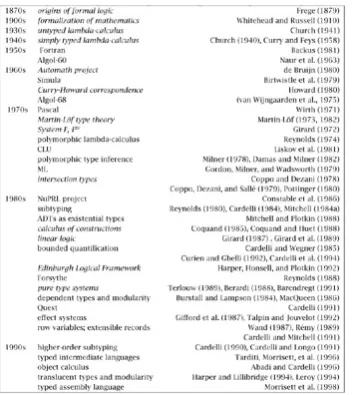
Figure 1-1 presents a brief (and scandalously incomplete!) chronology of some high points in the history of type systems in computer science. Related developments in logic are included, in italics, to show the importance of this field's contributions. Citations in the right-hand column can be found in the bibliography.
Figure 1-1: Capsule History of Types in Computer Science and Logic
[image:24.595.100.454.301.697.2]1.5 Related Reading
While this book attempts to be self contained, it is far from comprehensive; the area is too large, and can be approached from too many angles, to do it justice in one book. This section lists a few other good entry points. Handbook articles by Cardelli (1996) and Mitchell (1990b) offer quick introductions to the area. Barendregt's article (1992) is for the more mathematically inclined. Mitchell's massive textbook on Foundations for Programming
Languages (1996) covers basic lambda-calculus, a range of type systems, and many aspects of semantics. The focus is on semantic rather than implementation issues. Reynolds's Theories of Programming Languages (1998b), a graduate-level survey of the theory of programming languages, includes beautiful expositions of polymorphism, subtyping, and intersection types. The Structure of Typed Programming Languages, by Schmidt (1994), develop score concepts of type systems in the context of language design, including several chapters on conventional imperative languages. Hindley's monograph Basic Simple Type Theory (1997) is a wonderful compendium of results about the simply typed lambda-calculus and closely related systems. Its coverage is deep rather than broad.
Abadi and Cardelli's A Theory of Objects (1996) develops much of the same material as the present book,
de-emphasizing implementation aspects and concentrating instead on the application of these ideas in a foundation treatment of object-oriented programming. Kim Bruce's Foundations of Object-Oriented Languages: Types and Semantics (2002) covers similar ground. Introductory material on object-oriented type systems can also be found in
Palsberg and Schwartzbach (1994) and Castagna (1997).
Semantic foundations for both untyped and typed languages are covered in depth in the textbooks of Gunter (1992), Winskel (1993), and Mitchell (1996). Operational semantics is also covered in detail by Hennessy (1990). Foundations for the semantics of types in the mathematical framework of category theory can also be found in many sources, including the books by Jacobs(1999), Asperti and Longo (1991), and Crole (1994); a brief primer can be found in Basic
Category Theory for Computer Scientists (Pierce, 1991a).
Girard, Lafont, and Taylor's Proofs and Types (1989) treats logical aspects of type systems (the Curry-Howard correspondence, etc.). It also includes a description of System F from its creator, and an appendix introducing linear logic. Connections between types and logic are further explored in Pfenning's Computation and Deduction (2001). Thompson's Type Theory and Functional Programming (1991) and Turner's Constructive Foundations for Functional Languages (1991) focus on connections between functional programming (in the "pure functional programming" sense of Haskell or Miranda) and con structive type theory, viewed from a logical perspective. A number of relevant topics from proof theory are developed in Goubault-Larrecq and Mackie's Proof Theory and Automated Deduction (1997). The history of types in logic and philosophy is described in more detail in articles by Constable (1998), Wadler (2000), Huet (1990), and Pfenning (1999), in Laan's doctoral thesis (1997), and in books by Grattan-Guinness (2001) and Sommaruga (2000).
It turns out that a fair amount of careful analysis is required to avoid false and embarrassing claims of type soundness for programming languages. As a consequence, the classification, description, and study of type systems has emerged as a formal discipline. ?Luca Cardelli (1996)
< Free Open Study >
Chapter 2:
Mathematical Preliminaries
Before getting started, we need to establish some common notation and state a few basic mathematical facts. Most readers should just skim this chapter and refer back to it as necessary.
2.1 Sets, Relations, and Functions
2.1.1 Definition
We use standard notation for sets: curly braces for listing the elements of a set explicitly ({...}) or showing how to construct one set from another by "comprehension" ({x Î S | ...} ), ø for the empty set, and S \ T for the set difference of
S and T (the set of elements of S that are not also elements of T). The size of a set S is written |S|. The powerset of S,
i.e., the set of all the subsets of S, is written P(S).
2.1.2 Definition
The set {0, 1, 2, 3, 4, 5, ...} of natural numbers is denoted by the symbol . A set is said to be countable if its elements can be placed in one-to-one correspondence with the natural numbers.
2.1.3 Definition
An n-place relation on a collection of sets S1, S2, ..., Sn is a set R ⊆ S1 × S2 × ... × Sn of tuples of elements from S1 through Sn. We say that the elements s1Î S1 through snÎ Sn are related by R if (s1,...,sn) is an element of R.
2.1.4 Definition
A one-place relation on a set S is called a predicate on S. We say that P is true of an element s Î S if s Î P. To emphasize this intuition, we often write P(s) instead of s Î P, regarding P as a function mapping elements of S to truth values.
2.1.5 Definition
A two-place relation R on sets S and T is called a binary relation. We often write s R t instead of (s, t) Î R. When S and
T are the same set U, we say that R is a binary relation on U.
2.1.6 Definition
For readability, three- or more place relations are often written using a "mixfix" concrete syntax, where the elements in the relation are separated by a sequence of symbols that jointly constitute the name of the relation. For example, for the typing relation for the simply typed lambdacalculus in Chapter 9, we write ? ? s : T to mean "the triple (?, s, T) is in the typing relation."
2.1.7 Definition
The domain of a relation R on sets S and T, written dom(R), is the set of elements s Î S such that (s, t) Î R for some t. The codomain or range of R, written range(R), is the set of elements t Î T such that (s, t) Î R for some s.
A partial function R from S to T is said to be defined on an argument s Î S if s Î dom(R), and undefined otherwise. We write f(x) ↑, or f(x) = ↑, to mean "f is undefined on x," and f(x)↓" to mean "f is defined on x.
In some of the implementation chapters, we will also need to define functions that may fail on some inputs (see, e.g., Figure 22-2). It is important to distinguish failure (which is a legitimate, observable result) from divergence; a function that may fail can be either partial (i.e., it may also diverge) or total (it must always return a result or explicitly
fail)-indeed, we will often be interested in proving totality. We write f(x) = fail when f returns a failure result on the input
x.
Formally, a function from S to T that may also fail is actually a function from S to T ∩ {fail}, where we assume that fail does not belong to T.
2.1.10 Definition
Suppose R is a binary relation on a set S and P is a predicate on S. We say that P is preserved by R if whenever we have s R s′ and P(s), we also have P(s′).
[image:27.595.57.545.339.784.2]< Free Open Study >
2.2 Ordered Sets
2.2.1 Definition
A binary relation R on a set S is reflexive if R relates every element of S to itself—that is, s R s (or (s,s) Î R) for all s Î S.
R is symmetric if s R t implies t R s, for all s and t in S. R is transitive if s R t and t R u together imply s R u. R is antisymmetric if s R t and t R s together imply that s = t.
2.2.2 Definition
A reflexive and transitive relation R on a set S is called a preorder on S. (When we speak of "a preordered set S," we always have in mind some particular preorder R on S.) Preorders are usually written using symbols like ≤ or ?. We write s < t ("s is strictly less than t") to mean s ≤ t ∧ s ≠ t.
A preorder (on a set S) that is also antisymmetric is called a partial order on S. A partial order ≤ is called a total order if it also has the property that, for each s and t in S, either s ≤ t or t ≤ s.
2.2.3 Definition
Suppose that ≤ is a partial order on a set S and s and t are elements of S. An element j Î S is said to be a join (or least
upper bound) of s and t if
s ≤ j and t ≤ j, and
1.
for any element k Î S with s ≤ k and t ≤ k, we have j ≤ k. 2.
Similarly, an element m Î S is said to be a meet (or greatest lower bound) of s and t if
m ≤ s and m ≤ t, and
1.
for any element n Î S with n ≤ s and n ≤ t, we have n ≤ m. 2.
2.2.4 Definition
A reflexive, transitive, and symmetric relation on a set S is called an equivalence on S.
2.2.5 Definition
Suppose R is a binary relation on a set S. The reflexive closure of R is the smallest reflexive relation R′ that contains R. ("Smallest" in the sense that if R″ is some other reflexive relation that contains all the pairs in R, then we have R′ ⊆
R″.) Similarly, the transitive closure of R is the smallest transitive relation R′ that contains R. The transitive closure of R
is often written R+. The reflexive and transitive closure of R is the smallest reflexive and transitive relation that contains
R. It is often written R*.
2.2.6 Exercise [?? ?]
Suppose we are given a relation R on a set S. Define the relation R′ as follows:
R′ = R ∩ {(s, s) | s Î S}.
R0 = R
Ri+1 = Ri ∩ {(s, u) | for some t, (s, t) Î Ri and (t, u) Î Ri}
That is, we construct each Ri+1 by adding to Ri all the pairs that can be obtained by "one step of transitivity" from pairs already in Ri. Finally, define the relation R+ as the union of all the Ri:
Show that this R+ is really the transitive closure of R—i.e., that it satisfies the conditions given in Definition 2.2.5.
2.2.8 Exercise [??, ?]
Suppose R is a binary relation on a set S and P is a predicate on S that is preserved by R. Show that P is also preserved by R*.
2.2.9 Definition
Suppose we have a preorder ≤ on a set S. A decreasing chain in ≤ is a sequence s1, s2, s3, ... of elements of S such that each member of the sequence is strictly less than its predecessor: si+1 < si for every i. (Chains can be either finite or infinite, but we are more interested in infinite ones, as in the next definition.)
2.2.10 Definition
Suppose we have a set S with a preorder ≤. We say that ≤ is well founded if it contains no infinite decreasing chains. For example, the usual order on the natural numbers, with 0 < 1 < 2 < 3 < ... is well founded, but the same order on the integers, ... < -3 < -2 < -1 < 0 < 1 < 2 < 3 < ... is not. We sometimes omit mentioning ≤ explicitly and simply speak of S as a well-founded set.
< Free Open Study >
2.3 Sequences
2.3.1 Definition
A sequence is written by listing its elements, separated by commas. We use comma as both the "cons" operation for adding an element to either end of a sequence and as the "append" operation on sequences. For example, if a is the sequence 3, 2, 1 and b is the sequence 5, 6, then 0, a denotes the sequence 0, 3, 2, 1, while a, 0 denotes 3, 2, 1, 0 and b, a denotes 5, 6, 3, 2, 1. (The use of comma for both "cons" and "append" operations leads to no confusion, as long as we do not need to talk about sequences of sequences.) The sequence of numbers from 1 to n is abbreviated 1..n (with just two dots). We write |a| for the length of the sequence a. The empty sequence is written either as * or as a blank. One sequence is said to be a permutation of another if it contains exactly the same elements, possibly in a different order.
2.4 Induction
Proofs by induction are ubiquitous in the theory of programming languages, as in most of computer science. Many of these proofs are based on one of the following principles.
2.4.1 Axiom [Principle of Ordinary Induction on Natural Numbers]
Suppose that P is a predicate on the natural numbers. Then: If P(0)
and, for all i, P(i) implies P(i + 1), then P(n) holds for all n.
2.4.2 Axiom [Principle of Complete Induction on Natural Numbers]
Suppose that P is a predicate on the natural numbers. Then: If, for each natural number n,
given P(i) for all i < n we can show P(n), then P(n) holds for all n.
2.4.3 Definition
The lexicographic order (or "dictionary order") on pairs of natural numbers is defined as follows: (m, n) ≤ (m′, n′) iff either m < m′ or else m = m′ and n ≤ n′.
2.4.4 Axiom [Principle of Lexicographic Induction]
Suppose that P is a predicate on pairs of natural numbers. If, for each pair (m, n) of natural numbers,
given P(m′, n′) for all (m′, n′) < (m, n) we can show P(m, n),
then P(m, n) holds for all m, n.
The lexicograpic induction principle is the basis for proofs by nested induction, where some case of an inductive proof proceeds "by an inner induction." It can be generalized to lexicographic induction on triples of numbers, 4-tuples, etc. (Induction on pairs is fairly common; on triples it is occasionally useful; beyond triples it is rare.)
Theorem 3.3.4 in Chapter 3 will introduce yet another format for proofs by induction, called structural induction, that is particularly useful for proofs about tree structures such as terms or typing derivations. The mathematical foundations of inductive reasoning will be considered in more detail in Chapter 21, where we will see that all these specific induction principles are instances of a single deeper idea.
< Free Open Study >
2.5 Background Reading
If the material summarized in this chapter is unfamiliar, you may want to start with some background reading. There are many sources for this, but Winskel's book (1993) is a particularly good choice for intuitions about induction. The beginning of Davey and Priestley (1990) has an excellent review of ordered sets. Halmos (1987) is a good introduction to basic set theory.
A proof is a repeatable experiment in persuasion. -Jim Horning
Part I:
Untyped Systems
Chapter List
Chapter 3: Untyped Arithmetic Expressions
Chapter 4: An ML Implementation of Arithmetic Expressions
Chapter 5: The Untyped Lambda-Calculus
Chapter 6: Nameless Representation of Terms
Chapter 7: An ML Implementation of the Lambda-Calculus
< Free Open Study >
Chapter 3:
Untyped Arithmetic Expressions
To talk rigorously about type systems and their properties, we need to start by dealing formally with some more basic aspects of programming languages. In particular, we need clear, precise, and mathematically tractable tools for expressing and reasoning about the syntax and semantics of programs.
This chapter and the next develop the required tools for a small language of numbers and booleans. This language is so trivial as to be almost beneath consideration, but it serves as a straightforward vehicle for the introduction of several fundamental concepts-abstract syntax, inductive definitions and proofs, evaluation, and the modeling of run-time errors. Chapters 5 through 7 elaborate the same story for a much more powerful language, the untyped lambda-calculus, where we must also deal with name binding and substitution. Looking further ahead, Chapter 8 commences the study of type systems proper, returning to the simple language of the present chapter and using it to introduce basic concepts of static typing. Chapter 9 extends these concepts to the lambda-calculus.
3.1 Introduction
The language used in this chapter contains just a handful of syntactic forms: the boolean constants true and false, conditional expressions, the numeric constant 0, the arithmetic operators succ (successor) and pred (predecessor), and a testing operation iszero that returns true when it is applied to 0 and false when it is applied to some other number. These forms can be summarized compactly by the following grammar. [1]
t ::= true false
if t then t else t 0 succ t pred t iszero t terms: constant true constant false conditional constant zero successor predecessor zero test
The conventions used in this grammar (and throughout the book) are close to those of standard BNF (cf. Aho, Sethi, and Ullman, 1986). The first line (t ::=) declares that we are defining the set of terms, and that we are going to use the letter t to range over terms. Each line that follows gives one alternative syntactic form for terms. At every point where the symbol t appears, we may substitute any term. The italicized phrases on the right are just comments.
The symbol t in the right-hand sides of the rules of this grammar is called a metavariable. It is a variable in the sense that it is a place-holder for some particular term, and "meta" in the sense that it is not a variable of the object
language-the simple programming language whose syntax we are currently describing-but rather of the
For the moment, the words term and expression are used interchangeably. Starting in Chapter 8, when we begin discussing calculi with additional syntactic categories such as types, we will use expression for all sorts of syntactic phrases (including term expressions, type expressions, kind expressions, etc.), reserving term for the more specialized sense of phrases representing computations (i.e., phrases that can be substituted for the metavariable t).
A program in the present language is just a term built from the forms given by the grammar above. Here are some examples of programs, along with the results of evaluating them:
if false then 0 else 1;
? 1
iszero (pred (succ 0));
? true
Throughout the book, the symbol ? is used to display the results of evaluating examples. (For brevity, results will be elided when they are obvious or unimportant.) During typesetting, examples are automatically processed by the implementation corresponding to the formal system in under discussion (arith here); the displayed responses are the implementation's actual output.
In examples, compound arguments to succ, pred, and iszero are enclosed in parentheses for readability.[2] Parentheses are not mentioned in the grammar of terms, which defines only their abstract syntax. Of course, the presence or absence of parentheses makes little difference in the extremely simple language that we are dealing with at the moment: parentheses are usually used to resolve ambiguities in the grammar, but this grammar is does not have any ambiguities-each sequence of tokens can be parsed as a term in at most one way. We will return to the discussion of parentheses and abstract syntax in Chapter 5 (p. 52).
For brevity in examples, we use standard arabic numerals for numbers, which are represented formally as nested applications of succ to 0. For example, succ(succ(succ(0))) is written as 3.
The results of evaluation are terms of a particularly simple form: they will always be either boolean constants or numbers (nested applications of zero or more instances of succ to 0). Such terms are called values, and they will play a special role in our formalization of the evaluation order of terms.
Notice that the syntax of terms permits the formation of some dubious-looking terms like succ true and if 0 then 0 else 0. We shall have more to say about such terms later-indeed, in a sense they are precisely what makes this tiny language interesting for our purposes, since they are examples of the sorts of nonsensical programs we will want a type system to exclude.
[1]
The system studied in this chapter is the untyped calculus of booleans and numbers (Figure 3-2, on page 41). The associated OCaml implementation, called arith in the web repository, is described in Chapter 4. Instructions for downloading and building this checker can be found at http://www.cis.upenn.edu/~bcpierce/tapl.
[2]
In fact, the implementation used to process the examples in this chapter (called arith on the book's web site) actually
requires parentheses around compound arguments to succ, pred, and iszero, even though they can be parsed unambiguously without parentheses. This is for consistency with later calculi, which use similar-looking syntax for function application.
< Free Open Study >
3.2 Syntax
There are several equivalent ways of defining the syntax of our language. We have already seen one in the grammar on page 24. This grammar is actually just a compact notation for the following inductive definition:
3.2.1 Definition [Terms, Inductively]
The set of terms is the smallest set T such that {true, false, 0} ⊆ T; 1.
if t1Î T, then {succ t1, pred t1, iszero t1} ⊆ T; 2.
if t1Î T, t2Î T, and t3Î T, then if t1then t2else t3Î T. 3.
Since inductive definitions are ubiquitous in the study of programming languages, it is worth pausing for a moment to examine this one in detail. The first clause tells us three simple expressions that are in T. The second and third clauses give us rules by which we can judge that certain compound expressions are in T. Finally, the word "smallest" tells us that T has no elements besides the ones required by these three clauses.
Like the grammar on page 24, this definition says nothing about the use of parentheses to mark compound subterms. Formally, what's really going on is that we are defining T as a set of trees, not as a set of strings. The use of
parentheses in examples is just a way of clarifying the relation between the linearized form of terms that we write on the page and the real underlying tree form.
A different shorthand for the same inductive definition of terms employs the two-dimensional inference rule format commonly used in "natural deduction style" presentations of logical systems:
3.2.2 Definition [Terms, by Inference Rules]
The set of terms is defined by the following rules:
The first three rules here restate the first clause of Definition 3.2.1; the next four capture clauses (2) and (3). Each rule is read, "If we have established the statements in the premise(s) listed above the line, then we may derive the conclusion below the line." The fact that T is the smallest set satisfying these rules is often (as here) not stated explicitly.
Two points of terminology deserve mention. First, rules with no premises (like the first three above) are often called
axioms. In this book, the term inference rule is used generically to include both axioms and "proper rules" with one or
For each natural number i, define a set Si as follows:
S0 = ?
Si+1 = {true, false, 0}
È {succ t1, pred t1, iszero t1 | t1Î Si} È {if t1then t2else t3 | t1, t2, t3Î Si}. Finally, let
S0 is empty; S1 contains just the constants; S2 contains the constants plus the phrases that can be built with constants and just one succ, pred, iszero, or if; S3 contains these and all phrases that can be built using succ, pred, iszero, and if on phrases in S2; and so on. S collects together all the phrases that can be built in this way—i.e., all phrases built by some finite number of arithmetic and conditional operators, beginning with just constants.
3.2.4 Exercise [??]
How many elements does S3 have?
3.2.5 Exercise [??]
Show that the sets Si are cumulative—that is, that for each i we have Si ⊆ Si+1.
The definitions we have seen characterize the same set of terms from different directions: Definitions 3.2.1 and 3.2.2 simply characterize the set as the smallest set satisfying certain "closure properties"; Definition 3.2.3 shows how to actually construct the set as the limit of a sequence.
To finish off the discussion, let us verify that these two views actually define the same set. We'll do the proof in quite a bit of detail, to show how all the pieces fit together.
3.2.6 Proposition
T = S.
Proof: T was defined as the smallest set satisfying certain conditions. So it suffices to show (a) that S satisfies these
conditions, and (b) that any set satisfying the conditions has S as a subset (i.e., that S is the smallest set satisfying the conditions).
For part (a), we must check that each of the three conditions in Definition 3.2.1 holds of S. First, since S1 = {true, false, 0}, it is clear that the constants are in S. Second, if t1Î S, then (since S = Èi Si) there must be some i such that t1Î Si. But then, by the definition of Si+1, we must have succ t1Î Si+1, hence succ t1Î S; similarly, we see that pred t1Î S and iszero t1Î S. Third, if t1Î S, t2Î S, and t3Î S, then if t1then t2else t3Î S, by a similar argument.
For part (b), suppose that some set S′ satisfies the three conditions in Definition 3.2.1. We will argue, by complete induction on i, that every Si ⊆ S′, from which it clearly follows that S ⊆ S′.