Papers and Proceedings of the Royal Society of Tasmania, Volume 141 (1), 2007
35
ORIGIN AND EVOLUTION OF THE SUB-ANTARCTIC ISLANDS: THE FOUNDATION
by Patrick G. Quilty
(with 23 text-figures and two tables)
Quilty, P.G. 2007 (23:xi): Origin and evolution of the sub-Antarctic islands: the foundation. Papers and Proceedings of the Royal Society of Tasmania 141 (1): 35-58. https://doi.org/10.26749/rstpp.141.1.35 ISSN 0080-4703. School of Earth Sciences,
University of Tasmania, Private Bag 79, Hobart, Tasmania 7001, Australia. Email: [email protected]
Sub-Antarctic islands have a diversity of origins in detail but most are volcanic and very young suggesting that they are short-lived and that the distribution would have been very different a few million years ago. 'They contrast with the common tourist brochure concept of oceanic islands. As the Antarctic Plate is virtually static, the islands seldom show signs of association with long-lived linear island chains and most thus stand alone. Longer-lived islands are either on submarine plateaux or are continental remnants of the dispersion of Gondwana. The islands are classified in relation to raised sea-floor, transform fault, triple junction, subduction zone, submarine plateau, submerged continent or continental. Many are difficult of access and poorly known geologically. Their geological history controls their many other roles such as sites as observatories, or for study of colonisation, evolution and speciation rates.
Key Words: Sub-Antarctic islands, geological evolution, Macquarie Island, Balleny Islands, Scott Island, Campbell Island, Antipodes Island, Auckland Islands, Enderby Island, Peter I Island, Islas Diego Ramirez, South Georgia, South Sandwich Islands, Bouvetoya, Gough Island, Marion Island, Prince Edward Island, Iles Crozet, Amsterdam Island, St Paul Island, Kerguelen Plateau, Iles Kerguelen, Heard Island, McDonald Island.
INTRODUCTION
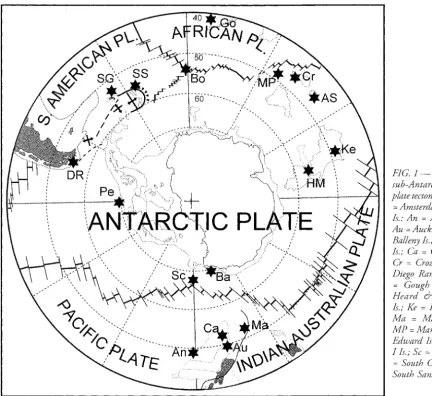
The sub-Antarctic for this paper is taken as the area of the sea-floor and land between the base of the Antarctic continental slope and a poorly-defined latitude, normally somewhere about 50°S but also extending well north of that to include Gough Island at 40°21 'S and Amsterdam and Saint Paul islands at 35-38°. It includes the islands of interest to the Scientific Committee on Antarctic Research (SCAR) (Bonner & Lewis Smith 1985, Dingwall 1995). One criterion for inclusion is the absence of a permanent resident human population. It thus includes the greater part of what is now termed the Antarctic Tectonic Plate (fig. 1),
a few pieces of the African, Australia-Indian and Pacific tectonic plates, and a series of tectonic micro-plates north of the Antarctic Peninsula. The sea-floor of the area formed as part of the break-up of the super-continent of Gondwana, beginning some 160 million years ago - mid-Jurassic in geological terms (fig. 2) and representing events in the last 3.5% of Earth history.
Knowledge of the origin and evolution of the islands is critical to any consideration of the time constraints on other features of the islands such as landform evolution or biological diversity.
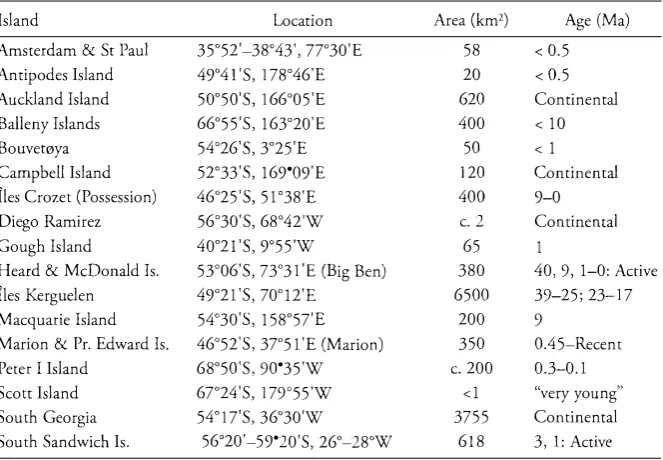
[image:1.547.100.432.545.775.2]The total area of the sub-Antarctic islands is < 14 000 km2 (table 1) but if the largest island groups (South Georgia and
TABLE 1
Sub-Antarctic islands considered in this review, showing location and area
Island Location Area (km1) Age (Ma)
Amsterdam & St Paul 35°52'-38°43', 77°30'E 58 < 0.5 Antipodes Island 49°41 'S, 178°46'E 20 < 0.5
Auckland Island 50°5o·s, 166°05'E 620 Continental
Balleny Islands 66°55'5, 163°20'E 400 < 10
Bouvetoya 54°26'5, 3°25'E 50 < 1
Campbell Island 52°33'5, 169°09'E 120 Continental
Iles Crozet (Possession) 46°25'5, 51°38'E 400 9-0
Diego Ramirez 56°30'5, 68°42'W C. 2 Continental
Gough Island 40°21·s, 9°55'W 65
Heard & McDonald Is. 53°06'5, 73°31 'E (Big Ben) 380 40, 9, 1-0: Active
Iles Kerguelen 49°21'5, 70°12'E 6500 39-25;23-17
Macquarie Island 54°30'S, 158°57'£ 200 9
Marion & Pr. Edward Is. 46°52'5, 37°51 'E (Marion) 350 0.45-Recent
Peter I Island 6S050'S, 90°35'W c. 200 0.3-0.1
Scott Island 67°24'5, 179°55'W <1 very young ,,
South Georgia 54°17'S, 36°30'W 3755 Continental
36
P. G.
Quilty
A GEOLOGICAL TIMESCALE
FIG. 2 - Geological timescale employed. This covers the last 600 million years. Numbers in italics and parentheses are percentages of Earth history that has passed before this time.
16
14
12
.--,
"::R. 0
j10
...-~8
+
0
6
C\I
ttl
Z
4
2
0
US
I
[image:2.555.55.487.58.454.2]Foldite
FIG.I-Islandsofthe sub-Antarctic in their plate tectonic context. AS = Amsterdam
&
St Paul Is.: An = Antipodes Is.;Au = AucklandIs.; Ba =
Balleny Is.; Bo = Bouvet Is.; Ca = Campbell Is.; Cr = Crozet Is.; DR =
Diego Ramirez Is.; Go = Gough Is.; HM = Heard
&
McDonald Is.; Ke = Kerguelen Is.;Ma = Macquarie Is.; MP = Marion
&
PrinceEdward Is.; Pe = Peter I Is.; Sc = Scott Is.; SG
= South Georgia; SS =
South Sandwich Is.
In
A
Rhyolite
FIG.
3 -
Classification of volcanic rocks including most of the types referred to in this paper. TB = trachybasalt: [image:2.555.54.531.455.716.2]Ites Kerguelen) are excluded, the figure is slightly over 3000 km2 . For all their being small specks in a vast area, they are valuable as sites for marine-based organisms to inhabit, breed and moult, and for humans to build observatories. Their history provides controls on rates of evolution and colonisation. In recent years, many international programs (such as the Deep Sea Drilling Project and Ocean Drilling Program) have been concerned with the evolution of the oceans and ocean floors which cover 71 % of the earth's surface. The sub-Antarctic islands, largely volcanic (using that term broadly), are relatively accessible sites allowing access to a variety of volcanic rocks and assist in gaining an understanding of the sources of oceanic lavas and conditions at the sites of generation of these lavas in the earth's mantle.
The islands are often on structures such as Macquarie Ridge and Kerguelen Plateau that have very great significance oceanographically controlling the direction of deep water flow and in many instances, the shallow water flow, especially as that varies during periods of low sea level -~--for example at glacial maxima. Some of these major structures have varied in depth for tectonic reasons over time and such variation, coupled with changing continental positions, has had an influence in the longer term evolution of global climate.
Concepts of islands are commonly influenced by brochures and images of the Indo-Pacific where clean white carbonate reefs and atolls abound and where Darwin developed the concept of atolls fOfming as rings around the top of progressively submerging volcanoes. Such island chains are attributed to migration of tectonic plates over a "melting anomaly" Of "hot-spot" within the mantle. Islands in the Pacific Ocean commonly, almost normally, are in the form of linear chains such as the Hawaiian island chain, with an active volcano at one end of a sequence of islands that are getting older, lower and more highly eroded with time and distance from the modern volcano. Individual islands form during a single episode of volcanism over perhaps a million years, when activity ceases for a while as the oceanic crust moves over the hot-spot -- the source of the lava from various depths in the earth's mantle. After a few million years, eruption begins again but by this time the chain has moved and a new volcano and island forms. Eventually the islands subside below sea level to become a seamount, or, if flat-topped, a guyot. In most oceans of the world, hot-spot sites are used to measure movement of the tectonic plate over such hot-spots but the Antarctic plate is different in that it is essentially stationary and thus provides a good site for studying aspects of the hot-spots themselves. Hot-spot linear island chains are not to be expected. The distribution and features of sub-Antarctic islands lead to questions of the too-ready acceptance of the "hot-spot/plume" concept as an explanation for all phenOlnena.
The Earth has two surface expressions. Continental crust floats above the earth's mantle and thus has the potential to retain its entire 4.5 billion-year-history, in contrast with oceanic crust which is regularly subduced into the man tie and thus modern oceanic floors have a maximum age of about 180 million years. As continents move apart, new sea-floor is generated at a mid-ocean ridge (MOR) such as that between Australia and Antarctica, or roughly centrally in the Atlantic Ocean. lhe elevation of the ridge is normally at about 2.8
km
water depth and this is the depth at which basaltic sea-floor generally forms. Segments of ridge crest are 0£{5et transform faults which have a characteristic{md evolution of the sub-Antarctic islands: 37
geometry. Ridge crests are the site of smaller, shallow earthquakes in contrast to subduction zones where large, deep, catastrophic earthquakes are more prevalent. Ridge crests, are the site of the phenomena associated with "black smokers" and their unusual life forms commonly attracting widespread interest because of their ability to live under extreme physico-chemical conditions.
This paper follows a route (fig. 1) from Tasmania, through Macquarie Island, Balleny islands, via Scott Island to the New Zealand sub-Antarctic islands on Campbell Plateau, then cast to the Antarctic Peninsula/South American region and South Adantic Ocean, before entering the Indian Ocean and terminating at the Heard and McDonald islands.
The aim is to summarise at a consistent technical the geological evolution of the islands as a basis on which other sciences can build, for example by showing how old the islands are and the influence age has on colonisation and subsequent rates of evolution. It also attempts to classifY the islands according to origin and draw out the difference between sub-Antarctic islands and the popular conception of more temperate and tropical islands. While most research on the sub-Antarctic has concentrated on the volcanic rocks, several areas have substantial sedimentary sequences of a
variety of ages and sedimentary environments, including Quaternary peat or glacial deposits. The comments in this paper refer mainly to the geology of the islands themselves and not so much to the geology of the surrounding sea-floor, other than to a general summary of the evolution of that sea-f1ooL
"1be reference list is not comprehensive and lists only enough papers to provide an adequate summary of the geology of the individual islands. Brief summaries of the volcanic characteristics of many are provided by a of authors in LeMasurier & Thomson (1990) who consider only those islands that are specifically volcanic and include many that are not considered here: conversely, this paper includes several not covered by LeMasurier & Thomson (1990).
The following terminology is used in this paper. Ma is used to denote the age in millions of years before present;
ka refers to thousands of years; m.y. is used to indicate an age difference, whenever that may have been. Figure 2 is a geological timescale employing that used by Geoscience Australia, modified in the younger section by reference to Berggren et al. (1995).
Most of the rocks encountered on the sub-Antarctic islands are volcanic in origin. One classification of such rocks, based on SiOz and Na20 and K20 content, is shown in figure 3.
The break-up of Gondwana has had a critical influence on the region.- When Gondwana began to disimegrate (160 Ma), Antarctica had been situated roughly over the South Pole for approximately 150 million years since moving south from the Northern Hemisphere. The region over the South Pole was all continental crust with distant ocean surrounding it. None of the sea-floor evident around Antarctica today exisred. Ihe entire super-continent at 160 Ma was populated with plants and dependent animals with much in common throughout the various modern fragments of Gondwana. Convenient summaries of the evolution of Gondwana are contained in Cande & Stock (2004-- Australia-Ne'N Zealand-Antarctica), Larter et al. (2002 ~ Pacific Cunningham et al.
38 J? C. Quilty
C
E
N
o
Z
o
I
C
A
c!
IE
N
01
z
o
B
20 Ma
40 Ma
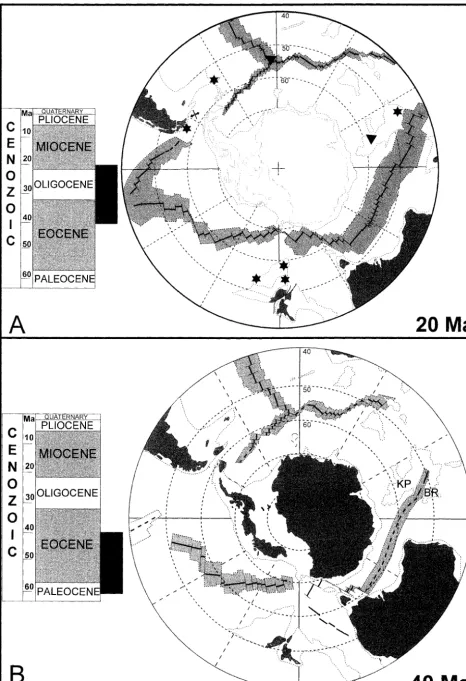
FIG. 4 - Antarctic Tectonic Plate boundaries at (A) 20 Ma and (B) 40 Ma. Ihe area that grew at mid-ocean ridge in the
[image:4.557.57.523.59.740.2]Origin and evolution of the sub-Antarctic islands: the foundation 39
Figure 4 illustrates the evolution of the Antarctic Plate between 40 and 20 Ma and each of the two maps shows the amount of sea-floor formed (and thus dispersion of the continents) in the previous 20 m.y.
At about
55
m.y., Australia accelerated its movement north to its current rate of about 6 cm/year. This was to have momentous consequences. By 34 Ma (Exon et al. 2004),Australia had moved north far enough that deep-ocean circulation could occur between Australia and Antarctica. With the development of deep ocean circumpolar circulation, Antarctica was completely isolated (as were Australia and South America) and assumed its current glaciated state with the consequent extinction of almost all terrestrial fauna and Bora. It developed an icesheet and 99.3% of Earth hiswry had passed by this time. The Southern Ocean linked the
rn
Upper crustal ophiolite zone
s
54
Pillow lavas
Deeper crustal rocks
54°40'
.\.-l.L-t.
Escarpment [image:5.547.28.249.251.771.2]Macquarie
'1sland
... _ ... --'_ ... Km
FIG.
5 --
Macquarie IslandIndian, Pacific and Atlantic oceans and washed Antarctica's shores. The oceanic crust of the Southern Ocean continued expanding by growth at mid-ocean ridges, but hardly any of the sub-Antarctic islands had come in to being by 20-30 Ma.
MACQUARIE ISLAND
Macquarie Island (Banks & Smith 1988, Selkirk et al. 1990)
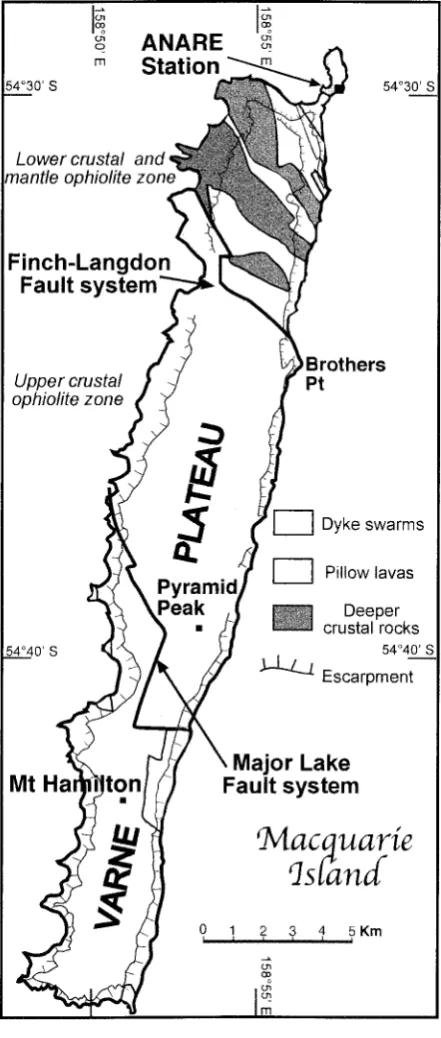
is on the Pacific Plate, very close to and east of the boundary between the Australianiindian and Pacific Plates (fig. 1). Macquarie Ridge, first identified by Bellingshausen in 1820, marks that boundarywhichis tcctonicallyvcryactive at present and large earthquakes are common. Macquarie Ridge links Macquaric Island and New Zealand where it continues as the Alpine Fault. The island (fig. 5) is marked by a surface plateau, the main part now identified as Varne Plateau, falling from over 400 m at its southern end, to about 250 m at the north.lhis probably represents old sea floor and some small hills may be remnants of submarine volcanoes. The plateau is surrounded by steep scree slopes on which landslips are common. The rugged western side of the island is separated from the ocean by a narrow raised platform; this feature is less well developed on the eastern side but where present, provides a convenient site for penguin and seal colonies. Ihe surface of the island has been disrupted by faulting and small scarps are obvious and common.
'The rocks that make up Macquarie Island (Varne et al.
2000) formed at a mid-ocean ridge at 9 Ma (Late Miocene; Quilty et (d. in press). Dating rocks has been difficult but recent discovery of enigmatic bolboforms has provided a precise fossil-based date on the assumption that extrusion of pillow lavas and deposition of sediments was coeval. The island is cut by two complex transform faults -- the Finch-·Langdol1 and Major Lake Fault systems (Wertz et al.
2003). It consists of a variety of igneous and sedimentary rocks typical of a cross section through the oceanic crust (Varne et al. 1969). North of the Finch-Langdon Fault
System, the rocks are from deeper in the crust and include a greater variety of intrusive rocks (gabbro, peridotite, dolerite dyke swarms and extrusive volcanic basalts, in addition to sediments including deep-sea nanno/foram ooze and volcanic sediment). In contrast, those of the southern 80% of the island are more like the near-surface rocks of the ocean floor with a higher concentration of pillow lavas and sediments. The complex formed initially at a slow spreading mid-ocean ridgeltransform fault complex, probably at an ocean depth of some 2.8 km. With time, it sank into deeper water but probably not below the carbonate compensation depth (CCD) as carbonate sediments commonly show no evidence of dissolution.
Interaction between the tectonic plates led to uplift of the island and that process continues. Macquarie Island contains many old beach levels attesting to past coastlines.
It is unclear what the current rate of uplift of the island is and it may vary from place to place. Adamson et al.
(1996) reviewed various possibilities and suggested that Macquarie Island emerged above sea level approximately 600 000-700 000 years ago. Since the first emergence, the amount of the island above sea level has varied greatly, reflecting both tectonic instability and changes in global sea level consequent on climate changes.
40
1?
G.BALLENY ISLANDS AND SCOTT ISLAND
The five major Balleny islands (fig. 6) form a linear series related to the Tasman Fracture Zone, a zone of closely spaced transform faults that passes from Antarctica, via the Balleny islands, to the southern and western margins of1asmania. Because oftheir steep coasts, access to the islands is difficult and much work remains to be done. The islands are the subaerial expression of a series of submarine ridges including the Balleny Seamounts to the northwest, the ANARE Seamounts to the southeast, and farther southeast and parallel is another seamount chain -- the Admiralty Seamounts. Ihe entire complex lies very close to the location of a transform fault
~"S
"
B
66'30'~
Scott 15"
0,5 km
I
FIG. 6 -~-(A) Balleny islands and (B) Scott Island.
(Lanyon 1994) but the relationship with that fault is not clear. Ihe Balleny island chain with its submarine extensions is oriented north~notthwest-~south-southeast paraUel to the local transform faults.
The islands formed by subaerial volcanic activity and the rocks are olivine trachybasalt with minor olivine-augite basalt and fit in the basanite--hawaiite field (fig. 3). 'Ihey are in the form of agglomerates, tuffs and lava flows with obvious stratification, sporadically rcd-coloured due to oxidation at the time of eruption. The Balleny island chain has been linked to the evolution of New Zealand but a fracture zoneltransform fault link with southern or western Tasmania is more accurate. 'Ihese islands have been attributed to hot-spot activity (Green 1992, Lanyon et al.
1993, l.anyon 1994) but it has also been suggested that they result from intermittent activity along a transform fault that is under some oblique tension and thus could be "leaky" (Kyle & Cole 1974), and in this regard may be similar in origin to Gough Island. The islands are close to the site of a major earthquake in March 1998, the largest magnitude earthquake recorded in that year to that time.
Ihe age of the volcanism is not well documented but analysis of nearby sea-floor magnetic lineations suggests that they are all less that 10 Ma. Radiometric dating of samples from the southern island - Sturge Island - indicates a Quaternary age ofless than 2 Ma (Embleton 1984, Jenkins et
al. 1992). Reports of many early expeditions stated that the islands were in eruption but there is no evidence that this is true and no modern infrared satellite imagery has detected any evidence of heat sources; the confusion probably stems from the unusual cloud formations that appear normally to cover the islands.
Tiny Scott Island seems to be a relatively normal volcanic island but it is not well studied. Its age is not known but is believed to be very young. It is the small projection above sea level at the northern end of a small, north-south oriented plateau (Scott Plateau - 145 x 30 km) which in turn sits on Eocene (about 40 Ma) sea-floor. Part of the Plateau is northwest-southeast oriented and is parallel to the Scott Seamount chain about 65 km to the southwest. Ihis chain in turn is parallel to the BaUeny Seamount chain and the histories of the two island groups are connected. Wright & Kyle (l990b) summarised what was known at the time and Lanyon (1994) examined further samples collected by dredging from adjacent to Scott Island.
The rocks of the island and surrounds are described as phonolites and phonotephrites, characterised by high Na20+K20 (normally 12-13% in the phonolites and 9% in the phonotephrites) and thus are very similar to the Balleny Island rocks and have a similar origin.
CAMPBELL PLATEAU ISLANDS
South of New Zealand is an extension of thinned continental crust about 25 km thick in contrast to the usual 40-~50 km and thus it lies below sea leveL Ihe area is the Campbell Plateau and an eastern extension- the Bounty Platform ~-- and is host to several islands or island groups -- Campbell, Auckland and Antipodes islands -- all lying north of the Antarctic Polar Frontal Zone. ]he islands contrast markedly with most sub-Antarctic islands geologically and historically. The basement of Campbell Plateau (Beggs ct at. 1990)
[image:6.557.58.286.219.756.2]450 km due north of Auckland islands and also on Campbell Plateau. 'nle granite intruded into older metasedimentary rocks (micaceous quartzite) similar to that known from Antarctica, New Zealand and the South Tasman Rise and thus is similar in setting and age to others well known from the former Gondwana.
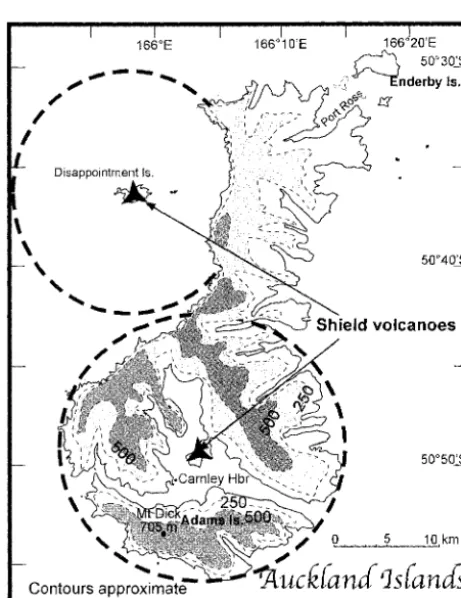
Antipodes Island is somewhat unusual among this group in being entirely volcanic in its exposed geology. The other island groups-- Campbell and Auckland - have a basement of continental rocks with a longer geological history, the continental crust acting as foundation for major shield volcanoes - similar to those of the eastern coastal region of South Island, New Zealand, i.e., near Christchurch and Dunedin - with low angle slopes, circular outline and a gentle form of eruption of low viscosity basaltic lava. The shield volcanoes at Campbell and Aucldand islands were about the same size, around 25 km in diameter.
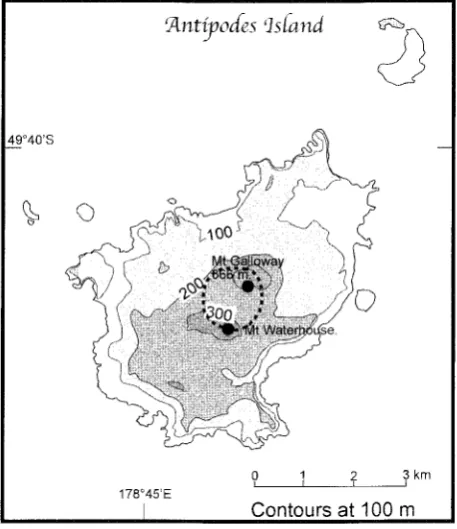
Antipodes Island
Although Antipodes Island (fig. 7) sits on the thinned continental crust of Campbell Plateau, the basement does not outcrop and what is preserved is the product of volcanic activity during the Pliocene and Quaternary (1-5 Ma) (Peat 2003) but Gamble & Adams (1990a) suggest that the ages are generally younger, less than 1 Ma, probably < 0.5 Ma.
Antipodes Island is much smaller than either Campbell or Auckland islands and has two peaks - mts Galloway and Waterhouse - marking the position of the central volcanic cone and many smaller remnants. The highest point is 366 m but most of the island is an undulating plateau with c1iffed margins to 150 m which show that much of the island consists of columnar basalt, the result of gentle eruption of low viscosity lava. The main lavas are low silica porphyritic lavas (basanite) with phenocrysts of olivine
To the northeast of the main island are two smaller islands (Bollons and Archway) which between them mark the eroded remains of a small volcano.
Antipodes Island shows no signs of having been affected by glaciation but has suffered considerable alluvial erosion to generate deep gullies. Like other Campbell Plateau islands, Antipodes Island has a layer of peat to 5 111 thick.
Campbell Island
Campbell Island (fig. 8) consists of the remnants of one shield volcano but its western side has been eroded away leaving only the eastern part. 1he centre of the volcano is
though~
to have been at about Dent Island. Older sedimentary rocks are exposed around Northwest Bay, and the entrance to Perseverance Harbour.The sediments around the margins of the southwestern part of the island (Northwest Bay, Penguin Bay, Rocky Bay and Tucker Cove in Perseverance Harbour) include a section of Cretaceous-Palaeogene rocks (Hollis et al. 1997). 1here are two formations - Garden Cove and Tucker Cove. The former is 30-100 m thick and consists of detrital conglomerate, sandstone and mudstone deposited in an initially non-marine environment which became marginally marine with time. This formation contains a few fossil groups, especially spores, pollen and dinoflagellates in addition to a few foraminifera and radiolarians. It is possible that the unit includes an almost complete section across the Cretaceous/
rmd evolution sub-Antarctic islands:
49"40'S
178"45'E
FIG.
7 --
Antipodes IslandCall1pbeff
1srand
Centre of volcano
~
Contours approximate
169°05·E
0LI _----""--_-If ~ km Contours at 100 m
\
\
\
\
\
\
,
I
i
,
FIG. 8 -- Campbell Island. GC = Carden Cove; PB =
Bay; TC = Tucker Cove.
41
Tertiary boundary, the time when an asteroid impact led to extinction of dinosaurs and various other groups. This would be a very rare occurrence of such a section in shallow-water sediments. It is the most southerly outcrop of Cretaceous sediments in the South Pacific (Hollis et al, 1997).
[image:7.547.276.505.65.330.2] [image:7.547.275.505.368.640.2]42
P.
C. Quilty
of Early Eocene. to Oligocene age and includes within it a Middle Eocene angular unconformity representing a short time interval. It is possible that a complete Eocene-Oligocene section exists on the island but has not been located. Mter deposition of the sediments, gabbro was intruded at 16 Ma (Middle Miocene) at Menhir (Morris & Gamble 1990).
The sediments (and gabbro) have acted as the basement on which the main volcano was built. The volcanic accumulation consists of lava flows and pyroclastics and the wall of Perseverance Harbour provides a good view of the low-angle volcanic sediments and lava flows. Volcanic activity is extinct and took place about 11-6 Ma, Mid to Late Miocene in geological terms. The volcanic rocks are quite diverse and include porphyritic hawaiites with phenocrysts of olivine and plagioclase. Minor trachyte and rhyolite flows also occur (Morris & Gamble 1990).
Glacial landforms are not very obvious on Campbell Island but V-shaped valleys have been interpreted and the silled entrance to Perseverance Harbour may be either glacial till or composed of debris transported by longshore currents. There is some debate about the extent of glacial evidence but McGlone (2002) recorded till and possible lateral moraine at 90 m a.s.!., and possible kame terraces, terminal moraine and erratic blocks, all suggesting considerable ice cover at the Last Glacial Maximum (18 ka). The island has suffered extensive marine erosion on the western side and this has removed much of the original volcano.
Following cessation of glaciation, vegetation became re-established at about 15 ka and similar changes to those noted on the Auckland islands are recorded at about 10 ka when tussock-grassland took over from macrophyllous forbs/herbfield. Another coeval change is noted at 7
ka
when scrub vegetation developed. As with other islands on Campbell Plateau, the vegetation history is now preserved in a widespread layer of peat 1-4 m thick./
I
",..--
....
"
'"
;
\
\
,
,
....
.
....
-Contours
approximate-166'E
FIG. 9 - Auckland islands
50'40'
volcanoes
166'10'E
Auckland islands
The Auckland islands (fig. 9) consist of the major Auckland Island but also smaller Enderby Island at the northeast and very small Disappointment Island to the northwest. The islands have a history similar to that of Campbell Island but generally earlier, and consist of remnants of two shield volcanoes sitting on continental basement which, in Carnley Harbour, includes granire and a sequence of Cenozoic sedimentary rocks (Ritchie & Turnbull 1990). The older sedimentary unit -latest Oligocene-Early Miocene Camp Cove Conglomerate 501-25 m thick - was deposited as a debris flow in a fluviatile environment and consists of matrix-supported clasts, mainly granitic. This is overlain by shallow marine Musgrave Formation about 15 m thick which has a diversity of rock types - quartz sandstone from a quartz! feldspar source, limestone and a significant fossil fauna of bivalves, gastropods, brachiopods, echinoderms, bryozoans and foraminifera. This is Middle Miocene in age.
The Auckland Island complex (Gamble & Adams 1990b) is the remnant of two shield volcanoes built on the older continental foundation. The southern of the two volcanoes is quite well-preserved, centred on Musgrave Peninsula in Carnley Harbour and its topographic outline is clear. The northwestern volcano was centred at Disappointment Island and is severely excavated on its western flank (similar
to the situation at Campbell Island) and only the eastern part is preserved. Volcanism appears to have begun in the latest Oligocene (about 23.8 Ma) with younger volcanics and dyke intrusions continuing until the Middle Miocene (16.5 Ma).
Auckland Island was essentially ice-covered during the Last Glacial Maximum, and possibly several other times during the Late Cenozoic, and the eastern side of the northern volcano has suffered greatly but particularly at the Last Glacial Maximum some 18 ka. This has generated a series of marked deeply-incised fjords carved by glaciers flowing
to the east. V-shaped valleys, hanging valleys, cirques at 250-300 m and moraine-dammed lakes are relics of this phase. As at Campbell Island, marine erosion resulting from heavy seas from this direction, has affected the· western side of the complex more than the east which has been relatively protected and thus retains the best evidence of its glacial past.
Following the Last Glacial Maximum, vegetation re-colonised the region from about 15 ka and later vegetation changes occurred at 10-12 ka, 7.5 ka and 4
ka
when various vegetation types advanced as climate ameliorated. That at 10-12ka
is most marked as tussock-grassland became established before the advent of small shrubs at about 4 ka (McGlone 2002). The remains of the vegetation and its record are preserved in an extensive peat layer 1-4 m thick in many places. [image:8.560.53.284.458.757.2]Origin and evolution of the sub-Antarctic islands:
43
Peter I Island
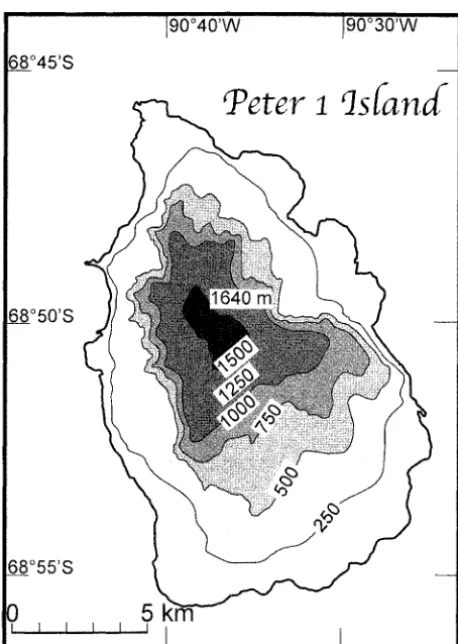
Peter I Island (fig. 10) was named by Bellingshausen in 1821, but he could not land because of its forbidding cliffs and ice cover. It covers some 154 km2 and is slightly elongate north-south with a roughly straight western coast and slightly embayed eastern coast. It is similar to the BaUeny islands, in sitting on a transform fault where basalt lava has found an easy way to the surface, but differs from them in that it is a simple transform arrangement and a single island; there is no chain. It appears to have been a major shield volcano about 64 km in diameter that has now sunk considerably from its original elevation (Rowley 1990).The island is poorly known because of its remoteness.
-nle entire structure, of which the island is the exposed part, comprises about 2900 km3 of a large volcano on the ocean floor about 4000 m deep and the island rises to 1640 m above sea level with a small crater at its apex, approximately 100 m in diameter. The formation of this cone probably began 10-20 Ma (possibly the source of earlier age estimates of 12.5 Ma come from samples taken at sea; Bastien & Craddock 1976) on oceanic crust that is about 60 Ma. Ages of lavas from the island range from 100-330 Ka. There is divided opinion about the origin of the island; is it a hot-spot or "leaky" transform source of lava? 'The rocks are very different from those ofJoncs Mountains, the closest similar rocks on the mainland of Antarctica. Hart
et al. (1995) regarded Peter I Island as formed from hot-spot lavas from a mantie source but the rocks differ from normal hot-spot lavas in having a high 2071204Pb signal. The transform model arises from the island's proximity to the 'Tharp Transform Fault (Prestvik et al. 1990).
68°45'S
Peter
1
1s[and
FIG. J 0 - Peter I Island
The rocks consist of basalt and trachyandesite which has then been intruded by dykes and small plugs of basalt. The rocks incorporate a variety of xenoliths of gabbro and peridotite with a few of quartz rich continental crustal material. They vary from vesicular to massive and take the form of pahoehoe (ropey) lava attesting to subaerial eruption; pillow lavas, which would indicate submarine eruption, are absent.
ISLANDS WITH H!STORY RELATED TO
THAT OF SOUTH AMERICA AND THE
ANTARCTIC PENINSULA
The region between the southern tip of South America and the Antarctic Peninsula (fig. 11) is one of the geologically most complex areas on the earth's surface. lhe area includes islands such as South Georgia which is mainly continental, Shag Rocks which are continental, the South Sandwich Islands which are subduction-related, and Diego Ramirez Isiands which are formed as a result of collision betwecn the Pacific Ocean sea-floor and the continent of South America.
The structure and age of the sea-floor of the Scotia Sea west of the South Sandwich Islands has a multiphase history over a relatively short geological interval. Immediately west of the volcanic arc of the South Sandwich Islands lies a roughly north-south oricnted spreading centre where the small Sandwich Plate (Cunningham et al. 1998) has been growing over the last 8 Ma. To the west of the new sea-floor thus formed, is older sea-floor of the Scotia Plate, due to an older episode of spreading (30-10 Ma) when South America and the northern Antarctic Peninsula separated in such a way that South America moved relatively northwest, north of a spreading ridge that was oriented northeast-southwest and subduction (now stopped) occurred under the northern margin of the Antarctic Peninsula. This plate is bounded at the west by the northwest-southeast oriented Shackleton Fracture Zone.
The Scotia Sea is bounded north and south by major transcurrent faults, the North and South Scotia Ridgcs with an east-west orientation. Both fault systems are marked by sinistral movement (north side rel~tively to the west) as SOllth America moved west relative to the Antarct.ic Peninsula. Between the faults marked by the ridges, the Scotia Plate has evolved. 'TIle area involved is some 1800 x 660 km, oriented east-west.
Islas Diego Ramirez
lhe Dicgo Ramirez Islands (fig. 12A, B) consist of a few islands to 2 km long and many smaller rocky islets, Like so many of the sub-Antarctic islands, they have a northwest-southeast orientation but this is due to their proximity to the subduction zone along the Chilean margin rather than to an association with a transform fault radiating from Antarctica. They lie on the Scotia Plate sOllth of the North Scotia Ridge and east of the Shackleton Fracture Zone.
[image:9.552.27.256.437.759.2]44
P.G. Quilty
FIG. 11 - 7ectonic sketch Mid-ocean spreading centres
of the Scotia Sea region. DR = Diego Ramirez Islands; SG = South Georgia; SR = Shag Rocks. double parallel those of the South Sandwich Plate are currently active.
'ls(as
~ie80
'Ramirez
(Grupo Norte)
Islote Martinez
Contour at 100 m
68°42'W
HG.12- Ramirez Islands. (A) Northern group; Southern group.
within it of an older Pacific Ocean seamount. Dating of events is not comprehensive but it is likely that the rocks suffered their most recent major metamorphic event in the Middle Jurassic (169 ± 16 Ma) and thus the original rocks were older, perhaps even late Palaeozoic. There appear to be two rock associations. One is more complex and regional, a tectonic melange of sea-floor rocks (sediments and that were initially at the leading edge of the rocks being subduced but later rose as the arc margin rose. The lithological affinities of the rocks are with those
i I
(Grupo Sur)
56°30'S
B
,56°31 'S
i68042,W
90m
Isla Bartoiome
e'
Contour at 100 m
68°41'W
[image:10.561.55.529.55.274.2]Origin and evolution of the sub-Antarctic islands: the foundation 45
South Georgia
South Georgia is dominantly continental and lies on the eastern end of the North Scotia Ridge (fig. 13) which is separated from the South American Tectonic Plate by the Falklands Trough; however, Cunningham et al. (1998) place South Georgia on the South American Plate (their fig. 1 (a), inset) whereas their fig. 1 (b) indicates that gravity data would suggest that it lies on the Scotia Plate. Figure 11 follows the implication of fig. l(b) of Cunningham et al. (1998). South Georgia was the site of the single "Antarctic" station for the first International Polar Year of 1882/83 - in Royal Bay (Headland 1992). The island is arcuate, concave to the southwest, and is the exposed part of a large continental basement fragment 380 x 140 km marked by the isobath
at 1000 m (Simpson & Griffiths 1982) and with margin
declining steeply to the 3000 m isobath. It seems that the exposed geology continues below sea level and that South Georgian rock types are typical of the entire block.
The 3000 m isobath delineates a series of three continuous
but separately identifiable east-west oriented continental blocks along the North Scotia Ridge. The most easterly is the South Georgia Block and the other island-bearer is the Shag Rock Block to the west-northwest of South Georgia. Its rocks may be older than those of South Georgia.
South Georgia, like the islands on distant Campbell Plateau, on the mirror side of the East Pacific Spreading Centre, are fragments of the older continental crust of Gondwana left behind during the dispersion of the super-continent. South Georgia and some other islands such as the Diego Ramirez Islands off southern Chile have been formed, or affected, by collision of Pacific Ocean sea Boor with the continental rocks of South America. South Georgia is one of the most spectacular places on Earth but early explorers such as Cook were not full of praise as they referred to its forbidding appearance. It is an extremely rugged landscape.
The island can be divided into two distinct terranes. One is the major part and the second, smaller, area is that in the southern reaches of the island - the Drygalski Fjord Complex of the Salvesen Range and to the southwest.
The major part is composed of strongly folded Late Jurassic and Early Cretaceous sedimentary rocks, mainly sandstones and volcanic rocks allocated to two major formations - Cumberland Bay and Sandebugten. These formed in a back-arc basin behind the southern Andes while subduction occurred on the southwestern side of the continent. The eastern side of the basin would have been parts of continental South America. The Cumberland Bay Formation which is the dominant exposed unit is Early Cretaceous in age (Aptian, 100-110 Ma; Thomson &
Tanner 1982) as judged by sparse bivalve and ammonite fossils, composed of andesitic volcaniclastic greywackes (Tanner 1991) up to 8 km thick. It was deposited in a marine environment by turbidity currents cartying sediments in units up to 5 m thick, from volcanic islands west of the current island. The composition of the greywack~s is consistent with this scenario.
The Sandebugten Formation is significantly different in composition, has thinner sedimentary units and is composed of siliciclastic turbidites sourced from the more easterly side of the same sedimentary basin and thus more continental in character. It occurs mainly in the northeastern edge of the island around Barff Peninsula east of Grytviken. There is doubt about the age equivalence of the Cumberland Bay
South §eorgia
Annenkov Is • .,.
FIG.
13 -
South Georgia. ~) Topography; (B) Geology.and Sandebugten Formations as fossils are sparse especially in the latter formation. It is possible that the Sandebugten Formation is considerably older than the Cumberland Bay Formation.
There is uncertainty about the relationship between the two formations. A thrust is normally evident between them but whether this is simply a thrust or also marking the position of an unconformity is not clear. The two formations have suffered different post-depositonal histories. It seems (Tanner 1991) that deformation of the formations occurred separately before they came into thrust relationships, the deformation of the Sandebugten Formation occurring earlier, and that of the Cumberland Bay Formation coinciding with the thrusting during the mid-Cretaceous at 91-82
Ma (Thomson & Tanner 1982).
The rocks of Annenkov Island are part of this sedimentary sequence but are only 3 km thick and have more abundant and diverse, but less definitive fossils which can be determined only as Early Cretaceous (Thomson & Tanner 1982).
The Salvesen Range is composed of Gondwanan continental gneisses and schists of the Drygalski Fjord Complex that are intruded by granite, layered gabbros and basic dykes (Headland 1992). These are the oldest rocks on the island and are the remnants of the original continental block on which the sedimentary sequences were deposited.
[image:11.555.279.507.62.379.2]46
P.
C. Quilty
onto the continental rocks during a period of subduction along what was the Pacific Ocean margin. Instead of being consumed during subduction, these rocks have remained above sea level and may have over-ridden the older basement. As the Pacific sea-floor was subduced along the southern margin, folding was intensified and a slice of Pacific sea floor, instead of being led down, attached itself to the southern margin of the island through obduction. Thus South Georgia is basically a piece of South America with a slice of Pacific Ocean sea-floor attached as Drake Passage was formed.
'The island has 13 peaks reaching over 2000 m, the highest Mt Paget at 2934 m a.s.!. This ensures that, even if north of the Antarctic Polar Frontal Zone, the island is heavily glaciated and has been for many millions of years. The island bears the scars of this history. lee reaches to 200 m on the southwest and 400 m on the other side of the island. The coast is thus heavily indented by fjords; it is marked by high cliffs in most places.
The small area of Shag Rocks (also known by a variety of other names and locations in earlier history) is some 250 km northwest of South Georgia. The rocks, while continental, are difFerent in type from South Georgia. These are greenschist facies metamorphic rocks that form small very rugged, triangular outcrops whose outcrop shape is controlled by internal structural fabric. Maximum elevation is 71 m.
THE SCOTIA ARC/SOUTH SANDWICH
ISLANDS
1he Antarctic tectonic plate has almost no area subject to subduction, but there is one relatively small but important area where this aspect is well developed - the South Sandwich Islands - 10 volcanic islands and a noteworthy shoal (fig. 14) over an arcuate length of 350 km; most have been active in the period of European visitation (Barker 1990). Barker (1990) recorded no Holocene eruption on Montagu Island, but Patrick et al. (2004) provided evidence for new activity in 2002 and continuing. Along Scotia Arc, the South Atlantic sea-floor is being subduced as a narrow slab in a "simplest of the world's arc-basin systems" (Lear et
at.
2(04) from the east below the South Sandwich Plate, accompanied by development of a volcanic arc with typical active volcanoes com positionally different from those elsewhere on the plate, and where deep earthquake activity is very pronounced. Even though the system is "simple", there are marked differences between the northern and southern ends of the arc. The northern end has a complex zone of seismic activity in contrast to the southern end which coincides with a transform fault. 'The eastern half of the Sandwich Plate and the Atlantic sea-floor converge at 67 (north)-79 (south) mm/year. 'lhe South Sandwich Trench, only some 100 km to the east of the volcanic arc, is over 8000 m deep in places, by far the deepest water in the Antarctic or sub-Antarctic. From the trench, the subduction zone dips at 75° to the west at 60 km depth and can be traced to depths in the mantle of only ~ 180 km and thus may be a geologically young feature, 15 Ma according to Leat et al. (2004). As expected in a volcanicarc above subducing crust and lithosphere, the rocks are generally pyroclastic in stratovolcanoes and with composition, while variable and including basalt, tending more into the andesite/dacite area with higher silica and volatile content, higher viscosity and evidence of more explosive volcanic activity. Eruptions include occasional release of very noxious
3000-5000 m
FIG.
14 -
South Sandwich Islands. Direction o/subduction indicated by large arrowheads.gases, such as that encountered by Capt.
c.A.
Larsen from Zavodovski Island, and accompanied by explosive volcanism such as that which produced an immense raft of pumice from the previously unknown Protector Shoal at the north in 1962 (Gass etat.
1963, Sutherland & Olsen 1968). Lavas from this site seem to come from a variety of sources, not a single parent (Leat etat.
2007). Over the last 200 ka, five eruptions have produced material that has been incorporated in the ice at Dome C in East Antarctica (Narcisi et al. 20(5).The slab of subducing South Atlantic sea-floor is older in the north (83 Ma) than in the south (27 Ma) and carries into the subduction zone the sediment that has accumulated on it; all sediment seems to be carried down (Leat et al.
2(04) but that in the north has a higher carbonate content than that in the south.
The islands are roughly evenly spaced along the arc, about 70 km apart. Leskov Island is about 50 km west of the axis of the other islands but this seems not to constitute evidence for any major anomaly. 'lhey are generally small, stark, barren features only 2-12 km across; the largest islands (Montagu and Saunders) are in the centre of the chain but there is no systematic variation in size along the chain. Visokoi, Montagu, Bristol and Cook islands are over 1000 m high, and Saunders Island 990 m. Others are substantially lower. Many arc roughly quadrate but Leskov, Saunders, and to a lesser extent 'Thule, are arcuate and concave to the northeast or east. Protector Shoal reaches to within 27
111 of sea level. The islands generally sit atop larger subsea
[image:12.568.296.523.54.305.2]The age of most islands is Holocene but Montagu Island is dated at about 1 Ma, and Freezland Rock off the southwestern end of Bristol Island is 3 Ma. The entire arc has been estimated to be 5 Ma (Barker 1990) and there seems to be no systematic variation in age along the chain.
The islands are all glaciated but vary greatly in ice cover, the difference depending on elevation, the proportion of the island that is elevated, and also on the heat flow from eruption in active volcanoes.
Bouvet0ya
Bouvet Island (fig. 15) lies very close to the triple junction of three tectonic plates - South American, African and Antarctic. It is a little to the east of the triple junction near the Southwest Indian Ridge and a little south of the Ridge where it formed. It consists of a single dominant cone with summit caldera that is open to the north, possibly due to collapse of the northern flank of the volcano. 1he northern, western and southern margins are relatively straight. The north and west coasts are steep, the north due to collapse, and the west due to marine erosion, but elsewhere the slope from the caldera rim to the coast is uniform and thus the volcano appears to be more shield-like than a stratovolcano. The concavity left by the collapse to the north is now filled by the island's major glacier, the north-flowing Posadowskybreen. Ihe rest of the island is covered by an icecap.
Because the island is so close to the triple junction and because the triple junction is believed to mark a long-lived plume marking the location where Antarctica, Africa and South America separated at some 120 Ma, the island volcanic rocks have been subject to many studies over a considerable interval, despite the difficulty of access (Verwoerd 1990a). Such studies have focused on questions of long-term evolution of hot-spot magmas especially at a point where there is no chance for involvement of a continental crust component.
The volcanic rocks are dated at slightly over 1 Ma and they sit on older crust - some 4.5~5 Ma which has had a single, geologically short history of two intervals. The first sequence includes dominantly pyroclastics which have been altered by the influence of seawater on the erupting rocks. The second sequence formed above sea level away from marine influence and consists of subaerial basalt flows consistent with the appearance of a shield volcano.
HG.
15 --
Bouvetoyaand evolution of the sub-Antarctic islands:
47
The rocks lie close to the boundary between tholeiitic and alkaline fields (fig. 3) but slightly on the alkaline side, and while dominantly hawaiite extend as far as trachyte and alkali rhyolite. 111e rhyolites come from Lars0ya at the southwestern point of the island and may be the youngest lavas of the area.
Between 1955 and 1958, a new beach and raised platform developed in the northwestern part of the island. Initially this was thought to be evidence of a modern eruption but re-examination shows that the rock is 0.45-0.5 m.y. old and the block retained its internal cohesion and thus is due to simple downslope landslide movement and not a chaotic avalanche or modern eruption. 'rhus there is no evidence of modern volcanism even though there is mild fumarolic activity at the summit.
Gough Island
Gough Island (fig. 16A, B) lies at about 40°5 and is thus closer to the equator than to the South Pole but is taken as sub-Antarctic for the purposes of the Scientific Committee on Antarctic Research (SCAR). It is the western end of three features - the others are McNish and R.S.A. Seamounts (fig. 16A) - which probably formed in the same way as Gough Island on a transform fault offset from the Mid-Atlantic Ridge, immediately south of Walvis Ridge. Between them, they constitute the Gough Fracture Zone (Chevallier 1987). There is some controversy about its geological setting but Gough Island seems to be similar to the Balleny islands except
o 2 km
I...---L-J
B
FIG. 16-Gough Island. (,4) ]he regional setting. (B) Geology of Gough Island. Dashed white arcs indicate past rrlldf'1"11c
[image:13.549.263.505.411.737.2]48
P.
G.
that two of the three island/seamount structures have already sunk below sea level thus Gough Island as the lone island of the chain,
Island is a single volcanic complex (Chevallier
et at. 1983, Chevallier 1987, Maund et at. 1988) but with several in its short history. When the entire edifice above below sea level is considered, it is roughly circular in plan. but the island itself is elongate northwest-southeast, about 13 x 6 km, and concave to the southwest. Chevallier six stages in the volcanic of the island. 'TIle oldest basaltic volcanism occurred at a little over 1 Ma at about sea level and even included beach pebbles in the 70 m thick volcanic unit which shows evidence of related to the interaction of sea water with the lava. 'nlis unit is exposed mainly on the northeastern side of the island. Ibis was followed by basalt above sea level from the main body of the volcano,
1 Ma at the base of the These lavas cover a little
over 50% of the surface the island, mainly in the centre and southwest and are cut a series of many radial dykes. After an erosive phase, a series of basalts were extruded about 3 km southeast of Mt Edinburgh at 0.5-0.6 Ma. Ihis ended the basaltic phase of the island's history and is further marked tbe collapse of the central caldera. the interval 0,47-0.12 Ma, trachyte intrusion and extrusion filled many of the formed after the basaltic and produced a series plugs at various around the island. 1bis is centred on Mt Om), but these arc not cut by dykes.
The latest eruption may have occurred as recently as 2300 ago. The lava arose from a hot-spot source (Harris et but in contrast to Tristan da Cunha to the north, the lavas have risen to the surface without any mixing with sediments the way and constitute a dosed fractional
system.
A marked feature of the island's volcanic centres is the presence of a series of arcuate, concave to the southwest, crater rims marking the positions of successive volcanic centres. It is likely that the southwestern side of volcanoes has suffered periodic to the southwest generating the concave-to-the-southwest aspect of the island.
-n1e island to be devoid of evidence of glaciation signs of elevation during its
8c Kent 1989). Well-developed terraces occur at 3-4 m, l2-15 m, 30 ill, 55 In, 75 m, and at -23 and - 50 ill. It has been suggested that that at
3--4
m level relates to coastal erosion at 120 ka last interglacial); those at 12-15 and 30 m to the Middle Pleistocene; that at 55 m earlier in the and the 75 m level somewhat older. -nlOse below modern sea level may relate to intervalslower sea level during the last
EVOLUTION OF THE iNDIAN
OCEAN AND
INDIAN
The Indian Ocean is unusual in having a series of submarine areas of ocean floor at intermediate depths
and sampled as volcanic rocks formed subaerially and now sunk sea leveL These submarine plateaux support volcanic islands such as Heard Island and lies Kerguel~n on Crozet on Crozet Plateau. Many short over many tens
of millions of years. Heard Island and Iles Kerguelen are consistent with this remark but there are exceptions.
The major tectonic development affecting the Indian Ocean began at 115-125 million years (early Cretaceous) when Africa-South America split off from Gondwana, opening up the Weddell Sea (Royer 8c Sandwell1989, Royer
& Coffin 1992). Shortly after this time, India (or what geologists term Greater India) began to move north from Antarctica from Gunnerus Bank, around Enderby Land to the Windmill Islands, thus initiating the Indian Ocean and permitting marine conditions to enter along this long coast. At about the same time, Africa/South America started to move apart allowing the Atlantic Ocean to form.
'Ule northward movement of India also coincided with the initiation of a Large Igneous Province (LIP) which led to the formation of the Kerguelen Plateau (Duncan 2002, Frey et al. 2003, Quilty 2006). Because of its size, and as a high proportion of the Kerguelen Plateau lies below sea level, it is not well sampled except on the few islands and through deep sea drilling. Its history cannot be said to be well understood. It formed in three distinct, short-lived stages -- at about 118-119 Ma, 100--95 Ma, and 35 Ma and younger. Initially this included what is now Broken Ridge and all was attached to southwestern Western Australia. The first phase of disintegration was marked by vast outpourings of basaltic lava above sea level in a short interval followed by formation of soils, supporting vegetation of palms and ferns recovered by drilling of the Ocean Drilling Program (ODP) in 1988 (Mohr & Gee 1992. Francis & Coffin 1992). It
may also have been a major source of carbon dioxide (Frey
et al. 2003) with Greenhouse effects (Hansen et al. 2007).
It is also likely that a thinned fragment of continental crust remains under Elan Bank, west of the main body of Kerguelen Plateau, and evidence of a continental component elsewhere on the plateau was encountered during drilling by ODP Leg ]83 in 1999 (Ingle et al. 2002). The foundations of Kerguelen Plateau were laid. 1his piece of Kerguelen Plateau sank below sea-level at about 100 Ma and has been accumulating pelagic sediment and volcanic material ever since, interrupted by times of increased ocean flow over the Plateau eroding some of the material already deposited and generating gaps in the geological record.
1he second phase in Kerguelen Plateau formation occurred at about 100-95 Ma (late Cretaceous) when Central Kerguelen Plateau was formed; this supports Heard and McDonald islands which did not come into existence until much later. 1hi5 part of the Plateau had a similar history to that of Southern Kerguelen Plateau, but is later. Until this time, part of the sea--Hoor spreading was occurring north of Kerguelen Plateau which remained on the Antarctic Plate, and a second coeval phase was active along the Western Australian coast opening up the eastern Indian Ocean. India kept moving north, generating sea-Hoor behind it and eventually colliding with Asia at about 40 Ma to form the Himalayas; this continues today.
Origin and evolution subAntarctic islands:
49
circulation yet existed but there may have been some flow through the Antarctic Peninsula region, some of which did not exist at 100 Ma. Sea-floor spreading between Australia and Antarctica accelerated to the modern rate of 7 cm/yr at 55 Ma, and by 34 Ma enough had occurred to alJow circumpolar circulation to develop as the gateway between Australia and Antarctica grew wide enough.
At this time, the South East Indian Ridge (SEIR) between Australia and Antarctica began to split Kerguelen Plateau from Broken Ridge, generating new sea-floor between Kerguelen Plateau and Broken Ridge/Australia. 'lhe rifi: was now complete. Antarctica lay isolated over the South Pole while all other, now individual, fragments of Gondwana moved northward.
'The northern part of Kerguelen Plateau formed at about 40 Ma and
Tics
Kerguelen began a complex evolution of basaltic volcanism interspersed with intervals of forestation forming horizons of sediments with peat and fossil trees between lava flows. Volcanic activity was more or less continuous from about 26 Ma (latest Oligocene) to very recently. The region is now quiet.Marion and Prince Edward islands -
the
Prince Edward Islands Group
Marion and Prince Edward islands (fig. 17) sit atop a small submarine plateau - the Marion Plateau, mostly shallower than 200 m (and thus much exposed during the low sea level ofthe Last Glacial Maximum) some 55--60 km long, oriented north-northeast - south-southwest, which formed at about 54 Ma (Verwoerd 1990b). They occupy positions at opposite ends of the plateau. 1hey have a relatively short, dominantly volcanic history, with episodes of marine sedimentation, sim ilar w the case in several other Indian Ocean volcanic islands. McDougall et al. (2001) regarded the volcano as
related to hot-spot activity and recorded a track of a hot-spot (the Marion Hot-spot) over the last 120 Ma from east of Madagascar to the current position of the islands.
Marion Island is slightly elongate east-west with a gentle dome shape, strong radial drainage and, in contrast to many islands discussed here, lacks a steep-cliffed margin.
Two main periods of eruption are recognised as (McDougall et
at.
2001) "older grey lavas" and "younger black lavas". 'The former does not outcrop widely as it has been covered by the more recent black lavas. The "older lavas" were extruded between 450-30 ka and alternate with sediment horizons many with glacial features. Five (perhaps as many as eight) glacial intervals are recognised and have been dated between dated flows. Flow dates are 454-413, 363-323, 244, 201-156, 110, 92-81 and 50 ka. The glacial intervals are then centred roughly on 450, 275, 190, 75 and 25 Ma, and have been interpreted as relating to well-known glacial maxima as defined by ice and sediment records elsewhere on Earth. Other possible glacial sediments are at 340, 122 and 100 ka. The younger black lavas all seem to be 10 ka and younger in age and are fresh and little-altered. The modern volcano on Marion Island erupted along an east-west fissure in 1980 and the most recent eruption was in 2004/2005. There is much evidence of activity in the last few thousand years from some 150 volcanic cones scattered widely around the island with little evidence of any structural pattern.All lavas are attributed to the alkali oceanic island basalt group but lack any deep-seated xenoliths. Trachyte occurs on
37' 40'E 38°E
km
31' 40'E " 38°E
FIG, 17 -- Marion Plateau with both Marion and Prince Edward islands.
Prince Edward Island. Gravity-controlled slope failure and landslides have had a major control on the modern landforms of the island leading to the rather uniform slopes.
Prince Edward Island is significantly smaller than Marion Island but was larger in the past. In contrast to the gentle slopes of Marion Island, it is marked by a 400 m escarpment at {he coast on the northeast and southwest, but well inland elsewhere. The escarpment close to the coast marks the position of faults that caused collapse of the island margins along the northwest-southeast trend. Prince Edward Island has similar lavas to those on Marion Island but also includes more silicic lava (trachyte) with eruption mainly in the 200-110 ka interval. Verwoerd (l990b) suggests the lavas on the two islands come from different reservoirs. In addition to the main vent at the peak, there are about 15 cones widely scattered over the island; some of these are believed to have been active during the Holocene but no modern eruptions arc known.
Marion Island has a small icecap above 1100 m and was seriously affected by glaciation during the Last Glacial Maximum; the moraines left by this glaciation are concentrated on the southeastern and northeastern extremities of the island, Prince Edward Island may have missed that glacial influence by virtue of being farther north and of lower elevation. Much of Prince Edward Island has disappeared, probably ro the northwest, either by horizontal movement along a fault, or a catastrophic slump that characterises many oceanic islands.
lies Crozet
'Ihis series of islands has a western and eastern
50
P. C.
'Archpe(aa
o
45°8
rrrnTTl Cliffs
km
Lines of conesLj~-.-1krn
Possession
• - ••.• Axis of glacial vall
Axis of main rift valley
krn
Antarctica (Nougier & Thomson 1990a, Chevallier et at. 1983). The plateau could be as old as 54 Ma but the islands are made of much younger volcanoes. The northeastern margin of the plateau has a marked 135" azimuth and this is reflected in the orientation of the long axis of Ile de la Possession and its central rift, the orientation of faults and cones on Ile aux Cochons, and many other aspects of the islands. The western group of three islands (lIe aux Cochons and the much smaller l1e des Pingouins and Ilots des Aporres) and the eastern island group (lle de la Possession and Ile de I 'Est) are composed of many small volcanoes some of which have been active in the last few thousand years. 'The larger islands have all been affected by glacial activity which has sculpted many into their present landforms but there are no glaciers currently on the islands.
While the islands may be widely scattered on the submarine plateau, some phases of volcanic activity are consistent across the chain. Activity in the eastern group is from 9-1.3 Ma, bur between 1 and 0.5 Ma all islands in the archipelago have been active.
Ile aux Cochons is a single young volcano, less modified than others in the area, and steeper on its western side.
It has grown through two phases of activity - the first represented by 400 m of phreatomagmatic breccias (caused
by
the explosive interaction oflavas with ground water) and interbedded 1 m thick basalt flows exposed in cliff sections in the northern and southern parts of the island. This phase (1-0.5 Ma) was followed by faulting which allowed emergence of the second phase (0.2 Ma- present) of some 60 small cones and flows radiating from a crater at the summit (Mt Richard-Foy). The younger cones commonly are arranged in four radiating linear series along the earlier, post first-phase faults. Two of the directions (700 and 160°) are parallei to faults that control some of the coast directions indicating that the coast is also pardy fault-controlled. These phases are the youngest recorded in the archipelago and other volcanoes have evidence of earlier eruption. 1he lavas are all alkali basalts.lIe des Pingouins and IIots des Apotres are 50 km south-southeast and 15 km northeast oElle aux Cochons. Both are remnants of volcanoes but have been severely reduced in size by block faulting or erosion.
Ile
des Pingouins displays coarse breccia, flows and hyaloclastites (glassy fragmental lavas) in cliffs, and Hots des Aporres consist of two small islands and 12 rocky islets arranged along the 700 azimuth.1he eastern group comprises two older and larger volcanic islands (fie de la Possession and lIe de l'Est) which may still technically be active. lie de la Possession is a stratovolcano which has dates of8.1-0. 53 Ma and was formed during five or more phases of volcanic activity. 1he oldest rocks occur on the western tip of the island and consist of fossiliferous hyaloclastite with mussels and pectenids (Chevallier et
at.
198.3) deposited in a shallow marine environment. Preservation is too poor to allow accurate radiometric dating. The second phase provided the 8.1 Ma date and was the main stratovolcano-building event that developed the basement of the island. The lava source probably was on the western side of the current island and generated lavas and interbedded pyroclastics until 2.7 Ma. The centre of the entire activity was to the west of the island. Immediately following thisFJG.IB--(A) aux Cochons. (C)