QLK5-2002-02400
Annex 1 of the Deliverable D2
Country Reports
on
Data Collection and Processing Systems (DCPSs) in 32
European Countries
May 2004
This report has been carried out with financial support from the Commission of the European Communities under Key Action 5 of the Fifth Framework Research and Technological Development Programme for the concerted action "European Information System for Organic Markets". The views expressed are those of the authors and do not necessarily reflect the views of the European Commission, nor do they in any way anticipate the Commission's future policy in this area.
Contents
1 Austria ... 3
2 Belgium... 15
3 Bulgaria ... 21
4 Cyprus ... 33
5 Czech Republic ... 35
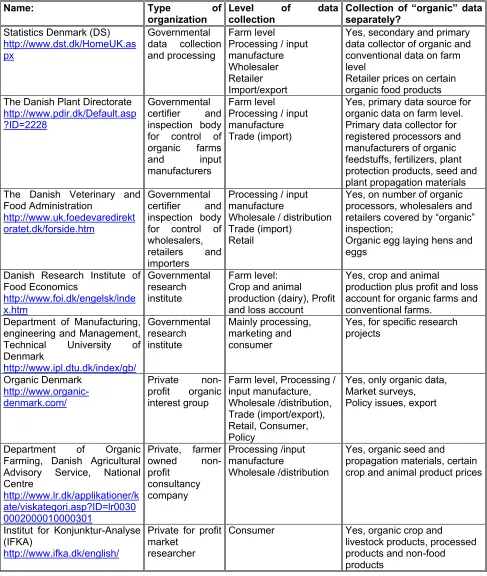
6 Denmark ... 45
7 Estonia... 55
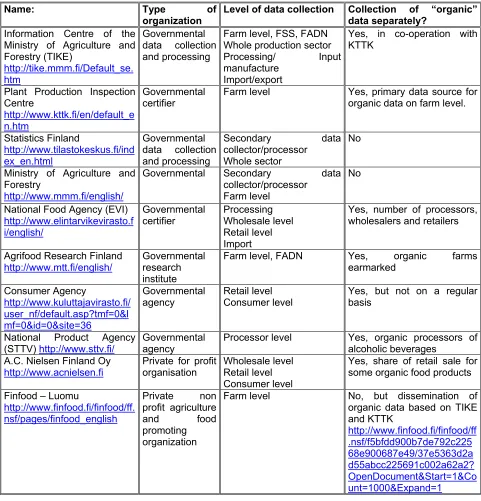
8 Finland ... 59
9 France ... 65
10 Germany ... 71
11 Greece... 101
12 Hungary ... 105
13 Iceland ... 113
14 Ireland ... 119
15 Italy... 123
16 Latvia ... 133
17 Liechtenstein... 137
18 Lithuania... 143
19 Luxembourg ... 149
20 Malta... 153
21 The Netherlands... 155
22 Norway... 163
23 Poland... 171
24 Portugal ... 179
25 Romania... 183
26 Slovakia ... 191
27 Slovenia ... 199
28 Spain ... 207
29 Sweden ... 213
30 Switzerland... 221
31 Turkey ... 235
1 Austria
Country Report
AUSTRIA
Prepared by:
Norbert Gleirscher
Centre for Mountain Agriculture University of Innsbruck
Technikerstrasse 13 6020 Innsbruck Austria
Tel: +43/512-507-5694 Fax: +43/512-507-2817
E-mail: [email protected]
1.1 National relevance of organic farming
As Austria is one of the pioneers in the development of organic farming the production and retailing structures are well developed. Therefore in 2002 the number of organic farmers was accounted with 17.891 (taking part in the Austrian environmental program ÖPUL), which in relation to the total number of farmers makes up a percentage of 8,2 %. Concerning the organic area in 2002 201.284 ha of grassland and 92.115 of arable land were under organic management. In total the organic area was about 296.154 ha (8,73 %). (Grüner Bericht 2002)
According to recent estimations the market volume for organic products in Austria accounts for about 300 million Euro. The main sales channels are big retailer chains with about 75 % of the market volume, followed by direct marketing and special organic shops (15 %) and sales to public canteens (10 %).
As for import level mainly fruits and vegetables as well as processed cereals are imported from Italy or other southern European countries. Main export partners are GB, D and FR, especially concerning meat (both beef and pork) and milk products (Lebensmittelbericht 2003).
Table 1-1: Organic Agriculture in Austria
Number of organic farms 18.576 Organic area in ha 296.154 ha
[image:6.595.62.537.495.715.2]1.2 Structure of national statistic/data providers in agriculture
Table 1-2: Structure of surveyed institutions in Austria
Type of Organisation
Governmental Governmental Semi- Governmental
Non-Private (non profit)
Privat
(Profit) TOTAL
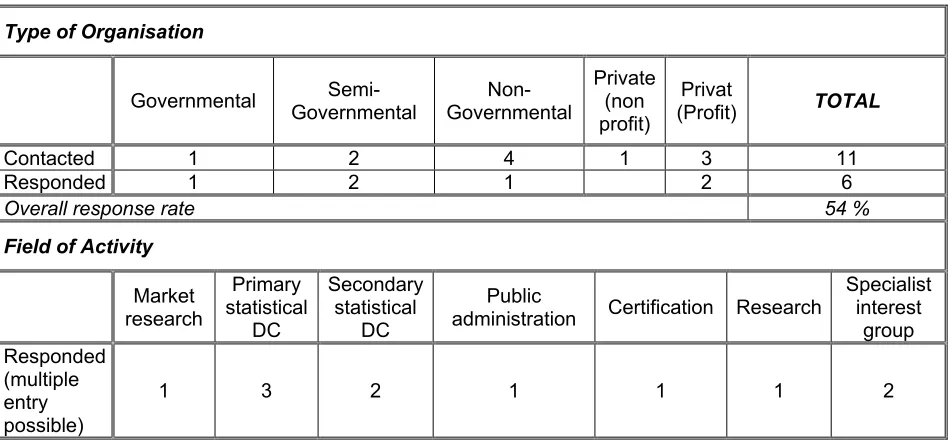
Contacted 1 2 4 1 3 11
Responded 1 2 1 2 6
Overall response rate 54 %
Field of Activity Market research Primary statistical DC Secondary statistical DC Public
administration Certification Research
Specialist interest group Responded (multiple entry possible)
1.3 Information about the surveyed institutions
1.3.1 Statistik Austria
Contact details: DI Beate Schmidt
Head office of Spatial Economics Hintere Zollamtsstrasse 2b 1035 Wien
Tel: +43/1-71128-7119 Fax: +43/1-4934300
E-mail: [email protected]
Statistik Austria is a semi-governmental organisation, which is financed by public funds. The main assignment of the organisation is to provide data on demographics, economic development, spatial economics and political economics in Austria. The directory of spatial economics is mainly dealing with all aspects of agriculture and agricultural production in Austria as well as with statistics on tourism or energy use. Additionally to production Statistik Austria also provides data on trade (import/export) of agricultural products as well as on consumption. Primary statistical data for analysis are mainly provided by the Ministry of Agriculture as well as the Agrar Markt Austria (INVEKOS). Regarding all agricultural statistics there is no distinction made between organic or conventional products. By EU-legislation and by order of the Ministry of Agriculture the Statistik Austria is also obliged to implement the Farm Structure survey.(FSS)
1.3.2 Agrar Markt Austria
Contact details: Mag. Micaela Schantl Department Marketing Pasettistrasse 64 1200 Wien
Tel: +43/1-33151-418 Fax: +43/1-33151-499
E-Mail: [email protected]
The Agrar Markt Austria is a semi-governmental organisation, which is financed by public founds and partly by membership fees. The main challenge of the organisation is to promote agricultural products with Austrian origin. Besides one main task is the execution of the market regulations since Austria joined the European Union in 1995. One main instrument therefore is the implementation and control of the national program for environment and agriculture (ÖPUL), from which the main structural agricultural statistics (agricultural area, land use, number of animals, etc.) can be derived. Regarding statistics on organic farming there are two main DCPS integrated: INVEKOS and ROLL-AMA;
farms in Austria take part in the ÖPUL (Austrian environmental programme), which is partly financed by the EU, the INVEKOS data give detailed information about the structural situation of organic farms in AUSTRIA.
ROLL-AMA in general gives information on the consumption of food in Austria, also integrating a special part about organic. Besides a household panel, which is done at regular intervals (4 times a year), it also contains statistics on organic food sold through the main retailer chains in Austria.
1.3.3 LBG-Wirtschaftstreuhand
Contact details: DI Martin Hellmayr Department of Statistics Schauflergasse 6/ PO 98 1014 Wien
Tel:+43/1-53105-100 Fax: +43/1-53105-115 E-mail: [email protected]
LBG –Wirtschaftstreuhand is a private business management consulting firm, which besides other activities is also involved in the analysis of voluntary bookkeeping farms in Austria. By order of the ministry of agriculture the economic situation of a representative number of farmers is analysed and published yearly in the “Grüner Bericht”, a compilation of the main relevant data concerning agriculture in Austria.
1.3.4 Ministry of Agriculture, Forestry, Environment and Water Management
Contact details: DI Thomas Rech
Section II (Sustainability and rural areas) Stubenring 1
1012 Wien
Tel: +43/1-71100-6764
E-mail: [email protected]
The Ministry of Agriculture, Forestry, Environment and Water Management acts mainly as an coordinator in collecting statistical data in respect of agriculture than primary data collection. A yearly report (Grüne Bericht) provides a compilation of all relevant agricultural data.
1.4 Institutions which run “Organic DCPS”
Most important institutions:
Other DCPS (which acquire only data segments):
− BIO ERNTE AUSTRIA: statistics on number of farms, estimations on marketed product volumes for milk, eggs, pigs, beef, and some sorts of vegetables and fruit.
1.5 Results of the second stage inquiry
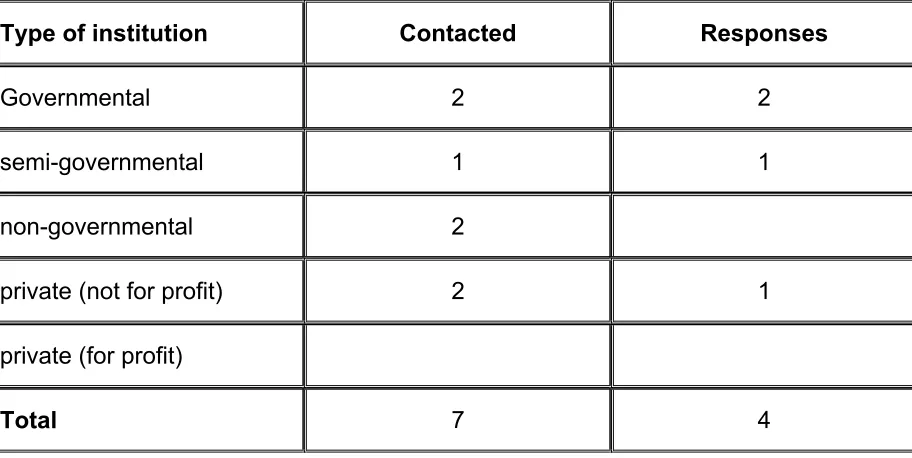
Table 1-3: Number of surveyed institutions/respond rate/respond structure AUSTRIA
Number of contacted institutions
Number of
Responses Response rate Respond structure
11 2 18%
Agrar Markt Austria (semi governmental, public administration)
LBG Wirtschaftstreuhand private (Profit), primary statistical data
Table 1-4: Overview about existing DCPS by actor level
DCPS Institution Actor level Total Org.
INVEKOS AMA Marketing GMBH Farm level X X
ROLL AMA AMA Marketing GMBH Consumer level X X
FADN LBG Wirtschaftstreuhand Farm level X X
Price Statistics LBG Wirtschaftstreuhand Farm level X X FSS
(Agrarstrukurerhebung) Statistik Austria Farm level X (X)
Statistik Austria
Import/Export level, Retailer level,
Wholesaler/Processor level
X
ALFIS Ministry of Agriculture
Farm level, production statistics, price statistics, labour force,
import/export
X
1.6 Detailed information about DCPS, which include organic data collection
1.6.1 Farm Level
FADN (Grüner Bericht)
conducted yearly by a private firm (LBG) and the results are presented in a yearly report called “Grüner Bericht”, where all the main figures concerning the development of the agricultural sector in Austria are illustrated. The report is openly available. The integration of organic farms into the sample took place firstly in 2000, since then particular income statistics on organic farms in Austria are available.
Which statistical scopes are covered by the DCPS and which segmentation does the data set allow?
- Name of the DCPS: FADN (Grüner Bericht)
- Statistical Scope: income statistics, agricultural financial ratios - Segmented by: farm type/size and product group
Does the DCPS cover only organic sector data, both organic and total data or only total data (no distinction of organic sector data possible)?
The DCPS covers both organic and total data, a distinction between organic and conventional is possible;
Does the DCPS promise relative valid and reliable results?
The data collection is done as a representative sample of 2264 conventional (1% of the total farms) and 402 (2,1 % of total organic farms) organic farms (sample size for 2002). The sample is for a bigger part composed of voluntary book-keeping farms as well as compulsory ones. As for conventional farms the sample is representative for farm types/size, product groups as well as regions. As for the sample organic farms it should be mentioned, that the sample is not representative, because the selection of farms is not harmonised with the types of organic farms in Austria. Although the DCPS gives clear indications about the economic development of organic farms.The system allows a direct comparison between organic and total farm data. The data collection is done permanently during the year, with a final analysis once a year. As for quality management besides computerised plausibility checks also visual checks by experts are conducted.
How are the results disseminated?
- The results are disseminated once a year in the overall agricultural report of the ministry of agriculture called “Grüner Bericht”. All data and analysis are also available on a web-page www.gruener-bericht.at. All information is openly available.
How is the DCPS harmonised or related to other superior DCPS? - The DCPS is harmonized with FADN.
What was mentioned for the DCPS as main opportunities and barriers as well as strength or weak points? Are there plans existing to improve the quantity, availability, comparability (harmonisation) or quality of organic data? When yes, which plans does exist?
- In total for the DCPS as strengths were mentioned its representatives, its long running (since the 60ies) and its weighted results. As for organic farms the high number of involved farms as well as the possibility to weight the results were seen as special strengths.
Can this DCPS be taken into account as a positive reference (case study) for organic data collection at general?
- Yes, the DCPS is already well known and internationally standardised.
Production Statistics
In combination with the FADN (“Grüner Bericht”), which is conducted by the LBG, the same sample of 2264 total and 402 organic farms is used for a production statistics assessment. Production statistics are conducted by a representative sample with on farm questionnaires.
The DCPS is not harmonized to an international DCPS and gives indications on the value of production on organic farms. As for quality management computerized plausibility checks and expert checks. The dissemination of results is done yearly by the ministry of agriculture in the report “Grüner Bericht.”
Price Statistics
In combination with the FADN (“Grüner Bericht”), which is conducted by the LBG, the same sample of 2264 total and 403 organic farms is used for a price statistics assessment. Price statistics are conducted by a representative sample with on farm questionnaires.
The DCPS is not harmonised to an international DCPS and gives indications on the average price level of producer prices on organic farms. As for quality management computerized plausibility checks and expert checks. The data on organic farming are not available openly and not included in a public report.
Agrarstrukturerhebung (Farm Structure Survey) Austria
The Farm Structure Survey in Austria is on important survey on agricultural statistics, which is conducted every 2 or 3 years as a representative sample and every 10 years as a full census. The DCPS provides information on the number of farms, the husbanded area, the allocation and size of animal stocks as well as the agricultural labour. The DCPS is conducted by the office of national statistics (Statistik Austria), the implementation and methodological coordination is done by EUROSTAT. Since 1990 organic farming is included into the DCPS.
Which statistical scopes are covered by the DCPS and which segmentation does the data set allow?
- Name of the DCPS: Agrarstrukturerhebung - Statistical scope: farm structure data
− Segmentation criteria: types/size of farms, husbanded area, production types, Grades of husbandry difficulties, main production areas
Does the DCPS cover only organic sector data, both organic and total data or only total data (no distinction of organic sector data possible)?
− Yes, data on organic farms are included into the DCPS.
− The Farm Structure Survey is a total census done in strong cooperation with EUROSTAT, the methodological approach is also elaborated in strong cooperation with EUROSTAT;
− Although in the official report of the farm structure survey there is no data on organic farms included, it is possible to make a direct comparison between organic and a and total farm data. This kind of analysis is not done until now, but theoretical it would be possible.
− As for quality management a computerized plausibility check as well as expert check are used. The full census is conducted every 10 years, an update of the data is done by random samples every 2-3 years by the Statistic Austria.
How are the results disseminated?
- The results of the farms structure survey are available as a public report. Although data on organic farming are not represented in the survey, it is possible to get a special analysis on them, but not openly available.
How is the DCPS harmonised or related to other superior DCPS?
− The “Agrarstrukturerhebung” of the Statistic Austria is harmonized to the FFS. Methodology and implementation is done in close cooperation with EUROSTAT.
What was mentioned for the DCPS as main opportunities and barriers as well as strength or weak points? Are there plans existing to improve the quantity, availability, comparability (harmonisation) or quality of organic data? When yes, which plans does exist?
- Strengths: Total census of all farms in Austria every 10 years - Weaknesses: Up-to- dateness of the data
INVEKOS (Integrated administration and control system)
The INVEKOS system is a data pool especially created for the execution and control of agricultural EU support measures. All relevant data are collected in cooperation with regional chambers and the Agrar Markt Austria, an organisation especially responsible for the administration and control of agricultural market regulation. As for the fact that in Austria about 95 % of all farms take part in the environmental programme ÖPUL (Austrian Programme for Environment and Agriculture) it is the mayor base for agricultural statistics on farm level in Austria. The data are administrated and analysed by the AMA.
Which statistical scopes are covered by the DCPS and which segmentation does the data set allow?
− Name of the DCPS: INVEKOS
− Statistical scope: farm structure data
− Segmentation criteria: Farm type/size, product group/area, region
Does the DCPS cover only organic sector data, both organic and total data or only total data (no distinction of organic sector data possible)?
husbanded area concerning grassland/arable land as well as the planted product groups.
Does the DCPS promise relative valid and reliable results?
− The method of data collection is done as a yearly census through the analysis of the support applications of farmers, which take part in market regulation measures supported by the European Union. The collection of the applications is either done by the regional agricultural chambers or since 2002 online via a new installed system called EAMA. (www.eama.at). Besides structure and size of the farms also data on number of animals (only for cattle is) registered. − All in all in 2003 155.600 farms are registered in the INVEKOS system, which
means that 99% of the total arable land, 94% of total permanent grassland and 80 % of the total vine and orchards are covered. The missing percentage of farms is mainly due to the too small size of the farms (a minimum of 2 ha is required to participate in the program), so the significance of the DCPS is only partly shortened.
− As for supported organic farms in Austria, which makes about 98% of the total, the DCPS gives clear figures on the structure, production and animal number (only for cattle) of organic farms. The DCPS therefore allows a direct comparison of organic farms and the total.
− For quality management data are checked by computerised plausibility checks as well as expert checks. Data are collected in yearly frequency.
How are the results disseminated?
− Although the major part of the data is reported in the “Grüner Bericht” from the ministry of agriculture, data in general are not public. The database is mainly used for reporting EU-support measures and for national analysis by the authorized national institutions.
How is the DCPS harmonised or related to other superior DCPS?
− INVEKOS is based on the EU regulation 3508/92 and 3887/92 with the aim to administer and control agricultural EU-support measures.
What was mentioned for the DCPS as main opportunities and barriers as well as strength or weak points? Are there plans existing to improve the quantity, availability, comparability (harmonisation) or quality of organic data? When yes, which plans does exist?
− No information on that point available
Can this DCPS be taken into account as a positive reference (case study) for organic data collection at general?
1.6.2 Consumer Level
ROLL AMA household panel
The ROLL AMA household panel is conducted by AC Nielsen AUSTRIA by order of theAgrar Markt Austria (www.ama.at).
Which types of data are collected? − Name of the DCPS: ROLL-AMA
− Types of data, which are collected: penetration of products, consumer expenditures, consumption volume, purchase frequency
− Segmentation criteria which can be used:
− socio-demographic criteria (age, family types, household income, education, sex)
− spatial criteria (AC Nielsen regions),
− product groups (fruits, vegetables, beef (incl.veal), pork, poultry, milk, milk products, cheese, eggs, oil
− food retailers (distribution channels)
Does the DCPS cover only organic sector data, both organic and total data or only total data (no distinction of organic sector data possible)?
− The DCPS covers both organic sector data as well as total, a direct comparison between total and organic consumption is possible.
Does the DCPS promise relative valid and reliable results?
− Concerning the methodology a representative consumer household panel and a household dairy are used. Starting in 1998 4000 households had to report on their consumption behaviour every 8 weeks, since mid of 2002 the number of households was reduced to 1400 with a report delivered once a year. Out of this analysis an extrapolation is made for Austria.
− The sample of households is representative for all consumer households. − As for quality management computerized plausibility checks are used. − Data are updated 3 times a year.
How are the results disseminated?
− In general data are not available openly, except some very general data on distribution channels (only retailers) and purchased products, which are available as a report. Most of the data are confidential and used for internal marketing purposes.
How is the DCPS harmonised or related to other superior DCPS? − No information available
What was mentioned for the DCPS as main opportunities and barriers as well as strength or weak points? Are there plans existing to improve the quantity, availability, comparability (harmonisation) or quality of organic data? When yes, which plans does exist?
− Weaknesses: The DCPS does only include household purchases, without gastronomy.
− At the moment there are no plans for any improvement.
1.7 Conclusion
In general the demand for data on organic farming in Austria is quite high, especially in the field of marketed volumes and consumer demands.
Regarding the farm level data on organic farms in general are sufficiently available through the publications of the ministry of agriculture, where the main elaboration of data out of various DCPS takes place. Through the combination of different data sources and yearly up dates the data quality on farm level is reliable and sufficient.
Besides structural data on organic farms in Austria, the availability of data concerning all other actor levels necessarily has to be improved. Especially data on the market volumes, imports and exports as well as price statistics (on production level as well as on points of sale) are not availably until now. Although in the recent past there are some new approaches to gather import/export data and assess the national market volumes, it seems to be very difficult to combine the existing but confidential market data (organic producer associations, retailers, wholesalers, control bodies) to one coherent DCPS. The main reasons for that on one hand can be seen in the lack of interest from the official side responsible for statistics as well as the disinterest of relevant market partners to create a more transparent market situation.
2 Belgium
Country Report
BELGIUM
Prepared by:
Johan Bakker
Wageningen UR, LEI (Agricultural Economics Research Institute) P.O.Box 29703
2502 LS The Hague The Netherlands
2.1 National relevance of organic farming
At the end of 2002 Belgium had a little more than 700 certified organic farmers. Together they represent about 25.000 hectares which represents about 1, 75% of the Belgium national agricultural area.
Belgium is divided in two parts: Flanders in the North en the Walloon region in the south. For a long time organic farming in the Walloon region was on a significant larger scale. More than 20.000 hectares of the organic area in Belgium is in the Walloon region. At this time the importance of organic farming is decreasing in the Walloon region and increasing in Flanders.
Most organic farms in the Flanders region practice rather intensive agriculture on very few hectares (vegetable and fruit crops).The implementation of the European subsidies for organic agriculture in 1994 and the lack of consumer confidence in the quality of agricultural products due to well-known crises (e.g. dioxin, BSE, OGM) are the decisive factors for the increasing number of conversions.
Illustration 2-1: Logos for organic products in Belgium
Since 1987, after the Biogarantie logo replaced former logos, the only logos for organic agriculture that are left in Belgium are Nature & Progrès and Biogarantie.
2.2 Structure of national statistic/data providers in agriculture
Main level BIOFORUM (National) http://www.bioforum.be
Farmer level BELBIOR (Flanders) [email protected]
UAB (Walloon region)
Union Nationale des Agrobiologistes Belges http://www.unab.be
CLE/CLO/VOLT (Flanders)
http://www2.vlaanderen.be/ned/sites/landbouw
Consumer level Nature Et Progrès (Walloon region) http://www.natpro.be
VELT (Flanders) http://www.velt.be
Retail level NAREDI
http://www.naredi.be
Export level AWEX (Agence Wallonne à l’Exportation) http://www.awex.be
EXPORT VLAANDEREN
http://www.export.vlaanderen.be
Information and Research BLIVO vzw (Flanders) [email protected]
CARAB asbl (Walloon region) http://users.swing.be/carab/
Inspection bodies BLIK
http://www.blik.be ECOCERT BELGIUM http://www.ecocert.be
Promotion and information VILT (Flanders) http://www.vilt.be VLAM (Flanders) http://www.vlam.be
Foods Safety FAVV (Flanders) http://www.favv.fgov.be
2.3 Information about the surveyed institutions
As a part of the government, VOLT, for one thing, is involved in monitoring the biological sector. They evaluate government policies and study on impacts.
For Belgium only VOLT returned a questionnaire with what they are covering the region of Flanders. This organization can be found through the portal that is mentioned above. They are capable to deliver information about the farm level with the variables area and number of farms. Also the segmentation of biological and in conversion is possible. This information is quick and easy obtained through the internet. As for the Walloon region it’s very difficult to find data. Till now nothing could be obtained. Structure data that is mentioned in part 1 of this country report is obtained through the internet at the site of Bioforum. Although this information is covering the year 2002 and has therefore some delay, it implicates the possibilities to obtain data on at least the level of organic farming.
2.2.1 Consumer Associations
Nature and Progrès and VELT were originally associations of both consumers and farmers. Today VELT promotes organic agriculture for consumers and hobby gardeners. Nature and Progrès is not officially recognised as a producer association because consumers can be members as well. In fact, it also defends farmer’s interests. The label Nature & Progrès is still used by a certain number of farmers (for direct marketing) and by many small organic shops.
2.2.2 Retailers Associations
NAREDI is the association of the retailers in organic foods and reform-shops.
2.2.3 Processors Associations
The processing firms are represented by Probila. This association informs its members, promotes organic products and represents its members' interests at ministries and in the BIOFORUM, who has replaced the former umbrella organisation Biogarantie.
2.4 Institutions which run “Organic DCPS”
2.5 Results of the second stage inquiry
The response of the second questionnaire was too poor to give a good image of the Belgium situation on the collection of organic agricultural data. The response of relevant parties is almost none.
The information about the surveyed institutions is equal to part 2.1 of this country report. See section 2.6 for the only known DCPS. Be aware that there should be other sources to collect organic data for the Belgium region.
2.6 Detailed information about DCPS, which include organic data collection
Farm level organic DCPS by VELT
The name of Volt’s DCPS is Bio_indicators.xls. This DCPS covers Flanders, the Dutch speaking part of Belgium. This DCPS is started in 2000 as a monitoring instrument for the Rural Development Plans in which organic farming was included. The monitoring started on a policy and/or research demand. The scope is on a farm structural level with the following variables: Areas in hectares of organic farm structure, number of organic farms and the number of organic animals. It is possible to segment different types of data for product groups, several kinds of animals, and for regions into the Nuts level 2.
1. The data in this DCPS covers only the organic farm structure of the Dutch speaking part of Belgium and is used for statistic purposes only. It is also not possible to make a correct comparison between organic and total agricultural. 2. The used methods of collecting data is yet unknown.
3. There is a general and free of charge access to the data through Internet and through reports.
4. The DCPS is not harmonized because there is already another DCPS that should be harmonized. (No q2 available for that DCPS). Therefore there is no request to deliver harmonized data and on top of that the organizational effort is not provided at this moment.
5. No strength and weakness are mentioned.
6. This DCPS could be interesting because of the case study effect. Potential possibilities to create a two ways winning situation.
2.7 Conclusion
3 Bulgaria
Country Report
BULGARIA
Prepared by:
Norbert Gleirscher
Centre for Mountain Agriculture University of Innsbruck
Technikerstrasse 13 6020 Innsbruck Austria
Tel: +43/512-507-5694 Fax: +43/512-507-2817
E-mail: [email protected]
3.1 National relevance of organic farming
Basically the situation of agriculture in Bulgaria is more than worse. Due to the breakdown of communism in 1992 and the following “reconstruction phase”, farmland was given back to the original owners as far as possible. The rest was divided among the whole population, which now effects a very small-scale structure of farms with small and non interrelated parcels of land, which inevitably results in problems for land cultivation. It also effected that due to unclear property and the missing of a land reform about 30 % of the agricultural land lies idle. Unclear property conditions also make it nearly impossible for farmers to raise a credit for necessary investments, which stables the vicious circle.
Concerning organic agriculture the development in Bulgaria is still in its infancy. Although in 2001 two ordinances on organic farming according to EU-regulations were enacted by the government, until now an adequate implementation was not conducted. Positively mentionable is the establishment of an national certification body in 2003, which seems to be almost functioning.
The structure of organic farms as well as the one of conventional ones is quite small. Out of traditional reasons the main products are fruits and vegetables and herbs (both cultivated and wild) as well as honey and wild berries. Due to missing mechanisation organic cereal production is nearly unimportant. According to current estimations about 50 organic farmers husband an area of 500 ha. Not included in this data is the organic area certified by foreign certification bodies like SKAL, IMO and Biosuisse.
From a market perspective the domestic market for organic products is more or less not existent. Therefore almost the whole volume of certified products is exported as raw material mainly to the NL, CH, and Germany.
Table 3-1: Organic farming in Bulgaria
Number of organic farms 50 Organic area in ha 500 ha
3.2 Structure of national statistic/data providers agriculture
Table 3-2: Structure of surveyed institutions in Bulgaria – Type of Organisation
Type of Organisation
Governmental GovernmentalSemi- Governmental
Non-Private (non profit)
Privat
(Profit) TOTAL
Contacted 4 2 2 8
Responded 3 2 5
Table 3-3: Structure of the surveyed institutions – Field of Activity
3.3 Information about the surveyed institutions
3.3.1 Ministry of Agriculture and Forestry
Contact details: Nelly Georgieva
Department of Agri-Statistics 55,”Hristo Botev” Blvd. 1040 Sofia
Tel: 00359-2-98511143 Fax: 00359-2-9808294
E-mail: [email protected]
The Department of Agri-Statistics is a governmental organisation integrated in the Ministry of Agriculture and Forestry. The department is in strong cooperation with the National Statistical Institute responsible for primary statistical data collection as well as for tasks of public administration. Data are collected exclusively on farm level, including both crop and livestock products. Reports in general are available publicly and free of charge and published either via paper reports or the ministries homepage (http://www.mzgar.government.bg/). In cooperation with the department of Agri-environment (responsible person: Viara Stefanova) agricultural statistics are based on already harmonized DCPS including FADN, FSS, Supply Balance sheet as well as production statistics. Although data specifically on organic agriculture are not included until now, there are very concrete plans to integrate statistics on organic agriculture both in FADN, Production statistics and FSS with beginning in 2005.
3.3.2 National Statistical Institute
Contact Details: Margarita Dimitrova
Department of Agricultural Statistics 2, P.Volov Street
1504 Sofia
Tel: 00359-2-9857546 E-mail: [email protected]
The Department of Agricultural Statistics within the National Statistical Institute is a governmental organisation, which main purpose is to collect and analyse data on
Field of Activity
Market research Primary statist. DC Secondary statist. DC Public
admin. Certification Research
Spec. interest group Respond. (multiple entry possible)
agriculture in Bulgaria. Although until now not involved in data collection on organic production and markets the department reports on crop products, livestock products, non-alcoholic and alcoholic beverages as well as on processed and non food products. Concerning the covered market levels of data collection besides the farm level the whole production sector, processing, wholesalers, import/export, retailers as well as the consumer level is investigated. Results are prepared as reports, newsletters and for a smaller part publicly available on the website www.nsi.bg.
3.3.3 SGS Bulgaria
Contact details Antoanette Traykova Agricultural Divison
25A Tsar Osvoboditel blvd. 1504 Sofia
Tel.:+359 2 9 10 15 Fax:+359 2 943 34 27
E-mail: [email protected]__
SGS Bulgaria is the first (and until now the only) private national certification body in Bulgaria. Established in 2003 besides certification the organisation is also responsible for the collection of data concerning organic agriculture. Besides the farm level, where number and structure of farms is acquired, also data on import and export of organic products are collected in cooperation with foreign certification bodies. The control body is obliged to make the gathered data available for the ministry of agriculture and forestry.
3.3.4 Association Agrolink
Contact details: Svetla Nikolova
50, Yanko Sakazov Street 1504 Sofia
Tel: 00359-2-8466675 Fax: 00359-2-29431511 E-mail: [email protected]
Voluntary efforts in the direction environmentally friendlier agriculture in Bulgaria have concluded in the creation of the Association of sustainable environmental solutions AGROLINK. The organisation was founded in the middle of 1999 by a team of agronomists, botanists, physicians, scientists and experts and farmers who have been involved in the related field with the aim to promote organic farming in Bulgaria. AGROLINK is also involved in projects concerning environmental legislation on organic agriculture. Concerning data collection on organic farming the organisation is running a DCPS on consumer level called COICOP.
3.4 Institutions which run “Organic DCPS”
− SGS Bulgaria
− Ministry of Agriculture and Forestry (Variables on organic farming are already included in FADN, FSS and Production Statistics so to say as a test, but the first reliable data will be not available before 2005)
− Agrolink Association
3.5 Results of the second stage inquiry
Table 3-4: Number of surveyed institutions/respond rate/respond structure
Number of contacted institutions
Number of Responses
Response
rate Respond structure
8 3 37,5 %
Ministry of Agriculture and Forestry SGS Bulgaria (certification body) Association Agrolink (special interest
group)
Table 3-5: Overview about existing DCPS by actor level
DCPS Institution Actor level Total Organic
FADN Ministry of Agriculture and Forestry
Farm level X (X) in 2005
FSS Ministry of Agriculture and Forestry
Farm level X (X )in 2005
Supply Balance sheet
Ministry of Agriculture and Forestry
Farm level X
Production Statistics
Ministry of Agriculture and Forestry
Farm level X (X) in 2005
Farmers engaged in
organic agriculture SGS Bulgaria Farm level X Processors engaged
in organic agriculture SGS Bulgaria
Wholesaler/
Processor X Exporters of organic
products SGS Bulgaria Trade/Import/Export X COICOP Association Agrolink Consumer X
3.6.1 Farm Level
SGS Bulgaria- Farmers engaged in organic agriculture
The DCPS is hosted by the national certification body and includes only farms certified by this organisation. The data provided are similar to a farm structure survey including data on number of farms, size, animal numbers and product groups. As for the fact, that SGS Bulgaria was established as recently as 2003, the database is still in development. The collected data are reported to the ministry of agriculture and food and build the bases for statistics on organic farming in Bulgaria.
Which statistical scopes are covered by the DCPS and which segmentation does the data set allow?
− Name of the DCPS: Farmers engaged in organic agriculture − Statistical scope: farm structure data
− Segmentation criteria which can be used:
• product groups: cereals, vegetables, fruit and berry, bovine animals, dairy products, honey
• farm type/size
Does the DCPS cover only organic sector data, both organic and total data or only total data (no distinction of organic sector data possible)?
− The DCPS does only cover organic sector data (certification body).
Does the DCPS promise relative valid and reliable results?
− The data collection is done within the certification process as a census of all farms certified by SGS Bulgaria. Concerning the representativeness of the DCPS it can be mentioned, that besides farms/organisations, which are certified by foreign certification bodies, all organic farms in Bulgaria are included. The percentage of farms certified by SGS-Bulgaria in relation to the total number of organic farms could not be elicted, because the total number of organic farms is not available (due to the fact, that until 2003, all organic farms were certified by foreign certification bodies, which are not obliged to deliver any data to the responsible national authorities).
− The DCPS does not allow a direct comparison between organic farm data and total farm data.
− At the moment there are only visual checks by experts as quality management systems used, a software for adequate data storage and analysis is still in development. (The DCPS is still based on MS-EXEL sheets)
− The data are collected yearly in combination with the inspection process.
How are the results disseminated?
− Data are not openly available; only a yearly report has to be sent to the ministry of agriculture.
How is the DCPS harmonised or related to other superior DCPS?
What was mentioned for the DCPS as main opportunities and barriers as well as strength or weak points? Are there plans existing to improve the quantity, availability, comparability (harmonisation) or quality of organic data? When yes, which plans does exist?
− Strengths: The range of the DCPS covers the major part of organic farms in Bulgaria
Weaknesses: The system of data storage and analysis is still done with excel sheets.
− Particularly the development of an adequate software solution for easier data management was mentioned as a challenge for the next year. Also, in preparation to the possible accession to the EU in 2007 the harmonisation of the DCPS to the requests of the EU is planned.
SGS-Bulgaria- Production Statistics
The DCPS is hosted by the national certification body SGS-Bulgaria.
Which statistical scopes are covered by the DCPS and which segmentation does the data set allow?
− Specific name of the DCPS: production statistics − Statistical scope: production statistics
− Segmentation criteria which can be used:
• product groups: cereals and protein crops, vegetables, fruit and nuts, oil seeds and oleaginous plants, beverages and spice crops, sheep and goats
Does the DCPS cover only organic sector data, both organic and total data or only total data (no distinction of organic sector data possible)?
− The DCPS does only cover organic sector data.
Does the DCPS promise relative valid and reliable results?
− The data collection is done with questionnaire on farm level for farms certified by SGS-Bulgaria. The data collection is done as a census (with the clients of SGS).The percentage of the organic farms covered by this DCPS is not elictable, because the total number of organic farms in Bulgaria is not acquired yet.
− As quality management system visual checks by experts are used, the data collection in done yearly in combination with the individual certification procedure.
How are the results disseminated?
- Data are not openly available; A report on production statistics is sent to the ministry of agriculture.
How is the DCPS harmonised or related to other superior DCPS?
What was mentioned for the DCPS as main opportunities and barriers as well as strength or weak points? Are there plans existing to improve the quantity, availability, comparability (harmonisation) or quality of organic data? When yes, which plans does exist?
− Strengths: The DCPS provides some indicative data on the production of organic goods in Bulgaria.
− Weaknesses: The system of data storage and analysis is still done with excel sheets.
− Particularly the development of an adequate software solution for easier data management was mentioned as a challenge for the next year.
3.6.2 Wholesaler / Processor Level
SGS Bulgaria: Processors engaged in organic farming
Which types of data are collected relating to different levels in the supply chain? - Specific name of the DCPS: Processors engaged in organic farming - Statistical scope which is related to the DCPS: food processing - The segmentation criteria: size, important markets
At which level are data collected?
− Data are collected on the level of processing industry, farmers and control institutions.
− The product groups covered are: Bread and cereals, Fruit and fruit products, Vegetables and vegetable products, sheep and goat, milk/products, herbs, baby foods
Does the DCPS cover only organic sector data, both organic and total data or only total data (no distinction of organic sector data possible)?
− The DCPS covers only organic data.
Does the DCPS promise relative valid and reliable results?
− Due to the fact that only SGS clients are included the DCPS is not based on a representative sample of organic food processors in Bulgaria. The data collection is done as a census, with weekly (?) data collection.
− There was no information available, which percentage of the total organic processors in Bulgaria is covered by the DCPS.
− The DCPS does not allow a direct comparison between organic product and total product data
− The data quality management is done by visual expert checks.
How are the results disseminated?
- The results are summarised in a report, which is not openly available. How is the DCPS harmonised or related to other superior DCPS?
What was mentioned for the DCPS as main opportunities and barriers as well as strength or weak points? Are there plans existing to improve the quantity, availability, comparability (harmonisation) or quality of organic data? When yes, which plans does exist ?
− Strengths: The DCPS provides some indicative data on the number of organic processors in Bulgaria.
− Weaknesses: The system of data storage and analysis is still done with excel sheets.
− Particularly the development of an adequate software solution for easier data management was mentioned as a challenge for the next year.
Can this DCPS be taken into account as a positive reference (case study) for organic data collection at general?
− No, the sample is neither representative nor complete.
3.6.3 Import / Export Level
SGS BULGARIA –Export/Import of organic products
Which statistical scopes are covered by the DCPS and which differentiation does the data set allow?
- Specific name of the DCPS: Export/Import of organic products
- The DCPS is used for imports as well as for exports of organic products
- The data collection concentrates on EU trade as well as on third country trade. - Segmentation criteria: product, product group, country of origin, country of
destination
At which level are data collected?
- Data are collected on the level of ports and borders, farmers organizations and processors and packers.
Does the DCPS cover only organic sector data, both organic and total data or only total data (no distinction of organic sector data possible)?
− The DCPS does only cover organic sector data (certification body)
Does the DCPS promise relative valid and reliable results?
− The questionnaire indicates, that the data are collected in the course of the certification process of the own clients as well as in cooperation with other certification bodies and NGOs acting in the country. There is no information available, how the data collection is done in detail. Therefore the DCPS can not be seen representative for the whole import/export sector.
− There was no information available. what percentage of import / export volumes is represented in the sample.
− The DCPS does not alllows a direct comparison between organic product and total data.
− The data collection is done permanently, this means, in the course of certification.
How are the results disseminated?
− The results are provided as a report, which is to a bigger part is available openly, although some information is kept confidential.
How is the DCPS harmonised or related to other superior DCPS?
- The DCPS is not harmonized to a international/superior DCPS. Definition of product groups is not harmonized to EUROSTAT or FAO and therefore there are no data provided to international DCPS. Also within the country no networking activities were reported.
What was mentioned for the DCPS as main opportunities and barriers as well as strength or weak points? Are there plans existing to improve the quantity, availability, comparability (harmonisation) or quality of organic data? When yes, which plans does exist?
− Strengths: The DCPS provides some indicative data on the volume of organic imports/exports in Bulgaria.
− Weaknesses: The system of data storage and analysis is still done with excel sheets.
− Particularly the development of an adequate software solution for easier data management was mentioned as a challenge for the next year.
3.6.4 Consumer Level
Association AGROLINK: COICOP Which types of data are collected?
- Specific name of the DCPS: COICOP
− The types of data, which are collected: penetration of products, consumer expenditures, purchase frequency,
− Segmentation criteria
• Buying behaviour: purchase frequency, choice of sales channel
• Socio-demographic criteria: Age groups, Family types, Household income, Education level, Gender, Occupation
• Differentiation by product groups possible; product groups included: Bread and cereals, Fruits, Vegetables, Beef (incl. Veal), Sheep and goat, Pork, Poultry, Fish and fishery products, Milk, milk products, Cheese, Eggs, Edible fat and oil, Sugar, jam, honey, chocolate and sweets, Sauces, salt, herbs, soups and others, Coffee, tea, cocoa, water, lemonade, juice, Baby foods
Does the DCPS cover only organic sector data, both organic and total data or only total data (no distinction of organic sector data possible)?
Does the DCPS promise relative valid and reliable results?
− The DCPS is based on a representative sample of the population; There was information available, for what currently the DCPS is representative or which percentage of the total population is covered. As methodology for data collection a consumer survey as well as a retailer survey is used.
− The DCPS does not allow a direct comparison between organic product and total product data.
− There was no data quality management indicated for the DCPS − Data are collected at least once per year.
How are the results disseminated?
− The results of the DCPS in general are openly available, with some exceptions. The dissemination is done in form of a report. As most relevant publication the “Opportunity for local organic market in Bulgaria” published by National Forum Ecotourism was mentioned.
How is the DCPS harmonised or related to other superior DCPS?
− The DCPS is harmonised to the international standards of the COIOP database, although the moment there is neither a data supply on national nor international level.
What was mentioned for the DCPS as main opportunities and barriers as well as strength or weak points? Are there plans existing to improve the quantity, availability, comparability (harmonisation) or quality of organic data? When yes, which plans does exist?
− There was no information on this task.
3.7 Conclusion
In general the importance of organic farming and therefore the necessity for statistical analyses was more or less not existent. As organic farming is seen a realistic chance (especially for export) for the further development of agriculture in Bulgaria, it getting more and more important to develop also statistical systems In preparation for the accession to the EU in 2007 the Ministry of Agriculture has seen the necessity to deal with the topic and integrated the variables on organic farming into already existing DCPS like FADN, FSS and Production statistics with first results available in 2005. With the establishment of the first national certification body SGS Bulgaria in 2003 for the first time there are some more reliable data on farm level available.
4 Cyprus
Country Report
CYPRUS
Prepared by:
Raffaele Zanoli, Susanna Vitulano Università Politecnica delle Marche Department: DIIGA
Via Brecce Bianche I-60131 Ancona Italy
www.agrecon.univpm.it/zanoli/zanoli.htm Email: [email protected]
4.1 National relevance of organic farming
Only recently organic agriculture has been introduced in Cyprus. It started in 1988 with two farmers involved in the production of several kinds of vegetables, including potatoes, cereals and livestock products (dairy products, meat). The farm size was approximately 3 hectares, and only a small part of the land was irrigated. In general, the whole production, processing, packaging and labelling systems used were in line with IFOAM's basic standards. Their production was sold locally. Distribution and marketing problems were faced. During the 1990s, the area of land under organic management as well as the number of farmers increased, although at a slow rate. New products have been added to the list of organic products, such as dessert grapes, carob, wine, herbs, pulses and others.
In 1999, there were 13 hectares and 15 farms under organic management, whereas in 2002 there were 45 farms which represent 0.009% of the total number of agricultural farms and 166 hectares (0.12% of total land). With the exception of one dessert grape farm and one vineyard, each of the other farms are less than 0.5 hectares in size. Apart from the Cyprus Organic Producers Association, which was founded in early 2000,there are no organic agriculture organisations so far, and no country logos are used for organic produce.
4.2 Structure of national statistic / data providers in agriculture
An introductory questionnaire was sent to the Ministry of Agriculture, Natural Resources and Environment, Department of Agriculture and to the Lacon GmbH Cyprus but they did not reply.
4.3 Conclusion
5 Czech
Republic
Country Report:
CZECH REPUBLIC
Prepared by:
PD Dr. Guido Recke
Agricultural and Food Marketing
Faculty of Organic Agricultural Sciences University of Kassel
Steinstrasse 19 37213 Witzenhausen Germany
Phone: +49 (0) 5542 98 1377 E-Mail: [email protected]
5.1 Brief introduction about the national relevance of organic farming
In general the importance of the agricultural sector in the Czech Republic measured with economic indicators can be compared with the EU states. The share of agriculture in the gross domestic product is about two percent and declining.
In 2002 the agricultural area of the Czech Republic was about 4.3 million hectares and more than 5 % was organic. About 90 % of the organic farm land was permanent grassland and 8 % was arable land. 157.360 hectares (473 farms) were registered and 77.776 hectares (244 farms) were in conversion. The 235.136 ha were farmed by 717 farmers (Table 5-1). Besides this, 92 producers and 146 distributors were registered (Table 5-2).
The Ministry of Agriculture introduced an agri-environmental programme, including direct support for organic farming, which started in 1998. The system is based on points for each organically farmed hectare (including land in conversion). This policy has resulted in a great increase in organically cultivated land since 1998.
More than 400 agricultural enterprises are members of PRO-BIO. It is the greatest national non-governmental organization associating organic farmers, processors, traders and consumers founded in 1990. PRO-BIO is a member of IFOAM and a partner of Bioland in Germany.
KEZ is the national certification and inspection body founded in 1998. Since 1 April 1999 KEZ has been authorised to carry out the organic farming control in the Czech Republic. KEZ has fulfilled all requirements for accreditation at IFOAM since February 2003. The Czech Republic has been on the equivalence list of third countries according to the EC Reg. 2092/91 since 4 February 2000. In the year 2002 425 certificates for exports which are almost 3.579 tons were granted. In 2002 the highest amount was exported to Germany (2.171 tons). In 2003 the total amount increased to 9.254 tons and 911 certificates. Most of it is exported to Austria (6.304 tons). There are very few organic imports, and these are mainly from EU member states. Concerning domestic market conditions the main part of the products is sold as conventional without being labelled. (Literature: http://www.organic-europe.net/country_reports/pdf/2000/czech republic.pdf, www.kez.cz (annual reports 2002/2003))
Table 5-1: Organic farming in the Czech Republic (2002)
Year 2002
Number of organic farms 717
Registered 473 Applicant 244 Organic area in ha 235.136
Source: Annual report of KEZ
Year 2002
Organic farms 717
Organic Producers 92
Organic Distributor 164
Total 973 Source: Annual report of KEZ
5.2 Structure of national statistic/data providers in agriculture
Table 5-3 shows that 13 institutions were contacted and 5 filled in the first questionnaire. The overall response rate is about 38 %. 50 % of the contacted persons in governmental and semi-governmental institutions responded but only 28 % of the contacted persons of private institutions or enterprises.
Table 5-3: Structure of surveyed institutions in Czech Republic
Type of Organisation
Governmental
Semi-Governmental GovernmentalNon- Private (non profit)
Privat
(Profit) TOTAL
Contacted 4 2 7 13
Responded 2 1 2 5
Overall response rate 38 %
Source: Own calculations
Table 5-4 gives an overview about the main functions of the institutions which responded. It shows that a wide range of functions from statistical data collection to research and education is represented by the institutions which have responded.
Table 5-4: Main function of the institutions which responded Main function of the institution which
responded (Multiple answers possible)
Number of institutions
Market research/intelligence
(qualitative/quantitative) 1 Primary statistical data collection 1 Secondary statistical data collection 1
Public administration 1
Certification 1 Research 2 Education 2 Specialist interest group 2
5.3 Information about the surveyed institutions
5.3.1 Statistical Office of the Czech Republic
Contact details: Ing. Dagmar Binova
CZECH STATISTICAL OFFICE
Department of Agricultural, Forestry and Environmental Statistics Na padesatem
100 82 Prague 10 Phone: +420 274 052 547 Fax: +420 274 054 120 E-mail: [email protected] Internet: www.czso.cz
The Statistical Office of the Czech Republic is public founded. It is the main institution for data colletion and processing. It is a governmental institution. In addition to linking and harmonising the statistical system, its most important tasks are international co-operation, determination of methodological and classification standards, anticipation of users' needs, collection, processing and dissemination of data. Until now data on organic agriculture is only limitedly available and is collected by the Department of Agricultural, Forestry and Environmantal Statistics in co-operation with the Ministy or Agriculture to fulfill the requirements of Eurostat. The DCPS for Farm Accoutancy data network is prepared with the Research Institute of Agricultural Economics. The DCPS for Price statistics is administered at the Department of Price Statistics.
5.3.2 Ministry of Agriculture
Contact details:
Ing. Martin Leibl, Ph.D. Ministry of Agriculture
Department of Structural Policy and Rural Development Těšnov 17
117 05 Prague 1 Czech Republic
Phone: +420 221812056 Fax: +420221812952 E-mail: [email protected] Internet: www.mze.cz
5.3.3 KEZ
Contact details: Tomas Zidek KEZ o.p.s.
Podebradova 909 53701 Chrudim Czech Republic
Phone: +420 469 622 249 E-mail: [email protected]
Internet: www.kez.cz
KEZ is the national certification and inspection body founded in 1998. Since 1 April 1999 KEZ has been authorised to carry out the organic farming control in the Czech Republic. Data collection is the major focus with respect to statistical data but not the major task of KEZ. Organic production and market data is organised in a separate department. Organic data of several product groups (crop products, livestock products, non-alcoholic and alcoholic beverages, processed products, non-food products and feeding stuff) are collected on the farm level, the whole production sector and on the wholesaler level. The information is disseminated in newsletters and websites and is available publicly and free of charge. Further details about data collection and processing are not available because the second questionnaire was not filled in.
5.3.4 PRO-BIO
Contact details:
Tom Vaclacik (consultant) Vinohradská 261
Moravské Kninice 66434
Czech Republic
Phone: +420 541 263 456 E-Mail: [email protected] Internet: www.pro-bio.cz
processing and dissemination are not available because only one person has described a small project done for PRO-BIO where data of 40 specialised health shops on a retailer level were collected.
5.3.5 Other institutions
Contact details: Ladislav Hanus
Mendel University of Agriculture and Forestry Zemedelska 1
61300 Brno Czech Republic
Phone: +420 545136059 Fax: +420 545136059 E-mail: [email protected]
Ladislav Hanus has been collecting data about import and export notifications of organic products for the Pro-Bio report. This has been done since 1990. Further details about the data collection and processing are not available.
5.4 Institutions which run “Organic DCPS”
The following list gives an overview about the Institutions which run an organic DCPS:
− Statistical Office of the Czech Republic − KEZ, mainly for administrative use − PRO-BIO, mainly for administrative use − Ministry of Agriculture
5.5 Results of the second stage inquiry
The results of the second questionnaire are given in Table 5-5. 3 institutions filled in the second questionnaire. The response rate is 60 %.
Table 5-5: Number of surveyed institutions/response rate/response structure Czech Republic Number of contacted institutions Number of responses Response rate Response structure
5 3 60 % Minstry of Agricultural Statistics Mendel University of Brno (only little information)
Pro-Bio (not representative) Source: Own calculations
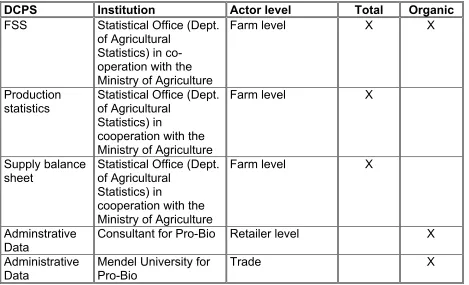
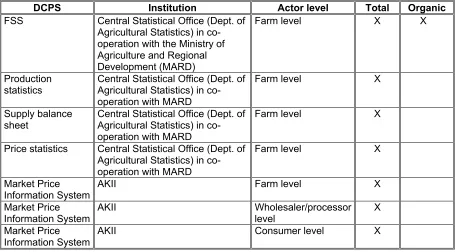
[image:43.595.67.536.412.697.2]Table 5-6 gives an overview about existing DCPSs by actor level. Most of the DCPS are managed by the Department of Agricultural Statistics in co-operation with the Ministry of Agriculture which is responsible for the DCPS Farm Structure Survey (FSS), production statistics and supply balance sheets. Organic data collection exists at the Ministry of Agriculture.
Table 5-6: Overview about existing DCPS by actor level
DCPS Institution Actor level Total Organic
FSS Statistical Office (Dept. of Agricultural
Statistics) in co-operation with the Ministry of Agriculture
Farm level X X
Production
statistics Statistical Office (Dept. of Agricultural Statistics) in
cooperation with the Ministry of Agriculture
Farm level X
Supply balance sheet
Statistical Office (Dept. of Agricultural
Statistics) in
cooperation with the Ministry of Agriculture
Farm level X
Adminstrative Data
Consultant for Pro-Bio Retailer level X
Administrative Data
Mendel University for Pro-Bio
5.6 Detailed information about DCPS, which include organic data collection
5.6.1 Farm Level
Czech Statistical Office of Agricultural Statistics, Dagmar Binova
This Data Collecting and Processing System (DCPS) is a Farm Structure Survey and was started in 2000. The statistical scope is farm structure data segmented to farm type and size. The DCPS covers total data and includes variables so that organic farms can be identified. 80 % of the organic area and almost 65 % of the organic farmers are represented. Because the definition of organic farming however was not exact, there might have been the problem of over-estimation of organic farming. Computerised plausibility and visual checks by experts are used as instruments for the data quality management. This DCPS is harmonised to EUROSTAT and its requirements. In accordance to EUROSTAT a national census approach is used. The data is collected every 2-3 years. The data are disseminated via Internet, CD ROM and on Agrocensus 2000. The strength of this DCPS is that a revised farm register exists. The long time demanding is a weakness. With regard to the organic area, the organic data are not separated and compared with data of conventional farms because there was no exact definition of organic farming. In future it has been planned to include specialised codes for organic farms in the farm register so that the recording of organic farms can be separated. At the moment this DCPS cannot be taken as a positive reference for a case study because until now organic data cannot be separated from conventional data. But if it is developed this will be a positive case study.
5.6.2 Retailer Level
PRO-BIO, Tom Vaclavik
5.7 Conclusion
In general the availability of data concerning organic agriculture is not good because of limited resources of the main data collecting and processing institutions. The Statistical Office of the Czech Republic and the Ministry of Agriculture are collecting data in accordance with the EU needs. The Ministry of Agriculture did not fill in the second questionnaire, so that the information about data collection and processing is limited. Besides PRO-BIO and KEZ are collecting data for their administrative use. At least some departments at the universities and private enterprises are collecting data for research or doing it for PRO-BIO. Although organic farming has made a rapid development since 1998, the official side will not provide people with a good database about organic data because of limited resources. Concerning the data quality it is not possible to make a statement due to lack of information.
6 Denmark
Country Report
DENMARK
Prepared by:
Lizzie Melby Jespersen
Danish Research Centre for Organic Farming Research Centre Foulum
P.O.Box 50 DK-8830 Tjele Denmark
Phone: +45 89 99 16 85
6.1 National relevance of organic farming
According to the Plant Directorate, which certifies and controls all organic farms in Denmark, there were in 2002 3714 organic farms with a total production area of 178.360 ha of which, 148.301 ha were certified organic and 26.049 ha were in conversion (1st and 2nd year). In Table 6-1 some key statistical figures for organic
agriculture are presented http://www.pdir.dk/Files/Filer/Oekologi/Statistik/02/Statistik_2002.doc.
Table 6-1: Number and area of organic farms in Denmark in year 2002.
Organic farms All farms1)
Total In % of all farms
Number of farms 3714 7,3 50.531 Total production area, ha 178.360 6,7 2.665.507 Certified organic area, ha 148.301 5,6
Total production area per farm,
ha 48,0 52,7
1) Statistics Denmark, Agricultural Statistics 2002
The former rise in conversion to organic farming peaked in 2002 and in 2003 more organic farmers returned to conventional farming than conventional farmers converted to organic farming. According to the Ministry for Food, Agriculture and Fisheries electronic newsletter, Externt Forum no. 15 there are in 2004 2965 organic farmers, who are subsidized for farming 156.618 ha of land.
In 2002 over 41 % of all organic farms were cattle farms (mainly dairy herds), which is a considerably higher figure than for conventional farms. The opposite is the case for pig producing farms. In table 6-2 is presented an overview of organic farms classified according to type of animal production (News from Statistics Denmark, No. 204, May 12, 2003).
Table 6-2: Organic farms classified according to type of production.
Organic farms
All farms Organic farms
All farms % of all farms
No. %
Total 3.594 50.531 100 100 7
Cattle farms 1.485 12.511 41 25 12 Pig farms 103 7.714 3 15 1
Poultry 109 384 3 1 28
Other animal farms
512 1.778 14 4 29
Arable farms1) 1.385 28.144 39 56 5