THE TASMAN
WIDER
1 ' 7 L :
Jim Russell,
Centre for Envirunmental Studies, University of 'f(l,\'rrtal!ia
(with one lext-·figure)
Tasman Peninsula's landscape, ir is argued, is not only neglected but also a repository of historically significant evidence that has largely failed to achieve recognition_ Examples of local landscape damage point to fundamental difficulties in heritage which have no! been met by the conferring of National Estate status on Tasman The methods and results, to date, of a research programme aimed at directing attention to the landscape protection needs of Tasman Peninsula are explained, with particular reference to the realisation of the National Estate idea and to an application of the concept of cultural landscape conservation. Key Words: Tasman Peninsula, Tasmania, landscape, heritage resources.
From SMITH, S.!. (Ed.), 1 989: IS HISTORY ENOUGH? PAST, PRESENT A1VD FUTURE USE OF 111E RESOURCES OF TASMAIV PENiNSUlA. Royal Society of Tasmania, Hobart: 1 27-1 32.
INTRODUCTION
History is not enough on Tasman Peninsula -certainly not if by "history" is meant only the type of conservation programme initiated at Port Arthur Historic S ileo Even if additional site conservation funds were available for Port Arthur, and even if similar programmes were extended to other peninsula penal station sites, this would leave unaddressed the care of a major resource which determines the character of the entire peninsula, namely, the Jand scape itselL There has been a singular lack of attention to the overaIl management of the peninsula's 47 000 ha, a landscape which not only provides the setting for all the historic sites but deserves recognition in its own right as a cultural heritage resource of outstanding significance. Furthennore, it is Tasman Peninsula in its entirety which is listed on the Register of the National Estate hy the Australian Heritage Commission, nol a number of separate historic buildings and sites.
This follows np the issue of noo-consideration the landscape as a whole on Tasman Peninsula: it begins by covering the evidence of neglect and culminates in an explanation of the author 's research project, aimed at bringing forward the eause of the forgotten landscape_ This research resulted in the publication of the Tasman Peninsula Landscape Development Manua! which is intended
all those responsible for local land. its basic format is an inventory of resources dosely associated with values, assessment of those resources and of recommendations for their management with an eye to an overall landscape future_
Local issues discemed are also discussed in wider contexts in the These are related to fundamental problems current realisation of the of the National Estate and 10 new perceptions
l"-'IIU"_:U�'" values and their conservation, which
have emerged elsewhere but which Australia is only just beginning to recognise. It is that efforts aimed at making good these hold the promise of rewards for Austr3Jians, both in lhe realm of development of a more satisfactory relationship with the land and in terms of progres s in the construction of a national identity.
THE EVIDENCE OF LANDSCAPE NEGLECT
o
5
-k m
N
10
,
D
P r iv a t e L a n d
S t a t e F o r e s t
�
�
( F o r e s t r y C o mm i s s io n )
R e s e rv e ( N a t i on a l
P a r k s a n d
W i l d l i f e S e r v i c e )
R e s e r v e
( L a n d s D e p a rt me n t )
[image:2.436.44.411.86.588.2]Tasmania ' s most-visited tourist destinatio n s , commercial attractions as well as visitor service buildings have been developed, Not ali of these complement their immediate or contribute positively to the peninsula's marked as a place or its role as a unique part of the nation's cultural and natural heritage. The construction of the Fox and Hounds hotel/motel in Tudor black and white style, for instance, can be interpreted as enshrining the preposterous view that Tasman Peninsula has no history of its own, and as betraying a lack of confidence in the area's own qualities. In addition, vigorous marketing on the local scene often seems to be equated with bigger and ever more highway advertising signs,
Samples from a wide range of additional landscape problems are the intrusion into of the coast of some of the worst features of home development (commonly including drainage and erosion misfortunes associated with subdivisional and building practices , Russell 1 983), examples of land clearing at odds with the visual character of the surroundings, and the loss of the charm local j ourneys as roads are remade with the fmes! verges pushed well back from the edge of the bitumen. , Behind such must lie perceptions of landscape are hard to understand. It can be plausibly ventured, however, that the "Irtanagl�menlt" of Tasman Peninsula is to be judged in same terms used by Cloke & Park ( 1 985) when describing the v alue accorded to landscape, fu"110ngst other rural resources, in B ritain and the United States:
"Landscape is generally viewed as a residual element in countryside resource management, in that it is generally created unconsciously as a result of resolving other resource-·use conflicts."
On Tasman Peninsula, individual landowners, entrepreneurs, and government agencies arc modifying the landscape in an unco-ordinated fashion, with no reference to an overall vision or a preferred landscape future. The Municipality of Tasmall Council, though charged with regulating many aspects of development on private land, is poorly placed to show a lead. The Council has a tiny financial base - it represents but a thousand or so people '-' and has no resources fO! landscape management. Council does have a good planning scheme, the Municipality of Tasman Planning Scheme 1 979, but no planner 10 capitalise on its best features or to carry out investigations on the effects of development on the landscape, Nor does the scheme, though containing many admonitions to hannouise new developments with the sun-ounding environment, offer guidelines or criteria to show decision-makers how to achieve such results.
Landscape development 129
THE BROADER CONTEXT
The N ational Estate
Tasman Peninsula's plighl illustrates a key issue and a challenge facing those charged with the National Estate and interpreting it to community. This which lies at the heart of the National arises, as in the of Tasman Peninsula, large areas of land
multiple tenancies and occupancies are register.
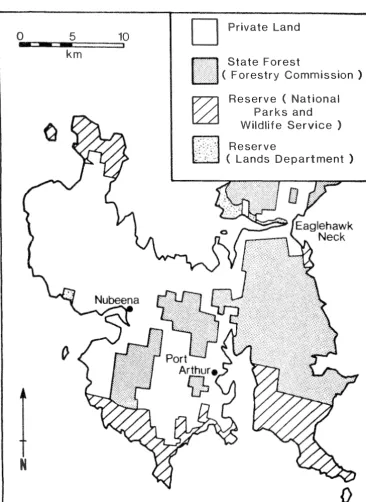
As explained in the previous section, Tasman Peninsula is subject to decisions, and management by many owners of land, as well as by various levels of government and many agencies within government, especially at the State leveL Figure 1 , showing the broad pattern of local land tenure, indicates some of the
Additional interests also represented are
sectors of the forestry industry which hold statutory rights to Crown forests (under Tasmania's forest concession §ystem) and exercise contractual over some private forests. There is no set of conservation goals, such as might reflect the N ational Estate slams, to which the individuals, industries, and anTIs of involved can relale their and "LI.lV l ltC' .
difficulties inherem in this kind of situation have not yet been addressed by the protectors of the National Estate. The issue can be summarised thus: where an area of National Estate is to multiple tenancies and occupancies, what are implications, when it comes to development and management, for those for local land? Or, put differently: how can the community interest in National Estate areas, thai is, those "that have aesthetic , historic, scientific or social significance or other value for future generations, as well as for present
scarce funds for some projects are available annually through the National Estate Grants Program hut Dot to individuals. Furthermore, Tasmania has not adopted its own S tale heritage legislation; there are no sources at State level which be tapped for assistance in addressing the matter landscape management on Tasm,ill Peninsula.
A Cultural
The cultural landscape idea can be used to redefine the of heritage resources. 11 shifts the focus from built environment, which has claimed most of the attention devoted to cultural in Australia over the last two decades, to the itself. The culmral the landscape modified by human activity, can understood (Tishler 1 982) as embracing, in addition to buildings ,
" a broad and complex ass:err,bl<lge of interrelated natural and cultural features establish the essential fabric for many historic sites, districts, neighbourhoods, communities, and even entire regions."
Amongst planning and conservation fes sionals, has hitherto been
largely in a resources context, but is being seen increasingly "as an expression of our history and culture" (Tishler 1 982).
If this perspective is adopted, the cultural landscape idea can provide not merely a new way of looking at falniliar environments but a new basis for their conservation (Taylor ! 984b), and one that goes beyond aesthetics. The landscape is seen as charged with social meanings (Powell 1 979), as holding symbolic value for a culture, and as providing significant evidence which society can employ 10
understand its historical treatment of the environment (PoweH 1 979) and attain self-knowledge (Smith 1 976). It has been argued that it is the investigation of the good and bad aspects of historic treatments of the Australian l andscape that can serve as an excellent foundation for an improved relationship with the land and, at the same time, assist in the evolution of a nat:onal identity (powell 1 979).
The idea of the conservation of cultural laild,;c2lPC:S is only beginning to be introduced into in contemporary times, with seminal theoretical development by Ken Taylor, lecturer in landscape architecture at the Canberra of Advanced Education 1 984a,b),
"" ."'>C.',"U'I',L,"O in Australia professed the through the discipline landscape archaeology some time (R. Morrison, pefs. comm.). The tern]
·'cultural l andscapeH has begun to receive currency amongst the heritage protection agencies of government at both Commonwealth and State levels (see, for exampl e , Victorian National Estate Committee 1 994, p. ] 8).
j\1.odels of conservation practice ean be found elsewhere, such in the National Parks of Britain, some special parks in the United Stmes, l ike the A dirondack Park and the Cape Cod National Seashore, and in eastern Europe, such as in the Zdarske H i l l s Protected Landscape Area of Czechoslovakia (see review, particularly of U . S .A. and British practices of conservation, in Russell 1 986). The exploration of conservation opportunities is starting to receive attention in some Australian states, notably New South Wales (for example,
JRe
Planning Services 1 986).An application of the concept of cultural landscape conservation to Tasman Peninsula is demonstrated in the research project covered in the next section. The claim that the peninsula is a cultural heritage landscape of national significance is based not merely on its extensive system of remnant convict sites, but on the to which the landscape itself is redolent occupation. The peninsula is " still fundamentally a landscape reflecting fifty years penal policy" (Jack 1 984). It was the nineteenth-century settlement and i t s communication routes effectively set the pattern of town development and roads which are seen today. Further, complementing the more visually dominant evidence of extant convict station buildings and ruins, there are both samples of broader landscapes with attributes which can be traced to penal settlement, like the basalt slopes around Saltwater River originally cleared by convicts to grow wheal, and a host of morc subtle features within landscapes, like sandstone quarries , remnants of jetties, and remnants of the timber which cauied a tramway across the flats at the of Impression Bay at Premaydena. Most of Tasman Peninsula's convict era historic sites have never been the subject of conservation Commonwealth withdrawal from involvement the conservation of Port Arthur makes the appellxance of such plans less l ikely than ever. Nevertheless, considerable for change to the landscape of Tasman as a whole make it timely for a call to accord recognition to the historic landscape and promote its conservation.
THE RESEARCH PROGRAMME
conservation on Tasman Peninsula, the author began to develop ideas of raising local consciousness of values in the landscape and suggesting how those responsible for land could themselves go about conserving those values. A research project was initiated (with National Estate Grants Program assistance) which was to culminate in the production of the Tasman Peninsula Landscape Development Manual: Eaglehawk Neck to Port Arthur (Russell 1 985a).
Designed to be distributed widely amongst owners, developers, and managers of Tasman Peninsula's land, as well as its decision-makers, the m anual was compiled following the development of a set of methodologies and criteria for landscape documentation and assessment. These cannot be discussed in detail in the present paper, but are available elsewhere (Russell 1 985b, 1 986); therefore explanation here is limited to general principles only. The manual embodies three conceptually distinct stages. S tage one involved the provision of information on resources with links to landscape character, that is, an inventory of such resources, including biophysical features which have become standard components of natural resources inventories, like native vegetation, soils, and wildlife. The cultural landscape focus, discussed in the previous section of this paper, led to the identification in the inventory of those cultural components of the landscape which remained as evidence of nineteenth-century penal settlement, with an emphasis on the components exhibiting broader features of the pattern of occupation. An assessment of resources comprised the second conceptual stage of work for the manual. For this phase, the methodologies used were aimed at defining the relative sensitivity (or vulnerability) of resources and/or parts of the landscape to damage from the impacts of likely forms of development, viewed in the light of existing landscape character. Finally, recommendations for the conservation of the landscape were derived, framed so as to be user specific, that is, to relate to the activities of the different types of landscape users on Tasman Peninsula. Additionally, particular attention was devoted to the needs of the Municipality of Tasman Council, in that sets of recommendations were developed to dovetail with the regulatory provisions of the Municipality of Tasman Planning Scheme 1 979. One aim seen as most important, and used to guide research for the manual, was that of directing people's attention to ways of protecting the total landscape. Accordingly, recommendations paid particular heed to the integration of the data and assessments that related to separate resources, and to the need to bring the resulting conclusions to bear on
Landscape development 131
clearly identifiable local landscapes. Hence the manual organises its information in a standardised format for each of the separate landscape units defined to cover the entire peninsula. To date, work on seven of the total twenty-seven landscape units distinguished has been completed.
There is a long way yet to go to fulfil com pletely the aim of making available a comprehensive compendium of information on Tasman Peninsula heritage resources and how to protect them. . Nevertheless, the seven landscape units already completed include the most complex on the peninsula in terms of land use conflict, as they refer to the localities most intensely developed for tourism (areas adjacent to the Arthur Highway between Eaglehawk Neck and Port Arthur). The manual is being used by the Tasman Council and by some State Government authorities. Additional support from the National Estate Grants Program has also allowed its distribution free of charge to local residents upon request to Tasman Council.
DISCUSSION
The Tasman Peninsula Landscape Development Manual is a response, one of the few possible in present circumstances pertaining to heritage protection in Tasmania, to the lack of attention to the landscape of Tasman Peninsula and the loss of its c haracter by attrition. The peninsula's situation is no different from that of other Tasmanian landscapes, but its status as a historical landscape of unique value to the nation provides an enlarged and perhaps keener focus for analysing the nature of the problem.
In fact, the peninsula has offered the setting for a research effort which can claim some pioneering qualities by v irtue of the combination o f characteristics in its approach (Russell 1 986). The development manual is a model for conservation practice applicable to large areas of land (held by many different owners) listed on Australia's Register of the National Estate. Further, the research extends the notion of cultural heritage resources conservation beyond buildings and other structures to the landscape itself; it adopts a "total landscape" emphasis for conservation, that is, a focus on both cultural and natural resources, and it makes direct c ommunity responsibility for landscape protection a major emphasis.
land are recognised. In addition, as embodied in the
Tasman Peninsula Landscape Developmeni Manual,
there is a need no! only for a wider vision of history and of cultural resources, but also for their values to be integrated w ith others, such as hiophysical and visual resource values. if landscapes are to conserved at their full worth.
REFERENCES
CLOKE, P,L & PARK, c.c., 1 985: R URAL RESOURCE
MANAGEMENT. Croom Helm, London and S ydney.
JACK, R.l. , 1 984: Tasman Peninsula, Tasmania. In Jeans, D.N. (Ed.): Australian Historical Landscapes. George A.llen and Unwin. 48·6 1 .
m c PLANNING 1 98 6 : Environmental
Heritage: Macarthur Region Environmenial Working Paper 3. prepared for the Depanment Environment and Planning, S ydney. of Environment and Planning, Sydney,
POWELL, I.M.; 1 97 9 : Landscapes and dialectics: incitements to a public expedition. Landsc. A ust. 1 (4): 1 90-1 96.
RUSSELL. I.A., 1 98 3 : Soil Resources, Tasman Peninsula :
Environmental
Soil Conditions No.3, National Centre for
RUSSELL, J .A.. 1 9853: Tasman Peninsula Landscape D e ve lopment Manual: Eaglehmvk Ned: to Porr Arthur, Research No.6, National Estate Gr£h'1ts Project Centre for Enviromneiltal Studies, TasIn .. Hobart.
RUSSELL, 1.A., 1 9R5b: Tasman Peninsuia Landscape inventory Research N o � 5 , National Estate Grants Project Centre for Envjronmental S tudies, Univ. TaSITL; Hobart, RUSSELL, 1.A, 1 986: Towards an Australian concept of
cultural landscape conservation: " model approach based on a case study of Tas�man Peninsula, in Tasmania. Ph.D. thesis, Univ. TaSffi, SMITH, R, 1 976: perceiving the Australian suburb. In
Smith, B. (Ed.) : The Mamfesto: Essays in Art and History. Oxfurd Press, Me1boume. TAYLOR. K.. 1 984a: Cultural pastoral landscapes of values and protection. Paper Institute of Landscape Architects National Conference, August 1 984, at Marcoola, Queensland: Landscape Architecture alld the National Estate.
TA YLOR, K.. 1 984b: landscape protection - the need for a broader conservation base. fieritage A ust. 3(2): 3�8.
TISHLER , W . H . , 1 98 2 : Historical landscapes : an intemational preservatinn perspective. Lanlise. Plann. 9: 9 1 �103.