UNIVERSITY OF TASMANIA
DEPARTMENT OF URBAN DESIGN
...
-T
E
US
OF TRA
FER
DEVELOPMENT
I
IN
U AL
PLANN
A profession
I
project
sub
in
partial completion o
Masters of To n Pia
TRANSFERABLE DEVELOPMENT RIGHTS IN RURAL PLANNING
A PROFESSIONAL PROJECT FOR PARTIAL COMPLETION OF , -,, .
THE MASTERS OF TOWN PLANNING
'
...
In
rural
areas, particularly those close to urban centres, issues such "',: , ,
as fragmentation of land holdings, demand for
rural
residential
living:.:,.·-. ,; ·,_;
' ' -" ' '
and the right to farm are significant pJanning concerns.
This
paper;:···_:_ "". ;
looks at these issues
in
theory and
in
the context of a study
are~l'fu.<+.:"
:
~<
,,j
.,., ' K '
the D'Entrecasteaux Channel region south of Hobart. A
particubtf-,-<<''·;:~'.·'.;:
,:
planning mechanism, that of
transferable development rights,
can"b~"·<·.:.<,
:/j
used to address some of the planning issues raised. This
is
reviewefi.,c'.~:~,
-
~.,,'',:',)
and suggestions put forward regarding the implementation of
a'.:·<:· ; ,,'
transferable rights scheme;, , : : }:
," <.c',~ ' A> ' ' : . . ~ ' ;
: ~ ._.< ... ' , ,' :o..'
',
:,~~,\ ~::.:· :~J
~ "
' , . , ' " ' > !.
,
'
JANUARY
1996 :\ ',, .. ,
:~<
MASTERS OF TOWN PLANNING
PROFESSIONAL
PROJECT
Th.is material has not been pre"iously published
and
is the authors
O'\\"ll
'\Vork. \Vhere the '\vork of
otbers has
been relied upon, the
citation
has been
included in
the
text.
Errors or
omissions
are all
TRANSFERABLE DEVELOPMENT RIGHTS
IN RURAL PLANNING
CONTENTS:
PART
1:
INTRODUCTION
'Y
TITLE AND ABSTRACT
'Y
CONTENTS
'Y
OVERVIEW
1.
TOPIC OUTLINE
2. STUDY APPROACH AND KEY FINDINGS
PART
2:
RURAL PLANNING:
AN OVERVIEW OF THE ISSUES
'Y
INTRODUCTION TO RURAL PLANNING
1
.
THE RURAL PLANNING ARENA
2. WHAT IS RURAL
3
.
PLANNING AND THE PUBLIC GOOD
4
.
LAND USE CONFLICTS
'Y
RURAL ISSUES
1
.
FRAGMENTATION
2
.
RURAL RESIDENTIAL LIVING
3. NUISANCE RISKS
4
.
BEST LAND USE
5
.
INFRASTRUCTURE COSTS
6. RURAL VILLAGES
7. LANDSCAPE PROTECTION
8
.
HISTORIC AND CULTURAL SITES
'Y
BRIEF HISTORY OF RURAL PLANNING
1. RURAL PLANNING IN AUSTRALIA
2. RURAL PLANNING IN THE UK
3
.
RURAL PLANNING IN THE USA
'Y
SUMMARY
PART 3: PLANNING THEORY:
(i)
(ii)
1
3
7
14
22
TRANSFERABLE DEVELOPMENT RIGHTS
'Y
TRANSFERABLE DEVELOPMENT RIGHTS DEFINED
'Y
A SHORT HISTORY OF TDRs
'Y
USE IN RURAL AREAS
1
.
NEW JERSEY PINELANDS
2
.
WELLINGTON SHIRE
,
NSW
3. MOUNT LOFTY RANGES - SA
'Y
MANAGINGTDRSCHEMES
1. ADMINISTRATION
2
.
METHODS OF TRANSFERRING RIGHTS
3. SOME DISADVANTAGES OF TDRs
'Y
POTENTIAL FOR USE IN TASMANIA
23
23
25
33
TRANSFERABLE DEVELOPMENi
RIGHTS
IN
R
U
RAL
PLANNING
PART
4.
CASE STUDY:
THE D'ENTRECASTEAUX CHANNEL
'Y
TIIBSTUDY AREA
1. INTRODUCTION
2. BRIEF HISTORY
3
.
SCENIC LANDSCAPE QUALITIES
4
.
LAND CAPABILITY
&
LAND USE
5. SETI'LEMENTS
6
.
POPULATION
'Y
ANALYSIS OF EXISTING LAND TENURE
1. LAND OWNERSHIP
2. EXISTING OF LOT SIZES
3
.
PATI'ERN OF RECENT SUBDNISIONS
'Y
CURRENT PLANNING CONTROLS
1. THE PLANNING SCHEME
2
.
CRITIQUE OF CURRENT SCHEME
'Y SUMMARY
PART 5: PLANNING SOLUTIONS
ADDRESSING THE ISSUES:
'Y
INTRODUCTION
'Y
PRIMARY PLANNING AIMS
'Y
PLANNING ACTIONS THAT MAY ACHIEVE THE AIMS
I
.
ZONING
2. DEVELOPER CONTRIBUTIONS
3
.
DIFFERENTIAL RATING
4
.
RIGHT TO FARM
5. PERFORMANCE FARMING
6. CLUSTERING
7
.
FLEXIBLE LOT SIZING
'Y SUMMARY
PART 6. PROPOSALS:
IMPLEMENTING A TDR SCHEME
'Y
CRITERIA FOR TRANSFERABLE RIGHTS
1.
THE RIGHT TO BE TRANSFERRED
2. SENDING ZONES
3. RESTRICTION TO BE PLACED ON SENDING LAND
4
.
CHARACTERISTICS OF RECENING LAND
5. RECENERS BENEFIT
'Y
IMPLEMENTATION
1
.
STRATEGY
2
.
EXAMPLES OF TDRs IN PRACTICE
3
.
LEVELS OF TMPLEMENTATION
4. POLICY AND LEGAL CHANGES
'Y
RECOMMENDATIONS
'Y
CONCLUSIONS
PART
7:
REFERENCES
&
APPENDICES
'Y
REFERENCES
'Y
SELECTED BIBLIOGRAPHY
'Y
APPENDICES
L TABLE OF SELECTED POPULATION STATISTICS
2
.
TABLE OF SELECTED PROPER'IY VALUATIONS
2. LAND TITLES DATA;
BY UPI AND MAP REFERENCE
3
. LAND TITLES DATA; BY COMMON OWNERSHIP
MASTER OF TOWN PLANNING
PROFESSIONAL PROJECT
Tasmania lies to the south
of mainland Australia and
in a temperate climate
.HOBART
IIillll
REST OF TASMANIA
Tasmanian population
distribution: A- Urban/Rural
B- Hobart/ State
A
00
RURAL POPULATION
•
URBAN POPULATION
TASMANIA
POPULATION
-
1991
RURAL POPULATION
URBAN POPULATION
POPULATION-1994
HOBART
REST
OF
-
TASMANIA
452,800
123,500
329,300
472
,
357
194,167
·~R 1\
NS·
-ii
.~. ri:::~A study of the value of Transferable Development Rights
as a planning tool for addressing rural planning issues
t
I
~ ~~'~. :i
such as land fragmentation, landscape protection
.
J
and productive land use.
'.~
PART 1: INTRODUCTION
T
TOPIC
OUTLINE
The island State of Tasmania is situated south of mainland
Australia between latitude 41
°
and 43°
S [map
l
.01].
Of
all
Australian states, it has
the
least centralised distribution of
population, with only about
40%
of the population in the capital
(Hobart)
and 27% defined as
'rural'
[charts -
l
.02 A
&
B].
It
also
experiences
lower population growth rates than most of Australia,
with Hobart's population growing at only half that of many other
state capitals. Nevertheless pressures are placed on productive
rural
land from both expanding urban
areas and
the increase in
those
seeking
a
'rural'
lifestyle.
The issues of farming rights, rural residential living and
fragmentation of land holdings
are
significant planning concerns.
In
common with other
states,
local
government is
primarily
responsible for administering planning schemes and attempts to
address these rural issues have often been piecemeal. Recent
'Right
to Farm' legislation has been passed by State parliament, but
this still
leaves many
aspects of rural
planning
unresolved.
This
paper
examines
the possible application of
one
control mechanism
that
can
be used
to address such rural issues; that of
transferable
MASTER OF TOWN PLANNING
PROFESSIONAL PROJECT
KEY FINDINGS OF THE PROJECT ARE
.
:
That there are a range of rural planning
issues
.
in particular those of
;
• fragmentation of
land
holdings
,
• farming rights
,
• landscape protection
, and
• rural residential growth
,
that are not being adequately addressed by current planning mechanisms.
That the case study area within the D
'
Entrecasteaux Channel region is subject to
a range of potential land use conflicts
,
particularly as an area of
;
• high
natural
and modified
landscape
values
,
• productive
levels
of primary
industry
, and
• as an area well suited to rural residential living
.
.
-That whilst the study region is at present predominately rural
,
there exists a
capacity withir] existing land holdings that could result in a significant increase
in
residential numbers based on the provisions of the current planning scheme
.
4.
..That svr,;h .
an increase
in
dwelling nvmbers
,
if done withovt adeqvate planning
controls, could substantially alter the rural character of the region.
5.
.
.That
of
the
range of planning mechanisms available
,
only
transferable
.
development rights offer the reasonable possibility of
;
• revising past zoning and subdivision patterns
,
and
..
• achieving compensation for those who may lose from such changes through
'
taxing
' those who benefit.
6.
That TDRs alone will not result
in
favourable outcomes without parallel use of
complimentary mechanisms
,
in
particular
;
• clustered developments
,
•
flexible
lot sizing
,
and
• design guidelines for subdivision and residential construction.
...,...-...,.,,"'"
,
-
..•.
....
. ...
·- ...
.
.
.
. .. -··· .
.. .·.
•
Given Tasmania's history of regional and State planning
,
it cannot be concluded that
. "'.;,
~
transferable rights are likely to be an imminent option for local planning authorities
,
'
m
but their possible use should not be
ignore
as the rural pfarming problems
".:~
1
discussed are unlikely to be
resolved
without planning
interventions
TRANSFERABLE DEVELOPMENT RIGHTS IN RURAL PLANNING
T
STUDY APPROACH
The project initially examines the general approaches taken to rural
planning. This is achieved in Part 2 by:
• An outline of the rural planning arena;
• The identification of current rural planning issues, such as
fragmentation, landscape protection and productive land use; and
•A look at some of the history of rural planning.
Part 3 examines the theory and application of a particular planning
tool, transferable development rights
(TDRs). Covered is:
• A summary of the history and theory of transferable development
rights; and
• A study of past and current uses of TDRs, including international
and Australian corn parisons; and
• Their recent application in rural planning.
In
Part 4, a study is made of a selected rural area to the south of
Hobart. This area provided the opportunity to:
• Assess the possibilities of applying a transferable development
rights scheme in Tasmania; and
• Allow the rural issues discussed in Part 2 to be seen in a local
context.
It
was found that a range of alternative planning mechanisms can be
used to address the planning issues encountered in the study area.
These are discussed in Part 5.
In
concluding, Part 6 outlines how the application of a TDR scheme:
• May address planning issues in the study area; and
• Provides a realistic assessment of how such a scheme may be
implemented.
-PART
2.
RURAL PLANNING :
AN
OVERVIEW OF THE ISSUES
T INTRODUCTION TO RURAL PLANNING
1. THE RURAL PLANNING ARENA
2. WHAT IS RURAL
3. PLANNING AND THE PUBLIC GOOD
4. LAND USE CONFLICTS
T
RURAL ISSUES
1. FRAGMENTATION
2. RURAL RESIDENTIAL LIVING
3. NUISANCE RISKS
4. BEST LAND USE
5. INFRASTRUCTURE COSTS
6. RURAL VILLAGES
7. LANDSCAPE PROTECTION
8. HISTORIC AND CULTURAL SITES
T
BRIEF HISTORY OF RURAL PLANNING
1. RURAL PLANNING IN AUSTRALIA
+
New Planning Dilemmas
2. RURAL PLANNING IN THE UK
3. RURAL PLANNING IN THE USA
MASTER OF TOWN PLANNING
PROFESSIONAL PROJECT
"Firstly, rural planning is not merely a sub-set of that
higher profile, more widely understood field of urban
planning. Certainly there is a common ancestry in
the early town planning movement, but rural
planning also draws strongly on fields like resource
management and agriculture as well as different
fields of geography."
'
.
THE RURAL PLANNING
ARENA ACCORDING TO
HOUSTON
·
TRANSFERABLE D
E
VELOPM
E
1H
RIGHTS
LI
RURAL PlANl'<l!NG
PART 2: RURAL PLANNING:
AN
OVERVIEW OF THE
ISSUES
T
INTRODUCTION
To
RURAL
PLANNING
1.
THE RURAL PLANNING ARENA
T
It
is argued
by many planners that rural planning is a neglected
area
in the profession. Planning practitioner
and educator,
Peter
Houston introduced
a special
issue of Australian Planning with the
claim that
"Rural
planning in Australia is very much an
ignored
theme and undoubtedly a poor relation to its older
and
more
established
urban cousin."
(Houston
1990:p5)
Even in the
UK,
where there has been a longer history of
'countryside'
plannjng,
it is
claimed that" ... no comprehensive view
of
rural land use has been arrived at.
In
many ways, planning
still
waits for planners and the public to decide what kind of rural
environment
they want"
(Doyle
&
Tranter 1978:p289)
Much of
the
literature on rural planning seems more concerned with
the history
and
the theoretical aspects of land management than
practical planning approaches. Research is often by those versed in
geography and physical science,
resulting
in information but rarely
planning
solutions.
Common in the literature though is the
identification
of a number of conflicts in land use between farming
and logging communities, traditional native owners, rural-urban
residential
occupants
and
conservation groups. A less cohesive view
is
to be found on what
approach
may ameliorate
the
conflicts.
Rural planning has traditionally been driven to
serve
specific
interest groups.
Predominant
is the desire to maintain a healthy
level of primary production, particularly food
for the
nation. So
even
when rural planning is undertaken ...
"Early
concerns over the
rural ramifications of the confident years
of
expansion
in
the 1950s
&
1960s has led to the establishment in many developed
countries
of
forms
of
countryside planning machinery geared mainly
towards
a rather
negative counteraction
of growth
coupled
with
policies of
MASTER OF TOWN PLANNING
PROFESSIONAL PROJECT
RURAL
VARIABLE NAME
POPULATION DENSITY
POPULATION CHANGE
POPULATION OVER AGE 65
4.
POPULATION MEN AGE
15-45
5. POPULATION WOMEN
AGE
6. OCCUPANCY RA TE
OCCUPANCY RA TE
HOUSEHOLD AMENITIES
OCCUPATIONAL STRUCTURE
10. COMMUTING-OUT PATTERN
7 7.
JN-MIGRATION
INDICATORS
CENSUS DATA
Popula
tionl
acre
%
change between census dates
%
of total population
%
of total population
%
of total population
%
population at
7 .5
per room
·
Household/ dwelling
% households with unshared use
of; a) hot water, b) fixed bath,
c) inside
we.
%
in
socio-economic groups;
a) employed farmers/managers,
b) owner farmers,
c) agricultural workers
.
%
employed residents working
outside the rural district
%
population resident for Jess
than 5 years
7
2. OUTMIGRATION
% population moved out in the
last year
7
3. IN/OUTMIGRATION BALANCE % in/out migrants
74. DISTANCE FROM NEAREST
CENTRE OF
50,000
POP
15. DISTANCE FROM NEAREST
CENTRE OF
7
00,000 POP
16. DISTANCE FROM NEAREST
CENTRE OF 200,000 POP
'Statistical' method of
defining a rural area
TRANSFERABLE DEVELOPMENT RIGHTS IN RURAL PLANNING
2. WHAT IS RURAL?
T
Traditionally, living in rural areas has been seen as offering a
simpler and slower lifestyle, 'rustic
'
and free of the pressures of an
urban society. Certainly, a comparison between a country
house-hold and a city househouse-hold even 25 years ago would have revealed
markedly different levels of amenity. But many of the indicators of
a rural life have changed: household amenities such as an internal
toilet, electricity, water and of course, information technology
(satellite TV, internet etc) are commonplace regardless of location.
These are no longer variables that usefully indicate a 'rural life'.
How then can rural land be defined? Cloke (1979:p5) outlines a
quantitative means of measuring
'rurality'
(sic). This utilises 16
variables ranging from population density to commuting patterns.
[2.
02].
Not unsurprisingly, Cloke's mapping of data for England
found that there was a strong correlation between rurality and
remoteness from urban centres. However, this was not universally
the case, with other factors, such as land productivity also playing
some part. Essentially though, rural areas are characterised by a
landscape free of large areas of housing or buildings for commerce,
but modified by humans in pursuit of raw materials such as food,
timber and minerals.
Comparisons with Cloke
'
s definition must be cautionary though, as
the UK has had a far longer history of modified landscape, with few
areas remaining that are not affected by human activity. Tasmania
conversely, has been subjected to farming practices for less than
200 years. There are vast areas, prescriptively called 'wilderness',
where human impact is minimal and even in areas where farming
has occurred for most of European settlement, there remains areas
of natural landscape scattered between the 'tilled soil
'
.
MASTER OF TOWN PLANNING
PROFESSIONAL PROJECT
The rationale for public intervention into free market determination of rural land use
Cause of Problem
Lack of knowledge by consumer.; and prodlcers of the outputs from land
Reason for Problem
Consequences
Remedies
lack of information "property riglts, Under use of existing knowledge, Research - State experimental
Scale economies in R & D, Under-investment in R & 0, stations, Training,
Insufficient consumer sovereignty Sub-optimal land resource use Resource ~
Restricted entry into Low market thresholds in rural Exploitation of consumers and producers, Sub-optimal resource use and prodlction
Licensing, trade re~lations
eg licensing processors, marketing boards incilstries using land
°'
areas areas, locational monopoly,incirectly inftuenc:ing use Restrictive practices
Decreasing cost in<ilstries Hig1 cost of operating a
marl< et
Absence of a marlcet
(a) ProO.Jcer externalities
(b) Regional externalities
0ynamics (a) Instability (b) Disequilibrium conditions
Lack of 1!<1Jity
8:
Social time preferenceHigl scale economics, in<ivisibilities Undersupply of goods and
services
Hig,er costs of collecting payments, Undersupply of 'public' good!;,
The free rider problem roads and water supply Diffirulty of defining property rigits, Air and water pollution, Market localisation (cis) economics, production and health effects,
Environmental degradation, Resource degradation by soil Joint demands tor infrastructure, erosion etc, Sub-optimal Diseconorrics of concentration spatial cistnbution of proOJction
Subsides, licensing and public
ownership
State provision of infrastructure such as bridges, roads , seniices
land use regulations and zoning,
Emission regulations and other
fOl"mS of envirorvnental
protection
Bio-physical variability, Income and long term pro<llction Public insurance and assistance, Wor1d market ftuctuations,
Techllical changes in prodlction,
Socio-economic change in markets
Socially unacceptable cistribution,
DistOl"tion to social time preference
problems, E<Jrity problems, Reconstruction and rural Sub-optimal rates of change development schemes
Social dsruption and pathologies Tax and welfare, Land refOl"m and financial assistance Private time preference not 1!<1Jal, Loss of non-renewable resotKces· Resource use controls and Distortion to social time preference at greater than optimal rates, licensing, royalties, government
DistOl"ted resource evaluation ownership Markets fa~ to reftect social values Undersupply of conservation
of merit goods areas etc
Subsidies, government ownership
[image:15.565.21.501.80.783.2]Source: McDonald (1989/b:p328)
1
TRANSFERABLE DEVELOPMENT RIGHTS IN RURAL PLANNING
bushland or recreation reserves but does not include national
parks, 'wilderness' areas or state forests.
It
is generally land in
private ownership
.
3. PLANNING AND THE PUBLIC GOOD
T
What is certain is that without adequate planning, the effects of
action which alter land use will be unknown. Ad hoe use has
resulted in many of the current
p
.r
ob
~
s
that appropriate planning
may well have avoided. Of course, wliat is appropriate one year
may be seen as inappropriate the next, but this may be more a
function of fluctuations in the market value of some items rather
than good long term management. Some actions may be
temporarily attractive, such as the clearing of bush from areas of
marginal soils to increase grazing land at a time that livestock
prices are experiencing a boom. To deny farmers this right might,
' /
in the short term, jeopardise their living, which suggests that good
f
planning is to simply allow the free market to reign unfettered.
McDonald (1989) comments on how a 'perfect' free market "would
be socially optimum
if
it achieved:
• efficiency in production - optimum use of production inputs ;
•efficiency in exchange - optimum arrangement of trade
between individuals in the system;
• equity
in
distribution.
Unfortunately, the assumptions required to make such a system
work are
so
stringent that they are
never
met."
The result of such failures are generally a loss of social benefits and
omission of the interests of the
'public
good'. Particularly stemming
from the environment movement there are now numerous critics of
the free market approach who suggest the "driving force of the
market (Adam's invisible hand) takes no account of the
J
environment nor can it" (Jacobs 1995).
In
the area of rural
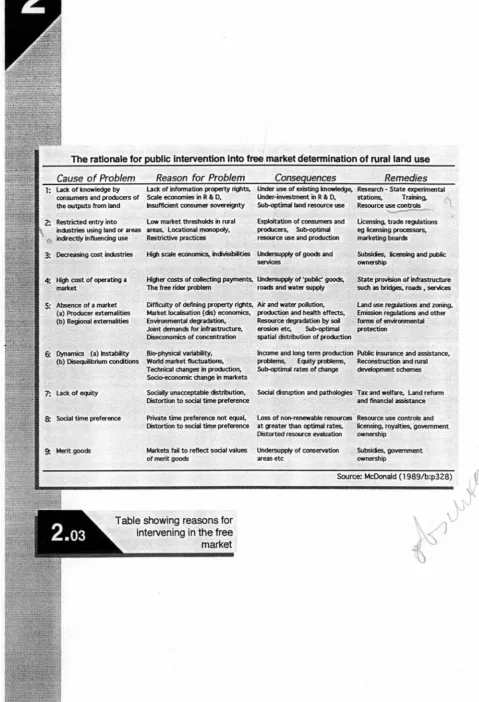
planning, McDonald lists nine problems which provide the rational
for public intervention in the free market (table
[2.03]).
MASTER OF TOWN PLANNING
PROFESSIONAL PROJECT
ACTION
Clearing of natural
bushland for crops or
Residential subdivision of
prime farmland
.
CONFLICT
Loss of native habitats
and species.
Expansion of farm
i
ng
into
marginal
lands
due to loss
of productive land.
Sale of single paddocks to Fragmentation of land
hobby farmers.
holdings creating
uneconomic
farm sizes.
·
Mining, forestry and
industrial activity
.
Use of chemicals, dams,
tailings, water, air and
noise pollution.
COUNTERACTION
Protection of natural
habitats, particularly for
rare & endangered species.
City growth limits, green
belts
,
compact city
strategies.
Farm subsidies, planned
hobby farm areas.
Environmental protection
laws
,
banning of logging,
mining & extractive or
polluting industries.
Feared
loss
of investment
Land rights leg
i
slation
,
and development potential. return of land to
traditional owners
.
TRANSFERABLE DEVELOPMENT RIGHTS IN RURAL PLANNING
4. LAND USE CONFLICTS
T
McDonald (in Cloke 1989:p215) identifies two major areas of
conflict in Australian land use planning: "the rural-urban fringe
where there is conflict between the expansion of urban- related uses
on to farmland and perhaps on to undeveloped open space areas,
and the extensive margin of agriculture/forestry where there is still
undeveloped wilderness that is now coming under pressure for
logging, water resources developments, or mining."
Changes in rural lifestyle are not caused solely by the influence of
an expanding urban area: changing labour demands, mechanisation
of the farm and increased mobility have
all
significantly altered the
traditional rural lifestyle. Emerson and Crompton (1968) are
quoted by Cloke (1979) as noting that English "rural communities
were themselves in a fluid state even before the integration of
newcomers became a serious problem."
The pivotal issue for such rural land is its protection against
inappropriate uses. The definition of inappropriate use varies
./
significantly depending on a person's socio-political outlook, but in
general, a use that results in degradation of the land to the extent
of 'useless' must be considered inappropriate. The dust bowls of
North America are clearly the result of an abuse ofland practice.
The use of prime agricultural land for residential living is more
subjective and the clearing of native vegetation for agricultural
production is supported by some and abhorred by others.
Many of these demands on land use result in competing interests
for that land. Such actions include land clearance, protection of
natural habitats, marginalisation of farming lands and
encroach-ment of urban
'sprawl'.
A range of these are shown
in
table [2.04].
,,____
MASTER OF TOWN PLANNING
RURAL PLANNING
O
s
T
·
FRAGMENTATION
T
RURAL RESIDENTIAL LIVING
T
NUISANCE RISKS
T
BEST LAND USE
y
INFRASTRUCTURE COSTS
:y
RURAL VILLAGES
LANDSCAPE PROTECTION
HISTORIC AND CULTURAL SITES
Range of rural planning
.
issues canvassed in the
following text
TRANSFERABLE DEVELOPMENT RIGHTS iN RURAL PLANNING
T
RURAL ISSUES
These problems range from 'nuisance' effects such as crop spraying,
'feral'
domestic pets, and introduction of weeds to major
environmental concerns such as land erosion, polluted waterways
and loss of species. These give rise to a number of rural planning
issues, some of which are listed at
[2.05].
The key elements arising
out of these issues are discussed below.
1.
FRAGMENTATION
T
Fragmentation refers to the division of larger land holdings into
smaller parcels of land which are then sold to an increased number
of land owners. This process usually occurs gradually over time
and in an ad-hoe manner, with new smaller holdings being
scattered amongst the original larger holdings.
Wellings et al
(1985)
outlines numerous negative impacts that
fragmentation of rural lands may have. These include;
• increased costs for infrastructure provision,
• reduction in the availability of good agricultural lands,
• degradation of water catchment areas and water supply
problems,
• nuisance risks such as dogs, weeds, straying stock,
• loss of flora and fauna habitats and ecosystems such as rain
forests and wetlands,
• a rise in the cost of land, increasing the expense for farmers
wishing to expand, and
• soil erosion.
The process has both historic and ongoing reasons for occurring.
These include dividing up the farm to pass on to children,
MAST
E
R OF TOWN PLANNING
PROFES
S
IONAL PROJECT
.
·
·
···
·--
-
·
·
·--
-
··-
· -
- -
--
-
--BELOW
:
The
downside of
rural residential
living
CONCERNS OVER RURAL RESIDENTIAL DEVELOPMENT
AREA
OF CONCERN
I
REASON
FOR CONCERN
• SERVICES
• ROADS
• ENVIRONMENT
• EFFECTS ON ESTABLISHED FARMING OPERATIONS
• PLANNING PROBLEMS
• Increasing Council commitments;
• Increasing land prices; • Increasing water costs.
• Upgrading costs, maintenance etc.
• Increasing risk of bush fires;
• Soil erosion due to clearing of land;
• Loss of views & natural landscape.
• Increased rates;
• Reduction in agricultural land; • Reduced control over water supply; • Straying stock;
• Nuisances such as weeds & dogs.
• Reduction in potential urban land; • Planning loopholes;
• Defiance of controls;
• Illegal structures.
ABOVE
:
A Range of rural
living options
SOURCE: Lalone in Pullen (1977:p17)TRANSFERABLE DEVELOPMENT RIGHTS IN RURAL
PLANNING
These smaller lots are usually attractive for rural residential living.
For adjoining farmers though, it is not always a desirable pattern of
development. The new owners of the smaller allotments are not
primarily involved in agricultural production.
As
such their
interests may be significantly different from those solely involved in
agricultural production.
2. RURAL RESIDENTIAL LIVING
T
There is a wide range of residential living options now available to
those wishing to live in the country. A number of typical living
options are illustrated by Latone at [2.
06.A].
These range from the
traditional farmhouse on large estates down to small lot 'rural'
subdivisions and small village lots.
Increasing numbers of people are seeking the option of rural living
and this can cause problems for the existing local communities.
According to Petersen (1994:p165), "The current wave of rural
residential development is again placing demands on all users of
rural lands." Wellings identifies five main areas of rural residential
living that concerned Local Governments in NSW
[2.06
.
B].
These
were essentially concerns about Council's ability to meet the
financial commitments that increased residential growth may bring
and the negative impact to existing rate payers.
Residential living in proximity to farmland can also be undesirable
for a number of reasons including good land management,
·,
MASTER OF TOWN PLANNING
PROFESSIONAL PROJECT
RURAL LAND USERS
• RURAL RESIDENTIAL -
those persons seeking a rural environment,
but who have little or no interest
in
agricuUural pursuits on
their
property.
• HOBBY FARMERS -
persons who are pursuing some agricuUural
endeavour to a greater or lesser extent, but the investment is justified
on rural interest and lifestyle with the primary income derived from
off the property.
·
·
•PART-TIME
FARMERS-
where farm size is inadequate and requires
the occupant (farmer) to supple""'!nt income from off-farm sources.
• FULL-TIME
FARMER
-
traditional commercial farming operations.
Categories of rural
'occupations'
_,-
RURAL
RESIDENTIAL
GENERALLY
t
SMALLER THAN MANAGEMENT
UNIT-'; USED FOR LITTLE ·:! OR NOTHING \
}-'\. :,
HOBBY
FARM
EQUAL OR SMALLER THAN MANAGEMENT UNIT
- NOT BEING USED TOMAXIMUM . .
~ ..
-~, " \~ ~., :>. ,,.t- .. .,,.
·• ;.:..,;.:.:•··· ;"'l"-.•. :.>.,.,.:,;.;,.•">'"''•
JONES et al (1992)
··-. ':"'.
·--
i
Oiagram
showing
changes
·
in land use efficiency
between differing users
PART-TIME
FARM
EQUAL TO MANAGEMENT
UNIT
JONES, et al (1992)
FULL-TIME
FARM
GENERALLY LARGER THAN MANAGEMENT
UNIT- USED TO CAPACITY. -BEING USED TO t
CAPACITY. \
'•:-::. -·:-:·.·•"•'
!·::·.\
··.':
--TRANSFERABLE DEVELOPMENT RIGHTS IN RURAL PLANNING
3. NUISANCE RISKS
"Y
These conflicts between farmers and other rural 'uses' are often
referred to as
nuisance risks to the farmer. Often, the farm activity
has been in the district for many years, but as suburbia encroaches,
the complaints against farm practice increase. Nor does it need to
be urban growth alone that generates increased conflict. Craythorn
(1994) also mentions the added costs that under-utilised hobby
farms have on a rural economy. Noxious weeds, vermin, wildfires
and dogs all place hobby farmers that may harbour such pests in
conflict with traditional land users.
Whilst it is arguable that these nuisance risks are unrealised, the
perception of them occurring places land users at odds and
discourages farm activity near residential areas.
It is believed that
farmers are more likely to divide up the farm for building lots
if
they are not protected from complaints and nuisance caused by
adjoining land owners.
4. BEST LAND USE
"Y
Crucial to the issue of land fragmentation is the assessment of
best
land use. The appropriate size for an allotment depends on the
capability of the land to support the intended function.
As
Petersen
(p169) states, "it is up to the owner to decide if that opportunity is
taken up" ... but it is the role of planning to provide the opportunity
and allow for lots "which will be sustainable over time and
compatible with the rural activities in which they are created."
A study of rural living patterns by Jones et al (1992) examined
sub-division and tenure fragmentation in the Albury-Wodonga region of
NSW. Categorised were four main patterns of rural living, defined at
[2.07]:-
Rural Residential,
Hobby
Farmers, Part-time Farmers and
Full-time Farmers. The study found that hobby farm holdings were
usually under the productive size ofland and that once subdivision
had taken place, they could not easily be bought back and
MASTER OF TOWN PLANNING
PROFESSIONAL PROJECT
MINIMUM LOT AREA - HOBBY FARM
METHOD
1:
Erosion Assessment
METHOD
2:
Water Supply
Beast carrying area,
Catchment area,
from table
1 :
14.5
ha
from table 2:
2.8
HA
House site:
0.05
ha
House site:
0.05
ha
Lawn area:
0.1
ha
Lawn
.
area:
.
0.1
ha
Cropping area:
0.2
ha
Cropping area:
0.2
ha
Tree crops
(20):
0.05
ha
Tree crops
(20):
0.05
ha
Kennels
(2
dogs):
0.005
ha
Kennels
(2
dogs):
0.005
ha
Bird shed
(20):
0.005
ha
Bird shed
(20):
0.005
ha
Equivalent beasts:
0.01
ha
Equivalent beasts:
0.01
ha
TOTAL:
14.92
ha
TOTAL:
3.22
ha
' .
TABLE
1
MINIMUM AREA (HA) REQUIRED FOR CARRYING
2.9
EQUIVALENT BEAST UNITS
Soil Type
0 - 2%
Slope
2
-
6%
Slope
6 -12%
Slope
12-25%
Slope
A
2.3
2.9
...
*
*
B
2.32
3.48
8.7
*
c
1.45
2.9
5.8
4
D
2.9
4.35
14.5
16
TABLE
2
MINIMUM CATCHMENT AREA (HA) FOR WATER SUPPLY
-
80% RELIABILITY, SML STORAGE
Soil Type
0
-
2%
Slope
2 - 6%
Slope
6 -12%
Slope
12-25%
Slope
A
B
c
D
*
.
*
*
*
14.5
*
*
*
*
*
*
*
2.1
2.1
2.8
*
"What
ever type of rural residential lot is created, it is essential that it
be provided with the level of services which will allow the proposed
use
...
to be conducted
.
0Source
:
Petersen (1994
:
p165)
Method of determining
suitable lot sizes based on
•
[image:25.565.3.489.46.838.2]TRANSFERABLE DEVELOPMENT RIGHTS IN RURAL PLANNING
The authors concluded that rural living should be "provided for at
the rwdes in which fragmentation has already been occurring,
and
that devewpment of rural living areas should only proceed ... with
regard to agricultural quality, water catchments, landscape quality,
... and sound site planning and design principles."
(Jones et
al
p44)
There have been a number of studies which have researched the
factors that best determine the suitability of land for various uses.
These include Woodward
&
Neilson (1981) Land Evaluation
Manual
and Austin
&
Cocks, (editors) (1978) Land Use on the
South Coast of NSW.
Main factors included in the evaluation of
rural lands were;
• Urban suitability,
•Agricultural suitability,
• Bushfire, flood, landslip and erosion potential, and
• Other factors such as mineral or forest wealth, scenic value,
cultural significance and water catchment potential.
The assessment of best land use is then made after consideration of
these factors. Petersen outlines perlormance guidelines used in
Gooburrum Shire (Queensland) that use two factors to determine
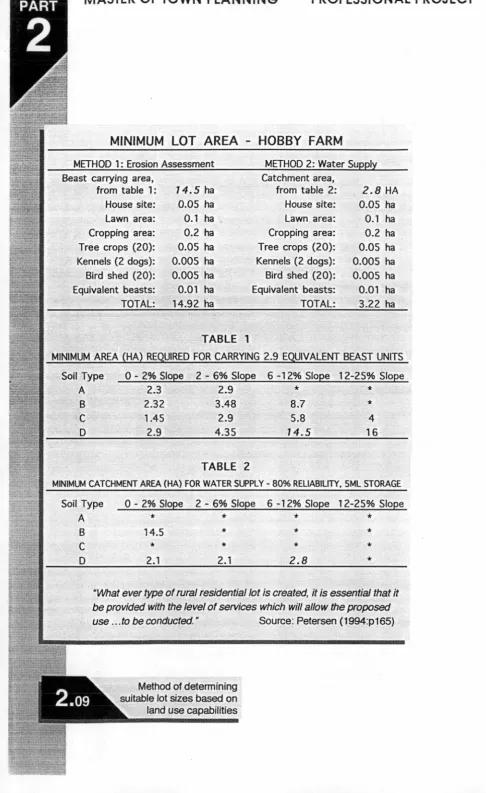
rural residential lot sizes - potable water supply, stock and crop
carrying capacity assessed against erosion potential and water
supply. The results obtained from the two assessment methods
varied considerably; in the example given at
[2.09)
a lot size of 3.3
ha was appropriate
if
based on water requirements and 15 ha
if
based on erosion potential. Clearly, the blanket application of
minimum allotment sizes without adequate assessment could lead
to less than desirable outcomes.
5. INFRASTRUCTURE COSTS
'Y
Other reasons for stemming, or even reversing the degree of
·
fragmentation of rural lands is the added costs of infrastructure
TRANSFERABLE DEVELOPMENT RIGHTS IN RURAL PLANNING
Shire (NSW) is charging developers $10,000 as part of the costs of
servicing remote allotments (greater than 10 kms from existing
services). This he believes, is to be about
113
of the true cost of
around $30,000. This may compare to costs of between $5,000 and
$10,000 for allotments close to existing services. That this cost is
often not passed on
to
the land owner or developer creates (in the
jargon of the economists) an unequal playing field, which shields
development patterns from the true market costs.
Whether rural lots should expect or be supplied with the same level
of service as urban lots is of course debatable.
If
the reason that
people seek rural living is to escape some of the pressures of a city
life, the trade off may well be a lesser level of both social and
physical services.
6. RURAL VILLAGES T
A crucial issue in the viability of rural communities is the level of
amenity and population of the local 'village'.
In
Australia, as with
most other rural areas in developed countries, the population
growth rate in urban centres has far outstripped rural centres.
Lees (1987:p356) reported that "of the 1200 or so towns in Australia
with 200 people or more, about one third of them are losing
population." This trend of urbanisation has however reversed in
the last two decades, with researches such as Hugo and Smailes
(1992:p29) reporting "a non-metropolitan renaissance."
.
This repopulation of the bush is not however universally even
across rural Australia. The growth has been concentrated
"in
the
well watered and attractive areas of the southeast and east coast
and the areas around the margins of the commuting zones of the
large cities." (Hugo and Smailes p29). Populations have continued
to decline in most of the more arid and remote parts of rural
MASTER OF TOWN PLANNING
PROFESSIONAL PROJECT
Australia:- States and Territories:
Growth rates of metropolitan and non-metropolitan population,
1981 - 1986
Annual population growth rates 1981-1986
State
.
New South Wales
·Tasmania
Northern TenitOI)'
Australian
Capital T enitOI)'Australia
-
TotalMetropolitan area
0.90
0.80
2.25
0.96
2.04
0.79
3.50
2.42
1.19
Non-metropolitan Area
1.53
1.35
2
.
57
0.77
1.89
0.87
5.78
-4
.
02
1.74
.
Source: Hugo
&Smailes (1992:p32)
:~Chart of Growth Rates: Australian States -
1981-1986
3.oo....-~~~~~~~~~~~~~
G
R
0
w
2.00----E
T
H
R
1.00-t----il
·
A
T
E
0.00
METROPOLITAN
NON-METROPOLITAN
Metropolitan
&
rural growth
rates
in
Australia between
1981 and 1986
•
New South Wales
•
Victoria
lllillJ
Queensland
[] South Australia
!!I
Western Australia
=Tasmania
TRANSFERABLE DEVELOPMENT RIGHTS IN
RURAL PLANNING
Whilst Tasmanian growth rates are considerably below those of
other states, the same trend is indicated [Table 2.
1 O].
The impact of
such change to rural villages is hard to predict. Many in small
towns " ... fear that the growing regional capital will continue to
bleed them" (Lees:p356). It also seems that people are moving from
cities to nearby rural areas as a lifestyle choices, and
if
these once
rural areas simply become swallowed up into urban conurbations,
they
will
need to move even further out to achieve the same
lifestyle.
This pattern in movement can be seen in the population figures for
the towns in the case study area examined in Part 4 of this project.
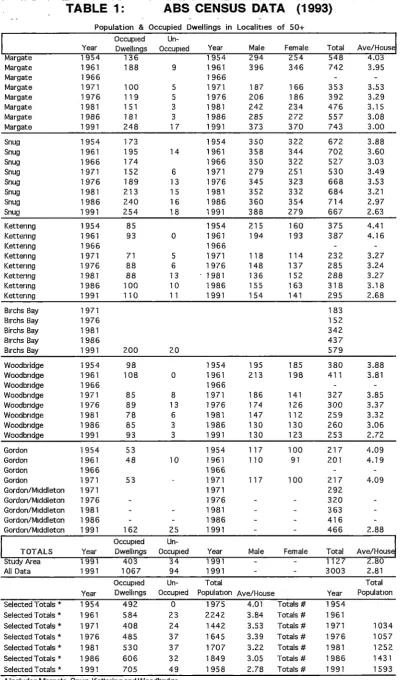
Margate, Snug, Kettering and Woodbridge have all shown a steady
decline in population through the 1950s and 60s, generally reaching
their lowest figures in the 1971 Census. Since then, they have
either stabilised or in the cases of Margate and Snug, returned to
the population levels of the 1950s.l
What is an appropriate size for these towns to grow to without
losing their rural identity yet ensuring sufficient population to
support infrastructure and service development? Some of the
research required to answer these questions is well beyond the
scope of this project, but it can be surmised that these towns could
warrant a doubling or even tripling in size and still remain 'small
towns'. Even combined with their catchment of nearby rural
populations, these towns do not exceed the population levels most
texts define as 'small'.
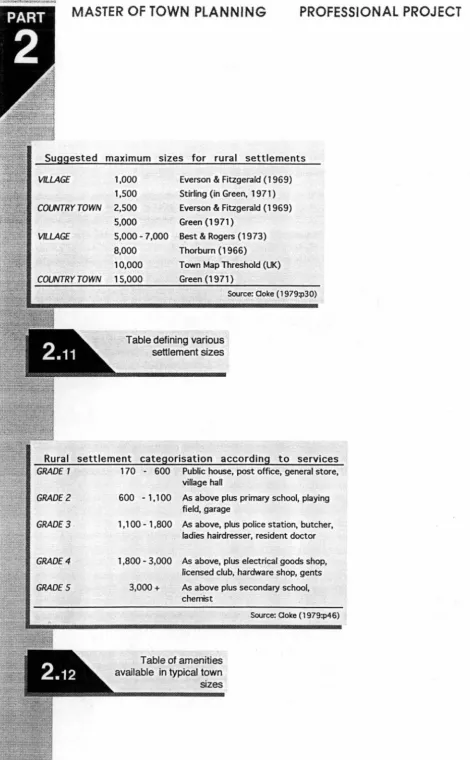
The classification of what is a village or country town varies
significantly between authors. Cloke (1979:p30) has collated a
number of classifications, reproduced at table [2.
11 ].
These indicate
that a village might have a population of between 1000 and 5000,
clearly exceeding the current population figures for the area. Such
small communities have difficulty maintaining viable services.
There are also a range of opinions as to what size rural settlements
need to be to support various service levels, but those that might
MASTER OF TOWN PLANNING
PROFESSIONAL PROJECT
Suggested maximum sizes for rural settlements
1,000
Everson
&
Fitzgerald (1969)
1,500
Stirling (in Green, 1971)
COU'JTRY TOWN
2,500
Everson
&
Fitzgerald ( 1969)
5,000
Green (1971)
5,000
-
7,000 Best
&
Rogers (1973)
8,000
Thorburn (1966)
10,000
Town Map Threshold (UK)
[image:31.566.17.487.34.794.2]COUNTRY TOWN
1 5,000
Green (1971)
Table defining various
settlement sizes
Source: Coke ( 1979:p30)
Rural settlement categorisation according to services
GRADE
7
170
-
600
Public house, post office, general store,
village hall
600 - 1, 1 00
As
above plus primary school, playing
field, garage
1, 100 -
1,800
As
above, plus police station, butcher,
ladies hairdresser, resident doctor
1,800 - 3,000
As
above, plus electrical goods shop,
licensed club, hardware shop, gents
3,000
+
As
above plus secondary school,
chemist
Table of amenities
available in typical town
sizes
TRANSFERABLE DEVELOPMENT RIGHTS IN RURAL PLANNING
typically be supported at various population levels are shown at
table (2.
12].
7. LANDSCAPE PROTECTION
T
Another reason to stem land fragmentation is the need to retain
rural land for uses other than farming practice. Many functions
other than commercial farming exist such as water catchment
areas, erosion protection, recreational pursuits, bio-diversity, and
the scenic value of a natural environment. These are merit goods
that the free market rarely values and it is often up to governments
(and planners) to provide for their protection.
Much marginal land that is not economic to clear traditionally fills
this role but is not protected for this exclusive use. The continuing
fragmentation of prime agricultural land places more and more
pressure on marginal land. The economics of farming and clearing
this land becomes viable
if
it is the only land left not broken into
smaller holdings close to a growing number of urban consumers.
Hence, in addressing the issues of farm protection, fragmentation
and the demand for rural living, the landscape can indirectly
benefit by the removal of a major market driven threat to its
survival.
8. HISTORIC AND CULTURAL SITES
T
Many historic and culturally important
sites
exist in
rural
areas.
These have often been neglected in favour of more 'high profile'
urban sites. They also often involve larger tracts of land on a
number of titles held by different owners.
In
order to plan for the
protection and/or improvement of such sites it may at times be
advantageous to amalgamate these titles or extinguish their
_.;.-· _:_.
MASTER OF TOWN PLANNING
---·· .
...,._._ .. a:, . . . , _ _>1.JN<l:I
Map of Australia's rainfall pattern
highlights
the
large arid
interior
Source: Macquarie Atlas (1984)
PROFESSIONAL PROJECT
,.,,..
'~.rr ..
f
!
--
-
!.-
-.
....
... . . . l<Ki - . _ _ , . , . .