A New Accounting Data Model
by
Stephen Patrick Vickers,
BA
(HoNs)
Submitted in fulfilment of the requirements for the Degree of Doctor of Philosophy
Declaration
The material contained in this thesis is original except where due
acknowledgement is given, and has not been accepted for the award of any other degree or diploma.
This thesis may be made available for loan and limited copying in accordance with the Copyright Act 1968.
Signed:
_<S:P-==-·-_\J_~_: ~---
(Stephen Patrick Vickers)/
Date:
Abstract
This thesis investigates the design of the data model underlying accounting systems. Despite radical 9hanges to business processes and enterprise information systems over recent decades, the data model used within accounting systems has changed little since the inception of double-entry bookkeeping over 500 years ago. Earlier studies have proposed alternative data models for accounting systems but these have not been adopted in practice. One reason for this is that they were not developed on the basis of accounting data representative of real world needs. This study uses empirical data derived from models of accounting transactions processed by actual organisations.
The motivation for this thesis arises from criticisms made about the inability of accounting systems to provide useful information to users and to support the business activities of organisations. However, there is very little empirical support for the criticisms which have been reported. Evidence gathered from users of accounting systems indicates that many of the criticisms have been overcome by contemporary accounting systems but some of the
limitations which remain are a direct result of the design of the underlying data model.
A comparison of the models of manufacturing organisations with the alternative proposals for accounting data models shows that these alternatives are not sufficient for modelling the transactions of actual organisations. Recent developments in both financial reporting and enterprise information systems also confirm the need for a model which is able to
accommodate changing user needs. This thesis uses an analysis of the accounting transactions from three organisations as the basis for the design of a new data model. The proposed data model extends the traditional recognition criteria to allow flows of a wider range of resources to be integrated into a single system as well as both past and future resource flows. Not only are some future flows used in the preparation of financial statements but their inclusion also permits the same system to be used for forward-planning. When combined with an explicit modelling of continuous resource flows, any need for end-of-period adjustments is removed and the constraints imposed by pre-determined reporting dates no longer apply. Problems concerning the choice of valuation basis and accounting method are avoided by designing the accounting data model to record resource flows independently of accounting choices. This makes the proposed model the first capable of supporting real-time reporting and allowing users to request financial reports based on their own preferred set of accounting policies.
Acknowledgements
I am greatly indebted to many people who have helped me along the journey culminating in the production of this thesis. Without such support and assistance undertaking this research would not have been possible. I am particularly grateful to my supervisor, Stewart Leech, whose insight and knowledge helped to guide me along the path; his dedication, patience and understanding during this time were much appreciated.
All of the members of the School of Accounting & Finance in the Faculty of Commerce at the University of Tasmania deserve recognition for providing such a supportive and congenial environment in which to pursue research. Special thanks go to Jayne Godfrey and family (whose sporting prowess helped to sustain me through to the end), Kathy Gibson, Peter Collett and Jayne Wilson. I also wish to acknowledge the generous financial support provided by the both the Faculty and the School. I very much enjoyed my time in Hobart; some might say I enjoyed it too much!
My thanks also to the anonymous companies which gave me their time aJ1.d access to their accounting records to support this research, and to former academic colleagues who have encouraged and supported my career in many different ways over the years.
Last, but by no means least, is an acknowledgement of the love and support provided by my family and friends; especially my parents for providing me with such opportunities in life and my wife for her care and forbearance during the process.
Dedication
In loving memory of Mike
Contents
Declaration 11
Abstract iii
Acknowledgements . IV
Dedication IV
Contents v
List of Figures x
List of Tables XI
Chapter 1 - Introduction ... ~ . . . 1
1.1 Motivation 2
1.2 Research Objectives 3
1.3 Research Approach 4
1.4 Overview of Thesis 5
Chapter 2 - Criticisms of Accounting Systems ...••... ~ . . . 7
2.1 Application Independence 7
2.2 Integration oflnformation Systems 8
2.3 Application of New Technology 10
2.4 Usefulness of Accounting Information 12
2.5 Choice for Users of Accounting Information 14
2.6 Aims for Future Accounting Systems 16
2.7 Contemporary Accounting Systems 18
2.8 Summary 23
Chapter 3 - Alternative Accounting Data Models . . . • . . . • . . . • . . . 25
3.1 REA Accounting Template 26
3.1.1 Design of the REA Accounting Template 26
Duplication (34); Redundancy (34); Subtyping (35); Combining Events (35); Degenerate Exchanges.(36); Equity (37)
3.1.2 Extending the REA Accounting Template 37
Manufacturing Processes (37); Non-Accounting Data (38); Internal Controls (39); Exchanges (40); General Business Processes (40); Business and Information.Events (43); Enterprise Domain Ontology (45)
3.1.3 Wider Applicability of the REA Modelling Approach 47 3.1.4 Contemporary Accounting Systems Based on REA 51
3.1.5 Summary 54
3.2 Multiview Accounting System 54
3.2.1 Design of the Multiview Accounting System 55
Resource and Exchange Events Accounting Model (56); Formula Accounting General Ledger (59); Interpreter (59)
3.2.2 Analysis of the Multiview Accounting System 60
Limited Scope (60); Over-Specification of the Model (61); Accounts as a Modelling Primitive (62); Use of Formulae (63); Data Duplication (63)
3. 2. 3 Summary 63 :
3 .3 REAL Modelling
3.3.1 Design of the REAL Modelling Methodology 3. 3. 2 Analysis of the REAL Modelling Methodology 3.3.3 Summary
3.4 Summary
Contents 64 65 67 71
72
Chapter 4 - Contextual Framework ... 75
4.1 Framework for Research in Information Technology 4.2 The Research Pyramid
4.2.1 The AIS Construct
4. 2. 2 Classification of Research 4. 2. 3 Valid Research Categories
4. 2. 4 Identifying Appropriate Research Methodologies 4.2.5 Summary
4.3 Focus of this Research 4.3.1 Quality 4.3.2 Variety · 4.3.3 Timeliness 4.3.4 Analysis
4.3.5 Need/or a New Accounting Data Model
4.3.6 Contemporary Validity of Criticisms of Accounting Systems 4.4 Summary
75 82 84 87 88 89 91 91 92 93 95 95' 97 98 100
Chapter 5 - Contemporary Validity of Criticisms of Accounting Systems ... 103
5 .1 Development of Hypotheses· 103
5.2 Research Method 105
5.2.1 Research Strategy 107
5.2.2 Survey Sample 109
5. 2. 3 Questionnaire 111
5. 2. 4 Minimising Survey Errors 112
5. 2. 5 Survey Execution 114
5 .3 Analysis of Interviews 116
5. 3.1 Aim A: Record Data in a Raw (Objective) Form 116 5.3.2 Aim B: Capture Both Financial and Non-Financial Events 116 5. 3. 3 Aim C: Multi-Dimensional Record of Events 117 5.3.4 Aim D: Encompass Past Events and Future Projections 118
5.3.5 Aim E: Process Data More Promptly 118
5.3.6 Aim F: Support More Efficient and Effective Business Processes 119 5.3. 7 Aim G: Improve Implementation and Maintenance of Internal Controls
120 5. 3. 8 Aim I: Support Multiple Valuation Bases and Accounting Policies 120
5.4 Support for Hypotheses 121
5.5 Summary 123
Contents
Chapter 6 -Modelling Contemporary Accounting Data ... 125
6.1 Development of Hypotheses 125
6.2 Research Method 127
6.2.1 Research Strategy 127
6.2.2 Case Study Subjects 129
6.2.3 Data Collection 129
6.2.4 Model Validation 130
6. 2. 5 Data Models of Organisations 131
6.3 Accounting Data Model for Company A 132
6.3.1 Transaction Types 132
6.3.2 Purchases 133
Stock (133); Fixed Asset (134); Expense (135); Payment (135); Intercompany Offset ' (136)
6.3.3 Inventory 136
Production (136); Transfer (137); Stock Count (137); Closing Stock (137)
6.3.4 Sales 138
Stock (138); Sale Charges (139); Sales Discounts (139); Receipt (139); Returned Cheque (139); Intercompany Offset (140); Bad Debt Write-off(l40)
6.3.5 FixedAssets 140
Commission a New Fixed Asset (142); Depreciate Fixed Assets (142)
6.3.6 Payroll 142
Time Worked and Leave Taken (142); Payroll Payment (143)
6. 3. 7 Internal Usage 143
Inventory (144); Labour (144)
6.3.8 Funds Transfer 145
6.3.9 Other 145
Matching (145); Standard Costing (146); Adjust Previous Estimates, Correct Miscodings and Reclassify Transactions (147); Omitted Transactions (147); Reclassify Balances (147); End-of-Year Transfers (149)
6.3.10 Complete Model 149
6.4 Accounting Data Model for Company B 149
6.4.1 Transaction Types 149
6.4.2 Job Cost 150
, Jobs (150); Change Orders (151)
6.4.3 Expenditure 153
Direct Expenses (153); Indirect Expenses (153); Payroll Expense (154); Payments (155)
6.4.4 Sales 155
Progress Invoices (155); Receipts (156)
6. 4. 5 Reporting Adjustments 15 6
Prepayments (156); Accruals (156); Payroll Tax (157); Margin (157); Empty Clearing Accounts (157); Capitalisation of Leases ( 159)
6.4.6 Complete Model 159
Contents
6.5 Accounting Data Model for Company C 159
6.5.1 Transaction Types 159
6. 5. 2 Expenses 160
6~3L~ow 1~
6.5.4 Payments 161
6.5.5 Sale a/Completed Ships 162
6. 5. 6 Sundry Revenue 163
6.5. 7 Receipts 163
6.5.8 Other Intercompany Transactions 164
Intercompany Exchanges (164); Intercompany Indebtedness (164); Funds Transfer (165)
6.5.9 Other Transactions 165
Reclassify Transactions (165); Corrections ofMispostings (165); Overhead Allocation (166); Accruals (166); Foreign Exchange (166)
6. 5.10 Complete Model 6.6 Summary
Chapter 7 - Designing A New Accounting Data Model
167 168
171
7 .1 Overcoming Problems with Existing Data Models 171
7.1.1 Duality and Non-Trivial Exchanges 171
7.1.2 Non-Economic Events 174
7.1.3 Recognition of Events 175
7.1.4 Discrete and Continuous Events 177
7.2 Designing a New Data Model 178
7.2.1 Accounting Measurement 178
7. 2. 2 Exchanges 179
7.2.3 Resource Flows 179
7.2.4 Fundamental Resources 181
Money Flow (182); Inventory Flow (182); Service Flow (182)
7.2.5 Modelling Exchanges 183
Exchanges oflnventory Resources (183); Exchanges of Service Resources (184)
7.2.6 Modelling External Exchanges 186
Purchases and Sales (187); Payroll (187)
7. 2. 7 Modelling Internal Exchanges 189
Money Transfer (189); Production (190); Inventory Transfer (190); Inventory Count (191); Internal Usage (191); Bad Debt Write-Off(192); Matching (192); Foreign Currency (194)
7.2.8 Other Transactions 197
Sales Tax (197); Capital Flows (198); Flows of Non-Economic Resources (201)
7.3 Generic Model Definition 204
7.3.1 Exchange Models 204
7.3.2 xis Constructs 205
7.3.3 A:xis Constructs 206
7.3.4 Typical A:xis Exchanges 210
7.4 Comparison with Alternative Models 210
7.4.1 Comparing A:xis with REA 210
Economic resources (210); Economic events (211); Economic agents (212); Stock-flow (213); Duality (213); Control (214); Responsibility (214); Commitments (214); Summary (215)
7.4.2 Comparing A:xis with the Multiview Accounting System 215 ·
Contents
7 .5 Validating the A:xis Data Model 216
7.5.1 Using A:xisfor Accounting Measurement 217
Valuation Rules (218); Future Assets (219); Applying the Valuation Rules to an A:xis Data Model (220); Illustrations of Accounting Measurement Using an A:xis Data Model (224)
7.5.2 Completeness of the A:xis Model 231
7.5.3 Example A:xis Data Models 233
Wilson Company (233); REEFA Ltd (Trading) (241); REEFA Ltd (Manufacturing) (243); Ventura Vehicles (248); Summary (253)
7.5.4 Methods Required to Support anA:xis Data Model 253
Exchanges (253); Resource Flows (255); Resources (256); Summary (257)
7.5.5 Implementing Systems Based on the A:xis Data Model 257
7.6 Summary 260
Chapter 8 - Conclusions ... ! • • • • • • • • • • • 265
8.1 Research Findings 266
8.1.1 Criticisms of Accounting Systems 266
8.1.2 Adequacy of Proposals for Alternative Accounting Data Models 268
8.1.3 Redesigning the Accounting Data Model 268
8.2 Limitations 269
8.3 Future Directions 271
8.3.1 Applicability of the A:xis Model 271
8.3.2 Implementing the A:xis Model 271
8.3.3 Using the A:xis Model 274
8.3.4 Extending the A:xis Model 274
8.4' Conclusions 275
Appendix A - Survey Questions ... 277
A.1 Questions for Inf onnation Providers A.2 Questions for Information Users
277 279
Appendix B - Object Role Modelling ... · ... 281
B. l Basic Elements B.2 Basic Constructs B.3 Constraints
B.4 Subtypes and Supertypes B.5 Nested Object Types
Appendix C - Prototype of an A:xis System
C.1 Relational Mapping
C.2 Procedures for Financial Reporting
Bibliography
'281 282 282 284 285
... 287
287 289
293
Figure 1.1 Figure 3.1 Figure 3.2 Figure 3.3 Figure 3.4 Figure 3.5 Figure 3.6 Figure 3.7 Figure 3.8 Figure 3.9 Figure 3.10 Figure 3.11 Figure 3.12 Figure 4.1 Figure 4.2 Figure 4.3 Figure 4.4 Figure 4.5 Figure 4.6 Figure 5.1 Figure 6.1 Figure 6.2 Figure 6.3 Figure 7.1 Figure 7.2 Figure 7.3 Figure 7.4 Figure 7.5 Figure 7.6 Figure 7.7 Figure 7.8 Figure 7.9 Figure 7.10 Figure 7.11 Figure 7.12 Figure 7.13 Figure 7.14 Figure 7.15 Figure 7.16 Figure 7.17 Figure C.l Figure C.2 Figure C.3
List of Figures
Structure of Thesis
Entity-Relationship Diagram for Wilson Company REA Accounting Template
Entity-Relationship Diagram for Ventura Vehicles REA Accounting Template with Internal Control Generalised Model of Business Events
Economic Event REA Diagram for the Merchant of Venice Revenue Cycle
Business Event REA Diagram for the Merchant of Venice Revenue Cycle
Revised REA Template with Commitments and Agreements REA Model of the Cooling Inlet Gas Stage
Generalised REA Model for Stages in a Manufacturing Process Multiview Accounting System
REAL Template Research Pyramid
Linked Meaning Triangles for AIS Research Appropriate Methodologies for AIS Research Operational Context of Accounting Systems Classification of RQmodet
Classification of RQcnt Total Survey Error
Data Model of Accounting System for Company A Data Model of Accounting System for Company B Data Model of Accounting System for Company C Exchange with Two Events
Three-Event Exchange with Sample Population Linked Duality Relationships
Modelling Duality with an Exchange Entity
Modelling an Audit Fee Accrual as a Commitment General Form of an xis Model
General Form of an A:xis Model
An Exchange Timeline
Timeline for a Money Transfer Exchange Timeline for an Inventory Purchase Exchange Timeline for an Inventory Sale Exchange Timeline for a Service Acquisition Exchange Timeline for an Inventory Contra Exchange Timeline for a Production Exchange
UML Class Diagram of an A:xis Model
Visualisation of an A:xis Exchange (Compact Version) Visualisation of an A:xis Exchange (Timeline Version) Entity Relationship Diagram of Prototype A:xis System Procedure for Valuing Exchanges
Procedure for Valuing Inventory Flows
6
28 30 31 39 41 44 44 46 48 49 5766
83 85 90 92 98 99 108 148 158 167 172 172 173 173 175 205 207 217 225 226 227 228 229 229 254 259 260 288 291: 291:Table 2.1 Table 3.1 Table 3.2 Table 3.3 Table 3.4 Table 3.5 Table 3.6 Table 3.7 Table 3.8 Table 3.9 Table 3.10 Table 3.11 Table 3.12 Table 4.1 Table 4.2 Table 4.3 Table 4.4 Table 4.5 Table 4.6 Table 4.7 Table 5.1 Table 5.2 Table 5.3 Table 5.4 Table 5.5 Table 5.6 Table 5.7 Table 5.8 Table 6.1 Table 7.1 Table 7.2 Table 7.3 Table 7.4 Table 7.5 Table 7.6 Table 7.7 Table 7.8 Table 7.9 Table 7.10
List of Tables
Aims for New Accounting Systems Entity Sets for Wilson Company
Accountability Relationships for Wilson Company Stock-Flow Relationships for Wilson Company Duality Relationships for Wilson Company Entity Sets for Ventura Vehicles
Duality Relationships for Ventura Vehicles Stock-Flow Relationships for Ventura Vehicles
Elements of the Wilson Company Model not Conforming to the REA Accounting Template
Elements of the Ventura Vehicles Model not Conforming to the REA Accounting Template
Comparison of the Original and Revised REA Accounting Templates
Events at Stage 1 of the Acid Gas Process
Valuation of Resources in the Multi view Accounting System Natural Science and Design Science
Framework for Research in Information Technology
Suggested Criteria for Use in the Evaluate Research Activity Analysis of REA Research Using the Framework for IT Research Examples of Build Research Activity in REA-Based Research (Constructs, Models and Methods)
Examples of Build Research Activity in REA-Based Research (Instantiations)
Criteria Used in Evaluate Research Activity in REA-Based Research Size of Organisations in the Directory of Manufacturers
Relationship Between Questions and Accounting System Goals Sources of Survey Error
Age oflnterviewees
Years of Experience of Interviewees
Highest Tertiary Qualification of Interviewees Highest Professional Qualification of Interviewees Interviewee Familiarity with Current Accounting System Summary of Bibliographic Information
Capturing Interactions in the Customer Interface
Representation in an A:xis Model of Typical Types of Exchange Rules for the Valuation of Future Assets
Rules for the Valuation of Future Assets in Exchanges Involving Monetary and Non-Monetary Resources
Wilson Company Exchange Instances Wilson Company Inventory Flow Instances Wilson Company Service Flow Instances
Wilson Company Labour Flow Instances (partial) Wilson Company Money Flow Instances
Wilson Company Service Resource Instances
17 27 29 29 29 30 32 32 33 34 46 48 59 76 77 77 78 79 80 81 110 111 113 114 114 115 115 115 131 176 209 219 220 235 236 237 237 238: 238:
Table 7.11 Table 7.12 Table 7.13 Table 7.14 Table 7.15 Table 7.16 Table 7.17 Table 7.18 Table 7.19 Table 7.20 Table 7.21 Table 7.22 Table 7.23 Table 7.24
REEFA Ltd (Trading) Exchange Instances REEFA Ltd (Trading) Inventory Flow Instances REEFA Ltd (Trading) Service Flow Instances REEFA Ltd (Trading) Labour Flow Instance REEFA Ltd (Trading) Money Flow Instances
List of Tables
REEFA Ltd (Manufacturing) Exchange Instances REEF A Ltd (Manufacturing) Inventory Flow Instances REEFA Ltd (Manufacturing) Service Flow Instances REEFA Ltd (Manufacturing) Labour Flow Instances REEFA Ltd (Manufacturing) Money Flow Instances
REEF A Ltd (Manufacturing) Standard Cost of Inventory Resources REEFA Ltd (Manufacturing) Standard Cost of Labour Resources REEFA Ltd (Manufacturing) Standard Usage
REEFA Ltd (Manufacturing) Cost Allocation
242 242 242 242 243 244 244 244 245 245 245. 245 246 246
Introduction
•
••
•• • •
• •
• •
• • • • •
•
••
••
• •• • •
•• • •
• •
•• • • • • •
•
••
••
Accounting systems have been the subject of many criticisms over recent decades. These criticisms are largely concerned with the failure of accounting systems to support the information needs of users. This may not be surprising since accounting systems continue to be based on an underlying data model which originated over 500 years ago. However, despite recent developments in information technology and in enterprise information systems, the criticisms continue to be repeated. Either the authors of the criticisms are mistaken or there is a need for accounting systems to be redesigned to better meet the demands of their users.
The objectives of this thesis are to:
•!• review the literature regarding criticisms made of accounting systems and proposals for alternative accounting models;
•!• seek evidence regarding the contemporary validity of the criticisms made; •!• identify the need for a new accounting data model from case studies of three
manufacturing organisations;
•!• design and validate a new accounting data model which overcomes the limitations of existing alternatives.
Introduction
Motivation Chapter 1
1.1 Motivation
The criticisms of accounting systems are likely to be associated with the signals· reported by Elliott (1991, 3) of the "growing irrelevance of accounting" which included the growing gap between the CEO (Chief Executive Officer) and the CFO (Chief Financial Officer) and the comment that managers are running their companies with non-accounting data.
Although computerised accounting systems may have reduced the time taken to prepare financial reports (especially financial statements), accountants continue to supply historical information which, in the information era, is not always sufficient for managers and
owners (Elliott 1991 ). The' popularity of enterprise resource planning (ERP) systems during the 1990's appears to have done little to quell the criticisms of accounting systems. Inst~ad, ERP systems have had the effect of moving the focus away from the accounting system as being the central source of information within an organisation, to a position where the accounting records ar.e a subsidiary part of an enterprise-wide information system updated with data captured by other modules. Thus, the "solution" to the problems which has been adopted in many organisations has been to sidestep the issue and relegate accounting to a repository for secondary data. This is very much like the initial reaction of auditors to computerised accounting systems; they avoided the system itself by auditing around it (checking inputs to the system and outputs from it). The continued use of a 500-year-old accounting model'( despite the continued criticisms of it) in a system which has sought to support the re-engineering 'Of business processes suggests that double-entry principles are both outdated and lacking in alternative solutions.
The failure of accounting systems to adopt new approaches is not caused by an absence of proposals for alternatives. The most prominent alternative is the REA accounting template proposed by McCarthy (1982). This approach is described in many accounting
information systems textbooks (see, for example, Moscove et'al. 1999; Romney and
Steinhart 2000; Hall 2001; Gelinas and Sutton 2001) but has not been used to develop models of accounting systems for any actual organisations. This suggests that the alternatives proposed may not be suitable for the needs of accounting information users.
.
1.2 Research Objectives
Introduction
Research Objectives Chapter 1
An initial review of the current state of accounting systems suggests that they have reached a crucial time in their evolution. Accounting provides a fundamental element of the
economic information about an organisation: it is concerned with recording details of the economic exchanges into which organisations enter. It fulfils a pivotal role in an
enterprise information system by providing a means of relating the different flows of resources which comprise an exchange (for example, the outflow of inventory and an inflow of cash). Without the accounting system at the heart of an organisation's
information system, there is a danger that these relationships between flows may not be recorded because the data may be captured by disparate systems. Thus, it is imperative that a new data model is designed to overcome the weaknesses of existing systems so that accounting can regain its ability to support user needs, and its declining importance within organisations can be reversed.
The main goal of this research is, therefore, to develop a new accounting data model. In order to justify and attain this goal, it is important to have a good understanding of:
•:• the problems experienced by users with existing systems; •:• the constraints of existing systems;
•:• the information needs of users.
These are ess~ntial so that appropriate solutions can be developed and evaluated which not
only overcome the problems with existing systems but also continue to fulfil the purposes for which they are used. It would be pointless to design a system which solves some problems only to create new ones. Thus, the research goal can be expressed in terms of the following objectives:
1. what problems with accounting systems and proposals for alternative accounting models have been reported in the literature?
2. what problems apply to contemporary accounting systems? 3. what are the data requirements of an accounting system?
4. how can a data model be designed to fulfil the data requirements and overcome the problems with existing systems?
Introduction
Research Approach Chapter 1
1.3 Research Approach
The research approach adopted in this thesis is consistent with the following statement made by Sutton (2000, 7) that:
"any research frame is appropriate if it adds to our perspective and
knowledge of the subject matter. I generally adhere to a loose form of the grounded theory approach put forward by Glaser and Strauss (1967)."
Grounded theory is based on the premise that "theory should be grounded in empirical evidence, i.e. evolve from the data, rather than be developed a priori and then be tested" (Lye et al. 1997, synopsis). If a new design of an accounting data model is to be valuable -it must be able to meet user needs. There may be a difference between the needs users
should have and the needs which users do have. One of the roles of accounting research is to_ improve the methods adopted by accounting in practice; changes in the methods used may have implications for the accolinting system due to changes in data requirements. However, a purely normative approach may fail to address the existing needs of users based <?n the methods currentl):' adopted. Ideally, therefore, any new accounting system ·proposed should be capable of supporting current needs as well as facilitating (even
encouraging) a move towards improved methods. There may be legal requirements for some current practices and so a system which is unable to support these needs may not be acceptable to users.
Grounded theory provides an appropriate basis for addressing the research objectives identified above. While evidence of problems. with accounting systems can be revealed by a literature review (first research objective), this may not reveal the underlying causes of the problems and hence may not be suitable as a means of evaluating proposed solutions (fourth research objective). A full appreciation of the data requirements of accounting systems can best be obtained from an analysis of business processes and the reports required concerning these processes. Thus, the basis of the new accounting data model proposed by this research will be developed from a study of problems experienced by users (second research objective) and their data requirements (third research objective).
.
1.4 Overview of Thesis
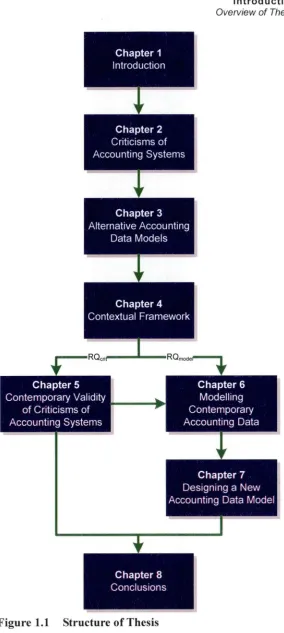
This thesis has the following structure:
Introduction
Overview of Thesis Chapter 1
•:• Chapter 2 reviews the criticisms made of accounting systems in the literature.
These are synthesised into a set of nine aims for accounting systems and discussed in the light of other evidence which casts some doubt on the current validity of some of the criticisms made. Three goals are derived for future accounting systems.
•:• Chapter 3 examines proposals for alternative accounting models: the REA
accounting template, the Multiview Accounting System and REAL business modelling. The ability of these models to overcome the criticisms of accounting systems is reviewed.
•:• Chapter 4 outlines the research questions which are addressed in this thesis and
classifies them based on the research frameworks proposed by March and Smith (1995) and David et al. (1999).
•:• Chapter 5 describes the research undertaken in relation to the research question
(referred to as RQcriJ which seeks indicative evidence regarding the contemporary validity of the criticisms of accounting systems reported in the literature. This research question provides further support for the need to design a new accounting data model.
•:• Chapter 6 considers the research question (referred to as RQmodei) which addresses the needs identified for a new accounting data model. Data models for three manufacturing organisations are developed as the basis for the new design. •:• Chapter 7 describes the new accounting data model designed to achieve the three
goals set for accounting systems.
•:• Chapter 8 summarises the research findings and the limitations, and concludes with
a discussion of the research contribution made by this thesis. The structure of the thesis is illustrated in Figure 1.1.
Figure 1.1 Structure of Thesis
Introduction
Overview of Thesis I Chapter 1
Criticisms of Accounting Systems
' ' '
. . .
. .
. . . .
.
.
.
. .
.
.
. .
.
.
. .
.
. .
.
.
~. . . .
.
. .
.
..
.
•
•
•
•
This chapter reviews the most significant criticisms of accounting systems which have been made in the literatUre. Criticisms of accounting systems have .beeri made from a wide variety of sources, both within and outside the accounting profession. Despite the age of some criticisms, they continue to be applied to contemporary systems.
The criticisms reported in this chapter have been categorised according to the nature of the problem being highlighted, but this also corresponds to a rough chronological sequence. Section 2.1 reports on the need for accounting data to be recorded independently of their use. Section 2.2 reviews calls for greater integration of related information systems. Section 2.3 considers problems which have been highlighted as a result of advances in
' '
technology, whilst Sections 2.4 and 2.5 describe issues relating to information usefulness and user choice, respectively. The criticisms described are synthesised into a set of aims for accounting systems in Section 2.6. Given the age of many of the criticisms, Section 2. 7 seeks to compare the problems raised against existing evidence ·concerning the abilities of contemporary accounting systems to overcome them. A summary of the chapter is
provided in Section 2.8.
2.1 Application Independence
Criticisms of Accounting Systems
, Integration of Information Systems Chapter 2
unable to support all existing information demands and/or new applications which may arise in the future.
Goetz (1939) considered the major purposes of accounting to be:
•:• a systematic method for handling part of the day-to-day activities of the business enterprise;
•:• the accumulation, classification, and reporting of data according to rules imposed by governments;
•:• the preparation of reports for credit purposes; •:• keeping track of equity interests;
•:• a tool of management.
Reports prepared for each of these purposes would apply sets of accounting methods appropriate to the specific task and which may be different in each case. To avoid variations in accounting methods having an impact on the accounting records, Goetz proposed that "an objective, historic record should be maintained, purged of opinion, estimate and other subjective data" (Goetz 1939, 156). Supplemental records to this Basic Historical Record would be maintained for the adjusting entries needed to prepare each type of report. Even though this predates the development of database theory, Goetz' s (1939) proposal bears great similarity to the central database design objective of
application independence which reflects a concern "with what the data is, rather than how it will be used" (Date 1995, 270).
Application independence in the design of accounting systems would help to ensure that data are recorded in a form which is suitable for multiple purposes and multiple users, and that it does not focus on a single task (such as the preparation of financial statements). This would reduce the need for multiple systems (and the consequential duplication of effort) to support user needs.
2.2 Integration of Information Systems
The tendency of accounting systems to focus on the preparation of financial statements as their sole task (see the discussion regarding application independence above) inevitably leads to the creation of multiple systems to satisfy the wide range of needs for accounting information. In particular, the demands of financial accountants for historical information
Criticisms of Accounting Systems Integration of Information Systems I
Chapter 2
are quite different from those of management accountants who need future estimates. A system which could integrate such needs may enable information to be provided more efficiently and effectively, as well as better support needs which rely on both historic and future data.
The AAA Committee on Managerial Decision Models (AAA 1969) considered that "organizations and management can generally gain by combining the conventional accounting system and other data-gathering functions necessary for decision models" (AAA 1969, 53). Their call for an integrated information system came from concerns over problems of data overlaps and information gaps which might result from using multiple systems. It was also seen as being a focus for the coordinated provision of extemally-generated data which are demanded by the decision models they considered.
The Committee was established to consider the implications of the Statement of Basic Accounting Theory (AAA 1966). This Statement identified the need for management information beyond that provided by the conventional model. The Committee defined the conventional accounting system as being one which "considers past data as the basic input, the chart of accounts as the basic classification model, and the financial statements as the basic output" (AAA 1966, 56). As a result of the managerial decision models considered, the Committee predicted that "accounting in the future will have to broaden the kinds of events which are recorded" (AAA 1969, 54) and that accounting information should be "multi-dimensional, encompassing both the past and projections of the future" (AAA 1969, -54). Their view was quite similar to Goetz's (1939) proposal for a basic historic record
(see above):
"New, less expensive data gathering, storage, and accessibility capabilities of computers will enhance the feasibility of having a system that essentially contains a library of raw data in as elementary, unstructured but
well-defined form as possible, properly indexed for subsequent retrieval and stored so as to facilitate a wide variety of manipulation, classification, and aggregation. Such data may include many events which have not been traditionally recorded." (AAA 1969, 55)
In a similar vein, the AAA Committee on Non-Financial Measure of Effectiveness (AAA 1971) sought to break down the divisions between what is and is not "accounting" in relation to detection and recording systems. They regarded "the substantive question of 'what' is detected and recorded and 'why"' (AAA 1971, 189) as being far more interesting :
Criticisms of Accounting Systems
Application of New Technology Chapter 2
than attempting to distinguish between accounting and non-accounting data. The
Committee commented on the problem that "classification often results in an aggregation
loss of certain detail" (AAA 1971, 193) and offered some support for the notion of a
"generalised concept of an account" put forward by Colantoni et al. (1970, 38) which would support a wide variety of user needs including both financial and non-financial
information. They also promoted the idea of using a single data bank as a repository for
those events which are to be detected and recorded (AAA 1971, 191-197).
McCarthy (1980, 628) used these two AAA reports to identify four major defects in the conventional accounting framework in support of his entity-relationship accounting model:
1. Its dimensions are limited.
2. Its classification schemes are not always appropriate.
3. Its aggregation level for stored information is too high.
4. Its degree of integration with other functional areas of an enterprise is too
restricted.
These criticisms were subsequently used in support of the development of the REA
accounting model (McCarthy 1982, 554-555) and have been accepted and extended by
other authors (see, for example, Armitage 1985; Andros et al. 1992; Hollander et al. 1996,
2000).
Although the information needs supported by each system may be distinct, the data
captured by each are similar and related. Apart from efficiencies which may be gained
from integrating systems (for example, a reduction in duplication of effort), there may also be benefits gained from creating links between the data items which may enable new
information needs to be supported.
2.3 Application of
New Technology
Some problems with accounting systems may be difficult or impossible to overcome for
technical reasons. Thus, when new technology becomes available, further advances are
made possible. However, the danger with new technology is that applications are not changed to take full advantage of the benefits available, but merely perpetuate the use of old methods.
Criticisms of Accounting Systems
Appltcation of New Technology Chapter 2
Harper (1985) reported on the presence of the "stage-coach" effect in computerised accounts; that is "the tendency for the application of a new technique to comply with the quite irrelevant designs that related to the old technique" (Harper 1985, 152). In the case of computerised accounting systems, he was concerned that "the longer we retain double-entry accounts, the longer we will be failing to exploit the full potential opened by databases" (Harper 1985, 152). The radical redesign of accounting systems suggested by Harper would now be termed business process reengineering (BPR). The principles of BPR have been widely applied in many areas of organisations. The basic underlying rationale has been succinctly described by Hammer (1990, 104) as follows:
"It is time to stop paving the cow paths. Instead of embedding outdated processes in silicon and software, we should obliterate them and start over." The principles of reengineering proposed by Hammer (1990, 108-112) were:
•:• organise around outcomes, not tasks;
•:• have those who use the output of the process perform the process;
•:• subsume information-processing work into the real work that produces the information;
•:• treat geographically dispersed resources as though they were centralised; •:• link parallel activities instead of integrating their results;
•:• put the decision point where the work is performed, and build control into the process;
•:• capture information once and at the source.
Andros et al. (1992) reported how IBM has included BPR principles in its development of new financial processes to overcome the "fundamental weaknesses" of traditional
accounting methods. In addition to the four criticisms reported by McCarthy (see above) which were concerned with the organisation and storage of business data, Andros et al. (1992, 29) added a further four weaknesses which dealt with the way data are recorded, maintained and reported:
1. Recording, maintaining, and reporting information processes seriously limit the system's ability to provide timely information to decision makers.
2. Traditional processing methods tend to institutionalise antiquated, inefficient, and ineffective business processes.
3. Implementing and maintaining internal controls is costly, ineffective, and not performed in a timely manner.
4. Antiquated processing and storage methods are costly to maintain and operate.
Criticisms of Accounting Systems
Usefulness of Accounting Information
To overcome these eight weaknesses, IBM adopted five solution concepts:
1. Reengineering business and information processes.
2. Developing event-driven solutions.
3. Integrating processes.
4. Integrating data.
5. Realigning information systems ownership.
Chapter 2
These concepts promote solutions which are based around integrated, enterprise-wide data
models which incorporate both financial and non-financial data with data being captured at
the time an event occurs by those responsible for that event. Andros et al. ( 1992, 31)
reported the application of these solution concepts in relation to IBM's process for paying
employees which was successful in terms of financial return, user satisfaction and
improved decision-making.
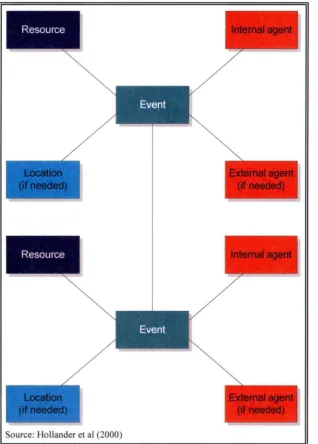
Hollander at al (2000) also advocated an event-driven system to overcome the criticisms of
traditional accounting information systems. They summarised the most significant of these
criticisms as follows (2000, 101-104):
1. The architecture captures data about a subset of an organisation's business events
(the accounting transactions).
2. Data are not recorded and processed in real time (i.e. as the business activity
occurs).
3. The architecture stores and processes only a limited number of characteristics about
accounting transactions.
4. The architecture captures and stores duplicate data in a highly summarised form.
5. The architecture stores financial data to satisfy one primary view (perspective).
Thus, the benefits of new technology should always be analysed to identify how they can
overcome problems with systems, rather than trying to fit old systems into new technology.
2.4
Usefulness
of Accounting Information
Some limitations in accounting systems may affect the quality of the information they can
provide. SAC 3 (AASB 1990) suggests timeliness and cost effectiveness as being
potential constraints on the ability to provide relevant and reliable financial information.
Criticisms of Accounting ·systems
Usefulness of Accounting Information Chapter 2
New technology can provide opportunities for reducing the impact of these constraints and thereby enhance the usefulness of the information which can be produced.
Seddon (1991) believed that contemporary accounting systems already comprised many modules (or subsystems) used to capture a wide range of data about an organisation's activities. He did, however, raise concerns over the difficulty with which data from these modules could be integrated:
"It may be difficult to use the data in the subsystem databases effectively. Even when interface programs exist the information they provide is likely to be very restricted. One has to rely on all the different subsystems and interface programs generating appropriate journal entries, and changes in accounting policy; even simple changes like a revision to the chart of accounts for the general ledger, will have implications· for many different subsystems." (Seddon 1991, 6-25, emphasis in original)
He identified five problems with the "conventional architecture of computer-based accounting systems" (Seddon 1996,,2):
1. No knowledge_ of accounting rules.
2. Restructuring the chart of accounts is difficult. 3. No support for multinational reporting.
4. Account balances can reflect only one valuation system. 5. Continuous processes are treated as periodic.
He considered these problems to be symptomatic of accounting systems being designed to support the bookkeeping process more than the accounting process (Sedaon 1996, 2). This provided the main justification used to support his research: the concern.that the continued
. .
use of double-entry bookkeeping leads to unproductive ways of thinking (such ~s historic cost accounting) which ~e not useful for making economic ~ecisions:
"The balance in a general ledger account is con~tant, in money terms, until it is changed by a journal entry ... However, market values are constantly changing, particularly in times of inflation, so accoUn.ting information may be more useful if values of assets and liabilities, and even balances in -revenue and expense accounts are continuously restated." (Seddon 1991,
6-25 - 6-26)
For Seddon, therefore, a primary requirement of an accounting system was an ability to present accounting information adjusted for the effects of inflation. In recognition of the fa~t that there is no single valuation basis suitable for all types of decision, he advocated the need for the accounting system to support multiple valuation bases as well as multiple accounting policies so that the user is able to choose their own preferred combination.
Criticisms of Accounting Systems
Choice for Users of Accounting Information Chapter 2
Seddon's (1991) proposals have the potential to improve the timeliness and reduce the cost of financial information by both seeking to utilise data captured in other systems and also developing a system which more closely models the underlying data.
r
.2.5 Choice for Users of Accounting Information
Particularly with the advances in technology, many business practices are being reoriented to provide a customer focus. That is, systems should be designed to support user needs rather than users having to accept whatever information is available from a system. Greater flexibility in the design and implementation of systems would allow users greater control over the information requested. Whilst developments such as XBRL (see, for example, Debreceny and Gray 2001) may provide users with some choice over the
presentation of reports, choice over the content is dependent upon the data recorded by the underlying accounting system.
Cushing (1989, 30) analysed "the feasibility and consequences of implementing a database approach to corporate financial reporting". One of his conclusions was that database disclosure would change the focus of accounting standard-setting from resolving
controversies over alternative methods of recognition, valuation, estimation, allocation and classification, to specifying which events should be recorded, which attributes of the events should be recognised, how attributes should be measured and (possibly) permissible forms of aggregation (Cushing 1989, 38). It would be up to each individual user to specify which accounting policies and valuation bases they wish to apply to the accounting data. Although Cushing was concerned with external reporting, the approach he discusses could be equally applicable to internal users.
The implementation of an approach such as that discussed by Cushing (1989) would also permit a broader definition of corporate accountability to be applied which could include events that are primarily non-financial in nature (Cushing 1989, 32). Such an approach may help to overcome the criticisms of accounting made by Elliott (1991, 2-3) who accused the "industrial-era accounting paradigm" of holding back the progress of
accounting and causing the "growing irrelevance of accounting". For example, he reported that "managers are running their companies with nonaccounting data" and "strategic
Criticisms of Accounting Systems
Choice for Users of Accounting Information Chapter 2
management processes are omitting accountants" (Elliott 1991, 3). Whilst he does not lay the blame at the door of accounting systems, one of his recommendations is for systems which are able to provide "process measures in real time" (Elliott 1991, 6). Furthermore, Elliott (1992, 69-70) makes the following predictions in respect of "third-wave accounting systems":
•:• focus on changes in resources and processes; •:• inclusion of intangible resourc.es and obligations;
•:• greater concern with measuring the values created for customers; •:• enabling rather than restricting;
•:• provision of information in real-time.
The final prediction was repeated in Elliott (1995, 121) where he also called for greater user choice in selecting the content, timing and format of reports.
The Australian Accounting Research Foundation (AARF) is pursuing a policy of harmonising its accounting standards with the International Accounting Standards. The main force behind the call for harmonisation.is the increased globalisation of business (Howieson 1998, 4) and in particular the capital markets.
"This is particularly relevant to an increasing number of.Australian companies who now seek to raise· finance on many world markets. Often this requires preparation of financial statements, at substantial cost, in accordance with a myriad of different ruies." (Curran 1996, i; emphasis
added) ·
' '
Whilst not wishing to detract from the goal of a single, global accounting language, the rational~ given above makes an indirect criticism of accounting systems. Given that the
economic activities experienced and recorded by an entity are not affected by the
destination of the financial reports, it is a concern that accounting systems can only convert these records into reports on the _basis of different accounting rules "at substantial cost". It is possible that this is due to the need ~or a considerable amount of judgment and
interpretation which is not easily automated. However, ifthis·were the case one might also expect the preparation of financial reports under local accountmg requirements to be an expensive and time-consuming process but there is no evidence that this is the case. The most plausible explanation is that accounting systems ai;e only designed to efficiently handle a single set of accounting rules. A system capable of supporting accounting rules from other countries would, therefore, at least reduce the urgency of international harmonisation and global agreement on a single accounting language.
.
Criticisms of Accounting Systems
Aims for Future Accounting Systems Chapter 2
A system such as that considered by Cushing ( 1989) which allows users greater choice
over the output generated and a greater integration of financial and non-financial events
could also alleviate problems related to the lack of harmonisation of international
accounting standards. It would, for example, remove the need for individual countries to
specify acceptable accounting standards (especially valuation methods) and allow users of
financial statements to make the selections for themselves.
2.6 Aims for Future Accounting Systems
It is not intended for the criticisms discussed above to be an exhaustive list of all those
reported in the literature; preparing such a list would be a near impossible task. However,
the criticisms included here reflect, in particular, those made by advocates of changes to
accounting systems and provide the basis for the alternative accounting models proposed.
It is worth noting that criticisms of accounting systems have arisen over a significant
period of time and are still being made. Moreover, accounting systems seem to have been
quite resistant to change if the recent repetition of long-standing criticisms is an accurate
reflection of their current state. The considerable overlap between the authors referred to
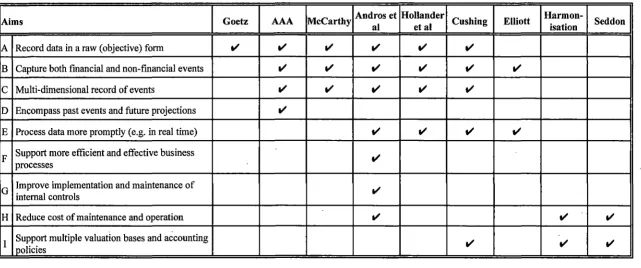
above is illustrated in Table 2.1 which synthesises the criticisms reported into a set of aims
for new accounting systems. The following assumptions were made in preparing this
table:
•:• The concerns expressed by McCarthy (1980; 1982) and Hollander et al. (2000)
about the classification schemes used and the level of aggregation have been
treated as relating to the single aim of recording data in a raw, objective form (Aim
A).
•:• Seddon's (1991) comments about difficulties in making simple changes are
assumed to reflect the cost of maintaining and operating the accounting system
(Aim H).
•:• Both McCarthy ( 1980; 1982) and Andros et al. ( 1992) commented on problems
regarding the integration of accounting systems with other areas of the business.
This criticism has been incorporated into the aim of capturing both financial and
non-financial data (Aim B) because they are seen as merely opposite sides of the
same argument. Both these problems (integration with other systems and focus on
financial data) can be resolved by either structuring the accounting system in such a:
::i... ~ ::;; ::i... g <::> ~
.
~ ~-~ iS'~
~-
--...!
Aims Goetz
A Record data in a raw (objective) fonn t/ B Capture both financial and non-financial events
c
Multi-dimensional record of eventsD Encompass past events and future projections E Process data more promptly (e.g. in real time)
F Support more efficient and effective business processes
G Improve implementation and maintenance of internal controls
H Reduce cost of maintenance and operation
[image:29.833.66.707.63.330.2]I Support multiple valuation bases and accounting policies
Table 2.1 Aims for New Accounting Systems
AAA McCarthy Andros et al
t/ t/ t/
t/ t/ t/
t/ t/ t/
t/ t/ t/ t/ t/ Hollander
Cushing Elliott Harmon- Seddon
et al isation
t/ t/
t/ t/ t/
t/ t/
0.. ~ (1) ~ en ... (]Q
g.
e.
~
a
(]Q...
...+ ...+ (') :::;" (1) § p)
t/ t/ t/
(') cr' (') (1) 0
s
a
... 0....
(1) ~ (]Q (1)en p) en '< en
-
...
...+ '<
(1) ...
s
a
t/ t/
t/ t/ t/
...+ (1)
0 (]Q 0
p)
....
::?. (').
a
....
...+ (1) )::. c;·
Pl 0..
§" u;• en
~ p)
Cl) 3 en
§:
O' (II ....., 0
~ 0 (]Q
~ ~ ....
-
(1)c:
)>(1) ... ....
Ci1
g
~
... ~ )::. 08>
(') c§
s
8~a
:::i c: -· ~...
a
§"cc 0
...
~ 0 co en en ~
~~
'< tll tll '<
CJj ....
...+
tll ... CD (1)
...+ CD 3
s
(1)~(II
s
s·
tll (')0 0 ....
.a
cr'Criticisms of Accounting Systems
Contemporary Accounting Systems Chapter 2 all of the data relevant to an organisation. The latter approach has been adopted by
Enterprise Resource Planning (ERP) systems which have been widely adopted in recent years, especially by large organisations (O'Leary 2000). Whilst the integration of multiple information systems may be preferred by some users, it is ·contended that if a single system were designed then it would always be possible to
divide it into a set of separate, integrated systems. However, the reverse does not necessarily follow: that separate systems can be integrated to form a single system. Thus, only the aim of capturing financial and non-financial data has been included here.
A system designed to achieve the aims set out in the table would overcome the most significant criticisms made against accounting systems. These aims are concerned with improving the following characteristics of the information which can be produced (the related aims are indicated in brackets):
•!• Quality (Aim G)
•:• Variety (Aims A, B, C, D and I) •!• Timeliness (Aims E and F)
In addition, Aim H is concerned with reducing the costs associated with accounting systems.
2. 7 Contemporary Accounting Sys~ems
This review has revealed the long-standing and repeated nature of many significant criticisms made against accounting systei:n-s. Apart from documenting the urgent_ need for a new design of accounting system, it also begs the question of "if these criticisms are so significant, why have they remained unresolved for so long?" After all, these criticisms are still being reported (see, for example, Hollander et al. 2000). One answer to this question is that, as the criticisms are not usually supported by evidence of actual cases, the authors may be reporting non-existent or out-of-date problems (as the existence of ERP systems might indicate). The only article that refers to an actual case is Andros et al. (1992). However, this example relates to an administrative system handling employee disbursements and not to an accounting system as such. Both McCarthy (1978; 1980; 1982) and Seddon (1991) take normative views of the accounting world and base their research purely on accounting theory. Elliott (1991) provides only anecdotal evidence
Criticisms of Accounting Systems Contemporary Accounting Systems
fl
from his experiences with real companies. Even the literature on international
Chapter 2
harmonisation provides only indirect evidence of the failures of accounting systems. Thus none of the criticisms made is supported by evidence drawn from an actual accounting system and so it could easily be the case that many (or all) of the criticisms do not apply to contemporary accounting systems. 1
A typical accounting system in Australia is a computerised package.2 These computer-based systems are built as a series of modules. The most popular modules found by Seddon et al. (1992) in their 1988 survey were Accounts Payable (92% of users) and Accounts Receivable (78% of users). Whilst they also found that such modules were not always integrated with the general ledger, all of the packages reviewed by Courtney and Flippen (1995) and Commonwealth of Australia (1995) support their full integration. It is likely, therefore, that a more current survey would reveal a much higher incidence of integrated modules in use, especially for recent installations. The modules offered by accounting systems cover a wide range of business functions. For example, purchasing (100%), sales order processing, sales invoicing, inventory control (79%) and fixed asset management (98%).3 ICAA (2001) indexes accounting software under 12 broad functional areas comprising a total of 53 separate capabilities. Although each package does not support every area or capability, the index does serve to illustrate the wide range of tasks for which contemporary accounting systems are being designed. Other recent evidence can be found in the dramatic acceptance of ERP systems by businesses. For example, Davenport (1998, 122) suggests that "the business world's embrace of enterprise systems may in fact be the most important development in the corporate use of information
technology in the 1990s". O'Leary (2000, 3) reports on a 1998 finding that "a single ERP system (SAP's R/3) is used by more than 60% of the multinational firms". Thus, the evidence suggests that integrated systems are available and are becoming increasingly popular.
It is of no real interest here whether criticisms of accounting systems might have applied to previous accounting systems and it would be problematic to investigate in any case.
Seddon et al (1992, 100-101) found 99% of the companies responding to their surveys undertaken in 1988 and 1989 were using a computerised general ledger system and 85% of the systems installed since 1980 were .
packages. ·
The percentages in brackets indicate the proportion of the packages reviewed in Commonwealth of Australia : (1995) which offer this function.
Criticisms of Accounting Systems
Contemporary Accounting Systems Chapter 2
The criticisms of accounting systems reported in the literature seem, prima facie, to contradict the nature of available systems and suggest that some of the aims derived from the criticisms may already have been achieved .. A brief analysis of some reviews of accounting software offers some support for this proposition. Even without considering the advanced capabilities of ERP systems, there is considerable evidence that
contemporary accounting systems have made majm advances in many of the areas which are the subject of criticism .. The evidence is presented below in terms of each of the aims identified.
A. Record data in a raw (objective) form. With the integration ofrelated modules into which source data are entered, and the storing of data in non-proprietary, database management systems,4 the ability to retrieve actual transaction data has been strengthened. In addition, Commonwealth of AustraVa (1995) provides sufficient information to identify 3 packages with over 1,000 customer sites which stored individual transaction details. This would~ at least, make users less dependent upon the summarised information available from a general ledger.
B. . (;apt1fre both financial and non-financial events. It would appear that many · software ·houses have addressed this issue by integrating a wide range of modules
into their accounting ~ystems. The existence of ERP systems is further evidence
' '
that accounting systems no longer focus solely on _financial records but can include other functio~al areas such as order processing, fixed asset management,
manufacturing and human resources.
C. Multi-dimensional record of events. The mere existence of modules for inventory control and fixed asset management is persuasive evidence that contemporary accounting systems provide an ability to store non-financial data. Weber (1986) and Seddon (1991) provide additional evidence of systems which store volume data. The entry and reporting of non-financial data was one of the evaluation categories applied ih Commonwealth of Australia (1995) and all the systems reviewed with over 1,000 customer sites offered this facility. In addition, at least 8 of the 15 popular accounting packages reviewed by Courtney and Flippen (1995)
90% of all the packages reviewed by Commonwealth of Australia (1995) were implemented using a DBMS.
• • • • • • II • • ~ • • • • • • • • • • • • • • • • • • • • •
Criticisms of Accounting Systems
Contemporary Accounting Systems Chapter 2
provided some facility for reporting inventory transactions on a unit (rather than monetary value) basis. 5
D. Encompass past events and future projections. No evidence has been found to suggest that contemporary accounting systems have moved away from the traditional accounting convention of recording only past events. However, the types of events captured by the accounting system has been extended to include many which precede the economic exchange of resources. For example, this is evidenced by the existence of sales and purchase order processing modules. But technicaUy these are still not future projections, but merely records of past occurrences.
E. Process data more promptly (e.g. in real time). Of the systems with over 1,000 customer sites reviewed by Commonwealth of Australia (1995), at least 75%6 allowed the on-line recording of transactions. This suggests that it may also be feasible for these systems to be operated in real-time and certainly does not support the statement made by Hollander et al. (2000, 102) that "because accounting data are only captured and processed days, weeks, or even months after the event occurs, accounting information for decision making is always late".
F. Support more efficient and effective business processes. This is a difficult aim for which to obtain support since the original criticism on which it is based was not specific about the failures of accounting systems. However, the reports of successful applications of BPR in practice and the growing popularity of ERP systems would suggest that improvements in business processes are not being thwarted by deficiencies in accounting systems.
G. Improve implementation and maintenance of internal controls. This criticism was raised using an example of a manual administrative support system (Andros et al. 1992). It is possible that the mere process of computerising the system would have been sufficient to overcome this weakness since controls can be programmed into the system to be executed at the time of the action. This may even be in real-time and hence allow controls to be preventative. Without more specific evidence, it is
The actual number may be higher because Courtney and Flippen (1995) were concerned with transactions being reported in date order and from a standard report (not one having to be constructed by a reporting module).
Insufficient information was provided for the remaining 25%.