Dynamics Based Control
with an Application to Area-Sweeping Problems
Zinovi Rabinovich
Engineering and ComputerScience Hebrew University of
Jerusalem Jerusalem, Israel
[email protected]
Jeffrey S. Rosenschein
Engineering and ComputerScience Hebrew University of
Jerusalem Jerusalem, Israel
[email protected]
Gal A. Kaminka
The MAVERICK Group Department of ComputerScience
Bar Ilan University, Israel
[email protected]
ABSTRACT
In this paper we introduce Dynamics Based Control (DBC), an approach to planning and control of an agent in stochastic envi-ronments. Unlike existing approaches, which seek to optimize ex-pected rewards (e.g., in Partially Observable Markov Decision Prob-lems (POMDPs)), DBC optimizes system behavior towards
speci-fied system dynamics. We show that a recently developed planning
and control approach, Extended Markov Tracking (EMT) is an in-stantiation of DBC. EMT employs greedy action selection to pro-vide an efficient control algorithm in Markovian environments. We exploit this efficiency in a set of experiments that applied multi-target EMT to a class of area-sweeping problems (searching for moving targets). We show that such problems can be naturally de-fined and efficiently solved using the DBC framework, and its EMT instantiation.
Categories and Subject Descriptors
I.2.8 [Problem Solving, Control Methods, and Search]: Con-trol Theory; I.2.9 [Robotics]; I.2.11 [Distributed Artificial Intel-ligence]: Intelligent Agents
General Terms
Algorithms, TheoryKeywords
Control, Multi-Agent Systems, Robotics, Target Dynamics, Dy-namics Based Control
1.
INTRODUCTION
Planning and control constitutes a central research area in mul-tiagent systems and artificial intelligence. In recent years, Partially Observable Markov Decision Processes (POMDPs) [12] have be-come a popular formal basis for planning in stochastic environ-ments. In this framework, the planning and control problem is often
Permission to make digital or hard copies of all or part of this work for personal or classroom use is granted without fee provided that copies are not made or distributed for profit or commercial advantage and that copies bear this notice and the full citation on the first page. To copy otherwise, to republish, to post on servers or to redistribute to lists, requires prior specific permission and/or a fee.
AAMAS’07 May 14–18 2007, Honolulu, Hawai’i, USA.
Copyright 2007 IFAAMAS .
addressed by imposing a reward function, and computing a policy (of choosing actions) that is optimal, in the sense that it will result in the highest expected utility. While theoretically attractive, the complexity of optimally solving a POMDP is prohibitive [8, 7].
We take an alternative view of planning in stochastic environ-ments. We do not use a (state-based) reward function, but instead optimize over a different criterion, a transition-based specification of the desired system dynamics. The idea here is to view plan-execution as a process that compels a (stochastic) system to change, and a plan as a dynamic process that shapes that change according to desired criteria. We call this general planning framework
Dy-namics Based Control (DBC).
In DBC, the goal of a planning (or control) process becomes to ensure that the system will change in accordance with specific (po-tentially stochastic) target dynamics. As actual system behavior may deviate from that which is specified by target dynamics (due to the stochastic nature of the system), planning in such environ-ments needs to be continual [4], in a manner similar to classical closed-loop controllers [16]. Here, optimality is measured in terms of probability of deviation magnitudes.
In this paper, we present the structure of Dynamics Based Con-trol. We show that the recently developed Extended Markov Track-ing (EMT) approach [13, 14, 15] is subsumed by DBC, with EMT employing greedy action selection, which is a specific parameteri-zation among the options possible within DBC. EMT is an efficient instantiation of DBC.
To evaluate DBC, we carried out a set of experiments applying multi-target EMT to the Tag Game [11]; this is a variant on the area sweeping problem, where an agent is trying to “tag” a moving target (quarry) whose position is not known with certainty. Ex-perimental data demonstrates that even with a simple model of the environment and a simple design of target dynamics, high success rates can be produced both in catching the quarry, and in surprising the quarry (as expressed by the observed entropy of the controlled agent’s position).
2.
MOTIVATION AND RELATED WORK
Many real-life scenarios naturally have a stochastic target dy-namics specification, especially those domains where there exists no ultimate goal, but rather system behavior (with specific prop-erties) that has to be continually supported. For example, security guards perform persistent sweeps of an area to detect any sign of intrusion. Cunning thieves will attempt to track these sweeps, and time their operation to key points of the guards’ motion. It is thus advisable to make the guards’ motion dynamics appear irregular and random.Recent work by Paruchuri et al. [10] has addressed such random-ization in the context of single-agent and distributed POMDPs. The goal in that work was to generate policies that provide a measure of action-selection randomization, while maintaining rewards within some acceptable levels. Our focus differs from this work in that DBC does not optimize expected rewards—indeed we do not con-sider rewards at all—but instead maintains desired dynamics (in-cluding, but not limited to, randomization).
The Game of Tag is another example of the applicability of the approach. It was introduced in the work by Pineau et al. [11]. There are two agents that can move about an area, which is divided into a grid. The grid may have blocked cells (holes) into which no agent can move. One agent (the hunter) seeks to move into a cell occu-pied by the other (the quarry), such that they are co-located (this is a “successful tag”). The quarry seeks to avoid the hunter agent, and is always aware of the hunter’s position, but does not know how the hunter will behave, which opens up the possibility for a hunter to surprise the prey. The hunter knows the quarry’s probabilistic law of motion, but does not know its current location. Tag is an instance of a family of area-sweeping (pursuit-evasion) problems.
In [11], the hunter modeled the problem using a POMDP. A re-ward function was defined, to reflect the desire to tag the quarry, and an action policy was computed to optimize the reward col-lected over time. Due to the intractable complexity of determining the optimal policy, the action policy computed in that paper was essentially an approximation.
In this paper, instead of formulating a reward function, we use EMT to solve the problem, by directly specifying the target dynam-ics. In fact, any search problem with randomized motion, the so-called class of area sweeping problems, can be described through specification of such target system dynamics. Dynamics Based Control provides a natural approach to solving these problems.
3.
DYNAMICS BASED CONTROL
The specification of Dynamics Based Control (DBC) can be bro-ken into three interacting levels: Environment Design Level, User Level, and Agent Level.
• Environment Design Level is concerned with the formal specification and modeling of the environment. For exam-ple, this level would specify the laws of physics within the system, and set its parameters, such as the gravitation con-stant.
• User Level in turn relies on the environment model produced by Environment Design to specify the target system dynam-ics it wishes to observe. The User Level also specifies the es-timation or learning procedure for system dynamics, and the measure of deviation. In the museum guard scenario above, these would correspond to a stochastic sweep schedule, and a measure of relative surprise between the specified and actual sweeping.
• Agent Level in turn combines the environment model from
the Environment Design level, the dynamics estimation pro-cedure, the deviation measure and the target dynamics spec-ification from User Level, to produce a sequence of actions that create system dynamics as close as possible to the tar-geted specification.
As we are interested in the continual development of a stochastic system, such as happens in classical control theory [16] and con-tinual planning [4], as well as in our example of museum sweeps, the question becomes how the Agent Level is to treat the devia-tion measurements over time. To this end, we use a probability threshold—that is, we would like the Agent Level to maximize the probability that the deviation measure will remain below a certain threshold.
Specific action selection then depends on system formalization. One possibility would be to create a mixture of available system trends, much like that which happens in Behavior-Based Robotic architectures [1]. The other alternative would be to rely on the esti-mation procedure provided by the User Level—to utilize the Envi-ronment Design Level model of the enviEnvi-ronment to choose actions, so as to manipulate the dynamics estimator into believing that a cer-tain dynamics has been achieved. Notice that this manipulation is not direct, but via the environment. Thus, for strong enough estima-tor algorithms, successful manipulation would mean a successful simulation of the specified target dynamics (i.e., beyond discerning via the available sensory input).
DBC levels can also have a back-flow of information (see Fig-ure 1). For instance, the Agent Level could provide data about target dynamics feasibility, allowing the User Level to modify the requirement, perhaps focusing on attainable features of system be-havior. Data would also be available about the system response to different actions performed; combined with a dynamics estimator defined by the User Level, this can provide an important tool for the environment model calibration at the Environment Design Level.
User
Env. Design Agent
Model
Ideal Dynamics Estimator
Estimator
[image:2.612.316.557.413.461.2]Dynamics Feasibility System Response Data
Figure 1: Data flow of the DBC framework
Extending upon the idea of Actor-Critic algorithms [5], DBC data flow can provide a good basis for the design of a learning al-gorithm. For example, the User Level can operate as an exploratory device for a learning algorithm, inferring an ideal dynamics target from the environment model at hand that would expose and verify most critical features of system behavior. In this case, feasibility and system response data from the Agent Level would provide key information for an environment model update. In fact, the combi-nation of feasibility and response data can provide a basis for the application of strong learning algorithms such as EM [2, 9].
3.1
DBC for Markovian Environments
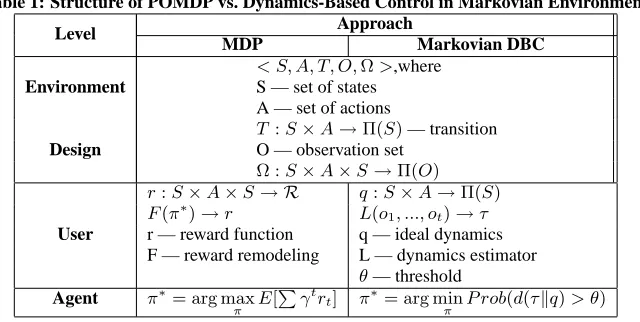
For a Partially Observable Markovian Environment, DBC can be specified in a more rigorous manner. Notice how DBC discards rewards, and replaces it by another optimality criterion (structural differences are summarized in Table 1):
• Environment Design level is to specify a tuple < S, A, T, O,Ω, s0 >, where:
– Sis the set of all possible environment states; – s0is the initial state of the environment (which can also
– Ais the set of all possible actions applicable in the en-vironment;
– Tis the environment’s probabilistic transition function: T :S×A→Π(S). That is,T(s0
|a, s)is the probabil-ity that the environment will move from statesto state s0
under actiona;
– Ois the set of all possible observations. This is what the sensor input would look like for an outside observer;
– Ωis the observation probability function:
Ω :S×A×S→Π(O). That is, Ω(o|s0
, a, s) is the probability that one will observeogiven that the environment has moved from statesto states0
under actiona.
• User Level, in the case of Markovian environment, operates on the set of system dynamics described by a family of con-ditional probabilitiesF = {τ : S ×A → Π(S)}. Thus specification of target dynamics can be expressed byq∈ F, and the learning or tracking algorithm can be represented as a functionL:O×(A×O)∗
→ F; that is, it maps sequences of observations and actions performed so far into an estimate τ ∈ Fof system dynamics.
There are many possible variations available at the User Level to define divergence between system dynamics; several of them are:
– Trace distance or L1 distance between two
distribu-tionspandqdefined by
D(p(·), q(·)) = 1 2
X
x
|p(x)−q(x)|
– Fidelity measure of distance
F(p(·), q(·)) =X x
p
p(x)q(x)
– Kullback-Leibler divergence
DKL(p(·)kq(·)) =
X
x
p(x) logp(x)
q(x)
Notice that the latter two are not actually metrics over the space of possible distributions, but nevertheless have mean-ingful and important interpretations. For instance, Kullback-Leibler divergence is an important tool of information the-ory [3] that allows one to measure the “price” of encoding an information source governed byq, while assuming that it is governed byp.
The User Level also defines the threshold of dynamics devi-ation probabilityθ.
• Agent Level is then faced with a problem of selecting a con-trol signal functiona∗
to satisfy a minimization problem as follows:
a∗
= arg min
a P r(d(τa, q)> θ)
whered(τa, q)is a random variable describing deviation of
the dynamics estimateτa, created byLunder control signal
a, from the ideal dynamicsq. Implicit in this minimization problem is thatLis manipulated via the environment, based on the environment model produced by the Environment De-sign Level.
3.2
DBC View of the State Space
It is important to note the complementary view that DBC and POMDPs take on the state space of the environment. POMDPs regard state as a stationary snap-shot of the environment; what-ever attributes of state sequencing one seeks are reached through properties of the control process, in this case reward accumulation. This can be viewed as if the sequencing of states and the attributes of that sequencing are only introduced by and for the controlling mechanism—the POMDP policy.
DBC concentrates on the underlying principle of state sequenc-ing, the system dynamics. DBC’s target dynamics specification can use the environment’s state space as a means to describe, discern, and preserve changes that occur within the system. As a result, DBC has a greater ability to express state sequencing properties, which are grounded in the environment model and its state space definition.
For example, consider the task of moving through rough terrain towards a goal and reaching it as fast as possible. POMDPs would encode terrain as state space points, while speed would be ensured by negative reward for every step taken without reaching the goal— accumulating higher reward can be reached only by faster motion. Alternatively, the state space could directly include the notion of speed. For POMDPs, this would mean that the same concept is encoded twice, in some sense: directly in the state space, and indi-rectly within reward accumulation. Now, even if the reward func-tion would encode more, and finer, details of the properties of mo-tion, the POMDP solution will have to search in a much larger space of policies, while still being guided by the implicit concept of the reward accumulation procedure.
On the other hand, the tactical target expression of variations and correlations between position and speed of motion is now grounded in the state space representation. In this situation, any further con-straints, e.g., smoothness of motion, speed limits in different lo-cations, or speed reductions during sharp turns, are explicitly and uniformly expressed by the tactical target, and can result in faster and more effective action selection by a DBC algorithm.
4.
EMT-BASED CONTROL AS A DBC
Recently, a control algorithm was introduced called EMT-based
Control [13], which instantiates the DBC framework. Although it
provides an approximate greedy solution in the DBC sense, initial experiments using EMT-based control have been encouraging [14, 15]. EMT-based control is based on the Markovian environment definition, as in the case with POMDPs, but its User and Agent Levels are of the Markovian DBC type of optimality.
• User Level of EMT-based control defines a limited-case tar-get system dynamics independent of action:
qEM T :S→Π(S).
It then utilizes the Kullback-Leibler divergence measure to compose a momentary system dynamics estimator—the Ex-tended Markov Tracking (EMT) algorithm. The algorithm keeps a system dynamics estimateτEM Tt that is capable of
explaining recent change in an auxiliary Bayesian system state estimator frompt−1topt, and updates it conservatively
using Kullback-Leibler divergence. SinceτEM Tt andpt−1,t
are respectively the conditional and marginal probabilities over the system’s state space, “explanation” simply means that
pt(s0) =
X
s
τEM Tt (s
0
|s)pt−1(s),
Table 1: Structure of POMDP vs. Dynamics-Based Control in Markovian Environment
Level Approach
MDP Markovian DBC
Environment
< S, A, T, O,Ω>,where S — set of states A — set of actions
Design
T :S×A→Π(S)— transition O — observation set
Ω :S×A×S→Π(O)
User
r:S×A×S→ R q:S×A→Π(S)
F(π∗
)→r L(o1, ..., ot)→τ
r — reward function q — ideal dynamics F — reward remodeling L — dynamics estimator
θ— threshold Agent π∗
= arg max
π E[
P γtr
t] π∗= arg min
π P rob(d(τkq)> θ)
minimization problem:
τEM Tt = H[pt, pt−1, τEM Tt−1 ]
= arg min
τ DKL(τ×pt−1kτ
t−1
EM T×pt−1)
s.t. pt(s
0
) =X
s
(τ×pt−1)(s 0
, s)
pt−1(s) =
X
s0
(τ×pt−1)(s0, s)
• Agent Level in EMT-based control is suboptimal with re-spect to DBC (though it remains within the DBC frame-work), performing greedy action selection based on predic-tion of EMT’s reacpredic-tion. The predicpredic-tion is based on the en-vironment model provided by the Enen-vironment Design level, so that if we denote byTathe environment’s transition
func-tion limited to acfunc-tiona, andpt−1 is the auxiliary Bayesian
system state estimator, then the EMT-based control choice is described by
a∗
= arg min
a∈ADKL(H[Ta×pt, pt, τ
t
EM T]kqEM T ×pt−1)
Note that this follows the Markovian DBC framework precisely: the rewarding optimality of POMDPs is discarded, and in its place a dynamics estimator (EMT in this case) is manipulated via action effects on the environment to produce an estimate close to the spec-ified target system dynamics. Yet as we mentioned, naive EMT-based control is suboptimal in the DBC sense, and has several ad-ditional limitations that do not exist in the general DBC framework (discussed in Section 4.2).
4.1
Multi-Target EMT
At times, there may exist several behavioral preferences. For example, in the case of museum guards, some art items are more heavily guarded, requiring that the guards stay more often in their close vicinity. On the other hand, no corner of the museum is to be left unchecked, which demands constant motion. Successful museum security would demand that the guards adhere to, and bal-ance, both of these behaviors. For EMT-based control, this would mean facing several tactical targets{qk}Kk=1, and the question
be-comes how to merge and balance them. A balancing mechanism can be applied to resolve this issue.
Note that EMT-based control, while selecting an action, creates a preference vector over the set of actions based on their predicted
performance with respect to a given target. If these preference vec-tors are normalized, they can be combined into a single unified pref-erence. This requires replacement of standard EMT-based action selection by the algorithm below [15]:
• Given:
– a set of target dynamics{qk}Kk=1,
– vector of weightsw(k)
• Select action as follows
– For each actiona∈Apredict the future state distribu-tionp¯a
t+1=Ta∗pt;
– For each action, compute
Da=H(¯pat+1, pt, P Dt)
– For eacha∈Aandqktactical target, denote
V(a, k) =hDKL(Dakqk)ipt.
LetVk(a) = Z1kV(a, k), whereZk = P
a∈A
V(a, k)is
a normalization factor. – Selecta∗
= arg min a
Pk
k=1w(k)Vk(a)
The weights vectorw~ = (w1, ..., wK) allows the additional
“tuning of importance” among target dynamics without the need to redesign the targets themselves. This balancing method is also seamlessly integrated into the EMT-based control flow of opera-tion.
4.2
EMT-based Control Limitations
EMT-based control is a sub-optimal (in the DBC sense) repre-sentative of the DBC structure. It limits the User by forcing EMT to be its dynamic tracking algorithm, and replaces Agent optimization by greedy action selection. This kind of combination, however, is common for on-line algorithms. Although further development of EMT-based controllers is necessary, evidence so far suggests that even the simplest form of the algorithm possesses a great deal of power, and displays trends that are optimal in the DBC sense of the word.
There are two further, EMT-specific, limitations to EMT-based control that are evident at this point. Both already have partial so-lutions and are subjects of ongoing research.
the appearance of values with different signs within the reward structure. For EMT-based control, however, negative preference means that one would like to avoid a certain distribution over sys-tem development sequences; EMT-based control, however, concen-trates on getting as close as possible to a distribution. Avoidance is thus unnatural in native EMT-based control.
The second limitation comes from the fact that standard environ-ment modeling can create pure sensory actions—actions that do not change the state of the world, and differ only in the way obser-vations are received and the quality of obserobser-vations received. Since the world state does not change, EMT-based control would not be able to differentiate between different sensory actions.
Notice that both of these limitations of EMT-based control are absent from the general DBC framework, since it may have a track-ing algorithm capable of considertrack-ing pure sensory actions and, un-like Kullback-Leibler divergence, a distribution deviation measure that is capable of dealing with negative preference.
5.
EMT PLAYING TAG
The Game of Tag was first introduced in [11]. It is a single agent problem of capturing a quarry, and belongs to the class of area sweeping problems. An example domain is shown in Figure 2.
0
1
2
3
4
5
6
7
8
10
12 13
16
15
14
17 18 19
22
21
23
9
Q
11
A
[image:5.612.89.260.318.465.2]20
Figure 2: Tag domain; an agent (A) attempts to seek and cap-ture a quarry (Q)
The Game of Tag extremely limits the agent’s perception, so that the agent is able to detect the quarry only if they are co-located in the same cell of the grid world. In the classical version of the game, co-location leads to a special observation, and the ‘Tag’ action can be performed. We slightly modify this setting: the moment that both agents occupy the same cell, the game ends. As a result, both the agent and its quarry have the same motion capability, which allows them to move in four directions, North, South, East, and West. These form a formal space of actions within a Markovian environment.
The state space of the formal Markovian environment is described by the cross-product of the agent and quarry’s positions. For Fig-ure 2, it would beS={s0, ..., s23} × {s0, ..., s23}.
The effects of an action taken by the agent are deterministic, but the environment in general has a stochastic response due to the mo-tion of the quarry. With probabilityq01it stays put, and with
prob-ability1−q0 it moves to an adjacent cell further away from the
1
In our experiments this was taken to beq0= 0.2.
agent. So for the instance shown in Figure 2 andq0= 0.1:
P(Q=s9|Q=s9, A=s11) = 0.1
P(Q=s2|Q=s9, A=s11) = 0.3
P(Q=s8|Q=s9, A=s11) = 0.3
P(Q=s14|Q=s9, A=s11) = 0.3
Although the evasive behavior of the quarry is known to the agent, the quarry’s position is not. The only sensory information available to the agent is its own location.
We use EMT and directly specify the target dynamics. For the Game of Tag, we can easily formulate three major trends: catching the quarry, staying mobile, and stalking the quarry. This results in the following three target dynamics:
Tcatch(At+1=si|Qt=sj, At=sa)∝
(
1 si=sj 0 otherwise
Tmobile(At+1=si|Qt=so, At=sj)∝
(
0 si=sj 1 otherwise
Tstalk(At+1=si|Qt=so, At=sj)∝dist(1si,so)
Note that none of the above targets are directly achievable; for instance, ifQt=s9andAt=s11, there is no action that can move
the agent toAt+1=s9as required by theTcatchtarget dynamics.
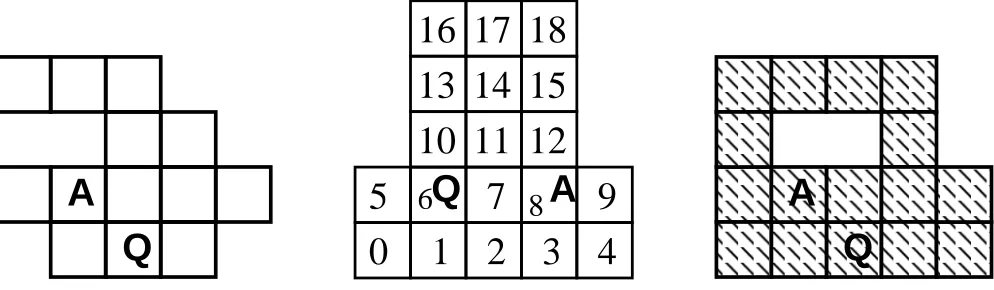
We ran several experiments to evaluate EMT performance in the Tag Game. Three configurations of the domain shown in Figure 3 were used, each posing a different challenge to the agent due to par-tial observability. In each setting, a set of 1000 runs was performed with a time limit of 100 steps. In every run, the initial position of both the agent and its quarry was selected at random; this means that as far as the agent was concerned, the quarry’s initial position was uniformly distributed over the entire domain cell space.
We also used two variations of the environment observability function. In the first version, observability function mapped all joint positions of hunter and quarry into the position of the hunter as an observation. In the second, only those joint positions in which hunter and quarry occupied different locations were mapped into the hunter’s location. The second version in fact utilized and ex-pressed the fact that once hunter and quarry occupy the same cell the game ends.
The results of these experiments are shown in Table 2. Balanc-ing [15] the catch, move, and stalk target dynamics described in the previous section by the weight vector[0.8,0.1,0.1], EMT pro-duced stable performance in all three domains.
Although direct comparisons are difficult to make, the EMT per-formance displayed notable efficiency vis-`a-vis the POMDP ap-proach. In spite of a simple and inefficient Matlab implementation of the EMT algorithm, the decision time for any given step aver-aged significantly below 1 second in all experiments. For the irreg-ular open arena domain, which proved to be the most difficult, 1000 experiment runs bounded by 100 steps each, a total of 42411 steps, were completed in slightly under 6 hours. That is, over4×104
online steps took an order of magnitude less time than the offline computation of POMDP policy in [11]. The significance of this dif-ferential is made even more prominent by the fact that, should the environment model parameters change, the online nature of EMT would allow it to maintain its performance time, while the POMDP policy would need to be recomputed, requiring yet again a large overhead of computation.
empir-A
Q
Q
A
0
1
2
3
4
5
6
7
8
9
10 11 12
13 14 15
16 17 18
A
Q
[image:6.612.58.555.55.200.2]Figure 3: These configurations of the Tag Game space were used: a) multiple dead-end, b) irregular open arena, c) circular corridor
Table 2: Performance of the EMT-based solution in three Tag Game domains and two observability models: I) omniposition quarry, II) quarry is not at hunter’s position
Model Domain Capture% E(Steps) Time/Step
I
Dead-ends 100 14.8 72(mSec)
Arena 80.2 42.4 500(mSec)
Circle 91.4 34.6 187(mSec)
II
Dead-ends 100 13.2 91(mSec)
Arena 96.8 28.67 396(mSec)
Circle 94.4 31.63 204(mSec)
ical entropy grows with the length of interaction. For runs where the quarry was not captured immediately, the entropy reaches be-tween 0.85 and 0.952for different runs and scenarios. As the agent actively seeks the quarry, the entropy never reaches its maximum.
One characteristic of the entropy graph for the open arena sce-nario particularly caught our attention in the case of the omnipo-sition quarry observation model. Near the maximum limit of trial length (100 steps), entropy suddenly dropped. Further analysis of the data showed that under certain circumstances, a fluctuating be-havior occurs in which the agent faces equally viable versions of quarry-following behavior. Since the EMT algorithm has greedy action selection, and the state space does not encode any form of commitment (not even speed or acceleration), the agent is locked within a small portion of cells. It is essentially attempting to simul-taneously follow several courses of action, all of which are consis-tent with the target dynamics. This behavior did not occur in our second observation model, since it significantly reduced the set of eligible courses of action—essentially contributing to tie-breaking among them.
6.
DISCUSSION
The design of the EMT solution for the Tag Game exposes the core difference in approach to planning and control between EMT or DBC, on the one hand, and the more familiar POMDP approach, on the other. POMDP defines a reward structure to optimize, and influences system dynamics indirectly through that optimization. EMT discards any reward scheme, and instead measures and influ-ences system dynamics directly.
2
Entropy was calculated usinglogbase equal to the number of pos-sible locations within the domain; this properly scales entropy ex-pression into the range[0,1]for all domains.
Thus for the Tag Game, we did not search for a reward function that would encode and express our preference over the agent’s be-havior, but rather directly set three (heuristic) behavior preferences as the basis for target dynamics to be maintained. Experimental data shows that these targets need not be directly achievable via the agent’s actions. However, the ratio between EMT performance and achievability of target dynamics remains to be explored.
The tag game experiment data also revealed the different empha-sis DBC and POMDPs place on the formulation of an environment state space. POMDPs rely entirely on the mechanism of reward accumulation maximization, i.e., formation of the action selection procedure to achieve necessary state sequencing. DBC, on the other hand, has two sources of sequencing specification: through the properties of an action selection procedure, and through direct specification within the target dynamics. The importance of the second source was underlined by the Tag Game experiment data, in which the greedy EMT algorithm, applied to a POMDP-type state space specification, failed, since target description over such a state space was incapable of encoding the necessary behavior ten-dencies, e.g., tie-breaking and commitment to directed motion.
The structural differences between DBC (and EMT in particu-lar), and POMDPs, prohibits direct performance comparison, and places them on complementary tracks, each within a suitable niche. For instance, POMDPs could be seen as a much more natural for-mulation of economic sequential decision-making problems, while EMT is a better fit for continual demand for stochastic change, as happens in many robotic or embodied-agent problems.
The complementary properties of POMDPs and EMT can be fur-ther exploited. There is recent interest in using POMDPs in hybrid solutions [17], in which the POMDPs can be used together with other control approaches to provide results not easily achievable with either approach by itself. DBC can be an effective partner in such a hybrid solution. For instance, POMDPs have prohibitively large off-line time requirements for policy computation, but can be readily used in simpler settings to expose beneficial behavioral trends; this can serve as a form of target dynamics that are provided to EMT in a larger domain for on-line operation.
7.
CONCLUSIONS AND FUTURE WORK
0 20 40 60 80 100 0.2
0.3 0.4 0.5 0.6 0.7 0.8 0.9 1
Steps
Entropy
Dead−ends
0 20 40 60 80 100 0.2
0.3 0.4 0.5 0.6 0.7 0.8 0.9 1
Steps
Entropy
Arena
0 20 40 60 80 100 0.2
0.3 0.4 0.5 0.6 0.7 0.8 0.9 1
Steps
Entropy
[image:7.612.45.567.59.192.2]Circle
Figure 4: Observation Model I: Omniposition quarry. Entropy development with length of Tag Game for the three experiment scenarios: a) multiple dead-end, b) irregular open arena, c) circular corridor.
0 10 20 30 40 50 60 0.2
0.3 0.4 0.5 0.6 0.7 0.8 0.9 1
Steps
Entropy
Dead−ends
0 20 40 60 80 100 0.2
0.3 0.4 0.5 0.6 0.7 0.8 0.9 1
Steps
Entropy
Arena
0 20 40 60 80 100 0.2
0.3 0.4 0.5 0.6 0.7 0.8 0.9 1
Steps
Entropy
Circle
Figure 5: Observation Model II: quarry not observed at hunter’s position. Entropy development with length of Tag Game for the three experiment scenarios: a) multiple dead-end, b) irregular open arena, c) circular corridor.
with respect to the deviation of actual system dynamics from the target dynamics.
We show that a recently developed technique of Extended Markov Tracking (EMT) [13] is an instantiation of DBC. In fact, EMT can be seen as a specific case of DBC parameterization, which employs a greedy action selection procedure.
Since EMT exhibits the key features of the general DBC frame-work, as well as polynomial time complexity, we used the multi-target version of EMT [15] to demonstrate that the class of area sweeping problems naturally lends itself to dynamics-based de-scriptions, as instantiated by our experiments in the Tag Game do-main.
As enumerated in Section 4.2, EMT has a number of limita-tions, such as difficulty in dealing with negative dynamic prefer-ence. This prevents direct application of EMT to such problems as Rendezvous-Evasion Games (e.g., [6]). However, DBC in gen-eral has no such limitations, and readily enables the formulation of evasion games. In future work, we intend to proceed with the development of dynamics-based controllers for these problems.
8.
ACKNOWLEDGMENT
The work of the first two authors was partially supported by Is-rael Science Foundation grant #898/05, and the third author was partially supported by a grant from Israel’s Ministry of Science and Technology.
9.
REFERENCES
[1] R. C. Arkin. Behavior-Based Robotics. MIT Press, 1998. [2] J. A. Bilmes. A gentle tutorial of the EM algorithm and its
application to parameter estimation for Gaussian mixture and Hidden Markov Models. Technical Report TR-97-021, Department of Electrical Engeineering and Computer Science, University of California at Berkeley, 1998. [3] T. M. Cover and J. A. Thomas. Elements of information
theory. Wiley, 1991.
[4] M. E. desJardins, E. H. Durfee, C. L. Ortiz, and M. J. Wolverton. A survey of research in distributed, continual planning. AI Magazine, 4:13–22, 1999.
[5] V. R. Konda and J. N. Tsitsiklis. Actor-Critic algorithms.
SIAM Journal on Control and Optimization,
42(4):1143–1166, 2003.
[6] W. S. Lim. A rendezvous-evasion game on discrete locations with joint randomization. Advances in Applied Probability, 29(4):1004–1017, December 1997.
[7] M. L. Littman, T. L. Dean, and L. P. Kaelbling. On the complexity of solving Markov decision problems. In
Proceedings of the 11th Annual Conference on Uncertainty in Artificial Intelligence (UAI-95), pages 394–402, 1995.
[8] O. Madani, S. Hanks, and A. Condon. On the undecidability of probabilistic planning and related stochastic optimization problems. Artificial Intelligence Journal, 147(1–2):5–34, July 2003.
[image:7.612.45.568.244.375.2]that justifies incremental, sparse, and other variants. In M. I. Jordan, editor, Learning in Graphical Models, pages 355–368. Kluwer Academic Publishers, 1998.
[10] P. Paruchuri, M. Tambe, F. Ordonez, and S. Kraus. Security in multiagent systems by policy randomization. In
Proceeding of AAMAS 2006, 2006.
[11] J. Pineau, G. Gordon, and S. Thrun. Point-based value iteration: An anytime algorithm for pomdps. In International
Joint Conference on Artificial Intelligence (IJCAI), pages
1025–1032, August 2003.
[12] M. L. Puterman. Markov Decision Processes. Wiley Series in Probability and Mathematical Statistics: Applied Probability and Statistics Section. Wiley-Interscience Publication, New York, 1994.
[13] Z. Rabinovich and J. S. Rosenschein. Extended Markov Tracking with an application to control. In The Workshop on
Agent Tracking: Modeling Other Agents from Observations, at the Third International Joint Conference on Autonomous Agents and Multiagent Systems, pages 95–100, New-York,
July 2004.
[14] Z. Rabinovich and J. S. Rosenschein. Multiagent
coordination by Extended Markov Tracking. In The Fourth
International Joint Conference on Autonomous Agents and Multiagent Systems, pages 431–438, Utrecht, The
Netherlands, July 2005.
[15] Z. Rabinovich and J. S. Rosenschein. On the response of EMT-based control to interacting targets and models. In The
Fifth International Joint Conference on Autonomous Agents and Multiagent Systems, pages 465–470, Hakodate, Japan,
May 2006.
[16] R. F. Stengel. Optimal Control and Estimation. Dover Publications, 1994.
[17] M. Tambe, E. Bowring, H. Jung, G. Kaminka,
R. Maheswaran, J. Marecki, J. Modi, R. Nair, J. Pearce, P. Paruchuri, D. Pynadath, P. Scerri, N. Schurr, and P. Varakantham. Conflicts in teamwork: Hybrids to the rescue. In Proceedings of the Fourth International Joint
Conference on Autonomous Agents and Multiagent Systems,