WHAT IS A SUITABLE PEDAGOGICAL FRAMEWORK
FOR DISTANCE EDUCATION FOR THE COMMITMENT
MANAGEMENT PROFESSION?
Barrie Todhunter
MBA (USQ), MPM (QUT), GradDipBldgProjMgt (QIT), BArch (UQ), DipArch (QIT)
MPMI PMP MAIPM
Senior Lecturer Faculty of Business
University of Southern, Queensland, Australia
ABSTRACT
This paper describes the progress of a current research project and its value in assessing the possible role of distance education in the professional development of ‘commitment managers’. It provides details of the context of the project, the research problem, the methodology adopted, and the
preliminary results of the analysis of interview and survey data. The project arose from the need to carry out a review of an existing postgraduate project management program offered in distance education mode at a regional Australian university. Goodyear’s (1999) pedagogical model and Engestrom’s (1987) Activity Theory were adopted as conceptual frameworks for the
analysis, and semi-structured interviews were carried out with students, academic staff and support staff to identify a range of ‘disturbances’. These were then explored further by means of a web-based survey to determine the attitudes of students towards their experiences with distance education to date. Although the context of the current project is project management, many of the issues are similar to those that face professional development programs in the poorly-defined context of commitment management. Preliminary results are presented indicating those issues that lead to ‘disturbances’ in
professional distance education programs, and those whose importance students rate highly. These critical issues will be explored more fully in the balance of the research project.
KEY WORDS
Activity theory, Commitment management, Distance education,
INTRODUCTION
This paper is a ‘work in progress’ and provides an overview of a research study being carried out by the author to develop a conceptual framework to guide the review of an existing distance education (DE) postgraduate program for professional education. Although the context of the current study is project management education, sufficient parallels exist in the areas of scope
management, quality management, cost management, risk management, stakeholder management and procurement management for the principles to be relevant to the emerging discipline of commercial contracting, referred to by the International Association for Contract and Commercial Management (IACCM) as ‘commitment management’. The setting of the research case study is a regional dual-mode university where technological developments and the changing focus towards transnational markets are challenging its historical practices. The paper summarises the research problem and objectives, the research methodology and the case study context of the learning setting and the learners, with a view to identifying any lessons that can benefit the teaching and learning associated with commitment
management.
Using established theoretical frameworks and the preliminary results of the current research study, the paper looks at the likely attributes of commitment managers and their needs and requirements for professional education and training in a highly-constrained learning environment. It briefly considers the nature and availability of education and training suitable for this emerging profession and their alignment with the needs of students who are also the practitioners and in most cases, already engaged in informal action learning. From this analysis, some broad conclusions and recommendations are provided for a conceptual framework to aid future empirical research.
THE RESEARCH PROBLEM
Professional education for commitment management must be delivered to a mature and globally-dispersed student population who are in full-time
employment and highly mobile. This raises the questions of what are the circumstances, attributes and educational requirements of such ‘earner-learner’ students (Stuparich 2001), and how can their needs be met? How many higher education institutions truly understand their student bodies? Sommerlad suggests that a ‘theory of pedagogy, as distinct from a theory of learning, must encompass all the complex factors that influence the process of teaching and learning’ (2003). Like project management, commitment
From a professional perspective, a commitment manager may often be a project manager who is simply wearing a different hat on the day. Although commercial contracting, or commitment management, has historically taken place in a ‘hard-nosed’ technical and adversarial environment where
negotiators and contract administrators play ‘hardball’, a simple analysis of the themes to be addressed in conference papers and the academic symposium at the IACCM 2006 Conference in the United Kingdom suggests that the most frequent themes to be addressed may be categorised as people management, marketing, legal, education/training, financial/costing, risk, technology and quality. The dominant themes are people- and management-related rather than technical, with over twenty-six themes identified in that category, and this has implications for training, education and the development of an appropriate curriculum. Interestingly, only one or two of the themes identified relate to ethics and governance issues.
Commitment management is in a similar position to project management – is it a profession? Does it have a universally-agreed body of knowledge upon which to develop a pedagogical framework for global education of its future practitioners? How do we establish common frameworks and guidelines across multiple boundaries of regulation, common practice and legal systems, and what are the issues associated with distance education in this context? A lack of pedagogic models and frameworks ‘tends to leave researchers and practitioners without strong anchorage for concepts drawn from diverse literatures’ (Sommerlad 2003). There is a substantial body of theory on ‘commitment management’ in the context of human resources management (Lawrence 1992; Baird 2002) and the commitment associated with internal relationships between employers and employees, but there is a much lesser body of theory on ‘commitment’ in the context of external relationships
between individuals, organisations and/or external stakeholders in the context of relationship building, whether for procurement or forms of alliance building (Pfeffer 1998).
From an academic perspective, ‘commitment management’ is yet undefined - there is no universal agreement on any body of knowledge to guide
professional practice nor is there an agreed definition of the attributes of effective practitioners. In one of the few comments on this discipline, commitment management has been defined as
’…an advanced method through which Contracts and Sourcing professionals can meaningfully apply quality principles to business terms, policies, practices and processes to drive improved negotiation, contract performance and governance standards. It offers a systematic way of ensuring that business requirements and capabilities are aligned with formal commitments, to ensure that business relationships are fulfilled as agreed’ (Heminway 2006).
education which represents an added ‘degree of difficulty’ to the considerations.
The existing postgraduate program under study at an Australian university evolved from an initial on-campus research-based Master of Business
program serving a small domestic market to a subset of a coursework Master of Business Administration (MBA) program offered in distance education mode. In response to further changes to the perceived market, it now exists in its own right as a coursework Master of Project Management offered in on-campus, distance and online modes with a high proportion of international students – a trend which continues to grow. Personal observations by the author as program coordinator suggested that the ‘correspondence school’ pedagogical model may no longer be appropriate for the development and evaluation of graduate attributes for highly-mobile management professionals. From a theoretical point of view, there appeared to be evidence of many ‘disturbances’ (Engestrom 1987) or conflicts between the educational and professional needs and objectives of the students and what was being provided, with many conflicts arising from the attitudes of academic staff towards distance education and towards the students themselves, and from the policies and processes of the learning institution. To encapsulate the research problem, the overarching question for this research was posed as: What are the key principles to guide the development of a suitable
conceptual framework for postgraduate project management distance education?
To answer this question, considerations included:
What are appropriate pedagogical frameworks for analysis of distance education for adult learners and vocationally-oriented distance education? What are the contextual issues that influence management education? What are the principles and practices guiding distance education? What are the characteristics and circumstances of the learners?
The study’s two-stage objectives are:
to integrate existing conceptual frameworks and Activity Theory for an holistic investigation of the selected case study environment; and
to formulate an appropriate pedagogical framework to guide the review of the existing learning environment for postgraduate management distance education.
THE PRELIMINARY CONCEPTUAL FRAMEWORK
In support of this approach, a suggested framework (Dinham and Stritter 1986) for research into professional education suggests consideration of: aspects of the learning experience (e.g. attributes of the learner,
educational prerequisites, behaviours of the educator etc.
the profession to be studied (e.g. architecture, engineering, project management etc).
Where development of theory is the objective of research, the appropriate paradigm is qualitative research and this may involve the study of both
subjects and situations in order to produce ‘descriptions of a case, a group, a situation, or an event, which is often called a case study’ (Krathwohl 1998) and which allows the researcher to get at the ‘rich data’. The author teaches at one of Australia’s large regional universities that specialises in distance
education and flexible delivery, and a case study approach to the research problem was adopted and the following research methodology was
formulated:
A literature review established the context of the study and generated the preliminary conceptual frameworks as described below;
Analysis of the university, faculty and program structure and of relevant documentation have defined the existing context of the organisational setting and the learning setting using Goodyear’s model (1999);
Analysis of semi-structured interviews with academic staff, support staff and students has identified recurring ‘themes’ of concerns;
A web-based survey of the project management student population (being undertaken at the time of writing) has provided data on student attributes and analysis of that data will explore the themes and contradictions identified in order to suggest a preliminary conceptual framework and model for review of the existing program;
Future focus groups with staff and students will further examine the themes, contradictions and preliminary conceptual framework and model; and
The completed conceptual framework and model will then be submitted for feedback from participants in the research project for validation of the development procedures.
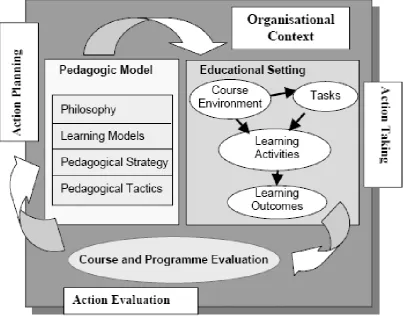
Existing conceptual models have provided a valuable starting point but the risk is that they ‘simplify complex processes and relationships’ (Goodyear 1999). An adaptation of Goodyear’s pedagogical model for open and distance education by Nunes and McPherson (2003) illustrated in figure 1 provides an appropriate preliminary analytical framework and comprises:
the pedagogical framework (consisting of philosophy, pedagogy, strategy and tactics);
the educational setting (consisting of environment, tasks and student activities which lead to learning outcomes); and
Figure 1: The Continuing Professional Distance Education model
(Source: Goodyear 1999; Nunes and McPherson 2003)
These constructs are used in conjunction with Engestrom’s ‘Activity Theory’ (1987) as a conceptual tool for studying developmental processes, and his ‘structure of human activity’ in an activity system (refer figure 2) is being used to better understand the learning setting and the interplay between members of the learning ‘community’ comprising teaching and support staff, the
students themselves and members of their families and workplace.
[image:6.595.74.473.541.749.2](Source: Engestrom 1987)
In the context of this case study:
‘instruments’ include the many tools and artefacts used for teaching and learning including technology, texts, language, assessment, etc.;
‘subject’ will vary from one instance of analysis to another and include academic staff, support staff and instructional designers although the main focus will be on the student as subject of the learning activity, and the desired object and outcome of those activities;
‘object’ refers to the ‘problem space’ relevant to each subject (this could be the study process itself, the learning objectives, program effectiveness, learner motivation, etc.);
the ‘community’ represents the multiple individuals and groups involved in the various learning activities, including the students, academic staff, support staff, employers, industry, family, etc.;
‘division of labour’ is the horizontal division of tasks between the members of the community and the vertical division of power and status; and
the ‘rules’ refer to the explicit and implicit regulations, norms and
conventions that constrain actions and interactions within the activity system (Engestrom 1987).
‘Disturbances’ typically indicate developmentally significant systemic
contradictions and change potentials within the activity (Engestrom 1987) and the early stages of the study have been designed to identify the contradictions and tensions that exist in the context of the learner and the learning
environment of this case study.
THE EDUCATIONAL CONTEXT
The purpose and value of a preliminary conceptual framework is to guide improvements to an existing distance education program but many such studies often have a ‘continuing preoccupation with the individual learner’ (Sommerlad 2003, p. 153) rather than the broader learning environment as suggested by both Goodyear and Engestrom. Socially-situated theories of learning suggest that ‘what one learns and how it is learned cannot be separated out from the groups one belongs to, nor from the wider location in the social structure’ and that a ‘theory of pedagogy, as distinct from a theory of learning, must encompass all the complex factors that influence the process of teaching and learning’ (Sommerlad 2003, p. 157). Activity Theory (AT) is a way of analysing an educational system holistically by taking multiple
perspectives (Jonassen and Rohrer-Murphy 1999), and can also be used to examine individual components as sub-systems.
framework has identified many instances where ‘disturbances’ were identified including the following examples:
Object
Academics expressed the desire to progress students from an early state of dependence to one of ‘independent learner’, and from novice to expert in the discipline;
Both academics and students expressed the need to develop poorly-defined ‘soft skills’ rather than traditional hard skills of a technical nature; Students expressed a strong desire to personalise the learning experience; Students indicated the importance of the workplace as a focus for
undertaking study and contextualising the desired skills;
Students nominated breadth of learning as more important than depth of learning with a narrow focus; and
Students stressed the importance of increased flexibility in the learning process to accommodate personal and professional circumstances.
Subject
Academic staff placed little emphasis on the nature of individual students and viewed them as an homogenous group with similar needs;
Academics desire to create an environment where students are actively engaged with the learning process and with others, whereas many of the students seek to have individual responsibility for their own style and method of learning;
Students identified an extensive range of constraints on their ability to study including lack of time, financial matters, access to technology,
language, cultural differences, entry characteristics, workplace experience, and level of knowledge at commencement.
Large numbers of students in distance education courses create difficulties for academics in providing a personalised learning experience for students.
Community
Academic staff have an increasing need to engage distance education students in some form of interaction, communication, engagement and collaboration, with an increasing dependence on technology.
The complexity of the learning environment has increased the need for better integration across the various elements of the organisational setting involving teaching staff, academic support staff, technicians, production staff, distribution staff, and administrative staff.
Larger numbers of distance education student cohorts introduces issues associated with the diversity of the student body, learning styles, learning needs, modes of delivery, methods of assessment, and learning materials. Both teaching staff and students see a need for a higher level of integration with the workplace incorporating work-based problems and projects in the learning process.
Academic staff raise issues on the additional time involved in distance education, the long lead times for preparation of study materials and the lack of resources to deal with the increased demands
Academic staff resent the ‘economic rationalism’, the sense of under-resourcing and the ‘massification’ of distance education programs where courses can have up to a thousand students enrolled in a single course (subject).
Larger cohorts in courses make it difficult for academic staff to support students who are encouraged to accept a greater responsibility for their own learning;
Rules
Students resented the artificial constraints on entry requirements and rate of progress, lack of recognition of prior workplace expertise, rigid program structures and an overall lack of flexibility in designing learning solutions to their own study needs;
Students raised concerns regarding the requirements to purchase and use expensive printed texts and study materials in an electronic age;
students resented non-essential rules and requirements related to
submission dates for assessment, pedantic referencing requirements, etc.
Tools
Students identified a range of inappropriate assessment practices, excessive reading materials, language issues, etc.
Numerous problems were identified by students with lack of access to the required technology, and ineffective technology platforms provided by the institution.
THE DISTANCE EDUCATION CONTEXT
The practice and nature of commitment management have parallels with those of project management in that they require practitioners to be highly mobile and to operate from remote locations - postgraduate learning must be made ‘accessible at any time and from any place’ to overcome the problems of ‘full-time careers, family obligations, and community requirements’ (Winters 2000).
Traditional institutional forms of learning ‘are no longer adequate and cannot keep up with the contemporary demand for learning’ (Chappell 2004), and distance education methods and systems are converging with those of face-to-face teaching under the influence of new electronic educational
technologies (King 1999; Moran and Myringer 1999; Trindade, Carmo et al. 2001). Moran and Myringer suggest that the focus today is on flexibility, student-centredness, networked learning, quality and efficiency, and the term ‘distance education’ may become obsolete as distance education ‘merges into the so-called mainstream of educational systems‘ (Ljosa 1993) or be
Although distance education has a long history, ‘there is a relative paucity of true, original research dedicated to explaining or predicting phenomena related to distance learning’ (Phipps and Merisotis 1999) and scholars have called for a consistent, conceptual framework for research in distance
education as a basis for a ‘unifying’ theory (Berge 2001). Jarvis et al provide a view of the major principles that underpin good practice in distance education as:
The organisation and administration of the system
The educational relationships between teachers and learners, and
The kinds of learning materials and modes of delivery most appropriate to meeting distance students’ learning needs (Jarvis, Holford et al. 1998).
The university that is the subject of the case study describes itself as
‘transnational’ (University of Southern Queensland 2005) and has ‘embraced the need for change implicit in a global educational environment that is highly competitive and dominated by the evolution of communications technologies’. Its stated intention is to ‘remain fast, flexible and fluid in meeting the needs of learners throughout Australia and internationally’ (2005). Gibson (1998) suggests that distance education in the twenty-first century should mean education anytime, anywhere, for anyone, but that this should happen in an educational paradigm of ‘education for each’ with a focus on the educational needs and objectives of each student, requiring an almost infinitely flexible model of learning. Given the growing focus of distance learning on the individual learner, this flexible model may be best achieved in the distance education mode.
The International Council for Distance Education (ICDE) has identified barriers to change in educational paradigms for distance education which included ‘resistance to new learning theory and practice, rigidity of organisational structures, the tyranny of time, persistence of faculty roles and rewards, assumptions about learning content, constraints of regulatory and accrediting practices, and traditional funding formulas’ (Moran and Myringer 1999). The Open University in the United Kingdom and similar models of ’open learning’ have removed many of the constraints on entry requirements, choice of programs, study pathways and progress, but ‘open learning’ is not
automatically synonymous with distance learning and is a relative concept (Morgan 1990; Paul 1993). Holmberg stresses that ‘distance education can in no way be regarded as a subset of open learning’ (1993) which differentiates distance education programs provided by single mode universities such as the Open University and those provided by dual-mode universities such as the University of Southern Queensland (USQ) in Australia (where both distance education and on-campus programs are delivered).
THE LEARNER CONTEXT
universities offering on-campus programs ‘are choosing distance education study not because it is the only alternative, but rather because it is the preferred alternative’ (Thompson 1998), reflecting the significance between ‘geographic distance’ and ‘transactional distance’ described by Moore (1993) and Garrison (2000).
As the demographic profile of professionals undertaking postgraduate study in commitment management would arguably align with those of students in the project management program under study, the requirement to address ‘the whole person’ (Farivarsadri 2001) and to cater for the needs of a diverse body of multi-national students presents a significant challenge for distance
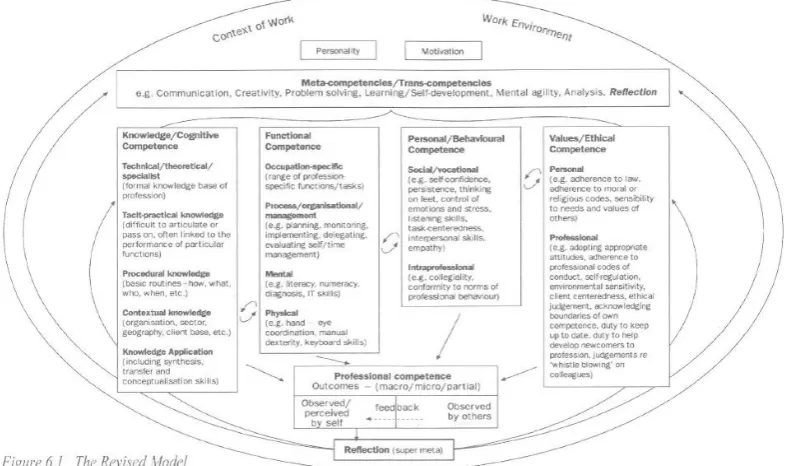
education. Contemporary learning (including vocational learning) places more emphasis on autonomy (Garrison 2000) and ‘the complete transformation of individuals’ (Chappell 2004) and seeks to develop more than just a narrow range of technical competencies. Although there is little research into the suitability of distance education to develop what is commonly called
‘capability’ (Barrie, McAllister et al. 1996), a wide range of competencies is considered in their research into professional competencies by Cheetham and Chivers (2005). These are illustrated in figure 6 as comprising:
Knowledge/cognitive competence, Functional competence,
[image:11.595.114.508.417.650.2] Personal/behavioural competence, and Values/ethical competence.
Figure 3: Revised model of professional competence
(Source: Cheetham & Chivers, (2005, p. 112))
2004). This desire to locate studies in the workplace is reflected in the comments by students in the current study but this can be difficult to
incorporate into models of distance learning where ‘massification’ (or large cohort numbers) is an issue. Communities of practice (Wenger 1998) provide a valuable environment for professional learning, where effective learning depends on access to experts and ‘the availability of peers and their
willingness to act as mentors and coaches’ (Wenger and Snyder 2001), and where participation in that community of practice may be ‘a key premise to understanding learning at work, including learning values and appropriating a vocational identity’ (Billett 2002).
RESEARCH RESULTS TO DATE
A web-based survey of postgraduate management students as described above has been carried out in two parts. Part A obtained demographic data on the students and their professional and educational backgrounds. Part B obtained attitudinal responses towards a range of issues related to their
experiences with distance education in the context of management education.
From a preliminary analysis of the data in part A of the survey, attributes of the students are summarised below, and it is argued that a similar demographic profile might apply to ‘commitment’ managers. Analysis of demographic data indicates that:
32% of students are female and this reflects an increasing trend;
36% of students are aged between 25 and 34, 40% are aged between 35 and 44 and more than 20% are 45 or over;
35% of students do not indicate English as their native language; 20% of students do not regard themselves as being fluent in English; 7% of students have some form of disability that adversely affects their
ability to undertake study;
36% of students have family commitments that affect their ability to undertake study;
68% of students have work commitments that affect their ability to undertake study;
90% of students are working full-time while studying;
79% of students have an undergraduate Bachelor’s degree prior to undertaking postgraduate study;
57% of students are fully self-funded while only 15% have their studies totally funded by other sources; and
57% of students are not resident in the country from where the program is offered (Australia).
Results of preliminary statistical analysis of the responses to part B are provided below. Of the sixty-two issues used in statements to determine students’ attitudes towards their experiences to date, the top ten issues that indicated ‘disturbance’ are:
3. lack of access to experienced practitioners from industry; 4. lack of pastoral support from the university;
5. lack of disability-friendly policies;
6. lack of opportunity to learn with, and from, other students; 7. lack of sensitivity to cultural issues;
8. excessive focus on theory rather than practice;
9. lack of consideration for student sense of isolation; and 10. restrictive university rules and regulations.
The top ten issues that were regarded as most important by students were: 1. appropriate knowledge and skills of teaching staff;
2. ability for students to maintain full-time employment during studies; 3. user-friendly technology platforms supplied by university;
4. adequate availability of study materials online; 5. clarity of course (subject) objectives;
6. adequate availability of study materials in print form;
7. development of sense of pride and self-satisfaction by students; 8. development of in-depth knowledge and skills in field of study; 9. development of critical/creative thinking skills; and
10. clarity of objectives of overall program.
These results are consistent with the views of Johnson and Thomas (2004, p. 312) who suggest that ‘…conceptions of educational effectiveness in the field of postgraduate education…need to be broadened from student attainment to include individual capabilities, individual performance at work, organisational change and capacities generally in the body of development professionals’ and that ‘…opportunities to apply learning are particularly important’ (2004, p. 308).
WHERE TO FROM HERE?
As indicated, this research study is a work in progress and the next stage to be undertaken is a more detailed analysis of the data from the student survey. ‘Disturbances’ will become more evident through the analysis and will be addressed through the conceptual framework and model to be developed as part of this study, which will then be examined further through the focus group stage of the study. The final outcome of the study will be a framework that can be used to guide a review of the existing postgraduate program. From there, it may be possible to generalise the outcomes to other educational disciplines and form the basis for more empirical studies to be carried out.
CONCLUSION
The study highlights a wide range of issues that represent ‘disturbances’ within the existing learning system related to the use of distance education mode for education of practising professionals. It emphasises consideration of the specific needs of mature-age learners, the higher-order competencies to be achieved as part of professional education, and pedagogical issues relating to the delivery of education to highly-mobile multi-national students operating in remote locations.
REFERENCES
Baird, M. (2002). "Changes, Dangers, Choice and Voice: Understanding what High Commitment Management Means for Employees and Unions." JIR 44(3): 359-375.
Barrie, S., L. McAllister, et al. (1996). Pathways to professional competence: supporting student learning. Different approaches: theory and practice in higher education, Perth, Western Australia.
Berge, Z. L. (2001). "A tangled web indeed: the difficulty of developing a research agenda for distance education." DEOSNEWS 11(10).
Billett, S. (2002). Workplace, communities and pedagogy: an activity theory view. Distributed learning: social and cultural approaches to practice. M. Lea and K. Nicoll, Routledge.
Chappell, C. (2004). Contemporary vocational learning – changing pedagogy. AVETRA 2004.
Cheetham, G. and G. Chivers (2005). Professions, competence and informal learning. Cheltenham, Edward Elgar.
Dinham, S. M. and F. T. Stritter (1986). Research on Professional Education. Handbook of Research on Teaching. M. Wittrock. USA, The American Educational Research Association, Simon & Schuster Macmillan.
Engestrom, Y. (1987). Learning by expanding: an activity theoretical approach to development research. Helsinki, Orienta-Konsultit.
Farivarsadri, G. (2001). A critical view on pedagogical dimension of
Garrison, R. (2000). "Theoretical challenges for distance education in the 21st century: a shift from structural to transactional issues " International Review of Research in Open and Distance Learning.
Gibson, C. C., Ed. (1998). Distance learners in higher education. Madison, USA, Atwood Publishing.
Goodyear, P. (1999). "Pedagogical frameworks and action research in open and distance learning." Retrieved 15 April, 2005, from
http://www.eurodl.org/materials/contrib/1999/goodyear/.
Heminway, M. (2006). IACCM Americas - 4th Annual Forum on Commitment Management. B. Todhunter.
Holmeberg, B. (1993). Key issues in distance education: an academic viewpoint. Distance education: new perspectives. K. Harry, M. John and D. Keegan. London, Routledge: 331-341.
Jarvis, P., J. Holford, et al. (1998). The Theory and Practice of Learning. London, UK., Kogan Page.
Johnson, H. and A. Thomas (2004). "Professional capacity and organizational change as measures of educational effectiveness: assessing the impact of postgraduate education in Development Policy and Management." Compare 34(3): 311-4.
Jonassen, D. and L. Rohrer-Murphy (1999). "Activity theory as a framework for designing constructivist learning environments." Educational Technology Research & Development (ETR&D) 47(1): 61-79.
King, B. (1999). Distance education in Australia. Higher education through open and distance learning. K. Harry. London, Routledge: 264-276.
Krathwohl, D. R. (1998). Methods of Educational & Social Science Research: An integrated approach. New York, Addison-Wesley Educational Publishers.
Lawrence, A. T. (1992). "Teaching high-commitment management the high commitment way " Journal of Management Education 16(2): 163-80.
Ljosa, E. (1993). Distance education in the society of the future: from partial understanding to conceptual frameworks. Distance education: new perspectives. K. Harry, M. John and D. Keegan. London, Routledge:
33-38.
Moran, L. and B. Myringer (1999). Flexible learning and university change. Higher education through open and distance learning. K. Harry. London, Routledge: 57-71.
Morgan, A. (1990). Whatever happened to the silent scientific revolution? - Research, theory and practice in distance education. Milton Keynes, UK, Institute of Educational Technology, The Open University.
Nunes, M. B. and M. McPherson (2003). "Action research in continuing
professional education." Journal of Computer Assisted Learning 19(4): 429-37.
Paul, R. H. (1993). Open universities - the test of all models. Distance education: new perspectives. K. Harry, J. Magnus and D. Keegan. London, Routledge: 114-125.
Pfeffer, J. (1998). "The real keys to high performance." Leader to Leader
8(Spring): 23-9.
Phipps, R. and J. Merisotis (1999). What's the difference? A review of contemporary research on the effectiveness of distance learning in higher education. Washington, USA, The Institute for Higher Education Policy.
Sommerlad, E. (2003). "Theory, research and practice - the problematic appearance of 'pedagogy' in post-compulsory education." Journal of Adult and Continuing Education 8(2): 147-64.
Stuparich, J. (2001). E-Learning in Australia: Universities and the New Distance Education,. E- Learning in Post-Secondary Education:
Trends, Issues and Policy Challenges Ahead, Tokyo, Japan, Centre for educational research and innovation/Organisation for economic co-operation and development (OECD/CER) in co-co-operation with the Japanese Ministry of Education, Culture, Sports, Science and Technology (MEXT) and National Institute of Multimedia Education, Japan (NIME).
Thompson, M. M. (1998). Distance learners in higher education. Distance learners in higher education. C. C. Gibson. Madison, USA, Atwood Publishing: 9-24.
University of Southern Queensland. (2005, 4 July 2005). "Overview of USQ." Retrieved 8 July, 2005, from
http://www.usq.edu.au/aboutusq/overview/default.htm.
Wenger, E. (1998). "Communities of Practice: Learning as a Social System." Retrieved March 17, 2003, from http://www.co-i-l.com/coil/knowledge-garden/cop/lss.shtml.
Wenger, E. and W. Snyder (2001). Communities of practice: the
organisational frontier. Harvard Business Review on Organisational Learning Harvard Business School Publishing Corporation.