USAGE OF A DOSIMETER SPECTRUM
EVALUATOR FOR DIFFERENT ENVIRONMENTS
A.V. Parisi 1* and J.C.F. Wong 2
1
Centre for Astronomy and Atmospheric Research, University of Southern
Queensland, Toowoomba, 4350, Australia. Ph: 61 7 46 312226. FAX:
61 7 46 312721. Email: [email protected]
2
Centre for Medical and Health Physics, School of Physical Sciences, Queensland
University of Technology, GPO Box 2434, Brisbane, 4001, Australia.
Abstract
The ranges of conditions and environments of a dosimetric spectrum evaluator
previously developed and employed in the evaluation of the UV source spectrum have
been considered in this paper. The complete system of four dosimeter materials can
be employed for a total UV exposure of up to approximately 10 J cm-2. The exposure
times required were influenced by the UV environment. The exposure times ranged
from 20 minutes to 3 hours for filtered solar erythemal UV, 5 to 30 minutes for solar
erythemal UV, 30 to 53 minutes for quartz tungsten halogen lamp erythemal UV, 10
to 15 minutes for plant damage solar UV and 90 minutes for plant damage UV from
fluorescent sun lamps. In these environments, employing the system in open and
well-ventilated conditions minimises changes in the dose response of the system due to
temperature. The results in this paper provide a guide for the range of conditions and
exposure times required for different environments for future research employing the
INTRODUCTION
Ultraviolet (UV) radiation is a genotoxic and has a causative role in human skin
cancer, premature skin photo-aging and wrinkling and some eye disorders (Longstreth
et al., 1995). Additionally, increased ultraviolet irradiances due to stratospheric ozone
depletion may affect plant growth (Caldwell et al., 1995). An improved
characterisation and understanding through UV measurements of the solar UV
exposures to humans and plants is required.
The measurement of UV radiation in photobiological experiments has been reviewed
in another paper (Wong and Parisi, 1998). Spectroradiometers and radiometers may
be employed for ambient UV measurements on a horizontal plane. However, UV
dosimeters must be employed for simultaneous multi-site measurements of the UV
irradiances to specific sites on the object of study. Dosimeters based on polysulphone
(Diffey, 1989) and CR-39 (Wong et al., 1992) have been employed for erythemal UV
measurements. A dosimetric spectrum evaluator based on four different UV dosimeter
materials has been developed (Parisi et al., 1997, Parisi and Wong, 1996a) and
employed in photobiological research (for example, Parisi et al., 1998a). Each of the
materials is sensitive to different UV wavelengths and measurement of the change in
the optical absorbance of each of the materials at a set wavelength for each material
allows broad scale evaluation of the UV spectrum. The minimum irradiance required
on this type of detector is 0.01 μW cm-2. This paper investigates the range of
conditions and exposure times of the spectrum evaluator system for different UV
MATERIALS AND METHODS
Dosimeter System
The technique for the spectrum evaluator based on the four different dosimeter
materials, polysulphone, nalidixic acid, 8-methoxypsoralen and phenothiazine has
been described elsewhere (Parisi et al., 1997). The physical size of the spectrum
evaluator holder is approximately 3 cm x 3 cm. Each different material is over a 0.6
cm diameter hole in the holder. The four different materials employed in the spectrum
evaluator have different responses to UV radiation. Consequently, they provide
measurements of the exposures in the respective wavebands. As a combined system,
the four exposure measurements allow broad scale reconstruction of the source
spectrum.
The system provides the time averaged spectrum over the exposure period and
incorporates any changes in the source UV spectrum during the period. The evaluated
source spectrum agrees to better than 20% with that measured with a calibrated
spectroradiometer. The exposure times for the spectrum evaluator are a compromise
between a sufficient UV exposure to produce a measurable change in optical
absorbance of the material, but not long enough to either saturate the most sensitive
dosimeter material or allow an unacceptable large change in the source spectrum.
Environments
The spectrum evaluator has been employed to evaluate the UV spectrum for both
natural and artificial UV sources at any orientation over the object of study in a
number of environments. The system has been employed to measure the biologically
horizontal plane in a number of different environments, namely, in a car interior
(Parisi and Wong, 1998), glass enclosure (Parisi and Wong, 1997a) and greenhouse
(Parisi and Wong, 1997b) for solar UV, outside for winter and summer sun and in the
laboratory employing a quartz tungsten halogen (QTH) lamp (Parisi et al., 1997) as
the UV source. For plant studies, the system has been employed over a plant canopy,
both in the field (Parisi and Wong, 1996b, Parisi et al., 1998b) and in a greenhouse
(Parisi et al., 1996). In the greenhouse, artificial UV was provided with Philips
TL40/12 sunlamps. The effect of ambient air temperature in each of these
environments on the response of the dosimeter material is also discussed.
Following the evaluation of the source spectrum, Sλ, with the spectrum evaluator, the
biologically effective UV irradiance (UVBE) can be calculated for any action
spectrum, Aλ,for the particular biological process under investigation. Alternatively,
the unweighted broadband UV irradiances may be calculated from the knowledge of
the source spectrum. The biologically effective UV irradiance for any action spectrum
is calculated as follows:
UVBE = ∫uv SλAλdλ (1)
where the integration is over the UV wavelengths. In this paper, the action spectrum
for human erythema (CIE, 1987) and the generalised plant damage action spectrum
(Caldwell, 1971) are employed.
RESULTS
Saturation
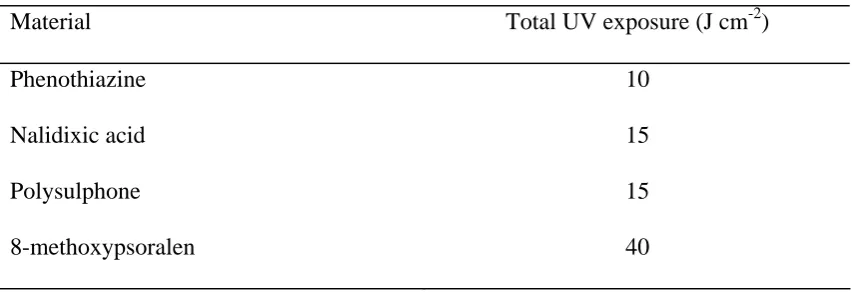
The dose response to UV radiation of each of the dosimeter materials has been
the dose response of each of the materials starts to saturate is provided in Table 1.
Phenothiazine is the most sensitive of the four materials with 8-methoxypsoralen the
least sensitive. Phenothiazine saturates for total UV exposure of approximately 10 J
cm-2, whereas, 8-methoxypsoralen has a linear dose response for a total UV exposure
of up to 40 J cm-2. Similarly, nalidixic acid and polysulphone have an approximate
linear response to about 15 J cm-2 of total UV before the response starts to saturate.
These are the approximate exposure limits before the individual dosimeters start to
saturate. As a combined system of dosimeters, the exposure limit for the system is
[image:6.595.85.516.417.563.2]approximately 10 J cm-2.
Table 1 - The approximate total UV exposure at which the dose response of each of
the materials start to saturate.
Material Total UV exposure (J cm-2)
Phenothiazine 10
Nalidixic acid 15
Polysulphone 15
8-methoxypsoralen 40
Environments
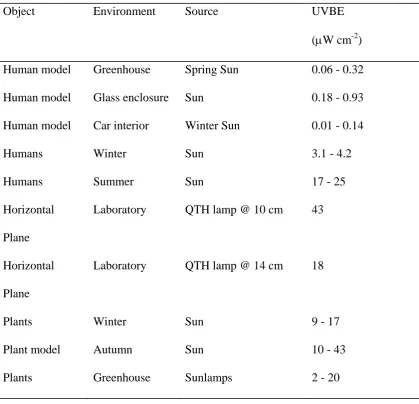
The different environments in which the spectrum evaluator has been employed and
the range of biologically effective irradiances for human erythema and generalised
plant damage that have been encountered are provided in Table 2. The environments
can be divided into a number of categories. Namely, filtered solar UV in a
from 0.01 to 0.93 μW cm-2. The spectrum evaluator has been orientated at the
appropriate angles both over a rectangular prism and a manikin to approximate the
human body shape. The second category of environment was solar UV for both
summer and winter with the spectrum evaluator attached to human volunteers and
erythemal irradiances of 3.1 to 25 μW cm-2. The third category was for UV from a
QTH lamp in the laboratory on a horizontal plane with irradiances of 18 to 43 μW cm
-2
. For plants, the irradiances can be grouped into natural sunlight in winter and
autumn and artificial UV provided with sunlamps in a greenhouse. For sunlight, the
plant damage irradiances were 9 to 17 μW cm-2 and 10 to 43 μW cm-2 in winter and
autumn respectively with plant damage irradiances of 2 to 20 μW cm-2 in the
Table 2 - The range of different environments and the biologically effective
irradiances for which the spectrum evaluator has been employed.
Object Environment Source UVBE
(μW cm-2)
Human model Greenhouse Spring Sun 0.06 - 0.32
Human model Glass enclosure Sun 0.18 - 0.93
Human model Car interior Winter Sun 0.01 - 0.14
Humans Winter Sun 3.1 - 4.2
Humans Summer Sun 17 - 25
Horizontal
Plane
Laboratory QTH lamp @ 10 cm 43
Horizontal
Plane
Laboratory QTH lamp @ 14 cm 18
Plants Winter Sun 9 - 17
Plant model Autumn Sun 10 - 43
Plants Greenhouse Sunlamps 2 - 20
Exposure Times
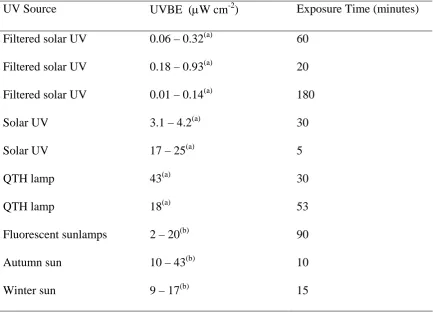
For general applications, the ranges of exposure times employed for the spectrum
evaluator for the different irradiances and environments are provided in Table 3. The
exposure times ranged from 20 minutes to 3 hours for the filtered solar erythemal UV,
erythemal UV, 10 to 15 minutes for the plant damage solar UV and 90 minutes for the
[image:9.595.87.521.223.537.2]plant damage lamp UV.
Table 3 – The range of biologically effective irradiances for erythema(a) and plant
damage(b) and the approximate exposure times that may be employed.
UV Source UVBE (μW cm-2) Exposure Time (minutes)
Filtered solar UV 0.06 – 0.32(a) 60
Filtered solar UV 0.18 – 0.93(a) 20
Filtered solar UV 0.01 – 0.14(a) 180
Solar UV 3.1 – 4.2(a) 30
Solar UV 17 – 25(a) 5
QTH lamp 43(a) 30
QTH lamp 18(a) 53
Fluorescent sunlamps 2 – 20(b) 90
Autumn sun 10 – 43(b) 10
Winter sun 9 – 17(b) 15
Temperature
The effects of temperature on the individual dosimeter materials have been measured
over the temperature range 34.5 to 61.3 oC (Parisi and Wong, 1996a). Over this range,
there was no significant temperature effect for polysulphone and 8-methoxypsoralen
and phenothiazine showing no effect up to 50 oC, with an effect for higher
temperatures. For nalidixic acid, there was a small increase with temperature in the
temperature effects can be minimised by using the system at approximately constant
temperatures below 50 oC. These can be maintained by employing the system in the
open or well-ventilated conditions.
CONCLUSION AND DISCUSSION
The ranges of conditions and environments of a dosimetric spectrum evaluator
previously developed and employed in the evaluation of the UV source spectrum have
been considered in this paper. The complete system of four dosimeter materials can
be employed for a total UV exposure of up to approximately 10 J cm-2. For the
different environments, the exposure times required for the spectrum evaluator were
found to be a compromise between producing a measurable change in optical
absorbance of the dosimeter material and reducing the saturation of the dosimeter
material and minimising any changes in the source spectrum. The exposure times
ranged from 5 minutes to 3 hours and were dependent on the UV irradiances and the
general shape of the UV spectrum, which was influenced by the UV environment. In
these environments, employing the system in open or well-ventilated conditions up to
temperatures of 50 oC minimises changes in the dose response of the system due to
temperature. The results presented in this paper provide a guide for the ranges of
conditions and exposure times required for the different environments for future
research employing the dosimetric spectrum evaluator.
Acknowledgments – The authors would like to thank Ken Mottram, Ron Matthews,
Oliver Kinder, Graeme Holmes and Dennis Cracknell in the USQ physics discipline
REFERENCES
Caldwell, M.M. 1971, “Solar ultraviolet radiation and the growth and development of
higher plants,” in Photophysiology, ed. A.C. Giese, vol.6, pp.131-177,
Academic Press, New York.
Caldwell, M.M., Teramura, A.H., Tevini, M., Bornman, J.F., Bjorn, L.O.&
Kulandaivelu, G. 1995, “Effects of increased solar ultraviolet radiation on
terrestrial plants,” Ambio, vol.24(3), pp.166-173.
CIE (International Commission on Illumination) Research Note 1987, A reference
action spectrum for ultraviolet induced erythema in human skin, CIE J. vol.6,
pp.17-22.
Diffey, B.L. 1989, “Ultraviolet radiation dosimetry with polysulphone film,” in
Radiation Measurement in Photobiology, ed. B.L. Diffey, pp.136-159,
Academic Press, New York.
Longstreth, J.D., de Gruijl, F.R., Kripke, M.L., Takizawa, Y. & van der Leun, J.C.
1995, “Effects of increased solar ultraviolet radiation on human health,”
Ambio, vol.24(3), pp.153-165.
Parisi, A.V. & Wong, C.F. 1996a, “A new method for measurements of erythemal
irradiance,” Photodermatol. Photoimmunol. Photomed. vol.12(2), pp.171-179.
Parisi, A.V. & Wong, C.F. 1996b, “Plant canopy shape and the influences on UV
exposures to the canopy,” Photochem. Photobiol. vol.64(1), pp.143-148.
Parisi, A.V., Wong, C.F. & Galea, V. 1996, “A method for evaluation of UV and
biologically effective exposures to plants,” Photochem. Photobiol. vol.64(2),
Parisi, A.V. & Wong, C.F. 1997a, “Erythemal irradiances of filtered ultraviolet
radiation,” Phys. Med. Biol. vol.42(7), pp.1263-1275.
Parisi, A.V. & Wong, C.F. 1997b, “The erythemal ultraviolet exposure for humans in
greenhouses,” Phys. Med. Biol. vol.42(12), pp.2331-2339.
Parisi, A.V., Wong, C.F. & Moore, G.I. 1997, “Assessment of the exposure to
biologically effective UV radiation using a dosimetric technique to evaluate
the solar spectrum,” Phys. Med. Biol. vol.42, pp.77-88.
Parisi, A.V. & Wong, C.F. 1998, “Quantitative evaluation of the personal erythemal
ultraviolet exposure in a car,” Photodermatol. Photoimmunol. Photomed.
vol.14(1), pp.12-16.
Parisi, A.V., Wong, C.F. & Galea, V. 1998a, “A study of the total ultraviolet exposure
to all the leaves for small plant growth,” J. Photochem. Photobiol. B: Biology,
vol.45(1), pp.36-42.
Parisi, A.V., Wong, C.F. & Randall, C. 1998b, “Simultaneous assessment of
photosynthetically active and ultraviolet solar radiation,” Agric. For.
Meteorol. vol.92(2), pp.97-103.
Wong, J.C.F. & Parisi, A.V. 1998, “Assessment of ultraviolet radiation exposures in
photobiological experiments,” submitted to Protection Against the Hazards of
UVR, Internet Photochemistry and Photobiology Conference, 18 Jan – 5 Feb
1999.
Wong, C.F., Fleming, R.A., Carter, S.J., Ring, I.T. & Vishvakarman, D. 1992,
“Measurement of human exposure to ultraviolet-B solar radiation using a