Title page
PATHWAYS TO LIFELONG LEARNING: TRANSFORMING CAPITALIST TRANSACTIONS INTO COLLABORATIVE JOURNEYS
Jay Somasundaram, Don Bowser and P. A. Danaher
Central Queensland University and the University of Southern Queensland Yaamba Road, Rockhampton, AUSTRALIA 4702
Pathways to Lifelong Learning: Transforming Capitalist Transactions into Collaborative Journeys
ABSTRACT
Using the principles of systems thinking (Gharajedaghi, 1999; Senge, 1990), the authors propose that three concepts are pivotal pathways to achieving a society of lifelong learners: the centrality of learning relationships; the design of systematic learning; and the tools used for learning. The authors examine the barriers in these pathways.
INTRODUCTION
Peter Senge’s seminal work, The Fifth Discipline(Senge, 1990), seeks a framework for creating learning organisations. The conference to which this paper contributes is on a similar but broader theme: the creation of learning societies and communities. Senge identifies five major ‘disciplines’ that he believes are essential for creating learning organisations. The paper draws on two of those disciplines – systems thinking and mental models – to explore the transformations necessary to create a learning society.
Systems thinking is the science and art of modelling and understanding our
environment as interacting sub-systems. It is a science in that there is a rich body of literature that analyses and categorises our environment as systems with common patterns and behaviours (e.g., Ackoff, 1999; Senge, 1990) and that provides guidance on developing useful models. It is an art in that all models (systems) are ultimately subjective. Relative objectivity is realised through explication and negotiation with stakeholders. As Gharajedaghi (1999) observed, models need to go through multiple iterations before consensus is reached.
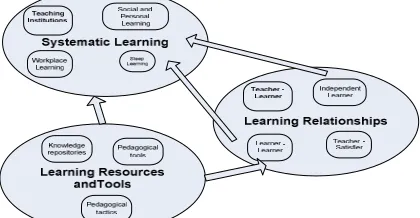
This paper contends that there are three sub-systems that are critical to the creation of a learning society (see Figure 1). The first is the interpersonal relationships in which learning takes place, the most commonly recognised being the teacher–learner nexus. The second sub-system is the process whereby systematic learning is designed and managed, and the last is the learning resources and tools associated with intellectual property used to facilitate learning.
Figure 1: The Three Sub-systems of Learning Societies
The authors contend that, as Wallerstein (1999) asserts, “The modern world system is a capitalist world-economy, which means that it is governed by the endless
accumulation of capital” (p. 35). The capitalist mental model in which our learning systems have developed and operate hampers the optimal development of learning societies.
This paper is not an evaluation of capitalismper se. “The problems with mental models lie not in whether they are right or wrong – by definition, all models are simplifications. The problems with mental models arise when the models are tacit – when they exist below the level of awareness” (Senge, 1990, p. 176). Such models are given a level of confidence above the degree of evidence available. The assumptions and limitations of these models are often poorly understood, and they are applied inappropriately. To challenge and examine them, the models need to be made explicit.
In facilitating the transformations of existing systems into lifelong learning systems, it is useful to understand the forces at play that caused existing systems to develop their current shape. Society maintains an ambivalent attitude towards capitalism,
sometimes disdainful, sometimes pragmatic, but increasingly treating it as a Truth. Individuals often feel an ownership responsibility for the systems they operate in, and implied criticism of the system is seen as a criticism of themselves (Senge, 1990, p. 18). This paper is not meant as a criticism.
The paper is about the allocation of resources to learning, and is thus an economic analysis. However, it does not fit the Australian concise Oxford dictionarydefinition of economics as “the science of the production of wealth” (Moore, 1997, p. 418) or that of “the study of how society manages its scarce resources” (Mankiw, 1998, p. 4). This is because the authors contend that the resources needed for learning are not scarce; on the contrary, the capitalist mental model creates an artificial scarcity in order to generate wealth.
LEARNING RELATIONSHIPS
The heart of the capitalist system is the barter, the exchange of goods.Capitalism favours learning taking place in a bimodal relationship, between a teacher and a learner: the teacher supplies units of teaching to the student in exchange for money. The teacher–learner model is ideally suited for the generation of wealth. The problem with this model is not that it is wrong, but that it suppresses and devalues other models that may be more prevalent, efficient, effective and inclusive in many circumstances.
Furthermore, learning is generally viewed as a public good, and much if not all of the money in the transaction is provided by the public (the government), rather than the individual learner/purchaser. Other requirements for effective markets, such as information and choice, are not met and therefore the benefits that markets bring cannot be realised.
This paper suggests three alternative models to the dominant teacher–learner nexus: a learner–learner model; a teacher–satisfier model; and an independent learner model. All these models are less suited to the generation of wealth, and are therefore subconsciously devalued by a capitalist society. This is not to suggest that these are not used, but that they are under-utilised. For example, creating independent learners is sometimes cited as an aim of teaching systems, but whatever independent learning takes place is managed within a teaching framework.
The Learner–Learner Model
The learner–learner paradigm sees both participants as learners, though not necessarily at the same level of sophistication, or of the same subject matter. A paradigm shift from teacher to learner challenges all stakeholders. Moving away from the teacher role results in a loss of power and control, and acknowledges
vulnerability. There is a need to explicate the learning needs of the ex-teacher, and to devise a curriculum that provides an opportunity to meet these needs. Each learner needs to recognise the requirements of the other, and to take responsibility for satisfying these requirements through taking the role of teacher or guide when the opportunity presents itself. Both parties have complex roles – demanding, but rich in learning opportunities.
The Teacher–Satisfier model
Maslow’s (1987) theory of human motivation ranks basic human needs into five groups – physiological needs, safety needs, belongingness and love needs, esteem needs and the self-actualisation need – “organised into a hierarchy of relative prepotency” (p. 17) – i.e., the physiological needs must be satisfied and, once satisfied, then safety needs become dominant and so on. Capitalism, through the accumulation of wealth, will satisfy the first two, but the other three are better satisfied through building relationships rather than through accumulating wealth. Australia has a civil and welfare system that guarantees to meet the psychological and safety needs of its citizens. However, as Covey (1989) argues, “Most people are deeply scripted in what I call the Scarcity Mentality. They see life as having only so much, as if there were only one pie out there” (p. 219). This point confirms the dominance of the capitalist mental model identified at the beginning of this paper.
Teaching is an excellent way to meet the higher needs – of love, esteem and
actualisation. Unfortunately our mental models cause us to denigrate teaching that is not commercialised. Teachers who seek positions for reasons other than financial benefit are viewed by the majority of society as different. Those who teach on a voluntary basis are considered in some way inferior in skills, and worse still as traitors, denying work to genuine teachers. Even the mention of the satisfaction of higher needs is met with suspicion, as it provides an argument for employers to offer lower wages.
The Independent Learner Model
Of the three, the independent learner model is the one that is often promoted as a dominant model in practice, although there is a lack of evidence to support such a position. It is stated in curricula as an objective, and there are examples of attempts to adopt such a model. However, expecting teachers to develop independent learners is like expecting fishmongers to teach their customers to fish. As discussed in the next section, independent learners faces two major hurdles: firstly they need a coherent instructional design framework to guide their learning, and secondly they face the problem of accreditation.
SYSTEMATIC LEARNING
Where one wants a large amount of learning, then a systematic approach is needed. The method of designing systematic learning is called instructional design, and is typically described as a number of steps or stages (e.g., Dick, Carey & Carey, 2005; Shambaugh & Magliaro, 2006). For the purpose of this paper, they are best grouped into four stages:
a) the establishment of learning objectives or outcomes b) the design of delivery
c) delivery (including formative assessment) d) summative assessment.
In schools, the statement of learning objectives is called a curriculum and the design of delivery is called lesson plans. In universities, the learning objectives and the design of delivery are typically combined in a course outline or profile.
Of principal importance, and often not included in instructional design texts, is the matter of accreditation, of getting external stakeholders to recognise the quality of the teaching and learning. If one is tackling systematic learning for self-actualisation, then accreditation is relatively unimportant. If, however, the achievement of knowledge and skills must be evidenced for some external purpose, such as obtaining work, there is increasing demand for accreditation above simple reliance on the teaching
institution’s reputation. An outcome-based accreditation will be focused on an evaluation of the learning objectives and the formative assessment, while a process-based accreditation will rely on the delivery. In process-process-based accreditations, the teaching institution is accredited and graduates of the institution are automatically granted accredited status.
When one examines the costs of these elements, delivery is the most expensive in practice. The development of learning outcomes and the design of delivery can be one-off costs (if we ignore the arguments for situated designs). The cost of summative assessment has two components: the design of assessment, which is a one-off cost; and marking, which will vary with the amount of teacher involvement needed.
Inextricably tied to accreditation is the establishment of learning objectives and summative assessment. One would see accrediting institutions increasingly taking on these functions.
The above analysis ignores three critical issues. Firstly, assessment is still a very inexact activity. We therefore rely quite heavily on process-based assurances (such as x years of study or work experience). Secondly, an ‘exam’-based assessment process heavily favours students with the ability to perform in that setting. Assessment conducted by students’ own teachers may be more reliable than external assessments (Coombes, Danaher & Danaher, 1992). Thirdly, accreditation may not be an essential requirement of systematic learning. Where stakeholders (whether they be future employers or others such as students, caregivers or the community) do not need strong evidence of learning, such as where the student is seeking self-actualisation, then alternative pathways to learning are available.
However, the purpose of this paper is not to contest the issue of formative assessment. It is to explicate the frameworks for systematic learning. In practice, a multitude of frameworks exists, including the relatively pure one where accreditation is primarily conducted by a board that is responsible for the determination of appropriate
curriculum and examination but that is not involved in delivery.
Stakeholders are increasingly demanding, not simply accreditation at a point in time, but continuing accreditation as evidence that people maintain the skills and
knowledge that they originally acquired, as well as that they have continued as lifelong learners, developing new skills as demanded by their profession. Continued accreditation faces the same problems, of process-based versus formative assessment and of the need to ensure that multiple pathways to accreditation are available – that, to put it bluntly, requirements for continued professional development are not seen as a means of getting people to take the courses run by the accrediting agency.
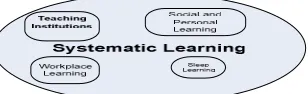
[image:6.595.223.377.614.661.2]The capitalistic benefits of delivery have not merely created ‘degree factories’ but have limited other options for lifelong learning by emphasising institutional learning. Individuals spend only a small part of their life in learning institutions (see Figure 2) and, even when they do attend school or college, typically they spend less than a third of their time there. We include sleep learning (see for example Neal & Dayan, 1997) as a learning system, not because we believe it is a sound learning method, but to emphasise the way that we are trapped by our mental models. We understand relatively little about the relationship between sleep and learning, even though sleep takes up about a third of most people’s time.
Figure 2: Systematic Learning
LEARNING RESOURCES AND TOOLS
sorts of ideas and insignia” (Fisher, 2000, p. 1). The largest of these, and those of most interest in this paper, are those of copyright and patents. The phrase ‘intellectual property’ uses the word ‘property’ to create a mental model that implies a strong sense of ownership. These legal constructs solidified in law about 600 years ago in the case of patents (Reynolds & Stoianoff, 2005, p. 269), and 300 years ago in the case of copyright (Reynolds & Stoianoff, 2005, p. 6). Nevertheless intellectual property differs from traditional property, in that ‘enjoyment’ of the goods can be shared without loss of value.
A major argument for copyright is that it increases creativity by economically rewarding creators. Fisher, however, concludes:
Empirical work has suggested that patent law has been more important in stimulating innovation in certain industries (e.g., pharmaceuticals and chemicals) than in others, but has failed to answer the ultimate question of whether the stimulus to innovation is worth its costs. With respect to forms of intellectual-property protection other than patents, we know even less. (Fisher, 2000, n.p.)
Current laws are hotly contested, both by those trying to increase the power of these laws and by those trying to seek alternatives. However, major movements, such as copyleft (http://www.gnu.org/copyleft/copyleft.html) and creative commons (retrieved December 14, 2005, fromhttp://creativecommons.org/), accept the
principle of ownership, but encourage owners to pass limited rights to consumers. On the other hand, privileges are increasing. Subsequent to the United States-Australia free trade agreement, the period of copyright protection was extended from 50 to 70 years (retrieved January 19, 2006, from
http://www.dfat.gov.au/trade/negotiations/us_fta/guide/17.html).
The authors contend that, whatever the merits of these arguments, intellectual property laws present a major obstacle to achieving a learning society. This is particularly true as new technology provides more and more opportunities for innovative teaching and learning. As Alison Littlejohn (2005), Chair of the International Centre on Research on Learning, commented in relationship to learning: “Intellectual property rights are one of the biggest stumbling blocks to e-learning” (n.p.).
The concept of intellectual property in a capitalist society causes two major
phenomena that hamper learning societies. Firstly, the focus is on research that can provide commercial benefit. Teaching and learning research, and in fact any research whose benefits are social and therefore difficult to commercialise, becomes a
secondary activity.
Secondly, frameworks for enforcing intellectual property rights are placing increased burdens on learning institutions. Schools and universities have to put in place
complex protocols to ensure that they do not break copyright laws. The additional work needed to ensure compliance may be of an order of magnitude greater than the actual copyright fees paid. The economic efficiency of such a bureaucracy is
Additionally there is the burden of legislative compliance which further influences operations, particularly in smaller learning organisations with limited financial resources.
CONCLUSION
Gardner, Csikszentmihalyi and Damon (2001), while engaged in a study of what it means to carry out work that is both excellent in quality and socially responsible, wrote:
…our concerns have spanned diverse professional realms — law, medicine, theatre, higher education, philanthropy, and more. In all of these we have recognized the same set of forces operating: the emergence of powerful and still dimly understood technologies; the overwhelming power of market forces and the concurrent decline of various competing ideologies and “isms”; the waning of an agreed upon set of principles and an ethical framework that has been designed to govern the decisions of all members of a profession; the loss of powerful ‘heroic’ role models that inspire the younger members of a profession and a concomitant foreboding sense that the future course of the domain is wrapped in uncertainty. (p. xi)
[image:8.595.193.403.396.505.2]Our purpose is not to offer clear solutions. Nor do we feel that precise global solutions can be proposed to transform our society into one of lifelong learners. We do not even claim that the analysis that we present (see Figure 3) is ‘right’. What we do claim is that it isalegitimate perception of our situation, and that it provides useful insights.
Figure 3: Pathways to Lifelong Learning Societies
We do, however, offer two strategies for transforming society into one of lifelong learners. Firstly, we must consider not only learning but also teaching as essential skills that must be taught and utilised from the formative years of our lives. Secondly, we must be willing to explicate all the forces at play in our society and to debate them within an ethical framework.
ACKNOWLEDGEMENTS
This paper is not a creation of the authors, but of the communities that we live in. The ideas expressed in it were created by the interactions of many people. The feedback of two anonymous referees enhanced the paper’s clarity and readability.
REFERENCES
Coombes, P. N., Danaher, M. J. M., & Danaher, P. A. (1992, October). The ethics of educational evaluation.Social Alternatives, 11(3), 39-42.
Covey, S. (1989).The 7 habits of highly effective people.New York: Simon & Schuster.
Dick, W., Carey, L., & Carey, J. (2005).The systematic design of instruction.Boston, MA: Allyn and Bacon.
Fisher, W. (2000). Theories of intellectual property. In S. Munzer (Ed.),New essays in the legal and political theory of property (pp. 168-200). Cambridge, UK:
Cambridge University Press. Retrieved December 12, 2005, from http://www.law.harvard.edu/faculty/tfisher/iptheory.html
Gardner, H., Csikszentmihalyi, M., & Damon, W. (2001).Good work: When excellence and ethics meet.New York: Basic Books.
Gharajedaghi, J. (1999).Systems thinking: Managing chaos and complexity: A platform for designing business architecture.Birmingham, MA: Butterworth Heinemann.
Littlejohn, A. (2005, December 2). Design of blended learning activities: Issues and perspectives. Workshop presented at Central Queensland University, Rockhampton, Qld.
Mankiw, N. (1998).The principles of economics.Miami, FL Harcourt Brace & Company.
Maslow A. (1987).Motivation and personality.New York: Addison-Wesley.
Moore, B. (Managing Ed.) (1997).The Australian concise Oxford dictionary(3rd ed.). Melbourne, Vic: Oxford University Press.
Neal, R. M., & Dayan, P. (1997). Factor analysis using delta-rule wake-sleep learning. Neural Computation, 9, 1781-1803.
Reynolds, R., & Stoianoff, P. (2005).Intellectual property: Text and essential cases. Annandale, NSW: Federation Press.
Senge, P. (1990).The fifth discipline: The art and practice of the learning organization.London: Doubleday.
Shambaugh, N., & Magliaro, S. (2006).Instructional design: A systematic approach for reflective practice.Boston, MA: Allyn and Bacon.