Constructing a leadership competencies development tool:
a case study in a university
By
Ronel Erwee, Lesley Willcoxson, Don Smith, Cec Pedersen
Faculty of Business
University of Southern Queensland
Paper; Proceedings of the 16th annual ANZAM conference, Beechworth, 6 December 2002
ABSTRACT
Constructing a leadership competencies development tool: a case study in a university
In recent years, faced with increasing pressure to be more ‘accountable,’ Australian universities have introduced various performance measurement processes previously associated primarily with the private sector. Prominent amongst measures designed to facilitate the effective use of human resources have been performance management systems, which within universities are often rebadged as
performance development systems in order to allay many academics’ concerns about ‘rampant managerialism’. Such rebadging is more than a demonstration of deference to academics’ concerns, however, for it signals not only a linguistic adaptation of corporate processes to educational institutions, but also practical adaptation. This adaptation often leads to the displacement of a management system and its attendant obligation to meet specified requirements with a development system characterised by notions of voluntary participation.
This emphasis on development may be sourced to more than academic concerns about managerialism. Despite stated support by senior university management for the introduction of performance
management processes, often this support is not indicated through role modelling – willingness to have performance reviewed and take action on the review - or through the provision of rewards for
exemplary performance. Additionally, within universities sanctions for poor performance have typically been weak or non-existent, and many staff could point to cases where the choice was made to deal with poor performance through re-structuring, in preference to direct management intervention. In face of such unwillingness or inability to utilise the type of management tools generally employed in the private sector, the capacity to manage performance is reduced and those charged with introduction of a ‘performance management’ system find themselves forced to emphasise the developmental benefits of the new system. This emphasis on development serves not only to mask lack of tangible rewards or senior executive support for performance management, but also to reassure staff of their power to influence and derive individual benefits from the system.
In such a context, where extrinsic motivators for participation are lacking and staff may be suspicious of the intent or ramifications of the system, it is essential to involve in development of the system those whose performance will be evaluated, for their involvement in development becomes a significant strategy in gaining acceptance for the system. What, however, constitutes a sufficient level of involvement? How can developers of performance management systems in such contexts ensure that the systems developed demonstrate appropriate regard for both relevant theories of good performance and for good performance in the given context? What difficulties confront system developers in such contexts?
This paper explores these questions through an account of and reflections upon the process of developing an instrument for evaluating the leadership and management competencies of university staff, to be incorporated into a university’s performance management system. It begins by presenting a brief overview of literature relating to competencies, then reviews the relationship of competencies to performance management, before outlining the case study university’s performance management system, in the context of which leadership competencies were to be evaluated. Next it describes the steps taken to develop and gain acceptance of the instrument to be used to evaluate leadership competencies, and finally it reflects upon the lessons learned through developing the instrument. Defining competence and leadership competencies
about collaboration and management. They are difficult for competitors to duplicate because they are distinctive and specific to each organisation. Concentrating on its core competences is presumed to make an organisation effective and lead to competitive advantage (Cappelli & Crocker-Hefter 1996). Figure 1: The core competences of organisations
Source: Bergenhenegouwen et al., 1997: 56.
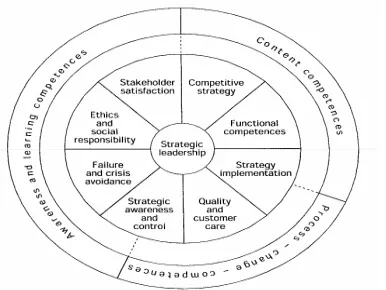
As indicated in figure 1, fundamental to the development and maintenance of organisational core competences are the competencies possessed by individuals and groups within the organisation. These competencies, in combination, form the set of generic competencies that enable an organisation to add value, to innovate and exploit internal architecture and external circumstances, to develop technological capability and strategic direction. As indicated in figure 2, Thompson & Richardson (1996) characterize these competencies as content, strategic change and strategic learning competencies, all of which are facilitated by strategic leadership competencies.
Figure 2: Generic competencies
Source: Thompson & Richardson, 1996: 8.
These generic competencies are arguably the competencies required for success by any organisation and thus are generalisable across organisations. In specific organisations, however, they may have somewhat different manifestations, reflecting each organisation’s characteristic areas of expertise, core competences and organisational culture (Thompson, Stuart & Lindsay, 1997). In practice, these generic competencies inevitably reside in individuals and, as indicated in one of the early definitions of competencies, ‘are causally related to effective and/or superior performance in a job’ (Boyatzis, 1982). Thus most organisations devote significant energy to defining the competencies required in their staff and to developing those competencies. Key amongst these competencies, according to Thompson and Richardson (1996), are strategic leadership competencies, which may be seen as pivotal in the development of organisational culture and thus, organisational capability (Schein, 1985).
organisational core competences. Focusing on leadership competencies in the higher education sector, Hammons and Keller (1990) developed a list of 43 indicators of leadership competence, while Bennis (1991) argued more succinctly for the importance of the management of attention (through vision and goal setting), the management of meaning or communication, the management of trust, and the management of self. Duncan and Harlacher (1991) categorised higher education leadership competencies under five dimensions: institutional vision and revitalization, ethical leadership, institutional empowerment and transformation, political leadership and institutional conceptualisation and survival. In more recent research, Ramsden’s (1998) interviews with 20 academic leaders led to the listing of 31 characteristics of good academic leaders, ranging from ‘being strategic and knowing about the wider system’ to ‘understanding where people are coming from’, ‘being a good manager of resources’ and ‘questioning sacred cows’ (Ramsden, 1998: 87).
In the higher education sector, as elsewhere, to improve performance through leadership an organisation must first determine the core competences of the organisation and then define which leadership competencies are critical for strategic and operational success. Having defined key competencies, the challenge is to ensure that the organisation possesses these competencies when and where required. This challenge may be met in part through recruitment processes but in most organisations it is largely met by the use of human resource management strategies, such as performance management, which can be used to monitor and motivate the development of necessary competencies by existing staff. Consideration will now be given to the role that performance management may play in the development and maintenance of leadership competencies.
Using performance management to develop leadership competencies
A critical question for any organisation is how to develop and monitor leadership competencies, so that the organisation’s competencies inventory remains relevant to its operating environment and so that the behaviours and achievements of its leaders serve as examples for others to follow. The human resource management literature argues for the utility of performance management as a tool for developing competencies while dealing with staff work performance in a predictable and fair way (Fandray, 2001; Greengard, 2001; Tovey, 2001). Managers themselves, however, have tended to associate performance management with monitoring, counselling and formal review processes and ‘to see performance management as an HR-driven process, a bureaucratic requirement with the expressed purpose of adjusting employees’ salaries’ (Williams, 2001: 48). A consequence of this perception has been a common acceptance that the most senior managers in an organisation should be exempt from the performance management process, and there are numerous anecdotal accounts of lack of support for performance management by top management (see for example James, 1998; Fandray, 2001). To a large extent, performance management systems have until recently been designed to monitor and develop the performance of middle managers and below.
In more recent times, however, performance management system designers have taken a greater interest in including upper management in their sweep. This may be attributed, at least in part, to a wider acceptance of the benefits of a more integrated systems approach to performance management. In this systems approach, performance management ceases to be associated primarily with the monitoring, review and counselling of individuals and instead becomes a tool for aligning individual and/or group performance with the strategic goals of an organisation by ensuring the possession or development of competencies necessary for the achievement of those goals. The achievement of alignment thus involves, in addition to the determination and monitoring of personal performance standards against specified competencies or goals, the consequent provision of training and development opportunities, career progression opportunities and financial and other incentives or rewards. It has been realised that, even at senior management levels, certain ground rules and performance outcomes are powerful determinants of work behaviour.
As universities have adapted to changing roles, and as decreasing levels of funding from Government forces universities to review income sourcing and better manage what revenue they have, there has been increasing pressure to adopt a business management orientation, traditionally associated with the private sector rather than universities. Accountability now extends well beyond financial probity and securing outputs, to extending organisational capacities by developing a performance culture which is receptive to change and which actively pursues and supports organisational learning (Office of the Public Service, Qld. Govt., 1999). In consequence, managers within universities are being forced to develop a broader set of competencies than has been the case historically, and many universities have begun to develop performance management systems designed to monitor possession of these competencies.
Varying budgets and unique institutional cultures with varying degrees of acceptance of change, however, impact on design and choice of tools associated with performance management systems within universities. A critical difficulty in introducing a performance management system is that of gaining widespread acceptance of the need for and usefulness of such a system. Associated with this overarching challenge is the difficulty of developing a system to which the majority of staff will commit, for diverse roles and responsibilities ensure that no one size fits all. That is, as suggested earlier, for leaders and managers within a university there may be a distinct set of necessary competencies beyond those generally required, and if these are left untested or undeveloped the performance management system may be rendered generally ineffectual. Furthermore, perceptions of appropriate sources of feedback may vary from organisation to organisation and in line with position in the organisational hierarchy. This is especially the case for 360-degree feedback which has received a mixed reception (Peiperl 2001; McCarthy & Garavan 2002; Maurer, Barbeite & Mitchell, 2002) and has been generally modified in universities to comprise the traditional downward appraisal and self-appraisal, with upward appraisal only for staff in management positions.
Case study: Developing university leadership competencies through performance management
The remainder of this paper discusses the issues involved in catering for one aspect of the diversity mentioned above. Specifically, it describes development of a leadership competencies evaluation instrument to be incorporated into the University of Southern Queensland’s new performance management program. Discussion will focus initially on the performance management system in which the leadership competencies tool was to be embedded, and then on the strategies used to determine appropriate competencies, develop the evaluation instrument, and gain acceptance for the instrument. Finally, discussion will turn to the lessons learned through the development process.
The performance management context
As development of the non-managerial staff performance management program (the BUILD Program) chronologically preceded development of the leadership competencies evaluation tool, to some extent the program for managers was informed by earlier events and decisions. For example, an important consideration for system designers was the need to align both programs to a set of common objectives. These objectives, developed specifically for BUILD (Building Upon Individual Learning & Development), guided the design process. They emphasised the need for the system to facilitate continuing discourse between managers and those they manage, to facilitate commitment to performance monitoring and reviewing, and to provide a vehicle for articulating and facilitating individual developmental opportunities. Additionally, the system developed was to illustrate HRM best practice by providing a workable framework for managing performance, taking into account contemporary practice. These objectives were supported by a set of general principles, the cumulative effect of which is to actively pursue personal development and increase organisational capacities.
and this is complemented by review of a list of job-specific competencies negotiated between the supervisor and supervisee. It is expected that in preparation for the review meeting the individual will have completed at least one Activities Report (an interim report on progress towards meeting goals), with this Activities Report being made available to the supervisor prior to the Learning and Development Review meeting. To take account of the distinct roles and responsibilities and needs of those in leadership positions, however, this program needed to be supplemented by the addition of a leadership competencies self-assessment and evaluation instrument. For those in leadership positions, this instrument would substitute for the Learning and Development Review form, providing more targeted feedback and a clearer indication of development needs specific to the leadership position. Thus, the task of the leadership competencies development team was to identify the leadership competencies of different leadership groups (Deans, Heads of Department and cost center managers) and design a self-assessment or feedback instrument for use within the context of the performance management system. The team was also to identify leadership development opportunities for different levels of leadership, for use in a later phase of the project.
Defining leadership competencies and developing the leadership competencies evaluation tool
The research and development process used by the leadership competencies development team was based on a realism paradigm and relied on multiple perceptions of leadership competencies in a university setting. Firstly, descriptive research was used to identify leadership competencies, developmental frameworks and qualitative methodology, enabling this study to build on competency frameworks in use at other universities. An iterative process involving triangulation of several data sources such as interviews and focus group discussions, and of several peer researchers’ interpretations of those triangulations (see Healy & Perry, 1998), permitted progressive refinement and further development of a competency framework at both macro and micro levels.
Methods used were mainly in-depth interviews, followed by discussions in focus groups - a technique used to collect data through group interaction on a topic determined by the researcher (Morgan 1997). Interview participants were selected in part on the basis that they represented leadership roles at various levels in the university. We argued that information gathered from interviews with senior managers such as heads of department, general staff managers and Deans involved in university leadership could be excellent data sources for theory building research. Focus group research, which has the advantages of savings in time and money, flexibility, group interaction and the active role of researchers in addressing a research problem (Healy 1999), is often described as the most useful and appropriate method in the exploratory and developmental phases of a project and thus focus groups were used to test responses to a draft leadership competencies instrument.
A multi-phase design was used and the phases are described below. Phase 1 – In depth interviews
A draft competencies framework was developed by the team based on relevant leadership literature (Senge, 1990; Hammons & Keller, 1990; Duncan & Harlacher, 1991; Bennis, 1991; Charlton, 1992; Avolio, 1996; Kouzes & Posner 1996; Lewis, 1996; Morden, 1997; Bass, 1998; Ramsden, 1998) and examples of similar tools developed in other universities (Miller 1998; University of Western Sydney 1994; QUT 2000). This framework (see appendix 1) made a distinction between leadership and management competencies, using the term ‘competence domain’ to indicate the broad competency area (e.g. interpersonal skills) and listing under these domains a set of indicators of competence (e.g., actively listening, in the interpersonal skill domain).
general background, the leadership and management competencies, performance management and general change issues. Each participant received a draft competencies framework and the interview protocol to study before the interview. Interviews lasted between 60 to 90 minutes.
Analysis of interviews: Interviews were transcribed and content analysed into broad categories using the NUD*IST program, designed for analysis of qualitative data. The broad categories sought to highlight issues such as most important, least important and missing indicators or domains as well as definitions of leadership and management. On the basis of feedback from participants, categorised in terms of these issues, decisions were made on what to edit out of the framework and what domains needed to be collapsed. As a decision rule, indicators that weren’t mentioned by any interviewees as having importance were excised. One of the outcomes was that certain domains or indicators with limited support were kept in for the next round of testing (eg student/client focus) and the centrality of team building to supervisory roles was confirmed. Indicators in the people management and development domains were reduced and new definitions for the leadership domains were formulated. An additional outcome of the framework testing was that it was decided that, despite support from some interviewees for the separation of leadership from management competencies, the original classification into management and leadership competencies could not generally be sustained and that the framework needed revision. Furthermore, the classification of domains under ‘management’ and ‘leadership’ produced a relatively undifferentiated mass that gave no significant indication of the role of the domains/competencies in terms of facilitating outcomes for individuals or the organisation. It was thus decided to re-group domains/competencies into three categories: competencies related to the effectiveness of individual interactions, competencies related to processes of effective leadership, and competencies effective for locating the unit within the wider organisational context. Additionally, in order to increase the usefulness of the instrument for development purposes, all indicators within competence domains were re-cast as behaviourally-based competence indicators. Thus, for example, ‘actively listening’ became ‘displays active listening skills’.
Through the interview and focus group processes, it became clear that the framework needed to challenge the status quo and attempt to change paradigms of leadership within the University. Furthermore, on the basis of the comparability of academic and general staff responses to the relative importance of the defined leadership competencies, the decision was made to design an integrated framework (and associated leadership competencies development tool) for both academic and general staff leaders. This decision to develop an integrated approach paralleled that which had been taken by developers of the BUILD program.
Phase 2 – Designing a leadership development instrument
Drawing on the information from phase 1, the leadership competencies development team designed an initial draft of a leadership competencies self-assessment or feedback instrument. This draft was named ‘Leadership and Management Competencies: Feedback and Development Tool’ in deference to the fact that some interviewees had maintained the need to distinguish between leadership and management, and the evaluative potential of the instrument was deliberately downplayed in the title. The draft instrument, together with a document containing the background to the new university performance management process, USQ BUILD, and a request for an interview to discuss the instrument, was forwarded to Deans and senior managers from across the university. This set of interviewees was chosen partly because they were the supervisors of the interviewees in phase 1 but also because they were of strategic importance in terms of gaining acceptance of the tool as part of the university performance management process. Perceptions of the Deans and senior managers were gathered on whether the tool would be useful for evaluation of self and evaluation by others. Specifically, would the leader be willing to use the instrument to evaluate his/her staff and to have his/her performance
evaluated by the same staff? Questions were also asked about descriptors best used when evaluating the frequency of behaviours.
was used for upward review. Concerns were expressed that staff should be able to provide feedback on a senior manager’s performance without being identified. Additional concerns were expressed that staff might be evaluated on competencies not central to their role, given that the draft instrument response categories assumed that each competency would be demonstrated at least some of the time. One Dean made suggestions about additional competencies he felt should be included.
Phase 3 – Focus groups
All phase one academic and general staff interviewees were invited to participate in focus groups to analyze and further refine the ‘Leadership and Management Competencies: Feedback and Development Tool. Thirteen academic and five general staff responded to the invitation and they were grouped into three focus groups, each of which met for about one hour. Prior to the meeting they received the draft competencies tool, the BUILD program document, and at the meeting the Dean’s suggestions for additional indicators was tabled. Focus groups clarified and selected appropriate leadership domains and reached consensus on the competence indicators. They provided feedback on the domains, rephrased some of the indicators, deleted a few indicators, and adopted some of the indicators proposed by the Dean, with this adoption leading to a rebalancing of the instrument such that its preponderant focus on leadership interactions was lessened by an increase in the extent of focus on leadership processes and context. They also asked that the instructions for use of the tool be expanded, for example, to provide for an indication of key competencies. The focus groups further suggested the need to include a frequency response category of ‘no opportunity’, to recognise that the frequency with which a competency is demonstrated is dependent on the opportunities available within a given work context. Their suggestions were implemented to produce the penultimate form of the ‘Leadership and Management Competencies: Feedback and Development Tool’ (appendix 3), which is currently being trialled by a group of key senior managers and their staff. Feedback from this trial will be used to make any final adjustments to the instrument before it is incorporated into the performance management system. Given sensitivities raised in respect of upward feedback, initial use of the instrument will be for self-evaluation and supervisor evaluation, with upward review being introduced subsequently. Phase 4– Utilising the leadership competencies framework for leadership development
The next, as yet uninitiated, phase will be to use the initial focus groups to generate ideas on how leadership competencies can be developed in a university setting and how the leadership competencies framework and performance management outcomes can be utilised for development purposes. It is anticipated that, working with colleagues in faculties, general staff areas, and the Human Resources section, the leadership competencies development team will be able to enhance existing staff
development programs to provide for improved leadership development opportunities across different levels of leadership within the university.
Lessons learned from the development of the leadership competencies instrument
Lessons learned from the development of the leadership competencies instrument relate primarily to issues of sufficient involvement, the balance of theory and practice, and difficulties encountered.
produced a surprising degree of eventual consensus on required leadership competencies and eventually yielded an instrument designed by and for USQ staff.
Perceptions of efficacy however, are also dependent upon the face validity of the instrument. The long iterative development process, in which leadership theory was tested against leadership practice in a variety of internal contexts, led to construction of an instrument whose credentials were known and accepted. Because staff perceived the instrument to adequately reflect leadership competencies required in both theory and practice, they recognised that it could be useful in tracking performance and performance improvement, for the purpose of making claims for promotion. Indeed, several staff in the focus groups and interviews commented on the usefulness of the instrument in these terms and as a checklist for personal development. Despite the absence of tangible rewards often associated with performance management systems in the private sector, the strategy of using both theory and practice to construct and establish the credentials of the instrument seems to have motivated staff to accept it as a useful development tool with potential long-term benefits, and given them incentive to support the initiative.
Difficulties associated with development of the leadership competencies tool centred on issues relating to time, the voluntary nature of participation and the lack of senior executive involvement. The development process spanned nine months and, because participation was voluntary and depended upon goodwill, approaches had to be personal and timelines had to be flexible. Nevertheless, there was widespread cooperation, suggesting that another aspect of timing may also have been a critical factor. That is, the existing annual review system had long been held in disregard, and this disregard may have contributed to willingness to be involved in development of an alternative system. The failure to involve the senior executive in construction of the instrument was unfortunate, but it is anticipated that widespread acceptance of the leadership competencies instrument at other levels of leadership will lead to its championing when it is presented for ratification as part of the new performance management system.
Like many other universities, it is likely to be some time before the case study university implements a performance management system rather than a performance development system and reaps the greater benefits of performance management. Nevertheless, the development process associated with the leadership competencies instrument, described above, may provide a useful model for organisations seeking to manage performance in a context of voluntary participation and individually initiated development.
References
Argyris, C (2000) Flawed Advice and the Management Trap. New York: Oxford University Press Avolio, B (1996) ‘What’s all the karping about downunder? Transforming Australia’s leadership
systems for the 21st century’ in Parry, K (ed) Leadership Research and Practice Melbourne: Pitman Publishing
Bass, B (1998) Transformational Leadership New Jersey: Lawrence Erlbaum Associates
Bennis, W (1991) 'Learning some basic truisms about leadership' National Forum, Vol 71 No 1 pp 12-15.
Bergenhenegouwen, G, ten Horn, H and Mooijman, E (1997) ‘Competence development – a challenge for human resource professionals: core competences of organizations as guidelines for the development of employees’ Industrial and Commercial Training Vol 29 No 2 pp 55-62
Boyatzis, R (1982) The Competent Manager – A Model for Effective Performance New York: John Wiley & Sons
Cappelli, P and Crocker-Hefter, A (1996) ‘Distinctive human resources are firm’s core competencies’
Organisational Dynamics Vol 24 No 3 pp 7-22
Duncan, A and Harlacher, E (1991) 'The twenty-first century executive leader' Community College Review Vol 18 No 4 pp 39-47
Fandray, D (2001) ‘The new thinking in performance appraisals’ Workforce Vol 80 No 5 pp 36-39 Greengard, S (2001) ‘Make smarter business decisions: know what employees can do’ Workforce Vol
80 No 5 pp 42-45
Hamel, G and Prahalad, C (1994) Competing for the Future Boston: Harvard Business School Press Hammons, J and Keller, L (1990) 'Competencies and personal characteristics of future community
college presidents' Community College Review Vol 18, No 3, pp 34-41.
Healy, M (2000) ‘The structures and processes of networks involved in the internationalisation of Australian small business’. Unpublished PhD dissertation, Faculty of Business, University of Southern Queensland.
Healy, M and Perry C (1998) ‘Quality criteria for realism research about networks and relationship marketing’. Paper presented at Sixth International Colloquium In Relationship Marketing. Auckland, New Zealand, December 4-6
James, D (1998) ‘Performance management: an old idea is given a new spin’ Business Review Weekly
Aug. 17 pp 86-87.
Kouzes, J and Posner, B (1996) The Leadership Challenge, San Francisco: Jossey-Bass. Lewis, D (1996) ‘New perspectives on transformational leadership’ in Parry, K (ed) Leadership
Research and Practice Melbourne: Pitman Publishing
McCarthy, A and Garavan, T (2001) ‘360° Feedback Process: Performance, Improvement and Employer Career Development’ Journal of European Industrial Training, Vol 25 No 1 pp 5-32 Maurer, T, Barbeite, F and Mitchell, D (2002) ‘Predictors of attitudes toward a 360-degree feedback
system and involvement in post-feedback management development activity’ Journal of Occupational & Organisational Psychology Vol 75, No 1.
Miller, P (1998) ‘The effectiveness of competency based management development and the relationship between individual and business performance’. Unpublished PhD thesis, Southern Cross University Morgan, D (1997) Focus Groups as Qualitative Research California: Sage
Office of the Public Service, Queensland Government (1999) A Focus on People: Performance Management in the Queensland Public Service pp 9-10.
Peiperl, M (2001) ‘Getting 360 Degree Feedback Right’ Harvard Business Review Vol 79 No 1
Queensland University of Technology (2000) ‘Quality Leadership Profile Report’, Working paper, Human Resources Department, Queensland University of Technology pp 1- 23
Ramsden, P (1998) Learning to Lead in Higher Education London: Routledge
Schein, E (1985) Organizational Culture and Leadership San Francisco: Jossey-Bass,
Senge, P (1990) The Fifth Discipline. The Art and Practice of the Learning Organization Sydney: Random House
Thompson, J and Richardson, B (1996) ‘Strategic competitive success: towards a model of the comprehensively competent organization’ Management Decision Vol 34 No 2 pp 5-19
Thompson, J Stuart, R. and Lindsay, P (1997) ‘The competence of top team members: A framework for successful performance’ Team Performance Management Vol 3 No 2 pp 57-75
Tovey, M (2001) Managing Performance Improvement Sydney: Prentice Hall
University of Western Sydney Macarthur (1994) Personal Performance Management Program Sydney: UWS
DRAFT COMPETENCIES FRAMEWORK
LEADERSHIP COMPETENCIES MANAGEMENT COMPETENCIES
Competence Domain (factor) Competency Indicators (defining variables) Competence Domain (factor) Competency Indicators (defining variables)
Strategic and organisation-wide management processes
- keeping informed of economic, social, political, technological and other environmental issues and their potential impact on USQ’s operation
• Developing organisation-wide strategies
• Environmental awareness
• Clear vision for organisation’s future
• Change agent
• Forecasting
• Developing medium and long term plans
• Entrepreneurial focus
Problem solving and decision making
-using analytical, conceptual and creative skills in identifying and evaluating options for decisions and exercising sound judgement in selecting, implementing and following through solutions
• Problem identification within sphere of influence
• Evaluating alternative actions
• Flexibility and adaptability in decision making
• Identifying degrees of urgency in decisions
• Judgement and perception
• Problem solving ability
• Reasoning and analysis
• Assessing risks
• Using brainstorming techniques People management and
development
- taking action to facilitate staff acquiring new skills, knowledge, abilities and confidence which will assist them in achieving USQ’s goals and prepare them for career advancement
• Recognising subordinate performance
• Setting expectations for others
• Motivating others
• Resolving conflict among subordinates
• Providing individualised consideration to subordinates
• Rewarding individual effort
• Coaching and developing others
• Developing learning plans
• Developing a positive spirit
• Providing support
• Seeking feedback and inviting dialogue
• Using feedback to monitor impact of decisions
• Encouraging innovation
• Managing poor or under performance
• Idealized attributes
• Idealized behaviours
• Inspirational motivation
• Intellectual stimulation
• Individual consideration
Team building
- providing focus and engendering a cohesive team effort
• Building teams and team morale
• Encouraging joint team responsibility for actions
• Rewarding team contributions
Interpersonal skills
- presenting materials and ideas clearly and persuasively both orally and in writing to influence others and the capacity to effectively listen, understand and interpret information
• Writing clearly and concisely
• Speaking clearly and concisely
• Expressing ideas thoroughly and informatively
• Communicating effectively in both individual and group settings
• Actively listening
• Keeping others informed
Administrative, financial and operations management
- process of effectively planning and taking action to attract, retain, allocate and utilise financial, people and equipment resources to achieve faculty goals
Head Of Dept • Budgeting
• Preparing business plans
• Asset management
• Quality monitoring
• Information management Admin Mgr • Purchasing • Operational scheduling • Product/service distribution • Productivity monitoring
• Inventory admin.
• Facilities and equipment maintenance
• Treating others with respect, trust and dignity
• Considering the needs and feelings of others
• Valuing individuals and their contributions
- ability present a case to persuade others in a manner that maintains respect and
• Persuading and influencing superiors
• Forging alliances with superiors
• Forging alliances with influential outsiders
credibility and achieves objectives
• Persuading and influencing subordinates
• Understanding political implications of decisions
• Encouraging improvement through change
• Working for interests of organisation and others above self
Conflict management
- ability to defuse tense situations and negotiate a mutually acceptable solution
• Intervening when appropriate
• Effectively handling disagreements and conflicts
• Maintaining neutrality
• Clear understanding of natural justice
• Negotiating to achieve resolution
• Evaluating feasibility of alternative dispute resolution mechanisms
• Working to achieve consensus
• Compromising where necessary
Planning and organising
- ability to conceptualise issues, analyse options and put in place appropriate strategies
• Anticipating and forward planning
• Assessing requirements
• Allocating time and resources
• Organising time
• Prioritising of tasks
• Creating and meeting deadlines and objectives
• Adaptability
• Working systematically
• Actioning policies and decisions
• Preparing contingency plans
• Tracking critical steps in projects
• Identifying and reacting to outside forces
• Monitoring performance against targets
Managing self
- capacity to organise, plan and prioritise work, make effective use of time, display initiative, self motivation, act with integrity and take responsibility for personal growth and development
• Prioritising competing demands to achieve objectives
• Maintaining personal performance in varying work contexts
• Developing management competence through developmental opportunities
• Using personal qualities to serve as a role model
• Participating in professional networks
• Improving competence through feedback from colleagues
• Improving competence through feedback from students/clients
• Participating in professional associations
• Self-motivation rather than passive acceptance
Student / client focus
- recognising the central importance of internal and external clients and
demonstrating a commitment to identify and serve their needs
• Including student/client needs in planning process
• Effectively using resources to provide a quality service
• Seeking student/client feedback to improve service
• Adjusting service in response to student/client feedback
• Meeting quality expectations of students/clients
Interview questions: Heads of department and general staff section leaders
• Background: To what extent do you think do the domains and indicators listed in the
competency framework cover all the areas of leadership or management that you confront in your role? Is this a reasonable definition of each competence domain?
• Leadership and Management competencies: What are you views on the competency indicators –
o which would you emphasise,
o which do you think are less appropriate?
o Which are omitted and should be added?
• Performance management :How should your leadership and management competencies be evaluated?
o Survey, annual review, feedback session, part of USQ performance management review?
o How should this be done: by yourself, your supervisor, other staff?
• What actions should be taken to develop leadership and management competencies?
• What obstacles do you see to developing leadership & management competencies?
• To what extent have you been involved in 360 degree feedback and do you think it is appropriate in your Department/Faculty/Section?
o Do you think that your work area would gain from 360 degree feedback?
o Do you think it would be supported by the staff in your area?
• General change: Have recent changes in the higher education sector had an effect on the management and leadership competencies you need?
PART A
LEARNING AND DEVELOPMENT REVIEW – What has been achieved in the past twelve months?
GENERIC
ATTRIBUTES
–
LEADERSHIP
AND
MANAGEMENT
How to use this instrument:
1) Please read through the instrument and place an asterisk (*) beside the leadership/management competencies that you think are the most critical for effective
performance in your leadership/management role, then
2) Using the scale of 1-6 please indicate the
frequency
with which you demonstrate each behaviour, relative to the opportunity provided within the
leadership/management context
1 = almost always 2 = most of the time 3 = about half of the time 4 = some of the time 5 = almost never
6 = no opportunity
Leadership
interactions
at individual and
group level
Leadership
processes
that facilitate
Linking the organisation to its
context
People development:
Takes action to facilitate staff acquiring new skills, knowledge, abilities and confidence which will assist them in achieving USQ’s goals
Frequency Frequency Frequency
Sets clear expectations when working with colleagues
Creates learning opportunities for others Articulates the wider vision
Encourages skill improvement Provides intellectual stimulation Encourages innovation
Coaches colleagues and assists their development Inspires and motivates others
Mentors or arranges mentoring for staff Behaves in a way that provides a good model for others
Provides constructive and timely feedback Works primarily for interests of organisation & those within organisation rather than self-interest
Acknowledges individual effort and good performance
Demonstrates cultural awareness and sensitivity
Team building: Finds a common sense of direction and builds a cohesive group
Frequency Frequency Frequency
Builds teams Develops a shared sense of purpose
Encourages sharing of responsibility by team Develops a positive spirit within teams & work unit
Acknowledges team contributions Acknowledges and utilises diversity productively
Interpersonal skills: Demonstrates respect and empathy for others and uses effective communication skills
Frequency Frequency Frequency
Treats people with respect, trust and dignity Demonstrates and requires ethical behaviour Builds cultural awareness
Displays active listening skills Demonstrates responsiveness to the
concerns of USQ stakeholders & partners
Communicates effectively in all modes
Strives to achieve and present a balanced view
Keeps others informed, sharing information openly and honestly unless inappropriate to do so
Conflict management: Demonstrates ability to defuse tense situations and negotiate mutually acceptable solutions
Frequency Frequency Frequency
Evaluates feasibility of different conflict resolution mechanisms
Develops processes to establish a climate of trust Resolves conflicts based on different perspectives of service
Effectively handles disagreement & conflict
Intervenes when appropriate
Maintains neutrality in conflict resolution process
Managing self: Displays self-knowledge and models desired behaviour
Frequency Frequency Frequency
Demonstrates integrity and honesty Shares personal expertise appropriately to benefit the university
Seeks feedback on performance from varied sources
Displays willingness to accept performance critiques
Takes responsibility for personal growth and development of leadership/management competence
Keeps abreast of current professional ideas
Demonstrates initiative and adaptability
Strategic management processes: Envisions future and builds culture and environment necessary to achieve goals
Frequency Frequency Frequency
Clarifies and articulates personal values Leads in formulating a vision and pushing frontiers Builds relationship between unit and organisational goals
Presents positive images of USQ in external forums
Leads in culture building Scans the environment, reading and forecasting trends
Creates environment of innovation and creativity Knows where the organisation/unit sits in the environment and has a viable vision for the direction in which it should move
Develops strategic alliances enabling cross discipline interaction
Develops medium and long term plans for unit/organisation
Demonstrates willingness to confront the status quo when necessary
Demonstrates an entrepreneurial focus
Problem solving/decision making:
Uses sound analytical, conceptual and creative skills to identify and evaluate options for decisions, and implements decisions
Frequency Frequency Frequency
Demonstrates perception and judgment Engages in contingency planning
Engages in lateral thinking Facilitates effective management of knowledge
Evaluates viability of alternative actions Leads meetings effectively
Administrative, financial, and operations management (as relevant to position):
Effectively plans and takes action to attract, retain, allocate and utilise human, financial and material resources for the purpose of achieving unit and organisational goals
Frequency Frequency Frequency
Demonstrates effective cost accounting and inventory control
Prepares sound business & unit plans
Displays high level administrative skills
Establishes and documents necessary protocols/ policies/ procedures
Monitors, and strives to improve, productivity
Budgets effectively
Undertakes effective staff planning, recruitment & selection
Persuasion & influence: Exercises persuasion and influence effectively to build a more constructive world
Frequency Frequency Frequency
Negotiates effectively Displays awareness of, and capacity to deal with, political implications of decisions
Links university to other community agencies
Forges alliances and networks that facilitate achievement of objectives
Advocates on behalf of disempowered groups Links university/discipline to professional bodies/other sources of professional knowledge
Demonstrates effectiveness in influencing and persuading others
Planning & organising: Demonstrates ability to conceptualise issues, analyse options and put in place appropriate strategies
Frequency Frequency Frequency
Creates & meets objectives and deadlines Monitors quality in all areas of responsibility Ensures that policies are sensitive to external influences
Effectively uses time and resources Seeks and uses feedback to improve quality of student/client service
Adapts planning to changes in education policies or environment
Anticipates and proactively deals with difficulties