Modelling using Matlab
David R Buttsworth
http://www.usq.edu.au/users/buttswod/
October16, 2002
Facultyof Engineering&SurveyingTechnicalReports
ISSN1446-1846
Report TR-2002-02
ISBN1 87707802 6
Faculty ofEngineering &Surveying
UniversityofSouthernQueensland
Toowoomba Qld4350 Australia
http://www.usq.edu.au/
Purpose
TheFacultyofEngineeringandSurveyingTechnicalReportsserveasamechanismfordisseminatingresults
fromcertainofitsresearchanddevelopmentactivities. Thescopeofreportsinthisseriesincludes(butisnot
restrictedto): literaturereviews,designs,analyses,scienticandtechnicalndings,commissionedresearch,
anddescriptions of softwareandhardwareproducedby staofthe FacultyofEngineeringandSurveying.
Limitationsof Use
The Council of the University of Southern Queensland, its Facultyof Engineering andSurveying, and the
sta of the University of Southern Queensland : 1. do not make any warranty orrepresentation, express
or implied, with respect tothe accuracy, completeness, orusefulness of the information containedin these
Anumberof Matlabroutinesforcombustioncalculationsandthermodynamicsimulationof spark
ignitioninternalcombustionengineoperationaredescribed. Functionsthatreturnthe
thermody-namic curve coeÆcients for a variety of fuel, air, and combustion product species are described.
A Matlab version of the Olikara and Borman method for determining the equilibrium state of
combustionproductsisalso presented. Additionalroutinesspecicallydesignedforsparkignition
engine modelling are also described. Most of the routines included in thisreport are essentially
Matlab versionsof theFORTRAN programspresentedbyFergusonforspark ignitionengine
cal-culations. Comparisons of results from the new Matlab routinesand previousroutines and data
indicate that the new Matlab routines are reliable { typical deviationsfrom previous resultsare
1 Introduction 4
2 Basic Thermodynamic Data 4
2.1 Air and CombustionProducts Data . . . 4
2.2 Fuel Data . . . 6
3 Fuel, Air, and Residual Gases 7 4 Equilibrium Combustion Products 9 5 AdiabaticFlame Temperature 10 6 ArbitraryHeat Release 11 6.1 EngineSpecication . . . 11
6.2 Functions forDierentialEquations . . . 11
6.3 Heat TransferModelling . . . 11
6.4 ArbitraryHeat ReleaseRoutine . . . 11
6.5 Analysis ofResults . . . 12
7 Conclusions 12
A airdata.m 17
B fueldata.m 19
C farg.m 21
F enginedata.m 29
G RatesComp.m& RatesComb.m & RatesExp.m 29
H ahrind.m 33
I plotresults.m 35
J calcq.m 38
1 Introduction
Matlab is popular for theoretical calculations and the analysis of experimental data. Although
many thermodynamic and combustion routines are readily available in FORTRAN, the Matlab
environment oers many advantages. Given the relative simplicity of internal combustion (IC)
engine routines presented by Ferguson [1] it appeared reasonable to develop equivalent routines
using Matlab. Having the fundamental routines available in Matlab aords workers that are
familiarwith thisenvironmentthe capacityto rapidlyadaptand extendtheroutinesasrequired.
TheMatlabroutinesdescribedhereinarebasedlargelyontheFORTRANprogramsforICengine
calculations presented by Ferguson [1 ]. However, extensive use is made of the matrix and array
datastructuresavailableinMatlab. Inthesubsequentsectionsofthisreport, theMatlabroutines
are described. Where appropriate, results obtained using the Matlab routines are compared to
resultsobtainedusingestablishedmethods.
2 Basic Thermodynamic Data
2.1 Air and Combustion Products Data
Gordon and McBride [2 ] tted curves to thetabulated JANAF data [3] (and a similarapproach
hasbeenadoptedfortheChemkincurves[4 ])togiveexpressionsforthethermodynamicproperties
of theform,
c p R =a 1 +a 2 T +a
3 T 2 +a 4 T 3 +a 5 T 4 (1) h R T =a 1 + a 2 2 T + a 3 3 T 2 + a 4 4 T 3 + a 5 5 T 4 +a 6 1 T (2) s R =a 1
lnT +a
2 T+ a 3 2 T 2 + a 4 3 T 3 + a 5 4 T 4 +a 7 (3)
TheMatlab functionairdata.m (AppendixA)returnsthecurvecoeÆcientsa
1 to a
7
foreither the
Gordonand McBride [2 ] curvesor theChemkin [4]curves over two dierent temperatureranges:
1) 300 <T <1000K; and 2) 1000 <T <5000K. There are10 rows in thereturned matrix and
eachrowprovidesthesevencoeÆcients(inascendingorder)foradierentspecies. The10species
for which data is available are (in the following order): CO
2 , H 2 O, N 2 , O 2
, CO, H
2
, H, O, OH,
and NO. The optionsfor airdata.m are listed inTable 1, and thenumerical values forthe curve
coeÆcientcan be foundin thelistingof airdata.minAppendixA.
Thespecic heatcurvesforthe10speciesusingtheGordonandMcBride[2 ] andtheChemkin[4]
coeÆcientsarepresented inFig.1 and Fig.2. Theseguresindicatethat dierencesbetween the
two sets of coeÆcientsare relativelyinsignicant. Forexample, with theO
2
curve,themaximum
dierence between the values of c
p
scheme switch meaning
'GMcB_low' Gordonand McBride[2 ], 300<T <1000K
'GMcB_hi' Gordonand McBride[2 ], 1000<T <5000K
'Chemkin_low' Chemkin[4 ], 300<T <1000K
'Chemkin_hi' Chemkin[4 ], 1000<T <5000K
Table1: Optionsavailableinairdata.m
Gordonand McBride [2 ] Chemkin[4 ] JANAF [3 ]
species h 0 f s 0 h 0 f s 0 h 0 f s 0
(kJ/kmol) (kJ/kmolK) (kJ/kmol) (kJ/kmolK) (kJ/kmol) (kJ/kmolK)
CO
2
-393 500. 213.697 -393543. 213.735 -393 520. 213.69
H
2
O -241 817. 188.708 -241843. 188.713 -241 810. 188.72
N
2
-0. 3 191.502 1. 4 191.509 0. 191.50
O
2
-0. 4 205.037 -0. 8 205.042 0. 205.04
CO -110 526. 197.533 -110540. 197.546 -110 530. 197.54
H
2
3.0 130.580 2. 4 130.594 0. 130.57
H 217 977. 114.604 217 977. 114.604 218 000. 114.61
O 249 195. 160.944 249 195. 160.944 249 170. 160.95
OH 39 463. 183.594 38 986. 183.603 38 987. 183.60
NO 90 285. 210.639 90 297. 210.651 90 291. 210.65
Table2: Valuesof h 0
f and s
0
usingthe Gordonand McBride [2 ] and the Chemkin [4] coeÆcients
compared withJANAF[3 ] values.
0
1000
2000
3000
4000
5000
0.9
1
1.1
1.2
1.3
1.4
1.5
T (K)
c
p
(kJ/kgK)
O
CO
2
O
2
CO
N
2
NO
Figure 1: Comparisonof specic heatcurves forCO
2 ,N
2 ,O
2
0
1000
2000
3000
4000
5000
1
1.5
2
2.5
3
3.5
T (K)
c
p
(kJ/kgK)
H/10
H
2
/10
H
2
O
OH
Figure 2: Comparison of specic heat curves for H
2 O, H
2
, H, and OH using coeÆcients from
GordonandMcBride[2 ](solid lines)andChemkin[4 ](brokenlines). (Thespecic heatvaluesfor
H
2
and Hhave beenreducedbya factor of10 forthisgure.)
mostoftheO
2
willhavedissociatedbythistemperatureanyway,theequilibriumthermodynamic
propertiescalculatedbythetwo dierent schemeswillbepractically thesame.
Reference values of enthalpy and entropy at T = 298:15K (and p = 101:325kPa) calculated
using the Gordon and McBride [2 ] and Chemkin [4 ] coeÆcients are presented in Table 2 where
comparisons can also be made with the tabulated JANAF [3] values. Apart from the reference
enthalpies for N
2 , O
2
, and H
2
(which should be zero), the maximum relative dierence between
curvevaluesandJANAFvaluesisabout1%inthecaseoftheGordonandMcBride[2 ]coeÆcients
for
h 0
f
OH
. All of the other reference values (apart from zero reference enthalpies) typically
deviate fromthe JANAFvaluesby around0.01%only.
Through comparison of the Gordon and McBride [2 ] and Chemkin [4 ] curves, it was foundthat
thecoeÆcient a
1
reportedbyFerguson[1 ] p129 for Ointhe hightemperature rangeis incorrect.
Thecorrectvalueisa
1
=2:5420596, andthisvalueisusedinairdata.m(seeAppendixA)whereas
thevaluereported byFerguson isa
1
=5:5420596 (whichis incorrect).
2.2 Fuel Data
Heywood [5] represents the thermodynamic properties of selected fuels using curves that dier
c p R =a 1 +a 2 T +a
3 T 2 +a 4 T 3 +a 5 1 T 2 (4) h R T =a 1 + a 2 2 T + a 3 3 T 2 + a 4 4 T 3 a 5 1 T 2 +a 6 1 T (5) s R =a 1
lnT +a
2 T+ a 3 2 T 2 + a 4 3 T 3 a 5 2 1 T 2 +a 7 (6)
whereasother workers such asFerguson [1 ] have adopted simpliedversionsof Eq. (4)to Eq. (6)
inwhicha
4 =a
5 =0.
The Matlab function fueldata.m (listed in Appendix B) returns a vector of curve coeÆcients
corresponding to a
1 to a
7
for a number of dierent fuels. Actual numerical values for the curve
coeÆcientscan be foundinAppendixB.
The various dierent fuel options and the sources of the data used in fueldata.m are presented
in Table 3. Values of reference enthalpy and entropy for the curves at T = 298:15K (and p =
101:325kPa) are also listed in Table 3. Where dierent curve t coeÆcients are available for
nominally the same fuel, the coeÆcients of Heywood [5] have been denoted with the suÆx _h.
Valuesfor a
7
were notpresented byHeywood [5 ], sothese values have beenobtained from other
sources ([6 ], [1 ], and [7 ]). There is some scatter in the values of h 0
f and s
0
reported by various
authors { the maximumdierences are around 0.8%. The values of h 0
f and s
0
from the present
curves(Table3) typicallyfallwithinthepreviouslyreportedrange of values.
In thecase of methane, methanol, and iso-octane, recommended curve ts from dierent sources
are available. Figure 3 provides a comparison c
p
overthe temperature range 300 <T < 1000K.
Inthecase ofmethane, thevaluesofc
p
fromthetwodierent sourcesdierbylessthan2%over
thespeciedtemperaturerange.
3 Fuel, Air, and Residual Gases
Dueto the volumetricineÆciencyofIC engines,combustion products remainwithinthe cylinder
when the exhaust valve closes. These combustion products (also known as residual gases) are
mixed with the fresh air-fuel mixture that enters the engine while the inlet valve remains open.
The thermodynamicproperties of the mixture of fuel, air,and residual gases can be determined
usingtheroutinefarg.mwhichislistedinAppendixC. Fordetailsoftheinputsand outputsfrom
thisfunction, seeAppendixC, orfromthe Matlabbase workspace, type: helpfarg.
Thefuelairresidualgasroutine,farg.misessentiallyaMatlabversionoftheFORTRANsubroutine
of the same name that is presented by Ferguson [1 ] p111. For thissubroutine, Ferguson [1 ] uses
the results of Hires et al. [9] to determine the low temperature combustion products. farg.m
fuelswitch composition source h 0 f s 0 (kJ/kmol) (kJ/kmolK) 'methane' CH 4
Ferguson [1 ] -74846 186.290
'methane_h' CH
4
Heywood [5 ] -74870 186.271
'propane' C
3 H
8
Heywood [5 ] -103856 270.200
'benzene' C
6 H
6
Ferguson [1 ] 82 939 269.241
'hexane' C
6 H
14
Heywood [5 ] -167028 386.811
'toluene' C
7 H
8
Raine [8 ] 49 999 319.742
'isooctane' C
8 H
18
Raine [8 ] -224012 422.964
'isooctane_h' C
8 H
18
Heywood [5 ] -224109 422.960
'methanol' CH
3
OH Ferguson [1 ] -201161 239.720
'methanol_h' CH
3
OH Heywood [5 ] -201004 239.882
'ethanol' C
2 H
5
OH Heywood [5 ] -236266 280.640
'nitromethane' CH
3 NO
2
Ferguson [1 ] -74718 275.044
'gasoline' C
7 H
17
Ferguson [1 ] -267089 465.242
'gasoline_h1' C
8:26 H
15:5
Heywood [5 ] -112702 |
'gasoline_h2' C
7:76 H
13:1
Heywood [5 ] -72105 |
'diesel' C
14:4 H
24:9
Ferguson [1 ] -99946 645.445
'diesel_h' C
10:8 H
18:7
Heywood [5 ] -180940 |
Table 3: Fuelchoicesavailableinfueldata.m
300
1
400
500
600
700
800
900
1000
1.5
2
2.5
3
3.5
4
4.5
5
T (K)
c
p
(kJ/kgK)
CH
4
C
8
H
18
CH
3
OH
Heywood
a
4
=a
5
=0
0
0.5
1
1.5
2
2.5
3
10
−3
10
−2
10
−1
10
0
phi
mole fraction
N
2
O
2
H
2
O
CO
2
NO
OH
CO
O
H
2
H
Figure 4: Comparison of equilibriumcombustion products forC
8 H
18
+0:21O
2
+0:79N
2
at T =
3000K andp=50atmfrom ecp.m(lines)and Figure 3.2inFerguson [1 ](symbols).
4 Equilibrium Combustion Products
Atelevatedtemperatures typicalofcombustionprocesses,theequilibriumstateofthecombustion
products can be determined usingthe method of Olikara and Borman [10 ] provided themixture
isnottoo rich. Thefunctionecp.m (listedinAppendixD)is aMatlab version oftheFORTRAN
subroutinepresentedbyFerguson[1 ]p128. Fordetailsoftheinputsandoutputsfromthisfunction,
seeAppendixD, orfrom theMatlab baseworkspace, type: help ecp.
To conrm the present implementation of the equilibrium combustion products routine,
calcula-tions were performed using ecp.m for isooctane-air mixtures at T =3000K and p = 50atm. In
Fig. 4, results from ecp.m for equivalence ratios 0:4 3 are compared with results from a
complete equilibrium calculation (presented in Figure 3.2 of Ferguson [1 ] p120) using a NASA
equilibrium program. It can be seen that the two results compare favourably for all 10 species
exceptO
2
,H,O, and OH whenpredictedmolefractionsareless thanabout0.3%.
The performance of the Matlab version of ecp (Appendix D) has been further investigated by
comparingthe resultsfrom ecp.m with resultsfrom the FORTRAN code presentedbyTurns[7 ],
TPEQUIL. This FORTRAN code is an implementation of theoriginal Olikara and Borman [10 ]
methodthat hasbeenreworked and debugged overanumberof years. The comparisonof results
[image:10.595.139.446.84.329.2]0
0.5
1
1.5
2
2.5
3
10
−3
10
−2
10
−1
10
0
phi
mole fraction
N
2
O
2
H
2
O
CO
2
NO
OH
CO
O
H
2
H
Figure 5: Comparison of equilibriumcombustion products forC
8 H
18
+0:21O
2
+0:79N
2
at T =
3000K and p = 50atm from ecp.m (lines) and the Olikara and Borman routine by Turns [7]
(symbols).
fuel Tadiabatic.m T
ad (K)
(K) Turns[7]
'methane' 2225.7 2226
'propane' 2266.9 2267
'benzene' 2342.4 2342
'hexane' 2273.6 2273
Table 4: Comparison of selected adiabatic ame temperature results from Tadiabatic.m with
resultsfrom Turns [7 ].
5 Adiabatic Flame Temperature
Theadiabaticametemperatureis ofinterestinmanycombustionsystems. Inthecontext of the
present spark ignitionICenginemodelling,theadiabaticame temperature isused astheinitial
temperatureoftheburnedgasatthestartofheatrelease. Tadiabatic.m(listedinAppendixE)rst
estimatestheadiabaticametemperatureas2000Kandcomparestheenthalpyoftheequilibrium
combustionproducts(fromecp.m)withtheenthalpyoftheunburnedmixture(fromfarg.m). The
temperatureis theniterativelyadjusteduntiltheburned and unburnedenthalpiesare equal. For
more detail,seeAppendixE orfrom theMatlab baseworkspace,type: help Tadiabatic.
Table 4 compares resultsfrom Tadiabatic.m with resultspresentedby Turns [7] for selected
[image:11.595.140.447.83.330.2] [image:11.595.196.390.407.495.2]6 Arbitrary Heat Release
Ferguson[1]p175presentsaFORTRANprogramforcalculatingtheperformanceofasparkignition
ICenginebasedon auser-speciedheatreleaseasafunctionofcrankangle. Inthissectionof the
report, anumberofMatlabroutinesbasedontheworkofFerguson[1 ]arepresented. Theprocess
of runningasimulation usingthese Matlabroutinesis alsooutlined inthissection.
6.1 Engine Specication
Theenginegeometryandoperatingparametersarespeciedinthele: enginedata.m. AppendixF
liststheleenginedata.m. Thecurrent parameters speciedinenginedata.m correspond to those
used in Example 4.4 of Ferguson [1 ] p175. To model a dierent engine or operating condition,
simplyedit thisle.
6.2 Functions for Dierential Equations
The governing dierential equations are integrated using the in-built Matlab function ode45.m.
A slightly dierent set of equations is integrated depending on the process within the engine.
Priorto anycombustion,thedierentialequationsto beintegratedarespeciedinRatesComp.m;
duringcombustion, RatesComb.m is used;and followingcombustion, RatesExp.m isused. These
three functions are listedin Appendix G. RatesComp.m and RatesExp.m are essentially
simpli-cations of RatesComb.m since there is no burned gas present prior to the start of combustion
(RatesComp.m)and there is nounburned gaspresent followingcombustion (RatesExp.m).
6.3 Heat Transfer Modelling
Heattransfer fromthe workinggasto thecylinder wallsand pistoncan be modelledusingeither:
1)aconstantheattransfercoeÆcient;or2)themodelbyWoschni[11 ]. Aswitchisavailableinthe
enginedata.mleto setthemodel. Whenaconstant heattransfercoeÆcient isused,twodierent
heat transfer values can be set: one for the unburned zone (hcu), and the other for the burned
zone (hcb){see AppendixF. Ifthe Woschni model isused, hcuand hcbshould be set to values
close to unitybecause they are treated as weighting factors for the model { these values can be
tunedasnecessary to improveagreement withexperimentalmeasurements.
6.4 Arbitrary Heat Release Routine
The main Matlab routine for the modellingof arbitrary heatrelease with a fuel inducted engine
isahrind.m(listedinAppendixH). The treatment oftheburnedfraction limitsx!0andx!1
diersslightlyfromthatofFerguson[1]. TorunthisscriptfromtheMatlabbaseworkspace,simply
−180
0
−90
0
90
180
1
2
3
4
5
6
7
crank angle (degrees ATC)
pressure (MPa)
Figure 6: Pressurefrom ahrind.m(line)and Ferguson[1 ](symbols).
6.5 Analysis of Results
To analyse and display the results, any number of Matlab scripts could be written. One such
example is presented inAppendix I. To run thisscript from theMatlab base workspace, simply
type: plotresults. Thisscriptle loadstheresultsstoredinahrind.mat. It alsoloadsresultsfrom
the text le ferguson.txt which containsthe tabulated output from the equivalent arbitrary heat
release calculation ofFerguson [1 ]p178.
The Matlab script le plotresults.m prepares 6 gures for inspection. These guresare included
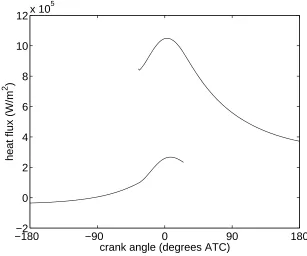
inthisreportasFig.6to Fig.11. Comparisonsbetweenthepresent resultsand thoseofFerguson
[1] conrms that the present implementation produces the expected results. Figure 11 indicates
theheatux withintheburned and unburned zonesforthefergusoncase. Toproducetheseheat
uxresults, an additionalfunction,calcq.m (AppendixJ) isusedto post-processthe results.
The indicated mean eective pressurefrom the current calculations is 0.95278MPa whereas F
er-guson[1 ]obtainsavalueof0.95102MPa{adierenceofaround0.2%. Errorsintheconservation
of mass(error1) andenergy (error2)are around0.04%forthecurrentcalculations.
7 Conclusions
A numberof Matlabfunctions andscript leshavebeenwrittento simulate thethermodynamics
of spark ignition internal combustion engines, based on the various FORTRAN codes described
[image:13.595.136.446.85.337.2]−180
0
−90
0
90
180
500
1000
1500
2000
2500
3000
crank angle (degrees ATC)
temperature (K)
burned gas
unburned gas
Figure7: Temperature fromahrind.m(lines)and Ferguson [1 ](symbols).
−180
−90
0
90
180
−300
−150
0
150
300
450
600
crank angle (degrees ATC)
[image:14.595.138.445.110.353.2] [image:14.595.141.444.456.696.2]−180
−90
0
90
180
−50
0
50
100
150
200
250
300
crank angle (degrees ATC)
heat transfer (J)
Figure 9: Heat transferfrom ahrind.m(line) andFerguson[1 ] (symbols).
−180
−8
−90
0
90
180
−7
−6
−5
−4
−3
−2
−1
0
crank angle (degrees ATC)
[image:15.595.138.446.107.352.2] [image:15.595.139.446.451.703.2]−180
−2
−90
0
90
180
0
2
4
6
8
10
12
x 10
5
crank angle (degrees ATC)
heat flux (W/m
2
)
Figure 11: Heatux resultsfromahrind.m.
The accuracy of thecurve coeÆcientsthat areused to describe thethermodynamicproperties of
the fuel, air, and combustion products has been established through internal consistency checks
and comparisons to well established properties at the reference conditions, T = 298:15K and
p = 101:325kPa. Based on these results, it is concluded that the fundamental thermodynamic
propertiesof thefuel,air,and combustion productspeciesareinagreement withpreviously
pub-lished resultsto withinthe scatterof those results{typicallylessthan 1%.
The accuracy of the Matlab equilibrium combustion products routine was established through
comparison with a comparable FORTRAN routine (Turns [7 ]) which has been revised over a
numberof years. Maximum dierences inmolar concentrations of less than 0.2%were typically
apparentovertherangeofconditionscalculatedbythetworoutines. Adiabaticametemperature
calculations also conrmed that dierences between the new Matlab routines and established
resultsaretypicallylessthanthe round-oerrors intheestablishedresults{ around0.05%.
ComparisonofanexampleenginecalculationusingthenewMatlabroutinesandtheoriginalresults
obtainedbyFerguson[1 ]demonstratesthatroutinesproduceaccurateresults. Theindicatedmean
eective pressurecalculatedbythetwo methodsdiersbyaround0.2%.
References
[1] C. R. Ferguson, Internal Combustion Engines, Applied Thermosciences, John Wiley and
Sons,New York,1986.
[2] S. Gordon and B. J. McBride, \Computer Program for Calculation of Complex Chemical
[image:16.595.138.445.84.340.2]Chapman-[3] \JANAFThermochemicalTables", U.S NationalBureauof StandardsPublications
NSRDS-NBS37,June 1971.
[4] R. J. Kee, F. M. Rupley, and J. A. Miller, \The Chemkin Thermodynamic Data Base",
SandiaReportSAND87-8215B, March 1991.
[5] J.B. Heywood, Internal Combustion EngineFundamentals, McGraw-Hill,New York,1988.
[6] R.Stone, Introduction toInternal Combustion Engines, MacmillanPress,Basingstoke, third
edition,1999.
[7] S.R.Turns, An Introduction toCombustion, Concepts and Applications, McGraw-Hill,New
York, 1996.
[8] R.R.Raine, \ISIS_319UserManual,computermodellingofnitricoxideformationinaspark
ignitionengine", Report, Revision3,Oxford Engine Group,October2000.
[9] S. D. Hires, A. Ekchian, J. B. Heywood, R. J. Tabaczynski, and J. C. Wall, \Performance
andNOxEmissionsModelingofaJetIgnitionPre-ChamberStratiedChargeEngine", SAE
Transactions, vol. 85,Paper760161, 1976.
[10] C. Olikaraand G. L.Borman, \Calculating Properties of EquilibriumCombustion Products
withSome Applicationsto I.C.Engines", SAEPaper750468, 1975.
[11] G.Woschni, \A UniversallyApplicableEquation fortheInstantaneousHeatTransfer
A airdata.m
function A=airdata(scheme);
%
% A=airdata(scheme)
%
% Routine to specify the thermodynamic properties of air and
% combustion products.
% Data taken from:
% 1. Gordon, S., and McBride, B. J., 1971, "Computer Program for
% Calculation of Complex Chemical Equilibrium Composition, Rocket
% Performance, Incident and Reflected Shocks, and Chapman-Jouguet
% Detonations," NASA SP-273. As reported in Ferguson, C. R., 1986,
% "Internal Combustion Engines", Wiley.
% 2. Kee, R. J., et al., 1991, "The Chemkin Thermodynamic Data Base",
% Sandia Report, SAND87-8215B. As reported in
% Turns, S. R., 1996, "An Introduction to Combustion:
% Concepts and Applications", McGraw-Hill.
% ********************************************************************
% input:
% scheme switch:
% 'GMcB_low' - Gordon and McBride 300 < T < 1000 K
% 'GMcB_hi' - Gordon and McBride 1000 < T < 5000 K
% 'Chemkin_low' - Chemkin 300 < T < 1000 K
% 'Chemkin_hi' - Chemkin 1000 < T < 5000 K
% output:
% A - matrix of polynomial coefficients for cp/R, h/RT, and s/R
% of the form h/RT=a1+a2*T/2+a3*T^2/3+a4*T^3/4+a5*T^4/5*a6/T (for
% example) where T is expressed in K
% columns 1 to 7 are coefficients a1 to a7, and
% rows 1 to 10 are species CO2 H2O N2 O2 CO H2 H O OH and NO
% ********************************************************************
switch scheme
case 'GMcB_low'
A=[ 0.24007797E+01 0.87350957E-02 -0.66070878E-05 0.20021861E-08 ...
0.63274039E-15 -0.48377527E+05 0.96951457E+01
0.40701275E+01 -0.11084499E-02 0.41521180E-05 -0.29637404E-08 ...
0.80702103E-12 -0.30279722E+05 -0.32270046E+00
0.36748261E+01 -0.12081500E-02 0.23240102E-05 -0.63217559E-09 ...
-0.22577253E-12 -0.10611588E+04 0.23580424E+01
0.36255985E+01 -0.18782184E-02 0.70554544E-05 -0.67635137E-08 ...
0.21555993E-11 -0.10475226E+04 0.43052778E+01
0.37100928E+01 -0.16190964E-02 0.36923594E-05 -0.20319674E-08 ...
0.23953344E-12 -0.14356310E+05 0.29555350E+01
0.30574451E+01 0.26765200E-02 -0.58099162E-05 0.55210391E-08 ...
-0.18122739E-11 -0.98890474E+03 -0.22997056E+01
0.29464287E+01 -0.16381665E-02 0.24210316E-05 -0.16028432E-08 ...
0.38906964E-12 0.29147644E+05 0.29639949E+01
0.38375943E+01 -0.10778858E-02 0.96830378E-06 0.18713972E-09 ...
-0.22571094E-12 0.36412823E+04 0.49370009E+00
0.40459521E+01 -0.34181783E-02 0.79819190E-05 -0.61139316E-08 ...
0.15919076E-11 0.97453934E+04 0.29974988E+01];
case 'GMcB_hi'
A=[ 0.44608041E+01 0.30981719E-02 -0.12392571E-05 0.22741325E-09 ...
-0.15525954E-13 -0.48961442E+05 -0.98635982E+00
0.27167633E+01 0.29451374E-02 -0.80224374E-06 0.10226682E-09 ...
-0.48472145E-14 -0.29905826E+05 0.66305671E+01
0.28963194E+01 0.15154866E-02 -0.57235277E-06 0.99807393E-10 ...
-0.65223555E-14 -0.90586184E+03 0.61615148E+01
0.36219535E+01 0.73618264E-03 -0.19652228E-06 0.36201558E-10 ...
-0.28945627E-14 -0.12019825E+04 0.36150960E+01
0.29840696E+01 0.14891390E-02 -0.57899684E-06 0.10364577E-09 ...
-0.69353550E-14 -0.14245228E+05 0.63479156E+01
0.31001901E+01 0.51119464E-03 0.52644210E-07 -0.34909973E-10 ...
0.36945345E-14 -0.87738042E+03 -0.19629421E+01
0.25000000E+01 0.00000000E+00 0.00000000E+00 0.00000000E+00 ...
0.00000000E+00 0.25471627E+05 -0.46011763E+00
0.25420596E+01 -0.27550619E-04 -0.31028033E-08 0.45510674E-11 ...
-0.43680515E-15 0.29230803E+05 0.49203080E+01
0.29106427E+01 0.95931650E-03 -0.19441702E-06 0.13756646E-10 ...
0.14224542E-15 0.39353815E+04 0.54423445E+01
0.31890000E+01 0.13382281E-02 -0.52899318E-06 0.95919332E-10 ...
-0.64847932E-14 0.98283290E+04 0.67458126E+01];
case 'Chemkin_low'
A=[ 0.02275724E+02 0.09922072E-01 -0.10409113E-04 0.06866686E-07 ...
-0.02117280E-10 -0.04837314E+06 0.10188488E+02
0.03386842E+02 0.03474982E-01 -0.06354696E-04 0.06968581E-07 ...
-0.02506588E-10 -0.03020811E+06 0.02590232E+02
0.03298677E+02 0.14082404E-02 -0.03963222E-04 0.05641515E-07 ...
-0.02444854E-10 -0.10208999E+04 0.03950372E+02
0.03212936E+02 0.11274864E-02 -0.05756150E-05 0.13138773E-08 ...
-0.08768554E-11 -0.10052490E+04 0.06034737E+02
0.03262451E+02 0.15119409E-02 -0.03881755E-04 0.05581944E-07 ...
-0.02474951E-10 -0.14310539E+05 0.04848897E+02
0.03298124E+02 0.08249441E-02 -0.08143015E-05 -0.09475434E-09 ...
0.04134872E-11 -0.10125209E+04 -0.03294094E+02
0.02500000E+02 0.00000000E+00 0.00000000E+00 0.00000000E+00 ...
0.00000000E+00 0.02547162E+06 -0.04601176E+01
0.02946428E+02 -0.16381665E-02 0.02421031E-04 -0.16028431E-08 ...
0.03890696E-11 0.02914764E+06 0.02963995E+02
0.03637266E+02 0.01850910E-02 -0.16761646E-05 0.02387202E-07 ...
-0.08431442E-11 0.03606781E+05 0.13588605E+01
0.03376541E+02 0.12530634E-02 -0.03302750E-04 0.05217810E-07 ...
-0.02446262E-10 0.09817961E+05 0.05829590E+02];
-0.16690333E-13 -0.04896696E+06 -0.09553959E+01
0.02672145E+02 0.03056293E-01 -0.08730260E-05 0.12009964E-09 ...
-0.06391618E-13 -0.02989921E+06 0.06862817E+02
0.02926640E+02 0.14879768E-02 -0.05684760E-05 0.10097038E-09 ...
-0.06753351E-13 -0.09227977E+04 0.05980528E+02
0.03697578E+02 0.06135197E-02 -0.12588420E-06 0.01775281E-09 ...
-0.11364354E-14 -0.12339301E+04 0.03189165E+02
0.03025078E+02 0.14426885E-02 -0.05630827E-05 0.10185813E-09 ...
-0.06910951E-13 -0.14268350E+05 0.06108217E+02
0.02991423E+02 0.07000644E-02 -0.05633828E-06 -0.09231578E-10 ...
0.15827519E-14 -0.08350340E+04 -0.13551101E+01
0.02500000E+02 0.00000000E+00 0.00000000E+00 0.00000000E+00 ...
0.00000000E+00 0.02547162E+06 -0.04601176E+01
0.02542059E+02 -0.02755061E-03 -0.03102803E-07 0.04551067E-10 ...
-0.04368051E-14 0.02923080E+06 0.04920308E+02
0.02882730E+02 0.10139743E-02 -0.02276877E-05 0.02174683E-09 ...
-0.05126305E-14 0.03886888E+05 0.05595712E+02
0.03245435E+02 0.12691383E-02 -0.05015890E-05 0.09169283E-09 ...
-0.06275419E-13 0.09800840E+05 0.06417293E+02];
end
B fueldata.m
function [alpha,beta,gamma,delta,Afuel]=fueldata(fuel);
%
% [alpha,beta,gamma,delta,Afuel]=fueldata(fuel)
%
% Routine to specify the thermodynamic properties of a fuel.
% Data taken from:
% 1. Ferguson, C.R., 1986, "Internal Combustion Engines", Wiley;
% 2. Heywood, J.B., 1988, "Internal Combustion Engine Fundamentals",
% McGraw-Hill; and
% 3. Raine, R. R., 2000, "ISIS_319 User Manual", Oxford Engine Group.
% ********************************************************************
% input:
% fuel switch
% from Ferguson: 'gasoline', 'diesel', 'methane', 'methanol',
% 'nitromethane', 'benzene';
% from Heywood: 'methane_h', 'propane', 'hexane', 'isooctane_h',
% 'methanol_h', 'ethanol', 'gasoline_h1', gasoline_h2', 'diesel_h';
% from Raine: 'toluene', 'isooctane'.
% output:
% alpha, beta, gamma, delta - number of C, H, 0, and N atoms
% Afuel - vector of polynomial coefficients for cp/R, h/RT, and s/R
% of the form h/RT=a1+a2*T/2+a3*T^2/3+a4*T^3/4-a5/T^2+a6/T (for
% Set values for conversion of Heywood data to nondimensional format
% with T expressed in K
SVal=4.184e3/8.31434;
SVec=SVal*[1e-3 1e-6 1e-9 1e-12 1e3 1 1];
switch fuel
case 'gasoline' % Ferguson
alpha=7; beta=17; gamma=0; delta=0;
Afuel=[4.0652 6.0977E-02 -1.8801E-05 0 0 -3.5880E+04 15.45];
case 'diesel' % Ferguson
alpha=14.4; beta=24.9; gamma=0; delta=0;
Afuel=[7.9710 1.1954E-01 -3.6858E-05 0 0 -1.9385E+04 -1.7879];
case 'methane' % Ferguson
alpha=1; beta=4; gamma=0; delta=0;
Afuel=[1.971324 7.871586E-03 -1.048592E-06 0 0 -9.930422E+03 8.873728];
case 'methanol' % Ferguson
alpha=1; beta=4; gamma=1; delta=0;
Afuel=[1.779819 1.262503E-02 -3.624890E-06 0 0 -2.525420E+04 1.50884E+01];
case 'nitromethane' % Ferguson
alpha=1; beta=3; gamma=2; delta=1;
Afuel=[1.412633 2.087101E-02 -8.142134E-06 0 0 -1.026351E+04 1.917126E+01];
case 'benzene' % Ferguson
alpha=6; beta=6; gamma=0; delta=0;
Afuel=[-2.545087 4.79554E-02 -2.030765E-05 0 0 8.782234E+03 3.348825E+01];
case 'toluene' % Raine
alpha=7; beta=8; gamma=0; delta=0;
Afuel=[-2.09053 5.654331e-2 -2.350992e-5 0 0 4331.441411 34.55418257];
case 'isooctane' % Raine
alpha=8; beta=18; gamma=0; delta=0;
Afuel=[6.678E-1 8.398E-2 -3.334E-5 0 0 -3.058E+4 2.351E+1];
case 'methane_h' % Heywood
alpha=1; beta=4; gamma=0; delta=0;
Afuel=[-0.29149 26.327 -10.610 1.5656 0.16573 -18.331 19.9887/SVal].*SVec;
case 'propane' % Heywood
alpha=3; beta=8; gamma=0; delta=0;
Afuel=[-1.4867 74.339 -39.065 8.0543 0.01219 -27.313 26.4796/SVal].*SVec;
case 'hexane' % Heywood
alpha=6; beta=14; gamma=0; delta=0;
Afuel=[-20.777 210.48 -164.125 52.832 0.56635 -39.836 79.5542/SVal].*SVec;
case 'isooctane_h' % Heywood
alpha=8; beta=18; gamma=0; delta=0;
Afuel=[-0.55313 181.62 -97.787 20.402 -0.03095 -60.751 27.2162/SVal].*SVec;
case 'methanol_h' % Heywood
alpha=1; beta=4; gamma=1; delta=0;
Afuel=[-2.7059 44.168 -27.501 7.2193 0.20299 -48.288 31.1406/SVal].*SVec;
case 'ethanol' % Heywood
alpha=2; beta=6; gamma=1; delta=0;
Afuel=[6.990 39.741 -11.926 0 0 -60.214 8.01623/SVal].*SVec;
Afuel=[-24.078 256.63 -201.68 64.750 0.5808 -27.562 NaN].*SVec;
case 'gasoline_h2' % Heywood
alpha=7.76; beta=13.1; gamma=0; delta=0;
Afuel=[-22.501 227.99 -177.26 56.048 0.4845 -17.578 NaN].*SVec;
case 'diesel_h' % Heywood
alpha=10.8; beta=18.7; gamma=0; delta=0;
Afuel=[-9.1063 246.97 -143.74 32.329 0.0518 -50.128 NaN].*SVec;
end
C farg.m
function [h,u,v,s,Y,cp,dlvlT,dlvlp]=farg(p,T,phi,f,fueltype,airscheme);
%
% [h,u,v,s,Y,cp,dlvlT,dlvlp]=farg(p,T,phi,f,fueltype,airscheme)
%
% Routine to determine the state of mixtures of fuel, air
% and residual combustion products at low temperatures.
% Method closely follows that of:
% 1. Ferguson, C.R., 1986, "Internal Combustion Engines", Wiley, p108;
% who uses the results of:
% 2. Hires, S.D., Ekchian, A., Heywood, J.B., Tabaczynski, R.J., and
% Wall, J.C., 1976, "Performance and NOx Emissions Modeling of a Jet
% Ignition Pre-Chamber Stratified Charge Engine", SAE Trans., Vol 85,
% Paper 760161.
% ********************************************************************
% input:
% p,T,phi - pressure (Pa), temperature (K), and equivalence ratio
% f - residual mass fraction; set f=0 if no combustion products
% are present and f=1 if only combustion products are present
% fueltype - 'gasoline', 'diesel', etc - see fueldata.m for full list
% airscheme - 'GMcB' (Gordon and McBride) or 'Chemkin'
% output:
% h - enthalpy (J/kg), u - internal energy (J/kg),
% v - specific volume (m^3/kg), s - entropy (J/kgK),
% Y - mole fractions of 6 species: CO2, H2O, N2, O2, CO, and H2,
% cp - specific heat (J/kgK),
% dlvlT - partial derivative of log(v) wrt log(T)
% dlvlp - partial derivative of log(v) wrt log(p)
% ********************************************************************
[alpha,beta,gamma,delta,Afuel]=fueldata(fueltype);
switch airscheme
case 'GMcB'
A=airdata('GMcB_low');
case 'Chemkin'
Ru=8314.34; % J/kmolK
table=[-1 1 0 0 1 -1]';
M=[44.01 18.02 28.008 32.000 28.01 2.018]'; % kg/kmol
MinMol=1e-25;
dlvlT=1; dlvlp=-1;
eps=0.210/(alpha+0.25*beta-0.5*gamma);
if phi <= 1.0 % stoichiometric or lean
nu=[alpha*phi*eps beta*phi*eps/2 0.79+delta*phi*eps/2 ...
0.21*(1-phi) 0 0]';
dcdT=0;
else % rich
z=1000/T;
K=exp(2.743+z*(-1.761+z*(-1.611+z*0.2803)));
dKdT=-K*(-1.761+z*(-3.222+z*0.8409))/1000;
a=1-K;
b=0.42-phi*eps*(2*alpha-gamma)+K*(0.42*(phi-1)+alpha*phi*eps);
c=-0.42*alpha*phi*eps*(phi-1)*K;
nu5=(-b+sqrt(b^2-4*a*c))/2/a;
dcdT=dKdT*(nu5^2-nu5*(0.42*(phi-1)+alpha*phi*eps)+ ...
0.42*alpha*phi*eps*(phi-1))/(2*nu5*a+b);
nu=[alpha*phi*eps-nu5 0.42-phi*eps*(2*alpha-gamma)+nu5 ...
0.79+delta*phi*eps/2 0 nu5 0.42*(phi-1)-nu5]';
end
% mole fractions and molecular weight of residual
tmoles=sum(nu);
Y=nu/tmoles;
Mres=sum(Y.*M);
% mole fractions and molecular weight of fuel-air
fuel=eps*phi/(1+eps*phi);
o2=0.21/(1+eps*phi);
n2=0.79/(1+eps*phi);
Mfa=fuel*(12.01*alpha+1.008*beta+16*gamma+14.01*delta)+ ...
32*o2+28.02*n2;
% mole fractions of fuel-air-residual gas
Yres=f/(f+Mres/Mfa*(1-f));
Y=Y*Yres;
Yfuel=fuel*(1-Yres);
Y(3)=Y(3)+n2*(1-Yres);
Y(4)=Y(4)+o2*(1-Yres);
% component properties
Tcp0=[1 T T^2 T^3 T^4]';
cp0=A(1:6,1:5)*Tcp0;
h0=A(1:6,1:6)*Th0;
s0=A(1:6,[1:5 7])*Ts0;
Mfuel=12.01*alpha+1.008*beta+16.000*gamma+14.01*delta;
a0=Afuel(1); b0=Afuel(2); c0=Afuel(3); d0=Afuel(6); e0=Afuel(7);
cpfuel=Afuel(1:5)*[1 T T^2 T^3 1/T^2]';
hfuel=Afuel(1:6)*[1 T/2 T^2/3 T^3/4 -1/T^2 1/T]';
s0fuel=Afuel([1:5 7])*[log(T) T T^2/2 T^3/3 -1/T^2/2 1]';
% set min value of composition so log calculations work
if Yfuel<MinMol
Yfuel=MinMol;
end
i=find(Y<MinMol);
Y(i)=ones(length(i),1)*MinMol;
% properties of mixture
h=hfuel*Yfuel+sum(h0.*Y);
s=(s0fuel-log(Yfuel))*Yfuel+sum((s0-log(Y)).*Y);
cp=cpfuel*Yfuel+sum(cp0.*Y)+sum(h0.*table*T*dcdT*Yres/tmoles);
MW=Mfuel*Yfuel+sum(Y.*M);
R=Ru/MW;
h=R*T*h;
u=h-R*T;
v=R*T/p;
s=R*(-log(p/101.325e3)+s);
cp=R*cp;
D ecp.m
function [h,u,v,s,Y,cp,dlvlT,dlvlp]=ecp(p,T,phi,fueltype,airscheme,Yguess);
%
% [h,u,v,s,Y,cp,dlvlT,dlvlp]=ecp(p,T,phi,fueltype,airscheme,Yguess)
%
% Routine to determine the equilibrium state of combustion products.
% Method closely follows that of:
% 1. Ferguson, C.R., 1986, "Internal Combustion Engines", Wiley, p122;
% which uses the method described by:
% 2. Olikara, C., and Borman, G.L., 1975, "A Computer Program for
% Calculating Properties of Equilibrium Combustion Products with
% Some Applications to I.C. Engines", SAE Paper 750468.
% ********************************************************************
% input:
% p,T,phi - pressure (Pa), temperature (K), and equivalence ratio
% fueltype - 'gasoline', 'diesel', etc - see fueldata.m for full list
% species CO2 H2O N2 O2 CO H2 H O OH and NO
% output:
% h - enthalpy (J/kg), u - internal energy (J/kg),
% v - specific volume (m^3/kg), s - entropy (J/kgK),
% Y - mole fractions of 10 species, cp - specific heat (J/kgK),
% dlvlT - partial derivative of log(v) wrt log(T)
% dlvlp - partial derivative of log(v) wrt log(p)
% ********************************************************************
[alpha,beta,gamma,delta,Afuel]=fueldata(fueltype);
switch airscheme
case 'GMcB'
A0=airdata('GMcB_hi');
case 'Chemkin'
A0=airdata('Chemkin_hi');
end
% Equilibrium constant data from Olikara and Borman via Ferguson
Kp=[ 0.432168E+00 -0.112464E+05 0.267269E+01 -0.745744E-04 0.242484E-08
0.310805E+00 -0.129540E+05 0.321779E+01 -0.738336E-04 0.344645E-08
-0.141784E+00 -0.213308E+04 0.853461E+00 0.355015E-04 -0.310227E-08
0.150879E-01 -0.470959E+04 0.646096E+00 0.272805E-05 -0.154444E-08
-0.752364E+00 0.124210E+05 -0.260286E+01 0.259556E-03 -0.162687E-07
-0.415302E-02 0.148627E+05 -0.475746E+01 0.124699E-03 -0.900227E-08];
MinMol=1e-25;
tol=3e-12;
Ru=8314.34; % J/kmol.K
M=[44.01 18.02 28.008 32.000 28.01 2.018 1.009 16 17.009 30.004]'; % kg/kmol
dcdT=zeros(4,1);
dcdp=zeros(4,1);
dfdT=zeros(4,1);
dfdp=zeros(4,1);
dYdT=zeros(10,1);
dYdp=zeros(10,1);
B=zeros(4,1);
% check if solid carbon will form
eps=0.210/(alpha+0.25*beta-0.5*gamma);
if phi>(0.210/eps/(0.5*alpha-0.5*gamma))
error('phi too high - c(s) and other species will form');
end
if nargin==5 % no Yguess so estimate the composition using farg
[h,u,v,s,Y,cp,dlvlT,dlvlp]=farg(p,T,phi,1,fueltype,airscheme);
Y(7:10)=ones(4,1)*MinMol; % since farg only returns first 6 species
end
% evaluate constants
patm=p/101.325e3; % convert Pa to atmospheres
TKp=[log(T/1000) 1/T 1 T T^2]';
K=10.^(Kp*TKp);
c=K.*[1/sqrt(patm) 1/sqrt(patm) 1 1 sqrt(patm) sqrt(patm)]';
d=[beta/alpha (gamma+0.42/eps/phi)/alpha (delta+1.58/eps/phi)/alpha]';
if abs(phi-1)<tol
phi=phi*(1+tol*sign(phi-1));
end
i=find(Y<MinMol);
Y(i)=ones(length(i),1)*MinMol;
DY3to6=2*tol*ones(4,1);
MaxIter=500;
MaxVal=max(abs(DY3to6));
Iter=0;
DoneSome=0;
while (Iter<MaxIter)&((MaxVal>tol)|(DoneSome<1))
Iter=Iter+1;
if Iter>2,
DoneSome=1;
end
D76=0.5*c(1)/sqrt(Y(6));
D84=0.5*c(2)/sqrt(Y(4));
D94=0.5*c(3)*sqrt(Y(6)/Y(4));
D96=0.5*c(3)*sqrt(Y(4)/Y(6));
D103=0.5*c(4)*sqrt(Y(4)/Y(3));
D104=0.5*c(4)*sqrt(Y(3)/Y(4));
D24=0.5*c(5)*Y(6)/sqrt(Y(4));
D26=c(5)*sqrt(Y(4));
D14=0.5*c(6)*Y(5)/sqrt(Y(4));
D15=c(6)*sqrt(Y(4));
A(1,1)=1+D103;
A(1,2)=D14+D24+1+D84+D104+D94;
A(1,3)=D15+1;
A(1,4)=D26+1+D76+D96;
A(2,1)=0;
A(2,2)=2*D24+D94-d(1)*D14;
A(2,3)=-d(1)*D15-d(1);
A(2,4)=2*D26+2+D76+D96;
A(3,1)=D103;
A(3,2)=2*D14+D24+2+D84+D94+D104-d(2)*D14;
A(4,1)=2+D103;
A(4,2)=D104-d(3)*D14;
A(4,3)=-d(3)*D15-d(3);
A(4,4)=0;
B(1)=-(sum(Y)-1);
B(2)=-(2*Y(2)+2*Y(6)+Y(7)+Y(9)-d(1)*Y(1)-d(1)*Y(5));
B(3)=-(2*Y(1)+Y(2)+2*Y(4)+Y(5)+Y(8)+Y(9)+Y(10)-d(2)*Y(1)-d(2)*Y(5));
B(4)=-(2*Y(3)+Y(10)-d(3)*Y(1)-d(3)*Y(5));
invA=inv(A);
DY3to6=invA*B;
MaxVal=max(abs(DY3to6));
Y(3:6)=Y(3:6)+DY3to6/10;
i=find(Y<MinMol);
Y(i)=ones(length(i),1)*MinMol;
Y(7)=c(1)*sqrt(Y(6));
Y(8)=c(2)*sqrt(Y(4));
Y(9)=c(3)*sqrt(Y(4)*Y(6));
Y(10)=c(4)*sqrt(Y(4)*Y(3));
Y(2)=c(5)*sqrt(Y(4))*Y(6);
Y(1)=c(6)*sqrt(Y(4))*Y(5);
end
if Iter>=MaxIter
warning('convergence failure in composition loop');
end
TdKdT=[1/T -1/T^2 1 2*T]';
dKdT=2.302585*K.*(Kp(:,[1 2 4 5])*TdKdT);
dcdT(1)=dKdT(1)/sqrt(patm);
dcdT(2)=dKdT(2)/sqrt(patm);
dcdT(3)=dKdT(3);
dcdT(4)=dKdT(4);
dcdT(5)=dKdT(5)*sqrt(patm);
dcdT(6)=dKdT(6)*sqrt(patm);
dcdp(1)=-0.5*c(1)/p;
dcdp(2)=-0.5*c(2)/p;
dcdp(5)=0.5*c(5)/p;
dcdp(6)=0.5*c(6)/p;
x1=Y(1)/c(6);
x2=Y(2)/c(5);
x7=Y(7)/c(1);
x8=Y(8)/c(2);
x9=Y(9)/c(3);
x10=Y(10)/c(4);
dfdT(1)=dcdT(6)*x1+dcdT(5)*x2+dcdT(1)*x7+dcdT(2)*x8+ ...
dcdT(3)*x9+dcdT(4)*x10;
dcdT(4)*x10-d(2)*dcdT(6)*x1;
dfdT(4)=dcdT(4)*x10-d(3)*dcdT(6)*x1;
dfdp(1)=dcdp(6)*x1+dcdp(5)*x2+dcdp(1)*x7+dcdp(2)*x8;
dfdp(2)=2*dcdp(5)*x2+dcdp(1)*x7-d(1)*dcdp(6)*x1;
dfdp(3)=2*dcdp(6)*x1+dcdp(5)*x2+dcdp(2)*x8-d(2)*dcdp(6)*x1;
dfdp(4)=-d(3)*dcdp(6)*x1;
B=-dfdT;
dYdT(3:6)=invA*B;
dYdT(1)=sqrt(Y(4))*Y(5)*dcdT(6)+D14*dYdT(4)+D15*dYdT(5);
dYdT(2)=sqrt(Y(4))*Y(6)*dcdT(5)+D24*dYdT(4)+D26*dYdT(6);
dYdT(7)=sqrt(Y(6))*dcdT(1)+D76*dYdT(6);
dYdT(8)=sqrt(Y(4))*dcdT(2)+D84*dYdT(4);
dYdT(9)=sqrt(Y(4)*Y(6))*dcdT(3)+D94*dYdT(4)+D96*dYdT(6);
dYdT(10)=sqrt(Y(4)*Y(3))*dcdT(4)+D104*dYdT(4)+D103*dYdT(3);
B=-dfdp;
dYdp(3:6)=invA*B;
dYdp(1)=sqrt(Y(4))*Y(5)*dcdp(6)+D14*dYdp(4)+D15*dYdp(5);
dYdp(2)=sqrt(Y(4))*Y(6)*dcdp(5)+D24*dYdp(4)+D26*dYdp(6);
dYdp(7)=sqrt(Y(6))*dcdp(1)+D76*dYdp(6);
dYdp(8)=sqrt(Y(4))*dcdp(2)+D84*dYdp(4);
dYdp(9)=D94*dYdp(4)+D96*dYdp(6);
dYdp(10)=D104*dYdp(4)+D103*dYdp(3);
% calculate thermodynamic properties
Tcp0=[1 T T^2 T^3 T^4]';
Th0=[1 T/2 T^2/3 T^3/4 T^4/5 1/T]';
Ts0=[log(T) T T^2/2 T^3/3 T^4/4 1]';
cp0=A0(:,1:5)*Tcp0;
h0=A0(:,1:6)*Th0;
s0=A0(:,[1:5 7])*Ts0;
% Y(1) and Y(2) reevaluated
Y(1)=(2*Y(3)+Y(10))/d(3)-Y(5);
Y(2)=(d(1)/d(3)*(2*Y(3)+Y(10))-2*Y(6)-Y(7)-Y(9))/2;
i=find(Y<MinMol);
Y(i)=ones(length(i),1)*MinMol;
% properties of mixture
h=sum(h0.*Y);
s=sum((s0-log(Y)).*Y);
cp=sum(Y.*cp0+h0.*dYdT*T);
MW=sum(Y.*M);
MT=sum(dYdT.*M);
Mp=sum(dYdp.*M);
R=Ru/MW;
dlvlT=1+max(-T*MT/MW,0);
dlvlp=-1-max(p*Mp/MW,0);
h=R*T*h;
s=R*(-log(patm)+s);
u=h-R*T;
E Tadiabatic.m
function Tb=Tadiabatic(p,Tu,phi,f,fueltype,airscheme);
%
% Tb=Tadiabatic(p,Tu,phi,f,fueltype,airscheme)
%
% Routine for calculating the adiabatic flame temperature.
% Method involves iteratively selecting flame temperatures until
% the enthalpy of the combustion products (in equilibrium) matches
% the enthalpy of the initial gas mixture.
% farg.m is used to determine the enthalpy of the unburned mixture,
% and ecp.m is used to determine the enthalpy of the burned gas.
% ********************************************************************
% input:
% p - pressure (Pa)
% Tu - temperature of the unburned mixture (K)
% phi - equivalence ratio
% f - residual mass fraction; set f=0 if no combustion products
% are present and f=1 if only combustion products are present
% fueltype - 'gasoline', 'diesel', etc - see fueldata.m for full list
% airscheme - 'GMcB' (Gordon and McBride) or 'Chemkin'
% output:
% Tb - temperature of the burned gas (K) - adiabatic flame temperature
% ********************************************************************
MaxIter=50;
Tol=0.00001; % 0.001% allowable error in temperature calculation
Tb=2000; % initial estimate
DeltaT=2*Tol*Tb; % something big
Iter=0;
[hu,u,v,s,Y,cp,dlvlT,dlvlp]=farg(p,Tu,phi,f,fueltype,airscheme);
while (Iter<MaxIter)&(abs(DeltaT/Tb)>Tol)
Iter=Iter+1;
[hb,u,v,s,Y,cp,dlvlT,dlvlp]=ecp(p,Tb,phi,fueltype,airscheme);
DeltaT=(hu-hb)/cp;
Tb=Tb+DeltaT;
end
if Iter>=MaxIter
F enginedata.m
% enginedata.m
%
% Script file used by the function ahrind.m to
% define the engine properties and initial conditions
% ***** engine geometry **********************************************
b=0.1; % engine bore (m)
stroke=0.08; % engine stroke (m)
eps=0.25; % half stroke to rod ratio, s/2l
r=10; % compression ratio
Vtdc=pi/4*b^2*stroke/(r-1); % volume at TDC
Vbdc=pi/4*b^2*stroke+Vtdc; % volume at BDC
% ***** engine thermofluids parameters *******************************
Cblowby=0.8; % piston blowby constant (s^-1)
f=0.1; % residual fraction
fueltype='gasoline';
airscheme='GMcB';
phi=0.8; % equivalence ratio
thetas=-35*pi/180; % start of burning
thetab=60*pi/180; % burn duration angle
RPM=2000;
omega=RPM*pi/30; % engine speed in rad/s
heattransferlaw='constant'; % 'constant', or 'Woschni'
hcu=500; % unburned zone heat transfer coefficient/weighting
hcb=500; % burned zone heat transfer coefficient/weighting
Tw=420; % engine surface temperature
% ***** initial conditions *******************************************
p1=100e3;
T1=350;
theta1=-pi;
V1=Vbdc;
[h1,u1,v1,s1,Y1,cp1,dlvlT1,dlvlp1]=farg(p1,T1,phi,f,fueltype,airscheme);
mass1=Vbdc/v1;
U1=u1*mass1;
G RatesComp.m & RatesComb.m & RatesExp.m
function yprime=RatesComp(theta,y,flag);
%
% yprime=RatesComp(theta,y,flag)
%
% 1) pressure; 2) unburned temperature;
% 3) work; 4) heat transfer; and 5) heat leakage.
% See Ferguson, C.R., 1986, "Internal Combustion Engines", Wiley,
% p174.
global b stroke eps r Cblowby f fueltype airscheme phi ...
thetas thetab omega ...
heattransferlaw hcu ...
Tw theta1 Vtdc mass1 ...
p=y(1);
Tu=y(2);
yprime=zeros(5,1);
% mass in cylinder accounting for blowby:
mass=mass1*exp(-Cblowby*(theta-theta1)/omega);
% volume of cylinder:
V=Vtdc*(1+(r-1)/2*(1-cos(theta)+ ...
1/eps*(1-(1-eps^2*sin(theta).^2).^0.5)));
% derivate of volume:
dVdtheta=Vtdc*(r-1)/2*(sin(theta)+ ...
eps/2*sin(2*theta)./sqrt(1-eps^2*sin(theta).^2));
switch heattransferlaw
case 'constant'
hcoeff=hcu;
case 'Woschni'
upmean=omega*stroke/pi; % mean piston velocity
C1=2.28;
hcoeff=hcu*130*b^(-0.2)*Tu^(-0.53)*(p/100e3)^(0.8)*C1*upmean;
end
A=1/mass*(dVdtheta+V*Cblowby/omega);
Qconv=hcoeff*(pi*b^2/2+4*V/b)*(Tu-Tw);
Const1=1/omega/mass;
[h,u,v,s,Y,cp,dlvlT,dlvlp]=farg(p,Tu,phi,f,fueltype,airscheme);
B=Const1*v/cp*dlvlT*Qconv/Tu; % note typo on p174, eq. 4.76
C=0;
D=0;
E=v^2/cp/Tu*dlvlT^2+v/p*dlvlp;
yprime(1)=(A+B+C)/(D+E);
yprime(2)=-Const1/cp*Qconv+v/cp*dlvlT*yprime(1);
yprime(3)=p*dVdtheta;
yprime(4)=Qconv/omega;
%
% yprime=RatesComb(theta,y,flag)
%
% Function that returns the drivatives of the following 6 variables
% w.r.t. crank angle (theta) for the combustion phase:
% 1) pressure; 2) unburned temperature; 3) burned temperature;
% 4) work; 5) heat transfer; and 6) heat leakage.
% See Ferguson, C.R., 1986, "Internal Combustion Engines", Wiley,
% p174.
global b stroke eps r Cblowby f fueltype airscheme phi ...
thetas thetab RPM omega ...
heattransferlaw hcu hcb ...
p1 T1 V1 Tw theta1 Vtdc Vbdc mass1
p=y(1);
Tb=y(2);
Tu=y(3);
yprime=zeros(6,1);
% mass in cylinder accounting for blowby:
mass=mass1*exp(-Cblowby*(theta-theta1)/omega);
% volume of cylinder:
V=Vtdc*(1+(r-1)/2*(1-cos(theta)+ ...
1/eps*(1-(1-eps^2*sin(theta).^2).^0.5)));
% derivate of volume:
dVdtheta=Vtdc*(r-1)/2*(sin(theta)+ ...
eps/2*sin(2*theta)./sqrt(1-eps^2*sin(theta).^2));
% mass fraction burned and derivative:
x=0.5*(1-cos(pi*(theta-thetas)/thetab));
dxdtheta=pi/2/thetab*sin(pi*(theta-thetas)/thetab);
if x<0.0001, x=0.0001; end;
if x>0.9999, x=0.9999; end;
switch heattransferlaw
case 'constant'
hcoeffu=hcu;
hcoeffb=hcb;
case 'Woschni'
upmean=omega*stroke/pi; % mean piston velocity
C1=2.28;
C2=3.24e-3;
Vs=Vbdc-Vtdc;
k=1.3;
pm=p1*(V1/V)^k; % motoring pressure
hcoeffu=hcu*130*b^(-0.2)*Tu^(-0.53)*(p/100e3)^(0.8)* ...
(C1*upmean+C2*Vs*T1/p1/V1*(p-pm))^(0.8);
hcoeffb=hcb*130*b^(-0.2)*Tb^(-0.53)*(p/100e3)^(0.8)* ...
A=1/mass*(dVdtheta+V*Cblowby/omega);
Qconvu=hcoeffu*(pi*b^2/2+4*V/b)*(1-sqrt(x))*(Tu-Tw);
Qconvb=hcoeffb*(pi*b^2/2+4*V/b)*sqrt(x)*(Tb-Tw);
Const1=1/omega/mass;
[hu,uu,vu,s,Y,cpu,dlvlTu,dlvlpu]= ...
farg(p,Tu,phi,f,fueltype,airscheme);
[hb,ub,vb,s,Y,cpb,dlvlTb,dlvlpb]= ...
ecp(p,Tb,phi,fueltype,airscheme);
B=Const1*(vb/cpb*dlvlTb*Qconvb/Tb+ ...
vu/cpu*dlvlTu*Qconvu/Tu);
C=-(vb-vu)*dxdtheta-vb*dlvlTb*(hu-hb)/cpb/Tb*(dxdtheta- ...
(x-x^2)*Cblowby/omega);
D=x*(vb^2/cpb/Tb*dlvlTb^2+vb/p*dlvlpb);
E=(1-x)*(vu^2/cpu/Tu*dlvlTu^2+vu/p*dlvlpu);
yprime(1)=(A+B+C)/(D+E);
yprime(2)=-Const1/cpb/x*Qconvb+vb/cpb*dlvlTb*yprime(1)+ ...
(hu-hb)/cpb*(dxdtheta/x-(1-x)*Cblowby/omega);
yprime(3)=-Const1/cpu/(1-x)*Qconvu+vu/cpu*dlvlTu*yprime(1);
yprime(4)=p*dVdtheta;
yprime(5)=Const1*mass*(Qconvb+Qconvu);
yprime(6)=Cblowby*mass/omega*((1-x^2)*hu+x^2*hb);
function yprime=RatesExp(theta,y,flag);
%
% yprime=RatesExp(theta,y,flag)
%
% Function that returns the drivatives of the following 5 variables
% w.r.t. crank angle (theta) for the expansion phase:
% 1) pressure; 2) unburned temperature;
% 3) work; 4) heat transfer; and 5) heat leakage.
% See Ferguson, C.R., 1986, "Internal Combustion Engines", Wiley,
% p174.
global b stroke eps r Cblowby f fueltype airscheme phi ...
thetas thetab RPM omega ...
heattransferlaw hcb ...
p1 T1 V1 Tw theta1 Vtdc Vbdc mass1
p=y(1);
Tb=y(2);
yprime=zeros(5,1);
% mass in cylinder accounting for blowby:
mass=mass1*exp(-Cblowby*(theta-theta1)/omega);
1/eps*(1-(1-eps^2*sin(theta).^2).^0.5)));
% derivate of volume:
dVdtheta=Vtdc*(r-1)/2*(sin(theta)+ ...
eps/2*sin(2*theta)./sqrt(1-eps^2*sin(theta).^2));
switch heattransferlaw
case 'constant'
hcoeff=hcb;
case 'Woschni'
upmean=omega*stroke/pi; % mean piston velocity
C1=2.28;
C2=3.24e-3;
Vs=Vbdc-Vtdc;
k=1.3;
pm=p1*(V1/V)^k; % motoring pressure
hcoeff=hcb*130*b^(-0.2)*Tb^(-0.53)*(p/100e3)^(0.8)* ...
(C1*upmean+C2*Vs*T1/p1/V1*(p-pm))^(0.8);
end
A=1/mass*(dVdtheta+V*Cblowby/omega);
Qconv=hcoeff*(pi*b^2/2+4*V/b)*(Tb-Tw);
Const1=1/omega/mass;
if Tb<1000
[h,u,v,s,Y,cp,dlvlT,dlvlp]=farg(p,Tb,phi,1,fueltype,airscheme);
else
[h,u,v,s,Y,cp,dlvlT,dlvlp]=ecp(p,Tb,phi,fueltype,airscheme);
end
B=Const1*v/cp*dlvlT*Qconv/Tb;
C=0;
D=v^2/cp/Tb*dlvlT^2+v/p*dlvlp;
E=0;
yprime(1)=(A+B+C)/(D+E);
yprime(2)=-Const1/cp*Qconv+v/cp*dlvlT*yprime(1);
yprime(3)=p*dVdtheta;
yprime(4)=Qconv/omega;
yprime(5)=Cblowby*mass/omega*h;
H ahrind.m
% ahrind.m
%
% Script file to determine the performance of a fuel inducted engine
% based on a (user-specified) arbitrary heat release profile as a
% function of crank angle.
% ********************************************************************
% input:
% enginedata.m - this is another script file that defines all of the
% relevant engine parameters and operating conditions.
% output:
% ahrind.mat - this file contains all of the variables. For plotting
% the results, see the example script file plotresults.m
% ********************************************************************
timestart=cputime;
global b stroke eps r Cblowby f fueltype airscheme phi ...
thetas thetab omega ...
heattransferlaw hcu hcb ...
Tw theta1 Vtdc Vbdc mass1 ...
p1 T1 V1
% load the engine parameters and initial conditions
enginedata
switch heattransferlaw
case 'Woschni'
if (abs(hcu) > 10)|(abs(hcb) > 10),
warning('Woschni model with weighting factor > 10')
end
end
% integration parameters
dtheta=1*pi/180;
options=odeset('RelTol',1e-3);
% integration during compression phase
disp(['integrating over the compression phase']);
[thetacomp,pTuWQlHl]=ode45('RatesComp', ...
[-pi:dtheta:thetas],[p1 T1 0 0 0],options);
% specification of initial conditions at start of combustion phase
% b - beginning of combustion
pb=interp1(thetacomp,pTuWQlHl(:,1),thetas);
Tub=interp1(thetacomp,pTuWQlHl(:,2),thetas);
Tbb=Tadiabatic(pb,Tub,phi,f,fueltype,airscheme);
Wb=interp1(thetacomp,pTuWQlHl(:,3),thetas);
Qlb=interp1(thetacomp,pTuWQlHl(:,4),thetas);
Hlb=interp1(thetacomp,pTuWQlHl(:,5),thetas);
% integration during combustion phase
disp(['integrating over the combustion phase']);
% specification of initial conditions at start of expansion phase
% e - end of combustion / start of expansion
pe=interp1(thetacomb,pTbTuWQlHl(:,1),thetas+thetab);
Tbe=interp1(thetacomb,pTbTuWQlHl(:,2),thetas+thetab);
We=interp1(thetacomb,pTbTuWQlHl(:,4),thetas+thetab);
Qle=interp1(thetacomb,pTbTuWQlHl(:,5),thetas+thetab);
Hle=interp1(thetacomb,pTbTuWQlHl(:,6),thetas+thetab);
% integration during expansion phase
disp(['integrating over the expansion phase']);
[thetaexp,pTbWQlHl]=ode45('RatesExp', ...
[thetas+thetab:dtheta:pi],[pe Tbe We Qle Hle],options);
% error checks
mass4=mass1*exp(-Cblowby*2*pi/omega);
p4=interp1(thetaexp,pTbWQlHl(:,1),pi);
T4=interp1(thetaexp,pTbWQlHl(:,2),pi);
W4=interp1(thetaexp,pTbWQlHl(:,3),pi);
Ql4=interp1(thetaexp,pTbWQlHl(:,4),pi);
Hl4=interp1(thetaexp,pTbWQlHl(:,5),pi);
[h4,u4,v4,s4,Y4,cp4,dlvlT4,dlvlp4]= ...
farg(p4,T4,phi,1,fueltype,airscheme);
U4=u4*mass4;
error1=1-v4*mass4/Vbdc;
error2=1+W4/(U4-U1+Ql4+Hl4);
% indicated mean effective pressure and thermal efficiency
imep=W4/(pi*b^2/4*stroke);
eta=W4/mass1*(1+phi*0.06548*(1-f))/phi/0.06548/(1-f)/47870/1e3;
% calcuate the heat flux in W/m^2
qcomp=calcq(thetacomp,pTuWQlHl,'comp'); % compression
qcombu=calcq(thetacomb,pTbTuWQlHl,'combu'); % combustion-unburned zone
qcombb=calcq(thetacomb,pTbTuWQlHl,'combb'); % combustion-burned zone
qexp=calcq(thetaexp,pTbWQlHl,'exp'); % expansion
timefinish=cputime;
timetaken=timefinish-timestart;
% save all data
save ahrind.mat
clear
I plotresults.m
% Script file to plot output from ahrind.m and compare results
% with output listed in:
% Ferguson, C.R., 1986, "Internal Combustion Engines", Wiley, p178;
load ahrind.mat; % results from ahrind.mat
load ferguson.txt; % tabulated output from ferguson p178-179
% Set some parameters to make figures look attractive
NLW=1; % normal line width
NFS=18; % normal font size
NMS=1; % normal marker size
close all;
figure(1);
plot(thetacomp*180/pi,pTuWQlHl(:,1)/1e6); hold on;
plot(thetacomb*180/pi,pTbTuWQlHl(:,1)/1e6);
plot(thetaexp*180/pi,pTbWQlHl(:,1)/1e6);
plot(ferguson(:,1),ferguson(:,4)*1e5/1e6,'o');
axis([-180 180 0 7]);
set(gca,'FontSize',NFS)
set(gca,'LineWidth',NLW)
set(gca,'XTick',[-180 -90 0 90 180]);
set(gca,'XTickLabel',[-180 -90 0 90 180]);
xlabel('crank angle (degrees ATC)')
ylabel('pressure (MPa)')
print -deps p_ahr.eps
figure(2);
plot(ferguson(:,1),ferguson(:,5),'o'); hold on;
plot(ferguson(:,1),ferguson(:,6),'s');
plot(thetacomp*180/pi,pTuWQlHl(:,2));
plot(thetacomb*180/pi,pTbTuWQlHl(:,3));
plot(thetacomb*180/pi,pTbTuWQlHl(:,2));
plot(thetaexp*180/pi,pTbWQlHl(:,2));
axis([-180 180 0 3000]);
set(gca,'FontSize',NFS)
set(gca,'LineWidth',NLW)
set(gca,'XTick',[-180 -90 0 90 180]);
set(gca,'XTickLabel',[-180 -90 0 90 180]);
xlabel('crank angle (degrees ATC)')
ylabel('temperature (K)')
legend('burned gas','unburned gas',2);
print -deps T_ahr.eps
figure(3);
nn=4; % for work plot
plot(thetacomp*180/pi,pTuWQlHl(:,nn-1)); hold on;
plot(ferguson(:,1),ferguson(:,7),'o');
axis([-180 180 -300 600]);
set(gca,'FontSize',NFS)
set(gca,'LineWidth',NLW)
set(gca,'XTick',[-180 -90 0 90 180]);
set(gca,'XTickLabel',[-180 -90 0 90 180]);
set(gca,'YTick',[-300 -150 0 150 300 450 600]);
set(gca,'YTickLabel',[-300 -150 0 150 300 450 600]);
xlabel('crank angle (degrees ATC)')
ylabel('work (J)')
print -deps W_ahr.eps
figure(4);
nn=5; % for heat transfer plot
plot(thetacomp*180/pi,pTuWQlHl(:,nn-1)); hold on;
plot(thetacomb*180/pi,pTbTuWQlHl(:,nn));
plot(thetaexp*180/pi,pTbWQlHl(:,nn-1));
plot(ferguson(:,1),ferguson(:,8),'o');
axis([-180 180 -50 300]);
set(gca,'FontSize',NFS)
set(gca,'LineWidth',NLW)
set(gca,'XTick',[-180 -90 0 90 180]);
set(gca,'XTickLabel',[-180 -90 0 90 180]);
xlabel('crank angle (degrees ATC)')
ylabel('heat transfer (J)')
print -deps Ql_ahr.eps
figure(5);
nn=6; % for heat leakage plot
plot(thetacomp*180/pi,pTuWQlHl(:,nn-1)); hold on;
plot(thetacomb*180/pi,pTbTuWQlHl(:,nn));
plot(thetaexp*180/pi,pTbWQlHl(:,nn-1));
plot(ferguson(:,1),ferguson(:,10),'o');
axis([-180 180 -8 0]);
set(gca,'FontSize',NFS)
set(gca,'LineWidth',NLW)
set(gca,'XTick',[-180 -90 0 90 180]);
set(gca,'XTickLabel',[-180 -90 0 90 180]);
xlabel('crank angle (degrees ATC)')
ylabel('heat leakage (J)')
print -deps Hl_ahr.eps
figure(6);
doflamearrivalplot=0;
thetaflame=-5*pi/180;
lengththeta=length(thetacomb);
plot(thetacomp*180/pi,qcomp); hold on;
if doflamearrivalplot==1,
plot(thetacomb(nflameu:nflameb)*180/pi, ...
[qcombu(nflameu) qcombb(nflameb)]);
else
nflameb=1;
nflameu=length(thetacomb);
end
Nunburned=1:nflameu;
Nburned=nflameb:lengththeta;
plot(thetacomb(Nunburned)*180/pi,qcombu(Nunburned));
plot(thetacomb(Nburned)*180/pi,qcombb(Nburned));
plot(thetaexp*180/pi,qexp);
axis([-180 180 -0.2e6 1.2e6]);
set(gca,'FontSize',NFS)
set(gca,'LineWidth',NLW)
set(gca,'XTick',[-180 -90 0 90 180]);
set(gca,'XTickLabel',[-180 -90 0 90 180]);
xlabel('crank angle (degrees ATC)')
ylabel('heat flux (W/m^2)')
print -deps qflux_ahr.eps
J calcq.m
function q=calcq(theta,pTarray,phase);
%
% calculation of the heat flux (W/m^2) from the data generated
% by ahrind.
% theta is an array of crank angles
% pTarray is the corresponding array of pressure, Temperature,
% Work, etc data as generated by running arhind.m
% phase is a switch indicating the part of the cycle:
% 'comp' - compression phase
% 'combu' - combustion phase, unburned gas zone
% 'combb' - combustion phase, burned gas zone
% 'exp' - expansion phase
global b stroke eps r ...
omega ...
heattransferlaw hcu hcb ...
Tw Vtdc Vbdc ...
p1 T1 V1
switch phase
case 'comp'
p=pTarray(:,1);
T=pTarray(:,2);
hc=hcu;
p=pTarray(:,1);
T=pTarray(:,3);
hc=hcu;
C2=3.24e-3;
case 'combb'
p=pTarray(:,1);
T=pTarray(:,2);
hc=hcb;
C2=3.24e-3;
case 'exp'
p=pTarray(:,1);
T=pTarray(:,2);
hc=hcb;
C2=3.24e-3;
end
switch heattransferlaw
case 'constant'
hcoeff=hc;
case 'Woschni'
V=Vtdc*(1+(r-1)/2*(1-cos(theta)+ ...
1/eps*(1-(1-eps^2*sin(theta).^2).^0.5)));
upmean=omega*stroke/pi; % mean piston velocity
Vs=Vbdc-Vtdc;
k=1.3;
C1=2.28;
pm=p1*(V1./V).^k; % motoring pressure
hcoeff=hc*130*b^(-0.2)*T.^(-0.53).*(p/100e3).^(0.8).* ...
(C1*upmean+C2*Vs*T1/p1/V1*(p-pm)).^(0.8);
end
q=hcoeff.*(T-Tw);
K ferguson.txt
-180. 698. 0. 1.00 NaN 350. 0. 0. 0.714 0.
-170. 695. 0. 1.01 NaN 353. -0. -1. 0.714 -0.14
-160. 684. 0. 1.04 NaN 357. -1. -2. 0.713 -0.28
-150. 666. 0. 1.08 NaN 362. -3. -4. 0.713 -0.42
-140. 641. 0. 1.14 NaN 369. -6. -4. 0.712 -0.56
-130. 609. 0. 1.23 NaN 377. -10. -5. 0.712 -0.69
-120. 571. 0. 1.35 NaN 386. -15. -6. 0.711 -0.81
-110. 527. 0. 1.50 NaN 398. -21. -6. 0.711 -0.93
-100. 477. 0. 1.72 NaN 413. -29. -7. 0.710 -1.05
-90. 424. 0. 2.01 NaN 430. -39. -7. 0.710 -1.15
-80. 368. 0. 2.43 NaN 451. -51. -6. 0.709 -1.25
-50. 205. 0. 5.24 NaN 544. -109. -4. 0.708 -1.46
-40. 160. 0. 7.28 NaN 588. -137. -2. 0.708 -1.49
-30. 122. 0.017 10.90 2143. 647. -170. -0. 0.707 -1.49
-20. 93. 0.146 20.93 2296. 752. -212. 5. 0.707 -1.45
-10. 76. 0.371 38.59 2439. 863. -262. 14. 0.706 -1.34
0. 70. 0.629 56.28 2514. 936. -289. 27. 0.706 -1.15
10. 76. 0.854 61.31 2497. 952. -253. 41. 0.705 -0.91
20. 93. 0.983 52.13 2400. 916. -152. 57. 0.705 -0.68
30. 122. 1.000 37.80 2248. NaN -26. 73. 0.704 -0.53
40. 160. 1.000 26.80 2091. NaN 94. 88. 0.704 -0.50
50. 205. 1.000 19.40 1948. NaN 198. 104. 0.703 -0.58
60. 257. 1.000 14.51 1822. NaN 284. 119. 0.703 -0.75
70. 312. 1.000 11.24 1714. NaN 355. 134. 0.702 -0.99
80. 368. 1.000 8.99 1621. NaN 411. 149. 0.702 -1.30
90. 424. 1.000 7.42 1541. NaN 457. 165. 0.701 -1.67
100. 477. 1.000 6.29 1472. NaN 493. 180. 0.701 -2.09
110. 527. 1.000 5.47 1412. NaN 522. 195. 0.700 -2.54
120. 571. 1.000 4.86 1360. NaN 545. 210. 0.700 -3.03
130. 609. 1.000 4.40 1315. NaN 563. 225. 0.700 -3.55
140. 641. 1.000 4.05 1276. NaN 576. 240. 0.699 -4.10
150. 666. 1.000 3.79 1241. NaN 586. 255. 0.699 -4.67
160. 684. 1.000 3.60 1212. NaN 593. 269. 0.698 -5.26
170. 695. 1.000 3.47 1186. NaN 596. 283. 0.698 -5.86
.](https://thumb-us.123doks.com/thumbv2/123dok_us/355589.66951/10.595.139.446.84.329/figure-comparisonofequilibriumcombustionproductsforc-kandp-atmfromecp-lines-andfigure-inferguson-symbols.webp)
.](https://thumb-us.123doks.com/thumbv2/123dok_us/355589.66951/11.595.140.447.83.330/figure-comparisonofequilibriumcombustionproductsforc-att-kandp-atmfromecp-lines-andtheolikaraandbormanroutinebyturns-symbols.webp)
.](https://thumb-us.123doks.com/thumbv2/123dok_us/355589.66951/13.595.136.446.85.337/figure-pressurefromahrind-m-line-andferguson-symbols.webp)
.](https://thumb-us.123doks.com/thumbv2/123dok_us/355589.66951/14.595.141.444.456.696/figure-temperaturefromahrind-m-lines-andferguson-symbols.webp)
.](https://thumb-us.123doks.com/thumbv2/123dok_us/355589.66951/15.595.139.446.451.703/figure-heattransferfromahrind-m-line-andferguson-symbols.webp)