The Recollection Component of Recognition Memory as a Function of
Response Confidence: An Event-Related Brain Potential Study
A dissertation submitted by
David M. Lalor
BAppSc (with distinction), BSc (Hons), BBus(Econ)
For the award of
Doctor of Philosophy
Abstract
The aim of the current series of experiments was to further explore the boundary conditions of the recognition memory old/new effect in the context of the
recognition/associative recall task (Rugg, Schloerscheidt, Doyle, Cox, & Patching, 1996). The study by Rugg et al. was replicated and extended by manipulating both the semantic relatedness between study items and the timing of recall. Event-related potentials (ERPs) were recorded from 17 scalp electrode sites during performance of a recognition/associative recall task. Forty participants were visually presented with four blocks of 50 word pairs which were either unrelated (Experiments 1 and 2) or weakly semantically related (Experiments 3 and 4). Participants were instructed to form an association between the members of each word pair. At test, the first members of each pair were visually presented
encoding strategies employed by the participants. Behavioural data consistently indicated that response confidence is confounded with response category. The ERP results also revealed that the old/new effect is not evident following the
experimental control of response confidence, and that immediate recall is
I certify that the ideas, experimental work, results, analyses, and conclusions reported in this thesis are entirely my own work, except where otherwise
acknowledged. I also certify that the work is original and has not previously been submitted for any other award.
_______________ _______________ David M. Lalor Date
Endorsement
I wish to acknowledge the love and support provided by my parents, Thomas and Patricia Lalor. The conduct of this research would not have been possible without their support. I can only offer my deepest gratitude for their guiding assistance throughout my life and my studies.
Title Page 1
Abstract 2
Introduction 4
Forms and measures of memory 4
Recognition memory: Behavioural frameworks for the isolation of components 9
Event-related Potential Studies of Recognition Memory 21
Confidence and EEG 36
Experiment 1 40
Method 40
Participants 40
Stimulus Materials and Presentation 41
Procedure 43
ERP Recording 44
Results 45
Behavioural Data 46
ERP Data: Pooled Across Confidence 48
ERP Data: Controlling for Confidence 55
Discussion 60
Late Negative Wave 66
Response Confidence and the Old/New Effect 67
Experiment 2 71
Method 71
Participants 71
Stimulus Materials and Presentation 71
Procedure 72
ERP Recording 72
Results 72
Behavioural Data 72
ERP Data: Pooled Across Confidence 74
Late Negative Wave 85
Response Confidence and the Old/New Effect 86
Experiment 3 89
Method 89
Participants 89
Stimulus Materials and Presentation 89
Procedure 89
ERP Recording 89
Results 90
Behavioural Data 90
ERP Data: Pooled Across Confidence 91
ERP Data: Controlling for Confidence 97
Discussion 102
Late Negative Wave 105
Response Confidence and the Old/New Effect 105
Experiment 4 108
Method 108
Participants 108
Stimulus Materials and Presentation 108
Procedure 108
ERP Recording 109
Results 109
Behavioural Data 109
ERP Data: Pooled Across Confidence 110
ERP Data: Controlling for Confidence 117
Discussion 120
Late Negative Wave 122
Response Confidence and the Old/New Effect 123
General Discussion 124
The Recollection Component of Recognition Memory as a Function of Response Confidence: An Event-Related Brain Potential Study
Understanding of the cognitive structure and dynamics of human memory has undergone a dramatic transformation over recent decades. Central to this process has been the accumulation of evidence suggesting that memory is not a single entity but rather consists of several dissociable (albeit interacting) systems, each fulfilling specific functions (Graf & Schacter, 1985; Graf, Squire, & Mandler, 1984; Tulving, 1984; Tulving & Schacter, 1990). Many characteristics of these proposed memory systems, including their precise definitions, cognitive functions, neuroanatomy, and the temporal parameters of their component processes have not been clearly delineated.
Forms and measures of memory
The term implicit memory was introduced by Graf and Schacter (1985) and refers to an unintentional, unconscious form of retention. That is, implicit memory involves a facilitation in test performance that can be attributed to a prior study episode (i.e., repetition priming). Participants are not required to recollect the study phase and may be unable to do so (Schacter, Chiu, & Ochsner, 1993). This form of memory can be contrasted with explicit memory which entails the
instructions refer the subject to a specific spatiotemporal context, these tasks have been variously described as autobiographical (Jacoby & Dallas, 1981), direct (Johnson & Hasher, 1987), episodic (Tulving, 1972, 1983, 1985), intentional (Jacoby, 1984), declarative (Squire, 1987), or explicit (Graf & Schacter, 1985). An alternative set of tasks which involve no reference to previous events have been described as implicit (Graf & Schacter, 1985), indirect (Johnson & Hasher, 1987), or incidental (Jacoby, 1984). Following Richardson-Klavehn and Bjork (1988), the terms direct and indirect will be used to characterise the classes of memory test that refer the subject to either a target event, or to the current task, respectively.
Similarly, the terms explicit versus implicit memory will be employed to refer to the underlying memory phenomenon or systems reputedly accessed by direct and indirect tasks, respectively.
Evidence consistent with the distinction between explicit and implicit forms of memory was provided by two avenues of research including studies concerned with the preserved memory abilities of amnesic patients, and those relating to repetition priming in normal participants. Support for the functional distinction between direct and indirect tasks in normal participants has been provided by studies suggesting that performance on direct tests (e.g., recall and recognition) is subject to a faster rate of decay than does priming on indirect tests (e.g., perceptual identification, Jacoby & Witherspoon, 1982; lexical decision, Bentin &
addition, altering the format of stimulus presentation between the encoding and test phases (e.g., different presentation modality or type font) influences repetition priming more than recognition (Jacoby & Dallas, 1981; Roediger & Blaxton, 1987). Dissociations have also been observed following depth of processing manipulations at study (e.g., elaborative semantic encoding versus orthographic processing). These studies have consistently revealed that, in contrast to direct tests, indirect tasks are relatively insensitive to variation in depth of processing (e.g., Craik & Lockhart, 1972; Craik, Moscovitch, & McDowd, 1994; Graf & Mandler, 1984).
Considerable neuropsychological evidence suggests that explicit memory processes depend critically on the medial temporal lobe region, including the hippocampus and associated cortical (i.e., parahippocampal, entorhinal, and perirhinal cortices) and midline diencephalic structures (i.e., medial thalamic nuclei) (Markowitsch, 1995; Squire, 1992). This form of memory has been identified as fundamentally relational in nature, as opposed to the item-specificity of implicit memory (Cohen, Poldrack, & Eichenbaum, 1997). Cohen et al. argue that the critical distinction between spared versus impaired memory in amnesia is the ability to relate or bind perceptually distinct aspects of episodes into a
compositional representation. Cohen et al. therefore maintain that explicit or declarative memory involves the formation of associations between items and the context in which they were experienced. Conversely, implicit memory
based tuning of modality specific processors. This view of implicit memory bears resemblance to Mandler’s (1980) concept of intraitem integration. Intraitem integration results from the presentation of an item which focuses perceptual and intrastructural aspects of the item, independent of the item’s relations to the surrounding context. According to Mandler, the outcome of this process is experienced by the subject as a sense of familiarity.
Neuropsychological studies involving indirect memory tests indicate that amnesics exhibit normal performance despite severely impaired direct test performance (Cohen & Squire, 1980; Schacter, 1987; Shimamura, 1986,). For example, Cohen and Squire investigated the ability of amnesic patients and normal control participants to read spatially transformed words. No significant difference was found between the groups in terms of reading rate despite the amnesics
inability to consciously recollect either the words read or the experimental episode. This result was consistent with the view that indirect test performance reflects the facilitory influence of prior processing of similar material without the involvement of intentional or recollective memory processes.
their acquisition. Tulving (1985) associated episodic and semantic memory with autonoetic and noetic consciousness, respectively. Noetic consciousness enables encoding and flexible manipulation of symbolic knowledge (e.g., the capital of France is Paris). That is, the content of noetic consciousness is fundamentally propositional in nature. Conversely, autonoetic consciousness correlates with episodic memory and is necessary for the knowledge that a recollection was personally experienced in a particular spatio-temporal context (e.g., details of a personal trip to Paris). Tulving argued that knowledge recovered from past events can represent a combination of semantic and episodic aspects of the experience. In the context of a recognition memory task, participants may be able to distinguish between recognised items they “remember” (i.e., recollected items associated with autonoetic consciousness) and those they “know” (i.e., nonrecollected items
involving noetic consciousness). In general, Tulving suggested that the contents of recollection vary along two dimensions including episodic trace information and semantic cue information. That is, the quality of conscious awareness
revealed relatively greater activation of anterior cortical (i.e., frontal and temporal) regions during recollection of personal episodes. The retrieval of semantic material was associated with increased posterior (i.e., parietal and occipital) cortical
activation. Frontal lobe involvement in episodic recollection was consistent with the impairment found in frontally damaged patients with respect to tasks requiring retrieval of temporally and spatially bound episodes (Squire, 1987). The results of Tulving (1989) therefore suggested that the neurophysiological correlates of conscious recollection vary as a function of the semantic versus episodic nature of the recollected material.
Recognition memory: Behavioural frameworks for the isolation of components
Several behavioural paradigms are currently widely employed as mechanisms for separating the component processes of recognition memory. These tasks include the process dissociation procedure (Jacoby, 1991), and the
The development of the process dissociation procedure was based on the view that performance on recognition memory tests reflects both consciously controlled recollection, and automatic familiarity components (Jacoby, 1991). Conscious or controlled processes are purported to require intention and limited-capacity attentional resources, whereas automatic or unconscious processes are elicited by environmental stimuli thereby requiring minimal attentional resources (Posner & Schneider, 1975; Schneider & Shiffrin, 1977). The recall or recollection
at test would therefore correctly inform the participants as to their nonfamous nature. Jacoby et al. argued that incorrectly identifying an old (i.e., previously studied in phase 1) nonfamous name as famous must be the result of unconscious, nonrecollective memory influences. By opposing the effects of conscious
recollection and automatic familiarity, Jacoby et al. indicated that they were able to isolate unconscious memory influences. In the context of recognition memory performance, the process dissociation procedure was initially described in Experiment 3 by Jacoby (1991). During phase 1 of this experiment participants were required to either read visually presented words or to solve anagrams. Anagrams are words which have had their letters rearranged. During phase 2, the participants repeated aurally presented words. Phase 3 involved a word recognition test which included words from both study phases together with nonstudied items. The recognition test was administered under two instruction conditions. In the
inclusion condition participants were required to call a test item old if it had
processes inhibiting recognition of phase 1 words.
Following Mandler (1980), Jacoby (1991) viewed recognition performance as being supported by the independent contributions of recollection and familiarity. Specifically, in the inclusion condition, the probability of correctly recognising a target item as old (O) from phase 1 is O (I) = R + F - RF. For the exclusion condition false recognition of phase 1 items was assumed to be on the basis of familiarity in the absence of recollection. The probability of incorrectly recognising a phase 1 word in this condition is O (E) = F - RF. Therefore, the probability of item recollection was estimated as R = O (I) - O (E). The probability of responding on the basis of familiarity could subsequently be estimated as F = O (E) / (1 - R).
In order to estimate the contributions of conscious (recollection) and unconscious (familiarity) processes using the formulae outlined above, Jacoby (1991) described three critical assumptions underlying his procedure. Violation of these assumptions would lead to inaccurate estimates of recollection and
research suggests that the type and amount of information retrieved in order to make memory judgments varies as a function of the type of test (e.g., Dodson & Johnson, 1993; Lindsay & Johnson, 1989). Specifically, Lindsay and Johnson (1989) employed a source monitoring task whereby participants were required to distinguish items that had been seen from items that had been read. These researchers found that source misattributions were more likely to occur during a recognition test than during a source monitoring task. Lindsay and Johnson interpreted this result in terms of variations in response criterion between the two tasks. That is, source monitoring tasks require greater reliance on the recollection of source identifying information relative to the recognition task. Dodson and Johnson (1996) argued that as the inclusion condition of the process dissociation procedure is in essence a yes/no recognition task whereas the exclusion condition is a list discrimination (i.e., source monitoring) task, the results of Lindsay and
Johnson do not support Jacoby’s (1991) consistency assumption.
phase (Humphreys, Bain, & Pike, 1989; Mandler, 1980). Moreover, high-frequency nonstudied items are more likely to be misrecognised due to the
misattribution of a test item’s familiarity to its study phase presentation (Glanzer & Adams, 1985). Variations in such misattributions can be achieved via instructional manipulations which vary the participants’ recognition response criterion
(Humphreys, 1976). Komatsu et al. hypothesised that the inclusion versus exclusion instructions result in the adoption of a more liberal response criterion. Consistent with this view, Komatsu et al. found that participants were more likely to falsely recognise nonstudied high-frequency words under inclusion, relative to exclusion, instructions. This result was therefore inconsistent with the invariance of familiarity assumption which predicts that familiarity response probabilities are similar across conditions.
Jacoby’s (1991) third assumption regarding the independence of recollection and familiarity has been similarly questioned following a series word-stem completion experiments by Curran and Hintzman (1995). These authors argued that if recollection and familiarity are positively correlated, rather than independent, then the influence of familiarity will be underestimated to the extent of such
correlation. That is, items associated with high recollection would also tend to be highly familiar. As the estimate of familiarity is based on items involving
result in the underestimation of familiarity. The extent of this underestimation was expected to increase as recollection increased. To test this hypothesis Curran and Hintzman manipulated presentation duration during the study phase. Previous research had suggested that increasing study time enhances recollection, leaving automatic priming intact (e.g., Jacoby & Dallas, 1981). During testing, the
participants were required to complete 3-letter stems with either previously studied words (inclusion condition) or new words (exclusion). In a series of five
experiments it was found that presentation duration was positively related to estimates of recollection whereas familiarity was inversely associated with this variable. It was concluded that such artifactual dissociations between recollection and familiarity are a logical consequence of their nonindependence. In addition, Curran and Hintzman found a consistent pattern of item-based correlations across their experiments. In violation of the independence assumption, item-based correlations between estimates of recollection and familiarity were found to be significantly positive.
test condition included 60 items heard in phase 2, 15 items read in phase 1, and 15 items solved as anagrams in phase 1. In the one-third heard condition, each of the above test item categories contributed 30 items. Attention (divided versus full) was also a between-subjects factor. Dodson and Johnson hypothesised that if
familiarity can be used in a controlled (as opposed to an automatic fashion) then participants may vary their recognition decisions in the exclusion condition as a function of the proportion of test items that were previously heard. That is, they would be less likely to identify an item as old on the exclusion task in the one-third heard condition relative to the two-thirds heard condition. The results were
that under no circumstances can errors result from recollective experiences. That is, participants either recollect the source of a studied item (i.e., that it was heard or seen as a word fragment during phase 2) or they do not recollect an item’s source characteristics. However, Dodson and Johnson found that recollective
misattributions on the exclusion condition were positively related to the similarity of target and nontargets. This result suggested that familiarity and recollection do not necessarily work in opposition on the exclusion test. Rather, both processes contributed to the false recognition of phase 1 items. The efficacy of Jacoby’s formulae for the estimation of the contribution of recollection to recognition performances was therefore undermined.
In summary, several lines of research suggest that Jacoby’s (1991) assumptions regarding recollective and familiarity components of recognition memory are overly restrictive. Moreover, Jacoby’s view of familiarity as an exclusively
unconscious automatic process is inconsistent with evidence that familiarity can be employed in a controlled fashion. This evidence seriously questions the
applicability of the process dissociation framework.
detail regarding the study episode (e.g., an evoked image or personal association elicited by the item at study). That is, Remember responses are associated with recollective awareness regarding any aspect of the encoding (i.e., study) event. Conversely, Know responses were assigned to items which were recognised on the basis of familiarity in the absence of recollective experience. Gardiner, Java, and Richardson-Klavehn (1996) have recently extended the range of options available to participants by including recognition decisions based on a guess. According to Gardiner, Remember responses are associated with explicit recollective processes while Know responses reflect implicit memory phenomenon. In a number of studies, Gardiner and his colleagues have presented evidence that the adoption of this introspective approach to memory provides a means of functionally
are associated with more Know and fewer Remember responses. In addition, Parkin and Walter (1992) found that elderly adults produce a higher proportion of Know responses.
The Remember/Know paradigm has however not escaped criticism as a means of exploring recollective and nonrecollective memory. Donaldson (1996) argued that the published data involving this procedure may be better understood if the mnemonic information is arrayed along a continuum along which participants establish decision criteria for both Remember and Know responses. According to Donaldson, a yes/no criterion distinguishes between old and new items. A second criterion partitions yes responses into strong (in terms of contextual detail
Remember responses represent conservative yes responses and that recognition estimates such as d’ or A’ (which adjust hit rates for false alarm rates) are bias, or criterion, free (see Snodgrass & Corwin, 1988). Donaldson tested these predictions in a meta-analysis of published research and via an experiment involving the manipulation of the liberality of the participants’ response criteria through the use of confidence ratings. Donaldson demonstrated that previous research supporting dissociations between Remember and Know responses could be explained in terms of a strength model. That is, functional dissociations involving the effects of various independent variables and Remember versus Know responses were related to the decision criteria adopted by the participants. Moreover, the individual subject data exhibited similar relationships to those in the meta-analysis. Donaldson concluded that the introspective Remember/Know paradigm fails to accurately distinguish recollective from nonrecollective memory.
Event-related Potential Studies of Recognition Memory
event-related potentials (ERPs) can address the temporal sequencing and spatial extent of brain activation associated with covert mnemonic processes.
(Johnson, 1995).
Memory retrieval processes have been extensively studied using ERP methodology. Numerous studies of memory retrieval measuring ERPs have demonstrated that brain electrical activity differs between old (i.e., previously studied) and new (i.e., previously unstudied) words during recognition memory testing (e.g., Curran, 1999, 2000; Friedman, 1990; Heit, Smith, &
Halgren,1988,1990; Johnson, Pfefferbaum, & Kopell, 1985; Neville, Kutas, Chesney, & Schmidt, 1986; Paller & Kutas, 1992; Paller, Kutas, & McIsaac, 1995; Rugg, 1990; Rugg, Cox, Doyle, & Wells, 1995; Rugg & Doyle, 1992; Rugg & Nagy, 1989; Rugg, Schloerscheidt, & Mark, 1998; Sanquist, Rohrbaugh, Syndulko, & Lindsay, 1980; Smith, 1993; Smith & Guster, 1993; Wilding, Doyle, & Rugg, 1995; Wilding & Rugg, 1997). That is, ERPs involving words that are correctly recognised as old are more positive than ERPs to correctly rejected new words (for reviews, see Johnson, 1995; Rugg, 1995). This ERP old/new effect typically involves a posterior-maximum phasic positive shift which commences
approximately 400-500 ms poststimulus onset and lasts for 400-600 ms. The effect is very robust, is morphologically similar across a variety of tasks, and has an asymmetric distribution in favour of left temporo-parietal electrode sites. That is, the effect is strongly lateralised in the left hemisphere which is consistent with neuropsychological evidence suggesting that long-term verbal memory
(misses), and new items incorrectly recognised as old (false alarms). Smith and Guster (1993) established that the old/new effect is unrelated to several potentially confounding variables, including the proportion of study items included in the test list and the target versus nontarget nature of previously studied words. In addition, the effect is not related to the necessity to assign old and new items to separate response classifications (Rugg, Brovedani, & Doyle, 1992). Several authors have noted that as the old/new effect precedes reaction time by several hundred
milliseconds, it may reflect processes that are functionally related to recognition memory discriminability (e.g., Halgren & Smith, 1987; Smith & Guster, 1993). It has been further suggested that the effect represents neural activity associated with processes which are either contributing to, or contingent upon, the correct
categorisation of previously experienced test items (Rugg, 1995). However, the precise nature of the cognitive processes associated with the old/new effect is currently not fully understood.
enables the subject to correctly identify the item as ‘old’ as the search process yields contextual information regarding the previous encounter with the item. In contrast, recognition based on familiarity is devoid of contextual detail regarding the target event. According to Mandler (1980), familiarity is an automatic
(unconscious) process. Jacoby (1991) associated familiarity and recollection with implicit and explicit processes, respectively. Jacoby and colleagues further argue that familiarity based recognition decisions occur when a test item is processed relatively ‘fluently’ (Jacoby & Dallas, 1981; Whittlesea, 1993). According to this view, fluency-based recognition decisions are supported by processes related to those underlying priming and other manifestations of implicit memory (Schacter, 1992; Tulving & Schacter, 1990).
reflects the speed with which words ranging in frequency access their stored lexical representations (Forster, 1976; McClelland & Rumelhart, 1981). Perceptual
fluency is a nonconscious process that involves the facilitation in the identification of recently encountered material (Jacoby & Dallas, 1981). Jacoby and Dallas proposed that the ease with which an item can be identified (i.e., perceptual fluency) is related to both word frequency and recency of presentation. Perceptual fluency of low-frequency words was postulated to increase to a relatively greater degree than high-frequency words following study, and that this increase in relative fluency leads to an experience of familiarity. However, the role played by
perceptual fluency in recognition decisions is not clear. Several studies reported relatively spared recognition performance compared to recall in amnesic patients (Hirst et al., 1986; Hirst, Johnson, Phelps, & Volpe, 1988). These results are consistent with the view that amnesics are able to recognise test items on the basis of spared implicit (i.e., primed perceptual fluency) processes. Conversely, a recent evaluation of recall and recognition in amnesics over an extensive range of
memory.
An alternative interpretation of the old/new effect has however been proposed. For example, Gardiner and Java (1990), employing the Remember/Know
procedure, found that the recognition advantage of low-frequency words was restricted to Remember responses. It was concluded that low-frequency words are subject to better recognition due to their higher levels of recollection. This
conclusion is consistent with suggestions that the greater distinctiveness of low-frequency words may increase their level of attention at study (Gregg, 1976), or the degree of elaborative encoding they receive (Schmidt, 1991), which may enhance the probability of recollection of these items. Smith (1993) similarly investigated the source of the old/new ERP difference using the Remember/Know paradigm. Following a study phase, during which participants were required to classify words from a range of frequency classes as either “interesting” or “uninteresting”, a Remember/Know recognition test was presented. The results revealed that
Remember items elicited greater positivity than Know items approximately 500 to 700 ms following word onset. Both Remember and Know items exhibited
enhanced positivity relative to new items from 400 to 700 ms postword onset. Conversely, previously studied words that were not recognised did not exhibit the old/new effect. Smith therefore concluded that the ERP difference between correctly recognised and unrecognised old items was related to retrieval processes as opposed to an implicit priming process. As both classes of recognition
the operation of two memory-related processes. However, the similar scalp distribution of electrophysiological activity associated with Remember and Know responses suggests that these response categories do not isolate qualitatively different ERP effects. Smith suggested that the old/new effect may index the focus of consciousness on the product of the retrieval process. According to Smith, the quantitative (as opposed to qualitative) activity differences between Remember and Know responses may reflect the retrieval of less specific contextual information concerning the target study episode for Know, relative to Remember responses. This conclusion is consistent with the view that familiarity may involve explicit memory. The proposal that familiarity reflects implicit memory processes and should therefore be spared in amnesia has not gone unchallenged. Moscovitch (1992, 1994) has suggested that familiarity is an explicit process and therefore relies on medial temporal and midline diencephalic structures which support declarative memory. Moscovitch argues that both familiarity and recollection are consequent upon the successful retrieval of episodic information. However,
recollection occurs when additional contextual detail surrounding the target event is both retrieved and integrated with the target item’s prior presentation. This
waveforms associated with recollective and nonrecollective memory. Smith and Halgren (1989) also argued that the old/new effect reflects recollective processes. These researchers obtained ERP recordings during a recognition task from patients who had undergone either left (L) or right (R), anterior temporal lobectomy (ATL), in addition to age- and education-matched control participants. The surgery involved unilateral removal of the hippocampal formation and associated cortical and limbic structures. Anatomical models of memory characterise these areas as critical for the formation of long-term
memories (Squire,1992; Zola-Morgan & Squire, 1993). Smith and Halgren found that LATL patients were significantly impaired on recognition of repeatedly presented words relative to both control and RATL participants. In addition, the word-repetition effect on ERPs was observed in both the control and RATL groups. However, this effect was eliminated in the LATL group. As the LATL participants did exhibit a normal level of improvement in reaction time and accuracy across test blocks, Smith and Halgren concluded that the contribution of the familiarity
component was intact in these participants. It has been argued that repeated exposure to items indexes the strength/familiarity component of the dual-process model (Atkinson & Juola, 1973; Mandler, 1980). Therefore, Smith and Halgren reasoned that the ERP old/new effect must reflect recollective experience.
nonsemantically (i.e., by counting the number of times the letter “e” appeared in each study item). All words were tested using an indirect perceptual identification task (i.e., identifying briefly presented words; 33 - 50 ms). The results revealed that the magnitude of repetition priming was unrelated to the encoding
manipulation. However, recall and recognition were superior for imaged words relative to nonsemantically encoded words. These results were consistent with previous research (see Richardson-Klavehn & Bjork, 1988). Of prime interest in this study however was that ERPs evoked at test varied as a function of the study condition. Specifically, imaged words elicited more positive ERPs relative to new words between 400 and 800 ms postword onset. Moreover, ERPs to imaged words were significantly more positive than words from the orthographic task from 500 to 800 ms. A difference waveform was obtained by subtracting the activation
associated with correctly identified words from the letter-counting task from the activity elicited by imaged words. This waveform exhibited laterality effects with a greater positivity over the left hemisphere. In addition, the deflection onset was 250 ms earlier at frontal locations. These characteristics of the difference
waveform resembled previously described old/new ERPs (e.g., Neville et al., 1986; Rugg, 1995; Rugg & Doyle, 1992; Smith, 1993). Paller and Kutas concluded that as the words from the imagery task were subject to higher levels of recall and recognition, the difference waveform may be interpreted as an ERP template for conscious recollection of the study episode.
that reported by Paller and Kutas (1992), however participants in this ERP study were required to perform an indirect lexical decision task at test. That is,
participants viewed a series of letter strings and decided as quickly as possible whether each string constituted an English word. The test items included equal proportions of orthographically and phonologically legal nonwords, words from the image task, words from a nonsemantic syllable counting task, and new nonstudied words. Paller et al. found that while recognition performance was influenced by the encoding condition, priming on the lexical decision task was not. Specifically, recognition accuracy was higher for words previously imaged whereas the degree of facilitation in lexical decision reaction time was similar for both categories of previously studied words relative to nonstudied items. The ERPs evoked at test were more positive for studied than for new words beginning approximately 300 ms postword onset. Following Paller and Kutas (1992), Paller et al. attempted to isolate the ERP correlate of recollective processes by comparing the activation associated with words from the syllable task with that evoked by words encoded during the image task. Between 500 and 800 ms after word onset, the ERP amplitude was larger for previously imaged words. This pattern of
template was not sensitive to the method of indirect testing employed.
Several criticisms may be raised regarding the conclusions reported by Paller and Kutas (1992) and Paller et al. (1995). Firstly, conscious recollection was not a prerequisite for successful perceptual identification or lexical decision at test. Although performance on indirect tests may be contaminated by explicit memory (e.g., Jacoby, 1991; Schacter, Bowers, & Booker, 1989), neither Paller and Kutas nor Paller et al. offered objective evidence that recollection occurred at the point of successful indirect test performance. Secondly, in order to obtain the recollection template, activity associated with orthographically encoded items was subtracted from that elicited from imaged words. However, the items previously studied via the orthographic task were subject to above-chance recognition performance. This waveform may therefore also include trials that involved recollection experiences during the latency regions examined by both Paller and Kutas, and Paller et al. Therefore, the resulting subtractedwaveform may not provide a pure reflection of recollection-related activity.
Rugg, Schloerscheidt, Doyle, Cox, and Patching (1996) reported an alternative method for segregating recollected from nonrecollected items (see also, Donaldson & Rugg, 1999). In this study, the operational definition of recollection involved the ability to retrieve associative information relating to the test item. During the study phase, a series of unrelated word pairs was presented visually and
nonstudied words. The participants were required to classify each item as old or new. For recognised items, the participants were further required to recall the item’s study associate. Successful associative retrieval was regarded as evidence that recollection of the study episode occurred at the point of recognition. Rugg et al. argued that if the ERP old/new effect reflects successful episodic retrieval then the effect should be larger for items associated with recollection than for those that can be recognised but for which contextual detail cannot be retrieved. Rugg et al. suggested that the latter class of items may have been recognised on the basis of familiarity or partial recollection. The ERP results were consistent with these predictions. From approximately 400 ms postword onset the waveforms for recognised items (including recognised/recalled and recognised/unrecalled words) became more positive than the waveform for new items. Consistent with previous research, the old/new effect was maximal over the left temporo-parietal regions. Moreover, the effect was larger and more temporally sustained for ERPs elicited by recognised/recalled compared to recognised/unrecalled items. Rugg et al.
concluded that the ERP old/new effect reflects successful episodic retrieval processes that are dependent on the medial temporal lobe.
The current series of experiments aim to further characterise the ERP correlates of recollection. Following Rugg et al. (1996), the two theoretical bases of
recognition memory will be separated according to whether contextual information associated with correctly recognised test items can be retrieved. That is,
the correctly recognised test items during the study phase. Successful retrieval of contextual information accompanying recognised target items strongly suggests that recollection occurred during the recognition of the particular item. Conversely, retrieval failure despite successful recognition suggests that the recognition
decision was based either on familiarity or incomplete recollection. That is, the recognition decision was made in the absence of complete recollection of the study episode. Waveform subtraction will be employed to isolate the ERP activity associated with recollection. This commonly used technique enhances the ability to associate patterns of activity with specific cognitive processes (Johnson, 1995). Specifically, the averaged waveform accompanying items subject to successful recognition but unsuccessful recall of the contextual material will be compared with both the new item ERP and the waveform involving test items subject to both successful recognition and contextual retrieval.
effectively as a cued-recall test. Such demand characteristics may influence the old/new effect. In order to explore the influence of demand characteristics, the order of administration of the recognition and recall tests will also be manipulated. Specifically, half of the participants (i.e., Experiments 1 and 3) will receive the recall test immediately following the recognition of a particular item, while the remaining participants (i.e., Experiments 2 and 4) will receive the recall test following the completion of the recognition test.
A further aim of this project is to further explore the boundary conditions associated with the old/new effect by examining the impact of manipulating the preexperimental semantic relationship between the study pairs on the pattern of old/new effects. This manipulation will require two sets of materials, including unrelated word pairs and weak associates. Varying the degree of cue-target semantic association may increase the extent to which the task relies on retrieval from long-term semantic memory. Following Tulving (1989) it is possible that the degree of semantic relatedness of the items will be positively related to the
magnitude of the old/new effects involving recollected items. Conversely, unrelated word pairs may require a greater episodic retrieval contribution at test which may be reflected in greater frontal activity (e.g., Van Petten, Luka, Rubin, & Ryan, 2002). Temporal and spatial variations in the old/new effects for recollected items across these conditions will provide electrophysiological support for
Confidence and EEG
for low-frequency words, the ERP waveform associated with correctly recognised words deviated in a positive direction from the new item waveform in the post 500 ms stimulus onset latency region. The distribution of the effect was consistent with the previously reported old/new effect. Rugg and Doyle attempted to control for the potentially extraneous variable of response confidence by conducting a second analysis following the selection of confident responses only when forming the ERP waveforms for the critical response categories. The results revealed that the pattern and distribution of the old/new effect was not influenced by response confidence. That is, the pattern of ERP differences involving the recollected and new item waveforms was similar when the waveforms were formed using confident responses only when compared with the pattern observed when the waveforms pooled across confidence levels. It is possible however that given the limited range of response options available to the participants in the Rugg and Doyle study (i.e.,
confident versus nonconfident) that many trials involving new words that were associated with medium levels of response confidence were nevertheless assigned to the confident category. That is, it is possible that the new item and the
recollected waveforms were confounded with response confidence despite the procedure employed by these researchers to control for this potentially confounding factor. Such contamination of confidence levels across the conditions employed in this study may have obscured any underlying EEG effects associated with
regarding their level of confidence associated with each trial. That is, after each test trial, participants will be required to rate the confidence associated with their decision on a 3-point scale ranging from high confidence (i.e., 3) to low confidence (i.e., 1).
It is possible that the ERP old/new effect is at least partially mediated by the influence of response confidence. For example, if ERPs formed from recollected and new items vary with respect to average response confidence, then
experimentally controlling for this potentially confounding factor may vary the pattern of ERP results typically observed in recognition memory paradigms, reviewed earlier. There is reason to suspect that such a confounding may be present given the various operational definitions of recollection employed in previous recognition memory ERP research. For example, in the study by Rugg et al. (1996), recollection was operationalised as the ability to both recognise a previously studied word and to correctly retrieve the item’s study associate. Trials (and the associated ERP waveform) associated with these performance
a high degree of confidence regarding the recognition decision. Alternatively, the new item waveform may be based on a greater number of trials associated with low response confidence regarding the status of previously unstudied test items. This argument is similarly applicable to the alternative paradigms employed by
researchers to measure the construct of recollection (e.g., process dissociation and the Remember/Know task). For example, the operational definition of recollection according to the process dissociation procedure involves successful recognition of the test item and correct allocation of the item to its original encoding context. It is likely that such trials would involve a high level of confidence regarding the
recognition decision at test.
Experiment 1
The primary aim of Experiment 1 was to replicate and extend the findings of Rugg et al. (1996) by examining the influence of response confidence in the context of the recognition/associative recall task. It was expected that the old/new effect would be replicated when ERP waveforms were formed without regard to the levels of response confidence. That is, the ERP waveform associated with
recollected trials is expected to deviate in a positive direction from the new item waveform, particularly at left temporo-parietal electrode sites. It is also
hypothesised that higher levels of reported confidence will be observed during recollected trials relative to new item trials. If differential levels of confidence are
observed between the recollected and new item response categories, then
controlling for this factor may serve to reduce the magnitude of the old/new effect, given the association between increasing confidence and positivity in the EEG record identified in previous research.
Method
Participants
were tested individually and gave informed consent prior to participation. The study was approved by the USQ ethics committee.
Stimulus Materials and Presentation
The critical stimuli consisted of 200 word pairs of weak associates that were selected from the Palermo and Jenkins (1964) associative norms. For each pair, the probability that the cue (referred to as the A item) elicited the target (B) ranged from .005 to .015. An additional eight word pairs were selected according to the same selection criteria to act as buffer items in the study lists. Two hundred similarly open-class words were selected as foils (i.e., new words) during the recognition/recall test phase. All stimuli varied in length between four and six letters and ranged in frequency between 1 and 41 counts per million according to the Kucera and Francis (1967) corpus. The new items (mean 7.51 counts per million, range 1- 41) and the critical A items from the word pairs (mean 7.85, range 1 – 38) did not differ significantly with respect to word frequency, t(398) = .41, p > .05.
In addition to the experimental word lists, a practice list was also produced, following the same selection procedure as for the experimental lists. The practice stimuli included 16 word pairs, which were presented during the practice study phase, and 32 test items (including the 16 A items from the practice study phase and 16 foil items).
relationship between the words was essentially nonexistent. (The originally selected pairs of weak associates were employed during the study phases of Experiments 3 and 4.) The subsequent list of to-be-studied word pairs was held constant for all participants. That is, the word pairings did not vary across participants. The study and test stimuli are presented in the appendix. The 200 critical word pairs were then randomly allocated into one of four study lists. Each list contained 52 word pairs including 50 pairs that were randomly selected without replacement from the 200 critical pairs and 2 buffer pairs. That is, each study list began and ended with a buffer word pair. The order of presentation of the experimental stimuli during both the study and test phases was randomly determined for each subject. With respect to the test phase, although the presentation order of the stimuli (including new items and previously studied A items) was determined randomly, such determination was subject to the constraint that no more than three items of a particular class (i.e., new or A items) should be presented consecutively. The presentation order of the study lists was rotated across participants using the random starting order with rotation technique (see Shaughnessy & Zechmeister, 1997).
appeared in the centre of the screen for 500 ms terminating 100 ms prior to test word onset. The participants were instructed to fixate upon this point in
anticipation of the forthcoming test item. The test item was then exposed for 300 ms followed by a blank screen (e.g., “GLUE”). A “?” appeared 2500 ms after word onset. The participants were instructed to withhold their response until the
appearance of the “?”. At a viewing distance of approximately 60 cm, the study and test stimuli subtended a maximum vertical visual angle of approximately 0.8o, and a maximum horizontal angle of approximately 1.9o.
Procedure
Participants were initially fitted with an ERP recording cap (see below) and seated in front of the display monitor in a dimly lit recording room. Each subject participated in four study-test phases. During each study phase, the 52 pairs in a particular study list were presented visually in the centre of a computer screen (e.g., “GLUE CHAIR”). Participants were instructed to encode each target in the
context of the cue (i.e., to remember the words as a pair), and were fully informed as to the nature of the subsequent recognition/recall tests. Participants were provided with the opportunity to practice both the study and test phases of the experiment using the 16 practice word pairs and the 32-item practice test.
behavioural or ERP results. The participants were informed that 50 of the
experimental items constituted the A words from the previously studied word pairs. The remaining test items had not been presented previously. The participants were required to verbally indicate whether each item had been presented during the study phase following the appearance of the “?” (i.e., “old” versus “new”). At this point, the participants were also required to indicate the degree of confidence associated with each recognition decision. Confidence ratings were provided on a 3-point scale, ranging from 3 (highly confident) to 1 (low confidence). For words judged old, the participants were further required to recall the item’s studied associate (e.g., “CHAIR”). If the studied associate could not be recalled, then the
participants were instructed to respond “don’t know”. The participants’ responses were recorded by the experimenter. At the completion of each response, the experimenter initiated the next trial.
In order to maximise the signal-to-noise ratio of the ERP recordings (by minimising the number of trials containing artifact) it was requested that
participants minimise muscle tension and eye movements during the test phase. Specifically, participants were requested to remain relaxed and as still as possible during the test trials and to restrict blinking to the period during which the question mark was displayed on the computer screen.
ERP Recording
were based on the international 10-20 system (Jasper, 1958). The montage
included three midline sites (Fz, Cz, Pz); left and right frontal (including Fp1/Fp2, F3/F4, and F7/F8); left and right central, C3/C4; left and right temporal, T5/T6; left and right parietal, P3/P4; and left and right occipital, O1/O2. All electrodes were referred to linked earlobes. The EOG was recorded bipolarly from two additional electrodes placed on the outer canthus of the left eye and above the supraorbital ridge of the right eye. Interelectrode impedance levels were maintained below 5 kΩ and all channels (i.e., including both EEG and EOG) were amplified with a bandpass of 0.03 Hz to 37 Hz (3 dB points). On-line sampling was at a rate of 5 ms per point for a duration of 1200 ms, commencing 100 ms prior to stimulus
Results
Across all four experiments, both behavioural and ERP data were analysed using repeated measures ANOVA. The degrees of freedom associated with each F ratio were adjusted by the Geisser-Greenhouse correction procedure which aims to protect against Type I error associated with violations of homogeneity of
covariance (Howell, 1997; Keselman & Rogan, 1980), and corrected degrees of freedom are reported. Homogeneity of covariance was assessed using the Mauchly sphericity test (see Tabachnick & Fidell, 1996). Pairwise comparisons were
performed using Tukey’s HSD test and involved a familywise significance level of
p < .05.
Behavioural data
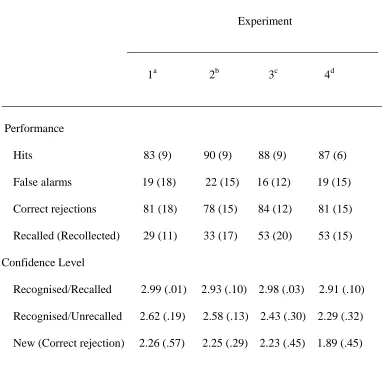
Table 1 presents the behavioural performance data across the four experiments. As can be seen in Table 1, participants in Experiment 1 correctly recognised a mean of 83% of the previously studied words in the recognition test (i.e., the A items from the studied word pairs), and made false alarms to 19% of the new test items. Eighty one percent of the new items were correctly rejected. The
Table 1 also presents the mean confidence levels associated with the three critical response categories (i.e., recognised/recalled, recognised/unrecalled, and new items). From Table 1 it can be seen that recognised/recalled items attracted the highest level of reported confidence (M = 2.99, SD = 0.01) while new items were associated with the lowest level of confidence (M = 2.26, SD = 0.57). Intermediate levels of confidence were reported in the recognised/unrecalled category (M = 2.62, SD = 0.19). A repeated measures ANOVA was conducted in order to assess the reliability of differences in response confidence across the various response categories. The analysis employed the factor of response category (new vs. recognised/recalled vs. recognised/unrecalled) and the results revealed a significant effect involving this factor, F(1.18, 9.44) = 11.07, p < .05. Subsequent testing revealed that the recognised/recalled items exhibited significantly higher confidence levels than both new items, t(8) = 3.88, p = .005, and
recognised/unrecalled items, t(8) = 5.81, p < .001. New items and
recognised/unrecalled items did not differ significantly with respect to response confidence, t(8) = 1.99, p > .05.
ERP Data: Pooled Across Confidence
Across all four experiments, separate averaged ERPs were obtained from trials
associated with the following performance characteristics: (a) successful cue recognition, given successful recall of the target (recognised/recalled); (b) successful cue recognition, given unsuccessful recall of the target
ERPs were initially formed without regard to the level of confidence associated with the recognition decisions for each trial. In Experiment 1, the mean number of trials contributing to the grand averaged ERPs was 44 (range, 16 – 96), 86 (56 – 135), and 149 (94 – 186) for the recognised/recalled, recognised/unrecalled, and new response categories, respectively. No subject in this series of experiments provided a sufficient number of artifact-free trials involving the incorrect
identification of new words as old (i.e., false alarms). Therefore, the question of the presence of old/new effects involving false alarms cannot be addressed in this study.
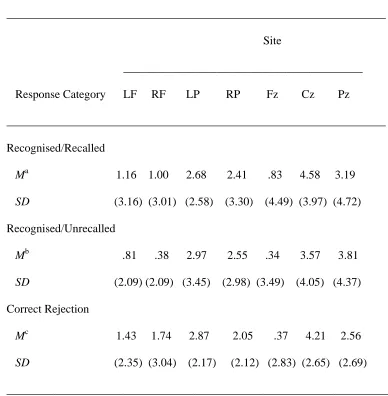
locations, but was most pronounced at left posterior sites (i.e., left temporo-parietal, including P3, C3, T5, and O1) and posterior midline sites (i.e., Cz and Pz). At frontal locations the effect was markedly smaller in magnitude and exhibited a bilateral distribution, as opposed to the left greater than right asymmetry seen at posterior sites. The ERP involving recognised/unrecalled items also exhibited a positive-going shift relative to new items at posterior electrode
sites (see Table 2). Across all experiments, the data from both latency regions were analysed using repeated measures ANOVA, which was conducted separately on the data from midline and lateral electrode sites. Global ANOVAs involving the lateral electrode sites employed the within-subjects factors of response category
(recognised/recalled vs. recognised/unrecalled vs. new), hemisphere (left vs. right), and electrode site (frontal vs. posterior). Global ANOVAs involving the midline electrode sites employed the factors of response category (recognised/recalled vs. recognised/unrecalled vs. new) and electrode site (Fz vs. Cz vs. Pz). Main effects involving the factors of hemisphere and site are not reported as they do not relate to the aims of the study, unless they interact with the factor of response category. That is, significant effects that do not involve the factor of response category are not reported. Pairwise comparisons involving the levels of the response category factor were conducted using Tukey’s HSD test to control familywise error at .05 (Howell, 1997).
electrode sites, F(1.93, 15.41) = 4.05, p < .05. Although the descriptive statistics presented in Table 2 suggest that the size of the old/new effect (i.e., the difference between recognised/recalled and new ERP waveforms) was larger at left-posterior electrode sites (relative to right-posterior sites), the interaction between response category and hemisphere was not significant, F(1.93, 15.47) = 1.74, p = .21. The second-order interaction involving the factors of response category, hemisphere,
and site was also not significant, F(1.47, 11.79) = 2.38, p > .05. However, a significant interaction was found between the factors of response category and electrode site, F(1.73, 13.87) = 6.20, p < .05. As is evident from Table 2, this result reflects the fact that the magnitude of the old/new effect was considerably larger at posterior electrode sites when compared with frontal sites. Subsidiary ANOVAs revealed no reliable effect of response category at either left-frontal, F(1.89, 15.16) = 0.53, p > .05, or right-frontal electrode sites, F(1.52, 12.18) = 1.81, p > .05. However, ANOVAs restricted to posterior sites revealed significant effects of response category at both left-posterior, F(1.70, 13.60) = 8.63, p < .05, and right-posterior electrode sites, F(1.34, 10.75) = 5.07, p < .05. Subsequent pairwise comparisons indicated that the recognised/recalled waveform was more positive than the correct rejection waveform at both left-posterior, F(1, 8) = 14.06, p < .01, and right-posterior sites, F(1, 8) = 5.43, p < .05. The recognised/unrecalled waveform was also more positive than the new item waveform at both
Comparisons between the recognised/recalled and recognised/unrecalled
waveforms revealed no significant effects at either left- or right-posterior sites. The global ANOVA involving the midline data resulted in a significant main effect involving the response category factor, F(2, 16) = 3.77, p < .05. The
interaction between response category and site was not significant, F(1.54, 12.34) = 2.53, p > .05. The significant effect of response category reflected the greater positivity of the recognised/recalled waveform relative to the new item waveform (see Table 2). Follow-up pairwise comparisons revealed that the
recognised/recalled waveform differed significantly from both the
recognised/unrecalled, F(1, 8) = 5.68, p < .05, and the new item waveform, F(1, 8) = 9.47, p < .05.
800-1100 ms latency region. From Table 3 it can be seen that the correct rejection waveform tended to be more positive than the recognised/recalled waveform during the 800-1100 ms poststimulus onset recording epoch. Notwithstanding this
category factor, F(1.43, 11.44) = 10.31, p < .01. In addition, the interaction between response category and site was also significant with respect to midline sites, F(2.16, 17.29) = 13.33, p < .001. As can be seen in Table 3 these results reflect the fact that both the recognised/recalled (i.e., recollected) waveform and the recognised/unrecalled waveform tended to be more negative than the new item (i.e., correct rejection) waveform, especially at posterior midline electrode sites (i.e., Cz and Pz) during the 800-1100 ms recording period. The recognised/recalled and recognised/unrecalled waveforms did not differ significantly at either Cz, t(8) = 1.61, p > .05, or Pz, t(8) = 1.83, p > .05.
ERP Data: Controlling for Confidence
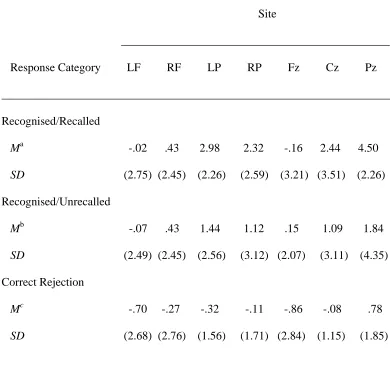
onset). Table 4 presents the means and standard deviations of the amplitudes (µV) of the ERPs evoked by the critical response categories for the 500 – 800 ms latency region in Experiment 1, while Table 5 presents similar data relating to the 800 – 1100 ms latency region. Figure 2 presents the grand averaged waveforms, formed from highly confident trials, from electrode sites in Experiment 1. This data was also subjected to repeated measures ANOVA using the factors of response category, site, and hemisphere (with respect to lateral electrodes), and response category and site (with respect to midline electrodes).
500-800 ms latency region. From Table 4 (see also Figure 2) it can be seen that the positive shift associated with the recognised/recalled waveform, relative to the new item ERP, is no longer evident. As outlined previously, this positive shift was statistically reliable with respect to the data that was pooled across response
confidence. However, ANOVA of the 500-800 ms data comprising highly confident responses revealed no significant main effect for the response category factor, F(1.69, 13.51) = 0.21, p > .05. In addition, the first-order interaction effects between response category and site, and response category and hemisphere were also not significant, F(1.70, 13.58) = 3.00, p > .05; and F(1.93, 15.43) = 0.20, p > .05, respectively. The second-order interaction between response category, site, and hemisphere was not significant, F(1.15, 9.16) = 1.21, p > .05.
were significant, F(1.43, 10.03) = 0.26, p > .05; and F(1.60, 11.20) = 0.86, p > .05, respectively.
800-1100 ms latency region. The descriptive statistics presented in Table 5 suggest that the recognised/recalled waveform deviates in a negative direction from that associated with the new item waveform during the 800-1100 ms poststimulus recording epoch. The global ANOVA of this data revealed a significant main effect of response category, F(1.45, 10.12) = 8.84, p < .01. The interaction
posterior electrode sites during the 800-1100 ms recording epoch, after controlling for response confidence. The recognised/unrecalled waveform was also
significantly more negative than the new item waveform at both left-posterior, F(1, 7) = 9.01, p < .05, and right-posterior sites, F(1, 7) = 40.32, p < .001. However, the recognised/recalled and recognised/unrecalled waveforms did not differ
significantly at either posterior electrode site.
The global ANOVA involving the midline sites revealed a significant main effect for the response category factor, F(1.71, 11.97) = 14.00, p < .001, and a significant interaction between response category and electrode site, F(2.63, 18.42) = 8.07, p < .01. As is evident in Table 5, the significant main effect of response category arose due to the increased negativity of the recognised/recalled waveform relative to the new item waveform. The significant interaction reflected the fact that this increased negativity was more pronounced at posterior sites (i.e., Cz and Pz, see Table 5). Follow-up comparisons revealed that the recognised/recalled waveform differed significantly from the new item waveform at both Cz, F(1, 7) = 23.42, p < .01, and Pz, F(1, 7) = 36.6, p < .001. However, these waveforms did not differ significantly at the midline frontal location, Fz, F(1, 7) = 3.38, p > .05. The recognised/recalled and recognised/unrecalled waveforms did not differ
significantly at either Cz, t(8) = 1.29, p > .05, or Pz, t(8) = 2.27, p > .05.
Discussion
Behavioural performance measures, such as the rate of successful recognition and the rate of successful recall of the studied associate, were similar to those reported in previous research involving the recognition/associative recall task (e.g.,
Donaldson & Rugg, 1999; Rugg et al., 1996). The proportion of recognised words associated with correct recall (i.e., 29%) was somewhat lower than that reported by both Rugg et al. (i.e., 36% correct recall) and Donaldson and Rugg (i.e., 49% correct recall). This difference is likely due to the larger number of study pairs involved in the current study. That is, the current design involved 196 word pairs during the study phase, which is substantially higher than both Rugg et al. and Donaldson and Rugg with 128 and 100 study pairs, respectively. In addition, the false alarm rate observed in the current study (and across all four experiments, as can be seen in Table 1) was higher than the rate of 6% which was reported by Rugg et al. The relatively low rate of false positives reported by Rugg et al. may be due to the provision of a "don't know" response option to participants in this study. From the perspective of the dual-process theories of memory (Atkinson & Juola, 1973; 1974; Mandler, 1980, 1991; Moscovitch, 1992, 1994), successful
recognition performance in the current study was based on veridical information concerning the study episode which was derived from either the successful retrieval of the study phase episode involving the test item (i.e., recognised/recalled trials involving recollection) or from partial retrieval of the study episode (i.e.,
As predicted, the ERP results of the current experiment indicated that the recognised/recalled waveform deviated in a positive direction relative to the new item waveform during the 500 - 800 ms poststimulus onset period. This result is consistent with the findings reported by Rugg et al. (1996) using a similar recognition/associative recall task during the test phase of the experiment. The effect was observed when ERPs for the experimental conditions were formed irrespective of the level of response confidence associated with each trial. The effect was most pronounced at posterior electrode sites. Although the effect was absent during the 800 -1100 ms poststimulus onset recording period, the
distribution of the old/new effect observed in the current experiment corresponds with that of previously reported recognition memory parietal old/new effects (Rugg, 1995). As outlined in the introduction, evidence concerning the implicit versus explicit nature of familiarity-based recognition decisions may be provided via an examination of the scalp distribution of activity associated with the two classes of recognition response (i.e., recognised/recalled and
In general, the pattern of ERP results obtained in Experiment 1 conforms with those observed previously in a variety of recognition memory paradigms (e.g., Curran, 1999, 2000; Friedman, 1990; Johnson et al., 1985; Paller & Kutas, 1992; Paller et al., 1995; Rugg, 1990; Rugg et al., 1995; Rugg & Doyle, 1992; Rugg & Nagy, 1989; Rugg et al., 1996; Rugg et al., 1998; Sanquist et al., 1980; Smith, 1993; Smith & Guster, 1993; Wilding et al., 1995; Wilding & Rugg, 1997). More specifically, ERP results similar to those observed in the current study have been reported previously in recognition memory studies which have operationalised recollection as the ability to retrieve contextual details regarding the initial encoding of the test item (e.g., Rugg et al., 1996; Wilding et al., 1995; Wilding & Rugg, 1996). For example, Rugg et al. (1996) operationalised recollection as the ability to both recognise a previously studied word, and to retrieve it’s studied associate. Rugg et al. found that relative to new words, these recognised/recalled words elicited an ERP that deviated in a positive direction at posterior electrode sites between 500-800 ms poststimulus onset. This effect was more pronounced at left temporo-parietal electrode locations. In addition, Wilding et al. (1995)
design involving, for example, direct manipulation of the encoding task, is therefore necessary in order to establish the reliability of the current result.
The present findings are consistent with the view proposed by Rugg et al. (1996) that when recollection is operationally defined as successful associative recall, within the context of a recognition memory test, the magnitude of the parietal old/new effect varies according to whether successful recollection has occurred. In Experiment 1, the descriptive pattern of the ERP waveforms during the 500-800 ms poststimulus period is consistent with the position of Rugg et al. as the old/new effect was consistently larger with respect to the recognised/recalled waveform compared with the recognised/unrecalled waveform (although the inferential pairwise contrasts indicated that these waveforms were not consistently different). Rugg et al. concluded that when operationalising recollection via an associative recall task, the parietal old/new effect is dependent upon successful recollection in a similar manner to that observed when recollection is operationalised as the ability to retrieve contextual details regarding the original study experience (Wilding & Rugg, 1996; Wilding et al., 1995).