Rochester Institute of Technology
RIT Scholar Works
Theses
Thesis/Dissertation Collections
8-5-2016
Identifying the Presence of Known Vulnerabilities
in the Versions of a Software Project
Craig Cabrey
[email protected]Follow this and additional works at:
http://scholarworks.rit.edu/theses
This Thesis is brought to you for free and open access by the Thesis/Dissertation Collections at RIT Scholar Works. It has been accepted for inclusion in Theses by an authorized administrator of RIT Scholar Works. For more information, please [email protected].
Recommended Citation
ROCHESTER
INSTITUTE OF
TECHNOLOGY
M
ASTERST
HESISIdentifying the Presence of Known
Vulnerabilities in the Versions of a
Software Project
Author:
Craig Cabrey
Adviser:
Dr. Meiyappan Nagappan
A thesis submitted in partial fulfillment of the requirements for the degree of Master of Science in Software Engineering
from the
Department of Software Engineering
B. Thomas Golisano College of Computing and Information Sciences
i
The thesis “Identifying the Presence of Known Vulnerabilities in the Versions of a Software Project” by Craig Cabrey has been examined and approved by the following Examination Committee:
Dr. Meiyappan Nagappan
Thesis Committee Chair Assistant Professor
Dr. Mehdi Mirakhorli
Assistant Professor
Dr. Scott Hawker
ii
Acknowledgements
I would like to thank my committee members, Meiyappan Nagappan and Mehdi Mirakhorli. In particular, I would like to thank my adviser, Meiyappan Nagappan, who provided me with the opportunity and necessary guidance to pursue this research.
I would also like to thank the independent security researcher, Bushra Aloraini, whose efforts to produce the evaluation data set was crucial to the success of this project.
I would like to thank the Golisano College of Computing and Information Sci-ences, which provided funding for this work.
iii
ROCHESTER INSTITUTE OF TECHNOLOGY
Abstract
Department of Software Engineering
Master of Science in Software Engineering
Identifying the Presence of Known Vulnerabilities in the Versions of a Software Project
by Craig Cabrey
As the world continues to embrace a completely digital society in all aspects of life, the ever present threat of a security flaw in a software system looms. Especially with a stream of high profile security flaws and breaches, the public is more aware of the risk now than ever before.
However, the realities of any software project is that there are engineering concerns of the utmost importance that all demand simultaneous attention. To balance and manage these challenges, software engineering has developed patterns of industry activities and best practices. Yet even as engineers rely on these practices to stay afloat, managing security can become elusive in a tangled mess of complex relationships between systems. Modern software projects rely upon other software to do its job; only the most niche and spe-cialized software lives in isolation in today’s industry.
iv
v
Contents
Acknowledgements ii
Abstract iii
Dedication viii
1 Introduction 1
1.1 Background . . . 1
1.2 Motivation . . . 3
1.3 Research Objectives . . . 4
1.3.1 Vulnerability Identification . . . 5
1.3.2 Software Version Sets . . . 5
2 Related Work 6 2.1 Change Detection . . . 6
2.2 Vulnerability Discovery . . . 8
2.3 Code Reuse . . . 9
2.4 Code Clones . . . 9
3 Approach 11 3.1 Anatomy of a Patch . . . 12
3.2 Data Conditioning . . . 13
3.3 Detection Process . . . 14
3.3.1 One Line Changes . . . 15
vi
3.3.3 Ratio Thresholds . . . 17
3.4 Data Sources . . . 18
3.4.1 National Vulnerability Database . . . 19
3.4.2 Project Repository . . . 19
3.4.3 Project Metadata . . . 19
3.5 Implementation . . . 20
3.6 File History Resolution . . . 21
4 Results 24 4.1 Understanding the Results . . . 25
4.2 Evaluation . . . 28
4.3 Example . . . 29
4.4 Discussion . . . 30
4.5 Threats to Validity . . . 32
5 Conclusions 34 5.1 Applications . . . 34
5.2 Future Work . . . 34
5.3 Conclusion . . . 35
A Evaluation Rationales 37
vii
List of Figures
3.1 Example of a software patch from the Apache HTTP Server Project,
created withgit format-patch -1. . . 18
3.2 A simple Git history involving a single master branch . . . 22
3.3 A Git history involving master and release branches . . . 23
viii
List of Tables
4.1 Combined result set and evaluation set for the Apache HTTP Server Project . . . 25 4.2 Combined result set and evaluation set for Apache Hadoop . . 26 4.3 Combined result set and evaluation set for Apache CloudStack 27 4.4 Results that establish baseline validity by showingnot vulnerable
for resolved versions . . . 27 4.5 Performance withoutindeterminateoutcomes . . . 31 4.6 Breakdown ofvulnerablevulnerability and version pair outcomes
in the result set for each project as ratios of their respective coun-terparts in the evaluation set . . . 31 4.7 Breakdown ofnot vulnerablevulnerability and version pair
out-comes in the result set for each project as ratios of their respective counterparts in the evaluation set . . . 32 4.8 Breakdown ofindeterminatevulnerability and version pair
out-comes in the result set for each project as ratios of their respective counterparts in the evaluation set . . . 32
ix
1
Chapter 1
Introduction
1.1
Background
Over time, software projects evolve to be enormously complex, both in terms of structure and interactions with external systems. There are a number of con-cerns of which engineers must be aware during the system’s design phase and its evolution. Issues such as compatibility, deployment, quality control, and security all demand time and resources while a project is being developed or maintained. Modern practices to address these concerns can be traced all the way back to when Belady et. al proposed Lehman’s Law of Software Evolu-tion (Belady and Lehman,1976).
Among those mentioned, software security has become an issue of paramount importance. With the global transition to online systems, the smallest mis-take could have far reaching consequences (Anderson, 2001; Telang and Wat-tal, 2007). Software security, then, is a fundamental quality of any system. To address this, industry standardized practices have been developed surround-ing security issues, such as responsible disclosure1. Responsible disclosure re-quires the cooperation of all involved parties, from the software maintainers to the software users. Without this cooperation, the practice falls apart and has the potential to leave software open for exploit.
Chapter 1. Introduction 2
Within the software community, a flaw that has security ramifications is known as a vulnerability. A vulnerability is a software defect that exposes an attack vector for a malicious actor to exploit. Not every vulnerability within a system is necessarily exploitable, however it can be difficult to understand when this is the case (Shirey,2000).
The discovery and disclosure of new vulnerabilities occurs on a regular basis and is an area of research that is fairly well understood. For example, Liu et. al (Liu et al.,2012) performed a survey on techniques of discovering vulnerabil-ities and outlined a number of techniques: static analysis, penetration testing, fuzzing, Vulnerability Discovery Models, and more. These techniques are al-ready deployed in practice while research on new and existing techniques is continuing.
However, while much research has been done in the way of predicting vul-nerabilities (Hovsepyan et al., 2012; Shin and Williams, 2013), there is little research on tracking existing vulnerabilities across the history of a software project. In an industry that is increasingly collaborative and decentralized (es-pecially in the case of open source projects), the possibility of regressions being introduced remains ever present. At least two of Lehman’s laws reinforce this possibility: increasing complexity anddeclining quality. Furthermore, the ever increasing trend of code reuse across and within projects makes possible the contamination of security problems from external pieces of software.
Utilizing the vast quantity of information on security vulnerabilities and high quality project metadata, known vulnerabilities can be tracked throughout a project’s history. Projects that have a history of past vulnerabilities will be able to track the status of these defects moving forward, to the benefit of all involved parties.
Chapter 1. Introduction 3
for identifying the presence (or absence) of a known vulnerability in a soft-ware project, and 2. from this algorithm, extrapolate the set of versions of the software project that contain the vulnerability and those that do not.
Section 1.2 outlines the motivation for this work and Section 1.3 details the spe-cific research objectives. In Section 2, the related work is identified. Section 3 gives an in-depth overview of the approach. Section 4 presents the results, evaluation, and analysis. Sections 4.5, 5.1, and 5.2 outline threats to validity, applications, and future work, respectively. Finally, Section 5 recaps with the conclusion.
1.2
Motivation
Since the exposure of high profile security vulnerabilities such as Heartbleed (Du-rumeric et al.,2014) and POODLE (Möller, Duong, and Kotowicz,2014), secu-rity has become a forefront issue not only in the software engineering industry, but also on the minds of the general public.
As the number of high profile security vulnerabilities continues to grow, the question has been raised as to whether security is being managed as properly as it could be. The proliferation of advanced mobile computing platforms has placed an additional emphasis on this urgency, as secure systems are more critical now than ever before.
At the same time, software engineering techniques have advanced significantly since the introduction of Lehman’s Laws. Developers have turned to the vast ecosystem of open source software to provide functionality built by the com-munity that proved too difficult or too cumbersome to achieve on an individual basis. But this approach also has its downsides.
Chapter 1. Introduction 4
applications in search of code reuse (Mojica et al.,2014). The authors found that the quality of the apps and libraries that were being reused affected the quality of the consuming app. In the same respect, security has an impact as well: including vulnerable versions of an app or library might infect the user.
In addition to this, dependency management becomes another item on the maintenance checklist, further increasing the mental load of the maintainers (Klatt et al.,2012). For the projects that have the necessary infrastructure to perform these tasks, it is less of an issue. But for projects that don’t have the resources or tooling necessary, dependencies may stagnate. In many cases, developers will simply bypass the proper channels and directly include copies of the libraries which they wish to use. This leads to a situation where there are many copies of the same software included as a dependency in such a way that precludes easily updating the software.
Keeping apprised on the latest developments in the security landscape and software engineering practices is a difficult challenge. Millions of projects are engaging in software reuse in an unprecedented manner. The downside is that keeping these projects up to date, especially as vulnerabilities are disclosed, patched, and released, can be a daunting challenge. This research attempts to alleviate part of that burden by introducing a method to automatically track the status of a vulnerability across different versions of a software project.
1.3
Research Objectives
Chapter 1. Introduction 5
The end result of the research is to present the versions of a given software project that resolve a given vulnerability. This is intended to be used by a soft-ware developer to track when a system dependency may be exposing a vulner-ability in the system and a path forward to resolve the potential vulnervulner-ability.
1.3.1 Vulnerability Identification
The goal of this part of the research is to devise a methodology by which to identify whether the given software version exhibits a given vulnerability. It is important to note that the purpose of this research isnotto identify additional, unknown vulnerabilities.
1.3.2 Software Version Sets
The result of this part of the research is to utilize the methodology of identify-ing whether a software version exhibits a particular vulnerability discussed in the previous section and apply it to all versions of a software project.
6
Chapter 2
Related Work
There are two general areas of research that are relevant to this work.
The first is security research. Security is a complex and ever evolving topic which is unique in that it includes the presence of bad actors. In regards to security, the software engineering industry has grown tremendously in its un-derstanding of and ability to proactively seek out the best practices in software security.
The second is software evolution over a time period. While this is a particularly large field, we are interested in observing the activity of code over time in how it is modified, used, and re-used. This is a heavily researched area of software engineering and there are a variety of techniques and practices developed over the past several decades.
2.1
Change Detection
Chapter 2. Related Work 7
Kim and Notkin surveyed matching techniques for revisions across a software project (M. Kim and Notkin,2006). The evaluated matching techniques were:
1. Entity Name,
2. String,
3. Syntax Tree,
4. Control Flow Graph,
5. Program Dependence Graph,
6. Binary Graph,
7. Clone Detection, and
8. Origin Analysis
The authors found that the optimal matching technique varies on the specific context. However, the best technique involved a combinations of techniques. This hybrid approach consists of running all techniques and finding a consen-sus from the results.
For the purposes of this research, we will be focusing on the second technique, matching by string. While this technique is not the best in terms of its ability to accurately match across different revisions of a project, it is the best option for the context of our work.
Chapter 2. Related Work 8
is not acceptable. Binary matching would require transforming the patch into its binary equivalent, which would be even more inaccurate (differences in bi-naries of different platforms, lack of reproducible builds, and so on). Finally, the clone detection and origin analysis techniques are promising approachs, but unfortunately neither one would be accept a snippet of code as an input, such as what a patch would provide.
2.2
Vulnerability Discovery
In another work, Kim explored different vulnerability discovery models and presented another that takes advantage of multiple versions within a software project (J. Kim, Malaiya, and Ray, 2007). The proposed model analyzes two successive versions. Kim finds that two successful versions are likely to share vulnerabilities because of the shared codebase.
Spacco et. al utilized a static analysis tool, FindBugs, to track defect warnings across different versions of a software project (Spacco, Hovemeyer, and Pugh,
2006). The authors identify two approaches: pairing warnings from differ-ent versions and warning signatures. The former iddiffer-entifies the pair based on a hash and equivalence predicate. The latter generates a string that includes class, method, and field names, then compares the value of the MD5 hash of the string.
Chapter 2. Related Work 9
2.3
Code Reuse
Hanna et. al (Hanna et al., 2013) built and executed a scalable system that performed code similarity analysis on applications from the Google Play Store called Juxtapp. The researchers evaluated their system on a sample of 58,000 Android applications to demonstrate the system’s scalability. They found 463 applications with buggy code reuse, 34 applications with known malware, and applications that are pirated versions of legitimate applications available on the store.
Adams et. al conducted an empirical study regarding the various activities required to make code reuse effective. (Adams et al., 2016). The process of code reuse is not free: it requires specific quality assurance and other software engineering activities which can cost signficant time and effort. The empiri-cal study analyizes three highly successful open source distributions (Debian, Ubuntu, and FreeBSD). One of the more relevant aspects of this study was how these organizations go about including updates from upstream vendors. There was no clear answer to this question: changing anything is an inherent risk, but not including critical updates (such as security patches) is even more of a risk. This already complicated question is even further compounded in orga-nizations that make use of dozens of upstream software components.
2.4
Code Clones
Chapter 2. Related Work 10
the clone detection tool was effective in identifying duplicated code in several high profile C and Java open source software projects.
11
Chapter 3
Approach
In order to determine whether a vulnerability is present in a particular version of software, we must be able to detect if the version exhibits the characteristics of that vulnerability. We refer to this outcome as a vulnerability and version
pair.
The characteristics of a vulnerability are a result of the flaw in the software it-self. That is, the logical error(s) that occurred when the software was written or changed which gave birth to the vulnerability. The resolution of a vulnerability is also introduced by a change to the software source.
Therefore, by searching for the correction to the error in the software source, we can deduce whether that vulnerability is exhibited in that version of the software. This correction comes in the form of a software patch, which forms the fundamental element of the approach.
Chapter 3. Approach 12
3.1
Anatomy of a Patch
The approach centers around the use of a software patch. To fully understand why this is useful and appropriate, it is crucial to understand what kind of information a patch contains and how it is encoded.
A software patch is a special document that describes how to make one or more changes to a codebase1. The GNU diff2 and patch3 utilities are examples of programs used to create and apply patches, respectively. Source control management systems such as Git use these tools to describe changes between different revisions.
Figure 3.1 illustrates an example of a software patch from the Apache HTTP Server project.
The first section of the patch is known as the header. It contains information such as source control metadata, authorship information, time stamps, and the subject matter of the patch.
The bodyof the patch is composed of any number ofdiffs. Each diff describes one or more changes to a single file within the source code tree. These changes are known ashunks.
Each hunk contains information that describes how lines within a source file are modified. A line can either be added or removed. An addition is denoted by a line that is prefixed with a plus sign (+) whereas a removal is denoted by a line that is prefixed with a minus sign (-). A hunk has no concept of a modified line; rather a modification will be treated as a removal and an addition.
The information encoded by a patch is rich with information that can be used to detect the resolution of a vulnerability within a software project. Relying on a patch as the foundation of the approach means that the approach remains
Chapter 3. Approach 13
language independent and operates directly on the primary artifacts of the soft-ware project.
3.2
Data Conditioning
To ensure we compute the most accurate and consistent results, a number of steps are taken during or prior to execution of the detection process. These steps focus on conditioning the input data to minimize the number of false results.
1. Where possible, a patch that provides a resolution for the vulnerability is extracted from the version control system of the project. A source control specific patch (such as Figure 3.1) has additional metadata that assists with resolving file histories across different versions. For the purposes of this work,git format-patch -1 SHAwas used to perform this step.
2. Source comments and other white space changes are pruned from the patch. Comments have no effect on the operational aspect of the code and therefore no implications with regards to the resolution of a vulnerabil-ity and can be safely removed. Removing comments from the detection process produces a more accurate ratio with respect to the code.
White space also has no bearing on the operation of the code. Moreover, white space is prone to a high rate of churn within software projects, which further reinforces the view that it should not be considered.
3. Non-language files, identified by file extension by means of GitHub’s Linguist mapping4, and tests, identified by the case insensitive string ‘test’ or ‘tests’ in the file path, are ignored during processing and do not contribute to the ratios as explained in Subsection 3.3.2.
Chapter 3. Approach 14
4. For each file in the patch, an attempt is made to resolve the file’s path between the time of the patch and the target version being tested. This process requires access to a Git repository and relies heavily on the qual-ity of information within the repository.
In many cases, obtaining a patch from a vulnerability can be a difficult process. The quality of information varies on a case by case basis. Fortunately, a previ-ous work focuses on linking a vulnerability to the change that resolves the de-fect (H.-M. Chen et al.,2016). As long as the procedure in that research works as intended, it can be used in conjunction with this work to build a pipeline starting with a vulnerability identifier and ending in version sets.
3.3
Detection Process
In this section, the procedure that is used to operationalize the approach is described.
Once a vulnerability is identified, a patch from the repository of the project in question is extracted and prepared, it can be used in the detection procedure.
For each file in the patch, the changes are split up into two distinct lists: one for additions and another for deletions. Next, the source of the file from the version being test is read into a separate list.
The collection of source lines is iterated over twice; first as the list of additions is iterated and again as the list of deletions is iterated. Through each iteration, a line of source is compared against a change.
The comparison step consists of stripping all white space from both lines, split-ting up each line into two sets of tokens, and checking the sets for equality.
Chapter 3. Approach 15
and unmodified from being counted as parts of the results. As an example, the following is an indicated change that would be ignored by the process:
- printf("");
+ printf("");
This procedure is repeated for all versions in a software project identified for testing and collected into a mapping from version identifier to a result set.
3.3.1 One Line Changes
In the case of a patch that includes a one line change to a file, there is an addi-tional component to the procedure. Rather than searching for only the change to the file, it will also search for the context surrounding that change. Specifi-cally, that means one line above and below the change in question, if applicable.
It is necessary to treat this scenario in a special manner because of the edge case it presents. Searching for the presence or absence of one line does not pro-vide enough context to sufficiently determine if the specific change is actually exhibited in the file.
Because the one line has the potential to appear more than once in a file, it would cause an unacceptable rise in the false positive rate. Forcing the change alongside its context has the effect of considering only the area of the file that is relevant.
The next section elaborates on how the final result is calculated and used to determine a version’s vulnerability status.
3.3.2 Ratios
Chapter 3. Approach 16
values are calculated at the end of the procedure, as defined by Equation 3.1 and 3.2.
ra=
1
|Pa|×
P
f∈P
P
a∈Pfa
(a∈Sf), if |Pa|>0
null, otherwise
(3.1)
rd=
1
|Pd|×
P
f∈P
P
d∈Pfd
(d /∈Sf), if|Pd|>0
null, otherwise
(3.2)
Where,
• raandrdare the ratios of additions and deletions, respectively,
• PaandPdare the sets of all relevant additions and deletions in the patch,
respectively,
• P is the set of relevant files in the patch,
• Pfais the set of relevant additions in the patch forf,
• Pfdis the set of relevant deletions in the patch forf,
• Sf is the set of source lines inf,
• null indicates that the result will not be considered when determining a final outcome
Bothraandrdhave values that range from 0.0 to 1.0. Anravalue of 1.0 means
that all additions are present in the source tree whereas a value of 0.0 means that none of the additions are present. Similarly, anrdvalue of 1.0 means that
all deletions arenotpresent in the source tree whereas a value of 0.0 means that all are present.
Chapter 3. Approach 17
3.3.3 Ratio Thresholds
In order to determine the likelihood of a vulnerability being exhibited in a ver-sion of software, the raw results generated by the methodology must be trans-lated into more relevant findings.
Thus, there are three possible outcomes for each vulnerability and software version pairing:
1. Vulnerable (V)
2. Not Vulnerable (NV)
3. Indeterminate (I)
Equation 3.3 describes the mapping from raw results to the possible outcomes:
R=
indeterminate, ¬(∃f ∈P exists(f))
vulnerable, if ra< Taor rd< Td
not vulnerable, otherwise
(3.3)
Where,
• Ris the result or outcome,
• TaandTdare the thresholds for additions and deletions, respectively,
• exists()is a function that determines if a file exists at a particular version To develop a pair of thresholds for this work, the system was trained by manu-ally inspecting the input patch and the source artifacts. The version of software that included the patch is treated as the control version. That is, the version that we are most certain includes the defect fix. This assertion is additionally backup up by project metadata such as issue trackers that identify the version in which the vulnerability is resolved. Ta andTd were set to0.5 and0.25,
Chapter 3. Approach 18
FIGURE 3.1: Example of a software patch from the Apache HTTP Server Project, created withgit format-patch -1
From 2fe8ec85fa8ef1340a61e688f3bc43c799add78e Mon Sep 17 00:00:00 2001
From: "William A. Rowe Jr" <[email protected]> Date: Tue, 2 Mar 2010 04:46:13 +0000
Subject: [PATCH] SECURITY: CVE-2010-0408 (cve.mitre.org)
mod_proxy_ajp: Respond with HTTP_BAD_REQUEST when the body is not sent after
request headers indicate a request body is incoming; this is not a case of HTTP_INTERNAL_SERVER_ERROR.
Submitted by: Niku Toivola <niku.toivola sulake.com>
rpluem, jim, wrowe
git-svn-id: https://[...]/httpd/trunk@917875 13f79535-47bb-0310-9956-ffa450edef68
---modules/proxy/mod_proxy_ajp.c | 2
+-1 file changed, +-1 insertion(+), +-1 deletion(-)
diff --git a/modules/proxy/mod_proxy_ajp.c b/modules/proxy/mod_proxy_ajp.c index 635ba32..0f5674c 100644
--- a/modules/proxy/mod_proxy_ajp.c +++ b/modules/proxy/mod_proxy_ajp.c
@@ -257,7 +257,7 @@ static int ap_proxy_ajp_request(apr_pool_t *p, request_rec *r, ap_log_error(APLOG_MARK, APLOG_DEBUG, 0, r->server,
"proxy: ap_get_brigade failed"); apr_brigade_destroy(input_brigade);
- return HTTP_INTERNAL_SERVER_ERROR;
+ return HTTP_BAD_REQUEST;
}
/* have something */
--2.8.0
It is important to acknowledge that developing the thresholds in this manner is not optimal and incorporates the bias of the author.
3.4
Data Sources
Chapter 3. Approach 19
the approach would work just as well.
3.4.1 National Vulnerability Database
The National Vulnerability Database (NVDB) is a public resource maintained by the United States government that collects and makes available information on disclosed vulnerabilities. This system provides historical feeds that can be utilized for mining purposes.
The NVDB provides a rich data set that can be used to extract known vulner-abilities for open source projects and useful metadata related to each vulnera-bility.
3.4.2 Project Repository
For the approach to operate, it is critical to have complete access to the source artifacts of the software project. The most effective way to get these artifacts is by using the project repository itself. Additionally, repositories also typi-cally contain the state of the source at each version, which is necessary for the objectives of the approach.
3.4.3 Project Metadata
Open source projects are much more than the source that makes up the end result. It is a collaboration of effort among individuals that requires constant and clear communication.
Chapter 3. Approach 20
3.5
Implementation
A Python 3.5 application using the approach was developed to consistently and efficiently generate results using the approach defined in Section 3.
The Python library GitPython5 was used to automate the manipulation of repositories. Git tags are most commonly used to denote release points6. Thus, tags were the primary mechanism used in evaluating each version of a software project. However, because tags are used for more than just software releases, the set of tags being used was manually verified to ensure it matched an ac-tual release. Before checking out each tag for testing,git reset -hardand
git clean -dfwas executed in the repository to ensure there was no cross contamination between versions.
The Python librarywhatthepatch7was used to parse the contents of a patch. Figure 3.4 is an example of how the patch in Figure 3.1 is parsed and repre-sented. For each line in the patch, there is a tuple composed of three elements: the original line number, the final line number, and the line contents. With this in mind, there are three cases to consider in the parsed representation:
1. (1, None, ’...’): A line was removed
2. (None, 1, ’...’): A line was inserted
3. (1, 2, ’...’): The line remains unchanged
Along with access to the repository, the parsed representation of the patch be-came the input for the detection process.
5https://github.com/gitpython-developers/GitPython, Version 1.0.2 6https://git-scm.com/book/en/v2/Git-Basics-Tagging
Chapter 3. Approach 21
3.6
File History Resolution
As noted in Subsection 3.2, one of the steps taken before the detection process is the resolution of the paths of each file in the patch with respect to the target version.
There are a number of scenarios that are possible, but not all can be handled in a manner that leads to meaningful results. The ability to track a file through history depends heavily on the project’s version control activities and practices.
Consider Figure 3.2. The figure represents a relatively simple history of a soft-ware project. Each circle represents a change (or commit) to the tree, with forward progression downward. The model being illustrated shows that the project utilizes a single master branch off of which each version is tagged. While there may be feature branching happening for development purposes, everything is merged back intomaster before a release is tagged. Thus, for the purposes of tracking, the history is linear and simple to follow. In this sce-nario, the file’s path was changed after the patch was introduced. Catching the change in path is straight forward as it simply a matter of analyzing each change between the introduction of the patch and the tag2.0.
Now consider Figure 3.3. In this case, the project is utilizing a more complex model which includes release branches. For each major release (a major release being thexin anx.y.zversioning scheme), a branch is created off ofmaster
and used to sequentially tag the minor versions (typically starting atmajor.0). With this model, it is much more difficult to track the history of a file. In this specific scenario, a file path change and subsequent modification occurred af-ter a branch was created for the 1.xseries of releases. While not an extreme situation by itself, the modification to the file was then backported8to the1.x
series by means of a cherry-pick9. Because the backporting process likely did
8Backporting is the process of retroactively applying newer changes to legacy versions of
software.
Chapter 3. Approach 22
FIGURE 3.2: A simple Git history involving a single master branch
mas t er br anc h
1. 0
2. 0 Fi l e pat h
c hange Fi l e modi f i c at i on
t ag
t ag c ommi t
c ommi t
not include the change in the file path, it is necessary to backtrack to theancestor
of both branches before moving forward to the1.1tag. Within our implemen-tation, this is achieved by usinggit rev-list -ancestry-path.
Chapter 3. Approach 23
FIGURE 3.3: A Git history involving master and release branches
1. x br anc h
c her r y - pi c k bac k por t mas t er br anc h
1. 0
2. 0 Fi l e
modi f i c at i on Fi l e pat h
c hange
t ag c ommi t
c ommi t
1. 1
2. x br anc h
FIGURE3.4: Example of a parsed patch
(257, 257, ’ ap_log_error(APLOG_MARK, APLOG_DEBUG, 0, r->server,’),
(258, 258, ’ "proxy: ap_get_brigade failed");’),
(259, 259, ’ apr_brigade_destroy(input_brigade);’),
(260, None, ’ return HTTP_INTERNAL_SERVER_ERROR;’),
(None, 260, ’ return HTTP_BAD_REQUEST;’),
(261, 261, ’ }’),
(262, 262, ’’),
24
Chapter 4
Results
In this section, the results of the approach are presented. The approach was ex-ecuted across three separate Apache Software Foundation1projects. The major versions of each project were tested against a number of vulnerabilities found from either the NVDB, the project’s issue tracker, or by mining the project’s revision history. Because the evaluation described in Subsection 4.2 is an inten-sive, time consuming process, we were forced to limit the number of versions and vulnerabilities for each project.
Tables 4.1, 4.2, and 4.3 present the combined results from the approach and the evaluation on the Apache HTTP Server Project2, Apache Hadoop3, and Apache CloudStack4, respectively. These projects were chosen for their rich project metadata, their relative importance in the software community, and the set of historical vulnerabilities associated with each project.
Table 4.4 shows results for the versions that the project developers have deemed to benot vulnerable. These versions were obtained from either the vulnerabil-ity description page, the project’s respective issue tracking the defect, or the project change log. In each instance, the version that contains the fix is explic-itly identified by the project. For each of these versions, we also expect that the
Chapter 4. Results 25
TABLE 4.1: Combined result set and evaluation set for the Apache HTTP Server Project
CVE-2004-0174a CVE-2006-3747b CVE-2007-1862c Version Result Evaluation Result Evaluation Result Evaluation
1.2.0 I I I N V I N V
1.3.0 I I I N V I N V
2.0.1 V V V N V I N V
2.1.1 N V N V V V I N V
2.2.0 N V N V V V V N V
2.3.0 N V N V N V N V I N V
2.4.0 N V N V N V N V I N V
aResolved in versions 1.3.30 and 2.0.49 bResolved in version 2.2.3
cResolved in version 2.2.6
CVE-2014-3583a CVE-2014-8109a CVE-2015-3183b Version Result Evaluation Result Evaluation Result Evaluation
1.2.0 I N V I N V I N V
1.3.0 I N V I N V I N V
2.0.1 I N V I N V V N V
2.1.1 I N V I N V V N V
2.2.0 I N V I N V V I
2.3.0 V N V I N V V I
2.4.0 V V V N V V I
aResolved in version 2.4.12 bResolved in version 2.4.16
approach will yieldnot vulnerableoutcomes. With these results, we establish baseline validity of the approach by showing that the outcomes of the approach agree with what the project maintainers state about each vulnerability in rela-tion to the version in which it was fixed.
The results of the approach will herein be referred to as theresult set. The results of the evaluation will be referred to as theevaluation set.
4.1
Understanding the Results
Chapter 4. Results 26
TABLE 4.2: Combined result set and evaluation set for Apache Hadoop
YARN-1993a HADOOP-12964a CVE-2012-3376b Version Results Evaluation Results Evaluation Results Evaluation
0.1.0 I N V I N V I N V
0.10.0 I N V I V I N V
0.11.0 I N V I V I N V
0.12.0 I N V I V I N V
0.13.0 I N V I V I N V
0.14.0 I N V I V I N V
0.15.0 I N V I V I N V
0.16.0 I N V I V I N V
0.17.0 I N V I V I N V
0.18.0 I N V I V I N V
0.19.0 I N V I V I N V
0.2.0 I N V I N V I N V
0.20.0 I N V I V I N V
0.21.0 I N V I V I N V
0.22.0 I N V I V I N V
0.23.0 I V I V I N V
0.3.0 I N V I V I N V
0.4.0 I N V I V I N V
0.5.0 I N V I V I N V
0.6.0 I N V I V I N V
0.7.0 I N V I V I N V
0.8.0 I N V I V I N V
0.9.0 I N V I V I N V
1.0.0 I N V I V I N V
1.1.0 I N V I V I N V
1.2.0 I N V I V I N V
2.2.0 V V I V N V N V
2.3.0 V V V V N V N V
2.4.0 V V V V N V N V
2.5.0 V V V V N V N V
2.6.0 V V V V N V N V
2.7.0 V V V V N V N V
Chapter 4. Results 27
TABLE 4.3: Combined result set and evaluation set for Apache
CloudStack
CVE-2015-3251a CVE-2015-3252a Version Result Evaluation Result Evaluation
2.1.3 I I I I
2.2.0 I I I I
3.0.1 I I I I
4.0.2 I I V I
4.1.0 V I V I
4.2.0 V I V I
4.3.0 V V V V
4.4.0 V V V V
4.5.1 V V V V
4.6.0 N V N V N V N V
4.7.0 N V N V N V N V
4.8.0 N V N V N V N V
aResolved in version 4.5.2
TABLE 4.4: Results that establish baseline validity by showing not vulnerablefor resolved versions
Vulnerability Version Fixed Result
Apache HTTP Server
CVE-2004-0174 1.3.30, 2.0.49 N V
CVE-2006-3747 2.2.3 N V
CVE-2007-1862 2.2.6 N V
CVE-2014-3583 2.4.12 N V
CVE-2014-8109 2.4.12 N V
CVE-2015-3183 2.4.16 N V
Apache Hadoop
YARN-1993 2.8.0a N/A
HADOOP-12964 2.8.0a N/A
CVE-2012-3376 2.2.0 N V
Apache CloudStack
CVE-2015-3251 4.5.2 N V
CVE-2015-3252 4.5.2 N V
Chapter 4. Results 28
Avulnerableoutcome implies that the version of software exhibits the charac-teristics of the vulnerability being tested. The software itself may or may not be exploitable, depending on the circumstance.
Anot vulnerableoutcome implies that the version of software does not exhibit the characteristics of the vulnerability being tested.
Anindeterminateoutcome means that there was insufficient data available to make a confident determination. In the result set, a vulnerability and version pair is marked asindeterminatewhen none of the files that comprise the body of the patch are present in the source code tree of that version. In the evaluation set, a vulnerability and version pair is markedindeterminateat the discretion of the researcher along with a rationale.
4.2
Evaluation
In order to effectively establish the validity of the approach, a separate and un-biased analysis of the same data set was performed by an independent security researcher.
The security researcher was instructed to perform a security review of all vul-nerabilities across all listed versions of each project. The researcher was per-mitted to use any methodology (static analysis, runtime exploitation, manual investigation, etc.) of their choosing to determinate vulnerability status. Addi-tional, they were instructed to use the same result types (vulnerable,not vulnerable, andindeterminate). However, the formal definition ofindeterminatewas not established at the time of the evaluation.
Chapter 4. Results 29
Tables 4.1, 4.2, and 4.3 present the results from the independent evaluation alongside the results from the approach.
Furthermore, it was important to establish that the approach indicatednot vulnerable
for the versions that the developer indicated as such. The result tables note the versions for which each vulnerability was considered resolved.
4.3
Example
CVE-2004-0174is an identifier for a security vulnerability within the Apache HTTP Server. The essence of the vulnerability is that the server’s connection handler, server/listen.c, does not handle short-lived connections in an appropriate manner which may lead to a race condition and denial of service attacks. This issue was resolved in version 1.3.30 of the 1.3.x series and version 2.0.49 of the 2.0.x series.
Table 4.1 shows that for version 2.0.1 of the Apache HTTP Server, both the re-sult set and evaluation set indicate that this version was subject to the vulner-ability. However, versions 1.2.0 and 1.3.0 were both marked asindeterminate
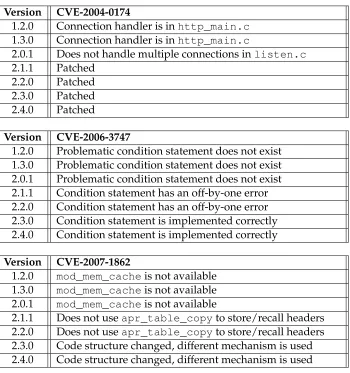
by the result set and evaluation set. The security researcher that produced the evaluation set gave the following rationale: “Connection handler is in http_main.c.” The result set indicates indeterminate because the relevant source files were not present at these points in the project’s history. From version 2.1.1 and for-ward, both the result set and evaluation set indicate that the software is no longer subject to the vulnerability.
Chapter 4. Results 30
Table 4.3 shows that versions 4.1.0 and 4.2.0 were indicated to bevulnerableby the result set. However, the evaluation set indicates that these versions were considered to be indeterminate. The rationale provided for this conclusion was that these versions have a different code structure as compared with the vulnerable versions of the software (versions 4.3.0, 4.4.0, and 4.5.1).
4.4
Discussion
The nature of the three types of outcomes means we cannot easily use binary classification techniques to assess the performance of the approach and result set.
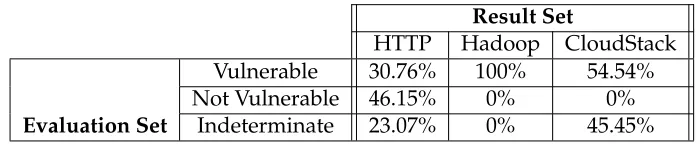
Instead, the performance of the results set can be assessed by analyzing its level of agreement with the evaluation set. Tables 4.6, 4.7, and 4.8 contain break-downs of each outcome type from the result set as the ratios of their counter-parts in the evaluation set. For example, for all of the vulnerableCloudStack results in Table 4.6, 54.54% of them were also found to be vulnerablein the evaluation set, 0% of them were found to be not vulnerable, and 45.45% of them were found to beindeterminate.
Interpreting the performance in this manner reveals that the approach as mea-sured by the evaluation set is extremely conservative in marking a vulnerabil-ity and version pair as not vulnerable. For vulnerableoutcomes in the result set, only Hadoop had equivalent outcomes in the evaluation set. However, for allnot vulnerableoutcomes in the result set, the evaluation set also had equiv-alentnot vulnerableoutcomes.
Chapter 4. Results 31
TABLE4.5: Performance withoutindeterminateoutcomes
Accuracy Precision Recall F-measure
86.6% 77.7% 100% 87.5%
TABLE4.6: Breakdown ofvulnerablevulnerability and version pair outcomes in the result set for each project as ratios of their
respective counterparts in the evaluation set
Result Set
HTTP Hadoop CloudStack
Evaluation Set
Vulnerable 30.76% 100% 54.54% Not Vulnerable 46.15% 0% 0%
Indeterminate 23.07% 0% 45.45%
to the evaluation shows that we can lend further credibility to the approach and its conservative nature.
Recall that the only context the approach has is a single patch containing the changes that introduce a fix for the vulnerability. The researcher, meanwhile, is able to use whatever resources they deem necessary to determine the vul-nerability status. In many of the cases, even the researcher was not able to confidently mark an outcome, as the CloudStack evaluation set shows. When considering the context and the nature of the results, it is appropriate and ex-pected that the indeterminateoutcome appears as frequently as it has in the result set.
If we consider the results withoutindeterminateoutcomes, as defined by:
{x6=indeterminate|x∈(Results∩Evaluation)}
then a binary classification of the results can be performed. In this context, a not vulnerableresult would be considered negative and a vulnerableresult would be considered positive. The performance of the approach after filtering the results on this criteria is shown in Table 4.5. The precision is calculated to be 77.7% and the recall is calculated to be 100% for an F-measure of 87.5%.
The approach favors erring on the side of caution by indicating a pair is either
[image:42.612.140.490.190.262.2]Chapter 4. Results 32
TABLE4.7: Breakdown ofnot vulnerablevulnerability and ver-sion pair outcomes in the result set for each project as ratios of
their respective counterparts in the evaluation set
Result Set
HTTP Hadoop CloudStack
Evaluation Set
Vulnerable 0% 0% 0% Not Vulnerable 100% 100% 100%
Indeterminate 0% 0% 0%
TABLE4.8: Breakdown ofindeterminatevulnerability and ver-sion pair outcomes in the result set for each project as ratios of
their respective counterparts in the evaluation set
Result Set
HTTP Hadoop CloudStack
Evaluation Set
Vulnerable 0% 32.91% 0% Not Vulnerable 91.30% 67.08% 0% Indeterminate 8.69% 0% 100%
itself towards either false negatives or false positives, favoring false positives is decidedly superior. When framed in the context of security, this is fitting and advantageous. Security is a critical and particularly detail oriented activity. Misplaced faith in tooling or the smallest, overlooked details have the potential to lead to disastrous results.
4.5
Threats to Validity
There are several threats that pose a risk to the approach and corresponding implementation.
Chapter 4. Results 33
As Bird et. al note, version control metadata can provide a rich source of infor-mation but the quality varies widely from project to project (Bird et al.,2009). The approach relies heavily on high quality version control metadata being available. Specifically, insufficient or poor file history may cause invalid or in-determinate results. Refactoring or restructuring efforts within a project could lead to similar outcomes. Further efforts to more intelligently handle version control efforts may mitigate this risk.
Finally, we are relying upon the security researcher’s expertise to provide high quality, reliable data against which to test the result set for validity. While this is not an unusual approach in and of itself, there is a problem with calling a version of software not vulnerable. Identifying a version asvulnerable (or even indeterminate) is acceptable because it rests upon a provable premise.
34
Chapter 5
Conclusions
5.1
Applications
The primary contribution of this work is to identify sets of versions of software that exhibit a particular vulnerability. To that end, an end to end system could be integrated as part of a development work flow that utilizes this approach.
Such a system would have two uses: 1. warn developers of changes in areas that have been affected by past vulnerabilities and the likelihood that they may be re-introducing the vulnerability and 2. notify developers of potentially vul-nerable dependencies within their software. A notification system would rely upon the ability to accurately identify the versions of dependencies included within a project.
The second noted use would need to be combined with work related to the identification of dependencies within software systems.
5.2
Future Work
Chapter 5. Conclusions 35
tracking files across history and through code changes to more accurately re-flect the state of a project with respect to a vulnerability. Additionally, machine learning techniques as well as a larger and more diverse set of projects can be applied to refine the approach for accuracy and applicability.
The manual parts of the approach can be made automatic to better integrate the system into a development work flow. A more sophisticated tool can be devised that uses this research as a foundation in order to fully integrate the approach into a development work flow. In combination with other tools, such a system will be able to identify changes that affect previously vulnerable areas and alert developers of potentially vulnerable dependencies.
5.3
Conclusion
The objectives of this research were twofold: 1. to propose a general algorith-mic approach to establishing the presence of a known vulnerability in a ware project and 2. using this approach, generate a set of versions of a soft-ware project indicating which exhibit a specific vulnerability. In devising an approach, a software patch that corrects a defect was established as the ground truth.
Three Apache Foundation projects were chosen to establish the approach as an effective mechanism. A set of vulnerabilities were chosen from each project’s respective history. A total of eleven vulnerabilities were tested across all projects. An independent security researcher performed a separate analysis on the same set of projects and vulnerabilities in order to evaluate the results of the ap-proach.
Chapter 5. Conclusions 36
37
Appendix A
Evaluation Rationales
TABLE A.1: Evaluation set outcome rationales for the Apache HTTP Server Project
Version CVE-2004-0174
1.2.0 Connection handler is inhttp_main.c
1.3.0 Connection handler is inhttp_main.c
2.0.1 Does not handle multiple connections inlisten.c
2.1.1 Patched 2.2.0 Patched 2.3.0 Patched 2.4.0 Patched
Version CVE-2006-3747
1.2.0 Problematic condition statement does not exist 1.3.0 Problematic condition statement does not exist 2.0.1 Problematic condition statement does not exist 2.1.1 Condition statement has an off-by-one error 2.2.0 Condition statement has an off-by-one error 2.3.0 Condition statement is implemented correctly 2.4.0 Condition statement is implemented correctly
Version CVE-2007-1862
1.2.0 mod_mem_cacheis not available 1.3.0 mod_mem_cacheis not available 2.0.1 mod_mem_cacheis not available
[image:48.612.143.493.307.680.2]Appendix A. Evaluation Rationales 38
Version CVE-2014-3583
1.2.0 mod_proxy_fcgiis not available 1.3.0 mod_proxy_fcgiis not available 2.0.1 mod_proxy_fcgiis not available 2.1.1 mod_proxy_fcgiis not available 2.2.0 mod_proxy_fcgiis not available
2.3.0 Buffers passed to handle_headers() are ensured to be properlyNULLterminated
2.4.0 Cause of the vulnerability is present in this version
Version CVE-2014-8109
1.2.0 mod_luais not available 1.3.0 mod_luais not available 2.0.1 mod_luais not available 2.1.1 mod_luais not available 2.2.0 mod_luais not available 2.3.0 mod_luais not available
2.4.0 LuaAuthzProviderprohibits users from supplying their own scripts to perform authorization
Version CVE-2015-3183
1.2.0 http_filtersis not available 1.3.0 http_filtersis not available 2.0.1 http_filtersis not available 2.1.1 http_filtersis not available 2.2.0 Different code structure
Appendix A. Evaluation Rationales 39
TABLE A.2: Evaluation set outcome rationales for Apache Hadoop
Version YARN-1993
0.1.0 YARN is not implemented 0.10.0 YARN is not implemented 0.11.0 YARN is not implemented 0.12.0 YARN is not implemented 0.13.0 YARN is not implemented 0.14.0 YARN is not implemented 0.15.0 YARN is not implemented 0.16.0 YARN is not implemented 0.17.0 YARN is not implemented 0.18.0 YARN is not implemented 0.19.0 YARN is not implemented 0.2.0 YARN is not implemented 0.20.0 YARN is not implemented 0.21.0 YARN is not implemented 0.22.0 YARN is not implemented
0.23.0 In TextView.java, echo() does not properly sanitize HTML attribute name
0.3.0 YARN is not implemented 0.4.0 YARN is not implemented 0.5.0 YARN is not implemented 0.6.0 YARN is not implemented 0.7.0 YARN is not implemented 0.8.0 YARN is not implemented 0.9.0 YARN is not implemented 1.0.0 YARN is not implemented 1.1.0 YARN is not implemented 1.2.0 YARN is not implemented
2.2.0 In TextView.java, echo() does not properly sanitize HTML attribute name
2.3.0 In TextView.java, echo() does not properly sanitize HTML attribute name
2.4.0 In TextView.java, echo() does not properly sanitize HTML attribute name
2.5.0 In TextView.java, echo() does not properly sanitize HTML attribute name
2.6.0 In TextView.java, echo() does not properly sanitize HTML attribute name
Appendix A. Evaluation Rationales 40
Version HADOOP-12964
0.1.0 HTTP was not used extensively
0.10.0 StatusHttpServerdoes not set anX-Frame-Optionsheader 0.11.0 StatusHttpServerdoes not set anX-Frame-Optionsheader 0.12.0 StatusHttpServerdoes not set anX-Frame-Optionsheader 0.13.0 StatusHttpServerdoes not set anX-Frame-Optionsheader 0.14.0 StatusHttpServerdoes not set anX-Frame-Optionsheader 0.15.0 StatusHttpServerdoes not set anX-Frame-Optionsheader 0.16.0 StatusHttpServerdoes not set anX-Frame-Optionsheader 0.17.0 StatusHttpServerdoes not set anX-Frame-Optionsheader 0.18.0 StatusHttpServerdoes not set anX-Frame-Optionsheader 0.19.0 HttpServer.javadoes not set anX-Frame-Optionsheader
0.2.0 HTTP was not used extensively
Appendix A. Evaluation Rationales 41
Version CVE-2012-3376
0.1.0 Does not contain federation features 0.10.0 Does not contain federation features 0.11.0 Does not contain federation features 0.12.0 Does not contain federation features 0.13.0 Does not contain federation features 0.14.0 Does not contain federation features 0.15.0 Does not contain federation features 0.16.0 Does not contain federation features 0.17.0 Does not contain federation features 0.18.0 Does not contain federation features 0.19.0 Does not contain federation features 0.2.0 Does not contain federation features 0.20.0 Does not contain federation features 0.21.0 Does not contain federation features 0.22.0 Does not contain federation features 0.23.0 Does not contain federation features 0.3.0 Does not contain federation features 0.4.0 Does not contain federation features 0.5.0 Does not contain federation features 0.6.0 Does not contain federation features 0.7.0 Does not contain federation features 0.8.0 Does not contain federation features 0.9.0 Does not contain federation features 1.0.0 Does not contain federation features 1.1.0 Does not contain federation features 1.2.0 Does not contain federation features 2.2.0 Patched
Appendix A. Evaluation Rationales 42
TABLE A.3: Evaluation set outcome rationales for Apache
CloudStack
Version CVE-2015-3251
2.1.3 Different code structure 2.2.0 Different code structure 3.0.1 Different code structure 4.0.2 Different code structure 4.1.0 Different code structure 4.2.0 Different code structure
4.3.0 In LibvirtComputingResource.java, when re-booting virtual machines, sensitive information is exposed since certain properties do not have the
VIR_DOMAIN_XML_SECUREflag.
4.4.0 In LibvirtComputingResource.java, when re-booting virtual machines, sensitive information is exposed since certain properties do not have the
VIR_DOMAIN_XML_SECUREflag.
4.5.1 In LibvirtComputingResource.java, when re-booting virtual machines, sensitive information is exposed since certain properties do not have the
VIR_DOMAIN_XML_SECUREflag. 4.6.0 Patched
Appendix A. Evaluation Rationales 43
Version CVE-2015-3252
2.1.3 Different code structure 2.2.0 Different code structure 3.0.1 Different code structure 4.0.2 Different code structure 4.1.0 Different code structure 4.2.0 Different code structure
4.3.0 In LibvirtComputingResource.java, when re-booting virtual machines, sensitive information is exposed since certain properties do not have the
VIR_DOMAIN_XML_MIGRATABLEflag.
4.4.0 In LibvirtComputingResource.java, when re-booting virtual machines, sensitive information is exposed since certain properties do not have the
VIR_DOMAIN_XML_MIGRATABLEflag.
4.5.1 In LibvirtComputingResource.java, when re-booting virtual machines, sensitive information is exposed since certain properties do not have the
VIR_DOMAIN_XML_MIGRATABLEflag. 4.6.0 Patched
44
Bibliography
Adams, Bram et al. (2016). “An empirical study of integration activities in dis-tributions of open source software”. In:Empirical Software Engineering 21.3, pp. 960–1001.
Anderson, Ross (2001). “Why information security is hard-an economic per-spective”. In: Computer security applications conference, 2001. acsac 2001. pro-ceedings 17th annual. IEEE, pp. 358–365.
[Apache-SVN] Contents of /httpd/httpd/branches/2.0.x/CHANGES(2016).URL:http: / / svn . apache . org / viewvc / httpd / httpd / branches / 2 . 0 . x /
CHANGES?view=markup(visited on 08/08/2016).
[Apache-SVN] Contents of /httpd/httpd/branches/2.2.x/CHANGES(2016).URL:http: / / svn . apache . org / viewvc / httpd / httpd / branches / 2 . 2 . x /
CHANGES?view=markup(visited on 08/08/2016).
[Apache-SVN] Contents of /httpd/httpd/branches/2.4.x/CHANGES(2016).URL:http: / / svn . apache . org / viewvc / httpd / httpd / branches / 2 . 4 . x /
CHANGES?view=markup(visited on 08/08/2016).
Belady, Laszlo A. and Meir M Lehman (1976). “A model of large program de-velopment”. In:IBM Systems journal15.3, pp. 225–252.
Bird, Christian et al. (2009). “The promises and perils of mining git”. In:2009 6th IEEE International Working Conference on Mining Software Repositories. IEEE, pp. 1–10.
BIBLIOGRAPHY 45
Chen, Hong-Mei et al. (2016). “Predicting and Fixing Vulnerabilities Before They Occur: A Big Data Approach”. In:Proceedings of the 2Nd International Workshop on BIG Data Software Engineering. BIGDSE ’16. Austin, Texas: ACM, pp. 72–75. ISBN: 978-1-4503-4152-3. DOI: 10 . 1145 / 2884781 . 2896829.
URL:http://doi.acm.org/10.1145/2884781.2896829.
CVE-2004-0174. (2004). Available from MITRE, CVE-ID CVE-2004-0174. URL:
https : / / cve . mitre . org / cgi bin / cvename . cgi ? name = CAN
-2004-0174(visited on 07/15/2016).
CVE-2006-3747. (2006). Available from MITRE, CVE-ID CVE-2006-3747. URL:
https : / / cve . mitre . org / cgi bin / cvename . cgi ? name = CVE
-2006-3747(visited on 07/15/2016).
CVE-2007-1862. (2007). Available from MITRE, CVE-ID CVE-2007-1862. URL:
https : / / cve . mitre . org / cgi bin / cvename . cgi ? name = CVE
-2007-1862(visited on 07/15/2016).
CVE-2012-3376. (2012). Available from MITRE, CVE-ID CVE-2012-3376. URL:
https : / / cve . mitre . org / cgi bin / cvename . cgi ? name = CVE
-2012-3376(visited on 07/15/2016).
CVE-2014-3583. (2014). Available from MITRE, CVE-ID CVE-2014-3583. URL: https : / / cve . mitre . org / cgi bin / cvename . cgi ? name = CVE
-2014-3583(visited on 07/15/2016).
CVE-2014-8109. (2014). Available from MITRE, CVE-ID CVE-2014-8109. URL: https : / / cve . mitre . org / cgi bin / cvename . cgi ? name = CVE
-2014-8109(visited on 07/15/2016).
CVE-2015-3183. (2015). Available from MITRE, CVE-ID CVE-2015-3183. URL:
https : / / cve . mitre . org / cgi bin / cvename . cgi ? name = CVE
-2015-3183(visited on 07/15/2016).
CVE-2015-3251. (2015). Available from MITRE, CVE-ID CVE-2015-3251. URL:
https : / / cve . mitre . org / cgi bin / cvename . cgi ? name = CVE
BIBLIOGRAPHY 46
CVE-2015-3252. (2015). Available from MITRE, CVE-ID CVE-2015-3252. URL:
https : / / cve . mitre . org / cgi bin / cvename . cgi ? name = CVE
-2015-3252(visited on 07/15/2016).
Durumeric, Zakir et al. (2014). “The matter of heartbleed”. In:Proceedings of the 2014 Conference on Internet Measurement Conference. ACM, pp. 475–488. Fluri, Beat et al. (2007). “Change distilling: Tree differencing for fine-grained
source code change extraction”. In:IEEE Transactions on Software Engineering
33.11, pp. 725–743.
Hanna, Steve et al. (2013). “Juxtapp: A scalable system for detecting code reuse among android applications”. In:Detection of Intrusions and Malware, and Vul-nerability Assessment. Springer, pp. 62–81.
Hovsepyan, Aram et al. (2012). “Software vulnerability prediction using text analysis techniques”. In:Proceedings of the 4th international workshop on Secu-rity measurements and metrics. ACM, pp. 7–10.
Jang, Jiyong, Ankit Agrawal, and David Brumley (2012). “ReDeBug: finding unpatched code clones in entire os distributions”. In: Security and Privacy (SP), 2012 IEEE Symposium on. IEEE, pp. 48–62.
Kim, Jinyoo, Yashwant K Malaiya, and Indrakshi Ray (2007). “Vulnerability discovery in multi-version software systems”. In:High Assurance Systems En-gineering Symposium, 2007. HASE’07. 10th IEEE. IEEE, pp. 141–148.
Kim, Miryung and David Notkin (2006). “Program element matching for multi-version program analyses”. In:Proceedings of the 2006 international workshop on Mining software repositories. ACM, pp. 58–64.
Kinsella, John (2016a). CVE-2015-3251: Apache CloudStack VM Credential Ex-posure. URL: http : / / mail - archives . apache . org / mod _ mbox /
cloudstack-users/201602.mbox/%[email protected]%3E(visited on 08/08/2016).
BIBLIOGRAPHY 47
201602 . mbox / %3C7508580E - 3D83 - 49FD - BE6E - B329B0503130 @
gmail.com%3E(visited on 08/08/2016).
Klatt, Benjamin et al. (2012). “Identify impacts of evolving third party compo-nents on long-living software systems”. In:Software Maintenance and Reengi-neering (CSMR), 2012 16th European Conference on. IEEE, pp. 461–464.
Liu, Bingchang et al. (2012). “Software vulnerability discovery techniques: A survey”. In: 2012 Fourth International Conference on Multimedia Information Networking and Security. IEEE, pp. 152–156.
Mojica, Israel J et al. (2014). “A large-scale empirical study on software reuse in mobile apps”. In:IEEE software31.2, pp. 78–86.
Möller, Bodo, Thai Duong, and Krzysztof Kotowicz (2014). “This POODLE bites: exploiting the SSL 3.0 fallback”. In:PDF online.
Myers, Aaron T. (2012).[CVE-2012-3376] Apache Hadoop HDFS information dis-closure vulnerability.URL:http://www.securityfocus.com/archive/ 1/523468(visited on 08/08/2016).
Roy, Chanchal K and James R Cordy (2008). “An empirical study of function clones in open source software”. In:Reverse Engineering, 2008. WCRE’08. 15th Working Conference on. IEEE, pp. 81–90.
Shin, Yonghee and Laurie Williams (2013). “Can traditional fault prediction models be used for vulnerability prediction?” In:Empirical Software Engineer-ing18.1, pp. 25–59.
Shirey, R. (2000).Internet Security Glossary. RFC 2828. GTE / BBN Technologies, pp. 189–189.URL:https://tools.ietf.org/html/rfc2828.
BIBLIOGRAPHY 48
Telang, Rahul and Sunil Wattal (2007). “An empirical analysis of the impact of software vulnerability announcements on firm stock price”. In:IEEE Trans-actions on Software Engineering33.8, pp. 544–557.
Yu, Ted (2014). [YARN-1993] Cross-site scripting vulnerability in TextView.java.
URL:https://issues.apache.org/jira/browse/YARN- 1993 (vis-ited on 05/10/2016).