All The Latest Software You Want For Free
[Click Here]
Latest Cell Phone Reviews + Exclusive Video Reviews
[Click Here]
w w w . s y n g r e s s . c o m
Syngress is committed to publishing high-quality books for IT Professionals and delivering those books in media and formats that fit the demands of our cus-tomers. We are also committed to extending the utility of the book you pur-chase via additional materials available from our Web site.
SOLUTIONS WEB SITE
To register your book, visit www.syngress.com/solutions. Once registered, you can access our [email protected] Web pages. There you may find an assort-ment of value-added features such as free e-books related to the topic of this book, URLs of related Web sites, FAQs from the book, corrections, and any updates from the author(s).
ULTIMATE CDs
Our Ultimate CD product line offers our readers budget-conscious compilations of some of our best-selling backlist titles in Adobe PDF form. These CDs are the perfect way to extend your reference library on key topics pertaining to your area of expertise, including Cisco Engineering, Microsoft Windows System Administration, CyberCrime Investigation, Open Source Security, and Firewall Configuration, to name a few.
DOWNLOADABLE E-BOOKS
For readers who can’t wait for hard copy, we offer most of our titles in down-loadable Adobe PDF form. These e-books are often available weeks before hard copies, and are priced affordably.
SYNGRESS OUTLET
Our outlet store at syngress.com features overstocked, out-of-print, or slightly hurt books at significant savings.
SITE LICENSING
Syngress has a well-established program for site licensing our e-books onto servers in corporations, educational institutions, and large organizations. Contact us at [email protected] for more information.
CUSTOM PUBLISHING
Many organizations welcome the ability to combine parts of multiple Syngress books, as well as their own content, into a single volume for their own internal use. Contact us at [email protected] for more information.
Craig A. Schiller Jim Binkley David Harley Gadi Evron Tony Bradley Carsten Willems Michael Cross
Botnets
Elsevier, Inc., the author(s), and any person or firm involved in the writing, editing, or production (collectively “Makers”) of this book (“the Work”) do not guarantee or warrant the results to be obtained from the Work.
There is no guarantee of any kind, expressed or implied, regarding the Work or its contents.The Work is sold AS IS and WITHOUT WARRANTY.You may have other legal rights, which vary from state to state.
In no event will Makers be liable to you for damages, including any loss of profits, lost savings, or other incidental or consequential damages arising out from the Work or its contents. Because some states do not allow the exclusion or limitation of liability for consequential or incidental damages, the above limitation may not apply to you.
You should always use reasonable care, including backup and other appropriate precautions, when working with computers, networks, data, and files.
Syngress Media®, Syngress®, “Career Advancement Through Skill Enhancement®,” “Ask the Author UPDATE®,” and “Hack Proofing®,” are registered trademarks of Elsevier, Inc. “Syngress: The Definition of a Serious Security Library”™, “Mission Critical™,” and “The Only Way to Stop a Hacker is to Think Like One™”are trademarks of Elsevier, Inc. Brands and product names men-tioned in this book are trademarks or service marks of their respective companies.
KEY SERIAL NUMBER
001 HJIRTCV764 002 PO9873D5FG 003 829KM8NJH2 004 BAL923457U 005 CVPLQ6WQ23 006 VBP965T5T5 007 HJJJ863WD3E 008 2987GVTWMK 009 629MP5SDJT 010 IMWQ295T6T Botnets: The Killer Web App
Copyright © 2007 by Syngress Publishing, Inc., a division of Elsevier, Inc. All rights reserved. Except as permitted under the Copyright Act of 1976, no part of this publication may be reproduced or dis-tributed in any form or by any means, or stored in a database or retrieval system, without the prior written permission of the publisher, with the exception that the program listings may be entered, stored, and executed in a computer system, but they may not be reproduced for publication. 1 2 3 4 5 6 7 8 9 0
ISBN-10: 1-59749-135-7 ISBN-13: 978-1-59749-135-8
Publisher: Andrew Williams Page Layout and Art: Patricia Lupien
Acquisitions Editor: Gary Byrne Copy Editors: Michelle Melani, Darlene Bordwell, Technical Editors: Craig Schiller, and Adrienne Rebello
Jim Binkley Indexer: Richard Carlson Cover Designer: Michael Kavish
Acknowledgments
v Syngress would like to acknowledge the following people for their kindness and support in making this book possible.
This may seem like a strange place to thank bankers, attorneys, and accountants, but these folks have all played a role in the success of Syngress Publishing:
Jim Barbieri, Ed Remondi, Anne Marie Sharpe, and their team at Holbrook Coop in Holbrook, MA.
Gene Landy, Amy Mastrobattista, and Beth Grazio at Ruberto, Israel & Weiner in Boston.
Lead Authors
and Technical Editors
Craig A. Schiller(CISSP-ISSMP, ISSAP) is the Chief Information Security Officer for Portland State University and President of Hawkeye Security Training, LLC. He is the primary author of the first Generally Accepted System Security Principles. He was a coauthor of several editions of the Handbook of Information Security Managementand a contributing author to Data Security Management. Craig was also a contributor to
Combating Spyware in the Enterprise(Syngress, ISBN: 1597490644) and Winternals Defragmentation, Recovery, and Administration Field Guide(Syngress, ISBN: 1597490792). Craig was the Senior Security Engineer and Coarchitect of NASA’s Mission Operations AIS Security Engineering Team. Craig has cofounded two ISSA U.S. regional chapters: the Central Plains Chapter and the Texas Gulf Coast Chapter. He is a member of the Police Reserve Specialists unit of the Hillsboro Police Department in Oregon. He leads the unit’s Police-to-Business-High-Tech speakers’ initiative and assists with Internet forensics.
Jim Binkleyis a senior network engineer and network security researcher at Portland State University (PSU). Jim has over 20 years of TCP/IP experience and 25 years of UNIX operating system experience. Jim teaches graduate-level classes in network secu-rity, network management, and UNIX operating systems at PSU. He provides the uni-versity with various forms of network monitoring as well as consulting in network design. In the past Jim was involved in the DARPA-funded “secure mobile networks” grant at PSU along with John McHugh. His specialties include wireless networking and network anomaly detection, including the open-source ourmon network monitoring and anomaly detection system. Jim holds a Master of Science in Computer Science from Washington State University.
Tony Bradley(CISSP-ISSAP) is the Guide for the Internet/Network Security site on About.com, a part of The New York Times Company. He has written for a variety of other Web sites and publications, including PC World, SearchSecurity.com,
WindowsNetworking.com,Smart Computing magazine, and Information Securitymagazine. Currently a security architect and consultant for a Fortune 100 company,Tony has driven security policies and technologies for antivirus and incident response for Fortune 500 companies, and he has been network administrator and technical support for smaller
vii
panies. He is author of Essential Computer Security: Everyone’s Guide to E-mail, Internet, and Wireless Security(Syngress, ISBN: 1597491144).
Tony is a CISSP (Certified Information Systems Security Professional) and ISSAP (Information Systems Security Architecture Professional). He is Microsoft Certified as an MCSE (Microsoft Certified Systems Engineer) and MCSA (Microsoft Certified Systems Administrator) in Windows 2000 and an MCP (Microsoft Certified Professional) in Windows NT.Tony is recognized by Microsoft as an MVP (Most Valuable Professional) in Windows security.
On his About.com site,Tony has on average over 600,000 page views per month and 25,000 subscribers to his weekly newsletter. He created a 10-part Computer Security 101 Class that has had thousands of participants since its creation and continues to gain popu-larity through word of mouth. In addition to his Web site and magazine contributions, Tony was also coauthor of Hacker’s Challenge 3(ISBN: 0072263040) and a contributing author to Winternals: Defragmentation, Recovery, and Administration Field Guide(ISBN: 1597490792) and Combating Spyware in the Enterprise(ISBN: 1597490644).
Tony wrote Chapter 4.
Michael Cross(MCSE, MCP+I, CNA, Network+) is an Internet Specialist/Computer Forensic Analyst with the Niagara Regional Police Service (NRPS). He performs com-puter forensic examinations on comcom-puters involved in criminal investigation. He also has consulted and assisted in cases dealing with computer-related/Internet crimes. In addition to designing and maintaining the NRPS Web site at www.nrps.com and the NRPS intranet, he has provided support in the areas of programming, hardware, and network administration. As part of an information technology team that provides support to a user base of more than 800 civilian and uniform users, he has a theory that when the users carry guns, you tend to be more motivated in solving their problems.
Michael also owns KnightWare (www.knightware.ca), which provides computer-related services such as Web page design, and Bookworms (www.bookworms.ca), where you can purchase collectibles and other interesting items online. He has been a freelance writer for several years, and he has been published more than three dozen times in numerous books and anthologies. He currently resides in St. Catharines, Ontario, Canada, with his lovely wife, Jennifer, his darling daughter, Sara, and charming son, Jason.
Michael wrote Chapter 11.
Gadi Evronworks for the McLean, VA-based vulnerability assessment solution vendor Beyond Security as Security Evangelist and is the chief editor of the security portal SecuriTeam. He is a known leader in the world of Internet security operations, especially regarding botnets and phishing. He is also the operations manager for the Zeroday Emergency Response Team (ZERT) and a renowned expert on corporate security and espionage threats. Previously, Gadi was Internet Security Operations Manager for the Israeli government and the manager and founder of the Israeli government’s Computer
Emergency Response Team (CERT).
David Harley(BA, CISSP) has written or contributed to over a dozen security books, including Viruses Revealedand the forthcoming AVIEN Malware Defense Guide for the Enterprise. He is an experienced and well-respected antivirus researcher, and he also holds qualifications in security audit (BS7799 Lead Auditor), ITIL Service Management, and medical informatics. His background includes security analysis for a major medical research charity and managing the Threat Assessment Centre for the U.K.’s National Health Service, specializing in the management of malware and e-mail security. His “Small Blue-Green World” provides consultancy and authoring services to the security industry, and he is a frequent speaker at security conferences.
David cowrote Chapter 5.
Chris Riesis a Security Research Engineer for VigilantMinds Inc., a managed security services provider and professional consulting organization based in Pittsburgh. His research focuses on the discovery, exploitation, and remediation of software vulnerabilities, analysis of malicious code, and evaluation of security software. Chris has published a number of advisories and technical white papers based on his research. He has also contributed to sev-eral books on information security.
Chris holds a bachelor’s degree in Computer Science with a Mathematics Minor from Colby College, where he completed research involving automated malicious code detec-tion. Chris has also worked as an analyst at the National Cyber-Forensics & Training Alliance (NCFTA), where he conducted technical research to support law enforcement.
Chris tech-edited Chapters 8 and 9.
Carsten Willemsis an independent software developer with 10 years’ experience. He has a special interest in the development of security tools related to malware research. He is the creator of the CWSandbox, an automated malware analysis tool.The tool, which he devel-oped as a part of his thesis for his master’s degree in computer security at RWTH Aachen, is now distributed by Sunbelt Software in Clearwater, FL. He is currently working on his PhD thesis, titled “Automatic Malware Classification,” at the University of Mannheim. In November 2006 he was awarded third place at the Competence Center for Applied Security Technology (CAST) for his work titled “Automatic Behaviour Analysis of Malware.” In addition, Carsten has created several office and e-business products. Most recently, he has developed SAGE GS-SHOP, a client-server online shopping system that has been installed over 10,000 times.
ix
Contents
Chapter 1 Botnets: A Call to Action. . . 1
Introduction . . . .2
The Killer Web App . . . .3
How Big Is the Problem? . . . .4
A Conceptual History of Botnets . . . .6
GM . . . .7
Pretty Park . . . .7
SubSeven Trojan/Bot . . . .8
GT Bot . . . .8
SDBot . . . .9
Agobot . . . .10
From Code-Based Families to Characteristic-Based Families . . . .11
Spybot . . . .12
RBot . . . .14
Polybot . . . .15
Mytob . . . .15
Capabilities Coming to a Bot Near You . . . .15
Cases in the News . . . .16
“THr34t-Krew” . . . .16
Axel Gembe . . . .17
180Solutions Civil Law Suit . . . .17
Operation Cyberslam: Jay Echouafni, Jeanson James Ancheta . . . .18
Anthony Scott Clark . . . .20
Farid Essebar . . . .21
Christopher Maxwell . . . .21
Jeffrey Parson . . . .21
The Industry Responds . . . .22
Summary . . . .24
Solutions Fast Track . . . .25
Frequently Asked Questions . . . .26
Chapter 2 Botnets Overview . . . 29
What Is a Botnet? . . . .30
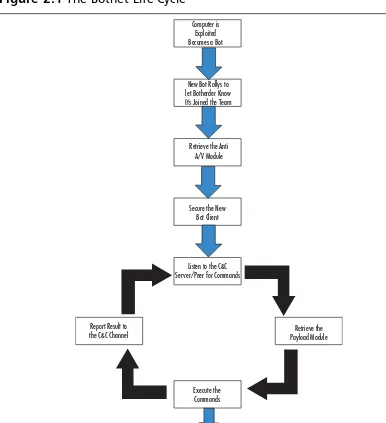
The Botnet Life Cycle . . . .31
Exploitation . . . .31
Malicious Code . . . .31
Attacks against Unpatched Vulnerabilities . . . .32
Backdoors Left by Trojan Worms or Remote Access Trojans . . . .33
Password Guessing and Brute-Force Access Attempts . . . .34
Rallying and Securing the Botnet Client . . . .37
What Does a Botnet Do? . . . .42
Recruit Others . . . .42
DDoS . . . .46
Installation of Adware and Clicks4Hire . . . .49
The Botnet-Spam and Phishing Connection . . . .51
Storage and Distribution of Stolen or Illegal Intellectual Property . . .55
Ransomware . . . .60
Data Mining . . . .61
Reporting Results . . . .61
Erase the Evidence, Abandon the Client . . . .62
Botnet Economics . . . .62
Spam and Phishing Attacks . . . .62
Adware Installation and Clicks4Hire Schemes . . . .63
Ransomware . . . .69
Summary . . . .70
Solutions Fast Track . . . .70
Frequently Asked Questions . . . .73
Chapter 3 Alternative Botnet C&Cs . . . 77
Introduction: Why Are There Alternative C&Cs? . . . .78
Historical C&C Technology as a Road Map . . . .79
DNS and C&C Technology . . . .81
Domain Names . . . .81
Multihoming . . . .82
Alternative Control Channels . . . .82
Web-Based C&C Servers . . . .83
Echo-Based Botnets . . . .83
Connect & Forget . . . .84
File Data . . . .84
URL Data . . . .84
Command-Based Botnets . . . .84
P2P Botnets . . . .86
Instant Messaging (IM) C&Cs . . . .86
Remote Administration Tools . . . .87
Drop Zones and FTP-Based C&Cs . . . .87
Advanced DNS-Based Botnets . . . .89
Dynamic DNS . . . .90
Fastflux DNS . . . .90
Future Outlook . . . .91
Summary . . . .93
Solutions Fast Track . . . .94
Contents xi
Chapter 4 Common Botnets . . . 97
Introduction . . . .98
SDBot . . . .98
Aliases . . . .99
Infection . . . .99
Signs of Compromise . . . .100
System Folder . . . .100
Registry Entries . . . .101
Additional Files . . . .102
Unexpected Traffic . . . .103
Propagation . . . .104
RBot . . . .104
Aliases . . . .105
Infection . . . .105
Signs of Compromise . . . .105
System Folder . . . .105
Registry Entries . . . .106
Terminated Processes . . . .106
Unexpected Traffic . . . .107
Propagation . . . .108
Using Known Vulnerability Exploits . . . .110
Exploiting Malware Backdoors . . . .111
Agobot . . . .111
Aliases . . . .112
Infection . . . .113
Signs of Compromise . . . .113
System Folder . . . .113
Registry Entries . . . .113
Terminated Processes . . . .114
Modify Hosts File . . . .114
Theft of Information . . . .114
Unexpected Traffic . . . .115
Vulnerability Scanning . . . .116
Propagation . . . .116
Spybot . . . .118
Aliases . . . .118
Infection . . . .118
Signs of Compromise . . . .119
System Folder . . . .119
Registry Entries . . . .119
Unexpected Traffic . . . .122
Keystroke Logging and Data Capture . . . .122
Propagation . . . .122
Mytob . . . .123
Infection . . . .124
Signs of Compromise . . . .124
System Folder . . . .124
Registry Entries . . . .125
Unexpected Traffic . . . .125
Propagation . . . .125
Summary . . . .128
Solutions Fast Track . . . .129
Frequently Asked Questions . . . .131
Chapter 5 Botnet Detection: Tools and Techniques . . . 133
Introduction . . . .134
Abuse . . . .134
Spam and Abuse . . . .139
Network Infrastructure:Tools and Techniques . . . .140
SNMP and Netflow: Network-Monitoring Tools . . . .143
SNMP . . . .144
Netflow . . . .146
Firewalls and Logging . . . .148
Layer 2 Switches and Isolation Techniques . . . .151
Intrusion Detection . . . .155
Virus Detection on Hosts . . . .160
Heuristic Analysis . . . .165
Snort as an Example IDS . . . .168
Installation . . . .169
Roles and Rules . . . .169
Rolling Your Own . . . .170
Tripwire . . . .173
Darknets, Honeypots, and Other Snares . . . .176
Forensics Techniques and Tools for Botnet Detection . . . .179
Process . . . .181
Event Logs . . . .184
Firewall Logs . . . .192
Antivirus Software Logs . . . .198
Summary . . . .208
Solutions Fast Track . . . .208
Frequently Asked Questions . . . .213
Chapter 6 Ourmon: Overview and Installation . . . 217
Introduction . . . .218
Case Studies:Things That Go Bump in the Night . . . .220
Case Study #1: DDoS (Distributed Denial of Service) . . . .220
Case Study #2: External Parallel Scan . . . .222
Contents xiii
How Ourmon Works . . . .227
Installation of Ourmon . . . .232
Ourmon Install Tips and Tricks . . . .236
Summary . . . .239
Solutions Fast Track . . . .240
Frequently Asked Questions . . . .241
Chapter 7 Ourmon: Anomaly Detection Tools . . . 245
Introduction . . . .246
The Ourmon Web Interface . . . .247
A Little Theory . . . .252
TCP Anomaly Detection . . . .255
TCP Port Report:Thirty-Second View . . . .255
Analysis of Sample TCP Port Report . . . .262
TCP Work Weight: Details . . . .265
TCP Worm Graphs . . . .267
TCP Hourly Summarization . . . .269
UDP Anomaly Detection . . . .272
Detecting E-mail Anomalies . . . .275
Summary . . . .279
Solutions Fast Track . . . .279
Frequently Asked Questions . . . .283
Chapter 8 IRC and Botnets. . . 285
Introduction . . . .286
Understanding the IRC Protocol . . . .286
Ourmon’s RRDTOOL Statistics and IRC Reports . . . .290
The Format of the IRC Report . . . .292
Detecting an IRC Client Botnet . . . .298
Detecting an IRC Botnet Server . . . .304
Summary . . . .309
Solutions Fast Track . . . .309
Frequently Asked Questions . . . .311
Chapter 9 Advanced Ourmon Techniques . . . 313
Introduction . . . .314
Automated Packet Capture . . . .314
Anomaly Detection Triggers . . . .317
Real-World Trigger Examples . . . .319
Ourmon Event Log . . . .324
Tricks for Searching the Ourmon Logs . . . .325
Sniffing IRC Messages . . . .329
Optimizing the System . . . .334
Buy a Dual-Core CPU for the Probe . . . .335
Separate the Front End and Back End with Two Different Computers . . . .336
Make the Kernel Ring Buffer Bigger . . . .336
Reduce Interrupts . . . .337
Summary . . . .339
Solutions Fast Track . . . .339
Frequently Asked Questions . . . .343
Chapter 10 Using Sandbox Tools for Botnets . . . 345
Introduction . . . .346
Describing CWSandbox . . . .348
Describing the Components . . . .352
Cwsandbox.exe . . . .354
Cwmonitor.dll . . . .356
Examining a Sample Analysis Report . . . .359
The <analysis> Section . . . .359
Analysis of 82f78a89bde09a71ef99b3cedb991bcc.exe . . . .360
Analysis of Arman.exe . . . .363
Interpreting an Analysis Report . . . .368
How Does the Bot Install? . . . .369
Finding Out How New Hosts Are Infected . . . .371
How Does the Bot Protect the Local Host and Itself? . . . .372
Determining How and Which C&C Servers Are Contacted . . . .375
How Does the Bot Get Binary Updates? . . . .376
What Malicious Operations Are Performed? . . . .378
Bot-Related Findings of Our Live Sandbox . . . .383
Summary . . . .385
Solutions Fast Track . . . .387
Frequently Asked Questions . . . .390
Chapter 11 Intelligence Resources . . . 391
Introduction . . . .392
Identifying the Information an Enterprise/University Should Try to Gather . . . .392
Disassemblers . . . .395
PE Disassembler . . . .395
DJ Java Decompiler . . . .396
Hackman Disassembler . . . .396
Places/Organizations Where Public Information Can Be Found . . . .398
Antivirus, Antispyware, and Antimalware Sites . . . .398
Viewing Information on Known Bots and Trojans . . . .399
Professional and Volunteer Organizations . . . .400
EDUCAUSE . . . .400
NANOG . . . .401
Shadowserver . . . .401
Contents xv
Vetting Members . . . .404
Confidentiality Agreements . . . .404
What Can Be Shared . . . .405
What Can’t Be Shared . . . .405
Potential Impact of Breaching These Agreements . . . .406
Conflict of Interest . . . .407
What to Do with the Information When You Get It . . . .407
The Role of Intelligence Sources in Aggregating Enough Information to Make Law Enforcement Involvement Practical . . . .409
Summary . . . .411
Solutions Fast Track . . . .411
Frequently Asked Questions . . . .414
Chapter 12 Responding to Botnets . . . 417
Introduction . . . .418
Giving Up Is Not an Option . . . .418
Why Do We Have This Problem? . . . .420
Fueling the Demand: Money, Spam, and Phishing . . . .421
Law Enforcement Issues . . . .423
Hard Problems in Software Engineering . . . .425
Lack of Effective Security Policies or Process . . . .426
Operations Challenges . . . .428
What Is to Be Done? . . . .429
Effective Practices . . . .430
Practices for Individual Computer Users . . . .430
Enterprise Practices . . . .432
How Might We Respond to Botnets? . . . .434
Reporting Botnets . . . .436
Fighting Back . . . .437
The Saga of Blue Security . . . .438
Some Observations about the Blue Frog Affair . . . .442
Law Enforcement . . . .443
Darknets, Honeynets, and Botnet Subversion . . . .444
A Call to Arms . . . .445
Summary . . . .447
Solutions Fast Track . . . .448
Frequently Asked Questions . . . .451
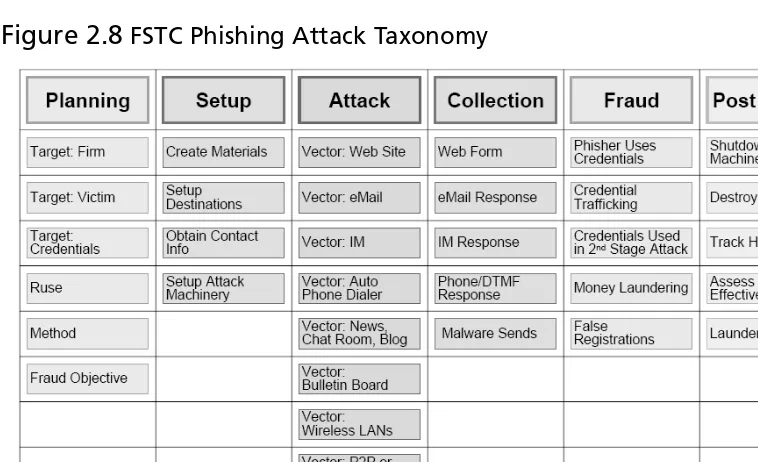
Appendix A: FSTC Phishing Solutions Categories . . . 453
Botnets:
A Call to Action
Solutions in this chapter:
■ The Killer Web App
■ How Big Is the Problem?
■ The Industry Responds
Chapter 1
1
Summary
Solutions Fast Track
Introduction
Throughout 2006, technical security conferences have been discussing the latest “killer Web app.” Unfortunately, this Web technology works for the bad guys. With funding from organized crime and spam lords, a generation of talented hackers without morals has created a devastating arsenal of deadly toys, in the form of botnets. Norman Elton and Matt Keel from the College of William & Mary in the 2005 presentation “Who Owns Your Network?” called bot net-works “the single greatest threat facing humanity.”This may be an exaggeration, but Botnets are arguably the biggest threat that the Internet community has faced. John Canavan, in a whitepaper titled “The Evolution of Malicious IRC Bots,” says that Botnets are “the most dangerous and widespread Win32 viral threat.” According to the cover of eWEEKmagazine for October 16, 2006, we are “Losing the Botnet War.”The article by Ryan Naraine titled “Is the Botnet Battle Already Lost?” describes the current state of the Botnet environment: Botnets are “the key hub for well-organized crime rings around the globe, using stolen bandwidth from drone zombies to make money from nefarious Internet activity.” (for more information, go to www.eweek.com/article2/ 0,1895,2029720,00.asp.) By contrast the security response is in its infancy with several vendors releasing version 1 of botnet-related products. Badly needed intelligence information is locked away with only the slightest means of com-municating it to the security professionals that need it.There isn’t any such thing as an information security professional security clearance. One vendor told us that the quality of their product depends on the quality of their intelli-gence sources and then went on to say that they could give us no information that could vouch for the quality of their intelligence sources.
(C&C) server is no longer as effective as it once was. Imagine how the first invading army that encountered a castle felt. Imagine the castle owner’s reac-tion upon the invenreac-tion of the siege tower, catapult, or mortar.Yet, in the years following the introduction of each of these weapons, castle design changed. A single wall surrounding the castle became a series of walls.The rectangular castle shape gave way to irregular shapes intended to deflect instead of stopping enemy weapons.The loss of a major weapon doesn’t mean the loss of the war unless the general lets morale plummet and does not evolve to meet the new environment.
This book will attempt to add new soldiers and new weapons to the battle. In doing so, the authors hope to stem the tide of lost morale and help security professionals regain focus. It is necessary to lay a foundation for deeper discussions.
This chapter describes the current state and how we got to this place. We come from many levels and as such we must start from the very beginning. What is a botnet? In its simplest form, it is an army of compromised com-puters that take orders from a botherder. A botherder is an immoral hacker who uses the botnet for financial gain or as a weapon against others.
The Killer Web App
How does this make a botnet a “killer Web app?”The software that creates and manages a botnet makes this threat much more than the previous genera-tion of malicious code. It is not just a virus; it is a virus of viruses.The botnet is modular—one module exploits the vulnerabilities it finds to gain control over its target. It then downloads another module that protects the new bot by stopping antivirus software and firewalls; the third module may begin scan-ning for other vulnerable systems.
A botnet is adaptive; it can be designed to download different modules to exploit specific things that it finds on a victim. New exploits can be added as they are discovered.This makes the job of the antivirus software much more complex. Finding one component of a botnet does not imply the nature of any of the other components because the first component can choose to download from any number of modules to perform the functionality of each phase in the life cycle of a botnet. It also casts doubt on the capability of
antivirus software to claim that a system is clean when it encounters and cleans one component of a multicomponent bot. Because each component is downloaded when it is needed after the initial infection, the potential for a system to get a zero day exploit is higher. If you are in an enterprise setting, you take the risk of putting a bot back into circulation if the effort to clean the malicious code isn’t comprehensive. Rather than take that risk, many IT departments opt to re-image the system from a known clean image.
Botnet attacks are targetable.That is, the hacker can target a company or a market sector for these attacks. Although botnets can be random, they can also be customized to a selected set of potential hosts.The botherder can con-figure the bot clients to limit their scanning to hosts in a defined set of Internet Protocol (IP) addresses. With this targeting capability comes the capability to market customized attacks for sale.The targeting capability of botnets is adaptive as well.The bot client can check the newly infected host for applications that it knows how to exploit. When it determines that the host owner is a customer of, for example, an e-gold account, the client can download a component that piggybacks over the next connection to e-gold the customer makes. While the host owner is connected to their e-gold account, the exploit will siphon the funds from the account by submitting an electronic funds transfer request.
How Big Is the Problem?
The November 17 issue of E-WEEK’s online magazine featured the news that the recent surge in penny stock and penile enhancement spam was being carried out by a 70,000-member botnet operated by Russian botherders. If left unabated, the botnet plague could threaten the future of the Internet, just as rampant crime and illegal drug use condemn the economic future of real neighborhoods.
Examine the extraordinary case documented by McAfee in its white paper, “Killing Botnets—A view from the trenches,” by Ken Baylor and Chris Brown. Even though the conclusion of the paper is clearly a sales pitch, the case it documents is real and potentially prophetic. In March of 2006, McAfee was called in to, in essence, reclaim a Central American country’s telecommu-nications infrastructure from a massive botnet. In the first week of the
engagement McAfee documented 6.9 million attacks of which 95 percent were Internet Relay Chat (IRC) bot related.The national telco reported the following resulting problems:
■ Numerous network outages of up to six hours
■ Customer threats of lawsuits
■ Customer business disruptions
■ Lengthy outages of bank ATM service
Since January 2005, Microsoft has been delivering the Windows Malicious Software Removal Tool to its customers. After 15 months, Microsoft
announced that it had removed 16 million instances of malicious software from almost six million unique computers. According to the Microsoft report “Progress Made,Trends Observed,” bots represented a majority of the
removals. Use of the tool is voluntary; that is to say, the vast majority of Microsoft users are not running it. Before someone interprets these numbers as positive, remember that this action is reactive.The computer was success-fully infected and put to some use prior to being detected and removed. A Microsoft patch was released during the last week of 2006, and within three days after the release, exploits for those patches were already being distributed throughout the Internet.
Consider the power in one botnet attack alone, the distributed denial-of-service (DDoS) attack. A small botnet of 10,000 bot clients with,
conservatively, 128Kbps broadband upload speed can produce approximately 1.3 gigabits of data per second. With this kind of power, two or three large (one million plus) botnets could, according to McAfee, “threaten the national infrastructure of most countries.” Individually, these large botnets are probably powerful enough to take down most of the Fortune 500 companies.
A Conceptual History of Botnets
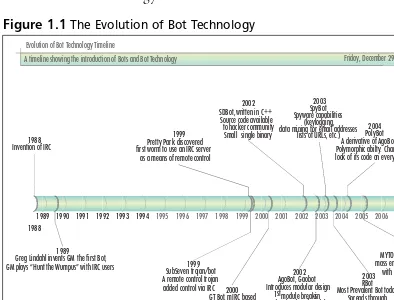
[image:27.612.50.444.274.574.2]Like many things on the Internet today, bots began as a useful tool without malicious overtones. Bots were originally developed as a virtual individual that could sit on an IRC channel and do things for its owner while the owner was busy elsewhere. IRC was invented in August of 1988 by Jarkko “WiZ” Oikarinen of the University of Oulu, Finland. Figure 1.1 traces the evolution of bot technology.
Figure 1.1The Evolution of Bot Technology
1988 2006
1989 1990 1991 1992 1993 1994 1995 1996 1997 1998 1999 2000 2001 2002 2003 2004 2005 2006 Friday, December 29, 2006 Evolution of Bot Technology Timeline
A timeline showing the introduction of Bots and Bot Technology
2004 PolyBot A derivative of AgoBot with Polymorphic abilty. Changes the look of its code on every infection 1988
Invention of IRC
1989
Greg Lindahl invents GM the first Bot, GM plays “Hunt the Wumpus” with IRC users
1999 Pretty Park discovered first worm to use an IRC server
as a means of remote control
1999 SubSeven trojan/bot A remote control trojan added control via IRC 2000
GT Bot, mIRC based Runs scripts in response to
IRC server events Supports raw TCP and UDP
Socket connections 2002 SDBot, written in C++ Source code available to hacker community Small single binary
2002 AgoBot, Gaobot Introduces modular design
1st module breaks-in downloads 2nd module 2nd module turns off anti virus
Hides from detection, downloads 3rd module Module 3 has attack
engines/payload
2005 MYTOBMy Doom mass emailing worm
with Bot IRC C&C 2003
SpyBot Spyware capabilities
(keylogging, data mining for email addresses
lists of URLs, etc.)
2003 RBot Most Prevalent Bot today
GM
The original IRC bot (or robot user), called GM according to Wikipedia, was developed the next year, in 1989, by Greg Lindahl, an IRC server operator. This benevolent bot would play a game of Hunt the Wumpus with IRC users.The first bots were truly robot users that appeared to other IRC neti-zens as other users. Unlike today’s bot net clients (robots), these robots were created to help a user enjoy and manage their own IRC connections.
From this simple example, other programmers realized they could create robot users to perform many tasks currently done by humans for both users and the IRC operator, such as handling tedious 24-hour-a-day requests from many users. An important bot development was the use of bots to keep a channel open and prevent malicious users from taking over the channel when the operator was busy doing other things. In order to assist the IRC operator, bots needed to be able to operate as a channel operator.The bots had evolved from being code that helps a single user to code that manages and runs IRC channels as well as code that provides services for all users.Serviceis the term used for functionality that is offered by server-side bots as opposed to client-side bots. Around this time, some IRC servers and bots began offering the capability to make OS shell accounts available to users. The shell account permits users to run commands on the IRC host. Wikipedia notes that “a lot of shell providers disappear very fast because of abusive behavior of their members.”
Pretty Park
In May 1999, Pretty Park, a bot client written in Delphi, was discovered. PrettyPark, according to “The Evolution of Malicious IRC Bots,” a Symantec white paper authored by John Canavan, had several functions and concepts that are common in today’s bots, including:
■ The capability to retrieve the computer name, OS version, user infor-mation, and other basic system information.
■ The capability to search for and retrieve e-mail addresses and ICQ login names
■ The capability to retrieve usernames, passwords, and dial-up network settings
■ The capability to update its own functionality
■ The capability to upload/download files
■ The capability to redirect (tunnel) traffic
■ The capability to launch a variety of DoS attacks
■ Incorporation of its own IRC client
SubSeven Trojan/Bot
By the late 1990s, a few worms (such as IRC/Jobbo) had exploited vulnera-bilities in IRC clients (particularly mIRC) that let the clients be remote con-trolled via a “backdoor.” In June, 1999, version 2.1 of the SubSeven Trojan was released.This release was significant in that it permitted a SubSeven server to be remotely controlled by a bot connected to an IRC server.This set the stage for all malicious botnets to come. SubSeven was a remote-controlled Trojan, also written in Delphi, touted by its author as a remote administration tool. Its toolset, however, includes tools a real administrator would not use, such as capabilities to steal passwords, log keystrokes, and hide its identity. SubSeven gave bot operators full administrative control over infected systems.
GT Bot
A botnet client based on the mIRC client appeared in 2000. It is called Global Threat (GT) Bot and was written by Sony, mSg, and DeadKode. mIRC is an IRC client software package. mIRC has two important charac-teristics for botnet construction: it can run scripts in response to events on the IRC server, and it supports raw TCP and UDP socket connections.
GT bot had the following capabilities:
■ Port Scanning It can scan for open ports.
■ Flooding It can conduct DDoS attacks.
■ BNC (Bounce) A method for anonymizing Bot client access to a server.
Today, all variations of bot technology that are based on mIRC are said to be members of the GT Bot family.These bot clients did not include a mecha-nism for spreading itself directly. Instead, they would use variations on social engineering ploys. A common ploy used to infect systems was an e-mail that claimed to be from a security vendor. If the user clicked on the embedded link they were taken to a Web site that delivered the client to the victim. These early botnet clients were not modular, but rather were all contained in a single package.
SDBot
Early in 2002, SDBot appeared. It was written by a Russian programmer known as sd. SDBot is a major step up the evolutionary chain for bots. It was written in C++. More important to the evolution of botnet technology, the author released the source code, published a Web page, and provided e-mail and ICQ contact information.This made it accessible to many hackers. It was also easy to modify and maintain. As a result, many subsequent bot clients include code or concepts from SDBot. SDBot produced a small single binary file that contained only 40KB of code.
A major characteristic of the SDBot family is the inclusion and use of remote control backdoors.
SDBot family worms spread by a variety of methods, including:
■ NetBios (port 139)
■ NTPass (port 445)
■ DCom (ports 135, 1025)
■ DCom2 (port 135)
■ MS RPC service and Windows Messenger port (TCP 1025)
■ ASN.1 vulnerability, affects Kerberos (UDP 88), LSASS.exe, and Crypt32.dll (TCP ports 135, 139, 445), and IIS Server using SSL
■ UPNP (port 5000)
The SDBot exploits two server application vulnerabilities: WebDav (port 80) and MSSQL (port 1433). It exploits two third-party application vulnera-bilities: DameWare remote management software (port 6129) and Imail IMAPD Login username vulnerability (port 143). It also exploits the fol-lowing Cisco router vulnerability: CISCO IOS HTTP authorization (Port 80) vulnerability.
The following backdoors are exploited by SDBot:
■ Optix backdoor (port 3140)
■ Bagle backdoor (port 2745)
■ Kuang backdoor (port 17300)
■ Mydoom backdoor (port 3127)
■ NetDevil backdoor (port 903)
■ SubSeven backdoor (port 27347)
If an exploit is successful, the worm creates and runs a script that down-loads SDBot onto the new victim and executes it. Once executed, the new victim is infected. Note that many of these attacks are still used today, espe-cially brute force and password guessing attacks targeted at ports 139, 445, and 1433.
Today, variants are spread by many other means including spam attacks in Instant Messaging (SPIM), CDs, infected attachments to e-mails, and hidden downloads on phishing sites. In 2002, the motivation for SDBot was to build a capability to launch DoS attacks. In November 2006, Panda labs reported that SDBot.ftp.worm, a component of SDBot, was the most frequently
detected virus.This is a testament to the staying power and adaptability of this approach.The June 2006 Microsoft report about the Malicious Software Removal Tool listed the SDBot as having been detected on 678,000 infected PCs, the second-highest total.
Agobot
1. The initial module delivered contains the IRC bot client and the remote access backdoor.
2. Module 2 attacks and shuts down antivirus processes.
3. Module 3 prevents the user from accessing a list of Web sites (usually antivirus vendor sites).
Each module retrieves the next module when it completes its primary tasks.This aspect permits the botherder to update modules 2 and 3 as new techniques or sites are available.This modular update capability makes the list of variants soar into the thousands. Agobot uses IRC for C&C, but is spread using peer–to-peer (P2P) file-sharing applications (for example, Kazaa,
Grokster, and Bear Share).The bot client could be commanded through IRC, but Agobot also opened a remote access backdoor to permit individual clients to be accessed directly. Agobot has the following capabilities:
■ Scans for certain vulnerabilities
■ Can launch a variety of DDoS attacks
■ Searches for CD keys to games
■ Terminates antivirus and monitoring processes
■ Modifies the host files to prevent access to antivirus Web sites
■ Hunts for systems with the Bagle worm and if it infects one, shuts down the Bagle processes
■ Hides itself using rootkit technology
■ Uses techniques to make reverse engineering difficult
Other related bots include Phatbot, Forbot, Polybot, and XtremBot.
Phatbot added the capability to use WASTE, a P2P for C&C that uses public key crypto.
From Code-Based Families
to Characteristic-Based Families
From this point in the evolution of bots, bot family groups are being created less based on the original code and based more on unique characteristics.Take
note of family names like Spybot, MyTob, and Polybot. While MyTob does indicate a code base, it is also a new characteristic, the mass mailing bot that happens to be based on MyDoom. Similarly, detections by antivirus (A/V) vendors are becoming less concerned with identifying the overall bot. Instead, they are tagging components they find with functional identifiers. Symantec, for example, tags individual components it finds with names like
Hacktool.HideWindow and Trojan.Dropper.The overall bot was an RBot, but Symantec never identified that connection.To the A/V vendor, they’ve done their job if they find the malicious code and deal with it. However, the corporate security officer would really like to know more.The organizing schema for the bot tells the security officer what potential attack vectors were used to infect the computer so that they might plug the holes instead of just fixing the broken machines.
Each of the original bot families has evolved to incorporate improvements that are seen in other bots. Since many of the bots are open source, modular, and in C/C++, it is easy to take source from one bot and add its capabilities to another bot.There is also a tendency for the A/V companies to use the names that they designated to the exclusion of other vendor-created names. Partially, this is because there are so many variants of each bot family that two bots in the same family can have significantly different capabilities. For
example, one variant may use IRC as its C&C and have keylogging capabili-ties, while the other variant may use P2P networks for C&C and search its botclients for PGP public and private keys, cached passwords, and financial account information. One vendor may call them both variants while another may tag one of the variants as a new family.
New family names from this point have tended to highlight a new capability.
Spybot
Like SDBot and Agobot, Spybot is easily customizable, a fact that complicates attempts to detect and identify this bot. According to some, this bot client is poorly written. It is similar in function to Agobot and is related to SDBot, Rbot, URBot, and URXBot. Different variants of Spybot have the following capabilities:
■ Port scanning for open ports
■ Launching DDoS attacks like UDP and SYN flooding
■ Checking to prune or manage older systems (Win 9x) and systems that connect via modem
■ Using social engineering to entice P2P users to download the infec-tion module of Spybot
■ Attempting to deceive users by posting a fake error message after the user runs the infection module
■ Logging of all keystrokes or only of keystrokes entered in Internet Explorer
■ Logging of everything copied to the Windows clipboard
■ Grabbing cached passwords on Win 9x systems
■ Some newer variants of Spybot capture screenshots around the part of the screen where a mouse click has occurred.This capability per-mits the botherder to defeat new security measures taken by some banks.These banks have users click on a graphical keypad to enter their PIN or password.
■ Although rare, some variants of Spybot are capable of sending spam messagesover instant messaging systems.These messages are reffered to as spim.
■ Sniffing the network, sometimes for user IDs and passwords, some-times for the presence of other IRC channels to exploit.
■ Killing the processes of antivirus and other security products
■ Newer variants have begun including a rootkit, usually a hacked or modified version of the FU rootkit.
■ Control of webcams, including streaming video capture
■ Recent exploit scanning. According to John Canavan’s whitepaper titled “The Evolution of Malicious IRC Bots,” variants in 2005 included:
■ Microsoft Windows DCOM RPC Interface Buffer Overrun (MS03-026)
■ Microsoft Windows Local Security Authority Service Remote Buffer Overflow (MS04-011)
■ Microsoft Windows SSL Library Denial of Service (MS04-011)
■ Microsoft SQL Server User Authentication Remote Buffer Overflow (MS02-056)
■ UPnP NOTIFY Buffer Overflow (MS01-059)
■ Microsoft Windows Workstation Service Buffer Overrun (MS03-049)
■ DameWare Mini Remote Control Server Pre-Authentication Buffer Overflow (CAN-2003-0960)
■ VERITAS Backup Exec Agent Browser Remote Buffer Overflow (UNIRAS 20041217-00920)
■ Microsoft Webdav Buffer Overrun (MS03-007)
■ Beagle
■ MyDoom
■ Netdevil
■ OptixPro
■ SubSeven
■ Kuang2
For more information, go to www.symantec.com/avcenter/reference/ the.evolution.of.malicious.irc.bots.pdf.
RBot
RBot first appeared in 2003. According to the June 2006 MSRT report from Microsoft (“MSRT: Progress Made,Trends Observed” by Matthew
infected. It is a backdoor Trojan with IRC C&C. It introduced the idea of using one or more runtime software package encryption tools (for example, Morphine, UPX, ASPack, PESpin, EZIP, PEShield, PECompact, FSG,
EXEStealth, PEX, MoleBox, and Petite). RBot scans for systems on ports 139 and 445 (systems with open Microsoft shares). It then attempts to guess weak passwords. It can use a default list or a list provided by the botherder. It can attempt to enumerate a list of users on the target system, a default list of user IDs and passwords, or try a list of user IDs and password combinations it found on other systems.
Polybot
The Polybot appeared in March of 2004 and is derived from the AgoBot code base. It is named for its use of polymorphism, or its capability to appear in many different forms. Polybot morphs its code on every infection by encasing the compiled code in an “envelope” code.The envelope re-encrypts the whole file every time it is run.
Mytob
The Mytob bot was discovered in February 2005.The bot is characterized as being a hybrid since it used source code from My Doom for the e-mail mass mailing portion of code and bot IRC C&C functionality. Note that “tob” is “bot” backwards.
Mytob uses social engineering and spoofed e-mail addresses, carries its own SMTP client, and has C&C capabilities similar to Spybot.
Capabilities Coming to a Bot Near You
This section contains brief descriptions of a few new bot components:
■ GpCoder A potential bot component that encrypts a user’s files then leaves a message to the user on how they can buy the decoder. Current versions can be decrypted by A/V vendor “fix” tools, but if later versions use stronger encryption the potential for damage could be big.
■ Serv-U Installed on botclients, the Serv-U ftp server enables both-erders to store stolen movies, software, games, and illegal material (for example, child pornography) on their botnets and serve the data
upon demand. Using other software, the Serv-U ftp server appears to be Windows Explorer in Task Manager.The data is being stored in hidden directories that can’t be reached using Windows.
■ SPIM Spam for Instant Messaging. Bots have now been used to send phishing attacks and links to Web sites that upload malicious code to your PC.
An example SPIM message:
ATTENTION...Windows.has.found.55.Critical.System.Errors...
To fix the errors please do the following:..
1 Download Registry Update from: www.regfixit.com.
2 Install Registry Update
3 Run Registry Update.
4 Reboot your computer
FAILURE TO ACT NOW MAY LEAD TO SYSTEM FAILURE!
McAfee’s Site Advisor flags the aforementioned site as one that uploads malicious code.
Cases in the News
With bot authors publishing so many variants, you would think that it might be easier to eventually catch some of these people. And you would be right.
“THr34t-Krew”
million in damage.TK worm exploited a common Unicode vulnerability in Internet Explorer.
Additional evidence was seized from an address in Illinois through a simultaneous search warrant.The worm had infected over 18,000 infected computers.The American member, Raymond Steigerwalt, was sentenced to 21 months in jail and ordered to pay $12,000 in restitution.
Axel Gembe
Axel Gembe is the author of Agobot (aka Gaobot, Nortonbot, Polybot), a 21-year-old hacker reported by police at the time of his arrest as “Alex G.” He was arrested May 7, 2004, at his home in Germany (Loerrach or Waldshut, different reports conflict) in the southwestern state of Baden-Württemberg. He was charged under Germany’s computer sabotage law for creating mali-cious computer code. He has admitted responsibility for creating Agobot in Oct 2002. Five other men have also been charged.
180Solutions Civil Law Suit
Sometime prior to 2004, a Lithuanian mob contacted Dutch hackers and asked them to create a botnet.The hackers created and delivered the botnet. It occurred to the hackers that the Lithuanians must be using it in some way to make money.They reasoned that they could do the same thing for them-selves.They created their own botnet with 1.5 million zombie clients.
In one venture, they were using the botnet to install software for an adware company, 180Solutions. 180Solutions had been under pressure from the public to clean up its act for years. In January 2005, they changed their policy to exclude paying for software installations that the user did not autho-rize. In doing so they began to terminate agreements with distributors that installed their software without the user’s approval. By August, according to 180Solutions, they had terminated 500 distributors.The Dutch hackers then employed the botnet to extort money by DDoSing 180Solutions until they paid.The company brought in the FBI who tracked down the hackers. On August 15, 2005, 180Solutions filed a civil suit against seven hackers involved in the DDoS attacks: Eric de Vogt of Breda, the Netherlands; Jesse Donohue of South Melbourne, Australia; Khalil Halel of Beirut; Imran Patel of
Leicester, England; Zarox Souchi of Toronto;Youri van den Berg of Deventer, the Netherlands; and Anton Zagar of Trbovlje, Slovenia.
Operation Cyberslam:
Jay Echouafni, Jeanson James Ancheta
The first U.S. criminal case involving a botnet went to trial in November 2005. Jeanson James Ancheta (aka Resili3nt), age 21, of Downey, California, was convicted and sentenced to five years in jail for conspiring to violate the Computer Fraud Abuse Act, conspiring to violate the CAN-SPAM Act, causing damage to computers used by the federal government in national defense, and accessing protected computers without authorization to commit fraud. He was also ordered to pay $57,000 in restitution.
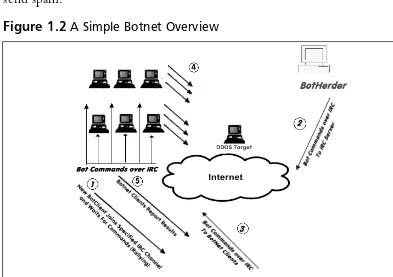
[image:39.612.50.443.308.585.2]Ancheta’s botnet consisted of thousands of zombies. He would sell the use of his zombies to other users, who would launch DDoS (see Figure 1.2) or send spam.
Notes from the Underground…
A Simple Botnet
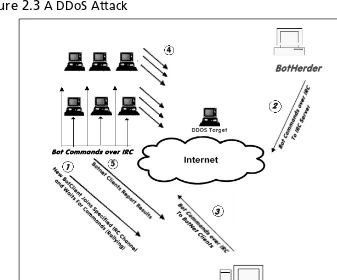
Figure 1.2 depicts a simple botnet being commanded to launch a DDoS attack against a competitor or other individual. The numbered steps illustrate a timeline from a new botclient joining the botnet and then participating in the DDoS attack. Steps 2-5 repeat ad infinitum with step 4 changing to whatever attack was commanded in step 2.
1. When a new botclient has been created (compromised), one of its first duties is to rally back to the C&C server. It does this by joining a specified IRC Channel and waiting for com-mands to be posted there.
2. The botherder posts a command to the C&C server, possibly in response to a paying customer’s request. In this case, the customer has requested that the botherder prevent a com-petitor’s Web site from getting any orders for several days. The botherder sends a command to the C&C server, speci-fying the target, the time and type of attack, and which of the botclients are to participate.
3. The botclients monitor the C&C server on the specified channel. When the botherder sends the command, the bot-clients see that it has been posted and schedule the
requested activity.
4. At the appointed time, all of the selected botclients begin sending network traffic to the target. With enough traffic, the target Web site is unable to process both the attack traffic and the legitimate traffic and soon attempts to pro-cess only attack traffic.
5. In step 5, optionally the botclients report back to the C&C server any results or that they have completed the task and are ready for new commands.
He also used a botnet of more than 400,000 zombies to generate income in a “Clicks for Hire scam” by surreptitiously installing adware for which he was paid more than $100,000 by advertising affiliate companies. A U.S. Department of Justice (DOJ) press release stated that Ancheta was able to avoid detection by varying the download times and rates of the adware instal-lations, as well as by redirecting the compromised computers between various servers equipped to install different types of modified adware.
Anthony Scott Clark
In December 2005, Anthony Scott Clark of Beaverton, Oregon, pled guilty to infecting thousands of computers and then to using those computers to con-duct a DoS attack. According to the DOJ press release (www.usdoj.gov/crim-inal/cybercrime/clarkPlea.htm), Mr. Clark admitted to the following:
From July through August 2003, Mr. Clark participated with several others in DDoS attacks on the Internet against eBay, Inc. and other entities. A DDoS attack is one in which many compromised computers (or bots) attack a single target, thereby causing a denial of service for legitimate users of the targeted system.
Mr. Clark and his accomplices accumulated approximately 20,000 bots by using a worm program that took advantage of a computer vulnerability in the Windows Operating System—the “Remote Procedure Call for Distributed Component Object Model,” or RPC-DCOM vulnerability.The bots were then directed to a password-protected IRC server, where they connected, logged in, and waited for instructions. When instructed to do so by Mr. Clark and his accomplices, the bots launched DDoS attacks at computers or com-puter networks connected to the Internet. Mr. Clark personally commanded the bots to launch DDoS attacks on the nameserver for eBay.com. As a result of these commands, Mr. Clark intentionally impaired the infected computers and eBay.com.
Farid Essebar
Farid Essebar, 18, of Morocco, is the author of the Zotob worm. Essebar is facing charges in Morrocco that he released the Zotob worm that crippled the world’s banks and medical companies.
Christopher Maxwell
Botnets can cause unintended damage.This was the case with Christopher Maxwell, aka “donttrip,” 20, of Vacaville, California. According to the DOJ
press release announcing his conviction, in January 2005, as his botnet searched for additional computers to compromise, it infected the computer network at Northwest Hospital in Seattle.The increase in computer traffic as the botnet scanned the system interrupted normal hospital computer commu-nications.These disruptions affected the hospital’s systems in numerous ways: Doors to the operating rooms did not open, pagers did not work, and com-puters in the intensive care unit shut down. According to the DOJ press release (www.usdoj.gov/criminal/cybercrime/maxwellPlea.htm), Maxwell pled guilty to “conspiracy to intentionally cause damage to a protected com-puter and to commit comcom-puter fraud,” and “intentionally causing or intending to cause damage to a protected co-conspirators created the botnet with over one million clients to fraudulently obtain commission income from installing adware on computers without the owners’ permission.The government esti-mates that Maxwell and friends earned approximately $100,000 from this venture. Maxwell’s bot damaged 400 DoD computers at Germany’s
Department of Defense (DoD). He was ordered to pay the hospital and the DoD restitution in the amount of $252,000 and sentenced to 37 months in federal prison.
Jeffrey Parson
In August of 2003, Jeffrey Parson released a variation of the Blaster Worm, which infected 48,000 computers worldwide. According to a U.S. Department of Justice press release (www.usdoj.gov/criminal/cybercrime/parsonSent.htm), “Parson admitted that he created his worm by modifying the original MS Blaster worm and adding a mechanism that allowed him to have complete access to certain infected computers. Parson then infected approximately fifty computers that he had previously hijacked with his worm. From those fifty
computers, Parson’s worm spread to other individual computers. Parson’s worm then directed those infected computers to launch an attack against a Microsoft Web site. Attorneys for the government calculate that more than 48,000 computers were infected by Parson’s worm.”
Parson was sentenced to 18 months in jail, three years of supervised release, and a restitution amount dependent on his observance of the condi-tions of supervised release. From the DOJ press release, “In sentencing Parson to eighteen months, Judge Pechman said she considered his unique circum-stances: that he was just three weeks past his 18th birthday when he released the worm, his history of mental illness, and that his parents had failed to monitor or guide him on his computer activities. Pechman told Parson his community service had to be through face-to-face contact with others and restricted his use of computers to only educational and business purposes. She told him, ‘No video games, no chat rooms. I don’t want you to have anony-mous friends; I want you to have real world friends.’ She also stressed that part of Parson’s supervised release would involve a mental health program.
The pattern that you can see in these criminal and civil prosecutions is that the punishment doesn’t appear to fit the crime. In most cases here, there was no record of sentencing.
The Industry Responds
At the TechEd 2006 conference in Boston, Microsoft confirmed that “well-organized mobsters have established control [of] a global billion-dollar crime network using keystroke loggers, IRC bots, and rootkits,” according to “Microsoft:Trojans, Bots Are ‘Significant and Tangible Threat,’” an article by Ryan Naraine in the June 12, 2006, edition of eWEEK.com. Microsoft is basing this conclusion on data collected by its Malicious Software Removal Tool (MSRT).The article says that MSRT has removed 16 million instances of malicious code on 5.7 million unique Windows systems. Sixty-two percent of these systems were found to have a Trojan or bot client.
On August 10, a group of information security professionals, vendors, and law enforcement gathered at Cisco Headquarters in San Jose. With little notice, the “Internet Security Operations and Intelligence Workshop” attracted around 200 attendees. Led by the enigmatic Gadi Evron (security evangelist for Beyond Security and chief editor of the security portal
SecuriTeam), speaker after speaker painted a bleak and complex picture. Many lamented the increasing ineffectiveness of the prevailing strategy, which
focused on identifying and taking out C&C servers.This is the “kill the head of the snake” approach. Bots have begun to evolve beyond this weakness now. Some now have multiple C&C servers, and, like a Hydra, if you cut off one C&C server, two more pop up. Some used protocols that lend themselves to a more decentralized organization. Some are using “Fast Flux” DNS technology (see Chapter 3) to play an electronic version of the shell game with the C&C server.There was much wailing and gnashing of teeth by the security and network professionals. However, amidst the lamentations, some very inter-esting and innovative ideas were presented.
These ideas involve different methods of detecting botnets, aggregating this information, and sharing it for the benefit of all. Some ideas were so tempting that participants began trying out aspects of the idea during the pre-sentation. When all was said and done, 200 minds knew what only a handful knew before. Further, a “call to action” had been issued. Come out of our shell, share what we know, organize our responses.
Summary
Botnet technology is the next killer Web application. It is a tremendous force multiplier for organized crime.The money from organized crime has created a fertile technology incubator for the darkside hacker.The problem they have created is huge, global in scope.Their primary victims targeted to become clients are the innocents, the elderly, the young, and the non-computer lit-erate. Many of the botherder schemes also target this defenseless group.The appetite for power doesn’t stop there. In the DDoS attack, bots have grown big enough to be a threat to major corporations and even nations.
Bot technology has evolved from simple agents that played games with users to mercenary robotic armies without morals, ready to carry out designer crimes on demand. From “Hunt the Wumpus” we now have botnets that col-lect information about customers of a specific bank, then target those cus-tomers with special botclients that contain features designed to defeat or bypass that bank’s security.Today’s bots are easy to customize, modular, adap-tive, targetable, and stealthy.They are moving to a more decentralized
approach and diversifying their C&C techniques.
Law enforcement has begun to catch and arrest some botnet developers and operators.The Microsoft bounty fund has proven useful in improving law enforcement opportunities to find the bad guys. Unfortunately, the court system is in serious need of change. Investigations take months for crimes that are over in seconds. Cases drag out for years, so much so that the affected businesses cannot afford to support prosecution efforts.The penalties being given are rarely more than a slap on the wrist, if anything at all is done. In many cases the arrested individual trades information for little or no punish-ment.The public reporting of light sentences and fines sends the message that crime does indeed pay and that you will likely never have to pay the piper.
effectiveness of our best weapon. Many of us had been touting the slogan “cut off the head of the snake.”The network and security professionals had been moving to implement a large-scale implementation of that in May. In hindsight, the war wasn’t lost, although it was a significant battle.This war will never be won or lost.The war between good and evil, like the road, goes ever on.
Instead of declaring surrender, a call to action has been issued. Network and security professionals gathered in August of 2006, with follow-on meet-ings planned throughout 2007. In these meetmeet-ings, a clearer view of the problem is emerging. Innovations are being shared and improved upon. For the new threat, new strategies and tools are being forged.The remainder of this book will bring you up to speed to join the battle.
Solutions Fast Track
The Killer Web App
■ The botnet is modular—one module exploits the vulnerabilities it finds to gain control over its target.
■ A botnet is adaptive; it can be designed to download different modules to exploit specific things that it finds on a victim.
■ Botnet attacks are targetable.That is, the hacker can target a company or a market sector for these attacks.
How Big Is the Problem?
■ Since January 2005, Microsoft has been delivering the Windows Malicious Software Removal Tool to its customers. After 15 months, Microsoft announced that it had removed 16 million instances of malicious software from almost six million unique computers.
According to the Microsoft report “Progress Made,Trends Observed,” bots represented a majority of the removals.
■ If left unabated, the botnet plague could threaten the future of the Internet, just as rampant crime and illegal drug use condemn the economic future of real neighborhoods.
■ In March of 2006, McAfee was called in to, in essence, reclaim a Central American country’s telecommunications infrastructure from a massive botnet.
The Industry Responds
■ At the TechEd 2006 conference in Boston, Microsoft confirmed that “well-organized mobsters have established control [of] a global billion-dollar crime network using keystroke loggers, IRC bots, and rootkits,” according to “Microsoft:Trojans,Bots Are ‘Significant and Tangible Threat,’” an article by Ryan Naraine in the June 12, 2006, edition of eWEEK.com.
■ Some bots now have multiple C&C servers, and, like a Hydra, if you cut off one C&C server, two more pop up.
Q: Have we lost the war of the botnets?
A: No. Until 2006, security and network professionals had not truly engaged the enemy. For the most part we saw victim response. When the victim was big, the response was big. 2005-2006 marks the beginning of efforts to coordinate larger responses to the threat. Up to this point, many secu-rity professionals had not made the connection that these attacks were being fueled by money from organized crime. Now that the connection to organized crime has been made, the playing field is forever altered. Law enforcement and other government agencies are now joining the fight. Several consortiums have emerged to gather, aggregate, and distribute information as well as to coordinate responses.The battle has only begun.
Frequently Asked Questions
The following Frequently Asked Questions, answered by the authors of this book, are designed to both measure your understanding of the concepts pre-sented in this chapter and to assist you with real-life implementation of these concepts. To have your questions about this chapter answered by the author, browse to www.syngress.com/solutions and click on the “Ask the Author”
Q: How much is the Microsoft bounty for virus authors and how do I get me some?
A: In 2003, Microsoft established a $5 million antivirus reward program. Microsoft periodically announces that it is offering a bounty for informa-tion leading to the arrest and convicinforma-tion of authors of a specific virus. Rewards of $250,000 have been paid for the creator of the Sasser worm. Today, awards are posted for the authors of the SoBig virus and the Blaster worm. If you have information about a virus that Microsoft has offered a bounty for, you should contact law enforcement. From the Microsoft Q&A page regarding the bounty (www.microsoft.com/presspass/fea-tures/2003/nov03/11-05AntiVirusQA.mspx) “Persons with information should go directly to the law enforcement agencies by calling their local FBI (www.fbi.gov/contact/fo/fo.htm) or Secret Service office, or the Interpol National Central Bureau (www.interpol.int) in any of Interpol’s 181 member countries, or by going to the FBI Internet Fraud Complaint Center Web site (www.ic3.gov).” The Microsoft Web page for informa-tion about current rewards is located at www.microsoft.com/security/ antivirus/default.mspx.
Botnets Overview
If only it were possible to reproduce yourself a million times over so that you can achieve a million times more than you can today.
—Dr. Joseph Goebbels, Propaganda Minister for Nazi Germany; from the 15 Feb 1943 entry in his personal diary.
Solutions in this chapter:
■ What Is a Botnet?
■ The Botnet Life Cycle
■ What Does a Botnet Do?
■ Botnet Economics
Chapter 2
29
Summary
Solutions Fast Track