Why Some International Norms Disappear
Diana Panke & Ulrich Petersohn Word count: 13.445
Abstract:
1Friedrich Kratochwil and John G. Ruggie, "International Organization: A State of the Art on an Art of
the State,"International Organization40, no. 4 (1986). I. Introduction
‘“Are the seven Commandments the same as they used to be, Benjamin?” For once Benjamin consented to break his rule, and he read out to her what was written on the wall. There was nothing there except of a single Commandment.’ (The horse Clover to the donkey Benjamin, Orwell, 1956, Animal Farm, 133)
This paper addresses the empirical puzzle as to why, at one point, some formerly deeply embedded norms lose their prescriptive status and can even cease to exist. In the above abstract, Benjamin and Clover speculate about a process integral to our international social environment: norm degenerations. Of course, norms are not often changed by pigs through decree as in the case of the animal farm. However, they can become abolished in many other ways. Even though the disappearance of international norms is not a rare phenomenon, it is not and has not been at the centre of scholarly attention. In the last two decades, International Relations research has examined how international norms, as a set of prescriptive rules with a specified applicatory scope, were created and under which conditions different actors became socialized into them. This article focuses not on norm creation and the impact of existing norms; rather it concentrates on the other side of the coin: the degeneration of international norms. While we have so far been inundated with literature on norm creation, diffusion and socialization, the literature often suffers from a theoretical and an empirical gap on the dynamics and scope conditions for the gradual and incremental weakening of international norms. Part of the reason for this might be that norms are counterfactually valid and do not cease to exist simply because non-compliance occurs.1 Nevertheless, this does not imply that norm disappearances do
2Louis Henkin,How Nations Behave: Law and Foreign Policy(New York: Columbia University
Press, 1968).
3Ibid., Michael Zürn and Christian Joerges, eds.,Law and Governance in Postnational Europe. Compliance Beyond the Nation-State(Cambridge: Cambridge University Press, 2005).
all the time’,2 non-compliance occurs frequently and impairs the power of
international law. In fact, international norms get violated all the time.3 Yet, while
non-compliance by individual states does not automatically abolish an international norm, norms can lose their prescriptive status if initial norm violations trigger a cascade of norm violations by other actors, who start to also violate the norm (without calling this practice non-compliance) instead of criticizing the initial non-compliant states and instead of individually or collectively sanctioning the norm violations. Thus, if norm violations become the rule rather than the exception, norms are in the process of becoming obsolete and are eventually abolished if the emerging new practice is not framed as non-compliance any longer. The eradication of previously strongly embedded norms can be observed for norms of colonial domination and subordination, slavery, or the right to torture on the international level, to name but a few. Why do formerly embedded norms, such as the one against mercenaries or the use of formal declarations of war, become incrementally or suddenly obsolete, even without being substituted with new norms? Why is it that international actors adhere to a particular norm for quite some time, but at one point cease to obey? In order to shed light on these processes, we inquire why and under which conditions international norms, some deeply institutionalized for centuries, become degenerated.
4Alexander Wendt, "Anarchy Is What States Make of It: The Social Construction of Power Politics," International Organization88, no. 2 (1992).
5Kratochwil and Ruggie, "International Organization: A State of the Art on an Art of the State." contrast, norms are likely to become incrementally eradicated if the environment is relatively stable, if norms are imprecise and if there is no central enforcement authority or no individual state willing and capable of punishing norm violations. Both degeneration processes lead to partial or complete norm substitutions, provided competing norms are present. If rival norms are absent, norms are simply deinstitutionalized without being replaced.
II. A (Common) – Yet Unresolved Empirical Puzzle
International norms are common and part of the daily business of any diplomat, state ministry, transnational corporation, or NGO to name but a few international actors. Norms spread in almost all issue areas; the density of international norms is so high that some speak of a ‘regulated’ anarchy as the international-level ordering principle.4
But what exactly are international norms and what do they do? This article advances a broad definition of norms as a set of rules with a prescriptive character for a defined scope of application. Norms can be codified through Treaties or conventions, yet can also be uncodified, as seen with customary rights. In the international system, international norms regulate states’ behavior through enabling certain actions in accordance with the norm and in prohibiting other actions which may violate or juxtapose that norm.
Norms are counterfactually valid and do not cease to exist simply because non-compliance occurs.5 Perhaps as a result of that, scholarship on the emergence of
6Neil S. MacFarlane,Intervention in Contemporary World Politics,Adelphi Paper 350(London:
International Institute for Strategic Studies, 2002), p. 36.
norms are in the process of being degenerated if norm violations become the rule rather than the exception and they are eventually completely abolished if the norm no longer guides states’ behaviors and if the new practices are not framed as non-compliance any longer.
Non-compliance with international norms through individual states happens frequently on the international level, but it does not automatically abolish an international norm. Norm disappearances are defined by the loss of the prescriptive status of formerly embedded norms. Thus, a norm has disappeared (= de facto lost its prescriptive status) if the a state’s non-compliance at one point triggers a cascade of norm violations by other actors, who also start to violate the norm instead of individually or collectively criticizing and eventually sanctioning the norm violating state. Thus, if norm violations become the rule rather than the exception, a norm is in the process of becoming obsolete and is abolished if the emerging new practice is not framed as non-compliance any longer.
Incremental degeneration can be observed in the case of the non-intervention norm. Rather than replacing the entire norm, the scope of the norm was continuously curbed by new exceptions. Non-intervention is codified in the UN Charter in Art. 2 VII and during the Cold War, it was considered one of the most important pillars of the international system. This opinion was expressed by the UN General Assembly in its Declaration on the Inadmissibility of Intervention (1965) and similarly by the International Court of Justice, declared in reference to the Corfu Channel case (1949) stating that “between independent States the respect for territorial sovereignty is an essential foundation for international relations”.6 However, the restrictive
7Blair, Tony (2004). Warns of Continuing Global Terror Threat, Speech at Sedgefield.Ann
Marie Slaughter,United? The UN, the US, and us.(Rome: Aspen Institute, 2004).
8Annan, Kofi (1998). Reflections on Intervention, Annual Ditchley Foundation Lecture.
discussion occurred regarding new security threats. In particular, state and non-state actors in possession of weapons of mass destruction were, and still are, seen as a vital threat to international peace and security by western states. This triggered a discussion on whether preventive and pre-emptive military strikes are legitimate exceptions to the non-intervention norm7. More recently, a resurgence of the idea of humanitarian
intervention also challenged the initial norm. UN secretary general Kofi Annan defined sovereignty as a responsibility, not just power. He stressed that the protection of sovereignty by the non-intervention norm was associated with compliance to the fundamental standards of the international community.8Consequently, states violating
these standards can forfeit their protection under the non-intervention norm. These examples show that a strong trend exists towards restricting the scope of the non-intervention norm.
Norms can also become abolished without being replaced or weakened by another norm. Article 53 of the Charter of the United Nations, for example, permits forcible measures against enemy states of the Second World War (WW II) without a Security Council Resolution. However, in 1995 the General Assembly recognized the substantial changes on the international level in Resolution 50/ 52 and deemed the "enemy state" clauses in Articles 53, 77 and 107 as obsolete. Although the norm is formally still part of the Charter, it has been deinstitutionalized by “decree”.
9John Keegan,A History of Warfare(New York: Alfred A. Knopf : Distributed by Random House,
Inc., 1993).
10Michael Eliot Howard,Restraints on War : Studies in the Limitation of Armed Conflict(Oxford ;
New York: Oxford University Press, 1979), p. 1.
11Brien Hallett,The Lost Art of Declaring War(Urbana, [Ill.]: University of Illinois Press, 1998), p.
65.
12John A. Lynn,Battle : A History of Combat and Culture, Rev. and updated ed. (Cambridge, MA:
Westview Press, 2004), p. 4.
13Hans J. Wolff,Kriegserklärung Und Kriegszustand Nach Klassischen Völkerrecht(Berlin: Duncker
& Humboldt, 1990), p. 26.
society.9 Western societies imposed a set of limitations on the conduct of war upon
themselves.10 One element of the “cultural regulation of violence” that persisted over
time is the desire for a formal declaration of war. The first evidences in the literature can be found in a five thousand year old Sumerian epic. It begins with an announcement by a herald sent by Agga to Gilgamesh of the reason to go to war.11
During the period of the Greek city states, hostilities were highly ritualized. Before the hoplites met on the battlefield, war had to be formally declared.12 Although the
form and regulations changed over the next number of centuries, the basic requirement of declaring war was relatively stable. Influential writers of the sixteenth and seventeenth centuries, like Jean Bodin, Machiavelli and Thomas Hobbes all agreed on the prerogative to announce war in the hand of the ruler and thereby implicitly produced evidences to the existence of the norm. This tradition was set forth during the eighteenth and nineteenth centuries13and the norm was even codified
14In June 1967 Algeria, Iraq, Kuwait, Sudan and Syria declared war against Israel and in March 2003,
Denmark declared war against Iraq.
15James D. Fearon, "Bargaining, Enforcement and International Cooperation,"International Organization52, no. 2 (1998).
16Johan P. Olsen, "Garbage Cans, New Institutionalism, and the Study of Politics,"American Political Science Review95, no. 1 (2001).
occurred since 1945, and almost none of these have been declared,14without the states
being criticized as violating Article 1 of the convention.
As these examples show, norm degenerations are widespread in international relations and take place in various forms. However, unlike Benjamin and Clover, we do not intend to merely stare at the writings on the wall. Rather, we seek to explain the phenomenon.
Prominent approaches dealing with international norms focus overwhelmingly on the creation of international norms and their impact on states, but rarely analyze degenerations. Rationalist approaches regard norms either as costly external constraints or as opportunity structures. Norms can alter means-ends calculations, but do not influence actors’ identities. International norms are created as a means to achieve the interests of powerful actors. Thereby, prior existing, countervailing norms are abolished or severely restricted.15 Other approaches claim that environmental
shocks facilitate the establishment of new norms.16 They explicitly or implicitly
assume that unsuited old norms are replaced in processes of norm creations.
17Thomas Risse, Maria Green Cowles, and James A. Caporaso, eds.,Transforming Europe. Europeanization and Domestic Change(Ithaca, NY: Cornell University Press, 2001).
18Yves Durel, "The Role of Cognitive and Normative Frames in Policy-Making,"Journal of European Public Policy7, no. 4 (2000).
‘good and democratic states’, while non-compliance would create cognitive dissonances for actors socialized into human rights norms.17 Constructivist accounts
on international norm creation focus on persuasion and the power of the better argument. They argue that old norms are more easily substituted by new ones, the higher the uncertainty of the environment and the more rapidly it changes.18
competing ones, others are restricted, and yet other norms are abolished without substitution. The next section seeks to fill in these gaps and systematically analyses whether and how the character of the norm in question, the nature of environmental changes, compliance monitoring and norm enforcement authorities and the presence of rival norms, influence degeneration processes and outcomes.
III. Accounting for Degeneration Dynamics
The state of the art approach offers rich accounts for the creation of norms on the international level, but is almost silent when it comes to the disappearance of a formerly embedded norm. Why do some previously strong norms become rapidly rather than incrementally weakened and similarly why are some replaced, while others are not?
In order to develop hypotheses on norm degenerations, we first inquire into the necessary conditions for norm degenerations and then distinguish between dynamics and outcomes as well as the facilitating variables triggering them. In general, norm disappearance requires that some actors are unsatisfied with a particular norm and have incentives to limit material or cognitive costs through either completely ignoring the norm or curbing it step-by-step. If actors want to save compliance costs due to mismatches between their interests and particular norms or due to cognitive costs stemming from the misfit between their identities and a norm, they can violate the latter and thereby introduce the first steps towards incremental or rapid norm weakening processes.
19Olsen, "Garbage Cans, New Institutionalism, and the Study of Politics.", Ernst Haas,When
resources to sanction scope-related deviations in order to protect or restore the norm. In instances in which centralized monitoring or enforcement authorities are present, such as international secretariats or international courts, enforcement costs are decentralized so that no single state has to invest resources to rescue the norm and protect it from change. This may stop incremental degenerations. Yet, compared to open challenges of the prescriptive status of a norm, scope-related curbing is harder to detect. Hence, it is less likely that infringement procedures are opened and pursued, if non-compliance is not obvious.
In rapid processes of norm abolition, actors who are unsatisfied with a particular norm do not challenge its scope of application. Instead, they violate the basic aims. This instantly saves compliance costs and reduces material or cognitive mismatches. Agents driving degeneration processes do not justify non-compliant actions as being in line with the norm and they do not highlight the general appropriateness and validity of the old norm. Compared to incremental de-institutionalizations, rapid degenerations are more obvious norm violations. Consequently, they are considerably easier to detect by monitoring institutions and norm adhering actors. Thus, rapid degeneration processes face a much higher risk of being detected and stopped, if other norm-adhering actors or enforcement authorities are present and willing to invest resources to prevent non-compliance.
But how do challenges translate into the abolishment of norms? Under which conditions can we expect these two degeneration dynamics to take place and actually succeed? When are norms substituted and when do they disappear completely?
Knowledge Is Power(Berkeley CA: University of California Press, 1990).
expectations. Hence, sunk costs and transaction costs necessary for fundamental and rapid norm changes are especially high in stable environments. These costs considerably decline in unstable environments, where many other norms that relate to the norm in question are in flux or where innovations alter traditions, particularly if the rapid contextual change proves a particular old norm as dysfunctional. In addition, it is more likely that many actors support the abolition of a dysfunctional norm. Rapid environmental changes in the immediate context of a particular norm can also create fundamental cognitive misfits as incentives to quickly deinstitutionalize the norm. In a stable or a slowly changing environment, by contrast, it is less likely that many states seek to abolish the norm at once, which increases the chances that norm violations are regarded as inappropriate behavior and eventually punished. The variable stability of the environment is operationalised in the following way: Rapid environmental changes are characterized by fundamental changes in the relevant context. Thus, in the policy or regulatory field to which the norm in question belongs, there are many new norms evolving in a short period of time, or new scientific or technological insights trigger a paradigm shift, or many related norms are suddenly violated, so that the regulative, technological or normative context in which the norm in question is situated changes very quickly. In a stable environment, by contrast, the relevant scientific, normative or regulatory context of a norm does not change: no major technological innovations are made, no new norms come into existence that relate to the norm in question, or other norms are hardly violated.
20 The constructivist causal mechanism is similar: Imprecise norms allow for some behavioral
deviations so that actors following logics of appropriateness can reduce normative or cognitive misfits, whilst still obeying the norm.
21 This could have various reasons. In incremental degenerations, actors might not notice scope
limitations, they might accept them as being perfectly in line with the norm, or they might themselves have incentives to restrict the instances to which a particular norm has to be applied. Over time, this leads to an increasing number of scope limitations, so that the norm loses its grip in international law and is only applied in rare instances. In rapid processes of norm degeneration, free-riding is likely. As a consequence, norm-obeying actors may be unwilling to invest their own resources to rescue an old norm and instead hope others will step in and punish instances of non-compliance.
applicatory scopes (e.g. enumerated exceptions without introducing new and vague concepts). Precise norms foster rapid degenerations, while their imprecise counterparts facilitate incremental changes. Precise norms prevent disguising violations of the vague aspects of the norm (e.g. in limiting the applicatory scope) as still being in line with the norm in principle, which renders the detection of non-compliance and its sanctioning easier and speeds up degeneration processes especially in the context of a rapidly changing environment. In regard to imprecise norms, by contrast, strategic rational actors can save some compliance costs in violating the vague aspects of a norm, whilst still pretending to obey the norm as a whole. This reduces the risk of being accused of and punished for norm violations and fosters a slow, step-by-step curbing of the norm instead of a speedy degeneration.20 The
precision/imprecision of norms is operationalised through the extent to which norms have clearly defined aims and procedures and have precisely defined applicatory scopes. Thus, vague norms entail complex undefined concepts, indistinct or conflicting procedures, unclear or overlapping aims, and exceptional clauses that increase the interpretational leeway.
Norm degenerations processes are more likely successful if other actors do not or cannot invest resources to punish obvious or hidden instances of non-compliance in order to stabilize and defend the norm in question.21 In particular if there is no
degeneration cascades with every additional actor who shifts into non-compliance in order to avoid paying compliance costs while others are already free-riding.
There are two outcomes of degeneration dynamics. Norms can be abolished with or without complete or partial substitution, depending on whether a competing norm is present or absent. Without a competing norm, norm substitution is impossible.
In the subsequent sections, we test the expectations on dynamics and outcomes of norm degenerations with qualitative case studies, selected according to a most similar systems design. We keep the enforcement aspect constant across the cases: in none of the cases international courts were active in punishing non-compliance and no extremely powerful individual state was willing or able to carry out enforcement measures in order to stop norm violations. Hence, we do not focus on cases from which we expect degeneration processes had been started by changing agents, yet stopped before the affected norm had been abolished. Instead, we are focusing on the facilitating variables for different dynamics and outcomes of degenerations. Accordingly, we test the following four hypotheses:
H1: Actors are more likely to succeed in rapidly weakening a norm, if the norm is highly precise, if the environment changes rapidly and if compliance is not enforced by others.
H2: Actors are more likely to succeed in incrementally curbing a norm, if the norm is imprecise, if the environment does not change rapidly and if compliance is not enforced by others.
H3: Weakened norms are likely to disappear without substitution, if no competing norm is present.
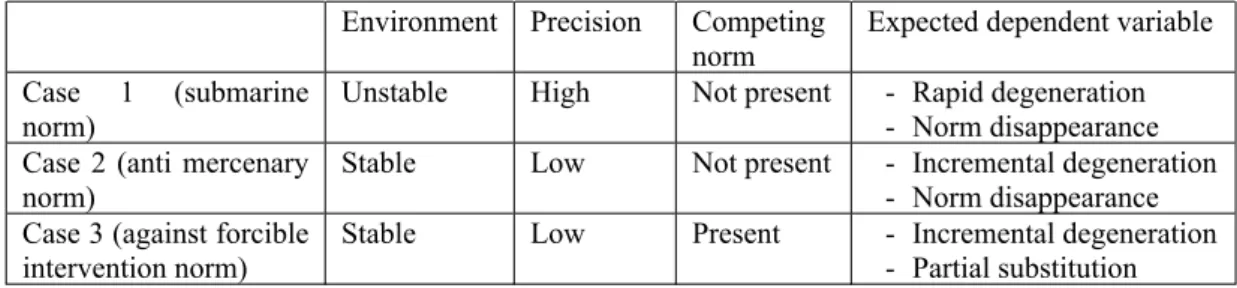
Our first case focuses on a precise norm within an unstable environment, so that we would expect rapid norm degeneration. By contrast, the other cases will examine relatively imprecise norms in stable environments, for which our hypotheses predict incremental norm degeneration. Since there are no rival norms in the second case, we would anticipate incremental degeneration without norm substitution. In the third case, however, competing norms are present, leading to the prediction of incremental norm disappearance with partial substitution.
Table 1: The case selection
Environment Precision Competing
norm Expected dependent variable Case 1 (submarine
norm) Unstable High Not present - Rapid degeneration- Norm disappearance Case 2 (anti mercenary
norm) Stable Low Not present - Incremental degeneration- Norm disappearance Case 3 (against forcible
intervention norm) Stable Low Present - Incremental degeneration- Partial substitution
Thus, contrasting the submarine case with the anti mercenary and the intervention cases generates variation on the independent variable of the first two hypotheses: as expected the norm rapidly degenerated in the submarine case, but was incrementally weakened in the other two cases. Hypotheses three and four are tested by contrasting the anti mercenaries norm with the intervention norm. As expected, the former disappeared, whilst the latter became partially substituted.
IV. Norm Degenerations in Practice
22Emily O. Goldman,Sunken Treaties : Naval Arms Control between the Wars(University Park, Pa.:
Pennsylvania State University Press, 1994), p. 317.
23Richard Burns, "Regulating Submarine Warfare, 1921-41: A Case Study of Arms Control and
Limited War,"Military Affairs35, no. 2 (1971), p. 58.
24Jeffrey Legro, "Which Norms Matter? Revisiting the ``Failure’’ of Internationalism,"International Organization51, no. 1 (1997), p. 39.
25Eliot Cohen and John Gooch,Military Misfortunes: The Anatomy of Failure(New York: The Free
Press, 2006), p. 62.
By the end of the 19th century, submarines had become sophisticated enough to be
utilized on a greater scale in warfare. Though attempts to regulate this new kind of weapons system had already been undertaken at the Hague Conference in 1899, the experiences of the First World War prompted the need for further regulations. At the Washington Conference in 1922 and the London Conference in 1930, the major sea-powers – the U.S., Great Britain, France, Italy and Japan – agreed on restricting submarine warfare.22 Submarines had to adhere to the same rules as surface ships.
Merchant vessels were not to be attacked unless they refused to stop after a warning and were not to be destroyed unless the crew and passengers were placed in safety. If a submarine was unable to comply with these rules it was expected to leave the merchant ship unharmed. This submarine code garnered the support of over 30 countries until 1937 – including Russia and Germany.23 Though the norm had been
subject to severe criticism, it proved incredibly robust, observed when Italy violated it during the Spanish civil war in 1937. Various countries took action to sanction the violations of the norm.24 Despite this promising first test, unrestricted submarine
26This was important, as the procedures allowed submarines to destroy warfare vessels immediately,
but not merchant ships (Legro, "Which Norms Matter? Revisiting the ``Failure’’ of Internationalism.", p. 39)
27Burns, "Regulating Submarine Warfare, 1921-41: A Case Study of Arms Control and Limited War.",
p. 58.
28Goldman,Sunken Treaties : Naval Arms Control between the Wars, 180.
The submarine norm was highly precise in its aim; namely to limit and restrict submarine warfare. It described further very precisely the procedures of how submarines should approach merchant ships. In this regard, complex clauses were avoided, the necessary steps were clearly specified, and paragraphs were not overlapping or vague in any respect. However, the applicatory scope of the submarine norm is slightly vague. The norm clearly distinguished between merchant ships and warships and attached different procedures to the different types of ships. In this respect, the precision of the submarine norm is also remarkably high. However, it did not provide a distinction between armed and unarmed merchant ships and left open whether the former should be treated as merchant ships or as warfare ships.26
Although the critical question as to whether armed merchant vessels lost their immunity was not explicitly answered in the treaties, the problem should not be taken too far. It was the British that had chiefly been opposed to including a differentiation in the treaty, but even they agreed that armed merchant vessels would lose their immunity.27Thus, overall, the submarine norm was precise.
The environment around the norm was exceptionally unstable at the time it became eradicated. Naval armament had been subject to various international arms control efforts during the interwar period. The treaty regime had succeeded in holding the naval powers in check and restricting armament.28However, from 1935 onwards,
29Sadao Asada,From Mahan to Pearl Harbor : The Imperial Japanese Navy and the United States
(Annapolis, Md.: Naval Institute Press, 2006), p. 204.
30William L. Shirer,The Rise and Fall of the Third Reich(New York: Simon & Schuster, 1990), pp.
288-289.
31Goldman,Sunken Treaties : Naval Arms Control between the Wars, p. 180.
32Accordingly, the US naval authorities justified unrestricted submarine warfare against Japan in the
following manner “realistic thinking demanded recognition of the fact that a nation’s economic force and its fighting forces bear the inseparable relationship of Siamese twins. Any reduction of a nation’s economic resources weakens its war potential. Sever the commercial arteries of a maritime nation and its industrial heart must fail, while the war effort expires with it” Burns, "Regulating Submarine Warfare, 1921-41: A Case Study of Arms Control and Limited War.", p. 60.
Treaty in 1936. The absence of Japan was of particular importance, as this meant the end of naval limitations and the cooperative system in the Pacific and in East Asia.29
Second, Germany and Britain signed the bilateral Anglo-German naval treaty in 1934, which limited the strength of the German navy to 35% of that of the Royal Navy. What appears to be an additional restraint at first sight turns out to be a carte blanche for armament. For instance, the Versailles Treaty proscribed the building of submarines. According to the Anglo-German treaty, Germany was allowed to build up its submarine fleet up to 60% of the British tonnage.30 Hitler withdrew from the
treaty in April 1939 in order to launch an even more massive naval armament. Third, the major powers had agreed on limits of ship displacement the in Washington Treaty. However, they all transgressed the restrictions: Italy’s battleships exceeded the limits by 18%, France by 8% and the Japanese by a significant 95%.31 Thus, the barrier of
violating naval agreements had been significantly lowered by prior violations. This reduced the probability of actors being sanctioned for violating the submarine norm.
At the same time, the actors could gain relative economic and military advantages from violating the norm against unrestricted submarine warfare.32 Japan,
33Cohen and Gooch,Military Misfortunes: The Anatomy of Failure, pp. 59-60.
34Burns, "Regulating Submarine Warfare, 1921-41: A Case Study of Arms Control and Limited War",
pp. 59-60.
35Ibid.
the war further. For the very same reason, the Royal Navy could not afford to leave its merchant ships defenseless by not arming them.33
When the actors decided to circumvent the norm, they had very little room for maneuver due to the high precision of the norm. The British navy ordered the merchant fleet to radio the position of U-boats and began arming the ships. These measures did not violate the norm, since it contained only procedures for submarines. However, as the procedures were designed to protect civilian vessels not participating in hostilities, they clearly undermined a necessary condition for the norm to be efficient. In October 1939 the British Admiralty gave further instructions to ram U-boats whenever possible. This step unmistakably rendered merchant sailors combatants.34While the German navy entered the war with strict orders to abide with
international law, including the rules regarding submarine warfare, already in October 1939 the German Admiralty issued orders allowing an attack on any “blacked out” vessels off the British and French coasts. Submarine warfare was further intensified, with permission given to attack all vessels under allied flag. A year later Germany declared Britain under siege and affirmed unrestricted submarine warfare around the island. Subsequently, Washington immediately abandoned the norm, and declared unrestricted submarine warfare against Japan when entering the war in 1941 (Ibid.).
In sum, as expected by hypothesis one, the unstable environment and the high precision of the norm contributed to its rapid degeneration. Some may argue the norm was the result of the efforts to implement the concept of limited war and it was doomed to fail as soon the belligerents resorted to strategic concept of total war.35
36Some may argue that gas was not used due to the threat of retaliation or simply because of its
military ineffectiveness. However, there are many cases were gas could have been used without the risk of retaliation, e.g. Spanish Civil War or Korea. Furthermore, gas can be highly effective against entrenched troops. The proscriptive power of the norm matter therefore to the actors (Richard Price and Nina Tannenwald, “Norms and Deterrence: The Nuclear and Chemical Weapons Taboos,” inThe Culture of National Security: Norms and Identity in World Politics, ed. Katzenstein, Peter (New York: Columbia University Press, 1996), pp. 117-119.
37Christian Zentner,Der Nürnberger Prozeß: Der Nürnberger Prozess(Stuttgart: 1994), p. 24.
regulated submarine warfare, also prohibited the use of gas in warfare.36 In contrast
to the submarine regulations, all parties complied with the latter norm during WWII. Total war, therefore, does not necessarily cause the disappearance of any existing norms of limited warfare. In line with hypothesis three, the norm was not substituted by another emerging norm of less restricted submarine warfare. One could think of a norm lifting restrictions on armed merchant ships, while still protecting unarmed vessels, or a norm acknowledging the difference between submarines and surface vessels, setting up tailored procedures and regulation of how to engage in war-fighting for U-boats. However, such a norm did not emerge. On the contrary, when the German political and military leadership was held responsible for war crimes before the Nurnberg Tribunal, they were also charged with having violated the norm against unrestricted warfare. Yet, this was the only case, which could be rebutted by referring to the “tu-quequo-principle” (defending by accusing the opponent of the same conduct).37 On the one hand, the indictment and defendant - justifying
38Sarah Percy, "Mercenaries: Strong Norm, Weak Law,"International Organization61, no. 4 (2007),
pp. 373-374.
39According to Art. 47 (2) API a mercenary is a) specially recruited locally or abroad in order to fight
in an armed conflict, b) does, in fact, take a direct part in the hostilities, c) is motivated to take part in the hostilities essentially by the desire for private gain and, in fact, is promised, by or on behalf of a Party to the conflict, material compensation substantially in excess of that promised or paid to combatants of similar ranks and functions in the armed forces of that Party, d) is neither a national of a Party to the conflict nor a resident of a territory controlled by a Party to the conflict, e) is not a member of the armed forces of a Party to the conflict; and, f) has not been sent by a State which is not a Party to the conflict on official duty as a member of its armed forces.
40Christian Schaller,Private Sicherheitsfirmen- Und Militärfirmen in bewaffneten Konflikten,Swp Studie S24(Berlin: Stiftung Wissenschaft und Politik, 2005).
41Percy, "Mercenaries: Strong Norm, Weak Law", p. 368
Incremental degeneration without norm substitution: The anti-mercenary norm
The prohibition of the use of mercenaries is widely accepted in the international community. Since the late 1960’s, more than 100 resolutions criticizing mercenary activities have been adopted by the UN General Assembly. Even the Security Council was involved several times with mercenaries in the 1960’s and 1970’s, condemning their use.38 Furthermore, the anti-mercenary norm is deeply incorporated into the
body of international law. Three international treaties deal with the question of mercenaries: the First Additional Protocol of the Third Geneva Convention (AP I) (1978), the OAU Convention for the Elimination of Mercenarism (1977) and the International Convention against the Recruitment, Use, Financing and Training of Mercenaries (1989). The most important document is the AP I since it is the most widely accepted treaty, with 167 states having ratified it in 2007. However, there is hardly a chance that anyone qualifies as a mercenary under AP I, since the definition provides many loopholes.39Due to these shortfalls the protocol is almost irrelevant for
the categorization of Private Security Companies, PSCs.40 Paradoxically weak law
does not imply that social norms are also inevitably weak.41 On the contrary, the
42Janice Thomson,Mercenaries, Pirates, & Sovereigns(Princeton: Princeton University Press, 1994),
p. 96.
43Deborah D. Avant,The Market for Force: The Consequences of Privatizing Security(Cambridge,
UK ; New York: Cambridge University Press, 2005), p. 3.
44Christian Miller, "Contractors Outnumber U.S. Troops in Iraq,"The Virginian Pilot4. July 2007. 45Lisa Rimli and Susanne Schmeidel,Private Security Companies and Local Populations(Geneva:
Swiss Peace: 2007), p. 15.
46Juan Carlos Zarate, "The Emergence of a New Dog of War: Private International Security
Companies, International Law, and New World Disorder,"Stanford Journal of International Law34 (1998), pp. 78-79.
decision-making authority and the ownership over the means of violence were monopolized in the hands of the state. As mercenaries use force outside the control of the state, their employment became prohibited. This taboo even remained significant in the second half of the last century and as of “[t]oday real states do not buy mercenaries”.42 Accordingly, mercenaries played almost no role in 20th century
warfare, although they never completely vanished.
Today a market for force has developed alongside the state system and the states armed forces.43PSCs providing armed services in conflict zones are present all
over the world. To give just two prominent examples for their commonplace use: in Iraq, approximately 30,000 PSCs are present44 whilst in Afghanistan, between
approximately 18,500 and 28,000 PSCs45 provide convoy security and protect
property or personnel to their customers. To put it bluntly, today, states are once again using mercenaries.
In the following section we show how the anti-mercenary norm degenerated incrementally. Although the anti-mercenary norm provided a clear aim - namely the prohibition of the use of mercenaries - the norm was nonetheless never especially precise. The classical definition of a mercenary is a foreign fighter, which signifies that they are not nationals to a party in the conflict, their primary motivation is money and they use force outside the control of the state.46 The ambiguity of the norm
47Even in the 20thcentury some armed forces employed foreigners. The United Arabs Emirates, for
example, still relied in the 1980’s on officers from Britain, Pakistan and Jordan. Until the 1970’s the Omani army was almost wholly recruited from foreigners. In the French Foreign Legion over one hundred nationalities were present in 1983 Thomson,Mercenaries, Pirates, & Sovereigns.
48Tony Lynch and A.J. Walsh, "The Good Mercenary?,"The Journal of Political Philosophy8, no. 2
(2000), p. 136.
49P. W. Singer,Corporate Warriors: The Rise of the Privatized Military Industry,Cornell Studies in Security Affairs(Ithaca: Cornell University Press, 2003), p. 53.
50David Shearer,Private Armies and Military Intervention,Adelphi Paper,(Oxford
New York: Oxford University Press for the International Institute for Strategic Studies, 1998).
51Fred Schreier and Marina Caparini, "Privatising Security: Law, Practice and Governance of Private
Military and Security Companies," inGeneva Centre for the Democratic Control of Armed Forces: Occasional Paper(Genva: 2005), pp. 3-4.
participating in hostilities as mercenaries.47Furthermore, a mercenary is considered as
being motivated by money. However, fighting for money does not automatically qualify someone as a mercenary. Many national armed forces recruit new personnel by offering career options, free education, health care and of course, a salary. New applicants often get a bonus when they sign up. Thus, there is no guarantee that soldiers are only motivated by patriotism and not (also) by financial benefits.48
However, soldiers would not generally be considered mercenaries.
The relevant environment did not change rapidly or fundamentally. The end of the Cold War caused a shift in the material environment of armed forces, as the defense budgets were shrunk and the size of the military forces was downsized. As a result, a huge pool of military qualified personnel flooded the market seeking new employments.49 This facilitated the emergence of the supply side of the market for
force. On the other hand, the demand side was prompted by the disengagement of the great powers in various regions of the world, which increased demand for military expertise and resources by weak states.50 Furthermore, Western armed forces also
developed a higher demand for military resources as deployment rates have increased significantly and put a severe strain on the troops.51
52James Jay Carafano,Private Sector, Public Wars : Contractors in Combat-- Afghanistan, Iraq, and Future Conflicts,The Changing Face of War,(Westport, Conn.: Praeger Security International, 2008), p. 43.
53In contrast to mercenaries, PMCs provide a much broader spectrum of services and operate on an
open global market within a corporate structure Singer,Corporate Warriors: The Rise of the Privatized Military Industry, p. 45. However, whether the services prohibited by the anti mercenary norm are now provided in a more professional corporate manner and are among other non-prohibited services, makes no difference before the norm. Moreover, trading on an open market does not render a practice appropriate.
54This is not to say, that there is analytically a clear cut difference between offensive and defensive
force Ibid. The differences are however perceived by the relevant actors. Foreign Affairs Committee, "Ninth Report of the Foreign Affairs Committee: Private Military Companies," (London: British Parliament, 2002).
55Robert Young Pelton,Licensed to Kill: Hired Guns in the War on Terror, 1st pbk. ed. (New York:
Three Rivers Press, 2007), Percy, "Mercenaries: Strong Norm, Weak Law," p. 109.
56http://www.eda.admin.ch/eda/en/home/topics/intla/humlaw/pse/parsta.html(Accessed: 4/26/09). 57http://www.icrc.org/web/eng/siteeng0.nsf/htmlall/montreux-document-170908(Accessed: 4/26/09) contractors are said to be more cost-efficient than in-house solutions.52However, it is
not an uncontested issue as to whether outsourcing saves costs. Second, deploying armed contractors reduces the strain on the troops as they serve as force multipliers. However, none of the actors challenged the anti-mercenary norm openly. Instead of employing mercenaries, they hired private security companies (PSC). The U.S., Germany and the UK, shared the view that PSCs were significantly different from mercenaries.53 For example, the Foreign Affairs committee in the British Parliament
differentiated between different tasks and argued that in contrast to firms providing military operations, PSCs using defensive force were considered legitimate.54
Although the distinction is not easily made, it has become widely accepted that if a firm is to cross the line and start providing offensive services, it would be considered a mercenary company.55 Following this vein, the U.S. and twenty-five other states
embraced this view in the Montreux document in 2008.56 PSCs were considered
business entities providing military and security services including armed guarding and protection of persons and objects. Such firms may use force, but only in self-defence or self-defence of third persons.57
anti-58Sarah Perce,Mercenaries, (Oxford: Oxford University Press, 2007), p. 227.
59Dina Rasor and Robert Bauman,Betraying Our Troops : The Destructive Results of Privatizing War,
1st ed. (New York: Palgrave Macmillan, 2007), p. 120.
60It is often argued that the normative change towards a liberal agenda led to a privatization revolution.
However, privatization or liberalization are not norms giving precise guidelines for behavior. These are belief systems containing a variety of general principles. Indeed, economic liberalism contains a general standard of behavior, asserting that market competition maximizes efficiency and effectiveness.
mercenary offensive tasks appeared to be too controversial and were pushed off the market, while the defensive services were accepted.58 However, as aforementioned,
the differentiation between the kinds of forces is not required in the anti-mercenary norm. However, as the use of defensive force is no longer an exception and is now considered legitimate, the actors succeeded in limiting the applicatory scope of the anti-mercenary norm. One could even go further and argue that this is just a fig leave, the beginning of a radical reformulation, eventually culminating in the entire anti-mercenary norm becoming meaningless. Although currently the defensive character of PSCs is upheld, the substance of the argument can be doubted. In many cases it appears as if they even go beyond the security task. PSCs in Iraq, for instance, also conducted offensive operations by taking the initiative to the enemy.59 In short,
neither has the anti-mercenary norm differentiated between offensive and defensive tasks, nor do PSCs perform purely defensive tasks. Thus, as expected by hypothesis two, the high precision and the rather stable environment, in combination with actors’ interests in violating the anti-mercenary norm, led to its incremental degeneration. In line with hypothesis three, the anti-mercenary norm was not substituted by another norm since other competing norms replacing the anti-mercenary norm did not exist.60
61Ulrich Schneckener, "Fragile Statehood, Armed Non-State Actors and Security Governance," in Private Actors and Security Governance, ed. Alan Bryden and Marina Caparini (Zurich: Lit Verlag, 2006), p. 32.
62James Pattison, "Just War Theory and the Privatization of Military Force,"Ethics and International Affairs22, no. 2 (2008), p. 151.
63Bruno Simma, "Nato, the UN and the Use of Force: Legal Aspects,"European Journal of International Law10 (1999), p. 2.
of force rather than contributing to it.61 PMCs are often deemed to undermine the
principle of legitimate authority, which internationally restricts the number of agents that are permitted to use force. James Pattison claims that “privatization of military force introduces a set of non state actors that do not fit into state-based systems of regulation”.62 Thus, the anti-mercenary norm was not substituted by another norm.
Hypothesis 3 can therefore be confirmed.
In sum, by the end of 2003, using PSC on a large scale in Iraq was considered to be appropriate. It took just a decade – from the first operation combat in the early 1990s to the broad PSC employment in Iraq – to change a norm, which had been in place for almost two hundred years. As expected from the hypotheses, the anti-mercenary norm has incrementally degenerated.
Incremental degeneration with partial norm substitution: the norm against forcible intervention
The first attempt to ban violence as a means in international relations was undertaken in 1928, when the major powers singed the Briand Kellogg Pact in Paris. Although the pact was not able to prevent another World War, the ban became a core principle in the newly drafted Charter of the United Nations (UNC). Article 2 IV UNC went even further by proscribing any use or even the threat of the use of force.63Article 53
64The non-intervention norm was confirmed in various documents by the majority of the UN General
Assembly and was even incorporated in the Charter of the Organisation of African States and the Final Act of the Helsinki Conference in 1975 Kelly Pease and David Forsythe, "Human Rights, Humanitarian Interventions, and World Politics,"Human Rights Quarterly15, no. 2 (1993).
65Oliver Ramsbotham and Tom Woodhouse,Humanitarian Intervention in Contemporary Conflict : A Reconceptualization(Cambridge, Mass.: Polity Press, 1996), p. 45.
importance of Article 2 IV by rendering itjus cogens, signifying that it is compelling law and derogations are prohibited. The regulatory scope of the Article overlaps to some extent with Article 2 VII of the UN Charter.64Article 2 VII prohibits any form
of external intervention in the domestic affairs of a state by all means. Since military interventions are the most controversial and the discussion usually focuses on military measures, both articles are often used interchangeably. The scopes of the articles, however, do not overlap completely. We regard the shared ground of the two Articles as the foundation of the “norm against forcible intervention”. Although the norm is considered a cornerstone of the international system, it is subject to incremental degeneration since the 1980s. The right of humanitarian intervention has been established as a new exception to the norm. Though humanitarian interventions are not new, from 1945 to 1990 only eleven were conducted.65 Since the 1990s their
66The enumeration is drawn from James Pattison,Humanitarian Intervention and the Responsibility to Protect: Who should intervene?, (Oxford: Oxford University Press, 2010).
67Martha Finnemore,The Purpose of Intervention(Ithaca & London: Cornell University Press, 2003),
p. 2.
68Stephen D. Krasner,Sovereignty: Organized Hypocrisy(Princeton, N.J.: Princeton University Press,
1999), p. 24.
69Michael Bayers and Simon Chesterman, "Changing the Rules About Rules," inHumanitarian Intervention: Ethical, Legal and Political Dilemmas, ed. J.L. Holzgrefe and Robert Keohane (Cambridge: Cambridge University Press, 2003), p. 198.
70Krasner,Sovereignty: Organized Hypocrisy, p. 41.
2003 and French and UN intervention in Côte d’Ivoire in 2003.66
However, some might object that intervention is hardly a new phenomenon in international relations and that the norm of non-intervention is only heeded when it seems convenient. Martha Finnemore argued that stronger states have always intervened in weaker states, only the “when” has changed over time.67 In the same
vein, Steven Krasner concludes that sovereignty (and non-intervention) has always been violated and that the Westphalian system was nothing more than organized hypocrisy.68 We do not reject the notion that interventions have taken place before.
Nevertheless, states have been very eager to protect their sovereignty and considered interventions therefore usually as illegitimate (Ibid. 41). Depicting interventions as norm violation constitutes a confirmatory act of the current rule set.69The difference
between traditional interventions and the current humanitarian intervention is that the latter is not considered a violation of the non-intervention norm anymore, but a legitimate exception. This claim is indirectly even supported by Stephen Krasner perception of human right: “… the international law of human rights is revolutionary because it contradicts the notion of national sovereignty – that is, that a state can do as it pleases within its own jurisdiction”.70
71 Article 51 UNC claims nothing in the Charter shall impair the right of self defence if an attack
occurs. Self defence, however, cannot be equalled with forcible intervention per se, since it can, in theory, be conducted on ones’ own territory without intruding on the territory of another state. Without a shadow of a doubt, a defender cannot be accused of violating the norm against forcible intervention, when he or she infringes the territory of the attacker while being attacked. It is more difficult to answer the question whether defenders are permitted to pre-empt attacks and forestall any imminent threats under Article 51. In sum, although the norm clearly determines who is allowed to use force against whom, the conditions for its permission are rather vague.
72Chapter VII UNC entrusts the UN Security Council with matters of international security. It has the
final say over the use of force in international relations and can sanction the use of forcible measures whenever it considers a situation to be a “threat to peace and stability”. Although a precise procedure is set up of how to invoke the Council, who decides, and how these decisions are to be reached, it is unclear under which circumstances force is permitted. In this matter the Council is given ample leeway since the term “any threat to peace, breach of peace or act of aggression” is intentionally kept vague to adapt to new circumstances. Consequently, this exception also lacks precision and considerably increases the ambiguity of the norm against forcible intervention.
73A third exemption is specified in Articles 53 and 107 UNC. The “enemy state clause” allows forcible
measures even without the approval of the Security Council or, apart from self defence, against states that had been enemies to the signatory powers during WWII. We do not extend on this exception further, since we consider it to be already degenerated.
and VII UNC conveys a very clear aim: no forcible external intervention in domestic affairs of another state. This prescription is comprehensive, addressing all peoples and granting no leeway for deviation. For this remarkable evolution in international affairs, the founders of the Charter needed just two sentences. Yet, the relatively high ambivalence of the norm against forcible intervention accrues from three exemptions stipulated in the same Charter. Article 51 UNC allows an infringement on the territory of the attacker while being attacked,71 based in chapter VII UNC the UN Security
Council can use forcible measures whenever it considers a situation to be a “threat to peace and stability,72 and Articles 53 and 107 UNC specify the “enemy state
clause”.73 Hence, the norm against the use of force is not explicitly precise because
the introduction of the various exceptions made it more complex and allowed deviations from the general rule without providing clear guidelines on the necessary conditions.
74Michael Akehurst, "Humanitarian Intervention " inIntervention in World Politics, ed. Hedley Bull
(New York: Oxford University Press, 1985).
75David Chandler,From Kosovo to Kabul : Human Rights and International Intervention(London ;
Sterling, Va.: Pluto Press, 2002), p. 22.
76United Nations Development Programme,Human Development Report 1994(New York: Oxford
University Press, 1994), p. 22.
77Keith Krause, "“Human Security: An Idea Whose Time Has Come?”"S+F: Sicherheit und Frieden
23, no. 1 (2005), p. 3.
78See for examplehttp://www.humansecuritynetwork.org(latest access December 2009).
not established.74 The protection of state sovereignty through the norm against
forcible intervention was valued as more superior than the enforcement of human rights. In the late 1980s and early 1990s, this gradually began to change. Powerful actors like the UN and transnational non-governmental organizations, such as Amnesty International and Oxfam, challenged this restrictive normative structure and demanded a more active promotion of human rights.75In this regard, the 1994 edition
of the UN Development Programme (UNDP) Human Development Report is an important document:
The concept of security has for too long been interpreted narrowly: as security of territory from external aggression, or as protection of national interests in foreign policy or as global security from the threat of nuclear holocaust…. Forgotten were the legitimate concerns of ordinary people who sought security in their daily lives.76
The UNDP report promoted a new understanding of security, shifting from a state-centric perception towards a more holistic concept of ‘human security’. Human security was defined as safety from threats such as hunger, disease, repression, and protection from disruptions in the patterns of daily life. The concept meant adopting a bottom-up view of security that focused on the relationship between states and their citizens. Security of a state or regime was no longer equated with the well-being of its citizens.77 The UN was not alone in supporting this new understanding, with some
79Press Release (26.3.2004): Memorial Conference on Rwanda genocide considers Ways to Ensure
more effective International Response in the Future, AFR/868; Source: <http://www.un.org/news/Press/docs/2004/afr868.doc.htm>.
80John H. F. Shattuck,Freedom on Fire : Human Rights Wars and America's Response(Cambridge,
Mass.: Harvard University Press, 2003), p. 75.
81Though not every state was in favour of such a right of humanitarian intervention, no one did oppose
it openly. Russia and China, for instance, did not veto the UN Security Council Resolution to Iraq in 1991 Nicholas Wheeler, "The Humanitarian Responsibilities of Sovereignty: Explaining the Development of a New Norm of Military Intervention for Humanitarian Purposes in International Society," inHumanitarian Intervention and International Relations, ed. Jennifer Welsh (New York and Oxford: Oxford University Press, 2003), p 39. Even though both states were uncomfortable with the new norm, they rarely challenged interventions when gross human rights violations took place. No state wanted to be seen as opposing a military action that was clearly saving lives (Jim Whitman, "A Cautionary Note on Humanitarian Intervention,"Journal of Humanitarian Assistance (1994)., 39).
The new emphasis on human security was, however, at odds with the concept of strong state sovereignty protected by a strong norm against forcible intervention. In cases of gross human rights violations, forcible intervention often appeared as the only option to immediately save people. In such cases, complying with the norm against forcible intervention created a cognitive dissonance. A notorious example to illustrate this dissonance is the reactions regarding the non-intervention in the case of the Rwanda genocide in 1994. Former UN General Secretary Kofi Annan accused the international community of being guilty of “sins of omission”79. US-President Clinton even apologized to survivors of the genocide for
the absence of any help and extended further: “The international community was not organized to deal with this, and it still isn’t. We are better organized than four years ago, but we have much more to do”.80 In line with that the former British Foreign
Minister Hurd also claimed that “recent international law recognises the right to intervene in the affairs of another state in cases of extreme humanitarian need”.81
82Boutros Boutros-Ghali,An Agenda for Peace: Preventive Diplomacy, Peacemaking and Peace-Keeping(New York: United Nations, 1992).
83International Commission on Intervention and State Sovereignty,The Responsibility to Protect.
(Ottawa: International Development Research Centre, 2001), p. IX.
84Ibid., 31.
and his successor.82They argued that sovereignty encompassed rights and duties and
was no longer an inherent right of the state. Instead, it was granted to the state by its citizens and the international community. If a state violates its duties, mainly defined by the standards of the international community, it can forfeit its erstwhile protection against intervention. This slowly changing normative environment was receptive for humanitarian interventions and offered the opportunity to curb the norm against forcible intervention. The publication of the report of the independent International
Commission on Intervention and State Sovereignty bound the two strings together,
with the new emphasis on human security and the idea of a conditional sovereignty.83
The ICISS promoted a duty to protect victims of gross human rights violations, called the ‘Responsibility to Protect’ (R2P). In principle, R2P demands that when gross human rights violations take place, the home state is called upon to take measures to end the violations in question. If the state is unable or unwilling to act, the state forfeits its protection and the international community may take forcible measures. R2P does not replace the norm against forcible interventions, but it does curb its scope significantly, as it allows interventions under certain conditions. As exceptions to the non-intervention norm were already constituted, R2P was framed as another exception. The ICISS explicitly stated that resorting to military action should only be an exception.84 Thus, in line with hypotheses two and four, the imprecise norm
85Alex Bellamy, "Responsibility to Protect or Trojan Horse? The Crisis in Darfur and Humanitarian
Intervention after Iraq,"Ethics and International Affairs19, no. 2 (2005).
86David Chesterman, "Humanitarian Intervention in Afghanistan," inHumanitarian Intervention and International Relations, ed. Jennifer Welsh (New York and Oxford: Oxford University Press, 2003), p. 163.
the final document of the UN World Summit in 200585and even opponents accepted
it. Second, the Security Council recently began to refer to the responsibility in its resolutions. During the informal consultations about R2P within the confines of the UNGA in 2005, 28 countries were in favour, 12 against, and three undecided. Even the important ‘permanent five’ (P-5) seemed to be in favour of R2P. In April 2006, R2P was mentioned for the first time in Security Council Resolution 1674. Finally, even in the case of Afghanistan, where states intervened for non-humanitarian purposes, policy makers nevertheless drew on human rights justifications.86
V. Conclusions
actors with incentives for defection and increases the chances that those norm violations are detected that curb the aim, procedures or applicators scopes of the norm in question too much. Both processes of degenerations are likely to lead to complete or partial norm substitutions, if competing norms are present, which fill the normative vacuum. If rival norms are absent, norms are abolished without being replaced.
These theoretical arguments are backed up by empirical evidence. The submarine warfare case confirms the hypothesis on rapid norm degenerations and the second and third cases on the anti-mercenary norm and the norm against forcible interventions confirm the hypothesis on incremental norm degenerations. In line with hypotheses three and four, the anti-mercenary norm and the submarine norm were de facto abolished without substitution, while the norm against forcible interventions became partially substituted through the humanitarian intervention norm.
Literature:
Michael Akehurst, "Humanitarian Intervention " in Hedley Bull, ed., Intervention in World Politics(New York: Oxford University Press, 1985) pp. 95-118.
Sadao Asada, From Mahan to Pearl Harbor : The Imperial Japanese Navy and the United States(Annapolis, Md.: Naval Institute Press, 2006).
Deborah D. Avant, The Market for Force: The Consequences of Privatizing Security
(Cambridge, UK ; New York: Cambridge University Press, 2005).
Michael Bayers, and Simon Chesterman, "Changing the Rules About Rules," in J.L. Holzgrefe and Robert Keohane, eds., Humanitarian Intervention: Ethical,
Legal and Political Dilemmas (Cambridge: Cambridge University Press,
2003) pp. 177-203.
Alex Bellamy, "Responsibility to Protect or Trojan Horse? The Crisis in Darfur and Humanitarian Intervention after Iraq,"Ethics and International Affairs, Vol. 19, No. 2 (2005), pp. 31-53.
Boutros Boutros-Ghali,An Agenda for Peace: Preventive Diplomacy, Peacemaking
and Peace-Keeping(New York: United Nations, 1992).
Richard Burns, "Regulating Submarine Warfare, 1921-41: A Case Study of Arms Control and Limited War,"Military Affairs, Vol. 35, No. 2 (1971), pp. 56-63. James Jay Carafano, Private Sector, Public Wars : Contractors in
Combat--Afghanistan, Iraq, and Future Conflicts (Westport, Conn.: Praeger Security
International, 2008).
David Chandler, From Kosovo to Kabul : Human Rights and International Intervention(London ; Sterling, Va.: Pluto Press, 2002).
David Chesterman, "Humanitarian Intervention in Afghanistan," in Jennifer Welsh,
ed., Humanitarian Intervention and International Relations (New York and
Oxford: Oxford University Press, 2003) pp. 163-176.
Eliot Cohen, and John Gooch, Military Misfortunes: The Anatomy of Failure (New York: The Free Press, 2006).
Yves Durel, "The Role of Cognitive and Normative Frames in Policy-Making,"
Journal of European Public Policy, Vol. 7, No. 4 (2000), pp. 495-512. James D. Fearon, "Bargaining, Enforcement and International Cooperation,"
International Organization, Vol. 52, No. 2 (1998), pp. 269-305.
Martha Finnemore, The Purpose of Intervention (Ithaca & London: Cornell University Press, 2003).
Foreign Affairs Committee, Ninth Report of the Foreign Affairs Committee: Private Military Companies, 2002 (London: British Parliament).
Emily O. Goldman, Sunken Treaties : Naval Arms Control between the Wars
(University Park, Pa.: Pennsylvania State University Press, 1994).
Ernst Haas,When Knowledge Is Power(Berkeley CA: University of California Press, 1990).
Brien Hallett, The Lost Art of Declaring War (Urbana, [Ill.]: University of Illinois Press, 1998).
Louis Henkin,How Nations Behave: Law and Foreign Policy (New York: Columbia University Press, 1968).
Michael Eliot Howard, Restraints on War : Studies in the Limitation of Armed Conflict(Oxford ; New York: Oxford University Press, 1979).
John Keegan, A History of Warfare (New York: Alfred A. Knopf : Distributed by Random House, Inc., 1993).
Stephen D. Krasner, Sovereignty: Organized Hypocrisy (Princeton, N.J.: Princeton University Press, 1999).
Friedrich Kratochwil, and John G. Ruggie, "International Organization: A State of the Art on an Art of the State," International Organization, Vol. 40, No. 4 (1986), pp. 753-775.
Keith Krause, "“Human Security: An Idea Whose Time Has Come?”" S+F: Sicherheit und Frieden, Vol. 23, No. 1 (2005), pp. 1-14.
Jeffrey Legro, "Which Norms Matter? Revisiting the ``Failure’’ of Internationalism,"
International Organization, Vol. 51, No. 1 (1997), pp. 31-61.
Tony Lynch, and A.J. Walsh, "The Good Mercenary?," The Journal of Political Philosophy, Vol. 8, No. 2 (2000), pp. 133-153.
John A. Lynn,Battle : A History of Combat and Culture(Cambridge, MA: Westview Press, 2004).
Neil S. MacFarlane, Intervention in Contemporary World Politics (London: International Institute for Strategic Studies, 2002).
Ann Markusen, "The Case against Privatization National Security," International Political Science Association(University of Oklahoma: 2001).
Christian Miller, "Contractors Outnumber U.S. Troops in Iraq," The Virginian Pilot
4. July 2007, A9.
Johan P. Olsen, "Garbage Cans, New Institutionalism, and the Study of Politics,"
American Political Science Review, Vol. 95, No. 1 (2001), pp. 191-198 James Pattison, "Just War Theory and the Privatization of Military Force,"Ethics and
International Affairs, Vol. 22, No. 2 (2008), pp. 143–162.
Kelly Pease, and David Forsythe, "Human Rights, Humanitarian Interventions, and World Politics," Human Rights Quarterly, Vol. 15, No. 2 (1993), pp. 290-314.
Robert Young Pelton,Licensed to Kill : Hired Guns in the War on Terror(New York: Three Rivers Press, 2007).
Sarah Percy, "Mercenaries: Strong Norm, Weak Law," International Organization, Vol. 61, No. 4 (2007), pp. 367-397.
Oliver Ramsbotham, and Tom Woodhouse, Humanitarian Intervention in
Contemporary Conflict : A Reconceptualization (Cambridge, Mass.: Polity
Press, 1996).
Dina Rasor, and Robert Bauman, Betraying Our Troops : The Destructive Results of
Privatizing War(New York: Palgrave Macmillan, 2007).
Lisa Rimli, and Susanne Schmeidel, Private Security Companies and Local Populations(Geneva: Swiss Peace: 2007).
Thomas Risse, Maria Green Cowles, and James A. Caporaso, eds., Transforming
Europe. Europeanization and Domestic Change (Ithaca, NY: Cornell
University Press, 2001).
Christian Schaller, Private Sicherheitsfirmen- Und Militaerfirmen in Bewaffneten Konflikten(Berlin: Stiftung Wissenschaft und Politik, 2005).
Ulrich Schneckener, "Fragile Statehood, Armed Non-State Actors and Security Governance," in Alan Bryden and Marina Caparini, eds., Private Actors and Security Governance(Zurich: Lit Verlag, 2006) pp. 23-40.
Fred Schreier, and Marina Caparini, "Privatising Security: Law, Practice and Governance of Private Military and Security Companies," Geneva Centre for