This is a repository copy of Getting started without a system : from phonetics to phonology in bilingual development.
White Rose Research Online URL for this paper: http://eprints.whiterose.ac.uk/54610/
Version: Accepted Version
Article:
Vihman, M.M. orcid.org/0000-0001-8912-4840 (2002) Getting started without a system : from phonetics to phonology in bilingual development. International Journal of
Bilingualism. pp. 239-254. ISSN 0756-6878 https://doi.org/10.1177/13670069020060030201
Reuse
Items deposited in White Rose Research Online are protected by copyright, with all rights reserved unless indicated otherwise. They may be downloaded and/or printed for private study, or other acts as permitted by national copyright laws. The publisher or other rights holders may allow further reproduction and re-use of the full text version. This is indicated by the licence information on the White Rose Research Online record for the item.
Takedown
If you consider content in White Rose Research Online to be in breach of UK law, please notify us by
Getting started without a system:
From phonetics to phonology in bilingual development
Marilyn May Vihman
University of Wales, Bangor
Marilyn May Vihman School of Psychology University of Wales, Bangor Gwynedd LL57 2AS
Wales, UK
FAX: 44+1248 382599
Keywords:
Abstract
The common formulation which proposes that bilingual children enter into language
production with either a single or a dual phonological system is questioned. Instead, it is
suggested that implicit learning allows the child to develop considerable distributional
knowledge about each of the languages to which he or she is exposed even before the
first words are produced, but that explicit learning and use of particular words and
phrases establishes the foundation from which more detailed phonological knowledge
will be induced. Once the child has produced some 50-100 different words (initially
based on Ôitem learningÕ), word templates can often be identified, reflecting the
individual childÕs development of readily accessible production patterns that may
constitute a rough match to words of one or both languages. The proposed course of
development is supported by analysis of early word patterns drawn from three bilingual
children. The item learning of early words, which reflects ÔselectionÕ of word targets with
few changes, is distinguished from the template-based later words, which may depart
more radically from the targets. The word templates of the bilingual children are found to
assimilate words of both languages, sometimes in contravention of adult language
1. Is Ôone system vs. twoÕ the right question?
The issue of whether bilingual children have one system or two Ôfrom the beginningÕ
has dominated the bilingual language development literature at least since the early
1970s.1 The formulation of this issue provided by Volterra and Taeschner (1978) has
served as a baseline for subsequent debate, even though the Ôlinguistic stagesÕ that they
posited have received little if any empirical support in the nearly 25 years of subsequent
research. Essentially, they argued that, in the first stage, the child has a single Ôlexical
systemÕ which includes words from both languages, but translation equivalents are rare, if
they occur at all; in the next stage Ôthe child distinguishes two different lexicons but
applies the same syntactic rules to both languagesÕ (p. 311). Volterra and Taeschner saw
the use of words from both languages in a single utterance as the consequence of a lack
of translation equivalents.
With reference primarily to the acquisition of morphosyntax Genesee (1989)
characterized this account as Ôthe unitary language system hypothesisÕ, while Meisel
(1994) proposed the term ÔfusionÕ to refer to cases in which language mixing, or
juxtaposition of elements from each of the languages within a single production unit, is
ascribed to Ôa failure in separating the two grammarsÕ (p. 414). Neither these expressions
nor the Volterra and Taeschner Ôstage modelÕ make any specific reference to phonology,
but the Ôone system vs. twoÕ issue has nevertheless generally been formulated with
reference to that model.
Attempts to test Volterra and TaeschnerÕs first claim, that children begin with a single
lexicon that includes word forms from both languages but that lacks - or even actively
collected in a single (Estonian language) context, as well as Deuchar and Quay (2000),
who make use of recordings in both English and Spanish contexts as well as diary notes.
The findings of both studies constitute a disconfirmation of the Ôunitary systemÕ proposed
for Stage I: Cross-language equivalents or synonyms do occur early on. In fact, many
words are deployed in both languages soon after the first occurrence in one of the
languages, even within the period of the first 50 words. (See also Mikes, 1990, who
reports early translation equivalents in the lexicon of four children acquiring
Serbo-Croatian and Hungarian, in a situation in which both languages were used both in the
home and in the community.)
On the other hand, Deuchar & Vihman (2002) establish that in early two-word
productions the children they observed both made use of a high proportion of utterances
drawing on both languages in combination, even excluding all cases in which the child
lacked a translation equivalent for the word that failed to match the discourse context.
Thus, careful studies of the early bilingual lexicon fail to support the hypothesis of an
early Ôunitary lexical systemÕ, yet analysis of the first steps in syntactic learning in the
same children fail to support the idea of Ôtwo separate systems from the startÕ either.
What can we learn from the study of emergent phonology in the bilingual child?
2. Implicit and explicit learning
Recent experimental work provides good reason to believe that there are two
independent but mutually supportive routes to learning phonology. Implicit learning
begins in the womb, with infants attuning to the characteristic melodic patterns of the
native language, particularly their motherÕs speech rhythms (Hepper, Scott &
one language or to more than one Ð has an ongoing and cumulative impact on what is
familiar over the course of the first months of life and thus can be expected to affect what
is easily and quickly learned as the childÕs memory for speech patterns increases. It is
important to note that even overhearing language not intended for the learner (and not
consciously registered) can result in implicit learning in adults (Saffran, Newport, Aslin,
Tunick & Barrueco, 1997). Effects such as those shown in perception studies by Jusczyk
(1997) and his colleagues, revealing sensitivity to coherence in ever smaller prosodic
units (clauses, as early as 4.5 mos., then phrases at 9 mos., and finally words at 11 mos.),
can be taken to be the result of implicit learning. The effect of implicit perceptual
learning on production can also be seen, for example, in the subtle ambient language
effects on vowel quality at 10 months, as revealed by acoustic analyses of the
vocalizations of infants exposed to Arabic, Cantonese, English or French
(Boysson-Bardies, HallŽ, Sagart & Durand, 1989). This kind of learning, which is probabilistic
rather than categorical, appears to involve the ongoing registering or ÔtallyingÕ of
frequencies of occurrence of potential linguistic units at different levels Ð segments,
syllables, prosodic units, words, phrases, clauses (Bybee & Hopper, 2001). The earliest
outcome of exposure to language, then, would be a sense of the prosodic patterns and the
segmental sequences characteristic of the input language. It would mean the
accumulation of distributional knowledge in advance of the laying down of specific
representations of words.
Explicit learning, on the other hand, is here taken to mean learning with attention, and
sometimes also with an intention rooted in a social (communicative) or cognitive
less conscious goal to replicate adult verbal behavior in given situations by matching
their sound patterns with vocal productions of a comparable kind (Locke, 1993). Thus the
origin of phonological system Ð at least for production - may not be found in the minimal
units of phonology (pace Jakobson, 1941/68, Ingram, 1992), whether those are conceived
of as phonemes, phonemic oppositions, or distinctive features, but in the lexicon, in the
word or phrase units ÔgivenÕ by the input speech, whole prosodically marked units
available to be matched (Croft, 1995). The sound system of the adult language or
languages will necessarily begin to crystallize out of this first explicit lexical learning,
however approximate or inadequate the childÕs first word attempts may be. There will be
nothing to call a ÔsystemÕ at the beginning, but isolated remembered ÔbitsÕ instead, words
and phrases understood and sometimes identifiably reproduced in a suggestive situational
context (McCune & Vihman, 2001; Vihman & McCune, 1994). Such lexical
representation is a necessary foundation for functional knowledge of phonological
contrast: For a child to develop a systematic representation of contrast in production,
individual forms must begin to be linked to meanings and thus come to have lexical
status.2
Motoric practice also leads to implicit learning. It is generally natural and even
necessary for adults as well as children to engage in repeated exercise of a new skill
(writing, typing, swimming, driving: Logan, 1988) before it can be called upon
voluntarily, in the service of a specific goal. The most striking evidence for this kind of
learning comes from studies of amnesic patients. Such patients have been shown to be
capable of learning new skills despite their impaired ability to lay down new (explicit)
situation in which repeated exposure or practice has led to learning of the new skill
(Poldrack & Cohen, 1994) Whereas such patients cannot voluntarily call up the skill in
the absence of the associated context, however, normally functioning people of any age
can be expected to experience a gradual transformation of implicit into explicit
knowledge, such that a voluntary choice of action patterns becomes possible, leading to
intentional behavior outside of any determinative context.
3. The construction of a phonology
We suggest that children do not have a linguistic system to begin with. Instead, we
see a phonological system as the emergent product of whole word learning. From this
perspective the childÕs first word production is supported only by (1) the implicit
knowledge of the ambient language(s) that grows out of the capacities for speech
perception available at birth or very soon thereafter and (2) vocal practice based on the
capacities for production that emerge in the middle of the first year (Vihman, 1996).
For phonological development, implicit learning through production as well as
perception must be factored in. The gradual increase in motoric skills, range of Ôvocal
motor schemesÕ (VMS) or phonetic patterns that the child can produce at will, depends in
part on practice, that is, on recurrent production of the same schemes (McCune &
Vihman, 2001). In other words, in the course of babbling infants develop a range of
VMS, differing from one child to the next but clearly informing their progress in early
word learning. The first word forms are learned as (approximate) whole word patterns;
the child represents and then deploys specific phonetic sequences, whole words or
phrases, typically based on patterns already motorically and auditorily familiar from
Miller, 1985). This is Ôitem learningÕ, which has been well established as the limited,
input-frequency-based starting point for syntax (Lieven, Pine & Baldwin, 1997) and for
inflectional morphology (Gathercole, Sebasti‡n & Soto, 1999).
The item learning exhibited in the first forms produced constitutes the foundation for
an initial accumulation of vocabulary; it also provides the basis for the induction of
regularities from the childÕs existing production patterns (Beckman & Edwards, 2000).
Once the child begins to represent a larger number of word forms for production Ð
perhaps 20 to 50 Ð it is typically possible to identify one or more Ôword templatesÕ, or
characteristic production patterns (ÔstructuresÕ or ÔschemasÕ [Waterson, 1971]; Ôcanonical
formsÕ [Menn, 1983]).
Word templates can be recognized in two ways: On the one hand, the majority of the
childÕs word forms begin to conform to one or more patterns; on the other hand, more
dramatically, some adult words begin to be ÔadaptedÕ or restructured to fit into these
patterns. Whereas the earliest identifiable words a child produces tend to show errors of
omission only, and have thus been described as relatively ÔaccurateÕ (Ferguson &
Farwell, 1975), later words often exhibit Ôerrors of commissionÕ, subjecting adult word
targets to harmony patterns and metathesis, for example. The occurrence of word
templates has been taken to mark the first steps in phonological organization or ÔsystemÕ
(Velleman & Vihman, 2002; Vihman & Velleman, 1989). For some children, a single
pattern may dominate at first, affecting well over half of all word tokens produced (see
Vihman, Velleman & McCune, 1994, Fig. 1-4); such a pattern may be highly specific,
such as the Ôpalatal patternÕ documented in Vihman et al. (1994), or quite general, such as
other children, such as WatersonÕs son ÔPÕ (Table 1) and my son Raivo (Table 2), a
number of sub-patterns can be identified, each characterizing a small group of words, yet
with all of these conforming to one or two more general phonotactic structures. (Here and
elsewhere the postulated template form is given in angle brackets after the heading.)
Table 1. PÕs Early Word Templates: ÔNasal StructureÕ (age 1;6) <øVøV>
[image:10.612.90.394.215.371.2] [image:10.612.90.412.435.589.2]Child form Adult target
[øaøa] another
[øeùøeù], [øiùøI] finger
[øaøO] Randall
[øeùøeù] window
(Adapted from Waterson, 1971)
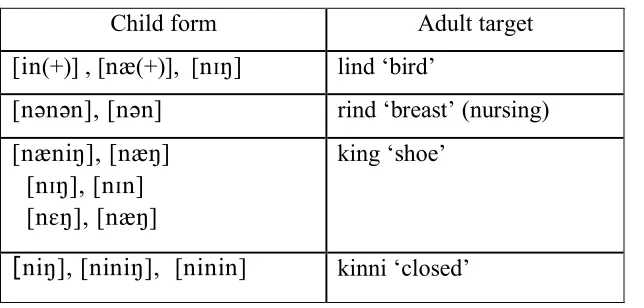
Table 2. RaivoÕs Early Word Templates: ÔNasal StructureÕ (age 1;3.18-1;3.24) <nVN>
Child form Adult target
[in(+)] , [nQ(+)], [nIN] lind ÔbirdÕ
[n«n«n], [n«n] rind ÔbreastÕ (nursing)
[nQniN], [nQN] [nIN], [nIn] [nEN], [nQN]
king ÔshoeÕ
[niN], [niniN], [ninin] kinni ÔclosedÕ
(Adapted from Vihman, 1981)
To the extent that childrenÕs babbling patterns are similar cross-linguistically, early
word forms - and the phonological patterns which derive from them Ð can be expected to
drawing on repeated use, across individual word forms, of a nasal stop, a segment well
attested in babbling in most language environments (Locke, 1983). The ÔharmonicÕ
syntagmatic recurrence of a single consonant in the child forms, in contrast to the
changing consonants of the adult models (finger, king), constitutes another common
characteristic, well attested cross-linguistically.
Nevertheless, word templates can be expected to reflect at least some aspects of the
phonological patterning of a particular adult language, since they derive from the item
learning of the childÕs first forms. They should thus differ somewhat from one language
to the next. The small samples characteristic of child production studies are a limitation
here, since patterning has been found to differ from one child to the next. For example,
final consonant production is common enough in English, yet in one study only two out
of five American children with a productive lexicon of some 50 words or more made
regular use of them (Vihman & Boysson-Bardies, 1994). On the other hand, in the same
study none of the five French children did so at that lexical level (see also the paucity of
final consonants produced by 10 children acquiring Finnish: Kunnari, 2001).
In contrast, omission of an initial consonant is rare in English but not in Finnish
(Savinainen-Makkonen, 2000), where the salience of medial geminates may be a
contributing factor (Vihman & Velleman, 2000). Interestingly, Bhaya Nair (1991) reports
regular initial consonant omission in her bilingual sonÕs Hindi at 19 months (20/59 first
word types), with some instances in his English as well: cover [Ub«], monkey [UNki],
water [•t«] (3/39). Hindi too has medial geminates, which, with medial clusters, account
Cross-linguistic production studies have shown that children learning the same
language differ most at the outset of identifiable word production. This is the period in
which we expect to see item learning only. We presume that implicit matching of the
childÕs own vocal productions to prosodic and segmental patterns in input speech triggers
or facilitates the first explicit lexical learning. Once the child has begun to learn a range
of different words, word templates will begin to be induced or abstracted out of those
words. The differences between such templates in individual children exposed to the
same language may be taken as evidence for the role of focussed attention, guided by
each childÕs personal interests and sensitivity to phonological patterning (including the
potential individual match between the childÕs own VMS, or most often used phonetic
patterns, and the shapes of adult word forms) (Vihman, 1993). By the end of the single
word period the language of the input exerts a ÔchannelingÕ effect, leading to greater
between- than within-group differences in the phonetics of childrenÕs words
(Boysson-Bardies & Vihman, 1991), including their rhythmic patterns (Vihman, Nakai & DePaolis,
2002).
4. Emergent phonology in the bilingual child
What is the implication of such an account for the bilingual child? As regards
Ôlanguage differentiationÕ, first of all, many studies published in the 1980Õs failed to
distinguish between knowledge of the language attained through exposure alone Ð
perceptual and distributional knowledge or representation Ð and knowledge expressed in
language production, particularly differential production according to linguistic context
(Genesee, 1989; Ingram, 1981; Johnson & Lancaster, 1998). At the current stage of our
year, it seems critical to distinguish between the store of knowledge attained in the first
months of language exposure, in the probable absence of specific linguistic
representations, and the later months, in which representations of particular words and
phrases begin to form (HallŽ & Boysson-Bardies, 1994). Based on implicit perceptual
learning, it can be assumed that the bilingual child has the foundations for learning each
of the languages at this point, and that they may be represented in such a way as to allow
independent access on the basis of various situational triggers, although independent
phonological systems (for production) will not be in evidence for some months.3 It is also
possible that, under conditions of exposure to two (or more) languages, a childÕs
phonological development is always subtly different from that of monolingual children.
This would account for the frequent observation that the production of a bilingual child is
in some ways unlike that of monolingual children acquiring either of the two languages
(e.g., Deuchar & Quay, 2000; Johnson & Lancaster, 1998; Khattab, this volume).
The production patterns exhibited in first words, based on item learning, or the
matching of existing production patterns to input forms, can differ only to the extent that
the adult languages differ in ways that can be reproduced by a one-year-old. For example,
Ingram (1981) reports that an Italian/English bilingual child produced mainly
monosyllabic forms in English but disyllabic forms in Italian, which he takes to reflect
the childÕs Ôtwo systemsÕ. Alternatively, under an item learning account of first word
production, we could conclude that the child was merely reproducing within-repertoire
sound patterns after learning their associations with situations of interest. That is,
bilingual exposure will have led the child to develop a rich store of implicit knowledge of
The learning of particular word forms will first be manifested as the child identifies (or
unconsciously ÔselectsÕ) adult forms that constitute a match for her existing production
patterns. Monosyllabic reproduction of monosyllabic English words and multisyllabic
reproduction of multisyllabic Italian words are the expected result of item learning in a
bilingual context.
If word templates constitute the Ôorigins of systemÕ, then the patterning of word forms
in a bilingual childÕs repertoire should help us to see whether the child, generalising from
the individual lexical items s/he has learned, first develops a single production system
encompassing words from both languages or two independent systems, one for each
language. Either is plausible, if we assume that item learning is the basis for the induction
of patterns. Both paths could be found in particular cases, since children acquiring a
single language show extensive individual differences, not only in the specifics of their
phonological paths (Vihman, 1993) but also in their general approach to learning
(Ferguson, 1977; Vihman & Greenlee, 1987). In what follows I will explore this idea by
considering the early phonological patterns of three bilingual children, examining word
productions to see whether patterns are applied to one or both languages.
5. Some analyses of early bilingual phonology
Waterson (1971) introduced the notion of Ôwhole word phonologyÕ, drawing on diary
data from her son P at a time when he was well into word production. At 1;6 he had some
155 words, of which 104 were monosyllables. Waterson identified five different
ÔstructuresÕ, based on Ôcorrelations at the phonetic levelÕ between adult and child forms.
The child word forms provided in Tables 1 and 2 (above) illustrate the sense in which the
target words for both childrenÕs words have in common only the presence of a medial
nasal, a pattern to which the child may have been sensitive, at least in part, because
nasal-vowel(-nasal) patterns were already in his production repertoire. In RaivoÕs case (Table
2) a non-overlapping range of variant forms were produced for each of the words.
However, after a few days the child settled into producing the single form [n«n] for all of
the words, suggesting that a process of abstracting away or induction from the
individually learned word forms had led to the formation of a single pattern that he could
readily access. This I take to be the prototypical origin of word templates.
A word template can be operationally defined as a consistent phonological pattern that
reveals both (1) selection of target words on the basis of the childÕs existing phonetic
forms and (2) adaptation of less narrowly selected target words to fit the pattern (see
Schwartz, 1988, for a review of the evidence for word selection on phonological
grounds). Following Vihman & Velleman (2000) we distinguish between words whose
child form matches the adult form relatively closely, termed selected, with errors of
omission only, and words whose child form departs from the adult form by changing
segments or sequence in such a way that it conforms more closely to the childÕs other
word forms than to the adult model, termed adapted, with possible errors of comission as
well as omission. The proportion of ÔselectedÕ vs. ÔadaptedÕ word forms differs by
individual child (Vihman, 2001). We will make the working assumption that
phonological systematicity is emergent when we begin to find one or more patterns
dominating the childÕs output, with errors of adaptation as well as selection. Thus, I will
distinguish between Ôfirst wordsÕ, which are typically selected only, and later words,
months of word production. At that point both selected and adapted exemplars will be
noted, since some target words will conform to the childÕs template as they stand and thus
need no adapting.
For my analyses I will draw on data from three bilingual children who have English as
one of their languages: Raivo (+ Estonian: Vihman, 1981, supplemented from diary
notes), Shelli (+ Hebrew: Berman, 1978), and Tom (+ French: Brulard & Carr, this
volume). Details on each childÕs bilingual situation, developmental course, data
collection and so on can be found in those sources (for Raivo, see also Vihman, 1985).
I. Raivo: Estonian/English. In Table 3 some of RaivoÕs very first words are presented
in the order in which they appeared Ð first several words with syllabic sibilants (1;1-1;2),
then more adult-like CVC forms involving a final voiceless fricative that varied between
[f], [Â], [s] and even [555%w∞] (1;2-1;4). In the last month the first disyllabic forms with
[image:16.612.90.565.462.718.2]sibilants appear (1;4), both as ÔselectedÕ and ÔadaptedÕ forms.
Table 3. Raivo (Estonian/English) <(C)VS>, <(C)VSV(S)> [S = sibilant]
Child age Child form: SELECT Adult target [I = imitated]
1;1.15 [S`],Ý [C] shoe
1;1.17 [is], [iÂ], [Â] viska ÔthrowÕ
1;1.21 [S] suur (I) ÔbigÕ (raises hands: Ôso bigÕ routine)
1;1.25 [s] vesi (I) ÔwaterÕ
1;2.2 [ts | ts] klotsid (I) ÔblocksÕ
Child age Child form:
SELECT
Adult target Child
age
Child form:
ADAPT
Adult target
1;2.20 [dIs] this 1;2.7 [kŸs] kŸpsis (I) ÔcookieÕ
1;3.27 [zšs], [jšs],
[Zus]
1;4.2 [pif], [piw] piss ÔpeeÕ 1;3.10 [m«s] musi (I) ÔkissÕ
1;4.4 [af:] ahv ÔmonkeyÕ 1;4.2 [duÂ] juust ÔcheeseÕ
1;4.4 [pIsi] pissi Ô(make) peeÕ 1;4.3 [kIzIs] kŸpsis (I) ÔcookieÕ
1;4.5 [«zIs] whatÕs this?
(Adapted from Vihman, 1981; supplemented from diary notes)
Although the first sibilant words are hardly accurate renditions of the structure of the
adult forms, they constitute ÔselectionsÕ in the sense that they substitute or reorder
nothing but merely reproduce subparts of the adult form. Of the first CVC sibilant forms
that Raivo produced, some show minor omissions or common substitutions, such as [d]
for [D], while others show bolder changes, adapting the structure of the adult form so that
it is more similar to RaivoÕs existing forms (reducing clusters to singletons, disyllables to
monosyllables). At the point at which the child begins to assimilate adult forms to fit a
pattern that characterizes many of his other words, we can recognize an emergent word
template (indicated here as the point at which an ÔadaptÕ column begins to supplement the
ÔselectÕ column). In RaivoÕs production of sibilant target words the CVC pattern, which is
congruent with his nasal pattern (Table 2), emerged first ([dIs] ÔthisÕ, [kŸs] kŸpsis
ÔcookieÕ), followed by a CVCV(C) template ([pIsi] Ô(make) peeÕ, [kIzIs] kŸpsis ÔcookieÕ).
The key point about these data, for present purposes, is the fact that both English and
Estonian adult models appear as both ÔselectedÕ and ÔadaptedÕ forms. That is, Raivo
appears to be consistently attempting to match his existing repertoire of production
patterns to adult targets regardless of the source language. This is not to say that Raivo
could not hear the difference between the two languages of his environment. Although he
monolingual and bilingual infants to convince us that any language to which a child is
regularly exposed will become familiar and readily discriminable from other languages,
even within the first six months of life (Bosch & Sebasti‡n-GallŽs, 1997; Mehler et al.,
1988). Thus, I do not wish to claim that Raivo could not distinguish the two languages.
Rather, I argue that in beginning to construct a phonological system, his first steps moved
from item learning in both languages (shoe, viska) to more general patterns (one- and
later two-syllable forms with a sibilant), which he at first deployed whenever the adult
target lent itself to the pattern. The system is emergent; it can be expected to grow into
two separate phonological systems as increasing numbers of patterns and of linguistic
units crystallize out of the childÕs (increasingly well defined) lexical representations (see
Macken, 1979).4
II. Shelli: Hebrew/English. Berman (1978) presents phonological data from her
daughter Shelli, acquiring English and Hebrew (Table 4). The data cover the period from
ShelliÕs first words (ca. 15 mos.) to a lexicon of about 175 words (ca. age 2), although no
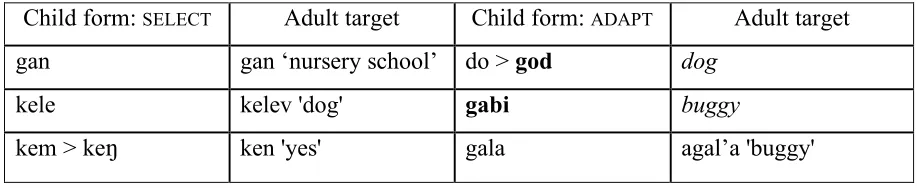
complete list is provided. ShelliÕs ÔadaptedÕ patterns are particularly striking because they
often involve metathesis (shown in bold), which constitutes a radical departure from the
adult form. In contrast, her ÔselectedÕ forms show only minor departures from the adult
[image:18.612.88.550.623.717.2]model (vowel or consonant change, initial cluster reduction, final consonant omission).
Table 4. Shelli (Hebrew/English) <vel - non-vel>
Forms occurring in an earlier vs. a later form are indicated by Ô > Ô.
Child form: SELECT Adult target Child form: ADAPT Adult target
gan gan Ônursery schoolÕ do > god dog
kele kelev 'dog' gabi buggy
ket cat gila, gida glida ÔicecreamÕ
kin cream kali Alex
kini skinny kami monkey
kise kise 'chair' kati mastik Ôchewing gumÕ
kova kova 'hat' keni candy
kudu kadur ÔballÕ kibi piggie
(h)am > xam xam 'hot' kiti chicken
kolo > kola áSokolad ÔchocolateÕ
koto Soko ÔcocoaÕ
kuc > gut juk ÔcockroachÕ
kuti > kuni Tunik (a name)
xon naxon Ôright!Õ
xali Mixali (a name)
(Adapted from Berman, 1978).
Like Waterson, Berman invokes perception to explain the childÕs radical adaptation of
certain adult words but provides no independent evidence for this interpretation. This is
only one of several interpretations that have been proposed to account for the ÔerrorsÕ or
adaptations reflected in childrenÕs early production patterns; alternative interpretations
include difficulties in representation or memory for language (Macken, 1979; Vihman,
1978), articulatory difficulties (Labov & Labov, 1977) or articulatory gesture
coordination (Studdert-Kennedy & Goodell, 1995), speech planning (Chiat, 1989), and
processing (Berg & Schade, 2000). Although we cannot presume to resolve this difficult
issue here, what is clear from Table 4 is that Shelli (a) has developed a ÔmelodyÕ template
consisting of velar consonant in initial position, non-velar in second position (compare
the labial Ð coronal pattern of Si: Macken, 1979), and (b) applies the pattern to words
III. Tom: French/English. Brulard and CarrÕs son Tom, acquiring French and
English (this volume), made use of a pattern involving medial /l/, among others (Table 5);
for comparison, we provide data from a monolingual French child, Laurent, who
developed a similar pattern (Table 6). The incorporation of /l/ into an early word template
has yet to be reported for English (based on published accounts of over 20 children). It is
thus striking that Tom should extend the pattern to English, picking up on the presence of
/l/ in telly and also fitting cardie into the pattern, with substitution of [l] for the
[image:20.612.89.503.316.505.2]later-learned English /r/.
Table 5. Tom (French/English) <(C)VlV>
Child form: SELECT
(1;10)
Adult target
[/aále] allez!
[d«álo] de lÕeau
Child form: SELECT
(2;0)
Adult target Child form: ADAPT
(2;0)
Adult target
[tEáli} telly [kaáli] cardie (cardigan)
[vwaála] voilˆ [baálo], [b«álo} pantalon
(Adapted from Brulard & Carr, this volume.)
Table 6. Laurent (French) <(C)VlV>
Child form: SELECT
(0;10)
Adult target
[(h)ailo] allo ÔhelloÕ
[[d(l)«] donne (le) Ôgive (it)Õ
[ljoljo] lolo ÔbottleÕ
(1;3.0) (1;3.0)
[alo] allo ÔhelloÕ [k•la] canard ÔduckÕ
[d«lo] dans/de lÕeau Ô (in
the/some) waterÕ
[bolo] chapeau ÔhatÕ
[pal›] ballon Ôbig ballÕ [b«la] la brosse Ôthe brushÕ
[kola] la cuill•re Ôthe spoonÕ
(Adapted from Vihman, 1993)
It is worth noting some other instances of interaction between TomÕs ÔsolutionsÕ to
word production problems which derive from one language but are then applied to the
other. Thus, at 2;0.15 for French /r/ he begins to produce a final voiceless uvular fricative
(also used by French adults) in dort ÔheÕs sleepingÕ and chaussure ÔshoeÕ; soon thereafter
he produces English words with the same final segment (more, door). A second case is
the production in English of [st] or [Zt] for final sibilants and clusters with sibilants: beast
[bist] (ÔselectedÕ), wash [w•st] (ÔadaptedÕ) at 2;2.7, nose [noZt], brush [b•st] (2;2.21) and
wasp [w•st] (2;4.0). At 2;2.21 the voiceless cluster was produced in French mouche
[must] ÔflyÕ.
As regards prosody, both Shelli and Tom were learning languages whose dominant
accentual pattern differed: French accent is normally iambic, although it may be shifted
for emphasis, while Hebrew is primarily iambic and English primarily trochaic.
Interestingly, both children showed a tendency to follow a single prosodic model in
production of their first few hundred words, but their Ôchoice of modelÕ differed: ShelliÕs
in Hebrew, while TomÕs were largely iambic, including errors of stress placement in
English.
6. Conclusions
Previous studies of bilingual phonology have compared phonetic and/or phonological
inventories (Ingram, 1981; Schnitzer & Krasinski, 1994), the application of phonological
processes (Vogel, 1975), acoustic analyses (Deuchar & Clark, 1996), or phonotactic
structures (Johnson & Lancaster, 1998; Paradis, 1996). Following Waterson (1971) and
Macken (1979), among others, this paper took a different approach, analysing early
production patterns. These analyses have taken into account both (1) the commonalities
across two or more child forms and (2) the relation of the child form to the adult target
(ÔselectedÕ vs. ÔadaptedÕ). Although the study has examined only a handful of patterns,
one or more from each of only three bilingual children, it is proposed as a way of looking
at bilingual child data that might prove useful in future studies.
The available data have been marshalled to support the position implied by the title. At
the start, and even well into production of the childÕs first word forms, we find no
evidence of a phonological system as such. Instead, the phonetic patterns and situational
application of individual words are learned holistically. Just as generalisation across
contexts of use begins to be found not with the first words but later in the period of the
first 50 words (Barrett, 1995), induction of a phonological pattern is characteristically
found not in the very first word productions but some time thereafter. By the time that a
diarist has recorded 50-100 word types it is generally possible to identify one or more
phonological patterns or word templates. We can take the existence of such patterns to
appears to reflect implicit comparison and organisation across the words the child has
produced.
On this basis, all the bilingual data we have considered here show interaction between
the two languages in the childrenÕs first phonological patterns. In RaivoÕs case the
sibilant patterns he applied to both languages have parallels in the production of
monolingual children learning each language (see Waterson, 1971, for the English
parallel). ShelliÕs Ôvelar firstÕ melody has been reported elsewhere for Spanish only so
far, although she extends it to English as well as Hebrew. TomÕs medial /l/-based pattern
happens to have been reported for a monolingual French child; its absence in English
monolingual data was noted. Finally, the cross-sectional data reported by Bhair Naya for
a Hindi-English learning child shows the omission in English of an onset stop and nasal,
a pattern considered deviant in English but one which occurs in several children
acquiring Finnish, another language with medial geminates (Vihman & Velleman, 2000).
After a period of some months, as the range of segmental and prosodic patterns
attempted increases, word production should reveal increasing numbers of productive
phonological patterns. Within a year of the first word production we expect a childÕs
repertoire to look more adult-like, although some difficult segments, consonant clusters,
or longer words may still be lacking. Even at that stage phonological processes which
take the whole word as their domain may apply, suggesting continued reliance on a
Ôwhole wordÕ or Ôlong domainÕ strategy in dealing with particularly challenging word
forms (Lle—, 1990; Vihman & Greenlee, 1987). A dual phonological system should
gradually become established, based on the regularities among and interconnections
direct consequence of growth in the childÕs dual lexicon (see Beckman & Edwards,
2000).
By the time that a bilingual child can approximate the adult segmental repertoire,
given adequate exposure to both languages, it should be possible to identify many
respects in which the phonologies have evolved into Ôindependent systemsÕ, although the
control required for a contrast in production in particular subsystems, such as voicing,
may not yet have been fully mastered. The dual phonological system of the adult
bilingual is taken here to have its origin neither in an initial Ôunitary systemÕ nor in a
Ôdual system from the startÕ but in (asystemic) item learning, followed by the gradual
emergence of a range of different production patterns, guided by the forms available in
the input. The implementation of phonological contrast, implicit in and a defining
characteristic of the adult system, will characterise the childÕs phonology only as the
constraints on production planning, linguistic perception, representation and processing
References
BARRETT, M. (1995). Early lexical development. In P. Fletcher & B. MacWhinney
(Eds.), Handbook of child language (pp. 362-392). Cambridge, MA: Blackwell.
BECKMAN, M. E., & EDWARDS, J. (2000). Lexical frequency effects on young
childrenÕs imitative productions. In M. B. Broe & J. B. Pierrehumbert (Eds.), Papers
in laboratory phonology V: Acquisition and the lexicon (pp. 208-218). Cambridge:
Cambridge University Press.
BERG, T. & SCHADE, U. (2000). A local connectionist account of consonant harmony
in child language. Cognitive Science, 24, 123-149.
BERMAN, R. A. (1977). Natural phonological processes at the one-word stage. Lingua,
43, 1-21.
BHAYA NAIR, R. (1991). Monosyllabic English or disyllabic Hindi? Language
acquisition in a bilingual child. Indian Linguistics, 52, 51-90.
BOSCH, L. & SEBASTIçN-GALLƒS, N. (1997). Native-language recognition abilities
in 4-month-old infants from monolingual and bilingual environments. Cognition, 65,
33-69.
BOYSSON-BARDIES, B. de, HALLƒ, P., SAGART, L. & DURAND, C. (1989). A
crosslinguistic investigation of vowel formants in babbling. Journal of Child
Language, 16, 1-17.
BOYSSON-BARDIES, B. de & VIHMAN, M. M. (1991). Adaptation to language.
Language, 67, 297-319.
BYBEE, J. L. & HOPPER, P. (2001). Frequency and the emergence of linguistic
CHIAT, S. (1989). The relation between prosodic structure, syllabification and segmental
realization: Evidence from a child with fricative stopping. Clinical Linguistics &
Phonetics, 3, 223-242.
CROFT, W. (1995). Intonation units and grammatical structure. Linguistics, 33, 839-882.
DEUCHAR, M. & CLARK, A. (1996). Early bilingual acquisition of the voicing contrast
in English and Spanish. Journal of Phonetics, 24, 351-365.
DEUCHAR, M. & QUAY, S. (2000). Bilingual acquisition. Oxford: Oxford University Press.
DEUCHAR, M. & VIHMAN, M. M. (2002). Language contact in early bilinguals. In
M.C. Jones & E. Esch (Eds), Contact-induced language change. The Hague: Mouton.
FERGUSON, C. A. (1979). Phonology as an individual access system. In C. J. Fillmore,
D. Kempler & W. S-Y. Wang (eds.), Individual differences in language ability and
language behavior (pp. 189-201). New York: Academic Press.
FERGUSON, C. A. & FARWELL, C. B. (1975). Words and sounds in early language
acquisition. Language, 51, 419-439.
GATHERCOLE, V. C. M., SEBASTIAN, E. & SOTO, P. (1999). The early acquisition of
Spanish verbal morphology: Across-the-board or piecemeal knowledge? International
Journal of Bilingualism, 3, 133-182.
GENESEE, F. (1989). Early bilingual development: One language or two? Journal of
Child Language, 16, 161-179.
HALLƒ, P. & BOYSSON-BARDIES, B. de. (1994). Emergence of an early lexicon: InfantsÕ
recognition of words. Infant Behavior and Development, 17, 119-129.
HEPPER, P. G., SCOTT, D. & SHAHIDULLAH, S. (1993). Newborn and fetal response
INGRAM, D. (1981). The emerging phonological system of an Italian-English bilingual
child. Journal of Italian Linguistics, 2, 95-113.
INGRAM, D. (1992). Early phonological acquisition: A cross-linguistic perspective. In
C. A. Ferguson, L. Menn & C. Stoel-Gammon (Eds.) Phonological development:
Models, research, implications (pp. 423-435). Timonium, MD: York Press.
JAKOBSON, R. (1941/68). Child language, aphasia, and phonological universals. The
Hague: Mouton. Eng. tr. of Kindersprache, aphasie und allgemeine lautgesetze.
Uppsala, 1941.
JOHNSON, C. E. & LANCASTER, P. (1998). The development of more than one phonology.
International Journal of Bilingualism, 3, 265-300.
JUSCZYK, P. W. (1997). The discovery of spoken language. Cambridge, MA: MIT Press.
KUNNARI, S. (2000). Characteristics of early lexical and phonological development in
children acquiring Finnish. Acta Universitatis Ouluensis B 34 Humaniora.
LABOV, W. & LABOV, T. (1978). The phonetics of cat and mama. Language, 54,
816-852.
LIEVEN, E. V. M., PINE, J. M., & BALDWIN, G. (1997). Lexically-based learning and
early grammatical development. Journal of Child Language, 24, 187-219.
LLEî, C. (1990). Homonomy and reduplication: On the extended availabiliy of two
strategies in phonological acquisition. Journal of Child Language, 17, 267-278.
LOCKE, J. L. (1983). Phonological acquisition and change. New York: Academic Press.
LOCKE, J. L. (1993). The childÕs path to spoken language. Cambridge, MA: Harvard
LOGAN, G. D. (1988). Toward an instance theory of automatization. Psychological
Review, 95, 492-527.
MACKEN, M. A. (1979). Developmental reorganization of phonology. Lingua, 49, 11-49.
MAYE, J., WERKER, J. F., & GERKEN, L. (2002). Infant sensitivity to distributional
information can affect phonetic discrimination. Cognition, 82, B101-B111.
MCCUNE, L. & VIHMAN, M. M. (2001). Early phonetic and lexical development.
Journal of Speech, Language, and Hearing Research, 44, 670-684.
MEHLER, J., JUSCZYK, P., LAMBERTZ, G., HALSTED, N., BERTONCINI, J., &
AMIEL-TISON, C. (1988). A precursor of language acquisition in young infants.
Cognition, 29, 143-178.
MEISEL, J. M. (1994). Code-switching in young bilingual children. Studies in Second
Language Acquisition, 16, 413-439.
MENN, L. (1983). Development of articulatory, phonetic, and phonological capabilities.
In B. Butterworth (Ed.), Language Production, vol. 2 (pp. 3-49). London: Academic
Press.
MIKES, M. (1990). Some issues of lexical development in early bi- and trilinguals. In G.
Conti-Ramsden & C. Snow (Eds.), ChildrenÕs Language, vol. 7 (pp. 102-120) . New York:
Gardner Press.
MOON, C., PANNETON-COOPER, R. P., & FIFER, W. P. (1993). Two-day-olds prefer their
native language. Infant Behavior and Development, 16, 495-500.
PARADIS, J. (1996). Phonological differentiation in a bilingual child. In A. Stringfellow,
22nd Annual Boston University Conference on Language Development. Boston:
Cascadilla Press, vol. ii.
POLDRACK, R. A., & COHEN, N. J. (1994). On the representational/computational
properties of multiple memory systems. Behavioral & Brain Sciences, 17, 416f.
SAFFRAN, J. R., NEWPORT, E. L., ASLIN, R. N., TUNICK, R. A. & BARRUECO, S.
(1997). Incidental language learning: Listening (and learning) out of the corner of your
ear. Pscyhological Science, 8, 101-105.
SAVINAINEN-MAKKONEN, T. (2000). Word initial consonant omissions Ð a
developmental process in children learning Finnish. First Language, 20, 161-185.
SCHNITZER, M. L. & KRASINSKI, E. (1994). The development of segmental
phonological production in a bilingual child. Journal of Child Language, 21, 585-622.
SCHWARTZ, R. (1988). Phonological factors in early lexical acquisition. In M. D. Smith
& J. L. Locke (eds.), The emergent lexicon (pp. 185-222). New York: Academic Press.
VELLEMAN, S. L. & VIHMAN, M. M. (2002). Whole-word phonology and templates.
Language, Speech & Hearing Services in Schools, 33, 9-23.
VIHMAN, M. M. (1978). Consonant harmony: its scope and function in child language.
In J. Greenberg, C.A. Ferguson & E.A. Moravcsik (Eds.), Universals of human
language, vol. 2 (pp. 281-334). Stanford, CA: Stanford University Press.
VIHMAN, M. M. (1981). Phonology and the development of the lexicon. Journal of
Child Language, 8, 239-264.
VIHMAN, M. M. (1985). Language differentiation by the bilingual infant. Journal of
VIHMAN, M. M. (1993). Variable paths to early word production. Journal of Phonetics,
21, 61-82.
VIHMAN, M. M. (1996). Phonological development. Oxford: Blackwell.
VIHMAN, M. M. (2001). Word templates and the origins of phonology. Paper presented at
the 7th International Cognitive Linguistics Conference. Santa Barbara.
VIHMAN, M. M. & BOYSSON-BARDIES, B. DE. (1994). The nature and origins of
ambient language influence on infant vocal production and early words. Phonetica, 51,
159-169.
VIHMAN, M. M., & GREENLEE, M. (1987). Individual differences in phonological
development. Journal of Speech and Hearing Research, 30, 503-521.
VIHMAN, M. M., MACKEN, M. A., MILLER, R., SIMMONS, H. & MILLER, J.
(1985). From babbling to speech. Language, 61, 397-445.
VIHMAN, M. M. & MCCUNE, L. (1994). When is a word a word? Journal of Child
Language, 21, 517-542.
VIHMAN, M. M., NAKAI, S., & DEPAOLIS, R. A. (2002). Getting the rhytm right: A
cross-linguistic study of segmental duration in babbling and first words. Laboratory
Phonology VIII. Yale University.
VIHMAN, M. M. & VELLEMAN, S. L. (1989). Phonological reorganization. Language
and Speech, 32, 149-170.
VIHMAN, M. M. & VELLEMAN, S. L. (2000). The construction of a first phonology.
VIHMAN, M. M., VELLEMAN, S., & MCCUNE, L. (1994). How abstract is child
phonology? In M. Yavas (Ed.), First and second language phonology (pp. 9-44). San
Diego, CA: Singular Publishing Group.
VOGEL, I. (1975). One system or two. Papers and Reports on Child Language
Development, 9, 43-62.
VOLTERRA, V. & TAESCHNER, T. (1978). The acquisition and development of
language by bilingual children. Journal of Child Language, 5, 311-326.
WATERSON, N. (1971). Child phonology: A prosodic view. Journal of Linguistics, 7,
179-211.
1 For reviews of the literature on Ôone system vs. twoÕ in the earliest stages of bilingual
development, see Lanza (1997), who focusses on morphosyntax and the discourse
context, and Deuchar & Quay (2000), who also include a chapter on bilingual phonology.
2
Perceptual sensitivity to the bimodal distribution of voice-onset time variants has been
demonstrated for 6- and 8-month-old infants (Maye, Werker & Gerken, 2002). The
results are taken to provide a mechanism for distributional learning that would account
for infantsÕ shift away from the discrimination of sounds not contrasted in the native
language late in the first year; they do not provide a sufficient basis for phonological
contrast in production, however.
3
For the child adopted away from the native culture Ð e.g., Romanian orphans adopted by
British families, or Chinese orphans adopted by Americans Ð the situation will be quite
different. In the absence of those first months of exposure we can expect such children to
network. In the absence of continuing exposure to the first language we cannot expect
these children to develop into bilinguals at all.
4
Note that Deuchar and Quay (2001) report the emergence of a system of
voiced/voiceless contrasts in utterance-initial stops in their subjectÕs English only at 2;3,
with the Spanish voice contrast still emergent at that age. This child already had over 300
![Table 3. Raivo (Estonian/English) <(C)VS>, <(C)VSV(S)> [S = sibilant]](https://thumb-us.123doks.com/thumbv2/123dok_us/8094158.232228/16.612.90.565.462.718/table-raivo-estonian-english-vs-vsv-s-sibilant.webp)