Angular-Based Word Meta-Embedding Learning
James O’ Neill and Danushka Bollegala
Department of Computer Science, University of Liverpool Liverpool, L69 3BX
England
{james.o-neill,danushka.bollegala}@liverpool.ac.uk
Abstract
Ensembling word embeddings to improve dis-tributed word representations has shown good success for natural language processing tasks in recent years. These approaches either carry out straightforward mathematical operations over a set of vectors or use unsupervised learn-ing to find a lower-dimensional representa-tion. This work compares meta-embeddings trained for different losses, namely loss func-tions that account for angular distance be-tween the reconstructed embedding and the target and those that account normalized dis-tances based on the vector length. We argue that meta-embeddings are better to treat the ensemble set equally in unsupervised learn-ing as the respective quality of each embed-ding is unknown for upstream tasks prior to meta-embedding. We show that normaliza-tion methods that account for this such as co-sine and KL-divergence objectives outperform meta-embedding trained on standard`1and`2 loss ondefactoword similarity and relatedness datasets and find it outperforms existing meta-learning strategies.
1 Introduction
Meta-embeddings are a quick and useful prior step for improving word representations in natural lan-guage learning tasks. This involves combining several learned embeddings in a way that improve the overall input representation. This approach is a less computationally expensive compared to if a practitioner were to train a set of word embed-dings from scratch, particularly when considering non-sliding window methods. The most straight-forward approaches to meta-embeddings are: con-catenation (CONC) and averaging (AV). The for-mer is limited since the dimensionality grows large for multiple embeddings as more vectors are con-catenated and the latter, while fast, does not pre-serve most of the information encoded in each
em-bedding when taking the arithmetic mean. Al-though, it would seem surprising concatenating vectors from different embedding spaces is valid, it has been shown that (Coates and Bollegala, 2018) AV approximates CONC even though the embedding spaces are different. Although, to ad-dress the loss of information when using AV, Sin-gular Value Decomposition has been used as a di-mensionality reduction technique to factorize the embeddings into a lower-rank approximation of the concatenated meta-embedding set.
Linear methods include the use of a projec-tion layer for meta-embedding (known as 1TON) Yin and Sch¨utze (2015), which is simply trained using an `2-based loss. Similarly, Bollegala et
al. (Bollegala et al., 2017) has focused on find-ing a linear transformation between count-based and prediction-based embeddings, showing that linearly transformed count-based embeddings can be used for predictions in the localized neighbor-hoods in the target space.
Most recent work (Bao and Bollegala, 2018) has focused on the use of an autoencoder (AE) to encode a set of N pretrained embeddings us-ing 3 different variants: (1) Decoupled Autoen-coded Meta Embeddings (DAEME) that keep ac-tivations separated for each respective embedding input during encoding and uses a reconstruction loss for both predicted embeddings while mini-mizing the loss for each respective decoded out-put, (2) Coupled Autoencoded Meta Embeddings (CAEME) which instead learn to predict from a shared encoding and (3) Averaged Autoencoded Meta-Embedding (AAME) is simply an averaging of the embedding set as input instead of using a concatenation. This is the most relevant work to our paper, hence, we include these 3 autoencoding schemes along with aforementioned methods for experiments, described in Section3. We also in-clude two subtle variations of the aforementioned
AEs. The first predicts a target embedding from an embedding set using the remaining embedding set, post-learning the single hidden layer is used as the word meta-embedding. The second method is similar except an AE is used for each input embed-ding to predict the designated target embedembed-ding, followed by an averaging over the resulting hid-den layers. This alternative is described in more detail in Section2.
The aforementioned previously proposed un-supervised learning have a common limitation, that is minimising the Euclidean (`2) distance
be-tween source word embeddings and their meta-embedding. Arora et al. (2016) have shown that the `2 norm of a word embedding vector is
pro-portional to the frequency of the corresponding word in the corpus used to learn the word embed-dings. Considering that in meta-embedding learn-ing we use source embeddlearn-ings trained on different resources, we argue that it is more important to preserve the semantic orientation of words, which is captured by the angle between two word em-beddings, not their length. Indeed, cosine sim-ilarity, a popularly used measure for computing the semantic relatedness among words, ignores the length related information. Additionally, we note the relationship between KL-divergence and cosine similarity in the sense both methods per-form a normalization that is proportional to the semantic information. Hence, we compare sev-eral popular measures such as MSE and MAE that use`2 and`1 respectively, against KL-divergence
and cosine similarity for the purpose of learning meta-embeddings and show that the loss which accounts for this orientation consistently outper-forms the former objectives that only consider length. We demonstrated this across multiple benchmark datasets.
2 Methodology
Before describing the loss functions used, we ex-plain the aforementioned variation on the autoen-coding method and how it slightly differs from 1TON/1TON+ (Yin and Sch¨utze,2015) and stan-dard AEs (Bao and Bollegala, 2018) presented in previous work. Target Autoencoders (TAE) are defined as learning an ensemble of nonlinear trans-formations between sets of basesXsin sets of
vec-tor spacesXS = {X1, ..,Xs, ..,XN} s.t Xs ∈
R|vs|×ds to a target space Xt ∈ R|vt|×dt, where
f(wi) : XS(i) → Xt ∀i is the nonlinear
trans-formation function used to make the mapping. Once a set of M number of parameteric models fw = {f(1)w ,fw(i), ..,f(wM)} are trained with
vari-ous objective functions to learn the mappings be-tween the word vectors we obtain a set of lower-dimensional target latent representation that rep-resents different combinations of mappings from one vector space to another. After training, allH
set of latent variablesZs = {z1, .., zH} are
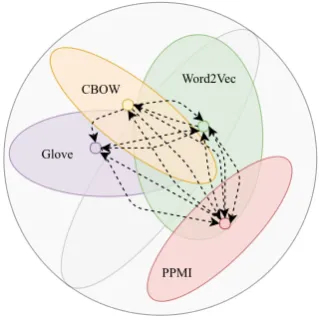
con-catenated with an autoencoded target vector. This means thats all vector spaces have been mapped to a target space and there hidden meta-word rep-resentations have been averaged, as illustrated in Figure1.
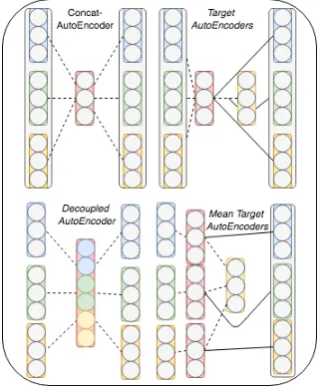
Figure 2 shows a comparison of the previ-ous autoencoder approaches (Bao and Bollegala, 2018) (left) and the alternative AE (right), where dashed lines indicate connections during training and bold lines indicate prediction. The Concat-AutoEncoder (CAEME) simply concatenates the embedding set into a single vector and trains the autoencoder so to produce a lower-dimensional representation (shown in red), while the decoupled autoencoder (DAEME) keeps the embedding vec-tors separate in the encoding. In contrast the tar-get encoder (TAE) is similar to that of CAEME only the label is a single embedding from the em-bedding set and the input are remaining embed-dings from the set. After training, TAE then con-catenates the hidden layer encoding with the orig-inal target vector. The Mean Target AutoEncoder (MTE) instead performs an averaging over sepa-rate autoencoded representation.
CBOW Word2Vec
Glove
PPMI
Figure 1: TAE Embedding
AutoEncoder Settings The standard
[image:2.595.336.496.525.689.2]dimension hd = 200. Weights are initialized
with a normal distribution, meanµ= 0and stan-dard deviation σ = 1. Dropout is used with a dropout rate p = 0.2 for all datasets. The model takes all unique vocabulary terms pertain-ing to all tested word association and word simi-larity datasets (n = 4819) and performs Stochas-tic Gradient Descent (SGD) with batch sizex˜ = 32 trained between 50 epochs for each dataset ∀d ∈ D. This results in a set of vectors Xj ∈
R|vj|×200∀jthat are then used for finding the
sim-ilarity between word pairs. The above parameters were chosen (hd,x˜and number of epochs) over a
small grid search. As stated, we compare against previous methods (Yin and Sch¨utze, 2015; Bao and Bollegala,2018) that use`2distance, as shown
in Equation1).
Lθ(ˆy, y) = 1 N
N
X
i=1
(y(i)−yˆ(i))2 (1)
Similarly, the Mean Absolute Error (`1 norm
of difference) loss N1 PN
i=1|y−yˆ|is tested. We
also compare against a KL divergence objective, as shown in Equation 2, yˆ is the last activation output from the log-softmax that representsq(x)
and the KL-divergence is given as KL(p|q) =
PN
i=1p(xi) log q(xi)/p(xi)
.
Lθ(ˆy, y) = 1 N
N
X
i=1
y(i)·log y(i)
−yˆ(i) (2)
[image:3.595.101.262.541.735.2]Sincetanhfunctions are used and input vectors are `2 normalized we propose a Squared Cosine
Figure 2: AE Meta-Embedding Methods
Proximity (SCP) loss, shown in Equation3where
m is the output dimensionality. This forces the optimization to tune weights such that the rota-tional difference between the embedding spaces is minimized, thus preserving semantic information in the reconstruction. In the context of its utility for the TAE, we too want to minimize the angular difference between corresponding vectors in dif-ferent vector spaces. It is also a suitable fit since it is a proper distance measure (i.e symmetric), un-like KL-divergence.
Lθ(ˆy, y) = 1 N
N
X
i=1
1−
Pm
j=1yˆij ∗yij
q
Pm
ij yˆ2ij
q
Pm
ij yij2
!2
(3) The model is kept relatively simple so that the comparisons against previous methods are directly comparable and that the performance comparison between the proposed SCP loss and KL divergence loss against MSE and MAE is controlled. Addi-tionally, all comparison are that of models which are only trained from co-occurrence statistics that are not leveraging any external knowledge (e.g AutoExtend (Rothe and Sch¨utze,2015)).
3 Experiments
The following word association and word similar-ity datasets are used throughout experimentation: Simlex (Hill et al.,2015), WordSim-353 (Finkel-stein et al., 2001), RG (Rubenstein and Goode-nough,1965), MTurk (MechanicalTurk-771) (Ha-lawi et al.,2012), RareWord (RW) (Luong et al., 2014) and MEN (Bruni et al., 2012). The word vectors considered in the embeddings set are skipgramandcbow (Mikolov et al.,2013), Fast-Text (Bojanowski et al., 2016), LexVec (Salle et al.,2016), Hellinger PCA (HPCA) (Lebret and Collobert,2013) and Hierarchical Document Con-text (HDC) (Sun et al., 2015). We now report results on the performance of meta-embedding autoencodings with various loss functions, while also presenting target autoencoders for combina-tions of word embeddings and compare against ex-isting current SoTA meta-embeddings.
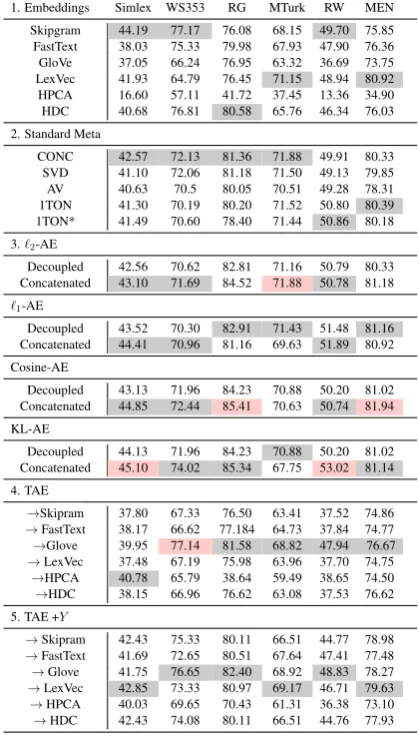
re-sults using autoencoder schemes by (Bao and Bollegala, 2018) that we have used to test the various losses, (4) introduces TAE without con-catenating the target Y embedding post-training with MSE loss and (5) shows the results of con-catenating Y with the lower-dimensional (200-dimensions) vector that encodes all embeddings apart from the target vector. Therefore reported re-sults from (4) are of a 200d vector, while (5) con-catenates the vector leading to a vector between 300-500 dimensions dependent on the target vec-tor. All trained encodings from sections 3-5 are 200-dimensional vectors. Results in red shading indicate the best performing meta-embedding for all presented approaches, while black shading in-dicates the best performing meta-embedding for the respective section.
Best performing word meta-embeddings are held between concatenated autoencoders that use the proposed Cosine-Embedding loss, while a KL-divergence also performs well on Simlex and RareWord. Interestingly, both of these dataset are distinct in that Simlex is the only dataset pro-viding scores on true similarity instead of free association, which has shown to be more diffi-cult for word embeddings to account for (Hill et al.,2016), while Rareword provides morpholog-ically complex words to find similarity between. Concretely, it would seem KL-divergence is well suited for encoding when the word relations ex-hibits of a more complex or rare nature. Similarly, we find SCP loss to achieve best results on RG and MEN, both the smallest and largest datasets of the set. Furthermore, the TAE variant has lead to com-petitive performance overall against other meta-embedding approaches and even produces best re-sults on WS353. Lastly, we find that HPCA em-beddings are relatively weak for word similarity.
4 Conclusion
We find the meta-embeddings trained using Au-toencoders with a Squared Cosine loss and a KL-divergence loss improves performance in the ma-jority of cases, reinforcing the argument that ac-counting for angles explicitly through normaliza-tion (log-softmax for KL) is an important crite-rion for encoding. It is particularly useful for distributed word representations, since embed-dings are learned from large documents of varying length and semantics. Lastly, we have shown its use in the context of improving meta-embeddings,
1. Embeddings Simlex WS353 RG MTurk RW MEN Skipgram 44.19 77.17 76.08 68.15 49.70 75.85 FastText 38.03 75.33 79.98 67.93 47.90 76.36 GloVe 37.05 66.24 76.95 63.32 36.69 73.75 LexVec 41.93 64.79 76.45 71.15 48.94 80.92 HPCA 16.60 57.11 41.72 37.45 13.36 34.90 HDC 40.68 76.81 80.58 65.76 46.34 76.03 2. Standard Meta
CONC 42.57 72.13 81.36 71.88 49.91 80.33 SVD 41.10 72.06 81.18 71.50 49.13 79.85 AV 40.63 70.5 80.05 70.51 49.28 78.31 1TON 41.30 70.19 80.20 71.52 50.80 80.39 1TON* 41.49 70.60 78.40 71.44 50.86 80.18 3.`2-AE
Decoupled 42.56 70.62 82.81 71.16 50.79 80.33 Concatenated 43.10 71.69 84.52 71.88 50.78 81.18 `1-AE
Decoupled 43.52 70.30 82.91 71.43 51.48 81.16 Concatenated 44.41 70.96 81.16 69.63 51.89 80.92 Cosine-AE
Decoupled 43.13 71.96 84.23 70.88 50.20 81.02 Concatenated 44.85 72.44 85.41 70.63 50.74 81.94 KL-AE
Decoupled 44.13 71.96 84.23 70.88 50.20 81.02 Concatenated 45.10 74.02 85.34 67.75 53.02 81.14 4. TAE
→Skipram 37.80 67.33 76.50 63.41 37.52 74.86
→FastText 38.17 66.62 77.184 64.73 37.84 74.77
→Glove 39.95 77.14 81.58 68.82 47.94 76.67
→LexVec 37.48 67.19 75.98 63.96 37.70 74.75
→HPCA 40.78 65.79 38.64 59.49 38.65 74.50
→HDC 38.15 66.96 76.62 63.08 37.53 76.62
5. TAE +Y
→Skipram 42.43 75.33 80.11 66.51 44.77 78.98
→FastText 41.69 72.65 80.51 67.64 47.41 77.48
→Glove 41.75 76.65 82.40 68.92 48.83 78.27
→LexVec 42.85 73.33 80.97 69.17 46.71 79.63
→HPCA 40.03 69.65 70.43 61.31 36.38 73.10
[image:4.595.311.521.65.434.2]→HDC 42.43 74.08 80.11 66.51 44.76 77.93
Table 1: Meta-Embedding Results
although this suggests cosine loss is also suitable for minimizing angular differences for word em-beddings, not only for meta-embeddings. Con-cretely, this paper has carried out a compre-hensive study of methods to embed a lower-dimensional representation from embedding sets, while proposing losses that explicitly keep angu-lar information intact for meta-embeddings.
References
Sanjeev Arora, Yuanzhi Li, Yingyu Liang, Tengyu Ma, and Andrej Risteski. 2016. A latent variable model approach to pmi-based word embeddings. Transac-tions of the Association for Computational Linguis-tics, 4:385–399.
Cong Bao and Danushka Bollegala. 2018. Learning word meta-embeddings by autoencoding. COLING.
vec-tors with subword information. arXiv preprint arXiv:1607.04606.
Danushka Bollegala, Kohei Hayashi, and Ken-ichi Kawarabayashi. 2017. Learning linear transforma-tions between counting-based and prediction-based word embeddings. PloS one, 12(9):e0184544.
Elia Bruni, Gemma Boleda, Marco Baroni, and Nam-Khanh Tran. 2012. Distributional semantics in tech-nicolor. In Proceedings of the 50th Annual Meet-ing of the Association for Computational LMeet-inguis- Linguis-tics: Long Papers-Volume 1, pages 136–145. Asso-ciation for Computational Linguistics.
Joshua Coates and Danushka Bollegala. 2018. Frus-tratingly easy embedding–computing meta-embeddings by averaging source word meta-embeddings. arXiv preprint arXiv:1804.05262.
Lev Finkelstein, Evgeniy Gabrilovich, Yossi Matias, Ehud Rivlin, Zach Solan, Gadi Wolfman, and Ey-tan Ruppin. 2001. Placing search in context: The concept revisited. InProceedings of the 10th inter-national conference on World Wide Web, pages 406– 414. ACM.
Guy Halawi, Gideon Dror, Evgeniy Gabrilovich, and Yehuda Koren. 2012. Large-scale learning of word relatedness with constraints. In Proceedings of the 18th ACM SIGKDD international conference on Knowledge discovery and data mining, pages 1406– 1414. ACM.
Felix Hill, Roi Reichart, and Anna Korhonen. 2015. Simlex-999: Evaluating semantic models with (gen-uine) similarity estimation. Computational Linguis-tics, 41(4):665–695.
Felix Hill, Roi Reichart, and Anna Korhonen. 2016. Simlex-999: Evaluating semantic models with (gen-uine) similarity estimation. Computational Linguis-tics.
R´emi Lebret and Ronan Collobert. 2013. Word emdeddings through hellinger pca. arXiv preprint arXiv:1312.5542.
Minh-Thang Luong, Ilya Sutskever, Quoc V Le, Oriol Vinyals, and Wojciech Zaremba. 2014. Addressing the rare word problem in neural machine translation. arXiv preprint arXiv:1410.8206.
Tomas Mikolov, Kai Chen, Greg Corrado, and Jef-frey Dean. 2013. Efficient estimation of word representations in vector space. arXiv preprint arXiv:1301.3781.
Sascha Rothe and Hinrich Sch¨utze. 2015. Au-toextend: Extending word embeddings to embed-dings for synsets and lexemes. arXiv preprint arXiv:1507.01127.
Herbert Rubenstein and John B Goodenough. 1965. Contextual correlates of synonymy. Communica-tions of the ACM, 8(10):627–633.
Alexandre Salle, Marco Idiart, and Aline Villavicencio. 2016. Matrix factorization using window sampling and negative sampling for improved word represen-tations.arXiv preprint arXiv:1606.00819.
Fei Sun, Jiafeng Guo, Yanyan Lan, Jun Xu, and Xueqi Cheng. 2015. Learning word representations by jointly modeling syntagmatic and paradigmatic re-lations. InProceedings of the 53rd Annual Meet-ing of the Association for Computational LMeet-inguistics and the 7th International Joint Conference on Natu-ral Language Processing (Volume 1: Long Papers), volume 1, pages 136–145.