Causes of spatial variation in parasite and
pathogen pressure in insects
Thesis submitted in accordance with the requirements of the
University of Liverpool for the degree of Doctor of Philosophy
By Daria Pastok
2
Abstract
The reproduction of the two-spot ladybird, Adalia bipunctata, is inhibited by a sexually transmitted ectoparasitic mite Coccipolipus hippodamiae that sterilizes female hosts, and a range of heritable microbes that kill male hosts during embryogenesis for instance Spiroplasma. Historical sampling indicated these two parasites were present commonly in A. bipunctata in the south of Sweden but were absent or rare in northern populations. In this thesis, I first established that the distribution of the mite was still stable over time, with a boundary to mite presence at 61˚N, as found 10 years previously. The incidence of male-killing Spiroplasma, in contrast, showed a small northward shift in its presence. I then examined the causes of mite presence/absence, and concluded ladybirds from northern populations were competent to carry and transmit mite infection, but that host phenology prevented its persistence in natural populations. I then explored the hypothesis that mite presence might select for increased reluctance of females to mate by comparing mating behaviour between mite present/mite absent populations. I observed that whilst rejection behaviour was protective against mite transmission, it was not more commonly observed in ladybirds derived from mite present populations. Finally, I examined whether the presence of male-killing
Spiroplasma might affect mite epidemiology, and whether the mite itself might impact on the dynamics of the male-killing Spiroplasma. I observed that
Spiroplasma did not affect individual competence to acquire and transmit mite infection, and did not protect its host against mite induced sterility. However,
3
Acknowledgements
PhD has been the most challenging time in my life. It has been an also amazing time. I have met a lot of wonderful people who gave me a lot of support, who motivated me and made me laugh. I would like to thank all of them. Without their support I wouldn’t be here where I am at the moment. I don’t want to miss anyone. Everyone is important.
First and foremost I would like to express my deepest appreciation to my supervisor Greg Hurst who is a wonderful person and one of the funniest, friendliest and the smartest people I know. He is someone you will instantly love and never forget once you meet him. Despite my poor English and lack of experience in a lab, Greg believed in me and gave me a wonderful opportunity to do PhD and work on two-spot ladybird, one of the most fascinating and beautiful organisms. Greg has been very supportive since the day I began working with him and he has guided me through all the years. I appreciate his vast knowledge and skills in many areas. I am very grateful to Greg for opening the science world for me and sharing the passion for science and nature and ladybirds! I am also grateful for his patience, for providing me with the excellent atmosphere during my PhD and for his advices and enthusiasm which made this thesis possible. Dear Greg, I really appreciate what you have done and I will be always grateful to you. Thank you Greg. You are wonderful!
I am very grateful to Amanda Minter and Sarah Trinder for their constant support and encouragement during my PhD. They are amazing friends, always ready to help. You never get bored with them. Amanda and Sarah have been very friendly, funny and thoughtful. I appreciate their kindness and understanding and I admire their ability to smile despite any situation. Thank you Amanda for sharing with me the passion for coffee and cats. Thank you Sarah for sharing with me the passion for plants. Dear Sarah and Amanda, you are wonderful!
4
Louise is always very funny and makes me laugh (for instance when she reads the newspaper headlines out loud in the office). Thank you Louise for being always very friendly and kind.
Thank you to Kevin Arbuckle, Rudi Verspoor and Jamie Alison. They are amazing people. They have been wonderful friends and coffee companions. I have really enjoyed conversations with them. Thank you for your support and for making me laugh, especially during long hours at work.
I would like to thank Annabel Rice and Crystal Frost for their constant support and guidance during my PhD and helping with my ladybirds. I would like to thank them for their friendship and the warmth they extended to me during my PhD. I have learnt a lot from them and I will never forget their kindness and friendliness. Additional thanks for Steve Parratt who introduced me to molecular biology and taught me laboratory techniques. I would like to thank him for his motivation, for his support especially during the first years of my PhD, and for being always so funny.
I will be forever thankful to Zen Lewis. Zen has been very supportive and helpful in providing advice many times during my PhD. She is a wonderful person, always very friendly and thoughtful. Dear Zen, thank you for your motivation, kind words and for telling amazing stories about Japan.
I would like to express my gratitude to Kayla King for her constant motivation and support. Kayla is always enthusiastic about science and her enthusiasm is contagious. I admire her positive attitude. She asks very interesting questions which lead to interesting ideas.
Thank you for those who proofread chapters: David Atkinson, Chris Corbin, Georgia Drew, Louise Reynolds and Rudi Verspoor. I appreciate their work and time. Their comments and feedback really helped to improve and finish all chapters. Thank you. I am also grateful to Anne Lizé for her help with statistical analysis.
5
wonderful time we spent during organizing workshops and events for children and students where we shared our passion for science. I have learnt a lot from you. Thank you for all your advices and making me laugh. I am also grateful to Chris Corbin who helped me a lot during one of my fieldwork in Sweden and with ladybird collection. I would like to thank Cassandra Raby for her enthusiasm and passion which were inspirations for me to learn more and do more. Thank you to Łukasz Łukomski and Rudi Verspoor for all 50p and £2 pound coins he collected for me. Thank you Łukasz for giving me the possibilities to talk in Polish, for your advices and for being always so funny (Dziękuję Łukasz!). I would also like to thank Vinnie Keenan for his positive attitude and making me smile.
Additional thank you to Georgia Drew, Chloe Heys, David Wallis, Gabriel Pedra, Leni Collin, Steve Price, Sam Barlow, Hazel Nichols, Nicola Young, Becci Turner, Andy Turner, Sόnia Ferreria, Olalla M. Lorenzo-Carballa , Paulina Giraldo-Perez, Karen Evans, Kieran Pounder, Yevhen Suprunenko, Susan Withenshaw, Rowan Connell, Wei Zhang, Sarah Forrester, Chris Mitchell, Julie Truman, Ewan Harney, Ewan Minter, Angela Sims, Kate Hutchence, Rowan Doff, Laura Gordon, Laura Martin, Louise Soanes, Shelly Maiden, Ellie Harrison, Christopher Lowe and Jessica Lingley for being always very kind, supportive and friendly. You are all wonderful.
I am grateful that I have met a wonderful academic staff from our Institute and I have had opportunities to learn form the best. Especially thank you to Mike Begon, Zen Lewis, David Montagnes, Steve Paterson, Andy Fenton, Ray Whitlock, Tom Price, Stewart Plaistow, Mike Speed, David Atkinson, Ilik Saccheri, Alistar Darby, Stephen Cornell, Jenny Hodgson, Raphael Levy, Arjen Van’t Hof, Pascal Campagne, David Williams, Ian Goodhead, David Thomson, Neil Hall, Soraya Shirazi-Beechey, Phill Watts, Lu-Yun Lian, Igor Barsukov and Geoff Parker.
I would like to acknowledge Louise Crompton and Carole Thomas for their kindness and support, and Meriel Jones and Linda Marsh for their guidance during my PhD.
6
for his advices and support in the lab. Special thanks to Mary-Jo Hoare for supporting me during my first fieldwork in Sweden and with ladybird collections.
I would like to express my gratitude to Tom Heyes for his help with maintaining aphid populations and bean plants, and for his friendliness and constant support in the lab.
I would like to thank all staff from the Store and Wash-up who really helped me during my PhD. Their great work helped to run my experiments smoothly and without any problems. Thank you for their kindness and support.
I would also like to express my gratitude to the University of Liverpool for giving me this wonderful opportunity to work here and for funding my studentship.
I would like to offer my special thanks to my flatmates Sophie, Jake, Liz, Guy, Anne, Joseph, Layla, Ben, Toni, Phil, Andy and Joe for their support and friendliness. I would also like to acknowledge Paul Elliott and his parents.
7
Table of Contents
Abstract ... 2
Acknowledgements ... 3
Table of Contents ... 7
List of Figures ... 12
List of Tables ... 16
Abbreviations: ... 20
Chapter 1: Introduction... 21
1.1 Parasite and pathogen diversity ... 21
1.2. Sexually transmitted infections... 23
1.3 Ladybird model system for STI study ... 26
1.3.2 Promiscuity and sexual selection. ... 32
1.3.3 Sexually transmitted infections ... 33
1.4 Aims of thesis ... 36
1.5 Thesis outline ... 38
Chapter 2: Stability of Spiroplasma and mite clines over time ... 41
2.1 Introduction... 42
2.2 Material and methods ... 45
2.2.1 Collection of material ... 45
2.2.2 Assessing the mite Coccipolipus hippodamiae infection status on ladybirds .. 49
2.2.3 Establishing presence/absence of heritable microbes ... 49
2.2.3.1 DNA Extraction.. ... 49
2.2.3.2 Screening ladybird DNA for presence of male-killing bacteria by molecular reactions.. . ...50
2.3 Results ... 55
2.3.1 Mite incidence ... 55
2.3.2 Prevalence and incidence of heritable male-killers ... 56
2.4 Discussion ... 63
Chapter 3: Host phenology limits the incidence of an insect sexually transmitted infection... ... 68
3.1 Introduction... 69
8
3.2.1 Is the absence of the mite from the north associated with an inability of the parasite to grow and transmit on ladybirds from the north? ... 74 3.2.1.1 Initial transmission and development of infection ... 74 3.2.1.2 Onward transmission of infection ... 75 3.2.2 Phenology of the host: sexual contact between generations and general observations on timing of reproduction ... 76 3.2.2.1 Temporal sampling in Stockholm in 2011 ... 77 3.2.2.2 Analysis of overlap between cohorts in mite absent/mite present populations ... 77 3.2.3 General phenological information on the timing of ladybird reproduction .... 79 3.3 Results ... 80 3.3.1 Is the absence of the mite from the north associated with an inability of the parasite to grow and transmit on ladybirds from the north? ... 80 3.3.2 Phenology of the host: sexual contact between generations and general observations on timing of reproduction ... 83 3.3.2.1 Temporal sampling in Stockholm in 2011 ... 83 3.3.2.2 Field observations on ladybird populations in August 2012 ... 85 3.3.3 General phenological information on the timing of ladybird reproduction .... 87 3.4 Discussion ... 89 Chapter 4: No evidence that presence of sexually transmitted infection selects for reduced mating rate in the two-spot ladybird, Adalia bipunctata ... 93 4.1 Introduction ... 94 4.2 Material and methods ... 96 4.2.1 Does rejection of mating by a female prevent transmission of C. hippodamiae
infection? ... 96 4.2.2 Do ladybird females from populations that carry the STI show lower mating rates and a greater likelihood of rejecting mating? Comparison of promiscuity of A. bipunctata from Nässjö and Stockholm ... 97 4.3 Results ... 100 4.3.1 Does rejection of mating by a female prevent transmission of C.hippodamiae
9
4.3.2.3 Would mating rate differ if only first interaction between male and female counts and the intense rejection is counted as a failed mating? ... 103 4.3 Discussion ... 105 Chapter 5: Spiroplasma do not alter STI epidemiology through protective or phenological effects...108 5.1 Introduction ... 109 5.2 Material and methods ... 111 5.2.1 Does the symbiont stop the host from acquiring and transmitting the mite?
...111 5.2.1.1 Are Spiroplasma-infected ladybirds less likely to carry mites in the wild? ...111 5.2.1.2 Does Spiroplasma produce resistance to mite infection in ladybirds in the laboratory environment? ... 112 5.2.2 Does Spiroplasma protect the host against mite-induced infertility? ... 114 5.2.2.1 Are Spiroplasma-infected females in the wild fertile despite mite infection?
...114 5.2.2.2 Laboratory study of impact of Spiroplasma on ladybird fertility ... 115 5.2.3 Effects of Spiroplasma on longevity of overwintered ladybirds in the presence/absence of mites ... 117 5.3 Results ... 120 5.3.1 Does the symbiont stop the host from acquiring and transmitting the mite?
...120 5.3.1.1 Are Spiroplasma-infected ladybirds less likely to carry mites in the wild?... ... 120 5.3.1.2 Does Spiroplasma produce resistance to mite infection in ladybirds in the laboratory? ... 125 5.3.2 Does Spiroplasma protect the host against mite-induced infertility? ... 126 5.3.2.1 Are Spiroplasma-infected females in the wild fertile despite mite infection?
10
6.1 Introduction ... 135
6.2 Materials and Methods ... 140
6.2.1 Can males maintain a high mating rate with increased exposure to females, and is mite transmission affected by male mating rate?... 140
6.2.2 Do females mate rapidly if they mated to a recently mated male? ... 145
6.3 Results ... 147
6.3.1 Can males maintain a high mating rate with increased exposure to females, and is mite transmission affected by male mating rate?... 147
6.3.2 Do females mate rapidly if they mated to a recently mated male? ... 155
6.4 Discussion ... 157
Chapter 7: General Discussion ... 159
7.1 Summary of findings ... 160
7.1.1 Chapter 2: The stability of Spiroplasma and mite presence in Swedish ladybird populations. ... 160
7.1.2 Chapter 3: Host phenology limits the incidence of a sexually transmitted infection ... ...161
7.1.3 Chapter 4: No evidence that the presence of sexually transmitted infection selects for reduced mating rate in the two-spot ladybird, Adaliabipunctata ... 162
7.1.4 Chapter 5: Spiroplasma do not alter STI epidemiology through protective or phenological effects ... 162
7.1.5 Chapter 6: Assessing the impact of symbiont induced sex ratio bias on the dynamics of sexually transmitted infections in the two-spot ladybird Adalia bipunctata ... 163
7.2 Outstanding issues within the Adalia-mite and Adalia-Spiroplasma system ... 164
7.2.1 If Spiroplasma influences the mite epidemiology, what is driving Spiroplasma incidence/prevalence? ... 164
7.2.2 Why do ladybirds appear to have no mechanism for preventing STI infection or progression? ... 166
7.2.3 How does Spiroplasma increase longevity? Is this general? ... 167
7.3 General perspective arising from this thesis ... 168
7.3.1 Is it a general principle that STIs will become rare near the poles? ... 168
7.3.2 How commonly do non-protective effects impact upon disease epidemiology? ...170
11
12
List of Figures
Chapter 1
Figure 1.1: The most common forms of two-spot ladybird Adalia bipunctata……..…27 Figure 1.2: The occurence of Spiroplasma and Rickettsia male-killing bacteria in Scandinavian countries between 2000-2002...31 Figure 1.3: The occurence of mite C. hippodamiae in the Scandinavian ladybird populations between 2000-2002...36 Figure 1.4: Potential interactions between male-killing symbionts, promiscuity and STI...37
Chapter 2
13 Chapter 3
Figure 3.1: Adalia bipunctata life cycle as typically observed in the Stockholm population...72 Figure 3.2: Pictorial representation of the potential phenology of A. bipunctata in Sweden...72 Figure 3.3: Experiment: Initial transmission and development of infection – testing if ladybirds from northern populations (where mite is naturally absent) become infected...75 Figure 3.4: Onward transmission of infection – testing if northern infectious ladybird from the previous experiment can transmit mite to its partner...76 Figure 3.5: Pigment development in the two-spot ladybird (Adalia bipunctata)...78 Figure 3.6: Method for examination of the fertility of field collected females. ...79 Figure 3.7: Phenology of old and new cohort ladybirds at four locations in Stockholm, Sweden, in Spring/Summer 2011...84
Chapter 4
14
Figure 4.5: Proportion of ladybird pairs that mated during 30 minute period from Stockholm (STI naturally present, but here absent in the laboratory) and Nässjö (STI absent) over days 2-5...104
Chapter 5
Figure 5.1: Testing if there is any association between Spiroplasma and mite presence on wild ladybirds...111 Figure 5.2: Testing if Spiroplasma bacteria produce a resistance to mite infection on ladybirds in the laboratory environment...113 Figure 5.3: Experimental design: Spiroplasma effect on wild ladybird fertility...115 Figure 5.4: Experimental design: Spiroplasma effect on laboratory bred ladybird fertility...116 Figure 5.5: The ladybird populations in large Petri dishes (10 ladybirds per one Petri dish)...117 Figure 5.6: An example of experimental ladybird population without mite infected individuals (control)...118 Figure 5.7: An example of experimental ladybird population with 1-3 individuals (females and/or males) infected with mite...119 Figure 5.8: The incubation period of the mite on Spiroplasma infected (S+) and
Spiroplasma uninfected (S-) ladybirds...128 Figure 5.9: Survival of A. bipunctata females: individuals infected with different infectious status (Spiroplasma/mite)...130
Chapter 6
15
16
List of Tables
Chapter 1
Table 1.1: Examples of different parasite transmission routes...22 Table 1.2: Examples of interactions between host and heritable microbes...29
Chapter 2
Table 2.1: Adalia bipunctata samples collected in Sweden in 2011 with additional data from Helsinki (Finland) in 2011...48 Table 2.2: Details of Adalia bipunctata samples collected in Sweden in 2012 with additional data from Tartu (Estonia) in 2012...48 Table 2.3: Details of Adalia bipunctata samples collected in Sweden in 2013...48 Table 2.4: Primer combinations and PCR conditions for molecular assays to test the presence of male-killing bacteria...53 Table 2.5: GLM model investigating the impact of sample location, time of collection and the interaction between sample location and time of collection on the presence of male-killing bacteria and their prevalence...57
Chapter 3
17
Table 3.6: Binomial GLM analysis of impact of location and sex of ladybird origin on host recovery from mite infection...82 Table 3.7: Estimated latent period of mite infection on ladybirds from North/South, partitioned by sex of recipient host...82 Table 3.8: The proportion of ladybirds from the North and the South that transferred mites onwards during copulation with an uninfected partner...83 Table 3.9: Binomial GLM analysis of impact of location and sex of ladybird origin on onward transmission...83 Table 3.10: Phenological observations taken in 2012 at various places in Sweden...86
Table 3.11: Fertility of new generation females collected from the field in various parts of Sweden in August 2012...87
Table 3.12: Phenological observations taken in 2011 at various places in Sweden...88
Chapter 4
Table 4.1: Five day experimental block design of sympatric matings between Stockholm and Nässjö individuals...99 Table 4.2: GLM model for the response variable presence/absence of mite transmission with donor sex (female/male) and accepted/rejected behaviours as factors. ...101
Chapter 5
18
Table 5.4: Mite and Spiroplasma infection status of A. bipunctata females collected during epidemic spread in June and July 2011 in different part of Stockholm...124 Table 5.5: The impact of host sex and Spiroplasma infection status on acquisition, persistence and mite transmissions in Swedish A. bipunctata...126 Table 5.6: Fertility of field collected A. bipunctata females in the presence/absence of mite, partitioned by Spiroplasma presence/absence...127 Table 5.7: Impact of the mite on fertility in the presence/absence of Spiroplasma in laboratory reared ladybirds...127 Table 5.8: Proportion of ladybirds which carried mites at the point of death...129
Chapter 6
19
Table 6.7: GLMM model investigating impact of first male partner mating history on a female ladybird probability to interact with a second male, with male identity as a random effect...155 Table 6.8: GLMM model investigating impact of first male partner mating history on the probability of a female ladybird rejecting a second male with which she has interacted, with male identity as a random effect...156
Appendix
Table A2.1: Presence/absence of mite C. hippodamiae in various Scandinavian populations of Adalia bipunctata in years 2000-2002 and in 2011, 2012 and 2013...172 Table A2.2: Prevalence of different male-killing bacteria Spiroplasma (S), Wolbachia
20
Abbreviations:
MK – Male-killing bacteria/Male-killer
OID – Ordinary Infectious disease
PCR – Polymerase chain reaction
21
Chapter 1: Introduction
1.1 Parasite and pathogen diversity
Animals are host to a number of parasites and pathogens, which play an important role in shaping the ecology and evolution of their host. Ecologically, mortality effects are such that parasitism and pathogens can be density dependent factors that regulate host population size (Woiwod and Hanski, 1992), and they may also in extreme circumstances produce local extinction. Beyond this, parasites and pathogens may affect community dynamics, and the outcome of inter-specific competition (Morris et al., 2004). Where parasites act differentially by sex, they may also alter the reproductive ecology of host the species (Jiggins et al., 2000).
The mortality effects that parasites and pathogens inflict upon their hosts exert a selection pressure both for the host to avoid becoming parasitized, and also to mitigate the effects of parasitism should it occur. As such, parasites and pathogens represent potent evolutionary forces. The most obvious adaptive responses to the presence of parasites are changes in the sequence and expression of genes involved in the immune system (Koella, 2009). However, adaptations to parasitism occur much more widely than this, and may include aspects of behaviour, physiology, life history, and cell biology (Schmid-Hempel and Sadd, 2009). Indeed, it is commonly thought that parasitism has a particular role in driving co-evolutionary arms races (Brockhurst et al., 2014). This importance derives from the selection they put on their hosts, and the reciprocal selection their hosts places upon them. This tendency to enter perpetual co-evolutionary cycles has led to parasites being regarded as strong ‘Red Queen’ forces, responsible for substantial evolutionary change.
22
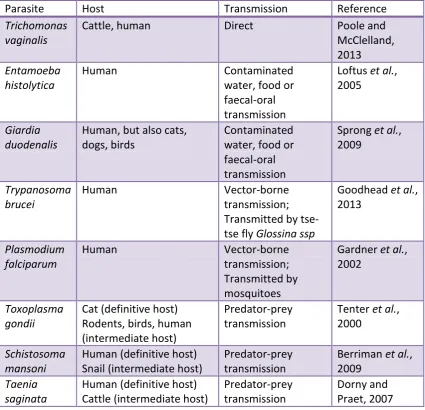
[image:22.595.114.540.313.723.2]offspring). Infectious transmission may be through direct ‘generic’ contact (e.g. ebola), through direct sexual contact (for sexually transmitted infections), through propagules transmitted through the environment (e.g. through sneezing), or through a vector (e.g a tse-tse fly transmitting Trypanosoma sp.). A parasite or pathogen may utilize one or more host species, either with direct transmission within a community of host species, or through defined ‘complex’ life cycles where the parasite moves between often very different host species in a defined order (e.g. schistosomes snail-human cycles).
Table 1.1: Examples of different parasite transmission routes.
Parasite Host Transmission Reference
Trichomonas vaginalis
Cattle, human Direct Poole and
McClelland, 2013
Entamoeba histolytica
Human Contaminated
water, food or faecal-oral transmission
Loftus et al., 2005
Giardia duodenalis
Human, but also cats, dogs, birds
Contaminated water, food or faecal-oral transmission
Sprong et al., 2009
Trypanosoma brucei
Human Vector-borne
transmission; Transmitted by tse-tse fly Glossina ssp
Goodhead et al., 2013
Plasmodium falciparum
Human Vector-borne
transmission; Transmitted by mosquitoes
Gardner et al., 2002
Toxoplasma gondii
Cat (definitive host) Rodents, birds, human (intermediate host)
Predator-prey transmission
Tenter et al., 2000
Schistosoma mansoni
Human (definitive host) Snail (intermediate host)
Predator-prey transmission
Berriman et al., 2009
Taenia saginata
Human (definitive host) Cattle (intermediate host)
Predator-prey transmission
23
The mechanism of transmission impacts upon a parasite’s ecological and evolutionary dynamics (Thrall et al., 2000). A vector borne infection, for instance, has dynamics that depend on vector number and competence. The infection is selected to maintain a vector well and also to increase the chance that an infected host is fed upon by the vector (Ewald, 1983). Parasites and pathogens transmitted through complex life cycles similarly will have dynamics, and evolutionary pressures, that depend on each host species. A vertically transmitted infection requires a healthy, reproducing host in order to attain transmission. However, because transmission is maternal, these infections may select for the production and survival of daughters over sons, thus generating a parasitic phenotype (Hurst and Frost, 2015).
1.2. Sexually transmitted infections
Sexually transmitted infections (STIs) are pathogens and parasites that require sexual contact between hosts for their maintenance within a species. This definition excludes pathogens and parasites in which some sexual transmission is observed but other means of transmission drive the pathogen epidemiology. This definition does not however debar other routes of infection from being important. For instance, HIV represents an STI in that it requires sexual contact for its spread, but is additionally transmitted from mother to child during birth, and through contact with contaminated blood.
24
There is an apparent contrast in the nature of STIs between vertebrates and invertebrates. Whilst the majority of STIs described in mammals are bacteria and viruses, insect STIs are often fungi or multicellular parasites such as nematodes or mites (Knell and Webberley, 2004). There may be a study bias against the discovery of microparasitic STIs in insects, as these require focussed study to detect (compared to finding a fungus, nematode or mite on a host). However, sexually transmitted mites and nematodes are not known in mammals, and thus it is likely that ectoparasitic STIs are more common in insects than mammals.
The impact of sexually transmitted infections on their host is different from other kinds of diseases. Sexually transmitted infections are selected to maintain a healthy, copulating host, as this maximizes transmission opportunities. Knell (1999) suggested that sexual selection for females to choose uninfected partners further provides a selection pressure on the STI to become cryptic. He developed a model which shows that if an individual chooses a mating partner based on the characteristics of health or parasitism, then there should be selection for reduced virulence of STIs (Knell, 1999). However, STIs are more likely than other infections to have sterility impacts (Lockhart et al., 1996). Sterility impacts derive in part from their position as infections of the genital tract. However, sterility may also be a product of adaptation (Apari et al., 2014). For instance, preventing a female mammal from establishing pregnancy will maintain her in the mating pool, transmitting infection. Further, extracting resources from reproduction rather than from somatic survival allows the STI not to make their host unhealthy and unattractive for mating. The concept that STIs may create sterility as an adaptive phenotype is supported by the observation that ectoparasitic STIs in ladybirds lead to sterility of their female host in spite of having no direct interaction with the reproductive system (Hurst et al., 1995).
25
thought to be relatively independent of the number of contacts a host has with other conspecific individuals. A consequence of this is that, unlike an OID, there is either no, or a very low, threshold host density required for an STI to establish in a population. Furthermore, there is no density dependent regulation of the host population by the infection, and theory suggests sterilizing STIs are thus more likely to make their host go extinct (Lockhart et al., 1996; Thrall et al., 1997; Thrall et al., 2000).
Empirical verification of these principles is, however, rare. Indeed, the spread of STIs to high prevalence and host extinction is avoided where promiscuous individuals mate with other promiscuous individuals. When this occurs, the STI circulates predominantly in just one part of the population, as seen for gonorrhoea in humans (Hethcote and Yorke, 1986). It is also likely that STIs do show some density dependence. When hosts are very rare, mating rates may be lowered. Laboratory simulation of STI transmission in Adalia bipunctata indicates that STI transmission rate is modulated, at least in part, by host density (Ryder et al., 2005).
STIs present an interesting case where the dynamics of the disease is affected by mating system. Different intensities of sexual selection in male and females, for instance, are predicted to be reflected in sex-biased patterns of infection (Ashby and Gupta, 2013). Where reproduction is focussed on a few males, these males represent super-spreaders which then pass infection into females. The less successful beta males, in contrast, are predicted to have low prevalence of infection. This scenario is observed in the sub-tropical eucalypt beetle,
26
It has been widely conjectured that mating system will evolve in response to the presence of an STI. Thrall et al., (1997) and Kokko et al. (2002) postulate that presence of an STI will select for a reduced mating rate. The prediction is that female individuals, being more impacted by sterility and with less fitness gain from mating multiply, will be strongly selected to reduce mating rates as a means of reducing STI exposure. Boots and Knell (2002), considering the same issue, predicted selection would produce a mix of individuals showing risky and safe sexual behaviour, rather than monogamy. They argue ‘risky behaviour’ is maintained as its cost reduces when risky individuals are rare. As monogamy becomes more common, they argue that the STI becomes rare, enabling the risky behaviour to persist.
It has also been suggested that STIs may select for mate choice, and for tolerance/avoidance behaviours. Attempts to uncover mate choice in favour of uninfected individuals have largely failed (Knell, 1999; Webberley et al., 2002), probably because STIs are strongly selected to be cryptic. Elsewhere, post-copulatory behaviours, such as grooming and masturbation, have been suggested as a means of preventing infection from becoming established (Waterman, 2010). Finally, Nunn et al. (2002) argue that the association between promiscuity and immune system activity amongst primate species is driven by the increased prevalence of STIs in promiscuous species.
1.3 Ladybird model system for STI study
27
The two-spot ladybird has been established as a useful species for ecological and evolutionary studies. Initially, the highly polymorphic elytral forms (Figure 1.1) led to it being used as a model for understanding the evolutionary forces underlying phenotypic variation in natural populations. It is considered aposematic, though less toxic than other sympatric ladybirds such as C. septempunctata (Marples et al., 1989; Marples et al., 1994). Patterns of mate choice (Majerus et al., 1982) and thermal melanism (Brakefield and Willmer, 1985) were considered as drivers in the spatial and temporal variation in colour pattern observed in natural populations.
More recently, the species has been used as a ‘model organism’ for three different areas of enquiry: promiscuity/sexual selection, heritable symbiont impacts, and interactions with natural enemies, particularly sexually transmitted infections. A core hypothesis within this thesis is that these three areas of research may be related: promiscuity/sexual selection driving STI epidemiology, STI epidemiology driving mating system biology, and heritable microbes potentially modifying both. I thus briefly review each field of research, before combining these studies to better understand these interactions.
28 1.3.1 Interactions with heritable symbionts
29
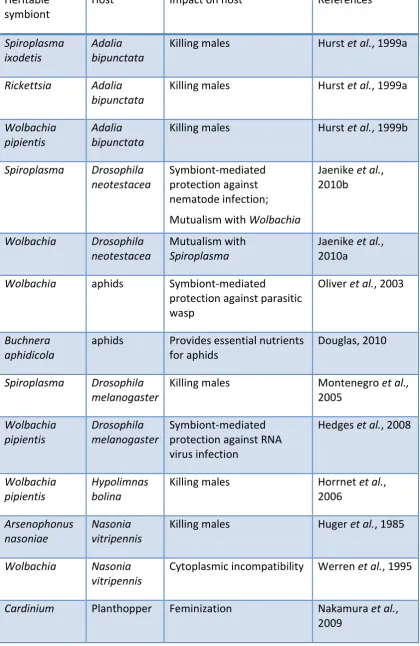
Table 1.2: Examples of interactions between host and heritable microbes.
Heritable symbiont
Host Impact on host References
Spiroplasma ixodetis
Adalia bipunctata
Killing males Hurst et al., 1999a
Rickettsia Adalia bipunctata
Killing males Hurst et al., 1999a
Wolbachia pipientis
Adalia bipunctata
Killing males Hurst et al., 1999b
Spiroplasma Drosophila neotestacea
Symbiont-mediated protection against nematode infection; Mutualism with Wolbachia
Jaenike et al., 2010b
Wolbachia Drosophila neotestacea
Mutualism with
Spiroplasma
Jaenike et al., 2010a
Wolbachia aphids Symbiont-mediated
protection against parasitic wasp
Oliver et al., 2003
Buchnera aphidicola
aphids Provides essential nutrients for aphids
Douglas, 2010
Spiroplasma Drosophila melanogaster
Killing males Montenegro et al.,
2005 Wolbachia pipientis Drosophila melanogaster Symbiont-mediated protection against RNA virus infection
Hedges et al., 2008
Wolbachia pipientis
Hypolimnas bolina
Killing males Horrnet et al., 2006
Arsenophonus nasoniae
Nasonia vitripennis
Killing males Huger et al., 1985
Wolbachia Nasonia vitripennis
Cytoplasmic incompatibility Werren et al., 1995
30 Adalia bipunctata is one of the first recorded cases of maternally inherited male-killing elements. Lineages of ladybirds producing daughters only were recorded by Lus in 1947 in Russia. Sex ratio bias was noted to be associated with low egg hatch rate, making male death the likely cause of the sex ratio skew. Inheritance was strictly matrilineal (Lus, 1947). The trait was further explored nearly fifty years later in the UK populations (Hurst et al., 1992; Hurst et al., 1993a). Here, 7-20% of female individuals carried the male-killing trait, which was revealed to be sensitive to antibiotics, implying a bacterial origin. Male-killing was also found to be associated with the presence of a Rickettsia bacterium (Werren et al., 1994).
This maternally inherited symbiont is transmitted from females (mothers) to their daughters and sons but only daughters survive and hatch from eggs. Sons are killed during embryogenesis, they are an evolutionary dead end for cytoplasmic genes (Hurst, 1991; Hurst and Majerus, 1993b; Hurst and Jiggins, 2000). The commonness with which infection is observed in ladybirds is thought to be associated with the presence of sibling egg cannibalism in coccinellids, which means that dead male eggs are consumed by their hatching sisters, which is advantageous for a maternally inherited agent. The presence of the male-killer increases the survival prospects of host female larvae in two ways: firstly by increasing the food resources available to hatching female larvae that carry the infection through consumption of the dead male eggs, and secondly by decreasing the competition between sisters for food (Hurst et al., 1992; Hurst and Majerus, 1993b).
31
prevalence of male-killing bacteria in Sweden, with Spiroplasma common and dominant south of 61˚N, but lower prevalence of this bacterium, alongside
Rickettsia, being found north of this area (Tinsley, 2003: see Figure 1.2).
Figure 1.2: The occurence of Spiroplasma male-killing bacteria in Scandinavian countries between 2000-2002 (Tinsley, 2003). Sampling regime by colour: ● Spiroplasma prevalence was higher than 30%; ● Spiroplasma prevalence between 10-30%; ● prevalence of Spiroplasma reached up to 10% of females in
Adalia; ● Rickettsia prevalence higher than 30%; ● Rickettsia prevalence between 10-30%; ● Rickettsia prevalence up to 10% of female Adalia populations;
● Absence of both Spiroplasma and Rickettsia (Map source: www.in-sweden.co.uk/physical-map-of-sweden.html).
[image:31.595.115.517.181.444.2]32
exists but is not explained. What is known is that Spiroplasma infection has an important effect on the ladybird population. It creates a distortion in the ladybird population sex ratio, which can become very female-biased (Hurst et al., 1993a; Ryder et al., 2014). This population sex ratio bias is likely to alter A. bipunctata’s mating system, and in so doing affect the dynamics of any sexually transmitted infection.
1.3.2 Promiscuity and sexual selection
Two-spot ladybirds are promiscuous. Females and males mate many times with different partners throughout their lives in both the wild and in the laboratory (Majerus, 1994; Haddrill et al., 2008). When a male meets a female, he climbs on her back, without apparent courtship. She may then accept or reject him, with rejection made more likely when the female is poorly fed (Majerus, 1994; Perry and Rowe, 2008b; Perry et al., 2009). If a female rejects the partner, she usually runs away or lifts her abdomen and pushes him away or she turns on her back or she drops from the top of the lid.
33 1.3.3 Sexually transmitted infections
The promiscuity of A. bipunctata is associated with the presence of sexually transmitted infections. Two infections are considered to be transmitted during host copulation. First, there is the Laboulbeniales fungus Hersperomyces virescens. This ectoparasitic fungus lives within the ladybird cuticle, from where fruiting bodies appear. An intense infection is associated with the ladybird host appearing with a ‘furry’ yellow coat. Sexual transmission has been inferred as being important from the position of the infection on the ventral side of the male abdomen and the dorsum of females, reflecting sexual contact points. However, other routes of infection have not been excluded. Prevalence of the infection can be locally high (e.g. in London in spring when even > 50% of adult ladybirds carrying the fungus infection: Welch et al. 2001) and there is some association with urban environments (Webberley et al., 2006b).
Second, there is Coccipolipus hippodamiae mites, the subject of this thesis. The interaction between two-spot ladybirds Adalia bipunctata and the parasitic mite
Coccipolipus hippodamiae is one of the best studied models for STI biology (Hurst et al., 1995; Webberley et al., 2002; Webberley et al., 2004; Knell and Webberley, 2004; Webberley et al., 2006a; Webberley et al., 2006b; Ryder et al., 2013; Ryder et al., 2014). Coccipolipus hippodamiae (family Podapolipidae) is principally an ectoparasite of A. bipunctata, with infection also observed on three other European ladybird species: the ten-spot ladybird Adalia decempunctata, Oenopia conglobata
and cream-spot ladybird Calvia quatuordecimguttata. However, the prevalence of mite infection on A. decempunctata, Oenopia and Calvia species is low (Webberley
et al., 2004). Mites were described on the two-spot ladybirds for the first time in the USA by Husband (Husband, 1981) and then in Europe (in the Russian populations) by Hurst (Hurst et al., 1995).
34
that mite transmission occurs readily. Where there are larval mites on just one of the two mating individuals, mite infection is transferred to the other party on around 90% of occasions.
The mite itself lives underneath the ladybird elytra, where it feeds on ladybird haemolymph. The adult mite is sessile and lays eggs (around 2 per day) which hatch into larvae after 3-4 days. Only female larvae can move between hosts during copulation (Hurst et al., 1995; Webberley et al., 2004; Webberley et al., 2006a). The mite is predominantly sexually-transmitted however laboratory observations have recorded that larval mite transmission, between aggregated ladybirds, during overwintering is also possible but rather rare (Webberley and Hurst, 2002). Furthermore a mite cannot survive for long without its host, therefore when a mite leaves its host it has to find a new host very quickly.
The mite is harmful for Adalia bipunctata. It develops quickly under the elytra of both sexes (Webberley et al., 2002; Webberley et al., 2004; Webberley et al.,
2006a). Mite infection sterilizes female ladybirds after about 10-14 days of infection and those host females continue to lay eggs which characteristically shrivel and do not hatch (Hurst et al., 1995). There is also some mortality effect of mite infection, with infection with this parasite reducing overwinter survivorship, especially for male beetles (Webberley and Hurst, 2002).
35
with mites earlier than females, in contrast to places where a male-killing bacterium is absent (for instance Toruń, Poland) (Ryder et al., 2014).
The mite is thus a formidable ecological force: it infects nearly all adult individuals where it is present, and sterilizes its female host. However, there is little evidence of resistance to the mite in natural populations. Nevertheless, mite presence shows strong geographic patterning, being present in central and southern Europe, and absent from western and very northern regions (Webberley et al., 2006b). Some of the most profound presence/absence variation is found in Sweden. Surveys by Tinsley (2003) recorded the mite being present in the south of Sweden (south of 61˚N) in Malmö, Stockholm and Gävle but being absent in northern Sweden (Ljusdal, Östersund and Vilhelmina) and also in Nässjö, the only southern location recorded free from mites (Figure 1.3). Phenological change in the ladybird has been hypothesized as the major driver of presence/absence of the mite (Hurst et al.
36
Figure 1.3: The occurence of the mite C. hippodamiae in Scandinavian ladybird populations between 2000-2002 (Tinsley, 2003). Orange places where the mite is absent. Green places where mite is present (Map source: www.in-sweden.co.uk/physical-map-of-sweden.html).
1.4 Aims of thesis
[image:36.595.114.357.69.387.2]37
interaction is through protection – symbionts are known to alter susceptibility to natural enemies in a number of systems (Haine, 2005). Any change in individual susceptibility to the mite associated with symbiont presence would alter the dynamics of both mite and symbiont.
Figure 1.4: Potential interactions between male-killing symbionts, promiscuity and STI. Each arrow represents a direct potential impact of one factor on the dynamics of another. These impacts may be either ecological (e.g. sex ratio alters promiscuity) or evolutionary (presence of an STI may select for changes in promiscuity).
[image:37.595.112.531.201.505.2]38 hippodamiae are quite common in the populations in the south of Sweden, but are absent (the mites) or low in prevalence (Spiroplasma) in the north. The first comprehensive survey of these parasites was conducted by Tinsley (2003), who observed about 40% prevalence of the Spiroplasma in populations south of latitude 61°N, along with presence of the mite below this latitude in all populations (expect of one from Nässjö). In contrast, the mite was always absent and Spiroplasma
prevalence was very low north of this line of latitude.
This thesis focuses on the incidence and epidemiology of the mite, and its interplay with host mating system and symbiont presence. The aims are:
a) To understand how mite presence/absence is determined in Swedish populations of A. bipunctata.
b) To determine if mite presence is associated with changes in mating system, in particular a reduction in host promiscuity.
c) To establish the likely influence of population sex ratio bias associated with male-killing bacteria on the dynamics of the STI.
d) To determine whether there is a direct link between Spiroplasma infection and host susceptibility to mite infection, and if there are other potential links mediated through longevity.
1.5 Thesis outline
39
pattern of mite and Spiroplasma presences stable (indicating an unchanging biological/ecological basis to the pattern), or have it changed over 10 years?
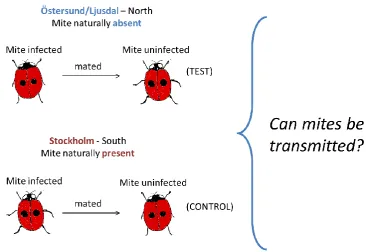
In Chapter 3, I then examine the biological and ecological factors that determine the incidence of the mite in Swedish A. bipunctata, with particular focus on the determinants of mite absence. One of the challenges arising from environmental change is to predict how the population size and range of insect pests and their natural enemies will respond to climate change. We can approach issues like this in a principled fashion through understanding the environmental factors that limit the current incidence and prevalence of pests and the natural enemies that control pest numbers. Previous studies have shown that the mite is absent in the northern Swedish ladybird population but it has been common in the south (except one place Nässjö where mites were not observed). Two hypotheses are tested: a) Is the cause of mite absence an inability of ladybirds from the north of Sweden to become infected with mite/transmit it to onward? b) Does the phenology of northern ladybirds prevent mite transmission between generations, such that the mite cannot persist in the population?
In Chapter 4, I extend previous studies examining the impact of the mite on the evolution of host mating system. It has been predicted, on the basis of mathematical models, that STIs should select for an alteration in mating system, with females in particular being selected to have reduced mating rate (Kokko et al., 2002). I present the first test of this hypothesis, by examining whether rejection behaviour (that prevents mating) occurs more commonly when the ladybirds derive from a population where the STI is present, compared to one where it is absent.
40
noted in laboratory study (Elnagdy et al., 2013). An effect such as this would be important for mite dynamics, as it would represent a phenological alteration (Chapter 3) that may affect mite dynamics.
In Chapter 6, I examine the potential for indirect influence of the Spiroplasma on mite dynamics, mediated through skewed population sex ratio. My thesis is that where the male-killer is common, population sex ratios are female-biased. Individual male ladybirds then have a higher mating rate than female ladybirds. This produces higher exposure to the STI, reflected in early epidemics of the STI on male than female host ladybirds. I will test two hypotheses: a) Sex ratio bias may reduce male to female transmission of the mite. When males mate commonly, the supply of infective larval mites may limit transmission. This effect would increase sex-biased prevalence. b) Sex ratio bias may increase female mating rate if males that mate multiply transfer less ejaculate, and make females less refractory to remating. This effect would increase the epidemic speed in both males and females.
41
Chapter 2: Stability of
Spiroplasma
and mite clines over time
1. The two-spot ladybird Adalia bipunctata is a host to heritable male-killing bacteria and a sexually transmitted mite Coccipolipus hippodamiae, both of which impact on host reproduction.
2. Previous studies in Sweden noted geographical variation in the incidence of these parasites in the period 2000-2002, with mite and male-killing Spiroplasma
being absent north of 61˚N.
3. Stability of this pattern would indicate a persistent underlying ecological driver to mite and Spiroplasma presence. In this chapter I therefore investigated if this discontinuity in incidence persists 10 years after the initial survey. In addition to the presence of Spiroplasma and mite, presence of other male-killers Rickettsia and
Wolbachia were also examined.
4. The pattern of mite presence/absence remained identical in 2011 to that observed in 2000-2002. The overarching pattern of male-killing Spiroplasma
distribution remained, with presence at high prevalence in southern populations and low prevalence in northern populations. However, there was a northward shift in the boundary between high and low prevalence populations.
5. Investigation of other male-killing symbiont presence revealed little change in Rickettsia distribution, which remained presence at low prevalence throughout the country. In contrast, there was evidence for A. bipunctata carrying Wolbachia
infections, which had not been recorded in the previous study.
6. We conclude that the stable distribution of the mite indicates a persistent underlying ecological factor that determines its incidence. The pattern of male-killing Spiroplasma indicates a shifting boundary, with an underlying ecological factor that has altered through the period of study.
42
2.1 Introduction
The two-spot ladybird (Adalia bipunctata)is host to a variety of parasites that affect host reproduction. As outlined previously, the haematophagous ectoparasitic mite
C. hippodamiae utilizes copulation as a transmission opportunity, and makes female hosts infertile. Vertically transmitted bacterial symbionts are also common. Adalia bipunctata carries four different strains of male-killing bacteria: Spiroplasma (Hurst
et al., 1999a), Rickettsia (Werren et al., 1994) and two strains of Wolbachia (Hurst
et al., 1999b). These parasites represent a strong ecological force. Where present, the STI reaches very high prevalence, thus impacting on host reproduction (Hurst et al., 1997). Past records suggest male-killing bacteria may also be sufficiently common to produce population sex ratio biases, which will thus impact on mating system biology (Ryder et al., 2014).
Broad surveys of these parasites have suggested their incidence varies over space. The mite is absent from western and northern populations in Europe (Webberley et al., 2006b). Areas of France and Holland that are close to the Atlantic are uninfected with the mite, as are UK populations. Infections with male-killing bacteria are found throughout Europe, but the strain of male-killer observed varies spatially. In the UK and Denmark and in Kyrgyzstan in Asia only Rickettsia has been recorded (Hurst et al., 1992; Zakharov et al., 1996; Hurst et al., 1999a). In Germany, Poland and Sweden, Spiroplasma and Rickettsia have been found (Hurst et al., 1999a), and more easterly in Moscow and St. Petersburg, Spiroplasma, Rickettsia and Wolbachia
(Zakharov et al., 1996; Majerus et al., 2000).
Past work has identified presence/absence boundaries for both the mite and male-killing bacteria in Sweden. Past study by Tinsley (2003) has suggested that the prevalence of male-killing bacteria and mites changes from the north to the south. Tinsley surveyed populations from the south of Sweden (Malmö 55˚35’N, 13˚02’E) on a N-S transect through to Narvik (68˚25’N, 17˚33’E) on the Norway/Sweden border in the Arctic Circle (Figure 2.1; material collected is detailed in the appendix Tables A2.3, A2.4 and A2.5). Surveys in 2000, 2001 and 2002 indicated Spiroplasma
43
Nässjö) in the south of Sweden (south of latitude 61°N), but was rare north of this latitude. Rickettsia, in contrast, was at low prevalence (from 1.22% in Narvik to 25.3% in Ljusdal) throughout. The mite was absent north of 61˚N, and present in more southerly regions, with the exception of Nässjö, a city in the interior of Sweden which lies 375 m (1230 ft) above sea level. The dissimilarity between south and north in both distributions was not gradual, but rather a rapid transition. This suggests that there is a hard barrier to the spread of these infections in certain places.
In this chapter, I aim to assess whether the stability of the patterns is observed in Sweden. Stability of incidence/prevalence would indicate a consistent driver of incidence/prevalence pattern, and would contrast with dynamic variation, which would indicate either changing ecological circumstances or co-evolutionary interactions.
44
Figure 2.1: Collection sites of Adalia bipunctata across Scandinavia visited by Tinsley between 2000 and 2002. Sampling regime by colour: ● samples in Autumn 2000;
45
2.2 Material and methods
2.2.1 Collection of material
Two-spot ladybirds (Adalia bipunctata) were collected across three years (2011, 2012 and 2013) from Swedish urban habitats (city centres and suburbs). The locations sampled paralleled those visited by Tinsley, with the exception of Narvik (the most northerly site) which was not visited (Figure 2.2). Samples collected are detailed in Table 2.1 (2011), 2.2 (2012) and 2.3 (2013). To this systematic collection was added samples of ladybirds from Helsinki, Finland (July/August 2011 collected by Dr Emily Hornett) and Tartu, Estonia (April 2012 collected by Prof. Toomas Tammaru).
South of 63˚N, Adalia bipunctata were mostly found on lime trees (Tilia sp., especially small-leaved lime tree Tilia cordata). North of this latitude (Östersund, Vilhelmina), lime trees were not present, and birches Betula represented the most common habitat. Where possible ladybirds were sampled from the same tree and bush species within a habitat to minimize ecological variance between collected populations (it is known that habitat type influences STI prevalence: Ryder et al.,
46
[image:46.595.115.509.68.589.2]47
Ladybirds were collected from trees by beating and from bushes by hand collection. Collected individuals were transferred to 1.5 ml Eppendorf tubes (Figure 2.3). Ladybirds that were caught as single individuals were confined singly, to prevent any mite contagion during storage. If a mating pair landed on the beating tray, ladybirds were not separated but transferred together into the Eppendorf.
Figure 2.3: Two-spot ladybirds in Eppendorf tubes (source: the Swedish website:
[image:47.595.114.242.224.411.2]48
Table 2.1: Adalia bipunctata samples collected in Sweden in 2011 with additional data from Helsinki (Finland) in 2011. Sites are listed in order of declining latitude, with northerly samples at the top and southerly samples at the bottom of the table.
Site Date of
collection Females Males Host plants
Vilhelmina 3/7 19 9 Betula sp.
Östersund 4/7 22 29 Betula sp.
Ljusdal 17/6 28/7 56 62 33 38 Tilia sp., Rosa sp.
Gävle 4/6
8/7
147 62
53
38 Tilia sp. Helsinki (Finland) July/August 40 N/A N/A Stockholm 20/5-28/7 2232 847 Tilia sp.
Nässjö 12/6
9/7 73 105 35 95 Tilia sp., Rosa sp.
Malmö 11/6 126 74 Tilia sp.
Table 2.2: Details of Adalia bipunctata samples collected in Sweden in 2012 with additional data from Tartu (Estonia) in 2012. Places are listed in order of declining latitude, with northerly samples on the top and southerly samples at the end of the table.
Site Date of
collection Females Males Host plants
Östersund 8/8 52 47 Betula sp.
Ljusdal 9/8 56 36 Tilia sp.,
Rosa sp.
Gävle 9/8 42 12 Tilia sp.
Stockholm 22-24/5 11-12/8
334 172
183
67 Tilia sp. Tartu (Estonia) April 24 7 N/A
Nässjö 10/8 60 16 Rosa sp.
Table 2.3: Details of Adalia bipunctata samples collected in Sweden in 2013. Populations are listed in order of declining latitude, with northerly samples on the top and southerly samples at the end of the table.
Site Date of
collection Females Males Host plant
Östersund 14/8 6 3 Betula sp.
Stockholm 21-24/5 12-13/8 +15/8 123 244 51
49 2.2.2 Assessing the mite Coccipolipus hippodamiae infection status on ladybirds
The sex of ladybirds was ascertained as described by Randall et al. (1992), with males identified by the presence of a notch in the final abdominal segment, and broad flexure bands between abdominal segments. Ladybirds were scored for mite presence within 24 hours of collection following Hurst et al. (1995). To this end, each ladybird was placed with care on its pronotum on Blu-tacTM and examined under a binocular microscope. Each elytron was carefully unfolded using a pin to expose the underside, and examined under x40 magnification. The presence/absence of mite infection was noted, and where infection was present, the intensity of mite infection estimated (number of mite adults, larvae, and eggs). An individual was deemed to be infected if any mite stage was present, and infectious if mite adults, eggs and larvae were all present. Records of mite presence/absence were compared to data from 2000-2002. Because the mite undergoes annual epidemics from May-July, followed by dilution as new generation adults emerge, comparison of prevalence between samples was not appropriate, as these are expected to differ between samples collected at different phases in the epidemic.
2.2.3 Establishing presence/absence of heritable microbes
Female ladybirds collected above were transferred to separate 1.5 ml Eppendorf tubes and preserved in 100% ethanol.DNA was extracted and the presence of male-killing bacteria then determined using diagnostic PCR assays.
2.2.3.1 DNA Extraction using the Promega Wizard® Genomic DNA Purification Kit
50
minutes before centrifugation at 14,000 x g* for 4 minutes. Supernatant was transferred to a new tube and DNA precipitated by adding 300 μl of room temperature isopropanol (Propan-2-ol). Following gentle mixing by inversion, samples were centrifuged at 14,000 x g* for two minutes. Supernatant was removed and the pellet washed by addition of 300 μl of room temperature 70% ethanol and centrifugation at 14,000 x g* for two minutes. After this stage, ethanol was carefully removed and the pellet containing DNA left to air-dry the pellet for 15 -60 minutes. The DNA was then resuspended in 60 μl of sterile distilled (MilliQ) water and incubated overnight in the fridge at 0.4˚C. Prepared DNA samples were either used directly in assays, or if not used within 24 hours, stored at -20˚C prior to assay.
2.2.3.2 Screening ladybird DNA for presence of male-killing bacteria by molecular
reactions
A three-step approach to assessing male-killing bacteria presence was adopted. First, the quality of extracted DNA template was tested using a PCR assay based on CO1 mtDNA, present in all insects. Samples passing this QC were then subject to separate PCR assays for the presence of Spiroplasma, Rickettsia and Wolbachia, using previous methodologies. Finally, amplicons from a sample of positive individuals for each infection were sequenced to ensure the current material reflected historical records of symbiont identity.
51
72˚C, followed by 1 cycle of 60s at 10˚C. All PCR assays were conducted alongside contemporaneous known positive and negative (blank) templates. Amplicons were visualised on 1.5% agarose gels containing 2 μl of Ethidium Bromide, alongside Bioline HyperLadder TM I size standard (1 kb). Gels were prepared using 1.5 g of agar and 100 ml of buffer TAE (Tris-acetate-EDTA; 1L of 50x TAE contains: 242 g of Tris Base, 75.1 ml of Glacial Acetic Acid, 200 ml of pH 8.0 EDTA and approximately 750 ml of RO Water). After electrophoresis, gels were visualised and photographed using UV-B light and the presence of absence of amplicon scored.
Templates that failed the QC were discarded from further analysis. The DNA templates passing QC were then tested for Spiroplasma, Rickettsia and Wolbachia, using primer combinations and PCR conditions given in Table 2.4. As before, all PCR assays were conducted alongside contemporaneous known positive and negative (blank) templates.
Positive PCR assay samples were sequenced for 1-5 individuals for each location for each symbiont infection to ensure these represented strains identified previously as male-killing bacteria. First, PCR product was cleaned of unincorporated nucleotides and oligonucleotide primer. To this end, 5 μl of PCR product was mixed with 0.2 μl shrimp alkaline phosphatase (BioLabs), 0.05 μl Exonuclease I (BioLabs), 1 μl 10 x SAP Reaction Buffer (BioLabs) and water to 10 μl. This was incubated at 37˚C for 45 minutes before killing enzyme activity by placing at 70˚C for 15 minutes. 1 μl of this product was used as a template in a 10 μl total volume with 0.18 μl BigDye 3.1 Terminator (Applied Biosystem®), 0.32 μl of one of the primers, 1 μl 5 x Reaction Buffer (BioLabs) and 7.5 μl water. This was subject to cycle sequencing program (25 cycles of 10s at 96˚C, 5s at 50˚C and 4 minutes at 60˚C, followed by incubation at 8˚C), and the product was then precipitated with 1.5 μl of 3M Sodium acetate (NaOAc) pH 4.6 and 31.25 μl of 100% Ethanol and centrifuged for 1400-2000 x g*
52
DNA sequences obtained were first assessed for quality by eye on BioEditTM and sequences similar to those on Genbank assessed examined through BLAST (Basic Local Alignment Search Tool) analysis on NCBI. The top hit was checked against the previously acquired sequences from ladybird symbionts. Expected hits were:
Spiroplasma accession number AJ006775, Hurst et al., 1999a; Wolbachia strain Y AJ130714 and Wolbachia strain Z AJ130715, Hurst et al., 1999b; Rickettsia
53
Table 2.4: Primer combinations and PCR conditions for molecular assays to test the presence of male-killing bacteria. All PCR cycles involved an initial melt phase of 2 minutes at 94˚C, and a final extension of 10 minutes at 72˚C (one exception for Spiroplasma final extension: 20 minutes at 72 ˚C).
Male-killing bacteria
Primers Primer sequence Gene region PCR conditions Expected amplicon size
Reference
Spiroplasma HaIn-1 (forward)
5’ GCT CAA CCC CTA ACC GCC 3’ 16S rRNA gene of
Spiroplasma
35 cycles of 15s at 94˚C 60s at 55˚C 30s at 72˚C
429-bp Hurst et al.,
1999a MGSO
(reverse)
5’ TGC ACC ATC TGT CAC TCT GTT AAC CTC 3’
Rickettsia R1
(forward)
5’ GCT CTT GCA ACT TCT ATG TT 3’ 17 kDa outer-membrane protein gene common to members of the typhi
group of the genus
Rickettsia
35 cycles of 20s at 95˚C 60s at 60˚C 60s at 72˚C
434-bp Werren et al.,
1994 R2
(reverse)
5’ CAT TGT TCG TCA GGT TGG CG 3’
Wolbachia wsp 81F (forward)
5’ TGG TCC AAT AAG TGA TGA AGA AAC 3’ wsp gene coding for an outer membrane protein of Wolbachia
30 cycles of 16s at 93˚C 60s at 55˚C 50s at 72˚C
610-bp Braig et al.,
1998; Zhou et al.,
1998 wsp 691R
(reverse)
54 2.2.3.3 Analysis of variation in symbiont presence between samples
55
2.3 Results
2.3.1 Mite incidence
56
Figure 2.4: The presence and prevalence of mite Coccipolipus hippodamiae in Sweden over time (2000-2002 Tinsley’s data; 2011-2013 data from this study). Pie charts represent proportion of collected ladybirds infected with mites. ● ladybird infected with mites; ● ladybirds not infected with mites. (Map source: www.in-sweden.co.uk/physical-map-of-sweden.html).
2.3.2 Prevalence and incidence of heritable male-killers
Symbionts previously identified as male-killing bacteria were identified across the species range (Figure 2.5). Symbiont infection was least common in northern populations in each sampling period, indicating a general pattern that male-killing symbionts were at higher prevalence in the south than the north.
The dominant male-killer observed was Spiroplasma. The higher prevalence of