block declarations.
White Rose Research Online URL for this paper:
http://eprints.whiterose.ac.uk/1208/
Article:
Smaus, J.-G., Hill, P.M. and King, A. (2001) Verifying termination and error-freedom of
logic programs with block declarations. Theory and Practice of Logic Programming, 1 (4).
pp. 447-486. ISSN 1471-0684
https://doi.org/10.1017/S1471068401001107
[email protected] https://eprints.whiterose.ac.uk/ Reuse
See Attached
Takedown
If you consider content in White Rose Research Online to be in breach of UK law, please notify us by
Printed in the United Kingdom c 2001 Cambridge University Press
Verifying termination and error-freedom of
logic programs with
block
declarations
JAN-GEORG SMAUSã
CWI, Kruislaan 413, 1098 SJ Amsterdam, The Netherlands
(e-mail:[email protected])
PATRICIA M. HILL
School of Computer Studies, University of Leeds, Leeds LS2 9JT, UK
(e-mail:[email protected])
ANDY KING
University of Kent at Canterbury, Canterbury, CT2 7NF, UK
(e-mail:[email protected])
Abstract
We present verification methods for logic programs with delay declarations. The verified prop-erties are termination and freedom from errors related to built-ins. Concerning termination, we present two approaches. The first approach tries to eliminate the well-known problem of speculativeoutput bindings. The second approach is based on identifying the predicates for which the textual position of an atom using this predicate is irrelevant with respect to termination. Three features are distinctive of this work: it allows for predicates to be used in several modes; it shows thatblockdeclarations, which are a very simple delay construct, are sufficient to ensure the desired properties; it takes the selection rule into account, assuming it to be as in most Prolog implementations. The methods can be used to verify existing programs and assist in writing new programs.
KEYWORDS:verification, delay declarations, termination, modes, types, selection rule, built-ins, errors
1 Introduction
The standard selection rule in logic programming states that the leftmost atom in a query is selected in each derivation step. However, there are some applications for which this rule is inappropriate, e.g. multiple modes, the test-and-generate paradigm (Naish, 1992) or parallel execution (Apt and Luitjes, 1995). To allow for more user-defined control, several logic programming languages provide delay declarations (Hill and Lloyd, 1994; SIC, 1998). An atom in a query is selected for resolution only if its arguments are instantiated to a specified degree. This is essential to ensure termination and to prevent runtime errors produced by built-in predicates (built-ins).
In this paper we present methods for verifying programs with delay declarations. We consider two aspects of verification: Programs should terminate, and there should be no type or instantiation errors related to the use of built-ins.
Three distinctive features of this work make its contribution:
(a) it is assumed that predicates may run in more than one mode;
(b) we concentrate on block declarations, which are a particularly simple and efficient delay construct; and
(c) the selection rule is taken into account.
We now motivate these features.
(a) Allowing predicates to run in more than one mode is one application of delay declarations. Although other authors (Apt and Luitjes, 1995; Naish, 1992) have not explicitly assumed multiple modes, they mainly give examples where delay declarations are clearly used for that purpose. Whether allowing multiple modes is a good approach or whether it is better to generate multiple versions of each predicate (Somogyi et al., 1996) is an ongoing discussion (Hill, 1998). Our theory allows for multiple modes, but of course this does not exclude other applications of delay declarations.
(b)Theblockdeclarations declare that certain arguments of an atom must be non-variable before that atom can be selected for resolution. Insufficiently instantiated atoms are delayed. As demonstrated in SICStus (SIC, 1998), block declarations can be efficiently implemented; the test whether arguments are non-variable has a negligible impact on performance. Therefore, such constructs are the most frequently used delay declarations. Note that most results in this paper also hold for other delay declarations considered in the literature. This is discussed in Sec. 9.
(c) Termination may critically depend on the selection rule, that is the rule which determines, for a derivation, the order in which atoms are selected. We assume that derivations areleft-based. These are derivations where (allowing for some exceptions concerning the execution order of two literals woken up simultaneously) the leftmost selectable atom is selected. This is intended to model derivations in the common implementations of Prolog with block declarations. Other authors have avoided the issue by abstracting from a particular selection rule (Apt and Luitjes, 1995; L¨uttringhaus-Kappel, 1993); considering left-based selection rules on a heuristic basis (Naish, 1992); or making the very restrictive assumption of local selection rules(Marchiori and Teusink, 1999).
One previously studied cause of non-termination associated with delay declara-tions isspeculative output bindings(Naish, 1992). These are bindings made before it is known that a solution exists. We present two complementing methods for dealing with this problem and thus proving (or ensuring) termination. Which method must be applied will depend on the program and on the mode being considered. The first method exploits that a program does notuseany speculative bindings, by ensuring that no atom ever delays. The second method exploits that a program does not
make any speculative bindings.
However, these two methods are quite limited. As an alternative approach to the termination problem, we identify certain predicates that may loop when called with insufficient(that is, non-variable but still insufficiently instantiated) input. For instance, with the predicate permute/2 where the second argument is input, the query permute(A,[1|B]) has insufficient input and loops.1 However, the query permute(A,[1,2])has sufficient input and terminates. The idea for proving termi-nation is that, for such predicates, calls with insufficient input must never arise. This can be ensured by appropriate ordering of atoms in the clause bodies. This actually works in several modes provided not too many predicates have this undesirable property.
Our work on built-ins focuses onarithmeticbuilt-ins. By exploiting the fact that for numbers, being non-variable implies being ground, we show how both instantiation
andtypeerrors can be prevented.
Finally, we consider two other issues related to delay declarations. First, we identify conditions so that certain blockdeclarations can be omitted without affecting the runtime behaviour. Secondly, to verify programs with delay declarations, it is often necessary to impose a restriction on the modes that forbids tests for identity between the input arguments of an atom. We explain how this rather severe restriction is related to the use of delay declarations and how it can be weakened.
This paper is organised as follows. The next section defines some essential concepts and notations. Section 3 introduces four concepts of ‘modedness’ and ‘typedness’ that are needed later. Section 4, which is based on previously published work (Smaus
et al., 1999), presents the first approach to the termination problem. Section 5, which is also based on previously published work (Smauset al., 1998), presents the second approach. Section 6 is about errors related to built-ins. Section 7 considers ways of simplifying theblock declarations. Section 8 investigates related work. Section 9 concludes with a summary and a look at ongoing and future work.
2 Essential concepts and notations
2.1 Standard notions
We base the notation on (Apt and Luitjes, 1995; Lloyd, 1987). For the examples we use SICStus notation (SIC, 1998). A termu occurs directlyin a vector of terms
t if u is one of the terms of t. (For example, a occurs directly in (a, b) but not in
(f(a), b).) We also say thatufills a position int. To refer to the predicate symbol of an atom, we say that an atom p(. . .) is an atom using p. The set of variables in a syntactic object ois denoted byvars(o). A syntactic object islinearif every variable occurs in it at most once. Otherwise it is non-linear. A flatterm is a variable or a termf(x1, . . . , xn), where n >0 and the xi are distinct variables. The domain of a substitution σisdom(σ) ={x|xσ6=x}. The variables in the range ofσare denoted as ran(σ) ={y|y∈vars(xσ), y6=x}.
A query is a finite sequence of atoms. Atoms are denoted by a, b, h, queries by B, F, H, Q, R. Sometimes we say ‘atom’ instead of ‘query consisting of an atom’. Aderivation stepfor a program P is a pair hQ, θi;hR, θσi, whereQ=Q1, a, Q2 and
R = Q1, B, Q2 are queries; θ is a substitution; a an atom; h ←B a variant of a
clause in P, renamed apart fromQθ, andσ the most general unifier (MGU) of aθ andh. We callaθ (ora)2 theselected atomandRθσtheresolventofQθ andh←B.
Aderivationξ fora programP is a sequencehQ0, θ0i;hQ1, θ1i;. . .where each pair
hQi, θii;hQi+1, θi+1iin ξ is a derivation step for P. Alternatively, we also say thatξ
is aderivation ofP∪ {Q0θ0}. We also denoteξbyQ0θ0;Q1θ1;. . .. A derivation is an
LD-derivation if the selected atom is always the leftmost atom in a query.
If F, a, H; (F, B, H)θ is a step in a derivation, then each atom in Bθ (or B)2
is a direct descendant of a, and bθ (or b)2 is a direct descendant of b for all b in F, H. We say that b is a descendant of a, or a is an ancestor of b, if (b, a) is in the reflexive, transitive closure of the relation is a direct descendant. The descendants of asetof atoms are defined in the obvious way. Consider a derivation Q0;. . .;Qi;. . .;Qj;Qj+1;. . .. We call Qj;Qj+1 an a-step if a is an atom in Qi (i6j) and the selected atom inQj;Qj+1 is a descendant of a.
2.2 Modes
For a predicate p/n, a mode is an atom p(m1, . . . , mn), where mi ∈ {I,O} for i ∈ {1, . . . , n}. Positions withI are calledinput positions, and positions withO are called
output positions of p. A mode of a program is a set of modes, one mode for each of its predicates. An atom written as p(s,t) means:sandtare the vectors of terms filling the input and output positions ofp, respectively.
An atom p(s,t) isinput-linear if s is linear. A clause is input-linear if its head is input-linear. A program is input-linear if all of its clauses are input-linear and it contains no uses of =(I,I).3
We claim that the techniques we describe are suitable for programs that can run in several modes. Throughout most of the presentation, this is not explicit, since we always consider one mode at a time. Therefore, whenever we refer to the input and output positions, this is always with respect to one particular mode. However, we will see in several examples thatone singleprogram can be ‘mode correct’, in a well-defined sense, with respect to several different modes. In particular,one singledelay declaration for a predicate can allow for this predicate to be used in different modes.
This is different from the assumption made by some authors (Apt and Etalle, 1993; Apt and Luitjes, 1995; Etalleet al., 1999; Naish, 1992) that if a predicate is to be used in several modes, then multiple (renamed) versions of this predicate should be introduced, which may differ concerning the delay declarations and the order of atoms in clause bodies.
Note that our notion of modes could easily be generalised further by assigning a mode to predicateoccurrencesrather than predicates (Smaus, 1999).
2.3 Types
A type is a set of terms closed under instantiation (Apt and Luitjes, 1995; Boye, 1996). The variable type is the type that contains variables and hence, as it is closed under instantiation, all terms. Any other type is a non-variable type. A type is a ground type if it contains only ground terms. A type is a constant type if it is a ground type that contains only (possibly infinitely many) constants. In the examples, we use the following types:any is the variable type,listthe non-variable type of (nil-terminated) lists, int the constant type of integers, il the ground type of integer lists, num the constant type of numbers, nl the ground type of number lists, and finally, tree is the non-variable type defined by the context-free grammar {tree→leaf;tree→node(tree, any, tree)}.
We write t : T for ‘t is in type T’. We use S, T to denote vectors of types, and write |= s : S ⇒ t : T if for all substitutions σ, sσ : S implies tσ : T. It is assumed that each argument position of each predicate p/n has a type associated with it. These types are indicated by writing the atomp(T1, . . . , Tn) whereT1, . . . , Tn are types. Thetype of a program P is a set of such atoms, one for each predicate defined inP. An atom is correctly typedin a position if the term filling this position has the type that is associated with this position. A term t is type-consistent with respect toT (Deransart and Ma luszy ´nski, 1998) if there is a substitutionθ such that tθ : T. A term t occurring in an atom in some position is type-consistent if it is type-consistent with respect to the type of that position.
2.4 blockdeclarations
A block declaration (SIC, 1998) for a predicate p/n is a (possibly empty) set of atoms each of which has the form p(b1, . . . , bn), where bi ∈ {?,-} fori∈ {1, . . . , n}. Aprogramconsists of a set of clauses and a set ofblockdeclarations, one for each predicate defined by the clauses. If P is a program, an atom p(t1, . . . , tn) isblocked
inP if there is an atomp(b1, . . . , bn) in theblock declaration forpsuch that for all i∈ {1, . . . , n}withbi=-, we have thattiis variable. An atom is selectable inP if it is not blocked in P.
Example 2.1
Consider a program containing theblockdeclaration
Then the atoms append(X,Y,Z), append([1|X],Y,Z), and append(X,[2|Y],Z) are all blocked in P, whereas the atoms append([1|X],[2|Y],Z), append(X,Y,[1|Z]) and the atomappend(X,[2|Y],[1|Z]) are selectable inP.
Note that equivalent delay constructs are provided in several logic programming languages, although there may be differences in the syntax.
A delay-respecting derivationfor a program P is a derivation where the selected atom is always selectable in P. We say that itfloundersif it ends with a non-empty query where no atom is selectable.
2.5 Left-based derivations
We now formalise the sort of derivations that arise in practice using almost any existing Prolog implementations. Some authors have considered a selection rule stating that in each derivation step, the leftmost selectable atom is selected (Apt and Luitjes, 1995; Boye, 1996; Naish, 1992). We are not aware of an existing language that uses this selection rule, contradicting Boye’s claim (1996, page 123) that several modern Prolog implementations and even G¨odel (Hill and Lloyd, 1994) use this selection rule. In fact, Prolog implementations do not usually guarantee the order in which two simultaneously woken atoms are selected.
Definition 2.2
[left-based derivation] Consider a delay-respecting derivation Q0;. . .;Qi;. . ., where Qi = R1, R2, and R1 contains no selectable atom. Then every descendant of every
atom inR1iswaiting. A delay-respecting derivationQ0;Q1. . .isleft-basedif for each
stepQi;Qi+1, the selected atom is either waiting inQi, or it is the leftmost selectable
atom inQi.
Example 2.3
Consider the following program:
:- block a(-). :- block b(-)
a(1). b(X) :- b2(X).
c(1). b2(1). d.
The following is a left-based derivation. Waiting atoms are underlined.
a(X),b(X),c(X),d; a(1),b(1),d; a(1),b2(1),d; a(1),d; d; 2.
Note that b(1) and b2(1) are waiting and selectable, and therefore they can be selected although there is the selectable atoma(1) to the left.
We do not believe that it would be useful or practical to try to specify the selection rule precisely, but from our research, it appears that derivations in most Prolog implementations are left-based.
Note that the definition of left-based derivations for a program and query depends both on the textual order of the atoms in the query and clauses and on the block
of selection of atoms, it is often useful to associate, with a query, a permutation π of the atoms.
Let πbe a permutation on{1, . . . , n}. We assume thatπ(i) =ifori /∈ {1, . . . , n}. In examples, π is written as hπ(1), . . . , π(n)i. We write π(o1, . . . , on) for the application of πto the sequenceo1, . . . , on, that isoπ−1(1), . . . , oπ−1(n).
3 Correctness conditions for verification
Apt and Luitjes (1995) consider three correctness conditions for programs: nicely moded,well typed, andsimply moded. Apt (1997) and Boye (1996) propose a general-isation of these conditions that allows for permutations of the atoms in each query. Such correctness conditions have been used for various verification purposes: occur-check freedom, flounder freedom, freedom from errors related to built-ins (Apt and Luitjes, 1995), freedom from failure (Bossi and Cocco, 1999), and termination (Etalle
et al., 1999). In this section we introduce four such correctness conditions and show some important statements about them. The correctness conditions will then be used throughout the paper.
The idea of these correctness conditions is that in a query, every piece of data is produced (output) before it is consumed (input), and every piece of data is produced only once. The definitions of these conditions have usually been aimed at LD-derivations, which means that an output occurrence of a variable must always be to the left of any input occurrence of that variable.
3.1 Permutation nicely moded programs
In a nicely moded query, a variable occurring in an input position does not occur later in an output position, and each variable in an output position occurs only once. We generalise this topermutation nicely moded. Note that the use of the letters s andtis reversed for clause heads. We believe that this notation naturally reflects the data flow within a clause. This will become apparent in Definition 3.5.
Definition 3.1
[Permutation nicely moded] Let Q = p1(s1,t1), . . . , pn(sn,tn) be a query and π a permutation on {1, . . . , n}. ThenQis π-nicely modedif t1, . . . ,tn is a linear vector of terms and for all i∈ {1, . . . , n}
vars(si)∩
[
π(i)6π(j)6n
vars(tj) =∅.
The query π(Q) is a nicely moded query corresponding to Q. The clause C = p(t0,sn+1)←Qisπ-nicely modedifQisπ-nicely moded and
vars(t0)∩
n
[
j=1
vars(tj) =∅.
The clause p(t0,sn+1)←π(Q) is anicely moded clause corresponding toC.
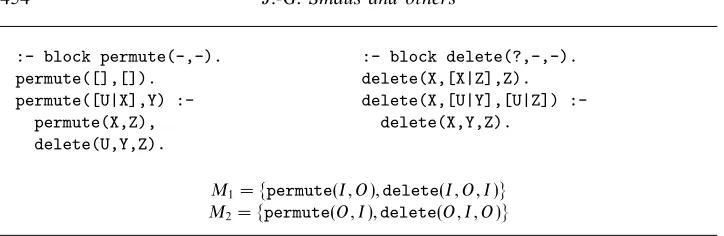
:- block permute(-,-). permute([],[]). permute([U|X],Y)
:-permute(X,Z), delete(U,Y,Z).
:- block delete(?,-,-). delete(X,[X|Z],Z). delete(X,[U|Y],[U|Z])
:-delete(X,Y,Z).
M1={permute(I,O),delete(I,O,I)}
[image:9.595.117.479.123.241.2]M2={permute(O,I),delete(O,I,O)}
Fig. 1. Thepermuteprogram.
A program P is permutation nicely moded if all of its clauses are. A nicely moded program corresponding toP is a program obtained fromP by replacing every clause C inP with a nicely moded clause corresponding to C.
In Lemma 3.3, on which many results of this paper depend, we require a program not only to be permutation nicely moded, but also input-linear (see section 2.2).
Example 3.2
The program in figure 1 is nicely moded and input-linear in mode M1.4 In mode
M2 it is permutation nicely moded and input-linear. In particular, the second
clause for permute is h2,1i-nicely moded. In ‘test mode’, that is, {permute(I,I),
delete(I,I,O)}, it is permutation nicely moded, but not input-linear, because the
first clause fordeleteis not input-linear.
We show that there is a persistence property for permutation nicely-modedness similar to that for nicely-modedness (Apt and Luitjes, 1995).
Lemma 3.3
Let Q = a1, . . . , an be a π-nicely moded query and C = h ← b1, . . . , bm be a ρ -nicely moded, input-linear clause where vars(Q)∩vars(C) = ∅. Suppose for some k ∈ {1, . . . , n}, h and ak are unifiable. Then the resolvent ofQ andC with selected atom ak is̺-nicely moded, where the derived permutation̺on {1, . . . , n+m−1}is defined by̺(i) =
π(i) ifi < k, π(i)< π(k) π(i) +m−1 ifi < k, π(i)> π(k) π(k) +ρ(i−k+ 1)−1 ifk6i < k+m
π(i−m+ 1) ifk+m6i < n+m, π(i−m+ 1)< π(k) π(i−m+ 1) +m−1 ifk+m6i < n+m, π(i−m+ 1)> π(k).
Proof
Let θ be the MGU of h and ak. By Def. 3.1, we have that aπ−1(1), . . . , aπ−1(n) and
4For convenient reference, the modes are included in the figure. Also, the program contains block
a1 a2 a3 a4
a3 a4 a2 a1
PP PP PPP P @ @@ b1 b2 b2 b1
a1 b1 b2 a3 a4 resolve
-a3 a4 b2 b1 a1
XX
XXXX
[image:10.595.116.477.122.210.2]XXXX
Fig. 2. The derived permutation̺for the resolvent.
h←bρ−1(1), . . . , bρ−1(m)are nicely moded andhis input-linear. Thus by Lemma 11 (Apt and Luitjes, 1995)
(aπ−1(1), . . . , aπ−1(π(k)−1), bρ−1(1), . . . , bρ−1(m), aπ−1(π(k)+1), . . . , aπ−1(n))θ
is nicely moded, and hence (a1, . . . , ak−1, b1, . . . , bm, ak+1, . . . , an)θ is ̺-nicely moded.
q
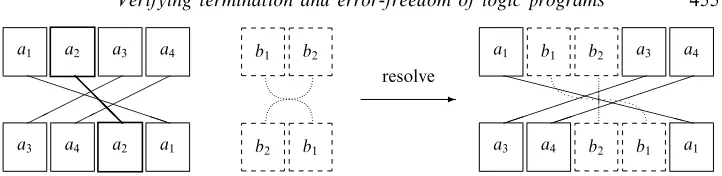
Figure 2 illustrates ̺ when Q = a1, a2, a3, a4, π = h4,3,1,2i, C = h ← b1, b2,
ρ = h2,1i, and k = 2. Thus ̺ = h5,4,3,1,2i. Observe that, at each step of a derivation, the relative order of atoms given by the derived permutation is preserved. By a straightforward induction on the length of a derivation, using the definition of ̺ for the base case, we obtain the following corollary.
Corollary 3.4
Let P be a permutation nicely moded, input-linear program, Q = a1, . . . , an be a π-nicely moded query and i, j ∈ {1, . . . , n} such that π(i) < π(j). Let Q;. . .;R be a derivation for P and suppose R =b1, . . . , bm is ρ-nicely moded. If for some k, l ∈ {1, . . . , m},bkis a descendant ofaiandblis a descendant ofaj, thenρ(k)< ρ(l).
Note that derivations of a permutation nicely moded query and a permutation nicely moded, input-linear program are occur-check free. This is is a trivial conse-quence of Theorem 13 (Apt and Luitjes, 1995). In section 7.3, we discuss ways in which the condition of input-linearity in Lemma 3.3 can be weakened.
3.2 Permutation well typed programs
In awell typedquery (Apt and Luitjes, 1995; Apt and Pellegrini, 1994; Bronsard et al., 1992), the first atom is correctly typed in its input positions. Furthermore, given a well typed queryQ, a, Q′and assuming LD-derivations, ifQis resolved away, thena becomes correctly typed in its input positions. We generalise this topermutation well typed (previously calledproperly typed(Apt, 1997)). As with the modes, we assume that the type associated with each argument position is given. In the examples, the types will be the natural ones that would be expected.
Definition 3.5
isπ-well typedif for alli∈ {1, . . . , n}andL= 1
|=
^
L6π(j)<π(i) tj:Tj
⇒si:Si. (1)
The clause p(t0,sn+1)←Q, where p(T0,Sn+1) is the type ofp, is π-well typedif (1)
holds for alli∈ {1, . . . , n+ 1}andL= 0.
Apermutation well typed query (clause, program) and a well typed query (clause, program) corresponding to a query (clause, program) are defined in analogy to
Definition 3.1.
Example 3.6
Consider the program in figure 1 with type{permute(list, list),delete(any, list, list)}. It is well typed for modeM1, and permutation well typed for modeM2, with the same
permutations as in Example 3.2. The same holds assuming type {permute(nl, nl),
delete(num, nl, nl)}.
Permutation well-typedness is also a persistent condition. The proof is analogous to Lemma 3.3, but using Lemma 23 instead of Lemma 11 (Apt and Luitjes, 1995).
Lemma 3.7
Let Q=a1, . . . , an be aπ-well typed query andC=h←b1, . . . , bmbe aρ-well typed clause where vars(Q)∩vars(C) =∅. Suppose for somek ∈ {1, . . . , n}, h andak are unifiable. Then the resolvent ofQandC with selected atomakis̺-well typed, where ̺ is the derived permutation (see Lemma 3.3).
Generalising Theorem 26 (Apt and Luitjes, 1995), permutation well-typedness can be used to show that derivations do not flounder (Smaus, 1999).
3.3 Permutation simply typed programs
We now definepermutation simply-typedness. The namesimply typedis a combination of simply moded (Apt and Luitjes, 1995) and well typed. In a permutation simply typed query, the output positions are filled with variables, and therefore they can always be instantiated so that all atoms in the query are correctly typed.
Definition 3.8
[Permutation simply typed] Let Q = p1(s1,t1), . . . , pn(sn,tn) be a query and π a permutation on {1, . . . , n}. Then Q is π-simply typed if it is π-nicely moded and π-well typed, andt1, . . . ,tn is a vector ofvariables.
The clause p(t0,sn+1) ← Q is π-simply typed if it is π-nicely moded and π-well
typed,t1, . . . ,tnis a vector ofvariablesandt0is a vector of flat type-consistent terms
that has a variable in each position of variable type.
A permutation simply typed query (clause, program) and a simply typed query (clause, program)corresponding toa query (clause, program) are defined in analogy
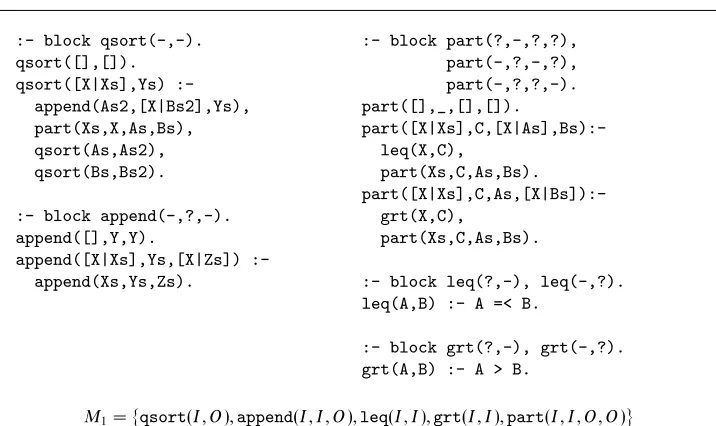
:- block qsort(-,-). qsort([],[]). qsort([X|Xs],Ys)
:-append(As2,[X|Bs2],Ys), part(Xs,X,As,Bs), qsort(As,As2), qsort(Bs,Bs2).
:- block append(-,?,-). append([],Y,Y).
append([X|Xs],Ys,[X|Zs]) :-append(Xs,Ys,Zs).
:- block part(?,-,?,?), part(-,?,-,?), part(-,?,?,-). part([],_,[],[]).
part([X|Xs],C,[X|As],Bs):-leq(X,C),
part(Xs,C,As,Bs).
part([X|Xs],C,As,[X|Bs]):-grt(X,C),
part(Xs,C,As,Bs).
:- block leq(?,-), leq(-,?). leq(A,B) :- A =< B.
:- block grt(?,-), grt(-,?). grt(A,B) :- A > B.
M1={qsort(I,O),append(I,I,O),leq(I,I),grt(I,I),part(I,I,O,O)}
[image:12.595.117.475.131.344.2]M2={qsort(O,I),append(O,O,I),leq(I,I),grt(I,I),part(O,I,I,I)}
Fig. 3. Thequicksortprogram.
Example 3.9
Figure 3 shows a version of thequicksortprogram. Assume the type{qsort(nl, nl),
append(nl, nl, nl), leq(num, num), grt(num, num), part(nl, num, nl, nl)}. The program is permutation simply typed for modeM1. It is not permutation simply typed for
mode M2, due to the non-variable term[X|Bs2]in an output position.
The persistence properties stated in Lemmas 3.3 and 3.7 are independent of the selectability of an atom in a query. For permutation simply typed programs, this persistence property only holds if the selected atom is sufficiently instantiated in its input arguments. This motivates the following definition.
Definition 3.10
[Bound/free] Let P be a permutation well typed program. An input position of a predicatep inP isboundif there is a clause headp(. . .) inP that has a non-variable term in that position. An output position of a predicatep in P isbound if there is an atomp(. . .) in a clause body inP that has a non-variable term in that position. A position isfreeif it is not bound.
We denote the projection of a vector of arguments ronto its free positions asrf
,
and onto its bound positions asrb.
Note that for a permutation simply typed program, there are no bound output positions, and bound input positions must be of non-variable type.
Lemma 3.11
LetQ=p1(s1,t1), . . . , pn(sn,tn) be aπ-simply typed query, and letC =pk(v0,um+1)←
vars(Q) =∅. Suppose that for some k ∈ {1, . . . , n}, sk is non-variable in all bound input positions5 andθis the MGU of p
k(sk,tk) andpk(v0,um+1). Then
1. there exist substitutionsθ1, θ2 such thatθ=θ1θ2 and
(a) v0θ1=sk anddom(θ1)⊆vars(v0),
(b) tkθ2=um+1θ1 anddom(θ2)⊆vars(tk); 2. dom(θ)⊆vars(tk)∪vars(v0);
3. dom(θ)∩vars(t1, . . . ,tk−1,v1, . . . ,vm,tk+1, . . . ,tn) =∅;
4. the resolvent ofQandC with selected atompk(sk,tk) is̺-simply typed, where ̺is the derived permutation (see Lemma 3.3). (For proof, see the Appendix.)
The following corollary of Lemma 3.11 (4) holds, since by Definition 3.5, the leftmost atom in a simply typed query is non-variable in its input positions of non-variable type.
Corollary 3.12
Every LD-resolvent of a simply typed query Q and a simply typed, input-linear clauseC, where vars(C)∩vars(Q) =∅, is simply typed.6
Before studying permutation simply typed programs any further, we now introduce a generalisation of this class.
3.4 Permutation robustly typed programs
The program in figure 3 is not permutation simply typed in mode M2, due to
the non-variable term [X|Bs2] in an output position. It has been acknowledged previously that it is difficult to reason about queries where non-variable terms in output positions are allowed, but on the other hand, there are natural programs where this occurs (Apt and Etalle, 1993).
We define permutation robustly-typedness, which is a carefully crafted extension of permutation simply-typedness, allowing for non-variable but flat terms in out-put positions. It has been designed so that a persistence property analogous to Lemmas 3.3, 3.7 and 3.11 holds.
Definition 3.13
[Permutation robustly typed] Assume a permutation well typed programP where the bound positions are of non-variable type. Let Q=p1(s1,t1), . . . , pn(sn,tn) be a query (using predicates from P) andπ a permutation on{1, . . . , n}. Then Q isπ-robustly typed if it isπ-nicely moded andπ-well typed, tf
1, . . . ,tfn is a vector of variables, and tb
1, . . . ,t b
n is a vector of flat type-consistent terms.
The clausep(t0,sn+1)←Qisπ-robustly typedif it isπ-nicely moded;π-well typed;
1. tf
0, . . . ,tfnis a vector of variables, andtb0, . . . ,tbn is a vector of flat type-consistent terms; and
5This is similar to the assumption ‘the delay declarations imply matching’ (Apt and Luitjes, 1995). 6This even holds without requiringCto be input-linear (Smaus, 1999, Lemma 7.3), but here we do not
:- block treeList(-,-). treeList(leaf,[]).
treeList(node(L,Label,R),List) :-append(LList,[Label|RList],List), treeList(L,LList),
treeList(R,RList).
:- block append(-,?,-). append([],Y,Y).
append([X|Xs],Ys,[X|Zs]) :-append(Xs,Ys,Zs).
M1={treeList(I,O),append(I,I,O)}
M2={treeList(O,I),append(O,O,I)}
Fig. 4. Converting trees to lists, or vice versa.
2. if a position in sb
n+1 of type τ is filled with a variable x, then x also fills a
position of typeτin tb 0, . . . ,tbn.
A permutation robustly typed query (clause, program) and a robustly typed query (clause, program)corresponding toa query (clause, program) are defined in analogy
to Definition 3.1.
Note that any permutation simply typed program is permutation robustly typed, where all output positions are free.
Example 3.14
Recall the program in figure 3. It is permutation robustly typed in mode M2, and
the second position ofappendis the only bound output position. Note in particular that Condition 2 of Definition 3.13 is met for the recursive clause of append: the variable Ysfills an output position of the head and also an output position of the body. Moreover, the program is trivially permutation robustly typed in mode M1.
Example 3.15
The program in figure 4 converts binary trees into lists and vice versa. Assuming type{treeList(tree, list),append(list, list, list)}, the program is permutation robustly typed in mode M2, and the second position of append is the only bound output
position. It is also permutation robustly typed in modeM1, where all output positions
are free.
The following lemma shows a persistence property of permutation robustly-typedness, and shows, furthermore, that a derivation step cannot instantiate the input arguments of the selected atom.
Lemma 3.16
Let Q = p1(s1,t1), . . . , pn(sn,tn) a π-robustly typed query and C = pk(v0,um+1) ←
q1(u1,v1), . . . , qm(um,vm) a ρ-robustly typed, input-linear clause where vars(Q) ∩ vars(C) = ∅. Suppose that for some k ∈ {1, . . . , n}, pk(sk,tk) is non-variable in all bound input positions andθ is the MGU ofpk(sk,tk) andpk(v0,um+1).
where̺is the derived permutation (see Lemma 3.3). Moreover,dom(θ)∩vars(sk) =∅. (For proof, see the Appendix.)
We now define programs where the blockdeclarations fulfill a natural minimum (1) and maximum (2) requirement. The minimum requirement states that selected atoms must fulfill the assumption of Lemmas 3.11 and 3.16. The maximum require-ment is needed in section 5.2. In other words, we define programs where the ‘static’ concept of modes and the ‘dynamic’ concept of block declarations correspond in the natural way.
Definition 3.17
[Input selectability] Let P be a permutation robustly typed program. P has input selectability if an atom using a predicate in P that has variables in all free output positions is selectable in P
1. only if it is non-variable in all bound input positions; and 2. if it is non-variable in all input positions of non-variable type.
Note that the above definition is aimed at atoms in permutation robustly typed queries, since these atoms have variables in all free output positions.
Example 3.18
Consider append(O,O,I) where the second position is the only bound output position, as used in the programs in figure 3 in modeM2 and figure 4 in mode M2.
The program forappend has input selectability.
Now consider append(I,I,O) where the output position is free, as used in the programs in figure 3 in modeM1and figure 4 in modeM1. The program forappend
has input selectability. Note that the block declaration for appendis the one that is usually given (Hill and Lloyd, 1994; L¨uttringhaus-Kappel, 1993; Marchiori and
Teusink, 1999).
The following is a corollary of Lemma 3.16 needed to prove Lemma 5.4.
Corollary 3.19
LetP be a permutation robustly typed, input-linear program with input selectability, Q=a1, . . . , anaπ-robustly typed query andi, j ∈ {1, . . . , n}such thatπ(i)< π(j). Let
Q;. . .; (b1, . . . , bm); (b1, . . . , bl−1, B, bl+1, . . . , bm)θ
be a delay-respecting derivation and k∈ {1, . . . , m}, such thatbk is a descendant of ai andbl is a descendant ofaj. Thendom(θ)∩vars(bk) =∅.
Proof
Suppose that b1, . . . , bm isρ-robustly typed. By Corollary 3.4, we haveρ(k)< ρ(l). Suppose bl =pl(sl,tl).
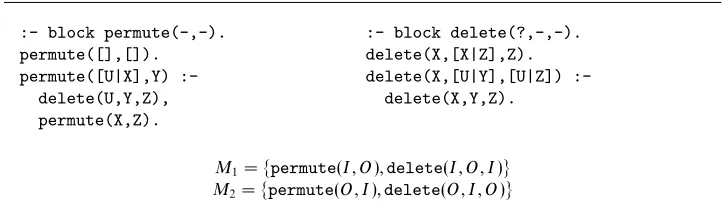
:- block permute(-,-). permute([],[]). permute([U|X],Y)
:-delete(U,Y,Z), permute(X,Z).
:- block delete(?,-,-). delete(X,[X|Z],Z). delete(X,[U|Y],[U|Z])
:-delete(X,Y,Z).
M1={permute(I,O),delete(I,O,I)}
[image:16.595.115.476.135.240.2]M2={permute(O,I),delete(O,I,O)}
Fig. 5. Putting recursive calls last in thepermuteprogram.
Intuitively, the corollary says that ifπ(i)< π(j), then noaj-step will ever instantiate a descendent ofai.
We conclude this section with a statement about permutation simply typed pro-grams, which we could not present earlier since it relies on the definition of input selectability. It says that in a derivation for a permutation simply typed program and query, it can be assumed without loss of generality that the output positions in each query are filled with variables that occur in the initial query or in some clause body used in the derivation.
Corollary 3.20
Let P be a permutation simply typed program with input selectability and Q0 be
a permutation simply typed query. Let θ0 =∅ and ξ = hQ0, θ0i;hQ1, θ1i;. . . be a
delay-respecting derivation of P∪ {Q0}. Then for all i>0, if x is a variable in an
output position inQi, thenxθi=x.
Proof
The proof is by induction on the position i in the derivation. The base casei= 0 is trivial sinceθ0=∅. Now suppose the result holds for some iand Qi+1 exists. By
Lemma 3.11 (4), Qiθiis permutation simply typed. Thus the result follows for i+ 1 by Lemma 3.11 (3). q
4 Termination and speculative bindings
Like most approaches to the termination problem (De Schreye and Decorte, 1994), we are interested in ensuring thatallderivations of a query are finite. Therefore the clause order in a program is irrelevant. Furthermore, we do not prove termination as such, but rather reduce the problem of proving termination for a program and query with left-based derivations to that with LD-derivations.
In this section, we present two complementing methods of showing termination. These are explained in the following example.
Example 4.1
Assuming left-based derivations, the program given in figure 1 loops for the query
permute(V,[1])(hence, in modeM2) becausedeleteproduces aspeculative output
:- block delete(?,-,-). delete(X,[X|Z],Z).
delete(X,[U|[H|T]],[U|Z]) :- delete(X,[H|T],Z).
Fig. 6. Most specific version ofdelete(O,I,O).
that this binding will never have to be undone. Termination in modes M1 andM2
can be ensured by swapping the atoms in the second clause, as shown in Fig. 5. This technique has been described asputting recursive calls last(Naish, 1992). To explain why the program terminates, we have to apply a different reasoning for the different modes.
In modeM2, the atom that produces the speculative output occurstextually before
the atom that consumes it. This means that the consumer waits until the producer has completed (undone the speculative binding). The program does not usespeculative bindings. In modeM1, the program does notmakespeculative bindings.
Note that termination for this example depends on left-based derivations, and thus any method that abstracts from the selection rule must fail.
The methods presented in this section can be used to prove that the programs in figures 4–7 terminate, but they do not work for the programs in figures 3 and 8. They formalise previous heuristics (Naish, 1985; Naish, 1992) and rely on conditions that are easy to check.
4.1 Termination by not using speculative bindings
In LD-derivations, speculative bindings are never used (Naish, 1992). A left-based derivation isan LD-derivation, provided the leftmost atom in each query is always selectable. Hence by Lemma 3.7, we have the following proposition.
Proposition 4.2
Let Q be a well typed query and P a well typed program such that an atom is selectable in P whenever its input positions of non-variable type are non-variable. Then every left-based derivation of P∪ {Q}is an LD-derivation.
We now give two examples of programs where by Proposition 4.2, we can use any method for LD-derivations to show termination for any well typed query. Note that the method of section 5 is not applicable for the program in Example 4.4 (because it is is not permutation robustly typed).
Example 4.3
Consider the program in figure 5 with mode M2 and either of the types given in
Example 3.6. This program is well-typed.
Example 4.4
Regarding this subsection, one may wonder: what is the point in considering derivations for programs withblockdeclarations where in effect we show that those
block declarations are redundant, that is, the program is executed left-to-right? However, one has to bear in mind that a program might also be used in another mode, and therefore, theblockdeclarations may be necessary.
4.2 Termination by not making speculative bindings
Some programs and queries have the nice property that there cannot be any failing derivations. Bossi and Cocco (1999) have identified a class of programs called
noFD having this property.Non-speculative programs are similar, but there are two differences: the definition of noFD programs only allows forLD-derivations, but on the other hand, the definition of non-speculative programs requires that the clause heads are input-linear.
Definition 4.5
[non-speculative] A program P isnon-speculativeif it is permutation simply typed and input-linear, and every simply typed atom using a predicate in P is unifiable
with some clause head inP.
Example 4.6
Both versions of the permuteprogram (figures 1 and 5), with either type given in Example 3.6, are non-speculative in modeM1. Every simply typed atom is unifiable
with at least one clause head. Both versions are not non-speculative in mode M2,
becausedelete(A,[],B)is not unifiable with any clause head.
Example 4.7
The program in figure 4 is non-speculative in mode M1. However, it is not
non-speculative in mode M2 because it is not permutation simply typed, due to the
non-variable term [Label|List]in an output position.
A delay-respecting derivation for a non-speculative program P with input se-lectability and a permutation simply typed query cannot fail.7 However it could still be infinite. The following theorem says that this can only happen if the simply typed program corresponding toP has an infiniteLD-derivation for this query.
Theorem 4.8
Let P be a non-speculative program with input selectability andP′ a simply typed program corresponding to P. Let Q be a permutation simply typed query and Q′ a simply typed query corresponding to Q. If there is an infinite delay-respecting derivation of P ∪ {Q}, then there is an infinite LD-derivation of P′∪ {Q′}. (For proof, see the Appendix.)
Theorem 4.8 says that for non-speculative programs, the atom order in clause bodies is irrelevant for termination.
:- block is_list(-). is_list([]).
is_list([X|Xs]):-is_list(Ys), equal_list(Xs,Ys).
:- block equal_list(-,?). equal_list([],[]).
equal_list([X|Xs],[X|Ys]):-equal_list(Xs,Ys).
Fig. 7. Theis listprogram.
Note that any program that uses tests cannot be non-speculative. In figure 3, assuming mode M1, the atoms leq(X,C) and grt(X,C) are tests. These tests are
exhaustive, i.e. at least one of them succeeds (Bossi and Cocco, 1999). This suggests a generalisation of non-speculative programs (Pedreschi and Ruggieri, 1999) (see section 8).
We now give an example of a program for which termination can be shown using Theorem 4.8 but not using the method of section 5 (see also Example 5.11).
Example 4.9
Consider the program in figure 7, where the mode is{is list(I),equal list(I,O)} and the type is {is list(list), equal list(list, list)}. The program is permutation simply typed (the second clause is h2,1i-simply typed) and non-speculative, and all LD-derivations for the corresponding simply typed program terminate. Therefore all delay-respecting derivations of a permutation simply typed query and this program
terminate.
5 Termination and insufficient input
We now present an alternative method for showing termination that overcomes some of the limitations of the methods presented in the previous section. In particular, the methods can be used for the programs in figures 3 and 8 as well as figures 4 and 5. In practice, we expect the method presented here to be more useful, although, as figures 6 and 7 show, it does not subsume the method of the previous section.
As explained in Example 4.1, termination of permute(O,I) can be ensured by applying the heuristic of putting recursive calls last (Naish, 1992). The following example however shows that even this version of permute(O,I) can cause a loop depending on how it is called within some other program.
Example 5.1
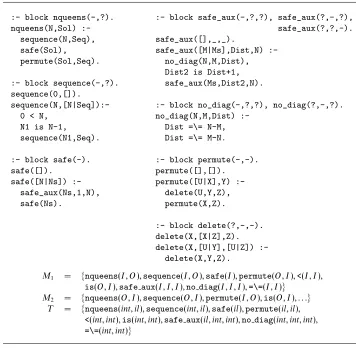
Figure 8 shows a program for then-queens problem, which usesblockdeclarations to implement the test-and-generate paradigm. With the modeM1and the typeT, the
first clause ish1,3,2i-nicely moded andh1,3,2i-well typed. Moreover, all left-based derivations for the query nqueens(4,Sol)terminate.
However, if in the first clause, the atom order is changed by moving
:- block nqueens(-,?). nqueens(N,Sol)
:-sequence(N,Seq), safe(Sol), permute(Sol,Seq).
:- block sequence(-,?). sequence(0,[]).
sequence(N,[N|Seq]):-0 < N,
N1 is N-1, sequence(N1,Seq).
:- block safe(-). safe([]).
safe([N|Ns]) :-safe_aux(Ns,1,N), safe(Ns).
:- block safe_aux(-,?,?), safe_aux(?,-,?), safe_aux(?,?,-). safe_aux([],_,_).
safe_aux([M|Ms],Dist,N) :-no_diag(N,M,Dist), Dist2 is Dist+1, safe_aux(Ms,Dist2,N).
:- block no_diag(-,?,?), no_diag(?,-,?). no_diag(N,M,Dist)
:-Dist =\= N-M, Dist =\= M-N.
:- block permute(-,-). permute([],[]). permute([U|X],Y)
:-delete(U,Y,Z), permute(X,Z).
:- block delete(?,-,-). delete(X,[X|Z],Z). delete(X,[U|Y],[U|Z])
:-delete(X,Y,Z).
M1 = {nqueens(I,O),sequence(I,O),safe(I),permute(O,I),<(I,I),
is(O,I),safe aux(I,I,I),no diag(I,I,I),=\=(I,I)}
M2 = {nqueens(O,I),sequence(O,I),permute(I,O),is(O,I), . . .}
T = {nqueens(int, il),sequence(int, il),safe(il),permute(il, il),
<(int, int),is(int, int),safe aux(il, int, int),no diag(int, int, int),
[image:20.595.114.470.134.482.2]=\=(int, int)}
Fig. 8. A program forn-queens.
for permute(Sol,[4|T]) to be correctly typed in its input position: permute is
called withinsufficient input.
To ensure termination, each atom that may loop when called with insufficient input should be placed sufficiently late; all producers of input for that atom must occur textually earlier. This assumes left-based derivations. Note that this explains in particular why in the recursive clause for permute, the recursive call should be placed last, and hence we are effectively refining the heuristic proposed by Naish (1992). Note also that in nicely and well moded programs, all atoms are placed sufficiently late in this sense.
5.1 Robust predicates
In this subsection, derivations are not required to be left-based. The statements hold for arbitrary delay-respecting derivations, and thus the textual position of an atom in a query is irrelevant. Therefore we can, for just this subsection, assume that the programs and queries are robustly typed (rather than justpermutationrobustly typed). This simplifies the notation. In section 5.2, we go back to allowing for arbitrary permutations.
Definition 5.2
[robust] LetP be a robustly typed, input-linear program with input selectability. A predicatepinP isrobustif, for each robustly typed queryp(s,t), any delay-respecting derivation ofP∪ {p(s,t)}is finite. An atom is robustif its predicate is.
By definition, a delay-respecting derivation for a query consisting ofonerobust atom terminates. We will see shortly however that this extends to queries of arbitrary
length. To prove this, we first need the following simple lemma.
Lemma 5.3
LetQ=p1(s1,t1), . . . , pn(sn,tn) be a robustly typed query. Then there exists a substi-tution σ such thatdom(σ) =vars(t1, . . . ,tn−1), andpn(sn,tn)σ is robustly typed.
Proof
Since Q is robustly typed and types are closed under instantiation, there exists a substitution σ such thatdom(σ) =vars(t1, . . . ,tn−1), ran(σ) =∅, and (t1, . . . ,tn−1)σ is
correctly typed.
Since Qis nicely moded, dom(σ)∩vars(tn) =∅. Sinceran(σ) =∅, it follows that vars(snσ)∩vars(tnσ) =∅ and hencepn(sn,tn)σis nicely moded.
SinceQis well typed, it follows by Def. 3.5 thatpn(sn,tn)σ is well typed.
Therefore, asQis robustly typed andtnσ=tn, it follows thatpn(sn,tn)σis robustly typed. q
The following lemma says that a robust atom cannot proceed indefinitely unless it is repeatedly ‘fed’ by some other atom.
Lemma 5.4
Let P be a robustly typed, input-linear program with input selectability andF, b, H a robustly typed query where b is a robust atom. A delay-respecting derivation of P ∪ {F, b, H}can have infinitely manyb-steps only if it has infinitely many a-steps, for some a∈F. (For proof, see the Appendix.)
The following lemma is a consequence, and states that the robust atoms in a query on their own cannot produce an infinite derivation.
Lemma 5.5
Proof
Let ξbe an infinite delay-respecting derivation ofP∪ {Q}. Assume, for the purpose of deriving a contradiction, that ξ contains only finitely many steps where a non-robust atom is resolved. Then there exists an infinite suffix ˜ξ of ξ containing no steps where a non-robust atom is resolved. Consider the first query ˜Q of ˜ξ. Then there is at least one atom in ˜Qthat has infinitely many descendants. Let ˜a be the leftmost of these atoms. Then as ˜ais robust, we have a contradiction to Lemma 5.4.
q
Approaches to termination usually rely on measuring the size of the input in a query. We agree with Etalleet al. (1999) that it is reasonable to make this dependency explicit. This gives rise to the notion of moded level mapping, which is an instance of level mapping introduced by Bezem (1993) and Cavedon (1989). Since we use well typed programs instead of well moded ones (Etalle et al., 1999), we have to generalise the concept further.
In the following definition,BInpP denotes the set of atoms using predicates occurring in P, that are correctly typed in their input positions.
Definition 5.6
[moded typed level mapping] Let P be a program. A function |.|:BInpP →IN is a
moded typed level mappingif for eachp(s,t)∈BInpP
• for anyu, we have|p(s,t)|=|p(s,u)|; • for any substitutionθ,|p(s,t)|=|p(sθ,t)|.
Fora∈BInpP ,|a|is thelevelofa.
Thus, the level of an atom inBInpP only depends on the terms in the input positions. Moreover, all instances of an atom in BInpP have the same level. Here our concept differs from moded level mappings. Also, our concept is defined for atoms in BInpP
that are not necessarily ground, but this difference only concerns the presentation. Since we only consider moded typed level mappings, we will simply call themlevel mappings.
The following standard concept is widely used in the termination literature (Apt, 1997).
Definition 5.7
[Depends on] Letp, qbe predicates in a programP. Thenp refers toq if there is a clause inP withp in its head andq in its body, andp depends onq (writtenp⊒q) if (p, q) is in the reflexive, transitive closure ofrefers to. We writep=q ifp⊒q and q6⊒p, andp≈q ifp⊒q andq⊒p.
Abusing notation, we shall also use the above symbols for atoms, where p(s,t)⊒ q(u,v) stands for p ⊒ q, and likewise for = and ≈. Furthermore, we denote the equivalence class of a predicatepwith respect to≈as [p]≈.
Definition 5.8
[well-recurrent] LetP be a program and |.| a level mapping. A clause C =h←B iswell-recurrent (with respect to |.|) if, for every a inB such thata≈h, and every substitution θ such thataθ, hθ∈BInpP , we have|hθ|>|aθ|.
A program (set of clauses) is well-recurrent with respect to |.| if each clause is
well-recurrent with respect to |.|.
Well-recurrence resembles well-acceptability (Etalle et al., 1999) in that only for atoms a≈hthere has to be a decrease, and that it assumes moded level mappings. It differs from well-acceptability, but also from delay-recurrence (Marchiori and Teusink, 1999), in that it does not refer to a model of the program.
To show that a predicatep is robust, we assume that all predicates q withp=q have already been shown to be robust.
Lemma 5.9
Let P be a robustly typed, input-linear program with input selectability and p a predicate in P. Suppose all predicates q with p = q are robust, and all clauses defining predicates q ∈[p]≈ are well-recurrent with respect to some level mapping |.|. Thenpis robust. (For proof, see the Appendix.)
Example 5.10
We demonstrate for the program in figure 8, with mode M1 and type T, how
Lemma 5.9 is used.8 Given that the built-in=\=terminates, it follows thatno diag
is robust. With the list length of the first argument of safe aux as level mapping, the clauses defining safe aux are well-recurrent so that safe aux is robust. In a
similar way, we can show thatsafe is robust.
Example 5.11
Consider again Example 4.9. We conjecture that is list is robust, but Lemma 5.9 cannot show this. While Example 4.9 is contrived, it suggests that the method of section 4.2 might be useful whenever Lemma 5.9 fails to prove that a predicate is robust. On the other hand, one could envisage to improve the method for showing robustness, for example by exploiting information given by a modelof the
program (Etalleet al., 1999).
5.2 Well fed programs
As seen in Example 5.1, there are predicates for which requiring delay-respecting derivations is not sufficient for termination. In general, the selection rule must be taken into account. We assume left-based derivations. Consequently, we now give up the assumption, made to simplify the notation, that the clauses and query are robustly typed, rather than just permutationrobustly typed. All statements from the previous subsection generalise to permutation robustly typed in the obvious way.
Asafeposition in a query is a position that is ‘sufficiently late’.
8We assume that the built-ins used here meet the conditions of Definition 3.17. We will see in section 7.1
Definition 5.12
[Safe position] For a permutation π, i is a called safe position for π if for all j,
π(j)< π(i) impliesj < i.
Whenever we simply speak of an atom in a safe position, we mean that this atom occurs in a π-robustly typed queryQin the ith position andiis a safe position for π, whereQandπ are clear from the context.
The next lemma says that in a left-based derivation, atoms whose ancestors are all in safe positions can never be waiting (see Definition 2.2).
Lemma 5.13
Let P be a permutation robustly typed program with input selectability, Q0 a
permutation robustly typed query and ξ =Q0;. . .;Qi. . . a left-based derivation of P∪ {Q0}. Then no atom inQifor which all ancestors are in safe positions is waiting.
Proof
Suppose Qi=a1, . . . , anisπi-robustly typed (note thatπiexists by Lemma 3.16). Let ak be an atom in Qi with all its ancestors in safe positions. By Def. 3.5, aπi−1(1) is
correctly typed in its input positions, and hence selectable. Moreover, since k is a safe position,πi−1(1)6k. It follows that if theproper ancestorsofakare not waiting, thenak is not waiting.
The result follows by induction on i. When i = 0, ak has no proper ancestors and hence, by the above paragraph, ak is not waiting. When i >0, then all proper ancestors of ak are in safe positions (by hypothesis) and hence, by the inductive hypothesis, they are not waiting. Thus, by the above paragraph, ak is not waiting.
q
To show Theorem 5.18, we need the following corollary of Lemma 5.13.
Corollary 5.14
Make the same assumptions as in Lemma 5.13. If Qi = a1, . . . , an is πi-robustly typed and the atom ak selected inQi;Qi+1 has only ancestors in safe positions, then
πi(k) = 1 (and henceak is correctly typed in its input positions).
A permutation robustly typed query is calledwell fedif each atom is robust or in a safe position. Note that if a predicatepcan be shown to be robust using Lemma 5.9, then all predicates q withp=q are also robust. However, this is a property of the method for showing robustness, not of robustness itself. To simplify the proof of Theorem 5.18, we want to exclude the pathological situation that p is robust but some predicate q withp=q is not.
Definition 5.15
[Well fed] Aπ-robustly typed query iswell fed if for each of its atomsp(s,t), either p(s,t) is in a safe position forπ, or all predicates q withp⊒q are robust. A clause is well fed if its body is. A programP iswell fedif all of its clauses are well fed and
input-linear, and P has input selectability.
Proposition 5.16
LetP andQbe a well fed program and query, andξ a derivation ofP∪ {Q}. Then each atom in each query inξis either robust, or all its ancestors are in safe positions.
Example 5.17
The program in figure 4 is well fed in both modes. The program in figure 8 is well fed in modeM1. It is not well fed in modeM2, because it is not permutation nicely
moded in this mode: in the second clause forsequence,N1occurs twice in an output
position.
The following theorem reduces the problem of showing termination of left-based derivations for a well fed program to showing termination of LD-derivations for a corresponding robustly typed program.
Theorem 5.18
Let P and Q be a well fed program and query, and P′ and Q′ a robustly typed program and query corresponding toP andQ. If every LD-derivation ofP′∪ {Q′} is finite, then every left-based derivation of P ∪ {Q}is finite. (Proof see Appendix)
Given that for the programs of figures 3, 5, 4 and 8, the corresponding robustly typed programs terminate for robustly typed queries, it follows by the above theorem that the original programs terminate for well fed queries.
For the program of figure 8, our method can only show termination for the mode M1, but not forM2, although the program actually terminates forM2 (provided the block declarations are modified to allow forM2).
6 Freedom from errors related to built-ins
One problem with built-ins is that their implementation may not be written in Prolog. Thus, for the purposes of this paper, it is assumed that each built-in is conceptually defined by possibly infinitely many (fact) clauses (Sterling and Shapiro, 1986). For example, there could be facts ‘0 is 0+0.’, ‘1 is 0+1.’, and so forth.
To prove that a program is free from errors related to built-ins, we require it to be permutation simply typed. This applies also to the conceptual clauses for the built-ins.
Some built-ins produce an error if certain arguments have a wrong type, and others produce an error if certain arguments are insufficiently instantiated. For example,
Lemma 6.1
Let Q=p1(s1,t1), . . . , pn(sn,tn) be aπ-well typed query, wherepi(Si,Ti) is the type of pi for eachi∈ {1, . . . , n}. Suppose, for somek∈ {1, . . . , n},Sk is a vector of constant types, sk is a vector of non-variable terms, and there is a substitutionθ such that tjθ:Tj for allj withπ(j)< π(k). Thensk:Sk.
Proof
By Definition 3.5, skθ :Sk, and thusskθ is a vector of constants. Since sk is already a vector of non-variable terms, it follows that sk is a vector of constants and thus skθ=sk. Thereforesk:Sk. q
Note that if sk is of type Sk, then sk is ground. By Definition 3.8, for every permutation simply typed query Q, there is a θ such that Qθ is correctly typed in its output positions. Thus by Lemma 6.1, if the arithmetic built-ins have type num in all input positions, then it is enough to have blockdeclarations such that these built-ins are only selected when the input positions are non-variable. This is stated in the following theorem which is a consequence of Lemma 6.1.
Theorem 6.2
Let P be a permutation simply typed, input-linear program with input selectability and Q be a permutation simply typed query. Let p be a predicate whose input positions are all bound and of constant type. Then in any delay-respecting derivation of P ∪ {Q}, an atom using p will be selected only when its input arguments are correctly typed.
When we say that the input positions of a built-in are bound, we imply that the conceptual clause heads have non-variable terms in those positions.
Example 6.3
For the program in figure 3 in mode M1, no delay-respecting derivation for a
permutation simply typed query and this program can result in an instantiation or type error related to the arithmetic built-ins.
7 block declarations and equality tests
Runtime testing for instantiation has an overhead, and in the case of built-ins, can only be realised by introducing an auxiliary predicate (see figure 3). Therefore, in the following two subsections, we describe ways of simplifying the block declarations of a program. An additional benefit is that in some cases, we can even ensure that arguments are ground, rather than just non-variable. We will see in section 7.3 that this is useful in order to weaken the restriction that every clause head must be input-linear. We have postponed these considerations so far in order to avoid making the main arguments of this paper unnecessarily complicated.
7.1 Avoidingblock declarations for permutation simply typed programs
is always provided by the clause heads. For example, it is not necessary to have a
block declaration for < because when an atom usingsequence is called, the first argument of this atom is already ground. We show here how this intuition can be formalised. In the following definition, we consider a setBcontaining the predicates for which we want to omit the blockdeclarations.
Definition 7.1
[B-ground] LetP be a permutation simply typed program andBa set of predicates whose input positions are all of constant type.
A query is B-ground if it is permutation simply typed and each atom using a predicate inBhas ground terms in its input positions.
An argument position k of a predicate p inP is aB-position if there is a clause p(t0,sn+1) ← p1(s1,t1), . . . , pn(sn,tn) in P such that for some i where pi ∈ B, some variable in sialso occurs in positionkinp(t0,sn+1).
The programP isB-groundif everyB-position of every predicate inP is an input position of constant type, and an atom p(s,t), wherep6∈ B, is selectable only if it is
non-variable in theB-positions ofp.
Note that since a constant type is, in particular, a non-variable type, it is always possible to find block declarations such that both the requirement on selectability in the above definition and in Definition 3.17 (2) are fulfilled.
Example 7.2
The program in figure 8 is B-ground, where B={<, is, =\=}. The first position of sequence, the second position of safe aux, and all positions of no diag are B-positions.
The following theorem says that for B-ground programs, the input of all atoms using predicates in Bis always ground.
Theorem 7.3
Let P be a B-ground, input-linear program with input selectability, Qa B-ground query, and ξ a delay-respecting derivation of P ∪ {Q}. Then each query in ξ is B-ground.
Proof
The proof is by induction on the length of ξ. Let Q0=Qandξ =Q0;Q1;. . .. The
base case holds by the assumption thatQ0 isB-ground.
Now consider some Qj where j > 0 and Qj+1 exists. By Lemma 3.11 (4), Qj andQj+1 are permutation simply typed and hence type-consistent in all argument
positions. The induction hypothesis is that Qj isB-ground.
Let p(u,v) be the selected atom, C = p(t0,sn+1) ← p1(s1,t1), . . . , pn(sn,tn) be the clause andθthe MGU used in the stepQj;Qj+1. Consider an arbitraryi∈ {1, . . . , n}
such that pi∈ B.
Ifp6∈ B, then by the condition on selectability in Def. 7.1,p(u,v) is non-variable in theB-positions ofpand hence, since theB-positions are of constant type,p(u,v) is
by the induction hypothesis, and hencep(u,v) is a fortiori ground in allB-positions of p.
Thus it follows thatsiθis ground. Since the choice ofiwas arbitrary, and because of the induction hypothesis, it follows that Qj+1 isB-ground. q
In Theorem 7.3, the assumption that the predicates in B have input selectability is redundant. Atoms using predicates in B are only selected when their input is ground, simply because their input is ground at all times during the execution.
Example 7.4
In the program in figure 8, there are noblockdeclarations, and hence no auxiliaries, for the occurrences ofis,<and=\=, but there areblockdeclarations onsafe aux
andno diag that ensure the condition on selectability in Definition 7.1.
7.2 Simplifying the blockdeclarations using atoms in safe positions
By a simple observation, we can simplify the blockdeclarations for predicates that are only used in atoms occurring in safe positions. Consider a permutation robustly typed program P with input selectability and a permutation robustly typed query Q. Suppose we have a predicate p such that for allq withq⊒p, all atoms usingq in Qand clause bodies inP are in safe positions.
Then by Lemma 5.13, in any left-based derivation of P ∪ {Q}, an atom using p is never waiting. Thus, the block declarations do not delay the selection of atoms using p. Suppose we modify P by replacing the block declaration for p with the emptyblockdeclaration. Then the modified program has the same set of left-based derivations of Q as the original program. For example, the block declaration for
sequencein the program in figure 8 can be omitted.
7.3 Weakening input-linearity of clause heads
The requirement that clause heads are input-linear is needed to show the persistence of permutation nicely-modedness (Lemma 3.3). This is analogous to the same state-ment restricted to nicely-modedness (Apt and Luitjes, 1995, Lemma 11). However, the clause head does not have to be input-linear when the statement is further restricted to LD-resolvents (Apt and Pellegrini, 1994, Lemma 5.3). The following example by Apt (personal communication) demonstrates this difference.
Example 7.5
Consider the program
q(A). r(1). eq(A,A).
where the mode is {q(I),r(O),eq(I,I)}. Note thateq/2 is equivalent to the built-in
=/2. This program is nicely moded but not input-linear. The query
q(X), r(Y), eq(X,Y)
is nicely moded. The query q(X),r(X) is a resolvent of the above query, and it isnot
Requiring clause heads to be input-linear is undoubtedly a severe restriction. It means that it is not possible to check two input arguments for equality. However, this also indicates the reason why in the above example, resolvingeq(X,Y)is harmful:
eq is meant to be a check, clearly indicated by its mode eq(I,I), but in the given derivation step, it actually is not a check, since it binds variables.
It is easy to see that Lemma 3.3 still holds if Definition 3.1 is weakened by allowing = to be used in mode =(I,I), provided atoms using = are only resolved when both arguments are ground. Resolving the permutation nicely moded query Q1, s=t, Q2 selecting s=t, where s and t are ground, will yield the resolvent Q1, Q2,
which is permutation nicely moded.
The mode =(I,I) can be realised with a delay declaration such that an atom s=t is selected only when s and t are ground. In SICStus, this can be done using the built-in when (SIC, 1998). However we do not follow this line because this paper focuses onblockdeclarations, and because it would commit a particular occurrence of s=tto be a test in all modes in which the program is used.
Nevertheless, there are at least two situations when clause heads that are not input-linear can be allowed. First, one can exploit the fact that atoms are in safe positions, and secondly, that the arguments being checked for equality are of constant type.
In the first case, we assume left-based derivations. We could allow for clause heads p(t,s) where a variable xoccurs in several input positions, provided that
• all occurrences ofx intare in positions of ground type, and
• for each clause body and initial query for the program, each atom using a predicateq withq⊒p is in a safe position.
By Corollary 5.14, it is then ensured that multiple occurrences of a variable in the input of a clause head implement an equality check between input arguments. Therefore, Lemmas 3.3, 3.11 and 3.16 hold assuming this weaker definition of ‘input-linear’.
Example 7.6
Consider the program in figure 1 in mode {permute(I,I), delete(I,I,I)}. This program is not input-linear. Nevertheless, the program can be used in this mode provided that all arguments are of ground type and calls to permuteand delete
are always in safe positions.
In the second case, it is sufficient to assume delay-respecting derivations. We can use Theorem 6.2. This time, we have to allow for clause headsp(t,s) where a variable x occurs in several input positions, provided that
• xonly occursdirectlyand in positions of constant type int, and • an atom usingpis selectable only if these positions are non-variable.
:- block length(-,-). length(L,N)
:-len_aux(L,0,N).
:- block less(?,-), less(-,?). less(A,B)
:-A < B.
:- block len_aux(?,-,?), len_aux(-,?,-). len_aux([],N,N).
len_aux([_|Xs],M,N) :-less(M,N),
[image:30.595.119.474.139.227.2]M2 is M + 1, len_aux(Xs,M2,N).
Fig. 9. Thelengthprogram.
Example 7.7
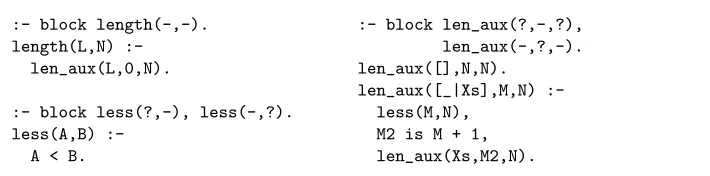
Consider the program shown in figure 9. It can be used in mode {length(O,I),
len aux(O,I,I)}(it is simply typed) in spite of the fact thatlen aux([],N,N) is not input-linear, using either of the two explanations above. The first explanation relies on all atoms using predicatesq ⊒len auxbeing in safe positions. This is somewhat unsatisfactory since imposing such a restriction impedes modularity. Therefore, the
second explanation is preferable.
8 Related work
First of all, note that our work implicitly relies on previous work on termination for LD-derivations (Apt, 1997; De Schreye and Decorte, 1994), since we reduce the problem of termination of a program with block declarations to the classical problem of termination for LD-derivations.
In using modes and types, we follow Apt and Luitjes (1995), and also adopt their notation. They show occur-check freedom for nicely moded programs and non-floundering for well typed programs. For arithmetic built-ins they require delay declarations such that an atom is delayed until the arguments are ground. Such declarations are usually implemented not as efficiently as block declarations. For termination, they propose a method limited to deterministic programs.
Naish (1992) gives good intuitive explanations (without proof) why programs loop, which directed our own search for further ideas and their formalisation. Predicates are assumed to have a single mode. It is suggested that alternative modes should be achieved by multiple versions of a predicate. This approach is quite common (Apt and Etalle, 1993; Apt and Luitjes, 1995; Etalle et al., 1999) and is also taken in Mercury (Somogyiet al., 1996), where these versions are generated by the compiler. While it is possible to take that approach, this is clearly a loss of generality since two different versions of a predicate is not the same thing as a single one which can be used in several modes. Naish uses examples where, under the above assumption, delay declarations are unnecessary. For permute, if we only consider the modeM2,