Article
An Overview of Applying Surfactants to
Modified-Functionalized Nanoporous Materials for Metal Ions
Sequestration
Suwimol Wongsakulphasatch
Department of Chemical Engineering, Faculty of Engineering and Industrial Technology, Silpakorn University, Nakhon Pathom 73000, Thailand
E-mail: [email protected]
Abstract. This paper presents an application of surfactants extended to environmental remediation. The promising process related to the use of surfactants for heavy metal sequestration purpose named “modified-functionalized nanoporous materials” is summarized in this work. The unique characteristic of high selective of the functional groups and large surface area of nanoporous support makes this material becomes a powerful tool for sequestration of target metals. The strength of this adsorbent is fast sorption kinetic, high thermal and chemical stability, easy handling, and the ability to regenerate.
Keywords: Modified-functionalized nanoporous materials, heavy metal, adsorption.
ENGINEERING JOURNAL Volume 17 Issue 2
Received 10 September 2012 Accepted 23 December 2012 Published 1 April 2013
1.
Introduction
Surface active agents or surfactants are amphipathic molecules consisting of a group that has very little attraction with the solvent, called a lyophobic (liquid-hating) group, and a group that has strong interaction with the solvent, named a lyophilic (liquid-loving) group. At low concentration, surfactants can lower surface tension of the system by adsorbing onto the interfaces and altering the interfacial free energies of those interfaces. At high enough surfactant concentration, surfactant molecules can spontaneously self-aggregate into a variety of structures, which are called micelles. The concentration at which surfactants begin to form micelle is named critical micelle concentration (CMC) [1, 2]. Because of the unique characteristics of surfactants, surfactants have therefore been applied and played an important role in various products of chemical industry such as detergents, cosmetics, petroleum, electronic printing, pharmaceuticals, medical, food, and environmental applications [2, 3]. Surfactants are used as emulsifier in food and cosmetic industries as well as in most of cleaning products such as detergents or soaps [3]. In addition, surfactants can be used to enhance oil recovery by, for example, improving oil drainage into well bore, wetting of solid surfaces, lessening oil viscosity and oil pour point, or lowering the interfacial tension. In the recent past decades, surfactants have been extended the use to environmental area for mainly toxic metal treatment purposes [4-7].
With the recognizing of high performance and versatile of surfactants applied in many industries as well as the concern of environment in the recent decades, the author would therefore like to present the extension of the use of surfactants to environmental applications. Technique related to an application of surfactants to remove metals, named modified-functionalized nanoporous support was summarized in this paper. The paper is organized as follows. First of all, a brief review of the danger of toxic heavy metals and various treatment techniques is presented. Then, environmental treatment technique related to the use of surfactants, named modified-functionalized nanoporous support is introduced. Concluding remark is presented in the last section.
2.
Toxic of Heavy Metals and Treatment Techniques
Heavy metals are nowadays applied in many industrial technologies and with the fast development of such technologies a large amount of heavy metals are discharged into environment. Excess exposure of heavy metal contaminations can damage environment, animals, and human health as they can enter the food chain when they are either discharged directly or indirectly into the environment. For example, copper, which is mostly found in printed circuit board manufacturing, electronics plating, paint manufacturing, wire drawing, etc., can cause toxicological concerns, such as dizziness, diarrhea, convulsions, neurotoxicity, etc. Exposure of cadmium can result in kidney dysfunction, carcinogenic, itai-itai disease, lung efficiency, or cancer. Sources of cadmium are electroplating, alloy manufacturing, mining, or refining. Mercury is found in the release of fossil fuel burning, battery production, mining and metallurgical process, or paint industries. An uptake of mercury can lead to neurological disturbances, impairment of pulmonary function, or kidney damage. Lead used in battery manufacturing, electroplating, pigments, ammunition, can damage brain, kidney, liver, and central nervous system. Nickel found in mineral processing, electroplating, steam-electric power plants, can result in lung and kidney cancer, gastrointestinal distress, and skin dermatitis [8, 9].
complexes, resulting in a reduction of high pressure needed for membrane permeation. Many types of surfactant are used to improve the ability of heavy metal ion removal in any treatment processes, such as, polyoxyethylene nonyl phenyl ethers [12], sodium dodecyl sulfate (SDS) [13], surfactin [14], rhamnolipid [14], etc. High removal efficiency greater than 90% can be obtained for this technique, however, large amount of surfactants used and less capability of continuous operating due to membrane blockage are the drawback of this technique [14, 15, 16]. Adsorption is another widely used process for toxic metal treatment due to its high efficiency, easy to handle, simple operation, and economical feasibility [3]. Adsorbents, such as carbon nanotubes [17], zeolites [18], activated carbon [19], etc., are commonly used in adsorption process due to high loading capacity and low cost. However, the inherent limitations of these adsorbents are their wide distribution of pore size and heterogeneous pore structure [20]. To improve capability of sorbent materials, a new class of adsorbents, named “modified-functionalized nanoporous support”, has been invented and developed [4-7]. Modification of nanoporous surface by organic materials or by surface active agents makes this material become a promising adsorbent for -application to metal sequestration. High selectivity for target metal of chosen its functional groups coupled with high adsorption capacity of porous support can enhance the reduction of metal concentration. As this hybrid adsorbent has emerged recently as a powerful tool for metal ion removal this work is therefore focused on the use of surfactants in this type of adsorbent.
3.
Modified-Functionalized Nanoporous Support
3.1. Application to Heavy Metal Ion Adsorption
One of various techniques that has been developed to enhance the ability of heavy metal removal processes with the application of surfactants is the use of surfactants connected to nanoporous materials, which is known as modified-functionalized nanoporous support [4, 20, 21, 22]. The distinctive of this adsorbent relies on the fact that surface of nanoporous material is modified by functional groups containing head groups that can interact selectively with target metal while the nanoporous material provides high surface area, which leads to high binding capacity. This adsorbent provides fast sorption kinetics, high stability, and easy regeneration [5, 21, 23]. Moreover, advantages of such hybrid sorbent materials over other adsorbents like activated carbon or zeolite are their high thermal and chemical stability [24]. Because of the strengthen characteristic of this highly selective sorbent material, it is now recognized as an effective technique for metal removal in the recent decade.
whereas 3,4-HOPO-SAMMS has the lowest performance to sequestrate these three metal ions. Mureseanu [6] modified the surface of mesoporous silica SBA-15 by N-Propylsalicylaldimino and used as adsorbent for heavy metal removal. The sorbent material showed high adsorption capacity and high selectivity for Cu(II), Ni(II), Zn(II), and Co(II) and it could be easily regenerated by acid treatment. Aguado [12] studied the performances of amine-functionalized mesoporous silica SBA-15 for heavy metal ions removal from solution. Three different functional groups were investigated in this work, aminopropyl, [2-aminoethylamino]-propyl, and [(2-aminoethylamino)-ethylamino]-propyl. It was observed that different functional groups has different selectivity to different metal ions of which aminopropyl selectively bound to Pb(II)>> Cd(II)>> Zn(II)> Cu(II)> Ni(II), [2-aminoethylamino]-propyl could adsorb Pb(II)>> Cu(II)> Zn(II) > Cd(II)> Ni(II), and [(2-aminoethylamino)-ethylamino]-propyl was able to bind to Pb(II)>> Cu(II)> Cd(II)> Zn(II)> Ni(II). It is noted however that all adsorbents show high sorption performances for all metal ions in this study of which fast adsorption rate was observed and the adsorbents could perform very well at even very low metal ion concentration of 5 mg L-1.
Wang [27] investigated the capability of superparamagnetic iron oxide (Fe3O4) nanoparticles modified
by dimercaptosuccinic acid (DMSA) to remove toxic soft metals, such as Hg, Ag, Pb, Cd, and Tl, from different sources, including river water, groundwater, seawater, and human blood and plasma. The DMSA-Fe3O4 was proved to be an excellent sorbent for toxic removal with a 30-fold higher capability than GT-73,
a commercial resin based sorbent. Moreover, adsorption kinetic of DMSA-Fe3O4 is faster than that of
GT-73 at a similar adsorption concentration. Such observed phenomena are due to the unique properties of DMSA-Fe3O4, of which the functional groups have high binding affinity to metal ions while a large surface
area of Fe3O4 nanoparticle facilitate the adsorption kinetic. Ballesteros and colleagues [28] studied
adsorption behavior of pirymidine-modified mesoporous silica MCM-41, named LDAPY-MCM-41, in aqueous solution. Selectivity of the adsorbent investigated with three metal ions, Cu(II), Ni(II), and Co(II), showed that the LDAPY-MCM-41 preferentially bind to Cu(II) rather than Ni(II) and Co(II), respectively. The maximum adsorption of Cu(II) of 2.976 mM g-1 was found at pH 8. This might be because Cu(II) can
access to interact with amino groups of LDAPY-MCM-41 easier than the others.
Perez-Quintanilla et al. [24] examined the use of modified-functionalized mesoporous silica to sequestrate Zn(II) from solution. In this work, 5-mercapto-1-methyltetrazole (MTTZ) was used as functional group to modify surface of HMS and MSU-2 mesoporous silica. High surface coverage and pore size of the hybrid sorbent materials showed high adsorption capacityof Zn(II) in solution of 0.94 mmol Zn(II) per gram of MTTZ-MSU-2 and 0.72 mmol Zn(II) per gram of MTTZ-HMS at pH 8. Higher adsorption observed in case of MTTZ-MSU-2 is due to its high surface area and pore diameter. Selectively adsorption behavior of these materials was also further investigated in this work by studying adsorption capacity of Zn(II)in solution containing co-existing metal ions including Pb(II), Cd(II), Cu(II), and Cr(III). The results revealed that at pH 8 the sorbent material, MTTZ-MSU-2, could adsorb Zn(II)~Pb(II)>>Cd(II)>Cu(II)>Cr(III). Liu et al. [29] proposed the effect of molecular length and structure of polyamines-functionalized poly(glycidyl methacrylate) (PGMA) on performances of Cu(II) removal. Four different types of aliphatic polyamines were investigated in this study: ethylenediamine (EDA), diethylenetriamine (DETA), triethylenetetramine (TETA), and tetraethylenepentamine (TEPA). It was found that an amount of Cu(II) uptake followed the order of DETA>TETA>EDA>TEPA as revealed by the average coordination number of copper as the lowest coordination for copper ion-adsorbed was observed with the DETA-PGMA. This is because the DETA has lowest nitrogen atoms in the coordination. Wu et al. [30] synthesized thiol-functionalized mesoporous silica for separation of heavy metal ions from water. Analysis of adsorption isotherms showed high performances for removing Cu(II), Pb(II), Ag(II), and Cr(III), and removal rate was high and the adsorbent could be regenerated by acid treatment without changing its properties.
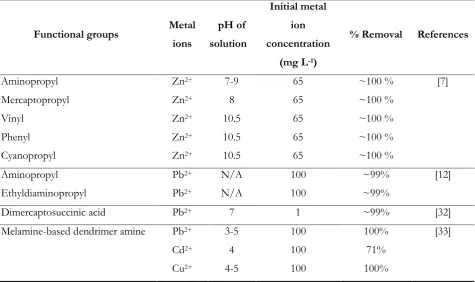
Table 1 summarizes examples of functional groups of modified-functionalized nanoporous support adsorbent that have been investigated to sequestrate metal ions from solution.
Table 1. Examples of functional groups used to modify nanoporous material surface to remove metal ions.
Functional groups Metal
ions pH of solution Initial metal ion concentration
(mg L-1)
% Removal References
Aminopropyl Mercaptopropyl Vinyl Phenyl Cyanopropyl Zn2+ Zn2+ Zn2+ Zn2+ Zn2+ 7-9 8 10.5 10.5 10.5 65 65 65 65 65 ~100 % ~100 % ~100 % ~100 % ~100 % [7] Aminopropyl Ethyldiaminopropyl Pb2+ Pb2+ N/A N/A 100 100 ~99% ~99% [12]
Dimercaptosuccinic acid Pb2+ 7 1 ~99% [32]
Melamine-based dendrimer amine Pb2+
Cd2+ Cu2+ 3-5 4 4-5 100 100 100 100% 71% 100% [33]
3.2. Proposed Mechanism of Modified-Functionalized Nanoporous Support
Modification surface of nanoporous adsorbent by organic materials have been developed to increase selectivity to target metals apart from high adsorption capacity of conventional porous materials. The organic materials are chosen in such a way that one side of the molecules should contain charges or polar groups that have ability to preferentially interact with metal ions of interest whereas another side should be atoms or molecules that have ability to connect to nanoporous surface. As such, surfactant is one of good choices to use as functional groups in modified-functionalized nanoporous adsorbent.
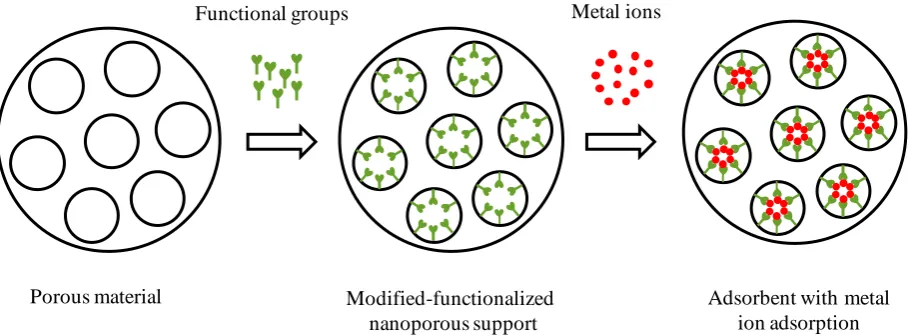
In adsorption system, the adsorption of metal ions on modified-functionalized nanoporous support mostly involves a solid phase (adsorbent) and a liquid phase (solution of metal ions). The mechanism relies mainly on attractive electrostatic interaction between metal ions and functional groups that contain different charges depend upon environmental solution [8]. Schematic of adsorption mechanism of modified-functionalized nanoporous support is demonstrated in Fig. 1.
Generally, different systems comprise of different parameters that can affect the system efficiency, as such in order to determine optimum operating condition for the system of interest, it is necessary to consider the effect of such parameters. There are many variable parameters that can influent adsorption performance of this hybrid adsorbent such as pH of solution, valence or size of functional group, temperature, type of support material, pore size and surface area of support material, initial concentration of metal ions, or contact time, etc.
[image:5.595.67.543.142.424.2]Fig. 1. Mechanism of adsorption by modified-functionalized nanoporous support adsorbent.
Wastewater treatment process is a process that likely mostly uses the modified-functionalized nanoporous adsorbent. Solution pH is therefore become one of influence factors on adsorption of metal ions on adsorbents as ionic states of either functional groups or metal ions can alter when pH of solution is changed, which could affect the formation of metal ion-adsorbent complexes and hence adsorption efficiency. Changing solution pH leads to the change of H+ or OH-, resulting in the change of the degree of
ionization, adsorption rate, and adsorption capacity of the system. One concept that can be used to determine proper pH solution of the system is the consideration of zero point charge of functional groups. The zero point charge is a pH at which the total charge on the functional groups is zero. When the pH of solution is less than the zero point charge of the functional groups, the surface charges are positive. On the other hand, if the pH of solution is higher than zero point charge of the functional groups of the adsorbent, the surface of the adsorbent possesses negative one. It is worth to note that charge state of metal ion is also decided by pH of solution. Most metal ions precipitate out in basic region as the ions react with OH- ions
forming metal hydroxide complex molecules, which does not contribute to adsorption process.
Temperature is another important factor that could alter the adsorption ability. The change of temperature can lead to the change in thermodynamics and kinetic energy. Thermodynamics data such as Gibbs free energy (
G
), enthalpy (H ), and entropy (
S
), which are known that depend on the temperature of the system, can tell us the feasibility and spontaneity of the process. Negative value of
G
indicates that the process can occur spontaneously and vice versa for the positive value. The value of H reveals the direction of energy in the system, positive values indicate endothermic whereas negative values designate exothermic process. The value of
S
demonstrates the order or disorder of the system, which in this case represents by the structure of metal-adsorbent at the interface. Negative values of
S
show a decrease of disorder structure at the ion-adsorbent interface and vice versa for positive values of
S
. Hence, examining thermodynamics data could notify if the adsorption process of interest can be used for metal treatment at different temperatures. Apart from thermodynamics point of view, the change of temperature also affects kinetic energy of the system as it can enhance or retard the diffusion rate of the ions. In general, increasing temperature can increase the movement of metal ions resulting in fast adsorption rate [8].Other parameters that can affect the efficiency of adsorption are, for example, initial concentration of metal ion as it is observed that removal capability increases with increasing initial ion concentration as this can enhance ion gradient to the vacant active site of the adsorbent [33]. Adsorption ability also depends upon the arrangement of functional groups on porous support as strong and stability adsorption can be obtained if multiple coordination sites are associated [36].
Combination of the unique characteristic of surfactant and nanoporous material in modified-functionalized nanoporous adsorbent makes this material become a potential adsorbent for metal sequestration purpose. The strengths of this hybrid adsorbent over conventional adsorbent are high selectivity, high adsorption capacity at even very low metal ion concentration, high stability, and fast sorption kinetics, where equilibrium can be reached quickly. In addition, another spotlighted-feature of modified-functionalized nanoporous support is that the solid phase of the adsorbent could be further developed and designed as a packed bed adsorbent, which is beneficial for continuous metal sequestration
Metal ions Functional groups
Porous material Modified-functionalized nanoporous support
[image:6.595.72.529.84.252.2]process in industrial scale. However, at the present, the inherent difficulty in applying the modified-functionalized nanoporous adsorbent for large scale applications are still encounter due to their complicated synthesis.
4.
Conclusion
Surfactants are proven to be versatile materials as they can serve high potential efficiency in many areas such as manufacturing of chemical, food, cosmetic, petroleum, etc. In the past decades, surfactants have been extended the use to environmental application of the removal of metal ions from different matrices such as wastewater, drinking water, ground water, or soil. The use of surfactants can enhance removal efficiency of membrane as the formation of micelle can capture metal ions and form molecule complexes, resulting in a reduction of high pressure needed for membrane process. This process is called micellar-enhanced ultrafiltration (MEUF). However, the drawback of this technique is that it is difficult to apply for continuous operating due to membrane blockage. Another technique that is developed to enhance the ability of heavy metal removal processes with the application of surfactants is the use of surfactants connected to nanoporous material, known as modified-functionalized nanoporous support. The distinction of this adsorbent relies on the fact that the functional groups (organic materials or surfactants) can interact selectively with target metal ions while the nanoporous support provides high surface area, leading to high binding capacity. However, the drawback of this technique is the difficulty in synthesising the adsorbent.
Acknowledgements
The authors would like to acknowledge National Research Universities, the Office of the Higher Education Commission, Silpakorn University Research and Development Institute, and Thai Government Science and Technology Scholarship Students (CSTS), National Science and Technology Development Agency (NSTDA) for financial support.
References
[1] D. F. Evans and W. Hakan, “Solutes and solvents, self-assembly of amphiphiles,” in The Colloidal Domain: Where Physics, Chemistry, Biology, and Technology Meet, 2nd ed. Canada: Wiley-VCH, 1999, ch. 1, sec. 1, pp. 5–9.
[2] M. J. Rosen, “Characteristic features of surfactants,” in Surfactants and interfacial phenomena, 3rd Ed. John Wiley & Sons, Inc., 2004, ch. 1, pp. 1-32.
[3] K. K. Singh, A. K.Singh, and S. H. Hasan, “Low cost bio-surfactant 'wheat bran' for the removal of cadmium from wastewater: Kinetic and equilibium studies,” Bioresource Technol, vol. 97, no. 8, pp. 994-1001, May 2006.
[4] G. E. Fryxell, H. Wu, Y. Lin, J. W. Shaw, C. J. Birnbaum, C. J. Linehan, Z. Nie, K. Kemner, and S. Kelly “Lanthanide selective sorbents: self-assembled monolayers on mesoporous supports (SAMMS),” J. Mater. Chem., vol. 14, no. 22, pp. 3356-3363, September 2004.
[5] W. Yantasee, “Simultaneous detection of cadmium, copper, and lead using a carbon paste electrode modified with carbamoylphosphonic acid self-assembled monolayer on mesoporous silica (SAMMS),” Anal Chim Acta., vol. 502, no. 2, pp. 207-212, January 2004.
[6] M. Mureseanu, “Modified SBA-15 mesoporous silica for heavy metal ions remediation,” Chemosphere, vol. 73, no. 9, pp. 1499-1504, August 2008.
[7] M. Barczak, E. Skwarek, W. Janusz, A. Dabrowski, and S. Pikus, “Functionalized SBA-15 organosilicas as sorbents of zinc (II) ions,” Appl Surf Sci, vol. 256, no. 17, pp. 5370-5375, June 2010. [8] U. Farooq, J. A. Kozinski, M. A. Khan, and M. Athar, “Biosorption of heavy metal ions using wheat
based biosorbents–A revies of the recent literature,”Bioresource Technol, vol. 101, no. 14, pp. 5043-5053, March 2010.
[9] F. Fu and Q. Wang, “Removal of heavy metal ions from wastewaters: A review,” J. Environ Manage, vol. 92, no. 3, pp. 407-418, March 2011.
[11] J. F. Scamehorn, S. D. Christian, D. A. El-Sayed, H. Uchiyama, and S. S. Younis, “Removal of divalent metal cation and their mixtures from aqueous stream using micellar enhanced ultrafiltration.” Sep Sci Technol, vol. 29, pp. 809-830, 1994.
[12] J. Aguado, M. J. Arsuaga, A. Arencibia, M. Lindo, and V. Gascon, “Aqueous heavy metals removal by adsorption on amine-functionalized mesoporous silica,” J Hazard Mater., vol. 163, no. 1, pp. 213-221, April 2009.
[13] X. Li, G. M. Zeng, J. H. Huang, C. Zhang, Y. Y. Fang, Y. H. Qu, F. Luo, D. Lin, and H. L. Liu, “Recovery and reuse of surfactant SDS from a MEUF retentate containing Cd2+ or Zn2+ by
ultrafiltration,” J. Membrane Sci, vol. 337, no. 1-2, pp. 92-97, July 2009.
[14] C. N. Mulligan, R. N. Young, and B. F. Gibbs, “Heavy metal removal from sediments by biosurfactants,” J. Hazard Mater, vol. 85, no. 1-2, pp. 111-125, July 2001.
[15] C. W. Candida and J. H. Harwell., “Surfactants and subsurfactant remediation,” Environ. Sci: Technol, vol. 26, no. 12, pp. 2324-2339, December 1992.
[16] S. Akita, L. Yang, and H. Takeuchi, “Micellar-enhanced ultrafiltration of gold(III) with nonionic surfactant,” J. Membrane Sci, vol.133, no. 2, pp.189-194, October 1997.
[17] Y. H. Li, “Adsorption of cadmium (II) from aqueous solution by surface oxidized carbon nanotubes,” Carbon, vol. 41, no. 5, pp. 1057-1062, April 2003.
[18] T. Gebremedhin-Haile, M. T. Olguin, and M. Solache-Rios, “Removal of mercury ions from mixed aqueous metal solution by natural and modified zeolitic minerals,” Water Air Soil Poll, vol. 148, no. 1-4, pp. 179-200, April 2003.
[19] Y. G. Ko and U. S. Choi, “Observation of metal ions adsorption on novel polymeric chelating fiber and activated carbon fiber,”Sep Purif Technol, vol. 57, no. 2, pp. 338-347, October 2007.
[20] B. Lebeau, F. Gaslain, C. F. Martin, and F. Babonneau, “Organically modified ordered mesoporous siliceous solids,”in Ordered Porous Solids, 2009, ch. 11, pp. 283–308.
[21] P. J. Majewski, “Removal of organic matter in water by functionalized self-assembled monolayer on silica,” Sep Purif Technol, vol. 57, no. 2, pp. 283-288, October 2007.
[22] W. Yantasee, Y. Lin, G. E. Fryxell, J. B. Busche, and C. J. Birnbaum, “Removal of heavy metals from aqueous solution using novel nanoengineered sorbent: Self-assembled carbamoylphosphonic acids on mesoporous silica,” Sep Sci Technol, vol. 38, no. 15, pp. 3809-3825, August 2003.
[23] G. E. Fryxell, Y. Lin, H. Wu, and K. M. Kemer, “Environmetal applications of self-assembled monolayers on mesoporous supports (SAMMS),” Nanoporous Materials III, Proceedings of the 3rd International Symposium on Nanoporous Materials, vol. 141, pp. 583-590, June 2002.
[24] D. Perez-Quintanilla, A. Sanchez, I. D. Hierro, M. Fajardo, and I. Sierra, “New hybrid materials as Zn(II) sorbents in water samples,” Mater Res Bull, vol. 45, no. 9, pp. 1177-1181, September 2010. [25] G. E. Fryxell, Y. Sandyfiskum, C. J. Birnbaum, and H. Wu, “Actinide sequestration using
self-assembled monolayers on mesoporous supports,” Environ Sci Technol, vol. 39, no. 5, pp. 1324-1331, January 2005.
[26] Y. Lin, S. K. Fiskum, W. Yantasee, H. Wu, S. Mattigod, E. Vorpagel, and G. E. Fryxell, “Incorporation of hydroxypyridinone ligands into self-assembled monolayers on mesoporous supports for selective actinide sequestration,” Environ Sci Technol, vol. 39, no. 5, pp. 1332-1337, March 2005.
[27] P. Wang, “Preparation of magnetic iron/mesoporous silica composite spheres and their use in protein immobilization,” Transactions of Nonferrous Metals Society of China, vol. 19, no. 3, pp. 605-610, December 2009.
[28] R. Ballesteros, D. Perez-Quintanilla, M. Fajardo, I. D. Hierro, and I. Sierra, “Adsorption of heavy metals by pirymidine-derivated mesoporous hybrid material,” J. Porous Mat, vol. 17, no. 4, pp. 417-424, 2009.
[29] C. Liu, R. Bai, L. Hong, and T. Liu, “Functionalization of adsorbent with different aliphatic polyamines for heavy metal ion removal: Characteristics and performance,” J. Colloid and Interf Sci, vol. 345, no. 2, pp. 454-460, January 2010.
[30] S. Wu, F. Li, R. Xu, S. Wei, and G. Li, “Synthesis of thiol-functionalized MCM-41 mesoporous silicas and its application in Cu(II), Pb(II), Ag(I), and Cr(III) removal,” J. Nanopart Res, vol. 12, no. 6, pp. 2111–2124, August 2010.
[32] W. Yantasee, C. L. Warner, T. Sangvanich, R. S.Addleman, T. G. Carter, R. J. Wiacek, G. E. Fryxell, C. Timchalk, and M. G. Warner, “Removal of heavy metals from aqueous systems with thiol functionalized superparamagnetic nanoparticles,” Environ. Sci. Technol., vol. 41, no. 14, pp. 5114-5119, June 2007.
[33] A. Shahbazi, H. Younesi, and A. Badiei, “Functionalized SBA-15 mesoporous silica by melamine-based dendrimer amines for adsorptive characteristics of Pb(II), CU(II) and Cd(II) heavy metal ions in batch and fixed bed column,” Chem Eng J., vol. 168, no. 2, pp. 505-518, April 2011.
[34] B. Volesky, “Biosorption process simulation tools,” Hydrometallurgy, vol. 71, no. 1-2, pp. 179-190, October 2003.
[35] P. Wu and Y. S. Zhou, “Simultaneous removal of coexistent heavy metals from simulated urban stormwater using four sorbents: A porous iron sorbent and its mixtures with zeolite and crystal gravel,” J. Hazard Mater, vol. 168, no. 2-3, pp. 674-680, February 2009.