Abstract: Multiple Input Multiple Output (MIMO) RADAR system is proficient in improving the range resolution while considering the orthogonality of the signal. In this paper, Poly Phase coded waveforms are optimized in time domain. The phase codes of the transmit waveforms are designed using ‘JAYA’ optimization algorithm and compared with the literature. Though Multi-Objective Decision Making (MODM) problem shows trade-off between different performance parameters, computationally effective ‘JAYA’ algorithm outperforms. The approach is validated with mathematical modeling and numerical simulations.
Index Terms: MIMO RADAR, Optimization, Poly-phase coded waveforms.
I. INTRODUCTION
Multiple Input Multiple Output (MIMO) radar system is capable of transmitting arbitrary waveforms from each antenna and exhibits remarkable potentials of mitigating fading effect, enhancing resolution, and reducing interference from clutter, jammers etc. Researchers have explored several advantages of MIMO radar such as diversity increment of the target signal, improvement in interference mitigation capability, enhanced parameter identifiability [1], and improved flexibility in designing transmit beampattern making it an interesting area. Theexisting work on MIMO radar waveform design focuses on the orthogonal waveform generation in time domain [2], [3] as well as space domain [4].
In the field of MIMO RADAR for designing orthogonal code sets for different transmit antennas various population based algorithms were reported such as Simulated Annealing(SA)[2], Genetic Algorithm(GA)[5], Particle
Swarm Optimization(PSO)[6], Ant Colony
Optimization(ACO)[7] etc. Each of the above algorithm is characterised by both the common controlling parameters and algorithm specific parameters such as annealing temperature in SA, crossover probability, mutation probability and selection operator in GA, position and velocity in PSO, pheromone intensity in ACO.
In this paper, we optimize polyphase coded waveforms in the time domain for MIMO radar. Optimization of poly phase codes in time domain takes care of range resolution property of radar as well as orthogonality of waveforms.
The organization of the rest of the paper is as follows. Cost functions of the poly phase coded waveforms are formulated in time domain in Section 2. Section 3 includes the detailed
Revised Manuscript Received on July 09, 2019
Pooja Bhamre, Department of Electronics and Communication, SVNIT, Surat, India.
Shilpi Gupta, Department of Electronics and Communication, SVNIT, Surat, India.
steps of the designing of the transmit codes with JAYA optimization. Design results are validated through the simulation and results are depicted in Section 4. Finally Section 5 concludes the paper.
II. PROBLEMFORMULATION
In phase coded waveform, the long pulse having duration T is considered which is converted into N smaller sub pulses, called chips by dividing. Each chip has a width τ = T/N. Phase-coded waveform is characterized by each of these chips and each sub pulse is characterised by a particular phase with which it is transmitted. Consider L isotropic radar antennas each separated by a distance of d, transmitting distinct phase coded waveforms. The transmitted waveform from the lth antenna element of the array is generally represented as
τ
τ
l=1,2,….L; n=1,2,…N.
where fc is the carrier frequency, Rect represents rectangular function, τ is the subpulse time duration, ul(n) is the nth subpulse of the coding waveform transmitted from lth antenna, and N represents number of subpulses in time domain of the coded waveform at each element. Assuming that there is no influence of the rectangular function and the carrier frequency on the waveform coding, analysis leads to simplify coding waveform of the lth antenna element of the MIMO radar which is given as
where øl(n) is the coding phase of the nth subpulse.
Receiver extracts echo signals by a set of matched filters. The matched-filter response of asignal consists of a narrow mainlobe and low side-lobes are required[8], [9]. Thus the width of the mainlobe and sidelobe level specifications are the function of the expected target resolution and expected target RCS difference. Prerequisite of high resolution in the multiple target detection for some applications is the autocorrelation side lobe peaks (ASP) level of the transmitted signals have to be low. The Autocorrelation function of polyphase sequence ul with discrete time index k can be represented as
Optimization of Poly Phase Codesin Time
Domain for MIMO RADAR
= 0
for 0 < k < N
(3)
= 0
for -N < k < 0
where for M-phase coded waveforms. The autocorrelation peaks are obtained at an integer multiples of the bit duration.
A. Single Objective Decision Making(SODM)
An objective function which is either to be minimized or maximized characterizes the given system model with the described restrictions. The single objective optimization problem is the one containing only one objective function.Radar applications including multiple target detection require high resolution. To accomplishthis it is required for the transmitted signals to have low autocorrelation sidelobe peaks levels (ASP)
The another measure of quality of designingthe sequence is expressed by discriminationfactor(DF).Golay[10] has given the discriminating factor (DF) as
For Barker sequences, DF is found to be equal to the sequence length. The value of DF is inversely proportional to the energy required for detecting a target and RadarCross Section (RCS) of the target. Hence the design requirement is to maximize DF [11].For this purpose optimization can be used to maximize Eq. (5). In this work optimization algorithm is applied to these single objective functions given in Eq. 4 and Eq.5 separately.
B. Multi-Objective Decision Making(MODM)
Mutually orthogonal waveforms has to be designed in order to suppress interference. They also have an advantage of acquiring independent information from various target returns. So orthogonal waveforms that have low cross-correlation (CP)[12] has to be developed. Now, cross correlation function of sequences up and uq is given as
= 0
for 0 < k < N
(6)
= 0
for -N < k < 0
The designed orthogonal waveforms should have lower ASP as well asCP [13]. Designing number of polyphase code sets (generally equal to number of antennas) having lesser cross correlation amongst them is very intractable problem. Various optimization algorithms are reported in the literature to form a multiobjective function containingASP, CP , total
autocorrelation side lobe energy(ASLE) and cross correlation energy(CCE). All above terms has to be as small as possible leading to overall minimization problem.
The cost function (CF) for optimization problem of minimizing is as follows:
(5)
III. JAYAOPTIMIZATION
The burden of tuning the controlling parameters is diminished in the Jaya algorithm proposed by Rao[14]. Various benchmark functions have been analysed using various number of optimization algorithms. The statistics showed that, the Jaya algorithm requires fewer iterations for achieving the global optimum, and proved to be superior in many ways as compared to other optimization algorithms. In the search process of Jaya algorithm, each individual upgrades its current value depending on the best and worst values of the cost function. This helps in convergence towards the global optimal [15]. Detailed steps of JAYA optimization algorithm are explained below.
1. Initial selection of L phase values are random numbers between 0 ≤ ≤ (M - 1) for M-phase coded waveform for a given number of population.
2. Calculation of the cost function as given in Eq. (4) and Eq. (5) for SODM and Eq. (7) for MODM problem for all the population is done followed by identification of the ‘best’ and ‘worst’ solution amongst all.
3. Modification of the population depending on the ‘best’ and ‘worst’ is as shown:
Xnew = X + r1(Xbest - X) - r2(Xworst - X) (8) where r1 and r2 are random numbers in the range [0, 1] for a specific iteration. Again calculation of the cost function of modified data is done.
4. Comparison of the original cost function and modified cost function is done. As it is a minimization problem, whichever results in least cost function, the corresponding X is kept. 5. Steps 2 - 3 - 4 are repeated until a termination criterion is reached.
IV. DESIGNANDSIMULATIONRESULTS Poly phase coded waveforms are designed with 4 antenna elements for time domain analysis with an isotropic radiation pattern which are separated by a distance of λ/2 where λ is the wavelength. We apply ‘JAYA’ optimization algorithm tocalculate phase values (ø). Simulations are carried out inMATLAB to design waveforms. Phases(ø) are designed at each subpulse through each antenna. JAYA optimization is applied to minimize the ASP function. 32-phased sequencesare optimized for different code lengths ranging from 2 to 12. Table I showsthe optimized sequences with corresponding ASP.
TableI: JAYA Optimized sequences and their ASP’s for different code lengths.
Code Length(N)
Optimized Sequence ASP
2 7,4 0.5
3 25, 22, 3 0.333
4 31, 19, 25, 28 0.25
5 0, 2, 30, 17, 0 0.2
6 6, 24, 16, 13, 16, 23 0.1766
7 10, 0, 1, 22, 0, 31, 8 0.142857
8 20, 27, 2, 31, 27, 18, 0, 18 0.125
9 0, 8, 13, 22, 11, 26, 18, 15, 8 0.1111
10 18, 13, 27, 22, 27, 20, 10, 17, 29, 9
0.1
11 31, 10, 0, 15, 31, 1, 8, 2, 31, 18, 17
0.0909
12 31, 19, 0, 15, 31, 31, 14, 12, 31, 0, 2, 0
0.0926
It can be observed that as code length increases there is an improvement in ASP upto code length N = 11. Further increase in code length degrades the performance.
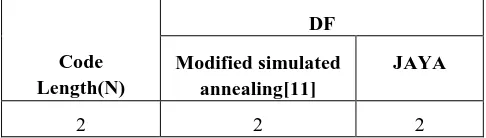
[image:3.595.45.290.239.531.2]Further, design consist of the JAYA optimized DF function . Designed sequences of 32-phased and various code lengths are compared with sequencesgiven by Singh[11] with respect to DF. It is observed from the Table IIuptocode length N = 11 DF obtained by Modified simulated annealing and Jaya are same.But further increase in code length degrades the performance.
Table II:Comparison of DF for different code lengths.
Code Length(N)
DF Modified simulated
annealing[11]
JAYA
2 2 2
3 3 3
4 4 4
5 5 5
6 5.63 5.63
7 7 7
8 8 8
9 9 9
10 10 10
11 11 11
12 12 10.799
15
14.99 8.7628
50 23.95 8.5324
100 38.11 9.4786
500 64.92 10.8813
1000 80.6 18.4162
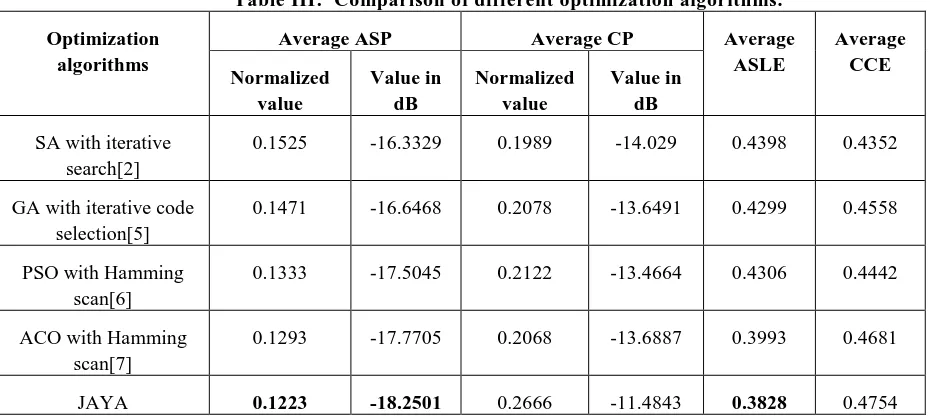
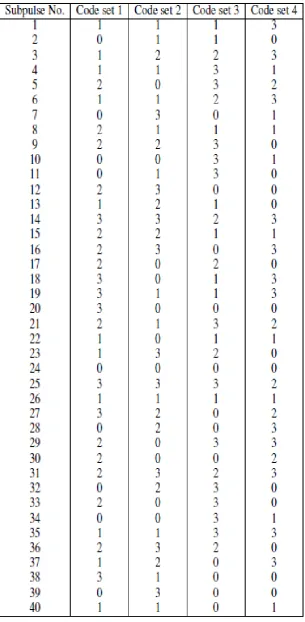
Finally, we also elaborated a minimization problem with multi-objective cost function represented in Eq. (7)with N = 40, M = 4 and L = 4. The results are compared with other population based algorithms used in literature in Table III. ASP and CP are normalized to the sequence length for fair comparison. It has been observed that our design is able to achieve the best ASP (-18.2501 dB) and ASLE (0.3828) amongst all, but at the cost of other performance parameters. So, it can be said that there is trade-off between different objectives in MODM problem. This performance improvement guarantees higher range resolution of the RADAR system. Optimized code sets using JAYA algorithm are given in Table IV. The designed phases can be implemented with the 2-bit phase shifters at the feeding network of each antenna.
[image:3.595.46.289.692.761.2]Fig. 1 Comparison Of Autocorrelation Function Of The Designedwaveforms Withn = 40, M = 4.
Table III: Comparison of different optimization algorithms. Optimization
algorithms
Average ASP Average CP Average
ASLE
Average CCE Normalized
value
Value in dB
Normalized value
Value in dB SA with iterative
search[2]
0.1525 -16.3329 0.1989 -14.029 0.4398 0.4352
GA with iterative code selection[5]
0.1471 -16.6468 0.2078 -13.6491 0.4299 0.4558
PSO with Hamming scan[6]
0.1333 -17.5045 0.2122 -13.4664 0.4306 0.4442
ACO with Hamming scan[7]
0.1293 -17.7705 0.2068 -13.6887 0.3993 0.4681
[image:4.595.43.509.505.715.2]Photo
V. CONCLUSION
The poly phase coded waveforms can be optimized for the resolution enhancement maintaining orthogonality for RADAR system. The pulse compression goodness of a code is decided by its autocorrelation function. The ‘JAYA’ optimization, without any algorithm specific parameters outperform other population based algorithms in the time domain waveform designing. Additionally, computational complexity of tuning the algorithm specific parameters have been reduced and hence the design time. Effect of varying the number of subpulses(N) and phases(M) on the performance can be carried out in near future.
REFERENCES
1. J. Li, P. Stoica, L. Xu, and W. Roberts, “On parameter identifiability of mimo radar," IEEESignal Processing Letters, vol. 14, no. 12, Dec 2007pp.968-971.
2. H. Deng, “Polyphase code design for orthogonalnetted radar systems," IEEE Transactions onSignal Processing, vol. 52, no. 11, 2004,pp. 3126-3135.
3. H. Li, Y. Zhao, Z. Cheng, and D. Z. Feng,“Orthogonal frequency division multiplexinglinear frequency modulation signal designwith optimised pulse compression property ofspatial synthesised signals," IET Radar, SonarNavigation, vol. 10, no. 7, 2016, pp. 1319-1326. 4. H. Deng, Z. Geng, and B. Himed, “Mimoradar waveform design for
transmit beamformingand orthogonality," IEEE Transactions onAerospace and Electronic Systems, vol. 52, no. 3, June 2016, pp. 1421-1433.
5. B. Liu, Z. He, J. Zeng, and B. Liu, “Polyphaseorthogonal code design for mimo radar systems,"in 2006 CIE International Conference on Radar,2006, pp. 1-4.
6. B. R. Reddy and U. M, “Polyphase orthogonal waveform using modified particle swarm optimization algorithm for mimo radar,"Proc. IEEE Int. Conf. on Signal Processing, Computing and Control, March-2012, pp. 1–6.
7. B. R. Reddy and U. M, “Design of orthogonalwaveform for mimo radar using modified antcolony optimization algorithm," in 2014 International Conference on Advances in Computing,Communications and Informatics (ICACCI),2014, pp. 2554-2559.
8. W. Mow, S. Li, “Aperiodic autocorrelation and crosscorrelation of polyphasesequences”, IEEE T INFORM THEORY, 1997, 43, pp. 1000–1007.
9. V. Chernyak, “Fundamentals of Multisite Radar Systems: Multistatic Radars and Multistatic Radar Systems”, (Taylor & Francis,1998). 10. M. Golay, “ The merit factor of long low autocorrelation binary
sequences (corresp.)”, IEEE Transactions on Information Theory 28(3), 1982, pp. 543–549.
11. S.P. Singh, K. Subba Rao, “Thirty-two phase sequences design with good autocorrelationproperties”, Sadhana, 35(1), 2010, pp. 63–73. 12. S. Ahmed, M. Alouini M, “A survey of correlated waveform design for
multifunction software radar”, IEEE AERO EL SYS MAG, 31, 2016, pp. 19–31.
13. Bhamre P., Gupta S.: ‘A review on poly-phase coded waveforms for mimo radar with increased orthogonality’, Proc. Future Internet Technologies and Trends, Springer International Publishing, 220, 2018, pp. 230–236.
14. R. Rao, G. Waghmare, “A new optimization algorithm for solving complex constrained design optimization problems”, ENG OPTIMIZ, 2017, 49, pp. 60–83.
15. R. Rao, A. Saroj, “A self-adaptive multi-population based jaya algorithm for engineering optimization”, Swarm and Evolutionary Computation, 2017, 37, pp. 1–26.
AUTHORSPROFILE
Pooja Bhamre
She was born in 1986. She received the B. Tech. degree in Electronics and Telecommunication engineering from College of Engineering Pune (COEP), Pune, India, in 2007. From 2011 to 2013, she was pursuing the postgraduate study in K. K. Wagh College of Engineering, Nashik, Pune university. She is
currently pursuing the Ph.D. degree from the Sardar Vallabhbhai National Institute of Technology (SVNIT), Surat, India. Her research interests are RADAR signal processing, MIMO RADAR and Optimization.
Dr. S. Gupta