Abstract: This correspondence presents a communication strategy for multi-robot systems (MRS) deployed for open area exploration and map making, which is improved using optimization algorithm. One of the noteworthy application of MRS is exploration of unknown environment. The crucial problem of MRS is reliable exchange of data between different robots and efficient communication with data collection centre. However in the real world, mobile robots have limited communication range and energy, which in turn impose constraints in the design of communication strategy for effective coordination. The biggest challenge in this domain is to formulate an appropriate exploration and communication framework, which helps robots in achieving their goal of exploring maximum area with minimum energy loss and transmitting the full exploration data, while working as a team. Here, a framework for multi-robot communication is proposed, using Flower Pollination Algorithm for efficient transmission and routing of data to base station, which is utilized by simultaneous localization and mapping (SLAM) protocol for exploration and map making. Comparisons of proposed protocol are made with other clustering based routing algorithms available in the literature. Simulation results depict that the proposed strategy outperforms other communication techniques in terms of energy efficiency and network life time. The minimized energy usage helps robots to stay alive for more time, which in turn helps in exploring large areas with similar conditions.
Index Terms: Multi-robot system, Optimization, Routing protocol, Unmanned exploration
I. INTRODUCTION
Unity is Strength” is a very insightful proverb which holds true for humans as well as robots in present times. Similar to humans, robots working together in proper coordination and cooperation perform better in various challenging situations. Multiple interacting dynamic objects or a group of robots functioning in an environment possessing some collective behaviour is known as a multi-robot system (MRS) [1]. Team of several simple robots is always beneficial over a complex single robot, as they offer higher degree of reliability through resource repetitiveness and effectiveness by parallel task execution. Moreover, MRS also delivers better fault tolerance and flexibility because of dynamic reformation and coordination.
Manuscript Received on May 5, 2019.
Kiran Jot Singh, ECE, Chandigarh University, Mohali, India.
Divneet Singh Kapoor, ECE, Chandigarh University, Mohali, India.
Balwinder Singh Sohi, ECE, Chandigarh University, Mohali, India.
Nitin Mittal, ECE, Chandigarh University, Mohali, India.
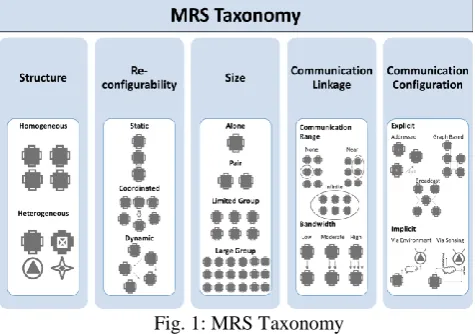
[image:1.595.307.545.401.568.2]Recent progress in robotic research has allowed roboticists to use MRS for solving various real world problems in areas like agriculture, natural resource monitoring, emergency response and rescue, maintenance of heavy machinery and many more. Researchers around the globe have developed many projects of MRS catering to various applications [3-7]. Based on the research projects, the type of MRS applications can be further classified into unmanned ground vehicles (UGV), unmanned aerial vehicles (UAV), unmanned surface vehicles (USV) and unmanned underwater vehicles (UUV). Various articles have been published in the area of MRS regarding survey analysis, review of research, frameworks, application domains and taxonomies. Based on the literature available [2, 8, 9, 10, 11, 12], MRS is a constitution of five groups i.e. structure, re-configurability, size, communication linkage and communication configuration, as depicted in Fig. 1.
Fig. 1: MRS Taxonomy
Structure, or in other words composition, is defined as the type of hardware and software used for robot team, which can be homogeneous (team of exactly same robots) or heterogeneous (robots with different specifications). Re-configurability refers to the way of coordination among robots. It extensively depends on the application domain and the environment in which the robot team is operating. It can be static where no movement takes place, or coordinated where complete team is led by a single robot, or dynamic in which the decision process is autonomous for every individual robot. Size of the MRS is defined as the number of robots involved in a particular task. It is totally application dependent. It can be a pair of robots, small team having 10-12
Improved Communication Strategy Based on
Optimization Algorithm For Unmanned
Multi-Robot Open Area Exploration
robots or a large group (swarm) of robots. Communication is a process in which data is transmitted and received between robots in order to accomplish the tasks. Further communication linkage or network refers to range/distance and bandwidth by which robots can connect to each other and configuration/pattern defines the process of communication i.e., explicit (indirect communication where information flow is through cloud) and implicit (direct connection between peer robots and BS) methods. The key factor for accomplishment of any task in an application is coordination among robots. Coordination can only be achieved by establishing communication between robots. Since from the inception of MRS, there have been constant developments in communication strategies to enhance battery life and bandwidth utilization [13, 14]. This article is primarily focused on enhanced MRS communication technique for the applications of field surveillance as well as search and rescue in military and urban domain. The same can be used/modified for forest fire detection, habitat monitoring and other surveillance applications [15].
This correspondence is organized as follows. The preceding section discusses real world communication constraints in stable and collaborative layout domain for MRS. Section 3 reviews routing protocols for MRS which are classified based on various parameters. Furthermore, meta-heuristic algorithms for MRS are compared followed by outlining of Flower pollination algorithm. Section 4 formalizes the exploration scenario and framework considered in this paper. Section 5 describes the proposed protocol and strategy in detail. Section 6 discusses the performance of the proposed protocol and its performance advantages over other approaches. Finally, in Section 7, conclusions are drawn and possible future directions are described.
II. REALWORLDCOMMUNICATION
CONSTRAINTSFORMRS
One of the biggest and vital challenge in MRS is effective communication among robots. The quality of communication degrades in exploration domain because of distance between peer robots or base station (BS), obstacles and many other geographical factors. Wireless network with large bandwidth provides satisfactory communication [16]. However, this is not true for real world conditions and network must be intelligently planned to overcome overloading and conservation of energy because of large number of robots. Communication support is a costly affair in terms of energy consumption, as more payload will drain the battery faster. Some of the potential parameters that must be considered while transmitting data from a robot are individual state, task data and environmental state. Individual state represents battery level and robot identification, task data refers to task specific information provided by sensors and environmental state characterizes hazardous variations in environment, which can constrain reliable communication between robots [17]. The communication standards such as Wireless Fidelity (Wi-Fi), Radio frequency (RF), Infra-Red (IR) to be deployed for MRS, must be considered depending on factors like geography, distance, line of sight etc., for a particular application. The type of communication configuration, which can be implicit or explicit, is also important for efficient information sharing in MRS for geographically reliant
applications. Moreover, type of communication strategy used, plays a crucial role in dissemination/reception of information to/from robots in a timely manner, in order to reduce conflicts and delay. Hence, the cost of communication is a function of parameters like transmission time, collision with other robots and energy consumed in order to fix communication range and strategy [18, 19]. On the whole, real world communication constraints must be taken into account before deciding communication technology, bandwidth allocation and communication strategy.
In this section, communication constraints in the example scenarios of field surveillance, search and rescue and monitoring systems, have been discussed. MRS are deployed in these setups to achieve higher efficiency, economical deployment and redundancy which is beyond the scope of single robot systems [20].
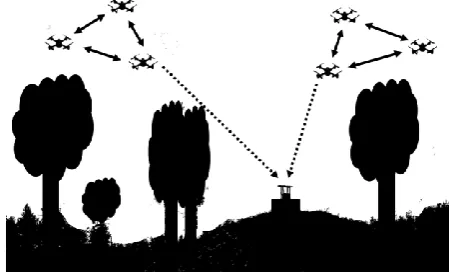
[image:2.595.312.538.424.560.2]A. Example Scenario 1: MRS in Stable Layout Domain This kind of scenario arises in applications like forest fire detection, habitat monitoring, aerial robotics and other monitoring systems. Robots maintain specific kind of formation in these applications, as shown in Fig. 2, and are controlled by BS. Robots establish recurrent connectivity, which refers to connectivity activated due to occurrence of an event or timeout, so bandwidth required is low. Peer to peer connection is established between robots in dynamic environment, where only location coordinates are shared to maintain formation. The BS has to plan the communication path (robot-robot and robot-BS) in an optimized manner in order to reduce transmission time and battery consumption, for maximum network lifetime.
Fig. 2: MRS in stable layout domain (Aerial Robotics)
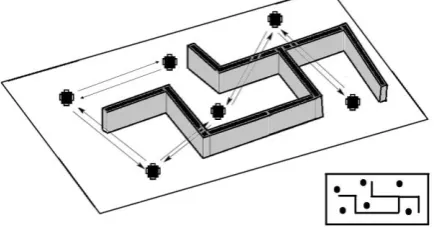
to BS, so that effective decisions can be taken timely. So, a higher bandwidth is required for efficient data transfer between robots and BS. As the terrain is unknown, robots have to communicate through various obstacles/scatterers, which makes the use of omnidirectional antenna with higher communication ranges necessary for robots. The key factors that limit the system performance are continuous connectivity, higher bandwidth and network congestion.
Fig. 3: MRS in collaborative layout domain (Map Building)
III. ROUTING PROTOCOLS FOR MRS COMMUNICATION The research in cluster-based routing protocols mainly focuses on three objectives: energy saving, reducing delay and enhancing accuracy. This means that a routing protocol offers a good performance for MRS data aggregation, if it is able to collect the maximum number of packets with minimum energy consumption and delay. However, these objectives are defined and optimized according to the consumer/application requirements. For example, a protocol that is able to reduce delay and increase accuracy is well-suited to real-time applications, even if it does not optimize energy efficiency [21]. In addition, routing protocols should consider and balance the potential correlations between energy, delay and the number of collected data samples. For example, collecting a greater number of packets increases energy consumption and delay, especially when the data sources are randomly scattered in the network. Reducing delay by utilizing direct communication (instead of multi-hop) increases energy consumption, whereas using multi-hop routing will increase data collection delay. For this reason, the issues of energy conservation, reducing delay and/or increasing the unit of collected data items, need to be addressed to design data aggregation routing protocols and enhance their performance in MRS.
Energy consumption needs to be reduced as a robot usually have limited power. Energy squandering hinges on the number of transmissions, dissemination stretch and data aggregation computation overhead. For this reason, data aggregation protocols should minimize the network traffic and path leap count. Data aggregation routing delay should be minimized for data freshness. In other words, routing delay may change the meaning and impact of collected data on further processing at BS. Data aggregation delay depends on network congestion (network traffic), transmission distance and communication delays. Increasing the count of captured data samples enhances data collection robustness. Indeed, the data consumer is able to make precise decisions on the collected data, if a greater number of data samples are
collected. Data accuracy depends on the routing algorithm's effectiveness to report data samples to the BS. Now, from above discussion it is quite evident that one single common default protocol will not suit each application and choosing appropriate parameter settings is necessary for stabilizing the energy dissipation with other competing metrics such as delay and data accuracy. Therefore, an approach that can effectively and automatically choose an appropriate protocol parameter is always sought by roboticists. Network layer in MRS routing protocol stack performs data routing and self-configuration of network. It finds the best route so that energy consumption of mobile robots is minimized. It is also responsible for the updation of network topology, if any link failure occurs [21]. Energy-aware routing algorithms for network layer can be classified into different categories, as given below:
Based on mode function: Proactive, Reactive and Hybrid Based on participation style: Direct, Flat and Clustering Based on network structure: Data centric, Hierarchical, Location based and QoS aware
In recent years, various investigators have used heuristic computation based clustering protocols. These protocols exhibits a vital system, by finding the ideal arrangements regarding optimal size of cluster and selecting best robots as CHR’s [22, 23]. Various techniques of computational intelligence (CI) and evolutionary algorithms (EAs), have been employed by researchers. Swarm intelligence (SI) and EA are meta-heuristic algorithms, have two key components: diversification and intensification. Various optimization techniques such as Particle Swarm Optimization (PSO) [25], Genetic Algorithm (GA) [24], Harmony Search Algorithm (HSA) [27] and Ant Colony Optimization (ACO) [26] have been used in this regard. These techniques utilize distinctive parameters in wellness capacity to achieve their goals. The arrangement of bunches and group based steering are some challenging issues encountered while implementation. In tackling these issues, the time of merging is an imperative metric in addition to energy efficiency. Details of the above said meta-heuristic algorithms based routing protocols, with an aim to prolong network lifetime along with the optimization criterion and effect is given as below:
PSO [28]: Optimization Criteria: Minimum intra-cluster distance
Effect: Extended network lifetime and throughput.
GA [29]: Optimization Criteria: Consumption of energy, number of clusters, size of cluster, direct distance to sink and cluster distance
Effect: Increase in network lifetime, better performance in terms of energy consumption, rate of convergence and execution time.
ACO [30]: Optimization Criteria: Energy consumption for communication, Residual energy, Path length
Effect: Prolong network lifetime, energy consumption balance among nodes and reduction of avg. energy consumption.
Effect: Lower energy consumption and extended network lifetime.
There are chances that a robot with low energy can become CHR, considering the point selection of CHR is probabilistic, as revealed by literature. So, there is a requirement to consider CHR selection in a deterministic way along with residual energy of robots. Other factors can also be considered to balance the load of robots such as distance from BS and distance of other robots from CHR. Therefore, the elementary requirement for energy efficient routing protocol foe communication is proper selection of CHR in appropriately formed cluster. In the majority of the conventions, CHR are expected to have a long correspondence empowering them to send information straightforwardly to the BS. This supposition that isn't constantly practical, because of signal propagation problems and BS is directly inaccessible to all robots. Therefore, there is a requirement to consider communication between CHR and BS in a multi-hop manner to handle this problem. The literature reveals that many evolutionary algorithms have done better than deterministic methods in many problems related with CHR selection in MRS. Appropriate selection of evolutionary algorithms alongside proper fitness function can proficiently balance the depletion of energy depletion in robots and hence uplift the lifetime of network. Flower pollination algorithm (FPA) is recently developed heuristic approach, that mimics the pollination process of flowers [32] and has been successfully applied for problems of forest fire detection [33] antenna design [34] etc. In this article, potential of FPA has been exploited for resolving the problem of load balancing in clusters in order to proficiently balance the consumption of energy in robots and maximize the period of stability for communication network.
A. Flower Pollination Algorithm
FPA is a unique bionic evolutionary algorithm that was proposed by Yang [32]. The motivation for FPA originates from the natural pollination process that happens in flowering plants. To emulate the pollination procedure, there are two distinctive pollination strategies for each flower to pick: worldwide/global or neighborhood/local pollination, with phase switch probability p.
Global pollination phase: For each individual, a random number is generated. If , then global pollination is done. In the worldwide/global pollination process, each flower modifies its position as per following expression [32]:
(1)
where and are the old and new positions of th
flower, respectively, is the best flower at current
iteration , which has the best fitness value among whole population, and the step size of global pollination is controlled by the scaling factor. Parameter ( ), the L’evy flight, is used as the strength of pollination in the basic FPA, and the step size ( ) obeys the L’evy distribution:
(2)
where is the gamma function. The pseudocode/ calculation steps of this algorithm is given below:
Start:
Initialize a population of random flowers
Define switch probability, Define objective function Identify current best solution while < max
for i = 1: if
perform Global Pollination:
else
perform Local Pollination:
end if
evaluate
if is better than update position end if
end for
Find the Current best end while
Update Final best End
Pseudocode 1. Pseudocode of FPA
Local pollination phase: If , the local pollination
process is be carried out. Flower obtains its new position according to the difference between its old position and
the position of two neighboring flowers and . This process is considered as local search, and the updating equation [32] is defined as
(3)
where is drawn from uniform distribution [0, 1], and it is considered as a local random walk. After pollination is completed, the new individuals update their positions by comparing fitness values. If the fitness of is enhanced
than that of , the new position of th flower will be
exchanged by . Otherwise, th flower remains at . In MRS, selection of CHR is binary-coded problem. So, one cannot straightforwardly use the basic FPA to handle this problem. For MRS, when position of the flower is modified, the position is discretized by following expression:
(4)
where indicates the position of th flower.
IV. PROBLEMFORMULATION
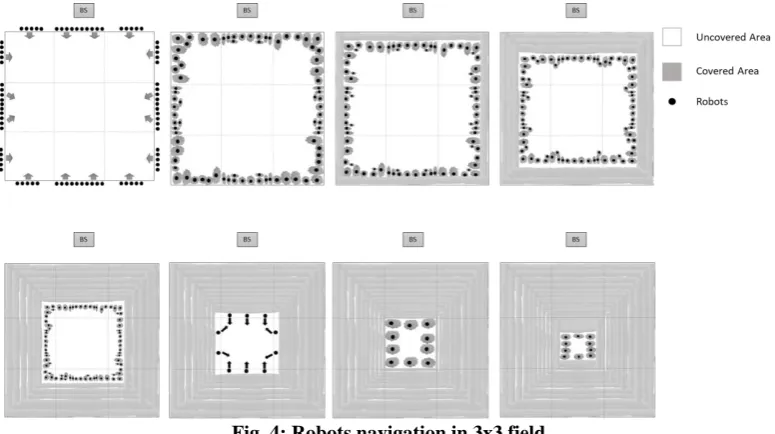
Fig. 4: Robots navigation in 3x3 field environment exploration, for the generation of maps and/or
search-and-rescue missions. An initially unfamiliar,
circumscribed, continuous two dimensional area is
considered, where signifies that the locations on
which is represented by and referring to latitude and longitude coordinates of global positioning system (GPS). A
team of mobile robots will
send data to principal control center called as base station (BS) located at a fixed location outside the bounds of . Each robot integrates various types of sensors, such as ultrasonic, LIDAR, thermal, image, GPS, etc. to perceive the environment, and transceivers (Texas CC1120, Microchip RN2483, Semtech SX1272 etc.) for long range data transmission and reception. Each robot is capable of exchanging data with BS and other robots over an ad-hoc wireless network governed by proposed algorithm (discussed in subsequent section). The BS plans the path and pose for each robot through simultaneous localization and mapping algorithm (SLAM) [35, 36], in order to safeguard the autonomy of robot. The progression of time is considered in
discrete steps i.e., , where last time step
of the mission is denoted by . The speed, position, direction and transmission range of robots is represented by a pose function of robot, given as
(5)
where, is the position, is the speed, is
direction and is the transmission range of robot at
time .
A. Exploration
As per the system paradigm described above, exploration of unknown territory is processed as follows. Area to be
explored is divided into matrix where and are whole numbers. Every element of the matrix is called zone, which is given as
(6)
Considering , is divided into matrix
i.e. zones. A number of robots (ten in our case) are placed at
boundaries of peripheral zones of . At a particular time , the deployment of robots is given as
(7)
In order to cater to the challenge of map building, SLAM algorithm is used because of its high convergence and ability to handle uncertainty efficiently [37]. A graph-based SLAM approach is being followed to represent map in terms of finite
vector by robot to record corresponding
observations from LIDAR sensors. Odometry
measurements are executed at time steps to register
new pose function of robot which is given as
(8)
where, and refers to before and after movement
poses of th robot. At time , the appraised joint posterior over the map, in probabilistic form, is given as [36]
(9)
The integration of sensor data to find maximum likelihood is re-appraised for whole map in each iteration to store overall data, as expressed below:
Map construction in graph-based SLAM is a two-step procedure, where first step is to describe and integrate constraints which is highly sensor dependent, named as front-end and second step is abstract depiction of data which is sensor agnostic, named as back-end [32, 38]. So the objective function to find configuration of robots is given as
(11)
where is difference of appraised and observed poses and
represents information matrix. At a particular time
interval decided by base station, robots stop moving and transmit their data to their respective ZCH (zone cluster head), which further transmits the data to BS. SLAM algorithm is computed at BS in order to update uncertainty grid [39], which in turn calculates the updated pose function , for all robots. This information is transmitted back to ZCH which forward the same to its zone member robots (ZMR) for further navigation. All robots will be made to converge towards central zone i.e., , as shown in Fig. 4. At central zone, ten robots with maximum energy will be selected by BS from all of the robots and same process is repeated again for central zone.
B. Radio Energy Dissipation Model for Communication As robots have limited energy, power consumption is a crucial factor for designing communication protocol, since robots consume energy for sensing, navigation, data processing, and wireless communication. The network energy is consumed on both sides during communication (sender and receiver) as per wireless energy consumption model [40]. The model consists of two parts reflecting transmission and reception as depicted in (12) and (14) respectively [40]. Robot consume energy to run the transmitter circuit and to activate the transmitter amplifier, whereas a
receiver consumes amount of energy for running the receiver circuit. Energy consumption in wireless
communication also depends on message length . Thus, the
transmission cost for a -bit message having
transmitter-receiver distance , is calculated as:
(12)
where is crossover distance and is given by:
(13)
The term signifies the energy consumed per-bit for
transmission, the parameters represent the
energy consumed and represent the energy
consumed in two ray ground propagation by radio. The cost of
reception for the -bit data message is given as:
(14)
V. PROPOSEDPROTICOLFORCOMMUNICATION Various tasks are performed by robots are sensing, computing, transmitting, and receiving. Few of these robots are ZCH or leaders, they collect and process the data and then
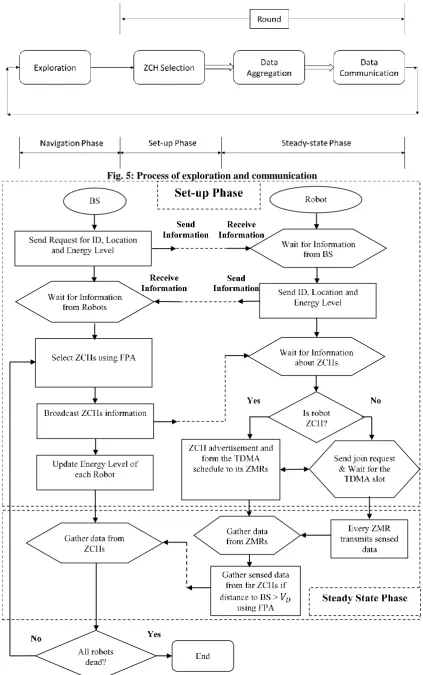
forward it to BS. The task of robots i.e. zone member robots (ZMR) other than ZCH is to sense the surroundings and send the data to the ZCH of their respective zone. The complete process of exploration and communication is performed in three phases i.e. Navigation phase in which robots sense the environment till particular time interval decided by base station and stop moving till next instruction by BS. The second phase is Set-up phase where ZCH selection is performed followed by Steady-state phase which is responsible for routing. Once steady-state phase is over BS again initiates navigation phase. The complete process of exploration and communication is shown in Fig. 5.
In this correspondence, FPA based Energy Efficient Routing Protocol (FPA-EERP) is proposed for energy efficient communication between robots and BS. The protocol process is bifurcated into rounds consisting of set-up and steady-state phase as illustrated in Fig. 6. The optimum ZCH selection is done in set-up phase and the optimum route is established in steady state phase, both using FPA.
The ZCHs are selected by BS from the alive robots having residual energy more than a threshold level, using FPA, which is basically average energy of all robots that are active, in set-up phase. Firstly, the BS makes announcement of a short communication in order to get the identifications (ID), energy levels and locations of every robot present in particular zone. Based on received data by robots, BS makes use of FPA to elect the ZCH per zone, on the basis of minimization of fitness function given by (15). The whole process is to minimize the fitness function and ZCH selection, which is formulated as Pseudocode 1. When ZCHs are elected and their associate members i.e. ZMRs are determined, then a communication broadcast is launched by BS to inform robots in various zones about their respective ZCH and ZMRs in association. A time division multiple access (TDMA) schedule is generated by elected ZCH to assign time slot to ZMRs and further notify with schedule through broadcasting in their zone. Schedule of TDMA is used to avoid intra-group interference and provides a facilitation to every ZMR for shutting down their radios when not in operation, for energy conservation. Furthermore, to reduce inter-zone interference a distinctive code division multiple access (CDMA) code is chosen by each ZCH chooses and notification is sent to all associated ZMRs present within the zone to make use of this code to send their information.
Fitness Evaluation: Lets consider a network of robots
deployed in area . Let denote
the population vector of a robots with robots, where
position of robot in zone is .
ZMRs and ZCHs are represented by values 0 and 1 respectively. The solutions (size of population) is initialized randomly in terms of 1s and 0s and one ZCH is
selected per zone. The robots are deployed into zones
where and and are whole numbers. The
Fig. 5: Process of exploration and communication
(15)
subject to: .
In order to accomplish the better stability period, reduction of standard deviation of remaining/residual energy of each robot
is very crucial. The standard deviation ( ) aids to measure the quality of even dissemination of the load between robots
per , which is given as
16)
where and is the
remaining/residual energy of th robot.
The second objective concerns with aggregation of residual
energy level and average distance value for selection of ZCH.
) (17)
where is average distance of a robot from all the other robots in same zone as given in (18). The chance of a robot to
become ZCH is elevated with its lesser average distance .
(18)
where is total number of robots in a zone, is
distance of th robot from th robot in its zone, as
(19)
Steady-state phase: Steady-state phase is divided into two parts named as Intra-zone data transmission phase and Inter-zone data transmission phase. Since, interval for data transmission in this phase is far lengthier than the set-up phase, so there is scope of energy dissipation reduction in this phase as well. In intra-zone data transmission, the member nodes send information to the ZCH at a certain time interval and perform exploration for rest of the time, being a part of reactive protocol. During inter-zone data transmission phase, ZCH receive data from other ZCHs & sends the aggregated data to next hop. Next hop depends on distance in BS and ZCH ( at the slot of time that is allocated by the ZCH of the upper level.
Intra-zone data transmission phase: During this data transmission phase, energy of active robots will be dissipated while sensing, navigation, packets transmission, receiving, and aggregation. For ZCHs, energy will also be consumed with packets reception and aggregation. Thus, in this phase, the energy of the ZMRs and ZCHs can be formally modified according to the following expression:
(20)
(21)
where, and denotes current energy of
ZMR and ZCH respectively, is
energy expenditure for transmitting data from ZMR to ZCH.
is energy dissipated for reception of data at ZCH and is the energy dissipated in data aggregation for ZCH.
Inter-zone data transmission phase: During this phase, the energy of ZCHs in the network will be modified according to the dissipated energy required for packets transmission to BS.
Energy is also dissipated for relay ZCHs i.e., to receive the message packets from distant ZCHs and transmission to next ZCH. Thus, in this phase, the energy of the ZCH can be formally modified according to the following
(22)
where, is the distance between ZCH and BS
and is the relay ZCH that lie within the
transmission/reception range and is the
residual energy of ZCHs. In the proposed routing algorithm, a multi-hop communication is used to improve communication efficiency and reduce long communication cost using FPA. If
the distance is greater than there is a
requirement to consider an adjacent ZCH as a relay to send its data to BS. To achieve load balancing, relative distance factor ( ) is considered, defined as
(23)
Distance factor is associated to the total sum of distance
in-between the source ZCH and relay ZCH and relay ZCH and BS. If is away from the BS, then it chooses a
as a relay node. with the least cost of link will be selected to relay the data sensed by .
VI. SIMULATONRESULTS
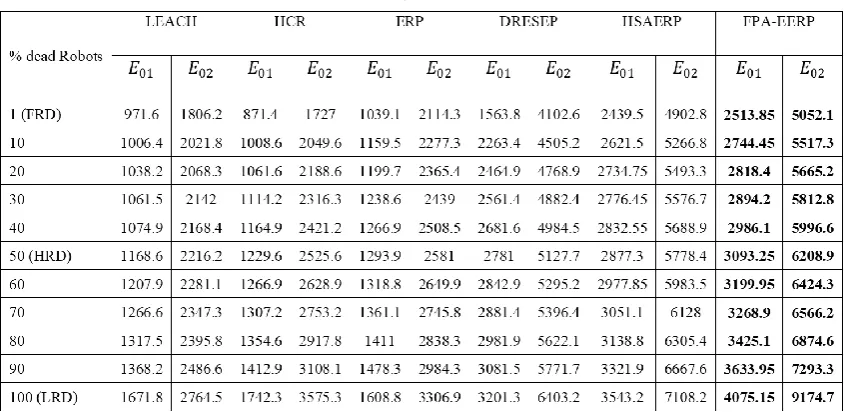
Table I Dead robot round history for 6.66 kJ and 13 kJ
Lithium-Polymer (Li-Po) battery (2200mAh = 88 kJ), which drives motors, control system and sensors. Also, it is assumed that a portion of energy (330mAh = 13 kJ) is used for powering LoRa module (Microchip RN2483) for transmitting and receiving data. Here, three cases are simulated at different initial energy levels for communication i.e., = 6.66 kJ
(50%) and = 13 kJ (≈100%). The parameters used for the protocol simulations in network are given below:
Number of robots = 80 Area =100m×100m
Location of BS = (50, 120) (Outside Area) Length of data packet: 40,000 bits
Initial energy, and = 13 kJ and 6.66 kJ
Radio energy, = 500 μJ/bit
Energy for data-aggregation, = 50 μJ/bit Radio amplifier energy, = 1000 nJ/bit/m2
Radio amplifier energy, = 0.013 J/bit/m4
Simulation results are produced by deploying 10 robots per outer zone, making a total of 80 robots. The network consist of robots having initial energy and BS is located at (50, 120) i.e., outside the area to be explored. FPA-EERP protocol performance is evaluated in terms of stability period (the time interval or the rounds before the first robot becomes inactive due to energy depletion) and network lifetime and further, compared with the other algorithms. The simulation results of total network lifetime for competitive protocols with initial energy =13 kJ are shown in Fig. 7. It can be seen that FPA-EERP has maximum network lifetime, because of the reason optimal selection of ZCHs and routing path by making use of FPA, on the basis of energy and distance. The performance advantage of FPA-EERP in terms of the total network lifetime is approx. 4% as compared to HSAERP & approx. 11% as compared to DRESEP, when 50% of robots are alive. The performance improves drastically till last robot is alive i.e. approx. 20% as compared to HSAERP and approx. 27% as compared to DRESEP.
To verify the performance of proposed algorithm, the simulations are performed with different initial energy of robots. Table I shows the dead robots round history for =
[image:9.595.309.545.443.573.2]6.66 kJ (50%) and = 13 kJ (≈100%) respectively. For the total network lifetime (i.e., time until last the robot dead (LRD)) and the stability period (i.e., time until the first robot dead (FRD)), the proposed protocol outperforms against all other protocols. Effect of robot density is evaluated the in each approach by varying the number of robots from 100 to 500 with initial energy 13 kJ. In the same parameters are used to form a simulation model, and the results are presented in Table II. The performance of FPA-EERP confirms that the consistency, firmness, and scalability of the proposed algorithm is brilliant and is appropriate to large scale MRS communication in exploration tasks.
[image:9.595.308.546.617.683.2]Fig. 7 Comparison of no. of alive robots per round wrt different protocols for 13kJ
Table II Effect of robot density on the performance of FPA-EERP
VII. CONCLUSION&FUTURESCOPE In this correspondence, various approaches for multi-robot
communication constraints involved in the field of multi-robot communication. This paper addresses the problem of routing of data by robots, which are spatially dispersed in zones, to BS at specific time instants, while ensuring an efficient communication and increased network life time. A framework for multi-robot communication using FPA is proposed for transmission and routing of data between ZMR to ZCH, ZCH to ZCH and ZCH to BS. This information is further utilized by SLAM protocol at BS for efficient exploration and map making. Periodic communication helps BS to generate updated poses for ZMRs in order to empower exploration process, which in turn saves robot’s energy. Simulation results shows that the proposed protocol i.e. FPA-EERP can be effectively applied in MRS for unknown environment exploration as it outperforms other methods (available in literature) in terms of energy efficiency and network life time, which leads to more freedom to explore.
In future, the investigation and applicability of proposed protocol on hardware [46] for communication in indoor and outdoor map making applications will be explored. Finally, this development will also incorporate open source codes, in order to empower researchers around the globe to develop hardware for these applications.
REFERENCES
1. Farinelli, A., Iocchi, L., & Nardi, D., Multirobot systems: a classification focused on coordination. IEEE Transactions on Systems, Man, and Cybernetics, Part B (Cybernetics), 34(5), 2004, 2015-2028. DOI: 10.1109/TSMCB.2004.832155
2. Khamis, A., Cooperative Multi-robot Systems. Resource Document. IEEE Robotics and Automation Society – Egypt Chapter Chair, 2016. http://www.landminefree.org/home/images/MRS_Webinar_Mineswe epers_23_July_2016.pdf
3. Ding, H., Cristofalo, E., Wang, J., Castanón, D., Montijano, E., Saligrama, V., & Schwager, M., A multi-resolution approach for discovery and 3-D modeling of archaeological sites using satellite imagery and a UAV-borne camera. In American Control Conference (ACC), 2016,1359-1365.
4. Montijano, E., Cristofalo, E., Zhou, D., Schwager, M., & Sagüés, C., Vision-based distributed formation control without an external positioning system. IEEE Transactions on Robotics, 32(2), 2016, 339-351.
5. Wang, Z., & Schwager, M., Multi-robot manipulation without communication. In Distributed Autonomous Robotic Systems, Springer, Tokyo, 2016, 135-149.
6. Culbertson, P., & Schwager, M., Decentralized Adaptive Control for Collaborative Manipulation. In IEEE Conference on Robotics and Automation, 2018.
7. Usevitch, N., Hammond, Z., Follmer, S., & Schwager, M., Linear actuator robots: Differential kinematics, controllability, and algorithms for locomotion and shape morphing. In Intelligent Robots and Systems (IROS), IEEE/RSJ International Conference, 2017, 5361-5367. 8. Locchi, L., Nardi, D., & Salerno, M., Reactivity and deliberation: a
survey on multi-robot systems. In Workshop on Balancing Reactivity and Social Deliberation in Multi-Agent Systems, Springer, Berlin, 2000, 9-32.
9. Pickem, D., Self-reconfigurable multi-robot systems (Doctoral dissertation, Georgia Institute of Technology), 2016. https://smartech.gatech.edu/handle/1853/55001
10. Yan, Z., Fabresse, L., Laval, J., & Bouraqadi, N., Team size optimization for multi-robot exploration. In International Conference on Simulation, Modeling, and Programming for Autonomous Robots, Springer, Cham, 2014, 438-449.
11. Verret, S., Current state of the art in multirobot systems. Defence Research and Development Canada-Suffield, 2005, 3.
12. Pagello, E., D'Angelo, A., & Menegatti, E., Cooperation issues and distributed sensing for multirobot systems. Proceedings of the IEEE, 94(7), 2006, 1370-1383.
13. MacLennan, B., Synthetic ethology: An approach to the study of communication. University of Tennessee, Computer Science Department, 1990.
14. Doriya, R., Mishra, S., & Gupta, S., A brief survey and analysis of multi-robot communication and coordination. In International Conference on Computing, Communication & Automation (ICCCA), 2015, 1014-1021.
15. Akyildiz, I. F., Su, W., Sankarasubramaniam, Y., & Cayirci, E., A survey on sensor networks. IEEE Communications magazine, 40(8), 2002, 102-114.
16. Casarini, E., & Martinelli, M, Updating communication maps for exploring multirobot systems, 2017.
17. Sarker, M. O. F., & Dahl, T., Bio-Inspired Communication for Self-Regulated Multi-Robot Sytems. In Multi-robot systems, trends and development. InTech, 2011.
18. Banfi, J., Li, A. Q., Rekleitis, I., Amigoni, F., & Basilico, N., Strategies for coordinated multirobot exploration with recurrent connectivity constraints. Autonomous Robots, 42(4), 2018, 875-894.
19. Reis, J. C., Lima, P. U., & Garcia, J., Efficient distributed communications for multi-robot systems. In Robot Soccer World Cup, Springer, Berlin, Heidelberg, 2013, 280-291.
20. Speranzon, A., On control under communicaiton constraints in autonomous multi-robot systems (Doctoral dissertation, Signaler, sensorer och system), 2004.
21. Akyildiz, I. F., Melodia, T., & Chowdhury, K. R., A survey on wireless multimedia sensor networks. Computer networks, 51(4), 2007, 921-960. DOI: 10.1016/j.comnet.2006.10.002
22. Khan, M. Y., Javaid, N., Khan, M. A., Javaid, A., Khan, Z. A., & Qasim, U., HYBRID DEEC: Towards Efficient Energy Utilization in Wireless Sensor Networks. World Applied Sciences Journal, 22(1), 2013, 126-132.
23. Loscri, V., Morabito, G., & Marano, S., A two-levels hierarchy for low-energy adaptive clustering hierarchy (TL-LEACH). In Vehicular Technology Conference, IEEE. 3, 2005, 1809-1813.
24. Deb, K., Pratap, A., Agarwal, S., & Meyarivan, T. A. M. T., A fast and elitist multiobjective genetic algorithm: NSGA-II. IEEE transactions on evolutionary computation, 6(2), 2002, 182-197.
25. Trelea, I. C., The particle swarm optimization algorithm: convergence analysis and parameter selection. Information processing letters, 85(6), 2003, 317-325.
26. Dorigo, M., & Di Caro, G., Ant colony optimization: a new meta-heuristic. In Evolutionary Computation, Proceedings of the 1999 Congress, IEEE, 2, 1999, 1470-1477.
27. Geem, Z. W., Kim, J. H., & Loganathan, G. V., A new heuristic optimization algorithm: harmony search. Simulation, 76(2), 2001, 60-68.
28. Zhu, Q., Liang, A., & Guan, H., A PSO-inspired multi-robot search algorithm independent of global information. In Swarm Intelligence (SIS), 2011 IEEE Symposium, 2011, 1-7.
29. Tu, J., & Yang, S. X., Genetic algorithm based path planning for a mobile robot. In Robotics and Automation. Proceedings. ICRA'03. IEEE International Conference, 1, 2003, 1221-1226.
30. Kambayashi, Y., Tsujimura, Y., Yamachi, H., Takimoto, M., & Yamamoto, H., Design of a multi-robot system using mobile agents with ant colony clustering. In System Sciences. HICSS'09. 42nd Hawaii International Conference, IEEE, 2009, 1-10.
31. Hoang, D. C., Yadav, P., Kumar, R., & Panda, S. K., Real-time implementation of a harmony search algorithm-based clustering protocol for energy-efficient wireless sensor networks. IEEE transactions on industrial informatics, 10(1), 2014, 774-783. 32. Yang, X. S., Karamanoglu, M., & He, X., Flower pollination
algorithm: a novel approach for multiobjective optimization. Engineering Optimization, 46(9), 2014, 1222-1237.
33. Mittal, N., Moth Flame Optimization Based Energy Efficient Stable Clustered Routing Approach for Wireless Sensor Networks. Wireless Personal Communications, 2018, 1-18.
34. Saxena, P., & Kothari, A., Linear antenna array optimization using flower pollination algorithm. SpringerPlus, 5(1), 2016, 306. 35. Hening, S., Ippolito, C. A., Krishnakumar, K. S., Stepanyan, V., &
Author-2 Photo
Author-3 Photo
Author-3 Photo
36. Eck, M., Simultaneous 2D Localization and 3D Mapping on a mobile Robot with Time-of-Flight Sensors (Doctoral dissertation, University of Applied Sciences Koblenz), 2013.
37. Vidal, A. R., Rebecq, H., Horstschaefer, T., & Scaramuzza, D., Ultimate SLAM? Combining Events, Images, and IMU for Robust Visual SLAM in HDR and High-Speed Scenarios. IEEE Robotics and Automation Letters, 3(2), 2018, 994-1001.
38. Grisetti, G., Kummerle, R., Stachniss, C., & Burgard, W., A tutorial on graph-based SLAM. IEEE Intelligent Transportation Systems Magazine, 2(4), 2010, 31-43.
39. Wallar, A., Plaku, E., & Sofge, D. A., Reactive motion planning for unmanned aerial surveillance of risk-sensitive areas. IEEE Transactions on Automation Science and Engineering, 12(3), 2015, 969-980.
40. Heinzelman, W. B., Chandrakasan, A. P., & Balakrishnan, H., An application-specific protocol architecture for wireless microsensor networks. IEEE Transactions on wireless communications, 1(4), 2002, 660-670.
41. Deng, S., Li, J., & Shen, L., Mobility-based clustering protocol for wireless sensor networks with mobile nodes. IET wireless sensor systems, 1(1), 2011, 39-47.
42. Sajid Hussain, D., & Abdul Matin, W., Hierarchical Cluster-based Routing in Wireless Sensor Networks. proceeding on IEEE Transaction on Computing Systems (ICDCS), 2013, 255-259. 43. Khalil, E. A., & Bara’a, A. A., Stable-aware evolutionary routing
protocol for wireless sensor networks. Wireless personal communications, 69(4), 2013, 1799-1817.
44. Mittal, N., & Singh, U., Distance-based residual energy-efficient stable election protocol for WSNs. Arabian Journal for Science and Engineering, 40(6), 2015, 1637-1646.
45. Hoang, D. C., Yadav, P., Kumar, R., & Panda, S. K., Real-time implementation of a harmony search algorithm-based clustering protocol for energy-efficient wireless sensor networks. IEEE transactions on industrial informatics, 10(1), 2014, 774-783. 46. Singh, K. J., Embedded Systems and Robotics Research Group.
(2018). Investigation of Bluetooth Low Energy and WiFi for M2M and Mesh Networking. Available at
47. https://electronicscu.wixsite.com/research/ibmm
AUTHORSPROFILE
Kiran Jot Singh is a PhD Research Scholar in Chandigarh University, India. He has keen interest in embedded systems and robotics. He has filed 8 patents in Indian patent office.
Divneet Singh Kapoor is an Assistant Professor in the ECE Department, Chandigarh University, India. His interests include robotics and signal processing.
Balwinder Singh Sohi is the Ex-Director of UIET, Panjab University, Chandigarh and presently he is working as Professor in the ECE department at Chandigarh University.