7-2003
The Parallel Implementation of a Full
Configuration Interaction Program
Zhengting Gan
Iowa State University
Yuri Alexeev
Iowa State UniversityMark S. Gordon
Iowa State University, [email protected]
Ricky A. Kendall
Iowa State UniversityFollow this and additional works at:
http://lib.dr.iastate.edu/ameslab_pubs
Part of the
Chemistry Commons
The complete bibliographic information for this item can be found at
http://lib.dr.iastate.edu/
ameslab_pubs/326
. For information on how to cite this item, please visit
http://lib.dr.iastate.edu/
howtocite.html
.
The Parallel Implementation of a Full Configuration Interaction Program
Abstract
Both the replicated and distributed data parallel full configuration interaction (FCI) implementations are
described. The implementation of the FCI algorithm is organized in a hybrid strings-integral driven approach.
Redundant communication is avoided, and the network performance is further optimized by an improved
distributed data interface library. Examples show linear scalability of the distributed data code on both PC and
workstation clusters. The new parallel implementation greatly extends the hardware on which parallel FCI
calculations can be performed. The timing data on the workstation cluster show great potential for using the
new parallel FCI algorithm in expanding applications of complete active space self-consistent field
applications.
Keywords
Configuration interaction
Disciplines
Chemistry
Comments
The following article appeared in
Journal of Chemical Physics
119 (2003): 47, and may be found at
doi:
10.1063/1.1575193
.
Rights
Copyright 2003 American Institute of Physics. This article may be downloaded for personal use only. Any
other use requires prior permission of the author and the American Institute of Physics.
Zhengting Gan, Yuri Alexeev, Mark S. Gordon, and Ricky A. Kendall
Citation: The Journal of Chemical Physics 119, 47 (2003); doi: 10.1063/1.1575193
View online: http://dx.doi.org/10.1063/1.1575193
View Table of Contents: http://scitation.aip.org/content/aip/journal/jcp/119/1?ver=pdfcov
Published by the AIP Publishing
Articles you may be interested in
Semi-stochastic full configuration interaction quantum Monte Carlo: Developments and application J. Chem. Phys. 142, 184107 (2015); 10.1063/1.4920975
Large-scale parallel configuration interaction. I. Nonrelativistic and scalar-relativistic general active space implementation with application to ( Rb – Ba ) +
J. Chem. Phys. 128, 014108 (2008); 10.1063/1.2805369
Improved implementation and application of the individually selecting configuration interaction method J. Chem. Phys. 122, 024110 (2005); 10.1063/1.1829045
Parallel Programming with Message Passing and Directives Comput. Sci. Eng. 3, 22 (2001); 10.1109/5992.947105
Parallel implementation of the CI-vector evaluation in full CI/CAS-SCF J. Chem. Phys. 113, 5653 (2000); 10.1063/1.1290014
The parallel implementation of a full configuration interaction program
Zhengting Gan
Scalable Computing Laboratory, Ames Laboratory U.S. D.O.E., Ames, Iowa 50011
Yuri Alexeev and Mark S. Gordon
Scalable Computing Laboratory, Ames Laboratory U.S. D.O.E., Ames, Iowa 50011 and Department of Chemistry, Iowa State University, Ames, Iowa 50011
Ricky A. Kendall
Scalable Computing Laboratory, Ames Laboratory U.S. D.O.E., Ames, Iowa 50011 and Department of Computer Science, Iowa State University, Ames, Iowa 50011
共Received 26 December 2002; accepted 26 March 2003兲
Both the replicated and distributed data parallel full configuration interaction共FCI兲implementations are described. The implementation of the FCI algorithm is organized in a hybrid strings-integral driven approach. Redundant communication is avoided, and the network performance is further optimized by an improved distributed data interface library. Examples show linear scalability of the distributed data code on both PC and workstation clusters. The new parallel implementation greatly extends the hardware on which parallel FCI calculations can be performed. The timing data on the workstation cluster show great potential for using the new parallel FCI algorithm in expanding applications of complete active space self-consistent field applications. © 2003 American Institute
of Physics. 关DOI: 10.1063/1.1575193兴
I. INTRODUCTION
Full configuration interaction 共FCI兲 provides the exact nonrelativistic solution of the many-electron Schro¨dinger equation in a given finite one-electron basis space. Therefore it is commonly used as a benchmark tool to assess approxi-mate correlation methods. In addition, FCI is also employed in complete-active space self-consistent field 共CASSCF兲
共Ref. 1兲programs to obtain the CI coefficients of CASSCF wave functions. Because the FCI calculation is carried out at every CASSCF iteration, considerable effort has been ex-pended to develop and implement efficient FCI algorithms to handle the relatively large active spaces, required by com-plex chemical systems.1–5
Because of the simplicity in computing the coupling co-efficients, almost all modern FCI algorithms are based on determinants instead of configuration state functions共CSFs兲. A major step forward in determinant-based FCI was intro-duced by Handy2 with the idea of separate alpha and beta strings for alpha and beta spins. Following this innovation, more efficient algorithms have been proposed and imple-mented, including the work by Olsen et al.,3 Zarrabian
et al.,4 Michael et al.,5 Rossi et al.,6 Sherrill et al.,7 Ivanic
et al.,9and others. However, despite the diversity of the al-gorithms, the implementations of FCI programs remain es-sentially in two different ways, either the integral driven ap-proach or the configuration driven apap-proach.6,8
The memory and efficiency requirements of a FCI cal-culation make it an ideal application for parallel computing. By taking advantage of the computational capacity provided by state-of-the-art high performance parallel supercomputers, FCI calculations that include up to ten billion determinants have been reported.8 However, the problem of parallel full
CI performance still requires attention. For example, due to the excessive communication present in parallel FCI calcu-lations, existing parallel FCI implementations are limited to supercomputers, such as the CRAY-T3E8,17 and IBM SP.6 Because clusters of PCs and workstations have become in-creasingly accepted as powerful alternatives to expensive su-percomputers, a FCI code that runs effectively on clusters is highly desired, albeit a challenging, task.
The difficulties in achieving high performance on paral-lel computers come from the complexity of modern com-puter architectures, and the networked distributed memory makes the situation even worse. Since there are multiple per-formance factors on parallel computers, any single mode CI driven method will have some pitfalls. Instead, a more flex-ible algorithm is needed. The original determinant FCI code9
in GAMESS is a straight string driven implementation. The
algorithm produces reasonable efficiency, but the computa-tional potential is not fully exploited, and the structure of data and computational algorithm is not well suited for dis-tributed computing. In this paper we present an efficient implementation of both replicated data and distributed data parallel FCI algorithms. In these new codes a combined string driven and integral driven approach is proposed to optimize both the sequential performance and the interpro-cessor communication. In the distributed data implementa-tion we identify the redundant communicaimplementa-tion in a parallel FCI calculation and its collective nature. These problems are solved conveniently in our combined approach. In addition, the communication performance is further improved by the implementation of new distributed data interface 共DDI兲10 communication routines. The performance and scalability of the new parallel implementation are demonstrated by ex-amples.
JOURNAL OF CHEMICAL PHYSICS VOLUME 119, NUMBER 1 1 JULY 2003
47
0021-9606/2003/119(1)/47/13/$20.00 © 2003 American Institute of Physics
II. THEORY AND METHODS
A. Description of the FCI algorithm
The FCI solves the Schro¨dinger equation by making use of the variational principle. In practice, it solves the eigen-vector problem of the Hamiltonian matrix in the determinant basis space defined by distributing the n electrons over N spin orbitals. Since usually only a few eigenvalues and eigenvectors are required in CI calculations, the eigenvalue problem is commonly solved by iterative diagonalization methods proposed by Davidson11 or Liu.12 In the Davidson diagonalization method the Hamiltonian matrix is projected onto a small set of subspace vectors, and the solution vector is obtained by full diagonalization in this small subspace. The subspace is improved at each iteration by adding a new basis vector, which is derived from the Ritz residual. When the subspace becomes too large to handle, a restart procedure is applied and the subspace is contracted. The most time consuming step in each iteration is the calculation of the Hamiltonian projection vectorfor the new basis vector C,
⫽HC, 共1兲
where H is the Hamiltonian matrix. As the dimension of the CI space increases, the storage of the Hamiltonian matrix in memory or even on disk soon becomes impossible. Thus a direct CI technique must be employed to calculate the vector without explicit construction of the Hamiltonian ma-trix. This strategy eliminates the storage problem of the Hamiltonian matrix, so a significantly larger CI calculation becomes possible.
The Hamiltonian operator Hˆ in the Schro¨dinger equation is generally expressed in second quantized form as
Hˆ⫽
兺
i j
hi jEˆi j⫹
1 2
兺
i jkl 共i j ,kl兲共Eˆi jEˆkl⫺␦jkEˆil兲. 共2兲
Here Eˆi j is the shift operator, hi j are one-electron
Hamil-tonian matrix elements, and (i j ,kl) are two-electron inte-grals. In the following discussions we will use u,,w to rep-resent determinants, I,J,K to reprep-resent strings, k,l to reprep-resent the orbital array of a string, L␣,L to represent alpha and beta excitation lists, and superscripts ,to denote unspeci-fied alpha and beta spins.
In the FCI wave function, a determinant is expressed as a combination of alpha and beta strings. An alpha string is defined as an ordered product of creation operators for spin orbitals with alpha spin, and a beta string is defined similarly,
兩K
典
⫽兩K␣K典
, 兩K␣典
⫽兿
i⫽1
n␣
␣l⫹共i兲,␣, 兩K
典
⫽兿
i⫽1n
␣k⫹共i兲,.
共3兲
l(i) and k(i) are the orbital arrays for the alpha and beta
strings, respectively. It is convenient to split Eˆi j into alpha and beta parts,
Eˆi j⫽Eˆi j␣⫹Eˆi j, 共4兲
and the Hamiltonian can be rewritten as a combination of six parts,
Hˆ⫽Hˆ1⫹Hˆ2⫹Hˆ3⫹Hˆ4⫹Hˆ5⫹Hˆ6,
Hˆ1⫽
兺
i
hiiEˆii␣⫹
1 2
兺
i j 关共ii, j j兲⫺共i j , ji兲兴Eˆii␣Eˆj j␣
⫹12
兺
i j 共
ii, j j兲Eˆii␣Eˆj j⫹
兺
ihiiEˆii
⫹12
兺
i j 关共
ii, j j兲⫺共i j , ji兲兴EˆiiEˆj j
⫹1
2
兺
i j 共ii, j j兲EˆiiEˆ␣j j,
Hˆ2⫽
兺
i⫽j
hi jEˆi j␣⫹
1
2ii jk,i
兺
⫽j 关共i j ,kk兲⫺共ik,k j兲兴Eˆi j␣Eˆkk␣
⫹1
2i jk,i
兺
⫽j 共i j ,kk兲Eˆi j␣Eˆkk ,
Hˆ3⫽
兺
i⫽j
hi jEˆi j⫹1
2i jk,i
兺
⫽j 关共i j ,kk兲⫺共ik,k j兲兴Eˆi jEˆkk
⫹12
兺
i jk,i⫽j 共
i j ,kk兲Ei jEˆkk␣ , 共5兲
Hˆ4⫽
1
2i jkl,i
兺
⫽j⫽k⫽l 共i j ,kl兲共Eˆi j␣Eˆkl␣兲,
Hˆ5⫽
1
2i jkl,i
兺
⫽j⫽k⫽l 共i j ,kl兲共Eˆi jEˆkl兲,
Hˆ6⫽
1
2i jkl,i
兺
⫽j⫽k⫽l 共i j ,kl兲共Eˆi j␣Eˆkl⫹Eˆi jEˆkl␣兲.
Here some of the two electron terms are grouped with one electron term for ease of implementation. The six terms can be viewed as the diagonal term (Hˆ1), alpha (Hˆ2) and beta
(Hˆ3) single replacement terms, alpha (Hˆ4) and beta (Hˆ5)
double replacement terms, and the combination of alpha and beta single excitations (Hˆ6).
The coupling coefficients are the matrix elements of op-erator Eˆi j and the operator product Eˆi jEˆkl .
Ei j,u⫽
具
u兩Eˆi j兩典
,共6兲
Ei j,kl,u⫽
具
u兩Eˆi jEˆkl兩典
.In the determinant basis, a nonzero coupling coefficient of a single operator Eˆi j can be either 1 or⫺1, and the associated phase factor Pi j,u can be obtained by counting the occupied orbitals that u andhave in common between orbitals i and
j, as discussed in Ref. 8.
Ei j,u⫽共⫺1兲Pi j,u,
共7兲
Pi j
,u⫽
兺
k⫽i⫹1
j⫺1
Eˆkk
,u
.
The coefficients Ei j,kl,u can be evaluated by summing over all the intermediate states,
Ei j,kl,u⫽
兺
w
具
u兩Eˆi j兩w
典具
w兩Eˆkl兩典
. 共8兲Although this may appear to be very complicated, only one intermediate state of w has a nonzero contribution, so it is computed as the product of two single operator coefficients, and its phase factor is the sum of the two,
Ei j,kl,u⫽共⫺1兲Pi j,kl ,u
; Pi j,kl,u⫽Pi j,uw⫹Pkl,w. 共9兲 Now, let Hi be the matrix form of operator Hˆi, with the
computational task of the vector apportioned accordingly,
⫽H1C⫹H2C⫹H3C⫹H4C⫹H5C⫹H6C ⫽1⫹2⫹3⫹4⫹5⫹6,
1,u⫽
兺
再
兺
ihiiEii␣,u⫹
兺
i⬍j 关共
ii, j j兲⫺共i j , j i兲兴Eii␣,uE␣j j,u
⫹
兺
i j 共
ii, j j兲Eii␣,uEj j,u⫹
兺
i
hiiEii
,u
⫹
兺
i⬍j 关共
ii, j j兲⫺共i j , j i兲兴Eii,Ej j,u
冎
C,2,u⫽
兺
再
兺
i⫽jhi jEi j␣
,u⫹
兺
i jk,i⬍j 关共
i j ,kk兲⫺共ik,k j兲兴
⫻Ei j␣,uEkk␣,u⫹
兺
i jk,i⬍j 共
i j ,kk兲Ei j␣,uEkk,u
冎
C,3,u⫽
兺
再
兺
i⫽jhi jEi j
,u⫹
兺
i jk,i⬍j 关共
i j ,kk兲⫺共ik,k j兲兴
⫻Ei j,uEkk,u⫹
兺
i jk,i⬍j 共
i j ,kk兲Ei j,uE␣,ukk
冎
C, 共10兲4,u⫽
兺
再
i⫽j⫽k兺
⫽l,i j⬍kl 关共i j ,kl兲⫺共il, j k兲兴Ei j,kl␣␣,u
冎
C,5,u⫽
兺
再
i⫽j⫽k兺
⫽l,i j⬍kl 关共i j ,kl兲⫺共il, j k兲兴Ei j,kl,u
冎
C,6,u⫽
兺
再
i⫽兺
j⫽k⫽l 共i j ,kl兲共Ei j,kl␣,u兲
冎
C,where u anddenote elements of vectorsand C. Follow-ing Olsen,3in the case of M s⫽0 the computation of terms
3and5can be eliminated and the computational effort of 6 can also be halved by imposing the condition
共␣,兲⫽共⫺1兲s共,␣兲. 共11兲
B. String and list generation
A string is represented by a list of occupied orbitals in ascending energy order. During a FCI calculation, the infor-mation about a string is frequently accessed, so it is expedi-ent to store this information rather than generate it on the fly. An effective way to accomplish this is to store strings in their bit format. In a system containing n␣ ␣ electrons and M orbitals, a string can be represented by a binary word of
length M. Each bit represents an orbital; the bit is set to 1 if the orbital is occupied and set to 0 if it is empty. This is also called a string’s binary representation. In FORTRAN a string can be stored as an integer and its information can be easily retrieved using the ibtest intrinsic function. However, if the number of orbitals M exceeds the total number of the bits of an integer word, this storage scheme becomes very inconve-nient. First, a string has to be stored using several integers and the bit testing becomes nontrivial. Second, the efficiency of bit testing is also reduced because of the increased number of unoccupied orbitals. To avoid such problems an alterna-tive orbital format is used in the code presented here, when the orbital space is relatively large. In this scheme only the occupied orbitals of a string are stored and each takes one byte of memory. InFORTRANthis can be implemented using an INTEGER*1 or CHARACTER array. The combination of
bit format and orbital format exploits the nature of FCI cal-culations, as a realistic FCI calculation can either have a large number of electrons or a large number of active orbit-als, but not both. Thus either the bit format or the orbital format of a string will be suitable for a given FCI calcula-tion.
The canonical order of a string K can be obtained by using a modified WYB series arrays proposed by Wang and co-workers 共WYB兲,13,14
Cano共K兲⫽1⫹
兺
i⫽1
n
WY Bi关k共i兲兴. 共12兲
Here denotes either alpha or beta spin of electrons, n is the number of electrons in string K, and k(i) is the orbital array. The WYB arrays can be generated recursively,
WY Bi共J兲⫽WY Bi⫺1共J⫺1兲⫹WY Bi共J⫺1兲, 共13兲
or be calculated directly
WY Bi共J兲⫽
冉
J⫺1i
冊
. 共14兲The canonical order generated by this indexing system is different from the addressing system proposed by Knowles
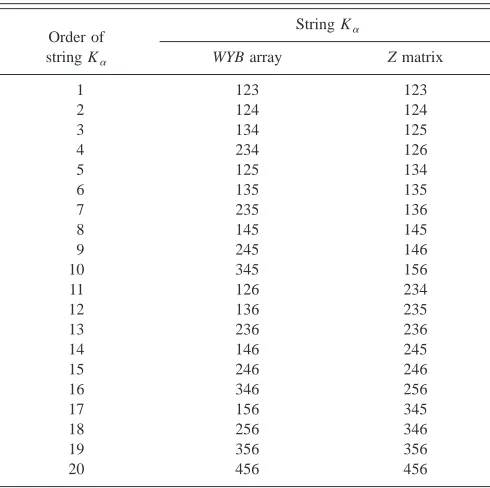
et al.,15where the Z matrix is used. Here we use L(n␣, M ) to denote the list of alpha strings in canonical order, n␣ is the number of electrons with alpha spin and M is the total num-ber of orbitals. Table I shows the list of n␣⫽3, M⫽6 using the two different indexing schemes. Only one set of WYB arrays is used for both alpha and beta strings, while the Z matrix has to be built for alpha and beta strings separately. Besides, the Z matrix is more complicated to construct com-pared to WYB arrays. The formula for the Z matrix is
Z共i,J兲⫽
兺
m⫽M⫺J⫹i M⫺i
冋冉
m n␣冊
⫺冉
m⫺1
n␣⫺i⫺1
冊册
,共M⫺n␣⫹i⭓J⭓i;i⬍n␣兲,
Z共n␣,J兲⫽J⫺n␣, 共M⭓J⭓n␣兲.
The canonical order of alpha and beta strings is used to ad-dress the determinants in the CI vector. The structure of the FCI coefficient matrix can be viewed as a two-dimensional matrix whose columns and rows are labeled by the canonical
49
J. Chem. Phys., Vol. 119, No. 1, 1 July 2003 Parallel full CI
order of alpha and beta strings, respectively. When Abelian spatial symmetry is exploited, we define the irreducible rep-resentation共irrep兲 of a string as the product of the irreps of its occupied orbitals,
⌫共K兲⫽
兿
i⫽1,n
⌫关k共i兲兴. 共15兲
Here ⌫(K) and ⌫(k) represent the irreps of string K and orbital k, respectively. Because of the spatial symmetry im-posed on the CI coefficient vector, the allowed combination of alpha and beta strings must be symmetry matched. If al-pha and beta strings are grouped according to their irreps, the matrix of CI vectors becomes symmetry blocked. Each block consists of only the alpha columns of that given irrep and thus has reduced dimension. Let C␣ and C represent the canonical order of string K␣ and K. Then, the address of a determinant is obtained by
Addr共K␣,K兲⫽ADDR共C␣兲⫹ORDB共C兲, 共16兲 where the entry address of each alpha column is kept in the
ADDR array, and the ORDB array maps the canonical order
of the beta string onto the actual order in its symmetry block, i.e., the offset value in the alpha column it belongs to. The contribution from the alpha string and the beta string can be computed and stored separately; this facilitates the combina-tion of alpha and beta strings.
The simple formula for calculating a string’s canonical order and the addressing scheme for a CI vector also leads to the optimization of a list generation technique. Given a string
K and operator Eˆi j, its single excitation string K
⬘
can begenerated by removing the electron from the jth orbital and placing it in the ith orbital. The canonical order of K
⬘
and the phase factor of Eˆi jcan be computed once the string K⬘
isformed. However, since only the canonical order C
⬘
and thephase factor are of interest, it is possible to obtain them without explicit construction of the new string. This can be done by looping over the occupied orbitals of Kin strictly ascending order with new orbital i included and old orbital j excluded. The phase factor is computed at the same time by counting the number of occupied orbitals between orbital i and j. The entire operation is completed within one single loop over the original string, and no new string is formed. So, the operation count is basically cut by half. This opti-mized list generation technique is very useful because list generation is used extensively in FCI algorithms.
The list generation algorithm described here is designed to serve the needs of the combined CI driven approach, in which both string driven and integral driven loops will be employed. For this reason, a buffer array is used to hold the generated excitation list. The single excitation string driven list is straightforwardly generated by applying all possible
Eˆi j operators to each string. To generate the double
excita-tion list, operators Eˆi j and Eˆklare applied separately to each
string. The intermediate string K
⬘
after applying Eˆkl isgen-erated explicitly, so the final double excitation strings K
⬙
can be computed from K⬘
, applying the technique discussed above. The method presented here does not generate the in-tegral driven strings directly. If an inin-tegral driven list is de-sired, it is obtained by sorting the stored string driven list. It should be mentioned that various advanced integral driven list generation methods have been proposed, including the direct list approach5,8and reduced list approach.6The possi-bility of employing such algorithms has also been consid-ered. The problem with the direct list approach is that two entire string space tests are required for each pair of integral indices 共i,j兲, and most such test operations are redundant. In addition, the enormous bit counting operation in the direct list approach raises a technical concern because such an op-eration can be very inefficient in FORTRAN unless mixedc/Fortran programming is used. The problem of string space
testing is avoided in the more recently proposed reduced list approach. In the latter, the excitation list is generated by inserting a pair of occupied orbital i and unoccupied orbital j into the reduced n⫺1 electron list. All the generated strings are valid excitation pairs, thus no operation is wasted. How-ever, this algorithm cannot guarantee the symmetry of the generated strings, since the reduced list no longer has any symmetry information. Such problems do not exist in the list generation algorithm presented here, as the imposed symme-try requirement on strings can be easily satisfied by looping over only the symmetry matched orbitals. Let ⌫ denote the irrep, i and j denote the orbitals, and K
⬘
the strings generated from Kby applying Ei j. We have⌫共K兲*⌫共K
⬘
兲⫽⌫共i兲*⌫共j兲. 共17兲 [image:7.612.52.297.71.315.2]The orbital pair i,j can simply be skipped if it does not match the required symmetry. Since the string driven list generation is highly efficient, it is more advantageous to obtain the in-tegral driven excitation list from the string driven one at the expense of extra sorting and storage, rather than adopt the list algorithms discussed above. Another benefit of this
TABLE I. The order of alpha strings using WYB arrays and the Z matrix for
M⫽6, n␣⫽3.
Order of string K␣
String K␣
WYB array Z matrix
1 123 123
2 124 124
3 134 125
4 234 126
5 125 134
6 135 135
7 235 136
8 145 145
9 245 146
10 345 156
11 126 234
12 136 235
13 236 236
14 146 245
15 246 246
16 346 256
17 156 345
18 256 346
19 356 356
20 456 456
method is that the spatial locality in the string driven list is partially preserved in the final integral driven list, thus reduc-ing communication.
C. Algorithm implementation
The vector updating step is traditionally organized in either an integral-driven or a string-driven approach, as dis-cussed in Refs. 6 and 8. However, the choice of one of these methods has mostly been concerned with the operation count, not the data structure and its access pattern in CI calculations. Because of the nonuniform memory access
共NUMA兲pattern of modern CPU architectures, one generally needs to exploit either spatial locality or temporary data lo-cality in order to obtain reasonable CPU performance. In parallel computing, the distributed memory adds another layer to the memory hierarchy. This provides huge storage capacity, but generally incurs high latency and has limited bandwidth to access. Clearly, exploiting the data locality is at least as important as decreasing the operation count to achieve high performance on modern hardware architectures. With these considerations in mind, a combined string driven and integral driven approach has been implemented in the vector construction. The combined multiple CI driven scheme was first proposed in theGUGACIcode developed by one of us,16 where the main data structure consists of three parts: the CI coefficient vector, the integral array, and the coupling coefficients. Accordingly, the configuration driven, integral driven, and loop driven approaches are integrated at different loop levels to make memory access to each part more efficient. In a FCI calculation the primary data is con-tained in the C and vectors, so the string driven loops should be employed wherever these vectors are involved. In a sequential code, the string driven loops are best placed in the innermost loop updating the vector. In a distributed data parallel code the string driven loops can also be used in the outermost loop to optimize the communication between processors. Although the storage of the integral array is gen-erally not a problem in a FCI calculation, the integral driven approach is much more efficient than the string driven one in computing Hamiltonian matrix blocks. In the integral driven approach the same intermediate result can be used to com-pute a series of similar Hamiltonian matrix blocks, which is actually generated implicitly in a direct CI approach. Re-using data here is a powerful technique, because it not only saves computation time, but also exploits the temporary data locality at the same time. It is thus desirable to integrate the two schemes together so that both the construction of the Hamiltonian matrix and the matrix vector product can be carried out with optimal performance. We now briefly de-scribe the implementation of the combined CI driven scheme in the two major routines, the beta-beta routine and the alpha-beta routine.
The beta-beta routine computes the terms of3 and5
关Eq. 共10兲兴, which correspond to the single and double re-placement of beta strings, respectively. In the algorithm pre-sented here part of the two-electron operator term that con-tributes to the same determinant pairs is also grouped into
3. Such grouping is expected to be much more efficient
than computing those terms separately. The contribution to
the same Hamiltonian matrix element is added together be-fore the multiplication by CI coefficients. As a result, the number of multiplication operations is reduced, and 共more important兲 fewer memory load and store operations on the CI elements are required. In the straightforward string driven implementation of 3 one loops over each beta string and
generates its single replacement strings first, then each beta pair is combined with the corresponding alpha strings and their contributions to 3 can be counted. However, this
simple algorithm does not perform well. One reason is that the stride of the inner loop, which equals the number of beta strings in that symmetry block, is too large. In modern CPU architecture a large stride in the innermost loop results in poor cache performance. Most importantly, there is repeated computation. Since the detailed orbital information of each alpha string is needed to compute the two-electron term in
3 for each beta pair the entire alpha strings must be
un-packed. Despite the optimized string storage scheme, such excessively repeated operations would still cost considerable computer time. Moreover, the computation of Hamiltonian elements is inefficient as well, because every element is com-puted from scratch.
To address the problems mentioned above, an integral driven approach is employed inside the string driven outer loop. First, one sets up a buffer array to store the generated beta single replacement pairs. The use of a buffer enables us to loop over the alpha string first so the innermost loop only acts on the CI elements in the same alpha column. The re-duced memory stride leads to improved cache reuse and memory page access patterns. The stride is limited by the size of a single alpha column. Since an alpha column can easily fit in L2 cache 共or even L1 cache for small cases兲, temporary locality can be expected if there are enough op-erations in the same alpha column. Second, an integral driven loop is used to organize the updating of 3. The benefit comes from the effective data reuse in the computa-tion of Hamiltonian matrix elements. Because the last term in H3 involving the alpha orbital array does not depend on
beta strings, except for the integral index, this term can be computed and shared by all the beta pairs with the same integral index. In the current implementation the alpha string orbital information is unpacked and computed only once for each beta integral index list, and the contribution to Hamil-tonian H3is calculated and stored temporarily. The
interme-diate result can be utilized by all the beta pairs that belong to the current integral index label, so that no further computa-tion over alpha strings is needed. This strategy for reusing data not only amortizes the overhead of string unpacking but also greatly reduces the computational effort for calculating the Hamiltonian matrix elements.
The algorithms for two different3implementations are
outlined below. The original algorithm has a very simple structure but the computation of the innermost loop is very demanding and not cache friendly. Although the second al-gorithm looks much more complicated, the innermost loop is very simple. Tests suggest that the optimized共second兲 algo-rithm is much more efficient than the original共first兲one.
51
J. Chem. Phys., Vol. 119, No. 1, 1 July 2003 Parallel full CI
A pure string driven algorithm for 3
⬘
Loop over each beta string KGenerate excitation string K
⬘
by applying Ej j, Loop over alpha strings,Retrieve orbitals array of alpha string Calculate H3, do3 contribution.
A combined driven algorithm for3 calculation:
Generate the integral driven beta list L
关do the following if buff is full兴 loop over index indij
loop over alpha strings, precompute and store the intermediate result for H3
loop over alpha strings共string driven兲
loop over beta pairs with indij共integral driven兲
compute H3 and update 3.
In the computation of5 a buffer array is used to hold
the beta double excitation list temporarily, so the string driven loop over alpha strings can be applied first. However, since the computation of the Hamiltonian matrix element here is rather straightforward, there is no need to use the integral driven approach. The innermost loop is optimized by using a string driven beta double excitation list to improve the cache performance. Note that since the stored beta list is retrieved for every alpha string, it is important to keep the array size in a reasonable range so it can fit into cache. In the code presented here, this is accomplished by imposing an upper limit on the size of the buffer array. The storage of the entire double excitation list is not only unnecessary, but also can be very inefficient, even if sufficient memory is avail-able.
The computation of 6 requires the combination of
al-pha and beta single excitation lists. For this reason the buffer array is divided into two parts, ialoop and ibloop, to hold the generated alpha and beta excitation lists separately. Still, one loops over the generated alpha excitation pairs first, so the inner loop over the beta list will act on the alpha columns defined by the given alpha pair. Temporary data locality can be exploited if the length of the beta list is long enough, because the more operations on the same chunk of data, the more chance there is to find the required data already in cache. Two major efforts are involved: building the Hamil-tonian block and updating thevector. To accomplish these tasks, the alpha list is generated in an integral driven loop and the beta list in a string driven loop. The alpha excitation pairs with the same integral index are grouped together so they can use the same integrals and intermediate data when combined with the beta list. Because of the reuse of data, the Hamiltonian matrix blocks, although never explicitly gener-ated, can be computed very efficiently. The string driven beta single excitation list is used in the innermost loop so the computation of the matrix vector product can be performed in a cache efficient way. For M s⫽0, however, the parallel strategy requires the overall structure in the alpha-beta part to be organized in an integral driven approach, so the integral index condition i j⭐kl can be applied to halve the
computa-tional cost. In such cases, an integral driven beta single
ex-citation list is generated and used to organize the innermost loop.
Algorithm for alpha-beta routine, M s⫽0: Generate the integral driven alpha list L␣
关do the following if buff is full兴 Generate the string driven beta list L
关do the following if buff is full兴 Loop over indij of L␣
Precompute the intermediate quantities for H6
Loop over alpha pairs with index indij共integral driven兲
Loop over beta pairs 共string driven兲, do 6 contribution.
Algorithm for alpha-beta routine, M s⫽0: Generate the integral driven alpha list L␣
关do the following if buff is full兴
Generate the integral driven beta list L
关do the following if buff is full兴 Loop over indij of L␣
Loop over alpha pairs with index indij共integral driven兲
Loop over indkl of L, indkl⭐indi j ,
Loop over beta pairs with index indkl共 inte-gral driven兲,
do6 contribution.
III. PARALLEL IMPLEMENTATION A. Parallization of subspace operations
In the parallel FCI program presented here both the CI coefficient vectors C and the corresponding vectors are kept in distributed memory. The CI vector is first organized in symmetry blocks, and then distributed evenly over all available processors. To avoid explicit access of a single ar-ray element, an alpha column is chosen as the smallest unit for a network communication. Therefore the determinants in the same alpha column must be kept on the same node.
The iterative Davidson diagonalization procedure is chosen as the first step because of the consideration of both parallel efficiency and memory capacity. According to Amdahl’s law, even a small percentage of serial code can cause serious scalability problems in parallel applications. Moreover, the memory requirement for the huge subspace vectors can generally only be partially solved using distrib-uted memory.
Each Davidson iteration involves several vector opera-tions, the construction of the Hamiltonian matrix in the sub-space, the computation of the residual vector, the precondi-tioning of the residual, Schmidt orthogonalization, and the normalization of the new basis vector. Fortunately, the par-allelization of these subspace operations is rather straightfor-ward. Since all the subspace vectors are distributed, the com-putationally intensive vector operations can be carried out locally on each processor, and only scalar values are required to communicate through network calls. The communication overhead here is negligible.
The most difficult part of the parallelization is the HC
step, in which the localvector is obtained from basis vec-tor C. Both replicated data and distributed data algorithms have been implemented to parallelize this step.
B. Replicated data implementation
In a replicated data implementation two working arrays
X and Y are needed to hold the entire CI vector and the
partially formed vector. As both the C and vectors are originally distributed, a ddi–allgatherv 共MPI–allgatherv兲
operation is called to collect the distributed vector C into the working array X on each processor. The HC calculation can then be executed in parallel and the partialvector obtained in array Y. After the HC calculation, the partial result is summed and scattered into thearray on each processor by calling the standard ddi–reduce–scatter 共MPI–Reduce– scatter兲operation. No communication is involved inside the
HC computation.
The key issue in parallelizing the HC task is to obtain good load balancing on each processor. To achieve this, a dynamic load balancing strategy is employed. The entire HC computation is split into many subtasks, each of which is defined as updating a segment of thevector. A task list is generated before the HC calculation, and the tasks are dy-namically assigned to processors at run time.
Good load balance can be easily achieved by generating a long task list and many small tasks. However, the associ-ated communication and computation overhead is undesir-able. As a compromise between load balance and the com-munication overhead, task aggregation is done to artificially produce some large tasks. Three parameters are used in the program to define the parallel subtasks:
共i兲Ntask–proc: the average number of tasks per processor.
共ii兲R–size: the ratio of the size of large tasks to that of small tasks.
共iii兲R–num: the ratio of the number of large tasks to that of small tasks.
The parameters are set to default values and can also be specified by input directives. Using these parameters to de-fine the task list also gives us more flexibility porting the code to different hardware platforms.
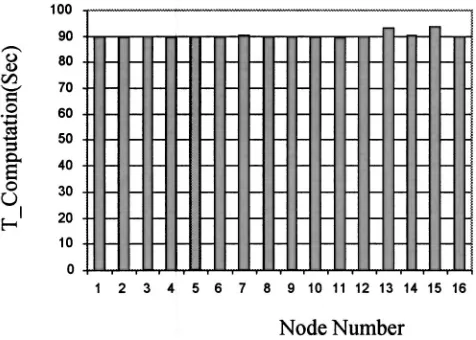
Once generated, the tasks are properly arranged in the task list. Good load balance can be obtained by executing the tasks in the order of decreasing size. Figures 1 and 2 give an example of a task list and the resulting load balance on a 16 node PC cluster.
C. Distributed data implementation
In the distributed data implementation, a segment is de-fined as the part of a CI vector on each node. To make full use of the data locality, a static load balancing scheme is employed. The computational task of each node is defined as updating its local segment. Using this task definition, in-terprocessor communication is only required for collecting the CI coefficient vectors C. The network communication can be carried out in a one-sided asynchronous manner, so that the remote CI coefficient vectors can be easily accessed without the collaboration of remote nodes. The one-sided communication feature is supported by DDI共distributed data interface兲 routines. In DDI two processes are spawned on each processor. One of these performs the computation; the other becomes the data server. A copy of the local C vector is required in the data server so it can be accessed by other remote processors. In the distributed data implementation the need for the replicated arrays X and Y is removed. Instead, a small sized buffer array Z is used to facilitate both commu-nication and computation. The remote CI coefficients, if needed, are first collected in the local buffer Z, and the up-dating of the segment can be carried out locally. The two approaches are illustrated in Figs. 3 and 4.
1. Beta-beta routine
[image:10.612.53.295.51.204.2]The beta-beta routine involves the single and double ex-citations of beta strings. Since the CI vector is distributed by alpha columns, this part can be done completely locally. The sequential algorithms can be applied here, but only the local alpha strings should be involved because only the local vector will be updated. However, each processor needs to create the entire set of beta single and double excitation lists, so the list generation process is duplicated. This can cause problems in the parallelization effort.8,17The most effective
FIG. 1. The size of subtasks in calculation of H3COH共14,14兲using repli-cated data parallel approach. 16 processors are used. The task parameters are
set to Ntask – proc⫽4.5, R – size⫽10, R – num⫽1.2. FIG. 2. Load balancing of HC step on 16 node PC cluster. The calculation is for H3COH共14,14兲using the replicated data parallel approach. The pa-rameters are set to Ntask – proc⫽4.5, R – size⫽10, R – num⫽1.2.
53
J. Chem. Phys., Vol. 119, No. 1, 1 July 2003 Parallel full CI
[image:10.612.320.558.52.222.2]way to solve this problem is to decrease the computation cost. In the current implementation the overhead is greatly reduced by an efficient list generation algorithm, so its im-pact on the overall performance is almost negligible.
2. Alpha-beta routine
The calculation of6 is the most time consuming step.
Since the alpha columns are globally distributed, this part also incurs intensive network communication to get the CI coefficients from remote processors. To exploit the sparse-ness of the FCI Hamiltonian matrix, network vector gather and scatter operations are commonly used to collect and dis-tribute the remote data. The gather operation applies to the C vector, and the scatter operation applies to thevector. Ac-cording to the task definition, only the local part of the vector is updated, so the scatter operation is not necessary in the current implementation.
To effectively hide any latency of the communications subsystem, it is favorable to send a small number of large
messages instead of a large number of small messages. For this reason, a buffer array is used to collect and store the remote alpha columns. The computational procedure of the alpha-alpha routine can be divided into three steps. First, the alpha single excitation list La is generated by looping over the local alpha strings and applying all the Eˆi j operators.
Second, the required remote alpha blocks in the excitation list are gathered into the local buffer array via network com-munication. Third, the beta list Lbis generated and combined
with the alpha list, and the6 contribution can be calculated
using the coefficient vector gathered in the buffer array. Communication only occurs in the second step; all the other steps are completely local. In order to avoid sending and receiving many small single alpha columns, an optimized communication technique can be applied by grouping the required remote alpha strings according to the nodes on which they reside. After grouping one can send the gather request of many alpha columns to the remote node in one communication call. The entire vector gathering step is com-pleted by sending such a request to and receiving the coeffi-cient vector from remote nodes one by one.
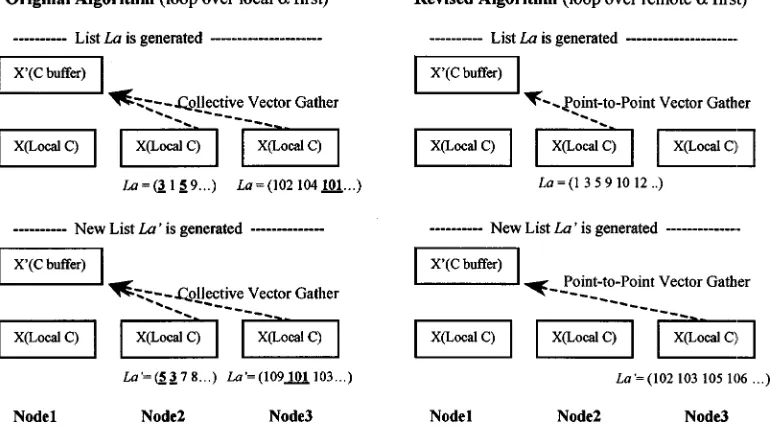
Even with such an optimization, the above algorithm can still be very communication intensive. The gather step men-tioned above is a collective operation; thus it requires the completion of all work on the participating nodes. Such an operation is not efficient on clusters. Especially if it is done in block mode, the communication must be carried out one by one and in a predefined order, which adds additional syn-chronization overhead. Moreover, there is the problem of ‘‘redundant communication.’’ Since the size of buffer array is always limited, the whole process of list generation generally requires many loop cycles to complete, thus the same remote alpha string may be generated and requested many times in different loop cycles. As shown in Fig. 5, the same remote alpha blocks may be fetched through network communica-tion repeatedly. Although such problems have not been ad-dressed by other distributed data FCI implementations, it is important to decrease communications to a minimum in or-der to achieve good performance on clusters.
[image:11.612.73.277.49.246.2]The solution to this problem in the algorithm presented here is to replace the redundant communication with extra computation; trading cycles for communication. Instead of looping over only the local alpha strings, one loops over the entire alpha strings. The entire alpha string space is swept and the remote alpha string is placed into the gather list only if it has a single excitation string that is local. Since each alpha string is looped only once, redundant communication is avoided. At the same time the collective gather is decou-pled into point-to-point gather automatically if one computes the contribution of 6 node by node, as illustrated in Fig. 5. Note that repeated computation occurs here since the entire alpha single excitation list is generated and checked on each node. However, because the string driven list in the current algorithm can be generated very efficiently, such extra com-putation has little impact on the overall performance. An-other important issue is the network contention that might arise if all nodes start the loop from the first node. This situation can be partially eased by changing the starting node of each computational processor. The starting node can be
FIG. 3. Outline of replicated data parallel FCI.
FIG. 4. Outline of distributed data parallel FCI.
[image:11.612.66.288.540.742.2]randomly chosen or can be specified in a predefined order. In this code each node starts from its local alpha strings, and then it loops over the remaining nodes in a cyclic order. In practice better results are obtained in this way, although the difference is not significant.
Once the required CI coefficients are fetched into the buffer array, the 6 construction can be carried out
com-pletely locally. The sequential algorithm discussed above is applied, and the computation is organized in a combined CI driven approach. For M s⫽0 the innermost loop must be organized in an integral driven approach, because of the static load balancing scheme employed here.
3. Alpha-alpha routine
The alpha-alpha routine computes the contribution of2
and4. As discussed above, this can be omitted by applying
a vector transposition step for M s⫽0. Since the calculation of 2 involves only single alpha replacement, this part is
integrated into the alpha-beta routine and the contribution of
2 is calculated as a byproduct of 6. This eliminates the
communication for2. The term4involves double
excita-tions of alpha strings and it is treated separately. Intensive network communication occurs here in order to get the re-mote alpha blocks for the calculation of4. The
communi-cation is handled in the same way as in the alpha-beta rou-tine, so repeated communication is avoided.
4. DDI in GAMESS
The distributed data interface10 共DDI兲 is the built in fa-cility inGAMESSfor network communications. Its underlying libraries include TCP/IP sockets code, MPI-1 and SHMEM libraries. DDI provides basic network communication func-tions, including point-to-point operations like send and
re-ceive and collective operations like broadcast and global sum. In addition, DDI also provides features including
dis-tributed and globally addressed array and one-sided commu-nication, which are very useful for many quantum chemistry codes.
On clusters, the one-sided communication is imple-mented by creating two processes on each node. One process handles real computational tasks, and the other becomes the data server. The data server holds the distributed array; its task is to listen to network messages and respond to the data request. Three basic operations are provided in DDI: remote
get, put, and accumulate. There are advantages to using
one-sided communications. First, it reduces programming diffi-culty. Second, it is efficient because the asynchronous com-munication model eases the overhead of explicit synchronization between processors.
However, many applications may require more compli-cated communication patterns. For example, the gather op-eration used in the vector updating step requires non-contiguous access to the distributed data, which is beyond the ability of remote get. To use the get function the required data must be placed contiguously in the distributed array. One can of course complete the remote gather task by re-peatedly requesting single alpha columns, but the associated synchronization and latency overhead would be very costly, especially on clusters. In addition, bandwidth is also severely limited if the size of a single alpha column is very small. Clearly, such problems can be solved if the data server is ‘‘smart’’ enough to do a local vector gather before sending the data. Such an operation would be very simple if one had an appropriate communication library interface.
To add more functionality to DDI, a message handling function ddi–user was created, and a DDI message ID from 99 to 199 is reserved for it. Inside ddi–user, the programmer can assign a reserved ID to a unique communication pattern and develop the corresponding request handling function. The next step is to pass the message and control from DDI to
[image:12.612.114.499.59.274.2]ddi–user. The DDI data server is a daemon process that
FIG. 5. Communication patterns of two different algorithms for alpha-beta routine. Numbers in the graph are for illustration purpose only. The numbers in bold indicate redundant communication.
55 J. Chem. Phys., Vol. 119, No. 1, 1 July 2003 Parallel full CI
exists until the program finishes, so a call is placed to
ddi–user in the daemon loop. The control will be returned to
DDI daemon immediately if the message ID does not match those reserved. Otherwise, ddi–user will hand the message request to the proper user defined functions via a message mapping mechanism. A remote gather operation is handled in the following way. First, the computation process共caller兲 sends a vector gather request to the DDI server. The message is received by the DDI daemon and then passed to ddi–user. Since the message ID for gather is a reserved one, ddi–user will take it and pass the execution control to the target func-tion ddi–vgather, where the vector gather request is actually handled. Inside ddi–vgather the server process first requests and receives the information about the requested alpha lists from the caller, then performs a local gather using a buffer array and sends the compiled data to the caller.
The implementation of remote vector gather is not a new idea. In fact, ARMCI 共Ref. 18兲 共aggregate remote memory copy interface兲 also provides a set of descriptive communi-cation interfaces, where a vector version of the get operation is provided. However, it is not simple to include all the com-munication patterns in real applications. With the ability to add user predefined communication routines, the DDI data
server evolves to a communication server, thereby providing
more flexibility in developing performance network commu-nication functions. For example, in the vector transposition step required by the simplification condition for M s⫽0, the DDI server acts in dual roles: it collects the transposed vector blocks and records the property of those blocks. After syn-chronization, it sends the recorded property array to a local computational process, and then sends the transposed blocks one by one. Such a communication intensive operation gen-erally does not scale well on clusters. However, with the ‘‘smart’’ DDI communication server it performs very effi-ciently and therefore does not create too much overhead.
IV. PARALLEL PERFORMANCE AND ANALYSIS
First, consider the sequential performance of the new parallel code. This is often ignored in parallel applications, but it provides an important baseline against which to com-pare scalable performance. Further, it is impossible to achieve high performance computing without a good under-lying serial code. An inefficient sequential algorithm can cost precious parallel CPU cycles, and this inefficient use of com-putational resources only increases as more processors are used. In Table II the timing of the HC construction per CI
iteration is listed for both the original code9and the present distributed data parallel code running on one processor. Note that in the sequential code only the upper triangle of Hamil-tonian matrix elements is computed. The distributed data code is designed with the concept of local and remote data in mind. When a Hamiltonian matrix element is found only the localvector is updated, thus the computation of the entire Hamiltonian matrix is required. Despite the extra computa-tion, the sequential performance is significantly improved. The increased efficiency is even greater in high-spin and high-symmetry cases. The good performance in high-spin cases can be explained by the string driven innermost loop in the alpha-beta routine. For M s⫽0 an integral driven inner-most loop over beta pairs is employed in the parallel code. The string driven innermost loop is more effective in exploit-ing the spatial locality so better cache and CPU performance can be obtained. In high-symmetry cases the significant per-formance gain indicates that the list generation algorithm is not only efficient, but also well suited for Abelian group symmetry.
[image:13.612.53.554.63.179.2]Two example calculations, one singlet and one doublet, are chosen to test the performance and scalability of the new parallel FCI code. The calculations were performed on a PC cluster consisting of 16 PII 400-MHz processors linked to a central hub using a 100-Mbps fast Ethernet connection. The cluster has 8-GB aggregate memory with 512 MB each. The
[image:13.612.348.521.537.704.2]FIG. 6. Parallel performance of replicated data FCI code on PC cluster共PII 400 MHz, 100-Mbps fast Ethernet, 16 nodes兲.*Doublet state of H3CSiH2, 10 306 296 Dets. generated by distributing 13 electrons among 14 active orbitals.**Singlet state of H3COH, 11 778 624 Dets. generated by distrib-uting 14 electrons among 14 active orbitals.
TABLE II. Timing comparison of calculations on single CPU IBM Power3II 375-MHz node.
Molecule
Point
group Irrep
Spin
mult Nel Norb
Dimension
共determ兲
Time per iteration共s兲
Speed up
Orig. FCI DDI FCI
H3COH C1 a1 1 14 14 11 778 624 694.4 352.9 1.97
H3CSiH2 C1 a1 2 13 14 10 306 296 3734.9 541.6 6.90
HNO CS a1 1 12 14 4 513 905 151.3 70.5 2.15
H3CN CS a2 3 12 16 24 986 830 8850.0 986.6 8.98
H2O C2v a1 1 10 14 1 002 708 25.5 8.1 3.15
C2H4 D2h a1g 1 12 16 8 018 480 281.3 66.2 4.25
Si2H4⫹ D2h b3u 2 11 16 4 369 587 337.0 42.7 7.89
singlet calculation on H3COH uses a FCI space of
11 778 624 determinants generated by distributing 14 elec-trons over 14 active orbitals. The doublet calculation on H3CSiH2 has a 10 306 296 determinant space generated by distributing 13 electrons over 14 active orbitals. In the sin-glet calculation only beta-beta and alpha-beta routines are performed and the alpha-alpha routine is replaced by a vector
共matrix兲 transposition step; in the doublet calculations the alpha-alpha routine is also executed.
Figure 6 illustrates the parallel performance of the repli-cated data code. The timing of the HC computation as well as that of one typical Davidson iteration is measured and analyzed. In the replicated data approach two collective op-erations have to be performed before and after the HC com-putation. The standard MPICH library is used for these col-lective communications. It is shown that in both calculations the computation time of the HC step scales almost perfectly, illustrating the effectiveness of the dynamic load balancing scheme. The overall speedup of the doublet calculation is about 12 on 16 nodes, which is reasonably good performance considering the cluster’s fast Ethernet connection. However, the speedup of the singlet calculation is only 8.4. Clearly, the ratio of computation to communication is an important factor for parallel efficiency, as in the singlet calculation the com-putational effort is nearly halved, while the communication remains almost the same. The communication time in the H3COH calculation takes 47.4% of the total iteration time
running on 16 nodes, almost as much as the cost of compu-tation. Of course, one expects the performance to improve using a better MPI library or hand-tuned collective routines. However, it is clear that the collective operations will remain the bottleneck on PC clusters. Besides, the replicated data approach is restricted by the memory capacity of a single CPU node.
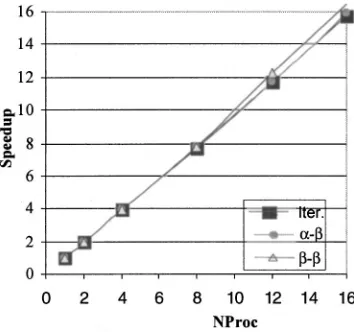
The parallel efficiency of the distributed data parallel FCI code was tested on the same PC cluster. The results for the singlet and doublet calculations are presented in Figs. 7 and 8, respectively. The singlet calculation scales almost per-fectly; the speedup on 16 nodes is 15.7. A slight super linear speedup is obtained in the beta-beta routine because of the
cache effect. Note that in the beta-beta routine the generation of the entire single and double excitation lists is repeated on each node. This is hard to avoid if one is to exploit the data locality, as discussed with regard to the direct list parallel implementation.8,17 However, they were unable to find a more efficient approach within the framework of an integral driven list generation scheme, so the scalability of the beta-beta routine is severely limited. In the present beta-beta-beta-beta implementation the list generation cost is decreased using the optimized string driven algorithm. The excellent scalability of this beta-beta routine also illustrates that an efficient se-quential algorithm can help the parallel performance. Simi-larly, the repeated list computation in the alpha-beta routine should not present a big problem, as only the single excita-tion list is involved. Although the overall performance ben-efits a little from the super linear speedup in the beta-beta routine, the key issue here is still the reduced communication cost. For example, on 16 nodes the time per CI iteration is about 149 sec, and the time for communication is less than 5 sec.
In the doublet calculation the beta-beta routine again shows almost perfect scalability. The speedup of the alpha-beta routine drops a little compared to the singlet calculation but it is still reasonable. Since the alpha-beta routine here is organized in the combined driven approach, its actual perfor-mance is better than that in the singlet calculation. The alpha-alpha routine is dominated by communication, so it does not perform as well as the other routines. Two possi-bilities are under investigation for future improvement of this part. The first method is to combine the alpha-beta and alpha-alpha routine together so the gathered remote vectors can be shared. Because the double excitation list is usually very large, the network performance may be further im-proved by dynamically choosing between vector gather and
block get based on the volume of communication. Another
[image:14.612.346.531.48.204.2]method is to transpose the CI vector so one can apply the algorithm of the beta-beta routine instead. In this way two vector transposition operations are required, one for the C vector and one for thevector. However, the storage of the transposed vectors may increase the memory requirement greatly, unless disk I/O is involved.
[image:14.612.86.263.51.217.2]FIG. 7. Parallel performance of distributed data code in FCI共14,14兲 calcu-lation of singlet state of H3COH on PC cluster. 11 778 624 Dets are gener-ated by distributing 14 electrons among 14 active orbitals.
FIG. 8. Parallel performance of distributed data code in FCI共13,14兲 calcu-lation of doublet state of H3CSiH2on PC cluster. 10 306 296 Determinants are generated by distributing 13 electrons among 14 active orbitals.
57
J. Chem. Phys., Vol. 119, No. 1, 1 July 2003 Parallel full CI
All electron FCI calculations on the potential curve of ground state N2have also been performed as a benchmark on the 16 node PII cluster. A small basis set 6-31G was used, and D2h symmetry employed. A total of 16 different geom-etries were computed to obtain the potential curve. The FCI
共14,18兲calculation includes 126 608 256 determinants in the CI space, and it requires 6.3 GB aggregate memory, close to the cluster’s 8-GB memory limitation. The N2 calculation
takes 750 sec per CI iteration, of which about 85 sec are spent on network communication and about 20 sec are lost due to load imbalance. There is a total of 12.6 GB data transferred per iteration and the average network bandwidth is about 75 Mbps, showing the effectiveness of the improved DDI communication server. The efficiency of CPU usage is measured as 83% for the entire calculation.
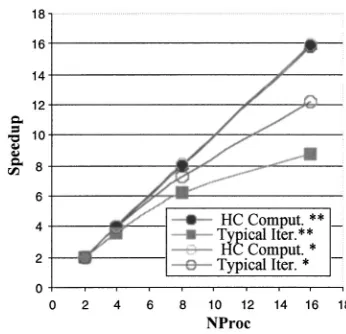
The parallel performance of the distributed data parallel code was also tested on an IBM pSeries p640 cluster. The IBM cluster represents the high end hardware platform in cluster computing. Each IBM node consists of 4 power3II processors running at 375 MHz, and each node has a dual Gigabit Ethernet 64-bit PCI connection. In contrast with the Pentium II processor, the IBM processor has a much larger 4-MB level 2 cache. It is necessary to keep the size of the buffer array basically unchanged in one set of calculations in order to factor out the cache effect. Otherwise the scalability obtained on the IBM system would be misleading. The cal-culations were performed on H3COH 共14,14兲 and H2O2
共14,15兲using up to 32 processors. As shown in Fig. 9, almost the same linear scalability is obtained in both calculations. Besides the speedup performance, the timing data in Table II is redone in Table III. Despite the slower CPU clock rate, the FCI共14,14兲calculation running on the IBM cluster is⬃4 –5 times faster than that on the PII cluster. The calculation re-quires only 33 sec per iteration on 16 IBM processors com-pared with 149 sec on the PC cluster. It is very encouraging that one iteration of a FCI 共14,14兲 calculation can be com-pleted within merely 18 sec. It is therefore expected that the parallel algorithm presented here will considerably expand the potential applicability of CASSCF, making calculations with such large or even larger active spaces routine. In Ref. 6
a similar CASSCF 共14,14兲calculation was performed on an IBM SP2 using eight four-way Power3 nodes; one CI itera-tion took about 270 sec to complete. The two calculaitera-tions are comparable, as in the FCI only the active orbitals are in-volved and CI symmetry was used in both calculations. The
present calculations were executed on Power3II 375-MHz nodes, which are twice as fast as the Power3 200-MHz nodes. The FCI共14,15兲calculation on H2O2 with 41 million
determinant basis was also performed to examine how the efficiency changes with the size of the problem. As illus-trated in Fig. 9, the increase in execution time is proportional to the increase in the CI dimension, indicating good effi-ciency of the algorithm in large calculations.
V. CONCLUSIONS
The implementation of both replicated and distributed data parallel FCI programs is presented in this paper. Data reuse, cache performance, and communication cost are the primary concerns in this parallel implementation. A bined CI driven scheme is implemented to meet these com-bined requirements. In the CI driven strategy the communi-cation is controlled by a string driven approach, the Hamiltonian matrix is computed in integral driven scheme, and the matrix vector multiplication is again performed using a string driven approach.
Improved string storage and CI address calculation schemes are proposed and implemented. Both string driven and integral driven lists are employed, and their generation algorithms are discussed. The list generation procedure is further combined with a buffer algorithm to balance the stor-age overhead and the computation cost of list generation.
In the replicated data parallel implementation load bal-ancing is the essential concept. The dynamical load balanc-ing strategy, although quite simple, effectively achieves good work balance and reduces the associated overhead. However, the parallel performance of the replicated data code is still limited by the collective network operations, and the capac-ity of the program is restricted by the amount of memory available on a single node.
[image:15.612.91.258.52.211.2]In the distributed data parallel implementation the com-munication cost is our primary concern. To make better use of data locality a static load-balancing scheme is employed. The communication costs in parallel FCI were analyzed, al-lowing the redundant communication and its collective op-eration nature to be identified. With the help of the combined CI driven scheme and an efficient list generation algorithm,
FIG. 9. Parallel performance of distributed data FCI on IBM cluster.* Sin-glet state of H3COH, 11 778 624 Dets generated by distributing 14 electrons among 14 active orbitals.**Singlet state of H2O2, 41 409 225 Dets gener-ated by distributing 14 electrons among 15 active orbitals.
TABLE III. Timing per iteration of distributed data FCI on IBM cluster. The number of determinants in the CI calculation is 11 778 624 for H3COH and 41 409 225 for H2O2, respectively.
NProc
Time per iteration
H3COH共14,14兲 H2O2共14,15兲
4 108.63 515.11
8 57.9 287.91
16 33.15 157.64
24 23.15 108.18
32 17.75 86.1
[image:15.612.315.560.85.177.2]