Rochester Institute of Technology
RIT Scholar Works
Theses Thesis/Dissertation Collections
8-9-2013
Construction of Multi-Mode Fiber Modes using
Phase Masks
Alexandre Tulikumwenayo
Follow this and additional works at:http://scholarworks.rit.edu/theses
Part of theSystems and Communications Commons
This Thesis is brought to you for free and open access by the Thesis/Dissertation Collections at RIT Scholar Works. It has been accepted for inclusion
Recommended Citation
Rochester Institute of Technology
College of Applied Science and Technology
Electrical Computer and Telecommunications Engineering Technology
(ECTET)
Construction of Multi-Mode Fiber Modes
using Phase Masks
Alexandre Tulikumwenayo
August 09, 2013
Rochester, New York, USA
A Research Thesis Submitted in Partial Fulfillment of the Requirements
for the degree of
Masters of Science in Telecommunications Engineering Technology
Thesis Supervisor
Professor Dr. Drew N. Maywar
Department of Electrical Computer and Telecommunications Technology
College of Applied Science and Technology
Rochester Institute of Technology
Rochester, New York
Approved by:
Dr. Drew N. Maywar
Thesis Advisor, Department of Electrical Computer and Telecommunications
Engineering Technology.
Prof. Mark J. Indelicato
Committe Member, Department of Electrical Computer and
Telecommuni-cations Engineering Technology.
Dr. Sungyoung Kim
Committe Member, Department of Electrical Computer and
Abstract
Transverse fiber modes are the distribution of electromagnetic fields in the
cross-section of an optical fiber through which light propagates in the fiber.
Research is being conducted to explore the usage of fiber modes with the
purpose of increasing the capacity and reach of optical fibers. Mode Division
Multiplexing, an area in which reseach is being conducted with the same
purpose, is a multiplexing scheme used in optical networks that maps data
channels onto different modes, and multiplexes these modes into one fiber for
transmission. This thesis focuses on the study of modes in multi-mode fibers,
and the simulation of mode creation in gradient-index multi-mode fibers.
Starting from published related works, equations for electric fields in
step-index and gradient-step-index multi-mode fibers are derived, and examples of
intensity profiles in several modes are shown. For the first time, we seek
to study modal cross-talk between modes. Given the creation process, not
all power is coupled into the desired mode, resulting in some power being
coupled into undesired modes. We also seek to increase the power coupling
between the created mode and the desired mode. We report a 23% power
coupling increase up from previous works. Finally, we seek to study the effect
of noise introduced by the components used in the process of creating modes.
We report an approximate 30dB signal-to-noise ratio is sufficient to create a
Contents
1 Introduction 1
1.1 Telecommunications Optical Fibers . . . 2
1.2 Modal Dispersion . . . 3
1.3 Mode Division Multiplexing . . . 4
1.4 Thesis Overview . . . 5
1.4.1 Previous Related Work . . . 5
1.4.2 Advancement of the State of the Art by the Current Thesis . . . 6
2 Mode Theory in Multi-mode Fibers 8 2.1 Geometry of Fibers . . . 8
2.2 Multi-mode Step-index Fibers . . . 10
2.2.1 Electric Field in Multi-mode Step-index Fiber . . . 10
2.2.2 Eigenvalues of Multi-mode Step-index Fibers . . . 14
2.2.3 Intensity Profiles of some Step-index Modes . . . 18
2.3.1 Electric Field in Multi-mode Gradient-index Fibers . . 22
2.3.2 Orthogonality of Gradient-index Fiber Modes . . . 23
2.3.3 Intensity Profiles of some Gradient-index Modes . . . . 26
3 Transverse-Mode Phase Masks 28 3.1 Construction of Fiber Modes using a Spatial Light Modulator 32 3.2 Unit Amplitude . . . 35
3.2.1 Results . . . 35
3.3 Optimal Aperture . . . 38
3.3.1 Abbe’s Theory . . . 38
3.3.2 Aperture Diameter Optimization . . . 40
3.3.3 Results . . . 46
3.4 Optimal Inner Aperture Block . . . 49
3.4.1 Results . . . 53
4 Far-field Phase Noise 56 4.1 SLM Noise . . . 56
4.2 Effect of SLM noise on creation of modes . . . 57
5 Concluding Remarks 60
Appendices 65
List of Figures
1.1 Inter-symbol Interference due to Modal Dispersion in
Multi-mode Fibers. . . 3
1.2 Four data channels are mapped to four different modes in a
Mode Division Multiplexing system. . . 5
2.1 Refractive index profile in: (a) multi-mode step-index fiber,
(b) a single-mode step-index fiber, and (c) a multi-mode
gradient-index fiber. . . 9
2.2 Graphical solution for multi-mode step-index E0,m and E1,m.
modes . . . 16
2.3 Graphical solution for multi-mode step-index E3,m and E4,m.
modes . . . 17
2.4 Intensity plots for four E modes in multi-mode step-index fiber. 19
2.5 Power-law refractive-index profile n(r). . . 20
2.6 Intensity plots fo four modes in gradient-index fiber. . . 27
3.2 In the far-field (a) Image A amplitude, (b) Image A phase, (c)
Image B amplitude a, (d) Image B phase. . . 30
3.3 Reconstructed Images (a) Amplitude of Image A with phase of Image B, (b) Amplitude of Image B with phase of Image A. 31 3.4 Construction of Fiber Modes using a Spatial Light Modulator. 32 3.5 Power Coupling and Modal Cross-talk for mode E0,1. . . 36
3.6 Power Coupling and Modal Cross-talk for mode E3,2. . . 37
3.7 Abbe’s Theory of Imaging. . . 39
3.8 Frequency Component of Mode E04. . . 41
3.9 An aperture is placed in front of SLM to block high frequencies. 42 3.10 Change ofη with respect to the highest allowed frequency for angular-independent modes (El=0,m). . . 44
3.11 Change ofη with respect to the highest allowed frequency for angular-independent modes (El6=0,m). . . 45
3.12 Power Coupling and Modal Cross-talk for Mode E0,1: Com-parison between Unit Amplitude and Optimal Aperture Setups. 47 3.13 Power Coupling and Modal Cross-talk for Mode E3,2: Com-parison between Unit Amplitude and Optimal Aperture Setups. 48 3.14 Lower frequencies do not exist in the spectrum of angular-dependent modes. . . 50
3.16 Change of η with respect to the lowest allowed frequency for
angular-dependent and angular-independent modes. . . 52
3.17 Percentage Increase in Power Coupling: Increasing Azimuthal
Mode Number. . . 54
3.18 Percentage Increase in Power Coupling: Increasing Radial Mode
Number. . . 55
4.1 Effect of SLM noise of mode creation. . . 58
4.2 Impact of SNR on Power Coupling. . . 59
A.1 Graphical solution to eigenvalue equation. The solution is the
Chapter 1
Introduction
The ever growing demand for higher speeds of information transmission is
leading to the exploration of new and more efficient ways of transmitting
information. As the existing high speed links are approaching their full
ca-pacity [1], it is imperative to explore new ways to accommodate the demand
for high speeds, and to provision for future higher speeds demand. This
demand is more accentuated in data centers and other local-area networks
(LAN), as the amount of information to transmit in these networks keeps
increasing. Multimode fibers (MMF) are the type of fibers widely employed
in these networks [2]. It is desired to transmit data at 10 Gb/s and higher bit
rates over long distances of MMF, but the modal dispersion in these fibers
1.1
Telecommunications Optical Fibers
There are mainly three types of optical fibers utilized in the
Telecommunica-tions industry: single-mode fiber, step-index multi-mode fiber, and
gradient-index multi-mode fiber. Single-mode fibers have a smaller core of a high
refractive index n1 surrounded by a cladding of a low refractive index n2.
Because of the small size of the core, single-mode fibers allow only one
dis-tribution of electromagnetic field, namely mode. They are generally used in
long haul communications. Step-index and gradient-index multi-mode fibers
are types of multi-mode fibers. Multi-mode fibers have a larger core
com-pared with single-mode fibers. In step-index multi-mode fibers, the refractive
index of the core is constant across the core and is higher than that of the
cladding. Gradient-index multi-mode fibers have a varying refractive index
in the core, following a decreasing power law with the maximum value at the
1.2
Modal Dispersion
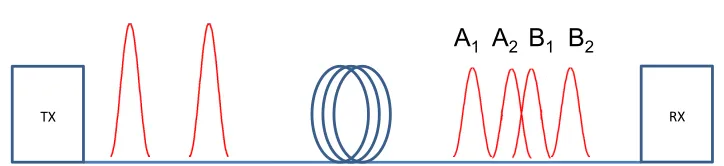
TX RX
A B
[image:14.612.126.488.184.267.2]A1 A2 B1 B2
Figure 1.1: Inter-symbol Interference due to Modal Dispersion in Multimode
Fibers.
As light, encoded with information to transmit, is launched in a MMF,
sev-eral different transverse modes are excited in which light propagates [3]. The
existence of these modes depends on the launch condition at the transmitter,
among other dependencies. The choice of MMF in LAN is based on the ease
of light launch into the fiber, and therefore a less expensive infrastructure
over single mode fibers (SMF). Since these modes have distinct group
ve-locities, the information carried by the modes reach the receiver at different
times. This physical phenomenon is known as modal dispersion. The direct
effect of modal dispersion is Inter-symbol Interference (ISI). A pulse leaving
the transmitter reaches the receiver after having overlapped with its
neigh-boring pulse [3]. Figure 1.1 shows two distinct pulses at the transmitter and
the subsequent four pulses at the receiver. ISI due to modal dispersion in
communications systems [3].
There have been numerous approaches to compensate for modal
dis-persion effects using digital signal processing [14] and other inline techniques
using adaptive optics. The compensation for modal dispersion using a spatial
light modulator (SLM) proves to be more efficient since it does not require
a prior knowledge of the refractive index profile of the transmission fiber [2].
By adaptively changing the phase mask applied on the input light beam, a
10Gbit/s transmission over 11.1 km has been demonstrated [2].
1.3
Mode Division Multiplexing
The plurality of modes in MMF has been long viewed as a negative effect on a
communication link due to the modal dispersion explained above. However,
the existence of multiple modes is now been seen as a way of increasing the
bandwidth of a MMF through Mode Division Multiplexing (MDM) [15]. In
a MDM, each mode is considered as an independent channel transmitting
separate signals, as shown in Figure 1.2. Each signal is mapped to a specific
mode, and a multiplexer at the transmitter couples all the signals in a single
Data Channel 1 Data Channel 2 Data Channel 3 Data Channel 4
Figure 1.2: Four data channels are mapped to four different modes in a Mode
Division Multiplexing system.
1.4
Thesis Overview
The focus of the thesis is to conduct a study of modes in gradient-index
fibers and to simulate their creation using MATLAB. In chapter 2, a theory
on transverse modes in step-index and gradient-index multi-mode fibers is
given. The chapter explains the geometry of these two types of fibers and
gives the equation for the electric field in each type. In chapter 3, a detailed
study of mode creation is conducted and the results are shown. Chapter 4
is an extension of chapter 3 where phase noise is added in the creation of
modes and the results are shown.
1.4.1
Previous Related Work
In 2005, a technique to compensate for multi-mode fiber dispersion by
adap-tive optics was reported by Shen et al. [14]. In this technique a Spatial Light
is accomplished by estimating ISI at the receiver side, and this information
is fed back to the transmitter, which adjusts the SLM in order to minimize
ISI. This loop continues until the minimum ISI is reached.
In 2011, yet another technique that uses an SLM for mode creation
was reported by Stepniak et al. [8]. In this technique, however, the SLM
takes on two values, 0 or π. Instead of utilizing ISI to adjust the SLM as in
the previous work did, the pattern applied to the SLM corresponds to the
target mode desired at the receiver. This method only works with a type of
gradient-index multi-mode fiber modes, namely Laguerre polynomial-based
modes, since the phase of these modes exhibits a π phase shift.
1.4.2
Advancement of the State of the Art by the
Cur-rent Thesis
In this thesis, we have extended the work by Stepniak et al. [8] by studying
the modal cross-talk in gradient-index multi-mode fibers. This is an
impor-tant study because modes are not created with 100%. Some of the power
is coupled into other modes which causes the problems of modal dispersion.
Knowing the power coupling between modes can help when designing a
net-work that can only tolerated a given modal dispersion.
by up to 23% is proposed. Finally, the noise of the SLM is considered in the
process of creating gradient-index multi-mode fibers. This is a valid study
because opto-electronics components of the SLM will inherently introduce
Chapter 2
Mode Theory in Multi-mode
Fibers
2.1
Geometry of Fibers
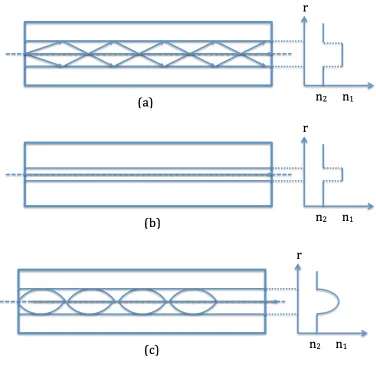
An optical fiber is a cylindrical dieletric waveguide that consists of an inner
region, namely core, of high refractive index surrounded by an outer region,
namely cladding, of lower refractive index as shown in Figure 2.1. Two
types of multi-mode fibers will be studied in this section: step-index fibers
Figure 2.1: Refractive index profile in: (a) multi-mode step-index fiber, (b)
2.2
Multi-mode Step-index Fibers
In multi-mode step-index fibers, the core fills the whole region r ≤ a with
a refractive index n1, and the cladding region r > a is of index n2. The
normalized index difference of a multi-mode step-index fiber is expressed as
[4][5]
∆ = n
2 1−n22
2n2 1
≈ n1n−n2
1
. (2.1)
In most commercial fibers, n1 ≈ n2, and thus the appromimation
in Eq. (2.1) . This condition is called the weak-guidance condition. The
numerical aperture (NA) defines the acceptance cone in which the incident
ray will experience total internal reflection. The NA is given by
N A=
q
n2
1−n22 =n1
√
2∆. (2.2)
2.2.1
Electric Field in Multi-mode Step-index Fiber
Given the weak-guidance approximation,linearly polarized (LP) modes arise
in optical fibers [7]. These modes consist of an x-poloarized electric
com-ponent and a y-polarized magnetic comcom-ponent [5]. The field comcom-ponents
are
and
H=Hy(r, θ,z)aˆy =Hy0(r, θ)exp(-iβz)aˆy (2.4)
where r is the radius from the center of the core and θ the azimuthal angle.
Using Maxwell’s equations and Helmholtz equations
∇2E+k2E= 0 (2.5)
and
∇2H+k2H= 0 (2.6)
where the transverse Laplacian
∇2
≡ ∂
2
∂x2 +
∂2
∂y2, (2.7)
and assuming tranverse variation in both r and θ [5], the wave equation in
either region is given by
∂2Ex
∂r2 +
1 r ∂Ex ∂r + 1 r2
∂2Ex
∂θ2 +β
2
tEx = 0 (2.8)
where
• βt2 = (n21k02−β2) is the transverse propagation constant
• k0 = 2λπ0 is the free space wave number
Assuming the solution for Ex to be a seriers of modes separable in r,
θ, and z, the solution Ex takes on a form of
Ex =
X
i
Ri(r)Φi(θ)exp(-iβiz). (2.9)
Each term Ex =RΦexp(-iβiz) in Eq. (2.9) is itself a solution to Eq.
(2.8), and can be substituted in Eq. (2.8) to obtain
r2 R
d2R
dr2 +
r R
dR
dr +r
2β2
t =−
1 Φ
d2Φ
dθ2. (2.10)
Since r and θ are indepentent, it follows that both sides of Eq. (2.10)
are equal to a constant, namely l2, and are separable into
d2Φ
dθ2 +l
2Φ = 0 (2.11)
and
d2R
dr2 +
1 r
dR
dr + [β
2
t −
l2
r2]R = 0. (2.12)
The solutions to Eq. (2.11) and Eq. (2.12) are
Φ(θ) =
cos(lθ+α)
sin(lθ+α)
and
Ex =
Jl(ura)
Kl(war)
(2.14)
respectively, where:
• Jl and Kl are ordinary Bessel functions of first kind of order l and
modified Bessel function of first kind of order l, respectively,
• u=apn2
1k20−β2 and w=a
p
β2−n2
2k20 are normilized transverse
phase and attenuation constants, repectively.
The complete electric field Elm and magnetic field Hlm are
Elm =
Jl(raul,m)cos(lθ)exp(−iβz), r≤a
Jl(ul,m)
Kl(wl,m)Kl(w
r
a)cos(lθ)exp(−iβz), r > a
(2.15)
Hlm =
Jl(raul,m)cos(lθ)exp(−iβz), r ≤a
Jl(ul,m)
Kl(wl,m)Kl(w
r
a)cos(lθ)exp(−iβz), r > a
(2.16)
where l and m designate the azimuthal mode number and the radial mode
2.2.2
Eigenvalues of Multi-mode Step-index Fibers
Some conditions, such as the core radius, the operating wavelength, and the
index difference between core and cladding, have to be met for modes to be
excited in the fiber, and these parameters have to be set so that the
boundary condition is met: the electric and magnetic fields must be
continuous at the core-cladding boundary r =a. This condition is called
the characteristic equationor dispersion relation. In weakly guiding
fibers, this condition is approximated by the condition that Eq. (2.14) be
continous at r =a, and is satisfied when
Jl−1(u) Jl(u)
=−w
u
Kl−1(w)
Kl(w)
(2.17)
where
V2 =u2+w2, (2.18)
and V is the V-parameter given by V = 2πλa
0N A. The solution to Eq.
(2.17) yields values for u and w for which the given mode is excited.
However, this equation is a transcendental function and cannot be solved
using the algebraic methods. The equation can be rewritten as
Jl−1(u) Jl(u)
+ w
u
Kl−1(w)
Kl(w)
= 0 (2.19)
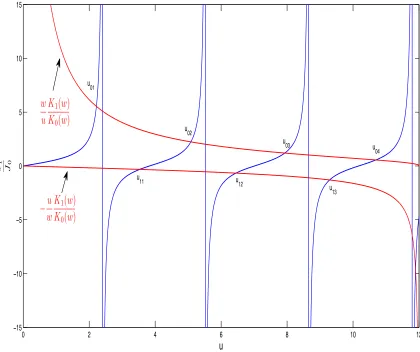
equation. A graphical method is another way of solving this equation. The
right-hand side and the left-hand side of Eq. (2.17) are ploted against u
and their intersections yield the values of u and w given V. Figure 2.2
0 2 4 6 8 10 12 −15 −10 −5 0 5 10 15 w u
K1(w) K0(w)
−wuKK1(w)
0(w)
[image:27.612.154.574.151.503.2]J 1 J 0 u u 01 u 11 u 02 u 12 u 03 u 04 u 13
Figure 2.2: Graphical solution for multi-mode step-index E0,m and E1,m.
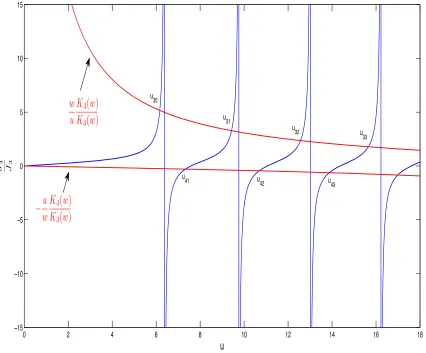
0 2 4 6 8 10 12 14 16 18 −15 −10 −5 0 5 10 15 w u
K4(w) K3(w)
−wuKK4(w)
3(w)
J 4 J 3 u u 30 u 31 u 32 u 33 u
[image:28.612.153.579.151.504.2]41 u42 u43
Figure 2.3: Graphical solution for multi-mode step-index E3,m and E4,m.
2.2.3
Intensity Profiles of some Step-index Modes
The intensity profile of a step-index multi-mode fiber modes is given by
Il,m=|El,m|2. (2.20)
Replacing the values of ul,m and wl,m obtained from the graphical solution
of Eq. (2.17) into Eq. (2.15), and setting z = 0, the intensity plots of E01,
[image:30.612.141.460.149.521.2]
2.3
Multi-mode Gradient-index Fibers
Figure 2.5: Power-law refractive-index profile n(r).
In gradient-index fibers, the core does not have a uniform refractive index
as it is the case in step-index fibers. The refractive index in the core
decreases with increasing radial distance from the center of the core. The
slowly varying index criterion, used in geometrical optics, is used in
gradient-index fibers to overcome the diffraction and scattering effects that
occur when the refractive index abruptively changes [9]. This criterion is
defined as
|λdn/dx
n |<< 1 (2.21)
and is interpreted as follows: the variation in refractive index that occurs
refractive index in core region.
The most used refractive index profile in gradient-index fibers is
parabolic, i.e, the light takes on a sinusoidal path as it propagates down the
fiber as shown in Figure 2.1. The advantage of this profile over a
step-index profile is that the modal dispersion is minimized [9]. The
parabolic refractive index profile is given by
n2(r) = n21[1−2∆(r
a)
p
] (2.22)
where
• ∆ = n21−n22
2n2
1 ≈
n1−n2
n1
• p, the grade profile parameter, determines the steepness of the profile
• n1 highest refractive index at the center of the core
• n2 refractive index in the cladding
The grade profile parameter of p= 2 is used for best reduction of modal
2.3.1
Electric Field in Multi-mode Gradient-index
Fibers
In gradient-index fibers, Maxwell’s equations and Helmholtz equations are
given by
∇2E+ (n2(r)k2
0 −β2)E = 0 (2.23)
and
∇2
H+ (n2(r)k02−β2)H= 0. (2.24)
To solve these equations, a similar method as in step-index fibers is used.
By substituting one term of Eq. (2.9) into Eq. (2.23), the wave equation for
a gradient-index fiber becomes
d2R(r)
dr2 +
1 r
dR(r)
dr + [n
2(r)k2 0 −β
2
− l
2
r2]R(r) = 0 (2.25)
and
d2Φ
dθ2 +l
2Φ = 0. (2.26)
Eq. (2.26) is the same as Eq. (2.11) and yields the same solution. Eq.
(2.25), however, is different from Eq. (2.12) in that n2(r) is not a constant.
However, a qualitatively similar function to a Bessel function results as a
Substituting Eq. (2.22) with p= 2 in Eq. (2.25) yields a Laguerre- or
Hermite-Gaussian function. In other cases where p6= 2, the WKB method,
invented by Kramers and L. Brillouin, is used to approximate the solution
[9]. The complete electric field in a gradient-index fiber using the Laguerre
form solution is
Elm=
Ll
m−1(ρ2)ρlexp(
−ρ2
2 )cos(lθ)exp(−iβz), r≤a
Jl(ul,m)
Kl(wl,m)Kl(w
r
a)cos(lθ)exp(−iβz) r > a
(2.27)
where
ρ=
s
k0n1
√ 2∆
a r (2.28)
and the Laguerre function is
Lln=
n X
s=0
(n+l)!(−1)sρ2s
(l+s)!(n−s)!s!. (2.29)
2.3.2
Orthogonality of Gradient-index Fiber Modes
The coefficient that defines how good two modes of electric fields El1,m1 and
El2,m2 overlap is defined as an overlap integral given by
η= ∞ R −∞ ∞ R −∞
El1,m1(x, y)E ∗
l2,m2(x, y)dxdy
2 ∞ R −∞ ∞ R −∞
El1,m1(x, y)
2 dxdy ∞ R −∞ ∞ R −∞
El2,m2(x, y)
2 dxdy
In polar coordinates, Eq. (2.30) is η= 2π R 0 ∞ R 0
El1,m1(r, θ)E ∗
l2,m2(r, θ)rdrdθ
2 2π R 0 ∞ R 0
El1,m1(r, θ) 2 rdrdθ 2π R 0 ∞ R 0
El2,m2(r, θ)
2 rdrdθ
. (2.31)
Substituting the electric fields in Eq. (2.31) by their respective
expressions in Eq. (2.15), the numerator becomes
2π Z 0 ∞ Z 0 Ll1
m0
1(ρ
2 r2)Ll2
m0
2(ρ
2
r2)(ρr)l1+l2e−ρ2r2cos(l
1θ)cos(l2θ)rdrdθ
2
(2.32)
where m0n =mn−1
By substituting ρ2r2 by ϕ, rdr = 1
2ρ2dϕ, Eq. (2.32) becomes
1 4ρ4
2π Z 0 ∞ Z 0 Ll1
m01(ϕ)L
l2
m02(ϕ)ϕ
l1+l2
2 e−ϕcos(l1θ)cos(l2θ)dϕdθ
2
(2.33)
Sinceϕ and θ vary independently, Eq. (2.33) can be written as
1 4ρ4
2π Z 0
cos(l1θ)cos(l2θ)dθ
∞
Z
0 Ll1
m0
1(ϕ)L
l2
m0
2(ϕ)ϕ
l1+l2
2 e−ϕdϕ
2
The Laguerre functions are orthogonal over [0,∞) with respect to the
weighting function xle−x, i.e,
∞
Z
0 Ll1
m1(x)L
l2
m2(x)x
l1+l2
2 e−xdx=
0, m1 6=m2 and l1 =l2
(m+l)!
m! , m1 =m2 and l1 =l2
(2.35)
Additionally, cosine functions are also orthogonal [16], as in Eq. (2.36),
π Z
−π
cos(l1x)cos(l2x)dx=
0, l1 6=l2
1, l1 =l2.
(2.36)
Given Eq. (2.35) and Eq. (2.36), it follows that the power coupling
between two modes of electric fields El1,m1 and El2,m2 is
η =
0, m1 6=m2 orl1 6=l2
1 m1 =m2 and l1 =l2
(2.37)
Modes of identical azimuthal and radial mode numbers completely
overlap, and modes of different azimuthal mode number or radial mode
2.3.3
Intensity Profiles of some Gradient-index
Modes
The intensity profile of a gradient-index multi-mode fiber modes is given by
Il,m=|El,m|
2
. (2.38)
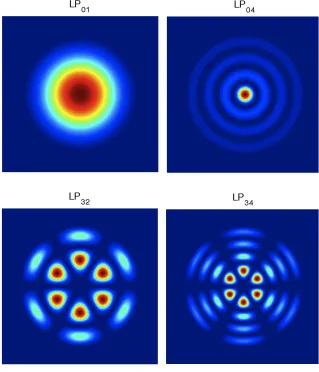
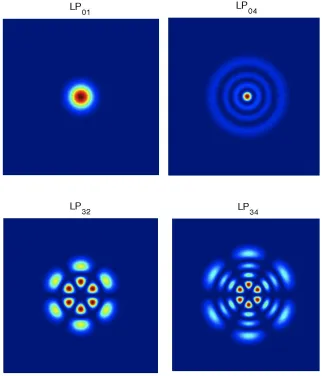
Figure 2.6 shows the intensity plots of E01,E04, E32, and E33 in a
[image:38.612.140.462.148.524.2]
Chapter 3
Transverse-Mode Phase Masks
The result of Fourier-transforming a signal that changes amplitude and
phase in the near-field shows the change of amplitude and phase in the
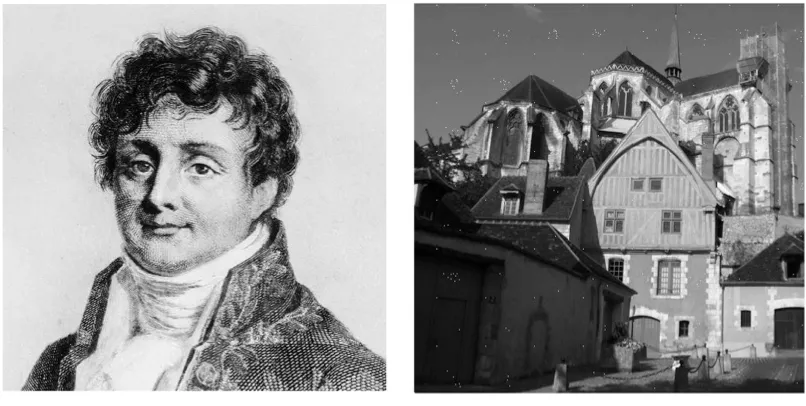
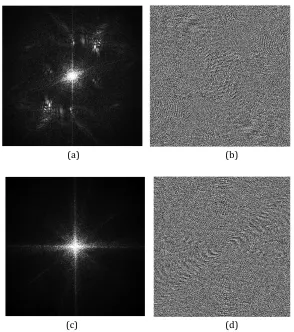
far-field. Figure 3.1 shows two images in the near-field and Figure 3.2
shows their corresponding amplitude and phase variations in the far-field.
The spectral amplitude and the spectral phase have been studied to see
which preserves more information about the original signal. In some
situations, only partial Fourier domain information is available or desired
over the other to reconstruct the original signal. It has been shown that
phase-only holograms, where the phase is recorded and the amplitude is
assumed to be unity, the signal is reconstructed with more features of the
original signal than the reconstructed signal from an amplitude-only
zero [8][13]. Figure 3.3 shows this interesting finding. The phase of Image
A is used in the reconstruction of Image B, while the phase of Image B is
used in the reconstruction of Image A. We can see that the spectral phase
carries more information about the original signal than the spectral
amplitude. It follows that using a phase-only spatial light modulator, fiber
[image:40.612.119.522.287.490.2]modes can be reconstructed with minimal error.
(a) (b)
[image:41.612.155.449.156.488.2]
(c) (d)
Figure 3.2: In the far-field (a) Image A amplitude, (b) Image A phase, (c)
!! ! !
[image:42.612.157.445.131.293.2]!!!!!!!!!!!!!!!!!!!!!!!!!!!!!!!!!!(a)!! (b)!
Figure 3.3: Reconstructed Images (a) Amplitude of Image A with phase of
3.1
Construction of Fiber Modes using a
Spatial Light Modulator
Figure 3.4: Construction of Fiber Modes using a Spatial Light Modulator.
Consider a 4-f optical setup shown in Figure 3.4. A spatial light modulator
(SLM) is placed in the Fourier plane of the first lens. The electric field Esi
incident upon the SLM is the Fourier transfom of the signal originating
Esi(fx, fy)∝F T{Ei}=
∞
Z Z
−∞
Ei(x1, y1)ej2π(fxx1+fyy1)dx1dy1 (3.1)
where
• Ei is the electric field from the input fiber
• fx = λfx and fy = λfy are the spatial frequencies
• (x, y) is the coordinate system in the Fourier plane
• λ is the signal wavelength
• f is the focal distance of the lens
• F T is the Fourier transform symbol
The incident field upon the second lens is the product of Esi and the
transfer function of the SLM T(fx, fy). The second lens performs another
Fourier transform of the incident signal and focuses the light into the
transmission fiber. Thus, the electric field E0 incident upon the
transmission fiber is given by [10]
Eo(x2, y2)∝F T{T(fx, fy)Esi(fx, fy)}=
∞
Z Z
−∞
T(fx, fy)Esi(fx, fy)ej2π(x2fx+y2fy)dfxdfy
where(x2, y2) is the coordinate system in the plane of the transmission fiber.
Although the field propagating out of the input fiber is usually
considered to be Gaussian, it can be assumed to be an impulse function
δ(x1, y1) without much compromise [12]. With this assumption, it follows
that Esi ∝F T{δ(x1, y1)}= 1. In turn, Eq. (3.2) becomes
Eo ∝F T{T(fx, fy)}=
∞
Z Z
−∞
T(fx, fy)ej2π(x2fx+y2fy)dfxdfy. (3.3)
At the transmission fiber, to excite a specifc mode, the incident electric
field Eo(x2, y2) has to match or overlap with the mode to be excited. The
quality of overlap is calculated with an overlap integral given by [11]
η= |
RR
Eo(x2, y2)EM∗ (x2, y2)dx2dy2|2
RR
|Eo(x2, y2)|2dx2dy2
RR
|EM(x2, y2)|2dx2dy2
(3.4)
where η is the power coupling coefficient (P C) and EM is the electric field
of the mode to be excited.
The maximum valueη takes on is 1 and this happens when Eo =EM,
i.e., Eo and EM completely overlap. It is then evident that in order to
excite a given mode EM, the transfer function of the SLM has to be the
T(fx, fy) =F T−1{EM(x2, y2)}=
∞
Z Z
−∞
EM(x2, y2)e−j2π(fxx2+fyy2)dx2dy2.
(3.5)
3.2
Unit Amplitude
As discussed earlier, the spectral phase of a signal carries more
information about the original signal than the spectral amplitute. Using a
phase-only spatial light modulator and assuming that the amplitude of the
light field reaching the front end of the SLM is a unit over the transmissive
region of the SLM, a desired mode is excited in the transmission fiber given
that the transfer function of the SLM is equal to the spectral phase of the
desired mode transform,
˜
T(fx, fy) =
T(fx, fy) |T(fx, fy)|
. (3.6)
3.2.1
Results
This section shows the results of constructed gradient fiber modes using the
setup shown in Figure 3.4. Figure 3.5 and Figure 3.6 shows how well
modes are created and the cross-talk with other modes. Mode E0,1 is
with mode E0,4 with a cross-talk coefficient of approximately 1.7x10⁻⁵. The
cross-talk coeffiencient is defined as the power coupling between a mode
and and another mode other than itself. Mode E3,2 has a power coupling of
approximately 8.8x10⁻⁵, and a cross-talk coefficient with mode E2,3 of
approximately 0.2x10⁻⁵.
0.00E+00 5.00E-‐06 1.00E-‐05 1.50E-‐05 2.00E-‐05 2.50E-‐05
E0,1 E0,4 E3,2 E2,3
η
Power Coupling & Modal Cross-‐talk
[image:47.612.122.431.261.514.2]E0,1
0.00E+00 1.00E-‐05 2.00E-‐05 3.00E-‐05 4.00E-‐05 5.00E-‐05 6.00E-‐05 7.00E-‐05 8.00E-‐05 9.00E-‐05 1.00E-‐04
1 2 3 4
η
Power Coupling & Modal Cross-‐talk
[image:48.612.123.496.127.387.2]E3,2
As the results show, using a unit amplitude across the transmissive area
of the SLM and using the phase signal of the target mode, the modes are
created at the output fiber with very little power coupling. The following
sections focus on improving this technique.
3.3
Optimal Aperture
3.3.1
Abbe’s Theory
Consider the 4-f optical system in Figure 3.7. Each point in the Fourier
plane (x, y) of the first lens corresponds to a spatial frequency and
amplitude. Abbe’s theory states that to reconstruct the image of the
original object, as many diffraction orders as possible must be recombined
for higher quality image of the object [13]. These diffraction orders
correspond to spatial frequencies. The second lens recombines the spatial
frequencies to reconstruct the image in the object plane (x2, y2). The
spatial frequencies (fx, fy) in the Fourier plane are related to (x, y) system
Figure 3.7: Abbe’s Theory of Imaging.
fx =
x
λf (3.7)
and
fy =
y
λf. (3.8)
where λ is the light wavelength and f is the focal distance of the first and
3.3.2
Aperture Diameter Optimization
The assumption that the light field reaching the SLM has a constant
amplitude across the transmissive area of the SLM requires that higher
frequencies be filtered out for maximum power coupling. To understand
this reasoning, lets consider the transfer function T of the SLM to be the
inverse Fourier transform of EM with both amplitude and phase. Here we
assuming that the SLM is configured to modulate amplitude and phase. If
T is applied to the SLM, the resulting electric fieldEo at the input on the
transmission fiber completely overlaps with EM, i.e., η= 1. However, it is
evident from Figure 3.8 that not all the spectral frequencies have the same
amplitude; there is a maximum frequency passed which the amplitude
Figure 3.8: Frequency Component of Mode E04.
However, if the amplitude component of the transfer function is
assumed to be constant across the sprectrum, higher order frequencies have
to be filtered out in order to achieve a high η, otherwise the resulting strong
interferance at high frequencies will cause the power coupling η to be much
less than 1. This is the case of Section 3.2. It follows that an aperture is
required to block higher frequencies, and the resulting setup is shown in
diameter that will result in maximum η.
SLM
Lens
Lens
[image:53.612.166.478.158.409.2]Aperture
Figure 3.9: An aperture is placed in front of SLM to block high frequencies.
We calculate the optimal aperture diameter by varying the maximum
frequency allowed through the aperture and recording the resulting power
coupling. Eq. (3.7) and Eq. (3.8) shows the relationship between (x, y)
coordinates in the Fourier plane and their corresponding spatial
frequencies. Figure 3.10 and Figure 3.11 show the change of η with
optimal diameter at which the highest power coupling is reached for any
given mode. For example, for mode E0,4, the maximum frequency, for both
fx and fy, at which the highest power coupling of approximately 0.8 is
0.115mm−1. Using Eq. (3.8) where the focal distance f = 20cm and the
wavelength λ= 850nm, we calculate the corresponding optimal diameter of
0 0.05 0.1 0.15 0.2 0.25 0.3 0.35 0.4 0.45 0
0.1 0.2 0.3 0.4 0.5 0.6 0.7 0.8 0.9 1
Spatial Frequency [mm−1]
η
E0,4 E0,5 E0,6 E0,7
[image:55.612.128.475.181.526.2]Highest
Figure 3.10: Change of η with respect to the highest allowed frequency for
0 0.05 0.1 0.15 0.2 0.25 0.3 0.35 0.4 0.45 0
0.1 0.2 0.3 0.4 0.5 0.6 0.7 0.8 0.9 1
Spatial Frequency [mm−1]
η
E1,4 E1,5 E1,6 E1,7
[image:56.612.128.475.180.526.2]Highest
Figure 3.11: Change of η with respect to the highest allowed frequency for
With an optimal aperture in place, we have a new transfer function of
the system optimal aperture-SLM, and is
˜
T(fx, fy) =
T(fx, fy) |T(fx, fy)|
.δ p
f2
x +fy2
fmax ! (3.9) where δ p f2
x +fy2
fmax ! = 1, √ f2
x+fy2
fmax ≤1
0, √
f2
x+fy2
fmax >1
(3.10)
and fmax is the maximum frequency allowed through the aperture.
3.3.3
Results
As we can see in Figure 3.12 and Figure 3.13, the power coupling
significantly increases for angular-independent and angular-dependent
0.00 0.10 0.20 0.30 0.40 0.50 0.60 0.70 0.80 0.90 1.00
E0,1 E0,4 E3,2 E2,3
η
Power Coupling & Modal Cross-‐talk for Mode E
0,1Op1mal Aperture Unit Amplitude
[image:58.612.122.511.132.424.2]E
0,1Figure 3.12: Power Coupling and Modal Cross-talk for Mode E0,1:
0.00 0.10 0.20 0.30 0.40 0.50 0.60 0.70 0.80 0.90 1.00
E0,1 E0,4 E3,2 E2,3
η
Power Coupling & Modal Cross-‐talk for Mode E
3,2Op1mal Aperture Unit Amplitude
[image:59.612.123.504.144.423.2]E
3,2Figure 3.13: Power Coupling and Modal Cross-talk for Mode E3,2:
3.4
Optimal Inner Aperture Block
This section investigates the impact of an aperture block at the center of
the aperture for the purpose of increasing the power coupling. As it was
shown in the previous section, the use of aperture is based on the fact that
higher frequencies do not exist in the spectrum of the mode, i.e., higher
frequencies have little or no amplitude. In Figure 3.14, far-field intensity
profiles of four modes are shown. It is the property of Laguerre-based
modes that they are invariant to the the Fourier transform [8]. As we can
see in the figure, lower frequencies also do not exit in the spectrum of the
modes, and as a result there is a minimum frequency under which the
amplitude becomes zero. It is important to note that this is true for
E
4,1E
4,4E
8,1E
8,4Min Max
[image:61.612.111.538.129.327.2]The intensity at the center of the mode is minimal
Figure 3.14: Lower frequencies do not exist in the spectrum of
angular-dependent modes.
It follows that by placing an aperture block to block lower frequencies
will lead to an increase in power coupling. Additionally, the optimal size of
the block that yeilds the highest increase in power coupling must be
utilized. The process of determining the optimal diameter of the inner
aperture block is similar to the one used to determine the optimal aperture
diameter: by varying the minimum frequency allowed throught the aperture
(which is equivalent to varying the maximum frequency blocked by the
inner aperture block), the power coupling is recorded, and the optimal
frequency at which the power coupling is highest. Figure 3.15 shows the
setup of the inner aperture block and Figure 3.16 shows the optimization
process of the inner aperture block.
[image:62.612.159.499.203.479.2]
Inner Aperture Block
Figure 3.15: Setup with Inner Aperture Block: An inner aperture block is
Figure 3.16: Change of η with respect to the lowest allowed frequency for
angular-dependent and angular-independent modes.
With an optimal aperture and an inner aperture block in place, we have
a new transfer function of the system optimal aperture-inner aperture
˜
T(fx, fy) =
T(fx, fy) |T(fx, fy)|
.δ p
f2
x +fy2
fmax
!
.γ pfmin
f2
x +fy2
!
(3.11)
where
γ pfmin
f2
x +fy2
! =
1, √fmin
f2
x+fy2 ≤
1
0, √fmin
f2
x+fy2
>1
(3.12)
and fmin is the minimum frequency not blocked by the inner aperture block.
[image:64.612.113.509.137.282.2]3.4.1
Results
Figure 3.17 and Figure 3.18 show the results of using an optimized inner
aperture block. We can see that by utilizing an inner aperture block, the
power coupling significantly increases in this way:
• As previously noted, only angular-dependent modes will experience a
power coupling increase by the use of an inner aperture block.
• The percentage power coupling increase increases with increasing
azimuthal mode number.
• The percentage power coupling increase decreases with increasing
0 5 10 15 20 25 30
E0,1 E1,1 E2,1 E4,1 E6,1 E8,1 E10,1
[image:65.612.121.496.131.378.2]Percentage Increase -‐ Increasing Azimuthal Number
Figure 3.17: Percentage Increase in Power Coupling: Increasing Azimuthal
0 5 10 15 20 25 30
E10,1 E10,2 E10,3 E10,4 E10,5
[image:66.612.117.498.137.368.2]Percentage Increase -‐ Increasing Radial Number
Figure 3.18: Percentage Increase in Power Coupling: Increasing Radial Mode
Chapter 4
Far-field Phase Noise
Thus far, in the creation of modes using far-field phase information, we
have considered an noiseless SLM, i.e., the SLM transfer function is equal
to the phase of the target mode, with no noise considered. However, in
reality this noise exists and is due to the effect of opto-electrical
components of the SLM. This chapter will explore the effect that the SLM
noise has on the creation of modes.
4.1
SLM Noise
In this section, we consider the SLM noise φ(fx, fy) to be a White Gaussian
noise of probability density function defined as
ξ= 1
σ√2πe
−f 2
x+fy2
where σ is the standard deviation of the noise.
With the SLM noise considered, the total transfer function becomes
˜
T(fx, fy) =
φ(fx, fy) +
T(fx, fy) |T(fx, fy)|
.δ p
f2
x +fy2
fmax
!
.γ pfmin
f2
x +fy2
!
(4.2)
The signal to noise ration (SNR), which defines the level of the phase to
the level of the noise, is defined as
snr= 10 logP(fx, fy)
φ(fx, fy)
, (4.3)
where
P(fx, fy) =
T(fx, fy) |T(fx, fy)|
(4.4)
4.2
Effect of SLM noise on creation of
modes
Using the transfer function defined in Eq. 4.2, Figure 4.1 shows the creation
of modes as a function of SNR. As we could have predicted, a higher SNR
SNR = 0 SNR = 5 SNR = 10 SNR = 15
E
0,1:
E
0,4:
[image:69.612.113.536.123.449.2]E
8,4:
Figure 4.1: Effect of SLM noise of mode creation.
Figure 4.2 shows the impact of SNR on the power coupling. We see
that a phase-to-noise ratio of approximately 30dB is sufficient to achieve
maximum power coupling for modes
E0,1, E0,4, E4,1, E4,4, E8,1, E8,4, E12,1, E12,4. It is also important to notice that
reconstruct modes with maximum power coupling holds true independently
[image:70.612.120.512.183.590.2]of the azimuthal or radial mode number.
Chapter 5
Concluding Remarks
This thesis investigated the creation of gradient-index fiber modes, first by
studying the electromagnetic fields of light in step-index and gradient-index
multi-mode fibers, and secondly by simulating the creations of modes using
MATLAB utilizing different techniques with the goal to maximize the
power coupling between the created mode and the desired mode.
We first reproduced a previous work by Stepniak et al. [8] and extended
the work by introducing an inner aperture block in the far field, which
resulted in an increase of power coupling of up to 23%. We examined this
technique for angular-depend and angular-independent modes and found
that this technique increases the power coupling for angular-dependent
modes only. We also reported that the power coupling increases with
mode number.
Finally, we investigated the effect of SLM noise to the creation of
modes. This is an important study because SLM noise is an inherent
property that needs to be considered in the creation of modes. We reported
that an approximate of 30dB of SNR is necessary to create modes with
Bibliography
[1] J. S. Lim A. V. Oppenheim and S.R. Curtis. Signal synthesis and
reconstruction from partial fourier domain information. Journal of the
Optical Society of America, 73:1413–1420, November 1983.
[2] M.J. Adams. Fundamentals of Optical Fibers. Wiley-Interscience, 2nd
edition, 1981.
[3] Vladimir. Kahn Joseph M. Boyd Stephen. Alon, Elad. Stojanovi and
Mark Horowitz. Equalization of modal dispersion in multimode fiber
using spatial light modulator. Global Telecommunications Conference,
2:1023–1029, 2004.
[4] K. G. Birch. Spatial filtering in optical data-processing. Rep. Prog.
Phys., 29:1265–1314, September 1972.
[5] David M. Bressoud. A Radical Approach to Real Analysis. The
[6] John A. Buck. An Introduction to Optical Waveguide.
Wiley-Interscience, 2nd edition, 2004.
[7] Joel Carpenter and Timothy D. Wilkinson. Characterization of
multimode fiber by selective mode excitation. Optics Letters, 30(10),
May 2012.
[8] W. Thomas Cathey. Optical Information Processing and Holography.
Wiley-Interscience, 1989.
[9] L. Maksymiuk G. Stepniak and J. Siuzdak. Binary-phase spatial light
filters for mode-selective excitation of multimode fibers. Journal of
Lightwave Technology, 29(13):1980–1987, July 2011.
[10] D Globe. Weakly guiding fibers. Applied Optics, 10(10):2252–2258,
October 1971.
[11] Keang-Po Ho Joseph M. Kahn and Mahdieh Bagher Shemirani. Mode
coupling effects in multi-mode fibers. In Optical Fiber Communications
Conference, March 2012.
[12] D. G. Cunningham L. Raddatz, I. H. White and M. C. Nowell.
Experimental and theoretical study of the offset launch technique for
the enhancement of the bandwidth of multimode fiber links. Journal of
Lightwave Technology, 16(3):324–331, March 1998.
[13] Alan V. Oppenheim and Jae S. Lim. The importance of phase in
[14] Bahaa E. A. Saleh and Malvin Carl Teich. Fundamentals of Photonics.
Wiley-Interscience, 1st edition, 1991.
[15] Joseph M. Kahn Xin Shen and Mark A. Horowitz. Compensation for
multimode fiber dispersion by adaptive optics. Journal of Lightwave
Technology, 30, November 2005.
[16] X. Zhao and F.S Choa. Demonstration of 10-gb/s transmission over
1.5-km-long multimode fiber using equalization techniques. IEEE
Appendix A
MATLAB Simulation of
Step-Index Multi-Mode Fiber
Modes
• Calculate the V number based on the fiber and light properties (fiber
core radius, numerical aperture and light wavelength)
• Define eigenvalue u as a vector of maximum value V
• Calculate eigenvalue w based on Eq. 2.18
• Define each term in Eq. 2.17 depending on the mode to be created
• Graphical method
Below is an example of a MATLAB simulation code and the
resulting graphical solution for mode of azimuthal mode number
4
– The intersections between the two plots are solutions to
eigenvalue u. The first intersection isu4,1, the second is u4,2, and
so on.
• Numerical method
– Using MATLAB built-in functions, find the root of Eq. 2.19
• Using Eq. 2.17, calculate w
• Use Eq. 2.15 and Eq 2.20, calculate the electric field of the mode
and and its intensity, respectively.
Light Properties
lambda = .85; %wavelength[microns]
k = 2*pi/lambda; %wave number
Fiber Properties
n1 = 1.46; %refractive index of the fiber core
delta = 0.0178; %normalized index difference
na = n1*sqrt(2*delta); %numerical aperture
V Parameter
v = 20; 2*pi*r*na/lambda;
Eigenvalues
u = 0:.0001:v;
w = sqrt(v.^2 - u.^2);
Bessel Functions for use in Eq. 2.16
j4 = besselj(4, u);
j3 = besselj(3, u);
k4 = besselk(4, w);
k3 = besselk(3, w);
Plotting for graphical solution
plot(u, j4./j3, ’-b’, ’LineWidth’, 1.1); hold on;
plot(u, -(u./w).*(k4./k3), ’-r’, ’LineWidth’, 1.1);
text(0.5, -6, ’$$-\frac{u}{w}\frac{K_4(w)}{K_3(w)}$$’, ’interpreter’, ...
’latex’, ’Color’, ’r’, ’fontsize’,25);
ylabel(’$$\frac{J_4}{J_3}$$’,’interpreter’,’latex’, ’fontsize’, 25);
xlabel(’u’, ’fontsize’,25);
axis([0 v -30 30])
Figure A.1: Graphical solution to eigenvalue equation. The solution is the