Rethinking science communication
models in practice
Jennifer Ellen Metcalfe
August 2019A thesis submitted for the degree of Doctor of Philosophy of The Australian National University
Declaration by author
This thesis is composed of my original work, and contains no material previously published or written by another person, except where due reference has been made in the text. The content of my thesis is the result of work I have carried out since the commencement of my research higher degree candidature, firstly at the University of Queensland (6/10/2011-31/5/2016), and then at the Australian National University (commenced on 24/06/2016). It does not include a substantial part of work that has been submitted to qualify for the award of any other higher degree or diploma in any other university or tertiary institution.
Acknowledgments
This is a very long list of acknowledgements, and in writing this I realise that when you do a PhD part time over many years involving three universities that it’s a journey. There are many people who come in and out of your life and who make a difference. There are deaths and births; there is despair and joy. There are challenges you don’t think you’ll ever surmount and then opportunities that open big fat doors. And all of those moments involve other people. I could not have completed this thesis without those people.
Firstly, I would like to acknowledge my late mother, Helen Metcalfe, who initially encouraged me to do a PhD and who always supported my academic and professional endeavours. She died on November 30, 2011, just after I enrolled in my PhD, and the memory of her selfless support and love has inspired me to continue and complete my PhD. My mother is the best person I have ever known. My father, George Albert (Bert) Metcalfe also inspired my lifelong joy of study. He completed two
Masters of Arts with theses on ancient Near East covenants as revealed by his study of ancient texts including Hebrew and Greek. He had started a PhD at Sydney University before he was affected by a severe stroke in his mid 60s. My siblings – Dean, Kathy, and Andrew – continue to be there for me during good and bad times. Their support and love have been crucial for me completing this PhD.
I would like to thank my team at Econnect Communication for their on-going patience and support of my academic preoccupations. In particular, I would like to thank Dr Jane Ilsley, who has been my right-hand woman at Econnect throughout this entire period. It is tricky running a science communication business as well as doing a PhD, and Jane has always supported me. I would also like to especially thank
of my thesis, and who also helped with intercoder reliability checking of some of the research coding. Maddie’s help followed earlier administrative assistants who helped me with accessing and managing the references for this thesis—Anne Huang, An Xu. I could not have done this thesis without your valuable assistance.
I would particularly like to thank Dr Michelle Riedlinger, one-time member of my Econnect team, who reviewed several of my chapters before I submitted. From the very beginning of this journey, she has constantly motivated and encouraged me. I would not have completed this PhD without her support, advice and cajoling. Others who have championed and chastised me into action include Toss Gascoigne, Marina Joubert, and Fabien Medvecky. Early in my thesis days, Dr Melanie McKenzie, also once an Econnect team member, encouraged me and pointed me in the right direction on numerous occasions. I have regularly referred to her University of Queensland PhD thesis, Science Communication Evaluation: The Role of Values, over the course of my studies. I have greatly missed her intellectual input and stimulation since her very untimely death in 2015. Melanie, this one’s for you!
Lamberts, and recently appointed Director of Research, Dr Sujatha Raman. Sujatha’s review of the Climate Champion Program case study (Chapter 5) was particularly insightful in helping me see the relevance of my research to shaping a new way of thinking about science communication models.
I would also like to thank my dear colleagues across the world, most of whom I met through the International Network for the Public Communication of Science and Technology, who I am also lucky enough to call friends.
Lastly, I would like to thank the many people who I have worked with over nearly 30 years practice as a science communicator. In particular, the wonderful farmers of the Climate Champion Program, the good folk of the Philippines Landcare
Abstract
Scholars have variously described and theorised different models of science
communication over the past 20 years. This has paralleled an increasing emphasis by science communicators and policy makers for more deliberative public engagement in science.
The problem I address in this thesis is: how well does the practice of science communication, especially when the science is publicly controversial, reflect the theorised models of science communication? This addresses a significant gap in scholarship as to date there has been little comparison of the science communication models against practice.
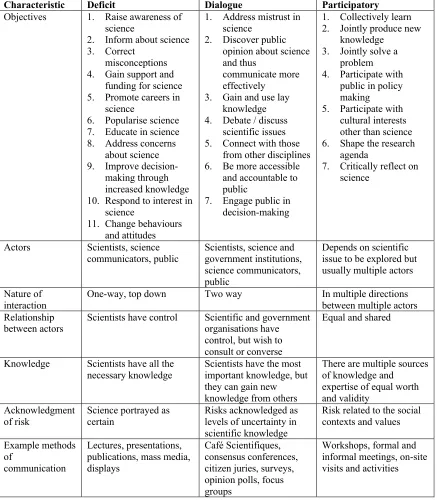
My literature review synthesises the breadth and depth of how scholars have theorised about the three main science communication models (deficit, dialogue and participation) to produce a comprehensive framework of model characteristics. I then compare the framework of theorised characteristics of the three models with (a) 415 science engagement activities recorded in a 2012 Australian audit; (b) oppositional climate science blogs www.skepticalscience.com and www.joannenova.com; and (c) a seven-year case study: the Australian Climate Champion Program, where scientists and farmers jointly addressed the problem of climate risk.
The data collected for the practice case studies were compared against the literature-based framework of selected characteristics for the theorised science communication models. Data were investigated through thematic content analysis, discourse analysis and descriptive statistical analysis.
confirmed that the three models do coexist in practice, but also indicated why and how they coexist. This coexistence of models in practice appears to be not merely an unintentional lucky accident but a necessity for science communication activities to achieve their objectives, especially when the science is controversial. The models proposed by scholars do not appear to take into account the extensive nature and mix of objectives for initiating or participating in science communication activities.
The importance of developing trusted relationships between participants for achieving the desired outcomes of all the theorised models of science communication was demonstrated by the Climate Champion Program case study. Participants in this program, which investigated climate risk, were much more open with each other, including when acknowledging uncertainties. Scientists changed the science they did, the shape of their research outputs and how they communicated about those outputs as a result of their involvement in the program. Trusted relationships developed through participation appear to make linear communication more viable, a finding which questions how many scholars have perceived the evolutionary nature of science communication models from deficit to more participatory forms of engagement.
This research improves understanding of how theorised science communication models might be further shaped to better reflect and even influence practice. I propose the new nexus model for science communication and describe how this can be
implemented within the practical contexts of considering the objectives for engagement, who is involved in the engagement activity, and how positive relationships can be fostered amongst those participating.
Contents
Declaration by author ... ii
Acknowledgments ... iii
Abstract ... vi
List of figures ... xi
List of tables ... xi
Glossary of common acronyms used ... xii
1. Introduction ... 1
1.1 Background to thesis ... 1
1.2 Academic context ... 6
1.2.1 Growing scholarly literature base on science communication models ... 6
1.2.2 Theories and models and the ‘theorised science communication models’ ... 8
1.2.3 Comparing theorised models of science communication with practice ... 11
1.2.4 Relationships between science communication scholars and practitioners ... 13
1.3 Defining science communication and the actors involved ... 15
1.3.1 Defining science communication ... 15
1.3.2 The move towards public ‘engagement’ in science ... 17
1.3.3 Science communication practitioners and scholars ... 19
1.3.4 Understanding who the public is ... 21
1.4 Controversial science ... 23
1.4.1 Climate Change as an example of a controversial science issue ... 23
1.4.2 Failure of science literacy communication on controversial topics ... 26
1.4.3 Research on science controversies is mostly focussed on linear science communication ... 27
1.5 Summary of terms used in the thesis ... 28
1.6 Australian context ... 28
1.6.1 Australian science communication focused on practicalities ... 29
1.6.2 Professionalisation of science communication ... 29
1.6.3 Government support for science communication ... 31
1.7 The research questions ... 33
1.8 Overview of data and methods ... 34
1.9 Overview of chapters ... 35
2. Literature review—Public science controversies drive theorised science communication models ... 37
2.1 Introduction ... 37
2.1.1 Setting the modern science communication scene ... 37
2.2 Public controversies drive new policies and ways of doing science communication ... 38
2.3 Science communication models ... 45
2.3.1 Deficit science communication model ... 49
2.3.2 Dialogue model of science communication ... 50
2.3.3 Participatory model of science communication ... 52
2.4 Comparing science communication models ... 54
2.4.1 Objectives ... 56
2.4.2 The actors, their interactions, and relationships ... 59
2.4.3 Knowledge ... 61
2.4.4 Acknowledgment of risk ... 62
2.4.6 Timing of science communication ... 63
2.5 Scholarly critique of successive models ... 64
2.6 Concluding remarks ... 69
3. Comparing science communication theory with the science engagement practices recorded in a 2012 Australian audit ... 71
3.1 Introduction ... 71
3.1.1 Research questions ... 72
3.2 The data—2012 National Audit of Australian Science Engagement Activities .. 72
3.3 Methods and results ... 74
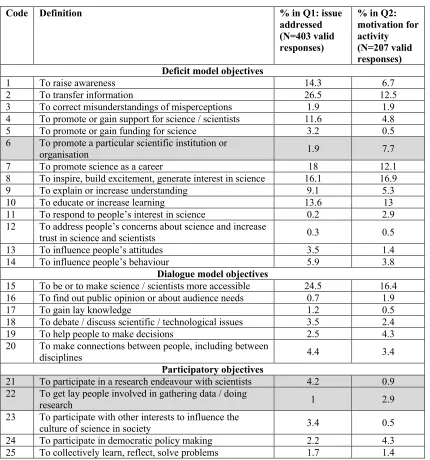
3.3.1 Science communication objectives ... 74
3.3.2 Nature of engagement ... 80
3.3.3 Comparing controversial and non-controversial activities ... 86
3.4 Discussion ... 88
3.4.1 Objectives for engagement activities broadly reflect theorised models ... 88
3.4.2 Australia’s science engagement dominated by deficit and dialogue objectives and activities ... 89
3.4.3 Engagement activities around controversial science more likely to be deliberative and participatory ... 92
3.4.4 Analysis of practice can further develop theoretical considerations of science communication ... 92
3.5 Conclusions ... 95
4. Engaging laypeople in a dialogue about controversial science using blogs—A climate change case study ... 99
4.1 Introduction ... 99
4.2 The potential of blogs to create a dialogue on controversial science ... 100
4.3 Study questions ... 105
4.4 The study focus ... 105
4.4.1 Choice of blogs ... 105
4.4.2 Choice of blogposts and comments ... 107
4.5 Methods ... 108
4.6 Analysis ... 112
4.6.1 The commenters ... 112
4.6.2 Motivation to comment on blogs ... 113
4.6.3 Nature of engagement ... 116
4.7 Discussion ... 120
4.7.1 Blogs on controversial science like climate change create own publics ... 120
4.7.2 Commenters use blogs as a ‘soapbox’ ... 121
4.7.3 Commenters use deficit-style communication ... 123
4.7.4 Limitations and further research ... 124
4.8 Concluding remarks ... 125
5. Comparing science communication models with a long-term participatory case study—The Climate Champion Program ... 127
5.1 Introduction ... 127
5.1.1 Agricultural extension and participatory science communication ... 129
5.2 The Climate Champion Program (CCP) ... 131
5.2.1 Rationale for CCP ... 131
5.2.3 Review and evaluation of the CCP ... 135
5.2.4 My research ... 137
5.3 Methods ... 138
5.3.1 Surveys of farmers and scientists (2013 and 2016) ... 138
5.4.2 Analysis of workshop discussions ... 141
5.4 Results ... 142
5.4.1 Actors’ objectives for participation ... 142
5.4.2 Nature of interaction ... 145
5.4.3 Relationships between actors ... 148
5.4.4 Knowledge ... 150
5.4.5 Acknowledgment of risk ... 153
5.5. Discussion and conclusions ... 155
5.5.1 Participants in Climate Champion Program were motivated mostly by deficit and dialogue-style objectives ... 155
5.5.2 Climate Champion Program reflects a mix of theorised characteristics of all three science communication models ... 157
5.5.3 Respectful, trusting and open relationships result from long term participation ... 158
5.5.4 Participatory communication results in more effective deficit and dialogue-style communication ... 160
5.5.5 Towards more robust science communication models ... 162
5.5.6 Applications to the practice of science communication ... 164
5.6 Concluding remarks ... 166
6. Towards a new model of science communication with implications for practice .... 167
6.1 Science communication models and practice—predictions and reality ... 170
6.1.1 Objectives for science communication ... 170
6.1.2 Actors and the nature of their engagement ... 172
6.1.3 Coexistence of models in practice ... 175
6.1.4 The role of controversy ... 178
6.2 Towards a new model of science communication ... 179
6.3 New nexus model of science communication ... 183
6.3 Implications for scholars ... 187
6.3.1 Recognising the coexistence of and dependence between science communication models ... 187
6.3.2 Understanding the benefits of trusted relationships ... 187
6.4 Implications for practitioners ... 188
6.4.1 The need for more deliberative dialogic and participatory science engagement ... 188
6.4.2 Strategic application of science communication models ... 190
6.4.3 Using more deliberative forms of science communication ... 194
6.5 Limitations of research, and opportunities for further research ... 196
6.6 Concluding statement ... 197
References ... 201
Appendices ... 223
Appendix A—2012 Australian National Audit of Science Engagement Activities online survey tool ... 224
Appendix B—Promotional document ... 235
List of figures
Figure 1. 2016 survey: Level of interaction of scientists with CCP farmers (n=7) ... 146
Figure 2. Spectrum model of science communication ... 179
Figure 3. The rosette model of science communication ... 182
Figure 4. The six-petal rosette model of science communication ... 184
List of tables Table 1. A summary of theorised science communication models ... 46
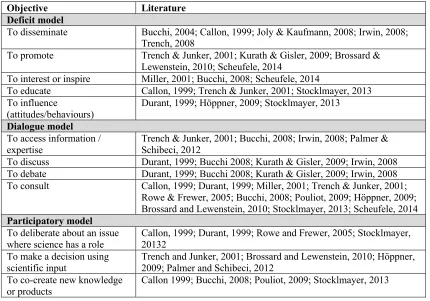
Table 2. Comparison of selected characteristics of theorised deficit, dialogue and participatory models of science communication (Sources: Brossard & Lewenstein, 2010; Bucchi, 2008; Callon, 1999; Durant, 1999; Irwin, 2008; Kurath & Gisler, 2009; Miller, 2001; Palmer & Schibeci, 2012; Pouliot, 2009; Rowe and Frewer, 2005; Scheufele, 2014; Stocklmayer, 2013; Trench & Junker, 2001) ... 55
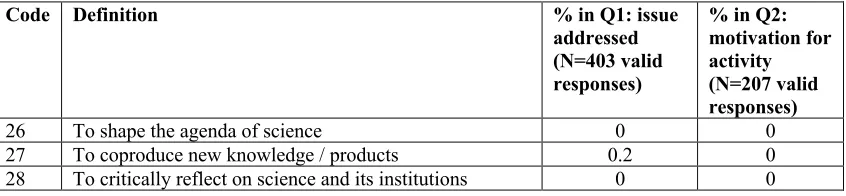
Table 3. Coding of qualitative data in response to asking for the significant issues driving the need for the engagement and the motivation. ... 76
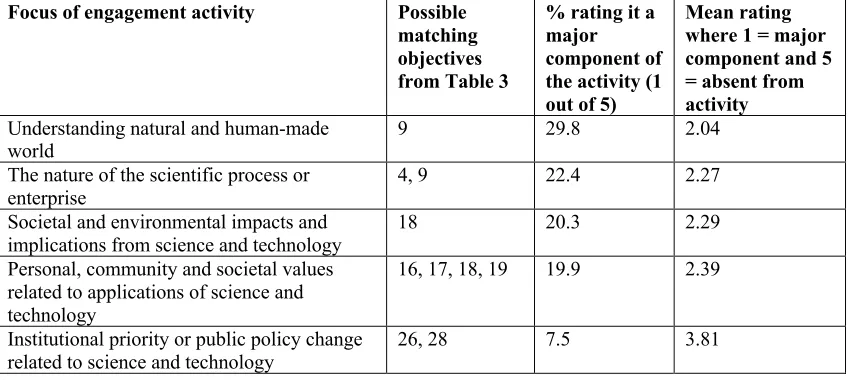
Table 4. Audit results showing the focus of each engagement activity according to five choices ... 80
Table 5. Coding of qualitative data in response to a question asking for a brief description of the engagement activity ... 82
Table 6. Coding of all qualitative data according to the science communication models present ... 85
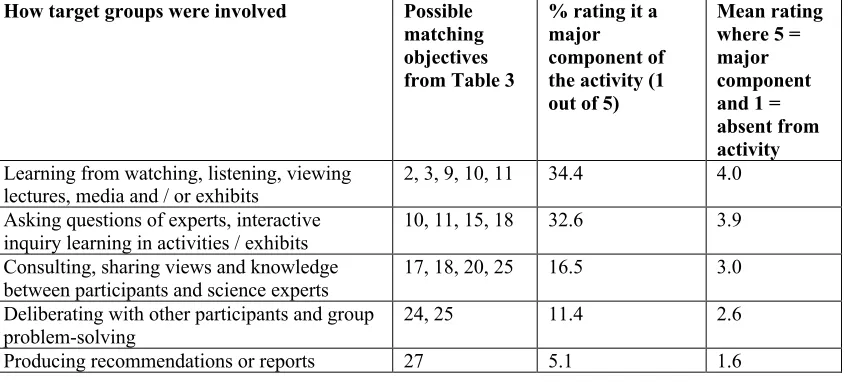
Table 7. Audit results showing how target groups were involved in each engagement activity according to five choices ... 86
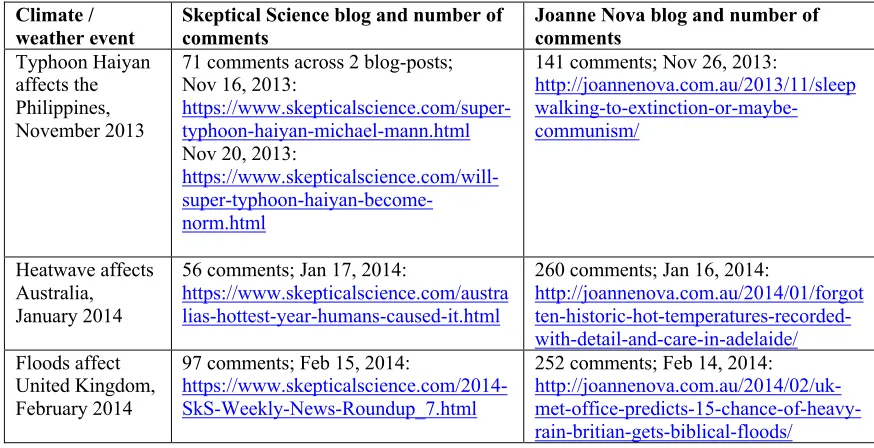
Table 8. Blog comments investigated from Skeptical Science and Joanne Nova’s blogs ... 110
Table 9. Science communication model objectives analysed in comments ... 109
Table 10. The gender of the blog commenters as a % of all bloggers ... 113
Table 11. Modes of participation in blogs by commenters as a % of total comments for each blog-post ... 117
Table 12. Survey questions explored according to aspects of theorised science communication models ... 139
Table 13. Discussions analysed at the CCP workshop, March 2014 ... 141
Table 14 The objectives of CCP farmers and scientists that emerged from survey qualitative data compared to those predicted by theorised science communication models ... 142
Glossary of common acronyms used
ANU Australian National University
ASC Australian Science Communicators
BSE Bovine Spongiform Encephalopathy, or mad cow disease
CCP Climate Champion Program
CGIAR Consultative Group on International Agricultural Research
CSIRO Commonwealth Scientific and Industrial Research Organisation
GM Genetically Modified
GRDC Grains Research & Development Corporation
MCV Managing Climate Variability
NGO Non-Government Organisation
OECD Organisation for Economic Cooperation and Development
PCST Public Communication of Science and Technology
PUS Public Understanding of Science
RDC Research and Development Corporation
UK United Kingdom
1. Introduction
1.1 Background to thesis
This thesis arose in response to the disconnect I perceived between science
communication theory and practice. Since the mid 1980s there has been a growing scholarly literature about science communication, but I was unsure if it reflected science communication in practice or if it could inform practice to make it more effective.
On the flipside, I also wondered if the scholarly theories and models about science communication could be further developed by reflecting on practice. I first heard about the theories of science communication, including the various models of science communication, through my involvement with the International Network for the Public Communication of Science and Technology (PCST Network) conferences. I attended my first conference in Montreal, Canada in 1994 and I have attended every biennial conference since then. The PCST Network aims to bring science
communication practitioners and scholars together for mutual benefit. I have always felt like I straddle both camps, although with a pronounced lean towards practice, and this means I have an on-going interest in the nexus between the two.
When I started to review the literature on science communication theories, I found a focus on science communication models, which present representations of reality, rather than theories. Scholarly research about science communication appears mostly to borrow from theoretical perspectives from other fields or disciplines such as sociology, social science, psychology, science and technology studies, media studies, formal education and communication more broadly (Gascoigne et al., 2010;
Stocklmayer & Rennie, 2017; Trench & Bucchi, 2010). As a consequence of this, I decided to focus on the science communication models prevalent in the literature rather than any broader considerations of theoretical science communication.
real or perceived practice of science communicators, but they did not explore further the implications for more theoretical considerations of science communication.
This thesis includes an extensive review of the literature on science communication models in order to set the scene and provide the framework for examining practice examples. The literature review uncovers a rich mix of objectives and motivations which various scholars have theorised as characteristic or predictive of the postulated science communication models. It is the theorisation about models that this thesis focuses on. The collation and synthesis of this breadth of theorisation about science communication models into one place has never been done before and offers a starting point for the analyses of practice that follow.
I was also interested to discover that the scholarly literature often situated its theorisation of science communication models with emerging publicly controversial science issues. This led me to a new thesis question about how the theorised science communication models were characterised in science communication practices on controversial issues compared with non-controversial issues. I wanted to find out what that meant for the practice of science communication, and for further development of the models.
response was not enough for understanding how science communication models were characterised within a specific activity.
I further used the Australian audit data to identify and compare those science engagement activities that were controversial with those that were non-controversial. Publicly controversial scientific issues in Australia include climate change, and to a lesser extent other environmental issues, nanotechnology genetically modified
organisms, stem cell research, and biotechnology (Ankeny & Dodds, 2008; Harwood & Schibeci, 2008; Hindmarsh & Du Plessis, 2008). Given the dominance of climate change in Australian political and public arguments about science, my two next case studies focused on science communication around this issue.
research that had been done on commenters to political blogs, so I thought this would also form an interesting and relevant comparison of engagement on polarised topics.
Secondly, I chose a long-term participatory science communication program involving farmers and scientists in climate science, known as the Climate Champion Program, to examine how that program appeared to reflect the theorised science communication models. While there has been considerable research on dialogue and participatory science communication activities, much of this has focussed on short-term and one-off events involving representatives of mass publics. For example, consensus conferences on controversial topics like food biotechnology (Einsiedel et al., 2001) or nanotechnology (Kleinman et al., 2011) or citizens juries, such as United Kingdom’s (UK) NanoJury examining nanotechnology and its implications (Bickerstaff et al., 2010). The Climate Champion Program was a long-term initiative with a focus on a specific issue (climate risk for farming) and involving those especially affected by that issue (farmers from around Australia) with scientists. I devised and initiated the program after conducting communication research for the Australian Bureau of
Meteorology in 2008 which analysed farmers’ needs from seasonal forecasts and asked for feedback on some of the Australian Bureau of Meteorology’s draft seasonal
forecasting products. This study resulted in significant changes to these products as well as the recommendation for the Bureau to: “work with target users, in a participatory style of science communication” (Land and Water Australia, 2008, p. 25) to jointly develop clearer explanations and understanding of climate risk. I was particularly interested to compare the characteristics of this program with the theorised science communication models to see how well they reflected the theorised participatory model.
more accurately describe and predict practice. In my concluding chapter, I postulate a new ‘nexus model’ of science communication which is based on both the theorised science communication models and my empirical findings from analysing practice. This new model can be explored further theoretically, tested against practice, and also holds direct implications for practice.
1.2 Academic context
1.2.1 Growing scholarly literature base on science communication models
Since the mid 1980s there has been a growing literature base about science communication. To a large extent this has followed the expansion of science
communication institutions and practice across continents to be a global force (Trench et al., 2014). The expanding science communication research scene often appears to be aimed at improving our understanding of the best ways to communicate complex information to be people not directly involved in science (Priest, 2010).
Much of the expansion in scholarly science communication research has focussed on models. Trench and Bucchi (2010, p. 2) claim that the “near-20 years of discussion of models of science communication – since the naming of the ‘deficit model’ – is the most solid thread of theoretical work in this field”. A bibliometric analysis (INSCICO, Science Communication Research Field Analysis, Policy Perspectives for Germany in the Global Context, 2017, Unpublished report) of all
research papers published in the three science communication journals—Public Understanding of Science (PUS), Science Communication (SCX) and Journal of
Science Communication (JCOM)—from when Science Communication started in 1979
areas of science literacy and the public understanding of science. At least 12 per cent explicitly focussed on science communication models. Likewise, an analysis of science communication journal articles published by Australian scholars between 2001 and 2011 found that papers on science communication models had more than doubled from 22 per cent of all papers to 48 per cent over that time period (Metcalfe & Gascoigne, 2012).
A dominant focus of the academic discussion theorising about science communication models attempts to describe the relationships that exists between scientists and publics in the communication process, including the objectives of scientists or science communicators for engaging with publics (Bucchi, 2004; 2014; Callon, 1999; Lewenstein, 2005; Rowe & Frewer, 2005; Trench & Junker, 2001). According to Brossard and Lewenstein (2010) these models are “frameworks for understanding what the ‘problem’ is, how to measure the problem, and how to address the problem” (p. 13); the ‘problem’ being the public’s understanding of and relationship with science. Alternatively, there is the conceived problem of scientists’ lack of
understanding or relationship with publics. Regardless, both these conceptions generate ‘blame’ models. Publics may be being blamed for not understanding and appreciating science, and scientists may be blamed for not understanding publics, trying to have positive relationships with publics or attempting to engage with them. In some cases, both scientists and publics are blamed for not engaging with each other and others to try and more deliberately solve important societal issues. In other words, instead of the models being helpful for explaining and informing science communication practice they can be used to criticise the efforts of practitioners.
theoretical approaches (Trench & Bucchi, 2010). This thesis seeks to compare the theorised science communication models against practice in order to empirically test and further develop them.
1.2.2 Theories and models and the ‘theorised science communication models’
At this point, it’s important that I discuss the distinctions between theory and models, as used in this thesis. A theory is a generalised conclusion or explanation about something, which results from analysis of evidence. In the introduction to their book on ‘Integrated Approaches to Communication Theory and Research’, Stacks and Salwen (2009) say that a communication theory “…organizes and refines our ideas like a map for
explaining unexplored territories” (p. 4). In this way, they argue that theoretically driven research involves testing and then building on the knowledge of “previous explorers”. In the context of this definition of theory being built on empirical evidence, the science communication models in the literature are not theories, however various scholars have theorised about their characteristics, although the evidence for this theorisation is not often clear. Craig (1993) says communication theory evolves from our intellectual and cultural history, and therefore is reflexive. Being reflexive, it can change and reinforce communication practice and thinking. The theorisation about science communication models in the literature appears to be particularly reflective of the UK and United States of America (USA) intellectual and cultural science communication traditions and history. As is discussed in the literature review (Chapter 2), the development of the science communication models was very much shaped by the controversies and policy developments that happened in both these countries since the 1980s.
and particularly in the Chapter 2 literature review, can be visualised, but whether they represent and simplify reality has not been fully explored or tested. This thesis
compares the widely theorised characteristics of the dominant science communication models against practice. For example, the theorised objectives predicted for each model are tested against whether these objectives are evident in practice.
However, models can be used to form a theory; models can be used to test theories; and models can be used to represent theory or an aspect of theory and make it more concrete. The relationship between research, models and practice can be complex and difficult to understand in science communication. Trench (2012) provides a clue to how science communication models may be relevant to practice when he says that science communication models construct the relations “between participants in a communication process and provide the basis for the strategies adopted in
communication acts or initiatives” (p. 2). The models of science communication that are described in the literature represent how scholars argue science has been, is being or should be communicated. They are ‘theorised’ science communication models, which are empirically compared with practice in this thesis. Such comparisons are useful for validating, developing or replacing the scholarly theories centred on science
communication models. This process should also lead to further refinement or even replacement of the science communication models.
The multimodal approaches to science communication theory presented by scholars largely emerged chronologically and showed a mix of objectives. Bauer,
Allum, and Miller (2007) argued that the three dominant models they presented (science literacy, public understanding of science, and science in society) still powerfully
blamed if they are not literate in science. This model of science communication is commonly referred to as the ‘deficit model’, where scientists provide information to fill a deficit of knowledge by publics. The public understanding of science model promotes dialogue between scientists and publics so that publics can better understand the
practice. It also questions whether theorised science communication models can inform practice so science communicators can be more effective at achieving their objectives, especially with controversial science.
1.2.3 Comparing theorised models of science communication with practice
Theorised science communication models attempt to capture a past, present or possible reality; but the assumptions of these models have not been widely tested with reference to the practice of science communication (Salmon et al., 2015). One notable exception to this was Brossard and Lewenstein’s (2010) analysis of the Human Genome Project’s Ethical, Legal and Social Implications outreach where they assessed case studies of practice against four science communication models: deficit, contextual (where
scientists consult the public to understand how people respond to information and thus communicate better with them), lay expertise (where scientists seek to understand and value lay knowledge alongside scientific), and public engagement (where citizen views and knowledge are integrated into policy debates). They found in practice that projects took a pragmatic approach and adopted parts of each science communication model according to the different contexts and needs of various publics. Jensen and Holliman (2015) investigated practices and discourses of UK science engagement practitioners (scientists at various stages of their careers who engage with the public) about their own experiences and compared these to Irwin’s (2008) three levels of thinking. Irwin’s first level thinking is similar to the deficit model (where scientists convey information to publics using one-way communication methods); the second level thinking is similar to the dialogue model (where scientists engage with publics through a two-way
(2015) found the experiences of practitioners to be firmly rooted in deficit-style communication, with some limited discourse and acceptance of dialogue methods. There appeared to be very little experience of second or third order thinking activities. However, this study did not examine specific science communication practices but rather the perceptions of the science communication practitioners. In another study, Laura Bartock (2015) for her Master of Science thesis at the State University of New York compared the three science communication models (deficit, dialogue and participation) with USA science communicators’ perceptions of their roles and responsibilities, audience/s and any ethical considerations. Her research focused on science communication practitioners working on projects at Long Term Ecological Research (LTER) sites, which are funded through the National Science Foundation. After analysing the semi-structured interviews, she concluded that the dialogue model dominated their practices, and that many practitioners were aware of the shortcomings of the deficit model and the difficulties of applying more participatory science
communication approaches. Bartock’s (2015) results showing a dominance of dialogue experience rather than deficit likely differ from Jensen and Holliman’s (2015) because she targeted those who have a specific role in science communication rather than scientists who occasionally do science communication. These three studies demonstrate that a few scholars have begun to examine the nexus between theorised science
communication models and practice, but only the first study (Brossard & Lewenstein, 2010) empirically examined and compared the actual practices of science
1.2.4 Relationships between science communication scholars and practitioners
The breadth of activity under the science communication umbrella is immense.
Featherstone et al. (2014) argue that the diversity of the field of science communication, which includes a range of different practitioners, as well as scholars with a diversity of disciplinary orientations, creates a diversity of motivations with both benefits and challenges for collaboration in the field. While Featherstone et al. (2014) argue that the field is motivated by the central idea, that “everyone involved in science communication wants it to be as good as possible” (p. 12), it is also important to recognise that that the differing cultures of academics and practitioners create tensions (see, for example, Miller, 2003; Miller, 2008). Tensions are created due to the differing pace of activities, with practice moving quicker than academia (Featherstone et al., 2014); scholars’ attitudes towards the efficacy of practice and practitioners toward the relevance of research (Miller, 2008; Han & Stenhouse, 2015); and the lack of productive spaces where scholars and practitioners can respond effectively to each other (Miller, 2003). Their priorities are also different. For example, project evaluation research, a central focus of collaboration between scholars and practitioners within the field, often focusses on short-term and localised practice projects, rather than developing generalised
knowledge, which is what usually drives scholarly research (Featherstone et al. 2014). A 2011 survey of science communication practitioners in Australia (Metcalfe & Gascoigne, 2012) found that those only involved in science communication practice (as compared to research and practice) were far more likely to obtain advice from
field, which implies that the majority were reading the research, or at least did not say they were not. Regardless, Salmon et al., (2015) suggest that the academic literature can only be a starting point for conversations between researchers and practitioners rather than an end in itself.
A study was conducted for the German government during 2016-17 that included interviews with 34 science communication experts around the world about their views on science communication research (INSCICO, 2017). Some of the experts interviewed considered the relationships between practitioners and scholars of science communication to be an important challenge for all researchers to address. As one expert said;
We don’t have a calling card for science communication. We can be happy with our tacit communities but if we want to influence policy makers, we need to open the dialogue and build awareness of a field of scholarship developed over many years versus a group of individuals with our own contacts.
Other experts did not think it was their role to communicate with practitioners, and some pointed out that not all research had practical implications. A few experts argued that science communication scholars were already doing a good job of linking research with practice. The experts made three suggestions for strengthening the links between science communication research with practice. These interestingly
corresponded to the three dominant models of science communication: publications on various forums to explain the research simply (deficit model), planned interactions at conferences and other local forums (dialogue model), and involving practitioners directly in research (participatory model).
science communication to practice. Such theoretical and empirical investigations may determine the relevance of such theorised models to practitioners as well as help shape the further theoretical development of the models.
This thesis is fundamentally about science communication, and as such it is important to explain what I mean by the term ‘science communication’ and to describe who the actors are within this community.
1.3 Defining science communication and the actors involved
In 2011, an online survey was conducted with Australian Science Communicators (Metcalfe & Gascoigne, 2012) where almost half (30) of the 65 participants also claimed to be involved in both communication research and practice. More recently, an informal poll was conducted at a recent PCST Network conference in New Zealand (April 2018). Participants in one of the sessions were asked to raise their hands if they were (a) a science communication scholar only; (b) a science communication
practitioner only; or (c) both. By far the majority of participants claimed to wear both hats. There appears to be a growing trend of practitioners doing research and scholars engaging in practice, which is not examined in this thesis but is another topic worthy of research.
But what is ‘science communication’? How does it compare with the
increasingly popular use of the phrase ‘science engagement’? And what is a science communicator compared to a science communication scholar?
1.3.1 Defining science communication
the journal, Science Communication (SAGE Publishing, 2018, para. 2), states that it:
…unites international scholarly exploration of three broad but interrelated topics: Communication within research communities - Communication of scientific and technical information to the public - Science and Technology communications policy. Science is broadly defined within the context of Science Communication to include social science, engineering, medical knowledge, as well as the physical and natural sciences.”
The first topic mentioned here, “communication within research communities”, is more about ‘scientific communication’, which I argue differs from ‘science communication’ in that it involves scientists communicating among themselves rather than with the public. In a paper I co-authored (Gascoigne, et al., 2010, p. 4) we defined science communication as something that: “deals with the diffusion, propagation and
appropriation of scientific knowledge in different contexts, for different purposes, with different effects (intended or unintended)”. This definition does not exclude
communication amongst scientists, something that Trench and Bucchi (2010, p. 1) noted was an issue when clarifying the field of science communication:
…it concerns the communication between communities of scientists, interest groups, policy-makers and various publics. But, on further reflection, we have to consider whether science communication also includes communication between and within various scientific institutions and communities of scientists.
For the purposes of my thesis, like some other scholars (e.g. Burns et al., 2003; Mullahy, 2004), I am defining ‘science communication’ as being the communication between scientists or science communicators and those without formal scientific expertise (e.g. laypersons, publics), rather than as being between scientists. As per the Science Communication quote above, those topics include all the sciences, from the
Interestingly, in their 2017 publication, Communicating Science Effectively: A Research Agenda, the USA National Academies of Sciences, Engineering, and
Medicine define science communication:
…as the exchange of information and viewpoints about science to achieve a goal or objective such as fostering greater understanding of science and scientific methods or gaining greater insight into diverse public views and concerns about the science related to a contentious issue (p. 2).
This instrumental definition for science communication focuses on objectives and hence presumed outcomes, something that is also prevalent in scholars’ theorising about science communication models (see Chapter 2). It also focuses on publicly controversial science by mentioning ‘viewpoints’, ‘diverse public views and concerns’, and
‘contentious issues’. This concern about controversial science in the last few decades has led government policy makers, scholars and practitioners to talk more about science ‘engagement’ rather than ‘communication’ (Jensen & Holliman, 2015).
1.3.2 The move towards public ‘engagement’ in science
The focus on ‘engagement’ rather than ‘communication’ is seen in projects like those funded under the European Science in Society and Science with and for Society
Programs, including the Engage2020 program (http://engage2020.eu/, retrieved 18 May 2019). Bultitude (2011) argues that this change in terminology may have arisen because some practitioners and policy makers perceived science communication to be about just one-way communication of knowledge rather than two-way ‘engagement’ where scientists interact and work together with the public. Governments of western
In the UK, the House of Lords’ Science and Society report in 2000 (UK House of Lords Select Committee on Science and Technology, 2000) led the way for a series of other reports that called for and articulated the need for greater public engagement in science (Joly & Kaufmann, 2008). When the science is controversial, such as is the case for climate change or genetic modification, public engagement is perceived to be needed to critically review research, solve problems or to support behaviour and policy changes (Few et al., 2007; Höppner, 2009; Marquart-Pyatt et al., 2011). But like science communication, ‘science engagement’ is also difficult to define.
Irwin (2014) says “Like beauty, [the definition of] engagement can lie in the eye of the beholder” (p. 166) and this seems to be the case when reviewing the literature definitions of public engagement in science; definitions vary from those that are broad and inclusive of all science communication to those that are much more narrow and specific about the type of or objective for activities. Broad and inclusive definitions include:
• “any scientific communication that engages an audience outside academia”
(Poliakoff & Webb, 2007, p. 244);
• “a form of two-way communication between the public and those who have
knowledge of, or power over, the particular issues at stake” (Joly & Kaufman, 2008, p. 226); and
• “communicative action to establish a dialogue between science and various
publics” (Bauer & Jensen, 2011, p. 4)
Narrower and more specific definitions of public engagement include:
• “the activities where scientists meet with publics and have a discussion which
• “interactive and iterative processes of deliberation among citizens and between
citizens and government officials with the purpose of contributing meaningfully to specific public policy decisions in a transparent and accountable way”
(Philips & Orsini, 2002, p. 3);
Public ‘engagement’ in science is used to describe a variety of science communication activities from public lectures, to community consultation to deliberative consensus conferences (Bauer & Jensen, 2011; Dudo, 2012; Powell & Colin, 2009). I argue ‘public engagement’ in science has been used by various policy makers, scientists, science communication practitioners and scholars to provide a more acceptable and progressive image of ‘science communication’. However, like Burns, O’Connor, and Stocklmayer (2003), I define science communication in its broadest sense to include all these definitions and forms of ‘science engagement’.
1.3.3 Science communication practitioners and scholars
I am often asked what I do, and if I reply that I am a ‘science communicator’, then people are confused. They understand what a teacher is, what a journalist is, and what a scientist is but they don’t know what a science communicator is. I generally explain by saying something more detailed like, ‘I help scientists to communicate their complex and technical research with ordinary everyday people, so they can more easily
the health of the Great Barrier Reef. I research and produce displays and interactive exhibits for environment visitor centres. A professional science communicator can be and do many things.
Most scientists also do ‘science communication’ and may refer to themselves as science communicators. Burns et al. (2003) point to the lack of clarity in the meaning of science communication, and what a science communicator does. They postulate that it is not merely an offshoot from the field of ‘communication’. Instead they define science communication as “the use of appropriate skills, media, activities, and dialogue to produce one or more of the following responses to
science…awareness…enjoyment…interest…opinions…. [and] understanding of science” (p. 191). This definition attempts to explain the breadth and diversity of roles that a science communicator may be involved in.
At the start of this section I highlighted that many of those involved in science communication see themselves as both a practitioner and a scholar. Modern science communication exists as both a field of scholarly research and a practice, similar to other multidisciplinary fields like journalism and public health (Gascoigne et al., 2010). The scholarship of science communication “draws its tools and concepts from
sociology, psychology, media studies, statistics and other areas, and has an
information officers, scientists themselves)" (Treise & Weigold, 2002, p. 311). In this sense, anyone involved in communicating science to the public can be defined as a science communicator.
1.3.4 Understanding who the public is
But who are the ‘public? Many science communicators and scientists conceive of an imagined public, who are often a mass audience and referred to as the ‘general public’. The public are often perceived and presented in the media, as acting as a single social entity (Warner, 2002), yet Mohr et al. (2013, p. i) encourages scholars and practitioners to not see the ‘public’ as singular and instead to talk about ‘publics’ in the plural, as “plural, dynamic and capable mobilising around shared interests”. Mohr et al. (2013) also describes ‘latent publics’, whose voices have not yet been articulated or made visible in societal discussions of science. This is in comparison with those visible and interested publics (Miller, 2010) regularly participating in science activities and
discussions. They are also in contrast with those publics responding to opinion polls or engaged in activism about science activities. Latent publics may be mobilised to engage with science through specific activities including lectures, festivals and media articles. Through the process of science communication, publics may form, re-form or be transformed by the process.
climate change). Communication strategies could then specifically target those with an early acceptance of the consensus scientific view with the aim of moving them towards active engagement in the issue (e.g. action to mitigate climate change). Other
communication strategies would use different tactics to engage those less aware and / or accepting of the consensus scientific view. Braun and Schultz (2009) present a typology of four publics participating in science communication about genetic testing. Their typology was based on how each public was constructed through the participatory process: the general public (anonymous people consulted through opinion polls and surveys), the pure public (those without strong opinions or political agendas engaged through citizen juries and consensus conferences), the affected public (those directly affected by the science, e.g. they have a genetic disease) and the partisan public (those with strong opinions and agendas). It is clear with these examples that controversial science plays a role in defining the ‘publics’ who emerge in the science communication process. The growing relationship between science and society can also create
‘scientific citizens’, a process which can result in a “growing socialization of science, and an advancing ‘laboratization’ of society” (Elam & Bertilsson, 2003, p. 246). Such scientific citizens are likely to have a natural interest in and desire to be engaged in science, whether it is controversial or not. My thesis recognises that there are likely multiple publics for science communication, and that in practice these publics may be engaged in science for a multiplicity of reasons.
1.4 Controversial science
It is apparent from a review of the literature (see Chapter 2) that the more controversial science becomes with publics, the more that various actors call for different models of engagement. This is often because traditional means of science communication are perceived to fail in practice (Irwin, 2008; 2014). Following McMullin (1987), I define ‘scientific controversy’ as a “publicly conducted and persistently maintained dispute” over a matter of belief where “each side of the controversy claims the authority of ‘science’ for their view” (p. 51). This definition means that a scientific controversy endures publicly over a significant period of time. Given the role of controversy in shaping the theoretical development of science communication models, it is important that I explore the notion of controversy further in this thesis. Therefore, this thesis compares two practical examples focussed on climate change science with the theorised science communication models.
1.4.1 Climate Change as an example of a controversial science issue
For those involved in communication about climate science, there is a perceived need to overturn the influential views of climate deniers and gain publics’ support for peer-reviewed climate science (e.g. Cook, 2014). It is hoped that such support will in turn lead to support for policy and behaviour changes that are thought to be critical for mitigating or adapting to climate change.
generate increased public interest and engagement in shaping the debate around the science and the politics when the existing institutions such as science organisations, governments, advocacy groups and the media fail to resolve matters (Marres, 2007). Most experts argue that the success of climate change policies, such as international treaties to reduce emissions, will depend on broad public support (Prikken, Burrall & Katyirtzi, 2011; Marquart et al., 2011; Swain, 2012). Lemonick (2010) argues that “it will take massive changes in agriculture, energy production and more to avert a
potential disaster [from climate change]” (p. 80). Some scholars argue such engagement is best done through more deliberative communication if we are to meet the challenges of climate change (Niemeyer, 2013).
adapt (Swain, 2012). However, scientists, in accordance with their training in the norms of presenting evidence, often couch their responses in the language of statistical
probabilities (Lemonick, 2010), which makes the science harder to understand. Of further concern, is that some scientists and science communicators have retreated from directly engaging with the public, especially the sceptical or ‘denier’ public. For example, controversial climate scientist Judith Curry, who heads the School of Earth and Atmospheric Sciences at the Georgia Institute of Technology in the United States, says that the: “mainstream climate science community has moved beyond the ivory tower into a type of fortress mentality, in which insiders can do no wrong and outsiders are forbidden entry” (Lemonick, 2010, p. 81). There have certainly been instances of such fortress mentality in the communication of climate science in
Australia with leading climate scientists avoiding communication in response to abuse and threats to them and their families (Simon Torok, personal communication).
Another issue with climate change communication is the global nature of the issue, meaning it can lack local relevance, which often leads to climate inaction as people feel disenfranchised and fail to act. It can also lead to national polarisation of views and subsequent government inaction. For example, the USA backing out of the Kyoto Protocol treaty and the failure of successive Australian governments to put a price on carbon. However, where science communication about climate change can appear to make a difference is at the local level, involving smaller groups of people who demand the specific information they need to create change in their local area or sphere of influence (Braun, 2010; Khan et al., 2012). In a paper providing the five ‘best
“emphasize climate change as a present, local, and personal risk” (p. 758). Despite this, little has been researched about smaller groups of people participating with scientists to solve problems or deal with issues about controversial science like climate change. This was my motivation behind exploring the Climate Champion Program where farmers participate with scientists to explore how climate science can better help them manage their on-farm risks (see Chapter 5).
1.4.2 Failure of science literacy communication on controversial topics
With controversial science issues, such as climate change, there continues to be the belief by many that ‘if only the public understood the science’, they would be able to accept it and understand the need for action or policy change. Bucchi (2004) talks about the failure of science literacy-driven science communication, given that many studies have shown, for example in the biotechnology arena, that increasing
1.4.3 Research on science controversies is mostly focussed on linear science communication
Most of the research to date on public engagement in controversial science, including climate change, has focussed on linear (one-way and two-way) science communication such as: media messages and framing; public awareness and gaps in understanding of the science and its impacts; public attitudes to the issues; and strategies to ‘sell’ the technology to the public. For example, a growing body of research investigates the media’s framing of climate science (e.g. Akerlof et al., 2012; Binder, 2010); the framing and language of climate change (e.g. Barr, Gilg & Shaw, 2011; Budescu, Broomwell & Por, 2009); public understanding and literacy about climate change (e.g. Ashworth, Jeannerret, Gardener & Shaw, 2011); and public attitudes to climate change science (e.g. Eckard, 2012). While there has been some analysis of public engagement aimed at changing attitudes to new technologies like nanotechnology or biotechnology (e.g. Delgado et al., 2011; Katz, Solomon, Mee and Lovel, 2009; Lyons & Whelan, 2010; Pidgeon & Rogers-Hayden, 2007), most of this research is directed at whether it was successful or not at changing public attitudes and behaviours or gaining policy support. There has been little exploration of the application of science communication models to practice, and the actors involved in communicating about controversial science.
Champion Program where Australian farmers interacted with scientists over a seven-year period (2010-2016).
1.5 Summary of terms used in the thesis
For the purposes of my thesis, when I refer to ‘science communication’, I am referring to all forms of public engagement in science from public lectures to stakeholder
consultation to deliberative problem solving. This is similar to the broad definition provided by Burns et al. (2003), as described above.
When I use the term ‘science communicators’ I am referring to professional science communication practitioners, as well as scientists who do science
communication. When I refer to ‘science communication scholars’, I am referring to those who study what science communicators do to communicate science to the public, as well as the science communication process.
When I use the term ‘publics’ I am referring to all the various sectors of society that are not professionally engaged in scientific research. Publics includes groups which are often referred to as ‘laypersons’, ‘audiences’, and stakeholders.
When I refer to ‘theorised science communication models’ I am referring to how scholars have theorised about the postulated science communication models in the literature. This has led to a set of characteristics which are discussed in detail for each model in Chapter 2.
When I refer to ‘controversial science’, I am referring to science which is publicly-contested, regardless of whether there is scientific consensus on the issue.
1.6 Australian context
national audit of science engagement activities arose, which is the first practice case to be examined (see Chapter 3). It also provides context for the other two practice cases, which focus on climate change science, which is publicly controversial in Australia.
1.6.1 Australian science communication focused on practicalities
From the very beginning, science communication in Australia has been rooted in the practicalities. The demands of establishing a society in the 1800s in an environment often hostile to European approaches to farming and environmental management shaped the science that needed to be done and hence its discourse. These practical beginnings continued with initiatives during the first and second World Wars, and then afterwards to rebuild the nation (Burns, 2014). Scientists understood that their work to rebuild the nation was ‘unlikely to attract public money unless the general public understood it’ (Burns, 2014, p. 73). This focus on practicalities still bears influence today with the emergence of the “science communicator” professional in the early 1990s. Such a professional was most often employed by the CSIRO mostly to assist scientists to communicate with farmers or government management agencies.
1.6.2 Professionalisation of science communication
In 1994, Australian Science Communicators (ASC) was formed. This was an important milestone in the formalisation of the term ‘science communicator’ and the emergence of a new profession. Until that time people involved in science communication had a wide variety of titles and came from a diversity of educational and disciplinary backgrounds. They tended to operate in a professional vacuum and play a subservient and largely unrecognised role (Metcalfe & Gascoigne, 2012). Three years after ASC was
audit (see Chapter 3).
Universities in Australia offered courses in science communication prior to ASC’s establishment but they were fragmented and often short-lived. The gradual emergence of the new science communicator profession gave energy and purpose to a number of universities. For example, the Centre for the Public Awareness of Science was set up at the Australian National University (ANU) in 1996 to “empower
Australians by encouraging in them a confident ‘ownership’ of modern science,
increasing science awareness in the community and improving the communication skills of scientists” (Burns, 2014, p. 75). New units were formed, new courses written, and a training framework established. The need for research followed. Post-graduate
qualifications in science communication by coursework and research became well-established at three universities: ANU, University of Queensland, and the University of Western Australia (Metcalfe & Gascoigne, 2012). However, due to changes in
personnel in the past few years, science communication courses at the University of Queensland and the University of Western Australia have ceased or reduced in their scope.
During the growth of training and research programs there appeared to be a marked a shift in the ideological approach to science communication. During the 1990s, science communicators focused on one-way communication via formal education, the media, publications, lectures and static museum displays. This focus probably reflected the professional backgrounds of most science communicators as editors, journalists, teachers and librarians. However, with the professionalisation of science communication through university courses and the growth of science
Stocklmayer, 2013). However, whether this shift was real or rhetorical has not been fully examined. My analysis of the 2012 national audit of science engagement activities (see Chapter 3) provides some insight into this question.
Today, it is common-place for Australian research and government
organisations to advertise ‘science communicator’ positions and there is now a rich diversity of science communicators in Australia, ranging from those working for research organisations like CSIRO to those working in thriving private consultancy businesses. More than 500 communicators attended ASC’s national conference in February 2014, which also celebrated ASC’s 20th anniversary.
1.6.3 Government support for science communication
Australia’s first national government program to support science communication, the Science and Technology Awareness Program (STAP), followed the release of a report prepared by The Royal Society in the UK in 1985. This report, which became known as the ‘Bodmer Report’ after the name of its Chair (Dr W.F. Bodmer), influenced science communication globally. It recommended actions for scientists, educators, the media, industry, government and museums, aiming to increase overall awareness of science and the way it pervades modern life:
Science and technology play a major role in most aspects of our daily lives both at home and at work. Our industry and thus our national prosperity depend on them. Almost all public policy issues have scientific or technological implications. Everybody, therefore, needs some understanding of science, its accomplishments and its limitations. (The Royal Society, 1985, p. 6)
understanding of science, have frequently become exemplars for other countries when developing their own” (Lock, 2011, p.18).
STAP was Australia’s first national science communication program. Created in 1989, it had seven staff and a budget in 1991-2 of $AU0.7 million, rising to $AU1.7 million in 1992-93 (10 cents per head of the population of Australia). These were modest resources given its ambitious aims:
The Government's Science and Technology Awareness Program aims to increase public awareness of the central role that science and technology play in national life, including economic and social development. The contribution of science and technology to industry, and the contribution of our manufacturing and services industries to national development, are not widely recognised by Australians. This lack of recognition appears to be one reason for the reluctance of Australians to adopt new technologies and innovative practices in the workplace. (Australian Government, 1992, p. 4)
STAP’s five target groups were young people and their teachers; women; industry and business leaders; scientists; and journalists. Over a decade and a half, successive governments tinkered with the program, not satisfied it was making much of a
difference. The Australian community was not engaged, student numbers in science
were falling, and investment in research by industry was among the lowest in the
Organisation for Economic Co-operation and Development (OECD), which was of concern to some Australian policy makers (Australian Government, 1992).
scientific endeavour, that attracts increasing national and international interest in its science, that critically engages with key scientific issues and that encourages young people to pursue scientific studies and careers” (p. 2-3). These four descriptors of an engaged society are also the basis for the four desired outcomes of the Inspiring Australia strategy.
The strategy (Australian Government, 2010) included 15 recommendations, the last of which recommended research such as “baseline and longitudinal, attitudinal and behavioural studies, activity audits, program evaluations and impact assessments” (p. xx). The purpose of this research was to develop the “strategic research and evaluation capability to design, target and review effective science engagement activities and to guide future investment” (p. xx). The 2012 audit of science engagement activities studied in Chapter 3 of this thesis delivered one of these research outcomes.
1.7 The research questions
The problem I address in this thesis is: how well does the practice of science communication, especially when the science is publicly controversial, reflect the theorised models of science communication? I have four subsidiary research questions that allow me to explore this problem, within an Australian context, but in ways that are relevant internationally.
(1) How well do theorised science communication models predict practice? (2) What science communication models are prevalent in science communication
practice?
(4) What implications and conclusions can I draw from my analysis of the nexus between science communication theories and practice?
This study explores the fit between theorised science communication models and what happens in the practice of science communication, and what that means for the further theoretical development and practice of science communication.
1.8 Overview of data and methods
The type of data and analytic methods used to investigate each of the practice case studies varies according to each particular case study and is explained fully in each chapter.
The first data set analysed in this thesis is the raw data collected through a 2012 national audit of science engagement activities in Australia. The audit used an online survey to collect data from 415 science engagement activities happening between 2010 and 2013. My analysis of the audit data went beyond that which was reported to the commissioning agent, the Australian Government’s Inspiring Australia program in the ‘National report of Australian science engagement activities’ (Metcalfe, Alford & Shore, 2012). The data studied for my second case study on climate change blogs were three sets of comments to the two antithetical blogs—www.skepticalscience.com and
Each data set was compared with the theoretical framework of selected characteristics of the theorised deficit, dialogue and participatory models of science communication that arose from my literature review (Chapter 2). For qualitative data, I used thematic content analysis. I first used a deductive approach to analyse responses against the literature-based framework. I then used an inductive approach to identify any further characteristics not present in the literature. The data generated by
discussions (climate blogs in Chapter 4 and workshops in Chapter 5) were analysed by using Kouper’s (2010) four modes of participation. Intercoder reliability was checked through an independent researcher who coded a sample of qualitative data sets. The quantitative data (from surveys in Chapter 3 and 5) were analysed using descriptive statistics.
1.9 Overview of chapters
dialogic tool between the commenters engaged with them; and most research into participatory science communication programs has focussed on one-off short-term events rather than a longer-term agenda of participation. My last chapter draws all the analyses together to look at the implications for theory and practice, and to suggest a new nexus model of science communication. In the final chapter I also outline the implications for strategic science communication practice from my research and consideration of the models.
As the focus of each example chapter is different, some of the literature review findings are repeated and extended in these chapters. Each chapter includes its own methodology, which is mostly a mix of qualitative research methods, and some quantitative methods (especially in Chapter 3).
At the time of writing this thesis, a large part of Chapter 3 has been published online in the Public Understanding of Science journal under the title, ‘Comparing science communication theory with practice: An assessment and critique using
Australian data’ (January 2019)1. I have also had numerous conference papers accepted, based on chapters 2, 3, 4, 5 and 6. I am co-author of a chapter in a book comparing science communication and education, based on parts of chapters 2 and 6: Motivating Engagement2.
1Metcalfe, J. (2019). Comparing science communication theory with practice: An assessment and critique using Australian data. Public Understanding of Science.
https://doi.org/10.1177/0963662518821022