An Efficient Implementation of a
Micro Virtual Machine
Yi Lin
A thesis submitted for the degree of
Doctor of Philosophy
The Australian National University
Except where otherwise indicated, this thesis is my own original work.
Yi Lin
Acknowledgements
First I would like to thank my supervisor, Steve, for many years of mentoring me through both a master degree and a PhD. He started and leads the micro virtual machine project, and I am lucky to be a part of it for my PhD. Witnessing a virtual machine being designed and built from scratch, and joining as a part of the process is of great value to me. I learnt a lot from his expertise in runtime implementation and hardware architecture, and his serious attitude towards performance analysis and sound methodology shaped my understanding about scientific performance evaluation and will benefit me life-long. Besides, I want to express my gratitude to Steve for creating an encouraging and autonomous lab environment that makes this hard and long PhD journey enjoyable.
Then I would like to thank my advisor, Tony. The compiler work would be much more difficult, much more time consuming, or maybe impractical for me to finish if he were not around. I greatly appreciate that he spent lots of time with me looking into the very details and figuring out issues. I also would like to thank Michael, my other advisor, for his great insights on language semantics and formal verification. He closely follows the progress of the project, helps keep the project always on the right track, and provides valuable suggestions.
Then I would like to thank my parents. They encouraged me to pursue a PhD degree in the area that I am interested in, and they are being supportive full-heartedly through these many years. In the very last few months of my PhD, they even cancelled a planned trip to visit me so that I can more concentrate on the thesis writing. The idea of starting a PhD, and the fact of actually finishing it, would hardly happen for me if it were not them.
In the years when I am in the computer systems lab in ANU, there have been many fellow students who have walked alongside me, whom I owe my thanks. They have discussed problems with me, and provided useful suggestions and solutions. Especially, I would like to thank Xi for helping me so much in research, in technical stuff, and in life.
Abstract
Implementing a managed language efficiently is hard, and it is becoming more dif-ficult as the complexity of both language-level design and machines is increasing. To make things worse, current approaches to language implementations make them prone to inefficiency as well. A high-quality monolithic language implementation demands extensive expertise and resources, but most language implementers do not have those available so their implementations suffer from poor performance. Alter-natively, implementers may build on existing frameworks. However, the back-end frameworks often offer abstractions that are mismatched to the language, which either bounces back the complexity to the implementers or results in inefficiency.
Wang et al. proposed micro virtual machinesas a solution to address this issue. Mi-cro VMs are explicitly minimal and efficient. MiMi-cro VMs support high-performance implementation of managed languages by providing key abstractions, i.e. code exe-cution, garbage collection, and concurrency. The abstractions are neutral across client languages, and general and flexible to different implementation strategies. These constraints impose interesting challenges on a micro VMimplementation. Prior to this work, no attempt had been made to efficiently implement a micro VM.
My thesis is that key abstractions provided by a micro virtual machine can be implemented efficiently to support client languages.
By exploring the efficient implementation of micro virtual machines, we present a concrete implementation, Zebu VM, which implements the Mu micro VM spec-ification. The thesis addresses three critical designs in Zebu, each mapping to a key abstraction that micro virtual machines provide, and establishes their efficiency: (i) demonstrating the benefits of utilizing a modern language that focuses on safety to implement a high performance garbage collector, (ii) analysing the design space of yieldpoint mechanism for thread synchronization, and (iii) building a micro compiler under the specific constraints imposed by micro virtual machines, i.e. minimalism, efficiency and flexibility.
This thesis is a proof of concept and an initial proof of performance to establish micro virtual machines as an efficient substrate for managed language implementa-tion. It encourages the approach of building language implementations with micro virtual machines, and reinforces the hope that Mu will be a suitable back-end target. The thesis discusses the efficient implementation for micro virtual machines, but illustrates broader topics useful in general virtual machine design and construction.
Contents
Acknowledgements vii
Abstract ix
1 Introduction 1
1.1 Thesis Statement . . . 1
1.2 Contributions . . . 1
1.3 Problem Statement . . . 2
1.3.1 Difficulties in Language Implementation . . . 2
1.3.2 Common Approaches to Language Implementation . . . 3
1.3.3 Micro Virtual Machines . . . 4
1.3.4 Implementing an Efficient Micro Virtual Machine . . . 5
1.4 Thesis Structure . . . 7
1.4.1 Scope . . . 7
1.4.2 Outline . . . 8
2 Background 9 2.1 Frameworks for Managed Language Implementation . . . 9
2.2 The Mu Micro Virtual Machine . . . 13
2.2.1 Memory Management . . . 13
2.2.2 Thread and Stack . . . 15
2.2.3 Exceptions . . . 15
2.2.4 Foreign Function Interface . . . 15
2.2.5 Support for a Client-level JIT . . . 16
2.2.6 Boot Image Generation . . . 18
2.2.7 Local SSI Form . . . 18
2.3 Zebu VM . . . 18
2.3.1 Design . . . 19
2.3.2 Implementation . . . 20
2.4 Related Mu Projects . . . 24
2.4.1 PyPy-Mu . . . 24
2.5 Summary . . . 24
3 A Garbage Collector as a Test Case for High Performance VM Engineering in Rust 27 3.1 Introduction . . . 28
3.2 Background . . . 29
3.2.1 Related Work . . . 29
3.2.2 The Rust Language . . . 30
3.3 Case Study: A High Performance Garbage Collector in Rust . . . 31
3.3.1 Using Rust . . . 32
3.3.2 Abusing Rust . . . 37
3.3.3 Evaluation . . . 39
3.4 Summary . . . 44
4 Yieldpoints as a Mechanism for VM Concurrency 45 4.1 Introduction . . . 45
4.2 Background, Analysis, and Related Work . . . 47
4.2.1 Background . . . 47
4.2.2 Analysis . . . 48
4.2.3 Related Work . . . 51
4.3 Yieldpoint Design . . . 52
4.3.1 Mechanisms . . . 52
4.3.2 Scope . . . 54
4.4 Evaluation . . . 55
4.4.1 Methodology . . . 55
4.4.2 Overhead of Untaken Yieldpoints . . . 57
4.4.3 The Overhead of Taken Yieldpoints . . . 59
4.4.4 Time-To-Yield Latency for GC . . . 59
4.5 Future Work: Code Patching As An Optimization . . . 62
4.6 Summary . . . 63
5 A Micro Compiler 65 5.1 Introduction . . . 65
5.2 Related Work . . . 66
5.3 Design . . . 67
5.3.1 Optimizations . . . 68
5.3.2 Swapstack . . . 70
5.3.3 Code patching . . . 75
5.3.4 Keepalives and introspection . . . 76
5.3.5 Boot image . . . 76
5.4 Evaluation . . . 78
5.4.1 RPython-Mu . . . 78
5.4.2 Back-end Code Generation . . . 82
5.4.3 Conclusion . . . 84
5.5 Summary . . . 84
6 Conclusion 87 6.1 Future Work . . . 88
6.1.1 PyPy-Mu on Zebu . . . 88
Contents xiii
6.1.3 Performance Re-evaluation of GC and Yieldpoints . . . 89 6.1.4 Verified Mu . . . 90
Chapter1
Introduction
Micro virtual machines were proposed by Wang et al. to facilitate efficient imple-mentations of managed languages by providing abstractions in a single, minimal, efficient and flexible low-level substrate. The design goals bring constraints and inter-esting challenges to a micro virtual machine’s implementation. This thesis discusses the challenges in implementing key abstractions in a micro virtual machine, demon-strates the efficiency of our solutions, and presents a concrete micro virtual machine implementation, Zebu VM.
This thesis complements the prior work [Wang et al., 2015] on micro virtual machines, by realizing that works’ design of a micro virtual machine specification into an efficient implementation. The prior work presented a proof of existence for micro virtual machines, while this thesis is a proof of concept and an initial proof of performance [National Research Council, 1994] for micro virtual machines as an efficient substrate for managed language implementation.
1
.
1
Thesis Statement
My thesis is that key abstractions provided by a micro virtual machine can be imple-mented efficiently.
1
.
2
Contributions
The thesis focuses on the approaches to and the delivery ofdesired propertiesof micro virtual machines, i.e., minimalism, efficiency, flexibility and robustness, across key servicesthat micro virtual machines provide, i.e., code execution, garbage collection and concurrency.
The principal contributions of this thesis are: (i) a critical analysis of current frameworks for managed language implementation, (ii) a case study of utilizing a memory-/thread-safe language for a garbage collector implementation to achieve both efficiency and robustness, (iii) a categorization of a widely used thread syn-chronization mechanism for virtual machines, yieldpoints, and an evaluation across various yieldpoint implementations with respect to their efficiency and flexibility, and
(iv) a micro compiler design as our solution to balance minimalism, efficiency and flexibility in back-end code generation for micro virtual machines1.
1
.
3
Problem Statement
1.3.1 Difficulties in Language Implementation
Engineering an efficient managed language implementation is hard, and it is becom-ing more difficult. (i) Language design tends to be higher level and friendlier to the programmer than to the machine. This leaves a larger gap between language semantics and machine instruction set architectures (ISAs) for implementers to close. Furthermore, some language features, such as dynamic typing, require sophisticated optimizations to be efficient, such as inline caching, type specialization and specula-tive execution. Performance suffers if the implementation is naive. (ii) Hardware is becoming more complex. Architectures such as multi-core and heterogeneous archi-tectures, and instructions such as hardware transactional memory, raise more issues that the implementers must take care of, such as memory consistency in concurrent systems, but they also provide more opportunities for the implementers to exploit for better efficiency. This further complicates the implementation. (iii) Implementation techniques are getting more advanced. Both academia and industry continuously improve the techniques used in language implementation, which improves perfor-mance but also makes the implementation more complex. It is resource-consuming (or infeasible) to apply state-of-the-art techniques in one single implementation. Small slowdowns may add up, compromising efficiency. (iv) Security is becoming more critical and more challenging to deal with efficiently.
The impact of implementation difficulties is profound. One obvious consequence when the difficulties cannot be properly handled is that performance suffers. Inef-ficient implementations may cause the language to run orders of magnitude slower than languages such as C. Even the simple tests of the Benchmarks Game [Bench-marks Game] reveal widely popular languages such as Python and PHP to be ex-tremely inefficient. This leads to a common misunderstanding that those languages are intrinsically inefficient. However, through efforts from academia and industry, more advanced language implementations such as PyPy [Rigo and Pedroni, 2006] and HHVM [Adams et al., 2014] make those languages faster, and in some cases, bring the performance to the same order of magnitude as C, indicating a major source of the inefficiency is the implementation. Unfortunately, most languages do not have such opportunities to draw attention from either academia or industry, and their implementations remain inefficient.
Another consequence is that implementation difficulties may obscure the language designers’ understanding of the underlying implementation and levels of abstraction, unnecessarily reflecting implementation details to language design. For example,
1While this thesis discusses and proposes a compiler design around minimalism, efficiency and
§1.3 Problem Statement 3
some languages expose specific GC algorithms and policies to the user. PHP bears the assumption of using immediate reference counting garbage collection throughout its language design2[PHP GC, 2017]. This also happens for .NET languages, which assume and expose a generational GC algorithm to users [.NET GC, 2017]. This assumption imposes unnecessary constraints on the language, and prevents the im-plementation from using other GC algorithms which may be more efficient or more suitable in some scenarios.
1.3.2 Common Approaches to Language Implementation
To make things worse, common approaches to managed language implementations make them prone to inefficiency. Developers may build amonolithicimplementation, which covers all aspects of the language implementation. Building a high-quality monolithic implementation demands great depth and breath of expertise from its implementers, and considerable resources if it is to deliver good performance. No-table examples with this approach include various Java virtual machines, such as Hotspot VM [Open JDK, 2017] and IBM J9. They are the results of efforts from many years of commitment and investment by large, well-resourced teams. However, many language implementations do not have such resources available, and remain inefficient.
Alternatively, developers may base their language implementation on top of ex-isting well-engineered and performant frameworks. This approach alleviates the implementation difficulties by leveraging mature infrastructures that include rich sets of optimizations, support for multiple platforms, and other standard services. Popular back-end frameworks for managed languages include LLVM and the JVM3.
Though the frameworks are eligible as back-ends and performant for their originally supported languages, the suitability of re-targeting them for other high-performance managed languages is questionable, especially for dynamic languages and just-in-time compiled languages [Tatsubori et al., 2010; Klechner, 2011; Castanos et al., 2012; Pizlo, 2016]. The reasons are solid, as we shall see below.
LLVM. LLVM was designed and built as an ahead-of-time optimizing compiler framework for native statically typed languages, which makes it less than ideal as a back-end for managed languages. (i) In a managed language implementation, the runtime is usually tightly coupled with the compiler. However, LLVM lacks a runtime implementation of features such as GC and exception handling, so the developers will still have to implement their own runtime. (ii) LLVM’s support for integrating with a runtime is insufficient, or inefficient. Most of the arguments are around flexible and efficient support for precise garbage collectors [LLILC GC, 2017].
2Facebook’s Hack language addresses this and other shortcomings of PHP [Hack, 2017]. In the
mean-while, PHP still carries the burden while being one of the most popular languages in web development.
3There are emerging frameworks, such as PyPy, Truffle/Graal and Eclipse OMR, which offer different
(iii) LLVM’s optimizing compiler is not a silver bullet to language optimization: LLVM can optimize its intermediate representation, but is not capable of language-specific optimizations [Klechner, 2011]. Both are essential for performance. (iv) Compilation time is an important requirement for a just-in-time compiler. However, it is not a major concern of LLVM and is known for slow compilation compared to a modern optimizing JIT.
The JVM. As opposed to LLVM, the JVM is a complete virtual machine with a high-performance JIT compiler and runtime. However, it also has pitfalls that prevent a high-performance implementation for an arbitrary language [Rose, 2014]. (i) Java bytecode, as the input intermediate representation (IR) for the JVM, is high-level. It lacks efficient access for unsafe and unmanaged code. This greatly constrains the viability and flexibility of implementing certain languages on top of the JVM. (ii) Java bytecode carries Java semantics, such as object orientation, object finalization, per-object headers and locks, the class hierarchy rootObject, and ‘all object variables are references’. This often presents semantic mismatches for an arbitrary language, and forces language developers to translate their languages into Java-like semantics when they target the JVM, no matter whether it is suitable or not for the language. As a result, it imposes unnecessary overheads. (iii) The JVM lacks a lightweight interface4 for clients to access run-time variables and states, or to control VM behaviours. It makes it difficult or impossible for clients to implement run-time optimizations.
1.3.3 Micro Virtual Machines
Based on the observation that managed language implementations are difficult and that existing back-end frameworks are not suitable, the idea of micro virtual machines was proposed in Wang et al. [2015] as a foundation for managed language implemen-tation. Micro virtual machines are analogous to micro kernels in terms of language virtual machines: they are a thin substrate that provides minimal key services to support managed language implementation. Micro virtual machines define the key services as three parts, i.e., memory management, code execution and concurrency, and provide a flexible and efficient abstraction over them.
Micro virtual machines are significantly different from existing back-end frame-works, mainly due to the principle that micro virtual machines are explicitly minimal. Micro virtual machines do not aim for omnipotence, but instead, they provide mini-mal support for the three key abstractions, and make guarantees for efficiency behind the abstractions. The implications of this principle are important: (i) The abstraction provided by the micro virtual machines draws a clear line between the front-end of the language implementation (referred to as the client) and the back-end, i.e., the micro virtual machine. This separation clarifies the duties of a client. If the client fails to undertake its duty, performance may be compromised. For example, in terms of code optimizations, the micro virtual machine is responsible for hardware-specific optimization as the hardware is abstracted away from the client, and the client takes
§1.3 Problem Statement 5
the responsibility for all other optimizations5. (ii) Minimalism leads to flexibility, as it imposes fewer assumptions about client languages, e.g., what languages can be implemented on top of micro virtual machines, how they are implemented at the client side and what the requirements of a implementation are. Ideally, micro virtual machines support various kinds of client languages, for example, functional/proce-dural/object-oriented, statically-/dynamically-typed. And micro virtual machines support different approaches to language implementations, whether they are inter-preted, compiled, or a mix of both. Micro virtual machines fit in resource-constrained platforms where a low memory footprint is a requirement. (iii) Finally, the minimal-ism leads to the possibility of verifiability. A formally verified micro virtual machine raises the abstraction level of a trustable computing infrastructure from operating systems [Klein et al., 2009] to language implementation back-ends.
Following the principles and concepts of micro virtual machines, Wang et al. pro-posed a concrete design, theMumicro virtual machine [Wang et al., 2015]. Mu is a specification that defines the semantics of the micro virtual machine6. Mu is designed with a requirement in mind: to efficiently support diverse managed languages and implementation approaches, with an emphasis on dynamically-typed languages. Mu attempts to avoid pitfalls of previous approaches and make distinct improvements. Mu exposes a unique level of abstractions by a low-level language-/machine-agnostic intermediate representation (Mu IR) with rich run-time support, such as garbage col-lection, exception handling, on-stack replacement, swapstack, introspection, dynamic code patching, and the capability of both just-in-time compilation and ahead-of-time compilation. With Mu, language developers can delegate low-level work to Mu while focusing on language-level compilation, optimization and runtime. A detailed introduction to Mu can be found in Section 2.2.
1.3.4 Implementing an Efficient Micro Virtual Machine
Though the concept of micro virtual machines and the specification of Mu was pro-posed by Wang et al., there was no efficient implementation, and the feasibility of building an efficient Mu micro virtual machine had not been proved prior to this work.
Micro virtual machines, on one hand, provide the upper language clients a flexi-ble and efficient abstraction over key services to support complex language features and necessary optimizations. On the other hand, micro virtual machines exploit hardware architectures to implement them efficiently. The difficulties as discussed in Section 1.3.1 naturally fall to the implementation of a micro virtual machine. But the difficulties are divided so that (i) client developers only need to focus on language specific difficulties, and (ii) the efforts in solving difficulties for micro virtual ma-chines are reusable. Nonetheless, implementing a micro virtual machine efficiently is difficult.
5This burden can be mitigated by providing a client-level micro virtual machine optimizer library
for common optimizations. However, language-specific optimizations have to be done by the client.
A micro virtual machine implements and provides some of the most complex services of a managed language implementation. Furthermore, the design of Mu imposes interesting constraints, which further makes an efficient implementation challenging. We categorize the constraints as minimalism, efficiency and flexibility. (i) Minimalism leads to properties such as faster compilation time and smaller mem-ory footprint, which makes Mu a desirable target for just-in-time compiled languages and on resource constrained devices. Minimalism also means fewer lines of code, which makes the implementation formally verifiable. (ii) Mu implies efficiency, thus it demands an efficient implementation. Though efficiency can be a trade-off with minimalism, Mu seeks a good balance with effective optimizations to achieve decent performance while remaining minimal. (iii) Mu does not impose unnecessary restric-tions, or prevent efficiency on the client side as they choose strategies to implement the clients. Mu must be flexible in order to support this. As we shall see in the following chapters, properly dealing with the implementation difficulties under these constraints is challenging.
This thesis presents an implementation of the Mu micro virtual machine named
Zebu VM. We explicitly designed Zebu VM so that it not only implements the Mu specification but also satisfies the constraints discussed above. To be specific, Zebu implements three key services that a micro virtual machine requires: garbage collec-tion, code execucollec-tion, and concurrency, and Zebu is also designed to beminimal, efficient, and flexible. We also added another constraint to our design,robustness, as our prior experience in low-level system development suggests that safety and software engi-neering for virtual machine construction is equally important [Frampton, 2010; Lin, 2012]. This thesis presents our design for the Mu micro virtual machine’s key services, and discusses how our design responds to the constraints.
Garbage collection We use the implementation of our garbage collector as a case study to justify one of the most fundamental design decisions for Zebu VM that affects overall efficiency and robustness – the choice of the implementation language. Prior work [Frampton, 2010] has shown the importance of implemen-tation languages to virtual machine construction and that it affects the overall performance, robustness and safety. We chose a young but promising language,
Rust, to implement Zebu. The language is efficient and memory-/thread-safe, but it has relatively restrictive semantics in order to achieve these properties. In this work, we verified that (i) the restrictiveness of the language does not prevent its use in a high-performance garbage collector implementation, (ii) its safety further benefits the implementation, and (iii) its performance is able to match the C language performance when used carefully. We further apply the approach applied to the garbage collector to the entire virtual machine implementation.
§1.4 Thesis Structure 7
threads to pause at designated positions with a coherent view of the virtual ma-chine, and can be used in various scenarios, for example, as a synchronization barrier for garbage collection. The design of yieldpoints affects both efficiency and flexibility of the virtual machine. We fully explore the design space for yieldpoints, and vigorously evaluate different designs on a mature platform prior to the start of Zebu’s development. The results help us understand the mechanics and ultimately decide that conditional yieldpoints are so far the most suitable choice, due to their decent performance for both taken and untaken cases and lowest latency.
Code execution We carefully design Zebu’s compiler, as it is the heart of a virtual ma-chine implementation and determines performance. We take the constraints of micro virtual machines into full consideration for the compiler, i.e., minimalism, efficiency and flexibility, and come up with a succinct compiler pipeline with only necessary transformations and effective back-end specific optimizations. We evaluate our compiler along with a re-targeted ahead-of-time-compiled man-aged language implementation, and compare the Zebu compiler with the lan-guage’s stock back-end, which targets C with LLVM. We find that, despite the fact that the re-targeting does not implement the front-end optimizations that Zebu/Mu expects, the resulting performance is good. We also show that Mu’s rich run-time support allows Zebu to outperform the stock implementation in some scenarios.
This thesis discusses the design and implementation of Zebu VM, the first micro virtual machine implementation that aims for high performance. The challenge of designing Zebu is to satisfy the interesting constraints as a micro virtual machine, i.e., minimalism, efficiency, flexibility and robustness. This thesis (i) discusses the design decisions we faced during implementing a high performance micro virtual machine, (ii) demonstrates that, performance-wise, Mu as a micro virtual machine is a favourable back-end target for managed language implementation, in comparison with existing frameworks, (iii) encourages new micro virtual machine implementa-tions and users, and (iv) sheds light on general virtual machine construction with discussions and insights in the thesis.
1
.
4
Thesis Structure
1.4.1 Scope
Mu is a long-running, cooperative and open source research project to explore the design and implementation of micro virtual machines. Zebu VM, a high-performance Mu implementation, is one important part of the Mu project, among a few other finished, on-going and planned projects. My thesis started and laid a solid foundation for Zebu VM. The design and implementation of Zebu VM up to the submission date
• The design of Mu micro virtual machine specification, and its feasibility for managed languages are notin the scope of this thesis. These are included in [Wang, 2017].
• The implementation of client languages isnotin the scope of this thesis. This thesis refers to an RPython client for performance evaluation, which is described in [Zhang, 2015].
• This thesis only evaluates the efficiency of our design. The metrics that demon-strate the minimalism of Zebu, such as compilation time and memory footprint, arenotincluded7.
1.4.2 Outline
Chapter 2 contains a comprehensive literature review of current approaches to man-aged language implementation, and a more detailed overview of the Mu micro virtual machine and Zebu VM. Chapter 3 discusses our utilization of Rust as the implemen-tation language to engineer Zebu VM, using the garbage collector as a case study to demonstrate the benefits of using a language such as Rust, and describes the difficulties encountered. Chapter 4 discusses the design of yieldpoints for thread synchronization in virtual machine implementation by evaluating characteristics of various yieldpoint designs. Chapter 5 introduces the Zebu compiler with a focus on its succinct compiler pipeline and the compiler support for Mu’s rich run-time semantics. Finally, Chapter 6 concludes the thesis and describes future work.
7Our approach favors fast compilation time and small memory footprint. But getting them correct is
Chapter2
Background
This chapter includes four sections. Section 2.1 is a literature review of current approaches to managed language implementation with a focus on their benefits and shortcomings. Section 2.2 gives a detailed introduction to the design of the Mu micro virtual machine, such as its intermediate representation and APIs. Section 2.3 is an overview of the Zebu VM including its general design and some details that will not be covered in the rest of the thesis. Section 2.4 gives background information on other Mu-related projects.
This chapter discusses background topics that are general and pertinent to the entire thesis. The background and the related works that are only closely related to a specific chapter of this thesis will be covered separately in each of the subsequent chapters.
2
.
1
Frameworks for Managed Language Implementation
Building a language implementation on top of another is a common strategy. This approach leverages substantial investments in the lower layer, avoiding re-inventing the wheel, often with significant benefits in performance and robustness. Above all, it may allow the language implementation to build on features that would otherwise be entirely out of reach given the available resources, such as high quality code generation and advanced garbage collection.
Section 1.3.2 has briefly discussed two concrete frameworks that are popular as back-ends for managed language implementation, i.e. LLVM and the JVM. This section is a more comprehensive literature review.
C as a Target Source-to-source compilation (also known as translation) is a common approach with many software engineering benefits [Plaisted, 2013]. C, as a high-performance low-level and mostly-portable language, is often considered as a good target for language implementation to save the efforts of machine code generation [Henderson and Somogyi, 2002; Flack et al., 2003]. However, in terms of managed language implementation, C is a cumbersome target. Some run-time features require the compiler to be cooperative, but those features are not supported in C and C prevents their efficient implementation. For example, C lacks support for exception
handling [Roberts, 1989]. When targeting C, exceptions are usually implemented as an explicit check for exceptional return values, or setjmp/longjmp (SJLJ), both of which impose a much higher overhead than a proper implementation of exception handling with stack unwinding. Secondly, C lacks support for exact garbage collec-tion [Baker et al., 2007; Rafkind et al., 2009]. Implementacollec-tion of garbage colleccollec-tion with C is either conservative, or creates a shadow stack to enable exactness, neither of which is ideal. Finally, C is statically compiled, making it a poor target for a just-in-time back-end. For these reasons, C became a less practical choice once frameworks such as LLVM emerged.
Compiler Frameworks Compiler frameworks expose a lower-level intermediate rep-resentation, such as LLVM IR and C−−, which makes them more suitable for just-in-time compilation than C, since such IRs are natural targets for front-end compilers. A mature, well-engineered, and language-agnostic back-end framework such as LLVM is of great value to language implementers, making it a desired target for compilers1,
static analysis [Grech et al., 2015] [Cassez et al., 2017], verification [Zhao et al., 2012], and many other purposes. Given its popularity, we observe that leveraging LLVM in managed language implementation can help achieve reasonable performance with LLVM’s just-in-time compilation support, but LLVM-enabled implementations can-not compete with a high-quality monolithic implementation. For example, multiple Python implementations that target LLVM report performance improvements over CPython [Willis, 2009; Pyston, 2017], but they are markedly slower than the state-of-the-art Python implementation, PyPy. Another example is that a few production implementations, such as JavaScriptCore and Glasgow Haskell Compiler, re-targeted to LLVM, but later moved away from LLVM or no longer use it as the default back-end. We listed the issues in Section 1.3.2.2 This thesis’ point of view is that LLVM helps managed language implementation significantly, especially when expertise or resources are limited, but LLVM was originally designed without consideration of managed language scenarios, which brings intrinsic pitfalls, therefore making it a less than ideal target when quality and performance are the main goal. Though LLVM is evolving to improve its support for managed languages such as through the introduction ofpatchpoint,stackmapand primitives to support garbage collection, the long list of failed projects is an evidence that it is still inadequate at the time of writing.
1Languages that have compilers targeting LLVM include ActionScript, Ada, C#, Common Lisp,
Crystal, D, Delphi, Fortran, OpenGL Shading Language, Halide, Haskell, Java bytecode, Julia, Lua, Objective-C, Pony, Python, R, Ruby, Rust, CUDA, Scala, Swift, and Xojo [LLVM LANGS, 2017].
2It is worth mentioning that Zing VM starts using LLVM as the second tier JIT, and reported
§2.1 Frameworks for Managed Language Implementation 11
High-level Virtual Machines A well-engineered reusable virtual machine can be a real asset to managed language implementation. Unlike compiler frameworks, a virtual machine provides not only compilation and code execution, but also the im-plementation of and integration with a runtime. Popular choices include the Java Virtual Machine (JVM) and the Common Language Runtime (CLR), both of which are mature and highly developed platforms. We observe that despite the fact that the JVM and CLR are efficient for their originally supported languages (Java and .NET languages respectively), other languages do not perform well when implemented on the VMs. Section 1.3.2 discussed issues of basing managed language implementation on top of the JVM. This thesis refers to those VMs as high-level virtual machines, as they expose intermediate representations that are relatively high level, Java byte-code and Common Intermediate Language (CIL) respectively. The problems with high-level IRs are fundamental: (i) High-level IRs are closer to the source languages, and inevitably carry semantics of the source language. This brings an impedance mismatching when targeting a language that the IR is not designed for. (ii) High-level IRs do not flexibly support various languages. The notable example is the introduc-tion ofinvokedynamicandMethodHandlein JSR-292 with Java 7 [JSR-292, 2011], later
VariableHandle in JEP-193 with Java 9 [JEP-193, 2014], and many proposals that
have not yet been delivered, such as value objects [JEP-169, 2012]. This reflects the lack of flexibility from a high-level IR, which may consequently lead to IR bloat in order to support more languages. (iii) High-level IRs are not expressive in terms of efficiently expressing language-specific run-time optimizations, for example, inline caches [Hölzle et al., 1991] and guarded specialization [Gal et al., 2009; Costa et al., 2013]. This leaves the problem that some essential optimizations cannot be done at the front-end because they cannot be expressed in the IR, and they will not be done in the back-end VM as the VM does not know about the source language and its specific optimization. Summarizing, though reusing existing virtual machines brings great benefits to a managed language implementation, the high-level IR stands in the way, and prevents high performance implementation.
per-formance of V8 JavaScript engine [Würthinger et al., 2017]. Though it is still slower, it is a comparison between an implementation based on a common framework and a high-quality state-of-the-art monolithic implementation. It is a significant improve-ment over previous approaches. Though meta compilation provides a different but promising way to implement languages on common frameworks, it has its own limita-tions. (i) Current approaches of meta compilation rely on a high-level virtual machine, i.e., the JVM for Truffle and the PyPy virtual machine for PyPy. They also encounter some of the problems with reusing a high-level virtual machine. Würthinger et al. stated that they met difficulties when translating language semantics into the JVM semantics, such as implementing continuation and coroutines as threads, implement-ing tail calls with an exception trick that the underlyimplement-ing compiler can recognize and optimize. The implementation of features that are missing on the host VM would either require changes to the host VM, or suffer from inefficiency. These are the same problems we discussed in the previous paragraph. (ii) Meta compilation has longer warm-up time, in comparison with a traditional approach. Würthinger et al. reported that the warm-up times for Truffle-based implementations are an order of magnitude longer than a traditional approach, ranging from 30 seconds to 90 sec-onds per benchmark. This makes meta compilation not suitable for scenarios that desire peak performance within seconds. (iii) Utilizing these frameworks to achieve good performance is non-trivial. Niephaus et al. demonstrates an example of how heavily annotated a simple interpreter loop may have to become to deliver good interpreter performance with Graal [Niephaus et al., 2018]. Given the limitations and problems, meta compilation provides an interesting and efficient solution as an answer to reusing common frameworks for managed language implementation, and has achieved the best performance so far.
§2.2 The Mu Micro Virtual Machine 13
early development [Gaudet, 2015]. Reusable VM components, as an approach to help managed language implementation, provide pluggable and replaceable components, instead of providing a complete abstraction layer. This approach can be suitable if the components capture the right abstractions.
In summary, there are various frameworks that can be used for managed language implementation in attempt to address the issue of high cost/low performance in managed language implementation. The frameworks include earlier attempts with LLVM and the JVM, and more recent efforts of Truffle, PyPy and Eclipse OMR. Interestingly, we noticed a trend that in the recent years, both industry and academia have shifted their focus and efforts from reusing existing frameworks to proposing new frameworks. We believe the intrinsic pitfalls of existing frameworks for managed languages are becoming well understood, and there is an emerging consensus that these shortcomings need to be addressed.
2
.
2
The Mu Micro Virtual Machine
The Mu micro virtual machine is a thin language-/machine-agnostic abstract virtual machine that focuses on providing core services in a minimal, efficient and flexible manner. Two major differences between Mu and other proposals are that Mu is minimal and that it presents a coherent lower-level abstraction. It is feasible to base other frameworks on top of Mu3. The principles of Mu’s design are centred around minimalism: (i) any feature or optimization that can be realized by the higher layer (client) must be; however, (ii) minimalism in Mu must not stand in the way of efficiency, and (iii) minimalism must not come at the cost of flexibility necessary to support diverse languages.
Mu was proposed in Wang et al. [2015] and Wang [2017] as an open specifica-tion [Mu Spec, 2016]. This secspecifica-tion gives an overview of the specificaspecifica-tion, as this thesis will later focus on the discussion about realizing the specification concretely. Mu presents an interesting and unique abstraction level: it is low-level but embraces a complete abstraction for rich run-time semantics. We do not discuss designs that are common to low-level IRs, such as binary operations, comparison operations, conver-sion operations and control flows. This section focuses on introducing Mu specific designs.
2.2.1 Memory Management
Mu’s abstract memory includes three parts: a managed heap, stacks, and global cells. Mu provides complete and coherent semantics for its abstract memory, including garbage collection for the managed heap, unified access to Mu memory and cross-referencing between the managed heap and native memory.
Garbage Collection. Mu supports garbage collection (GC) with its IR without exposing details and assumptions about the underlying algorithms and policies. The Mu type system includes reference types that point to objects4. Reference types include ref<T> (a normal reference), iref<T> (an internal/derived reference that points to the middle of an object),weakref<T>(a weak reference that will not protect the referenced object from collection), andtagref64 (a tagged reference that serves as a union of a double, or an integer, or a reference with a tag). Mu providesNEWand
NEWHYBRID5for allocation in the managed heap, which return a reference to the object
as aref<T>value. Other reference types are derived fromref<T>to refer to the heap.
Mu guarantees that non-weak reference values (including derived values) that are reachable from the client or client-generated IR are always accessible as long as they reference a valid heap object6. Other than this, Mu does not expose more details or
make more guarantees about GC.
Unified Access to Mu memory. Mu provides memory access operations viaLOAD
andSTOREwith specified memory order and atomic operations. Accessing Mu
mem-ory isalways through an internal reference, iref<T>. References to stack-allocated values (throughALLOCA) and to global values are always of typeiref<T>, as they are conceptually referencing the middle of a memory range, stack and global memory respectively. Accessing heap-allocated objects requires deriving an internal reference from aref<T>through instructions such asGETIREF,GETFIELDIREF,GETELEMENTIREF
and SHIFTIREF7. This abstraction unifies the access of Mu memory, and prevents
the ambiguity of allowing multiples types being accepted by one memory accessing instruction, or bloating instruction sets for each single reference type. Furthermore, this abstraction can be zero-cost.
Cross-referencing with Native Memory. Mu allows referencing native memory in Mu code, and vice versa. Other than reference types, Mu provides an unsafe pointer
typeuptr<T>8, to refer to native memory. Managing the lifetime and validity of native
memory is a client-side duty. Native pointers areuntracedby Mu, and Mu’s garbage collector is unaware of native pointers. Mu also allows exposing heap references to native code by pinning the objects. PINmakes a guarantee that the object reference (or the internal reference) will stay valid until an UNPIN for the object is executed. This implies that the garbage collector will keep the object alive regardless of its reachability in the Mu and will keep the object in place even if the collector is a moving collector.
4Though Mu does not have the concept of object oriented programming, and is oblivious to
inher-itance and dispatch tables, we use the term ‘object’ to refer to a piece of memory allocated in Mu’s abstract heap.
5NEWHYBRID allocates objects of variable-length hybrid types, while NEW allocates fixed-length
objects.
6Mu trusts the client, and allows clients to derive reference values, including invalid references such
as out-of-bound array indexing. Accessing invalid references is undefined behaviour in Mu.
§2.2 The Mu Micro Virtual Machine 15
2.2.2 Thread and Stack
Mu supports a very flexible model for threads and stacks to allow efficient imple-mentation of coroutines and client-level green threads (many-to-one model) [JDK Developer’s Guide, 2017]. Mu makes an explicit distinction between the concepts of thread and stack: a stack is a memory area used as the context of execution while a thread is the container for execution. Under this model, the creation of stacks and threads is separate. The creation of a stack does not imply execution with the stack context at creation time; instead, only when a stack is bound to a thread does the execution start. A Mu stack can beactivewith a Mu thread as its execution container, or can be detached from any running Mu thread in a ready state and waiting for
resumption. The key to this design is theswapstackprimitive [Dolan et al., 2013] as a lightweight context switching mechanism. We will elaborate on this in later sections, as Mu exposes a more flexible model ofswapstack[Wang et al., 2018] compared to the prior work.
2.2.3 Exceptions
Mu provides exceptions that are similar to the commonthrow-catchmodel [Steele and Gabriel, 1993; Koenig and Stroustrup, 1993]. Mu has built-in exceptions, such as division-by-zero error and invalid memory accessing, and also supports user-defined exceptions as a heap object by aTHROWinstruction. Some Mu IR instructions can op-tionally declare a block as the exception destination (similar to acatchblock), and if an exception is thrown from the instruction or gets propagated to the instruction, Mu will transfer the control flow to the designated exception block. Potentially exception-generating instructions (PEIs) in Mu include binary operations, memory allocation and access, thread creation, stack rebinding (swapstack) and call instructions. It is worth mentioning that Mu allows exceptional resumption with a given stack: when the stack is bound to a thread, instead of resuming normally with arguments, an exception is given; the control flow resumes as if the instruction threw the exception. This, in combination with Mu’s thread model, allows very flexible threading and control flow to implement client-level semantics.
2.2.4 Foreign Function Interface
2.2.5 Support for a Client-level JIT
Mu is designed to efficiently support dynamic languages where a client-level just-in-time compiler is essential.
Watchpoints Watchpoints are a mechanism for the client to conditionally interrupt and intervene in code execution in Mu with an assumption that the watchpoint execution is cheap in normal cases. A watchpoint is a global guard whose behaviour depends on its status: disabled (default) or enabled. The same watchpoint (identified by its ID) may be referred to by multiple instructions. Mu has two kinds of watchpoint instructions. WATCHPOINTis a guard, which either normally continues when disabled, or traps to the client when enabled. A special form of WATCHPOINT is TRAP, which unconditionally traps to the client. WPBRANCH is the other watchpoint instruction which branches to different targets based on the watchpoint status, i.e., branching instructions with targets that can be switched during execution. Watchpoints allow the client to implement efficient predicates, or interrupt IR execution for various purposes, e.g., querying execution states, triggering higher-tier recompilation, de-optimization, specializing code, etc.
Introspection Mu abstracts over machine state, and allows clients to inspect the abstract state. For example, Mu allows stack walking through abstract stack frames with a unidirectional framecursor. Clients may create a framecursor that points to the most recent Mu frame, move it monotonically towards previous frames, and inspect the current function, instruction, and variables with the cursor. Mu requires variables to be explicitly marked askeepaliveat a given instruction so that they will be kept alive in a known location at that instruction and can be inspected by the client. Mu instructions that leave the current frame or stack, such asCALL, SWAPSTACKand
WATCHPOINT, may optionally namekeepalivevalues. This prevents Mu from storing
excessive variable location information in the runtime [Stichnoth et al., 1999].
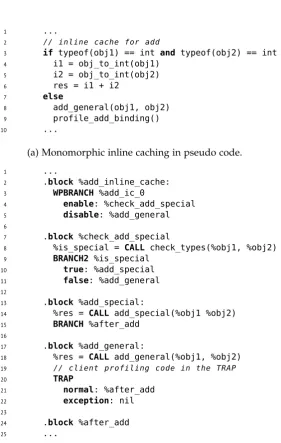
Function Redefinition Mu supports function redefinition. A function may be dy-namically redefined, and when a newer version is defined, Mu guarantees that any further call to the function will be resolved to the most recent version. In practice, the client can use function redefinition to implement multi-tiered optimization and/or specialization of functions. Figure 2.1 shows one way to implement code specializa-tion with inline caching in Mu.
§2.2 The Mu Micro Virtual Machine 17
1 ...
2 // inline cache for add
3 if typeof(obj1) == int and typeof(obj2) == int
4 i1 = obj_to_int(obj1)
5 i2 = obj_to_int(obj2)
6 res = i1 + i2
7 else
8 add_general(obj1, obj2)
9 profile_add_binding()
10 ...
(a) Monomorphic inline caching in pseudo code.
1 ...
2 .block %add_inline_cache:
3 WPBRANCH %add_ic_0
4 enable: %check_add_special
5 disable: %add_general
6
7 .block %check_add_special
8 %is_special = CALL check_types(%obj1, %obj2)
9 BRANCH2 %is_special
10 true: %add_special
11 false: %add_general
12
13 .block %add_special:
14 %res = CALL add_special(%obj1 %obj2)
15 BRANCH %after_add
16
17 .block %add_general:
18 %res = CALL add_general(%obj1, %obj2)
19 // client profiling code in the TRAP
20 TRAP
21 normal: %after_add
22 exception: nil
23
24 .block %after_add
25 ...
[image:31.595.183.465.160.604.2](b) One way to implement inline caching with Mu. Use WPBRANCH to enable/disable the inline cache, and use TRAP to profile and redefine check_types and add_special to a type-specialized version.
allow re-organizing frames for a paused stack (in the ready state), and provide the client with sufficient mechanisms to build OSR in their own implementation.
2.2.6 Boot Image Generation
Boot images are commonly used by managed runtimes to capture ahead-of-time gen-erated code and virtual machine state to expedite start-up. In principle the machine state can typically be constructed from scratch at start-up, but the boot image is a simple optimization that will greatly reduce start-up time by pre-computing and storing the requisite bootstrap state [Alpern et al., 1999; Open J9, 2017]. Meta-circular language implementations depend on a boot images in order to bootstrap [Alpern et al., 1999; Ungar et al., 2005; Rigo and Pedroni, 2006; Blackburn et al., 2008; Wimmer et al., 2013]. Mu provides a make_boot_image() API for generating a boot image for the target platform. The function takes a set of white list functions, native data relocation maps, and an optional entry function if the boot image is desired to be an executable. When the boot image is loaded and resumed, it is guaranteed that the image contains (i) all white-listed functions in their compiled state, (ii) all related entities (such as values, types, functions, etc), and (iii) all objects in the Mu heap reachable at the time of the call. We will elaborate more in Section 5.3.5.
2.2.7 Local SSI Form
Mu IR uses a special Static Single Information (SSI) form9[Ananian, 1997; Singer, 2006; Boissinot et al., 2012], an extension form of Single Static Assignment (SSA). Besides the properties from SSI/SSA that every variable has exactly one definition and cannot be redefined, we further require that every block explicitly declare variables at the start of its label and the variables are strictly local to the block (we still call them SSA variables). A block terminating instruction is required to explicitly list all the variables being passed to the destination block, instead of only variables split by a
σ-function in normal SSI form.
The benefits of the design are three-fold: (i) The liveness of SSA variables are explicit in the IR form, which can be exploited by the micro virtual machine to skip expensive global liveness analysis. (ii) Longer live ranges are broken up into smaller ones, which may allow better register allocation such as less spilling. (iii) This form also makes data flow explicit, and helps a formal specification of Mu. However, this design is essentially a non-minimal SSA form with potential unnecessary value merging, which causes difficulty in register coalescing. The performance implications of this design are unclear, as we shall discuss in Section 5.4.2 with a concrete example.
2
.
3
Zebu VM
Zebu VM is a concrete Mu micro virtual machine implementation that aims for high performance, developed as part of this thesis. Zebu VM is a proof of concept and
§2.3 Zebu VM 19
an initial proof of performance for efficient micro virtual machines. In later chapters, we will discuss design points that are important to Zebu and are the principle con-tributions of this thesis. In this section, we briefly discuss Zebu and its design and implementation.
2.3.1 Design
In building Zebu, our goal is to apply state-of-the-art techniques, and when necessary, advance the state-of-the-art. Implementing a virtual machine is heavily engineering-oriented, but nonetheless important part of computer systems research. We elaborate both research questions and practical engineering concerns for our designs.
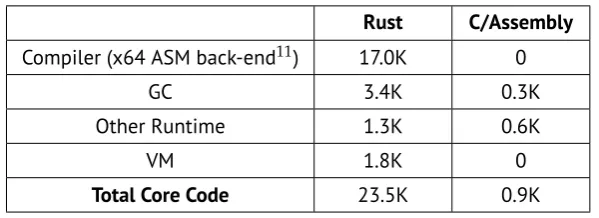
Focus on Cost-Benefit Ratio Zebu is designed with a target of around 25K lines of code in implementation while being able to achieve competitive performance, as the small amount of lines of code leads to the possibility of being formally verified practically [Klein et al., 2009]. Our experiences with Zebu prove that this target is feasible. Table 2.1 shows that the total lines of code of the core Zebu VM fall within our expectation10. In Chapter 5, we will further discuss the performance.
Rust C/Assembly
Compiler (x64 ASM back-end11) 17.0K 0
GC 3.4K 0.3K
Other Runtime 1.3K 0.6K
VM 1.8K 0
[image:33.595.169.469.382.491.2]Total Core Code 23.5K 0.9K
Table 2.1: Code base of Zebu (as in Git revision 211e3976). The core VM code takes 24.4K lines of code, which falls within our expectation.
We designed our compiler with a focus on cost-benefit ratio. We estimate the potential benefits (mainly performance gain) and the cost (in terms of lines of code and compilation time if applicable). For example, in an early prototype, we used a weight-based bottom-up rewrite system (BURS) for instruction selection [Boulytchev, 2007]. However, we realized that, due to the simplicity of Mu IR, BURS is over-kill for Zebu, and we replaced it with much simpler tree pattern matching that prioritizes the first match. This decision not only saves us from the effort of maintaining a code generator generator but also reduces the time spent in instruction selection, while maintaining the ability to produce good quality code for Mu. Another example is that
10The line counting is done with a Zebu build of the x64 ASM back-end configuration (the aarch64
back-end of 10.0K LOC is not included). The count only includes core VM code, and excludes supporting code, such as the IR data structure (3.4K LOC) and API wrappers (4.7K LOC). As Mu defines its API in C, we implement a set of wrappers to delegate the calls to our Rust code.
11We have two code generators for x64, an ASM one for boot image generation and a binary one for
Zebu foregoes the opportunity of doing software instruction scheduling in its back-end. We justify this decision thus (i) modern processors make software instruction scheduling less effective by out-of-order execution, branch prediction and instruction prefetch, (ii) some optimizations can be done by our client at the IR level, such as loop unrolling, and (iii) by skipping instruction scheduling, we further skip the necessity of providing surrounding infrastructures to support instruction scheduling, such as more information about machine instructions.
We applied the same principle for our runtime design as well. Zero-cost exception handling [Drew et al., 1995] delivers excellent performance, but it is expensive to build as it requires the compiler to cooperate and build tables for location information of variables and registers so that the runtime can use them to unwind the stack and restore execution context. However, since Mu already imposes the cost for building such tables for the requirement of supporting introspection, it is natural and beneficial to use them for exception handling. But we are undecided on the value of extending these tables to also support identifying GC roots on the stack. Recent research showed that a high performance garbage collector that is conservative with respect to thestack
imposes insignificant overhead [Shahriyar et al., 2014]. Besides, conservativeness with the stack allows us significantly simplify our compiler implementation, and we are no longer required to carefully maintain reference locations throughout the compiler pipeline.
Follow the Standards Following defined or de facto standards is an important software engineering principle. Standardized practices enable inter-operability with utility tools or other software that follow the same standards. However, for virtual machine implementation, developers may easily deviate from the standards for their own requirements. For example, developers may use project-specific calling conven-tions, memory layout, binary format, etc., and sometimes this is necessary.
However, Zebu chose as a design principle to stick to existing standards wher-ever possible. For example, Zebu uses the standard ABI for calling convention and memory layout for target architectures [AMD64 ABI, 2017; ARM64 ABI, 2017]. Zebu generates position-independent boot images in the standard binary format for target operating systems, e.g., ELF for Linux and Mach-O for MacOS. Zebu generates debug symbol information in DWARF. This requirement benefits Zebu. (i) It essentially eliminates the language barrier between Mu and native, and allows direct access be-tween Mu code and native, which efficiently supports the Foreign Language Interface required by Mu (as discussed in Section 2.2.4). (ii) It allows us to use standard utility tools to link, debug, inspect and profile code generated by Zebu, which is valuable for development.
2.3.2 Implementation
§2.3 Zebu VM 21
Compiler
X64 Back-end AArch64 Back-end
IR Transformation
Machine Code Optimisation Instruction Selection
Register Allocation Mu IR
Machine Code
Runtime
GC
Other Runtime Threading
IR Maps (Types, Functions)
Run-time Maps Language Client
[image:35.595.150.488.174.609.2]API
Compiler
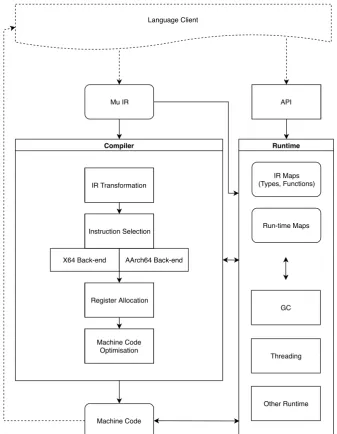
Zebu implements a back-end compiler with a short pipeline. The Zebu compiler executes a defined pipeline which consists of passes. There are two sets of passes, IR-level passes and machine code passes, separated by a target-specific instruction selection.
IR-level Passes are mainly for IR transformation and analysis, listed as below. The symbol ? indicates a target-dependent pass, and analysis passes are omitted from the list.
1. Return block creationgenerates a single epilogue for each function, and explicitly marks it so that trace scheduling will take it into consideration.
2. Inlining?identifies possible inlining choices. Though inlining can be done by the language client, the micro virtual machine has target information, and is able to make better inlining choices.
3. IR rewriting? lowers the IR to serve two purposes: (i) For instructions that will introduce new blocks, this pass will rewrite the instruction, and introduce new blocks so that trace scheduling will properly lay out the blocks. (ii) For instructions that involves run-time calls such as heap allo-cation, this pass will rewrite the instruction into a fast-path sequence with a call into the runtime slow-path. Furthermore, fast-path and slow-path blocks are also explicitly marked so that trace scheduling will take them into consideration.
4. Depth-tree generation?is an essential IR-level pass for performance. The client feeds Zebu with a sequence of instructions. This pass uses heuristics to turn the sequence into a depth tree, in order to expose favorable patterns for instruction selection.
5. Trace schedulingidentifies hot traces, and lays out the trace linearly. Zebu mainly uses three sources of information for trace scheduling: (i) Zebu considers trace hints from internally generated blocks. (ii) Zebu allows con-ditional branching instructions to specify a probability with each branch. (iii) When the probabilities tie, Zebu prioritizes putting the false block to the hot trace, following common practice.
Instruction Selection in Zebu is implemented by tree pattern matching that priori-tizes the first match. The instruction selector invokes an abstract interface for the given target to emit machine code. The abstract interface may have differ-ent implemdiffer-entations. For x86_64, we implemdiffer-ented an assembly back-end for ahead-of-time compilation12, and a binary back-end for just-in-time
compila-tion. Though both back-ends share the compiler infrastructure, the instruction
12The assembly back-end generates assembly code that can be easily assembled and linked into a
§2.3 Zebu VM 23
selector needs to be aware of the current back-end in some cases. For example, the instruction selector resolves a function to a symbolic name for ahead-of-time compilation, but to an address for just-in-time compilation.
Machine-level Passes further optimize the generated code. Zebu provides an ab-straction of the machine code so that some machine code passes can also be implemented in a target independent way.
1. Register allocation is the most important optimization at the machine-level. We implemented a graph-coloring register allocator with iterated register coalescing [Appel and Palsberg, 2003]13. We tuned the allocator using heuristics that consider loop depth for temporaries and moves to make decisions for freezing, spilling, and coloring nodes. The reason is that our SSA form (as discussed in Section 2.2.7) requires local variables to be local to a basic block, which essentially splits long-lived temporaries into many smaller ones. An untuned allocator makes arbitrary decisions that may fail to properly coalesce temporaries, and consequently the code contains a lot more moves than necessary.
2. Peephole optimization is the last pass to clean up the generated code. Currently we have only implemented target independent ones such as redundant move removal and jump removal.
Runtime
Zebu divides its managed heap into three spaces, two Immix spaces [Blackburn and McKinley, 2008] for different sized smaller objects and a freelist space for large objects. Zebu pursues a constant 1/8 ratio for the max overhead of heap object metadata, i.e., 1 byte per every 8 bytes heap space. This model reduces memory overhead for small objects, which is usually the dominant majority in managed languages. Zebu also has a special immortal space only for objects that are persisted during boot image generation; those objects are mutable and can be referenced normally, but the GC will not reclaim the memory even if they are no longer reachable (as we put them in the data segment in the boot image instead of in our managed heap).
Zebu implements a Mu thread as a Rust thread. But before a Mu stack is executed, Zebu saves the native stack pointer, and then does a special swapstack operation between the native stack and the Mu stack so that further execution of Mu code is always on the Mu stack. Before a thread quits, Zebu swaps back the native stack to allow proper destruction of the Rust thread. Zebu protects both ends of a Mu stack from any form of accessing to prevent over-flow and under-flow.
Zebu implements its own signal handler. The signal handler is responsible for (i) re-throwing Mu built-in exceptions, such as floating point errors and invalid memory access, (ii) INT-3 code patching guard (specific to x86_64), and (iii) aborting
13We chose a graph-coloring algorithm for reliable results and easy implementation. However, this
properly if none of the above met. Zebu doesn’t implementTRAPand client-supplied
traphandlerwith signals. Instead, Zebu simply emits a run-time call to prepare and
call to the pre-registered traphandler as aTRAPinstruction.
2
.
4
Related Mu Projects
Mu is a cooperative research project. This thesis presents the design of the imple-mentation that focuses on performance. There are other Mu-related projects, such as Holstein VM14 (a reference implementation), the Mu formal specification in HOL15, and other language clients on top of Mu, GHC-Mu16and PyPy-Mu17. In this section, we only focus on PyPy-Mu, as it is closely related to this thesis for the performance evaluation in Section 5.4.
2.4.1 PyPy-Mu
PyPy-Mu is an interesting combination that allows us to to verify the feasibility and performance of Mu in a number of ways: (i) Python is a popular language with its offi-cial implementation known to be inefficient, and there are many implementations that improved the performance, among which PyPy provides a state-of-the-art solution. We are interested in seeing how PyPy performs with Mu as its back-end. (ii) PyPy has a JIT for a dynamically-typed language, which exactly matches the design goals of Mu. (iii) PyPy is an unconventional implementation, as it is meta-circular and fea-tures a meta-tracing code generator. It is an ambitious target to check Mu’s flexibility of supporting different client implementation strategies. (iv) PyPy is implemented in RPython, a restricted subset of Python. PyPy relies on the ahead-of-time compilation of RPython for a boot image. We are also interested in having RPython and the boot image generation performed by Mu so that the whole implementation stack for PyPy runs on top of Mu. (v) Enabling RPython on Mu allows other language implementations based on PyPy and RPython to run on Mu.
We proceed this in a two-step approach. We start with enabling RPython on top of Mu, which gives us RPython as a language, and also language interpreters written in RPython, such as a SOM interpreter [RPYSOM, 2014]. Then, we enable the PyPy JIT on top of Mu to support the whole PyPy implementation stack. Currently we are approaching the end of the first step, and the work to support PyPy JIT is not ready yet. The initial work is described by Zhang [2015].
2
.
5
Summary
This chapter covers the background for the thesis. We started with a survey of current frameworks for managed language implementation. We pointed out the pitfalls of
§2.5 Summary 25
Chapter3
A Garbage Collector as a Test Case
for High Performance VM
Engineering in Rust
High performance virtual machines build upon performance-critical low-level code, typically exhibit multiple levels of concurrency, and are prone to subtle bugs. Imple-menting, debugging and maintaining a virtual machine can therefore be extremely challenging. The choice of implementation language is a crucial consideration when building a virtual machine. Rust’s ownership model, lifetime specification, and refer-ence borrowing deliver safety guarantees through a powerful static checker with little run-time overhead [Rust, 2010]. These features make Rust a compelling candidate for a virtual machine implementation language, but they come with restrictions that threaten expressiveness and efficiency. It is desirable to implement a virtual machine in a language that can benefit the implementation in terms of performance and ro-bustness, however, it is uncertain that if it is feasible to deliver both requirements if the language is too restrictive.
This chapter describes our experience in constructing a prototype garbage collec-tor for the Zebu VM in Rust, which was the first major component of the micro virtual machine that we built in Rust. Although we have subsequently built a complete pro-totype VM in Rust, we focus here on the garbage collector. Section 3.1 presents our motivation to utilize Rust to implement the Zebu VM. Section 3.2 briefly introduces related work and the Rust language. Section 3.3 uses our garbage collector imple-mentation as a case study to discuss the benefits of Rust, the obstacles encountered, and how we overcame them, with a performance analysis. Section 3.4 concludes this chapter. We find that Rust’s safety features do not create barriers for efficiency, and benefit our implementation.
This chapter describes work published in the paper “Rust as a Language to im-plement high-performance garbage collection” [Lin et al., 2016].