‘Playing for Sheep Stations:
A Discourse Analysis of Wild Dog
Management and Control Policy in
New South Wales, Australia.’
Penelope Margaret Marshall
22nd May 2013
A thesis submitted for the degree of
Doctor of Philosophy of
Statement of Authenticity
This thesis is my own original work and has not previously been submitted for assessment at either the Australian National University or any other institution. All sources have been acknowledged.
Signature
ÄI
amK
oJI •—
Acknowledgments
This thesis would not have been possible without the guidance and support of the following people:
My Supervisor, Professor John Dryzek and panel members: Adjunct Professor Jennifer Andrew, Professor Linda Botterill, and Dr Carolyn Hendriks;
Mrs Ellen and Mr Bill Green - Please accept my deepest and sincerest thanks for your many kindnesses. Your selfless and unwavering commitment to farming families and to achieving transparency and accountability in the ‘dog job’ over more than forty years in South East Australia is unparalleled.
Professor David Marsh - my sincere thanks;
Mr Rod and Mrs Juleen Young, NSW Farmers Association - Staunch and fearless advocates of farming families in furtherance of wild dog management and control across NSW;
Mr Wal Merriman, Chairman of the Board of Australian Wool Innovation (AWI) and the Board of AWI - Thank you.
Mr Ken Grime, University Legal Counsel, Australian National University and Ms Carol Beynon, Australian National University Counselling Centre;
Dr Dianne Heriot, the Australian Parliamentary Librarian, Dr Joy McCann, Senior Research Officer, Dr Roger Beckerman and the Parliamentarians and members of the Joint Parliamentary Library Committee at Parliament House;
Noelene Franklin; Brian and Alice Ferris; Brian and Mary Frazer; Elaine and Ron McPaul; Graeme and Bronwyn Brazel; Bruce and Kirsten Moore; Bruce Wiggan; Anthony Green; Michael Green; Ernie Constance; Russell Summerall; John and Jeanette Robinson, John and Ann Rolfe; Mick Thorman; Tim Seers; Peter Frizell; David Eyre - Thank you!
The South Coast Board of the Livestock Health and Pest Authority, members of the Barnard River Wild Dog Association, the Niangla Wild Dog Association, and the Armidale Livestock Health and Pest Authority;
The farming families of New South Wales;
Professor Carsten Daugbjerg; Dr Ann Nevile; Assoc Professor Alastair Greig; Professor Frank Fischer; Professor John Uhr; Professor John Ravenhill; Adjunct Professor Larry Saha; Emeritus Professor Marion Sawer; Emeritus Professor Marian Simms; Professor George Cho AM; Emeritus Professor Richard Mulgan, Professor Kerry Jacobs; Dr Sylvie Shaw; Professor Janine O’Flynn, Dr Jacqui Russell; Dr Anna Carr; Dr Gail Radford, Dr Will Sanders; Dr Maria Maley;
The administrative staff of the School of Politics and International Relations, Sociology and Deliberative Democracy: Jeanie Haxell: Helen Felton; Carrie Wright; Caroline Wood; Meg Sawtell; Veenita Vido; Tracy Deasey; Elaine Santos; and, Martin Heskins;
Particularly and especially - The unofficial Writers’ Group in the School of Politics and International Relations at the ANU: Dr Melissa Lovell; Dr Selen Ayirtman; Dr Katie Curchin; Dr Heba Betainah: Dr Helen Taylor; and, Dr Elizabeth Ganter;
My larger friendship circle: Suzy Marsh; Dr Moira Bryne; Mike Bennell, Dr Michael Dalvean, Adam Packer, Dr Desley Speck; Dr Mhairi Cowden; Dr Beibei Tang; Dr Karen Tindall; Tom King; Dr Alison Oakleigh; Dr Ricardo Mendez; Dr Anett Richter; Stephanie Hansen; Kate Dufty; Fiona Allen; Harry & Vanessa, Marianne Witt; John Fumer; Barbara and Arild;
My most cherished family - Felicity, Isaac, Vanessa, Vic, Sam, Russell, Uncle Ken, Aunty Gisela, Margaret, Rosemary, Nana Beryl, Nicky, Ron; MaryAnn; Margaret, and, posthumously, Nana; Bill and Elaine Lynch; and, my Mum, Pat Williamson;
To: Ian, Vanessa, Sam, Felicity, Isaac
and
Abstract
Key words: wild dogs, New South Wales, administrative rationalism, discourse analysis, Australia, storylines
This thesis challenges the constitutive and taken-for-granted assumptions of the current dominant administrative rationalist discourse of wild dog management and control (WMDC) in New South Wales (NSW), Australia. It asks: To what extent can conflicts over WDMC in NSW be understood in terms of contending discourses and what does that imply for policy legitimacy? It isolates the storylines that emerged from substantial empirical research and examines, if and how, these storylines contributed to the dominant discourse of administrative rationalism.
From the beginning of white settlement of NSW, the State and farm families worked in concert to achieve the eradication of wild dogs and dingoes. From the 1960s, however, a significant discursive turn occurred in WDMC. This occurred as a result of the contending discourses of environmentalism, ecological science, animal welfare and biosecurity. These discourses collectively afforded new meanings to dingoes, wild dogs and WDMC. Concurrently, the State drove this discursive turn through a discourse of administrative rationalism.
From 1995 until 2011, a period of successive NSW Labor Governments, the State further consolidated this discursive approach. It reified ‘experts’ and legislatively empowered public land managers to inform, shape and promulgate the dominant discourse of WDMC through the promotion of a ‘best practice’ model. Within this model the individual knowledges and experiences of farm families of WDMC were subject to empirical measurement, the interpretations of public land managers and the corroboration of continuing ecological studies. The entry of new social actors closely linked to Government who actively promoted ‘new’ innovations and technologies in WDMC further distilled the dominance of the administrative rationalist discourse.
exploited mercilessly for its political capital by all political parties. Successive NSW Labor Governments consistently reiterated in storylines its financial largesse in WDMC to give legitimacy to its discursive approach. These storylines of financial expenditures in real terms however are difficult to substantiate.
Table of Contents
Statement of Authenticity ii
Acknowledgments iii
Abstract vii
Table of Contents ix
Acronyms and Abbreviations xiii
List of Tables xvii
Chapter One: Introduction
The storyline of the ‘dog tree’ 1
The function of storylines within discourse 3
The Research Gap 4
The Interpretive ‘turn’ and Discourse 5
A Discursive Turn 9
The distinction between ‘wild dogs’ and ‘dingoes’ 10
Delimitations 11
Research Question 12
The importance of understanding epistemology 12
The Challenge 13
Sub Questions 14
Method 15
Chapter Two: ‘Fleecing the lamb’ - Policy adhockery and amnesia in wild dog
management and control 23
The ‘Golden Fleece’ 23
The cultural representation of ‘risk’ 25
The consolidation of the State’s management of risk 26
Chapter Three: ‘So what’s political about wild dogs?’ The political warp and woof
of wild dog management and control in NSW 49
Administrative Rationalism 50
The role of the State 51
The political capital of WDMC 54
NSW Labor and Country Labor and the colonisation of WDMC 55 The implications of NSW Labor strategy and the expansion of the
National Estate on WDMC 60
The language of WDMC 60
The Four Concepts 61
What is a wild dog? 61
What are Schedule Two lands? 62
What is a management plan? 62
The Guideline 63
The Consequence 65
Reported public expenditures 69
NSW Labor’s ‘Green Legacy’ and NSW NPWS 70
Bob Carr and ‘new’ environmentalism 79
The Liberal National Coalition as the authorial voice on WDMC 84
The Shooters’ Party 88
The NSW Greens 91
Chapter Four: ‘Pulling the wool over your eyes:’ Transparency and accountability
in NSW WDMC 94
Part I: ‘Show me the money’
NSW NPWS Annual Reports and Financial Statements 96 ‘Major works - pest, weed and animal management’ 98
NSW State of the Environment Reports 102
The McLeod Report:
A point of comparison: NSW NPWS Annual Report 2002-2004
and the NSW Parliament General Standing Committee No. 5 Feral Animals
Inquiry 114
Protecting Our National Parks from pests and weeds 115
The Audit Office of NSW 116
Part II: Other Institutional Actors
State Council of the Rural Lands Protection Boards Annual Reports 116
State Forests, Forests NSW 118
Game Council NSW 119
The Wild Dog Destruction Board 122
NSW Department of Primary Industries 123
The Audit Office of NSW 126
Part III: Findings 127
Chapter Five: ‘Dyed in the wool’: The epistemological basis of WDMC
The fundamental clash of epistemologies 132
The storyline of adaptive management 133
The ‘strategic approach’ 134
The inherent problem of the ‘strategic approach’ 139 The effect of a scientific rationalist approach on the public policy of WDMC
145
Crossing the Rubicon - the commercialisation of WDMC 148
Paradigm shift - same old, same old... 153
Chapter Six: ‘Strangers in the home paddock’: the competing discourses in
wild dog management and control 157
Background 157
The discourse o f ‘new’ environmentalism 158
The determination of the NSW Scientific Committee and
the risk of hybridisation 164
A change in the ecological storylines 168 The storylines of jingoism, racism and anthropomorphism 170
The discourse of agrarianism 172
The discourse of animal welfare 175
Codes of practice and standard operating procedures 176
The storylines of aerial baiting with 1080 177
The commercial partnerships 181
The Royal Society for the Prevention of Cruelty to Animals 184
Animals Australia 186
Australian Pesticides Veterinary Medicines Authority 187 The National Farmers’ Federation and NSW Farmers Association 187
The discourse of biosecurity 189
Chapter Seven: ‘Greasy wool’ - Public consultation in wild dog management and
control 193
The Commonwealth Structure 194
The NSW State Administrative structure of WDMC 195 The State Council of the NSW Rural Lands Protection Board 197 The Co-operative Wild Dog/Fox Control Plan for the Brindabella and Wee
Jasper Valleys 197
‘Nil Tenure’ 199
‘Resources necessary to effectively and equitably implement the plan’ 200
The sites of contestation 201
Public wild dog management and control meetings 203
Contending discourses 208
The storylines of agrarianism 208
The storylines of animal welfare 209
The storylines of science and technology 209
The storylines of biodiversity 212
The storylines of funding 212
Perceptions of the consultation process 213
Social Impacts 217
Personal 218
Environmental 218
Financial 218
The silencing of farmers’ voices 219
Wild dog management and control plans 221
Industry and government reports 224
Conclusion
‘It all went to hell in a hand basket’ 228
Acronyms and other abbreviations
A B A R E S A u s tra lia n B u re a u o f A g ric u ltu ra l an d R e so u rc e E c o n o m ic s a n d S c ie n c e s
A B S A u s tra lia n B u re a u o f S ta tistic s
A C T P a rk s A u s tra lia n C a p ita l T e rrito ry P a rk s S e rv ic e
A IA C R C A u s tra la s ia n In v a s iv e A n im a ls C o o p e ra tiv e R e s e a rc h C e n tre
A L P A u s tra lia n L a b o r P a rty
A N U A u s tra lia n N a tio n a l U n iv e rs ity
A P A S A u s tra lia n P e s t A n im a l S tra te g y
A R A R P A u s tra lia n P e s t A n im a l R e se a rc h P ro g ra m
A V P M A A u stra lia n P e s tic id e s a n d V e te rin a ry M e d ic in e s A u th o rity
A W I A u stra lia n W o o l In n o v a tio n L td
A W I W D A C A u stra lia n W o o l In n o v a tio n W ild D o g A d v is o ry C o m m itte e
B R S B u re a u o f R u ra l S c ie n c e s
C E O C h ie f E x e c u tiv e O ffic e r
C M A C a tc h m e n t M a n a g e m e n t A u th o rity
C M A s C a tc h m e n t M a n a g e m e n t A u th o ritie s
C O A G C o a litio n o f A u s tra lia n G o v e rn m e n ts
C O P s C o d e s o f P ra c tic e
C S IR O C o m m o n w e a lth S c ie n tific In d u s try an d R e s e a rc h O rg a n is a tio n
C W A C o u n try W o m e n ’s A s s o c ia tio n
D A F F A u s tra lia n G o v e rn m e n t D e p a rtm e n t o f A g ric u ltu re , F is h e rie s a n d F o re s try
D E C C W D e p a rtm e n t o f E n v iro n m e n t, C lim a te C h a n g e a n d W a te r
D E W H A D e p a rtm e n t o f E n v iro n m e n t, W a te r, H e rita g e a n d th e A rts
D P I D e p a rtm e n t o f P rim a ry In d u strie s
E P A E n v iro n m e n t P ro te c tio n A g e n c y
E P B C A E n v iro n m e n ta l P ro te c tio n a n d B io d iv e rs ity C o n s e rv a tio n A c t 1999
G IS G e o g ra p h ic In fo rm a tio n S y ste m
G P S G lo b a l P o s itio n in g S y stem
IA C R C In v a siv e A n im a ls C o o p e ra tiv e R e s e a rc h C e n tre
IU C N In te rn a tio n a l U n io n fo r th e C o n s e rv a tio n o f N a tu re an d N a tu ra l R e so u rc e s
G B M W H A G re a te r B lu e M o u n ta in s W o rld H e rita g e A re a
L H P A L iv e s to c k H e a lth a n d P e st A u th o rity
L H P A s L iv e sto c k H e a lth and P e s t A u th o ritie s
L L S L o c a l L a n d S e rv ic e s
L W B C L a n d an d W a te r B io d iv e rs ity C o m m itte e
L W C D e p a rtm e n t o f L a n d , W a te r a n d C o n s e rv a tio n
M L A M e a t an d L iv e sto c k A s s o c ia tio n
N F A C P N a tio n a l F e ra l A n im a l C o n tro l P ro g ra m m e
N F F N a tio n a l F a r m e r s ’ F e d e ra tio n
N H T N a tio n a l H e rita g e T ru s t
N R A T h e N a tio n a l R e g is tra tio n A u th o rity fo r A g ric u ltu ra l an d V e te rin a ry C h e m ic a ls
N R M M C N a tu ra l R e s o u rc e M a n a g e m e n t M in is te ria l C o m m itte e
N R M S C N a tu ra l R e s o u rc e M a n a g e m e n t S ta n d in g C o m m itte e
N S W F A N e w S o u th W a le s F a rm e rs A s s o c ia tio n
N S W N P W S N e w S o u th W a le s N a tio n a l P a rk s an d W ild life S e rv ic e
N S W P A C N e w S o u th W a le s P e s t A n im a ls C o m m itte e
N S W R L P B s N e w S o u th W a le s R u ra l L a n d s P ro te c tio n B o a rd s
N S W R F B N e w S o u th W a le s R u ra l F ire B rig a d e
N S W W D A G N S W W ild D o g A d v is o ry G ro u p
N R A N a tio n a l R e g is tra tio n A u th o rity fo r A g ric u ltu ra l an d V e te rin a ry C h e m ic a ls
O E H O ffic e o f E n v iro n m e n t a n d H e rita g e
P A C R C P e st A n im a ls C o o p e ra tiv e R e se a rc h C e n tre
P A C s P e st A n im a l C o n tro lle rs
P A P P p a ra -a m in o p ro p io p h e n o n e
P A S P e st A n im a l S tra te g y
P C O P est C o n tro l O rd e r
P IM C P rim a ry In d u strie s M in is te ria l C o u n c il
P IS C P rim a ry In d u strie s S ta n d in g C o m m itte e
PP P a s tu re s P ro te c tio n
P P B P a stu re s P ro te c tio n B o a rd s
R L P B R u ra l L a n d s P ro te c tio n B o a rd
R L P B s R u ral L a n d s P ro te c tio n B o a rd s
R M P S R e g io n a l P e s t M a n a g e m e n t S tra te g y
R S L R e tu rn e d S e r v ic e m e n ’s L e a g u e
R S P C A R o y al S o c ie ty fo r th e P re v e n tio n o f C ru e lty to A n im a ls
S E W P C D e p a rtm e n t o f S u sta in a b ility , E n v iro n m e n t, W a te r, P o p u la tio n a n d C o m m u n itie s
S IA S o c ial Im p a c t A s s e s s m e n t
SIS S p e c ie s Im p a c t S ta te m e n t
S O P s S ta n d in g O p e ra tin g P ra c tic e s
T A P s T h re a t A b a te m e n t P la n s
T S C A T h re a te n e d S p e c ie s C o n s e rv a tio n A c t 1995
V P C V e rte b ra te P e s ts C o m m itte e
W D M C w ild d o g m a n a g e m e n t a n d c o n tro l
W D A W ild D o g A s s o c ia tio n s
W D A s W ild D o g A s s o c ia tio n s
List of Tables
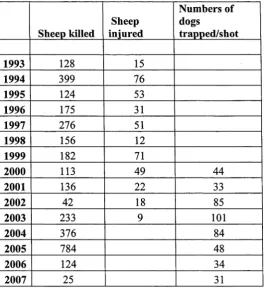
Table 2.1 Adaminaby/Yaouk Sheep Losses 1993 - 2003 40
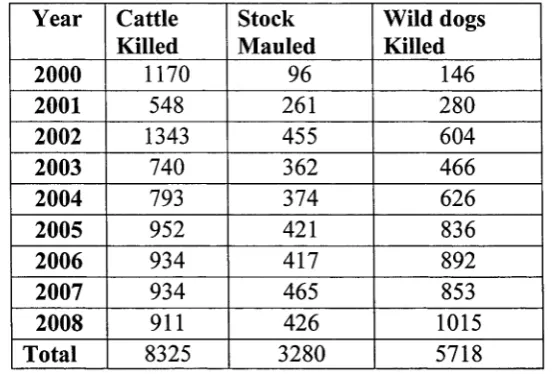
Table 2.2 Reported Cattle Losses in Kempsey RLPB 2000 - 2008 44
Table 3.1 2001-2002 NSW Reported Expenditure on
All Feral Animal Control 70
Table 3.2 Southern Tablelands Wild Dog Control Board:
Stock losses 1974- 1985 75
Table 4.1 2004 State of the Environment Report for the
Australian Capital Region - ‘South East’ 107
Table 4.2 NSW NPWS Operational Budget for Wild Dog Control 110
Table 4.3 State Forests and Forest NSW Total Reported
Expenditure on All Feral Animal Control 2009-2010 119
Table 4.4 Actual NSW DPI Expenditure to Rural Lands Protection
Boards: ‘to assist in the destruction of wild dogs’ 124
Table 7.1 Expenditures on Wild Dog Management and Control
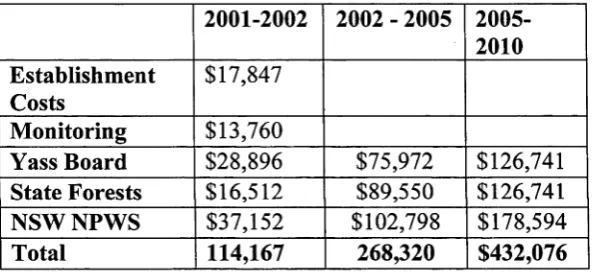
in the Brindabella & Wee Jasper Valleys 2002-2010 200
Table 7.2 Signed Wild Dog Management and Control Plans
as at 1 August 2009 222
Chapter One: Introduction
‘Eye of newt and toe of frog, Wool of bat and tongue of dog, Adder's
fork and blind-worm's sting, Lizard's leg and owlet's wing, For a
charm of powerful trouble, Like a hell-broth boil and bubble’
Macbeth (IV, 1, 14-15).
The storyline of the ‘dog tree’
In New South Wales (NSW) wild dogs are killed; trapped; shot; or poisoned. Every so often they are hung dead from ‘dog trees’ across the Australian landscape by some farmers and dog trappers.
While this is perceived by some as evocative of a ‘dark, grizzly and grotesque past’ (Matchett 2008 25 June:50) or ‘confronting’ for city dwellers, (Doherty 2008 2 August: B3) the ‘dog tree’ functions as a sign warning other neighbouring farmers that ‘the dogs are in’; that the farmer has ‘got the dog’ and that hopefully, this marks an end to the misery and the stress to the farm family. As Mick Hedger, reportedly a third generation Snowy Mountains’ trapper stated ‘the only dogs in those trees are killing dogs’ (Doherty 2008 2 August: B3).
The ‘dog tree’ also serves as evidence for the dog trapper or farm family; not simply just for payment (Lower North Coast & Tablelands Dingo Destruction Board 1947- 1983, Davies 2009, Jopson 2009, 26 October, Inman 2010 9 May). It evokes century old normative expectations of what it means to be a ‘good neighbour.’
From early European settlement a community meeting was called in rural communities when the ‘dogs were in.’ In South East NSW pounds were ‘put on the table’ to pay for a trapper to catch and destroy a problem dog(s) (Franklin, N. pers. comm. 2008).
Farm families hold the bush knowledge, skills and experience of ‘trappers, ‘doggers’ and ‘pest animal controllers’ in high esteem. For example, in South East Australia individuals Bill Coman, Bill Morris, Mick Davis, Andrew McDougall, ‘Boots,’ Warren Schofield, Murray Schofield and the RLBP Ranger, Andrew Miners are all respected for these skills. In contrast, the term ‘Ranger’ usually connotes a person working for a Government Department or Agency or a person working for the LHPA who may be involved in a range of tasks associated with feral animal control and the functions of the LHPA system more generally.
Historically, many Wild Dog Associations (WDAs) across NSW collected voluntary levies on a regular basis from their members to employ a ‘dogger’ full time - some still do - although not all members contributed financially (Lower North Coast & Tablelands Dingo Destruction Board 1947-1983, Fennessy and Bromell undated: circa 1958). Some farming families employed ‘doggers’ privately for particularly ‘problem’ dogs (Bean 1945, Barnard River Wild Dog Association 1956-1968, Rolls 1969, Rolls 1981, Van Eyk 2001 17 December). These practices were widespread from the time of White colonisation of Australia and were undertaken with the full imprimatur of the State (The Maitland Mercury and Hunter River General Advertiser 1864 23 February, Bean 1945, Rolls 1969).
Institutional reports, records and correspondence garnered by farming families, RLPBs and WDAs across NSW reveal that over the past fifty years the meaning of ‘good neighbour’ has been appropriated for a range of different purposes by a suite of Government Departments across Australia (NSW National Parks and Wildlife Service 2002). As late as the 1980s, the principal function of WDMC policy was promulgated - at least publicly - as safeguarding the national flock. Mitchell (1986), for example, stated:
The Department’s Wild Dog Control Program should be seen in the context of providing resource protection (under the good neighbour principle) to sheep graziers in the Eastern Highlands region of Victoria (Mitchell 1986).
However, the meanings associated with ‘dog trees’ and ‘good neighbour’ changed.
Statement of protest to public land managers who are perceived to have failed in their responsibilities as a ‘good neighbour’ in controlling wild dogs on public lands.
Overall, the meanings attached to ‘dog trees’ by farm families gleaned from the empirical research of this thesis are clear: Wild dogs cause harm to the social, economic and environmental fabric of the lives of Australian farm families; wild dogs kill, maim, maul and inflict terrific injuries on agricultural stock in Australia; public land managers do not meet their obligations as ‘good neighbours’ in controlling wild dogs; farm families have a moral right to productively farm private land free of wild dogs; a ‘good’ neighbour - irrespective of whether they are a public or private landholder - has a duty to keep the increasing numbers of wild dogs off farms.
The function of storylines within discourse
Thus, the ‘dog tree’ functions as a storyline. A storyline is: ‘a generative sort of narrative that allows actors to draw upon various discursive categories to give meaning to specific or social phenomena’ (Hajer 1995: 56).
Dramaturgically, the ‘dog tree’ highlights the importance of meaning within WDMC wherein it maps ‘...an architecture of meaning’ (Yanow 2003: 235). That is, it speaks of local and situated knowledges - ‘the very mundane, but still expert, understanding of and practical reasoning about local conditions derived from lived experience’ (Yanow 2003 : 236).
As a storyline, the ‘dog tree’ draws attention to the pivotal role that ‘story lines’ have within a particular discourse and how they contribute to it. Yet, storylines are also often subverted performing different functions within other discourses (Hajer 1995). As Hajer writes:
For example, the storyline of the ‘dog tree’ is understood by farm families as a symbolic statement of protest and proof of the cruelty meted out by wild dogs on agricultural livestock. Visceral photographic images of dead or dying, disembowelled and savaged sheep and of calves and cattle with their teats and ears chewed off or back legs badly bitten are common.
Yet, within a discourse of animal rights the storyline of the ‘dog tree’ is subverted and appears as evidence of the alleged cruelty meted out to specific ‘non-human’ animals, wild dogs - a storyline in itself - which animal rights activists mobilise politically to prevent: Wild dogs are not ‘pests,’ ‘vermin’ or ferals’ but simply ‘mislocated,’ overabundant and ‘simply bom in the wrong place at the wrong time’ (Oogjes G. 1999 26-27 May, Oogjes 2003 25 February). However, to some public land managers and scientists the ‘dog tree’ appears to serve as ‘further’ evidence of ‘backward’ farming traditions and even ignorance which works to cement their privileging of a scientifically informed and bureaucratically controlled discourse of WDMC.
The Research Gap
This thesis examines the policy and practice of WDMC in NSW over the years of successive NSW Labor governments from 1995 until 2011. It argues that the dominant discourse of WDMC in NSW was an ‘administrative rationalist’ one. This thesis understands administrative rationalism as a discourse that seeks: ‘to organise scientific and technical expertise into bureaucratic hierarchy in the service of the state’ (Dryzek
1997: 73).
Methodologically, this thesis responds to John Dryzek’s call that:
the search for administrative rationalism in environmental affairs should begin not with the writings of theorists and the proclamations of activists, but with an examination of actual policy practice’ (Dryzek 1997 :75).
Firstly, this thesis examines the dominant discourse of WDMC policy and practice and the storylines that contribute to it as they are articulated in the public domain. This has not been done previously and represents a significant contribution to the academic literature.
It makes this contribution in three ways. First, it provides a short history of WDMC in NSW. It then draws on 153 parliamentary speeches of the NSW Parliament over successive terms of the NSW Labor Government from 1995 until 2011; second, it draws on the Annual Reports and Financial Statements of the six State actors involved in WDMC over the life of successive NSW Labor Governments; and, third, it draws on the prevailing WDMC public policy literature, scientific and technological literature as well as relevant economic and Government reports.
It then compares and contrasts the findings that emerge from an analysis of publicly available NSW WDMC plans and from attendance at sixty three public WDMC meetings. It supplements this comparison throughout with publicly available, historical WDMC literatures. This Triangulation’ (Sarantakos 1998:168-170; 469) of data sources and the analysis which flows from it has not been done previously.
Throughout this thesis, the storylines that emerge from these literatures are presented to see how - and if - they contribute to the dominant administrative rationalist discourse and to see how they position the ‘voice’ of farm families. It also identifies competing discourses in WDMC as they emerge from these literatures. As a consequence of this empirical research, this thesis argues that there is a significant gap between what is said to happen in WDMC in NSW and what happens in ‘actual’ policy practice. It asks: ‘Why?’
The Interpretative ‘turn’ and Discourse
knowing’ (Andrew 2003, Yanow 2006). It rejects the myth of ‘value-free empirical inquiry’ (Hawkesworth 2006: 48). As Yanow explains:
All ideas - including those of the natural and physical sciences - have “a history and a tradition of thought, images, and vocabulary that have given [them] reality and presence”...In this sense, then, social scientific texts do not merely present their subjects through the lenses of their data, but represent and re-present- constitute, construct-them (Yanow 2006: 7).
Further as Hendriks (2007) explains:
Inspired by post-positivism, interpretive researchers reject the idea that the goal of policy analysis is to settle debates by conducting a value-free, objective assessment of the policy situation (Fischer, 2003: 120; Yanow, 200: 5-6). In contrast, they seek to appreciate and improve policy practice by studying its paradoxes and ambiguities (Stone, 2002), and exploring various meanings embedded in language, action and artefacts (Fischer and Forester, 1993; Hajer
1995; Rein and Schon, 1993) (Hendriks 2007: 280).
This thesis explores the ‘paradoxes,’ ‘ambiguities’ and ‘various meanings’ inherent in NSW WDMC and in doing so argues that the policy and practices of NSW WDMC represent an intense socio-political struggle wherein ‘in addition to the dominant discourses, competing discourses struggle to gain recognition and power’ (Fischer 2003: 76). In this thesis a discourse is understood as:
a shared way of apprehending the world. Embedded in language, it enables those who subscribe to it to interpret bits of information and put them together into coherent stories or accounts. Each discourse rests on assumptions, judgments, and contentions that provide the basic terms for analysis, agreements, and disagreements, in the environmental area no less than elsewhere (Dryzek 1997:
6).
people live their experiences (phenonomenology)’ and equally that ‘there is meaning embedded in actions, text or artefacts (hermeneutics) (Yanow, 2006; Dryzek 1982)’ (Hendriks 2007: 280). Discourse ascribes meaning because it actively excludes, ‘other possible sets of articulations or meanings’ (Epstein 2008: 9). It links: ‘together other elements in a logic that modifies each particular element in an explanation that consists in a “synthesis of many determinations” (Marx 1973)’ (Howarth and Griggs 2012: 324).
In this light the current reliance on ‘experts’ in NSW WDMC policy is hegemonic [See (Howarth 2010) for detailed discussion]. Thus the ‘problem’ of wdmc in NSW ‘has nothing at all to do with the broad concept of “nature”’ (Latour 2004: 5). The policy and practices of NSW WDMC can be seen as an exercise in power which is currently shaped and affected epistemologically by the ‘nature centrism’ of a scientific rationalist discourse. Overall, the strength of an interpretative ‘turn’ is that it:
extends the analytic goal beyond the technical efficiency of the governing institutions to include an assessment of the political interests and needs of the larger political community. From this perspective, the political community is inhabited by citizens who ‘live in a web of interdependencies, loyalties and associations’ in which ‘they envision and fight for the public interest as well as their individual interests’ (Stone 1988: vii)’ (Fischer 2003: 223).
However, of note, ‘discourse is not only about representations and systems of meaning’ (Howarth 2010-4). Drawing on the work of Laclau and Mouffe (1985), Howarth argues persuasively that ‘a discursive structure is not a merely “cognitive” or “contemplatory” entity; it is an articulatory practice which constitutes and organizes social structures’ (Howarth 2010: 312 citing Laclau and Mouffe 1995:96). Importantly, discourses can be seen as ‘relational configurations of elements that comprise agents (or subjects), words, actions and things’ which are ‘intelligible within the context of a particular practice’ (Howarth 2010: 311-312).
institutions like states, markets or governance networks can be conceptualised as more or less sedimented systems of discourse, that is, partially fixed systems of rules, norms, resources, practices and subjectivities that are linked together in particular ways (Howarth 2000: 123).
As a result, this thesis views discourses and discursive structures as relational and intertwined; they do not have an existence separate to agents. However, at the same time, and importantly, discourses and discursive structures are marked both by their contingency and undecidability (Howarth 2010). Thus, discourses are ‘inherently social phenomena’ (Hajer and Wagenaar 2003, Epstein 2008). They involve people, institutions and ideas. They are powerful. They also change (Adams 2001).
For example, many dog trappers and farmers now hang wild dogs well away from main roads and on fence lines on private property out of public view. Since the late 1960s neither the State nor its agents enforce the systematic eradication of ‘dingoes’ which it had done extensively since European colonialisation (Rolls 1969, Rolls 1981, Marshall 2006). The issue of animal rights is a pervasive presence and informs WDMC policy and practice (Jones 2002 31 October, Sharp and Saunders 2008). Prominent political ecologists now call for the removal of sheep from the Australian landscape altogether and advocate reintroducing dingoes to Targe tracts of Australian sheep grazing country as a means of preserving native animal species’ (Milbum 2007 September, Smith 2009
13 August)
Hence, the policy and practices of NSW WDMC are as much about the discourses and the storylines which inform them as they are about the exercise of power, the social actors, the institutions and the ideas involved at a particular time. The history and the socio-political context of WDMC and how each has contributed to NSW WDMC policy NSW over time must be understood. This thesis addresses these issues.
A Discursive Turn
From the 1960s onwards, a discursive ‘turn’ occurred in WDMC. Several ‘intervening variables’ contributed to this ‘turn.’ As Fischer & Gottweis (2012) explain:
Communication interaction can (and often does) exert a causal influence on political change, although the influence tends to be that of an intervening rather than an independent variable. For this reason discourse and argumentation based on it cannot be the cause, but it is often a cause of political change (Fischer and Gottweis 2012:17).
During this time, fewer and fewer Australians swore allegiance to ‘Queen, Country and the Merino.’ The world-wide rise o f ‘new’ environmentalism, the decline of the ‘power’ of the wool discourse to the Australian economy; the global rise of synthetics; the ‘minerals boom;’ Australia’s growing acceptance of the policy of multiculturalism; and, the decline in the explanatory purchase of an Anglo Saxon discourse in defining Australian culture (Bolton 1999). The collapse of the Australian Reserve Price Scheme (RPS) for wool in 1989 further challenged the power of the ‘wool’ discourse (See Massey 2011 for lengthy discussion).
Together these factors hollowed out a space for the entry of powerful and competing discourses to take hold - most notably, the competing discourse of ‘new’ environmentalism’ (Meyer 2006). Environmentalism is a discourse, like others, that is replete with its own storylines: ‘sustainable development,’ ‘the risk society,’ the ‘precautionary principle,’ ‘ecological modernisation,’ ‘biodiversity,’ ‘intrinsic value’ and ‘animal rights’ are but a few.
The rise of ‘reflexive modernization’ (Beck 1992, Beck 2006) as a consequence of modernity is a feature of the Twentieth Century. Importantly, from the 1950s the effects of ‘reflexive modernization’ were particularly felt through the adoption of the ‘precautionary principle’ in WDMC policy in NSW (Vertebrate Pests Commitee 2003 November).
divergent and difficult to reconcile' (Smith 2003: 2 citing Soper 1995: 254). In other words, the discourse of environmentalism, ‘new’ or ‘old,’ encompasses a broad church. Like all storylines, the ‘environmental’ storylines of WDMC contribute to and/or are subverted within competing discourses. Notwithstanding this, taken as a whole, the discourse of ‘environmentalism’ has proved to be a powerful, competing discourse within the issue of WDMC. Through its reliance on scientific rationalism it draws on the distinction between ‘wild dogs’ and ‘dingoes.’ The significance of this distinction in WDMC cannot be understated.
The distinction between ‘wild dogs’ and ‘dingoes’
The current storyline of WDMC legislatively charges public land managers with the twin objectives of conservation and control that is, to conserve the ‘dingo’ and to control ‘wild dogs’ to the extent necessary (Department of Primary Industries, Official Notices, 6 October 2006). Under NSW Labor, the meaning afforded to ‘wild dogs’ was muddied by the adoption of a nomenclature that distinguished ‘wild dogs’ (Canis lupus familiaris) from ‘dingos’ (Canis lupus dingo) and from other dogs. However, the extent of the hybridisation of dingoes with wild dogs made this distinction, without genetic testing, difficult - if not impossible. Nevertheless, this scientific distinction was enshrined in legislation. Technical incongruities between conflicting pieces of legislation were overcome by regulation and administrative fiat (See Fleming, Corbett et al. 2001, for a discussion, New South Wales Gazette 2006).
However, this discursive ‘turn’ also marked the entry of ‘new’ players in WDMC. In 2006, the Invasive Animals Cooperative Research Centre was formed, the strategic aims of which were:
to counteract the impact of invasive animals through the application of new technologies and by integrating approaches across agencies and jurisdictions’ (Invasive Animals Cooperative Research Centre 2005/2011:1).
Inherent within these ‘new technologies’ and ‘approaches across agencies and jurisdictions’ is the privileging o f ‘scientific expertise,’ measurement and quantification in WDMC (Braysher 1993, Fleming, Corbett et al. 2001, Ballard 2012). Overall, the ‘coupling’ of some parts of industry, ecological interests and government through commercial partnerships has further cemented the reliance on scientific understandings of ‘wild dogs’ as well as fostered an exponential rise in and commitment to technological ‘innovations’ in WDMC. This has significantly redefined what was a personal issue into a public ‘problem’(Mills 2000).
Delimitations
This thesis is delimited in two ways:
First, this thesis views the management of agro biodiversity - of which WDMC is a part - as:
an active anthropogenic enterprise that cannot be divorced from the rich cultural diversity and local knowledge embodied in livelihood systems (Lockie and Carpenter 2009 citing Prain et al 1999; Thrupp, 2000: 5).
Second, this thesis does not explore the meanings of ‘dingoes’ in the Aboriginal Dreaming or their significance in Aboriginal culture. This omission does lessen their significance. A study of this type is simply outside the ability and cultural competence of the writer. [See (Rose 2000) for discussion].
Research Question:
The research question of this thesis is: ‘To what extent can conflicts over wild dog management and control in New South Wales be understood in terms of contending discourses and what does that imply for policy legitimacy?
Substantiated by extensive research across NSW, this thesis argues that the ‘problem’ of WDMC is socially constructed. Currently it is framed within the dominant discourse of administrative rationalism which is perpetuated through storylines in WDMC policy and practice literatures.
This thesis argues that there has been a discursive shift in WDMC from which the knowledge and experiences of farm families have been largely excised. This shift has resulted in a consultation process which, despite political and institutional rhetoric to the contrary, institutionalises inequalities in power relations and negates the ‘situated and embodied knowledges’ of farm families through the privileging of a ‘partial perspective’ (Haraway 1991: 91).
Overwhelmingly, the consultation process represents, at best, a fragile, if not a thin veneer of ‘negotiated participation in governance’ wherein ‘governments consult because they have to (either because the interests concerned are powerful or ministers insist on it)’ (Stewart 2009: 5) and because it is enshrined in legislation.
The importance of understanding epistemology
the reliance on a particular epistemology excludes ‘other possible sets of articulations or meanings’ (Epstein 2008: 9). In turn, an epistemology links:
together other elements in a logic that modifies each particular element in an explanation that consists in a “synthesis of many determinations” (Marx 1973) (Howarth and Griggs 2012: 324).
Within the dominant discourse of WDMC, ‘nature’ and ‘wild dogs’ are understood and afforded meaning within the prevailing scientific ‘paradigm.’ Kuhn (1996) describes a scientific ‘paradigm’ as sharing two characteristics: First, it attracts an ‘...enduring group of adherents away from competing modes of scientific activity,’ and, second, it is ‘...sufficiently open ended to leave all sorts of problems for the redefined group of practitioners’ (Kuhn 1996: 10). Further, Kuhn writes:
When the individual scientist can take a paradigm for granted, he [sic] need no longer, in his major works, attempt to build his field anew, start from first principles and justifying the use of each concept introduced (Kuhn 1996: 18-19).
The Challenge
Based on extensive empirical research across NSW, the challenge to the current dominant discourse of WDMC that this thesis presents is threefold:
First, it contends that current WDMC policy and practice has everything to do with the maintenance of and the administrative delivery of State power (Fukes 2005, Paehlke and Torgerson 2005). This is affected through the dominant discourse of administrative rationalism which is underscored by a reliance on scientific ‘knowledge’ and technological innovations which are promulgated within the storylines of ‘best practice’ that promulgates ideas of ‘expertise’ and ‘engagement’ in WDMC policy literature.
Although scientific experts continue to maintain that their research is value- neutral, the limits of such neutrality become apparent once the experts introduce their technical findings into the socio-political world of competing interests (Fischer 2005: 71).
While the writer accepts that there is a material reality, it also draws on Hajer’s work in understanding the concept of ‘nature’ and the meanings of ‘wild dogs’ and WDMC within discourse as:
not something ‘out there’ but a culturally appropriated concept, a norm, a counter-image, a memory, a Utopia. When someone talks about nature, the question is ‘which nature?’ (Beck, 1995 pp 36-38) - and, it might be added, ‘whose nature?’(Hajer 1995: 178).
As such, this thesis argues that the current discourse of WDMC in NSW is wedged between the managerial ‘logic of appropriateness’ - that is, ‘the ‘fit’ between circumstances and objectives’ that are imposed on public servants and the managerial ‘logic of obligation’ which reflects ‘the degree of compulsion or pressure to consult’ (Stewart 2009: 4) that is imposed on public servants by government in affecting WDMC.
Third, this thesis re-presents the ‘knowledges’ and experiences of farm families’ who are actively involved in the regular performance of ‘engagement’ through public WDMC meetings across NSW. It demonstrates that this is the place where the rejection of the dominant discourse is most apparent, where alternative meanings are articulated and where storylines are re-affirmed and subverted. The empirical research of this thesis reveals that in everyday life the legitimacy of the dominant administrative discourse is contested by competing discourses. It is apparent that significant antagonism (Mouffe 1999, Mouffe 2000, Mouffe 2005) exists among the social actors involved in WDMC. However, to date the extent of this contestation has not been sufficient to overcome the dominant discourse.
This thesis in turn asks some specific questions: What are the storylines in WDMC? How are storylines subverted? What discourses are evident? Is there evidence of a discursive tum(s)? How are meanings constructed and changed? (Edelman, p. 194) It asks these questions because it understands hegemony as “...an unstable equilibrium that always remains partial and temporary’ (Fischer 2003: 78); the discourses and the storylines that contribute to WDMC change.
It understands the concept of ‘hegemony’ in WDMC as sharing two characteristics: Firstly, as a:
‘type of rule or governance that captures how a regime, practice or policy holds sway over a set of subjects with a particular entwining of consent, compliance, and coercion,’ and, secondly, as ‘a practice of politics that involves the linking together of disparate demands to forge projects or “discourse coalitions,” which can contest a particular form of rule, practice or policy’ (Howarth: 2009: 317).
Crucially, this thesis asks questions regarding the extent to which ‘local knowledge’ (Andrew and Robottom 2005) is important to the policy analysis relative to a policy issue and how policies are modes for the expression of human meaning (Yanow 2003: 228). This in turn has broader implications for the notions of democracy as it is played out at the grassroots because as Dryzek (2006) argues:
The democratic question then becomes how dispersed, critical, and competent influence over this contestation can be promoted, bearing in mind that decentralization does not necessarily equal democracy, that particular discourses can take oppressive and constraining form, and that interventions in the world of discourses can be designed to manipulate and control them (Dryzek 2006: 75).
Method
plays out at the ‘grassroots.’ Throughout this thesis, the ‘voices’ of farm families and their experiences of WDMC are explored. The research on which it is based reveals that there is a significant disconnect between what is said in the policy literature about what happens in WDMC in New South Wales (NSW), Australia and what actually happens. The task of this thesis has been to discover, ‘Why?’
To do this it has been necessary to understand methodologically as Charlotte Epstein puts it: ‘the current ‘hegemonic articulation’ as it applies to WDMC and to discover and explore other: ‘sets of articulations or meanings’ (Chambers 2003, Epstein 2008 citing Sopher 1995: 254). The method of this thesis challenges the constitutive and ‘taken for granted’ assumptions of the current discourse of WDMC by capturing an alternative ‘way of seeing’ - looking at WDMC from the ‘grassroots.’ It suggests instead that: ‘the relation between what we see and what we know is never settled’(Berger 1972: 7). It consistently sheds light on how farm families are positioned in the literature, how they ‘see’ and experience the current dominant discourse of NSW WDMC.
The empirical research on which this thesis relied is substantial. It emanated from sources only in the public domain: one hundred and fifty three (153) Hansard speeches; WDMC policy, scientific and technological literatures; publicly available WDMC plans from New South Wales Rural Lands Protection Boards (NSW RLPBs); attendance at sixty three public WDMC meetings held across NSW in 2007, 2008 and 2009; and, publicly available historical WDMC literature.
The original research involved an ex-post social impact assessment (SIA) of the effect on farming families of wild dog predation on agricultural stock and relied on semi structured interviews in an area called ‘The Northern Demonstration Site.’ This was an area ‘created’ in Northern NSW by the IACRC in which ecological trials involving wild dogs and experimental technologies were to be conducted by staff of the IACRC, working in conjunction with the then NSW Department of Primary Industries (NSW DPI). It was also a site where a NSW DPI staff member had been appointed to facilitate and expedite the ‘signing o ff of two WDMC plans by two prominent WDAs - Barnard River and Niangla Wild Dog Associations respectively.
In 2007, the NSW Government called for submissions to what became known as the ‘Schedule Two Review’. Schedule 2 lands, of which there were 248 in NSW, are lands comprising of National Parks, Nature Reserves, State Recreation Areas, State Forest, Crown land and Reserves and Sydney Catchment Authority Land. The purpose of the review was to ensure: ‘that the lands currently listed in Schedule 2 remain relevant to the management objectives of the Pest Control Order’ (PCO). The PCO for wild dogs issued under the NSW Rural Lands Protection Act 1998 requires all land managers to control wild dogs. The potential to impinge directly on the workings of WDMC working groups and WDAs throughout NSW added uncertainty. An air of ‘fragility’ pervaded public WDMC meetings and many were delayed.
In January 2008, the Australian Pesticides and Veterinary Medicines Authority (APVMA) publicly released the Sodium Fluoro Acetate (1080) Final Review Report and Regulatory Decision. This report was long-awaited having been first commissioned in 2002. The timing of its release again had significant implications on the field work for this thesis. This report was of particular significance to WDAs and Wild Dog Working Groups across NSW. A ‘wait and see’ approach developed in 2007 and 2008 as the implications of the report were realised.
December 2008, the new governance structure was proclaimed by the Minister for the then NSW Department of Primary Industries (NSW DPI). This announcement had significant implications for the completion of field work. There was a drop in the number of meetings held in 2008 and then a spike from early to mid-2009.
Significantly, there was a perception perpetuated in the public policy literature that WDMC plans existed across NSW. This was not the case. After visiting the then Pest Animals Officer for the then State Council of the Rural Lands Protection Board to collect the ‘missing’ plans, it became apparent, that at that time there was not and never had been a full set of completed and/or current WDMC plans across NSW.
Towards the end of 2009, just over a third of the possible 70 WDMC plans existed. Of these, many were incomplete and in what could generally be described as a ‘parlous’ state. Of these, very few plans were available as electronic copies; some were out-dated and/or replaced by or were only ever simple ‘contracts for work.’ In contrast, the research for this thesis revealed that a number of communities were only marginally involved, while some had publicly ‘walked away,’ yet a ‘signed’ plan was still in existence. Management plans that did exist were mostly available only when physically located across NSW and many were ‘unsigned’ by authorised representatives. In some locations, Rangers had difficulty in locating the plan when requested; the WDMC ‘plan’ was clearly not a priority in some locations and Rangers emphatically said so. WDMC plans were something that was imposed on farmers and RLPBs as ‘yet another’ administrative task by bureaucrats and research scientists within Government Departments. This discovery was unanticipated - and, a time-consuming delay.
Initial scoping inquiries of ‘potential’ farming families revealed a perception by many that they may be penalised by public land managers if their individual concerns were revealed, no matter how carefully participants, stock and geographic details were de- identified. This perception was voiced consistently across a number of NSW geographic locations. This was acknowledged and carefully considered. As a result all meetings were coded and individual sentiments or statements articulated by participants were de- identified and coded.
concerning WDMC touch farm families very deeply (Russell 2006 26-27 July). To facilitate these emotions as they arose would have required professional skills in the context of intensive and private semi-structured interviews.
In contrast, farming families positively encouraged attendance at public WDMC meetings. These invitations snowballed as the thesis developed. Public WDMC meetings very often occur in geographically isolated and mostly closed rural communities. WDMC on public lands is also funded by public money administered through a number of government agencies and authorities as well as through compulsory general rates levied on farm families by individual LHPAs. This in-kind and financial contribution from farming families is significant.
As a result, this thesis is not limited to one particular geographical area in NSW such as ‘The Northern Demonstration Site’ as first envisaged by the IACRC. A case study with a particular focus on individual participants located in one site could not guarantee anonymity for any of the participants or for the members of WDAs involved and any findings may have been artificially skewed, or, worse still, may have been held to be indicative of WDMC across the whole of NSW - a common complaint directed by many farming families towards ecological studies into wild dogs.
As a consequence, this thesis focuses only on material available in the public domain. The scope of the materials of this thesis is necessarily broad and also includes geographic locations from across NSW. This decision necessitated additional, substantial and lengthy field work across NSW which was further complicated by frequent and sudden delays in meeting dates and generally very short notice of public WDMC meetings across NSW. However, the approach taken to the publicly available but little explored ‘materials’ and ‘artefacts’ of WDMC in NSW offers a significant contribution to what hopefully will become a continuing line of social science inquiry into WDMC in NSW as it offers a rich insight into understanding the public policy of WDMC in NSW.
Chapter Outlines
Chapter Two examines the historical context of WDMC in NSW. It examines some of the ways in which ecological storylines mostly overlook the history of institutional responses to farm families’ concerns over WDMC in NSW; the State’s early dependence on the economic and cultural contributions of the wool and sheep industry to the nascent Australian nation; the changed role of the State in WDMC policy; and, the continuing contributions of family farming to Australian agriculture. This Chapter explores these anomalies and argues that, from the 1960s, the State acted progressively to control farm families who participated in WDMC and the methods of WDMC. This was achieved in part through a series of administrative and legislative changes which had significant impacts on the ‘voices’ of farm families and the grassroots practices of WDMC and, at the same time, heralded the entry of powerful new State actors in WDMC. Taken together, this represented a discursive turn in WDMC in NSW.
Chapter Three examines the political context of WDMC in NSW. It examines storylines of WDMC that emerge from the Parliament of NSW during the years 1995 to 2011 - a period of unbroken NSW Australian Labor Party Government in NSW. Using the search term ‘wild dogs’ as the unit of its analysis it draws on a sample of 153 parliamentary speeches sourced from the Parliament of NSW Hansard. It argues that the storylines that emerge demonstrate successive parliamentary attempts to forge as ‘obvious,’ ‘true’ and even ‘necessary’ (Epstein 2008:10) ‘natural’ relationships between WDMC and party political affiliation.
Successive attempts to effect this ‘naturalisation’ served three functions: First, to enhance the political capital of NSW parliamentary parties - especially Country Labor; second, to affect the administrative control of WDMC; and, third, to secure the scientific and technological voice as the ‘expert’ voice on WDMC. The cumulative effect of this ‘naturalisation’ was to contain and conduit farm families’ concerns within and through an administrative rationalist discourse and to position the alternative ‘voices’ of farm families as self-serving and subordinate to the over-arching political contest.
successive NSW Labor Governments against the financial expenditures on WDMC as reported in a survey of the Annual Reports, Financial Statements and allied Reports of six institutional actors charged with affecting WDMC on public lands over this period. Taken together, the Annual Reports, Financial Statements and allied Reports reveal that successive NSW Labor Governments used these Reports to legitimise its claims of financial expenditures to WDMC and to promulgate WDMC policy across NSW.
As a result of this analysis, it argues that these Annual Reports and Financial Statements are best understood not as ‘fact.’ Rather, they are rational instruments which contribute collectively to the process of ‘fact building’ and to the construction of ‘expertise’ within the dominant discourse of WDMC in NSW. The storylines that emanate from the minutia of these Reports reify the administrative rationalist discourse, and over time, reveal more about the production of ‘knowledge’ and ‘taken for granted’ assumptions, the networks, and, relations of power inherent in WDMC than they do about financial expenditures in real terms on WDMC across NSW.
Additionally, while the Audit Reports of the NSW Auditor General temper the storylines of NSW Labor by pointing increasingly to disparities between the dominant storylines of NSW Labor on WDMC and the material reality of WDMC as reported, these observations did not prove sufficient to unseat the administrative rationalist discourse. To the contrary, the process of the Audit Reports contributed to the re embedding of WDMC within the dominant discourse.
Chapter Six examines four contending discourses in turn: ‘new’ environmentalism; agrarianism; animal welfare; and, biosecurity. It argues that the function of the storylines within these competing discourses was threefold: to create meaning and validate action, to mobilise action, and to define alternatives (Hannigan 2006: citing Gelcich et al. 2005: 379). Overall, the Chapter reveals that while the NSW Labor Government privileged ecological science as the authorial voice in WDMC the legitimacy of this authority was strongly contested. This added further complexity to the understanding of the issue of WDMC and, in turn, impacted dramatically on its implementation in NSW.
Chapter Seven
This Chapter examines how the conundrum of WDMC, that is, the twin obligations of the management and control of wild dogs, and, the conservation of the dingo ‘plays out’ in the process of public consultation with farm families across NSW. It examines this declared NSW Government policy objective in light of the findings of extensive field work across NSW completed over the years 2007 - 2009. In all, sixty three public WDMC meetings were attended and all ‘signed o ff plans up to August 2009 were collected and examined. As a result, three key points emerge:
First, the public policy of WDMC is delivered ‘top down.’ Second, during the period of successive NSW Labor Governments, farming families consistently challenged both the authority of ‘experts’ and public land managers and the legitimacy of NSW WDMC policy. Public WDMC meetings became the site of this discursive struggle. Third, this Chapter challenges the explicit assumption in WDMC policy that wild dog predation on agricultural stock has decreased as a result of State intervention. It reveals a significant disconnect between what the policy literature says happens in WDMC in NSW and what actually happens as it is experienced by farm families in public WDMC meetings and through WDMC plans.
Chapter Two:
‘Fleecing the lamb’ - Policy adhockery and amnesia in wild dog management and control
As Dovers (1990) notes, there is a great deal of ‘policy adhockery and amnesia’ in ‘modem policy and institutional responses in regards to the unsustainable use of Australian environments and natural resources’ (Dovers 2000: vii). In this sense, it is possible to see the ways in which ecological storylines mostly overlook the history of institutional responses to farm families’ concerns over WDMC in NSW, the State’s early dependence on the economic and cultural contributions of the wool and sheep industry to the nascent Australian nation, the changed role of the State in WDMC policy and the continuing contributions of family farming to Australian agriculture.
This Chapter explores these anomalies and argues that the State acted progressively to control farm families who participated in WDMC and the methods that were used. This was achieved in part through a series of administrative and legislative changes which had significant impacts on the ‘voices’ of farm families and the grassroots practices of WDMC and, at the same time, heralded the entry of powerful new State actors in WDMC. This Chapter, at times, draws on historical literatures, often quite lengthy in order to represent the full sense of their frustration.
The ‘Golden Fleece’
Punitively, any threats to the nascent State’s ‘golden fleece’ were dealt with harshly. In 1834, for example, in the ‘colony’ of NSW the Scab in Sheep Act was passed. This Act was progressively introduced into all Australian colonies. It imposed penalties on any person who ‘turned out’ any sheep infected with the ‘Scab.’ The penalties were:
months or if a female to be confined in the penitentiary class of the factory or other place duly appointed for the custody of female offenders for any time not exceeding six months or to be kept in solitary confinement on bread and water for any time not exceeding one month (Colony of New South Wales 1832 31 August).
Likewise, Glen and Short (2000), albeit in an ecological study designed to measure the distribution and abundance of dingoes across NSW from 1883 until 1930, collated historical data on bounty payments for dingo scalps across NSW. This study concluded that:
The control of dingoes in New South Wales appears to have been a prerequisite for the success of the sheep industry, and it is likely that the protection of livestock was the major incentive for the eradication of the species from much of the State (Glen and Short 2000: 441).
However, it is also apparent that in most current WDMC public policy literatures there is a notable elision of the historical and instrumental role that the State played in actively encouraging WDMC from the time of colonial settlement wherein it was considered a social and legal ‘duty’ to eradicate dingoes and wild dogs (Bean 1945, Rolls 1969, Rolls 1981, Clendinnen 2003, Grattan 2004).
In NSW, as Glen and Short (2000) found:
The payment of bounties began in 1852 with the introduction of “An Act to Facilitate and Encourage the Destruction of Native Dogs” (Breckwoldt 1988). In 1880, the payment of bounties on noxious species became the responsibility of the Pastures and Stock Protection Boards (later shortened to Pastures Protection Boards) (Glen and Short 2000: 433).
For example, the Armidale Pastures Protection Board in a Statement of Receipts and Expenditure for Year Ended 31 December 1926, reported:
The cultural representation of ‘risk’
In an historic sense, early and pervasive attitudes to dingoes - the terms ‘dingo’ cum ‘wild dog’ were used synonymously - were symptomatic of Australia’s cultural circumstance and reflected ‘white,’ ‘Eurocentric’ and ‘settler’ values. Clendinnen (2004), the renowned Australian historian, wrote:
The Australian’s alert, handsome dingos especially caught the dog-loving British eye. In flagrant defiance of an ‘all dogs ashore’ order Phillip had given in Portsmouth, a number of officers had brought their dogs with them on the voyage...Soon after they landed the dog-deprived British were searching the countryside or bartering with dog-rich Australians for dingo puppies...
What happened next could have served as an early warning of deep incompatibilities. John Hunter, studying the dingos as carefully as he studied all the creatures of the new continent, discovered them to be fatally flawed. Despite their noble good looks, they had an ineradicable propensity to kill all and any small animals. Some could even drag down kangaroos...
These nomad dogs knew nothing of the pastoralisf s distinction between ‘stock’ and ‘game’ (Clendinnen 2003: 71 - 72).
This ontology gained increasing currency in Australian literary contributions over time. Henry Kendall’s poetry in the 1850s and 1860s mirrors the contradictions inherent in the binary of dingo-wild dog in the Australian imaginary in poems such as ‘The Warrigal’ (1839), his ode to the concept o f ‘The Noble Savage.’ In contrast, in the poem ‘The Hut by the Black Swamp’ Kendall describes the wild dog’s behaviour as outcast avoiding both Aboriginal and Settler:
But rather here the wild-dog halts,
And lifts the paw, and looks and howls (Kendall 2006)
By the late nineteenth century, the notion of the settler state was firmly entrenched. Australia, as most Australian school children learn by rote, was a pastoral nation ‘Riding on the sheep’s back.’ The wool and sheep industry formed the backdrop of a national identity and the fledgling nation’s national accounts in which graziers and farmers were venerated for their stoicism, conservatism and fierce independence in the face of adversity and hardship.
For example, in a collection of short stories, Barbara Baynton retells the chilling story of the rape and murder of an isolated farmer against the backdrop of a dingo attack on sheep:
“By God!” said the boundary rider, “it’s been a dingo right enough? Eight killed up here and there’s more down there in the creek - a ewe and a lamb, I’ll bet (Baynton 1902: 137).
The acceptance of the dingo’s status as feral and the creation of the iconic ‘dingo fence’ - which was first established in 1914 and ran originally for 8,650 kilometres - as a tool of exclusion, not only entered the Australian lexicon, but also became a representation of fanners’ and settlers’ lived experiences in the Australian ‘Bush.’
The eradication and exclusion of the dingo as ‘canus lupus dingo’ was not surprisingly material when compared to the greater calls of nation building. The survival and future prosperity of the nation depended on the success of the agricultural industry. This pervasive representation entered into the wider Australian cultural psyche. Famous Australian bush storytellers and poets, Henry Lawson and ‘Banjo’ Patterson immortalised ‘the dingo,’ the ‘drover’s dog,’ the ‘mongrel’ or the ‘native’ dog in short stories such as ‘Joe Wilson and his Mates at Dead Dingo’ and poems like ‘The Dying Stockman’ and ‘High Explosive.’
The consolidation of the State’s management of ‘risk’