Abstract: Conducive information sharing and the cost decrease is the most vital favorable circumstances of the cloud storage devices. In order to profited by this utility the people and ventures redistribute their information to the cloud. While re-distributing the information to the cloud, it presents difficulties on safe guarding of information privacy. The most effective method to curb to get the gigantic measure of information turns out to be testing issue, particularly when the information are put away in cloud. To ensure information privacy here proposes attribute and time factors joined access control on time-delicate data. At the point when the access policies are sent in the plain text structure which may uncovers the security of information just as the client's privacy. Cipher text-policy attribute-based encryption(CP-ABE) which gives information get to control by which the particular clients whose attributes are matched with the access policy can just decode the cipher texts. In existing techniques the attribute values in access policies are partially concealed. In this paper, an effective and mild information get to control strategy is proposed for information protection safeguarding to conceal the entire quality in the access policies. Attribute Bloom Filter[ABF] is utilized for checking even if an attribute is available in defined access policy and identify the accurate location in the access policy.
Index Terms: Access Policy, Attribute Bloom Filter, Cloud storage, CP-ABE.
I. INTRODUCTION
With the expanding pattern of redistributing information to the cloud for proficient data storage, secure information system is required [1]. The Cipher text-policy attribute-based encryption (CP-ABE)[2] is a valuable cryptographic strategy that is increasingly proper technique, for the data owners to openly characterize the access control approach. The CP-ABE decides the client's access benefit which depends just on their characteristic qualities without thinking about some other basic variables, for example the time factor. In genuine world, the time factor assumes as an essential job in managing time-sensitive information. In such situations [3], the system of access benefit planned discharging access control ought to be considered. Let’s take an example of enterprise data exposure: An organization readies some vital documents for various planned clients, and these clients will pick up their access benefit at various time spans, as the organization may contain some private data. Thus, the access benefit can be discharged at an early time just to the CEO. At that point just the chiefs of the particular divisions could get to benefit at a later time. Finally, different representatives in the bureaus of the organization can get to the document. While transferring, the data owner can dole out various time guides needs toward clients when they needs to get to the time-sensitive information that is transferred to the cloud. While re-distributing information into the cloud,
end-customers miss the physical curb of their information. Also, cloud service providers are not fully devoted by the clients, which makes the access control all the more difficult. For instance, if customary access control instruments are connected, the cloud server turns into the judge to assess the access policy and settle on access choice. In this manner, end-clients may stress that the server may settle on inaccurate access choice deliberately or inadvertently, and uncover their information to a few unapproved clients. So as to empower end-clients to curb the access of their own information, a few attribute based access control schemes[4] are proposed by utilizing attribute based encryption. In atttribute based access control, end-clients can get to strategies for their information and encode the information under these access policy. Just the clients whose qualities can fulfill the entrance arrangement are qualified to decode the information. Despite the fact that the current attribute based access control plans can manage the attribute-based access control schemes[4], they all experience the ill effects of one issue: the access strategy may spill protection. This is on the grounds that the access policy is related with the encoded information in plain content structure. When the access policy is in the plain text form, the enemies may get a bit of security data about the client.
Here proposes a productive attribute and time components consolidated access curb plot, for time-sensitive information out to the cloud storage data. This plan has two essential capacities: It acquires the property of fine granularity from CP-ABE; By presenting the trapdoor system, it further holds the component of the time release from Timed-Release Encryption(TRE). Note that in Time and attribute factors joined encryption, the presented trapdoor instrument is just identified with the time factor, and just a single comparing mystery should be distributed while uncovering the related trapdoors. This makes our plan very proficient, which just achieves minimal overhead to the first CP-ABE based plan. Instructions to plan a productive access design for subjective access benefit development with both attribute and time components, particularly when access policy installs different access benefit discharging time focuses is vital.
II. RELATEDWORKS
Attribute based encryption is a sort of public key encryption in which the mystery key of a client and the cipher text are needy upon characteristics. In such a structure, the unraveling of a cipher text is possible just if the game plan of traits of the customer coordinates the properties of the cipher text. In many circumstances, when a client encodes sensitive information, it is tyrannical
that the client careful access control strategy on who can unscramble this information.
Access Policy Based On Time and Attribute
Factors In Public Cloud
First displayed the Attribute Based Encryption[ABE] for executed access control through public key cryptography. The essential goal for these models is to offer security and access control. The fundamental aspects are to give adaptability, versatility and fine grained access control. CPABE[5] is the modified form of traditional model of ABE. Clients are doled out with an access tree structure over the data attributes. Threshold gates are the nodes of the access tree. The traits are related by leaf nodes. To mirror the access tree structure the secret key of the client is characterized. Cipher-texts are named with sets of properties and private keys are related with monotonic access structures that control which Cipher-texts a client can decode. Key Policy Attribute Based Encryption[KP-ABE] plot is intended for one-to numerous correspondences. In a KP-ABE framework, cipher texts are marked by the sender with a lot of expressive characteristics; while client's private key is issued by the trusted attribute authority catches an arrangement that requires which sort of cipher text the key can unscramble.
Time has constantly assumed a vital job in time-sensitive functional applications, just as watchword has dependably played out a basic job in retrieval of data. The target of coordinated discharge accessible encryption (TRSE),to communicate something explicit with watchword into what's to come. It has two properties of time and watchword. The property of time here means to scramble a message with the ultimate objective that the beneficiary can't unravel the figure content until a specific time later on. This is called coordinated discharge encryption which is truncated as TRE[6]. A substantial bit of the TRE plans receive unbalanced cryptographic instrument, such TRE is called as TR-PKE(timed-discharge open key encryption)[7]. The property of watchword here expects to enable the sender to send a trapdoor to the server which will engage the server to discover all messages containing the catchphrase. This is called accessible encryption which is consolidated as SE. SE fuses symmetric SE (SSE)[8] and unsymmetric SE (PEKS).
III. PROPOSEDWORK
CP-ABE[9][10] an encryption procedure which empowers the end-clients to encode their information dependent on the access policies characterized over a few qualities of information clients and which permits the information clients whose attributes fulfill the entrance approaches just can unscramble the information. CP-ABE, the access strategy is connected to the cipher text as plaintext, that release a few private data about the clients. The current strategies just in part shroud the traits esteems in the access policy, while the trait names are as yet unsafe. Here proposes a proficient and fine-grained huge information get to control conspire with security safeguarding approach. In particular, conceal the entire attribute in the access policies. To help information unscrambling, here additionally structure an ABF to identify an attribute is in the access policy and find the careful location in access policy on the off chance that it is in the access policy. To keep the safeguard spillage from access policy, a clear technique to shroud the attribute in access policy. Be that as it may, when the attributes are covered up, the unauthorized clients as well as the approved clients can't realize which traits are engaged with the access policy, which helps the decoding a testing issue. In this plan the point is to
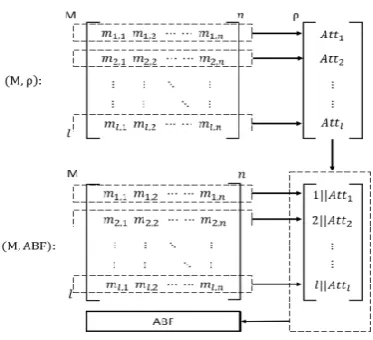
conceal the entire characteristic rather than just in part concealing the attribute values. In addition, this don't limit our technique to a few particular access structures. The fundamental thought that to express the access policy in LSSS get to structure (M,ρ) where M is a access policy matrix and ρ coordinates each column Mi of the network M to a trait [11], and shroud the characteristics by basically expelling the property coordinating capacity ρ. Without the attribute matching function ρ, it is important to plan an ascribe restriction calculation to assess whether a characteristic is in the access policy and if so the right position in the access policy. In the proposed strategy utilizes a ABF to find credits to unknown access approach, that can spare a great deal of capacity overhead and calculation cost particularly for substantial universe.
IV. SYSTEMMODEL
Like CP-ABE based plans, the framework as appeared in Figure 1 comprises of the accompanying elements: a Central Authority[CA] which capable to deal with the safeguard assurance of entire framework: It distributes system parameters and disperses privacy keys to every client and furthermore it goes about as a period specialist to keep up the timed-releasing function., several data owners(Owner) who can chooses the access policy dependent on a particular characteristic set and at least one discharging time points for each document, and afterward scrambles the record under the chose arrangement before the document is transferred, numerous data consumers(User) is allotted a security key by the CA. User can access any cipher text put away in the cloud, yet can decode it, and a cloud administration provider(Cloud) incorporates the overseer of the cloud servers. The cloud embraces the capacity undertaking for different elements, and processed to get to benefit discharging calculation under the control of CA.
V. CONSTRUCTION
A. Set Up
Amid the framework setup stage, Setup algorithm runs by the attribute authority. Give U a chance to mean the characteristic space in framework. Let G and GT be cyclic multiplicative gatherings of prime order p, and e : G×G→GT be a bilinear map[12]. Let Latt be the utmost bit length of attributes in the framework. Let Lrownum be the utmost bit length of the row numbers in access matrix. Let LABF be the size of bit array of the ABF. Let k denotes the number of hash functions related to ABF.
Central authority aimlessly selects a generator g ε G, α ,a
z∗p, and U = | U | random group elements h1,h2,...,hU ε G . and
it also generates k hash functions H1(),H2(),···,Hk() which maps an element to a specific position within the range of [1,LABF]. Then the public key generated as
PK=(g,e(g,g)α,ga,Latt,Lrownum,LABF,h1,h2,··,hU,H1(),H2(),..,Hk())
(1)
Fig. 1. System model
B. Generation Of Secret Key
The key generation algorithm which uses the public key PK, the master key MSK and attributes set S as input and then it calculates:
K = gαgat, L = gt, Kx = htx x ε S (2)
C. Encryption Of Data
Previously redistributing information to cloud, client's encode information by the usage of encryption algorithm. Firstly uses the information encryption subroutine to scramble the information to cipher text under access approaches communicated in the LSSS structure.
For a Threshold-gate access tree A, taking the comparing edge tree-string FA as information, utilizing a LSSS[13], for every Threshold-gate,it can pursue the edge tree-strings structure to over and over execute the one-push addition, and in the end yield a LSSS (M,ρ) for A, where ρ is controlled by FA as the I-th line of M is marked by the I-th characteristic of FA. Specifically, every hub of the entrance tree is viewed as a member of an edge get to structure indicated by its parent hub. At that point it begin with a (1,1)- limit LSSS and consider the root hub of the tree as its member. It over and over execute the one-push inclusion on the non-leaf hubs of the tree, and will inevitably get the alluring LSSS.Let matrix M = (1)1 × 1, vector L = (FA), and m = 1,d = 1).
Algorithm 1: Convert to Linear access matrix
• Repeat the following until all coordinates of L are attributes.
✓Consider M to be an m × d matrix over Zp, and L = (L1,L2,...,Lm)
✓Scan the coordinates of L to find the first coordinate that is a threshold-tree-string rather than an attribute. Suppose the index of
this coordinate is z. Here a
threshold-tree-string Lz = Fz = (Fz,1, Fz,2,..., Fz,m2,t2). If such a coordinate does not exist, it means that all the coordinates have been attributes and the algorithm should stop and output the matrix M.
✓ Resolve Fz to obtain its m2 children Fz,1,Fz,2,...,Fz,m2 and threshold value d2.
✓ For this (d2,m2)-threshold access structure, construct the corresponding LSSS matrix according to Equation, then execute insertion of this (d2,m2)-LSSS matrix on the z-th row of M to obtain a new M with m1 + m2 rows and d + d2 -1 columns. Set
L = (L1,L2,...,Lz−1,Fz1,Fz2,...,Fzm2,Lz+1,...,Lm), and then set m = m - 1 + m2, and d = d - 1 + d2. • Return the matrix M
Encryption
The information encryption subroutine takes as data sources the public key PK, the message m and access structure(M, ρ). As shown in Figure 2, M is an l×n access matrix and the function ρ maps rows of M to the attributes. The algorithm firstly chooses an encryption secret s z∗ p randomly and then choose an arbitary vector Vi = (s,y2,···,yn), where y2,···,yn are used to share the encryption secret s. For i=1,···,l, it estimate λi = Mi · Vi, where Mi is the vector corresponds to the i-th row of M. Then, it forms the cipher text as
CT = (C = me(g,g)αs,C0 = gs,Ci = gaλih−s ρ(i) )i=1,··l (3)
Fig. 2. Attribute bloom filter with LSSS access policy
ABF Build
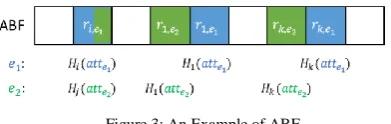
The ABF[14] building scheme takes as info the access policy(M, ρ). It firstly ties properties related with the access policy and the relating line number in the access matrix M placed together and gains a great deal of segments. Se =I || atte i [1,l], where the i-th row of the access matrix maps to attribute atte = ρ(i). Both the row number and the attribute are extended to the greatest piece length by placing zeros on the left of bit strings. By beguiling the arrangement of components Se as an info, the ABF can be developed by calling the Garbled Bloom Filter Building calculation in [14]. To place a new element e in the set Se to the ABF, the algorithm rest shares the element e with (k,k) secret sharing mechanism by arbitrarily generating k-1 λ-bit strings r1,e, r2,e,···, rk1,e, and computes
[image:3.595.312.499.353.523.2]with k unified and independent hashing functions H1(),···,Hk() and gets H1(atte), H2(atte),···, Hk(atte), where each Hi(atte) (i[1,k])represents the location index of ABF. As shown in Figure 3,it then stores the i-th element share ri as
[image:4.595.72.268.130.192.2]rk,e → Hk(atte) position in ABF
Figure 3: An Example of ABF
At the point when to place new components to the ABF, a few area j = Hi(e) may involved by recently included component. In the event that such circumstance occurs, it rehash the current share as one share of the new component. For instance, as appeared in Figure 3, the location Hj(atte2) of component e2 is equivalent to the position Hi(atte1) of component e1. Taking into account that this situation of the ABF has just been involved by ri,e1, rather than haphazardly choosing a λ-bit string, and set rj,e2 = ri,e1. In the event that the position is changed with another string, the recently embedded component can't be recuperated.
D. Data Decryption
While getting to the information put away in the public cloud, data clients can load the encoded information as indicated by their interests. In any case, the access control occurs amid the decoding, which implies that data clients can unscramble the information just when its properties can fulfill the entrance strategies used to encode information. In conventional ABE frameworks, the entrance approach (M, ρ ) is joined to the cipher text. In this way, the data consumers can without much of a stretch examine whether the traits can fulfill the access policy. Be that as it may, in this plan, it shroud the attributes mapping function ρ, so data clients ought to examine which attributes they possessed are in the access matrix firstly by running the ABF query mechanism as pursues.
ABF Query
It selects the information sources the attribute set S, the ABF and the public key PK. For each characteristic att S claimed by the data clients, the algorithm rest processes the location lists by encouraging the attribute att with the k hashing functions H1(),···,Hk() and gets H1(att),H2(att),·· ·,Hk(att). Then, it fetches the equivalent strings from the locations indexed by Hi(att) (i [1,k]) in the ABF as follows; Hk(att) location in ABF → rk,e. Afterwards, it reorganize the element e as e = r1,e⊕ r2,e⊕,·· ·,⊕ rk1,e ⊕ rk,e = r1,e ⊕ r2,e
⊕···⊕rk1,e ⊕r1,e ⊕r2,e⊕ ···⊕rk1,e ⊕e. Finally, it gives the rebuild attribute mapping as ρ’ =(rownum,att) att ε S.
Decryption
Information decoding algorithm takes as sources of info the secret key SK, the cipher text CT just as the access matrix M and the rebuild attribute mapping ρ'. If the attributes can satisfy the access policy, it can leverage the Lagrange Interpolation Formula to and coefficients ci such that Pi ε I
ciλi, where I =i:0(i) S ε {1,2,,l}. Then, the data clients can compute
(4)
and to get back the information as m = C/ e(g,g)αs . Else, it results ⊥ which implies the decryption process decline.
VI. CONCLUSION
The proposed strategy chiefly center around viable access control on time sensitive data in cloud. The re-distributed information to the cloud may results difficulties on the data privacy. There is an opportunity of getting to the document sent by the data owners to the distributed storage by the unapproved clients. CP-ABE systems which helps in the data access control mechanisms depend on the attributes of the consumers whose attributes match the access policy only can decode the cipher texts. This strategy consolidates the idea of timed-release encryption to the CP-ABE. The proposed systems gives the data owners an ability of adaptably arrival of access benefit to the distinctive clients at various time spans, as indicated by an all around characterized access policy over release time and attributes. Here we additionally utilizes an ABF to conceal the attributes of users. The advantage of utilizing the attribute bloom filter is that the authorized just as the unauthorized client needs to check the attribute bloom filter whether their attributes are available. It also helps to identify the accurate row numbers of attributes in the access matrix of the attributes in bloom filter if used in the access policy. Thus it averts spillage of any secret information. Different from the existing methods the proposed method can conceal the whole attribute in the access policies. Accordingly helps in protected transmission of information over the public cloud..
ACKNOWLEDGMENT
The authors would like to thank .Surekha Mariam Varghese, Head Of Department, Computer Science and Engineering, Mar Athanasius College Of Engineering Kothamangalam for her valuable help.
REFERENCES
1.Qi Han, Yinghui Zhang, Hui Li, “Efficient and robust attribute-based `encryption supporting access policy hiding in Internet of Things”, Future Generation Computer Systems (2018).
2.J. Bethencourt, A. Sahai, and B. Waters, “Cipher text policy attribute-based encryption”, in Proceedings of the 28th IEEE Symposium on Security and Privacy (SP ’07), pp. 321–334, IEEE, 2007.
3.E. Bertino, P. A. Bonatti, and E. Ferrari, “TRBAC: A temporal role-based access control model,” ACM Transactions on Information and System Security, vol. 4, no. 3, pp. 191–233, 2001.
4.K. Yang and X. Jia, “Expressive, efficient, and revocable data access control for multi-authority cloud storage”, IEEE Trans. Parallel Distrib. Syst., vol. 25, no. 7, pp. 1735–1744, July 2014.
5. Zhe Liu, Johann Großschadl, Zhi Hu, Kimmo Jarvinen, Husen Wang, and Ingrid Verbauwhede, “Elliptic
Hardware Implementations for the Internet of Things”, IEEE Transactions on computers, VOL. 66, NO. 5, MAY 2017.
6. Z.Qin, H. Xiong, S.Wu and J.Batamuliza, “A survey of proxy re-encryption for secure data sharing in cloud computing”, IEEE Transactions on Services Computing,2016.
7. F.Armknecht, J.-M. Bohli, G.O.Karame, and F. Youssef, “Transparent data deduplication in the cloud”, in Proceedings of the 22nd ACM SIGSAC Conference on Computer and Communications Security, pp. 886–900, ACM, 2015.
8. R. Masood, M. A. Shibli, Y. Ghazi, A. Kanwal, and A. Ali, “Cloud authorization: exploring techniques and approach towards effective access control framework”, Frontiers of Computer Science, vol. 9, no. 2, pp. 297– 321, 2015.
9. A. Sahai, B. Waters, “Fuzzy identity-based encryption”, in: Proceedings of the 2005 Annual International Conference on the Theory an Applications of Cryptographic Techniques, EUROCRYPT’05, 2005, pp. 457–473.
10. Parmar Vipul Kumar, Rajani Kanth Aluval, “Key Policy Attribute Based Encryption (KP-ABE)”: A Review International Journal of Innovative and Emerging Research in Engineering Volume 2, Issue 2, 2015. 11. B. Waters, “Cipher text-policy attribute-based encryption: An
expressive, efficient, and provably secure realization”, in Proc. of PKC’11. Berlin, Heidelberg: Springer-Verlag, 2011, pp. 53–70. 12. Eric Zavattoni, Luis J. Dominguez Perez, Shigeo Mitsunari, Ana H.
Sanchez-Ramırez, Tadanori Teruya, and Francisco Rodrıguez-Henrıquez, “Software implementation of an Attribute-Based Encryption scheme”, IEEE Transactions on Computers,Volume: 64 , Issue: 5 , May 2015
13. C.Dong,L.Chen,andZ.Wen, “When private set intersection meets big data: an efficient and scalable protocol”, in Proc. of CCS’13. ACM, 2013, pp. 789–800.
14. Burton H. Bloom, “Space/Time Tradeoffs in Hash Coding with Allowable Errors”, Communications of the ACM Volume 13, July,1970.
AUTHORSPROFILE
Amrutha N received Bachelor of Technology in Information Technology from CUSAT University in 2017 and currently pursuing Master of Technology in Computer Science and Engineering from APJ Abdul Kalam Technological University. Her research interest is in security.