Security Modeling for Web Based Visitor‘s Login
System for Pursuance of Security Design Pattern
Yogini C. Kulkarni, S. D.
Joshi
Abstract: In recent years because of the widespread use of internet and other communication media security occurrences have broken all the barricades. System gets attacked by malicious attackers and various cyber criminalities. Every system should be built by taking security as a main priority while building a system so as to make it reliable, safety and also it should be enhanced with other quality parameters. Hence since beginning at every phase of software development till the implementation of the software, security aspect is needed to take into consideration before making the final design decision to avoid the expenses which may incur while recovering of the system after the damage. For attainment of this, it is must to integrate the security at each phase of the software development. The software developers insists on incorporating the software safeguards at the design phase which may wind up in identifying the architecture restrictions related with the security which in fact may not be necessary. To reduce this problem, this paper intends a structure for security development activities. These activities consist of security requirements identification and threats analysis which are to be converted into design decisions to lessen the risks to identified important assets. The recognized design parameters are then manually prioritized using VOSREP and CRAMM and accordingly Security design pattern is to be developed to incorporate security in the software. By manually calculating values of assets and prioritizing will help to identify the security requirements at the early stage of the software development life cycle. Accordingly the decisions for developing the security design pattern are to be taken for building the software system
Keywords: Security Engineering process, Security Requirement Elicitation, Security modeling
I. INTRODUCTION
Generally, software is designed and developed without thought process of security issue, the non-functional requirement of security parameter being in the minds of the developers [4]. The issue of security is taken into consideration after creating the entire software which results in leaving behind potential loopholes which may be origin to create vulnerable attacks for hackers and crackers. The main reason of increasing attacks is the poor quality of the software system and many loopholes left unknowingly while developing the software through which the attackers can attack onto the system.
Revised Manuscript Received on November 05, 2019.
Yogini C. Kulkarni , Information Technology Department , Bharati Vidyapeeth (Deemed To Be University) Pune,India.Email: [email protected]
Prof. Dr. S .D. Joshi , Computer Engineering Department ‗ Bharati Vidyapeeth (Deemed To Be University) Pune,India.Email: [email protected]
As attackers are more inventive by creating more complex attacks, a systematic approach is required for maintaining the security of software for development of secure software. Hence it is required the assessment of the security requirement at the early stage of the development of the software. The main objective for identifying the security requirements is to put in order the elicited security requirements and to take the decisions for implementing the security to reduce the various types of vulnerabilities related with the threats.
The modeling techniques like generating the misuse case, abuse case, attack trees for the security concepts like threats, attacks and vulnerabilities together can be termed as security modeling. These techniques explore the concepts of security issues so they can be handled throughout the software development lifecycle. This paper describes security modeling as a method with respect to software development. The following modeling techniques are described.
Assets Identification using VOSREP and CRAMM
Risk Identification using STRIDE and DREAD
Threat modelling.
II.RELATED WORK
In software engineering, the securities and its requirements must be identified along with the functional as well as non-functional requirements. The main priority should be given to the security requirement which is to be recognized at the earliest phase to avoid the future recurring costs due to vulnerability which occurs because of poor design of the software. These requirements should be systematically analyzed based on the risk measurement techniques. Security requirements should be accurate, sufficient and complete. Once these requirements are clearly précised, those can then be implemented and maintained throughout the life cycle development of the software [1] [2]. Manually we are prioritizing the threats and risks associated with the web based login system. The following methodologies are involved.
1. STRIDE which provides checklist for recognized threats. [1]
2. DREAD which provides a rating to the recognized threats identified [1],
III. FRAMEWORK FOR SECURITY DEVELOPMENT AT SDLC
The fig.1 shows the framework for engineering activities involved in a secure software development which are - (i)Security requirements analysis : It includes security
requirement elicitation, analysis & prioritization and identification of the security design pattern
(ii) Design phase/Architecture phase: After the completion of security requirement elicitation regarding the functional as well as non-functional requirements one needs to take the decision for designing of the software. According to systems development viewpoint security modelling will be required for implementing the security design pattern.
In case of the wrong design decisions, it may create redundant design constraints or makes the system vulnerable and ultimately increasing of the budget of software development.
(iii) Implementation Phase: This phase includes the coding for incorporating security, code validation and testing of the security pattern.
Fig.1 Software Security Assessment for incorporating security in SDLC [14]
Once the security requirements are elicited and prioritized, suitable design decision will consider the security threats for developing the security design pattern. The approach involves conversion of identified security requirements and threats into design decisions to reduce the security threats. Mapping of the security requirements with the different security services is done for identifying the security practice to incorporate into the life cycle of the software. The recognized design attributes are hierarchies and on the basis of the set of important security attributes a security design pattern is developed at every stage of the software development. At the end the specific cryptographic techniques is to be finalized for reducing the unnecessary constraints in the software development process. We exemplify our process with suitable case study of Web based visitor‘s Login system.
IV. SECURITY MODELING FOR INCORPORATING THE SECURITY IN SDLC
There are mainly four key stages for the embedding of the security in software development life cycle as follows. 1. Security Requirement Engineering
2. Architecture and Design Level 3. Code level security
4. System Level Security
The activities involved in the above process are shown in the fig.2
Fig.2 Outline of the incorporating Security design pattern in SDLC
A. Security Requirement Analysis:
The security requirements are to be finalized at the premature stage of the software development of SDLC. In this phase first we will discover all the security requirements related to our system. (Web Based Secure Login System). The security requirements are then analyzed.
a.Security Requirement Elicitation: Security requirement can be defined as systems provisions for its security such as necessities made for maintaining the security through access control mechanism. The access control protects the access by illegal users and helps to secure data and application of the system. The fundamental cause of security requirements is the reduction of different types of hazards related with the threats and suggests on extracting of security requirements like abuse case [5], misuse case [6, 7], common criteria and attack trees [8].
While designing the software, in the security requirement elicitation phase the focus is to be given on the elicitation of the security requirements. The importance for providing the correct information is given highest priority. In this phase the data is gathered for the security requirements through various models and from various persons like for e.g. the customers, manager, software coders, software designers and quality assurance team. Constructing accurate requirement models means to guarantee of correctly collecting the requirements. The requirement models help the software designers to specify the functions as well as the data.
The security requirement elicitation is done with reference to the method involved in VOSREP- Viewpoint Oriented Security Requirement Engineering Process (VOSREP) is defined as process making the security engineering as the incorporated approach with requirement engineering. VOSREP is process to elicit, analyze, prioritize and manage requirements. It takes into consideration both the functional requirements as well as nonfunctional requirements while development of the software. The different activities in VOSREP are as follows.
1. Security Requirement Discovery and Definition It is the first activity of the VOSREP process the security requirements with functional and nonfunctional requirements are identified and defined for the system to be developed. 2. Analysis and Prioritization
In the second step, the recognized functional and nonfunctional requirements are analyzed for their feasibility, consistency and completeness. Once those are finalized these
security requirements are prioritized based on the measure of the risk of threat on the important assets.
3. Management of the Security Requirements
Once the security requirements are recognized, analyzed and prioritized those are maintained throughout of the lifecycle of the software development.
The table of requirement specification is s shown in table .These specifications are generated using VOSREP[10].
b.Security Requirement Analysis (Use of assembling threats table)
The tasks to be performed in analyzing the security requirements are as follows: -
(i)Verifying for comprehensiveness- Check list is to be generated to verify whether the extracted security requirements have reduced all the threats of the system. This check list is used to resolve the contradictions that may exist in the security requirements elicited from different viewpoints.
(ii) Assembling of security requirements - This step consists of recognizing and grouping together the security requirements. According to our system different tasks are performed in security requirement analysis phase as shown in following flowchart.
Table-I: An Example Of Web Based Visitor Login System [10] Viewpoints Services Nonfunctional
requirements
Threats Threats identified Security Requirements Visitor 1.Registration
of the visitor
1.Reliability 1.Spoofing T1. Impersonate 1.Authorization Requirement 2.Registration
Information
2.Response 2.Flooding T2.Visitor Data_Theft 2.Privacy requirement 3.Registration Time 3.Disclose login
information
T3.VisitorDisclose_Data 3.Non repudiation requirement
3.Execution of
the key
generation
4.Impersonation T4.Securitycode_Violated
5.Change
password
T5.VisitorChange_Data
6.Repudiation T6. Visitorpass_steal
T7. Denial_of_service
Visitor Record Management
1.Update the visitor‘s data
1.Correctness 1.Change login information
T8.Unauthorize_access 1.Integrity Requirement 2.visitor‘s
registration Query Process
2.Minimum response time
2.Impersonation T2. VisitorData_Theft 2.Authentication
3.Varification of generated security code
3.Scalable 3.Outsider T4.
securitycode_Violated
4.Visitor‘s pass Generation
T9. System_Failure
5.Maintainance of the visitor‘s database
T10. Outsider
Database 1.Maintain the registration numbers
1.Optimized 1.Outsider T11.Copy 1.Security review requirement
2.Integrtiy T12.Replace
T5 .VisitorChange_Data 2.Intrusuion detection requirement
Fig.3 Flowchart showing different tasks in the security modeling
The above steps are explained according to our implementation as follows.
i. Threat Modeling for Recognition and Assembling of Threats [11]
Threat modeling is recursive process which starts during the architecture/design phase. The design phase explains the progression of threat modeling through the phases of SDLC to able the analyst to add more details in the threat model via repetitive threat model process. By using common criteria approach the threats are assembled together as follows. 1. Impersonate(T1)
2. Visitordata_Theft(T2) 3. Visitordisclose_Data(T3) 4.Security Code violated(T4) 5.VisitorChange_Data(T5) 6. Visitorpass_steal(T6) 7. Denial_of_service(T7) 8. Unauthorize_access(T8) 9. System_Failure(T9) 10. Outsider(T10) 11.Copy(T11) 12.Replace(T12)
ii. Characterizing of the discovered threats
The threats are recognized, characterized using STRIDE model and assembled as follows.
1. Spoofing
2. Tampering of the data
3. Repudiate and receive (To refuse the authorization) 4. Information disclosure
Table-II: Recognition and Assembling Of Threats
Threat Name Threats Function Property Example Vulnerabilities
Spoofing
T1, T2, T3, T4
Pretending to be someone else
while using
system Authentication
Hacking of victim‘s email and use to send
message
Authentication error
Tampering Data(TD)
T1, T5, T6, T8
Change data
or code Integrity
Executable file gets hampered
by an attacker
Manipulation of the data
Repudiate to
receive (RR) T8, T12
Claiming not to do the particular
action regarding the authorization
Non repudiation
Disagreeing of sent mail
to alike
Insufficient verification of
the data
Information disclosure
(ID)
T2, T3, T4
Leakage of sensitive
information Confidentiality
The sensitive information
like credit card information available on internet.
Information management
error
Denial of service (DS)
T9, T10
Non availability
of service Availability
Web application
not responding
to user‘s request
Buffer overflow (Buffer
Overflow)
Elevation of
privileges(EP) T8
User can perform unauthorized
action Authorization
The user changes the
admin account
Authorization error
The STRIDE model is used for the tabular representation of checklist for recognized threats are as shown below. STRIDE model helps to identify and categorize threats and vulnerabilities.
Table-III: Checklist for Discovered Threats
S T R I D E
T1 √ √
T2 √ √
T3 √ √
T4 √ √
T5 √
T6 √
T7
T9 √
T10 √
T11
T12 √
iii. Rating Threats
[image:6.595.44.288.270.477.2]There are various methods for analyzing risks like EBIOS, OCTAVE, CORAS. We have used CRAMM and DREAD for assessing the risks associated with the threats. The brief description about CRAMM and DREAD is given below. CRAMM: It is qualitative risk assessment tool and is to be applied for IT security. It is developed by UK governments Central Computer and Telecommunications‘ Agency in 1985 .The following diagram shows the processes involved in CRAMM.
Fig .4 CRAMM Processes [12]
DREAD: DREAD is a structure which is used to assess different threats by rating .This structure consists of five main categories: Damage, Reproducibility, Exploitability, Affected Users, and Discoverability
D-Damage- It makes reference to what level the assets are affected by the threats. R-Reproducibility- It gives the possibility of recursively occurrence of an attack.
E-Exploitability- It is sequence of commands which takes benefits of vulnerability to raise unexpected behavior on computer software.
A-Affected User- The influence of an attack on people D-Discoverability – Ease of discoverability of the threat The rating is assigned to the threats using CRAMM and DREAD method as follows.
Table-IV: Risk Measurement Threat
ID D R E A D
Overall Risk
T1 5 5 5 10 5 6
T2 10 5 5 10 5 7
T3 5 5 5 0 0 3
T4 5 5 5 5 5 5
T5 0 0 5 0 5 2
T6 5 5 5 5 10 7
T7 0 10 5 0 5 4
T8 5 5 5 10 5 6
T9 0 0 5 0 5 2
T10 10 0 5 10 10 7
T11 0 0 5 5 5 3
T12 0 0 5 5 5 3
iv. Values
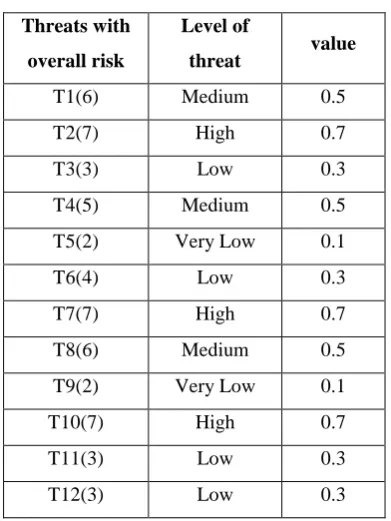
[image:6.595.314.539.442.586.2]After the risk rating procedure, the risk measurement table the 10-point rating is to be scaled down to two-point scaling as shown below. The ranging is done as follows[1]
Table-V : Scaling Down The Risk Rating To Values DREAD
TEN-point Scale
DREAD
TWO-point Scale Values
1-2 Very Low 0.1
3-4 Low 0.3
5-6 Medium 0.5
7-8 High 0.7
9-10 Very High 0.9
The recognized threats have to assign a value according to CRAMM evaluation.
v. Measuring of the threats
Table-VI: Risk Assessment
[image:7.595.34.293.66.346.2]vi. Assigning values to affected assets Table-VII: Values To The Assets
Table-VIII: Probable vulnerable threats Threats
with overall
risk
Level of Threat
Threat
Asset Value(1-10
) Value
(1-10)
T1(6) Medium 0.5 6
T2(7) High 0.7 4
T3(3) Low 0.3 5
T4(5) Medium 0.5 5
T5(2)
Very
Low 0.1 5
T6(4) Low 0.3 8
T7(7) High 0.7 8
T8(6) Medium 0.5 5
T9(2)
Very
Low 0.1 7
T10(7) High 0.7 4
T11(3) Low 0.3 4
T12(3) Low 0.3 4
With reference to above table we define the probable vulnerable threats as follows.
vii.Approximation the Risk Level and Prioritizing the important assets
Based on the values generated in above table the detailed computed values of security requirements for secure login system are as shown table 9 [13]. After probable vulnerable threats rating we calculate the risk level value along with the values of SR prioritize values, we use the 3 dimensional lookup table given by the CRAMM where the strength of the threat, the level of the vulnerability and the value of the asset are input parameters, gives the final value of risk in the range 1 through 7 .The vulnerability values are assigned by CRAMM method,i.e low as 0.1,medium as 0.5 and high as 1 [1]
For e.g. suppose asset is Visitors Information (7) the threat to this is Spoofing (0.9) and Vulnerability being medium (0.5). The measure of risk will be (Risk=threat value*vulnerability asset +value/2) for e.g (0.9*0.5+7/2=4) In the similar fashion we can calculate the approximated values of risk and security requirement prioritize of important assets which is given in table 9.
Threat Affected Assets Values
T1(6) Visitor information() 6 T2(7) Communication Channel 4
T3(3) Registration Info() 5
T4(5) VisitorPass Info() 5
T5(2) Registration Info() 5
T6(4) Security Code Steal() 8
T7(7) Registration Info() 8
T8(6) Registrationcopy() 5
T9(2) Systemfailure() 7
T10(7) Communication channel 4
T11(3) VisitorInfo() 4
T12(3) VisitorInfo() 4
Threats with overall risk
Level of
threat value
T1(6) Medium 0.5
T2(7) High 0.7
T3(3) Low 0.3
T4(5) Medium 0.5
T5(2) Very Low 0.1
T6(4) Low 0.3
T7(7) High 0.7
T8(6) Medium 0.5
T9(2) Very Low 0.1
T10(7) High 0.7
T11(3) Low 0.3
[image:7.595.54.250.394.655.2]Table-IX: Prioritization table [1] Security
requirement
Threat Threat rating
Vulnerability Assets affected Asset value
Risk SR prioritize
Authentication T1 0.9 0.5 Visitor information()
7 4 14
T2 0.7 0.1 Communication
Channel
6 3
T3 0.3 0.1 Registration Info() 9 5
T4 0.9 0.5 VisitorPass Info() 4 2
Authorization T11 0.3 0.1 Registration Info() 4 2 4
T5 0.1 0.1 VisitorPass Info() 5 2
Integrity T5 0.1 0.1 Registration Info() 4 2 4
Visitor Info() 5 2
Non-repudiation T6 0.3 0.1 Security Code Steal()
8 4 4
Privacy T2 0.7 0.1 Registration Info() 4 2 7
T6 0.3 0.1 VisitorPass Info() 5 2
T8
Registrationcopy() 2 1
Availability T7 0.1 0.1 Registration Info() 4 2 4
T9 Systemfailure() 5 2
0 5 10 15
DESIGN DECISIONS
After recognizing the security requirements and design constraint, the final decision for the selection of suitable cryptographic technique is to be taken for developing security design pattern.
CONCLUSION
This paper presents the security model for the recognition of security activities during the software development. To develop secure software, the main focus must be given on security at every phase of the software development lifecycle to lessen the security flaws. The identification of the security requirement helps the software developer to maintain the
thread of security. The most important assets are to be identified for which the security is to be maintained by calculating the risk values. For recognizing the suitable cryptographic technique the security services are mapped with the identified threats to develop security design pattern for web based secure login system. This is to be obtained by working out on the security activities which recognize and remove security flaws at all the stages of software development.
Table-X: Design Decisions
REFERENCES
1. Aayush Gulati , Shalini Sharma, and Parshotam MMehmi. 2012.PROPOSING SECURITY REQUIREMENT PRIORITIZATION FRAMEWORK., International Journal of Computer Science, Engineering and Applications (IJCSEA) Vol.2, No.3
2. Donald G. Firesmith, (2003) ―Engineering Security Requirements‖, Journal of object technology, vol 2, no.1, pp.53-68.
3. Zeki Yazar. A Qualitative Risk Analysis and Management Tool – CRAMM. SANS Institute Reading Room site
4. Ramchandran., 2002 .Designing Security solutions,Wiley Computer Publishing
5. Dermott JM and Fox C (1999) Using abuse case models for security requirements analysis. Department of Computer Science, James Madison University, pp 55–64
6. Alexander IF (2003) Misuse cases, use cases with hostile intent‘‘. IEEE Software, pp. 58–66
7. Guttorm S, Opdahl AL (2005) Eliciting security requirements with misuse cases. RequirEng 10:34–44
8. Jacob Bergvalloch Louise Svensson .2015.Report on ‗Risk analysis
review‘ Linköpingsuniversitet
https://www.diva-portal.org/smash/get/diva2:821842/FULLTEXT01. pdf
9. NURIDAWATI MUSTAFA,MASSILA KAMALRUDIN,SAFIAH
SIDEK. 2018. SECURITY REQUIREMENTS ELICITATION AND CONSISTENCY VALIDATION: A SYSTEMATIC LITERATURE REVIEW ., Journal of Theoretical and Applied Information 96(16).ISSN: 1992-8645
10. Ashish Agarwal, Dr. Daya Gupta. Security Requirements Elicitation Using View Points for Online System First International Conference on Emerging Trends in Engineering and Technology
11. Security Requirements,
http://www.dwheeler.com/secure-programs/Secure-ProgramsHOWTO /requirements.html
12. Mohamed Ghazouani, Sophia Faris, Hicham Medromi, Adil Sayouti.2014. Information Security Risk Assessment — A Practical Approach with a Mathematical Formulation of Risk ., International Journal of Computer Applications (0975 – 8887) Volume 103(8),
13. Kakali Chatterjee ,Daya Gupta ,Asok De. 2013 .A framework for development of secure software.,CSIT., 1(2):143–157
14. Shams Tabrez Siddiqui.2017. Significance of Security Metrics in Secure Software Development.,International Journal of Applied Information Systems (IJAIS) – ISSN : 2249-0868 Foundation of Computer Science FCS, New York, USA Volume 12 – No. 6, August 2017 – www.ijais.org 10
AUTHORS PROFILE
Yogini Kulkarni received her B.E. degree in
Computer Engineering from Shri Sant Gajanan Maharaj College of Engineering, Shegaon from Amaravati University, Amaravati, Maharashtra in 1990 , M.E. (Computer Engineering) Degree from Bharati Vidyapeeth Deemed University Pune. She is currently working as PG Coordinator and Assistant Professor in Information Technonolgy, Bharati Vidyapeeth (Deemed To Be University) College of Engineering, Pune since 2010. Currently she is pursuing Ph.D.from Shri Jagdishprasad Jhabarmal Tibrewala University, Rajasthan . Her research interests include software engineering. She is a sincere teacher devoted to Education and Learning for the past 27 years. Her research projects include Software Engineering and Image Processing. She will be available at [email protected] for any further communication.
Shashank Joshi received his B.E. degree in
Electronics and Telecommunication from Govt. College of Engineering, Pune in 1988, MBA (Systems) from Pune University, the M.E. (Computer Engineering) and Ph. D. (Computer Engineering) Degree from Bharati Vidyapeeth Deemed University Pune. He is currently working as the Dean,
Professor in Computer Engineering Department Bharati Vidyapeeth (Deemed University) College of Engineering, Pune since 1990.
![Fig .4 CRAMM Processes [12]](https://thumb-us.123doks.com/thumbv2/123dok_us/8159872.249339/6.595.44.288.270.477/fig-cramm-processes.webp)