A COMPONENT FRAMEWORK FOR
BUILDING WEB SCIENCE GATEWAYS
AND PORTALS
MEHMET AKIF NACAR
Submitted to the faculty of the Indiana University Graduate School in partial fulfillment of requirements
for the degree Doctoral of Philosophy
in the Department of Computer Science Indiana University
Accepted by the Graduate Faculty, Indiana University, in partial fulfillment of the requirements for the degree of Doctor of Philosophy.
Doctoral Committee
________________________________ Geoffrey Fox (Principal Advisor), Ph.D
________________________________ Donald McMullen, Ph.D
________________________________ Minaxi Gupta, Ph.D
________________________________ David Leake, Ph.D
Acknowledgements
First, I would like to thank my advisor, Professor Geoffrey C. Fox for his endless support and encouragement during all stages of my research. His advice and research projects were very crucial towards finishing my study.
I am delighted to thank research committee members Professor Donald McMullen, Professor David Leake and Professor Minaxi Gupta for their feedback to complete my dissertation.
I also owe thanks to Dr. Marlon Pierce, assistant director of Community Grids Lab for his insightful discussions and support. I am thankful to Professor Donald McMullen, director of Knowledge Acquisition and Projection Lab at Indiana University for friendly suggestions. I am pleased to thank Professor Gordon Erlebacher, Florida State University, for his feedbacks and criticism.
Without the friendly atmosphere in Community Grids Lab, my studies would not be finished. I would like to thank my colleagues Dr. Hasan Bulut, Dr. Kangseok Kim, Ahmet Topcu, Ali Kaplan, Ahmet Sayar, Fatih Mustacoglu, Harun Altay and Necati Aysan for their company. I also thank staff members at Community Grids Lab for their help and support.
Abstract
Portlet-based Grid portals have become a crucial part of the international distributed computing infrastructure to support computational science (“cyberinfrastructure”) provide component-based problem solving environments for scientists. Although Web portals are intended to provide user-friendly environments with easy-to-use interfaces, the development of portals and their portlet components is time consuming. We aim to address this problem by providing reusable components for rapid portlet development. Our approach, Grid Tag Libraries and Beans (GTLAB), encapsulates common Grid operations with reusable XML tags, providing a dramatically simplified programming interface to common cyberinfrastructure services. GTLAB also provides a way for creating composite tasks that models the requirements of computational science portals. In addition to standard Grid job submission and remote file operation tags, we also provide management and monitoring capabilities for Grid tasks. This system can persistently store job metadata, which results in a permanent storage for archiving and reference.
applications for the study of planetary materials. The requirements of VLab include job preparation and submission, job monitoring, data storage and analysis.
Table of Contents
1 INTRODUCTION... 1
1.1 MOTIVATION ... 6
1.2 PROBLEM STATEMENT ... 7
1.3 RESEARCH ISSUES ... 10
1.4 GRID TAG LIBRARIES ... 13
1.5 CONTRIBUTIONS OF THIS RESEARCH ... 14
1.6 ORGANIZATION OF THE THESIS ... 16
2 BACKGROUND ... 18
2.1 OVERVIEW OF GRID COMPUTING ENVIRONMENTS ... 18
2.1.1 GCE Shell ... 19
2.1.2 GPDK ... 19
2.1.3 Gateway System... 20
2.1.4 GridSphere Portal Framework ... 20
2.1.5 OGCE Portlets ... 21
2.2 TYPICAL GRID PORTAL USAGE SCENARIOS ... 21
2.2.1 User scenario for VLab portal... 22
2.2.2 User scenario for scientific workflows ... 24
2.2.3 User scenario for access control of portlets ... 24
2.2.4 User scenario for Web 2.0 portals... 25
2.3 GRID PROGRAMMING INTERFACES ... 26
2.3.2 Condor Web Services ... 26
2.3.3 Simple API for Grid Applications (SAGA) ... 27
3 SURVEY OF TECHNOLOGIES ... 28
3.1 INTRODUCTION ... 28
3.2 GRID PORTALS ... 28
3.3 OGSA AND WSRF SERVICES ... 30
3.3.1 Globus job management services... 31
3.3.2 Globus File Management Service ... 31
3.3.3 Monitoring and Discovery Service ... 31
3.3.4 Condor... 31
3.3.5 Credential management service ... 32
3.4 WEB SERVICES ... 32
3.5 PORTAL FRAMEWORKS AND THEIR COMPONENTS ... 34
3.5.1 Shortcomings of JSR 168... 35
3.6 GRID ACCOUNT MANAGEMENT ... 36
3.7 GRID AUTHORIZATION INFRASTRUCTURES ... 36
3.8 WEB APPLICATION FRAMEWORKS ... 37
3.8.1 Java Server Faces (JSF) ... 38
3.8.2 Web Interfaces and JSF ... 39
3.8.3 JSF Portlets ... 40
3.8.4 JSF portlet bridge ... 40
4 APPLICATIONS ... 41
4.2 VLAB: VIRTUAL LABORATORY FOR EARTH AND PLANETARY MATERIALS
PORTAL ... 42
4.3 QUAKESIM PORTAL ... 46
4.3.1 QuakeSim Gateway Architecture ... 47
4.3.2 QuakeSim Portlets ... 50
4.4 CIMA: COMMON INSTRUMENT MIDDLEWARE ARCHITECTURE PORTAL ... 51
4.4.1 Requirements ... 53
4.5 BIG RED PORTAL ... 56
4.5.1 Integrating GTLAB with Big Red Portlets ... 57
4.6 SUMMARY ... 58
5 ARCHITECTURE OF GRID TAG LIBRARIES ... 59
5.1 INTRODUCTION ... 59
5.2 DESIGN ... 61
5.3 GRID TAGS ... 63
5.4 GRID TAG SCHEMAS ... 64
5.5 USE CASE EXAMPLE ... 65
5.6 DESIGN AND IMPLEMENTATION OF GRID TAGS ... 67
5.7 HANDLER TAG MANAGES MONITORING OF THE JOBS ... 68
5.8 GRID BEANS ... 71
5.9 SESSION MANAGEMENT ... 73
5.10 CACHING... 74
5.11 SYNCHRONOUS AND ASYNCHRONOUS ... 75
5.13 COMPONENT PARSER ... 77
5.14 MONITORING AND MANAGEMENT OF JOBS ... 79
5.15 METADATA MANAGEMENT ... 81
5.16 COLLECTING USER INPUT VALUES AND HANDLING NAVIGATION ... 82
5.17 EXPERIMENTS ... 84
5.17.1 Testing Setup ... 85
5.18 ANALYSIS OF GTLAB ARCHITECTURE ... 87
5.19 FUTURE WORKS: APPLYING GTLAB INTO WEB 2.0 ... 89
5.19.1 Discussion ... 89
5.19.2 Web gadgets ... 91
5.20 SUMMARY ... 91
6 APPLYING WORKFLOWS TO GRID PORTALS ... 92
6.1 FOUNDATIONS OF SCIENTIFIC WORKFLOWS ... 92
6.2 IMPORTANCE OF WORKFLOWS IN GRID PORTALS ... 94
6.3 LEGACY WORKFLOWS FOR GRID SYSTEMS ... 95
6.3.1 Taverna ... 95
6.3.2 Kepler ... 96
6.3.3 Karajan ... 96
6.4 HANDLING DIRECTED ACYCLIC GRAPHS IN GTLAB ... 97
6.5 DESIGN AND ARCHITECTURE OF GTLAB WORKFLOWS ... 100
6.6 TAVERNA USE CASE ... 104
6.7 PERSISTENCY ISSUES OF WORKFLOWS WITHIN GTLAB ... 108
6.8.1 Discussion of Kepler and BPEL extensions ... 110
7 PORTLET ACCESS CONTROL MECHANISMS ... 111
7.1 USER ACCOUNT MANAGEMENT IN GRID PORTALS ... 112
7.1.1 Authentication ... 112
7.1.2 Authorization ... 115
7.1.3 Portal Users and Groups ... 116
7.1.4 CIMA Portlets for Partner Labs ... 119
7.2 CONTROLLING ACCESS TO GRID PORTLET CONTENTS ... 119
7.3 IMPLEMENTATION OF THE CIMA CRYSTALLOGRAPHY PORTAL ... 121
7.3.1 Requirements ... 121
7.3.2 Architecture of the CIMA Crystallography Portal ... 124
7.3.3 Identity Mapping between Portal and Data Manager Service ... 125
7.4 SUMMARY ... 126
8 CONCLUSION AND FUTURE WORKS ... 128
APPENDIX A ... 133
APPENDIX B ... 145
List of Tables
Table 3.1 Comparison of GAMA and PURSe ... 37
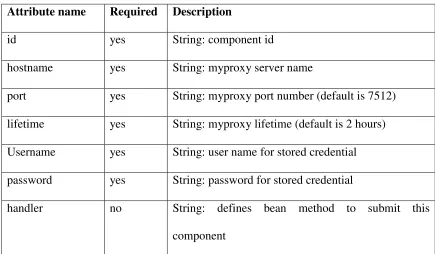
Table 5.1 Attributes of multitask tag ... 70
Table 5.2 Attributes of myproxy tag ... 70
Table 5.3 Timings of GTLAB processing stages on the portal server... 87
List of Figures
Figure 1.1 Classic three-tier architecture illustrates the portal in the client tier (left), service middleware in the middle tier and computing and data resources in the resource layer (right). The core of our work will address the components used to assemble the client tier... 3 Figure 1.2 Grid tags are used to build a sample portlet application that calls services
including: a) Myproxy service to get user credential, and b) GRAM service to execute a script. ... 9 Figure 1.3 OGCE portlets screenshot where all Grid operations are implemented as
portlets (i.e., tabs). The portlet shown is a generic interface to Globus GRAM middleware. ... 13 Figure 4.1 VLab portal serves to the end users by utilizing remote resources. ... 45 Figure 4.2 QuakeSim portal architecture with Grid services invocations of TeraGrid
nodes. ... 49 Figure 4.3 Disloc portlet page contains multi-staged jobs with DAG representation ... 50 Figure 5.1 Big picture of Grid portlets using GTLAB libraries and JSF framework .... 60 Figure 5.2 Grid tags are embedded into JSF view pages with visual HTML tags ... 61 Figure 5.3 Grid tags schema for job submission to GRAM server ... 65 Figure 5.4 A typical multistage Grid job involves four sub-tasks: moving an input file
Figure 5.5 The handler tag is used with <h:dataTable> to create a table of tasks and
enable cancellation actions. ... 69
Figure 5.6 Grid tag libraries are used to build a sample Grid portlet page. ... 73
Figure 5.7 Shows architecture of ComponentBuilderBean and its components ... 76
Figure 5.8 Parsing the JSF component tree that only shows tags widget ... 77
Figure 5.9 Each component has its own set of attributes and attributes can be given as constant or reference value... 78
Figure 5.10 Properties of a component stored in a JSF session during component parsing ... 78
Figure 5.11 Sequence diagram for Grid tags and beans including user interaction. ... 80
Figure 5.12 JSF applications uses Web forms through lightweight Web browsers. HTTP requests goes to the Web application on Tomcat and responses get back to the browser. ... 85
Figure 5.13 Request processing stages and their timing in portal server... 86
Figure 5.14 Average response time of requests initiated by end users, Tform ... 88
Figure 5.15 Average network latency time in between and user and portal server ... 88
Figure 6.1 XML schema of multitask represents a DAG. It shows the relationship of Grid tags by defining dependency tag in GTLAB. ... 100
Figure 6.2 Taverna composition of three major Grid tasks in a workflow ... 102
Figure 6.3 A user interacts with a workflow portlet to utilize Taverna enactor. User provides parameters by submitting a Web form that start the chain of events in order. ... 106
Figure 7.1 Snapshots of GAMA enabled CIMA portal ... 114 Figure 7.2 Relationships of CIMA portal roles, users and groups... 117 Figure 7.3 UserSample portlet that allows users to stepwise scan through an
Chapter 1
Introduction
Over the last decade, the improvement of Web technologies has produced e-Science
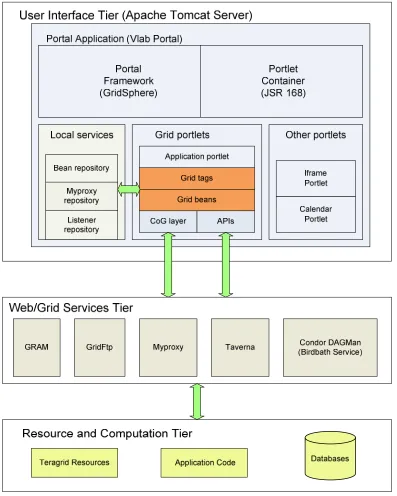
The efforts of building science knowledge management environments can be categorized in two aspects: 1) Core Grid applications that serve to construct foundations, and 2) management of the Grid applications. Figure 1.1 illustrates three-tier architecture that contains resource providers, middleware and portals.
Grid infrastructure spans multiple organizations in different administrative domains (that is, creating “Virtual Organizations” [2]). Each autonomous institution provides computing resources and data capacity through organizational boundaries. Therefore, Grid resources must respect the security and privacy concerns to tie resource providers and scientists. Examples of large virtual organizations providing data storage, computing power, and Grid services include TeraGrid [4], the Open Science Grid (OSG) [5] and Enabling Grids for E-SciencE (EGEE) [6].
The Grid initiatives must provide middleware layer to access supercomputing resources and data seamlessly. Grid middleware that is serving Grid users includes the Coordinated TeraGrid Software and Services (CTSS) [7] on TeraGrid, the Virtual Data Toolkit [8] on OSG, and gLite [9] on EGEE. Grid middleware services range from security, file management, information service, and schedulers.
Grid middleware such as file manipulation and command execution. evolve over the time. Efforts to build GCEs are now often called scien
Figure 1.1 Classic
three-middleware in the middle tier and computing and data resources in the resource layer (right). The core of our work
There are a variety of application portals available to solve numerous problems. Examples range from atmospheric discoveries in
Atmospheric Discoveries ( National Virtual Observatory
solving environment to develop a solid Earth science framework for modelling and such as file manipulation and command execution. These terms also evolve over the time. Efforts to build GCEs are now often called science gateways
-tier architecture illustrates the portal in the client tier (left), service middleware in the middle tier and computing and data resources in the resource layer (right).
The core of our work will address the components used to assemble the client tier.
There are a variety of application portals available to solve numerous problems. Examples range from atmospheric discoveries in Linked Environments for Atmospheric Discoveries (LEAD) [12] to virtual observatories described in
rvatory (NVO) [13]. The QuakeSim portal [14]
solving environment to develop a solid Earth science framework for modelling and These terms also ce gateways [11].
tier architecture illustrates the portal in the client tier (left), service middleware in the middle tier and computing and data resources in the resource layer (right).
will address the components used to assemble the client tier.
understanding earthquakes. The Virtual Laboratory for Material Sciences (VLab) project [15] is an example of a science gateway for computing the properties of planetary materials under extreme conditions and provides the specific motivating cases for our research.
A science portal supports the work of a scientific team or community by combining a Web portal and associated Web Services. By using a Web browser, a scientist can access both private and shared workspaces of discipline-specific data and tools. Science gateways are also access points to Grids of computational and data resources, allowing a user to leverage the capability of a Grid without forcing the user to deal with the complexity of Grid technology.
Most Web applications employ server-side technologies to provide rich dynamic content to its viewers. Java Server Faces (JSF) is a dynamic Web application framework that is similar to other dynamic Web application templates like velocity (http://velocity.apache.org), Java Server Pages, and Spring (http://www.springframework.org). JSF provides dynamic content using Java servlet technology. Dynamic content is generated based on the request and response paradigm. Unlike static HTML pages, Web application frameworks allow interaction with users. The server pages take requests, process them and respond to the user through a Web interface. Besides its inherent virtues, we believe that JSF is very well suited for science gateway development, as we will discuss.
We need a component model for User Interface (UI) matching Grid services as a component model for Grid middleware. Portlets attached to services do not work except in simple cases. There is no good way to link portlets, therefore most UI's need workflow services. Therefore we must use tags as component model and allow multiple tags in a portlet application. Our solution to building science gateways is providing a modular component framework. This framework provides reusable parts (tags) to construct portlet pages as well as composing and managing these parts.
1.1
Motivation
Scientific knowledge is shared by the community in terms of its needs and levels of understanding. To accomplish this missions, Grid portals [32] distribute the knowledge resources on the Web and restrict accesses to the groups of people. In that sense Grid portals are science gateways for people ranging from researchers at national research labs to school children. Therefore, all age groups and educational levels can access to the information thorough science portals on demand.
In the Grid portal field there are numerous efforts to build intuitive gateways and construct standards to build these applications using common platforms that help to interchange the knowledge between the institutions. These developments require computer scientists to study the Grid portals field.
Vine [37]. One of our goals is to utilize Grid resources transparently that range from TeraGrid resources to our Gridfarm clusters at Indiana University.
The first generation Grid portals for interacting with this middleware were stovepipe solutions to fit the needs of scientists that basically have capabilities to run and manage applications through Web applications [10]. Second generation portals are aware of the need to build reusable software components and propose a common framework for scientists. The Java Specification Request (JSR) 168 standard [16] and portal frameworks provide a standard portlet specification that defines programming interfaces and portlet container model.
The challenge for the community now is to define the third generation of Grid portal technology. In our research we have brought the problems of second-generation portal development on the table, and we have proposed solutions to these research area. We have proposed to model fine-grained Grid portal components that can flexibly compose client tier applications to Grid capabilities.
1.2
Problem Statement
applications must provide look and feel pages and customization to access the back end resources.
To achieve interoperability and to avoid relying on unsustainable custom solutions, science portals and e-Science generally follow Web specifications closely. For the portal community, the dominant specification has been JSR 168. After completing repeated efforts on building OGCE and QuakeSim portal [14, 38] we have learned the shortcomings of JSR 168. An important aspect of the JSR 168 is to build portlet components by implementing low level application program interfaces. There are two drawbacks of this approach: i) Portlets are coarse-grained components that wrap entire Web applications, not their functional components; and ii) portlet implementations are not reusable if one needs to combine one or more portlet capabilities. Consequently, we conclude science gateways have an inadequate component framework: JSR 168 is a useful starting point, but insufficient to develop science gateways in all aspects.
<html>
<body>
<f:form>
<o:submit id=”test” action=”next_page” />
<o:myproxy id=”pr” hostname=”gf1.ucs.indiana.edu”
port=”7512” lifetime=”2” username=“mnacar”
password=”***” />
<o:jobsubmit id=”task” hostname=”cobalt.ncsa.teragrid.org”
provider=”GT4” executable=”/bin/ls”
stdout=”tmp/result stderr=”tmp/error” />
</o:submit>
</f:form>
</body>
</html>
Figure 1.2 Grid tags are used to build a sample portlet application that calls services including: a) Myproxy service to get user credential, and b) GRAM service to execute a script.
Another problem of portals in general is to provide access control to the portlet contents. That is, we must consider what happens after a workflow is executed and data is generated. This is particularly important when making a scientist’s unpublished scientific data and computations available through Web interfaces: only the scientist and designated collaborators should have access, although many other people will use the portal (and the same components) to view different data sets. Portals frameworks restrict user or group access rights on portlet components. Users will see the same content of accessible portlets no matter what their rights are or what group they are in. The portlet Application Programming Interface (API) does not constrain the content access; in other words there is no policy enforcement on customizing portlet contents per users. We studied enforcement methods to restrict the portlet access to the user groups such as administrators, directors, researchers, providers, customers, study groups, students and anonymous users.
1.3
Research issues
The key research issue is the lack of a simple client interface to Grid services, particularly for Grid portals. There is also the need for a component environment compatible with Web Model-View-Controller architectures. This component model should be extensible beyond any specific implementation.
How do we apply Grid components to Web applications to build modular portals? There are server-side Web application frameworks to build portals. JSR 168 is one of the standard portlet container that support servlet-based Web applications. Velocity, Java Server Pages (JSP) [40], Struts and Java Server Faces (JSF) [41, 42] are some of the technologies to develop portals. JSF is interesting because its [43] component-based architecture fits better to our component model. JSF is an MVC approach to data binding. Therefore we have chosen JSF application framework to prototype Grid tag libraries. The detailed discussion of JSF is given in Section 5.6. However, we are able to extend our model to any other server-side Web framework.
One of the problems with the Grid operations is how to represent them in the context of Web applications. Java servlets [44] already provide an API to program server-side applications by using object oriented programming paradigm. Thus, application logic in the context of Web applications is reusable among different applications. But there is no way to reuse server pages in presentation logic. To come up with solutions for building modular Web application pages, we introduce widgets as tag libraries. Tag libraries encapsulate reusable Grid components so that allowing an extensible architecture for future additions.
demand. Some science disciplines closely rely on composing workflows such as life science workflows defined in [45]. Thus, they need graphical tools to generate complex workflows easily. Other types of scientists usually work on the well-established workflows composed by workflow authors [46]. They only need to enact and monitor the workflows. Depending on the nature of our case studies, we have focused on the first type of workflow demands by implementing graphs. Then we studied workflow enactment and monitoring integrated into Grid portals.
How do we handle and identify the jobs within a user context? One of the research problems we have to deal with is user metadata management. For example, a user session lasts from when a user logs into a portal until the user logs out or session lifetime expires or browser window is closed. We needed to have a mechanism to manage user metadata for tracking Grid jobs that running on Grid servers. Therefore we need to persist and store job metadata within a user’s context for both archiving and reusing reasons.
1.4
Grid Tag Libraries
[image:28.612.123.544.226.597.2]Grid Tag Libraries and Beans (GTLAB) [15, 48] provide a set of JSF tag libraries for Grid portal development. This library encapsulates atomic Grid operations as well as multi-staged operations. We explain GTLAB component model and its job management capabilities in Chapter 5.
Figure 1.3 OGCE portlets screenshot where all Grid operations are implemented as portlets (i.e., tabs). The portlet shown is a generic interface to Globus GRAM middleware.
[16] for portlet developers to reuse portlets among different portal frameworks such as GridSphere, Liferay and Jetspeed. Thus, Application developers have to customize the portlets to comply with specific needs of the gateways. Another aspect of OGCE is that the Grid capabilities are separate portlet applications in Figure 1.3. Developers need to assemble several portlets to get workflow capabilities. The problem is that portlets are not composable elements. They are independent Web applications that live in a container. It is not possible to express dependencies for example between portlets. All these efforts require substantial effort of programming. The developers need to reuse and modify some of the codes, view pages, configuration and deployment descriptors. On the other hand, GTLAB enables all capabilities within a Web application that requires minor customization on the view pages. All other APIs, libraries, and deployment descriptors will be the same.
To provide a component model for Grid portals, we must provide abstract and extensible interfaces and APIs. The advantage of this approach is that new tags and beans can be added by deriving the interfaces. For example, Condor and Taverna support can be added in the same way.
1.5
Contributions of this research
of re-implementing all capabilities for each portal instance repeatedly. We must therefore design Grid operations as components that application developers can get them together to build Grid portals. This work is discussed in Section 5.2.
Aggregation of services and capabilities requires control over the flow of the execution which in sense enforces us to match workflow mechanisms to the portal. Grid portals naturally require one or more Grid operations running in a sequence that is defined in dependency rules. Generally simple flow controls can be represented as a DAG. We also have investigated applications going beyond simple DAGs with the full-fledged workflows. The example usage cases may include using filters to refine data, orchestrating Web services and Grid services within a context of workflow. This work is discussed in Section 6.6.
Grid tag libraries framework manages user accounts within portal sessions. User sessions are able to list ongoing jobs from previous sessions. Metadata and status information can be monitored by the Grid users.
Persistency feature stores and archives metadata information about Grid tasks in the permanent storages for each user. Although metadata information is stored for archiving, they are also used for resubmitting the same parameters for repeated experiments. Collecting all these features together, Grid tag libraries provide a component framework for Grid community.
• Collecting input parameters and files needed to run computational experiments.
• Moving output files and staging them to visualization services and monitoring them in overall.
We also have applied Grid tags to QuakeSim Eartquake science portal to run Disloc [49] and Geofest [50] applications and monitor the progress of these simulations and manipulate output data to generate mash-ups, plots and visualizations.
We have summarized the Grid portal efforts of scientific communities including VLab, CIMA and QuakeSim. These use cases have shown that similar issues and solutions are applicable to different community requirements. Our generic Grid tags have been applied to these portlets by adjusting configuration and customization principles for each case. Therefore we have observed rapid development of these portals.
1.6
Organization of the Thesis
The organization of the rest of this thesis is as follows:
Chapter 2 surveys the state of the art technologies used within science gateways literature.
Chapter 3 builds background on Grid computing environments. It summarizes Grid and Web services as gateway to virtual organizations. We also evaluate Grid portal approaches and techniques that used in the past. We motivate through usage scenarios.
Chapter 5 presents the foundations of Grid Tag library approach and evaluates it in architectural perspective. We mention about design principles of Grid tags and beans. We identify the modules of Grid tags are: session manager, component parser. We also showed that how Grid tags deal with DAGs and workflows and handle persistency and archiving.
Chapter 6 covers workflow and DAG management for various Grid workflow mechanisms including OGSA services, Condor DAGMan and Taverna.
Chapter 7 mentions about access control mechanisms on portlet contents and our solution to the CIMA portal problem.
Chapter 2
Background
2.1
Overview of Grid Computing Environments
Grid Computing Environments (GCEs) [10] provide a user view of computational Grid technologies. GCEs are often associated with Web portals, but in general it may be any type of client management environment. Web portals are accessible gateways to the resources and services. GCEs come in two primary varieties:
• Problem Solving Environments (PSEs), which provide custom interfaces for working with specific sets of applications, visualization tools, etc; and
• Shell-like system portals, which provide direct access to basic commands such as file manipulation and command execution.
architectures. Java portlet components became standardized with the Java Specification Request JSR 168 [16]. Web services architectures are summarized in [51]. Modern portal systems have adopted these two cornerstones and follow a general architecture. Standard-based portlets provide reusable functional components that can be shared between different portal installations. Web services decouple the portal functionality from its presentation layer.
We will summarize the efforts from building GCEs to science gateway in last decade.
2.1.1
GCE Shell
We describe the design and features of our Grid Computing Environments Shell system, or GCEShell [52]. We view computing Grids as providing essentially a globally scalable distributed operating system that exposes low level programming APIs. GCEShell environments are separated from specific user interface rendering. GCEShell consider here a general engine for managing Grid and Web service clients. This GCEShell engine is initially implemented as a command line interface, is inspired by the Unix shell environments [53], which provide a more user friendly environment for interacting with the operating system than programming directly with system level libraries.
2.1.2
GPDK
accessing Grid services. GPDK utilizes large-scale scientific applications through Web interface. GPDK has its own Portal Engine (PE) that redirects user requests to the server and responses from the server. PE implements essential user management, application management and presentation services for GPDK portal.
2.1.3
Gateway System
Gateway system [55] is one of the early computational portal effort that provides seamlessly secure and uniform access to computational backend services. It applies three-tiered architecture by supporting distributed component-based middleware. Gateway Web portal implement services including user interface, metadata, security and shared visualization.
2.1.4
GridSphere Portal Framework
framework; as a result these portlets are not portable among portal containers. However, the Vine project [37] is trying to decouple Grid portlets from GridSphere. This effort is extensible for stand-alone applications through Grid portlets.
2.1.5
OGCE Portlets
OGCE portlets [27] are built on Velocity and provide access to common Grid services through the Java CoG abstraction layer [62]. OGCE also provides portlets for Condor and Storage Resource Broker (SRB) services [56]. These portlets are compliant with JSR 168 and portable among portal frameworks. For example, one can deploy OGCE portlets on either GridSphere or uPortal. Each portlet provides a single Grid capability. JSR 168 does not support inter-portlet communication in its specification; however, OGCE portlets has simple in-memory hash-tables that share session data between portlets. This is typically used to access proxy credentials.
2.2
Typical Grid Portal Usage Scenarios
Grid portals address wide science community problems ranging from atmospheric discoveries to virtual observatories. There are various types of users needed to be served. There are also numerous applications to being utilized within portal environment. To overcome these problems, there are different types of Grid portal approaches exist starting from GPDK, the following OGCE and Grid portlets of GridSphere.
to expose these applications to the world and to observe their impact. They need to use the Web and broadcast the dynamic information to international communities. First, Grid portals need to design efficient interfaces to enable scientists to do their work more effectively. Second, they need to advertise their backend services and make them available through standard interfaces like Web services. Third, when they are doing all this web development, they also need to keep their services and data secure. In this case, they need to enforce policies for user authentication and to describe access rights of users. These are classic Computer Science problems, but they become much more difficult in distributed environments.
The Grid community wants to discuss problems at appropriate scope levels. For instance, Grid providers have problems publishing the services on a broad range of platforms, Grid users willing to access capabilities that are aggregated on a gateway and application developers wants to comply with all these needs. Thus, Grid architects have to come up with solutions to these issues in great detail, although they need to provide high level tools. Successful practices and useful science gateways come from following the requests mentioned before. For example, LEAD, NVO, VLab, QuakeSim, and CIMA portal can be considered that implementing requirements accomplished successfully. There are success stories about these portals in applications chapter.
2.2.1
User scenario for VLab portal
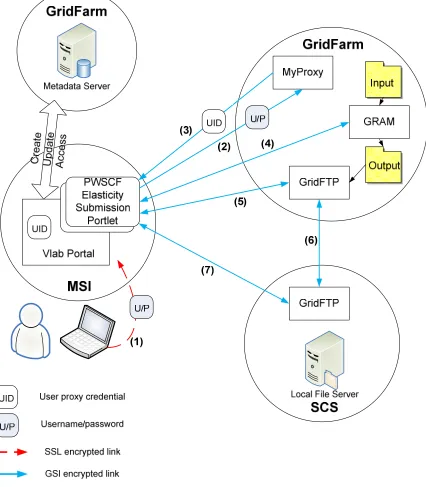
Plane-Wave Self-Consistent Fields (PWscf) [63], part of the Quantum Espresso suite is used to do simulations for computational material science. It is desirable to make PWscf into a gateway because PWscf requires challenging processes. These processes include computational experiment preparation, running applications and evaluating results either in the visual or non-visual environments. Our main contribution to VLab is managing the complicated flow control of processes by the Web interfaces.
Any given tasks might involve input file generation, code submission, data analysis, and visualization. These tasks are often linked and have dependencies among them. A need thus arises for a workflow and associated software, such as a workflow tags. Workflows might themselves be composed of simpler workflows. An example is given that illustrates the PWscf job submissions in section 4.2.
After we describe the community demands, we evaluate different Web application frameworks and portal frameworks. We found GridSphere and JSF are the best candidates, because JSF provides component based Web environment compared to equivalents JSP and Velocity. GridSphere provide JSR 168 standard portlet component model with a robust framework, well supported and maintained. We then developed a fine grained component model to build portlets out of reusable tags. This improvement guarantees lower cost and time contribution, and rapid development.
2.2.2
User scenario for scientific workflows
Users are looking from their specific perspective. When you talked to people from different communities, you will see the problems and concerns are similar. We can group these concerns based on our observations as following:
1. Efficient user interface design 2. Manage services and applications 3. Follow the progress
4. Display the results
5. Manage all of the above in a workflow 6. User account management
These demands are common and there are common solutions to these problems. PSEs, Grid portals and science gateways all seek solutions to these issues. There are practice of submitting jobs, account management, interface design and display technologies available. But we wanted to introduce supporting workflows that tied into Web application framework as components. Thus, we sketched a solution to all possible demands from different communities. We applied an abstract component model which is tag libraries. For example, we can design interface and workflow for VLab people and deploy it as a science gateway. Similarly, we can design a different interface and workflow by using the same component model and make CIMA science gateway available.
2.2.3
User scenario for access control of portlets
students on CIMA portal. Crystal owners are responsible for publishing samples and their data. Crystallographer analyze and classify the samples, users can see their own samples and the others’ samples unless they are private. Crystallography labs are responsible for broadcasting video and lab conditions real-time. Students demand all these capabilities on the portal to understand crystal features. In some cases, students will be replaced by pharmaceutical companies that demand crystal analysis.
CIMA users have roles when they registered to the portal in first place. Portal administrators assign the users to the relevant groups. CIMA roles and groups restrict user access rights to the resources. Thus, every other user can see different sample data on their window, and they can customize display on demand. To this extent, CIMA portal is a science gateway to Crystallography people that they can share data and make collaboration on the data.
2.2.4
User scenario for Web 2.0 portals
In one step further, we want to build Grid portals out of Web 2.0 widgets. Thus, Grid portals run as thin clients on the client side browsers. Grid gadgets will exist in public repositories and the users can integrate these features to their portal pages with no hassle. As Web 2.0 tools growing up, we need to adapt existing security methods to protect Grid resources without any breaches. So far Grid servers apply tight security policies and mechanisms to Grid services. Gadgets also should support these security measures to end up with integrity.
2.3
Grid programming interfaces
2.3.1
Java Commodity Grid Kit
Java Commodity Grid (CoG) Kit [66] enable Grid users, Grid application developers, and Grid administrators to utilize, program, and control Grids from a higher-level framework. Java CoG Kit allows for easy and rapid Grid application development. It also encourages collaborative code reuse and avoids the duplication of effort among problem solving environments, science portals, and Grid middleware.
OGSA Grid services are interfaced by Java CoG abstractions [62]. These programming interfaces have capabilities to generate proxy certificates, submit jobs, transfer files and make file operations. They also provide composite task submissions and their handling. We use Java CoG abstractions to build OGSA based Grid clients.
2.3.2
Condor Web Services
other than the standard Condor command-line tools. This provides an XML abstraction of the programming interfaces that can be bound to any programming language such as Java. Therefore, Birdbath client stubs can be generated from the Birdbath Web service interface. We have built Birdbath client stubs as an API to program Condor Grids.
2.3.3
Simple API for Grid Applications (SAGA)
Chapter 3
Survey of technologies
3.1
Introduction
In this chapter we review state of the art in science gateways and best practice technologies. Various important specifications and industry standards exist, and these must serve as the starting point for our work in Grid portal area. The next sections summarize Grid, Grid portals, and Web services technologies. Portal frameworks and portlet standards are reviewed in the later sections. We then review Web application frameworks after Grid account management.
3.2
Grid Portals
of abilities can be supported by Science portals. Grid portals have advantages as follows: a) provide single point of access to distributed information and services, b) utilize Grid services on behalf of the user, c) endure environment changes at remote hosts such as policies sometimes differ and allocations of servers change.
In early stages of building science portals, stovepipe solutions have been used to build Web interfaces for Grid portals, but the usage of emerging technologies among Grid community required them to adopt a portlet component model for Grid portals.
A number of Grid portals exist including QuakeSim portal for earthquake sciences, VLab portal for Material Sciences, TeraGrid User Portal [71] for managing TeraGrid resources and LEAD portal for atmospheric discoveries. Grid portals utilize Grid resources, services and data on virtual organizations. Grid portals [32] address the problems of building Web applications to enable virtual organizations on the Web. These problems can be summarized as below:
• Security services
• File transfer management
• Job management
• Accessing to metadata services
• Resource sharing
Grid portal efforts generally have focused on Grid portlets. Grid services are wrapped by equivalent client components that are called Grid portlets. Grid portlets generally points out solutions can be summarized below:
• Supporting portlet development
• Integrating collaboration tools to support user communities
• Developing supplemental Grid services to manage science applications and data.
3.3
OGSA and WSRF services
Open Grid Service Architecture (OGSA) [3] is a comprehensive architecture for the Grid based on Grid services and Web services. Web Services Resource Framework (WSRF) [60] is a set of specification by OASIS [72]. These specifications describe how to implement OGSA using Web services. Globus toolkit (GT) [33, 61] is one of the well known Grid service providers that support OGSA (GT3) and WSRF (GT4) based services . Virtual organizations (VO) can be built using GT. VOs either manage clusters on the systems where machines are locally located or VOs can construct a Grid out of several other VOs as well. The major problem of constructing Grids among different administrative domains is the requirement of major security policy enforcement. GT introduces Globus Security Infrastructure (GSI) [73] security mechanism that is credential based security that uses X.509 certificates. In this approach, there two types of certificates: 1) resource (or see terminology) certificate, 2) user certificate. All certificates are created and signed by Certificate Authorities (CA). There is CA signing hierarchy to allow different administrative domains to trust. User certificates are required to access VOs. Users also are registered to grid-map file which is an access control file for the Grid. Grid services have to comply with GSI security.
3.3.1
Globus job management services
The GRAM service enables Linux based systems to run remote scripts by using daemons called Gatekeepers. Web Service GRAM (WS-GRAM) service differentiates from non WS-GRAM services by using ‘sudo’ accesses on Linux. GRAM service basically runs any command line script on behalf of the user. To abstract command line shell, they have introduced RSL [2] description language. The disadvantage of GRAM is to use socket connections that sometimes causes problems when the systems use firewalls.
3.3.2
Globus File Management Service
Another crucial service is to transfer files between remote hosts so called GridFtp. It is a FTP protocol that builds GSI security on top of it. GridFtp allows third party file transfers as well as file operations such as making directories, renaming files, deleting files etc.
3.3.3
Monitoring and Discovery Service
MDS provides metadata information about Grid system. In other words, MDS catalogs resource information with an annotation schema. This service gives users information about system maintenance, number of machines on the Grid, the load of system, available compute power, amount of data storage etc.
3.3.4
Condor
boundaries. Condor-G [69] incorporates Grid technologies and provides interoperability with VOs are managed by Globus. However Condor is only available on the shell environments and being managed by using command line scripts. This drawback makes Condor platform dependent. To allow platform decoupling, they have used Web services and have provided Birdbath [2] services. Thus, using Birdbath service interface, you can generate client stubs for any platform such as Java, Python, and C#.
Although Condor-G allows user submitting jobs to run on high performance resources, it does not support multiple job submissions. To overcome this side effect they have introduce Condor DAGMan [2] to compose DAG graphs among Condor resources.
3.3.5
Credential management service
MyProxy is a credential repository introduced by [2]. MyProxy stores credentials on behalf of users in repositories. When user wants to use its credential, it gets the credential by using username password pairs different than certificate pairs. MyProxy prevents to type credential password frequently.
3.4
Web services
A Web service is a software system identified by a URI, whose public interfaces and
bindings are defined and described using XML. Its definition can be discovered by
other software systems. These systems may then interact with the Web service in a
manner prescribed by its definition, using XML based messages conveyed by internet
protocols [51].
Web services are defined using the Web Services Description Language (WSDL) [74]. WSDL describes the location of services, types of ports, method descriptions, types of messages so on. WSDL is a platform independent XML document which Web services clients can be created from. Therefore, many different clients can talk to Web service using WSDL description through SOAP channels.
SOAP is a wire transport protocol on top of Transport Control Protocol (TCP) layer. SOAP basically provide request/response paradigm by using message envelopes. Each message is packaged in an envelope with a return address. Envelopes contain the message body. When the message arrived at the service location, SOAP engine encrypts the envelopes and extracts the message itself for the application.
Web services are used in numerous distributed applications. There are services available all sorts of applications like industrial, commercial and academic. To discover available services, Universal Description Discovery and Integration (UDDI) [75] is defined to advertise services. The clients search through UDDI repositories to explore new services or similar services what they are looking for.
3.5
Portal frameworks and their components
Web-based portals leverage personalized content and provide access to backend resources. First of all, we need to distinguish portals and portal frameworks. Portals are deployed instances of portal software frameworks that are adopted for specific application or science Grid. For instance, VLab [2] and CIMA [2] portal projects have adopted GridSphere as a framework, but many other Java frameworks exist, such as uPortal, Jetspeed [21], eXo [77], Liferay, and so on. It is desirable to be able to exchange software components between portals and to be able to swap frameworks (e.g. GridSphere for Jetspeed2). Portal frameworks utilize various components known as portlets. Portal frameworks plug these capabilities within deployment descriptors for these portlet Web applications. The framework provides a portlet container and portal specific capabilities such as login, access management, and layout. The Java JSR 168 specification provides the means for building standard portlet frameworks and portlet components.
JSR 168 defines a Java API for portlet development and provides portlet lifecycle management. Portlet Web applications are interchangeably used among portal frameworks such as GridSphere, uPortal, Jetspeed2, and others: one may use the same portlet Web applications without modifying the application code. Portal frameworks do require portlet registration/deployment in a container specific procedure, as well as some container specific modifications to the Web application’s configuration file.
Each portlet application renders an HTML markup fragment for presentation. Portal framework aggregates portlet markups a unified style and display them in one Web page.
3.5.1
Shortcomings of JSR 168
JSR 168 has from our point of view several significant shortcomings. JSR 168 does not standardize description of users, groups and roles. Thus, portal frameworks provide their own style of user and group concepts that may cause mapping problems. We have faced such kinds of problem with the CIMA portal. More importantly, these components and others are not clearly defined as Web services. This creates problems when using the portal as a front end to Grids and Web service oriented science applications. Another major shortcoming of the JSR 168 specification is that it does not provide a sophisticated development environment for creating the portlets themselves out of reusable components.
3.6
Grid account management
Portals in general manage user accounts in implementation specific and usually non-portable ways. But Grid portal user management requires handling standard Grid users with their credentials. Credential mapping with user identities are always issue with Grid portals. There are various solutions are studied by Grid community.
Point-solution attempts to Grid authentication and authorization problem are available such as Grid Account Management Architecture (GAMA) [79] for Grid account management and Portal-Based User Registration Service (PURSe) [80] for Portal user management.
Grid portlets mentioned so far assumes portal users already have Grid accounts available. They only issue proxies to existing Grid accounts. However, there are portal and Grid account management portlets handle Grid account creation and management. GAMA and PURSe are well known Grid and portal account management portlets in open Grid community. Both systems have pros and cons in terms of their designs and underlying technologies. Also portability of servers and user interfaces are general aspects to be considered. The comparison of those account systems are shown on the Table 3.1.
3.7
Grid authorization infrastructures
permission to access the resources. They facilitated Security Assertion Markup Language (SAML) [85] attribute assertion model within this architecture.
Table 3.1 Comparison of GAMA and PURSe
Criteria PURSe GAMA
Server
SimpleCA has to be on PURSe server.
Same with GAMA
Communication
Non-secure server communication
Secure server communication
User interface Standard JSR 168 portlets
Portlets tightly integrated to Gridsphere authentication
module
Access
PURSe server only accessible by local JSP pages
GAMA server provides Web service access
There exist external services providing single functionality like Central Authentication Service CAS [86] for authentication or PERMIS [87] for authorization. Also those available services are not enough to enable a portal entirely service based. If the portal services are available, but there is no portal services coordination available for portals as Web or Grid services.
3.8
Web application frameworks
describing their content. Static content does not change; it is always output the same way ignoring any external variables. For example, HTML provides a means to serve static content. HTML describes the way a document should be displayed in a browser but provides no means to change that display. On the other hand, dynamic content can be influenced by external variables often passed through the URL or HTTP Headers. For example, Java Server Pages (JSP) provides a scripting engine that allows accessed pages to output different HTML based on external variables. The client-server model the Web uses only allows two points where dynamic content can be processed on the client and/or the server. Due to limitations on the client side, complex operations are left for server side executing. With standardizations from the World Wide Web Consortium (W3C) [88] client side technologies like JavaScript should work similarly among standard compliant browsers. Of course, many browsers do not conform to the standards, leading to many complications. However, JavaScript provides a common platform for dynamic content on client side and introduce many benefits over standard server-side manipulations. Most Web sites and/or Web applications employ a combination of client-side and server-side technologies to provide rich dynamic content to its viewers.
3.8.1
Java Server Faces (JSF)
With standard JSF add-ons it has become easy to bridge JSF applications into portlet applications. Such components include so-called "bridges" currently being developed by Apache [90] that serve the purpose of adapting JSF applications to function as individual portlets within standard containers. These bridges have worked to optimize development time of the VLab portal.
3.8.2
Web Interfaces and JSF
JSF is a dynamic Web application framework that similar to other dynamic Web application templates like Velocity, JSP and Spring. JSF provides dynamic contents using Java Servlet [44] technology. Dynamic contents are generated based on request and response paradigm. Unlike static HTML pages Web application frameworks allow interaction with users. The server pages take requests, process them and respond to the user through a Web interface.
JSF applies MVC software design pattern [31] that decouples data, controller and user interface. The data corresponds to model in JSF terminology is called backing beans. The controller corresponds to JSF servlet that manages user requests. Finally, the view corresponds to Web interfaces of JSF. This architecture separates the data access and user interaction. Also MVC allow reusing backing beans within different applications without rewriting them.
<f:form/>, <h:commandButton> etc. These tag instances binds attributes to backend beans that defined on the configuration file of the application called faces-config.xml. Thus, we can say that JSF uses Model2 (is a variation of MVC) pattern better than JSP. Model and View logics completely separated; Model is provided by using Java Beans. JSF Core tags and HTML tags enable developers to inject bean methods by using attributes.
3.8.3
JSF Portlets
JSF portlets are built on top of the standard portlet API (JSR 168) so that allowing them to be deployed within various portal frameworks. Java portlet development generally requires implementing portlet API within the Web application. But there is a tool called JSF portlet bridge that makes portlet programming easier for developers. As a result, developers are not required to construct their portlets using the portlet API directly.
3.8.4
JSF portlet bridge
Chapter 4
Applications
4.1
Introduction
The “Grid tag libraries” has been used in real applications like The Virtual Laboratory for Earth and Planetary Materials (VLab) [15], Common Instrument Middleware Architecture (CIMA) [92], and Indiana University Big Red portal [93]. We summarize the efforts to build science gateways on the following use cases. We also evaluate and discuss repeated problems and their solutions sticking with these practices.
4.2
VLAB: Virtual Laboratory for Earth and Planetary
Materials Portal
The VLab is a National Science Foundation-funded interdisciplinary research collaboration whose primary objective is to investigate planetary materials at extreme conditions based on computational techniques to better understand the processes that create earth-like and other planetary objects. Such calculations typically involve hundreds or thousands of computer runs. These runs occur in stages, with complex interactions. They are often managed by several researchers. To address challenges in collaborative and distributed computing, VLab brings together a team that includes researchers in computational material science, geophysics, scientific visualization, Grid computing, and information technology. Additional information on VLab is available from [94].
additional constraint on our system is that it must be robust, i.e., fault tolerant. When working in a complex multi-user environment, it is inevitable that some components will fail. However, these failures should not affect the work of an individual researcher. Thus, we have chosen to connect the users of the systems (referred to as clients) and the various tasks requested by the users (storage, visualization, analysis, job submission, etc.) as services using NaradaBrokering [95], a middleware system that builds in many of the required features.
In its initial phase, VLab follows a well-established pattern for building Grids: application codes on remote machines are accessed securely through Grid services through a browser portal. This follows the common three-tiered architecture. A user interacts with a portal server through a Web browser. The portal server in turn connects to remote Grid services that manage resources on a backend system that provides the computing power for running the codes. The longer term research goal however is to go beyond these traditional approaches. The distinguishing feature of our research is the use of the publish/subscribe paradigm, which completely decouples the clients from the services. Users have no knowledge of the resources allocated to their requests, although they will have the capability to monitor task progress.
the case of VLab. Instead, we need to collect all capabilities within a single portlet application and to handle complicated PWSCF-based job executions and file transfers in a sequence; that is, we must define dependencies between atomic job tasks. Consequently, we have determined that we can represent job dependencies using DAGs.
To implement these graphs, we chose the Java CoG abstraction [62] interfaces for DAG executions in Grid. These provide a convenient Java programming interface that can be easily integrated into Java portlets. However, we identified the need to provide a higher-level development environment that encapsulates common tasks needed to assemble a DAG in a portlet. Our approach is to design XML-based tag libraries for expressing DAGs and to embed them in the Web pages. For that reason, we found the JSF application framework to be appropriate. JSF is a component-based Web framework that can be extended to add new components, such as our DAG XML tags. As we discuss in this paper, we have implemented and have used initial prototype of Grid tags within JSF. In case of VLab portal, we have learned that we need a more comprehensive workflow engine to support loops, parallel jobs and conditional branches.
4.3
QuakeSim Portal
The QuakeSim portal is a problem solving environment to develop a solid Earth science framework for modeling and understanding earthquake and tectonic processes. The multi-scale nature of earthquakes requires integrating many data types and models to fully simulate and understand the earthquake process. The QuakeSim gateway includes portlets and services for accessing real time and archival data. The data sources (Global Positioning System data, earthquake fault models) can be integrated with computational applications for event detection and seismic deformation calculations. These latter include finite element methods (GeoFEST [50]) that can be computationally intensive and best run on parallelized platforms. In this study, we aim to utilize TeraGrid [4]resources to solve computational problems of QuakeSim project [96].
manage jobs and to build multiple steps of jobs that depend each other (i.e., to handle simple workflows).
QuakeSim’s computational services are suitable for many of its applications, but it must be extended to support more extensive computations for parallel applications. Grid services of TeraGrid (e.g., Globus, Condor) provide this capability, so we need a way to modify existing JSF-based portlets to work with these services. To simplify this transition and to provide test cases for our GTLAB framework, we decided to combine the two efforts.
We describe the application of GTLAB to QuakeSim as a case study. In this case backend applications run on TeraGrid and we access these legacy applications with GRAM, GridFtp, MyProxy services. We will show the integration and implementation of Disloc and Simplex portlets with GTLAB. We also evaluate development time and runtime performance results based on the tests that we conducted on different geographical locations.
4.3.1
QuakeSim Gateway Architecture
Instead of altering QuakeSim service interfaces synchronizing with Grid services, we remove the Web services layer. Therefore we use Grid services to invoke remote applications, to make file transfers and to provide security. However, we also need to allow implementing workflows within the scope of QuakeSim scripts. In other words, we are able to translate Ant scripts to series of Grid service invocations that are represented as graphs. This new approach has advantages to the previous architecture. First, there is no need to alter service interfaces when the Ant scripts change. Second, in the previous system, service clients cannot access the service layer to change scripts. Therefore the clients have to request required changes that involve additional management efforts as well.
Figure 4.2 QuakeSim portal architecture with Grid services invocations of TeraGrid nodes.
such as GRAM for invoking applications or GridFtp to transfer files from one server to another.
4.3.2
QuakeSim Portlets
QuakeSim portal previously built and production with different technologies. In this case study, we rebuild QuakeSim portal with Grid portlets by integrating GTLAB. Therefore, we choose GridSphere portal framework to build QuakeSim portal. In the building process we provide portlets for QuakeSim applications including Disloc and Simplex.
<o:multitask id="multi" persistent="true"
taskname="#{resource.taskname}">
<o:myproxy id="mypr" hostname="gf1" lifetime="2"
password="manacar" port="7512" username="manacar"/> <o:jobsubmit id="make" arguments=
"/home/manacar/disloc-work" executable="/bin/mkdir"
hostname="gf1.ucs.indiana.edu" provider="GT2"
stdout="/home/manacar/tmp/out-make"/>
<o:jobsubmit id="disloc"
arguments="/home/gateway/GEMCodes/Disloc/input.txt
/home/manacar/disloc-work/disloc.out"
executable="/home/gateway/GEMCodes/Disloc/disloc"
hostname="gf1.ucs.indiana.edu" provider="GT2"
stdout="/home/manacar/disloc-work/out-disloc"/>
<o:dependency id="dep" dependsOn="make" task="disloc"/> </o:multitask>
Figure 4.3 Disloc portlet page contains multi-staged jobs with DAG representation
4.3.2.1 Disloc Portlets
command-line tools or shell scripts. But portal users can only access by using Grid services to access TeraGrid in a secure way.
GTLAB provides a client layer on top of Grid services that is bridge to the portal users. In other words, the portal users can access Disloc transparently through portal user interfaces (i.e., Web forms). Not only using an application is possible, but also a DAG could run the multiple steps of Disloc such as in Figure 4.3 making a directory on the file system to save output file, then running Disloc application that depends on the first task.
4.3.2.2 Simplex Portlets
Simplex is an inversion code based on Disloc. Similar to Disloc, Simplex applications are run by DAGs that describe order of the tasks and their dependencies. Then JSF pages collect parameters and information about the task to submit it to TeraGrid.
4.4
CIMA: Common Instrument Middleware Architecture
Portal
1One of the key issues in developing shared instrument systems is how to create an open and flexible approach to user interfaces for access to instruments and the data streams coming from them. In related work [98] we have described how portals can be used to organize access to instruments through the Common Instrument Middleware
1





![Figure 5.6). A context server [15] provides archival facilities that store bean values and](https://thumb-us.123doks.com/thumbv2/123dok_us/8134935.243245/84.612.108.537.140.477/figure-context-server-provides-archival-facilities-store-values.webp)