Abstract— Over the previous few centuries, technology has converted massively from being a desktop personal computer to handheld mobile phones, with lower energy consumption of raw computing power. This computability is now incorporated with other systems as well as isolated to a single device. This paradigm was first noted in cyber-physical systems with the introduction of cloud services. The evolution of Artificial Intelligence(AI) with cloud computing and the importance of this field in human life, induce us to make simple and efficient talkative assistant robot for indoor navigation. The navigation system in outdoor typically rely upon Global Positioning System (GPS) but the indoor navigation systems have to rely on different technologies, as GPS signals cannot be received indoors. Thus, several technologies have been proposed and implemented over the past decade to improve navigation in indoors. But they were costly and less effective. Therefore, we have proposed a system that assists humans to find their location in a conversational manner. The suggested system was constructed by introducing the advantages of a personal assistant device, Amazon Alexa, the cloud services of Amazon and its voice services for indoor navigation. A Raspberry Pi 3 Model B is used as the element of the hardware to provide our system with intelligent characteristics. You can trigger the speech service using the "Alexa" keyword. Using the voice command, the skill / application we created can be initiated. It operates a script on the cloud once Alexa is enabled, which runs a subroutine on the Raspberry Pi 3 in-turn to provide a path for that specific place. Once the Raspberry Pi calculation is finished, it sends the message back to Alexa. Alexa transforms the text into a voice and informs the user path.
Keywords: Artificial Intelligence, Global Positioning System, Raspberry Pi, Voice command.
I. INTRODUCTION
Technology is an element of learning that is constantly evolving and evolving. Intelligence is called the ability of a system to calculate, reason, understand interactions and analogies, learn from knowledge, store and collect memory information, fix problems, understand sophisticated ideas, use linguistic communication fluently, classify, generalize, and embrace fresh stuff. One of the categories of Intelligence is computing (AI) and is that the branch of technology involved with creating computers behave like humans. in keeping with the daddy of computing, John McCarthy, it's “The science and engineering of creating intelligent machines, particularly intelligent pc programs”. AI is achieved by studying how much human brain believes and
Revised Version Manuscript Received on 05 August, 2019.
Bharath Subramani, Assistant Professor, Department of Electronics and Communication Engineering, PSNA College of Engineering and Technology, Dindigul, Tamilnadu, India.
(e-mail: [email protected])
Deepika SP, Assistant Professor, Department of Electronics and Communication Engineering, PSNA College of Engineering and Technology, Dindigul, Tamilnadu, India.
[image:1.595.328.552.285.400.2]how people learn, decide, and operate while trying to unravel a drag, then exploiting the results of this research as a basis for creating smart software packages and systems. AI's two main wishes, original to develop knowledgeable systems − systems that display smart behaviour, learn, show, explain, and recommend their customers, and next to implementing Human Intelligence in Machines − make systems that perceive, believe, learn, and act like people.
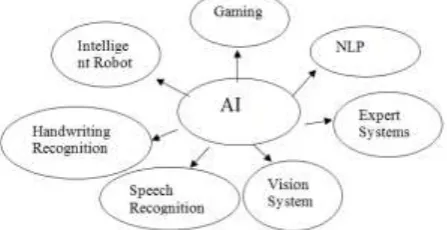
Fig 1 Applications of Artificial Intelligence In the time of genomics and proteomics, peptide based immunization structuring and immunodiagnosis is the best for infections running from jungle fever to disease. It does basically require distinguishing proof of areas in the pathogen local protein arrangements [3], which are perceived
by either B-cell or T-cell receptors [3]. The antigenic areas of protein perceived by the coupling destinations of immunoglobulinA significant focus of AI is the development of human intelligence-related laptop features such as reasoning, teaching, and problem-solving. The varied AI square dominant areas mentioned in Fig.1. The results of this research as a basis for smart computer code and systems development. The results of this research as a basis for smart code and systems development. AI's two main needs, original to generate excellent systems − systems that display smart behaviour, learn, show, clarify, and advise their customers, and next to implementing Human Intelligence in Machines − generate systems that comprehend, believe, learn, and act like humans. A severe AI thrust is in the growth of human intelligence-related laptop features such as reasoning, teaching, and problem-solving. Fig.1 lists the assorted dominant AI areas. Within the Forties, the field of AI work culminated in the invention of the Programmable Computing Machine, a machine supporting the abstract essence of mathematical reasoning. A years later, one of the key objectives of AI assessment is to allow machines to talk in natural languages such as English. Linguistic communication
A Robust Artificial Intelligence: Smart Indoor
Positioning System
method (NLP) relates to human intervention AI methodology with AN smart scheme using language communication such as English. Linguistic communication process is required if you want to conduct AN smart system like an automaton as per your instructions, if you want to listen to a call from a dialog based mainly on clinical skills, etc. The NLP is made up of two components. One is tongue understanding (NLU) used to map the specified input into useful depictions in tongue and to analyze completely distinct elements of the language. Different is the tongue generation (NLG) used to produce meaty phrases and phrases from some mental representation within the tongue type. Throughout the 90s, a brand new paradigm known as "smart agents" became widely recognized. Associate degree smart agent could be a system that perceives its environment and takes action that maximizes its potential for achievement. Language process engines with smart agent driven by sensitive search motors will merely beat people at sensitive general trifle queries within the original decades of the first twenty-first century. Due to its large number of prospective apps, indoor navigation can be a horribly active field of study. It's easy to look for us, even in a new AN city, with a smartphone in hand. But inside it is still easy to press for loss wherever signals are not correctly traceable by microwaves, the world positioning system (GPS) will be attenuated and dispersed by towers, walls and various items. In indoor navigation, the computer sphere undergoes a fundamental transformation. Cloud computing represents fresh sanctions in which even bigger amounts of information can be stored, handled and processed, yet new smart algorithms, apps, and experiences.
II. LITERATURE SURVEY
Wong Joanne, Sanna Taking, Nazrin Isa and Kok Chao1 proposed an application that tracks indoor positioning because using GPS in indoor navigation results in signal loss due to the contact of building walls. This system works with variable Wi-Fi access points available in smartphones and buildings. This system greatly reduces power consumption and complexity and also maintains accuracy and speed. Seema Rawat, Parv Gupta and Praveen Kumar2 designed a system using Automatic Speech Recognition (ASR). This system briefly describes its working, types, overview, history, future aspects and scopes. One of the trending applications of Artificial Intelligence is ASR. It is the voice respondent system in mobile application and helps in the lives of blind, deaf and physically challenged peoples. A.Ramya and T.Srihari3 proposed a model that controls various domestic appliances through the application of Raspberry pi through voice programmed by Python language. Dynamic Time Warping (DTW) recognizes the voice of the user. Raspberry pi is used to save energy, provides safety to home, elder and disabled people can access this easily. Abhiram T.S, Arya A.R, Aswin R.S and Jeena John4 proposed a model that mainly focuses on home automation with Artificial Intelligence thereby developing self-thinking home. This model uses Voice Recognition System and in this model, if the number of words reduces, accuracy gets increased. Raghvendra Priyam, Rashmi Kumari, and Dr Prof Videh Kishori Thakur5 proposed a system that uses speech recognition technology with Artificial Intelligence because using this user can do other
works simultaneously and can control appliances by voice input. This system uses four different speech enhancement algorithms to effectively control the machinery through voice. Jatin Borano6 reviewed the current progress of Artificial Intelligence (AI) technology, its advantages, disadvantages and applications. From AI approaches, the computing world has gained many benefits. The ability to learn from AI is more flexible and powerful. It is mainly used in real-time systems because of its fast response, low computational time and achieving parallelism. One of the greatest challenges of modern science is to make communication between human and computer. Mohammad Al Raba bah, Abdusamad Al Marghilani and M.A. Eyad proposed an application to transform wavelet for reducing the value of the artificial neural network for speech recognition task. This speech recognition system describes informative signs and voice signals and uses a Genetic algorithm to train the neural network.
This system improves recognition accuracy even in low noise situations. Pallavi V.Hajari and Ashwini G.Andurkar proposed a method for an intelligent home security system which consists of facial recognition for finding the face of a family member and voice recognition for finding the identity of words spoken by the persons. This method is implemented using Raspberry Pi because of its low cost, the stable operating system in real-time applications.
III. TECHNOLOGY STACK
We have incorporated a number of technical parts and developed a seamless functionality into this project. The following is a feature of our technological pile:
3.1 Physical Layer:
This layer contains the equipment that interact with the user.
Raspberry Pi Model B Raspberry Pi Sense Hat USB Speaker
USB Microphone
3.2 Application Layer:
The following elements comprise this layer:
3.2.1 Alexa Skills Kit (ASK) –
The Alexa Skills Kit (ASK) is a compilation of APIs, documents, code samples and instruments which enable us to quickly and easily add abilities to Alexa.
3.2.2 Amazon Web Services (AWS) Lambda –
AWS Lambda is a responsive cloud service, which checks and reacts to actions in the application using the user-defined, functions-defined codes.
3.3 Programming Layer:
The source code is published in Node.js for all our programs.
3.3.1 Node js –
Node.js is used with Raspberry Pi for seamless integration of AVS. It is called npm with many libraries that make the Node.js Package System a very effective and versatile programming option. Node.js is a Google Chrome-built JavaScript platform (V8 Engine).
IV. PROPOSED SYSTEM 4.1 System Overview:
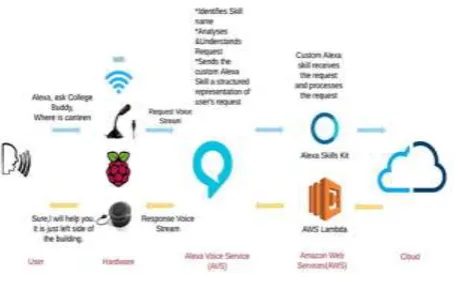
The following diagram depicts our system overview. When a user speaks, the audio input is given to USB microphone and is processed by Amazon Alexa. Our System relies on Raspberry Pi 3 Model B as it satisfies the hardware requirements and also does all the computations. Raspberry Pi is a mini computer which uses ARM 7 Microcontroller. It has four USB Ports, an Ethernet Port, an HDMI Port, an inbuilt 802.11n Wi-Fi, Bluetooth 4.0(BLE), a Camera interface, VGA Audio Port, GPIO pins and a micro SD card port. Its inbuilt Wi-Fi is responsible for connecting it to the cloud service. Alexa is a cloud-based service that supports all voice and machine learning recognitions. Alexa is able to construct with us thanks to our instruments, APIs and
reference solutions and documentation. Amazon published Alexa Voice Service (AVS) API, which enables Alexa to incorporate tailored capabilities into devices and apps. AVS is the smart voice control service. It offers automatic cloud-based voice recognition (ASR) and comprehension of natural languages (NLU). Amazon Alexa's voice is made by a lengthy artificial neural network of short-term memory. The Natural Languages Processing (NLP) algorithm enables Alexa to understand what the consumers say. Alexa utilizes NLP methods that have been trained by Amazon's designers and users to deal with customer demands and meet their
requirements. The AVS can be activated with the "Alexa"
keyword. The Self service APIs, tools, documents and code samples are included in the Alexa Skills Kit (ASK), which allow us to add Alexa's skills quickly and easily. "Alexa, ask my college mate where canteen is? The know-how / application that we have created using ASK can be initiated using the voice-command." The default wake term here is Alexa. It wakes up the machine and says the customer would like to speak to Alexa. Ask is the initial sentence used to indicate the sort of request that consumers use. My college buddy is the invocation name that users will say to launch the skill. “Where is canteen” is an utterance. When a user asks Alexa to open the customized skill, it is routed to AWS Lambda function. AWS Lambda is a serverless event-driven Amazon-based computing platform. It is a computer service that executes code in reaction to incidents and manages the computer resources needed by that code automatically. In Java, Python and Node.js AWS Lambda supports the code published, and Amazon Linux (including Bash, Go & Ruby) may start procedures in languages. Once Alexa is triggered, it sends a request to lambda in the form of JSON object and runs a script on the cloud written in Node.js programming language. We have chosen Node.js programming language as it can seamlessly integrate AVS with Raspberry Pi. It is a web server that opens a file on the server and returns the content to the client. It eliminates waiting and continues with the next request. Node.jss is called npm which comes with many libraries and makes the programming very cost-effective and flexible. The lambda function received the request and
[image:3.595.312.540.546.691.2].
Fig 2 System overview
synthesis Markup (SSML) value of the output text item, Alexa scans the JSon item and speaks the phrases. SSML is a billing language for the synthetic speech generation, which offers a normal manner of marking text. This output speech is given to the user through USB speaker.
4.2 Pseudo code:
"use strict";
var Alexa = require ("alexa-sdk"); var handlers = {
"CanteenIntent": function () {
this.response.speak ("Sure, I will help you. Go straight and take 4th left. Walk for 3 minutes. You will find canteen on the right side ");
this.emit (': responseReady‟); },
"LaunchRequest": function () {
this.response.speak ("Hello, I am College Buddy. Welcome to PSNA College Campus. I am here to help you to find your way");
this.emit (': responseReady‟); },
"CourseIntent": function (){
this.response.speak("The Seven Under Graduate Courses available in PSNA are B.E Civil Engineering, B.E Mechanical Engineering, B.E Electronics and Communication Engineering, B.E electrical and Electronics engineering, B.E computer Science Engineering, B.E Bio Medical Engineering and B.TECH information technology");
this.emit (':responseReady'); }
exports.handler = function (event, context, callback){ var alexa = Alexa.handler (event, context);
alexa.registerHandlers (handlers); alexa. Execute ();
};
4.2.1 Description:
Var Alexa = require (“alexa-sdk”); is used to include the Alexa SDK library in the lambda function.
When Alexa sends a request to lambda function, the script needs to handle those requests. All those requests are handled by an object called handlers. var handlers = { }
Adding handler for the intent: “CanteenIntent” :function (){ }
Adding response: Alexa SDK library includes a response. speak () and emit () methods, which together generate a JSON response when Alexa triggers any intent.
this.response.speak (““) method accepts the string response for when any intent is triggered.
this.emit („:response ready‟) method triggers the lambda function to respond with the ““string.
Launch Request: If the user invokes the skill with the invocation name but does not provide any command mapping to intent, then the skill will receive a Launch Request.
Lambda function triggers the export.handler () function every time an Alexa skill requests it.
4.2.2 Service Request for Intent in the form of JSON object:
{
"session": { "new": false, "sessionId":
"SessionId.4ec32de7-b373-4858-bd03-d858a3674d7b", "application": {
"applicationId":
"amzn1.ask.skill.f05feb05-768c-4423-b3bc-0caf01045a87" },
"attributes": {}, "user": { "userId":
"amzn1.ask.account.AGGRYATOPIENM3RMP6AF5TISG HCBFWRI3G7XB224WO5CI5UHOSXED6GQ7B7EIDAZ 3X5J7NDBI4AI6WEJJQWHA7FHPGJAGHEVOZK3SBG UFTI5S54SYKWBJ45OBUFKQ25LMVTSPPXBDYJY2C Z3QB7UA2OLPVK7BBV3AGICZ75PLWOTBVU3VNJX RDLEB7UWB7Y4N7WARRFMXQ34XAQ"
} },
"request": {
"type": "IntentRequest", "requestId":
"EdwRequestId.735068fb-3f41-420b-9ad4-df40d48accb3", "intent": {
"name": "CanteenIntent", "slots": {}
},
"locale": "en-US",
"timestamp": "2018-03-06T00:56:50Z" },
"context": { "AudioPlayer": {
"playerActivity": "IDLE" },
"System": { "application": { "applicationId":
"amzn1.ask.skill.f05feb05-768c-4423-b3bc-0caf01045a87" },
"user": { "userId":
"amzn1.ask.account.AGGRYATOPIENM3RMP6AF5TISG HCBFWRI3G7XB224WO5CI5UHOSXED6GQ7B7EIDAZ 3X5J7NDBI4AI6WEJJQWHA7FHPGJAGHEVOZK3SBG UFTI5S54SYKWBJ45OBUFKQ25LMVTSPPXBDYJY2C Z3QB7UA2OLPVK7BBV3AGICZ75PLWOTBVU3VNJX RDLEB7UWB7Y4N7WARRFMXQ34XAQ"
},
"device": {
"supportedInterfaces": {} }
} },
"version": "1.0" }
{
"version": "1.0", "response": { "output Speech": {
"ssml": "<speak> Sure, I will help you. Go straight and take 4th left . Walk for 3 minutes. you will find canteen on the right side </speak>",
"type": "SSML" },
"speechletResponse": { "output Speech": {
"ssml": "<speak> Sure, I will help you. Go straight and take 4th left. Walk for 3 minutes. You will find canteen on the right side </speak>"
},
"shouldEndSession": true }
},
[image:5.595.57.288.225.500.2]"sessionAttributes": {} }
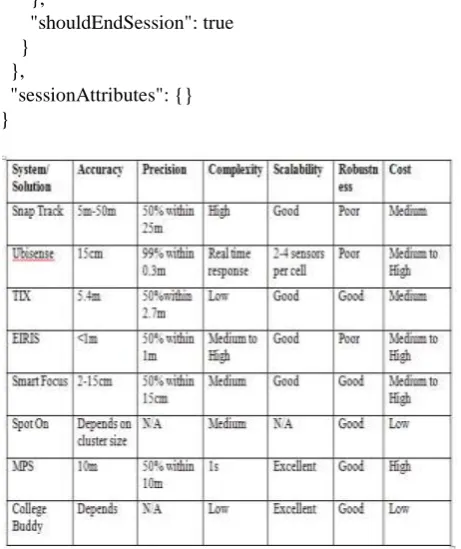
Table 1 Comparison of various Indoor Positioning Systems
V. ANALYSIS
Table 1 compares the current system with the proposed system and different performance measurement criteria are observed.
5.1 Experimental Setup:
We used the Amazon Alexa Skill, we created for the Raspberry Pi 3 Model B kit, to test our implementation. We used the Raspberry Pi, development purpose requires a power source and is powered using 1.5A mobile charger. USB Speaker and USB microphone are connected to 2 USB ports in Raspberry pi 3. Raspberry pi is Connected to a Wi-Fi which does not have any firewall setup on it.
Output:
Hello, I am College Buddy. Welcome to PSNA College Campus. I am here to help you to find your way.
User:
Alexa, ask my college Buddy, available UG courses.
Output:
The Seven under Graduate Courses available in PSNA are B.E Civil Engineering, B.E Mechanical Engineering, B.E Electronics and Communication Engineering, B.E Electrical and Electronics engineering, B.E Computer Science Engineering, B.E BioMedical Engineering and B.TECH information technology.
VI. RESULT User:
Alexa, open my college, Buddy.
User:
Alexa, ask my college Buddy, features of your college.
Output:
PSNACET is a leading internationally standardized organization in Tamilnadu. It was founded in 1984 in the periphery of the city of Dindigul in reaction to a government call for an engineering quality establishment in South Tamilnadu. This renowned institution currently has 7 UG and 8 PG Engineering classes, as well as MCA and MBA classes.
User:
Alexa, ask my college buddy, guide me to principal room.
Output:
From the gate go straight. You will find the Main Building, on the ground floor. Turn right and reach HRDC hall. Principal Sir Mahendran‟s room is on the left side
User:
Alexa, ask my college buddy, I want to go to trust office.
Output:
Go straight. Turn 1st left. Walk for 5 minutes. Turn left, you will find trust office on the left side
User:
Alexa, ask my college buddy, where is a canteen.
Output: Sure, I‟ll help you. Go Straight.Take the 4th left. Walk for 3 minutes. You will find canteen on the left side.
User:
Alexa, ask my college buddy, first-year block.
Output:
From your location turn right. Walk straight ahead towards the crossroad. Opposite to the tea shop.
User:
Alexa, ask my college buddy, Main computer centre. Output: Move straight to the road end. Turn left. Go straight. turn 1st left.
User:
Alexa, ask my college buddy, ATM
Output:
canteen and another one behind the main block.
User:
Alexa, ask my college buddy, EEE block.
Output:
Turn left move along the road to the crossroad. Turn right. Move front ahead. Turn right opposite to mechanical block and besides the tea shop.
VII. CONCLUSION
To conclude, with this project, users looking for assistance in finding their spots indoors could be expected to benefit. Different AI methods are important in the computer globe. An algorithm is not necessary to undertake a particular job. Their quick reaction and computer times, thanks to their parallel architecture, are also very well suited for real-time systems. This suggested scheme will serve its best among all current systems listed in Table 1 by reducing the energy usage and design complexity while preserving precision and system velocity.
REFERENCES
1. Wong Joanne, Sanna Taking, Nazrin Isa and Kok Chao, Indoor Navigation and Localisation Application System, 2016 3rd International Conference on Electronic Design
(ICED), August 11-12, 2016, Phuket,
Thailand,pp:327-331.
2. Seema Rawat, Parv Gupta and Praveen Kumar, Digital Life Assistant using Automated Speech Recognition, International Conference on Innovative Applications of Computational Intelligence on Power, Energy and Controls with their Impact on Humanity(CIPECH14),28 & 29 November 2014, Page no: 43-47.
3. Abhiram T.S, Arya A.R, Aswin R.S and Jeena John, Home Automation using Artificial Intelligence, International Journal of Advanced Scientific Technologies, Engineering and Management Sciences (IJASTEMS), Volume 3, Special Issue 1, April 2017, Page no: 274-277.
4. Raghvendra Priyam, Rashmi Kumari, and Dr. Prof Videh Kishori Thakur, Artificial Intelligence Applications for Speech Recognition, Conference on Advances in Communication and Control Systems 2013 (CAC2S 2013), Page No: 473-476.
5. A.Ramya and T.Srihari, Raspberry Pi (Model B) Based Interactive Home Automation System, International Journal of Trend in Research and Development, Volume 3(1), Page no: 438-440.