Theses
Thesis/Dissertation Collections
8-25-1990
Imagination makes things perfect
Donna Lee Rollins
Follow this and additional works at:
http://scholarworks.rit.edu/theses
This Thesis is brought to you for free and open access by the Thesis/Dissertation Collections at RIT Scholar Works. It has been accepted for inclusion
in Theses by an authorized administrator of RIT Scholar Works. For more information, please contact
Recommended Citation
by
Donna Lee Rollins
SUbmitted in Partial FUlfillment of the
Requirements for the Degree
MASTER OF FINE ARTS
MFA PHOTOGRAPHY PROGRAM
SCHOOL OF PHOTOGRAPHIC ARTS AND SCIENCES
ROCHESTER INSTITUTE OF TECHNOLOGY
ROCHESTER,
NEW YORK
Erik Timmerman, Chairman
Associate Professor
School of Photographic Arts and Sciences,
RIT
Edward Kinney
Instructor
School of Fine Art,
RIT
Martha Leinroth
Instructor
Title of Thesis:
"Imagination Makes Things Perfect"
I, Donna
Lee
Rollins
hereby grant permission
to the Wallace Library of R.I.T.
to reproduce my thesis in
whole or in part.
Any reproduction will not be for
com-mercial use or profit.
Introduction:
Basic Principles of Animation
Animation Techniques
Design Factors
Discussion
Film and Materials Tests
Shooting
Procedure TestsProcessing
Procedure TestsPre-Production
Methodology
Single-Frame Technique Explored
Pre-Production Organization
The Search for Talent
Production
Shooting
- On Location ProductionShooting
- In Studio ProductionProcessing
Pre-Crane Preparation
The Animation Crane
Movements of the Compound
The Animation Camera
Lighting
for AnimationAnimation
Filming
Custom Lab
Processing
of 16mm StockEditing
ProceduresThe Audio Track
Final Presentation
Conclusion:
Appendix:
Glossary
of Animation TermsGlossary
of Computer Animatiom TermsThesis Visuals and Excerpts
Soundtrack Dialogue
Computer Sequence Print-Out
At the core, animation relies on
fundamental
principles of motion and mechanics, plus the comprehension of effects and techniques associated with the operation of the animation camera and crane,
(see
glossary)Film animation
is
a visual communication method with thepotential to both clarify the complex as well as reveal the unseen. It differs from live-action
film,
which records a scene at either18 frames
(silent)
or 24 frames(sound)
per second,in
that ituses a frame-by-frame
(single-frame)
cinematographic style. In thistechnique,
the camerais
stopped after exposing one frame or several frames to allow for adjustments or replacement of theimage
to enhance theillusion
of the next frame's movement. This methodrequires considerable conceptual thinking, basic manual
dexterity,
and
highly
intensive and skilled labor to achieve the required ordesired effect.
Animation has its own characteristic ways of "stylizing" nature, of simplifying events or situations, and exposing their
component parts for better understanding.
By
employing a series of live-action, motor-driven film stills in an animated style, identification with and recognition of reality appears more immediate
for the viewer andis
more easily coupled with the presentation of an analytical viewpoint.
The use of a variety of graphic styles to
illustrate
different principles imbues animated film with
highly
symbolic powers.This factor, in and of
itself,
serves to lift animation from arepresentational level to a more complex artistic mode.
Any
suchdemonstration of the innate nature of an instance or event
is
alde-Animation Techniques
The essence of frame-by-frame
filmmaking
is the creation of theillusion
of movement, or action, through the sequential exposure ofindividual
images
or artwork. Full animation is described as using10 or more
(up
to24)
complete and distinct drawings per each secondof film. In limited animation, the number of
key
positions assumedby
the artworkis
proportionately increased(to,
say, 5 images persecond of screen time), and consequently, the viewer sees these main
postures or poses for a longer time, while 'in-between' drawings or
images are fewer in number. The use of rapid-advance photographic
images
is
well suited to the idea of limited animation, especiallysince the quality, or resolution, of the artwork used and seen on
the screen
is
more photo-graphically correct and complete.It is apparent that 'timing1
is one of the factors from which
the handmade medium of frame-by-frame film derives its visual flex
ibility
and control. Since time operates on several levels, including
the gestures and movements of individual objects, the pace ofaction within a scene, and the rhythm of scenes within a segment,
time and
timing
may be considered the foremost element(and
mosttechnical consideration) of animation. Timed gestures
help
definethe character, accentuate important action, and establish the bal
ance between the movement and activity necessary to communicate the
substance of the situation. In order that the film avoid
becoming
staid or appear static, pacing, or the rate at which the action un
or transitional scenes, that serve to order and set the rhythmic
tone of a film. That the piece builds on and
increases
in intensity from scene to scene adds to the
complexity
and poignancy ofthe piece as a whole.
Speed in animation operates in direct relation to the number
of frames occupied
by
images
in the film, compared to andin
combination with the speed of projection. The more frames a movement
takes, the slower
it
will appear on the screen. Conversely, thefewer the
frames,
the faster the action. Since the standard speedof a cinematic soundtrack
is
scaled to 24 frames per second of film,and since this can also be expressed as a calibrated relationship
between the number of frames to the parts of a second, the opportun
ity
exists in animation for a wide range of possibilities for actionand movement. In order to achieve the appearance of natural motion
in limited animation, a subject under normal circumstances will fall
within the range of 2 to 4 frame exposures per image. It should be
pointed out,
however,
that the speed of an animated subject is ofnecessity determined with respect to a variety of
factors,
including
the size of the subject
in
the frame, its position in theframe,
itsrelationship to other objects in the scene, and the specifics of the
movement to be performed. Needless to say, the apparent speed of the
subject may not always be the same as the actual speed the animator
is
attempting to convey.Design Factors
In animated
film,
images in front of the viewer passin
rapidby
the composite effect of the speed at whichthey
appear, the typeof action
they
present, the development of successiveimagery,
andthe tone or mood of the setting. With this in mind, I began
defining
an approach to visually represent the
internalized
and(usually)
emotional state of 'imagination'.
Using
recognizable scenes taken fromexternal experience, the mental pictures of the
imagination
rely ona kind of
logic,
even though scenes are manipulated and ordered tofulfill certain wishes or desires. In adopting a similar, logical
premise, I rejected the mastery of complex or sophisticated
imaging
devices
in
favor of a synthesis of aesthetic and expressive manners.The choice of materials and tools was crucial to the experience
and required
interplay
between fundamental perceptual skills and newexploratory exercises.
By
identifying
options and considering somealternatives, the project was delineated into discreet operational
portions, each utilizing a different process or technique that was
to necessitate different specialized equipment:
1)
Preparation of artwork orimages,
including
shooting, andprocessing techniques;
2)
Pre-production work,including
sequencing, timing, etc;3)
Camera work, or rephotographing of artwork on the crane;4)
Audio trackdefinition,
including
scripting, music, soundeffects recording;
5)
Post-production editing and mixing.In effect I was to assume the role(s) of artist,
designer,
cameraman, goofer,
director,
lab technician, custom printer, layoutartists, retoucher, cinematographer, editor, sound technician, audio
Film and Material Tests
The search for appropriate materials to produce the visual im
pression needed to evoke the desired response from the viewer lead
me to examine the properties of several still films for both their
graphic appeal and perceptual expediency.
Kodalith Ortho Type 3 Film
is
an extremely high-comtrast,orth-ochromatic film designed primarily for making line and halftone neg
atives or positives for reproduction of drawings. Available in both
sheets and rolls, this film has a wide exposure latitude, requires a
1A
(red)
Safelight forhandling,
exhibits an exposure speed of aboutISO 5 to ISO
15,
and may be processed(depending
on the effect desiredin any of five different Kodak developers
(including
paperdeveloper)
for
2-
minutes at 68- Pre-loaded in35mm,
36-exposure cassettesby
Kalt
Corporation,
this film wasinitially
attractive for itsbold,
gestural descriptiveness .
By
reducing the subject to broad areas oflight and shadow, and
by
removing suggestive(i.e.
distractive)
detailfrom the scene, movement and expression could be emphasized. Although
a seemingly
ideal
choice for the simulation of emotive representationthe unusually slow film speed rendered it virtually useless for fast
paced, motor-driven action
-an underlying technical strategy of the
project. The languid exposure index necessitated that tests with
this film be conducted under extremely bright daylight conditions
which would prove difficult to simulate or control in-studio.
(The
high contrast tests with this film were eventually employed as
image
and white film used
primarily
in scientific, medical,biological,
and document photography, but
is
also suitable for special effectsapplications due to
its
extended sensitivity range. Available in135 magazines and 50' 35mm rolls, this film must be loaded and un
loaded
in
total darkness to avoidfogging,
exhibits a recommendedexposure
index
of ISO 20 to ISO 200(depending
on light source andfilter
factors),
and may be processed in D-76 undiluted for 11 mins.at 68- Rated at ISO 50 with the suggested Wratten 25
filter,
Irated
it
ISO 100 without a filter for my rapid advance camera tests.The uncommon tonal shifts
inherent
in this film's visible and invisible spectral sensitivity served to exaggerate and enliven the
transition from
image
to image. The appearance also seemed tosuggest the addition of
hand-coloring,
a particularly appealingaspect to me and one rationale for an
initial
testing
of this unusualemulsion. Unfortunately, the "Kigh Speed"
on the label of this film
is
a misnomer, since copious quantities of electromagnetic radiationare necessary for an image of distinct sharpness. An alternative
and equally
frustrating
problem of infrared film stems from itssensitivity to
heat,
which produces unwanteddensity
in the form ofexposure
fog
along most edges and across the first few frames of mostrolls. Obviously, for my purposed use of shooting action
in
sequence,each and every frame
is
not onlyindependently
important,
but ultimately dependent on each successive image
in
order to sustain continuity. Since imagined visualization is ground in logical representa
tion of
ideas,
readily apparent and clearly understandableinforma
tion is required to convey the necessary essence of the scene.
Kodalith Fine Line developer recommended for processing. Although
increased
speed was promised for this special purpose black andwhite reversal film when processed
in
Kodak D-lldeveloper,
theeffect was marginal. The graphic appeal I had hoped to obtain in
an unsual emulsion proved
inappropriate
forrecording
motion abovea shutter setting of 1/60 sec,
forcing
me to abandon graphic artsand
speciality
films as a primary consideration for the project.Tri-X Pan
Film,
a Kodak work horse with deserved attributes oflatitude and availability, is capable of excellent sharpness, full
tonal rendition, and good resolution. Rated ISO
400,
this film isrecommended for
dimly
lighted subjects or fast action, and is alsouseful for scenes requiring good depth of field or fast shutters.
Produced primarily for the 35mm format and easily developed in a
wide variety of over-the-counter solutions, my tests required that
I 'push'
the exposure index to ISO 1600 and then 'reticulate' the
emulsion
in
order to enhance its pictorial appearance while raisingthe image contrast through extended processing. This strategy worked
well
initially,
but the graphic effect inducedby
reticulation wasthwarted
by
the minimal amount of enlargement needed(no
more than3"x4")
for use on the animation crane.Reviewing
the literature providedby
Kodak on their range ofblack and white films in Kodak Professional Black and White Films
(publication
F-5)
lead me to test KodakRecording
Film 2475. Listedas a very high-speed, coarse-grain panchromatic
film,
it
is recommended for photography
in
low light levels of existinglight,
orwhere very fast shutter speeds are coupled with small apertures.
the bulk of my rapid-advance photography. With emulsion charact
eristics of coarse grain and a low degree of enlargement possible,
contrast was
readily
increased
through a 9 minute development timeat 68
in
Kodak DK-50.Recording
Film2475,
then,
satisfied themain technical concern of matching a compatible exposure index with
sufficient subject movement.
Shooting
Procedure TestsIn-studio tests with contrasty, uni-directional and
(what
Iterm)
theatricallighting
produced mixed results. The subject lostsubstance
(resolution)
when moving out of the line of direct lighting,
causing eitherblurring
of the figure orinsufficient
exposuredensity,
or both. In these first tests I used classmates and friendsas models, resulting in a look of natural spontaneity and an unex
pected, but welcome, sense of candor. The most important element of
the studio tests was the recording of explicit facial expression,
without precise
detail,
and subtle gestural posture needed to conveyto the audience the desired emotional intent. This cinematic aspect
of the shooting sessions,
in
which I attempted to capturefeeling
through extended-frame sequences, was critical to the subsequent
development of both visual impact and narrative cohesion.
Sample Test Shoot:
Location: Upperclass
Lighting
Studios, GannettBuilding
Equipment: 35mm camera with 3fps winder; quartz-halogen
adjustable spotlight on overhead boom
reflectors on both sides and front of subject
Exposure: f/8 at l/60th second in "sequence"
mode
Action: Figure
slowly
turns whilespeaking
into receiverProcessing
Procedure TestsFollowing
Kodak's suggestions, andin
an attempt to increasegrain and contrast, I opted for extended
development
of my film inDK-50. One roll was processed in D-19 for 6 minutes, since it was
predicted
(by
Kodak)
that this would raise the apparent contrast ofthe
image,
but no appreciableincrease
or overall graphic enhancement was obvious.
The
idea
of makinglarge,
16x20 contact sheets of each roll,instead
ofblowing
up each exposureindividually,
was promptedby
theavailability
of a Labrador 8x10 condenser enlarger located in theMFA Darkroom complex. Two lenses were on-hand for use with this
venerable machine; one 300mm wide-angle and one 360 normal Schneider
lens . On
being
advised that the slightly longer lens exhibited moreapparent sharpness, my first set of large B&W contact sheets were
made with rows of 2-g"x3V' images. It was only later, after I had
reacquainted myself with the rudimentary functions of the animation
crane, that I remembered the minimum "field size"
requirements for
the compound bed were 3"x4". The shorter, 300mm Schneider lens thus
proved more suitable for the enlarging task, although fewer frames
per roll were capable of enlargement. Ultimately, rows of
images
3 frames across and 4 frames down were prepared on
double-weight,
Kodak Polyfiber paper, G surface
(for
later retouching and coloring),with a #5 Ilford 6"x6"
and
heat-absorbing
glass of the enlarger. The high-contrast filtration was employed to enhance the appearance of the melodramatic
lighting
andincrease
the graphic look of the subject.The Labrador 8x10 unit
is
equiped with a glass negative carrierthat required constant and continuous
inspection
and cleaning toreduce
(since
it
could not be eliminated!) the amount of dust andparticulate matter observable on the contact sheets.
Freshly
purchased and pristine negative sleeves were
initially
employed to allowprecise positioning of the negative strips in the
holder,
but flawsin the acetate covering proved more pervasive than expected.
Finally
after much trial and error,- a crude but
satisfactory registration
system was
devised,
allowing maximum use of the 16x20 dimensionalarea of the projection sheet.
Pre-Production
Methodology
After amassing a set of 16x20 contacts from various test shoots,
the indivual sheets were cut, images numbered, and sequences prepared.
For the early tests, a variety of coloring mediums were used, from
artist oils, magic markers, and sparkle paints to colored mylar and
photo toners, in order to determine the image enhancement generated
by
each. Most proved too harsh or garish, and the subtlety and scarcity of coloration
in
the final version tends to giveit
a more powerful look
due,
in
part, to the bolder appearance and graphic aspectsengendered
by
the predominant use of black and white images. Mostfilms with this appearance are received as evocative, docu-dramatic
works and present a readily identifyable
'look'
to motion picture
Single-Frame Technique Explored
Equipment for the
preliminary
frame-by-frame
filming
included aCanon Super-8 movie camera, capable of single-frame photographing and
macro
focusing,
loaded with a standard Kodachrome 40(Type
A)
moviecartridge. Set up on a professional copy stand equipped with four
quartz lights balanced for tungsten films with a relative color
temp
erature of
3200-3400K,
exposure controls were set to "automatic".A guick-and-dirty registration board for artwork, consisting of a
sheet of plate glass taped to a piece of matboard
(contact-frame
like)
proved
unsatisfactory
as a guide for placement of thefigure/frames,
but a refined version with plexiglass
(although
still crude) allowedmore precise alignment.
In an attempt to define patterns, rhythms, and visual
syncho-pations, notes were kept and various frame counts recorded,
beginning
with a minimum of 2 frames per image and progressing to a maximum of
6.
frames each. Additional series were filmed using alternating sequences
(such
as 2 frames followedby
4 frames of successiveimages)
andthe length, or frame count, of each segment was transposed
into
timeduration.
Remembering
procedures andtranscribing
notes while previewing test reels became cumbersome, so ensuing tests contained in
troductory
shots of "frame-count cue cards"which enabled the easy
identification of the number of frames assigned each image in differ
ent segments .
All Super-8 cartridges were processed through the camera and
film department of the local K-Mart affiliate
by
GuardianPhoto,
acommercial lab located in New Jersey. The cost per reel was approx
imately
$2.00
and turn-around time from drop-off to pick-up was onlyper
image
gave the appearance of normal, conversational actionin
medium and close-up shots, while
full-figure
long
shots approachednatural action at 4 to 5 frames per image. The rude registration
system provided evidence that sufficient
imagery
was available torepresent the figure
in
sufficiently
important
key
positions, orposes, enabling the
illustration
of complete movements. The overallvisual appearance and effect was judged compatible with the type and
style of motion I
intended
to simulate.Pre-Production Preparation
With the bulk of material and equipment
testing
accomplished,the broader areas of production were delineated: opening titles,
sequenced segments, transition scenes, computer-assisted spot, audio
track,
dialogue,
and ending credits.To flesh out the discreet formation of ideas for individual
segments that would eventually form the
body
of the piece, a searchbegan for existing artwork that would enhance the visual metaphors
presented, while also serving as type-cast, cliche imagery. Several
recurring themes were identified and images were culled from 1950's
advertisements of ' techno-deco'
(my
term)
television sets, bulbousautomobiles, and merry housewives clad in basic pearls and
lacy
apronsMy
sources included attic stashes of "Better Homes and Gardens" andvarious out-dated publications located at the neighborhood Goodwill
outlet.
Mediums of communication, in particular telephones and television
sets, were chosen to symbolically illustrate how such instruments are
employed as ambiguous tools - devices used to perform a desired task
AND a contrivance used to achieve or evoke a desired effect
their use
is
symptomatic of alienatedintrapersonal
relationships.Lacking
applicable verbal skills to express emotional attitudes,many people turn to, and in fact are
heavily
dependent
upon, indirectand
ineffectual
mass mediums and techno-shock devices.Daily
conversational
discourse,
then,
is
reduced toinnuendo
and allusion.The
implication
is
that our emotional or spiritual selves seek toalleviate a
compelling
sense of remoteness, ordisconnectedness,
by
the adoption
(and
proliferation) of special tools that were createdfor the very purpose of
being
means of idea transference. Thiscondition , or state, was to be a crucial aspect of the film's con
tent.
Production
Shooting
-Location
The opening titles were created and prepared on a "Magic
Etch-A-Sketch"
screen, the glass covered frame of aluminum powder and
plastic beads common to almost every children's
toy
box.My
initialreaction to the use of a childs plaything as a graphic tool stemmed
from
its
very subtle, but very appropriate nature, and included:*the graphic appeal of
its
picturingdevice;
*its
inherent
simplicity and universal recognition;*its similarity in appearance to a television screen;
*the cryptic and
highly
stylized graphics it produces;*the unsuspected amount of skill
it
requires to "operate";*the seeming outward channeling of internal ideas
by
technolog
ical means, etc.
Naturally,
the idea that I was possibly the first totruly
exploitthis undiscovered aspect of the post-modern
idiom
did not escape myfew shares
in
Ohio Art in hopes ofcornering
thisemerging market!).
My
"Etch-A-Sketch artist was a computer systems analystby
day,
and an avant-guard artist only
by
request. With a Smith-Victorhalogen
lighting
kit obtained fromdepartmental
sources, I recreateda standard
'copy
stand'lighting
set-up
around a coffeetable, withtwo quartz units placed at
aproximately
45angles to the 'magic
screen'. Other equipment
included
a 35mm camera with winder, a 50mmf/1.8 lens with 49mm
polarizing
filter,
tripod,
and several rolls ofTri-X
(36
exp.)
.Shooting
the scene from overhead(
i . e . inverted)
while the artistwrote "Etch-A-Sketch" script
('titles')
right-side-up, we quicklyproduced several hundred
frames,
including
the opening 'shaking'technique needed to wipe the magic screen clear of figures.
Moderately
fast
(ISO
400)
Tri-X was used instead of the extremely high-speedRecording
Film 2475 because thelighting
was both controllable andconstant, plus the action
being
recorded was limited and unfolded ata
relatively
slow pace. It was also hoped that better resolutionand sharpness would be achieved when photographing the thin, scratchy
lines of the "etch-A-Sketch" letters.
The technique of rapid-advance
sequenced
imagery
was implied convincingly.The Search for Talent
Musical, vocal, and acting talent
is
abundant in a large collegecommunity like RIT, but
finding
a committed cast who could devotetime and energy, plus take direction from a slightly confused
inde
pendent filmmaker narrowed the possibilities considerably. At first
friends filled roles mainly as warm bodies for light and film
tests,
the
acting
roles,in
fact,
were cast after coincidental meetingswhich resulted in the recognition of an
individual's
ability toemote facial gesture,
body
movement, or vocal style as wascon-sistant with my
impression
of the character.Ms. Deborah
Neisel,
who figuresprominently
in
thefilm,
showednot only a natural ability, but a true affinity for the emotive
situations described to her
in
my directions. Her portrayalthroughout the film was of a
completely
professional nature and thislends the piece an
increased
sense of authority.Production
Shooting
- StudioUnlike the opening titles, which were shot on location with
portable
lighting
units at the home of the artist, the majority ofthe photo-visuals for the project were exposed in the studio. In
order to produce contrasty
lighting
and dramatize my actress, asingle-source, overhead boom was used. The focus was to be the
subject's facial expressions and their transformation
during
thescene through the use of multi-layering of
imagery,
reinforced withdialogue or sound. The voice-overs were undefined at the time of
this original shoot, so the visuals needed to be clearly expressive
and somewhat exaggerated in order to represent a variety of feelings.
Melodrama was coupled with pantomimed action to produce a useful
range of behavioral patterns.
For one session, the subject was directed to slowly turn while
simulating
a phone conversation. The action was framed as a mediumclose-up
shot and the only prop was a telephone receiver. Afterdiscussion
of the emotive quality desired and several rehearsals tomotor-driven
36-exposure
roll(20-25
seconds),
the scene was shot.The next segment required a more elaborate set-up and auxiliary
lighting
toilluminate
a larger section of the studio. Pressboardflats and a neutral gray seamless
backdrop
were arranged to effectthe appearance of a small,
totally
enclosed space or room. Themakeshift walls were to serve as a metaphor for psychological barriers
causing the subject to react with a myriad of emotional expressions
-surprise,
despair,
fear,
anger, realization, etc. The action wasframed within a
long
shot and from an elevated camera angle. Thesubject was directed to attempt to leave the confines of the claus
trophobic space and exhibit dramatic
bodily
gestures.Following
afew rehearsals to confine the activity within the threshold of the
rapid-advance technique, the scene was photographed.
(This
sequencewas pulled from the final version for various reasons,
including
alack of continuity with other scenes and what was perceived as min
imal emotive
impact.)
A segment consisting of the subject
interacting
with a selectionof television spots began with the appropriation of a large TV monitor
from the Film/Video Department, RIT. The 27"
set was to serve not as
a prop, but as a varying light source for recording the action of
the subject. With this magic
flickering
device in place in a darkened studio, metered exposure readings indicated that the cathode ray
tube was emitting insufficient luminance for capturing action, even
with my extremely fast film.
Realizing
that the inverse square lawof "
. . . illumination diminished
by
distance . ."
was
thwarting
myattempt at realism, I resorted to a makeshift simulation technique.
A photoflood equipped with light-directing barndoors was secured to
the bottom most, floor level mount of a light stand and aimed at a
studio assistant who held a 20x24 foamcore reflector. As my actress
swing the reflector back and
forth,
causing
the light to increaseand
decrease
inintensity
asit
fell on the subject, andthereby
create the appearance of a
flickering
television screen. Additionally, a backlight was positioned
directly
behind the figure andaimed at a
backdrop
in
order to producecontouring
of the subjectwhen she was thrown
into
silhouetteby
the changinglighting
pattern.Props
included
aTV-watching
easy chair and a high-tech wirelessremote control for channel switching. The subject was directed to
occassionally point the remote at the camera position, while regis
tering
increasingly
disgusted facial expressions. The action wasframed as a medium shot
(upper
torso), and no time limit was imposedsince successive rolls could simply be edited together to create
continuity.
In a departure from so-called realistic situations, in which
the subject projected, received, and reacted to emotion-ladden stim
ulus, I proposed an aesthetically inspired sequence of images seen
in. tandem and designed to coincide and mesh visually with one another,
The scene invloved "heads and
hands",
expressive facial poses, andthe superimposition of a mysterious luminous sphere.
The "circle of light" sequence was concocted from an overhead
ceiling light fixture that was taped over a photoflood head. This
served as the main subject as well as the sole light source for the
scene.
My
actress was directed to approach the sphere, reach outfox-it,
and caress the outer aura createdby
the radiating light. Theglowing orb, as a manifestation of energy or a form of power, was
intended
to represent a source or sense oflucidity
as is found inpersonal understanding and realization.
(Also
known as enlightenment)This was an interpretive attempt at conceiving and presenting inter
nal,
intangible,
andintimately
held impressions of an inner statechanging facial
features,
which were photographedseparately
as asuccession of backlit head shots for the completed version.
Production
Processing
The darkroom phase of the project
incorporated
all the techniques of my earlier
tests,
including
extended processing and contrastfiltration to dramatize the expressive content of each scene. Even
with newly acquired
familiarization
of required processing methods,several weeks of printing
lay
before me.My
attention was dividedbetween concentrating on refinements in registration and obtaining
consistent results in development.
Increasing
the size of the projected
images
to a minimum of 3"x4" on a sheet of 16"x20" photo
paper-necessitated the alignment of relatively short lengths of film
in
thelarge,
glass negative carrier. The thick estar base of KodakRecording
Film 2475 produces a tight, characteristic curl in thedirection of the emulsion, exacerbating the precise positioning and
ordering of the cut stri~ps. The ensuing
lengthy
and involved systemI was forced to devise for printing each series of photo-visuals re
quired more patience and manual
dexterity
than formal proceduresox-calculations. Surprisingly, at an enlarging distance of almost
5',
the resolution and image characteristics retained their impact and
content, rewarding my diligence with a freshness and charm that had
been unanticipated. Well into. my second 50 sheet box of 16"x20"
polyfiber printing paper, the whole of the piece took on a
descrip
Pre-Crane Preparation
Compilation of scene content and progression required the ex
amination and comparison of both compatible and divergent elements
of the prepared visuals. In order to verify the order and then
arrange them in proper sequence, each contact sheet was cut and
labeled as the collation process began. An exposure
log
was createdto contain the final arrangement of images and included directions
and instructions for use
during
filming
on the animation crane.Consisting
of over 200 pages and covering the action containedin over 10,000 frames that would be
individually
exposed, thisfilming
chax't identified:
1)
the scenebeing
photographed;2)
the position and direction of the camera;3)
the field size and focus necessary;4)
the identification of the image to be filmed;5)
the number of frames alloted each visual;6)
the total number of frames for each segment;7)
the transitionalfilming
device used in each scene;8)
descriptions of the sound effects or dialogue used; etc.In this manner, the progression of photo-visuals and cut-out artwork
was delineated and each scene was plotted. Additionally, a footage
and
timing
chart was devised that equated screen time to frame count(ex.
12 frames =0.5 seconds, 24 frames =1.0 seconds).By
usingthis informal outline I was able to denote the segment, its length
in both seconds and frames, the transition vehicle
(cut,
fade,ox-dissolve)
I intended to use, and cues for audio accompaniment.By
employing this procedure, over 20 complete and distinct sections of
the film emerged, containing 7 major scenes that included 8
auxili
ary
segments, offsetby
5 transitional ploys. Theanywhere from less than 20 frames to more than several
thousand,
andappeared on screen for anywhere from a few seconds to several minutes,
A series of
supplimentary
xeroximages
were produced with hand-drawnembellishments
in
order to expand specific situation into generalizedexperience. Still
in
its
conceptualform,
the bulk of the visualwere transported to the animation lab for
frame-by-frame
assembly.The Animation Crane
The animation stand, the camera, and single-frame
filming
techniques all work in conjunction to blend the artistry of the animator
with the
craftsmanship
of the crane operator.Many
hours of workare necessary to photograph even a few seconds of an animated film,
with almost 1500 frames required for every minute of viewing time.
Ax-twork for animation is prepared to be shot within the borders
of a 12-g"xl0V' field guide, which serves as a map for the position
of the camera and the angle of view. The largest dimensions that can
be photographed on a standax-d animation bed is
12"x9",
designated as"field 12" on the guide. This lax-gest field is divided into seperate
rectangular areas which correspond in shape and size to the format of
motion picture film and television screens. The smallest standard
field size
is
l"xV',
called "field1",
but most animation workis
gauged to "field 4"
which measures 4"x3". The various field sizes
allow for considerable
flexibility
in
both camera movement and thecreation of artwork.
Photographing
artwork at field size 9 and thenchanging
to field size 4 will produce the effect of zooming in on thesubject, or allow for a close-up of an object
in
a scene. Even whenthe minimum sized artwork
is
employed, shooting at a lower fieldfull-sized characters.
Since every element
in
the visuals must look like itbegins,
ortakes off, from the same position
in
each successiveframe,
animatorsmust use a system for
registering
each image. Marks or crosshatchescan suffice, but the most precise system
involves
"punching"the
artwork with holes that are aligned to "pegs"
installed
on the bed of
the animation crane. An alternate method
involves
the use of animation "header strips"
which are
appropriately
punched and can be easilyattached to the
top
or end of each visual sothey
coincide with theregistration pegs.
Normally
a light table is employed to assist inexact positioning, or an animator's pegboard
(composed
of a thicksheet of frosted plexiglass) is available which incorporates the same
peg system for exacting alignment.
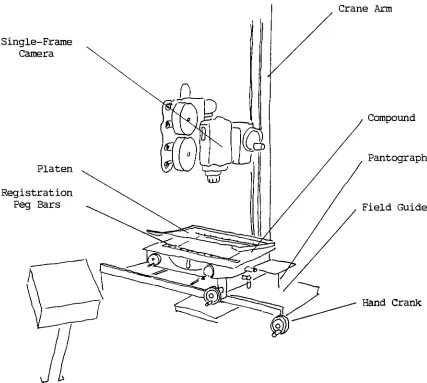
An animation stand can be as simple as a bare table with a slid
ing
column for mounting a camera, and two photo floods on either sidefor illumination. A professional animation stand, like that in figure
1,
is
ahighly
sophisticated piece of equipment designed not only tobe extremely stable
(to
avoidblurring
during
exposure), but to allowthe greatest extent of movement for specific motion effects. Such an
animation crane allows the artist to incorporate tilts, rotations,
panning, trucking, zooms, dissolves, fades, and superimpositions into
the animated film without
having
to draw the individual images neededto produce such an effect.
To provide for maximum adaptability of action for animated photo
graphy, professional animation tables are mounted on a "compound",
which
is
a platform that rests on two parallel rails running in bothan east/west
(back
andforth)
direction and a second set fixed in anorth/south
(up
anddown)
direction. With a series of mechanicalhandwheels,
the animation bed can be moved in all directions, andFIGURE 1
Crane Arm
Single-Frame
Camera
Registration
Peg
BarsHand Crank
[image:26.554.101.528.151.534.2]movements are calibrated
in
0.01 units(either
inches
or centimeters,depending
on the scaledesired)
to allow for the smallest advancementof action necessary for movement in any
horizontal
or vertical direction.
In order to maintain exact alignment for artwork that progresses
across the screen, the compound
is
fitted with"travelling
peg bars".These bars are fitted with the moveable pegs that
keep
the visualsregistered under the camera
during,
andbetween,
exposures. Thereare several peg standards, but a common one uses a round central peg
flanked on either side and at equal
intervals
with rectangular pegs.Additional sets of moving pegs may be used to allow one visual to be
animated while another
(like
a background scene) remains stationery.Also included
in
the compound set-up is a "pantograph", or pointer,which is positioned over a field guide
immediately
to the right ofthe compound
bed,
showing the camera operator the exact position ofthe artwork under the lens.
Acting
as a kind of mappingdevice,
thepantograph allows the precise
tracing
of directional movements of thevisuals with respect to the area actually
being
filmed.To
keep
artwork perfectly flat while in positionduring
exposure,a hinged sheet of
heavy
plate glass is lowered over the visuals, extending
to all sides of the largest field size. This "platen" notonly
aidsin
registration of the images but prevents cut-outs andother artwork from casting unwanted shadows. (Note: When an animator
needs shadows, allowing their appearance behind some cut-outs will
increase
the sense of weight and volume behind the figure, causing a3-dimensional effect.) The
top
of the compound bed is covered withfoam padding to absorb the pressure of the
heavy
glass platen, butit
Movements
of theCompound
An animation crane equipped with
travelling
pegs and elaboratemovements of the bed
is
requisite for single-frame films both foreffective mobility and versatility.
Working
in
conjunction with thetracking
movements of the camera, several basic functions of thecompound may be employed to produce
differing
visual effects.1)
Using
the sliding camera carriage, the animator may approachor recede from the surface of the compound
bed,
covering asmaller or larger field size. The effect
is
similar to aZoom in or out.
2)
The bed itself can be moved sideways(east/west
direction)
or up and down
(north/south direction),
or in any otheroblique direction
by
a combination of these movements.3)
Thetx-avelling
peg bars can be moved in a sideways directionwhile the bed remains stationery, producing a panning effect.
4)
Auxilliary
floating
peg bars enable movement independent ofthe motion of regular
travelling
pegs, allowing differentartwork to move
in
opposing directions or at different speeds5)
Some animation compounds allow for rotation around a verticalaxis of the center of a field size.
The juxtaposition of
differing
compound features enables the animatorto direct the viewer's attention through the course of the film.
The Animation Camera
A motion picture camera to be used for animation should exhibit
1)
thecapability
ofexposing
one frame at atime;
2)
thecapability
offeeding
filmin
reverse;
3)
afading,
twinblade
shutter;4)
a lens capable offocusing
down to small fieldsizes;
5)
a frame counter;6)
through-the-lens
viewing
(desirable,
but not mandatory).The
ability
to shoot one frame at a time under controlled conditions should not be underestimated. Whether the camera is mechan
ically
orelectronically
driven,
starting up and advancing, then
stopping for each frame must be
extremely
precise to avoid small, buteasily noticed,
differences
in
exposure between frames. Such variations,
even if very slight, will result in a visible flicker whenviewed on screen. Modern animation cameras are fitted with electronic
motors which can
alternately
start, stop, or run at a constant andaccurate speed. The motor
is
designed to operate consistentlywhether running in a forward or reverse direction.
A
fading
shutter consists of twoblades,
one of which may bemoved relative to the other to allow more or less light to pass
through. When
they
ax-edix-ectly
over-each other, moving in unison,
the angle of the shutter opening
is
equivalent to a half circle, orapproximately
170.Moving
one blade in relation to the other allowsthe shutter angle to be changed in increments of only a few degrees
in
order tofully
open orfully
close the shutter. The shutter ishalf open at
85,
a quarter open at43,
andfully
closed at 0.(Note:
Other methods of varying the exposure include varying the lensopening, or aperture, or altering the
intensity
of theillumination.)
Since the field sizes used in animation are often quite small,
close proximity of the camera to the artwork
being
photographed resingle-frame
filmmaking,
the camera lensis
specially
mounted toexpand the
focusing
scale.Additionally,
adjusting
the camera headup or down along
its
calibrated support columnis
designed to correspond to specific field sizes.
A frame counter
is
more than aluxury
on an animation camera-it
is
an essential component.Ordinarily,
arevolving
counter, capableof
being
set to zero when necessary,is
connected to the single-framemechanism
allowing
it
to count both forward orbackward,
depending
onthe direction the camera
is
set to run. The counterindicates
thenumber of the frame just shot and
is
necessary forbacking
up the individually
exposed frames for shooting dissolves and superimpositions.The functions of an animation camera allow for gradual changes
in
a scene or from one scene to another. A "fade"is the reduction
or
increase
in the shutter angle over a specified number of framesduring
filming. A "fade-in"consists of gradually opening the shutter
angle
during
exposure, producing a progressively brighter picture. A"fade-out"
requires gradual closing, or reducing the shutter angle
during
filming
to slowly darken the picture. A "dissolve"is merely
a combination of these two technigues, and is accomplished
by
firstreducing
the shutter angleduring
exposure of a specific number offrames,
rewinding the filmby
the same number of frames, and thenre-exposing
the scene as the shutter opening is gradually increased.Another common use of variable exposures is the technique of
"superimposition"
, which requires splitting the total exposure between
two passes of film through the camera. The first run of film exposes
the scene at a reduced shutter angle, say
45,
and after rewinding, asecond pass of another scene
is
made at a shutter angle of 55. Theoverall picture has thus received
100%
exposure, but the various elefilm. An exact count of exposed frames must be kept as the film
passes through the camera, for any frame out of synch with
its
alternating exposure will cause either an
under-or overexposed frame that
will appear as a flicker or blank spot
in
the final scene.Lighting
for AnimationLighting
for flat animationis
normally required to be even,constant, sometimes color corrected, and often polarized. This type
of
lighting
can usually be providedby
two photoflood lamps of equalwattage, placed at 45 angles to the animation bed. Placement is
critical
in
order to achieve balancedillumination
as well as toreduce the occurance of glare and reflections on either the surface
of the glass platen or from artwork on acetate.
Additionally,
a polarizing filter is positioned between the camera lens and compound bed
to correct or eliminate light reflected back from artwork. Sometimes
sheets of polarizing acetate, or gels, may be placed over the light
source as well. Since film stocks designed for artificial
lighting
are designated
by
their color temperature, some modification of thelighting
conditions, such as the use of color correcting gels, mayalso be necessary.
Animation
Filming
Once assigned an animation studio (a.k.a. "crane room") the
full-function animation camera was loaded with 50' of 16mm Kodak film.
I opted for short reels of film, which would require later splicing,
over one
long
400' roll because I was familiar with the shorter stockand because the short spools allowed more control over the whole of
the
filming
process.Fifty
feet of filmis
approximately
4000frames,
but the unique operations of the animation camera requires the ad
vancement of at least the first 100 frames
during
theloading
processto insure proper
positioning
andfeeding
of the film as it passesthrough the film gate.
During
exposure of the next 400 framesor so
the
take-up
(or
"torque")
motor requires manualtightening
in order toavoid
having
the filmbuckle,
which wouldtrip
an automatic shut-offmechanism of the camera.
A checklist of crane functions and operations,
including
settingthe shutter angle, lens opening, zeroing the frame counter and other
compound controls, adjusting the light voltage, etc. are all required
before
filming
can actually begin. With a field guide in place underthe platen, a final visual check
is
made through the viewfinder offraming
and composition prior to actual shooting.Shooting
SeguenceThe opening titles, which were originally hand-colored, arrived
in
the crane room prepared withindividually
cut, red acetate overlays(like
templates)
designed to cover each "Etch-A-Sketch" image exactly.The
transparency
of the acetate, as well as its saturated color, imparted a 3-dimensional effect to the visuals.
Forty
individual photoimages
spanning over 1000individually
exposed frames,lasting
lessthan 60 seconds on screen, were recorded at Field 5 with a full shutter
setting. Motion was created
by
shooting at 5 frameintervals,
while"pauses"
were filmed at 15 frames per
image,
and "holds" at 24 to 48frames
(approximately
1-2 seconds on screen).The awkward appearance of the
"Etch-A-Sketch"
imperfect,
incomplete,
nature of the visual medium one ofthe main
ideas
of the film. The theme of 'mechanism as communicator'was
introduced
as a preface for the use of other more sophisticated,but equally
defective,
communication formats that were to be usedin
later segments of the piece. The symbolism was
deliberately
lowkey
and restrained
-even
slightly
playful!The titles dissolved to a visual of a "video glitch", or inter
ference pattern common to
TV,
as a forward to the concept of discordant and static filled messages. The opening close-up, which filled
the screen with diagonal and jagged lines, slowly trucked back to
Field
9,
revealing a circa 1950 's television set. This scene featured
a parody of the television medium, mimicing its latent power, author
ity,
and so-called sophistication. This transition scene isbrief,
but it serves to introduce the px-emise of communication failure as a
symptom of
imaginary
invention and describes thedevice-dependency
of most forms of interactive messages.
In a cut to the first major scene
involving
a characterization,a female figure appears
facing
the camera position. The subjectis
photo-real (i.e. a continuous-tone
image)
and is depicted with a TVremote control
device,
switching channels. Simulated broadcastvoice-overs consisting of
innane,
gimmicky, and formula-laden views ofreality
form the audio track.(See
APPENDIX C for complete dialogue).Over 50 individual photo visuals were arranged to illustrate the
channel changer's
increasing
disillusionment with the medium'shighly
stylized message. The scene ends abruptly with a cut back to the
interference
pattern, serving as noisy, confusing comments on thevideo caricatures.
leading
the viewer into the next scene for an 'imagination mode'rebuttal. As the camera
is
drawnslowly
back from the zig-zag patternon the monitor, the action cuts to the first in a series of cut-outs
of female figures taken from '50's era magazine art. Housewives in
dated
fashions,
complete with lace aprons and highheels,
are seenin front of vintage television sets
(See
APPENDIX B for illustrationexamples). The voice-over broadcasts serve as a stark contrast to
the
images,
presenting strikingly relevant, political views on avariety of topics pertinent to contemporary women viewers. It is the
contx-adictory depiction of feminist opinion in so nostalgic a setting
that parallels the unlikely use of the airwaves
by
women for suchpertinent issues. The evidence of the employment of the imagination
for this scene
is
established through the presumption that such athing
will probably not occur(".
. . not in your wildest dreams . .")because it
is
considered 'fantastic.The
improbability
of the availability or access to television asa medium of communication on topics considered significant to women
in
the current populationis
emphasizedby
an end scenefeaturing
acut-out male characterization. His image is stylized in a standard
old-fashioned mode, reflecting the out-dated male views of dominance
and control.
Echoing
the action of the previous scenes, the subjectis
depictedin
a large easy-chair with his back to the viewer, casually
switching channels with a remote control device as he attemptsto tune-out the female-oriented telecast. The satirical nature of
the commentary on the audio track underscores the observation that
the power of the 'technological button' remains with the male, and
the image on the screen can easily be interrupted through the
timely
intervention
of the mechanical-control device. The use of a handheldremote unit to thwart
incoming
channels andthereby
intercept attemptsmost
interpersonal
conversationin
general, and psycho-sexualinter
action
in
particular.Linked
by dissolves,
the four separatesegments of this seguence
required a series of smaller
images
to be cycledcontinuously
throughthe screen of the
television
cut-out, while the full-figure cut-outsin the foreground responded or reacted to the voiceovers. Almost
1300
individually
exposed frames were shot at Field9,
and short50 frame
dissolves
wereinserted
between each setting. The animationcamera's variable shutter
capability
wasintegral
in the creation ofthe transitional nuances of this segment.
Another,
more unusual transition scene was developed using thissame camera technique to present an alternate aspect of the use of
the
imagination
as a means of communication and conceptualization.By
utilizing the unique attributes of single-framefilmmaking,
acontinuous dissolve of a sequence of facial close-ups was superim
posed over a slowly
tracking
background.Lasting
only 20 seconds onscreen, this scene nevertheless required precise planning, exacting
calculations, perfect execution, and
literally
hours offilming
timeto expose, and then re-expose almost 500 individual frames. In pre
paring the
background,
a panoramic inkdrawing
depicting
telephonelines
traversing
a mountainous landscape was transferredby
hand toa 10"x30" sheet of clear acetate with a technical pen. Attached
by
header strips to
traveling
peg bars and bottom lighted through frostedplexiglass, the scene was slowly panned beneath the stationary camera
by
minute turns of the east/west handwheel controls of the compound.Exposure for each frame was set for a shutter opening of only
85,
ox-half open,
in
anticipation of the second exposure pass of "head shots"which were exposed in short dissolve sequences of
0 to 85
shutter
settings. The combination of exposure sequences were determined to
female character's
changing
facialexpressions are superimposed over the
telephone-lined
landscape. Thetone of the scene
is
muted and somber and serves to set the stagefor the upcoming
emotionally
charged segmentthat exploits the use
of this alternate
instrument
of communication, thetelephone,
in
anattempt to
dispel
a sense of separateness anddisconnectedness.
Likethe
television,
the telephoneis
another 'device'that was created to
enhance or expand our
ability
to communicate or connect with others,but which has become
strangely
symbolic of thediscomfort
we feelwhen faced with communication anxiety.
As the segment
begins,
a photo-realistic shot of a female figurewith her back to the camera fades in. The action begins as we hear
telephone-stylized,
one-sided conversational dialogue while thecharacter begins a slow turn toward the camera. This 'eve-dropping'
continues as the subject completes one turn and, upon resuming the
opening stance of
having
her back toward the audience, undergoes avisually graphic transformation from a continuous-tone subject to a
xeroxed
image,
from unauthoritativefamiliarity
to unavoidablestark-ness. The visual connotation is reinforced as the dialogue also
switches fx-om remarks steeped in gamesmanship to earnest expressions
of
inner
desires. The mundane photo-realimages,
being
composed ofshades of gray, are analogous to the real-life vagueness and
banality
of the opening
dialogue,
while the bolder, high-contrast, black andwhite
impression
of the xerox visuals, representing the subject asareas of important highlights and shadows, accompanies the more in
ternalized discourse of the audio track.
The third representation of the subject is as hand-drawn,
highly
graphic figures against a dark background. This
is
the character'sIn this imagined
fox-m,
the subject appears
direct,
fragile,
and vulnerable. The implicationnow
becomes
cumulative: the continuous-toneimagery
and correspondingconversational
dialogue
represent the social 'norm1, the usual patterned response
indicative
of sanctionedinteraction;
the photo-copyimagery,
being
once removed fromreality
and stressing strongervisual
impact,
contains dialogue that the subject wishes to actuallyexpress, but which cannot be spoken under 'normal conditions'; and
the
hand-rendered
drawings
convey the underlying essence of thesubject, the authentic feelings of the character.
The conclusion of this sequence shows a reversion to temporal
photo-reality, with the formula conversation serving to further
suppress any significant communicative exchange. The attempt must
remain unresolved, the subject remains unconnected, and the relation
ship remains uncommitted.
By
resorting to instruments originallyintended to enhance our understanding and assimilation of reality,
we have only succeeded in creating a
device-dependency
that servesto contribute to our sense of
inadeguacy
and disjointedness. Thisis
theimpetus
behind the creation of the film - theperfection and
completeness of the imagination versus the
impotency
andincompat
ibility
present inreality-Continuing
with the theme of internalized emotionalduress,
another segment similar in
its
visual effect to the faces passingover the bleak landscape was created as a transitional scene. A
perpetually changing series of facial features was superimposed over
an abstracted pen and
ink
drawing
of stylized faces and hands. Anelongated sheet of clear acetate with the illustrations was attached
by
header strips totraveling
peg bars and bottom lit. The background
drawing
was slowly trucked beneath the stationary cameraby
superimposed
images
were meant to signal the viewer that realityand
fantasy
were influx,
changing
with regard to influences orconditions not
fully
understood and thatmay or may not persist
through time.
This abstracted face-hand motif was expanded
by
the next film segment, which derivesits
impact
strictly from the special featuresof the animation camera.
Lasting
almost a full minute on the screenand covering well over 1200
frames,
this scene displayed continuousdissolves of over 70
separately
photographedimages
which werere-combined and assimilated
into
almost 40 individual action shots. Theemotive drama
illustrated
by
this, the 'circle of light' sequence,took over 4 hours of single-frame
filming
and, because the entirevisual effect depended on the superimposition of continuously dis solving
images,
required painstaking planning and executionin
ordex*to assure that each frame recieved the correct amount of exposure.
An error in even one fx-ame results in a shift that causes a visible
'flash'
whenever-the overexposed fx-ame appears on screen.
A normal dissolve technigue
is
often called a mix, since itspurpose
is
to show a gradual scene change or shift in setting ormood. In the 'glowing orb'
segment, splitting the total exposure
between two runs of film through the camera served to illustrate
action, or movement, in the figure and enabled the subject to exhibit
emotion through alternating facial expressions. The overall visual effect was ambiguous, allowing the viewer to attribute more
intim
ately held interpretations to this scene than any that had come before
it.
By
applying the underlying theme of imaginative vision, theComputex--Aided
Imaging
Artists have used graphics and symbols for thousands of years
to record and transmit
ideas,
but theintroduction
in the late 60's
of computer-aided
images
hasliterally
transformed animation methodsinto
"childs play", with many programs capable ofbeing
completedby
10 year olds! The advent of
technologically
complex systems forself-expression allows a conscious exploration of new approaches
within the medium, and computer-programmed animation represents the
cutting edge of visually created motion.
Obviously,
theseimaging
systems allow an
important
degree of freedom of expression not normally available to artists and animators.
Computer systems programmed for
imaging
allow and accept inputfrom the operatox--ax-tist that are analogous to image descriptions
ox-other
information
about the pictux-ebeing
created. When enough information about an. idea or object is available
in
a computerfile,
it
is
no longer necessary to produce and reproduce complete illustra