Continuous Quality Improvement for Calculus Using
Mentor-Mentee Approach
Samsul Ariffin Abdul Karim1, *, Mohd Mughti Hasni2, and Nooraini Zainuddin3 1,3
Fundamental Applied Sciences Department and Centre for Smart Grid Energy Research (CSMER), Institute of Autonomous System, Universiti Teknologi PETRONAS, Bandar Seri Iskandar, 32610 Seri Iskandar, Perak Darul Ridzuan, Malaysia.
1
Center for Smart Grid Energy Research, Institute of Autonomous System, Universiti Teknologi PETRONAS, Bandar Seri Iskandar, 32610 Seri Iskandar, Perak Darul Ridzuan, Malaysia.
2
Centre for Foundation Studies, Universiti Teknologi PETRONAS, Bandar Seri Iskandar, 32610 Seri Iskandar, Perak Darul Ridzuan, Malaysia.
Abstract. This paper proposes mentor-mentee event as a method to improve the performance of the studentsin Calculus subject for Foundation Third Semester in Universiti Teknologi PETRONAS (UTP). About 40 mentees are selected based on their course work (CW) marks and 20 mentors are chosen from UTP undergraduate students (UG). All the mentees must complete 12 hours within two-days event. In this event, active learning (AL) and cooperative learning (CL) are utilized as a learning method, this includes brainstorming, think pair share, think problem solving (TPS), pair work, turn to neighbor summaries, and etcetera. All the outcomes are analyzed through statistical measurements. From the results, it indicates that, Mentor-Mentee Event has improved significantly the performance of the mentees in the final exam.
Keywords: Continuous quality improvement (CQI), Mentor-Mentee, Active learning, Cooperative learning, Statistical analysis
1 Introduction
Calculus is a compulsory subject that must be taken by all Engineering and Science Foundation students in the university being studied. Based on the performance from previous semester, around 5% students have some difficulties in Calculus. It must be understood that students must have good basic in Calculus to excel in Differential Equation that will be offered in Year 1 Semester 1. A Pilot Project was tested in March 2016 Semester and July 2016 Semester where 40 Mentees and 20 Mentors were involved in both programs. Based on the Final Examination results for July 2016, 39 students passed the course except one pass after taking Supplementary Examination. The main outcome from the Mentor-Mentee Program indicates that this program can assist low achievement students to improve their results. In this paper, we discuss the development of a framework for Effective Mentor-Mentee Program to produce High Impact Mentor-Mentee Program.
As mentioned, it is compulsory for Engineering and Sciences as well as Technology Foundation students to pass Pre-Calculus in Semester I. Under this system, once they passed, Business Information System (BIS) and Information Communication Technology (ICT) students can register for the Calculus and Linear Programming while Engineering and Sciences students take Calculus in Semester II. Unfortunately, there are students who have some difficulties in some topics such as Limit and Integration in Calculus. How do we assist those students? Do we need to give some extra class to them? Do we need to innovate our teaching method? Maybe using some animation software can improve their basic understanding? There are many ways that we may assist the students. One of the ways is implementing Mentor-Mentee Program by selecting Mentor-Mentees and suitable Mentor. Continuous Quality Improvement (CQI) is important for us to improve certain area not just in our teaching and learning but in the assessment of the courses. (Foster, 2011) indicated that youth development approaches i.e. mentoring, result in improvement behavior changes in interpersonal skills as well as the way they learn. Dittmar and McCracken (2012) proposed Mentoring, Engagement, Technology and Assessment Model or META Model to improve the e-learning for online teaching. Leidenfrost, Strassing, Schutz and Carbon (2014) studied the impact of peer mentoring style among all mentors. They found that any mentoring style can improve the performance of the mentees. Slack, Johnson, Dodor and Woods (2013) studied the mentoring for at risk middle school students. They conducted the survey involving 59 mentees and 43 mentors. Zales (1996) studied the active learning as a tool to improve student achievement in Mathematics. Adamu (2014) analyzed the relationship between Mathematics Anxiety and Calculus Achievement among 148 engineering students at Waziri Umaru Federal Polytechnic, Birnin, Kebbi, Nigeria.
The main finding is the females’ students has high anxiety than males’ students. Meanwhile Hossain, Tarmizi and Ayub (2012) studied the cooperative and cooperative learning in Malaysian mathematics education. They found that by working in small groups, the students can improve their academic performance while promoting their interpersonal competencies through both types of learning. Tall (1993) discussed the students’ difficulties in Calculus by given many types of the difficulties. For instance, in limits and infinite processes, among others.
Based on previous studies, active learning and mentoring can be used to improve the performance of the low achievement students. Thus, in this study, Mentor-Mentee Program will be used to improve the performance of the students incorporated with active learning as well as cooperative learning. Furthermore, the study does not focus on gender as discussed by Adamu (2014) but focus on students who have lower coursework (CW) marks in Calculus.
2 Methodology
This project is divided into several stages:
2.1 Phase 1:
The main objective of this stage is to answer research question number 1, which is, what topics in Calculus that the students (mentees) have most difficulties? Coursework (CW) breakdown will be carefully analyzed. In Calculus there are 5 quizzes; Quiz 1 and Quiz 2 – Differentiation, Quiz 3 and Quiz 4 – Integration and Quiz 5 – Series. Meanwhile Test 1– Differentiation and Test 2 – Integration. Any students who scores less than 27% out of 50% will be selected to be Mentee. There are also students also were selected as Mentees because their score is low for Test 1 or Test 2 even though their CW is more than 27%. This is to assist students that need help to improve their basic and concept in Calculus. Mentors are required to attend Training of Mentor (TOM) before they can be appointed as Mentor. For every semester, there are 40 mentees from Foundation and 20 mentors from undergraduates (UG). The ratio is 1 Mentor for 2 Mentee.
2.2 Phase 2:
The objective of Phase 2 is to determine whether the Mentor-Mentee Program to assist Mentees improve their main basic and concept in Calculus. The Mentor-Mentee Program was conducted on Week 12.
During Study Week, Mentees must undergo minimum 12 hours coaching sessions with their respective Mentor. Each Session is divided into several different topics. For instance, Session 1, they discussed Basic Differentiation and Its Applications. In 3 hours, Mentee will learn how to get better understanding in this topic. Active learning (AL) and cooperative learning (CL) were carried out throughout Mentoring and coaching session. The Mentees worked in pairs, where we utilized the think pair share, pair testing as well as reflection and at the end of the session, Mentees must be able to answer few questions to test whether they really understand or not the topics that have been discussed throughout each session. Mentees must submit their complete solution to their Mentor. Mentor marks the questions and gives appropriate feedbacks to Mentees within one day. Reflection will be given at the end of each session. They may meet again for further discussion on the matter. Based on our previous Mentor-Mentee event, it was noticed that Mentees were quite happy and can follow what the Mentors teach, as well as they discussed actively in a small group and as a pair. Think Pair Share, Pair Testing as well as Reflection provide the Mentees better understanding about difficult topics.
2.3 Phase 3:
This final phase looks at research question number 3. Can Mentor-Mentee Program improve mentees performance in Calculus final exam? At the end of the Program, mentees as well as mentor are required to give feedback of the Mentor-Mentee Program through questionnaire. Mentees final exam results and outcome from the questionnaire will be analyze in detailed through statistical and R software to determine the effectiveness of Mentor-Mentee Program.
2.4 Data Collection
The Mentor-Mentee Event are organized for two semesters, that is, March 2017 and July 2017 for Calculus subject offered in Semester 3 Foundation students. The deliberation of the mentor is made as follows: 1 Mentor for 2 Mentees. The (M2E) event is proceed as follows:
3 Data Analysis
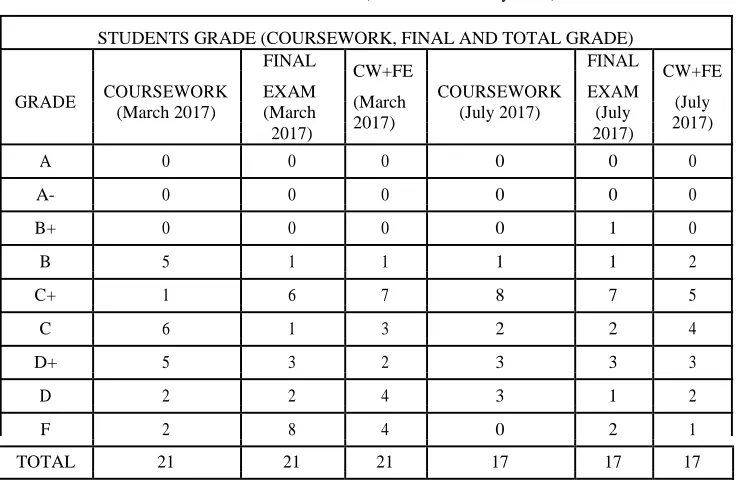
Table 1. Students Grade (March 2017 & July 2017)
STUDENTS GRADE (COURSEWORK, FINAL AND TOTAL GRADE) FINAL
CW+FE FINAL CW+FE
COURSEWORK EXAM COURSEWORK EXAM
GRADE (March (July
(March 2017) (March (July 2017) (July
2017) 2017)
2017) 2017)
A 0 0 0 0 0 0
A- 0 0 0 0 0 0
B+ 0 0 0 0 1 0
B 5 1 1 1 1 2
C+ 1 6 7 8 7 5
C 6 1 3 2 2 4
D+ 5 3 2 3 3 3
D 2 2 4 3 1 2
F 2 8 4 0 2 1
TOTAL 21 21 21 17 17 17
Table 1 above shows the student grade for March 2017. The total number of 21 students have been separated based on their grade. From CW grade, the highest grade that the students obtained was only B which is approximately only 23.81% from 21 students. This was followed by grade C+ which is 4.76%. Next, C where most of the students obtained C for their CW grade which contributed around 28.57%. For D+, D and F, they contributed 42.86% out of 21 students. For their FE, the highest grade that the students achieved was B which is the same as CW but with less students. Next would be C+ which is almost 28.57%. For the grade D+, D and F, it would be about 61.9%. For the grade D+, D and F, 61.9% is slightly higher as compared to CW which contributed only 42.86%. Now, if we look at the total FE grade, the total percentage of students got D+, D and F were about 47.62%. If we look at the median for CW in March 2017, the grade will be C. In their FE, the median would be D+. For the total final grade (CW + FE) in March 2017, the median would be C+. Notice that the median grade for the final grade which is total (CW+FE) is higher than the median grade for CW. By using the Mentor-Mentee approach, we managed to help the students be more prepared for their FE thus improving the total final (CW + FE) grade.
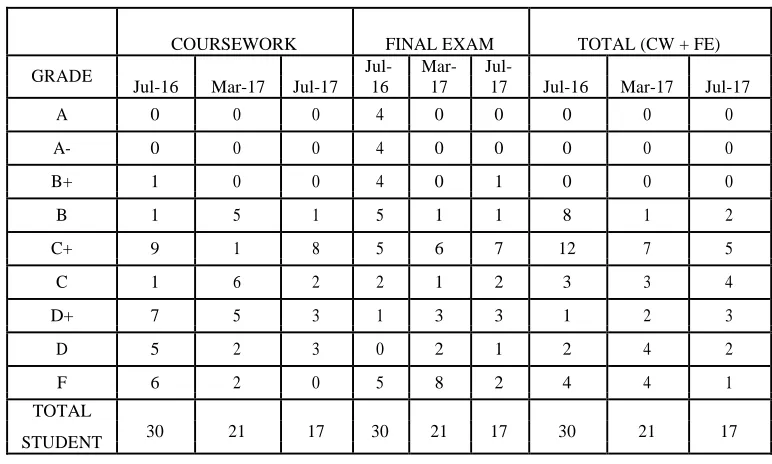
Table 2. Students Coursework and Final Exam (July 2016, March 2017 & July 2017)
COURSEWORK FINAL EXAM TOTAL (CW + FE)
GRADE Jul- Mar- Jul-
Jul-16 Mar-17 Jul-17 16 17 17 Jul-16 Mar-17 Jul-17
A 0 0 0 4 0 0 0 0 0
A- 0 0 0 4 0 0 0 0 0
B+ 1 0 0 4 0 1 0 0 0
B 1 5 1 5 1 1 8 1 2
C+ 9 1 8 5 6 7 12 7 5
C 1 6 2 2 1 2 3 3 4
D+ 7 5 3 1 3 3 1 2 3
D 5 2 3 0 2 1 2 4 2
F 6 2 0 5 8 2 4 4 1
TOTAL
30 21 17 30 21 17 30 21 17
STUDENT
[image:4.595.152.444.419.562.2]Table 2 shows the students CW, FE and the total (CW + FE) for July 2016, March 2017 and July 2017. For July 16, the median grade for CW, FE (CW+FE) was D+, B and C+ respectively. For July 16, the performance in the FE have increased significantly as compared to the median grade of CW. If we compared with March 17 and July 17 median grade, the performance was much better since during their 12 weeks’ programs studying Calculus, the implementation of Mentor Mentee started earlier after Test 1 as compared to March 17 and July 17 which started only after Test 2. However, every batch still must complete a minimum of 12 hours Mentor-Mentee.
Fig. 1. Students Coursework (July 2016, March 2017 & July 2017)
Fig. 2. Students Final Grade (July 2016, March 2017 & July 2017)
[image:4.595.154.441.597.744.2]Fig. 1 shows the comparison graph of students CW grade of different batch which is July 16, March 17 and July 17 Different color would indicate different batch. For July 16 and July 17, most students would score C+ for their CW. For March 17, it would be C. From Fig 2, it gave us the comparison graph of students’ total (CW+FE) grade of different batch which is July 16, March 17 and July 17. Most of the student’s grade belong in C+. The comparison grade between their CW and total (CW + FE) shows that the result managed to be maintained and with some slight improvements for March 2017 where the final grade has improved from C to C+.
4 Conclusion
Thus far, the mentor-mentee approach has been implemented throughout three semesters namely July 16, March 17 and July 17. From the results as well as the descriptive statistics, it can be shown that the Mentor-Mentee Event has managed to help students to slightly increase their final grade by looking the median from the grades. We intend to complete the study by testing the hypothesis based on four semesters i.e. July 2016, March 2017, September 2017 and March 2018. This can be achieved by using ANOVA and chi-square tests.
Acknowledgement to Universiti Teknologi PETRONAS (UTP) for the financial support received in the form of research grant: Scholarship of Teaching & Learning (SoTL) No. 0152AA-A67.
5 References
Adamu, G.A. (2014). Mathematics Anxiety Among Engineering Students and Its Relationship with Achievement In Calculus. International Journal of Psychology and Counselling, 6(1), pp. 10-13.
Dittmar, E. & McCracken, H. (2012). Promoting Continuously Quality Improvement in Online Teaching: The Meta Model. Journal of Asynchronous Learning Networks, 16(2), pp. 163-175.
Foster, L. (2011). Effectiveness of Mentor Programs-Review of the Literature from 1995 to 2000. California Research Bureau. ISBN 1-58073-136-1.
Hossain, Md. A.H., Tarmizi, R.A. & Ayub, A.F.M. (2012). Collaborative and Cooperative Learning in Malaysian Mathematics Education. IndoMS J.M.E., 3(2), pp. 103-114.
Leidenfrost, B., Strassing, B., Schutz, M. & Carbon, C.-C. (2014). The Impact of Peer Mentoring on Mentee Academic Performance: Is Any Mentoring Style Better than no Mentoring at All? International Journal of Teaching andLearning in Higher Education, 26(1), pp. 102-111.
Slack, R.S., Johnson, C.A., Dodor, B. & Woods, B. (2013). Mentoring “At Risk” Middle School Students: Strategies for Effective Practice. North Carolina Middle School Association Journal, 27(1), pp. 11.
Tall, D. (1993). Students’ Difficulties in Calculus. Proceedings of Working Group 3 on Students’Difficulties in Calculus, ICME-7 1992, Quebec, Canada, pp. 13-28, ISBN 2 920916-23-8.