Abstract: The purpose of this study is to identify the principles of understanding Islamic work ethics implementation and job satisfaction among mainstream Muslim journalists and alternative media in reporting the news. Methodology Using a questionnaire, the study used a survey method in which the sample of 300 respondents from communities across the state. The findings based on the public perception of the level of understanding between journalists, mainstream and alternative media of Islamic work ethics principles showed no difference where respondents expressed a moderate level. But from the respondents' point of satisfaction to the mainstream media journalists and alternative shows respondents expressed high level of satisfaction with the work ethics among alternative media journalists over respondents ' mainstream media said the level of work ethics among journalists is still at a moderate level. In summary, we conclude that the top of the mainstream and alternative media should be sensitive to this situation where views on the findings show the level of understanding between mainstream journalists and alternative media on the implementation of Islamic work ethics are at a moderate level. Similarly, respondents' level of satisfaction with Islam correspondent mainstream media shows predominantly a moderate level. If left unchecked, it will cause damage to the premises as it is very important in Islam that work practices attract customers and increase the reliability of the submitted information.
Keyword: Islamic Work Ethic, Journalists, Mainstream Media, Alternative Media
I. INTRODUCTION
Working as a journalist is a very difficult profession to carry out. This is because not only do they work as a religious, but the biggest task is to implement tough trust amar ma'aruf nahi mungkar.The issue of ethical journalism when associated with work is important because journalists play an important role in explaining the truth to the public such information. The validity of the relevant information for the community. That's why journalism should have Islam-based work ethics. This is because it is very hard to implement his career as a journalist.Many issues now promised to journalists today many display news of misleading or inaccurate information to the public and each accusing each other is expressing the correct message to the mainstream media and some of them have voiced doubts about the validity and dishonest as well as alternative media.
Revised Manuscript Received on May 28, 2019.
Mohamad Khadafi Hj Rofie , School of General Studies, College of Arts and Sciences, Northern University of Malaysia (UUM), Kedah, Malaysia,
According to (Zulkiple & Mahasin, 2011), among those who study the science of religion or the clergy against journalists called earlier, the current reporter among the non-Muslim majority. The reason why writing false and misleading news was unethical journalist. The case is also supported by Faridah (2003), the rapid expansion of today's world of journalism is not accompanied by an increase in the quality of media practitioners, particularly in terms of adherence to journalistic ethics, monitoring functions and the journalist's role as information conduit and agents of change. Similarly, the opinion presented in today's journalism practice by Nor Adzrah, Solar Hani and Kelly (2012) is often a topic of concern for a variety of accusations and complaints about the journalist's reputation.
Sometimes some unscrupulous people are treated like a doll in the game by journalists. This problem occurs due to the greed for profit and the pleasure of ignoring the real ethic of work unilaterally.
This prompted the researchers to investigate the extent to which the truth is about the reporting of news presented by both media is based on the perception of the public. Could it be because of the police organization's policy. Or they want their media to look for popularity or pitch sales. If it really happens this means the work ethic they have nothing at all when viewed from the perspective of Islam. This is because Islam is concerned about a job with responsibility and truth. Therefore, this paper will discuss the level of understanding and satisfaction of society to the implementation of Islamic work ethics adopted by journalists Islam.
II. JOURNALISTS AND WORK ETHICS OF THE ISLAMIC PERSPECTIVE
Correspondent means the individuals assigned to obtain information to be conveyed to the audience. From the point of view of Islam, a journalist means an educator, preacher and leader (Mashitah, 2009). Being a journalist must have a work ethic and the right way to be in dokong and practiced. While journalists have difficulty, hardship or any type of test in order to get the news but in truth jihad Islam is regarded and rewarded by Allah S.W.T if a transmission in accordance with sharia (Nik Yusri, 2009). This is because Islam as a religion that organizes all its followers holistic lifestyle and adhere to ethical principles of Islam that covers every aspect of life (Nor Adzrah, Suria Hani & Fauziah, 2012).
Islamic Work Ethics Toward Islamic
Journalism
Generally means moral ethics about good behaviour, moral obligation, moral attitudes, moral responsibility, social justice, and good life characteristics (Grassian, 1981). With regard to work-related ethics, the responsibility and consequences of one's behavior or profession to society are generally referred to. A member of the public service duty to understand a government employee's role and behavior responsibilities (INTAN, 1991). In Islam, ethics is seen in two different understandings of the notion of rationalism represented by the Mu'tazilah and traditionalism ideology as represented by Asy'ariyah, according to Shukri and Razali (2001). The existence of these differences is hard to deny because it stems from the influence of Greek philosophy on the Islamic world and, at the same time, from the narrative passages of the Quran itself, promoting the birth of a difference in interpretation. Can be seen, ethical signals that require human interpretation and reflection are usually inserted in the Quran message. With two (2) main features, Islamic ethics also has expectations ahead. First, Islam's ethics is not contrary to human nature. Second, the rationalism of Islamic ethics (Amin, 2002).
Rafik (1998), has outlined some basic summary of system parameters of Islamic ethics, namely:
a.Acts and decisions are considered to depend on the goodwill of individual ethics. Indeed, Allah knows all of our intention
b.good intentions are followed by good deeds that are considered worship acts. Dietary intentions cannot make it illegal as legitimate.
c.Islam gives a person the freedom to believe and do things they want; but that cannot go beyond the boundaries of responsibility and justice.
d.Belief in Allah gives people complete liberty from all things other than God or man.
e.The decision of the majority or the minority that benefit is not necessarily ethical. Ethics is not something that is related to the number or amount.
f.Islamic system using open approach to ethics is not a proprietary system or self-oriented. Selfishness has no place in Islam.
g.Ethical decisions are based on a reading of the Qur'an and the universe simultaneously.
h.Unlike systems of ethics recommended by most other religions, Islam encourages men to perform tazkiyah through active participation in life. By keeping ethics in the face of global test, a Muslim can prove his obedience to Allah S.W.T.
In a related work ethic study, the organization will normally be associated. One organization perceived as vital to the organization of the public media. This is because there should be permission to provide news. This is because, when viewed from Islam's perspective, work ethics must play an important role in making people believe a problem solved. Firman Allah S.W.T .:
Meaning ".... Allah intends for you ease and does not intend for you hardship and [wants] for you to complete the
you; and perhaps you will be grateful. (Surah al-Baqarah, 2: 185).
In discussing journalists' ethics and working mainly from the Islamic perspective by Nik Yusri (2009), one of a journalist's properties must have an honest work ethic and misconduct acts as outlined in the Qur'an and al-Hadith law. This statement is the same as that specified by the Mus Chairil and Faridah (1997), which also emphasizes fairness, trust and honesty in a number of guidelines in the code of journalistic ethics. These guidelines have a significant professional impact on duty for journalists.
The Malaysian Press Institute, consisting of 35 mass media organizations in Malaysia, took the initiative to establish an appropriate ethic for the journalist Malaysia to meet this requirement. When drawing up the ethics initiative of the Setter Malaysia Journalism Ethics Committee, of which Malaysian media, print and electronic chief editors have studied various types of journalistic ethics in use in the United States, Japan, the Republic of Korea, the Philippines and Indonesia. The results of the ethics study to guide journalists in Malaysia will be established. In Malaysia's Ethical Journalism Initiative, ethical principles include:
a.The journalist's main task is to report the truth and to respect people's right to obtain the right information ; b.In carrying out this task, he should appreciate the freedom
to collect and publish news in an honest manner and with the right to make fair comments and criticisms;
c.Journalists shall use reasonable means to obtain news, photographs / movies, and documents;
d.Any information found to be incorrect appears to be corrected
e.Journalists should respect the confidentiality of news sources;
f.Reporters should be well mannered when performing their duties and refrain from plagiarism and incitement, unfounded accusations and corruption in any form whatsoever;
g.Journalists should avoid news articles racist, extreme and contrary to the ethics of Malaysian plural society;
a.Be cautious and afraid of Allah S.W.T in every news given the reviews and have to take care of personal morality with morality and ethics in Islam.
b.Nature of self-confidence and society by publishing truth and useful news and conducting a detailed study before accepting any news disseminated.
c.Making propaganda not only benefits alone as its primary goal. By linking the issues and stories written by preaching to Allah S.W.T. so that people know that Allah S.W.T.'s religion or Islamic message covering all areas of life.
d.It is misleading to refuse lies / writing and thinking and to bring them to Allah S.W.T. because that is the only way to bring happiness to humanity.
e.The study will be undertaken Mohammed Ashraf, Khairul Azhar and Rushdi (2013) is often also true media sites, especially in mission-related social media using false hadiths and not investigating the source of a news story or even a statement received rather continuing to broadcast and symptoms of "copy and paste" This is very dangerous. Preferably, a news is filtered and distilled before the source is verified and not mistaken as the word of Allah S.W.T,
Which means: O you who have believed, if there comes to you a disobedient one with information, investigate, lest you harm a people out of ignorance and become, over what you have done, regretful."(Surah al -Hujurat, paragraph 6).
In theology there will be ethics and discipline as the science of the Qur'an and Hadith sciences observed in its delivery through cyber propaganda because it is an interest in the propaganda of the call and the correct instruction in principle and it rejects all forms of evil and falsity.
In Islam's eyes, the most precious pen is a pen and scribbled truth twist of destiny for the rest of the world and human nature, according to Abdul Ghani (1995). But in his remarks as a journalistic researcher to state that the media industry in Malaysia does not like to put journalistic ethics as something that must be respected.
Noor Adzrah, Suria Hani dan Fauziah (2012), a career in journalism is now considered to be one of the most popular careers because many thought it was the profession closest to the name of the group and a privilege to receive earlier information. But not many people realize that a journalist's job is actually similar to the missionary task of presenting the truth. This is because all of a journalist's career's daily affairs are a mission laden with efforts to repair, wake up and save society. Definitely working ethical journalists responsible to God, self and society will yield good results if the duty to report and disseminate this information is properly implemented and aimed at seeking Allah's pleasure alone. No matter what form of mankind's sustained development, the right to life must remain in dokong and be practiced in pure nature and ethics. The concept of communication is part of Islam's teachings, covering the relationship between the slave and his Creator, Allah S.W.T., the relationship between man
and his fellow man, whether Muslims or non-Muslims, and the relationship with nature.
As effective as any of the journalist's skills in obtaining information and writing news, he is still considered not to have adequate qualifications without classifying information and has not learned to filter and find information that is really worth journalism (Faridah, 2000).
Popular opinion, on the other hand, in accordance with the demands of capitalism, newspapers and magazines to be sold in order to reap the benefits of either building or demolishing a news that they ignore the work ethic. It is more important for their profits and popularity than to maintain the ethic of work (Nik Yusri, 2009).
III. METHODOLOGY
The methodology is quantitative and data collection methodology used is survey method (questionnaire). The sample consisted of 300 respondents from communities around the state. The election of respondents made using simple random sampling or simple random sampling. Instruments in this study was adapted from previous studies where appropriate research that takes into account variables work ethic understanding of Islam and job satisfaction. A computer uses the software Statistical Package for Social Science or SPSS version 19.0 for descriptive finding answers that are presented in tables to find the frequency and percentage.
IV. RESULT
Level of Understanding about Islamic Work Ethic
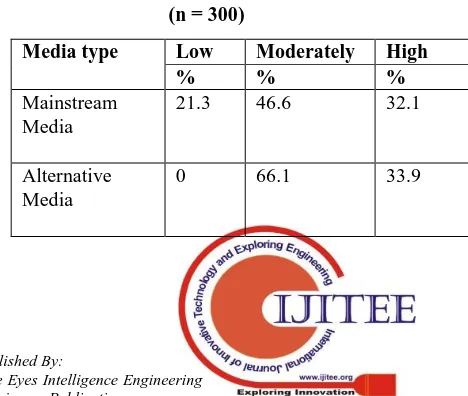
[image:3.612.336.570.578.776.2]The findings on the level of understanding of Islamic work ethics among journalists based on the perception that most of them stated that the level of understanding of Islamic ethics among journalists in mainstream media (46.6 %) and alternative (66.1 %) is working at a moderate level. This showed that most journalists both from the mainstream or alternative people still do not understand the concept of work ethics code based on Islam. Islamic work ethic level information in Table 1
Table. 1 Percentage of Respondents Level To Work Ethic Understanding Islam among journalists
(n = 300)
Media type Low Moderately High
% % %
Mainstream Media
21.3 46.6 32.1
Alternative Media
Level of Job Satisfaction
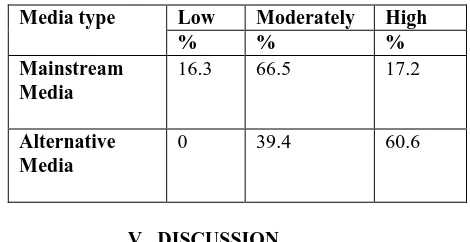
[image:4.612.71.306.208.329.2]The results for respondents' level of satisfaction Islamic work ethics adopted by journalists in presenting a news showed that most respondents trust the views expressed by the alternative media (60.6%) compared to the mainstream media in which respondents indicated a moderate level (66.5%) for reliable , Job satisfaction information shown in Table 2.
Table 2: Percentage of Respondents Satisfaction Against Journalists(n = 221)
Media type Low Moderately High
% % %
Mainstream Media
16.3 66.5 17.2
Alternative Media
0 39.4 60.6
V. DISCUSSION
It can be argued on the basis of the findings that the level of understanding of Islamic work ethics among journalists in the mainstream and alternative media is at the medium level. These findings are now supporting the issues where allegations and complaints about the journalist's reputation are often a topic of concern for journalists now being the subject of some games while greed for profit and ignoring the popularity of working ethics (Nor Adzrah, Suria Hani & Fauziah, 2012). Compared with previous journalism before independence, many journalists who really humility and always convey the true popularity of non-profit or simply (Zulkiple & Mahasin, 2011). This is according to Zulkiple and Mahasin (2011) reporters today among most non-Muslims among those who study the science of religion or the clergy against journalists called earlier. While the code of ethics of journalism underlined that most Islamic (Muschairal) plus the code of ethics of journalism Islam (Nik Yusri, 2009) but most of the media industry in Malaysia do not like to put journalistic ethics as a compulsory fulfilled (Abd Ghani, 1995). It can be concluded that journalists are now more likely to capitalism where more concerned with profits and the popularity of news from keeping work ethic (Nik Yusri, 2009). If not checked with Islamic work ethic understanding that will lead to bear sin because spread falsehoods without permission.
While in terms of discussion about the level of satisfaction of respondents to the news conveyed by the mainstream media and the alternative shows the respondents said the word of the alternative media is more reliable than the mainstream that shows the average level. This is due to the news disseminated by the code of ethics of journalism (Nor Adzrah, Suria Hani & Fauziah, 2012) that filter the past and examine the validity of
fear of God because of a display news, if not authentic contents will cause they will bear sin because journalists are also considered a preacher in spreading information (Nor Adzrah, Suria Hani & Fauziah, 2012). If you look at the mainstream media is at a moderate level of satisfaction, this shows some media used by some people for profit and popularity (Nor Adzrah, Suria Hani & Fauziah, 2012; Abdul Ghani, 1995) rather than aiming to seek the truth as demanded by Islam. It can be concluded that alternative media should maintain a supply news for people who are always authentic and always follow the code of ethics of journalism which is more similar to the direction of Islam. Similarly, the mainstream media in order to give confidence to the people of journalists having always provide correct information, transparency, trust, and bring back people's trust in the media and always adhere to the principles of Islamic work ethics.
VI. CONCLUSION
In conclusion, this study involved a sample of communities around the state, which include a total of 300 respondents. The results based on public perception of the level of understanding of Islamic work ethic among journalists, mainstream and alternative media showed no difference where respondents expressed a moderate level. But from respondents' satisfaction to mainstream media journalists and alternative shows respondents expressed high degree of satisfaction with the work ethics among alternative media journalists over respondents ' mainstream media said the level of work ethics among journalists is still at a moderate level. In summary, we conclude that the top of the mainstream and alternative media should be sensitive to this situation where views on the findings show the level of understanding between mainstream journalists and alternative media on the implementation of Islamic work ethics are at a moderate level. The parties must turn the page on which the previous history before the birth of independent journalists, most of them featuring the truth because their understanding of work ethic because Allah SWT rather than simply aiming to achieve popularity and profit at the expense of real work ethic. Similarly, the level of satisfaction of respondents to Islam correspondent mainstream media mainly show a moderate level. If left unchecked, it will cause damage to the premises as working practices in Islam are very important in attracting customers and increasing the reliability of the information they communicate should always adhere to the Islamic concept.
REFERENCE
1. Al-Qur’an, Surah al-Baqarah, 2:185. 2. Al-Qur’an, Surah al-Hujurat, ayat 6).
3. Abdul, G. S. (1995). Writing and writing ethics of Islam. Islam Nusantara Journalism Seminar, organized by the Terengganu State Government and the Malay Journalists Association of Malaysia (PWM), 10 Jun, 1995. 4. Amin, A. (2002). Between Al-Ghazali and Kant: Philosophy Islam
5. Faridah, I. (2003) Philosophy and ethics of journalism in Malaysia: Between the demands of professionalism and industry interests. Malaysian Journal of Communication , 19 . pp. 59-78.
6. Faridah, I. & Mus, C. S. (2000). Journalistic ethics. Subang Jaya: FAR Publishers.
7. H, M. T. I. (1997). Mengislamisasikan komunikasi warta. Kuala Lumpur: Dewan Bahasa danPustaka.
8. INTAN (1991). Values and ethics in the public service. Kuala Lumpur: Institut Tadbiran Awam Negara.
9. Mashitah, I. (2009). Islam correspondent is an educator, preacher and leader. Mstar Online. Atas talian www.mstar.com.my
10. Muhamad Asyraf Ahmad Termimi, Khairul Azhar Meeranghani & Rushdi Ramli (2013). Dakwah siber: Etika dan akhlak. Isu-Isu Dakwah Semasa, ms 455-472.
11. Mus Chairil Samani & Faridah Ibrahim (1997). Diskusi etika kewartawanan. Bangi: Universiti Kebangsaan Malaysia.
12. Nik Yusri Musa (2009). Konsep dan etika kewartawanan menurut Islam. Dlm. Komunikasi di Malaysia suatu penelitian awal pendekatan Islam Hadhari. Bangi: Institut Islam Hadhari, Universiti Kebangsaan Malaysia. 13. Nor Adzrah Ramlee, Suria Hani A. Rahman & Fauziah Hassan (2012).
Wartawan sebagai pendakwah dan pembangun ummah. Bangi: Universiti Kebangsaan Malaysia.
14. Rafik Issa Beekum. 1998. Islamic business ethics. Petaling Jaya: The International Institute Though Malaysia.
15. Shukri Ahmad dan Razali Mat Zin.(2001). Adab dan etika kerja dalam oganisasi. Sintok: Universiti Utara Malaysia.
16. Zulkiple Abd. Ghani (2010). Dakwah dalam era siber di Malaysia. Nilai: Penerbit USIM.