International Journal of Innovative Technology and Exploring Engineering (IJITEE) ISSN: 2278-3075,Volume-8 Issue-12, October 2019
Abstract: The demands of modern science and data driven era is today challenging the computing field from numerus perspective. As a result, today computer architecture and supporting components are getting rapid transformations and upgradations along with the improved and diversified Computing solution. This Unique sense research initiative is most challenging attempt to standardize Smart Computing Technology findings for future computing demands from careful investigation of emerging demands and smart utilization of resources. This research initiative “Unique sense” is the comprehensive construction of Smart computing model for providing solution for the emerging demands from various fields. As a part of this research focuses on one such primitive objective to deliver the provisioning for handling and processing the bigdata and more emerging demands on data handling.
Project name “smart computing prototype 4” is the part of Unique sense and the continuity of previous prototype 1, 2 and 3. It is an advanced version of previous deployment. This work consists of Stack of technologies and techniques wrapped together for the bigdata provision on Broadcom BCM2837B0 chip, Cortex-A53 (ARMv8) 64-bit SoC with maximum clock speed 1.4GHz and evaluated its capability.
Keywords : Computing, Smart Computing, Unique sense, Computer, RISC, ARM, Bigdata, Industry 4.0.
I. INTRODUCTION
By natural the cognitive intelligence nature is been achieved by unity in diversity and unique capability of understanding, deliverance, etc. The desired goal of smart computing is using the proper resource for the prior task and improvement with optimization. There are tremendous evolutions that happen in the computer and computing field for satisfying the requirements of society. In general, there are two aspects while considering the computing one is the extraction of value from the model, the other perspective is technological/technical.
While architecting any form of computing impact of above those two define the utilization and reach of solution. Such as Ubiquitous computing delivers Any form, anywhere
Revised Manuscript Received on October 05, 2019.
Vijaykumar Selvam, School of Computer Science, Engineering and Applications, Bharathidasan University, Trichy, Tamil Nadu, India. Email: [email protected]. ORCID : 0000-0002-5903-3128
Dr. M. Balamurugan, School of Computer Science, Engineering and Applications, Bharathidasan University, Trichy, Tamil Nadu, India. Email: [email protected]. ORCID: 0000-0003-2558-3161
Sethupathi Venugopal, Mersicher Supply Chain Private Limited, Madurai, India, Country. Email: [email protected]
Nancy A, School of Computer Science, Engineering and Applications,
Bharathidasan University, Trichy, Tamil Nadu, India. Email:
[email protected]. ORCID: 0000-0002-3060-699X
Aishwarya A, Sixth Sense Research and Development Foundation,
Tamil Nadu, India. Email: [email protected]. ORCID:
0000-0001-9975-0511
computing in general, cloud computing deals with virtualization of resources make it avail based on demands in additive to that pay peruse, etc. All those were achieved by the adoption and development of various technologies and techniques. Even, similarly, the evolution of smart computing is the next level of IoT and Mobility Architecture reusability, and low-cost frugal alternatives for Bigger tasks.
One such basic principle in this system needs to be performed individually and in demand, basics need to be performed like unity in diversity. Capable to adapt with homogeneous and heterogeneous connectivity. The most common problem today is computers and devices deal with the problem irrespective consideration of utilizing the resource optimistically finally it ends up with expensive resource utilization. Example As same doing a simple calculation in computers, Using HPCs for smaller problems [8],[9].
Unavailability of resources at the time of demands, etc. This whole project carefully considering those while making this computing solution is the frugal availability for diversified demands in scientific, industrial and general needs of the most.
A. Hadoop
Hadoop is the well-known Apache’s opensource framework delivers solution for managing bigdata and parallel processing from its technology HDFS and Map reduce.
B. Raspbian GNU/Linux 9.8 (stretch)
Peter Green and Mike Thompson project is the initiation for Raspbian opensource operation system the first build was completed around 2012. It is one such operating system from Raspberry Pi foundation under development. This is specially ameliorated for an array of Raspberry Pi single board computers [2].
C. BCM2837 (SoC)
The studied design BCM2837 consists of ARM Cortex-A53, 1.4GHz 64-bit quad-core processor which has the capacity of better thermal management from its predecessor. The four independent units or cores allow the Cortex A53 processor enables efficiency in the aspect of parallel processing and better bigdata technology support also enables quicker and efficient I/O handling than its predecessor.
D. Smart Computing
Smart computing is the emerging computing trend but still mysterious like the term “Bigdata” which got a shape today by numerous research
initiatives.
Unique Sense: A Smart Computing Prototype 4
But ultimately smart delivers optimistic enabling of technology and techniques which is capable to do multiple tasks smartly and easily. So, in common this computing initiative delivers alternative solutions for existing problems in case of availability and resource inadequate situation and those were capable of reusability and enabling the adoptions and upgradations based on demands. Those where capable of enabling individual and clustered environments based on needs.
E. Unique Sense
“Unique Sense” is code name of smart computing research initiative from Sixth Sense Research and Development Foundation for delivering frugal and alternate computing solution.
II. PROBLEMSTATEMENT
There are different forms of computing and models enables solutions for diversified problems today. This Unique sense smart computing technology visions to deliver solution for complex problems under it’s in a smarter way by its optimized cutting-edge techniques and technology adoption. This research work also delivers various research opportunity and scopes in different phases of optimization and deliverance to various different problems with frugal solutions such as for Internet of things, Industry 4.0, Bioinformatic data analysis, precision medicine, other computer applications such as Blockchain etc In this bigger journey this “unique sense: smart computing prototype 4” objective to enable solution for dealing Bigdata provisioning and delivering the capability of ARM[15] and low-cost machines to deal bigger problems in a smarter manner instead of depending on expensive resources. The ultimate is not to make something ultimate in single domain perspective solution instead this research work aims to enable centric ultimate alternative for existing systems and emerging computational problems.
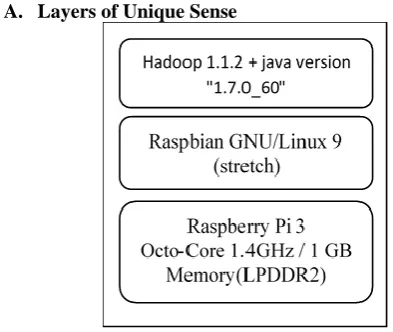
III. STACKCONFIGURATIONOFUNIQUESENSE4 The Unique sense 4 also adopts a stack of technologies like its predecessor overview in the fig.1. The stack together layered to achieve parallel processing and Bigdata handing with fault tolerance capability on lightweight ARM architecture. In general ARM processors[14] are lightweight, and fast execution on small applications and vector information. In such a way this work is initiated to analyze the stability and performance of Bigdata stack build on the top of Broadcom BCM2837B0, Cortex-A53 (ARMv8) 64-bit SoC @ 1.4GHz
[image:2.595.303.500.51.217.2]A. Layers of Unique Sense
Fig. 1.Stack Architecture of Unique Sense 4 Broadcom BCM2837B0 based Raspberry Pi 3 B+ [2] used as the hardware provisioning to enable virtual container to perform parallel jobs inside the architecture even the machine having quad core. Compare with unique sense 3 the deployed infra having the capability of approx. 50 percent only in the perspective of processing and memory capability. Because it deals with 1.4GHz max clock speed and 1GB LPDDR2 SDRAM as a shared GPU memory. Also customized Debian[13]. “Raspbian GNU/Linux 9 (stretch)” utilized for this project to wrapping Hadoop and Java[15] to perform MapReduce task on Light weight Architecture.
B. CPU
The quad core BCM2837 holds ARM Cortex-A53, 1.4GHz Little Endian Computing environment delivers parallelism and Ten times the better performance than its predecessor Model 1[7]. The spec deployed for Unique sense 4 is even lower configuration than our previous Octo core Unique sense 3 deployment. in Table 1 to shown Its computing capability better.
Table 1 : CPU Capability
On-line CPU(s) list: 0-3
Thread(s) per core: 1
Core(s) per socket: 4
Socket(s): 1
Model: 4
Model name: ARMv7 Processor rev 4 (v7l)
CPU max MHz: 1400.0000
CPU min MHz: 600.0000
BogoMIPS: 38.40 C. Configuration
The Raspbian GNU / Linux 9 enabled the platform to deploy Hadoop 1.1.2 on Broadcom BCM2837B0 , Cortex-A53 (ARMv8) 64-bit SoC . As same as preceding deployment Unique sense 4 configured. In the unique sense 4 below mentioned java version[15] is configured.
pi@raspberrypi:~ $ java -version java version "1.7.0_60"
Java(TM) SE Runtime Environment (build 1.7.0_60-b19) Java HotSpot(TM) Client VM (build 24.60-b09, mixed mode)
HDFS file system is configured for data provisioning used in Hadoop map reduce.
[image:2.595.309.545.485.602.2]International Journal of Innovative Technology and Exploring Engineering (IJITEE) ISSN: 2278-3075,Volume-8 Issue-12, October 2019
After configured the stack of Technologies the system is ready to perform map reduce job with in the environment[6].
IV. RESULTANDDISCUSSION
After starting the Hadoop services job of finding the value for pi begins with 5 mappers and the task is executed in
different cluster inside the single physical node low power light weight architecture raspberry pi 3 B+ and the following result obtained from the machine shown in figure 2 and figure 3.
hduser@raspberrypi:/usr/local/hadoop $ hadoop jar hadoop-examples-1.1.2.jar pi 5 50 Number of Maps = 5
Samples per Map = 50 Wrote input for Map #0 Wrote input for Map #1 Wrote input for Map #2 Wrote input for Map #3 Wrote input for Map #4 Starting Job
19/03/17 11:14:45 INFO mapred.FileInputFormat: Total input paths to process : 5 19/03/17 11:14:46 INFO mapred.JobClient: Running job: job_201903171109_0002 19/03/17 11:14:47 INFO mapred.JobClient: map 0% reduce 0%
19/03/17 11:14:55 INFO mapred.JobClient: map 40% reduce 0% 19/03/17 11:15:00 INFO mapred.JobClient: map 80% reduce 0% 19/03/17 11:15:04 INFO mapred.JobClient: map 100% reduce 0% 19/03/17 11:15:06 INFO mapred.JobClient: map 100% reduce 33% 19/03/17 11:15:07 INFO mapred.JobClient: map 100% reduce 100%
19/03/17 11:15:10 INFO mapred.JobClient: Job complete: job_201903171109_0002 19/03/17 11:15:10 INFO mapred.JobClient: Counters: 30
19/03/17 11:15:10 INFO mapred.JobClient: Job Counters
19/03/17 11:15:10 INFO mapred.JobClient: Launched reduce tasks=1 19/03/17 11:15:10 INFO mapred.JobClient: SLOTS_MILLIS_MAPS=28353
19/03/17 11:15:10 INFO mapred.JobClient: Total time spent by all reduces waiting after reserving slots (ms)=0
19/03/17 11:15:10 INFO mapred.JobClient: Total time spent by all maps waiting after reserving slots (ms)=0
19/03/17 11:15:10 INFO mapred.JobClient: Launched map tasks=5 19/03/17 11:15:10 INFO mapred.JobClient: Data-local map tasks=5
19/03/17 11:15:10 INFO mapred.JobClient: SLOTS_MILLIS_REDUCES=12149 19/03/17 11:15:10 INFO mapred.JobClient: File Input Format Counters 19/03/17 11:15:10 INFO mapred.JobClient: Bytes Read=590
19/03/17 11:15:10 INFO mapred.JobClient: File Output Format Counters 19/03/17 11:15:10 INFO mapred.JobClient: Bytes Written=97
19/03/17 11:15:10 INFO mapred.JobClient: FileSystemCounters 19/03/17 11:15:10 INFO mapred.JobClient: FILE_BYTES_READ=116 19/03/17 11:15:10 INFO mapred.JobClient: HDFS_BYTES_READ=1210 19/03/17 11:15:10 INFO mapred.JobClient: FILE_BYTES_WRITTEN=305403 19/03/17 11:15:10 INFO mapred.JobClient: HDFS_BYTES_WRITTEN=215 19/03/17 11:15:10 INFO mapred.JobClient: Map-Reduce Framework
19/03/17 11:15:10 INFO mapred.JobClient: Map output materialized bytes=140 19/03/17 11:15:10 INFO mapred.JobClient: Map input records=5
[image:3.595.83.459.89.704.2]19/03/17 11:15:10 INFO mapred.JobClient: Reduce shuffle bytes=140 19/03/17 11:15:10 INFO mapred.JobClient: Spilled Records=20 19/03/17 11:15:10 INFO mapred.JobClient: Map output bytes=90
19/03/17 11:15:10 INFO mapred.JobClient: Total committed heap usage (bytes)=811749376
19/03/17 11:15:10 INFO mapred.JobClient: CPU time spent (ms)=5020
19/03/17 11:15:10 INFO mapred.JobClient: Map input bytes=120
19/03/17 11:15:10 INFO mapred.JobClient: SPLIT_RAW_BYTES=620
19/03/17 11:15:10 INFO mapred.JobClient: Combine input records=0
19/03/17 11:15:10 INFO mapred.JobClient: Reduce input records=10
19/03/17 11:15:10 INFO mapred.JobClient: Reduce input groups=10
19/03/17 11:15:10 INFO mapred.JobClient: Combine output records=0
19/03/17 11:15:10 INFO mapred.JobClient: Physical memory (bytes) snapshot=751460352
19/03/17 11:15:10 INFO mapred.JobClient: Reduce output records=0
19/03/17 11:15:10 INFO mapred.JobClient: Virtual memory (bytes) snapshot=2254426112
19/03/17 11:15:10 INFO mapred.JobClient: Map output records=10
Job Finished in 25.316 seconds
Estimated value of Pi is 3.16800000000000000000
Fig. 3. Continuation Output of Unique sense 4
Figure 2 & Figure 3 shows the result of the Pi job in Broadcom BCM2837B0 Cortex-A53. As same the previous Unique sense 1, 2, 3, the job execution mapped with 5 tasks and executed in parallel. Without overclocking the system, the Time taken for the job execution is approximately 21.316 (Sec). For the same CPU spends 5020(ms).
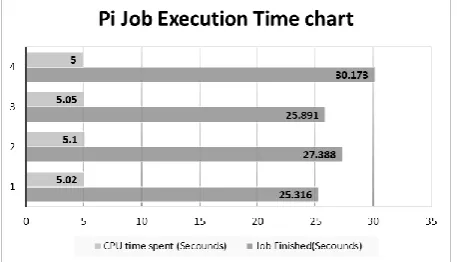
Figure 4 : Job execution and CPU Time Spent on Job comparison
For further evolution the pi job executed more times in the similar environment and the result given in the table 2. The chart shown above in the figure 4. clearly shows that same job execution in the same environment consumes different timing. Even though in four trial job 4 consumes considerable time taken to finish its job.
Table 2 : Job finished and CPU Time Spend
Job Finished CPU Time spent Job 1 25.316 5020
Job 2 27.388 5100
Job 3 25.891 5050
Job 4 30.173 5000
While considering both total job time and CPU time taken to complete the job delivers interesting considerable perspective that CPU time spent for job not directly make impact on finishing the job. Even in the job 4 CUP complete the task in 5000 (ms) but job finished over all delay while compare with job 1, job 2 and job 3. Those where
considerable for further investigation. Also, this unique sense 4 performs better than unique 3 even the technical specification of Unique sense 4 is lower than the Unique sense 3.
V. CONCLUSION
The proposed frugal solution unique sense smart computing prototype 4 result proved its capability of provisioning bigdata, parallel processing and capability of handling numerous I/O, these results denote biggest positive sign for considering it as a smart alternate solution for today's and upcoming big data and computing demands in various fields and towards big data trends. Also, the implementation model helps to identify the demands of this computing and supports to fine-tune the smart computing in the multi-dimension perspective.
ACKNOWLEDGMENT
I would like to acknowledge and express my gratitude to SIXTH SENSE RESEARCH AND DEVELOPMENT FOUNDATION for supporting on this work and valuable assortment of knowledge and data, and would love to convey thanks to all the members for their valuable time and contribution.
REFERENCES
1. S. Vijaykumar and S. G. Saravanakumar, “Implementation of NOSQL
for robotics,” in INTERACT-2010, 2010, pp. 195–200.
2. “Raspberry Pi revision codes - Raspberry Pi Documentation.” [Online].
Available:
https://www.raspberrypi.org/documentation/hardware/raspberrypi/revis ion-codes/README.md. [Accessed: 01-Oct-2019].
3. “Raspbian,” Wikipedia. 30-Aug-2019.
4. V. Selvam, D. M. Balamurugan, A. Nancy, and S. S. G, “Unique Sense :
A Smart Computing Prototype 2,” International Journal of Scientific Research in Computer Science, Engineering and Information Technology, vol. 3, no. 3, pp. 2024–2031, Apr. 2018.
5. Jeffrey Dean and Sanjay Ghemawat, “MapReduce: Simplified Data
Processing on Large Clusters”. Communications Of The Acm January 2008/Vol. 51, No. 1.
6. Alex Holmes, “Hadoop in Practice’. Publisher: Manning, Shelter Island.
Year: 2012. ISBN:
[image:4.595.49.278.380.511.2]International Journal of Innovative Technology and Exploring Engineering (IJITEE) ISSN: 2278-3075,Volume-8 Issue-12, October 2019
7. S. Vijaykumar, S. G. Saravanakumar, and M. Balamurugan, “Unique
Sense: Smart Computing Prototype,” Procedia Computer Science, vol. 50, pp. 223–228, Jan. 2015.
8. Evaluating and Improving the Performance and Scheduling of HPC
Applications in Cloud by Abhishek Gupta, Paolo Faraboschi, Fellow, IEEE, Filippo Gioachin, Laxmikant V. Kale, Fellow, IEEE, Richard Kaufmann, Bu-Sung Lee, Verdi March, Dejan Milojicic, Fellow, IEEE, and Chun Hui Suen.
9. TibidaboI: Making the Case for an ARM-Based HPC System by Nikola
Rajovica,b,_, Alejandro Ricoa,b, Nikola Puzovica, Chris
Adeniyi-Jonesc, Alex Ramireza,b.
10. S. Vijaykumar, S. G. Saravanakumar, and M. Balamurugan, “Unique
Sense: Smart Computing Prototype for Industry 4.0 Revolution with IOT and Bigdata Implementation Model,” Indian Journal of Science and Technology, vol. 8, no. 35, Dec. 2015.
11. V. Selvam, M. Balamurugan, and S. G. Saravanakumar, Unique Sense.
a Smart Computing Prototype. Grin Verlag, 2016.
12. “Debian Operating system”.[Online]. Available:
https://www.debian.org/releases/stable/.
13. S. Vijaykumar, Dr. M. Balamurugan, and Ranjani K, “Big Data:
Hadoop Cluster Deployment on ARM Architecture,” International Journal of Advanced Research in Computer and Communication Engineering.
14. “ARM Architecture”[Online]. Available:: http://arm.com/.
15. Java, JVM, JSP. [Online]. Available:
https://docs.oracle.com/javase/7/docs/technotes/tools/share/jps.html.
16. M. Balamurugan, A. Nancy, and S. Vijaykumar, “Alzheimer’s disease
diagnosis by using dimensionality reduction based on knn classifier,” Biomedical and Pharmacology Journal, vol. 10, no. 4, pp. 1823–1830, 2017.
17. Dean J, Ghemawat S. MapReduce: Simplifed Data Processing on Large
Clusters. Communications of the ACM 50th Anniversary issue: 1958-2008. 2008; 51(1):107–13.
18. Accenture, Big Success with big data. 2014. Available from:
http://www.accenture.com/us-en/Pages/insight-big-success-big-data.as px
AUTHORSPROFILE
Mr. Vijaykumar Selvam, is working on smart computing and Big Data Analytics. His educational background includes Master of Philosophy, Master of Computer Applications, Bachelor of Computer Science, Post Graduate Diploma in Information and Communication Laws, and Postgraduate Diploma in NGO
Management from reputed
institutions/universities of India. In additive to that, he has obtained more than 300 international certificates on various courses. He has to his credit more than 60 + research publications in various reputed International/National journals and conference, 3 Patents, Datasets and has authored 3+ Books. He is also a reviewer for various international journals and reviewed more than 1000 Articles.
Dr. M. Balamurugan, is currently working as Professor and Head in the Department of Computer Science of Bharathidasan University, Trichy, India. He has credits of 30 +
international and national conferences
Publications. He has published 30+ research papers in national and international journals. His research interests are mainly focused on the area of Data Science. He 0has supervised several research scholars in these areas.
Ms. Nancy Abraham, was completed her Bachelor of Computer Applications in the year of 2009 – 2012 and Master of Computer Applications in the year of 2012 – 2014 and she completed her master of philosophy in 2015. She worked well in various Researches (Advanced Network, Cognitive Science). She currently is doing Ph.D. in Computer Science, Bharathidasan University, Trichy.
Dr.V.Sethupathi Venugopal, is Director of Mersicher Supply Chain Private Limited, Madurai-Tamilnadu, India. He completed his
Doctorate in Computer Science and
Engineering in the year 2019 from Bharathidasan University, Master’s Degree
in Computer and Communication
Engineering and Bachelor degree in
Computer Science and Engineering in the year 2011 and 2009 respectively from Anna University. He has around eight years of Academic, Research and Industry experience in the field of Computer Science and Engineering. He has published several papers in International Journals and Conferences in the Computer Science domain.