This is a repository copy of Local Flood Risk Management Strategies in England: Patterns of Application.
White Rose Research Online URL for this paper: http://eprints.whiterose.ac.uk/104310/
Version: Accepted Version
Article:
Benson, D, Fritsch, O and Langstaff, L (2018) Local Flood Risk Management Strategies in England: Patterns of Application. Journal of Flood Risk Management, 11 (S2). S827-S837. ISSN 1753-318X
https://doi.org/10.1111/jfr3.12264
(c) 2016 The Chartered Institution of Water and Environmental Management (CIWEM) and John Wiley & Sons Ltd. This is the peer reviewed version of the following article: 'Benson, D, Fritsch, O and Langstaff, L (2018) Local Flood Risk Management Strategies in England: Patterns of Application. Journal of Flood Risk Management, 11 (S2). S827-S837,' which has been published in final form at https://doi.org/10.1111/jfr3.12264. This article may be used for non-commercial purposes in accordance with Wiley Terms and Conditions for Self-Archiving.
[email protected] https://eprints.whiterose.ac.uk/
Reuse
Unless indicated otherwise, fulltext items are protected by copyright with all rights reserved. The copyright exception in section 29 of the Copyright, Designs and Patents Act 1988 allows the making of a single copy solely for the purpose of non-commercial research or private study within the limits of fair dealing. The publisher or other rights-holder may allow further reproduction and re-use of this version - refer to the White Rose Research Online record for this item. Where records identify the publisher as the copyright holder, users can verify any specific terms of use on the publisher’s website.
Takedown
If you consider content in White Rose Research Online to be in breach of UK law, please notify us by
1
Local flood risk management strategies in England:
patterns of application
Abstract
In England, the Flood and Water Management Act 2010 provides specific roles for Lead Local Flood Authorities in flood and coastal erosion risk management. Under Section 9 of the Act, authorities are responsible for preparing, applying and monitoring a local flood risk management strategy that balances community input into flood management with national policy objectives. Authorities are legally obliged to consider specified requirements in strategy production, including consultation with the public. Using an evaluative framework based on legal requirements and local government guidelines, this article assesses the extent to which these requirements have been met in a sample of 43 strategies. Our findings suggest that strategies generally meet minimal legal requirements, although variance exists in approaches adopted, particularly in respect of consultation and links to other environmental management aspects. Recommendations for enhancing future practice are provided.
1. Introduction
W -
-making powers are increasingly shared between central government agencies and lower governance levels (Benson et al. 2013; Moss and Newig 2010). This process is highly apparent in the United Kingdom (UK), where the Flood and Water Management Act 2010 has resulted in new flood risk management roles for local authorities in England (Lorenzoni and Benson 2015). Under the Act, Lead Local Flood Authorities (LLFAs1) in Englan
(UK Government 2010: Section 9(1)). Intended to help balance national level flood risk management policy objectives with local level control, the local flood risk management strategies must incorporate specific requirements, including outlining objectives for managing flood risk, management measures, costs and benefits of measures, assessment of local flood risk, arrangements for strategy review and how the strategy contributes to wider environmental objectives (ibid.). Critically, strategies must also be prepared in consultation with other risk management authorities and the public. Many authorities in England have now adopted a local flood risk management strategy, providing an opportunity to assess the degree to which legal requirements have been applied.
1 T A LLFA E
2
In doing so, this article contributes to academic studies in this area while providing policy relevant research. Firstly, it adds to our knowledge on current UK flood risk management. The management of flood risks remains a politically contested subject in Britain due to concerns over funding and collaborative management responsibilities (Johnson et al. 2005; Johnson and Priest 2008; Thaler and Priest 2014; Thaler and Levin-Keitel 2015). Likewise, flood risk governance is associated with uncertainty and accountability (Krieger 2013). Consequently, a systematic evaluation of current practice is timely to inform these debates. Secondly, the findings of this study serve to provide recommendations for future policy.
This article therefore evaluates local flood risk management strategies in England. Section 2 provides historical context to the study and an overview of legal requirements for strategy production, as defined in the Flood and Water Management Act 2010 and accompanying Local Government Association guidance (LGA 2011). Section 3 then describes the methods developed to evaluate their application. As outlined, an initial survey of LLFAs in England was conducted to establish the extent of strategy development. From this initial search, a sample of 43 strategy documents was selected for analysis. This sample was then assessed to gauge the degree of compliance with legal requirements by examining the information provided. Section 4 discusses the results of this evaluation, to identify the strengths and weaknesses of approaches nationally. Section 5 reflects on these patterns to forward recommendations for policy makers.
2. Context
Current national policy, underpinned by the concept of flood and coastal erosion risk management, relates to severe flood events in summer 2007. Met Office data show that 415.1mm of rain was deposited across England and Wales between May and July: the highest figures recorded for this period since records began in 1766 (Met Office 2013). As a result, severe flooding was experienced in June, which particularly impacted north-east and central England, and in July in which Wales and southern and central England were affected. Surface water flooding was a significant contributory factor but flood defences along several major rivers, including the Severn, Don and Thames, were also overwhelmed. Around 55,000 homes and businesses were inundated, with the floods causing £4 billion in total damage of which £3 billion was insurable loss (EA 2007, 2010; see also Chatterton et al. 2010). Under intense political pressure to respond to perceived failings in its floods governance, the Government initiated a wide-ranging review led by Sir Michael Pitt (Cabinet Office 2008a).
Pitt examined why flood governance structures had failed. The M
3
et al. 2005; Johnson and Priest 2008). Pitt, however, identified multiple concerns with this system in his Review (Cabinet Office 2008a). Recommendations made included establishing a Cabinet Committee for flood risk management, increasing spending for flood resilience measures, the publication of monthly Government reports on recovery from flood events, and the publication of a Government action plan to implement responses to the Review (Cabinet Office 2008b). Another key point (see Chapter 6) was the need for enhanced roles for local authorities:
T ‘
coordinating responsibilities and hence become accountable for managing local flood risk. This reflects their greater engineering capacity, their local strategic
(Cabinet Office 2008a: 84-85)
The report also criticised the adequacy of existing national legislation for flood risk management, which it considered anachronistic and uncoordinated, recommending that
F W G
ct that addresses all sources of
C O
2008a: 139). By this point, UK flood legislation and policy had evolved incrementally over decades, leading to complexity in responsibilities (see Penning-Rowsell and Handmer 1988; Cook 1998; Lorenzoni and Benson 2015).
I G P ‘ , Defra (the Government Department for Environment, Food and Rural Affairs) accepted all 92 recommendations made, noting that Defra 2008a: 2), subsequently incorporating findings into its Future Water strategy (Defra 2008b). Defra noted that its Environment Agency had subsequently helped protect an additional 37,000 properties through building 49 new defence projects (Defra 2008a). Other policy innovations such as upgrades to the Met
O N “ W W “
Planning Policy Statement 25, for reducing flood risks in development planning, are also
B G
easures would be
P Responses focused on four areas:
granting the Environment Agency new responsibilities for maintaining a strategic overview of flood risk management, plus modelling and mapping flood risks; providing more powers
Agency and Met Office forecasting and warning centre; and, creating a UK Search and Rescue Group to improve flood emergency responses (ibid.: 5).
4
2009, followed by the establishment of a National Flood Emergency Framework (2010), the introduction of the Water Industry (Schemes for adoption of private sewers) Regulations 2011, a National Flood and Coastal Erosion Risk Management Strategy 2011 (Defra 2011a, discussed below), and an Exercise Watermark2 in 2011. Some Pitt recommendations,
however, were not fully implemented. A National Resilience Forum and dedicated Cabinet Committee for flood management were subsequently not established. In addition, a single unifying legislative act failed to materialise, although new legal measures were eventually adopted.
The Flood and Water Management Bill was published in 2009, ostensibly to legally codify
P F W “ Defra 2008b). Due to
ussed on the immediate legislative
D a: 5).
After a relatively smooth passage through the UK Parliament, the Act received royal assent on 8th April 2010. In setting out the legal context to flood and coastal erosion risk
management policy in England and Wales, the Act introduced several major legal requirements (UK Government 2010)3. Firstly, it compels the Environment Agency to
ain, apply and monitor a strategy for flood and coastal erosion risk E “ The national strategy was obliged to specify: risk management authorities; their flood-related functions; objectives for managing flood and coastal erosion risk; measures for meeting these objectives; implementation of measures; costs and benefits related to the measures; how measures will be financed; an assessment of flood and coastal erosion risks; the impacts of climate change on flood and coastal erosion risk management; the contribution of the strategy to other environmental objectives; and arrangements for reviewing the strategy (ibid.: Sec. 7(2)). These features were subsequently incorporated in to the National Flood and Coastal Erosion Risk Management Strategy, adopted in 2011. Secondly, Lead Local Flood Authorities are required
“ Such authorities in England are defined by the Act as either the unitary authority for the area or the relevant county council (ibid.: Section 6(7)a,b). Thirdly, the Act provides the legal foundation for the Regional Flood and Coastal Committees, which succeeded the Regional Flood Defence Committees (ibid.: Section 22). The Environment Agency is required, on a regional basis, to consult Committees, receive their consent for implementing its programmes and their agreement for expending revenue raised. Finally, LLFAs in England are made responsible for developing, maintaining, applying and monitoring a local flood risk management strategy to provide a long term approach to counter flood risks within their areas (ibid.: Section 9).
2 Exercise Watermark was a four day event involving national and local agencies that tested civil flood preparedness in
England and Wales (Defra 2011b).
3 Other legal measures contained in the Act allow greater powers for the Environment Agency and local authorities to
5
At first sight, local flood risk management strategies reflect the Floods Directive (2007/60/EC). The Directive requires European Union member states to assess and map areas at risk from flooding and to prepare flood risk management plans in response to risks identified. True, both local flood risk management strategies and measures taken in the framework of the Floods Directive tackle the same policy problem - flood risk. However, the strategies are not directly linked to the Directive and its implementation. Historically, Local Flood Risk Management Strategies and management processes in the UK related to the Floods Directive, specifically Flood Risk Management Plans, originate from two parallel, yet different discourses: one that emerged in response to the 2007 floods and another stemming from wider European-level developments (Dworak and Görlach 2005). Legally, they rely on different foundations: the former was introduced by the Flood and Water Management Act, whereas the Floods Directive was transposed into UK law through the 2009 Flood Risk Regulations. Practically, the strategies have been connected to the Floods Directive process by national policy, and authorities are encouraged to coordinate with the Floods Directive via the preliminary flood risk assessments produced by local authorities, as discussed below.
Local flood risk management strategies must contain specific information about their preparation and application (UK Government 2010: Section 9). Legal obligations on LLFAs contained in the Act, described in detail below, require that strategies specify: risk management authorities in the local authority area; the functions of these authorities; the objectives for flood risk management; measures for meeting these objectives and their implementation; costs and benefits associated with the measures and how they will be funded; a local flood risk assessment to support the strategy; arrangements for reviewing the strategy; and the contribution of the strategy to other environmental objectives (ibid.: Sections 9(4)(a)-(i)). Consistency with the national flood and coastal erosion risk management strategy must be achieved (ibid.: Section 9(5)). Flood risks, in the context of LLFAs, include surface runoff, groundwater and ordinary watercourses (ibid.: Section 9(2)): the Environment Agency retains flood defence responsibility for main rivers, coasts and reservoirs. Although LLFAs are required to publish a strategy summary (ibid.: Section 9(7)), no time limit is specified regarding strategy adoption or revision. Despite these requirements, only limited details are provided by the Act regarding format, content and scope of strategies leading to subsequent publication of guidance by the Local Government Association (LGA 2011).
The LGA s Framework to assist the development of the Local Strategy for Flood Risk
Management LLFA
LGA
3). Collaboration within flood and coastal erosion risk management is strongly encouraged,
T F
6
Some broad pointers are provided towards meeting the legal requirements for strategy development contained in the Act while being mindful of local flexibility. Together, the legal requirements and accompanying guidance therefore provide specific criteria for evaluating local flood risk management strategies.
3. Methods
To evaluate strategies in England a bespoke analytical framework was developed from the legal requirements and subsequent implementation guidance (LGA 2011). Comprised of evaluative criteria, this framework was then employed to analyse a sample of Local Flood Risk Management Strategies from local authorities across England.
The evaluative criteria
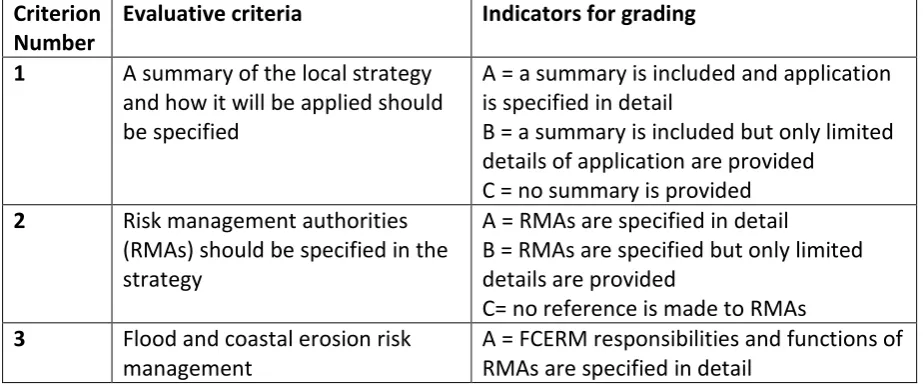
We relied on the scorecard approach (Fritsch Kamkhaji 2016) to appraise whether strategies provide the required information. Taking government guidelines as a benchmark, we established a list of 16 criteria that one would expect to find, with each one relating to a specific obligation in the legislation, as shown in above (Table 1 below). Additional details on application are drawn from the LGA framework.
Criterion 1 “ A
UK G ment 2010). Section 9 (4)(a) of the Act (UK Government
2010) states that each s
“
erosion risk management functions that may be exercised by those authorities in relation to Criterion 2 therefore states that risk management authorities should be specified, with Criterion 3 determining that their functions and responsibilities are also identified. Again, the LGA Framework provides some guidance through initially listing the potentially relevant risk management authorities for inclusion in strategies, as named in the Act: the Environment Agency; Lead Local Flood Authorities (unitary, county council or London boroughs); district councils; internal drainage boards; private water companies; the highway
a ‘ F C C
National Rail and British
Waterways (LGA 2011: Chapter 6). Further guidance is provided on detailing risk management authority functions, with tasks divided into strategic policy-making, risk management planning and implementation (ibid.: Chapter 7). Objec
7
respect of objectives setting (Criterion 4), the LGA Framework initially defines an objective LGA 2011: 37), recommending the establishment of higher level strategic objectives along with more detailed ones. While high level objectives, it is suggested, could relate to broader social, economic and environmental targets, detailed objectives should be linked to specific flood risks based on preliminary flood risk assessments.
Criteria 5 and 6 relate to the requirement in the Act (Section 9(4)(d)(e) for strategies to specify measures introduced to meet these management objectives and how they will be implemented (UK Government 2010). According to the LGA (2011: 38) management
iden
W
strategies, such as Catchment Flood Management Plans and Shoreline Management Plans, are suggested as a means of supporting measures introduced, structural measures could include Sustainable Urban Drainage Systems for new developments, introduced under the
2010 legislation (ibid.). A s and benefits of
UK G “
reflected in Criterion 7 and 8. Guidance is provided in the LGA Framework on specifying costs, benefits and funding of management measures. Benefits are defined more broadly than just flood protection provision and argued to include risk management, adaptation, cost-effective, consistent and transparent planning, and sustainable development outcomes (LGA 2011). Both national capital and revenue forms of funding are described, along with calculations for government Flood Defence Grant in Aid and a discussion of how local, national and EU sources of funding can be accessed (ibid.).
Table 1 >>>>>>
Criteria 9 and 10 are linked to requirements for assessing flood risk. Section 9 (4) (g) of the
A
UK G Criterion 9. The LGA (2011: 34) guidance
,
examined in Criterion 10. Conducted to fulfil the legal requirements of the Floods Directive, preliminary flood risk assessments were completed by LLFAs in 2011. Here, the LGA
F
8
Criteria 11, 12 and 13 relate to more general legal requirements for strategy review and links to wider environmental objectives. Each strategy must state how and when it will be reviewed (UK Government 2010: Section 9(4)(h)) but no specific details are provided in the legislation. As preliminary flood risk assessments must be updated every six years, to coincide with the Directive planning process, the LGA Framework refers to linking strategy
LGA C B
sk contexts, noting that it
Finally, in order to show how the
strategies are meeting wider environmental objectives (Section 9(4)(i) of the 2010 Act), the Framework specifically identifies inte EU “ E
Assessment Directive, Water Framework Directive, and Habitats Directive (LGA 2011: Chapter 12). Strategic environmental assessment, in this respect, could be employed as an ex post validation mechanism to check for compliance.
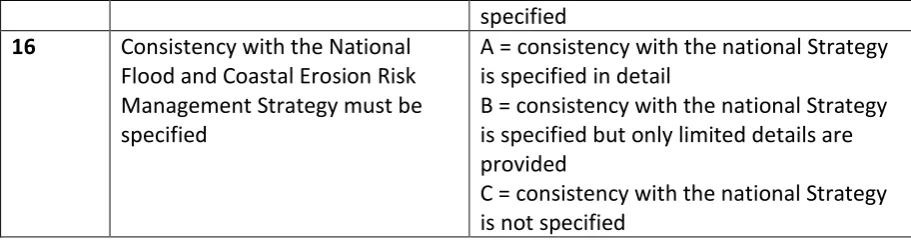
One area of specific interest prior to the analysis was the extent of consultation on strategy preparation. Lead local flood authorities are required to consult other risk management (UK Government 2010: Section 9(6)(a)(b)). In their guidance Framework, the LGA therefore suggests potential mechanisms for public engagement in strategy preparation (LGA 2011). Criteria 14 and 15 therefore examine how well this requirement has been met. Previous study has shown these processes to be weak in other collaborative water management mechanisms in England, for example the River Basin Liaison Panels that support the Water Framework Directive implementation. The effectiveness of public participation has also been questioned in environmental governance more widely (Newig & Fritsch 2009; Zwart 2007). Finally, Criterion 16 examines consistency with national level strategy: a specific requirement of the Act (Section 9(5)).
However, merely stating that such criteria have been met allows little analytical sensitivity since strategies could just express minimal compliance with legal requirements and provide limited detail. The Local Government Association, in its guidance to LLFAs (LGA 2011), sets out recommended approaches for addressing each requirement thereby establishing some Strategies were therefore rather than scored for each criteria (Table 1) against three qualitative measures A where information about compliance with each criteria was complete and specified in detail
(i.e. high compliance) B incomplete or only limited
9 The research process
The evaluation was conducted in several inter-linked stages. Firstly, web searches were employed to ascertain Local Flood Risk Management Strategy adoption across England, with information compiled in a database. From this search, a total of 81 authorities in England were identified in mid-2015 as having produced a strategy4. Secondly, this database was
used to derive a sample of 43 strategies for analysis. Although the sample was semi-randomised, strategies were deliberately chosen to: (i) include different types of authorities; (ii) provide a wide geographical spread across England. Thirdly, this sample was evaluated using the framework of indicative criteria to assess whether legal requirements were being met. Strategies were graded against the framework according to how much information was provided. To reduce inter-reviewer subjectivity, one researcher reviewed the entire sample, with another researcher then validating grades given within a smaller sample to cross-check accuracy. The evaluation did not measure final implementation of each strategy, only the stated intent of each LLFA in implementing flood risk management. Qualitative comments were also made on the strengths and weaknesses of individual strategies in meeting criteria to support subsequent analysis and lesson-drawing. Finally, individual evaluations were entered into a spreadsheet for analysis and interpretation, with results discussed below.
4. Patterns of application
Our evaluation provides a general overview of application of the legal requirements, in addition to comparative analysis of individual criteria. One particularly striking feature was the differentials in information provided, with strategies varying between 8 and 100 pages in length. Variance in length did not follow a specific pattern between local authorities in terms of the level of flood risk or the size of the authority. The level of detail also varied considerably, with some strategies written in an overly technical style which could exclude non-experts and the public.
Generally, application of the legal requirements was effective, with most strategies receiving an A or B grade overall, based on the mode grade for all criterion. Yet only two strategies were rated A across all criteria, suggesting room for future improvement. One example of best practice comes from the London Borough of Wandsworth. Produced by consultants, the strategy is clearly structured, links to relevant flood risk assessments, is easy to follow and gives extensive details of flooding sources alongside a summary section (London Borough of Wandsworth 2014). This strategy also includes a comprehensive action plan and a breakdown of engagement with the local community. Although many strategies
10
included some elements, few contained all of them. The Buckinghamshire LLFA, for instance, produced a somewhat weaker strategy document, in particular information related to cost-benefit analysis, monitoring and review, and specific flood management measures were incomplete. On the other hand, this document excels when it comes to information related to consultation and involvement. Likewise, the Blackport Council strategy is sketchy on many scores, for instance when it comes to the payment and implementation of measures and aspects of consultations. However, this strategy also comes with many strengths, for instance very informative sections on how the strategy links to the implementation of the Water Framework Directive and the Habitats Directive. Finally, the strategy produced by the Devon LLFA fails to report adequately on important aspects such as the payment of flood protection measures and the cost and benefits of activities, but also comes with strong sections such as those on consultation. Table 2 below provides an overview of our findings.5
Table 2 >>>>
When considered in more detail, significant variance exists across the criteria and between LLFAs. Criterion 1 (inclusion of a summary of the strategy and its implementation) was almost universally well applied. In practice, 38 strategies were given an A grade. The majority of strategies gave a prominent position to summarising approaches and detailing implementation, with this information often contained in an executive summary or introductory section.
Criterion 2 (risk management authorities should be specified in the strategy), was applied to a high standard across the strategies, with 33 rated an A grade. Almost all LLFAAS provided a clear specification of risk management authorities, with only one recording no information. This is perhaps unsurprising, as the 2010 Act only requires LLFAs to identify other relevant authorities.
Criterion 3 (flood and coastal erosion risk management responsibilities/functions of risk management authorities should be specified in the strategy) is interrelated with Criterion 1. In expectation, this requirement should be relatively straightforward to address, as the functions of different authorities are detailed in the LGA guidance. Again, a high proportion of strategies met this requirement. But while 29 Strategies were graded as an A (information specified in detail), with some providing extensive descriptions, in other instances the functions and responsibilities were only briefly specified with little information provided, i.e. B grade. Some LLFAs adopted a minimal approach to compliance, with four not providing any information on this requirement.
Criterion 4 relates to the requirement that strategies must specify the objectives for management of flood risks. On examination, almost all LLFAs completed this requirement to a high standard, with 35 Strategies graded as an A (only one was graded C). Authorities
11
appeared to have expended significant effort in determining their objectives, with both high level and detailed approaches evident.
The 2010 Act also states that strategies must specify the proposed measures to meet these objectives. Criterion 5 therefore specifically focused on whether measures had been adopted and described. The LGA Framework lists measures that could be included, such as studies, assessments and plans, plus structural and non-structural measures for reducing flood risks. Again, LLFAs appeared to have spent significant effort on determining appropriate measures to support their objectives, with 24 rated as A in terms of information specified. Four strategies did not contain any details.
Criterion 6 is directly linked to Criteria 5. The 2010 Act states that strategies must set out how and when the measures proposed will be implemented. Analysis of the sample showed that, in contrast to Criterion 4, this aspect was more variable. Some 23 strategies did provide action plans, along with details of implementation and timings but a number of others (17) gave only minimal information, while 3 did not specify implementation. This situation may relate to the preliminary nature of some strategies and hence more details may emerge in future iterations.
Costs and benefits of proposed measures should also be specified (Criterion 7). While the 2010 legislation does not explicitly state determination (or even conceptualisation) of costs and benefits, the Local Government Association framework provides some limited guidance, as discussed above. On examination, LLFAs appeared to struggle with this requirement: 11 were graded A; 19 were graded B; while with the remainder it proved impossible to locate a specific discussion of costs and benefits. This problem may indicate some confusion over precisely what type of information should be specified. But without some recognised methodology for calculating these, often intangible, aspects, this requirement can be
difficult to address. B C F ‘ M “
with Lancashire County Council) interpreted this requirement by providing a diagram to illustrate how local flood risk management can link into wider environmental and social goals (Blackpool Council/Lancashire County Council 2014: 60). It highlights the role of flood risk management in sustaining benefits arising from local investment in transport infrastructure, to support employment, education and reduce congestion. The strategy also suggests that investment in sustained economic growth will be more attractive if business sectors are resilient to climate change. However, the observed pattern may also point to more general problems related to the collection and analysis of data required for cost-benefit calculation (Ackerman Heinzerling 2002; Hanley 2001), thereby mirroring challenges experienced in UK policy making more broadly (Fritsch et al. 2014). Alternatively, the low response rate may reflect a general unwillingness to express planning choices in figures and numbers (Dehnhardt 2014).
12
document to promote successful collaboration and partnership funding for local flood risk management. This criterion is important as local communities are being encouraged to acquire funding from local partners or beneficiaries, allowing them more influence and choice on which projects are undertaken. This criterion proved difficult to grade objectively, as a clear majority (27) strategies provided detailed information on funding. However, few actually quoted specific figures making it problematic to assess the financial implications of proposed measures. A small minority (5) gave no information at all, despite clear direction in the legislation.
How strategies assessed local flood risk was examined by Criterion 9. Almost all LLFAs met this requirement (35 were graded A), specifying to varying degrees how assessments were conducted. In addition, strategies also generally provided good details on how Preliminary Flood Risk Assessments were employed in their production (Criterion 10). However, a small minority (3) gave no details on this aspect, although this does not imply that they were not utilised at all. Given that such information is available from the parallel Floods Directive process, local authorities do have access to it.
Another important legal requirement is to specify how and when the strategy will be reviewed, examined via Criterion 11. Analysis showed that this criterion was only adequately met. Few LLFAs provided more than a minimal statement about the review process, i.e. B grade. Information stated was generally vague, with no real commitments to updating
“
of future revisions, but without saying when this updating would occur. Overall, this requirement was therefore only minimally complied with, although reasons are difficult to ascertain without further in-depth investigation. Criteria 12 and 13 concern the requirement for strategies to specify how they contribute to achieving wider environmental objectives for water and habitat protection. Results were variable for both criteria. Most (i.e. 20) strategies identified how they would contribute to objectives related to the Water Framework Directive but few gave more than minimal details. Strategic environmental assessments typically showed that strategy measures would have a positive impact on water quality, yet did not state how this would be achieved. Integration with the Habitats Directive was rather poorly specified, with 10 strategies not mentioning this aspect. One good example is the Portsmouth City strategy (Portsmouth City Council 2013: 29), which includes a table of how activities can affect water quality through pollution from littering, dumping, habitat degradation from invasive non-native species and general neglect.
13
issues were apparent with public consultation. Firstly, levels of detail about public consultation varied greatly. Some documents contained just one line stating that a consultation had occurred, while others only gave brief descriptions. Secondly, the consultation mechanisms described also varied along a continuum of minimum public engagement (e.g. placing information on websites and inviting responses) to more directly engaged processes such as public meetings, drop-in sessions and publicity events. Typical mechanisms employed, however, came from the minimum end of this continuum. Thirdly, few strategies explained how public consultation had influenced their development. In one example of best practice from the London Borough of Wandsworth (2014), the strategy outlines public engagement and provides a section showing how the consultation fed back to strategy development. Surrey County Council, in contrast, published a separate document showing the consultation questions and responses that also indicated how feedback was employed to update the strategy (Surrey County Council 2012). Several authorities used the consultation to determine details on historical flooding in their areas.
Responses to Criterion 16 (consistency with the National Flood and Coastal Erosion Risk Management Strategy must be specified) were also variable. National policy provides a framework for coordinating actions by LLFAs, hence a degree of consistency with local flood risk management strategies is critically important. Examination of the sample, however, showed that while larger authorities were able to detail integration with the national strategy, smaller urban authorities often ignored this requirement. As a result, 13 strategies lacked any relevant information on this aspect. Given that this obligation is critical to the overall implementation of national flood risk management policy, these findings are significant.
5. Conclusions and recommendations for future practice
14
- ort of becoming genuine
mechanisms to communicate flood risk to the public. Another feature, not examined by the review, is the extent to which strategies are enhancing local FRM an area for future in-depth research. However, given the preliminary status of strategies in England, such issues can be resolved in the revision process.
Several recommendations could therefore be forwarded for future strategy production. Firstly, strategies should provide better information on how measures will be financed, presented in ways easily understandable by the public. Secondly, timescales for strategy review, along with specific targets to be met, should be included. Strategy revision should be coordinated with the Floods Directive and Water Framework Directive planning cycles, to ensure greater consistency in management objectives and implementing measures. Easy to understand action plans with specified review timings and objectives should also be considered. Better explanations of monitoring of strategies would also improve the communication of flood risks to the public. Thirdly, strategies should demonstrate much more how they integrate with national strategy and other environmental objectives such as enhancing water quality and biodiversity protection. Flood risk management measures could be better considered within integrated water resources management, whereby all aspects of water governance are combined at localised scales. Finally, and perhaps most critically, future strategy development should give better consideration to public consultation. Some LLFAs adopted innovative and successful mechanisms for public engagement, suggesting scope for mutual learning on best practice. Communication of flood risks appeared optimal where strategies were produced in a non-technical way, with maps, photographs and case studies employed to enhance accessibility and made freely available for public inspection via different media, including meetings and other fora. But on the
I -
enhance localised and collaborative governance, as envisaged by the Pitt Review, is to be effective then LLFAs need to better engage the public in not only strategy development but also long term implementation of flood and coastal erosion risk management. Our recommendations therefore include conducting further, in-depth empirical research into strategy development in order to examine ways to enhance these documents as
flood risk management, with a particular
emphasis placed on the inclusion of the public in strategy production and implementation.
References
A F H L P -benefit analysis of
15 Benson, D., Jordan, A.J., Smith, L. (2013). I
A E A
U“A, Environment and Planning A 30 (6): 1695-1712.
Blackpool Council/Lancashire County Council (2014). Lancashire and Blackpool local flood risk management strategy. Preston: Lancashire County Council.
Cabinet Office (2008a). The Pitt Review: learning lessons from the 2007 floods. London: Cabinet Office.
Cabinet Office (2008b). Press n S M P L
from the 2007 floods. Press release. London: Cabinet Office.
Chatterton, J. Viviattene, C., Morris, J., Penning-Rowsell, E. C., Tapsell, S. M. (2010). The costs of the summer 2007 floods in England. Project Report. Bristol: Environment Agency.
Cook, H.F. (1998). The protection and conservation of water resources: a British perspective. Chichester: Wiley.
D A T
cost benefit analysis in water policy: the case of German policy-maker Env. Pol. & Gov., 24 (6): 391-404.
Department for Environment, Food and Rural Affairs (Defra) (2004) Making space for water: developing a new Government strategy for flood and coastal erosion risk management in England a consultation exercise. London: Defra.
Department for Environment, Food and Rural Affairs (Defra) (2008a). T G r S M P ‘ summer 2007 floods. London: Defra.
Department for Environment, Food and Rural Affairs (Defra) (2008b). Future water: the
G E . London: Defra.
Department for Environment, Food and Rural Affairs (Defra) (2011a). National flood and coastal erosion risk management strategy. London: Defra.
Department for Environment, Food and Rural Affairs (Defra) (2011b). Exercise watermark: final report. London: Defra.
Department for Environment, Food and Rural Affairs (Defra) (2012a). T G
r S M P Review of the summer 2007 floods: final progress report. London: Defra.
16
D T G B F t in Europe: the development of a EU Int. J. Riv Bas Mngt., 3(2): 97 103.
Environment Agency (EA) (2007). Review of 2007 summer floods. Bristol: Environment Agency.
Environment Agency (EA) (2010). Delivering benefits through evidence: the costs of the summer floods in England. Bristol: Environment Agency.
Fritsch O., Kamkhaji J. (2016). Implementing in the laboratory: scorecards for appraising regulatory impact assessments. In: Handbook of regulatory impact assessment, eds. C. Dunlop and C. Radaelli. Cheltenham: Edward Elgar, 399-411.
H N C - Env. & Plan. C:
Govt & Pol., 19: 103-118.
Johnson, C., Tunstall, S., Penning-‘ E F y change: E W Int. J. W. Res. Devt., 21 (4): 561 575.
J C P “ J Flood risk management in England: a changing landscape of Int. J. W. Res. Devt., 24 (4): 513-525.
K K T -based governance: the case of flood G E Reg. & Gov., 7 (2): 236-257.
Local Government Association (LGA) (2011). Framework to assist the development of the local strategy for flood risk m A . London: LGA.
London Borough of Wandsworth (2014). London Borough of Wandsworth local flood risk management strategy. London: Wandsworth Borough Council.
Lorenzoni, I., Benson, D., Cook, H. (2015). ‘ rescaling in UK climate adaptation
J K K
Klindworth (eds.) Climate adaptation governance theory, concepts and praxis in cities and regions. Chichester: Wiley.
Met Office (2013) Record rainfall - June-July & May-July 2007. Exeter: Met Office. (Accessed online 03.08.2015) http://www.metoffice.gov.uk/climate/uk/interesting/may_july2007.
M T N J M
Env. Mngt., 46 (1): 1-6.
N J C E J N K E W
in implementing the EU Floods Directive? A comparison with the Water Framework
D E G Env. Pol. & Gov., 24 (4):
17
N J F O Environmental governance: participatory, multi-level and effective? Env. Pol. & Gov , 19 (3), 197-214.
Penning-‘ E C H J W F B
The Geog. J., 154 (2): 209-220.
Portsmouth City Council (2013). Local flood risk management strategy. Portsmouth: Portsmouth City Council.
Rouillard, J.J. B T H K V ‘ A D P
catchment- L “ E Env. Sc. &
Pol., 50: 155-165.
Surrey County Council (2012). Draft Surrey local flood risk management strategy. Kingston upon Thames: Surrey County Council.
T T P “ P
E Area46 (4): 418-425.
Thaler, T., Levin-Keitel, M. (2015). M -level stakeholder engagement in flood risk
management - E Env. Sc. & Pol.
UK Government (2010). Flood and Water Management Act. London: UK Government.
UK Parliament (2010). Flood and Water Management Act 2010: Progress of the Bill. London: UK Parliament.
) I L Env. Val., 16: 485-511.
Table 1: Evaluative framework for assessing the extent to which local flood management strategies in England meet legal specifications, as required by the Flood and Water Management Act 2010.
Criterion Number
Evaluative criteria Indicators for grading
1 A summary of the local strategy and how it will be applied should be specified
A = a summary is included and application is specified in detail
B = a summary is included but only limited details of application are provided
C = no summary is provided
2 Risk management authorities (RMAs) should be specified in the strategy
A = RMAs are specified in detail
B = RMAs are specified but only limited details are provided
C= no reference is made to RMAs
3 Flood and coastal erosion risk management
[image:18.595.70.532.569.761.2]18 responsibilities/functions of RMAs should be specified in the strategy
B = FCERM responsibilities and functions of RMAs are specified but only limited details are provided
C = no reference is made to FCERM responsibilities and functions of RMAs
4 Objectives for managing local flood risks should be specified in the strategy
A = objectives for managing local flood risks are specified in detail
B = objectives for managing local flood risks are specified but only limited details are provided
C = no objectives are specified
5 Flood management measures for meeting these objectives should be specified in the strategy
A = flood management measures for meeting objectives are specified in detail B = flood management measures for meeting objectives are specified but only limited details are provided
C = no flood management measures for meeting objectives are specified
6 How these measures will be implemented (timings,
approaches adopted) should be specified in the strategy
A = implementation of measures is specified in detail
B = implementation of measures is specified but only limited details are provided
C = no implementation of measures is specified
7 Costs and benefits of these measures should be specified in the strategy (economic, social, environmental)
A = costs and benefits (economic, social, environmental) of measures are specified in detail
B = costs and benefits (economic, social, environmental) of measures are specified but only limited details are provided C = no costs and benefits are specified
8 How the measures will be paid for should be specified in the strategy (what are the funding sources?)
A = how measures will be paid for is specified in detail
B = how measures will be paid for is specified but only limited details are provided
C = how measures will be paid for is not specified
9 An assessment of local flood risk should be specified in the strategy
A = an assessment of local flood risk is specified in detail
B = an assessment of local flood risk is specified but only limited details are provided
C = no assessment of local flood risk is specified
19 Assessments should be specified in the strategy
are specified in detail
B = Preliminary Flood Risk Assessments are specified but only limited details are provided
C = Preliminary Flood Risk Assessments are not specified
11 How and when the strategy will be reviewed should be specified in the strategy
A = how and when the strategy will be reviewed is specified in detail
B = how and when the strategy will be reviewed is specified but only limited details are provided
C = how and when the strategy will be reviewed is not specified
12 How the strategy contributes to wider environmental objectives (Water Framework Directive) should be specified
A = how the strategy contributes to wider environmental objectives (WFD) is
specified in detail
B = how the strategy contributes to wider environmental objectives (WFD) is
specified but only limited details are provided
C = how the strategy contributes to wider environmental objectives (WFD) is not specified
13 How the strategy contributes to wider environmental objectives (Habitats Directive) should be specified
A = how the strategy contributes to wider environmental objectives (Habitats Directive) is specified in detail
B = how the strategy contributes to wider environmental objectives (Habitats Directive) is specified but only limited details are provided
C = how the strategy contributes to wider environmental objectives (Habitats Directive) is not specified
14 Consultation with the public in preparation of the strategy should be specified
A = consultation with the public in
preparation of the strategy is specified in detail
B = consultation with the public in
preparation of the strategy is specified but only limited details are provided
C = consultation with the public in
preparation of the strategy is not specified
15 Consultation with other RMAs (EA, water companies, district councils, IDBs, highways authority) should be specified
A = consultation with other RMAs is specified in detail
B = consultation with other RMAs is specified but only limited details are provided
20
specified
16 Consistency with the National Flood and Coastal Erosion Risk Management Strategy must be specified
A = consistency with the national Strategy is specified in detail
B = consistency with the national Strategy is specified but only limited details are provided
[image:21.595.71.527.72.192.2]C = consistency with the national Strategy is not specified
Table 2: the evaluative criteria and grades for the sample.
Criterion Number
Strategy evaluative criteria Grade
A
Grade B
Grade C 1 A summary of the local strategy and how it will
be implemented should be specified
38 5 0
2 Risk management authorities (RMAs) should be specified in the strategy
33 8 2
3 Flood and coastal erosion risk management responsibilities/functions of RMAs should be specified in the strategy
29 10 4
4 Objectives for managing local flood risks should be specified in the strategy
35 7 1
5 Flood management measures for meeting these objectives should be specified in the strategy
24 15 4
6 How these measures will be implemented (timings, approaches adopted) should be specified in the strategy
23 17 3
7 Costs and benefits of these measures should be specified in the strategy (economic, social, environmental)
11 19 13
8 How the measures will be paid for should be specified in the strategy (what are the funding sources?)
27 11 5
9 An assessment of local flood risk should be specified in the strategy
35 5 3
10 Preliminary Flood Risk Assessments should be specified in the strategy
33 7 3
11 How and when the strategy will be reviewed should be specified in the strategy
12 18 13
12 How the strategy contributes to wider environmental objectives (Water Framework Directive) should be specified
20 15 8
13 How the strategy contributes to wider
environmental objectives (Habitats Directive) should be specified
21
14 Consultation with the public in preparation of the strategy should be specified
12 23 8
15 Consultation with other RMAs (EA, water companies, district councils, IDBs, highway authority) should be specified
25 13 5
16 Consistency with the National Flood and Coastal Erosion Risk Management Strategy must be specified