
AMSYAR ARIF B MOHAMED BUKHARY
DEVELOPMENT OF EMPTY OIL PALM FRUIT BUNCHES
(EFB) SEGREGATION USING MACHINE LEARNING
AMSYAR ARIF B MOHAMED BUKHARY
This report is submitted in partial fulfilment of the requirements
for the degree of Bachelor of Electronic Engineering with Honours
Faculty of Electronic and Computer Engineering
Universiti Teknikal Malaysia Melaka
Tajuk Projek : DEVELOPMENT OF EMPTY OIL PALM FRUIT
BUNCHES (EFB) SEGREGATION USING
MACHINE LEARNING Sesi Pengajian : 2017/2018
Saya AMSYAR ARIF BIN MOHAMED BUKHARY mengaku membenarkan laporan
Projek Sarjana Muda ini disimpan di Perpustakaan dengan syarat-syarat kegunaan seperti berikut:
1. Laporan adalah hakmilik Universiti Teknikal Malaysia Melaka.
2. Perpustakaan dibenarkan membuat salinan untuk tujuan pengajian sahaja. 3. Perpustakaan dibenarkan membuat salinan laporan ini sebagai bahan
pertukaran antara institusi pengajian tinggi. 4. Sila tandakan ():
SULIT*
(Mengandungi maklumat yang berdarjah keselamatan atau kepentingan Malaysia seperti yang termaktub di dalam AKTA RAHSIA RASMI 1972)
TERHAD*
(Mengandungi maklumat terhad yang telah ditentukan oleh organisasi/badan di mana penyelidikan dijalankan.
TIDAK TERHAD
Disahkan oleh:
(TANDATANGAN PENULIS) (COP DAN TANDATANGAN PENYELIA)
Alamat Tetap: NO 12 JALAN
BESTARI INDAH
VILLA BESTARI
GOMBAK 53100
KUALA LUMPUR
SELANGOR
Tarikh : 13 Mei 2018 Tarikh : 24 Mei 2018
*CATATAN: Jika laporan ini SULIT atau TERHAD, sila lampirkan surat daripada pihak berkuasa/organisasi berkenaan dengan menyatakan sekali tempoh laporan ini perlu dikelaskan sebagai SULIT atau TERHAD.
FAKULTI KEJUTERAAN ELEKTRONIK DAN KEJURUTERAAN KOMPUTER
BORANG PENGESAHAN STATUS LAPORAN
DECLARATION
I declare that this report entitled “DEVELOPMENT OF EMPTY OIL PALM FRUIT BUNCHES (EFB) SEGREGATION USING MACHINE LEARNING” is the result of my own work except
for quotes as cited in the references.
Signature : ………
Author : Amsyar Arif bin Mohamed Bukhary
APPROVAL
I hereby declare that I have read this thesis and in my opinion this thesis is sufficient
in terms of scope and quality for the award of Bachelor of Electronic Engineering
with Honours.
Signature : ………
Supervisor Name : Dr Syafeeza Binti Ahmad Radzi
DEDICATION
I would like to dedicate this project to my final year project supervisor and
Co-supervisor who have been constantly giving support and dedication to all family
ABSTRACT
This project represents the development of empty oil palm fruit bunches (EFB)
segregation prototype using MATLAB for the different age group. Most of the manufactured
industry does not utilize the production by using the EFB according to suitable age. This
problem occurs because the products do not have the good system to be implemented to
segregate the EFB according to their age specification such as to improve the parameters for
the machine to be operated. This is very crucial in the industry because the different age of
EFB for making commercializes purposes and generate additional income to the palm oil
company. The approach of this control system starts with building the high percentage of
identification for each bunches belongs to which age group. The neural network is using the
MATLAB software to train the parameter given and it automatically adjusts to the network's
weights and biases. The system starts with after the drying process of the bunches after the
milling process, MATLAB based of Neural Network as the threshold data to identify each
bunches group and determine the sample of EFB to segregate according to their age
ii
ABSTRAK
Projek ini menerangkan tentang pembangunan dalam prototaip mengasingkan tandan
kosong kelapa sawit (TKK) dengan menggunakan aplikasi MATLAB untuk kelainan
kumpulan usia. Kebanyakan industri tidak menggunakan sepenuhnya dalam menghasilkan
seseuatu produk baru mengikut kemampuan kesesuaian usia TKK tersebut. Masalah timbul
apabila dalam menghasilkan ssesuatu produk baru, satu system yang baik tidak dapat
diimplikasi yang membolehkan mengasingkan kumpulan usia TKK tersebut dari segi
penambahbaikan parameter untuk mesin berfungsi. Hal ini merupakan satu kepentingan
kepada industri sebagai sedia maklum setiap lapisan umur mempunyai keistimewaan bagi
menghasilkan sesuatu produk baru mengikut ciri-ciri yang spesifik yang mampu
dikormesialkan serta memberikan variasi dampak positif kepada keuntungan industri
tersebut. Kaedah pendekatan sistem kawalan ini bermula dengan menghasilkan kadar
peratusan yang tinggi terhadap pengasingan TKK mengikut lapisan umur yang ditetapkan.
Kaedah Jaringan Neural diimpikasikan dengan cara aplikasi MATLAB untuk mengajar
sistem beroperasi dengan parameter yang ditetapakn justeru itu mampu justifikasi secara
automatic berdasarkan jaringan berat dan bias. Sistem ini beroperasi dengan cara kaedah
pengeringan TKK selepas diproses kemudian terus ke jaringan neural serta arahan yang
betul sebagai sumber rujukan untuk menetukan usia TKK yang ditentukan. Tambahan pula,
TKK akan desalurkan kepada penghantar yang betul dan di hantar kepada kilang yang
ACKNOWLEDGEMENTS
The satisfaction that came after the completion of any task would be incomplete without mentioning the group of people who made it possible, the person who provide constant guidance, encouragement and support throughout this project. I consider it my privilege to express gratitude and respect to all those who involve direct and indirectly in the completion of this project.
I would like to thank this project supervisor Dr. Syafeeza Binti Ahmad Radzi for his precious guidance and effectually care which happens to be the psyche of this project. I would also like to express my heartfelt gratitude to Dr. Norhashimah Binti Mohd Saad as my co-supervisor for his encouragement and valuable guidance.
My deepest appreciation and to MPOB company supervisors, Dr. Kamarudin bin Hassan Head of Biomass technology, for thought and helped me to understand and learn various processes in palm oil fruit as well as understanding various processes within the plant.
iv
TABLE OF CONTENTS
Declaration i
Approval i
Dedication i
Abstract i
Abstrak ii
Acknowledgements iii
Table of Contents iv
List of Figures vii
List of Tables x
List of Symbols and Abbreviations xi
List of Appendices xii
CHAPTER 1 INTRODUCTION 1
1.1 Introduction of the project 1
1.3 Problem Statement 7
1.4 Scope of work and Limitation 8
1.5 Project Significant 10
CHAPTER 2 BACKGROUND STUDY 11
2.1 Neural Network for self-learning pattern recognition(brain) 11
2.2 Learning Vector Quantization approach 15
2.3 Self-Organizing map 18
2.4 Convolutional Neural Network 20
2.5 Idea approach 22
CHAPTER 3 METHODOLOGY 25
3.1 Overview of the project 25
3.2 Software Development of Neural Network 27
3.3 Image processing as image acquisition 29
CHAPTER 4 RESULTS AND DISCUSSION 32
4.1 Neural Network Approach 32
4.2 Image Acquisition 38
4.3 GUI 45
4.3.1 Image Acquisition and Data Collection 46
4.3.2 Neural Network 48
vi
CHAPTER 5 CONCLUSION AND FUTURE WORKS 53
5.1 Conclusion 53
5.2 Future work and industrial implication 54
REFERENCES 57
LIST OF FIGURES
Figure 1.1 Measurements of oil palm bunch componenst. (The age of the bunch ) 2
Figure 1.2: Drying palm oil bunch cut to half. 3
Figure 1.3: The palm oil process flow 5
Figure 1.4: Age classification profile of the palm oil tree [1] 6
Figure 2.1: Neural approach for the image segmentation[9] 13
Figure 2.2: Neural network architecture with LVQ algorithm[12] 15
Figure 2.3: Neural network representation with LVQ algorithm 16
Figure 2.4: Neural network representation with LVQ algorithm 16
Figure 2.5: Structure of Self-organizing map 18
Figure 2.6: A regular 3-layer neural network[15] 20
Figure 2.7: ConvNet arranges its neurons in three-dimensional (width,height,depth) 20
Figure 2.8: Sorting of fruit by conveyer according to specification 23
Figure 3.1: Flowchart of overall project. 26
Figure 3.2: Flowchart of image processing 30
viii
Figure 4.2: Neural Network layer system 33
Figure 4.3: Algorithm Neural Network 34
Figure 4.4: Training progress of Neural 34
Figure 4.5: Training performance of epoch versus mse 35
Figure 4.6: Table of confusion output class 36
Figure 4.7: Receiver operating characteristic result 37
Figure 4.8: Sample EFB 1 38
Figure 4.9: Sample EFB 2 39
Figure 4.10: Sample EFB 3 39
Figure 4.11: Workspace in Matlab 40
Figure 4.12: Image display through Matlab 41
Figure 4.13: Colour Plane 42
Figure 4.14: Result RGB colour plane 43
Figure 4.15: Feature points from the image 44
Figure 4.16: Overall GUI( Graphical User Interphase) 45
Figure 4.17: Tag measurement of EFB sample 46
Figure 4.18: Result from the image processing GUI 47
Figure 4.19: Neural Network GUI 48
Figure 4.20: Result from a test data sample Group 1 49
Figure 4.21: Result from a test data sample Group 2 50
Figure 4.22: Result from a test data sample group 3 50
Figure 5.1: Propose design prototype of conveyer system 54
x
LIST OF TABLES
Table 2.1: Summary comparison of related project 23
Table 4.1: Summarise table of training efficiency 35
Table 4.2: summary of table confusion results 37
LIST OF SYMBOLS AND ABBREVIATIONS
EFB : Empty Fruit Bunches
FFB : Full Fruit Bunches
NN : Neural Network
LVQ : Learning Vector Quantization
SOM : Self-Organizing Map
xii
LIST OF APPENDICES
1
CHAPTER 1
INTRODUCTION
This chapter introduces the overall project descriptions with its introduction of the
project, problem statement, objectives, project scope, and project significance and to
provide a sense of purpose and reasons to proceed with the project.
1.1 Introduction of the project
This project represents the development of empty oil palm fruit bunches (EFB)
segregation prototype using MATLAB for the different age group. The current
utilisation of the EFB is inefficient and low in productivity due to the age is hardly
determined among the fruits after processes of an oil palm fruits extraction in the
actual palm oil milling process.
The EFB is said to be the final product achieved where it is available in
2
industry does not have the good parameters to reuse for making goods to the
industry. This is because of lack of an economy system for handling and storage and
less desirable quality of resulting products. By proposing the right method where can
help on age classification it might help on the utilization of EFB to the industry.
Furthermore, if the objective achieved, thus the production of oil palm will
increase because of the increase in quality were proportional to the production. This
is very crucial in the industry because the different age of EFB for making
commercialising purpose and generate additional income to the palm oil company.
The approach of this control system starts with building the high percentage of
identification for each bunches belongs to which age group. The age of the bunch is
determined by the length of bunch stalk devoid of fruit, EFB spikelet as shown in
Figure1.1 (middle part of the fruit).
[image:20.595.126.523.444.679.2]This project is to develop a prototype of oil palm fruit bunch segregation system,
which divides the EFB according to similar fibre quality which considers as a similar
age profile. This project represents the extension process after the milling process in
the actual industry. Since it just to test the functionality of the prototype, the drying
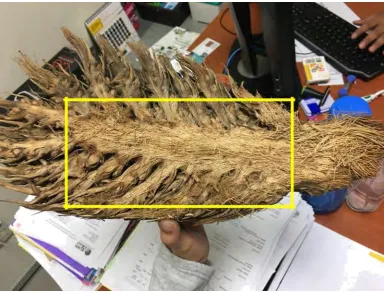
[image:21.595.128.513.222.515.2]palm oil bunch cut into half will be presented as a sample.
Figure 1.2: Drying palm oil bunch cut to half.
Camera act as an image sensor will firstly detect the image of EFB and
differentiate to three types of measurement. The “X” value of the new sample (in the
yellow rectangle box) will now be recognized as the new data in this report. The new
data integrated with MATLAB based of Neural Network as the threshold data or
4
In order to create the database or to make it more understandable, the database
now will be referred to the Neural Network training model as a brain. In fact, it
would act as a self-learning of pattern classification. Measurements of palm oil
bunch component data provided by MPOB researcher in a parameter which to
identify the physical characteristics of oil palm fruit bunches and their relationships
according to respective oil palm tree ages. The measurements given are measured
manually using the measurement ruler.
Neural network method applied by using the MATLAB software, which used to
train the parameter given and it automatically adjusts to the network's weights and
biases. The result of palm oil bunch age will be the input for the segregation to
occur. Lastly, the EFB will be sorting through the correct box conveyer according to
their age specification and ship to the suitable industry.
Furthermore, if the objective achieved, thus the production of oil palm will
increase because of the increase in quality were proportional to the production. This
is very crucial in the industry because the different age of EFB for making
commercialises purposes and generate additional income to the palm oil company.
The approach of this control system starts with building the high percentage of
identification for each bunches belongs to which age group.
This system prototype will be an emphasis on the industry where it will take over
after the process of milling process where the segregation of EFB will occur
1.2 Background
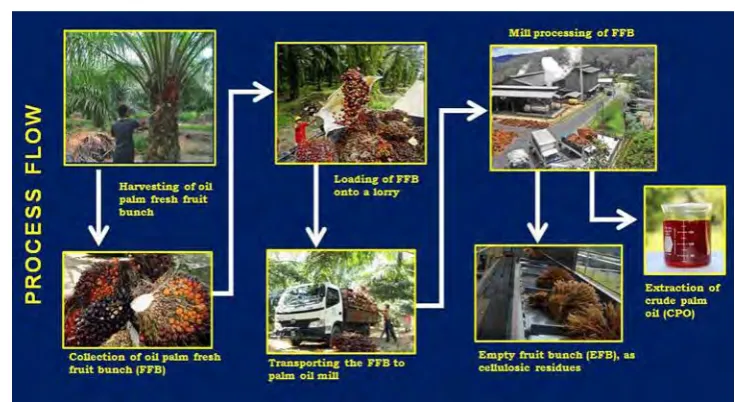
Figure 1.3: The palm oil process flow
Oil palm plantation in Malaysia is 5.74 million hectares, producing approximately
86.32 million tonnes of fresh fruit bunches (FFB) in 2016 [1]. The FFB was
processed in the palm oil mill for oil extraction, leaving empty fruit bunches (EFB)
and fruit (mesocarp) fibres as the main cellulosic residues. These cellulosic were
currently being used in the agriculture sector for mulching the young palm tree (as
nutrient on decomposition)[2]. According to barriers to economic use of Oil Palm
Trunk (OPT) by plywood mills, the main issues will be on Logistics, handling the
storage, inherent characteristics of OPT, processing and manufacturing processes,
market competition & high cost of production[3].
In the report of MPOB 2015 it was found that the age classification of palm oil
can be classified according to 4 age profiles which are immature from 3years old,
young from 4 to 7 years old, prime from 8 to 17 years old and old from 18 to 25
6
determine the age of the fruit for better production in industry. These classifications
[image:24.595.158.492.179.393.2]can be shown below[1]:
Figure 1.4: Age classification profile of the palm oil tree [1]
Because of the age is hardly determined among the fruits, thus EFB is not fully
utilized by the industry. The EFB is said to be the final product achieved where it is
available in abundance after the milling process of FFB is successfully done where
most of the industry does not have the good parameters to reuse for making goods to
the industry[4]. This is because of lack of the economy system for handling and

![Figure 1.4: Age classification profile of the palm oil tree [1]](https://thumb-us.123doks.com/thumbv2/123dok_us/63434.5969/24.595.158.492.179.393/figure-age-classification-profile-palm-oil-tree.webp)
