Strategic L earn in g an d Capability D evelopm ent Challenge:
T h e Case of T h ai A uto-Part Firm s
C haiw at C hitravas
A thesis submitted for the degree of Doctor of Philosophy
of
T
h eA
ustralianN
ationalU
niversityDeclaration Statement
I c e rtify that this thesis is w h o lly m y own original w ork. This study contains no material w h ich has previously been accepted for the award o f any other degree at any other university. To the best o f m y knowledge, this study contains no material previously published or w ritten by any other person, except where due reference is given in the text.
Chaiwat Chitravas Canberra - October 19, 2006
Acknowledgements
This Ph.D. thesis w ould not have been completed w ith o ut the assistance o f many great people, from whom I have learned sig n ifican tly. In Australia, I am much obliged to Assoc. Prof. Don Scott-Kem m is (m y principal supervisor), whose supervision style warms m y heart. I v iv id ly remember when I firs t met Don at the Canberra A irp o rt in February 2003, and he kin d ly took me on a grand tour o f “ w hat was le ft” o f the bush land after the notorious Canberra Bushfire. I appreciated his generous welcome to Canberra, and thankful for the tour. B ut im portantly, I am indebted to him for his tireless supervision,
long hours o f discussion, and the “ open door” p olicy. I am also indebted to Prof. Bruce Stening and Prof. Hal H ill for their superb guidance. These people sig n ifican tly assisted me w ith the learning process related to the research strategy as w e ll as provided their im portant contacts in Thailand. In addition, I also h ig hly appreciated the generous financial support (the A N U Thai A lu m n i PhD Scholarship, the fie ld w o rk and overseas conference funding provided by the N ational Graduate School o f Management), w ith o ut w hich this thesis w ould not have been possible.
In Thailand, I w ish to express m y gratitude to all the people who made my fie ld w o rk possible (and “ less p a in fu l” ), in particular, the Thailand A utom otive Institute who k in d ly allowed me to v is it them and in terview the key personnel. In addition, the Institute also permitted me to fo llo w “ into the fie ld ” and observed their training activities during the A utom otive Experts D ispatching Programs. Other organizations I w ish to thank are: the Thai Auto-Parts M anufacturers Association for a llo w in g me to interview their personnel and p roviding me w ith further contacts; the Federation o f Thai Industries (A utom obile Industry C lub and Auto-Parts Industry C lub); the A S E A N A utom otive Federation; the Society o f A uto m o tive Engineers, Thailand; the Board o f Investment for providing me w ith an o ffic ia l letter fo r accessing firm s; the N ational Science Technology and Development Agency fo r p ro vid in g me w ith many useful interviews as w e ll as
im portant secondary data; and Asian P olicy Research fo r assisting me w ith interview guide revisions. Furthermore, I w ish to express m y sincere appreciation fo r the Thai auto-part firm s ’ executives, who understandingly accepted m y request to interview them, their top managers, engineers, and technicians. Some o f these personnel also provided me w ith personal plant tour, and sometimes offered me a free lunch!
Personally, I w ish to thank m y parents w ho were com m itted to p roviding the resources (as much as they could) fo r m y own personal “ learning and capability development” . Last but not least, m y beloved w ife deserves much gratitude. She had resigned from her jo b as an Assistant Professor (in Thailand) and accompanied me to A ustralia to continue to provide me w ith the love as w e ll as the morale support.
Abstract
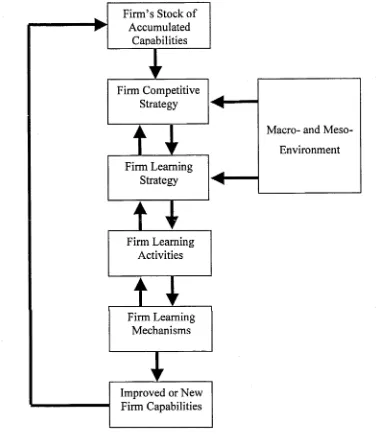
The objective of this thesis is to investigate the competitive and learning strategies of Thai auto-part firms, in particular the impact of the differences in strategies on the firms’ learning activities and mechanisms. The study finds that firms’ strategies, learning activities, and learning mechanisms interacted to form either a fast or slow rate of firm capability accumulation. The conceptual and analytical framework integrates four components: 1) the changes in the external meso-environment, 2) firm competitive and learning strategies, 3) firm learning activities and mechanisms, and 4) firm capability development. In addition, the behavior of firm owners and its top managers were also explored. The frameworks are used to build a causal model to explain how different firm strategies contribute to different types of learning activities and mechanisms, and finally how these systemic elements interacted together to shape the latecomer firms’ capability accumulation pattern and finally their “capacity to learn”.
The research adopted a qualitative multiple-case study approach, with cross-case comparisons, involving nine Thai auto-part firms. The primary data comprised semi-structured interviews and some direct observations, while the secondary data comprised many documents from both the nine firms and the supporting organizations. The use of a wide range of sources, including interviews with industry experts, contributed to the reliability of the assessments of firm level strategies, activities, and performance. The analysis comprised a painstaking iterative process of analyzing the interview transcripts, drawing analytical tables and figures, writing analytical memos, and consolidating these into nine detailed case study write-ups.
The analysis shows that the performance of these nine firms - in terms of growth, exports, product sophistication, etc. - diverged over time. The empirical evidence suggested that Thai auto part firms’ competitive and learning strategies evolved differently, and that those strategies were shaped by and influenced: 1) their subjective perception of changes within the meso-environment and 2) the firms’ stock of accumulated capabilities. This impacted the way the firms chose their learning mechanisms and conducted their learning activities. Depending on the types of strategies (conservative or ambitious), the firm’s learning activities progressed either gradually or swiftly from simple activities to more complex ones. Similarly, depending on the level of effort, coordination, and synergy achieved in concurrently managing strategies, learning activities and mechanisms, the firms either achieved a fast or a slow rate of capability accumulation. It is argued that regardless of firm differences, one thing remains crucial - the systemic learning property (i.e. the firm’s “learning system”). Viewing the changes within the meso-environment as business opportunities, the “strong learner” firms tended to formulate aggressive competitive and learning strategies, engaged in a more diverse, complex (yet focused) learning activities, and achieved synergy between the passive and active learning mechanisms. In short, these firms had a well- aligned learning system. In contrast, the “weak learner” firms viewed the meso-level changes more as threats. They had conservative strategies, inadequate learning effort with poor transition to complex learning activities, and lack of synergy between the passive and active learning mechanisms. In short, these firms had a poorly-aligned learning system. Additionally, the role played by the Thailand Automotive Institute could be crucial to assist the weak learner firms to transition to become stronger, and avoid being “locked in” to a poorly-aligned learning system.
Contents
Declaration Statement 1
Acknowledgements ü
Abstract iü
List of Tables ‘x
List of Figures x
List of Abbreviations x*
Chapter 1 - Introduction
1.1 Background and Motivation 1
1.2 The Research Problem and Key Assumptions 3
1.3 Objectives of the Research 4
1.4 Scope and Focus 5
1.5 Outline of the Thesis 5
Chapter 2 - Review of Related Literature
2.1 The Latecomer Firms Literature (LFL) 9
2.1.1 Origins o f Technological Capability and Learning Concepts 10
2.1.1.1 Technological Capability Concepts 10
2.1.1.2 Learning Concepts 12
2.1.2 The Taxonomies o f Technological and Organizational Capabilities 14 2.1.3 Technological Capabilities and Learning: Lessons from the Empirical Studies 16
2.1.3.1 Thailand Empirical Studies 19
2.1.4 Absorptive Capacity and Latecomer Firm Learning 24
2.1.5 Summary o f LFL 25
2.2 The Strategic Management and Resource-Based Literature (SRBL) 26 2.2.1 Origin o f Concepts: Resources, Capabilities and Core Competencies 26
2.2.1.1 Conceptual Implications 27
2.2.2 The “outside-in” o f Firm Strategies 28
2.2.3 The “inside out” o f Firm Strategies 29
2.2.4 The Dynamic Resource/Competency-based Theory 33
2.2.4.1 The Modern Resource-based Concept 34
2.2.5 Strategy as Learning and Knowledge Strategy 3 8
2.2.6 Summary o f SRBL 40
2.3 Summary and the Literature Reciprocal Gaps 41
Chapter 3 - Conceptual and Analytical Frameworks
3.1 Environmental Factors, Firm Competitive Strategy and Learning Strategy 44
3.1.1 Macro- and Meso-Level Factors 44
3.1.1.1 Contributions from LFL and SRBL and Limitations 44
3.1.1.2 Innovation Systems Literature 46
3.1.2 Firm ’s Competitive Strategy: Paths and Positions 46 3.1.3 Firm 's Learning Strategy: Paths and Positions 50 3.1.4 Summary on Framework for Environmental Factors and Firm Strategies 53
3.1.4.1 Defining the Key Characteristics of Firm Competitive Strategy 53 3.1.4.2 Defining the Key Characteristics of Firm Learning Strategy 55
3.1.4.3 Defining the Framework for Firm Strategies 57
3.2 Firm’s Learning Activities, Learning Mechanisms and Capability Development 58 3.2.1 Firm ’s Learning Activities and Learning Mechanisms: Processes 58
3.2.1.1 Firm Learning Activities 58
3.2.1.2 Firm Learning Mechanisms 59
3.2.2 Firm ’s Capability/Competence Development 62
3.2.3 Summary on Learning Activities, Mechanisms and Capabilities 63 3.2.3.1 Defining the Framework for Firm Learning Activities 64 3.2.3.2 Defining the Framework for Firm Learning Mechanisms 67 3.2.3.3 Defining the Framework for Firm Capability Development 68
3.3 Dynamics of Latecomer Firm Strategies, Learning Activities and Capability
Development 72
3.3.1 The Dynamic Capabilities o f Latecomer Firms 72
3.3.2 The Dynamic Multiple Alignments 73
3.3.3 Summary Framework on Firm Learning System and Capability Development 76 Chapter 4 - Research Methodology and Design
4.1 Revisiting the Research Questions and Objectives 78
4.2 Research Scope and Analytical Framework 79
4.2.1 Research Scope 79
4.2.2 Unit o f Analysis 79
4.2.3 Analytical Framework 79
4.2.4 Operational Variables 81
4.3 Research Design 81
4.3.1 Why Case Study? 81
4.3.2 Why Multiple-Case Design ? 84
4.3.3 Why the Thai Automotive Industry? 85
4.3.4 Sampling Issues 86
4.3.4.1 Sample Size 86
4.3.4.2 Purposive (Theoretical) Sampling 86
4.3.5 Preliminary Design o f Case Study Interviews 88
4.3.6 Pilot Fieldwork 89
4.3.6.1 Pilot Sample Firms and Organizations 89
4.3.6.2 Use of Tape Recorder 90
4.3.6.3 Resulting Pilot Analysis 91
4.4 Data Sources and Purpose 92
4.4.1 Primary Data 92
4.4.2 Secondary Data 94
4.5 Main Fieldwork Preparation and Strategy 95
4.5.1 Interview Preparation for Business firms 95
4.5.1.1 Top Management and Managers 96
4.5.1.2 Operational Staff 96
4.5.2 Interview Preparation for Non-firm Organizations 96
4.6 Data Collection Process 97
4.6.1 Interview Strategy 97
4.6.2 Case Study Database 99
4.6.3 Outcome 99
4.7 Data Analysis Process 102
4.7.2 Within-Case Data Analysis 103
4.7.3 Cross-Case Data Analysis 104
4.8 Research Ethics 105
Chapter 5 - Thai Automotive Industry Analysis
5.1 From Assembly to Semi-Manufacture: Localization and Protection Phase
(1960s to 1980s) 107
5.1.1 The Institutions \ 07
5.1.1.1 The Local Content Requirements and the Phased Increase 110
5.1.2 The Private Business Firms 114
5.1.2.1 Assembly Firms 114
5.1.2.2 Auto-part Firms 116
5.1.3 The Non-firm Organizations \ 17
5.1.4 Summary and Implications on Firm Strategies and Learning \ \ 9 5.2 From Protection to Partial Liberalization (the late 1980s to pre-1997 crisis) 120
5.2.1 The Institutions 120
5.2.1.1 Incipient Lowering of Protection and Increased Competition 121 5.2.1.2 The Push to Maintain and Increase Localization 121
5.2.1.3 Research and Development Promotion 123
5.2.1.4 Export Promotion and Further Liberalization 123
5.2.2 The Private Business Firms 124
5.2.2.1 Assembly Firms 124
5.2.2.2. Auto-part Firms 126
5.2.3 The Non-firm Organizations 127
5.2.4 Summary and Implications on Firm Learning \ 28 5.3 From Post-Crisis to Full Liberalization: Current Phase 128
5.3.1 The Institutions 128
5.3.1.1 The LCR Abandonment and the Revised Tariff
Structure 129
5.3.2 The Private Business Firms 130
5.3.2.1 Assembly Firms 130
- Impact of 1997 crisis
5.3.2.2 Auto-part Firms 133
- Impact of 1997 crisis
5.3.3 The Current Industry Structure and Performance 135 5.3.4 The Additional Non-firm Organization: Thailand A utomotive Institute \ 38
5.3.4.1 Thai Automotive Master Plans 139
5.3.4.2 The Challenge of Human Resource Development 140
5.3.5 Summary and Implications on Firm Learning 141
5.4 Summary: Shifting Importance of Firms’ Strategies, Learning and Capability
Development 143
Chapter 6 - Firm Competitive and Learning Strategies
6.1 Firm Strategies During the Start-up Phase 147
6.1.1 Firm AH Group (1979 - 1988) 147
6.1.2 Firm CPC (1965 -1970) 149
6.1.3 Firm CSP (1995 - 2001) \ 50
6.1.4 Firm D Group (1966 - 1979) 151
6.1.5 Firm L (1972 - 1990) 153
6.1.6 Firm S Group (1941 - 1965) 154
6.1.7 Firm SOM (1990 - 1994) 155
6.1.8 Firm TKT (1973 - 1990) 156
6.1.9 Firm TS Group (1960 - 1980) 158
6.1.10 Summary o f Different Firm Strategies (start-up phase) 159
6.2 Firm Strategies During the Expansion Phase 162
6.2.1 Firm AH Group (1989 - pre-1997 crisis) 162
6.2.2 Firm CPC (1971 - pre-1997 crisis) 164
6.2.3 Firm CSP (2002 -0 4 ) 165
6.2.4 Firm D Group (1980 - pre-1997 crisis) 166
6.2.5 Firm L (1991 - pre-1997 crisis) 167
6.2.6 Firm S Group (1966pre-1997 crisis) 168
6.2.7 Firm SOM (1995 - pre-1997 crisis) 170
6.2.8 Firm TKT (1991 - pre-1997 crisis) 171
6.2.9 Firm TS Group (1981 - pre-1997 crisis) 173
6.2.10 Summary o f Different Firm Strategies (expansion phase) 174
6.3 Firm Strategies During the Adaptation phase 177
6.3.1 Firm AH Group 178
6.3.2 Firm CPC 179
6.3.3 Firm CSP 181
6.3.4 Firm D Group 182
6.3.5 Firm L 185
6.3.6 Firm S Group 187
6.3.7 Firm SOM 188
6.3.8 Firm TKT 190
6.3.9 Firm TS Group 192
6.3.10 Summary o f Different Firm Strategies (adaptation phase) 195
6.4 Summary of Different Patterns of Firms’ Strategies 198
Chapter 7 - Firm Learning Activities and Mechanisms
7.1 Firm Strategies During the Start-up Phase 202
7.1.1 Firm AH Group (1979 - 1988) 202
7.1.2 Firm CPC (1965 - 1970) 204
7.1.3 Firm CSP (1995 - 2001) 206
7.1.4 Firm D Group (1966 - 1979) 208
7.1.5 Firm L (1972 - 1990) 211
7.1.6 Firm S Group (1941 - 1965) 213
7.1.7 Firm SOM (1990 -1994) 214
7.1.8 Firm TKT (1973 - 1990) 216
7.1.9 Firm TS Group (1960-1980) 217
7.1.10 Summary o f Different Firm Learning Activities and Mechanisms
(start-up phase) 219
7.2 Firm Strategies During the Expansion Phase 222
7.2.1 Firm AH Group (1989 -pre-1997 crisis) 222
7.2.2 Firm CPC (1971 -pre-1997 crisis) 226
7.2.3 Firm CSP (2002 - 04) 228
7.2.4 Firm D Group (1980 - pre-1997 crisis) 230
7.2.5 Firm L (1991 - pre-1997 crisis) 234
7.2.6 Firm S Group (1966pre-1997 crisis) 237
7.2.7 Firm SOM (1995 - pre-199 7 crisis) 241
7.2.8 Firm TKT (1991 - pre-1997 crisis) 244
7.2.9 Firm TS Group (1981 - pre-1997 crisis) 246
7.2.10 Summary o f Different Firm Learning Activities and Mechanisms
(expansion phase) 252
7.3 Firm Strategies During the Adaptation phase 257
7.3.1 Firm AH Group 257
7.3.2 Firm CPC 261
7.3.3 Firm CSP 264
7.5.4 Firm D Group 266
7.3.5 Firm L 271
7.3.6 Firm S Group 275
7.3.7 Firm SOM 279
7.3.8 Firm TKT 281
7.5. P FVrm 71S Group 284
7.3.10 Summary o f Different Firm Learning Activities and Mechanisms
(adaptation phase) 291
7.4 Summary of Different Patterns of Firm Learning Activities and Mechanisms 296
Chapter 8 - Inter-firm Differences in Strategies, Learning and Capability Development
8.1 Intra-industry Differences in Firm Strategic Paths 300
8.1.1 Firm Competitive Strategy 300
8.1.1.1 Competitive Goals 300
8.1.1.2 Competitive Positions 302
8.1.2 Firm Learning Strategy 304
8.1.2.1 Learning Goals and Capability Gap 304
8.1.2.2 Learning Positions: Balancing the Tensions 305
8.2 Cross-firm Differences in Processes: Learning Activities and Mechanisms 307
8.2.1 Firm Learning Activities 307
8.2.2 Firm Learning Mechanisms 310
8.2.3 Impact o f Firm Strategies on Learning Activities and Mechanisms 312 8.3 Cross-firm Differences in Capability Development and Alignment 312
8.3.1 Rates and Types o f Capability Development 312
8.3.2 Dynamic Multiple Alignments and Firm Learning System 316
8.4 Summary 319
Chapter 9 - Conclusions
9.1 Revisiting the Research Questions 325
9.1.1 Impact o f the Meso-Environment Changes on Firm Strategies 325 9.1.2 Firm Strategies and the Impact on Firm Learning Activities and Mechanisms 328 9.1.3 Alignment Between Firm Strategies, Learning Activities, and Learning
Mechanisms: Implications on the Rate o f Capability Accumulation 330
9.2 Implications for Corporate Management and Policy 334
9.2.1 Firm Competitive and Learning Strategies 334
9.2.2 Firm Learning Activities and Mechanisms 336
9.2.3 The Dynamic Multiple Alignments and the Rate o f Capability Accumulation 337
9.2.4 Policy Implications 338
9.3 Suggestions for Future Research 339
References 341
Appendix 365
List of Tables
Table 1.1: The Structure of the Thesis 6
Table 3.1: Key Defining Characteristics of Firm Competitive Strategy 54 Table 3.2: Key Defining Characteristics of Firm Learning Strategy 56
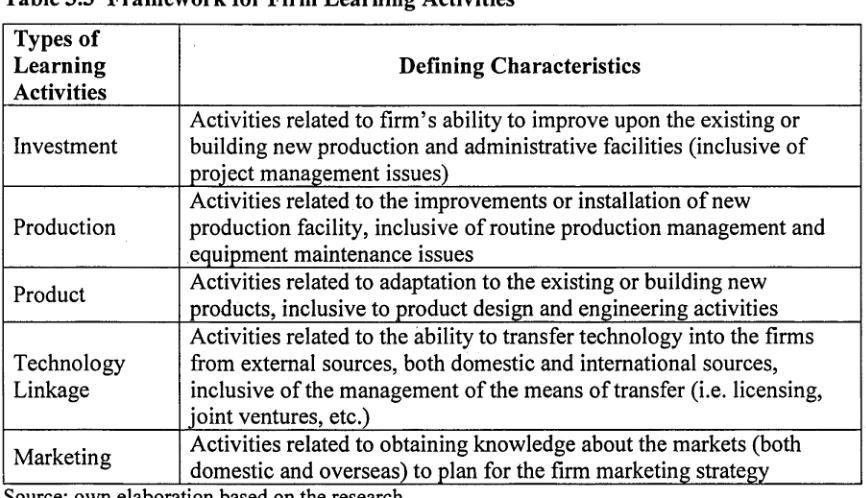
Table 3.3: Framework for Firm Learning Activities 66
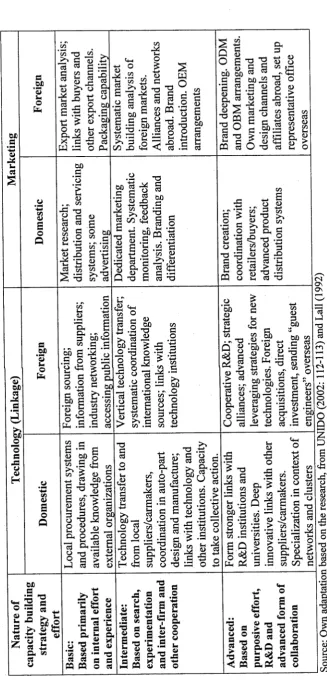
Table 3.4: Framework for Latecomer Firm Capability Development 70
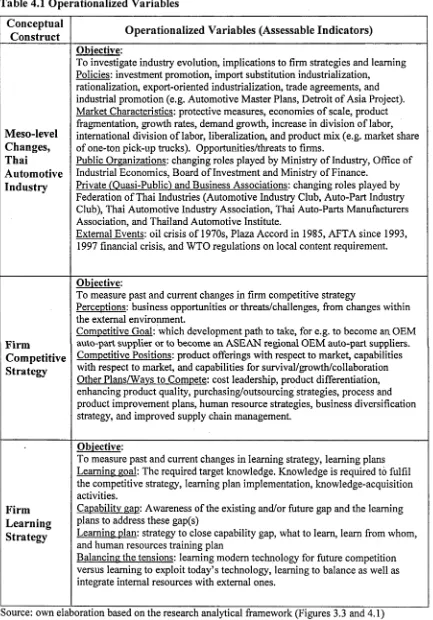
Table 4.1: Operationalized Variables 82
Table 4.2: Profiles of the Sampled Firms 87
Table 4.3: List of Firms and Organizations Visited During the Pilot Fieldwork 90
Table 4.4: Sources of Data and Purpose 93
Table 4.5: Summary of the Collected Data 100
Table 5.1: Movements of Japanese Component Manufacturers to Thailand 117
Table 5.2: Local Content Requirement (LCR) in 1994 122
Table 5.3: Production Capacity for Vehicles in 2004 135
Table 5.4: Production Capacity for Motorcycles in 2004 137 Table 5.5: Structure of First-tier Auto-part Firms in Thailand 138 Table 5.6: Shifting Importance of Firm Strategies and Learning 145 Table 6.1: The Main Common Phases for Each Case Study Firm 146 Table 6.2: Summary of Firm Strategies during the Start-Up Phase 160 Table 6.3: Summary of Firm Strategies during the Expansion Phase 175 Table 6.4: Summary of Firm Strategies during the Adaptation Phase 196 Table 6.5: Summary of Firm Strategies across All Phases 199 Table 7.1: Summary of Firm Learning Activities and Mechanisms
- the Start-Up Phase 220
Table 7.2: Foreign Joint Ventures for Firm D Group
During Its Expansion Phase (1980 - pre-1997 Crisis) 231 Table 7.3: Foreign Joint Ventures for Firm S Group
During the Expansion Phase (1966 - pre-1997 Crisis) 240 Table 7.4: Foreign Technical Assistance for Firm S Group
During Its Expansion Phase (1966 - pre-1997 Crisis) 240 Table 7.5: Products of Firm TS Group During the Expansion
Phase (1 9 8 1 - pre-1997 Crisis) 249
Table 7.6: Foreign Joint Ventures of Firm TS Group During
The Expansion Phase (1981 - pre-1997 Crisis) 250 Table 7.7: Foreign Technical Assistance of Firm TS Group
During the Expansion and Adaptation Phases (post 1981) 251 Table 7.8: Foreign Joint Ventures of Firm TS Group During
the Adaptation Phase (post-1997 Crisis) 253
Table 7.9: Summary of Firm Learning Activities and Mechanisms
- the Expansion Phase 289
Table 7.10: Summary of Firm Learning Activities and Mechanisms
- the Adaptation Phase 292
Table 7.11: Summary of Firm Learning Activities and Mechanisms
Across All Phases 298
Table 9.1: Meso-level Changes and the Impact on Firm Strategies 327
List of Figures
Figure 2.1: The Literature Reciprocal Gap 42
Figure 2.2: Conceptual Model of Latecomer Firm Capability Development 43 Figure 3.1: Visualizing Single Firm Strategy: Competitive and Learning Paths 49
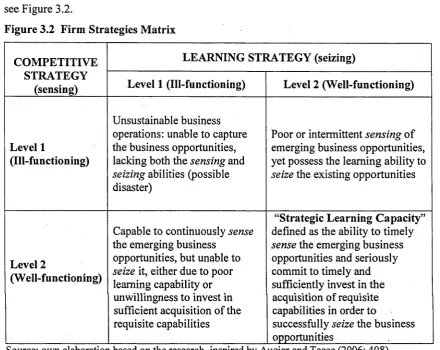
Figure 3.2: Firm Strategies Matrix 57
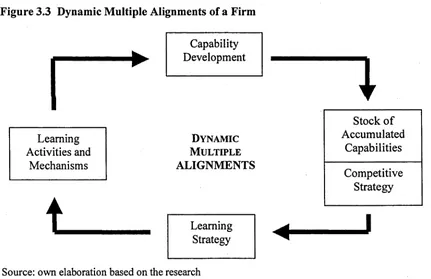
Figure 3.3: Dynamic Multiple Alignments of a Firm 75
Figure 4.1: Analytical Framework (elaborated) 80
Figure 5.1: Trade Deficits 109
Figure 5.2: Proportion of Local Contents in the Automobile Assembly 112 Figure 5.3: Planned Capacity Expansion Prior to 1997 132 Figure 5.4: Production Adjustment of the Assemblers During the 1997 Crisis 133 Figure 5.5: The Structure of the Thai Automotive Industry 136 Figure 8.1: Divergence in Competitive Strategy: Paths and Positions 301 Figure 8.2: Divergence in Learning Strategy: Paths and Positions 306 Figure 8.3: Divergence in Processes: Learning Activities 309 Figure 8.4: Divergence in Processes: Learning Mechanisms 311 Figure 8.5: Divergence in Capability Development - Rates, Functions, and Levels 313 Figure 8.6: Dynamic Multiple Alignments and Capability Development 317
Figure 9.1: Firm Learning System 332
Figure 9.2: Summary of the Key Concepts Investigated 333
List of Abbreviations
A A F A S E A N A u to m o ti v e F e d e r a tio n A D C A u t o m o b i l e D e v e l o p m e n t C o m m i t t e e A E D P A u t o m o t i v e E x p e r ts D i s p a t c h i n g P r o g r a m A F T A A S E A N F r e e T r a d e A g r e e m e n t
A IC A u t o m o b i l e I n d u s tr y C l u b
A I C O t h e A S E A N I n d u s tr ia l C o - o p e r a t i o n S c h e m e A P I C A u t o - P a r t s I n d u s tr y C lu b
A R T C A u t o m o t i v e R e s e a r c h a n d T e s t i n g C e n te r A S E A N A s s o c i a t i o n o f S o u th E a s t A s i a n N a t i o n s A T I A s s o c i a t i o n o f T h a i I n d u s tr ie s
B O I O f f i c e o f th e B o a r d o f I n v e s tm e n t
B U I L D B O I U n it f o r I n d u s tr ia l L in k a g e D e v e l o p m e n t C A D C o m p u t e r - A i d e d D e s ig n
C A E C o m p u t e r - A i d e d E n g in e e r in g C A M C o m p u t e r - A i d e d M a n u f a c tu r in g C B U C o m p l e t e l y B u i lt U n it
C D C a p a b i l i t i e s D e v e l o p m e n t C K D C o m p l e t e l y K n o c k D o w n C N C C o m p u t e r N u m e r ic a l C o n t r o l C S C o m p e t i t i v e S tr a te g y
D IP D e p a r t m e n t o f I n d u s tr ia l P r o m o t io n D S D D e p a r t m e n t o f S k ills D e v e l o p m e n t E R P E n t e r p r i s e R e s o u r c e P l a n n i n g F D I F o r e ig n D i r e c t I n v e s tm e n t F I B O I n s titu t e o f F ie ld R o b o t ic s F T I F e d e r a t i o n o f T h a i I n d u s tr ie s G M G e n e r a l M o to r s
H R D H u m a n R e s o u r c e s D e v e l o p m e n t IE I n d u s tr ia l E n g in e e r in g
I P A I n v e s t m e n t P r o m o t io n A c t I R P I n d u s tr ia l R e s t r u c t u r i n g P r o g r a m
IS O I n te r n a t io n a l O r g a n iz a tio n f o r S ta n d a r d i z a t i o n IT I n f o r m a t i o n T e c h n o lo g y
IT B I n v i g o r a t i n g T h a i B u s in e s s J E T R O J a p a n E x t e r n a l T r a d e O r g a n i z a t i o n J I C A J a p a n I n te r n a t io n a l C o o p e r a t i o n A g e n c y J I T J u s t In T im e
L A L e a r n i n g A c ti v itie s
L A M L e a r n i n g A c ti v itie s a n d M e c h a n i s m s L C R L o c a l C o n t e n t R e q u ir e m e n t
L F L L a t e c o m e r F irm L ite r a tu r e L M L e a r n i n g M e c h a n is m s L S L e a r n i n g S tr a te g y M M C M i t s u b i s h i M o to r C o r p M O C M i n i s t r y o f C o m m e r c e M O F M i n i s t r y o f F in a n c e M O I M i n i s t e r o f I n d u s tr y
N I E s N e w l y I n d u s tr ia l iz in g E c o n o m ie s
N S T D A N a t i o n a l S c ie n c e a n d T e c h n o lo g y D e v e lo p m e n t A g e n c y O B M O w n B r a n d M a n u f a c tu r e
O D M O w n / O r i g i n a l D e s i g n M a n u f a c tu r e O E M O r i g in a l E q u i p m e n t M a n u f a c tu r e O I E O f f ic e o f I n d u s tr ia l E c o n o m ic s P S P T P a r is h S tr u c tu r a l P r o d u c ts T h a i la n d Q C Q u a l i t y C o n t r o l
Q C D Q u a li ty , C o s t, a n d D e li v e r y
Q S 9 0 0 0 Q u a l i t y S y s te m ( p r e f e r r e d b y th e U S “ B i g T h r e e ” ) R & D R e s e a r c h a n d D e v e lo p m e n t
R E M R e p l a c e m e n t E q u i p m e n t M a n u f a c tu r e S E T T h e S to c k E x c h a n g e o f T h a i la n d S M E S m a ll a n d M e d iu m - s iz e d E n te r p r is e S R B L S tr a t e g i c R e s o u r c e - B a s e d L ite r a tu r e S U V S p o r ts U t ili ty V e h ic le
T A I T h a i l a n d A u to m o ti v e I n s titu t e
T A IA T h a i A u t o m o t i v e I n d u s tr y A s s o c ia ti o n T A P M A T h a i A u t o - P a r t s M a n u f a c t u r e r s A s s o c ia ti o n T D R I T h a i l a n d D e v e l o p m e n t R e s e a r c h I n s titu te T IS I T h a i l a n d I n d u s tr ia l S ta n d a r d s I n s titu te T P I T h a i l a n d P r o d u c tiv it y I n s titu t e T P O s T h e r m o p l a s t i c P o ly O le f in s T P S T o y o t a P r o d u c t i o n S y s te m T Q M T o ta l Q u a li ty M a n a g e m e n t
T R I M s T r a d e R e l a t e d I n v e s tm e n t M e a s u r e s
T S 1 6 9 4 9 Q u a li ty M a n a g e m e n t S y s te m ( m o r e m o d e r n th a n Q S 9 0 0 0 ) U N U n ite d N a t i o n s
U N I D O U n i t e d N a t i o n s I n d u s tr ia l D e v e l o p m e n t O r g a n iz a tio n U S T h e U n ite d S ta te s o f A m e r ic a
Chapter 1 - Introduction
This chapter provides the background to the research problem, sets out the research
objectives and the scope and focus of thesis, and provides a brief outline of each chapter.
1.1 Background and Motivation
In today’s globalized world, one o f the key strategic assets is knowledge (Winter,
1987) and the key process to acquiring knowledge is learning (Lundvall, 1996; Veras-Cruz
et al., 2005); and furthermore, the truism is all firms need to learn and continuously change
if they are to survive the competition (Bessant, 2003; Bessant and Francis, 1999).
Consequently, “learning has become a key question for managers [and policy makers]”
(Hakansson et ah, 1999: 445), and many firms in the developing countries realize the
importance o f learning process, knowledge and capability development to their on-going
success. Some firms, however, have not yet come to such a realization and face the grave
consequences of becoming the casualties of globalization.
This research focuses on the management o f learning process in Thai firms and
specifically addresses the concepts of firm’s competitive and learning strategies and the
issue of firm capability development. Thailand is a latecomer country with much learning
and technological catch-up remaining to be accomplished1 2 (see for example, Khaosaat
(1977), Santikarn (1981), Bell et ah (1982), TDRI (1989), Vongpanitlerd (1992),
Chantramonklasri and Pfotenhauer (1994), and Arnold et ah (2000)). Moreover, the
innovation (learning) system within Thailand is still highly fragmented with passive and
slow technological learning firms, ineffective government policies and stand-alone
education, and poor training institutes, and overall inadequate infrastructure support for 2 firm-level development. These conditions have perpetuated over the past fifty years
(Amin, 2001; Intarakumnerd, 2004).
1 Both the technological capability o f Thai firms and the country’s secondary school enrolment rates lagged behind most countries in the region. In addition, the institutions and public programs targeted at upgrading firm s’ human resource training, skills development and formation o f knowledge networks had been rather ineffective compared with other countries in the region (Ghani et al., 2002: 46).
2 Intarakumnerd (2004) pointed out that Thailand’s innovation (learning) system was in a crucial transition towards a more coherent and stronger system. The main actor spearheading the change was the Thaksin government (from 2001 to early 2006). Since m id-2006 when there was unrest in the Thai political system
(which culminated in the military coup d'etat in September 2006), the success o f such transition remains
highly doubtful. Consequently it could be said that it is highly likely that the fragmented, weak Thai innovation system will continue to persist in the near future.
Yet paradoxically, some Thai firms have managed to embrace the increased
competitive pressure and started to acquire the “capacity to learn” and developed well-
functioning “learning system” in order to attain competitiveness in certain product areas .
This paradox naturally provides an interesting question relating to firm strategies, in
particularly how they overcome such immense odds (i.e. capability gap, lack of skilled
human resources, fragmented industrial policies, poor innovation system, etc.) and finally
develop the “capacity to learn” . Consequently, the primary question this research sets out
to answer is “within the poorly supported meso-environment, how can these Thai firms
successfully acquire the ‘capacity to learn’ and increase the rate of capability
accumulation.”
Thailand is undergoing a period of transition:
“ ...[The country] is not a highly successful ‘tiger economy’ such as Korea or Taiwan, nor is it a special case o f a city state such as Hong Kong or Singapore - moreover, it currently finds itself in a ‘sandwich position’ in respect to its competitive advantage. After having experienced remarkable growth in the decades prior to the Asian crises in 1997, Thailand is no longer a true low-wage country, but it is not a high-skill, knowledge economy either” [italics added] (Berger, 2005: 1).
It provides an excellent context for the study for three reasons (Abdulsomad, 2003: 6-7):
• Due to erosion of traditional comparative advantage, Thailand faced an increased
pressure to transform the industry and move into higher value-added activities
(Sheehan, 2005).
• Historically, there has been an intensification of export-led growth strategies that
coincided with the withdrawal of state protection. These exports required higher
levels of competitiveness in terms of product quality, lower cost, and on-time
delivery, and to achieve these, higher-level of firm capabilities are required.
3 This claim is supported by the recent research findings on transnational corporations and innovation systems
upgrading in Thailand: “there is clear evidence that Thai based firms have gradually developed TCs
[technological capabilities] in due course o f industrialisation and are currently in the stage o f overcoming intermediate to advanced thresholds [i.e. the movement from craft-based technician skills to design
engineering (include reverse engineering) and technology research and development]. While sector affiliation and historic developments have strongly influenced these developments, the core driving force seems to be the competitive pressures associated with a liberalised world economy” [italics added] (Berger, 2005: 1 10). In addition, an example o f a globally competitive product produced from Thailand is the one-ton pick-up trucks (Anonymous, 2006c; Zagaroli, 2005); “Thailand has a strong and growing position for pick-up trucks in the world market ... Thailand is the second largest producer o f pick-up trucks worldwide behind the United States” (Porter, 2003: 24).
• The new competition, as a result of globalisation and liberalisation, created both
challenges as well as opportunities for the local Thai firms.
Hence, it could be said that Thai manufacturing firms currently face a grave imperative to
upgrade, to successfully move out o f the “sandwich position”, into a higher skill
knowledge-based position and engage in higher value-added production activities.
Within Thailand, the automotive industry is particularly interesting since it has quite
a long history of technological development, spanning roughly four and half decades. The
industry underwent significant “swings of the pendulum” (i.e. sequence of changes in
market factors, public policies as well as business opportunities and challenges) (Chitravas,
2005a; Higashi, 1995; Poapongsakorn and Wangdee, 2000; Terdudomtham, 2004;
Thanamai, 1985). In addition, during the financial crisis the automotive industry suffered
the most severe impact (Dollar and Hallward-Driemeier, 2000). Certainly, the sequence of
industrial-level changes impacted firm’s perception of opportunities and challenges, and in
turn, affected the formulation o f firm-level for capability development. Hence the
automotive industry offered a rich ground for exploratory research on issues such as the
dynamics of firm-level strategies, its interaction with firm learning activities and capability
development.
1.2 The Research Problem and Key Assumptions
To understand how some Thai firms successfully learn (or fail to learn) and develop
their capabilities, the sequence of changes in the macro- and meso-environment must be
taken into account. Similarly the disaggregation o f firm-level learning processes must be
made to attempt to build an inductive model capable of explicating firm-level competitive
and learning strategies, their role in shaping the rates and types of capability development.
With these overall objectives, the research focuses on three key questions:
1. What were the competitive and learning strategies o f Thai auto-part firms?
a. How did these firms perceive the opportunities and challenges arising from
changes in the macro- and meso-environment?
b. How did firms respond, in terms of their firms’ competitive and learning
strategies, to these external changes?
2. To what extent can the differences in firm learning activities and mechanisms be
explained by the differences in firm competitive and learning strategies?
3. What are the implications of the firm “learning system” - the dynamic alignment
(and re-alignment) between the key characteristics of firm competitive and learning
strategies and the learning activities and learning mechanisms - on the rate of firm
capability accumulation?
In answering these questions, there are two key assumptions:
First a starting point for the research is the concept of firm heterogeneity derived
from the resource-based perspective (see for example, Penrose (1959), Helfat (2000),
Nelson (1991), Rumelt (1991), Teece and Pisano (1994) and Malerba (2002)). Even if the
firms are experiencing the same sequence o f historical changes within the Thai automotive
industry, they are assumed that they may have different perceptions o f business
opportunities (and challenges) and hence, different competitive and learning strategies,
different types o f learning activities, and different rates and types o f capability
accumulation.
The second assumption is that firms with superior coordination and adaptation of
their strategies, learning activities, and learning mechanisms are said to have higher-level o f
“capacity to learn” and thus will achieve faster rates o f accumulation of capabilities.
Having stated these assumptions, the overall research aim is to attempt to explain the
differing rates of capability accumulation among Thai firms, in terms of their
heterogeneous learning and competitive strategies and learning activities.
1.3 Objectives of the Research
In line with the three research questions and the main aim, this thesis pursues the
following five objectives:
• To elaborate the sequence of policy, market and institutional changes within the
Thai automotive industry since its inception in the early 1960s;
• To link the sequence o f meso-level changes with the dynamics of firm-level
competitive and learning strategies, aiming to differentiate “strong learner” firms
from the others
• To discuss the impact o f differences in firm competitive and learning strategies on
the firm-level learning activities, again aiming to differentiate “strong learner” firms
from the others
• To explore and explain the issue o f the dynamic alignment (and re-alignment)
among three key conceptual variables - 1) firm strategies, 2) learning activities (and
mechanisms) and 3) firm capability development - and how such multiple
alignments could lead to accelerating or slowing down the rate of capability
accumulation, again aiming to differentiate “strong learner” firms from the others
• To provide a normative framework for latecomer firm’s business managers facing
the crucial issue of formulating firm competitive and learning strategies, aiming at a
higher rate o f capability development
1.4 Scope and Focus
The scope o f this study is the Thai auto-part sector, which supplies auto-parts to
both the replacement equipment manufacture (REM) and original equipment manufacture
(OEM) markets. It focuses on a selected set of case study firms and in particular on their
important historical transition periods in business activities (e.g. transition from
replacement equipment manufacture (REM) auto-part trader to a manufacturer o f original
equipment manufacture (OEM) auto-parts, similarly the transition o f OEM to ODM4 and
OBM5, if any had occurred). The ownership of these firms is dynamic and some firms are
currently within large corporate groups comprising many diversified businesses. Such
firms are viewed at the group level (or at least the auto component and related parts of the
group) in order to capture the “learning spillovers” and the sharing o f the parent firm’s
competitive and learning strategies within the corporate group. In addition, the dynamics
o f each firm as it grew from a small family-owned to a large multinational firm is captured.
Consequently the focus is also on the historical transitions of these learning activities,
learning mechanisms, human resources formation and development, and crucial firm
resource acquisition and access to external resources. All these factors have an impact of
firm-level strategies and capability development.
1.5 Outline of the Thesis
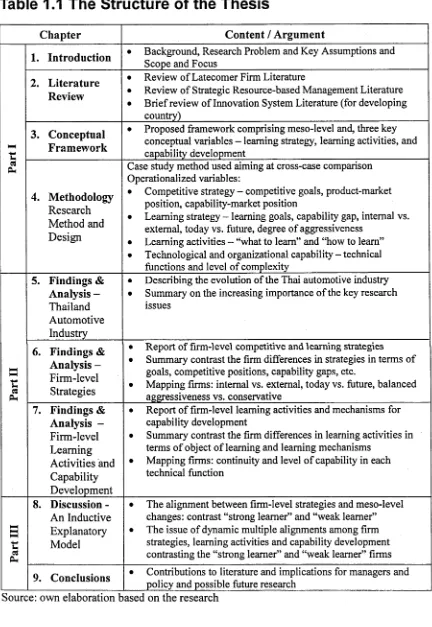
The research is reported in nine chapters (see Table 1.1).
4 Own design manufacture
5 Own brand manufacture
Table 1.1 The Structure of the Thesis
C h a p te r C o n ten t / A r g u m e n t
P
a
r
t
I
1. In tro d u c tio n • Background, Research Problem and Key Assumptions and Scope and Focus
2. L iter a tu r e R ev iew
• Review of Latecomer Firm Literature
• Review of Strategic Resource-based Management Literature • Brief review of Innovation System Literature (for developing
country)
3. C o n ce p tu a l F r a m e w o r k
• Proposed framework comprising meso-level and, three key conceptual variables - learning strategy, learning activities, and capability development
4. M e th o d o lo g y Research Method and Design
Case study method used aiming at cross-case comparison Operationalized variables:
• Competitive strategy - competitive goals, product-market position, capability-market position
• Learning strategy - learning goals, capability gap, internal vs. external, today vs. future, degree of aggressiveness
• Learning activities - “what to learn” and “how to learn” • Technological and organizational capability - technical
functions and level of complexity
P
a
r
t
II
5. F in d in g s & A n a ly sis - Thailand Automotive Industry
• Describing the evolution of the Thai automotive industry • Summary on the increasing importance of the key research
issues
6. F in d in g s & A n a ly sis - Firm-level Strategies
• Report of firm-level competitive and learning strategies
• Summary contrast the firm differences in strategies in terms of goals, competitive positions, capability gaps, etc.
• Mapping firms: internal vs. external, today vs. future, balanced aggressiveness vs. conservative
7. F in d in g s & A n a ly sis - Firm-level Learning Activities and Capability Development
• Report of firm-level learning activities and mechanisms for capability development
• Summary contrast the firm differences in learning activities in terms of object of learning and learning mechanisms
• Mapping firms: continuity and level of capability in each technical function
P
a
r
t
II
I
8. D iscu ssio n - An Inductive Explanatory Model
• The alignment between firm-level strategies and meso-level changes: contrast “strong learner” and “weak learner” • The issue of dynamic multiple alignments among firm
strategies, learning activities and capability development contrasting the “strong learner” and “weak learner” firms
9. C o n clu sio n s • Contributions to literature and implications for managers and policy and possible future research
Source: own elaboration based on the research
[image:19.529.39.471.85.712.2]Overall the thesis is divided into three parts. Part I starts with the Introduction followed by
Chapter 2, which describes the relevant literature along two main lines: strategic
management and economic development literatures. The strategic management literature
will focus mainly on the capabilities view o f the firm, with emphasis on the “modern”
resource-based thinking such as the concept of core competencies, dynamic capabilities,
and competence-based strategy. The economic development literature will focus on the
issue o f learning and capability development, using mostly the latecomer firms’
perspective. Other literatures locate at the periphery o f these fields is related to Thailand’s
innovation system development and the concept of absorptive capacity. Chapter 3
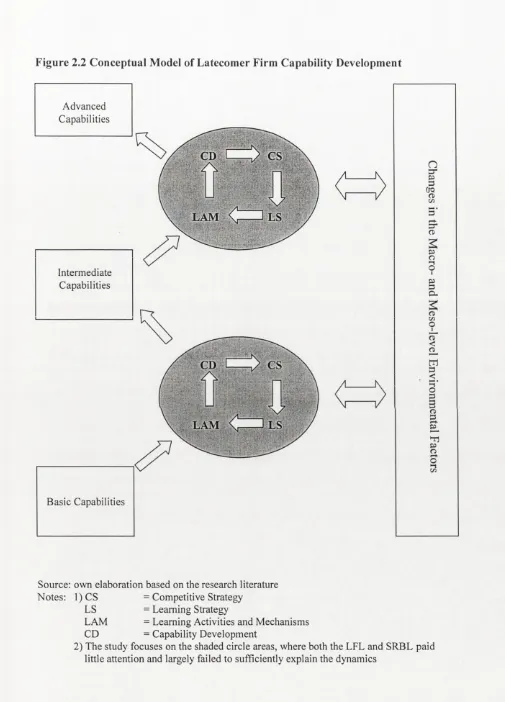
synthesizes the findings from the literature review in terms o f three key conceptual
variables (firm strategies, learning activities and mechanisms and firm capability
development) situated within the meso-environmental changes. The synthesis provides
justification for the analytical framework at the end o f the chapter. Chapter 4 elaborates on
the multiple-case study research method and defines the operationalized variables used in
the study. The chapter also elaborates on the definition of the various indicators used to
operationalize the conceptual constructs.
Part II contains the analytical history of the learning and capability building
processes of the nine Thai auto-part firms. Chapter 5 describes the sequences o f changes in
market, policy and institutional factors within the Thai automotive industry. The purpose is
to provide sufficient background on meso-level developments, to link with the development
of firms’ competitive and learning strategies. Then Chapter 6 elaborates on how different
firms’ strategies have co-evolved with the changes in opportunities and challenges at the
meso-level. The aim is to discern the different patterns of firms’ competitive and learning
strategies, isolating the “strong learner” firms from the others. Chapter 7 reports on firm-
level learning activities and learning mechanisms used for capability accumulation. Again,
the aim is to isolate the “strong learner” firm patterns from those of other firms.
Part III comprises two final chapters: Chapter 8 analyzes the characteristics o f
firms’ strategies, the differences in firms’ learning activities (and combination o f learning
mechanisms) and differing rates and types of firms’ capability accumulation. The aim is to
highlight the alignment (or misalignment and re-alignment) among the three and how this
leads to slowing down or accelerating the rate o f capability accumulation. The alignment
between firm-level strategies and changes in the meso-environment is also examined.
how firm strategies and learning activities work together to achieve the accumulation of
capability. It also presents a more fundamental issue related to firm-level learning, the
“capacity to learn” and firm “leaning system”, which arises out o f the case study analysis.
In addition, the chapter summarizes the research contributions, empirically and
theoretically, and the significant implications for practicing business managers.
Chapter 2 - Review of the Related Literature
The main purpose of this chapter is to review the literature both on the development
o f “latecomer” firms6 and on strategic management, particularly that from a resource-based
perspective. The objective is to identify overlaps and complementarities in these two sets
o f literature, in relation to the question of firm competitive and learning strategies and
capability development. It is also the objective of this chapter to identify gaps in relation to
that question and hence the opportunities to develop a more comprehensive and integrated
analytical framework.
There are three main sections. The first section discusses the latecomer firm
literature and assesses with the strengths and limitations o f this work for this study. The
second section discusses the strategic management and resourced-based literature with
particular emphasis on firm learning strategy. It shows that historically this literature has
been preoccupied with the strategy “content” issues. Very little work has been conducted
on the role played by firms’ learning strategy, efforts and learning activities (i.e. the
strategy “process” issues), especially for the latecomer firms7. The last section summarizes
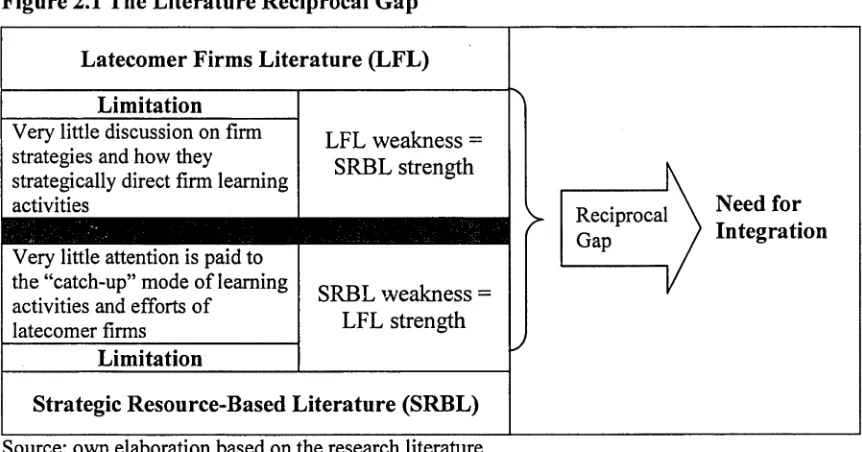
the “reciprocal” knowledge gaps that exist in both bodies of the literature, highlighting that
neither bodies of literature on its own are sufficient to fill such gaps. Consequently it is
argued that there is a need to build a more integrated, holistic conceptual framework that is
capable o f capturing the dynamics o f latecomer firms’ capability development, and hence is
relevant for strategic learning issues.
2.1 The Latecomer Firm Literature (LFL)
This section reviews the origins of learning and technological capability concepts;
the taxonomies used in categorizing technological capabilities (including the extension to
cover the non-technological functions); the important lessons learned from numerous
empirical studies about the characteristics of learning and capability development; and
finally, the role of absorptive capacity in latecomer firms’ learning. The section concludes
6 Hobday (1995a) uses the concept o f “latecomer firm” to described how firms in the newly industrialized econom ies attempted to catch up.
7 The latecomer firms’ viewpoint is lacking in not only the strategic resource-based literature (SRBL), but also in the strategic management literature in general since most research within this literature originated from the First World context.
with the important points that could be drawn from the literature along with the existing
limitations.
2.1.1 Origins of Technological Capability and Learning Concepts
2.1.1.1 Technological Capability Concepts
During the 1950s, 1960s and the first-half of the 1970s, much of the latecomer
firms’ development literature neglected the need for (and the importance of) the creation of
the indigenous technological activities in the developing countries (Abdulsomad, 2003: 11),
and most literature emphasized the effort devoted to the transfer of technology in terms of
choosing an appropriate foreign technology and technology transfer8 per se. Then in the
latter half of the 1970s and the early 1980s, the concept of technical change within the
developing country context had shifted to focus more on the accumulation of “domestic”
technical resources and the link to the creation of “indigenous technological capability”
(Bell, 1984; Fransman and King, 1984; Teubal, 1984; Westphal et al., 1985). This led
researchers in international technology transfer (from industrialized to developing
countries), to focus more on determining the factors that impacted the development o f
indigenous capabilities in the late industrializing and developing countries (see for
example: Enos and Park (1988) and Amsden (1989) on the case of Korean industrialization;
Amsden and Kang (1995) on the case of Korean automotive industry; Scott-Kemmis and
Bell (1988) on the case of India; and Bell et al. (1982) on the case study of inadequate
learning in Thailand’s infant industry). Due to increased interest, more definitions related
to technological capability were developed9.
Since the late 1970s, this concept of technological capabilities and learning has been
a primary focus of LFL for nearly three decades (Kim and Nelson, 2000b: 1). A particular
concern o f the early work was the specification of the technological capability concept.
One of the first definitions of technological capability during the early 1980s was “the
8 Regarding “technology transfer”, Nelson (1990: 78) noted that this phrase is a misnomer and the use o f the terms “technological learning” is more appropriate. This was because the transfer recipient, the developing country, did not passively receive the imported technology as it is handed down from the industrialized country. Instead the recipient countries need to actively engage in a complex and costly technological learning process, to learn to achieve mastery o f the imported technology.
9 For example, another definition o f technological capability included Enos (1991), who described the three main components o f technological capability: 1) human skills (i.e. the knowledge residing in the firm’s engineers and operators), 2) the institution (i.e. this allows human skills to be brought together and put to use), and 3) the common purpose (i.e. the knowledge necessary to absorb, adapt and improve on the technology).
ability to make effective use o f technological knowledge ... in production, investment and
innovation” (Westphal et al., 1985: 171). Fransman and King (1984: 10) identified six
different (technological) capabilities related to the production processes: 1) search for
available alternative technologies, 2) selection of the most appropriate technology, 3)
mastering the technology, 4) adaptation of the technology, 5) institutionalized search with
the development o f research and development facilities and 6) conduct basic research.
Later the definition o f technological capabilities included additional concepts of
technical change and specialized resources; for example Bell and Pavitt (1995: 71) defined
technological capabilities as “domestic capabilities to generate and manage change in
technologies used in production, and these capabilities are based largely on specialized
resources” [italics added]. Today this definition o f technological capabilities had been
extended to empirically analyze the technological development in many different industrial
contexts (see for example: petroleum industry (Acha, 2000); Brazilian steel industry
(Figueiredo, 2001); Japanese and European optoelectronics industry (Miyazaki, 1994); and
electronics industry (Ariffin and Figueiredo, 2001)). Others have broadened the definition
of technological capabilities to include the non-technical dimensions such as: marketing
functions (Ernst et al. (1998a), Tran (1999)); technology linkage capability (UNIDO, 2002;
Virasa, 2005); and managerial and organizational function (Weinstein and Azoulay, 1999:
43). In addition, Virasa (2005: 98-99) pointed out that the process of a firm’s technological
capability development is not limited to just the technical dimension per se, but rather it is
highly related to the non-technical dimension such as the firm’s business model10.
Regardless of its origins and development, almost all of the conceptual definitions
regarding technological and organizational capability stress the importance of skills,
knowledge, and the role of conscious investment in the firm-level acquisition o f capability.
In addition, embedded within the capability acquisition process are the learning processes
and the use of such processes to acquire the necessary knowledge to manage technical
change. Consequently, it appears that firm learning process could be defined as the process
of knowledge acquisition and conversion whereby firm can develop the technological and
organizational capability.
10 He based his ideas on the Thailand’s National Innovation Survey (2000 and 2002), which stated that there are three types o f business model: locally-owned brand manufacturer (OBM), locally owned original equipment manufacture (OEM) supplier, and locally-owned niche-focused venture.
2.1.1.2 Learning Concepts
Historically, prior to the early 1980s, most of the learning and technical change
research had been conducted in industrialized countries and little is known about learning
within the developing country context (Bell et al., 1982). In addition, the learning concept
was mainly concerned with the concept o f a the mechanistic “learning curve” or Boston
Consulting’s “experience curve” or economist’s “learning by doing” (Arrow, 1962). These
concepts proposed that learning is automatic and it is a by-product of production
experience.
In the mid-1980s, this concept o f “automatic” learning by doing was rejected by
various scholars. For instance, Bell (1984) stated that learning is not automatic and that
generally there are two types: doing-based and non-doing-based learning. The latter
requires more conscious investment in efforts. He argued that the doing-based learning per
se is insufficient for successful development of capability. Similarly, Bell and Scott-
Kemmis (1990) found that the predicted efficiency and cost savings outcome from
“automatic” learning by doing did not occur and it was probably because of the failure to
invest in sufficient learning effort and other factors such as lack of properly managed
structure and poor learning conditions. Later this concept of costly learning was applied
into the firm-level study on technological accumulation, capability acquisition and
development (Bell and Pavitt, 1993; 1995).
Today, it is clear that building firm-level capabilities requires purposeful
management of the firms’ learning processes (Dutrenit, 2000; Kim, 1997a; Lall, 1987). As
Bell and Pavitt (1995: 100) have succinctly pointed out that
“Technological [and organizational] capabilities are not acquired as an
automatic by product of investment and production activities. They are
accumulated through conscious and continuous investment by firms in specialized, change-generating [or learning] activities, comprising product design, production engineering, quality control, training and linkages to foreign sources of technology ... [italics added]”
Purposive learning processes are a “a pathway to accumulate certain types of technological
capabilities” (Figueiredo, 2001: 31). Rush et al. (2004) draw on Bell and Pavitt (1993),
Lall (1992), Kim (1997a) and Cohen and Levinthal (1990), in proposing a model of an
“extended learning processes” comprising eight key elements11:
11 These eight elements were developed as categories in an audit tool for firms.
• Awareness and willingness of the need to change
• Searching for triggers for change
• Regular audits of existing competencies (or capabilities) including core ones
• Development o f technology strategy based upon core competence
• Assessment and selection (exploration) or range o f technological options
• Acquisition of technology
• Implementation and absorption of technology
• Learning through development of internal capabilities (Rush et al., 2004: 328)
This extended learning concept assisted in categorizing firms’ learning ability according to
their degree of awareness of the need to change and the degree of their preparedness and
readiness to change (Ibid.).
Since learning is not merely automatic “learning by doing”, but requires investment
of effort (Bell, 1984; Kim, 1998; 1999) and effort put into learning activities are
consciously designed to improve performance (Pavitt, 2002). In addition, at times several
learning mechanisms are to be executed concurrently to achieve successful accumulation of
innovative capabilities (Kim, 1998; Tran, 1999). These authors implicitly suggest that the
investment in the formulation and implementation o f the firm learning strategy is
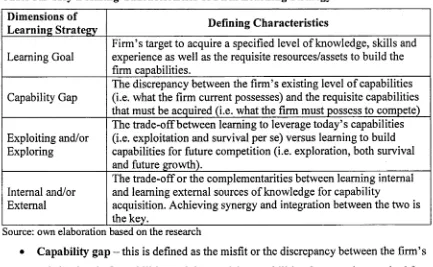
important. All of all these studies point towards the importance of learning strategy in
directing (and coordinating) firms’ diverse learning activities and keeping them in focus.
An explicit learning strategy could play a key role in maintaining a firm’s
continuous learning activities through time. This concept of firm competitive learning
strategy has not been thoroughly developed in the literature. Moreover, it is not clear how
such strategy would relate to the latecomer firm’s learning activities and the issue of
capability development. One notable exception would be Rush et al’s (2004) “extended
learning process”, it discusses the formulation of technology strategy based upon firm core
competencies. However such discussion is restricted to technology strategy per se and does
not provide a comprehensive framework for a firm competitive and learning strategy.
2.1.2 The Taxonomies of Technological and Organizational
Capabilities
There are many ways to categorize firm -level technological capabilities. One taxonomy for classifying technological capabilities provided by Lall (1992: 166). Lall (1992) classifies firm ’ s technological capabilities into three levels o f complexity (simple routine capabilities, adaptive/duplicative capabilities, and innovative capabilities) and six operational areas (pre-investment, project execution, process engineering, product engineering, industrial engineering and linkages). Based on this classification, it was possible for a firm to have different or uneven accumulation o f level o f capabilities for each operational area. Similarly, Bell and Pavitt distinguished between “ production capacity” and “ technological capability” , stating that the latter involves more effort in the generation and management o f resources pertaining to technical change and involving the management o f knowledge, skills and experience (Bell and Pavitt, 1995: 78). Importantly they also note that technological capabilities also involve the management o f institutional structures and linkages, both intra- and inter-firm (Ibid.). W ith this distinction, they developed taxonomy o f technological capabilities comprising three main technical-functions (investment, production, and supporting) and w ithin each there are four levels o f complexity (a level o f basic routine production and three levels o f technological capabilities: basic, intermediate and advanced) (Ibid.: 84). The Lall (1992) and Bell and Pavitt (1995) taxonomies have two similarities:
• Both focus on two similar major dimensions: technical functions and levels o f complexity o f capabilities.
• Both acknowledge that the movement from simple (basic-level) to advanced (innovative-level) capabilities is not automatic and requires purposeful investment in complex learning processes involving the management o f technical change. Despite the similarities, there is also an important difference:
• By disaggregating the levels o f firm technical capabilities into four levels, Bell and Pavitt’ s taxonomy clearly distinguishes between the ability to exploit the existing production technology and routine production activities (the first level indicates the “ production capacity” ) versus the capability to manage and generate technical
change (the latter three levels indicate “innovative technological capability”) 13.
This was done to emphasize the dynamic aspect of technical change since
production capacities are static attributes and technological capabilities, on the other
hand, are more dynamic and crucial to successful management of technical change14
(Albu, 1997: 7). In contrast, Lall’s technological capability framework comprises
three levels of technological capability (basic, intermediate and innovative) and
implicitly addresses the above issue.
Other taxonomies extended the “technological” aspect of capabilities to include other non
technical element, such as marketing capabilities (Ernst et al., 1998a; UNIDO, 2002), the
inclusion o f these capabilities was necessary because they were pre-requisites (in some
industries) to the successful build-up of technological capabilities (Ibid.). Apart from the
addition o f marketing and technology linkage capabilities, the UNIDO framework13
(UNIDO, 2002: 96) utilizes the same matrix structure as described by Lall (1992) and Bell
and Pavitt (1995).
The significant insight provided by the many taxonomies above is the fact that as a
given firm moves up the capability ladder (i.e. from the routine/basic production
capabilities to the innovative/advanced capabilities), it is possible that two or more
technical-functions could differ in the depth as well as the rate of accumulation of
capabilities. Also the distinction between the routine production capabilities and the
innovative technological capabilities is the key issue, since at each stage it is likely that the
accumulation of these two different capabilities requires different managerial functions on
the management o f firm strategies that often involve two aspects: 1) the varying degree of
technical change (which to a certain extent dependent on the environmental factors
impacting the firm) and 2) the types and sequence of capabilities that must be accumulated,
with respect to firm’s strategies. Here in this study, it is argued that these two issues would
13 Historically, this distinction was elaborated by Bell (1987) as three categories o f technology flows: Flow A, Flow B and Flow C. Flow A deals with ordinary importation o f capital goods, technology, engineering and services, and Flow B comprises the skills and know-how to operate and maintain the established production technology. It is only in Flow C that the knowledge and expertise for implementing technical change was discussed; Flow C also refers to the “know-why” dimension o f technology.
14 “A firm with no technological capabilities at all, would be rigidly unable to adapt to any changes in its environment, and would not survive long. However, the fact that a firm has a limited set of technological capabilities, and uses these to gradually improve production capacity, may not always be adequate either. In the long run, such a firm may not be able to change radically enough to bridge the discontinuities that occasionally arise in technical change, and may be out-competed by those that can” (Albu, 1997: 9).
15 Berger (2005) pointed out that this UNIDO framework on firm technological and organizational capability is one o f the latest developments on the concept.