This is a repository copy of Explicit and Implicit Instruction of Refusal Strategies: Does Working Memory Capacity Play a Role?.
White Rose Research Online URL for this paper: http://eprints.whiterose.ac.uk/131375/
Version: Accepted Version
Article:
Ahmadian, MJ (2018) Explicit and Implicit Instruction of Refusal Strategies: Does Working Memory Capacity Play a Role? Language Teaching Research. ISSN 1362-1688
https://doi.org/10.1177/1362168818783215
© The Author(s) 2018. This is an author produced version of a paper accepted for
publication in Language Teaching Research. Uploaded in accordance with the publisher's self-archiving policy. Reprinted by permission of Sage Publications.
[email protected] https://eprints.whiterose.ac.uk/
Reuse
Items deposited in White Rose Research Online are protected by copyright, with all rights reserved unless indicated otherwise. They may be downloaded and/or printed for private study, or other acts as permitted by national copyright laws. The publisher or other rights holders may allow further reproduction and re-use of the full text version. This is indicated by the licence information on the White Rose Research Online record for the item.
Takedown
If you consider content in White Rose Research Online to be in breach of UK law, please notify us by
Explicit and Implicit Instruction of Refusal Strategies: Does Working Memory Capacity Play a Role?
Mohammad Javad Ahmadian
University of Leeds
This study investigated the differential effects of implicit and explicit instruction of refusal strategies in English and whether and how the impacts of instruction methods
WMC E
assigned to three groups (explicit, implicit, and control). Implicit instruction was operationalized through input enhancement and provision of recast. In the explicit instruction group, participants received description and exemplification of refusal strategies and were provided with explicit corrective feedback. Prior to the treatment, all participants took WMC test, Discourse Completion Test (DCT) and completed a pragmatics comprehension questionnaire (CQ). Results revealed that explicit instruction was more effective than implicit instruction for both production and comprehension of refusals and that both implicit and explicit groups maintained the improvement in the delayed post-test administered two months later. In
addition, whilst WMC scores were positively and strongly correlated with gains in the immediate and delayed post-test for both DCT and CQ in the implicit group, no
meaningful relationship was found for explicit and control groups. The unique feature of this research is demonstrating that explicit instruction of refusal strategies
equalizes learning opportunities for all learners with differential levels of WMC.
INTRODUCTION
Learning L2 pragmatics is a complex and cognitively demanding process. Learning a pragmatic feature, such as refusals which have multiple realizations in English,
involves
(Taguchi, 2015, p. 1). Given the non-salient and opaque nature of such features for language learners, mere exposure to the target language will not necessarily result in development and acquisition. Therefore, particularly in English as a Foreign Language (EFL) contexts, to use the target language for
communicative purposes is limited, principled instruction of L2 pragmatics seems necessary (Kasper & Schmidt, 1996). This study targeted refusal strategies because declining a request, invitation or offer is quite prevalent in everyday oral and written
communication. In fact, owing to cross-
clearly and politely, though not directly, has led many non-native speakers to offend
T B .
implicit-explicit instruction continuum to compare the relative efficacy of different treatment conditions (Jeon & Kaya, 2006). Explicit instruction aims to promote
(Ellis & Shintani, 2014). There is, however, an important difference between L2 pragmatics and general SLA in the way in which explicit instruction is operationalized. Whilst in L2 pragmatics literature, explicit teaching is operationalized through
metapragmatic rules explanation, in the general SLA literature this is not necessarily the case (Taguchi & Roever, 2017). On the other hand, implicit instruction approaches do not involve rule explanation, are geared for learning without awareness of rules
and so it can enter working memory
and be processed by implicit learning mechanisms T ‘ 18). The empirical studies conducted so far have utilized a diverse mix of treatment conditions (or different operationalizations of the same treatment), length of instruction (which are, at times, unequal for different groups), data elicitation instruments (role plays, DCTs, etc.), participants, and data analysis techniques (see Taguchi & Roever, 2017). Although this methodological and conceptual diversity could provide a fairly comprehensive picture of the impacts of L2 pragmatics instruction, it renders drawing definitive theoretical conclusions and pedagogical implications from the amassed evidence rather difficult. Therefore, it is imperative to both expand the scope of the investigation and conduct further rigorous research in this area (Bardovi-Harlig, 2012). This could involve looking at different target features, various contexts and the role of individual differences. In particular, attempts at comparing the relative effectiveness of explicit and implicit instruction of relatively
complex pragmatic features such as refusal strategies are scarce. Also, a host of research shows that learners with different cognitive characteristics such as language aptitude and working memory capacity can have differential gains from specific instructional methods (Vatz, et al., 2013). WM plays a key role in the allocation and regulation of attentional resources to various dimensions of language. Not unlike the development of grammar and lexis which have shown to be correlated with working memory capacity, Taguchi and Roever (2017) argue, development of L2 pragmatics depends on general cognitive mechanisms such as working memory. However, the interaction between L2 pragmatics instructional sets and cognitive individual difference (ID) variables such as WMC has yet to be examined. Investigating ID variables vis-à-vis L2 pragmatics instruction would offer a clearer and more nuanced picture of the mechanisms which underlie and drive the development of L2
pragmatics features. Therefore, the study reported in this paper investigated: (a) the differential effects of implicit and explicit instruction of refusal strategies on accurate production and comprehension of this pragmatic feature; and (b) whether and how
WMC mediates the effects of implicit and explicit instruction of refusal strategies. These two questions assume theoretical and practical significance.
Examining the relative effects of different approaches to L2 pragmatics instruction as well as the way in which they interact with cognitive ID variables allows us to make more fine-tuned and generalizable predictions about the effects of various
policy makers to equalize learning opportunities through identifying pedagogical conditions that cater to the needs of all learners regardless of their level of cognitive processing abilities (DeKeyser, 2012). In addition, the findings of such studies provide us with further insight as to the role of general cognitive abilities in the development of L2 pragmatics. This will in turn help to explain and illuminate some of the key findings of recent research on instructed L2 pragmatics.
REVIEW OF THE LITERATURE
Methodological Options in L2 Pragmatics Instruction
In the instructed SLA literature, the purpose of implicit instruction is to induce
learners to infer grammatical or pragmatic rules without drawing their focal attention to them (Ellis, 2009). For Housen and Pierrard (2005, p. 10), implicit instruction is carried out spontaneously, is unobtrusive, presents the target features in a contextualized manner, and does not use metalanguage. However, in explicit
instruction, D K ,
p. 380) puts it, .
These definitions allude to the fact that the central construct for characterizing and
which constitutes
C
and is assumed to be limited, selective, and responsible for controlling access to consciousness (Schmidt, 2001). From this perspective, then, the main function of ins nal capacity to the target features in the input (Indrarathne & Kormos, 2016).
There is no single approach for realizing implicit and explicit instruction in language classrooms (Ellis, 2009). But, broadly, implicit instruction is geared to
f the target feature(s). Therefore, teaching practices which are associated with it involve
E . This could be operationalized (as in the current study) through input enhancement and provision of recasts (i.e.
reformulation which entailed inaccurate refusals). Explicit instruction, on the other hand, caters to intentional learning where learners are made aware that they are going to learn about grammar, vocabulary, or pragmatic aspects of language and then to practice them in the class (Ellis & Shintani, 2014). There is a wealth of research suggesting that implicit and explicit instruction could have differential effects on L2 acquisition. For example, in a seminal and oft-cited
N O , overall, explicit form-focused
instruction is far more effective than implicit instruction as far as L2 grammar
acquisition is concerned. This state of affairs has not changed since then and several recent studies have corroborated this general conclusion. Most notably, Spada and Tomita (2010) meta-analysis found large effect sizes for explicit instruction over implicit instruction of both simple and complex grammatical features.
However, it should be emphasized that in L2 pragmatics, implicit instruction is all too often operationalized as mere exposure to TL input, which is somewhat different from the implicit form-focused instruction in instructed SLA literature. House (1996), for example, examined the relative effects of input and opportunity for
communicative activities (i.e. implicit instruction) over explicit instruction of conversational routines . She compared two versions of a similar communicative course which took place over 14 weeks. In the implicit group, participants were asked to do extensive conversational practice, but they were not presented with any metapragmatic information. In the explicit group participants received explicit metapragmatic information about the use and function of routines both orally and through handouts. Based on descriptive statistics, House concluded that explicit instruction was more effective than implicit teaching in helping learners to use gambits and strategies.
Alcón-Soler (2007) investigated the relative effectiveness of implicit and
In this study,
implicit instruction was operationalized through presenting excerpts from a series called Stargate, using input enhancement and implicit consciousness-raising tasks. Explicit instruction consisted of presenting a scripted version of excerpts from the same series used in implicit group as well as explicit consciousness raising tasks.
D “ Alcón-Soler defined awareness at
two levels of noticing and understanding. However, she did not find any advantage for explicit instruction over implicit instruction except for the observation that only participants in the explicit group were aware of factors involving interlocutor social distance and level of imposition. She concluded that making use of explicit and implicit consciousness-raising activities in conjunction with feedback were beneficial for noticing requests.
Similarly, Takimoto (2007) compared the impact of three input-based approaches on pragmatic proficiency development. Participants in the first group received explicit information and carried out structured input tasks. In group two, participants did a problem-solving task but did not receive any explicit information. In group three, participants were asked to do structured input tasks without any explicit information. Takimoto found that the positive effects of giving explicit
after explicit instruction learners tended to use more indirect refusal strategies which is, in fact, considered to be politer. This finding was corroborated by Nguyen, et al. (2012) who compared the effects of explicit and implicit form-focused instruction on the acquisition of constructive criticism (a fairly complex pragmatic feature with multiple realizations). Nguyen, et al. operationalized explicit instruction through: consciousness-raising activities, metapragmatic explanation, follow-up discussions, productive activities, reflecting on output and attempting to improve it, and explicit correction of both grammatical and pragmatic errors (p. 420). Treatment in the implicit group involved: input enhancement, discourse completion tasks, reflecting on output and attempting to improve it, provision of recast (in the form of confirmation checks) and writing correct versions on the blackboard. They used a discourse
completion task, oral role play and oral peer feedback to elicit constructive criticisms. Results revealed that explicit group outperformed the implicit and control group.
Ghavamnia et al. (2014) compared four instruction conditions which differed in terms of the way in which input was enhanced and made more noticeable for participant. The interesting point about their study design is that they have
operationalized input enhancement on a continuum of explicit (i.e. metapragmatic explanation), less explicit (i.e. form comparison), and fairly implicit (i.e.
typographically enhanced input plus input flooding) conditions Overall, results of their study showed that more explicit methods of instruction (i.e. form comparison and metapragmatic explanation) were more effective than both the control group and input flooding and typographical enhancement.
In another relevant study, Fordyce (2014) explored both immediate and
long-term effect
forms in written production. Explicit instruction was operationalized through enhanced input as well as explicit instruction in the form of inductive activities and metapragmatic information. In the implicit group, the focus was on comprehension and analysis of texts in the absence of metapragmatic information. Fordyce found that explicit instruction was more effective than implicit instruction for most of the target features and the positive effects of instruction were, by and large, maintained after five months.
It seems that the above reviewed L2 pragmatics studies fall into two categories: those that operationalize implicit instruction as mere
exposure/communicative practice, and those that operationalize implicit instruction
form in an unobtrusive
manner. It appears that the second body of literature is closer to mainstream L2 grammar research in terms of their operationalization of implicit instruction.i Also, as this review of the literature suggests, although explicit instruction has been found to be generally more effective than implicit instruction, the results are mixed and inconclusive. This could be ascribed to the differences among studies in terms of
cognitive abilities. Nguyen, et al. (2017), for instance, found that although input enhancement and recasts (i.e. confirmation checks) could benefit different aspects of
in which their attentional resources are allocated to form and/or meaning. This interpretation of results makes theoretical sense and could explain part of the inconsistencies evident in the literature reviewed above. The vast majority of L2 pragmatics instruction studies have capitalized “ 1993, 2001) conceptualization of awareness to operationalize treatment conditions (i.e., awareness or lack thereof, focal attention vs peripheral attention, etc.) and to interpret the results (e.g. Fordyce, 2014); but, no published empirical work has considered individual dif and processing abilities as a possible explanatory factor. Empirical research in cognitive psychology has revealed
that WM F C
, p. 77) taxonomy of attention, WM is conceptualized at the interface of
internal
and external attention
Also, in SLA literature, several
researchers have argued for the importance of the linkage between WM and
features (Sawyer & Ranta, 2001; Robinson, et al., 2012); learners with larger WMC tend to notice, register and process information more efficiently. Therefore, it is theoretically warranted to hypothesize that learners with various levels of WMC might benefit from L2 pragmatics instruction methods differentially.
Working Memory Capacity
Working Memory is a limited capacity cognitive mechanism which is responsible for the temporary storage and manipulation of information (Baddeley, 2001). The theoretical model adopted in most of the SLA studies is the one originally developed by Baddeley and Hitch (1974). According to this model, WM is comprised of three main components: the central executive which controls the limited attentional capacity and is assisted by two subsidiary slave systems, the phonological loop, and, the visuo-spatial sketchpad. ‘
added to the model which is responsible for integrating information from various sources and modalities. It is generally assumed that WM establishes the link between human action and long-term memory, semantics, and perception (Baddeley, 2017). A large and growing body of research has shown robust WMC effects across various L2 learning mechanisms, production and comprehension skills and abilities (vocabulary learning, speaking, L2 reading and writing, etc.) (Juffs & Harrington, 2011; Linck, et al. 2014; Wen, et al., 2015) and there are theoretical grounds to hypothesize that
learners with greater WMC are more likely to benefit from implicit instruction conditions. This hypothesis is motivated by two interrelated premises: (a) under implicit instruction conditions learners are predominantly left to their own devices to infer or extract regularities and patters (or the underlying rules) in the input; and, (b) learners with higher WMC are more prone to notice, identify and register
linguistic/pragmatic rules and then to sustain those features in an active and readily
form-meaning-context connections which are required for the acquisition of (pragma-) linguistic features. This latter assumption aligns D
efficacy of form-focused instruction depends on, inter alia, the extent to which
which is itself regulated by WM system (Sawyer & Ranta, 2001).
Although, as it was noted above, no published work has attempted to explore the relationship between L2 pragmatic instructional sets and WMC, there are a number of studies which informed the study reported in this paper. Taguchi (2008) is the only published study which has examined the effects of WMC on processing L2 pragmatic features. This study explored whether and how speedy and accurate comprehension of conversational implicatures is affected by WMC as measured by Reading Span Test. However, it did not look into how WMC mediates the effects of different L2 pragmatics instruction methods. The findings did not reveal any statistically significant relationship between WMC and comprehension of
implicatures. In the context of interactionist SLA, Yilmaz (2013) examined the degree to which learners with differential levels of WMC and language aptitude would benefit from explicit corrections and recasts. He measured WMC through an operation span task. Results revealed that WMC and language aptitude interacted with the effects of explicit feedback and recast. In addition, Yilmaz found that explicit feedback was more beneficial than recast only for learners with high WMC and LA.
The researcher
study allowed learners to benefit from their WMC or LAA [Language Analytic Ability]
361). These findings support the idea that LA and WMC moderate explicit language learning (DeKeyser, 2000). However, there are other studies which have shown that implicit learning conditions are more favorable to learners with greater WMC. In another interaction study, Goo (2012) found that individual differences in terms of WMC mediate the effects of recast (but not oral metalinguistic feedback) on the acquisition of that-trace filter. More recently, Sanz, et al. (2016) investigated the mediating role of WMC in the ab initio development of Latin under explicit structured versus implicit less structured conditions. They found positive correlations between WMC and learning under implicit and less structured conditions and concluded
followed by practice with explicit feedback levels the field for (Sanz, et al., 2016, p. 688).
Rosen and Engle (1998, p. 419) cogently argue that individual differences in WMC would impact performance to the extent that: required because elements of the task automatically induce thoughts and behaviors
, and/or
the suppression of those inappropriate thoughts or be As regards learning L2 pragmatic features, the sources of such irrelevant thoughts and behaviors are
of how that pragmatic feature is enacted. Allami & Naeimi (2011) found significant differences between Persian and American speakers in terms of the ways in which they realize refusals. Also, they found that with an increase in L2 proficiency, the amount of transfer of L1 sociocultural norms to L2 performance rises significantly. All this renders learning a pragmatic feature such as refusals under implicit instruction conditions enormously taxing, especially for learners with relatively smaller or reduced WMC who have been revealed to be less efficient in inhibiting and suppressing thoughts irrelevant to the task at hand (in this case, L1 sociocultural norms) (Rosen & Engle, 1998). However, this argument is rather conjectural and has not yet been empirically tested. In order to provide further insight into L2 pragmatics instruction and to better understand the nature of L2 pragmatics knowledge and the cognitive mechanisms involved in its acquisition and processing, this study, therefore, aims to address the following questions:
1- Do implicit and explicit instruction of refusal strategies have differential
-test and delayed post-test comprehension and production scores?
2- Do individual differences in WMC interact with the effects of implicit and
-test and delayed
post-test performance? And if so how?
THE STUDY
Participants
Procedure
During the first week, WMC test, as well as DCT and CQ (all detailed below), were administered. Participants had 30 minutes to complete the DCT (2.5 minutes for each item) and 18 minutes for CQ (1.5 minutes for each item). Treatment for each group (see below) started in week 2 and lasted for six weeks. At the beginning of week 8, participants took scrambled versions of the original DCT and comprehension
questions. Eight weeks later (week 16) they took another (i.e. a reshuffled) version of the DCT and CQ as the delayed post-test. In order to ensure treatment fidelity and given the fairly large number of participants in each group, two teaching assistants (TA) were employed. Both TAs, who participated in this research on a voluntary basis, held MA in applied linguistics and were familiar with the concept of speech act; yet, they attended two 30-minute training and coordination meetings with the researcher and discussed how treatment and data collection procedures differed across the three groups.
Targetfeature
T
C Y ) -threatening and is
considered to be more complicated than many other speech acts. This is mainly
becaus
suggestion and therefore do not allow for much pre-production planning and preparation (Gass & Houck 1999, p. 2). Whilst refusals are performed in virtually all languages, their realization strategies and frequency of occurrence and the reasons and excuses which the speaker provide differ across languages (Allami & Naeimi, 2011; Chang, 2011). For instance, comparing the use of refusal strategies in Korean and American English speakers, Kwon (2004) found that Korean speakers tend to hesitate more often and make much less use of direct refusal formulas than their
E K K
E I
cross-cultural differences, there is evidence suggesting that learners tend to transfer refusal strategies from their L1. For instance, Keshavarz, et al. (2006) showed that even highly proficient Iranian EFL learners produce non-target-like refusal strategies which have been transferred from Persian (Farsi). Nevertheless, despite their highly complex nature (Allami & Naeimi, 2011), refusal strategies have shown to be
amenable to instruction (see Eslami, 2010 for a review) and by virtue of constituting -cultural sticking point for many nonnative they can provide
particularly appealing targets for instructed L2 pragmatics studies (Beebe, et al. 1990, p. 56).
Treatmentconditions
The overall aim of the implicit condition was to create a rich learning environment and to induce learners to infer realization strategies for themselves rather than provide them with metapragmatic information. To achieve this, a combination of input enhancement and recast was employed. Input enhancement involves increasing the salience of certain parts of the input (Sharwood Smith, 1993, p. 177). Salience has been shown to play a key role in the process of L2 acquisition (N. Ellis, 2006) and L2 pragmatic features in EFL context could be categorized as one of the most non-salient aspects of language. Given the limited and selective nature of human capacity, when
ompete for
and more salient stimuli are more likely to be attended for further processing (Chun, et al. 2011, p. 75). During each session which lasted for about 40 minutes,
participants were asked to read and discuss in pairs five hypothetical speech
situations in which a request was followed by a refusal strategy. Input enhancement was realized through underlining all refusal strategies in bold. Participants were then required to perform role plays based on hypothetical situations and the researcher-teacher and TAs moved around the class and reformulated their incorrect use of refusal strategies. Given the limited time for each session and in order to make sure all participants received equal amount of feedback, TAs were instructed to provide only one recast (in the form of confirmation checks) per performance (i.e., two for each pair) and move on to the next pair. They only provided recast for refusals and nothing else. At the end of the session, the researcher-teacher wrote all possible appropriate refusals for five situations on the board and asked learners to retrospect and see if they had used the strategies correctly.
Explicit condition
In the explicit condition, each session lasted for about 40 minutes in which
participants read five hypothetical speech situations and were asked to work in pairs to identify refusal strategies and recognize the level of politeness in each (polite
versus impolite). T
exemplification of various types of refusals in English, B
classification, for 8-10 minutes. The aim of this part of the instruction was to draw attention to various realizations of refusals in English through the provision of metapragmatic information and deductive rules (Norris & Ortega, 2001). Finally, participants were asked to perform role plays based on hypothetical speech situations and were advised to use the refusal strategies that had been discussed. The researcher-teacher and TAs then provided explicit corrective feedback (again, two for each pair) on their incorrect use of refusal strategies in the context of role plays. Any other error (e.g. grammar or lexis) that did not cause communication breakdown was ignored. This kind of explicit instruction is in line with Transfer-Appropriate
Processing (TAP) hypothesis which suggests that we can better remember what we have learned if the cognitive processes that are active during learning are similar to those that are active L ). That is,
Control group
The main rationale for including a control group in the design of this research was to make sure that probable improvements were not due to practice effect (i.e., doing scrambled version of the same DCT and CQ on immediate and delayed post-test occasions) and/or learning as a result of being enrolled in an intensive IELTS program. Participants in the control group did not do any activities related to refusals nor did they receive metapragmatic information (implicitly or explicitly). However, they engaged in classroom discussions and dialogues led by their instructors. The
researcher and the TA co-taught all three groups. All discussions were similar to IELTS speaking questions and participants received feedback on the grammatical and lexical aspects of their output from both the researcher-teacher/teaching assistant and their peers.
Instruments, analysis, and scoring
DCT
T , B (1990) Discourse
Completion Test was adopted. Despite the criticisms leveled against DCTs for their rather low cognitive validity (see Labben, 2016), they provide useful information as to
acts, and to a limited extent, they might also provide some information about
M N ‘ In addition,
they make unobtrusive and efficient data collection possible (Beebe, et al. 1990; Labben, 2016). The DCT used in this study comprised 12 situations (three requests, three invitations, three offers, and three suggestions) each containing a blank which participants could only fill out with a refusal (see Appendix A in supplementary
material). The same DCT was used for both groups in pre- post- and delayed post-test occasions but the items were scrambled for each occasion and the content remained the same.
A M N ‘
T could render
coding and analysis of responses rather tricky as appropriacy is a matter of degrees and what might sound utterly inappropriate to a particular person in a specific
context, might come across as fairly appropriate to another person or under different conditions. In the current study, following Beebe, et al. (1990), refusals were coded and analyzed in terms of semantic formulas. According to Cohen (1996, p. 265), a
semantic criterion or strategy; any one or more of these can be used to perform the
B in the following refusal, four semantic formulas are used by the teacher: I
[expression of regret]. I wish I could lend it to you [wish] I
to calculate the percentage of appropriate and pragmalinguistically correct refusal strategies, the following equation was used:
X Percentage of semantic formulas used
To set a baseline for comparison, taking into account the findings of previous research investigating American English (Beebe, et al. 1990; Kwon, 2004), 36 was taken as the number of possible indirect semantic formulas for 12 situations as using three indirect semantic formulas for a refusal seems to be the most appropriate way of rejecting a request, invitation, or offer (e.g., expressing regret > giving reason > promise of future acceptance). An anonymous reviewer of LTR asked for a rationale
-speak standards. This is a valid concern. As Taguchi (2011) suggests, in the era of
multilingualism and poststructuralism, native-speaker norms have been seriously challenged and might not be relevant to evaluation of pragmatic competence. However, the main purpose of this study was to investigate whether and how L2 pragmatic features could be taught under different instruction conditions and the
regardless of the nature and origin of the conventions used. In addition, using
conventions other than those used by native-speakers is enormously challenging. This
ELF E
under-represented in the litera T ‘ E ELF norms were available and we had used them, the results of the study would not have changed (i.e. explicit instruction of refusal strategies is more effective than implicit instruction and that explicit instruction equalizes learning opportunities for all learners regardless of their level of WMC).
In addition to the number and type of pragmalinguistically correct semantic formula, the order of using them is of paramount importance. That is to say, for native speakers of American English starting a refusal act by giving promise of future acceptance and then providing reason for not accepting and finally expressing regret seems rather odd and unnatural. Therefore, semantic formulas which had been produced out of native-like order were not awarded any point. This order was selected after consulting three native speakers of American English.
Comprehension questionnaire (CQ)
In order to assess the comprehension of appropriate refusal strategies, participants
think someone else performed
(Cohen & Ishihara, 2010, p. 267). A validated 12-item questionnaire was developed (some of the items were adapted from Babai & Sharifian (2013)). Each item contained the description of a speech act situation followed by a multiple-choice section in which participants were asked to indicate how they would rate the
The CQ was sent to 5 educated native speakers of English and the answers provided by native speakers were considered as the basis of analysis. For example, if all native speakers chose one option (e.g. highly appropriate) then that single option was considered as the correct response; but, if two options were chosen by different native speakers (e.g. highly appropriate; moderately appropriate), then both options were considered as correct. For each correct answer one point was awarded and therefore the scores could range between 0 and 12. Scrambled versions of the same questionnaire were used for post-test and delayed-post-test.
WMC test
To assess working memory capacity, a validated Operation Span Test (OST) in
L F was designed and used. OST is one of the frequently used tests which is assumed to tap into the central executive component of working memory.
Central executive, as was noted and
attentional resources (Baddeley, 2017, p. 302). The test contained 56 items presented in four sets of two, three, four, and five items. Each item comprised an arithmetic operation which was either correct or incorrect and a word that appeared next to the operation (as in the English example below):
Is 8 + 5 = 14 correct? Society
Upon presentation of each item, participants were asked to do two tasks: (1) deciding if the operation is correct and circling CORRECT/INCORRECT (written in Farsi) on the sheet of paper that they were provided with and (2) at the same time,
remembering the words that appeared next to each operation. Half of the equations were correct and half of them were incorrect and in order to avoid rehearsal,
following Conway, et al. (2005, p. 773), each item was presented immediately after completing the preceding item and participants were asked to perform the
operations immediately. Participants were not allowed to take notes but at the end of each set and they were asked to write down as many words as they recalled. For each recalled word one point was awarded but, following Conway, et al. (2005) guidelines, if the accuracy of the processing component (i.e. the arithmetic part) was below 85% (i.e., less than 47 items), the data for that participant was discarded this did not happen in the current study. P WMC scores could range between 0 and 56.
RESULTS
This study had a within-subject variable (time), a between-subjects factor (instruction method), and one covariate (WMC). Correlation coefficients were used to calculate the interrater reliability: DCT (r = .998), CQ (r = .995), and WMC (r = 1.00). All
The first research question concerned with the differential effects of implicit and explicit instruction of refusal strategies on the production and comprehension of this pragmatic feature in immediate and delayed post-tests. Table 1 presents
descriptive statistics for the performance of all three groups in pre-tests for CQ and the DCT. Although there are minor mean differences between groups in terms of both production and comprehension, the results of MANOVA, W L = .94, F (2) = 1.09, p = .36, = .029, and the follow-up univariate analyses (Table 2) show that these differences are not statistically significant, DCT: F (2, 75) = .423, p = .65; CQ: F (2, 75) = 1.92, p = .15. This indicates that the three groups have begun the study on an equal footing in terms of comprehension and production of refusal strategies prior to the treatment.
Table 1 & 2 about here
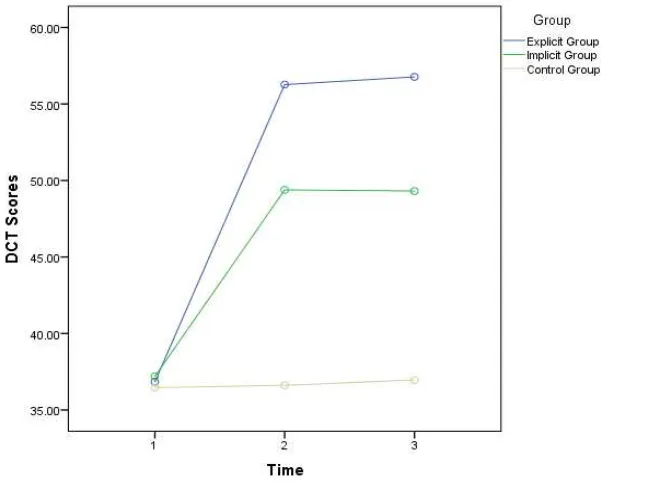
Descriptive statistics in Table 1 show that, as far as DCT is concerned, there are fairly large between-group differences from pre-test to immediate post-test for implicit and explicit groups but not for the control group. The main effect of time is statistically significant, F (2, 75) = 553.56, p < .000, and the partial eta squared is .88 which is rather large. Follow-up pair-wise comparisons confirm statistically significant improvement from pre-test to immediate post-test (p <.000) but not from immediate post-test to delayed post-test (p = .612). Also, the interaction between time and group is significant, F (4, 75) = 152.824, p < .000, = .80. As illustrated in Figure 1, although both implicit and explicit groups have had significant gains from pre-test to immediate post-test in terms of production of refusal strategies (DCT), there are sizable differences between the two groups in terms of their gains from instruction and, as displayed in Table 3, participants in the explicit group have outperformed those in both implicit and control groups. Results also show that the difference between implicit and control group was significant.
Table 3 about here
To sum up, with regard to the first research question, the results of the statistical tests indicate that: (a) prior to treatment, participants in all groups were fairly similar in terms of CQ and DCT scores; (b) compared to the control group, both implicit and explicit groups have had significant gains from pre-test to post-test; and (c) explicit group outperformed both implicit and control groups on post-test
assessment.
Figure 1 and 2 about here
The second research question asked whether individual differences in WMC interact with the effects of implicit and explicit instruction of refusal strategies on
-test and delayed post-test performance. Descriptive statistics for WMC test are shown in Table 4 and although, as shown by the SD magnitude, there is a fair amount of variation in the WMC scores (Implicit group: M = 36.692, SD = 4.07; Explicit group: M = 37.576, SD = 2.87; Control group: M = 37.153; SD = 3. 081) there is no statistically significant difference among them in terms of WMC, F (2, 75) = .424, p < .656.
Table 4 about here
Correlational analyses were performed with WMC test and immediate post-test scores for both DCT and CQ to see if WMC plays a mediating role in the effects of implicit and explicit instruction methods. Owing to the large number of correlations and in order to avoid committing Type I error, Bonferroni Correction was applied and the alpha value was set to .004, which means that in order for the differences to be statistically significant the p value should have been less than .004. Table 6 shows that there are strong correlations between WMC, DCT, and CQ in the implicit group (immediate DCT: r = .672, p < .000; delayed DCT: r = .585, p < .002; immediate CQ: r = .624, p < .001; delayed CQ: r = .620, p < .001) but not in the explicit group (immediate DCT: r = .307, p = .127; delayed DCT: r = .317, p < .115; immediate CQ: r = -.159, p = .438; delayed CQ: r = .141, p = .493). These fairly strong correlations in the implicit group point to the important mediating role that WMC plays in the effectiveness of implicit instruction of refusal strategies.
In relation to the second research question, then, results revealed that: (a) all three groups were fairly equal in terms of WMC; (b) in the implicit group,
DCT CQ
their WMC capacity; (c) in the explicit group, no meaningful correlation was found.
DISCUSSION AND CONCLUSION
The aim of this research was to explore the differential effects of explicit and implicit instruction of refusal strategies on both production and comprehension of this
pragmatic feature WMC
treatment conditions. The results showed that overall both implicit and explicit instruction led to significant improvement in both accurate production and
instruction in general and explicit instruction in particular (House, 1996; Félix-Brasdefer, 2008; Nguyen, et al., 2012), highlight the pivotal role of instruction in
“ “LA
to and notice in target language input and what they understand the significance of
I EFL , primarily,
develop their repertoire of vocabulary and grammar and since there is very limited opportunity to interact with native speakers, L2 pragmatic features, such as refusal strategies, seem to be list of priorities for attention. According to Wickens (2007), if a feature is not salient and is not expected to have much value, it will not be selected for further cognitive processing. The findings of this study showed that instruction induces learners to attend to refusal strategies probably through enhancing their salience and expected value. However, whereas explicit instruction seems to have made the target feature critically salient and of high expected value for language use (Wickens, 2007) and has made learners aware of
“
2001, p. 6), implicit instruction has been less successful in achieving this goal. Another interesting aspect of the findings was the large effect sizes for both time and the interaction between time and group. This could be explained in the light of J K 6) meta-analysis which yielded the arbitrary cut-off point of five hours of intervention for having durable and significant effects. In the current study, both implicit and explicit groups received about 12 hours of instruction which has led to both large effect sizes and durable effects as evidenced in the delayed post-tests administered two months later. These long-term benefits confirm
F s that the positive effects of instruction were sustained after five months. They are also in alignment with TAP hypothesis discussed earlier in the paper: in both explicit and implicit conditions, participants engaged in communicative activities which bore a resemblance to the retrieval conditions and, more
importantly, fostered deep levels of processing (Lightbown, 2008).
The results of this study also demonstrated that WMC mediates the effects of implicit instruction of refusal strategies, such that those with larger WMC obtained higher scores on both post-test and delayed post-tests across both production (DCT) and comprehension (CQ) measures. No meaningful relationship was found between WMC and outcome variables in the explicit group. Broadly, this finding supports
T ‘
performing refusals accurately would still prove highly effortful and cognitively demanding. This will culminate in higher demands on WMC which, in addition to
- W
177), selects and modulates both sensory information coming to the mind and the existing information (Chun, et al., 2011). Therefore, the implicit instruction condition is expected to be more favorable for learners with larger WMC who can regulate their limited attentional capacity more efficiently. D ‘ E
findings, we could argue that learners with higher WMC are more adept in
suppressing and inhibiting irrelevant information (e.g., L1 sociopragmatic norms or other aspects of the materials presented) and therefore would be more successful in benefiting from implicit instruction condition. This finding and interpretation are in accord with previous aptitude-treatment interaction research (e.g. Sanz, et al. 2016) which shows that WMC plays a major role in teaching situations where metalinguistic information is withheld and no explicit corrective feedback is provided. The
implication of this for language education and policy making is profound as it suggests that explicit instruction of L2 pragmatic features has the potential to level the playing field for learners with various levels of cognitive abilities. Language teaching does not always involve teaching classes with students who are homogenous in terms of cognitive and processing abilities; far from it, in addition to learners who have relatively smaller WMC, learners with Specific Learning Difficulties (SpLDs) normally have reduced WMC, which will impair their ability to select and allocate sustained attention to target features (see Kormos, 2017 for an exhaustive account). This argument is in alignment with findings of Kormos and M as cited in Kormos, 2017) that learners with SpLDs struggle to infer regularities and patterns under implicit instruction conditions and prefer explicit instruction. Therefore, in order to move towards inclusive language pedagogy, it is imperative to employ teaching practices which do not favor particular groups of language learners; but are responsive to all learners regardless of their SpLDs or differential level of WMC.
Despite these positive results, this research had some limitations which need to be acknowledged and taken into account in future research. First and foremost, as suggested by Taguchi (2015), in order for L2 pragmatics instruction research to come up with robust, generalizable, and reliable results, multiple tasks and elicitation instruments need to be used. In the current study, DCT and CQ were employed, but although these two instruments are quite common and convenient for eliciting L2 pragmatics knowledge, they might not adequately represent the social intricacies and cognitive demands of actual communication. Second, it might be worthwhile to utilize a battery of WM tests, and better still, the kind of tests which tap into phonological short-term memory a construct that has been shown to be correlated with a myriad of L2 processing and acquisition mechanisms. Finally, focusing on various L2
pragmatic features which have multiple realizations could further shed light on the relative effectiveness of different instructional sets as well as whether and how such effects are moderated by individual differences in WMC.
Alcon-Soler, E. (2007). Fostering EFL Learners' Awareness of Re-questing through Explicit and Implicit Consciousness-raising Tasks. Investigating Tasks in Formal Language Learning. Bristol: Multilingual Matters, 221-241.
Allami, H., & Naeimi, A. (2011). A cross-linguistic study of refusals: An analysis of pragmatic competence development in Iranian EFL learners. Journal of Pragmatics, 43(1), 385-406.
doi:http://dx.doi.org/10.1016/j.pragma.2010.07.010
Babai Shishavan, H., & Sharifian, F. (2013). Refusal strategies in L1 and L2: A study of Persian-speaking learners of English. Multilingua-Journal of Cross-Cultural and Interlanguage Communication, 32(6), 801-836.
Bachman, L. F. (1990). Fundamental considerations in language testing. Oxford: Oxford University Press.
Baddeley, A. D. (2001). Is working memory still working? American Psychologist, 56(11), 851.
Baddeley, A. D. (2017). Modularity, working memory and language acquisition. Second Language Research, 0267658317709852.
Baddeley, A. D., & Hitch, G. (1974). Working memory. Psychology of learning and motivation, 8, 47-89.
Bardovi-Harlig, K. (2001). Evaluating the empirical evidence: Grounds for instruction in pragmatics. Pragmatics in language teaching, 1332.
Bardovi-Harlig, K. (2012). Pragmatics and second language acquisition. In S. M. Gass & A. Mackey (Eds.), The Routledge Handbook of Seocnd Language Acquisition (pp. 147-162). New York: Routledge
Beebe, L. M., Takahashi, T., & Uliss-Weltz, R. (1990). Pragmatic transfer in ESL refusals. In R. Scarcella, E. Anderson, & S. Krashen (Eds.), Developing communicative competence in a second language (pp. 55-73). New York: Newbury House.
Chen, X., Ye, L., & Zhang, Y. (1995). Refusing in Chinese. In G. Kasper (Ed.), Pragmatics of Chinese as native and target language (pp. 119-163): Universit of Hawai'i. Chun, M. M., Golomb, J. D., & Turk-Browne, N. B. (2011). A taxonomy of external and
internal attention. Annual review of psychology, 62(1), 73-101. doi:10.1146/annurev.psych.093008.100427
Cohen, A. D. (1996). Developing the ability to perform speech acts. Studies in second language acquisition, 18(2), 253-267.
Conway, A. R., Kane, M. J., Bunting, M. F., Hambrick, D. Z., Wilhelm, O., & Engle, R. W. (2005). Working memory A
guide. Psychonomic Bulletin & Review, 12(5), 769-786.
DeKeyser, R. (2012). Interactions between individual differences, treatments, and structures in SLA. Language Learning, 62(s2), 189-200.
DeKeyser, R. M. (1995). Learning second language grammar rules. Studies in second language acquisition, 17(3), 379-410.
Doughty, C. (2001). Cognitive underpinnings of focus on form. In P. Robinson (Ed.), Cognition and second language instruction (pp. 206-257). Cambridge: Cambridge University Press.
Ellis, R. (2009). Implicit and explicit knowledge in second language learning, testing and teaching (Vol. 42): Multilingual Matters.
Ellis, R., & Shintani, N. (2014). Exploring language pedagogy through second language acquisition research: Routledge.
Erlam, R. (2005). Language aptitude and its relationship to instructional effectiveness in second language acquisition. Language Teaching Research, 9(2), 147-171. Eslami, Z. R. (2010). Refusals: How to develop appropriate refusal strategies. In A.
Martínez Flor & E. Usó Juan (Eds.), Speech act performance: Theoretical, empirical and methodological issues (pp. 217-236). Amsterdam: John Benjamins.
Félix-Brasdefer, J. C. (2008). Pedagogical intervention and the development of pragmatic competence in learning Spanish as a foreign language. Issues in Applied Linguistics, 16(1).
Fordyce, K. (2014). The differential effects of explicit and implicit instruction on EFL
Applied Linguistics, 35(1), 6-28.
Ghavamnia, M., Eslami-Rasekha, A. & Vahid-Dastjerdia, H. (2014). The effects of input
enhanced instruc I EFL
accurate suggestions. The Language Learning Journal. Advance online publication;: doi:10.1080/09571736.2014.972431
Goo, J. (2012). Corrective feedback and working memory capacity in interaction-driven L2 learning. Studies in second language acquisition, 34(3), 445-474. House, J. (1996). Developing pragmatic fluency in English as a foreign language:
Routines and metapragmatic awareness. Studies in second language acquisition, 18(2), 225-252.
Housen, A., & Pierrard, M. (2005). Investigations in instructed second language acquisition (Vol. 25): Walter de Gruyter.
Indrarathne, B., & Kormos, J. (2016). Attentional processing of input in explicit and implicit conditions. Studies in second language acquisition, 1-30.
doi:10.1017/S027226311600019X
Ishihara, N., & Cohen, A. D. (2010). Teaching and learning pragmatics: Where language and culture meet: Pearson Longman.
Jeon, E.-H., & Kaya, T. (2006). Effects of L2 instruction on interlanguage pragmatic development. In J. M. Norris & L. Ortega (Eds.), Synthesizing research on language learning and teaching (pp. 165-211). Amsterdam: John Benjamins. Juffs, A., & Harrington, M. (2011). Aspects of working memory in L2 learning.
Language Teaching, 44(2), 137-166.
Kasper, G., & Schmidt, R. (1996). Developmental issues in interlanguage pragmatics. Studies in second language acquisition, 18(2), 149-169.
Kormos, J. (2017). The second language learning processes of students with specific learning difficulties. New York: Routledge
Kwon, J. (2004). Expressing refusals in Korean and in American English. Multilingua-Journal of Cross-Cultural and Interlanguage Communication, 23(4), 339-364. Labben, A. (2016). Reconsidering the development of the discourse completion test in
Interlanguage Pragmatics. Pragmatics, 26(1), 69-91.
Leech, G. (1983). Principles of pragmatics. London and New York: Longman. Lightbown, P. M. (2008). Transfer appropriate processing as a model for classroom
second language acquisition. Understanding second language process, 27-44. Miyake, A., & Friedman, N. P. (1998). Individual differences in second language
W Foreign language
learning: Psycholinguistic studies on training and retention, 339-364. Nguyen, T. T. M., Pham, T. H., & Pham, M. T. (2012). The relative effects of explicit
and implicit form-focused instruction on the development of L2 pragmatic competence. Journal of Pragmatics, 44(4), 416-434.
Nguyen, M., Pham, H., & Pham, T. (2017). The effects of input enhancement and recasts on the development of second language pragmatic competence. Innovation in Language Learning and Teaching, 11(1), 45-67.
Norris, J. M., & Ortega, L. (2000). Effectiveness of L2 instruction: A research synthesis nalysis. Language Learning, 50(3), 417-528.
Robinson, P., Mackey, A., Gass, S. M., & Schmidt, R. (2012). Attention and awareness in second language acquisition. In S. M. Gass & A. Mackey (Eds.), The
Routledge handbook of second language acquisition (pp. 247-267). New York: Routledge.
Rosen, V. M., & Engle, R. W. (1998). Working Memory Capacity and Suppression. Journal of Memory and Language, 39(3), 418-436. doi:http://dx.d
oi.org/10.1006/jmla.1998.2590
Sanz, C., Lin, H.-J., Lado, B., Stafford, C. A., & Bowden, H. W. (2016). One Size Fits All? Learning Conditions and Working Memory Capacity in Ab Initio Language Development. Applied Linguistics, 37(5), 669-692. doi:10.1093/applin/amu058 Sawyer, M., & Ranta, L. (2001). Aptitude, individual differences, and instructional
design. Cognition and second language instruction, 319-353. Schmidt, R. (1993). Consciousness, learning and interlanguage pragmatics.
Interlanguage pragmatics, 21, 42.
Schmidt, R. W. (2001). Attention. Cognition and Second Language Instruction, ed. by P. Robinson, 3-32: Cambridge: Cambridge University Press.
Spada, N., & Tomita, Y. (2010). Interactions between type of instruction and type of
A M A Language Learning, 60(2), 263-308. Taguchi, N. (2008). The effect of working memory, semantic access, and listening
abilities on the comprehension of conversational implicatures in L2 English. Pragmatics & Cognition, 16(3), 517-539. doi:doi:10.1075/pc.16.3.05tag Taguchi, N. (2015). Instructed pragmatics at a glance: Where instructional studies
Taguchi, N., & Roever, C. (2017). Second language pragmatics. Oxford: Oxford University Press.
Takahashi, T., & Beebe, L. M. (1987). The development of pragmatic competence by Japanese learners of English. JALT journal, 8(2), 131-155.
Takimoto, M. (2007). The effects of input-based tasks on the development of learners' pragmatic proficiency. Applied Linguistics, 30(1), 1-25.
Vatz, K., Tare, M., Jackson, S. R., & Doughty, C. (2013). Aptitude-treatment interaction studies in second language acquisition. Sensitive periods, language aptitude, and ultimate L2 attainment, 35, 273.
Wen, Z., Mota, M. B., & McNeill, A. (2015). Working memory in second language acquisition and processing (Vol. 87): Multilingual Matters.
Wickens, C. D. (2007). Attention to the second language. IRAL-International Review of Applied Linguistics in Language Teaching, 45(3), 177-191.
Table 1: Descriptive statistics for DCT and CQ (pre-test, post-test, delayed post-test)
Pre-test DCT Immediate post-test DCT
Delayed post-test DCT
Pre-test CQ Immediate post-test CQ
Delayed post-test CQ
Explicit Group 36.846
(SD = 2.693)
56.269 (SD = 4.712)
56.769 (SD = 4.827)
6.3077 (SD = 1.010)
9.8462 (SD = 1.084)
9.7692 (SD = 1.031)
Implicit Group 37.192
(SD = 2.757)
49.846 (SD = 3.716)
49.653 (SD = 4.185)
5.9231 (SD = 1.128)
8.1154 (SD = 1.107)
8.0385 (SD = 1.280)
Control Group 36.461
(SD = 3.127)
36.615 (SD = 3.311)
36.961 (SD = 3.052)
6.461 (SD = .904)
5.923 (SD = 1.467)
[image:23.792.83.521.319.361.2]6.730 (SD = 1.929)
Table 2: One-way ANOVAs for pre-tests
Sum of Squares df Mean Square F Sig.
Pre-test DCT 6.949 2 3.474 .423 .657
Pre-test CQ 4.000 2 2.000 1.927 .153
Table 3: Pair-wise comparisons between groups
Mean Difference Std. Error Sig.
DCT CQ DCT CQ DCT CQ
[image:23.792.73.505.394.490.2]Control Group 13.282* 2.269* .913 .248 .000 .000
Implicit Group Control Group 8.615* .987* .913 .248 .000 .000
[image:24.792.70.582.316.365.2]*. The mean difference is significant at the .05 level. b. Adjustment for multiple comparisons: Bonferroni.
Table 4: Descriptive statistics for WMC test
Group N Minimum Maximum Mean Std. Deviation
Explicit Group Operation Span Task 26 33.00 45.00 37.576 3.177
Implicit Group Operation Span Task 26 30.00 44.00 37.692 4.047
9.63
Figure 2: CQ scores
i I am grateful to an LTR anonymous reviewer for suggesting such a distinction.