Policy Coordination
An Analysis of Issues
Noela Eddington, Department of Education and Training, Queensland
Ian Eddington, University of Southern Queensland, Toowoomba
Abstract
Australian Workforce Futures: a national workforce development strategy (Skills Australia 2010) noted international findings on the limitations of Vocational Education and Training (VET) systems that measure their contribution to increasing the stock of skills by focusing primarily on numbers targets and efficiency measures. It noted that a fundamental change to the Australian VET System was needed to equip enterprises to more effectively use the skills, expertise and talent of their existing employees and noted that investment in workforce development programs needs to occur simultaneously at government, industry and enterprise level.
In response to this challenge, Queensland has been conceptualising an Industry Development Skills Policy model to sit along side the traditional Education Services Model. A pilot study, namely the Workplace Partnership and Productivity Project (WP&PP) was established in manufacturing to demonstrate productivity benefits from integrated service delivery across industry development, work and skills policy. This paper discusses the policy coordination issues that have arisen through this initiative and suggests that agency capability to work collaboratively is critical to successful execution of such projects. The ‘capability’ factor is discussed and suggestions made regarding the initiation of collaborative activity through policy coordination processes.
Keywords:Policy Coordination, Networked Governance
Introduction
There is continuing debate in the United Kingdom and Australia (Buchanan et al, 2001; Buchanan, 2006; Keep et al, 2006) which suggests that, in the context of the changing economic, social and environmental settings, the existing supply-driven approach to skills provision is insufficient. Questions around the capacity of VET to deliver optimal outcomes for a sustainable future1 are timely, and a future VET system must not be compromised by existing governance, policy and institutional deficiencies. It is time for the current VET system to address the manner in which it might adapt to the changing context and how it might participate in a broader policy debate.
This paper relates specifically to the WP&PP experiment in Queensland which seeks to integrate industry development, work and skills policy in an industry development context. It deals particularly with governance of the three policy areas involved in the project and the trials and tribulations that have been experienced so far. The setting is the manufacturing sector and the views expressed in this paper reflect the experiences of the authors.
1
Noela Eddington Monitoring and Evaluation: Industry Development Skills Policy
The paper is also based on a body of literature concerning governance issues (Keast et al, 2006; Waddock, 1991, Osborn and Hagedoorn 1997, Seltzer and Stoker 1999, Clarke and Stewart, 1997). The thrust of this literature is that contemporary governments face
increasingly complex challenges that often defy precise definition, cut across policy and service areas, are beyond the capacity of any one agency or sector to respond to effectively, have no clear or correct solution and resist solutions offered by the single agency approach (Keast et al, 2006). Skills issues are one such complex challenge; they have multi-factorial causes and we now know that ‘demand-side’ or workplace strategies that cut across policy areas are required if skills policy is to address more effectively the persistent shortages and declining productivity that Australia is experiencing.
We have also learned through experience with Skills Formation Strategies (Skill Ecosystems) that bureaucratic systems and processes are familiar with both state and market modes of governance that utilize targets and efficiency measures, but they have difficulty operating in collaborations or network structures that tend to rely on relationships. Collaborative efforts are sometimes established to solve cross-cutting issues, but their outcomes and processes are generally predicated on traditional ways of working and reporting. This was certainly the case when Skills Formation Strategies were introduced in Queensland.
The characteristics of the three modes of governance will be briefly identified, before moving on to the specific collaborative network structure in question. The paper will suggest activities that should be undertaken to set up a collaboration, discuss the issues that arose in the project, and suggest that new sets of stakeholder expectations, capabilities and accountabilities need to be established in order to address persistent complex issues faced by modern bureaucracies. Skills are increasingly recognized as a complex issue and cannot be resolved through individual departmental programs that address only part of the problem. Consequently, network structures may well form part of an organizing mechanism for any future Industry Development Sills Policy.
Network Structures, Modes of Governance and Policy Coordination
First, it is necessary to clarify the meaning of ‘networks’, ‘networking’ and ‘network
structures’, as colloquially the terms are used rather loosely. Networking can be either formal or informal and refers to the loose connections and contacts between individuals. Networks are more formal and usually form around a common interest, but activity generally relates to actions of independently operating organizations (Mandell and Gage, 1988). Network structures form when agencies or people realize that they represent only one part of an issue, and that only by collaborating through a common mission will goals be accomplished
(Mandell 1994). They require activity beyond actions of independently operating agencies or individuals; action is of necessity strategically interdependent and committed to joint
overriding goals. Accordingly, there is a high risk involved for individual agencies as typical bureaucratic power and authority cannot be used unilaterally. Power becomes based on trust and interpersonal relationships, the time to achieve outcomes is usually protracted, new risks are involved, and a different set of leadership capabilities is required.
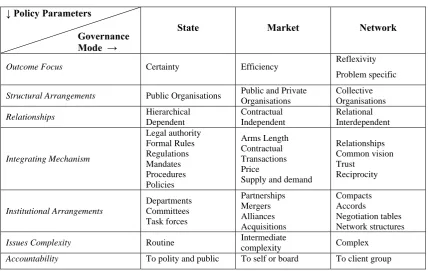
The Table 1 framework is intended as a starting point which identifies the institutional settings and processes of the governance modes. It enables insight into questions about the constitution of the right mix and helps to inform better tailored governance regimes of collaborations for complex policy issues. Hopefully such tailoring will lead to more flexible and efficacious public policy process. In Western democracy, government traditionally coordinates fragmented policy arenas (sometimes superficially), but the suggestion here is that government should actually select the right mix of modes that is fit for the purpose. It goes without saying that the design of the governance mode must be an appropriate fit for the problem at hand, and this assumes the correct ‘naming and framing’ of the problem in the first instance.
Table 1: Governance modes
↓ Policy Parameters
Governance Mode →
State Market Network
Outcome Focus Certainty Efficiency Reflexivity
Problem specific
Structural Arrangements Public Organisations Public and Private Organisations
Collective Organisations
Relationships Hierarchical Dependent Contractual Independent Relational Interdependent Integrating Mechanism Legal authority Formal Rules Regulations Mandates Procedures Policies Arms Length Contractual Transactions Price
Supply and demand
Relationships Common vision Trust Reciprocity Institutional Arrangements Departments Committees Task forces Partnerships Mergers Alliances Acquisitions Compacts Accords Negotiation tables Network structures
Issues Complexity Routine Intermediate
complexity Complex
Accountability To polity and public To self or board To client group
Source: Constructed from Keast et al (2006) p.39
Government policy interventions to support industry development are often provided by a range of agencies that typically manage industry, work and skills policies. Policy coordination in these areas can provide collective synergies for industry clients, as it enables an holistic approach to business strategy, operating systems, and people management and development. From a skills perspective, it enables skills to be better tailored and utilized in context thereby creating better value.
Policy coordination relies on a strong sense of interdependence between agencies. The process requires tight alignment of resources and effort to meet a set goal. Coordination requires clear problem definition, agreement on protocols, activity and structured communication flows, commitment and accountability. Although power remains with individual agencies, trust and relationships underpin coordinated activity.
The Workplace Partnership and Productivity Project
Noela Eddington Monitoring and Evaluation: Industry Development Skills Policy
when ‘partnership’ exists than through the normal business improvement processes such as High Performing Work Practices. The Project was located in the manufacturing sector and managed by the industry development agency (Department of Employment, Economic Development and Innovation) which already had effective high performance workplace2 programs in place. The training agency (Department of Education and Training) was asked to join the network structure to deal with both demand-side and supply-side skills issues.
Essentially, three agencies agreed to coordinate their respective policy interventions and to asses the impact on productivity. The Department of Education and Training (DET) was also using the project to trial a set of tools for potential use in the developing Industry
Development Skills Policy model. The focus of the intervention was ‘productivity’ enhancement through a combined interagency approach across the business development spectrum.
Representatives of the three agencies formed a Steering Committee under the leadership of the work agency. This policy integration is, in effect, relying on a network structure which initially actively tested the capability of the bureaucracy to operate collectively. The paper proceeds to discuss what might ideally have happened in the set up phase and the issues that arose as a result of poor insights into implementation factors around policy coordination and network structures.
Set-up: Policy Coordination in a Network Structure
Collaborative working is now central to the way many programs are delivered and innovations produced (Spoehr, 2010). The term refers to the way individuals and
organisations ‘work together’ to address issues and deliver outcomes that are not easily or effectively achieved through ‘siloed’ activity.
In the start-up phase of a network structure there is a set of activities that should be
undertaken to ensure that the collaborative approach is properly structured and managed to achieve its purpose. These include:
1. Identifying the Challenge
The challenge may be to explore and expose policy problems or to confirm success of concepts in demonstration projects. It is necessary at this stage to promote dialogue on key issues to be addressed and to establish the broader context for these issues. It requires a broad scoping of the problem or reaching universal agreement on the problem.
2. Recognising and Accepting the Need for Policy Coordination within a Network Structure Potential stakeholders need to identify potential benefits of working in collaborative network structures, identify the factors associated with successful collaborative activity, identify potential barriers to operating in such structures, acknowledge whether the policy context relies on voluntary, coerced or mandatory processes, acknowledge the extent of interdependence required to deal with the challenge as well as areas where independence may prevail.
3. Developing Clarity and Realism of Purpose
Stakeholders need to establish an agreed common purpose or understanding of each agency’s expectations. It requires a clear, unambiguous statement of the purpose of the collective activity, and clarity around what is to be achieved and how it should be achieved. On-going rounds of dialogue are required to identify interests and shape
2
decisions and directions. Issues may need to be framed in different ways to help members interpret problems from different perspectives, analyse information and develop solutions. Stakeholder reasons for engaging in the collaborative activity need to be understood and accepted.
4. Establishing Membership, Commitment and Ownership
Establishing relevant membership of the network, determining who should be involved and at what level should arise from continuing dialogue. This involves identifying
necessary participants and their resources (skills, knowledge and assets) and securing their buy-in and the commitment of their organisation. Consideration should also be given at this stage to the enlistment of outside support such as industry organisations and unions. 5. Creating Clear and Robust Network Structure Arrangements
It is necessary to negotiate the terms of engagement of network members. These are the rules, standards, meeting procedures, decision-making processes, roles and behaviours that guide the way network members will interact with each other. The organising structure of the network needs to be agreed. It is necessary to ensure the prime focus is on process, outcomes and innovation. There must be transparency around financial and non-financial resources each stakeholder contributes to the collaborative activity.
6. Developing and Maintaining Trust
Taking time to build and nurture relationships is central to successful collaborative networks. Relationships are critical in collaborative network structures where outcomes are reliant on interdependent activities, and where members need to set power and perception differences aside.
7. Monitoring, Measuring and Learning
This principle refers to the reflective component of the network structure. It should relate to the assessment of the network performance and, in so doing, cement commitment and trust. Success criteria need to be clear, the collaborative service provision and the effectiveness of the network structure need to be assessed, review findings need to be widely disseminated and continuing barriers addressed. Most importantly, the learning from this stage should trigger continuous revision of goals, objectives and arrangements. There is evidence from successful collaborative networks3 that time and effort spent planning, organising and building agreement in the set-up phase is essential to forming a structure that will achieve members’ collective goals.
Issues that arose in the WP&PP
The issues that arose in the WP&PP are analysed in the context of the collaborative network set-up principles outlined above. The comments are not intended as a criticism of individuals or organisations, but are offered because of the potential learning they offer for future activity in policy coordination set up under network structures.
1. Identifying the Challenge
The WP&PP was initiated by the work agency to confirm greater labour productivity improvements when employer-employee partnerships are in place, than when traditional business process improvements are used in isolation. Early discussions between the three agencies involved revealed that all three claimed improved productivity as a result of their interventions. Therefore combining the three policy areas and their identified resources in the WP&PP, immediately posed a problem for the project. It became much more than influencing change in employer-employee relationships. In fact, it became a
3
Noela Eddington Monitoring and Evaluation: Industry Development Skills Policy
comprehensive industry development process with interventions in business strategy, processes, people management and skills.
Impact: The challenge became one of coordinated policy interventions aimed at improving business outcomes in productivity and profitability. The employer-employee partnership became the process through which strategy, systems and people management (including skills) interventions would be implemented. But this was neither discussed nor formally understood by the network and much time was wasted in fruitless discussion.
2. Recognising and Accepting the Need for Policy Coordination within a Network Structure The Project was initiated without the benefit of an understanding of the three modes of governance noted in Table 1. It essentially began under a state mode of governance, the mode that is most familiar to government agencies. Discussions progressed on the
assumption that the state mode policy parameters (outcomes, structure, relationships, issue complexity etc) were able to deal with the challenge. There was no recognition of the differences between state and network modes of governance, and no attempt to tailor the governance mode to the challenge at hand. It is contended that a mixed mode of
governance would have been preferable in this Project.
Impact: The governance mode was inappropriate for the challenge at hand. Individual agencies tended to drive their own agendas
3. Developing Clarity and Realism of Purpose
Because the real ‘challenge’ was obscurely articulated but never formally recognised by the agencies, an over-riding unambiguous statement of the purpose of the collective activity did not occur. Instead, each agency was required to articulate their specific objectives (Attachment 1) and, as these were at a lower level, they did not serve as an integrating mechanism (refer Table 1) for the collaborative network.
Impact: The network rationalised, initially internally but later externally, that the project would proceed by ‘feeling its way’. Potential enterprises, unions, industry organisations and consultants were confused and gaining ‘buy in’ by these stakeholders became problematic and protracted. The problem lay in an inability of the project to clearly articulate expectations, processes, funding and roles to prospective enterprises and consultants.
4. Establishing Membership, Commitment and Ownership
Appropriate membership of the WP&PP was established. Senior Officers from the three agencies, relevant unions and industry organisations formed a Steering Committee and two operational officers were nominated from the industry and work agencies.
Commitment and ownership was strong, but to individual agency objectives.
5. Creating Clear and Robust Network Structure Arrangements
As alluded to above, the familiar state mode of governance prevailed as per the policy parameters in Table 1. In particular, the challenge was treated as ‘routine’, when in effect several of the identified lower level objectives were quite complex, for example, the ‘partnership’ between employers-employees in the current industrial relations environment and the ‘demand-side’ skills issues. Similarly, the outcome focus, structural arrangements, relationships, institutional arrangements and integrating mechanism were technically based in the state mode of governance.
Impact: The Project was managed more as a cooperation (loose connections, low trust, independent goals, power remained with agencies, commitment and accountability to the agencies not the Project, relationships were somewhat underdeveloped and low risk prevailed), than as a coordination challenge. Agency capability was insufficient to effectively achieve strong policy coordination which is characterised by more
interdependent goals, integrated policies and aligned resources, stronger commitment to the Project challenge, focused dialogue around set-up activities, understanding of complexities inherent in the Project and more explicit communication. There was however, good work-based trust and structured communication flows which helped
network members conceptualise Project implementation. It is uncertain if this flowed on to all prospective consultants.
6. Developing and Maintaining Trust
No strategy was employed to develop understanding and trust between individuals. There was, in fact, a pre-existing element of adversarial attitude between several stakeholders. A deliberate relationship building strategy should have been employed and, from hindsight, some process akin to the work agency’s ‘partnership’ process or interest based negotiation would have helped members better understand and appreciate each other’s position. The Project proceeded on a set of assumptions that were never verified and agreed. However, pre-existing relationships existed between some members of the network and these were used extensively to sort through issues that should have been addressed early on.
Impact: A considerable amount of time wasting effort, stress and confusion occurred in the start-up phase of the project. Briefings, presentations and other forms of written
communication underwent extensive revision. Workshops were run early on by the New Zealand Partnership Resource Center, but the context for the Queensland processes was different and, although helpful to the agencies involved, led to more confusion, especially amongst external stakeholders.
7. Monitoring, Measuring and Learning
The Project proceeded without review of milestones, some of which were probably unrealistic given the nature of the project and the significant changes in thinking around employer-employee relationships and ‘demand-side’ skills issues that were being explored.
Noela Eddington Monitoring and Evaluation: Industry Development Skills Policy
Impact: The Project continues to proceed and is currently seeking enterprises that are prepared to engage in the new ways of doing business in workforce management practices, including addressing ‘demand-side’ issues that impact on the availability of a high skilled workforce able to effectively utilise their knowledge and skills to the advantage of
industry. It is suggested that more attention to the Project set-up strategies for network structures outlined above would have benefited progress.
Government Capability to Operate in Networks
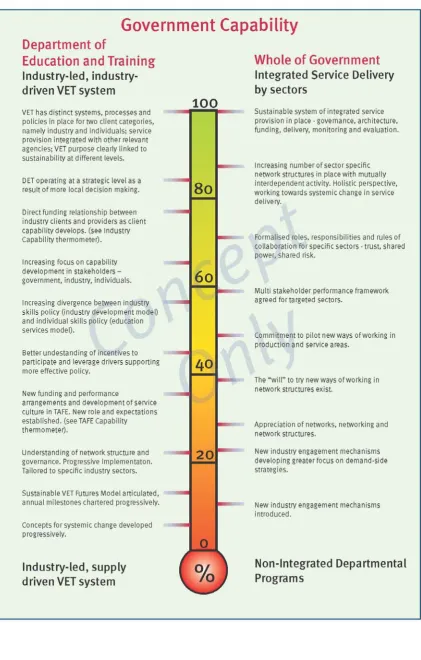
Experience in the WP&PP is that, unless the ‘capability’ issue is addressed, agencies tend to follow ‘business as usual protocols’. Policy coordination in collaborative networks brings organisations together to achieve something that cannot be delivered by any organisation’s individual efforts. For collaborations in network structures to be effective, participating organisations have to let go of some of their autonomy, share resources and power, and be willing to work for the collective good. For many organisations, making such a shift in functioning is not easy as it is most likely ‘business as unusual’ for governments from multiple perspectives: governance, roles, responsibilities, accountability, monitoring and reporting, managing employment and just transitions and sustainable production and consumption functions. A capability scale such as that outlined in the right hand side of Figure 2 could be used to guide thinking within bureaucracies when setting up coordinated policy interventions to deal with more complex issues. It articulates the type of behaviours that need to be developed incrementally by specific stakeholders in order to optimise value from integrated policy designed to support complex economic, social and environmental outcomes.
When embedding skills policy in collaborative networks is initiated by other policy areas, it is difficult for the skills agency to influence the capability of others to work effectively within a network structure. Skills are technically 3rd or 4th order issues after strategy, operating systems and people management. They do not really kick in to the industry development process until the higher order issues have been sorted. Once this occurs, skill needs can be better
understood and aligned to business needs because the tasks have been designed to which skill sets can be specifically matched. This is quite a different process to identifying skill needs for industry in a supply-driven VET system, where much information on skill needs can be quite superficial and qualifications supplied which may or may not end up where they are needed, let alone effectively utilised. The supply-driven approach is generally a ‘hit and miss’ process, because the root causes of skills issues and alignment of real skill needs to the business is often missing.
Noela Eddington Monitoring and Evaluation: Industry Development Skills Policy
Conclusion
The paper discusses policy coordination and the capability of government generally to operate in network structures. Such structures are often promoted as useful in addressing complex social and economic issue, as opposed to single agency policy interventions where state and/or market modes of governance prevail. Recent experience in a combined industry, work and skills policy intervention, namely the Workplace Partnership and Productivity Project, is analysed in terms of a set of desirable activities that should be completed to ensure that the collaboration is properly structured and managed to achieve its purpose. A capability scale is proposed as a starting point for operating in network structures where policy coordination interventions are organised.
References
Black, S.E. and Lynch, L.M. 2003, ‘The new economy and the organization of work’ in The Handbook of the New Economy, ed. Jones, D. New York: Academic Press.
Black, S.E. and Lynch, L. M. 2004, ‘What’s driving the new economy? The benefits of workplace innovation’, Economic Journal, February.
Buchanan, J, 2001, ‘Beyond Flexibility: skills and work in the Future’, NSW Board of Vocational Education and Training.
Clarke, M, Stewart, J, 1997, ‘Handling the Wicked Issues: A Challenge for Government’, Discussion Paper, University of Birmingham: Institute of Local Government Studies.
Flood, P, Guthrie, J, Wenchuan, L, O’Regan, C, Armstrong, C, MacCurtain, S, Mkamwa, T. 2008, Link Research Centre Working Paper Series WP 02-08.
Hardy, B, Hudson, B, Waddington, E. 2003, ‘Assessing Strategic Partnership’, Office of the Deputy Prime Minister, London.
Keast, R, Mandell, M, Brown, K, Woolcock, G. 2004, ‘Network Structures: Working Differently and Changing Expectations’, Public Administration Review, May/June 2004, Vol.64, Number 3.
Keast, R, Brown, K, 2002, ‘The Government Service Delivery Program: a case study of the push and pull of central government coordination’, Public Management.
Keep, E. 2009, Workforce improvement strategies in the UK presented at Workforce Development Forum, Department of Employment, Economic Development and Innovation, Brisbane.
Keep, E, Mayhew, K, and Payne, J, 2006, From skills revolution to productivity miracle – not as easy as it sounds? Oxford Review of Economic Policy vol.22 no. 4.
_, 1997, ‘Holistic Government’, London:Demos.
Mandell, M, 1994, 1994, ‘Managing Interdependencies Through Program Structures: A Revised Paradigm’, American Review of Public Administration 24(1):99-121.
Mandell, M and Gage, W, eds, 1988, ‘Special Symposium: Management in the Intergovernmental System: Networks and Strategies’, International Journal of Public Administration 11(4).
Osborn, R, Hagedoorn, J, 1997, ‘The Institutionalization and Evolutionary Dynamics of Interorganizational Alliances and Networks’, Academy of Management Journal 40(2):261-278.
_, 2010, ‘Australian Workforce Futures: a national workforce development strategy’, Skills Australia.
Spoehr, J, Barnett, K, Molloy, S, Vas Dev, S, Hordacre, A. 2010 ‘Connecting Ideas: Collaborative Innovation for a Complex World’, Department of Further Education, Employment, Science and Technology, South Australia.