Educational Destinations of Key Stage 4 and Post-16 Learners,
2014/15
1In December 2015 we published the statistical article “Educational Destinations of Key Stage 4 and Post-16 Learners, 2012/13”. This is an update to that article, with 2015/Post-16 destinations for the 2014/15 leaver cohorts. Since this article was last published, more complete information on learners’ programmes of study has become available in the post-16 data collections. Therefore, learning programme codes have been used to more precisely determine the leaver cohort and a learner’s destination, rather than learning activity codes used previously. Information is therefore not directly comparable with previous years.
Background
Arrangements for measuring performance in school sixth forms and in further education/work-based learning are currently entirely separate. Performance measures are produced from different data-collection systems using differing analysis methodologies. This means we are unable to compare
outcomes in a meaningful way across learner settings, and that learners and parents do not have access to transparent information to inform their choices.
To address this disparity, the Welsh Government (WG)’s Further Education & Apprenticeships team and Knowledge and Analytical Services are currently working to develop a set of consistent measures (achievement, value added and destinations) for further education institutions and sixth forms to enable the publication of headline and provider level information on an annual basis. Further information about this development of consistent measures for post-16 learning can be found on the WG website.
Destinations of learners (i.e. what a learner moves on to do after completing their learning) can be categorised into two broad types: educational and employment. We are working with the Department for Education on a separate project, the Longitudinal Education Outcomes Study (LEOS), to determine the employment destinations of learners in Wales, using administrative data held by the Department for Work and Pensions and HM Revenue & Customs. This article therefore focuses on the educational destinations of learners and provides an overview of progress made. These are experimental data, and as such we would value any feedback on the methodology, please see the Further Information section at the end of the article. This article provides information at an all-Wales level, but we anticipate that the methodology will be used to develop performance measures for individual learning providers in future.
Date of Publication: 14 December 2017 Next update: Not a regular output
Educational Destinations of Key Stage 4 and Key Stage 5 Learners
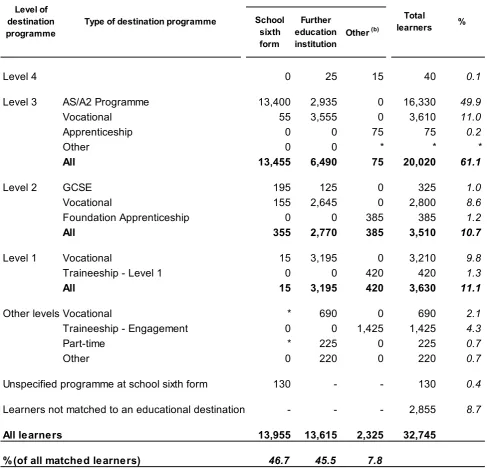
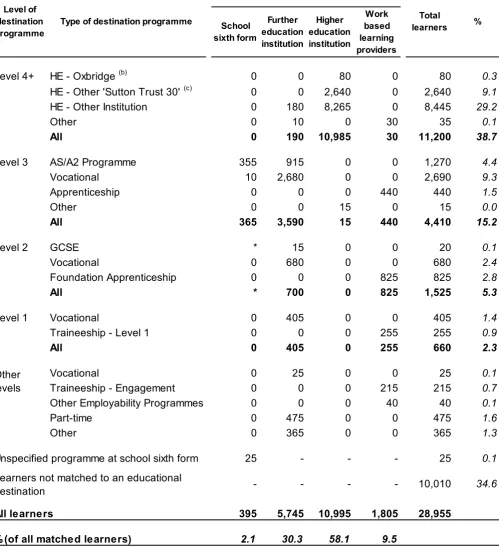
Tables 1 and 2 detail the 2015/16 educational destinations of the 2014/15 Key Stage 4 and Key Stage 5 leaver cohorts2. Note that independent schools are not included in the analysis in terms of either the leaver or destination cohorts, as these establishments fall outside the scope of the Pupil Level Annual School Census (PLASC) data collection.
Key results are as follows:
• 61 per cent of Key Stage 4 leavers progressed to a level 3 programme at a school sixth form, Further Education (FE) institution or Work Based Learning (WBL) provider; a further 30 per cent remained in some other form of education or training, generally undertaking programmes at level two or below
• 47 per cent of Key Stage 4 leavers with a matched destination were at school sixth forms and 46 per cent were at FE institutions
• 39 per cent of Key Stage 5 leavers progressed to a Higher Education (HE) level 4+ programme at
a HE or FE institution; a further 27 per cent remained in some other form of education or training (i.e. at level 3 or below)
• 58 per cent of Key Stage 5 leavers with a matched destination were at HE institutions, 30 per cent were at FE institutions and 10 per cent were at WBL providers
Chart 1: Educational Destinations of 2014/15 Leavers in 2015/16
(a) Includes unspecified programmes at sixth form schools (b) Those not matched to an educational destination
2 Definitions of the Key Stage 4 and Key Stage 5 leaver cohorts can be found in the Further Information section at the end of
this document 0%
39% 61%
15% 11%
5% 11%
2% 8%
4% 9%
35%
0%
10%
20%
30%
40%
50%
60%
70%
80%
Key Stage 4 Leavers
Key Stage 5 Leavers
Table 1: Educational Destinations of 2014/15 Key Stage 4 Leavers(a) in 2015/16
School sixth form
Further education institution
Other (b)
Level 4 0 25 15 40 0.1
Level 3 AS/A2 Programme 13,400 2,935 0 16,330 49.9
Vocational 55 3,555 0 3,610 11.0
Apprenticeship 0 0 75 75 0.2
Other 0 0 * * *
All 13,455 6,490 75 20,020 61.1
Level 2 GCSE 195 125 0 325 1.0
Vocational 155 2,645 0 2,800 8.6
Foundation Apprenticeship 0 0 385 385 1.2
All 355 2,770 385 3,510 10.7
Level 1 Vocational 15 3,195 0 3,210 9.8
Traineeship - Level 1 0 0 420 420 1.3
All 15 3,195 420 3,630 11.1
Other levels Vocational * 690 0 690 2.1
Traineeship - Engagement 0 0 1,425 1,425 4.3
Part-time * 225 0 225 0.7
Other 0 220 0 220 0.7
Unspecified programme at school sixth form 130 - - 130 0.4
Learners not matched to an educational destination - - - 2,855 8.7
All learners 13,955 13,615 2,325 32,745
% (of all matched learners) 46.7 45.5 7.8
(a)
Defined as all year 11 learners enrolled at maintained schools in Wales in January 2015 PLASC (b)
Includes HE institutions and WBL providers
Sources: Pupil Level Annual Schools Census (PLASC), Post-16 Collection, Lifelong Learning Wales Record (LLWR), Higher Education Statistics Agency (HESA) Student Record Level of
destination programme
Type of destination programme
Educational establishment
Total
Table 2: Educational Destinations of 2014/15 Key Stage 5 Leavers(a) in 2015/16 School sixth form Further education institution Higher education institution Work based learning providers
Level 4+ HE - Oxbridge (b) 0 0 80 0 80 0.3
HE - Other 'Sutton Trust 30' (c) 0 0 2,640 0 2,640 9.1
HE - Other Institution 0 180 8,265 0 8,445 29.2
Other 0 10 0 30 35 0.1
All 0 190 10,985 30 11,200 38.7
Level 3 AS/A2 Programme 355 915 0 0 1,270 4.4
Vocational 10 2,680 0 0 2,690 9.3
Apprenticeship 0 0 0 440 440 1.5
Other 0 0 15 0 15 0.0
All 365 3,590 15 440 4,410 15.2
Level 2 GCSE * 15 0 0 20 0.1
Vocational 0 680 0 0 680 2.4
Foundation Apprenticeship 0 0 0 825 825 2.8
All * 700 0 825 1,525 5.3
Level 1 Vocational 0 405 0 0 405 1.4
Traineeship - Level 1 0 0 0 255 255 0.9
All 0 405 0 255 660 2.3
Vocational 0 25 0 0 25 0.1
Traineeship - Engagement 0 0 0 215 215 0.7
Other Employability Programmes 0 0 0 40 40 0.1
Part-time 0 475 0 0 475 1.6
Other 0 365 0 0 365 1.3
Unspecified programme at school sixth form 25 - - - 25 0.1
- - - - 10,010 34.6
All learners 395 5,745 10,995 1,805 28,955
% (of all matched learners) 2.1 30.3 58.1 9.5
(b) University of Oxford and University of Cambridge (c)
The Sutton Trust has developed a list of the 30 most highly selective British Universities, which includes the University of Oxford and the University of Cambridge. This row includes the remaining 28 Universities, since we have detailed learner progression to Oxbridge separately in the table.
(a)
Defined as all learners aged 16 to 19 engaged in a level 3 programme at either a school sixth form or FE
Sources: Pupil Level Annual Schools Census (PLASC), Post-16 Collection, Lifelong Learning Wales Record (LLWR), Higher Education Statistics Agency (HESA) Student Record Level of
destination programme
Type of destination programme
Educational establishment
Total
learners %
Other levels
Further Information
1 Data Sources
This Statistical Article summarises data on the 2015/16 educational destinations of learners leaving Key Stage 4 and Key Stage 5 learning in 2014/15. The leaver cohorts comprise Key Stage 4 (year 11) leavers from maintained schools in Wales and Key Stage 5 leavers from maintained school sixth forms and FE institutions.
The key data-sources used in this article are as follows:
Pupil Level Annual School Census (PLASC): every January, all maintained schools are required to provide the Welsh Government with pupil and school level data. All pupils on roll on the census date must be included in the return
Post-16 Data Collection: every October, all maintained schools with sixth forms and middle schools with pupils in years 12, 13 and/or 14, are required to report all learning programmes and activities undertaken by learners in the previous academic year.
Lifelong Learning Wales Record (LLWR): contains data on further education, work-based learning and community learning, collected on a ‘rolling’ basis throughout the year with regular statistical freezes. It provides the official source of statistics on post-16 (non-higher education) learners in Wales.
Higher Education Statistics Agency (HESA): an annual collection of a range of UK-wide data from universities, higher education colleges and other differently funded providers of higher education. This data is then provided to UK governments and higher education funding bodies to support their work in regulating and funding higher education providers.
These collections relate to pupils enrolled at maintained schools in Wales; learners accessing post-16 learning at school sixth forms, Further Education (FE) institutions, Work Based Learning (WBL) providers or Local Authorities; and students enrolled at Higher Education (HE) institutions in the UK respectively.
Our statement of administrative sources, which refers specifically to the LLWR and HESA student record, can be found at: Statement of Administrative Sources.
2 Data Matching Process
Datasets supplied to London Economics
The matching approach implemented was both sequential (from the best quality to the fuzzy matching stages) and iterative (with the approach being constantly fine-tuned and adjusted to reflect the emerging evidence). The process was also additional in the sense that records matched in the later stages were added to matches identified in the earlier (higher quality) stages.
In general the approach was based on the following steps:
1. Match based on existing identifiers (Unique Pupil Number; Unique Learner Number) and personal characteristics (first, middle and family names; gender; date of birth; home postcode)
2. Direct match based on personal characteristics exactly matching or highly consistent across data sources
3. Fuzzy matching based on regular expressions of name, slight discrepancies in date of birth, wider definitions of postcode, name and date of birth frequency, etc.
A number of cases with the same identifiers and different personal characteristics were manually reviewed to identify instances where the same individual was recorded with slight differences in characteristics and cases where the identifier appeared to link two different pupils.
3 Determination of leaver cohorts
The LLWR is a full-year data collection and includes information relating to completion status and the start and end-dates of learning programmes. Therefore determining leaver cohorts from FE institutions and WBL providers in a given academic year was relatively straightforward. However, the PLASC is a census-based data collection which includes all pupils “in learning” as at a given date in January each year.
For the purposes of this output, we have defined the Key Stage 4 leaver cohort as all year 11 learners captured in the January 2015 PLASC.
The Key Stage 5 leaver cohort is made up of learners from the PLASC and LLWR. Firstly, learners in years 12, 13 and 14 in the January 2015 PLASC were compared against learners in years 12, 13 and 14 in the January 2016 PLASC. The learners that were not recorded in the January 2016 PLASC were defined as ‘leavers’ (and therefore includes leavers from year 12 i.e. during/after the first year of sixth
Dataset 2010/11 2011/12 2012/13 Academic year 2013/14 2014/15 2015/16 (approx.) Learners PLASC (year 11
and above) 60k per year
Post-16 Collection 30k per year
LLWR 100k per year
WED 70k per year
form, as well as years 13 and 14). These leavers were then matched to the Post-16 Collection (96 per cent) to ensure only those on level 3 learning programmes were included in the leaver cohort.
The remainder of the cohort is made up of learners aged 16 to 19 who were engaged in a level 3
programme in the 2014/15 LLWR, whose learning programme was recorded as completed or terminated (i.e. not recorded as continuing or transferred). Those on the same learning programme in 2015/16 as 2014/15 were not included in the leaver cohort; nor those on AS programmes in 2014/15 who went on to an A2 programme in 2015/16.
4 Learners with multiple destinations
Our initial analysis showed that around 7 per cent of Key Stage 4 leavers and 3 per cent of Key Stage 5 leavers had been matched to multiple destinations in 2015/16. These instances can occur due to collaborative arrangements between school sixth forms and FE institutions. Other examples might
include learners progressing to learning at a school sixth form, withdrawing and subsequently enrolling at an FE institution in the same academic year (or vice versa).
Where a learner was matched to more than one destination on the Post-16 Collection and/or LLWR, the learning programme with the earliest start date was taken as the destination, with the caveat that ‘early dropout’ programmes be excluded. This means that if a learner with multiple destinations had at least one learning programme that they had been enrolled on for 8 weeks or more, the destination was taken as the earliest start date of those programmes (thus discounting those programmes the learner had been enrolled on for fewer than 8 weeks).
The Key Stage 4 analysis showed a large number of learners that were matched to ‘Other
Undergraduate’ programmes on the HESA record in addition to level 3 programmes on the Post-16 Collection/LLWR. Further investigation suggested these were enrolments on HE ‘taster’ courses delivered by Welsh HE institutions. In these cases, the level 3 programme was taken as the learner’s destination.
For the remaining instances where there were multiple destinations across the HE and FE datasets, a hierarchal approach was developed which took the highest level destination for each learner, based on the ordering of destination programmes in Tables 1 and 2.
A small number of learning programmes were captured on the Post-16 Collection as ‘Unknown’. These are detailed under ‘Unspecified programme at school sixth form’ in the subsequent analysis. The number of such occurrences has fallen from 600 in the previous article to 155 in this year of the analysis.
5 Definitions
5.1 Terminology
The term ‘academic year’ used throughout this article refers to the period 1 August to 31 July.
5.2 Cohorts
The base Key Stage 4 cohort comprises all year 11 pupils in maintained schools in Wales recorded in the January 2015 PLASC. In instances where a pupil is enrolled at more than one school, we have taken the pupil’s main school and excluded the registration at the subsidiary school.
The base Key Stage 5 cohort comprises of:
i. year 12, 13 and 14 learners undertaking level 3 programmes in maintained schools; and
ii. learners aged 16 to 19 undertaking level 3 programmes at FE institutions in the respective academic year.
The cohorts include learners in maintained special schools (but not Pupil Referral Units). Learners in independent schools are not included.
5.3 Destinations
Note that the coverage of education destinations is limited to maintained schools, FE institutions and work-based learning providers in Wales. Destinations to schools, FE institutions or work-based learning providers in England will not be identified, nor to independent schools whether in Wales or England. The HESA data covers all UK institutions. Leavers with a deferred entry into Higher Education would not be reflected.
The Sutton Trust has developed a list of the 30 most highly selective British Universities. The list includes the University of Oxford and the University of Cambridge but we have detailed learner progression to these institutions separately in the tables.
Since this article was last published, more complete information on learning programmes has become available in the post-16 data collections. Therefore, learning programme codes have been used to determine the leaver cohort and learners’ destinations, rather than learning activity codes used previously. Therefore figures are not directly comparable with previous years.
This data is still experimental, as we continue to develop the methodology for the derivation of leaver cohorts and their destinations. It will be further developed as we look to incorporate employment destinations using the LEOS data.
6 Rounding and Suppression
All figures in this statistical article are rounded to the nearest 5 and therefore there may be slight differences between the sum of the constituent rows/columns and the totals. A ‘*’ represents numbers greater than 0 but less than 5.
7 Key Quality Information
7.1 Relevance
The measures set out in this article are intended to be used:
• by the Welsh Government, to monitor providers’ performance and as baseline information to set targets for improvement;
• by Estyn, to inform inspection judgements on Key Question 1 ‘How good are outcomes?’;
• by providers themselves, as a management tool to measure their own performance and
benchmark themselves against sector averages, as part of their annual self-assessment cycles; and
• in future years once the analysis is established, as the basis of published performance indicators for individual providers, to inform learner and parental choice.
The measures are also used both within and outside the Welsh Government to monitor educational trends and as a baseline for further analysis of the underlying data. Some of the key users are:
• Ministers and the Members Research Service in the National Assembly for Wales;
• Officials in the Welsh Government;
• Other government departments;
• Students, researchers, and academics;
• Individual citizens, private companies, and the media.
These statistics are used in a variety of ways. Some examples of these are:
• general background and research;
• inclusion in reports and briefings;
• advice to Ministers;
• to inform and evaluate the education policy-making process in Wales.
7.2 Accuracy
Statisticians within the Welsh Government undertake quality assurance processes ahead of publishing this article.
Pages 2 and 3 provide an overview of methodological/data quality issues that relate specifically to the data in this output.
7.3 Timeliness and Punctuality
7.4 Accessibility and Clarity
This statistical release is pre-announced and then published on the Statistics and Research section of the Welsh Government website.
7.5 Comparability
The Department for Education (DfE) has released analysis detailing the destinations of Key Stage 4 and Key Stage 5 learners in England which can be found via the following link:
Destinations of Key Stage 4 and Key Stage 5 pupils: 2016
However, due to differences in methodology and data collection, caution should be exercised in making direct comparisons with the figures contained within this release. In particular, the DfE figures:
• detail employment destinations as well as education destinations;
• measure participation in a destination that has been sustained for 2 terms; and
• use a different definition for Key Stage 5 learners.
7.6 Coherence
Careers Wales undertake an annual survey of school leavers on behalf of the Welsh Government. The data from this survey provides a valuable snapshot of pupil destinations, with information recorded as a result of the pupil’s known activity on 31st October 2015.
The methodology and definitions used for the survey differ to those used in this article, but the education destinations of year 11 leavers in 2015 are broadly comparable with the figures detailed in Table 1 of this article.
8 Additional Information
This data is designated as experimental statistics. We welcome and value any feedback on the methodology or contents of this output. Please contact us using details on the first page.
9 Notes on the use of statistical articles
Statistical articles generally relate to one-off analyses for which there are no updates planned, at least in the short-term, and serve to make such analyses available to a wider audience than might otherwise be the case. They are mainly used to publish analyses that are exploratory in some way, for example:
Introducing a new experimental series of data;
Drawing attention to research undertaken by other organisations, either commissioned by the Welsh Government or otherwise, where it is useful to highlight the conclusions, or to build further upon the research;
An analysis where the results may not be of as high quality as those in our routine statistical releases and bulletins, but where meaningful conclusions can still be drawn from the results.
Where quality is an issue, this may arise in one or more of the following ways:
• being unable to accurately specify the timeframe used (as can be the case when using an administrative source);
• the quality of the data source or data used; or
• other specified reasons.
However, the level of quality will be such that it does not significantly impact upon the conclusions. For example, the exact timeframe may not be central to the conclusions that can be drawn, or it is the order of magnitude of the results, rather than the exact results, that are of interest to the audience.
The analysis presented does not constitute a National Statistic, but may be based on National Statistics outputs and will nevertheless have been subject to careful consideration and detailed checking before publication. An assessment of the strengths and weaknesses in the analysis will be included in the article, for example comparisons with other sources, along with guidance on how the analysis might be used, and a description of the methodology applied.
Articles are subject to the release practices as defined by the release practices protocol, and so, for example, are published on a pre-announced date in the same way as other statistical outputs.
Missing value symbols used in the article follow the standards used in other statistical outputs, as outlined below.
.. The data item is not available
. The data item is not applicable
- The data item is not exactly zero, but estimated as zero or less than half the final digit shown
* The data item is disclosive or not sufficiently robust for publication